
 | Buy DocSouth Books
The History of the Colored Methodist Episcopal Church in America:
Comprising Its Organization, Subsequent Development and Present Status:
Electronic Edition.
Phillips, C. H. (Charles Henry), 1858-1951.
Funding from the Library of Congress/Ameritech National Digital Library Competition supported the electronic publication of this title.
Text scanned (OCR) by
Richard Musselwhite
Images scanned by
Richard Musselwhite
Text encoded by
Andrew Leiter
First edition, 2000
ca. 1.1MB
Academic Affairs Library, UNC-CH
University of North Carolina at Chapel Hill,
2000.

Source Description:
(title page) The History of the Colored Methodist Episcopal Church in America: Comprising Its Organization, Subsequent Development and Present Status
C. H. Phillips, A.M., M.D., D.D., LL.D.
Third Edition
2 v. in 1: 623 p., ill.
Jackson, Tennessee
Publishing House C.M.E. Church
1925
Call Number 287.8 P558A (Divinity School Library, Duke University)
The electronic edition is a part of the UNC-CH
digitization project, Documenting the American South.
This electronic edition has been created by Optical
Character Recognition (OCR). OCR-ed text has been compared against the
original document and corrected. The text has been encoded using the
recommendations for Level 4 of the TEI in Libraries Guidelines.
Original grammar, punctuation, and spelling have been preserved. Encountered
typographical errors have been preserved, and appear in red type.
All footnotes are inserted at the point of reference within paragraphs.
Any hyphens occurring in line breaks have been removed, and the trailing part of a word has been joined to the preceding line.
All quotation marks, em dashes and ampersand have been transcribed as
entity references.
All double right and left quotation marks are encoded as " and "
respectively.
All single right and left quotation marks are encoded as ' and ' respectively.
All em dashes are encoded as --
Indentation in lines has not been preserved.
Running titles have not been preserved.
Spell-check and verification made against printed text using Author/Editor (SoftQuad) and Microsoft Word spell check programs.
Library of Congress Subject Headings, 21st edition, 1998
Languages Used:
- English
- French
- Latin
LC Subject Headings:
- Colored Methodist Episcopal Church -- History.
- Colored Methodist Episcopal Church -- Clergy -- Biography.
- African American Methodists -- History.
- African American Methodists -- Biography.
- African American clergy -- Biography.
- African Americans -- Religion.
- Methodism -- History.
- United States -- Church history.
Revision History:
- 2001-08-16,
Celine Noel and Wanda Gunther
revised TEIHeader and created catalog record for the electronic edition.
-
2000-07-14,
Jill Kuhn, project manager,
finished TEI-conformant encoding and final proofing.
-
2000-07-13,
Andrew Leiter
finished TEI/SGML encoding
- 2000-06-20,
Richard Musselwhite
finished scanning (OCR) and proofing.


THE HISTORY
OF THE
Colored Methodist Episcopal Church
IN AMERICA:
COMPRISING
ITS ORGANIZATION, SUBSEQUENT DEVELOPMENT
AND PRESENT STATUS.
BOOK ONE
BY
C. H. Phillips, A.M., M.D., D.D., LL.D.,
A Bishop of The Church.
THIRD EDITION
JACKSON, TENN.:
PUBLISHING HOUSE C. M. E. CHURCH.
H. P. PORTER, AGENT.
1925.
Page verso
Entered, according to Act of Congress, in the year 1898,
By C. H. PHILLIPS,
In the Office of the Librarian of Congress, at Washington.
Page 3

Dedication.
TO MY BELOVED, SAINTED MOTHER,
WHO GAVE ME MY FIRST LESSONS IN SPIRITUAL THINGS:
TO THE HUNDREDS OF YOUNG MEN AND WOMEN
WHO ARE IN OUR SCHOOLS IN PURSUIT OF AN EDUCATION; AND
TO THE ENTIRE CHURCH IN PARTICULAR, AND
TO THE READING PUBLIC IN GENERAL,
THIS BOOK IS AFFECTIONATELY DEDICATED
BY THE AUTHOR.
Page 4
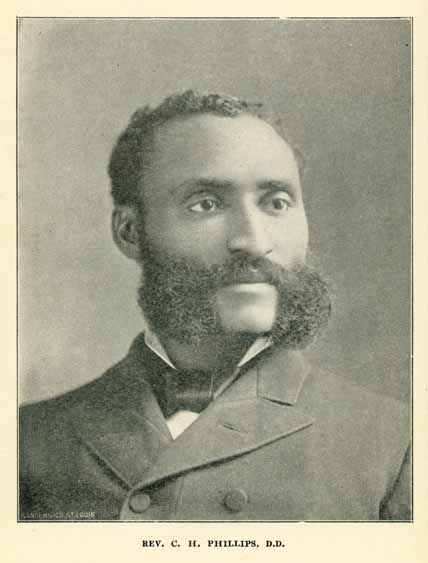
REV. C. H. PHILLIPS, D.D.
Page 5
PREFACE.
THERE is generally a universal desire felt in the votaries of any institution or organization to know something of its rise, progress, and subsequent position; and no less is the desire to learn of the prominent characters that have largely been instrumental in making these results possible. The Colored Methodist Episcopal Church is now in its twenty-eighth year as an organization, and it is not too early for some one to attempt to write its history. For some time the Church has been indebted to Rev. F. M. Hamilton for his "Plain Account of the C. M. E. Church," a pamphlet of 136 pages. This has been our only published record, and has met a long-felt want. When we began this work it was not our intention to write a history, but rather to write up some matter which we purposed to include in a book to be known as "Our Twenty-Fifth Mile-Stone." This work was to be a compilation of the cuts and communications that appeared in the Quarto Centennial Number of the Christian Index, May 11, 1895. But as we wrote the work grew upon us, and finally we decided to discard the idea of producing "Our Twenty-Fifth Mile-Stone" and write "The History of the Colored Methodist Episcopal Church" instead. It was not without some misgivings that we pursued this undertaking. We had no books containing any considerable amount of information in regard to our Church to which we could refer. Indeed, no such books exist. But fortunately for us, we came into the possession of some old copies of the Christian Index, the official organ of the Church. From 1870 to 1878, the paper then being published monthly, we obtained almost every copy. The bishops wrote more in those days than now, and from their communications and those of other prominent writers we were reliably informed of all the important doings and movements in the Church. Since 1878, the year we began our ministerial career, we have been identified with and fully cognizant of almost every move the Church has made. These qualifications should
Page 6
in some degree evidence the fitness of the author for assuming the responsibility of writing a history of the Church. It has not been our purpose to write biographies of the preachers, but mention has been made of some of those who have been prominent in the Church and in previous General Conferences. The author will be more than amply repaid for the labor he has expended in writing this history if a generous constituency will give it an impartial consideration; if it to them, in any appreciable degree, represents the purposes for which it was designed; and if it receives a circulation that will place it in many homes throughout the land. In conclusion we desire to reiterate that our subject has been to give the Church a plain, practical history of its doings and movements from the General Conference of December, 1870, down to the present time. How far we have accomplished these ends must be determined by those who will carefully peruse these pages.
C. H. P.
Jackson, Tenn., April, 1898.
Page 7
BIOGRAPHY OF THE AUTHOR.
BY J. W. SMITH, D.D.,
Editor Star of Zion, Official Paper of the A. M. E. Zion Church.
IT affords me extreme pleasure to introduce to the public generally one of the brightest ministerial stars in the Colored Methodist Episcopal Church in America--Rev. C. H. Phillips, D.D. He was born in Milledgeville, Ga., January 17, 1858. His parents had twelve children, of whom he was the tenth. The two youngest died before they had reached ten years, leaving him the youngest of the family, a place which he has filled for more than a quarter of a century. His mother was named Nancy and his father George Washington. They were both converted when young, and thus were able to throw around their children a holy influence which shaped their lives for good and for fields of usefulness when they had reached manhood and womanhood. His father has been a gospel minister for more than fifty years. In June of 1890 his dear mother, at the age of seventy, laid down the cross, took up the crown, and went home. Of the ten children that grew up to mature age, four were boys, and all are now ministers of the gospel save the oldest brother, John, who died about six or seven years ago between the age of fifty and sixty, after having traveled about twenty-two years as an itinerant minister and member of the Georgia Conference.
At the age of seventeen young Phillips was happily converted, and joined Trinity C. M. E. Church, in which he had been reared, the Rev. Frank Ford, who has since died, and who during his lifetime was one of the leaders of the Georgia Conference, being his pastor. With his conversion began the unfolding of those avenues which have led him to his present position and status.
December 16, 1880, he was married, by Rev. J. Braden, D.D., President of Central Tennessee College, to Miss Lucy Ellis Tappan (a daughter of a prominent Baptist minister in Nashville), a graduate of Fisk University. Cultivated in mind and heart,
Page 8
and influenced by the Holy Spirit, she has ever been his helpmeet, and has done much to make the favorable impression he now enjoys.
Educationally Dr. Phillips is a ripe scholar. When a boy he always had a love for books, and received an elementary education at home while working on his father's farm. He would go to school after the crop was laid by during the summer and after the farm produce was gathered in the fall. Along this line he continued his education, making progress in the science of farming as well as in books. Having an insatiable thirst for a deeper education, whereby he might be the better prepared for the Christian ministry, to which honored position he felt a divine call immediately after his conversion, his father, after the holidays of 1875, sent him to Atlanta University, Atlanta, Ga., where he joined the Junior Preparatory Class, and continued in this institution until he had completed his Sophomore year in college.
In September, 1878, while Principal of the city schools of Barnesville, Ga., he was licensed to preach by Rev. R. T. White, the presiding elder at that time of the Barnesville District and still the acknowledged leader of the Georgia Conference. Thus was carried into consummation the impression made on him just after his conversion.
Two months after he had been licensed to preach he went to Nashville, Tenn., and entered Central Tennessee College, where be could study theology with his classical studies. He progressed rapidly. He never lost a year nor was he ever turned back. He read Latin and Greek with an ease that delighted his professors and astonished his classmates. On entering this college he found that he was behind his class (Junior Classical) in mathematics and ahead in the languages; therefore in mathematics he formed a class of one, and had to "wade through" this science all alone. Loomis' ten books in geometry, spherical trigonometry, surveying, analytical geometry, and differential and integral calculus, he studied alone, and he never received a mark below ninety, marking on a scale of one hundred as perfect. By this time he had caught up with his class in mathematics, and with them took up their last study in that science, a work on philosophy, by D. Olmstead, LL.D. He easily led his class in the languages, and in the absence of the
Page 9
professor would often hear his class recite in "Horace" and in "Odyssey."
In May, 1880, he graduated as Bachelor of Arts from Central Tennessee College. In this same school he received his theological training, and graduated from there in medicine in 1882. During the years of 1884 and 1885 he was Principal of Lane Institute, then known as the Jackson High School. He gave form to this school by grading the classes, creating its curriculum, and publishing its first catalogue. At the meeting of the Board of Trustees in May, 1885, he, by a motion made by himself and seconded by Rev. W. T. Thomas, of Alabama, had the name changed from Jackson High School to Lane Institute. Since that time the school has been named Lane College. In this year 1885 his alma mater conferred upon him the degree of Master of Arts. In June, 1890, Philander Smith College, of Little Rock, Ark., and Wiley-University, of Marshall, Tex., almost at the same time (he being ignorant of the intentions of these two schools, which are among the best of the great M. E. Church), conferred upon him the degree of "Doctor of Divinity." Thus step by step, by assiduous study, which will accomplish almost anything, this promising young divine has climbed from the lowest to his present heights in the intellectual ladder.
He joined the West Tennessee Conference at Trenton in 1879. During his college days he served the Pilot Knob Circuit with great success. This was his first itinerant work. Here he held his first revival, which resulted in thirty-five accessions to the church. He made a splendid report at this Conference, and was ordained a deacon by Bishop L. H. Holsey.
In December, 1885, his Conference met at Memphis, and Bishop Lane appointed him to the pastorate of Collins Chapel, the leading appointment in Tennessee. At this Conference he was elected a delegate to the General Conference which met in 1886 at Augusta, Ga. He was not only the youngest man ever appointed to Collins Chapel up to that time, but also the youngest ever elected by his Conference a delegate to any preceding General Conference. His rising prominence in his denomination was evidenced by the fact that the bishops unanimously nominated, and his General Conference then in session at Augusta confirmed him as a proper person to go as a
Page 10
fraternal delegate to the General Conference of the great M. E. Church, South, which was in session in Richmond, Va. Bishop Holsey was the first delegate ever sent to this body, and Rev. Phillips was not only the second, but the first ever selected from the rank and file of his Church. His speech before that Conference was most favorably commented upon by the press of the country.
When he had rounded out two successful years at Collins Chapel, adding one hundred and forty persons to the church, finishing up its front, a part of which at that time was exposed, running up the brick work of the tower to its present height, and making round reports each year at the Conference, he was at Jackson, Tenn., in December, 1887, transferred to the Virginia Conference and stationed at Washington, D. C., as pastor of Israel Metropolitan C. M. E. Church. Here he entered upon a career that gave him a national reputation. Washington opened new fields and new facilities and opportunities for further development. He found the church embarrassed by a debt of $13,400, upon which the members were paying seven per cent. interest. The interest alone amounted to over $900 a year, yet he was able to keep it down and reduce the principal. The winter of 1889, just after the holidays, he began a revival which resulted in one hundred and five additions to the church. Some of the present trustees and stewards of Israel Church were converted in that revival.
Dr. Phillips has traveled extensively. In the spring of 1889 the Sabbath-School Union of the District of Columbia elected delegates to attend the first World's Sabbath-School Convention, which convened in London in July, 1889. He was not present at any of the Union meetings in Washington, but in his absence was one of the three delegates elected, Rev. W. H. Brooks and Rev. George Moore being the others. June 19, 1889, they sailed, having in their company Rev. A. Walters, who has since been elected to the bishopric of the A. M. E. Zion Church. He spent two months abroad, traveling through France, England, Ireland, and Scotland, visiting such cities as Liverpool, London, Manchester, Paris, Edinburgh, and Glasgow. He preached in several of these cities and lectured upon some phase of the negro problem. Returning to America, he met his Conference at Lynchburg, Va., in October, 1889, and was elected
Page 11
the second time as a delegate to the General Conference of his Church, which met in Little Rock in 1890.
In 1891 he was one of the delegates to the Ecumenical Conference, which met in Washington, D. C., in October; was the only representative of his Church on the program; and his able speech before that learned body elicited a most favorable comment. The Washington Evening Star said: "One of the most earnest and eloquent addresses of the day was the one on 'The Legal Prohibition of the Saloon,' by Rev. C. H. Phillips, D.D., of this city, a well-known preacher of the C. M. E. Church. When he left the platform he was presented with a handsome bunch of flowers from the W. C. T. U., and Bishop Wayman remarked that he had carried off the palm." The Washington Post said: "The speaker in his tribute to water indulged in a flight of florid rhetoric that captured the audience. Dr. C. H. Phillips was heartily applauded as he stepped down from the platform, and this demonstration was renewed as he received a bouquet of flowers, and Bishop Wayman remarked that he had carried off the palm."
Immediately after the adjournment of this great Conference, his church in Washington (Israel Metropolitan) gave him a farewell reception, at which Frederick Douglass, the lamented Dr. Price, Dr. I. B. Scott, of Texas, his classmate, now editor of the Southwestern Christian Advocate, Hon. John C. Dancy, and Dr. J. C. Waters made addresses. Nearly all the city pastors of color and the writer were present. He was pastor of this aristocratic church four years, being the only pastor of his Church who served there that length of time. He reduced the debt from $13,400 to $10,000, and the rate of interest from seven to six per cent., and added two hundred members to the church.
His Conference meeting in Petersburg, Va., October, 1891, transferred him to the Kentucky Conference, and stationed him at Center Street Church, Louisville, Ky. The first year he added sixty converts to the church, repaired and made it inside the most beautiful church in the city; increased the congregation considerably; raised in one collection $650, the largest ever known in the history of that church; and at the close of two years left the church in a much better condition than he found it. His ability as a preacher was quickly recognized,
Page 12
for the Louisville Courier-Journal and Louisville Commercial occasionally reported his sermons. The daily Commercial, after publishing his sermon on the necessity of establishing a refuge for colored girls, and also publishing his biography, closed with these words: "Dr. Phillips' sermons are attracting large congregations. Higher honors are waiting for him in his Church, and it is generally conceded that he will yet reach the goal."
At the Kentucky Conference, which met at Paducah September 27, 1893, he was the third time elected delegate to the General Conference, which met in May, 1894, at Memphis, Tenn.
At the Paducah Conference Bishop Beebe appointed him presiding elder of the Mt. Sterling District, which he improved financially and spiritually. He was a-visitor to the General Conference of the A. M. E. Zion Church, which met at Pittsburg, Pa., and made a rousing speech, which was loudly cheered. The Doctor is a popular man, and has a host of popular friends in Zion Church. He attended the Parliament of Religion in Chicago during the World's Fair, and he and Bishop Holsey were members of the Advisory Council. At the brilliant reception held in Chicago in the A. M. E. Zion Church he grandly represented the C. M. E. Church on the program.
In 1894, at his General Conference, he was elected editor of the Christian Index, after having come within three votes of being elected to the episcopal office.
In 1896 he represented his Church before the General Conference of the M. E. Church, which met at Cleveland, Ohio. His address received favorable comment from the religious and secular press.
In October of 1896 he was one of the invited speakers at the centennial celebration of the A. M. E. Zion Church, held in New York City. He spoke on "The Relation of the C. M. E. Church to the A. M. E. Zion Church."
At his Conference in October, 1897, he was elected for the fourth time a delegate to the General Conference of his Church.
As a man Dr. Phillips is modest, genial, dignified, sincere, liberal, and broad in his sympathies. These qualities are daily winning for him friends. As a preacher he is a splendid organizer,
Page 13
a shrewd financier, a successful revivalist, a bustling pastor, and a people-gatherer. As a speaker, whether in the pulpit or on the platform, he is impressive, forceful, thoughtful, suggestive, occasionally humorous, intensely earnest, his sermons and speeches often being graced by choice flowers of rhetoric and burning with fervid eloquence.
This is an honest write-up of my friend, who in the fulness of his intellectual powers is strong, loyal, and influential in the grand denomination in which he is a pillar, an adornment, and a support. May his influence and his possibilities continue to shine with increasing luster as the days roll by!
Charlotte, N. C.
Page 15
CONTENTS.
- CHAPTER I.
The General Conference of the Methodist Episcopal Church, South--Important Question Asked and Answered--Religious Oversight of the Slaves before the War--Some White Preachers Who Labored for Their Spiritual Good--M. E. Church, South, Takes Initiatory Steps Looking toward the Organization of Its Colored Contingent into a Separate Church . . . . . 23 -
CHAPTER II.
The First General Conference--Bishop Paine, Senior Bishop of the M. E. Church, South, Presiding--Revs. Green, Watson, Taylor, and Others Present--Forming Committees --Eight Conferences Represented, viz.: Memphis, Kentucky, Arkansas, Georgia, South Carolina, Mississippi, Alabama, and Texas--Remarks on W. H. Miles, R. H. Vanderhorst, L. H. Holsey, Isaac Lane, I. H. Anderson, and R. T. Thirgood . . . . . 27 -
CHAPTER III.
First General Conference--Report of the Committee on Church Organization--The New Church Named . . . . . 34 -
CHAPTER IV.
First General Conference--A Publishing House Founded-- An Official Organ Created . . . . . 39 -
CHAPTER V.
First General Conference Concluded--Report of Committee on Episcopacy--The Election of Two Bishops Recommended --B . S. Newton and L. H. Holsey Appointed Tellers --Divine Guidance Sought in the Election--W. H. Miles and R. H. Vanderhorst Chosen Bishops--L. J. Scurlock Elected Book Agent--Fixing Salaries of the Bishops--Conferences Bounded--Bishops Consecrated by Bishops Paine and McTyeire, Assisted by Elders
Page 16West, Bullard, Stewart, and Churchill--Petition from Winchester, Ky.--Closing Remarks on the First General Conference . . . . . 41
- CHAPTER VI.
The Church Organized--The Work Begun in Earnest-- Bishops Miles and Vanderhorst Holding District Conferences --Isaac Lane, Presiding Elder Jackson District --Letter of E. B. Martin to H. H. Hammel--Some Faithful Preachers--First Episcopal Plan of Visitation--Dr. Watson's Editorial--Bishop Vanderhorst and the Georgia Conference--Some Personal Reminiscences--Estranged Relation between C. M. E. and A. M. E. Churches--The Cause--Bishops Miles and Vanderhorst Memorialize A. M. E. General Conference--Their Letter--Bishop Vanderhorst Dies--Remarks Concerning Him--Bishop Miles Calls an Extra Session of the General Conference--L. J. Scurlock Resigns the Assistant Editorship of the Index --E. B. Martin Succeeds Him--Letter from Wyatt Low --Letter from Bishop Miles--Chapter Concluded . . . . . 48- CHAPTER VII.
The General Conference of 1873--J. W. Bell Elected Secretary --Some Visitors from the M. E. Church, South-- Bishop Miles's Memorable Message--Its Reception--Referred to the Various Committees--J. A. Beebe, L. H. Holsey, and Isaac Lane Elected Bishops--Their Consecration --Memorial Services to Bishop Vanderhorst--Some Legislative Work--The Educational and Missionary Work of the Church--Some Important Reports--The General Missionary Board Appointed--The Annual Conferences Assessed for the Support of the Bishops--A Committee Eulogizes the Life, Labors, and Character of Bishop Vanderhorst--E. B. Martin Makes a Report on Publishing Interests--Afterwards Elected Editor and Book Agent--Conference Adjourns . . . . . 56- CHAPTER VIII.
Fraternal Letter from the Bishops of the A. M. E. Church --Editorial Comment by E. B. Martin--Death of Senior Bishop William Paul Quinn, of the A. M. E. Church . . . . . 65
Page 17CHAPTER IX.
The Bishops Holding Annual Conferences--Their Field Not an Easy One--Some Epithets by which the Church Was Called--Some Early Persecutions--Letters from the Bishops--Chapter Concluded with an Interesting Letter from R. T. White, of the Georgia Conference . . . . . 71- CHAPTER X.
The Church Spreading--Educational Enterprise Projected --E. B. Martin Resigns His Office, and J. W. Bell Is Appointed --Meeting of the Publishing Committee in Jackson --Book Concern and Index Moved to Louisville--J. W. Bell Removed, and Alexander Austin Appointed Editor in His Stead--Index in New Dress--Letter from Bishops Miles and Lane--Austin Removed--W. P. Churchill Appointed--Circular Letter from the Bishops --General Conference of the Methodist Episcopal Church, South . . . . . 77- CHAPTER XI.
The Third General Conference--Able Message of the Bishops --Conference Well Attended--Important Changes in the Discipline--Publishing Committee--Bishops' Educational Paper--Central University the Name of the School Founded--Missions--Salary of the Bishops Fixed and the Conferences Assessed--Conferences Bounded--Statistics --Committee's Report on Fraternal Greetings-- Composition of the Committee--Its Powers--Some Who Preached During the Conference--Adjournment . . . . . 86- CHAPTER XII.
The Bishops Working for the School at Louisville--R. T. Thirgood Writes a Short Letter--Bishop Miles Visits Boston, Mass.--Dr. Price Indorses His Work in Zion's Herald--A New Conference Organized--Bishops Miles and Holsey Visit Round Lake (N. Y.) Camp Meeting-- Their Letters--How They Were Benefited--Bishop Miles on Organic Union--Israel Church, at Washington, D. C., Withdraws from the A. M. E. Connection--The Cause-- E. B. Martin Expelled--The A. M. E. Zion General Conference
Page 18--Sentiments of W. P. Churchill on Organic Union --The Louisville and Sardis School Enterprises--An Appeal from Bishop Miles--The School Projects Fail-- The Causes--East Texas Conference--Some Prominent Men in the Conferences--Letters from E. W. Moseley, D. K. Sherman, and Bishop Holsey--General Conference of 1878 to Meet in Jackson, Tenn.--Church Seven Years Old . . . . . 97
- CHAPTER XIII.
The Fourth General Conference--Some Distinguished Visitors --Work of the Conference--Its Close--Meeting of the Book Committee--Some Important Matters Adjusted --Death of John Lane--Tribute from Bishop Miles's Daughter--Deaths of Crouch, Samuel, and Ridley--Remarks about Fitzhugh, J. K. Daniel, Collins, and A. J. Stinson--Struggles of the Book Committee--Letter from Bishop Miles--The Bishops in Annual Meeting--Fraternal Delegates Appointed to the Various Methodist Bodies --Bishop Holsey Goes to Europe--Fitzhugh Joins the African Methodist Episcopal Church--Thomas Appointed Editor--Educational Matters--Letter from D. L. Jackson --Lane College--Its Early History--First Catalogue-- First Graduates . . . . . 110- CHAPTER XIV.
Meeting of the Fifth General Conference--Some New Delegates Elected--Death of G. W. Usher--Fraternal Messenger from the M. E. Church, South--His Address--Replies --Bishop Hillery's Address--Legislation of the General Conference--General Officers Elected--Index Removed to Louisville--Other Distinguished Visitors-- Bishop Holsey's Visit to the General Conference of the M. E. Church, South, as Fraternal Delegate--Our Educational Enterprises--New Church Congregation Organized at Washington, D. C.--Bishop Miles's Appeal in Its Behalf--Pastors of Miles Memorial Church--Centennial of Methodism Celebrated in Baltimore, Md.--Our Representatives --A Word about R. S. Williams--Looking toward the Next General Conference--It Meets, and Is the Sixth General Conference--Some Legislative Enactments
Page 19--Fraternal Delegate to the General Conference of the M. E. Church, South--General Officers and Book Committee Elected--Bishop Miles's Protest--Silver Watch Presented to Bishop Miles--His Reply--The Temperance Question--Chapter Concluded . . . . . 124
- CHAPTER XV.
Important Event in 1886--A Large Congregation Received from the A. M. E. Church--Samuel B. Wallace the Leader-- General Conferences of Three Great Methodist Bodies Meet in 1888--They Elect Bishops--First World's Sunday School Convention--Some Discussions in the Church-- Meeting of the Seventh General Conference in Little Rock, Ark.--Remarks on the Same--Some Important Legislation--General Officers Elected--Delegates to the Second Ecumenical Conference Chosen--Bishop Holsey's Petition for a Supernumerary Relation Rejected-- Dr. J. C. Hartsell, Fraternal Delegate from the M. E. Church, and Dr. M. G. Alexander, from the A. M. E. Church, Make Addresses--Replies--E. W. Moseley, Fraternal Delegate to the General Conference of the M. E. Church, South--Greetings from Bishop Hood, of the A. M. E. Zion Church--Bishop Beebe Replies--Greetings from the M. E. Church, South--Bishop Miles's Failing Health--Work of His Colleagues--Second Ecumenical Conference Meets at Washington, D. C.--General Conferences of Other Methodist Bodies--Elias Cottrell, R. T. Brown, and R. S. Williams, Fraternal Delegates--The Church Prosperous . . . . . 142- CHAPTER XVI.
Bishop Miles's Sickness--His Death--His Burial . . . . . 153- CHAPTER XVII.
Movements of the Church in 1893--The Agitation of More Bishops after the Death of Bishop Miles--Remarks about R. S. Williams and Elias Cottrell--Some Able Men Mentioned--Meeting of the General Conference in Memphis, Tenn.--Lay Delegates--Some New Clerical Delegates --Bishops' Message--The Election of R. S. Williams
Page 20and Elias Cottrell to the Episcopal Office--The Church No Lover of Politics--Some Measures Defeated--Financial Plan--The Contingent Fund--Memorial Services in Honor of Bishop Miles--Fraternal Delegates from the M. E. Church, South, and the A. M. E. Church--Bishop Lane a Fraternal Delegate to the M. E. Church, South-- An Opinion of the Bishops--Some Measures Passed-- Bishop Holsey Granted a Respite--Williams and Cottrell Ordained--Book Agent and Editor Elected--Some Last Acts of the Conference--Church Extension Society Abolished . . . . . 164
- CHAPTER XVIII.
Opening of the Year 1895--The Church Celebrates Its Twenty-fifth Anniversary--Resolution on the Celebration Adopted by the General Conference of 1894--The Celebration--"Despise Not the Day of Small Things" --The Effect of the Celebration--Death of Samuel B. Wallace--Funeral Services--Bishop Williams Officiates --Other Ministers Present--His Body Interred--His Birth--His Rapid Rise in the Ministry--General Remarks Concerning His Useful Career--General Conferences of Several Methodist Churches--Hart, Lane, and Phillips, Fraternal Delegates--Three Methodist Bodies Elect Bishops--The A. M. E. Zion Connection a Hundred Years Old--Bishop Holsey Resumes Work--Revivals-- Lane College--A Publishing House Purchased--Looking Forward to the General Conference of 1898--Bishops Beebe, Holsey, and Lane . . . . . 178- CHAPTER XIX.
Pen Sketches of Bishops Miles, Vanderhorst, Beebe, Holsey, Lane, Williams, and Cottrell . . . . . 196- CHAPTER XX.
OUR LITERATURE . . . . . 234- CHAPTER XXI.
OUR FUTURE . . . . . 242 - CHAPTER VI.
Page 21
ILLUSTRATIONS.
- C. H. PHILLIPS . . . . . Frontispiece
- THE PUBLISHING HOUSE . . . . . 37
- MORNING CHAPEL, FORT WORTH, TEX . . . . . 69
- ISRAEL METROPOLITAN CHURCH, WASHINGTON, D. C . . . . . 103
- COLLINS CHAPEL, MEMPHIS, TENN . . . . . 117
- MILES MEMORIAL TABERNACLE, WASHINGTON, D. C . . . . . 133
- LANE COLLEGE, JACKSON, TENN . . . . . 147
- HAYGOOD MEMORIAL HALL, PAINE INSTITUTE, AUGUSTA, GA . . . . . 159
- TRINITY CHURCH, AUGUSTA, GA . . . . . 169
- SYDNEY PARK CHURCH, COLUMBIA, S. C . . . . . 179
- JACKSON CHAPEL, ANNISTON, ALA . . . . . 185
- OUR MISSION CHURCH, HOT SPRINGS, ARK . . . . . 193
- BISHOP MILES . . . . . 199
- BISHOP BEEBE . . . . . 209
- BISHOP HOLSEY . . . . . 215
- BISHOP LANE . . . . . 219
- BISHOP WILLIAMS . . . . . 223
- BISHOP COTTRELL . . . . . 229
- BISHOP C. H. PHILLIPS, D.D. . . . . . 250
- LANE METROPOLITAN CHURCH, CLEVELAND, OHIO . . . . . 517
- BISHOP G. W STEWART, D.D. . . . . . 565
- BISHOP R. A. CARTER, D.D. . . . . . 567
- BISHOP N. C. CLEAVES, D.D. . . . . . 569
- BISHOP R. T. BROWN, D.D. . . . . . 571
- BISHOP J. A. HAMLETT, D.D. . . . . . 575
- BISHOP J. W. MCKINNEY, D.D. . . . . . 577
Page 23
HISTORY OF THE COLORED M. E. CHURCH.
CHAPTER I.
The General Conference of the Methodist Episcopal Church, South--Important Question Asked and Answered--Religious Oversight of the Slaves before the War--Some White Preachers who Labored for their Spiritual Good-- M. E. Church, South, Takes Initiatory Steps Looking toward the Organization of Its Colored Contingent into a Separate Church.
WHEN the General Conference of the Methodist Episcopal Church, South, met in April, 1866, in the city of New Orleans, this important question was asked by that body: "What shall be done to promote the religious interests of the colored people?" It was indispensably necessary that such a query should be raised. The war had just ended, and amid the changes of fortune and the vicissitudes of time the relation of slave to master had undergone a radical change.
When the war came on, the Methodist Episcopal Church, South, had 207,000 colored communicants. Their spiritual wants were administered to by faithful and earnest ministers of the Southern Methodist Church. Georgia and South Carolina alone had as many as sixty ministers who served as missionaries to the slaves.
Bishop James Osgood Andrew, ninth bishop of the
Page 24
Methodist Episcopal Church and second bishop of the Methodist Episcopal Church, South, having become connected with slavery by reason of a colored girl in his possession bequeathed him by a lady, also by reason of a boy belonging to his daughter, and other legal slaves of his whom he secured to his second wife, actually became unacceptable to many Northern Conferences, and precipitated the occasion, if not the cause, of the great split in Methodism in 1844. That General Conference declared that "it is the sense of this body that Bishop Andrew desist from the exercise of his office so long as this impediment remains." Upon that resolution the North voted in the affirmative, and the South in the negative. The inevitable separation of this Church came; and in 1846, at the General Conference of the Methodist Episcopal Church, South, J. O. Andrew, who had been the ninth bishop of the Methodist Episcopal Church, became the second bishop of the Methodist Episcopal Church, South, Bishop Joshua Soule being the first. While Bishop Andrew owned slaves, and thus indirectly, if not directly, gave a tacit assent to the perpetuation of the "peculiar institution" of slavery, which John Wesley declared to be "the sum of all villainies," yet he was a man of warm and tender heart, and frequently rose to sublime heights of eloquence when pleading for the religious instruction of the slave. The services of Dr. Lovick Pierce and James E. Evans; of Bishops George Pierce, John C. Keener, and Rolland N. McTyeire
Page 25
shall never be forgotten. They labored assiduously for the Christian civilization of our race. In 1807 John Early, afterwards a bishop of the Methodist Episcopal Church, South, was first sent to labor among the slaves of Thomas Jefferson, in Bedford County, Virginia; while Bishop William Capers' monument erected over his grave bears the inscription: "Founder of the Missions to the Slaves." These men simply followed in the wake of unselfish pioneers who had preceded them.
Thus the religious nature of the slave was developed; thousands took on the civilization by which they were environed, and thousands more cast their lot with the Methodists. It was not unnatural that the Southern Methodist Church should, after the war, have shown a disposition to do what was best for her colored contingent. Gradually this contingent was either going into the African Methodist Episcopal Church and African Methodist Episcopal Zion Church or into the Methodist Episcopal Church. Such were the persecution, misrepresentation, ridicule, and stratagems brought to bear against the Church, South, and especially its colored communicants, that many were toled away; for, out of the 207,000 on the roll before the Civil War, only 78,000 were found at its close. To save this remnant was the supreme thought of the leaders of the Church, South. To organize them into an ecclesiastical body occurred to them as the only feasible thing to be done. Consequently when the General Conference in 1866
Page 26
asked, "What shall be done to promote the religious interests of the colored people?" that same body wisely resolved that "when two or more Annual Conferences shall be formed, let our bishops advise and assist them in organizing a separate General Conference jurisdiction for themselves, if they so desire and the bishops deem it expedient, in accordance with the doctrine and discipline of our Church, and bearing the same relation to the General Conference as the Annual Conferences bear to each other." It was found at the General Conference of the Church, South, which met in Memphis in 1870, that five Annual Conferences had been organized, whereupon the bishops, in their message, inserted these words: "It is our purpose, unless you otherwise order, to call a General Conference to be holden next winter for the purpose of organizing them into an entirely separate Church, thus enabling them to become their own guides and governors."
Page 27
CHAPTER II.
The First General Conference--Bishop Paine, Senior Bishop of the M. E. Church, South, Presiding--Revs. Green, Watson, Taylor, and Others Present--Forming Committees-- Eight Conferences Represented, viz.: Memphis, Kentucky, Arkansas, Georgia, South Carolina, Mississippi, Alabama, and Texas--Remarks on W. H. Miles, R. H. Vanderhorst, L. H. Holsey, Isaac Lane, I. H. Anderson, and R. T. Thirgood.
THE time appointed by the General Conference of the Methodist Episcopal Church, South, at Memphis in 1870, for holding the first General Conference of its colored members was December 15, 1870. Rev. A. L. P. Green, D.D., of Nashville, Tenn.; Rev. Samuel Watson, D.D., of Memphis; and Rev. Thomas Taylor, D.D., of Jackson, Tenn., were present, with others, to assist in the organization, having been appointed by the Southern Methodist General Conference at its session in Memphis. Bishop Paine, of the same Church, presided. After opening the Conference with divine service, he made a few impressive and appropriate remarks. Rev. James A. Heard, pastor of the First Methodist Episcopal Church, South, of Jackson, acted as Secretary pro tem. Upon the request of Bishop Paine, Dr. Green read the action of the General Conferences of 1866 and 1870 of his Church, so far as it related to the organization of our Church. This done, our fathers then proceeded to found a Church against which "the gates of hell should never prevail."
Page 28
In May, 1870, we had five Annual Conferences; but at the organization of the General Conference in December, these had increased to eight. The list of delegates from the several Annual Conferences was called and those present answered to their names. These were the Conferences and persons who represented them:
MEMPHIS CONFERENCE.--Clerical: Isaac Lane, John W. Lane, T. N. Stewart, Benjamin Bullard, Job Crouch, Silas Phillips, and Beverly Ford. Reserves: J. Merriwether, S. B. Stinson, and, C. Henning. Lay Delegates: Augustus Bostic, Little John Scurlock, Berry Hill, Charles McTyeire, Samuel Craighead, Moses Harding, and R. Shields. Reserves: John Tuggle, R. Goodloe, and Isaac Blair.
MISSISSIPPI CONFERENCE.--Clerical: R. Polk and Frank Funchess. Reserves: John Dorsey and Frank Ambrose. Lay Delegates: M. Mitchell and Nat. Harris. Reserves: P. Barnes and William Jones.
ALABAMA CONFERENCE.--Clerical: Anderson Jackson, Moses Pringle, Ezekiel Reynolds, Robert Thirgood, and A. Hawkins. Lay Delegate: J. Brockman.
GEORGIA CONFERENCE.--Clerical: Richard H. Vanderhorst, Isaac H. Anderson, Edward West, and Lucius H. Holsey. Lay Delegates: Solomon Garrett, F. Ford, Green Saltmarsh, and William Chesnut.
KENTUCKY CONFERENCE.--Clerical: Barnett S. Newton, R. Marshall, and W. P. Churchill.
Page 29
Reserve: W. H. Miles. Lay Delegates: James Graves and William Watson.
ARKANSAS CONFERENCE.--Clerical: R. Samuels and Solon Graham. Reserve: Boston Welborn. Lay Delegate: Isaac Simpson.
SOUTH CAROLINA CONFERENCE.--Clerical: R. Valentine and Richard Moses.
TEXAS CONFERENCE.--Clerical: William Taylor.
A majority of all the delegates elected being present, the Conference effected a permanent organization, with James A. Heard, Secretary, and L. J. Scurlock, Assistant Secretary. The rules of order as contained in the "Manual of Discipline" of the Methodist Episcopal Church, South, were adopted for the government of the Conference; the bar was fixed on an imaginary line across the room from the side of the window nearest the pulpit; and the hours of meeting and adjournment were fixed at 9 A.M. and 12:30 P.M. Thus cautiously, systematically, and prayerfully the framers of our Church institution proceeded in the great work which devolved upon them.
By motion, the Committees on Organization, Episcopacy, Discipline, Books and Periodicals, Itinerancy, and Boundaries were composed of one member from each Annual Conference. They were as follows:
ORGANIZATION.--Memphis Conference, Benjamin Bullard; Kentucky Conference, Barnett S. Newton; Mississippi Conference, Frank Ambrose; Alabama Conference, Anderson Jackson; Arkansas Conference, Richard Samuels; Georgia Conference, Isaac
Page 30
H. Anderson; South Carolina Conference, Richard Moses.
Episcopacy.--Memphis Conference, Augustus Bostic; Kentucky Conference, R. Marshall; Mississippi Conference, William Jones; Alabama Conference, E. Reynolds; Arkansas Conference, Richard Samuels; Georgia Conference, R. H. Vanderhorst; South Carolina Conference, Richard Valentine.
THE DISCIPLINE.--Memphis Conference, J. W. Lane; Kentucky Conference, B. S. Newton; Mississippi Conference, Nat. Harris; Alabama Conference, R. T. Thirgood; Arkansas Conference, Isaac Simpson; Georgia Conference, L. H. Holsey; South Carolina Conference, Richard Moses.
BOOKS AND PERIODICALS.--Memphis Conference, Isaac Lane; Kentucky Conference, James Graves; Mississippi Conference, F. Ambrose; Alabama Conference, A. G. Hawkins; Georgia Conference, R. H. Vanderhorst; South Carolina Conference, R. Valentine; Arkansas Conference, J. Simpson.
ITINERANCY.--Memphis Conference,--Isaac Lane; Kentucky Conference, W. Watson; Mississippi Conference, F. Funchess; Alabama Conference, A. Jackson; Georgia Conference, Edward West; Arkansas Conference, R. Samuels.
BOUNDARIES.--Memphis Conference, T. N. Stewart; Kentucky Conference, B. Ball; Arkansas Conference, J. Simpson; Mississippi Conference, F. Ambrose; Georgia Conference, G. D. Flannagan; South Carolina Conference, R. Valentine; Alabama Conference, Robert T. Thirgood.
Page 31
SUNDAY SCHOOLS.--T. N. Stewart, L. H. Holsey, W. P. Churchill.
FINANCE.--P. Bell, L. J. Scurlock, Silas Phillips.
PUBLIC WORSHIP.--Isaac Lane, Jordan Merriwether, Charles Lea, Job Crouch.
The men that composed this General Conference and formed these committees were the pioneers of our Methodism. The work they accomplished has stood the test of more than twenty-five years. It was clear, simple, and permanent. The moral temper of the Conference was in striking contrast to political conventions, where inordinate ambition, self-aggrandizement, and unholy rivalry mar the proceedings and too often thwart the plans of patriotic men looking to the best interests of the people. Truth, and an unselfish love for the general welfare of the Church, illuminated their thoughts and seemed to direct their way to wise conclusions. Dr. Samuel Watson, who attended the meeting of this body from start to finish, and who, before its close, was requested to edit the Christian Index, made these complimentary and terse remarks about the Conference:
It was a most interesting occasion. Delegates from eight Annual Conferences were in attendance. They came from South Carolina to Texas, on the south and west, and Kentucky, on the north. I have never seen a more harmonious Conference of any kind. There was a good degree of intelligence among its members. A distinguished judge, who attended the Conference daily, said it would compare favorably with the Tennessee Legislature.
Such views of the character and ability of the men
Page 32
that were with the Church in its formation are not overdrawn.
Some who were prominent in that Conference, and helped to give tone and dignity to it, as well as shape the destiny of the newborn Church, have largely shaped its policy ever since. In no one General Conference has the Church found so much bishop timber and so many men possessing such admirable elements of leadership as those that constituted our first General Conference. William Henry Miles, a reserve delegate from the Kentucky Conference, and Richard H. Vanderhorst, a regular delegate from the Georgia Conference, were, on December 21, the fifth day of the session, elected the first bishops of our Church; but they were not all the bishop timber in this Conference. There was a young man from Sparta, Ga., about the age of twenty-nine or thirty, who, unconscious to himself, exhibited to others possibilities and a life of great usefulness to his Church. Allusion is here made of Lucius H. Holsey. Quick of apprehension, apt in instruction, brilliant, brainy, gifted, and endowed by nature with an intellect destined to expand and develop, this body saw in him a future bishop, and at a subsequent General Conference he was elected and consecrated to the episcopal office. Isaac Lane, L. H. Holsey's senior by five or six years, also a leader in 1870, was afterwards elected a bishop. Time has verified the wisdom of the body that elected them. Mention should be made also of Isaac H. Anderson, who has maintained his hold upon the Church
Page 33
ever since its organization. He has been a member of every General Conference, except the one of 1874, and has just rounded out eight years as Book Agent and manager of the Christian Index.
Of the preachers who composed our first General Conference, I. H. Anderson, now of the North Mississippi Conference, and R. T. Thirgood, of the North Alabama Conference, are the only ones, Bishops Holsey and Lane excepted, who are in the itinerant service of the Church. Not ten of the clerical delegates are living, not eight of the laymen, who saw the old Colored Methodist Episcopal ship launched, with flag and pennant streaming wide, a quarter of a century ago. They have passed over to that bourne from whence there can be no returning.
What is life? A transient bubble,
Like the ignis fatuus' gleam--
Full of crosses, full of trouble,
Passing like a fevered dream.
Page 34
CHAPTER III.
First General Conference--Report of the Committee on Church Organization--The New Church Named.
THE report of no committee was looked forward to with more eagerness, solicitude, and interest than the Committee on Church Organization. I. H. Anderson, the Chairman, in submitting his report, gratefully acknowledged the obligations of his brethren to the Methodist Episcopal Church, South, for what they had done for them; believing, however, that the time had come when, for the glory of God and the best interest of both races, they should have a distinct and independent organization, provision for the same having been made, as we have already seen. This report was preceded by a touching and forcible address by Bishop Paine upon the present and future relations of the Church, South, to the Church about to be organized. He urged upon the Conference the sine qua non of a pure ministry and the great importance of a spiritual membership. There was absolutely no difficulty in giving a name to the new Church institution. The eight members of that committee, representing eight Annual Conferences, were of one mind, soul, and spirit. Their knowledge of early Methodism enabled them to select a name that would be closely related to the one by which the followers of John Wesley were first known in this country. This was the report of the committee:
Page 35
Whereas the Methodist Episcopal Church in America was the name first given to the Methodist Church in the United States; and
Whereas we are a part of that same Church, never having seceded or separated from the Church; but in the division of the Church by the General Conference in 1844 we naturally belonged to the South, and have been in that division ever since; and now, as we belong to the colored race, we simply prefix the word "colored" to the name, and for ourselves adopt the name, as we are in fact a part of the original Church, as old as any in America; therefore be it
Resolved, 1. That our name be the "Colored Methodist Episcopal Church in America."
2. That while we thus claim for ourselves an antiquity running as far back as any branch of the Methodist family on this side of the Atlantic Ocean, and while we claim for ourselves all that we concede to others of ecclesiastical and civil rights, we shall ever hold in grateful remembrance what the Methodist Episcopal Church, South, has done for us; we shall ever cherish the kindliest feelings toward the bishops and General Conference for giving to us all that they enjoy of religious privileges, the ordination of our deacons and elders; and at this Conference our bishops will be ordained by them to the highest office known in our Church. No other church organization has thus been established in the land. We most sincerely pray, earnestly desire, and confidently believe that there will ever be the kindliest feelings cherished toward the Methodist Episcopal Church, South, and that we may ever receive their warmest sympathy and support.
3. That we request the bishops to organize our General Conference on the basis of the Discipline of the Methodist Episcopal Church, South, in its entire doctrine, discipline, and economy, making only such verbal alterations and changes as may be necessary to conform it to our name and the peculiarities of our condition.
Along the lines mentioned in this chapter the
Page 36
Church was established and named, and at no time since has there been a general desire to change its name or modify or alter the basis upon which it was founded. While there has been no great desire to change the name, there has been a desire to see the phrase, "in America," dropped; and this can, and doubtless will, be done in the future, without any injury to the name of the Church.
Page 37

THE PUBLISHING HOUSE, JACKSON, TENN.
Page 39
CHAPTER IV.
First General Conference--A Publishing House Founded-- An Official Organ Created.
MEASURES looking forward to the creation of a Publishing House were adopted at the third day's session, or December 19, 1870. I. H. Anderson moved that the Publishing House be located in Memphis, Tenn. The motion was first laid on the table, but afterwards taken therefrom and adopted. From the very beginning it became apparent to these framers of the Church that a Publishing House, where the literature of the Church should be created and deposited, was an indispensable necessity. L. H. Holsey, a young man of promise and ability, after showing the need of a Publishing House, offered the following, which was adopted:
Resolved, 1. That we have a Book Agent.
2. That we empower the associate editor to act as Book Agent.
3. That we require the Book Agent and Editor, with the assistance of the preachers and presiding elders, to get as many members and other friends as possible to subscribe five dollars or more for the future establishment of said Publishing House.
4. That said subscriptions or donations shall be forwarded to the Publishing Committee, who shall constitute the managers of said fund for said purpose under the supervision of Dr. Samuel Watson.
Thus were our publishing interests founded, which
Page 40
have undergone some change at each recurring General Conference.
For two years before the Colored Methodist Episcopal Church had assumed tangible form, a paper known as the Christian Index had been published in its interest by Samuel Watson, D.D., of the Church, South. This Conference resolved that it should continue to be published, with Dr. Watson as editor, and that the office of Assistant Editor should be created. A cash system was adopted, and it was resolved that each preacher should procure ten subscribers for the paper, and that in no case should a paper be sent unless the cash accompanied the subscription. No General Conference since has been able to make any improvement on this cash system.
The Publishing Committee was to be composed of the Presiding Elder of the Memphis District, the stationed preacher at Collins Chapel, and Augustus Bostic, a prominent layman of the same church. It was further decided that, at the General Conference which was to meet in Augusta, Ga., the first Wednesday in July, 1874, the Publishing Committee should make a full statement of all moneys received and expended during the quadrennium.
Our readers can clearly see that the legislation of this first General Conference reflects credit upon the men of that day. Their work has been permanent; their record is written on high. They have bequeathed to us a glorious history, a history that shall shine with increasing luster as the years roll by.
Page 41
CHAPTER V.
First General Conference Concluded--Report of Committee on Episcopacy--The Election of two Bishops Recommended --B. S. Newton and L. H. Holsey Appointed Tellers --Divine Guidance Sought in the Election--W. H. Miles and R. H. Vanderhorst Chosen Bishops--L. J. Scurlock Elected Book Agent--Fixing Salaries of the Bishops --Conferences Bounded--Bishops Consecrated by Bishops Paine and McTyeire, Assisted by Elders West, Bullard, Stewart, and Churchill--Petition from Winchester, Ky. --Closing Remarks on the First General Conference.
THE Committee on Episcopacy, of which Augustus Bostic was Chairman, on December 21, 1870, recommended the election and consecration of two men to the episcopal office. The report was adopted; but before the election the Conference sought Divine guidance and aid in the selection of the men who were to be the first bishops of the Colored Methodist Episcopal Church. Our forefathers did not resort to wire-pulling, political jugglery, and hypocritical demagogy in order to elect the men; neither did they indulge in misrepresentations to blight the possibilities of any man; they relied upon the guidance of the Holy Spirit. Like the apostles, when they were filling the place of Judas, who, by transgression, fell, they prayed: "Lord, thou knowest the hearts of all men: show which two men among us thou hast chosen, that they may take the lead of our ministry and this Church which under thy providence has just been
Page 42
founded." After such a season of prayer and devotion to God, it was not likely that they should err in their selection.
L. H. Holsey, of Georgia, and B. S. Newton, of Kentucky, were appointed tellers. The balloting began, and ended with the following result:
First ballot (votes cast, 40; necessary to a choice, 21)--W. H. Miles, 27; R. H. Vanderhorst, 16; Job Crouch, 12; W. P. Churchill, 9; T. N. Stewart, 8; B. S. Newton, 2; R. Marshall, 2.
William H. Miles, of Kentucky, having received a majority of votes cast, was declared, by Bishop McTyeire, duly elected Bishop of the Colored Methodist Episcopal Church in America.
Second ballot (votes cast, 40; necessary to a choice, 21)--R. H. Vanderhorst, 20; Job Crouch, 15; W. P. Stewart, 7; W. P. Churchill, 3. No election.
Third ballot (votes cast, 40; necessary to a choice, 21)--R. H. Vanderhorst, 26; Job Crouch, 12; W. P. Churchill, 2.
Richard H. Vanderhorst having received a majority of all votes cast, Bishop McTyeire declared him duly elected.
The election of bishops over, the Conference, on the third ballot, elected L. J. Scurlock Book Agent, L. H. Holsey running him closely.
Consequently W. H. Miles and R. H. Vanderhorst became our first Bishops, and L. J. Scurlock our first Book Agent.
It is a little interesting to see how the Committee
Page 43
on Episcopacy fixed the salaries of the bishops. Bishop Miles was to receive a salary of $1,000 per year, and Bishop Vanderhorst, $700 per year. Each Annual Conference was to pay the bill of traveling expenses that should be submitted by the bishop as having been incurred by him in the discharge of the business or duties of the Conference visited--in other words, they were to receive the salaries already stated and their traveling expenses.
We have seen that eight Conferences were represented at the opening of the General Conference; but before its close the Virginia and Tennessee Conferences were formed, making ten in all. The Committee on Boundaries fixed the territory of these Conferences as described below:
- 1. The Memphis Conference embraces that part of Tennessee south of the Tennessee River, and North Mississippi.
- 2. The Tennessee Conference embraces that part of the State of Tennessee north of the Tennessee River, and North Alabama.
- 3. The Kentucky Conference embraces the State of Kentucky.
- 4. The Virginia Conference embraces the State of Virginia.
- 5. The Arkansas Conference embraces the State of Arkansas.
- 6. The Texas Conference embraces East Texas.
- 7. The Georgia Conference embraces the States of Georgia and Florida.
- 8. The Alabama Conference embraces the State of Alabama except that part included in the Tennessee Conference.
- 9. The Mississippi Conference embraces the State of Mississippi except that part included in the Memphis Conference.
-
Page 4410. The South Carolina Conference embraces the State of South Carolina.
To raise the $1,700 which had been appropriated for the bishops' salaries, the following assessments were made:
- Memphis Conference . . . . . $225 00
- Virginia Conference . . . . . 150 00
- Arkansas Conference . . . . . 100 00
- Texas Conference . . . . . 210 00
- Georgia Conference . . . . . 225 00
- Alabama Conference . . . . . 220 00
- Mississippi Conference . . . . . 220 00
- South Carolina Conference . . . . . 125 00
- Kentucky Conference . . . . . 225 00
- Total . . . . . $1,700 00
As small as these assessments were, they were not all collected, and the result was the bishops were not paid in full. They did not fail to travel, however; for they labored unceasingly to spread the Church and add souls to her number.
On the night of the same day of their election, in the First Methodist Episcopal Church, South, they were consecrated to their high office by Bishops Paine and McTyeire. Edward West and Benjamin Bullard presented W. H. Miles, and T. N. Stewart and W. P. Churchill presented R. H. Vanderhorst, and assisted the bishops in the ordination exercises. Those who were present and are still living will not forget the solemnity of the occasion. Bishop Paine resigned the chair to Bishop Miles as soon as the ordination was over, and he, after presiding for awhile, resigned in favor of Bishop Vanderhorst. Thus was the machinery
Page 45
turned over to our bishops, and by them it has been manned ever since.
Before concluding this write-up of the first General Conference, we desire to show our readers how the hearts and minds of the people were turned toward Jackson, Tenn., when representatives from all parts of the country had gathered there to form the new Church. Among the petitions that were presented none were more important, none indicated more clearly the trend in which legislation should be directed, none looked forward with more favorable apprehension, showing more palpably the interest that was coeval with the followers of this Church, than the petition that was presented by W. H. Miles, from Winchester, Ky. It was dated November 25, 1870, and read thus:
To the Colored General Conference of the Methodist Episcopal Church, South:
"Grace to you and peace from God our Father, and the Lord Jesus Christ."
We thank our God, through Jesus Christ, for you all, that our Church is widening its sphere of usefulness, and is gathering into its fold true and penitent believers; for we desire nothing so much as the spreading of the gospel of Christ. May your deliberations be guided by wisdom from on high; and, in your instituting a new order of things in our Church, our daily prayer shall be: "May the Lord direct you." If it be the will of God, our desire is that colored bishops be appointed or elected to take charge of and preside over the colored Church. It is our desire that our organization be known under the name of the "Methodist Episcopal Church"--not that we wish to sever our connection with the "Methodist Episcopal Church, South;" not that we want to unite with the "Methodist Episcopal
Page 46
Church, North;" but as our Savior called us to come unto him, let us imitate his goodness and purity, and in name avoid all stumbling-blocks, and, looking heavenward, move on triumphantly to the prize of the high calling in Christ Jesus. Some of the churches in Central Kentucky have engendered some bitterness of feeling on this account; and this slight change would produce harmony and unity of action that would render us invincible against the hosts of this world, and perhaps would be the means of saving many a wearied and lost soul.
We trust that you will listen to our prayers, and accept this graciously from your brethren in Christ at Allen's Chapel, main cross street, Winchester, Ky.
Signed by the Church through us as its officers: John Allen, Thomas Webb, Richard Trotter, Harrison Martin, Jacob Carey, Stewards; James Austin, Class Leader; Edward Massie, George Gardner, Sheet Irvin, Trustees; Reuben Taylor, Pastor Dry Fork Station; Moses Hall, Pastor Owingsville Station; Stephen Brown, Pastor Mount Sterling Station; and Richard Wells, Pastor Red River Circuit.
These petitioners were earnest; they plainly saw that if the colored contingent of the Church, South, were to have a future, then they must assume a new relation to that Church.
Our first General Conference was the most important one yet held. It had conditions, and not theories, to confront. It had to shape and outline the policy of the new organization; define its relation to the Church that gave it birth; resolve to abstain, as a Church, from participation in politics, and know nothing among men, save Christ, and him crucified. Having no Discipline of its own, the Conference adopted the Discipline of the Methodist Episcopal Church, South, taking out and putting in such things as would be for the highest interest of the Church. It
Page 47
also decided to patronize the Sunday school literature of the Church, South, both in books and periodicals.
Legal and constitutional in organization, legitimately descended from the very father of Methodism, clear and spotless in its record, firm and unwavering in the doctrines and principles of Methodism, the Colored Methodist Episcopal Church entered upon its career clear as the sun, bright as the moon, and terrible as an army with banners.
Page 48
CHAPTER VI.
The Church Organized--The Work Begun in Earnest--Bishops Miles and Vanderhorst Holding District Conferences --Isaac Lane, Presiding Elder Jackson District--Letter of E. B. Martin to H. H. Hammel--Some Faithful Preachers --First Episcopal Plan of Visitation--Dr. Watson's Editorial --Bishop Vanderhorst and the Georgia Conference-- Some Personal Reminiscences--Estranged Relation Between C. M. E. and A. M. E. Churches--The Cause--Bishops Miles and Vanderhorst Memorialize A. M. E. General Conference--Their Letter--Bishop Vanderhorst Dies --Remarks Concerning Him--Bishop Miles Calls an Extra Session of the General Conference--L. J. Scurlock Resigns the Assistant Editorship of the Index--E. B. Martin Succeeds Him--Letter from Wyatt Low--Letter from Bishop Miles--Chapter Concluded.
THE Church organized, bishops elected, and the line of policy outlined, the ministers of the new Church began at once to spread and extend its borders. Bishops Miles and Vanderhorst traveled extensively, building up circuits, missions, and stations, and taking back members who had been toled into other denominations by misrepresentation of the relation of our Church to the Church, South.
In the summer of 1871, Bishop Miles held District Conferences in Tennessee, Mississippi, Kentucky, and other States; and Bishop Vanderhorst was engaged in the same kind of work in South Carolina, Georgia, and Florida. Faithful men in all parts of the Church were laboring for her expansion.
This year we find Isaac Lane presiding elder of the
Page 49
Jackson District, and E. B. Martin at Palona, Miss. Writing to H. H. Hammel, of Nashville, Tenn., the latter says:
I have a great deal to do; I have not had any money since April; I have eight places to preach at on this circuit. I am in the wilderness; I never hear a car whistle, only when I ride twelve or thirteen miles to the little station where the post office is. But I am the servant of God; and if the Lord says stay here, I will stay and do the best I can. I believe God blesses my labors, for the Church here was nearly all gone to the Baptists. I called them, and they came back to the fold again. I had a great meeting and baptizing the first Sunday in the month. God takes care of me. I say sometimes, like good old David: "The Lord is my shepherd; I shall not want."
The above letter was dated Palona, June 17, 1871.
E. B. Martin was afterwards pastor of Collins Chapel, Book Agent, editor of the Christian Index, and pastor at Louisville, Ky., where he finally deserted the Church; and after becoming for a few years the pastor of a congregation which he drew out from Center Street Church, he connected himself with the Baptist denomination.
In the various Conferences were to be found zealous men who considered no sacrifice too great for them to make for the good of the cause which they represented. L. H. Holsey, I. H. Anderson, and Edward West, in Georgia; B. S. Newton, R. Marshall, W. P. Churchill, and J. W. Bell, in Kentucky; J. A. Beebe, a coming young man in North Carolina--all these were fruitful in labors.
The District Conferences held by the two bishops were interesting and usually well attended. Several
Page 50
Conferences were organized, and the degree of enthusiasm was such that the young daughter of Methodism was fast making her place among other Christian bodies.
The first plan of episcopal visitation appeared in the Christian Index of July, 1871. Here it is:
- Conference. . . . . . Place. . . . . . Time.
- Kentucky . . . . . Glasgow . . . . . Aug. 20.
- Tennessee . . . . . Clarksville . . . . . Sept. 6.
- Arkansas . . . . . El Dorado . . . . . Sept. 20.
- Texas . . . . . Marshall . . . . . Oct. 11.
- Memphis . . . . . Memphis . . . . . Nov. 8.
- Mississippi . . . . . . . . . . Nov. 22.
- Alabama . . . . . Auburn . . . . . Dec. 6.
- Georgia . . . . . Milledgeville . . . . . Dec. 13.
- South Carolina . . . . . . . . . . Dec. 20.
In making out the above plan, the bishops evidently intended to accompany each other, for Dr. Watson, the editor of the Index, made this explanation:
Bishops Miles and Vanderhorst will visit and hold these Conferences together, wherever practicable. This was the ancient style of Bishops Coke and Asbury. Thus our bishops will have an opportunity to get acquainted with the churches, and the churches with them.
Bishop Vanderhorst held the Georgia Conference, which met in December, in Milledgeville. The writer was only thirteen years old, but he remembers that the Bishop preached a great sermon from 2 Pet. i. 10: "Wherefore the rather, brethren, give diligence to make your calling and election sure: for if ye do these things, ye shall never fall." We do not remember the outlines--it is enough, young as we were--to remember the text--but we do recollect that his sermon
Page 51
was eloquent, powerful, and pathetic, and made a great impression upon the people. The intonation of his voice, his graceful gestures, his beautiful cadences, his anxious look, his elegant diction, and his native eloquence marked him an orator of the purest type. He was a tall, erect, dignified black man. Dr. Watson, when describing the two bishops at one time, said: "Bishop Miles is bright, but Bishop Vanderhorst, as a Kentucky brother said in the General Conference, is black enough for any of us." These men of God, undaunted by persecution--for this they did not escape--pressed forward in protecting the rights and defending Colored Methodism from the attacks of her enemies.
In these days there arose an estranged relation between the African Methodist Episcopal Church and the Colored Methodist Episcopal Church, by reason of the former Church occupying property belonging to the latter, to which, by the action of the Methodist Episcopal Church, South, it was justly entitled. In the ante-bellum days the colored Methodists of the South held their membership in the Methodist Episcopal Church, South; nor was said membership held by choice, but by necessity; they could not do otherwise. They were not allowed to form organizations among themselves, as they had done in the North. Hence when the African Methodist Episcopal Church made the attempt to gather them together, that Church was driven out as an Ishmael; but when the war had knocked off the shackles from the slaves, "Bethel" again came upon the scene and gathered
Page 52
many under her banner. This was not all; churches that belonged to the Colored Methodist Episcopal Connection, which had been turned over to it by the Church, South, the African Methodist Episcopal Church held for its own use, and many were never recovered. The General Conference of the African Methodist Episcopal Church met in Nashville, Tenn., in May, 1872, and to this body Bishops Miles and Vanderhorst addressed a memorial letter. It was dated Memphis, Tenn., May 1, 1872. This memorial is in point here, as it will show that our Church had ample reasons for complaint. The letter is published in full:
To Your Honorable Body, Hoping God's Blessing May Attend You, and That You May Have a Pleasant Session--Greeting:
DEAR BRETHREN AND SIRS: This being the first session of your General Conference since we have effected our separate organization, we desire to live in peace with all men, and especially with Christians. So we concluded to drop your honorable body a few lines, asking you to take some steps to settle the difficulty that now exists between our Churches with regard to our church property which your congregations are now occupying without any legal right by the decision of the General Conference at Memphis, Tenn., in 1870. We assure you that we wish to live in peace with your Church, and do not wish to go to law for our churches. If it pleases your honorable body to appoint a committee to meet us, rest assured that your committee will be met with due respect on our part. We believe these little questions in law are injurious to our race, and we think that something should be done on both sides to stop the contention and bring peace between us. Some of your ministers in the past have been very hostile to us, forbidding us to preach in our own churches that were occupied by your congregations, for which we are very sorry. We only ask that which is ours under the law of the land,
Page 53
and we assure you that if we have any of your houses of worship we are ready and willing to give them up; and we ask your honorable body to turn over to us all of our church property throughout the South without the trouble of lawsuits. We await your answer.
W. H. MILES,
R. H. VANDERHORST,
Bishops of the Colored Methodist Episcopal Church in America.
This letter might appear a little caustic and pungent, but these blemishes and pert utterances disappear when we consider the style of the writer. Bishop Miles, who doubtless wrote the letter, was a plain, positive man. He always wrote or spoke what he thought, never seeking to confuse or mislead by so doing. The letter breathed the spirit of Christ; it only asked to be treated after the manner of the golden rule: "Whatsoever ye would that men should do to you, do ye even so to them."
This memorial letter was perhaps the last official paper to which Bishop Vanderhorst ever signed his name. He left Memphis in May, 1872, and died in July of the same year. Bishop Vanderhorst was really a worn-out preacher when elected to the episcopal office. He was fifty-seven years old at the time of his election, and was of frail constitution. His episcopal career, though short, was brilliant, useful, and successful. His death necessarily increased the labors and responsibilities of Bishop Miles.
The General Conference at Jackson, Tenn., adjourned to meet in Augusta, Ga., in August, 1874; but the death of one bishop, the rapid growth of the Church, and its flattering possibilities necessitated a
Page 54
called session; consequently Bishop Miles called an extra session of the General Conference to meet in Augusta, Ga., March 19, 1873. Not only was the election of more bishops necessary, but there were other matters of importance that needed attention. L. J. Scurlock, who had been elected Book Agent and assistant editor of the Index, left his post for a more lucrative field and became a member of the Mississippi Legislature. E. B. Martin, pastor of Collins Chapel, having been appointed to act in his stead, was actually in training for the editorship of the Index, a position which, in the Index of February, 1873, Dr. Watson declared he could fill no longer than the ensuing General Conference.
Notwithstanding some irregularities, impediments, and drawbacks, the work progressed steadily onward. Wyatt Low, an earnest preacher in Georgia, writing to the Index in November, 1872, says:
The Merriwether Circuit is doing well. I have received
over a hundred members this year. I have baptized one
hundred and ten. I will soon have four new churches on
my circuit. Elder J. T. Phillips*
*J. T. Phillips was the brother of the author. He died
in peace, July, 1892.
will dedicate a church
the third Sunday in November, and we hope to have Bishop
Miles preach a dedication sermon of a church near West
Point after the Conference. I feel that God has blessed my
circuit this year.
While missions, circuits, and stations were being increased with a healthy membership, Bishop Miles was holding Conference after Conference, getting them in readiness for the fast approaching General
Page 55
Conference. The East Texas Conference met at Marshall, November 6, 1872. Bishop Miles, writing of that session, says:
Rev. Daniels, presiding elder of the district, had made an arrangement with the officers of the Methodist Episcopal Church to hold the Conference sessions in their church. After religious services, several women came in, claiming to be members of that Church, and ordered us out. One very old lady, bending over a long staff, said: "My God, brethren; I am a radical all over! Go away from here, you conservatives!" I felt sorry for the old lady, to think that politics had so deranged an old woman who was nearly in the grave. I withdrew the Conference from their church in good order. I told the brethren not to say anything; and we then marched up to the Public Square, and halted in front of the courthouse, where the Cumberland Presbyterians offered us the use of their church. We did well after that, and had a good time. We bought a lot on which to build a church. The East Texas Conference is doing well. They had an increase of 1,620 members, and ten preachers were admitted on trial.
What is true of this Conference was true of all the rest: they were constantly growing. Thus Bishop Miles, an indefatigable servant of the Church, with far more responsibility than any other one man in the Connection, performed his duties faithfully until the General Conference at Augusta elected three other men to share with him the responsibilities of the episcopal office.
Page 56
CHAPTER VII.
The General Conference of 1873--J. W. Bell Elected Secretary --Some Visitors from the M. E. Church, South-- Bishop Miles' Memorable Message--Its Reception--Referred to the Various Committees--J. A. Beebe, L. H. Holsey, and Isaac Lane Elected Bishops--Their Consecration --Memorial Services to Bishop Vanderhorst-- Some Legislative Work--The Educational and Missionary Work of the Church--Some Important Reports--The General Missionary Board Appointed--The Annual Conferences Assessed for the Support of the Bishops--A Committee Eulogizes the Life, Labors, and Character of Bishop Vanderhorst--E. B. Martin Makes a Report on Publishing Interests--Afterwards Elected Editor and Book Agent--Conference Adjourns.
IT is noticeable that very little writing was done through the Index by delegates respecting the election of bishops and measures that were to be discussed and perhaps adopted by the General Conference of 1873. So quiet were they that the editor had occasion to remark:
We would like to hear of the movements of the Bishop. He may not have time to write much, but there are others who can take the time; and if they do so, we can keep the readers of the paper posted in regard to Church in matters. Wake up, brethren! Let us hear from you about measures to be adopted by the General Conference.
In the February number of the Christian Index Dr. Watson urged the delegates to make the selection of bishops a matter of special prayer to God; that much depended upon the men who were to be chosen
Page 57
for the standard bearers of the cross of Christ; that men sound in body and mind should be chosen; and then the Church would enter upon a new era of prosperity.
Accordingly the second General Conference of the Church met in Augusta, Ga., in Trinity Church, Wednesday, March 19, 1873, at 10 A.M. Bishop Miles, the only bishop of the Church, conducted the devotional exercises, and J. W. Bell, of Kentucky, was elected temporary, and afterwards permanent, Secretary.
Since the first General Conference, Bishop Miles reported having organized the Northwest Texas, Louisiana, Missouri and Kansas, and North Carolina Conferences. Their delegates were seated and a quorum was announced.
Among the visitors from the Church, South, were Bishop George F. Pierce; Dr. Abby, of the Mississippi Conference; Rev. J. E. Evans, Rev. C. W. Key, Rev. Thomas Seals, and Dr. Hicks, of the North Georgia Conference; and Several others.
Much interest centered in the Bishop's message, as it was to be the first message delivered to the new organization. Below is the full text of that memorable document:
REVEREND AND DEAR BRETHREN: The present session of your body has been made necessary by the rapid growth of the Church, the increasing demands of the work, and by the lamented death of my beloved colleague, Bishop Richard H. Vanderhorst. He was a good man, and commanded the respect and confidence of the whites as well as the people of his own race. He died in peace. I trust you will order a suitable memorial of his character and services. Since
Page 58
the sad event to which I have referred, the sole oversight of our rapidly-expanding Communion has devolved upon me. The work is too great for me, and the Church must suffer unless the vacancy be filled. The interest at stake is too vast and precious to be periled by waiting for the regular quadrennial session. To strengthen the episcopacy is at present an urgent demand. It is not three years since we were set up as a separate and independent ecclesiastical body. Then we had no certain statistics as to the number of preachers or members embraced in our jurisdiction. Eight Annual Conferences were represented in the General Conference assembled at Jackson in 1870. As reported to you on yesterday, I have organized four more-- viz., the Northwest Texas, the Missouri and Kansas, the Louisiana, and the North Carolina Conferences. Two other Conferences were made in regular session, and their delegates are here to take their seats with you in this meeting. Now I report to you 14 Annual Conferences, 635 traveling preachers, 583 local preachers, and a membership of 67,888. In view of the opposition from certain quarters, these results are very inspiring. Let us thank God, and take courage.
The territory embraced in our Conferences is very large. One or two men in the episcopacy can only make transient visits to the chief points. A more thorough personal oversight is necessary to an intelligent and effective administration. As the result of my observations upon the State and necessity of the work, I recommend the election and ordination of at least three bishops.
It is eminently proper that I remind you officially of the Christian kindness and consideration of the Methodist Episcopal Church, South, toward us as a people. Under the authority of their General Conference, their bishops assisted in our organization by presiding at our first session, ordaining our bishops, publishing our Disciplines, and helping to redeem in spirit and to the transfer of church property. The brethren of the Church, South, have shown us great favor; and their debtors we are for sympathy and encouragement, for brotherly counsel and material aid, and for the transfer, under all the forms and securities of law, of an amount of property which, left to
Page 59
ourselves, we would not have realized in a generation. Let our brotherly love toward them abound, and let us vindicate their confidence in us by fidelity to our work and active consecration to the mission whereunto we are called.
Our publishing interests demand your careful examination. Without specific advice, I suggest that they ought to be permanently located, judiciously manned, and some plan devised for the more liberal patronage of the Christian Index and the Discipline. These things are important, not only for the sake of financial results, but for the advancement of our people in intelligence and in Christian morals, for the right training of the young, and to put to silence the reproach of our enemies. We must become a reading people if we would acquire influence, overcome opposition, and maintain ourselves respectably among the Churches of the land. Next to the maintenance of sound doctrine and godly discipline (and it will be tributary to these), the most vital point is the education of our people, and especially the improvement of our ministry. With regard to the latter, I suggest, as the best we can now do, to urge great caution in licensing men to preach by the Quarterly Conferences and to enforce in the Annual Conferences the requirements of the course of study, holding all persons steadily to the rule. As to the general subject, my conclusion, after much thought, is to recommend the appointment of a committee, with instructions to take counsel and elaborate a scheme of education, to be submitted to the General Conference at its regular session a year hence.
My judgment, brethren, is that you should not at this time enter upon the work of general legislation. This session was made necessary by the death of Bishop Vanderhorst, the increase in the number of Conferences, and the growing demand for episcopal service. Let us attend to these things, make such preliminary arrangements for the other interests to which I have called your attention as you judge best, and then adjourn to resume our active ministerial labors in our several fields of labor.
As an ecclesiastical organization, our growth has not only been rapid, but healthy, and seems to contain all the elements of permanence and broader development. Let us hold fast whereunto we have attained. Let no man take
Page 60
our crown. With the same singleness of purpose, the same freedom from all entangling alliances with outside questions, let us do the work of evangelists, and make full proof of our ministry by preaching a pure gospel and building up the Church in faith and holiness.
May the great Head of the Church guide you in the selection of the chief pastors of the flock, and also to such plans as shall bring glory to Him through the moral and spiritual improvement of all our people.
March 20, 1873.
W. H. MILES.
The address of the Bishop, which sent a thrill of joy through the hearts of all the delegates and visitors; was referred to the respective standing committees which had already been appointed.
The Committee on Episcopacy reported that they had examined the character and administration of Bishop Miles, and also the labors of Bishop Vanderhorst up to the time of his death, and found both blameless in their lives and official administrations. Upon the recommendation of the committee, their characters were passed unanimously. The committee further recommended the election of three additional bishops, and the Conference concurred.
On Saturday morning, March 23, 1873, after a few pertinent remarks by Bishop Miles and a fervent prayer by Bishop Pierce, who prayed for the guidance of the Spirit in the solemn matter before the delegates, the balloting proceeded. Votes cast, 41; necessary to a choice, 22.
On the first ballot Joseph A. Beebe, of North Carolina, and L. H. Holsey, of Georgia, each received 39 votes, and Isaac Lane, of Tennessee, received 13, being third next highest. A number of complimentary
Page 61
votes were cast for W. P. Churchill, I. H. Anderson, R. T. White, and others.
J. A. Beebe and L. H. Holsey were declared elected Bishops of the Colored Methodist Episcopal Church by Bishop Miles.
On the second ballot Isaac Lane received 27 votes, and W. P. Churchill, 13.
Bishop Miles announced that Isaac Lane, having received a majority of all votes cast, was duly elected bishop.
Congratulations by the people and speeches by the bishops-elect over, the Conference, on motion of I. H. Anderson, elected Bishop Pierce to preach the ordination sermon on the Sabbath, March 24, at 3 o'clock, and Bishop Miles to preach the memorial sermon of Bishop Vanderhorst at 8 P.M. Rev. B. S. Newton, Rev. Job Crouch, Rev. Stokes Steele, and Rev. William Taylor assisted in the ordination of the newly elected bishops.
This Conference displayed a disposition to remove the Book Concern from Memphis to Nashville, the question being discussed pro and con. Finally it was continued at Memphis. The assessment of twenty-five cents per member was changed to ten cents, for the support of the Book Concern, and the presiding elders were to see that the same was collected. An editor was elected, who was to have charge of the Book Concern, as well as edit the Christian Index. Some wanted to elect a general traveling agent to travel in the interest of the Index and the Book Concern, and see to the judicious distribution of the literature of the Church throughout the territory embraced
Page 62
in its organization. A wiser plan was reached, however, when the Conference ultimately decided to have the bishops act as agents for the circulation of the Index and literature of the Church. Special agents for publications in the Church have rarely ever proven successful.
To this General Conference is due the credit of beginning the educational and missionary work of the Church. The substance of the report on education was: The bishops were instructed to take measures looking to the establishment of an institution of learning; to unite on the subject of education to the extent of their opportunities; to receive donations and contributions for the benefit of the cause, and acknowledge the same in the Index; that all preachers give it their strict attention, and lecture on the subject occasionally; and that the bishops bring the matter before the several Annual Conferences for their consideration.
The report of the Committee on Missions was no less interesting. They adopted Chapter 10 of the Discipline of that day, after saying twenty-five percent, instead of forty per cent, of missionary moneys raised shall be paid into the treasury of the General Missionary Board. The officers elected were: B. E. Ford, of Mississippi, President; I. H. Anderson, of Georgia, Vice President; and E. B. Martin, of Tennessee, Secretary. R. T. White, of Georgia; A. Bostic of Tennessee; and S. Bobo, of Mississippi, were elected a Board of Managers.
The Conference voted an annual assessment of five dollars on each Annual Conference for the support of
Page 63
the widow of Bishop Vanderhorst during her lifetime.
The Church was sadly in need of a well-regulated financial plan, but it was necessary for the new organization to become experienced in financiering before such a plan could be inaugurated. To raise money for the support of the bishops, the General Conference made an assessment directly upon the Annual Conferences rather than upon individuals. Each Conference was assessed as follows:
- Kentucky Conference . . . . . $325 00
- Tennessee Conference . . . . . 600 00
- Georgia Conference . . . . . 600 00
- Mississippi Conference . . . . . 250 00
- Arkansas Conference . . . . . 175 00
- North Mississippi Conference . . . . . 250 00
- East Texas Conference . . . . . 350 00
- Alabama Conference . . . . . 450 00
- South Carolina Conference . . . . . 100 00
- North Carolina Conference . . . . . 100 00
- Louisiana Conference . . . . . 300 00
- North Kansas Conference . . . . . 75 00
- Florida Conference . . . . . 75 00
- Virginia Conference . . . . . 75 00
- Northwest Texas Conference . . . . . 75 00
These assessments were never paid, and so the bishops experienced many hardships; yet their zeal for the Church abated not, neither did they cease their labors.
On the last day of the Conference, E. S. West, R. J. Brown, J. A. Beebe, R. T. White, and Emanuel Asbury, as a Committee on Eulogy, reported a preamble and resolutions eulogizing the life, character, labors, and achievements of the late Bishop Vanderhorst,
Page 64
and recommended the erection of a suitable monument to his memory.
Dr. Watson, of the Church, South, who had edited the Index from its creation until the assembling of the General Conference, having given notice that he could in no sense longer hold the position, was, by the members of the Conference, tendered a unanimous rising vote of thanks for his pious labors and valuable assistance in their behalf.
E. B. Martin, the Acting Agent, by reason of L. J. Scurlock's desertion, made a report of the paper and book interests. From January, 1872, to March 1, 1873, $983 had been expended on the paper; $936.25 had been received; books on hand were valued at $290.80; cash, about $60 or $70; while $1,630.90 was the total amount paid out during the fifteen months.
There were several new men in this body who were not in the General Conference of 1870. Among these were R. T. White, who has attended every quadrennial session of the Church from that time; R. J. Brown, who has long since died in peace; J. A. Beebe, who in the same Conference was elected a bishop; J. W. Bell; E. B. Martin, and others.
The last legislative act of the Conference was the almost unanimous election of E. B. Martin to the Book Agency and editorship of the Christian Index. This done, the proceedings of the second General Conference passed into history.
Page 65
CHAPTER VIII.
Fraternal Letter from the Bishops of the A. M. E. Church-- Editorial Comment by E. B. Martin--Death of Senior Bishop William Paul Quinn, of the A. M. E. Church.
The General Conference at Augusta, Ga., continuing in session only seven days, adjourned before the following fraternal letter from the bishops of the African Methodist Episcopal Church reached Augusta. At their request, it appeared in the Index, April 1, 1873:
PHILADELPHIA, March 26, 1873.
To the Members of the General Conference of the Colored Methodist Episcopal Church, now in Session in Augusta, Ga.
DEAR BRETHREN: The members of the Board of Bishops of the African Methodist Episcopal Church, in session at their episcopal rooms in the city of Washington, D. C., on behalf of the said Church, send you their Christian greetings. They take this method of expressing to you their deep interest in your success in the new organization effected under the generous auspices of the Methodist Episcopal Church, South. We confess that we would have been more than pleased if, in the providence of God, you could have seen your way clear to have united with us instead of increasing the number of independent organizations of Methodists by one. This, we believe, you would have done had you previously known and entirely understood the history of the rise and progress, with the designs, intentions, and manifest utility, of our Church, as you will, we trust, hereafter know and understand them. Whatever the result or consequence of such acquaintance may be, we trust that the day is not far distant when you will be thus acquainted with us and when all colored Methodists shall become one great, united family. Indeed, is it not desirable that the whole Methodist family should become one, under
Page 66
one united system of doctrine, discipline, and government in the United States of America? We believe you will say with us that such a condition of Church fellowship is most desirable. If the will of the Lord be so, we hope and pray for it. Until then we shall rejoice in the success which God may give to you. May it be your lot, dear brethren, to help increase the membership of the Church of Christ, and thus spread abroad a knowledge of his kingdom upon the earth. We shall rejoice in your educational enterprises, in your financial strength among our dear people throughout this land. We thank God for the apparent peace and prosperity which thus far have attended your Church. May continued success attend your true and faithful ministrations in the Lord.
We could not close our communication without alluding
to the fact that you, like we, have been called to mourn
the loss of one of the members of your Episcopal Board, the
Reverend Bishop Vanderhorst. In this loss we can sympathize
with you, as you may with us in the loss of our
senior bishop,*
*The bishops of the African Methodist Episcopal Church refer here
to the death of Bishop William Paul Quinn, senior bishop of that Church,
which occurred at Richmond, Ind. Feb. 21, 1873.
who left this world in great peace, leaving
behind him a most satisfactory testimony of his having
gone to that rest which remains for the people of God.
We are your brethren in Christ.
Signed, on behalf of the Board of Bishops,
JABEZ PITT CAMPBELL,
T. M. D. WARD,
Bishops.
After closing the above document, they touched upon the letter which Bishops Miles and Vanderhorst had addressed to their General Conference with regard to adjusting property disputes between their members and ours. Concerning this they said:
Touching the question of property, we are willing to act strictly according to the principle of equity and right,
Page 67
and earnestly hope that all disputes regarding the same may be amicably adjusted.
E. B. Martin, editor of the Christian Index at that time, among other things, writes as follows concerning that fraternal letter:
We are very much gratified at the spirit and the subject-matter
of the letter. We regret it did not come in time to
be presented to and acted upon by the General Conference.
Let us respect and love each other as brethren beloved, laboring
for the same glorious end. The causes that led us
to be in separate bodies were in existence before most of
us were brought upon the stage of action. We have nothing
to do with the dead past, but with the present and future
of our beloved Methodism. Whatever we can do without
compromising our self-respect to bring about the best
state of Christian fellowship we will most cheerfully do.
Our brethren of the African Church may learn a lesson
from the Methodist Episcopal Church and the Methodist
Episcopal Church, South. Their bishops appointed one of
their number, with another distinguished minister, to attend
the General Conference of the latter Church, which
met in Memphis, May, 1870. Although they were received
most cordially and treated with the utmost kindness and
hospitality, yet officially they could not be received, because
they were not sent by their General Conference.
When the General Conference of the Methodist Episcopal
Church was held in Brooklyn, May, 1872, they appointed
fraternal messengers*
*The Methodist Episcopal Church, South, in refusing to recognize the
accredited fraternal messengers from the Methodist Episcopal Church,
must have done so because it was customary or lawful for such appointments
to be made by their General Conference. The fact that they were
so cordially received in 1874, at Louisville, having been appointed by
their General Conference at Brooklyn, fully justifies the statement. The
General Conference of the Colored Methodist Episcopal Church has delegated
the power of appointing fraternal messengers to the bishops; and,
so far as we know, other Methodist bodies have done the same.
to attend the General Conference
of the Methodist Episcopal Church, South, which met in
Louisville, May, 1874. They will doubtless be received with
Page 68
pleasure. We contend, therefore, that the document which came to us from the African Methodist Episcopal bishops should have sprung from their General Conference. The Methodist Episcopal Church sent delegates; we say to our African brethren: "Go thou and do likewise."
This fraternal message from the bishops of the African Methodist Episcopal Church, breathing, as it did, a spirit of union of all colored Methodists, was the first of its kind to reach our Church; hence it is recorded, that it may find a place in the early history of our Methodism.
Page 69

MORNING CHAPEL, FORT WORTH, TEX.
Page 71
CHAPTER IX.
The Bishops Holding Annual Conferences--Their Field Not an Easy One--Some Epithets by which the Church was Called--Some Early Persecutions--Letters from the Bishops--Chapter Concluded with an Interesting Letter from R. T. White, of the Georgia Conference.
ACCORDING to the episcopal plan of 1873, Bishop Miles held the Missouri and Kansas, Tennessee, North Mississippi, and Kentucky Conferences; Bishop Beebe, the Virginia, North Carolina, South Carolina, and Georgia Conferences; Bishop Holsey, the Florida, Arkansas, Mississippi, and Alabama Conferences; and Bishop Lane, the Northwest Texas, East Texas, and Louisiana Conferences. As far as possible, the three new bishops held the District Conferences belonging to their districts. J. A. Beebe, who was a presiding elder in the North Carolina Conference at the time of his election to the office of Bishop; L. H. Holsey, who was a pastor at Augusta, Ga.; and Isaac Lane, in charge at Jackson, Tenn., wound up the affairs of their charges before entering upon the duties of the episcopal office.
No easy field lay before these consecrated men. The Church was in its infancy; it was maliciously misrepresented, wantonly maligned, and frequently calumniated by stronger religious denominations. The relation of our Church to the Methodist Episcopal Church, South, was the prolific cause of most of the misrepresentations that were heaped upon us. The Church was called a "Rebel Church," "Democratic
Page 72
Church," and "the old Slavery Church." These were powerful weapons used against us, for the reason that our people were naturally credulous, especially concerning anything that might be said about those who had kept their forefathers in slavery for more than two centuries. Some were odiously inclined to the Church, South; others refused social relations with those who in any way affiliated with that Church. Thus the credulity of the ignorant was played upon with ease, and they joined in the rabble cry: "Demolish the new Church!"--the "Democratic Church."
The persecutions of those times have undergone such changes, and we are so far removed from the environments and conditions of those days, that it is best for the present historian to let the men of that age tell us of those persecutions. Bishop Miles, writing to the Index in January, 1873, says:
I have traveled over a large portion of our work, and have seen a great deal of the world. I find our work is doing well. Men and means are what is wanted to do a great work for Christ. We still have the political influence of the Methodist Episcopal Church and the African Methodist Episcopal Church to contend with. I wonder if they will never get tired of telling falsehoods on our Church. Through it all we have a right to thank the great Head of the Church that, notwithstanding all they say and do, we are yet on the gaining ground.
The Missouri and Kansas Conference met in first session near Santa Fé, Mo. The church having been burned just before the Conference, we held the session in the woods, and had a very pleasant time.
The letter of Bishop Holsey, which appeared in the Index of June 12, 1873, is in point here:
Page 73
I have just arrived home from a tour to Florida. I went by way of Savannah; stopped there over night, and preached two sermons in old Andrew Chapel to a small congregation. The pastor, M. B. King, seems to be hopeful of a better time. Sisters Susan Deas and Susan Carrier have stood the storm of persecution from their African friends like true heroines of the Cross; and they are still, to a great degree, "the staff and stay" of the Church. When will this spirit of persecution die?
Concerning the Church work at Tallahassee, Fla., the Bishop wrote:
The Church here has had many hard and sore trials; and after being "in the furnace of affliction," she comes forth purer than she was before, and is destined to distinguish herself in a glorious career.
On his return from Florida, he remained over in Thomasville, Ga., on the Sabbath, and preached twice, to the delight of the people. Of the church there he wrote:
The church in this place has been burned by our enemies, but a new one has been erected on the smoky ruins. The present building is in debt, and has only a few members; but these are faithful and true. Their African brethren are still waging an unholy war of persecution and slander against the innocent few because they choose to worship God according to the dictates of an unfettered conscience. What a crime to divide Churches, and then burn the building! Is not this the frightful spirit of the beast? Answer, ye church burners, if ye will; if not, ye shall do it in the day of judgment.
The Bishop concludes his letter jocosely:
I left Thomasville and came to Macon, Ga., where I met my beloved colleague, Bishop Beebe, who was in fine health and high spirits. After twenty-four hours spent at the home of R. J. Brown, I bade them adieu. The "iron horse" soon brought me home, where I found my family sick with mumps and measles. Two of my children had been near
Page 74
death's door, and a "new" member of the family had also arrived two weeks before I did.
Bishop Lane, in October, 1873, left Jackson to visit or hold what was then called the Northwest Texas Conference, which met at Waxahachie. Arriving a little ahead of the preachers, he visited the African Methodist Episcopal Church of that town. The impression of his visit he afterwards wrote to the Index. Speaking of the African Methodist Episcopal brethren, he said:
I was pained to meet with some opposition from them. The minds of the people were prejudiced against us by reason of certain rumors put in circulation by some of our opposers. It would not be amiss to say that they charged us with being a "Democratic" Church, which every one who is acquainted with our organization and its operations knows is not true. They also charged us with being under the control of the Methodist Episcopal Church, South, which everybody knows is not true. The Church, South, controls its organization, and we control ours. At the same time, we are pleased to say (which is nothing but what truth and justice require) that the Methodist Episcopal Church, South, is very kind to us, and always greets us in Christian love and fellowship.
Bishop Beebe, in a letter to the Index, dated March 25, 1874, says:
Our work in North Carolina is progressing, not withstanding the strong opposition by the Zion Church, which has monopolized the largest portion of the members of our Church because of the continued slander and unreasonable accusations brought against us. Time has shown that we are not a political Church. Our aim is the glory of God and the salvation of the souls of men. The peaceable manner of our Church has won for us the confidence of the majority of the most intelligent people of our State.
Page 75
Much more might be written respecting the early struggles of our Church, but enough has been recorded to give those of this age, and those who are yet to come upon the scene of action, a fair knowledge of the forces against which this youngest daughter of Methodism had to contend in order to obtain her present position of influence and prestige.
We conclude this chapter with the interesting article of R. T. White, a prominent preacher in the Georgia Conference. It appeared first in the quartocentennial number of the Christian Index, which celebrated the twenty-fifth anniversary of the Church on May 11, 1895. It is as follows:
The Colored Methodist Episcopal Church in America was ushered into the world under the most unfavorable circumstances, and at a period the most critical ever known in the annals of Church history. The political struggle of the country had just terminated, leaving the colored man what has been called a free man. Over this blessed bone the colored people went wild with enthusiasm. In the midst of universal rejoicing and gladness, thought was given the Church as to how best to arrange for our people. Among the leaders of the race some cried one thing and some another. Propositions coming in from the North and also from the South, the leaders of the Colored Methodist Episcopal Church accepted the offer made them by the Methodist Episcopal Church, South, which resulted in what is known as the the independent Colored Methodist Episcopal Church, a Church the very type and image of the one organized and set up by Christ himself; not noted for wealth or culture, but a Church noted for piety, integrity, and truth. The object of her organization was never more or less than the education of the race and the salvation of precious souls. The very existence of the Colored Methodist Episcopal Church is a demonstration of the fact that, though her elder sisters are
Page 76
doing a great work, they could not do all of the good work in the world that God wanted done. Her existence is truly providential. She is the creature of heaven. Pure in motive and fair in every feature, her work was given her of God, and must be done. Men and devils may hinder, but cannot stop her in her onward march. At the time of her eventful birth many Herods of every cast and color stood in the way inquiring of the wise men concerning the time and place of this newborn Church. Herod and his household were not a little troubled. They started out with vile forces to hinder, by all possible criticism and misrepresentation, to destroy, the life of this newborn sister of the Methodist family.
If it be wise to estimate a thing by its actual cost, then truly the Colored Methodist Episcopal Church is one of peerless, priceless value, especially to those of her men who sacrificed their time, talent, money, and blood for the perpetuation, of the Church they loved. She is dear to all her ministers and members, both old and young. She becomes doubly dear to the old heroes of the Cross as they are called upon to count the links in the long chain of their suffering for her existence and recognition among the Christian thinkers of the world. There are old men who bled that she might live, and gave to her character, dignity, and reputation in the world. They know her better and love her more than others who have to suffer for her less.
We have an army of young men in the Church of whom she is proud. They have a noble work before them, a work they can never be too well prepared to do. They are styled the hope of the Church. The old men are praying: "Forsake me not when I am old, turn me not empty away when my strength faileth." The Colored Methodist Episcopal Church, like Christ, her author, is the good thing that came out of Nazareth. Her mission, like his, is among the poor, the sick, and the needy. Like him, the vile of earth sought to exterminate her from the world; like him, she had at first but few to sympathize with her or follow her; like him, they cried: "Away with her! She is not fit to live." Her enemies thought she was dead; but, like Christ, her Captain, it has been more than three days since she arose from the dead; and, behold, she is alive forever more, and has the keys to the mystery of the cross, as much so as any of her sisters.
Page 77
CHAPTER X.
The Church Spreading--Educational Enterprise Projected --E. B. Martin Resigns His Office, and J. W. Bell is Appointed --Meeting of the Publishing Committee in Jackson --Book Concern and Index Moved to Louisville--J. W. Bell Removed, and Alexander Austin Appointed Editor in His Stead--Index in New Dress--Letter from Bishops Miles and Lane--Austin Removed--W. P. Churchill Appointed --Circular Letter from the Bishops--General Conference of the Methodist Episcopal Church, South.
NOTWITHSTANDING the obstructions that presented themselves here and there, the work of the Church was pushed forward with great energy and success. The bishops traveled extensively throughout their episcopal fields, and wrote frequently to the paper for the encouragement of the Church. We have shown that the General Conference at Augusta, Ga., while not taking initiatory steps toward founding and equipping an institution of learning, did pass commendatory resolutions, having for their ultimatum such worthy results. The bishops were empowered, as well as requested, to prepare the people for an advance movement along educational lines. Bishop Miles, in the Index of June, 1873, suggested that his colleagues and other leaders should select some school sites, with the inducements that the people of such places would offer, and present the same to the General Conference of 1874; the best offer to be accepted by that body. W. H. Miles, as senior bishop, led the way by proposing to found a Church school in Louisville, Ky. At the behest and earnest solicitation of
Page 78
the Kentucky Conference, he took the necessary steps to establish a school in which young men were to be educated for the ministry. He purchased, in the city of Louisville, valuable grounds for the sum of $8,500, and, in September, 1873, issued a circular letter calling for $50,000 with which to complete his plans. As this was the first public appeal made by one of our leaders for the cause of education, its closing paragraphs must be of interest to our readers. After making known his wants, he adds:
I address this circular letter to all our friends, both white and colored. I confidently ask Southern white people to help us. We look to them as our friends. We beg that, in view of our wants, of the conservative character of our Church, of the deep interest which all good people must feel in our success, and of the glory of God and the prosperity of his Church, you will help us. We ask the patriot to assist us; we ask the rich to assist us; we call upon all good Christians to assist us. The agents appointed by me are: J. W. Bell, pastor Center Street Church, Louisville, Ky.; W. P. Churchill, pastor Hopkinsville Station, Hopkinsville, Ky.; R. E. Marshall, presiding elder Hopkinsville District; Alexander Austin, pastor at Winchester, Ky. These brethren I most heartily commend and indorse as worthy of your entire confidence, and I assure you that whatever you may give will be most faithfully applied to this great charity.
In the above movement we have the beginning of our educational enterprises. As to how this Louisville project finally terminated will be related hereafter.
It is a little interesting to note how frequently the offices of Book Agent and editor of the Index, which two offices one man filled, changed hands. E. B. Martin, who was elected in March, 1873, resigned in
Page 79
September of the same year, holding the office just a little over five months.
When the Book Committee, of which Bishop Miles was Chairman, met in Jackson, Tenn., September 10, 1873, a careful examination was made of all matters pertaining to the Book Concern and the Christian Index. Bishops Holsey and Lane; H. H. Hammel, of the Tennessee Conference; W. P. Churchill, of Kentucky; Moses Pringle, of Mississippi; and R. T. Thirgood, of Alabama, were among those present. The committee held several sessions and discussed the feasibility of moving the Book Concern to Louisville. Some favored its remaining in Memphis; others favored its removal. Finally that and other questions were referred to the bishops, as a special committee, for adjustment. After due consideration, Bishops Miles, Holsey, and Lane made this report:
Whereas the bishops have been appointed by the Book Committee as a special committee to look into matters respecting its prosperity and success; and whereas we, the aforesaid committee, have had the matter under careful consideration; and whereas the rent in the city of Memphis is very high; and whereas we have failed to succeed in the aforesaid city; and whereas the Book Concern can be better sustained in the city of Louisville; therefore be it
Resolved by this committee now in session, That the paper and Book Concern be removed to the city of Louisville, Ky.; and that J. W. Bell, of Kentucky, be employed as Book Agent and editor.
Thus the Book Concern was moved and a new Book Agent and editor was appointed. E. B. Martin, in his last editorial in the Index, said:
I did not resign because I did not like to work, but because I had too much for any man to do and attend to the
Page 80
business as it ought to have been attended to. I thought, therefore, that I had better resign and let the committee put some one else in my place. I hope we will all be better satisfied in the future.
Relieved of the responsibilities of Book Agent and editor, Martin devoted himself entirely to the pastorate of Collins Chapel, one of the most flourishing congregations in the new Connection.
Bishop Miles was appointed to superintend the removal of the Book Concern to Louisville, and was made its Business Manager. The Index, which was issued monthly, did not appear in October, as some time was taken up in its removal and permanent location in its new home. In November, 1873, with J. W. Bell as editor and Book Agent, Bishop Miles as Business Manager, and Bishops Beebe, Holsey, and Lane and W. P. Churchill as Publishing Committee, the Index made its appearance from 103 Fifth Street, Louisville, Ky. In that issue Bishop Miles remarks:
The Book Committee met in Jackson, Tenn., September 10. Brother Martin said he was called to preach, and not to edit a paper. J. W. Bell, of Kentucky, was appointed to fill his place. The committee insisted upon removing the office to Louisville. I told them I would do what I could for it. I was asked to rent and fit up a house for an office and book repository. I have accordingly rented a good stand at 103 Fifth Street, this city, and shall keep all kinds of books for sale.
J. W. Bell, after one month's trial as Book Agent and editor, discovered that the duties were too onerous, and urged the Business Manager and the Publishing Committee to divorce the Book Agency from the editorship, and, at his suggestion, this was done.
Page 81
In the December number of the Index he writes editorially:
In consequence of having so large a charge as Center Street Church, the agency of the Book Concern and the editorial management of the Christian Index, and not being able to give satisfaction to these departments, I complained to the Business Manager; and after hearing my complaints, he agreed to relieve me of the agency of the Book Concern, and has appointed W. P. Churchill Book Agent. All persons ordering books will hereafter address W. P. Churchill; all communications for the Christian Index should be addressed to J. W. Bell, Louisville, Ky.
The editorial career of J. W. Bell was brief. Some misunderstanding arose between him and Bishop Miles, and, after two or three months' service, he was removed from the editorship of the paper and the pastorate of Center Street Church. Alexander Austin was appointed his successor, both as editor and pastor.
In January, 1874, Editor Austin issued his first number. He acknowledged the kindness of Bishop Miles and made a graceful bow to the readers of the Christian Index. The paper appeared in a new dress, and apparently was doing well. Bishop Miles, in this number, says:
Our subscriptions to the Index have been greatly increased, and our book department is doing well for the times. We have stock in the house valued at nearly $4,000, with $2,500 insurance in two good companies. We have been to Cincinnati and bought new type and fixtures from the Cincinnati Type Foundry for the enlargement of our paper. This first issue of the new year is from our own office and from our own type. We are now prepared to do all manner of job printing.
This was an excellent showing for in institution that had been in existence just three years. The
Page 82
publishing department took on new life, and for a time seemed to be in a prosperous condition. Many writers contributed to the columns of the Index; and such literature as was kept on hand found a ready market throughout the Church, whose motto was: "The world for Christ." It could not be supposed that a Church of its age could move along absolutely without some friction. Quite a number of patrons complained of sending in orders for books and other literature which were never filled, while subscribers found fault with the irregular way the official organ came to their addresses. These irregularities produced a little disturbance here and there, and occasioned those most deeply concerned considerable annoyance. In the meantime the Business Manager found it indispensably necessary to make appeal after appeal in the paper to the preachers to send in the ten-cent assessment for the support of the Book Concern. At one time he wrote:
The General Conference at Augusta adopted a wise plan by assessing our preachers and members ten cents a year. What a light tax! It could and would be collected if our presiding elders and preachers managed right. If the preachers will only work for these publishing interests and the people do their duty, we will build up a book repository in a few years that will astonish the world.
All the bishops were interested in the Book Concern. Writing of the Northwest Texas Conference, Bishop Lane, in January, 1874, says:
Our book repository and the Christian Index were duly considered by the Conference, which seemed to be interested in both. A good many books were sold, and three subscribers obtained for the Index.
Page 83
It would seem, however, that the Book Concern was passing, so far as its management was concerned, through a migratory, transitory stage. Alexander Austin, who was appointed editor in January, 1874, was removed by the bishops at their episcopal meeting in May of the same year. He served only six months, and was succeeded by W. P. Churchill, who was already the Book Agent of the Church. In his first editorial, which appeared in the Index of July, 1874, Churchill says:
Having been appointed by the Board of Bishops to edit the Christian Index in the place of A. Austin, who was removed, I assume the arduous and responsible duties with reluctance. We will endeavor to the best of our ability to present the paper to you improved, and earnestly request every one to be our steadfast supporter.
Bishop Miles, the Business Manager, resigned at the May meeting of the bishops, and W. P. Churchill was not only by them made editor, but also Business Manager until the General Conference, which met in August, 1874.
The Book Concern and its management did not consume all the attention of the bishops or absorb all the interest of the preachers. In all parts of the rapidly expanding Church the subject of education was being agitated as never before. Conferences and individuals were responding liberally to the appeals of Bishop Miles, and moneys were flowing into the coffers of the school fund. The Tennessee Annual Conference appointed trustees to confer with those appointed from the Kentucky Conference, whose object was to establish, as we have seen, a school in
Page 84
Louisville. The bishops, too, were united, and in May, 1874, addressed a letter to the ministers and members of the Colored Methodist Episcopal Church in America. This was the first letter of its kind to emanate from our bishops as a Board, and for that reason it is published in full:
LOUISVILLE, KY., May 7, 1874.
DEAR BROTHERS AND SISTERS: We, the College of Bishops of your Church, having been honored and called to this high position by you, think it proper to address you by means of this circular letter. We have met in our episcopal meeting, and, hearing from the whole work, feel encouraged to go forward in the good and glorious cause of our blessed Lord. Many have been our difficulties, as you are aware; but--thanks be to God!--the Church is gaining ground. The interest in Sabbath schools is greatly increased. We recommend holy living, family prayer, and promptness to duty. We think it advisable to attend morning preaching as far as possible and to abstain from the use of all intoxicating liquors. Educate yourselves and children; pay your preachers better, and give them a Church in which to study and improve themselves; for the Church, in our judgment, is suffering for a better informed ministry. We call the attention of all to the effort that the Kentucky and Tennessee Conferences are making for the erection of an institution of learning for the training of our ministry. We believe that it would be best for the whole Connection to center on that one institution for the education of our ministers. We pledge our fidelity to the Church in all her institutions.
Yours for the spreading of the gospel of Christ,
W. H. MILES,
JOSEPH H. BEEBE,
L. H. HOLSEY,
ISAAC LANE.
The General Conference of the Methodist Episcopal Church, South, which met in Louisville, Ky.,
Page 85
May 1, 1874, and adjourned on the 26th of that month, was visited by our bishops. They received a most cordial welcome, and were given a collection of $251 to assist in their educational enterprise. The interview between the College of Bishops of the Methodist Episcopal Church, South, and ours was of a most pleasant nature. The work and enterprises of the Church were fully explained by our bishops; while the report, which was read by Bishop Pierce before his General Conference, recited the organization, growth, and possibilities of the Colored Methodist Episcopal Church. He encouraged his people to sympathize with, and extend aid to, the new Church which they had assisted in founding just four years before.
In every sense of the word, this first quadrennium of our Church, which ended in August, 1874, was an epoch-making period in its history. Four years' experience had unquestionably demonstrated that the Methodist Episcopal Church, South, had pursued the only practicable course and had properly met all the exigencies of the situation by "setting up," not "off," the Colored Methodist Episcopal Church in America.
Page 86
CHAPTER XI.
The Third General Conference--Able Message of the Bishops-- Conference Well Attended--Important Changes in the Discipline--Publishing Committee--Bishops' Educational Paper--Central University the Name of the School Founded--Missions--Salary of the Bishops Fixed and the Conferences Assessed--Conferences Bounded-- Statistics--Committee's Report on Fraternal Greetings-- Composition of the Committee--Its Powers--Some who Preached during the Conference--Adjournment.
THE third General Conference was held in Louisville, Ky., in August, 1874. Bishop Miles conducted the devotional exercises, assisted by E. S. West, of Georgia, and Reuben Polk, of Mississippi. The Conference opened on the 5th, but there was no quorum present; the next day however, they were duly organized. E. B. Martin was made Secretary, and the various committees were appointed.
The bishops' message was looked forward to with great interest, as it was to be the first quadrennial address to be delivered before such a distinguished gathering. The document was able and was read by Bishop Holsey. It was as follows:
DEAR AND BELOVED BRETHREN: We, the bishops of the Church, deem it necessary and proper within itself to submit to your godly judgment and serious consideration this our first quadrennial address. Since our last session many have been the changes and difficulties through which we have had to pass as ministers of the pure word of life; and, amid the diversified and ever-changing aspect of the world, the Church and ministry have maintained their integrity, and "continueth to hold fast the form of sound words,"
Page 87
and, under God, have preserved their purity and unity. The Church has greatly extended her borders, and more fully intrenched herself behind the ramparts of a pure and unadulterated gospel. The many difficulties with which we have been environed are gradually declining, and are destined at an early day to become extinct. All things have worked together for good to us as a Church; and we believe that we are on the approach of final triumph and permanent success, everything seeming to indicate and foreshadow a bright and glorious future for us. Harmony and peace have generally prevailed throughout the length and bounds of our rapidly-expanding Communion. Our preachers and members have become more sober-minded and steadfast in regard to Church name and Church organization, as well as more satisfied that the Church is properly and rightly founded upon the true gospel principles contained in Wesleyan Methodism.
The General Conference at a called session laid off the boundary for the North Mississippi and Florida Conferences, and since that time these have met in regular session and elected delegates to this session of the General Conference.
There are many and weighty demands of the Connection to meet at this time, to which we now direct your attention.
REVISION OF THE DISCIPLINE.
Although it is a usage of Methodism to overhaul the Discipline quadrennially to meet the constant and ever-growing demands of the times, yet in this case and at this period we would suggest that you make as few changes as possible. Our present rules and laws have in most instances worked well to the spreading of evangelical piety and sound Christian principles among us. These thoughts are the more to be heeded when we consider the uncertainties and difficulties that usually attend the removal of the old and the circumscription of new and unknown landmarks. Time, patience, and forethought are all necessary to meet the present crisis; yet economy of time is not to be wholly disregarded, and will perhaps serve to check careless and superfluous legislation, remembering that the different
Page 88
flocks must suffer from a long absence of their pastors.
THE BOOK CONCERN.
The Book Concern requires your most serious and undivided attention. It needs to be readjusted and the machinery put in running order. It is a long-cherished institution and now a necessary concomitant of the Church, and we cannot afford to do without it. It is the grand arm of the Church to scatter the seeds of holiness and gospel truth over these lands. We trust that it will be placed upon the most sure basis for permanent success. It is a tender and delicate enterprise, and should be propelled with "a wise heart and a judging head." Already it has been a success, and has accomplished much for the cause of Christ and the good of souls. If rightly manned in the future, it will not only add to our spiritual and numerical strength, but will give a dividend of money to be disbursed by the wisdom of the General Conference. The last General Conference placed it in the hands of a committee and located it in the city of Memphis, Tenn., with powers, as the committee thought, to attend to all matters respecting its perpetuity and prosperity. Perceiving that the Concern was not well managed, the committee found cause to meet and look into its management, and, after a thorough investigation of the entire Concern, became convinced that its removal was absolutely and indispensably requisite. Accordingly, in the month of September last it was removed to the city of Louisville, Ky., where it has remained until the present time. We are glad to say to you that since that time it has been a success, and has greatly, if not entirely, regained the once unwavering confidence of the Church and people, and is paying its way and making some dividends. We suggest that it be continued in its present locality.
THE CHRISTIAN INDEX.
The Christian Index, our official organ, is in a thriving condition. Under its present management it is published monthly. It is too small, however, for the increasing demands of the Church, and needs revision and enlargement. If not enlarged, it should be published oftener than once a month. Our people are coming to be a reading element
Page 89
of general society, and perhaps a more frequent visit of the paper to their homes and firesides would give it a circulation and an appreciation unprecedented in its history. These are matters to be considered by you, and we do not wish to forestall the judgment of the Conference.
SABBATH SCHOOLS.
The Sabbath-school cause is a matter of first importance and magnitude. It is the nursery from whence the ranks of the Church and ministry are to be supplied; and, therefore, the subject claims the greatest care and the most thorough examination. We think that the law in regard to Sunday schools should be somewhat more stringent and specific if possible. Our present law, in this particular no doubt, is good enough, but scarcely plain enough, especially in regard to the election of superintendent. While the Quarterly Conference is a board of managers, and, of course, has the full power to elect the superintendent and attend to other matters of the Sunday school, yet the rule might be adapted to suit the intellectual status of our people.
SUNDAY SCHOOL PAPER.
We also recommend the establishment of a Sunday school paper, to be called the Sunday School Index, to be published monthly, with a lesson for each Sabbath in the year, the same to be sold cheaply, to meet the wants of our schools, pupils, and people. This, in our judgment, is necessary, especially at this time; for there are many "so-called," but unsound, "doctrines" of Christianity afloat upon the tide of education and civilization, and it is the imperative duty of the Church to provide wholesome food and unadulterated Christian literature for her children and those that learn at her altars and in her courts.
MISSIONS.
The missionary operations of the Church are important items, and come up for your review and inspection. We need money and other means to extend the kingdom of the Redeemer and to expose the desolate places throughout the country to the benign influences of the gospel of Christ. Something has been done in this direction, and something
Page 90
more may be and must be done in this particular before we can expect much from this part of our labor in the vineyard of our Lord. The great command is to "go into all the world, and preach the gospel to every creature." Nothing is more distinctive of a living, vital, and active Christianity than a healthy and successful missionary plan. The death of the missionary spirit in the Church is the prediction of the early death of the Church itself. It is intimately and inseparably connected with the interest of the Church at large, and is so inherent in and congenial to the gospel and Church of Christ that the destruction of the former would be the fatal, inevitable extinction of the latter. These are the appointed means and instruments employed by the great Head of the Church to make known his will to man. Whatever, therefore, impedes the one obstructs the other; and as a natural consequence the cause suffers, languishes, and dies. Hence the importance of the missionary work and the duty of the Church are apparent to all thinking minds.
DEATH OF BISHOP VANDERHORST.
Since your organization into a separate ecclesiastical body, one of your chief pastors has been called from labor to reward. We refer to Bishop R. H. Vanderhorst. Your Annual Conferences, having been advised of it, unanimously called a General Conference, which met in Augusta, Ga., March, 1873; and at that time and place three bishops were elected and ordained.
NO MORE BISHOPS NECESSARY.
We, therefore, recommend the election of no more bishops at this session. We believe the present corps of bishops can do all the episcopal work that is strictly necessary for the next four years, should their lives and health be prolonged. While the field is large and our labors hard, and while at the same time could the field be better worked and more thoroughly cultivated it would yield a larger increase to the given outlay of means, yet there are many other points to be settled before the election and consecration of another bishop or bishops could be deemed the step of wisdom. In our judgment, it is better to have too little episcopal visitation than too much. If this office in
Page 91
the Church becomes depreciated and is looked upon with listless indifference by the Church and people, the General Conference, the only legislative body in the Church, becomes paralyzed, and there would be no means of carrying the will of that body into execution; consequently there could be no connection between making laws and their observance. Let the episcopacy remain what it has been and what it is at present--high, elevated, pure, sacred, devoted to God--then we may safely look to it as a power for good in the Church.
EDUCATION.
The subject of education and ministerial training claims your best attention and deepest consideration. It is eminently "the question" of the session. You are aware of its vast and momentous importance at the present juncture. It enters deeply and minutely into all the operations and relations of the Church and ministry; and the cause of Christ is suffering for a better informed, more enlightened, and intelligent pastorship. Nothing can be substituted for it, nothing can be taken in exchange or put in its place to answer the universal call of the Church; not that education is all in all, but it is one of those mighty and potent means employed by God to make known his will and the revelation of his word to the benighted sons of a degraded and apostate race. As a means, we cannot look upon it as of small moment and of little avail. When the cry comes up to the Annual Conference, "Send us a good preacher," it is generally understood that they mean an "educated" minister, one that "rightly divides the word of truth." There seems to be a sort of universal and spontaneous consent and willingness among the people to contribute to this great and grand cause, and we believe that we can procure the necessary means to accomplish the end in view. We may not expect to do a great deal at present in educating the masses of our people, but we can educate our young preachers that may come into the ministry from time to time. An institution of learning under our control and manned by a good, competent faculty, and well equipped, would act as a stimulus to the whole Church. It would bring into concerted action the energy and patronage of the people, and in a
Page 92
short time we might have a good and respectable school for the young preacher and teacher. The last General Conference appointed the bishops a committee to draw up and mature, as far as they might see proper, a plan of education to be submitted to this session. Accordingly, we have prepared a paper on the subject, and in due time it will be submitted for your examination and readjustment. We think it far better to have only one such school at present; and let the whole Church center upon that, and thus make it a permanent success before another such enterprise is undertaken. Who does not see that one good school is better than many maimed and broken-down ones?
We trust that wisdom, moderation, and sanctified knowledge will guide you and the Spirit of the Lord direct you in all your undertakings in the work of the Lord.
W. H. MILES,
J. A. BEEBE,
L. H. HOLSEY,
ISAAC LANE.
The Conference was well attended and was composed of many new leaders. From Georgia we find such names as E. B. Oliver, J. T. Phillips, Frank Ford, and William Payne; also R. T. White, E. S. West, and R. J. Brown, who were members of the General Conference of 1873. Among the most prominent laymen were H. H. Hammel and A. Bostic, of Tennessee.
Many new changes were proposed, but very few met the concurrence of the Conference. Among the most important changes in the Discipline we may mention the change of the time of meeting of the General Conference from "July or August" to "April or May;" the requiring of the Church Record to be examined and inspected by the Quarterly Conference; and the nomination of the Sunday school superintendent by the pastor, to be confirmed or rejected by the Quarterly Conference.
Page 93
The Conference indorsed the removal of the Book Concern to Louisville, and voted that it should remain there. An effort was made to reduce the ten-cent assessment to five cents, but it was decided that ten cents was low enough, and that remained the assessment per member for the next quadrennium. The Publishing Committee was composed of the four bishops, with H. H. Hammel and D.D. Taylor added, while W. P. Churchill was unanimously elected Book Agent and editor of the Christian Index.
The paper of the bishops on education, which had been prepared by order of the General Conference of 1873, was read, and its sentiments adopted. It proposed the establishment of a school to be named "Central University," and that Bishop Miles should become its agent; that preachers in charge of churches should raise collections during the year for its maintenance; and that the field in which the agent should operate be "as wide as the world."
In regard to missions, the Conference did little else than to elect a Board of Managers, consisting of B. E. Ford, President; J. W. Bell, Vice President; E. B. Martin, Secretary; and W. P. Churchill, Treasurer. The associates of the officers were H. H. Hammel, Frank Ford, and R. T. Thirgood.
The Committee on Episcopacy developed the fact that the bishops had not received their salaries, but had been abundant in labors. The salaries of the bishops were fixed at $1,000 each and traveling expenses, and the Conferences were assessed the following amounts:
Page 94
- Tennessee Conference . . . . . $480 00
- Kentucky Conference . . . . . 310 00
- Georgia Conference . . . . . 650 00
- Louisiana Conference . . . . . 250 00
- Mississippi Conference . . . . . 400 00
- North Mississippi Conference . . . . . 350 00
- East Texas Conference . . . . . 300 00
- Northwest Texas Conference . . . . . 40 00
- Arkansas Conference . . . . . 80 00
- Alabama Conference . . . . . 450 00
- Missouri and Kansas Conference . . . . . 50 00
- North Carolina Conference . . . . . 100 00
- South Carolina Conference . . . . . 125 00
- Florida Conference . . . . . 150 00
- Virginia Conference . . . . . 100 00
The Book Committee was to meet once a year and publish through the Index its condition and that of the publishing department.
The boundaries of the Conferences, which generally undergo some change at each recurring General Conference, exhibit in some degree the growth of the denomination. At this Conference the boundaries were fixed as follows:
- 1. The Kentucky Conference embraced the State of Kentucky.
- 2. The North Mississippi Conference embraced all of the northern part of Mississippi.
- 3. The Mississippi Conference embraced all that was not embraced in the North Mississippi Conference.
- 4. The Georgia Conference embraced all the State of Georgia except that in the Florida Conference.
- 5. The North Carolina Conference embraced the State of North Carolina.
- 6. The Virginia Conference embraced West Virginia also.
- 7. The Florida Conference embraced the State of Florida and that part of Georgia that was not embraced in the Georgia Conference.
-
Page 958. The Missouri and Kansas Conference embraced the States of Missouri and Kansas.
- 9. The Northwest Texas Conference embraced all Northwest Texas.
- 10. The East Texas Conference embraced all of East Texas.
- 11. The Arkansas Conference embraced all of the State of Arkansas.
- 12. The Louisiana Conference embraced all of the State of Louisiana.
- 13. The Indian Mission Conference embraced the Indian Territory.
At this Conference the statistics showed 4 bishops, 15 Annual Conferences, 607 traveling preachers, 518 local preachers, 74,769 members, 535 Sunday schools, 1,102 teachers, and 49,955 scholars; the Christian Index had a circulation of 1,550, and the Book Concern was making some money.
On the eve of adjourning, the Committee on Fraternal Greetings reported, and their sentiments became the sentiments of the General Conference. Frank Ford and R. T. White, both of Georgia, submitted this report:
We, your committee, to whom this important matter was referred, ask the appointment of a committe by this Conference, consisting of the bishops of our Church, with others, to treat with other branches of like faith on the subject of union. We have had this important and interesting subject under serious consideration, and we now affirm that a union in the effort to save souls is most desirable. We need a union of hand, head, heart, and means to spread the gospel of the Son of God--a union in the great and grand effort, through Christ, to Christianize the world. If the different families of Methodism could be united, we would break down the opposition of sin and the devil, and be able to send the tidings of salvation to thousands of souls now in darkness, who are debarred the liberty of the
Page 96
benefits of Bible truth. We recommend that the committee labor to effect such a union as the Bible authorizes.
The bishops, with Frank Ford and R. E. Marshall, constituted the committee, and were invested with authority to negotiate with any committee that might be appointed by any branch of Colored Methodists in the interval of the meetings of the General Conference, and at the same time empowered and instructed to consider any proposition that might be made respecting union. Thus the Church, by its highest legislative court, as early as 1874, put itself upon record as favoring organic union; the only proviso being, "As the Bible authorizes."
Among those who preached during the Conference we find the names of the bishops, and Rev. B. E. Ford, Rev. J. T. Phillips, Rev. J. P. Anderson, Rev. J. W. Lane, Rev. R. T. White, Rev. E. B. Martin, Rev. Frank Ford, Rev. W. M. Payne, Rev. H. Armstead, and others.
Nashville, Tenn., was fixed as the meeting place of the next General Conference, and the Louisville General Conference was no more.
Page 97
CHAPTER XII.
The Bishops Working for the School at Louisville--R. T. Thirgood Writes a Short Letter--Bishop Miles Visits Boston, Mass.--Dr. Price Indorses His Work in Zion's Herald--A New Conference Organized--Bishops Miles and Holsey Visit Round Lake (N. Y.) Camp Meeting-- Their Letters--How They Were Benefited--Bishop Miles on Organic Union--Israel Church, at Washington, D. C., Withdraws from the A. M. E. Connection--The Cause-- E. B. Martin Expelled--The A. M. E. Zion General Conference --Sentiments of W. P. Churchill on Organic Union--The Louisville and Sardis School Enterprises-- An Appeal from Bishop Miles--The School Projects Fail --The Causes--East Texas Conference--Some Prominent Men in the Conferences--Letters from E. W. Moseley, D. K. Sherman, and Bishop Holsey--General Conference of 1878 to meet in Jackson, Tenn.--Church Seven Years Old.
FROM the Louisville General Conference the bishops and delegates went forth to their respective fields of labor like giants refreshed with new wine. The bishops gave great stimulus to the various enterprises of the Church in all the Conferences held by them in the fall of 1874 and winter of 1875. Bishop Miles, as Educational Agent, was considerably encouraged and greatly assisted by his colleagues. The Annual Conferences indorsed the action of the General Conference in regard to the Central University, and contributed generously for its permanent establishment.
R. T. Thirgood, one of the leaders in Alabama, in January, 1875, says:
Whereas Bishop Miles was appointed by the General Conference to labor for the Central University, I thank God for the steps taken in this direction. We, as elders and
Page 98
preachers, should bring the subject before our congregations and people, for we need an educated ministry in the world and in our Church.
In October, 1875, Bishop Miles visited the New England States in the interest of his school. Stopping over in Washington, D. C., he received a donation at Hillsdale and East Washington Missions. Arriving in Boston, Mass. he called upon Dr. Price, who at that time was editor of Zion's Herald, one of the best papers of the Methodist Episcopal Church. This genial editor informed him that the bishops of his Church were holding their episcopal meeting in the city. Bishop Miles called upon them. They indorsed his work and gave him an invitation to dine with them. Their treatment was so cordial that he afterwards remarked:
These Christian gentlemen are in every way worthy of the confidence and esteem of the Colored Methodists of the country.
His appeals did not realize the results anticipated, though he was well recommended by men who stood high in Church and State. He secured, however, some aid. Zion's Herald spoke thus of the Bishop and his visit to Boston:
Bishop W. H. Miles, of the Colored Methodist Episcopal Church, is in the city in the interest of an educational institution of his Church, which they propose to locate in Louisville, Ky. Three or four thousand dollars have already been raised, and eight thousand dollars subscribed for an endowment. They desire to raise fifty thousand dollars. Education is their great want. They have no institution of learning in the Church. Bishop Miles is a man of large presence, intelligent, devout, of excellent judgment, and a sound and earnest preacher. He represents an interest of
Page 99
the highest importance, and deserves the countenance and aid of all Christians.
Not along educational lines only, but in the general work of the Church, the attention of the Bishop was directed. In March, 1875, at the invitation of persons interested in our Church, he visited Washington with a view of organizing a Conference. In November of the same year he was called there again, and, in the home of Mrs. Watson, 461 New Jersey avenue, a few brethren met him and talked over the question of organization. The new Conference was afterwards organized in the room of J. M. Mitchell. Those present were J. M. Mitchell, W. H. Young, and J. H. Cain. After some consideration the last-named persons were ordained deacons by the bishop. W. H. Young was then appointed to East Washington Mission, and J. H. Cain to Hillsdale, a church which the Bishop had dedicated just a week prior to the time of the organization of what was then known as the Maryland, District of Columbia, and Virginia Conference. This Conference was recognized at the General Conference of 1878.
In July, 1875, Bishops Miles and Holsey, by request, attended the great Round Lake Camp Meeting, at Round Lake, N. Y. Both preached, to the delight of thousands. Of Bishop Miles the New York Christian Advocate said:
At 10 o'clock we assembled at the stand to hear Bishop Miles, of the Colored Methodist Episcopal Church in America. The people who heard him enjoyed his discourse very much. Rev. T. H. Pearne, of Ohio, preached in the evening, followed by Bishop Miles with one of his magnificent
Page 100
exhortations. The congregation in the Washington Street Tabernacle was addressed by Bishop Holsey. We had the pleasure of hearing the Bishop deliver a very eloquent sermon.
Zion's Herald said:
Bishops Miles and Holsey are abundant in service, and their sermons and exhortations are highly appreciated.
The impression which the Northerners made upon these two faithful servants of the Church long lingered with them. Bishop Holsey afterwards said:
I must confess that I was perfectly astonished at the warm feeling and Christian love with which we met. The impression had been made on my mind that these Northern white brethren would scorn us and would not receive us into their houses, and accordingly I expected to meet with such treatment; but far from it. We were kindly, cordially, and warmly received and entertained during the meeting. We were not treated as an inferior race of beings, neither were we known by the color of the skin or the peculiarities of the hair, but as brethren in the Lord. These good brethren did everything to make us happy. The grounds are beautiful indeed, and well arranged for the camp meeting. It would seem that nature has fitted the place designedly for Methodists to have the camp meeting. The grounds are situated in the heart of a populous and beautiful country, a few miles from the celebrated Saratoga Springs, whose waters are for the healing of the nations. They have splendid tents and cottages, while the grounds are beautifully adorned. In the rear of the grounds is the beautiful Round Lake, from which the place takes its name. Bishop Miles and I enjoyed the occasion greatly, to our spiritual and Christian edification, and while I write the hallowed influences of that meeting are inspiring my heart and life with new zeal and new energies for the future work of the ministry in the gospel of the blessed God. I think I shall never forget this Round Lake camp meeting. How often did I repeat that Psalm, "Behold, how good and how pleasant it is for brethren to dwell together in unity!"
Page 101
Bishop Miles was no less impressed than Bishop Holsey. Their visit among men of letters and culture and broad-mindedness had strengthened them in goodness, broadened their views, and deepened their love for Methodism in general, and Colored Episcopal Methodism in particular.
We have before now shown the disposition of our leaders in regard to uniting with other Methodist bodies. No one can mistake their position or charge them with indifference. Bishop Miles, on his return from Round Lake, again broaches the question of union. He says:
I am free to confess that if all the Colored Methodist churches in the United States were united it would be better for all; and I, for one, am willing to do all I can without compromising principle to bring about a better feeling.
After referring to the fraternal letter which he and Bishop Vanderhorst addressed to the General Conference of the African Methodist Episcopal Church, which met at Nashville, Tenn., in May, 1872, and after receiving, as he intimates, "the cold hand of contempt," he says:
I have not much to hope for from that Church, yet we will wait and hope that by another General Conference they will learn to love more and hate less. Is there not some way by which the Colored Methodist Episcopal Church, the African Methodist Episcopal Zion Church, and the colored members of the Methodist Episcopal Church can effect a union that will be satisfactory to all? If so, let the leading men of each Church begin to agitate the question. It may seem strange to many that I speak as I do; but it is in good faith, as I am satisfied that it would be to the glory of God to unite the people of God and put an end to the controversy that has existed among us.
Page 102
In 1876, Israel Church, Washington, D. C., which for half a century had been under the fostering care of the African Methodist Episcopal Church, connected itself with us, after assuming, as it did, an independent relation of any church, with J. M. Mitchell as pastor for three or four years.
As to how the property should be deeded was the question that gave rise to the estranged relation between that Church and the African Methodist Episcopal Connection. The latter insisted on having the church and property deeded to them, while the former was determined to hold the same in their possession. The trouble grew and grew until finally Israel withdrew. It was along this line that our Methodism was planted in Washington, where we now have four flourishing congregations. J. W. Bell, of Kentucky, became the first pastor of Israel Church after its connection with us. Since then it has been served by C. W. Fitzhugh, W. T. Thomas, G. W. Usher, R. S. Williams, C. H. Phillips, S. B. Wallace, and H. S. Doyle. R. E. Hart is its present pastor.
In the year 1876 we find E. B. Martin, of Tennessee, preaching with effect and power in Center Street Church, Louisville, Ky., having been transferred in the fall of 1875. In 1877 he had some family troubles, which precipitated his downfall. Bishop Miles expelled him from the Church and ministry; and though he appealed to the General Conference of 1878, that body indorsed the ruling of the Bishop, and this ended the career of E. B. Martin with our Church.
Page 103

ISRAEL METROPOLITAN CHURCH, WASHINGTON, D. C.
Page 105
The General Conference of the African Methodist Episcopal Zion Church met this year (1876) in Louisville, Ky.; that of the African Methodist Episcopal Church, in Atlanta, Ga. That there were some who expected the Zions to take some steps looking toward uniting with our Church may be inferred from an editorial which appeared in the Christian Index in May of that year. The editor said:
Our last General Conference, inspired and prompted by the Spirit of God, expressed its desire for organic union with all Colored Methodists, and appointed a committee and invested it with absolute power to effect fraternal or organic union. The African Methodist Episcopal Zion Church will hold its General Conference in Louisville, Ky., and we doubt not that some proposition will be presented or some plan adopted that will tend to bring about organic union. There already exist the most cordial feelings between these two Churches. The members are closely connected in the bonds of Christian love, and we can see no reason why a union of Church, as well as a union of hearts, should not be speedily consummated.
In June, when the Conference was in session, Editor Churchill again wrote:
This Church and our Church are on the most fraternal terms, and it is thought by many that a union of the two will be effected, if not at this session, at least at an early date.
It is clear to the careful observer that our Church in those days was on the aggressive side; and if no organic union was effected, the blame lies somewhere else, and not on us.
We return again to our educational enterprises. In connection with the project at Louisville, Bishop Miles commenced another, at Sardis, Miss. He traveled
Page 106
much and raised considerable moneys for these schools. In July, 1876, he found it necessary to write:
I have received a letter from Mr. Butler, in which he says he expects me to take possession of the Louisville property by September 10. The whole debt will be due on January 1. Will not the whites, North and South, help us to raise five thousand dollars? I hold a large number of notes, amounting to thousands of dollars, for the school, which are now due. Promises have been made to pay them long ago, but they are yet unpaid. Now, if I fail to raise the money, the Church will be sued, and the property, perhaps, sold to pay for itself. I now give warning that, if payments are not paid on notes due by December 1 next, I will be compelled to put every unpaid note that is due in the hands of an officer for collection. This will be against my will, but I am forced to do so to save the school property.
It is unnecessary to narrate further the history of these enterprises. It is sad to record that, after all his appeals and efforts to raise money, after all the assistance given by his colleagues and others, after all the moneys raised and paid on the property, all was lost. The Central University, at Louisville, and the High School, at Sardis, both failed, and Bishop Miles ever afterwards left the educational work of the Church to the leadership of others. The conducting of both enterprises at one time and the failure of a large number of persons to pay the subscriptions upon which he relied implicitly were the direct causes of these failures. These misfortunes, however, did not destroy the determination of the Church to establish schools. The continued agitation of the subject of education had so aroused the people that they were
Page 107
willing to say, like Nehemiah: "We are doing a great work, so that we cannot come down." Trying again, our leaders succeeded, as we shall see hereafter.
In December, 1876, the East Texas Conference met in Dallas. Among its prominent men we see such persons as M. F. Jamison, R. A. Hagler, F. M. McPherson, and E. W. Moseley, a recent transfer from the North Mississippi Conference. It was at this Conference that M. F. Jamison was ordained an elder and made presiding elder of the Dallas District, and E. W. Moseley was appointed to Sherman Station. These two men afterwards made a reputation as wide as the Church. The Tennessee Conference had among her number of noble men such persons as J. H. Ridley, J. K. Daniel, J. W. Lane, Job Crouch, Charles Lee, and others. The North Mississippi Conference met at Sardis, January 3, 1877. Here we see I. H. Anderson, who had been transferred from the Georgia Conference; S. Bobo, B. E. Ford, and Moses Wright--four, perhaps, of its most prominent men. When the Conference asked, "Who remain on trial?" among those we find the name of Elias Cottrell, who had in him possibilities of which the Conference did not dream. Seventeen years after this he became a bishop in his Church. The Kentucky Conference was proud of her J. W. Bell, W. P. Churchill, David Ratcliff, R. E. Marshall, and Dr. Koger. The Georgia Conference referred with pleasure to R. T. White, R. J. Brown, J. T. Phillips, William Payne, Frank Ford, A. J. Stinson, E. S. West, M. B. King, Henry Armstead, E. B. Oliver,
Page 108
and S. E. Poer. Every Conference had strong men who, in their day, did no little to extend the borders of the Church.
The year 1877 finds the Connection in a prosperous condition and rapidly expanding. E. W. Moseley, writing from Sherman, Texas, in February, 1877, says:
The East Texas Conference consists of about 120 ministers and delegates. Our work is growing rapidly in this State. I am a young member of this Conference, having been transferred from the North Mississippi Conference one year ago. I am told that in 1871 there were but 700 members in the Conference, and now the reports show 8,000. Our Church has some as intelligent people in it as can be found in the South. All we need to perpetuate it is a pure and intelligent ministry.
D. K. Sherman, writing from Montpelier, Ky., in January, 1877, says:
I came here in September last to preach the funeral of Mr. Bradshaw's child. There was not a member of our Church in this neighborhood. I held a protracted meeting for two weeks and had ten conversions. I can now report sixteen members.
In all parts of the Church revivals were being held, and its growth, both in the societies and the Conferences, was healthy and steady. Of the Georgia Conference, Bishop Holsey said that its session held in December, 1876, was harmonious and pleasant; that nine members were admitted and one readmitted; that a large number were located and the body concentrated in effective preachers. The demand for well-equipped ministers was greater than the supply.
Page 109
After holding the North Carolina Conference, the Bishop had occasion to say:
What we need in that State are men that are able to maintain their ground. The African Methodist Episcopal Zion Church has the preëminence, and we have been severely slandered and persecuted. I had many calls for able men, but did not have them to send. Who will go? Whom shall I send? Let the preachers with small families say: "Here am I, send me."
In the fall of 1877 the various Conferences elected delegates to the General Conference, which adjourned to meet in Nashville, Tenn., but for good reasons the place of meeting was changed to Jackson, Tenn. The closing of this year marked seven years' existence of the Colored Methodist Episcopal Church.
Page 110
CHAPTER XIII.
The Fourth General Conference--Some Distinguished Visitors --Work of the Conference--Its Close--Meeting of the Book Committee--Some Important Matters Adjusted --Death of John Lane--Tribute from Bishop Miles' Daughter--Deaths of Crouch, Samuel, and Ridley--Remarks about Fitzhugh, J. K. Daniel, Collins, and A. J. Stinson--Struggles of the Book Committee--Letter from Bishop Miles--The Bishops in Annual Meeting--Fraternal Delegates Appointed to the Various Methodist Bodies--Bishop Holsey Goes to Europe--Fitzhugh Joins the African Methodist Episcopal Church--Thomas Appointed Editor--Educational Matters--Letter from D. L. Jackson--Lane College--Its Early History--First Catalogue --First Graduates.
WE now come to the fourth General Conference, which met in Jackson, Tenn., August 7, 1878. The Georgia Conference, being represented by R. T. White, E. S. West, Frank Ford, E. B. Oliver, and A. J. Stinson, made but one change in its delegation of 1874: A. J. Stinson was substituted for J. T. Phillips. The Kentucky Conference sent a new delegation in the persons of T. Cowan, W. H. Chase, and H. A. StewarD.D. A. Walker, who was a lay delegate, has attended every General Conference since as a clerical delegate. Others who had had experience in preceding General Conferences were D. L. Jackson, G. I. Jackson, and R. T. Thirgood, of Alabama; I. H. Anderson, of Mississippi; and J. W. Bell, a delegate from the Washington Mission Conference, which had been organized by Bishop Miles since 1874. The
Page 111
session was a pleasant and satisfactory one. The yellow fever raging in Memphis and other cities in West Tennessee occasioned the legislators no little inconvenience and hastened the Conference to a rapid termination.
There were no men in this Conference who were more conspicuous than J. K. Daniel, John W. Lane, John H. Ridley, and C. W. Fitzhugh, representatives from the Tennessee Conference. They took an active part in all legislative movements, and reflected, as much so as others, credit upon the Conference that elected them. Ridley was appointed Educational Commissioner (as the successor of Bishop Miles), also President of the General Missionary Board; Fitzhugh was made editor of the Christian Index; and John W. Lane was elected Book Agent and a member of the Book Committee, H. A. Steward and D. A. Walker being the other two members.
The General Conference changed the method of collecting the bishops' salaries. Instead of assessing the Conferences, as had been the custom, each member was assessed ten cents, and no preacher was to be held blameless who should fail to raise the amount assessed his work. The collection of these funds was therefore made a question in the examination of characters in the Annual Conferences, and the success of this plan proved its superiority over the old system.
Another important change was the reducing of the ten-cent assessment for the Book Concern to five cents per member, while Israel Church, at, Washington, was made the Metropolitan Church of the Connection.
Page 112
The Conference was visited by S. W. Moore, D.D., and Hon. Milton Brown, fraternal delegates from the Methodist Episcopal Church, South. Dr. Moore's address was able and well received. Among other things he said:
Your Church is the youngest child of the Methodist family. You are eight years old as a separate Church. Your history is short, but honorable. None of the older children have any cause to be ashamed of your start in life. Only be true to yourselves and our common Head, and all the older Methodisms will be proud of you; they will welcome your representatives in the Ecumenical Conference to be held in September, 1881, in London, England, in which all the Methodisms are to be represented by picked men from each to consult about the common work and interest of all. Without presuming to dictate, I venture to express the hope that your General Conference will take such action on that subject as shall secure your delegates a place and a hearing in that expected council.
Bishop Miles was very felicitous in his reply. Touching the organization of our Church, he said:
We believe our separation from the Methodist Episcopal Church, South, was satisfactory to all concerned. It was not on account of prejudice. The kindest feeling has prevailed between us, and I pray God there may be no strife between us in the future.
These were the first delegates the Church, South, had sent to one of our General Conferences. Our Church appointed no fraternal delegate to the General Conference of this Church until Bishop Holsey was delegated in 1882, their General Conference meeting at Nashville, Tenn., in May of that year. C. H. Phillips bore fraternal greetings in 1886; E. W. Moseley, in 1890; and Bishop Lane, in 1894.
Page 113
Among other things accomplished were the levying of a tax of ten cents per member to assist in paying the great debt of Israel Metropolitan Church, in Washington, D. C., and appointing Bishop Lane agent for the same. The statistics showed more than 100,000 members, which was an increase of over 40,000 since the organization of the Church eight years previously.
It was clear to the Conference that the financial status of the Christian Index and Book Concern was far from being satisfactory or healthy. The Book Committee and managers of the paper--Bishop Miles being publisher--having been appointed, as we have already seen, were authorized to investigate and make some disposition of all debts which had been incurred by the late management. The publishing interests were continued at Louisville.
Washington, D. C., was selected for the next place of holding the General Conference, and the Conference of 1878 was at an end.
About the first of September, 1878, soon after the adjournment of the General Conference, the Book Committee met in Louisville and carefully investigated the condition of the Book Concern and Christian Index. They found the house in debt to the amount of several hundred dollars, with everything mortgaged for the same. The five-cent assessment was slowly collected--so slowly that, in November of the same year, the committee informed the Church through the official organ that
We find it will be impossible for us to run longer, so we
Page 114
have decided to close the Book Concern, sell the stock on hand, and pay what debts we can. This, however, will not cover all our indebtedness; therefore we are compelled to make a plea to the brethren to raise the five-cent assessment. Bishop Miles will have the paper published regularly every month. Please send in the money and help us.
It is seen that the Book Concern was having a sad experience and sore trials. The trouble was only temporary; for soon, though in debt, the Book Concern was again doing business.
On September 18, 1878, John W. Lane died, of yellow fever, in Brownsville, Tenn. His death sent a shock throughout the Church. He had attended every General Conference since 1870, and was one of the most prominent characters the Connection had produced. In October, 1878, Mrs. Susie Miles Payne, daughter of Bishop Miles, paid a tribute to his memory in the Christian Index. Writing from Louisville, Ky., she says:
Brother J. W. Lane was here two weeks before he died. After being in our city a few days, he heard that the yellow fever was in his city, and said he must go home. My parents were very sorry for him. Father told him to stay and send for his family, but he said he would go home and suffer with his people. On his arrival home, he wrote that he thought times were better, but that he himself was nearly worn out. Only a few days after this we heard that he was dead. I hope that he will never be forgotten. He was a good, Christian man. When he came among us, he came not with enticing words of man's wisdom, but announcing as his purpose the preaching of Christ, and him crucified. "Precious in the sight of the Lord is the death of his saints."
The people of West Tennessee who knew him best,
Page 115
and consequently loved him most, revere his memory to this day.
But Lane was not the only eminent preacher that the Tennessee Conference had lost by death. There were Crouch and Samuels, who had preceded him into eternal rest. In eleven or twelve months after the death of Lane occurred the death of J. H. Ridley. He died, of yellow fever, in August, 1879, being at that time pastor of Collins Chapel, in Memphis, Tenn. Ridley was a young man of great promise. His character, talents, gifts, and graces soon brought him to the front. He was licensed to preach in 1874 by Charles Lee, at that time presiding elder of the Jackson District. Joining the Tennessee Conference in the fall of the same year, he was appointed to a circuit in the Jackson District. The next year he was stationed at Clarksville, where he remained three years. Such was the brightness of his intellect, the goodness of his heart, the strong force of his character, and the deep impression of God's call to him to enter the ministry, that success everywhere attended his labors. After serving two appointments, he was sent to Collins Chapel, where he conducted a revival that was blessed with more than a hundred additions to his Church, and where he afterwards died. He was distinguished for his perseverance, honored for his honesty of purpose, and loved by all for his magnanimity. The members of Collins Chapel and other friends erected, soon after his death, a monument over his grave as a befitting token of the esteem in which he was held by citizens without regard to denomination.
Page 116
Thus ever and anon Death was claiming leading men of the Church as his own lawful prey.
The year 1880 finds C. W. Fitzhugh in the pastorate
of Israel Church, in Washington, D. C., as well
as editor of the Christian Index, having been transferred
from the Tennessee Conference. The People's
Advocate,*
*The People's Advocate has since suspended publication.
an influential paper of Washington, after
describing an eloquent sermon preached by Fitzhugh,
closed the spicy editorial with these words:
The lecture room was crowded with eager listeners to hear the sermon, which was able and instructive. Rev. Fitzhugh is building up a strong congregation, and is making for himself an enviable reputation as a speaker of no mean ability.
C. H. Collins, whose brilliant career was brief, was doing well at Augusta, Ga.; A. J. Stinson had more than two hundred additions to his pastorate at Milledgeville, Ga.; and J. K. Daniel was meeting with great spiritual and financial success at Memphis, Tenn. On the circuits, missions, and small stations our preachers were preaching the Word of Truth, which the Lord prospered by not letting it return unto him void.
In the midst of the struggles of the Book Committee to free the Church from debts, Bishop Miles made himself personally responsible for the same and labored earnestly to pay them. Writing to the paper in July, 1880, he has this to say:
There is an old debt of one hundred and seventy dollars that is liable to be sued for at any time. Mr. Dougherty
Page 117
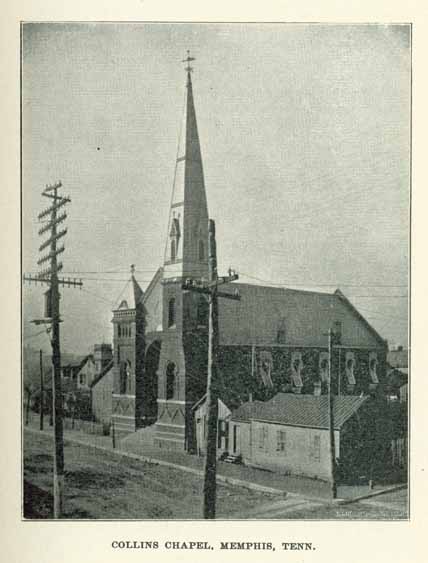
COLLINS CHAPEL, MEMPHIS, TENN.
Page 119
says if I will make myself personally responsible for the debt, he will take my note and wait on me a few months for the money. This debt is the Riley mortgage. Now, if the preachers will rally for the Index and increase its circulation, I will pay that debt, as I have paid others, and save the Church from the cost and scandal of a lawsuit. I think I will be able to report at the next General Conference that the Christian Index and the Book Concern are entirely clear of the debts they owed at the last session of that body.
This expectation, however, was not realized; for the debts were not paid by the General Conference of 1882, but continued to harass for some time afterwards, when they were finally settled.
In April, 1880, the bishops held their episcopal meeting at Jackson, Tenn., and appointed fraternal messengers to the General Conferences of the Methodist Episcopal Church, the African Methodist Episcopal Church, and the African Methodist Episcopal Zion Church. M. F. Jamison, of the East Texas Conference, and J. W. Bell, of the Kentucky Conference, were sent to the General Conferences of the Methodist Episcopal Church and the African Methodist Episcopal Church, respectively; I. H. Anderson and E. Cottrell were sent to the General Conference of the African Methodist Episcopal Zion Church. In addition to this, delegates were selected to the first Ecumenical Conference, which met in London in September, 1881, Bishop Holsey heading the delegation. This was one of the greatest gatherings known to Methodism. It was a family reunion in which every branch of Methodism was represented. Bishop Holsey, the only delegate of our Church who went abroad,
Page 120
reflected great credit upon the Church and himself. His address was able and much commented upon by all who heard it. The Conference closing, the Bishop traveled to Paris, France, and other cities, and, on his return to America, wrote articles concerning his trip abroad for the Christian Index and other papers, and delivered lectures in different parts of the country.
In the summer of 1881 trouble arose between C. W. Fitzhugh and Israel Church, at Washington, of which he was pastor, in connection with his editorial work on the paper. It resulted in his withdrawal from that church and the Connection. In regard to this matter, Bishop Miles, in the June number of the Index, says:
Rev. C. W. Fitzhugh has joined the African Methodist Episcopal Church, and is no longer a member of the Colored Methodist Episcopal Church. The public is hereby notified to send nothing more to him for publication in the Christian Index. All matter must hereafter be sent to my address, Louisville, Ky.
W. T. Thomas, of the Alabama Conference, was appointed to the pastorate of Israel Church, also editor of the Christian Index; and he held these positions until the meeting of the General Conference in 1882.
The Church was not allowing the subject of education to sleep. In June, 1881, D. L. Jackson, a leader in the Alabama Conference, expresses himself plainly in the Index:
We appeal to the bishops for a Connectional high school or college to be erected at the earliest possible period. If each Annual Conference will raise the amount to be assessed,
Page 121
we shall surely accomplish our ends. The Alabama and Tennessee Conferences should unite in building this school; and if the project is properly conducted, it will soon be upon foot.
The Tennessee Conference began a school enterprise in 1878. When the Conference met in the fall, a committee, consisting of Rev. C. H. Lee, Rev. J. H. Ridley, Rev. Sandy Rivers, Rev. Berry Smith, and Rev. J. K. Daniel, was appointed to solicit means to purchase a school site. Bishop Lane assisted in this commendable undertaking, and, largely through his influence, four acres of ground were purchased in East Jackson, Tenn.; and, again, the educational work of the Church was begun. From the beginning, Bishop Lane has been the President of the Board of Trustees; has fathered the project; and traveled through the North, as well as throughout the South, raising money for its benefit. It has had a steady and healthy growth.
This school was first known as the Jackson High School. In May, 1885, by motion of the author of this book, the trustees changed the name to Lane Institute. This was a move in the right direction. It was a fitting honor to the man who was to devote his life work to its permanent establishment and maintenance.
In 1882 the school was opened with a few scholars, with Miss Jennie Lane as president. Since then the presidents have been Prof. J. H. Harper, Dr. C. H. Phillips, Prof. T. J. Austin, Prof. E. W. Bailey, Prof. E. W. Denton, and Dr. T. F. Sanders. The school
Page 122
was first taught in a two-story frame building, which stands to-day as a reminder of the humble beginning of this proud institution of learning. Under the leadership of Bishop Lane, a handsome brick building, three stories high, has been erected, and stands a monument to his zeal, an honor to our Methodism, and a blessing to mankind.
The main building of Lane College, the name by which the school is now known, was dedicated October 23, 1895, by Bishop R. S. Williams. The Christian Index, in a report of the dedication in its issue of November 2, says:
Early in the day crowds from neighboring towns and cities began to assemble. At 1 o'clock P.M., Bishop Lane said the hour for divine services had arrived. Bishop Williams was appropriately introduced, and preached an able sermon from Isa. xxvi. 1. At the close of the sermon Bishop Lane called upon Dr. Phillips for an address, who was followed by Mr. Payne, Superintendent of the Public Schools of Jackson. The addresses over, Bishop Cottrell led in a fervent prayer, and then a collection of one hundred dollars in cash was raised. Bishop Lane then presented the building to Bishop Williams for dedication; the latter gave the Book of Discipline to Bishop Cottrell, who did the reading, and the main building of Lane College was duly dedicated to God and to the cause of Christian education. All the speakers showered merited encomiums upon the head of Bishop Lane, who modestly bore it all, thanking God for what he had been able to accomplish for the Church and race. The day marked a new era in our educational movement. It is the first brick building that our Church has built and dedicated to God and humanity for educational purposes. The 23d inst. was a great day, and that building will stand as a monument to its founder.
The first catalogue, as prepared by the writer, appeared
Page 123
in 1885-86; since then it has been revised to meet changing conditions. In 1887 we had the first five graduates, and every year since that time Lane College has sent forth young men and women to lift up the race intellectually, morally, and otherwise.
Page 124
CHAPTER XIV.
Meeting of the Fifth General Conference--Some New Delegates Elected--Death of G. W. Usher--Fraternal Messenger from the M. E. Church, South--His Address-- Replies--Bishop Hillery's Address--Legislation of the General Conference--General Officers Elected--Index Removed to Louisville--Other Distinguished Visitors-- Bishop Holsey's Visit to the General Conference of the M. E. Church, South, as Fraternal Delegate--Our Educational Enterprises--New Church Congregation Organized at Washington, D. C.--Bishop Miles' Appeal in Its Behalf--Pastors of Miles Memorial Church--Centennial of Methodism Celebrated in Baltimore, Md.--Our Representatives --A Word about R. S. Williams--Looking toward the Next General Conference--It Meets, and is the Sixth General Conference--Some Legislative Enactments --Fraternal Delegate to the General Conference of the M. E. Church, South--General Officers and Book Committee Elected--Bishop Miles' Protest--Silver Watch Presented to Bishop Miles--His Reply--The Temperance Question--Chapter Concluded.
WHEN the fifth General Conference met in Washington, D. C., May 4, 1882, the Connection was then twelve years old. It was noticeable that there were more young men in this than in any preceding General Conference. A new leadership was coming to the front; the old was gradually receding. The Alabama Conference still adhered to R. T. Thirgood; the Georgia conference, to R. T. White; the North Mississippi Conference, to I. H. Anderson and B. E. Ford; and the Tennessee Conference, to J. K. Daniel. Among the younger element we notice such men
Page 125
as E. W. Moseley, M. F. Jamison, Elias Cottrell, D. A. Amos, Henry Bullock, A. J. Stinson, D. L. Jackson and G. I. Jackson (brothers), W. T. Thomas, W. H. Daniels, H. A. Steward, D. A. Walker, G. W. Usher, and others. These men have been more or less prominent in the Church ever since, save Usher, who died a few years afterwards, loved by the Church. The meeting of this Conference in the capital of the nation did much to strengthen our Methodism in that city and give prestige to the entire Connection.
Dr. S. K. Cox, of the Methodist Episcopal Church, South, was the fraternal messenger from that Church. His address breathed a fraternal spirit, and was responded to by Bishop Miles.
In the midst of the session Miss Louisa M. Holsey, daughter of Bishop Holsey, died at her home in Augusta, Ga., and the Bishop was called to the funeral services. The Conference appointed a committee to draft suitable resolutions on her life and death. A. J. Stinson, E. W. Moseley, and M. F. Jamison, who constituted the committee, furnished the facts that Miss Holsey died May 2, in her nineteenth year; that she was one of the brightest intellects of the Atlanta University; and that her loss would be irreparable to the Bishop and his family. The preamble and resolutions were spread upon the General Conference Journal and a copy sent to the family.
On the sixth day of the session Bishop Hillery, of the African Methodist Episcopal Zion Church, delivered a fraternal message in the name of his Church, to which J. W. Bell replied.
Page 126
Many resolutions were offered, but few of them met the concurrence of the Conference. Resolutions to change disciplinary question No. 20 to No. 1 in our Book of Discipline, in regard to Annual Conference proceedings; resolutions looking to the abolition of District Conferences; and resolutions providing for the creation of "stewardesses" were all promptly refused. When G. W. Usher offered his resolution providing for stewardesses it produced laughter. There was absolutely no sentiment favoring such a resolution, for it was tabled without opposition. The motion was timely, but was twelve years ahead of time. There was no attempt to pass such a motion at the General Conference of 1886; a desperate effort was made in 1890, but failed; finally, at the General Conference of 1894, a resolution creating "stewardesses" was passed with but little or no opposition against it. Usher did not live to see that which he said would be, but his name will long be associated with a movement that has given the women of our Church a larger sphere of usefulness.
Bishop Holsey was sent as a fraternal delegate to the General Conference of the Methodist Episcopal Church, South, then in session at Nashville, Tenn. He was instructed by our General Conference to ask for assistance to help in building up our educational projects, and any conclusions reached by him and the Methodist Episcopal Church, South, would meet the indorsement of our Church. His address before that body was well received, and out of his visit came the
Page 127
Payne Institute and a promise to aid in our educational work generally.
There was no change in the financial system. Bishop Miles was so well pleased with it that he said no Church had a better plan.
The Conference elected W. T. Thomas editor of the Christian Index; Elias Cottrell, Book Agent; and Bishop Lane, W. M. Payne, and N. B. Smith a Board of Managers for the Christian Index.
Among other things accomplished were the continuance of the ten-cent assessment for the liquidation of the debt of Israel Church; the limiting of the presiding elder's district to eighteen appointments; and the organization of the Missouri and Kansas Conference, embracing the States of Kansas and Missouri. The official organ was voted to be removed from Louisville, Ky., to Jackson, Tenn.; every traveling and local preacher was obligated by the law to subscribe for the Index; and the Annual Conference boundaries were ordered to be printed in our Book of Discipline.
Among the representative men of other denominations who visited the Conference we might mention Bishops T. M. D. Ward, D.D., H. M. Turner, D.D., LL.D., A. W. Wayman, D.D., and J. A. Shorter, D.D., and Drs. C. S. Smith and D. P. Seaton, of the African Methodist Episcopal Church; Revs. Daniels, Bell, and Hamer, of the African Methodist Episcopal Zion Church; Revs. Given and Buel, of the Baptist Church; and Rev. E. W. S. Peck, of the Methodist Episcopal Church.
Page 128
On the tenth day of the session Rev. Frank J. Peck and Rev. Levi J. Coppin, of the African Methodist Episcopal Church, delivered excellent fraternal addresses, which were responded to by E. W. Moseley and E. Cottrell.
The Committee on Episcopacy reported $13,184.83 as having been paid the bishops during the quadrennium. Dividing this amount by four, it will be seen that each bishop received less than $1,100 per year as salary; yet it was more than they had received at any time since their election to the episcopal office. In their message to the General Conference they said:
The ten-cent assessment for the support and traveling expenses of the bishops has proved a wise arrangement, and has worked well in most of the Conferences, in consequence of which the bishops have had better support since the adoption of that measure than in former years, though all of their salaries have never been paid.
The financial embarrassment of these faithful servants was great, still they devoted their energies and consecrated their time and talents to the Church and to the cause of their common Master.
The statistics reported were as follows: Bishops, 4; preachers, 1,729; members, 125,000; Sunday schools, 1,457; Sunday school teachers, 3,773; Sunday school scholars, 42,254. The increase in the membership during the quadrennium was, 18,967.
After a session lasting eighteen days, the General Conference adjourned to meet in Augusta, Ga., in May, 1886.
Perhaps no movement received greater impetus at the hands of our Church leaders in the General Conference
Page 129
at Washington than did our contemplated educational enterprises. Bishop Holsey's visit to the General Conference of the Methodist Episcopal Church, South, had seemingly so stirred that Church that they decided to do something in a tangible way to assist us in establishing schools where young men can prepare for the ministry and young women can fit themselves as teachers. Their General Conference authorized its bishops to appoint a Commissioner of Education, together with three trustees, who should work in harmony with such a number from our Church in any worthy move to found a school or schools for our denomination. Accordingly, on August 29, 1882, at the call of Bishop Pierce, all of our bishops, with distinguished men from the Church, South, met in the First Methodist Church of Atlanta, Ga., and discussed things educational. A board of trustees was formed; the school at Jackson, Tenn., already in an embryonic state, was to receive aid; and a school was located at Augusta, Ga. This school was afterwards named Payne Institute, in honor of Dr. Uriah Payne, who endowed it with $25,000. It has had nearly one hundred graduates; with the endowment the property is valued at $46,000; and G. W. Walker, D.D., has been its honored, faithful, and scholarly president from its establishment even up to this time.
The three Texas Conferences have located, at a cost of $2,000, comprising one hundred acres of land, a school at Tyler, known as the Texas College. The General Conference of 1894, which met at Memphis,
Page 130
recognized this school by allowing these Conferences to retain out of the general funds that amount proportioned for educational purposes. This school has no endowment and has to depend upon the moneys raised by the preachers of Texas and the moneys procured from Children's Day exercises and personal contributions to support it. The school has a bright future. It began its first session in January, 1895, under Prof. S. A. Coffin, who, with his wife, Mrs. Bessie Coffin, as matron, served faithfully as principal. They have now under course of completion a commodious dormitory and school building for students.
Haygood Seminary represents the thrift and sacrifice of the two Arkansas Conferences. It is located in Washington, Ark. More than any other one man, Henry Bullock, president of the Board of Trustees, has been its prime mover and has labored earnestly for its success. Prof. Pinckney and Misses Josephine Beebe and Ida M. Lane have served as principals. At present Prof. G. L. Tyus, a graduate of Payne Institute, is giving entire satisfaction in the position once occupied by his worthy predecessors. The property is valued at $5,000.
Homer Seminary, located at Homer, La., is under the fostering care of the Louisiana Conference. Miss Mattie Clark, of North Carolina, was principal until the session of this Conference, at Shreveport, in December, 1895, when M. E. Robinson, a graduate of Lane College, was elected, Miss Clark being retained as his assistant.
These schools are destined to do much in the way of
Page 131
preparing preachers for their work; teachers for the schoolroom; and men and women for the duties of an intelligent citizenship.
In September, 1883, a new congregation was organized in Washington, D. C., by F. M. Hamilton, at that time presiding elder of the Washington District. For reasons which they considered just and legitimate, about sixty-nine persons received letters of withdrawal from Israel Metropolitan Church. John H. Brooks, C. E. Hilary, Turner Jenkins, Jonas Blanham, and others, the leaders of the movement, desired, with this number as a nucleus, to form a new Colored Methodist Episcopal Church. Accordingly, on Third street, between L street and New York avenue, a lot was purchased, on which there was a hall, and in this hall they worshiped until a large and imposing brick structure was erected. The lot, being in a prominent part of Washington, cost $3,000. One-sixth of this amount was paid in cash, and the remainder was to be paid in three notes of two and three years' time, bearing interest at six per cent. In April, 1884, Bishop Miles makes this appeal in the Index:
Our first note, for eight hundred and thirty-three dollars, will be due in June, 1884. As the time is near at hand when I shall be called on to pay this note, I appeal to our presiding elders and preachers to go to work at once and raise half of the ten-cent assessment and forward to my address by the middle of June. I have a part of the money on hand. This is the centennial year of Methodism in America. Let us make Miles Chapel our centennial Church by raising five cents per member in all our congregations by June 15.
Page 132
W. F. Simons, a local preacher, first served this organization as pastor, which from the outset was known as Miles Chapel. The General Conference of 1894, in recognition of the services and faithful labors of Bishop Miles, named it Miles Memorial Tabernacle. Its first regular pastor was G. L. Davis, of Tennessee. It has since been served, as pastor, by H. W. Madison, of Alabama; J. W. Luckett, of Kentucky; J. C. Martin, of Tennessee; G. C. Taylor and J. W. Harris, both of Georgia.
The year 1884 was one of interest to Methodists everywhere in general, and to American Methodists in particular. In Lovely Lane Chapel, in Baltimore, Md., where the first General Conference was held when American Methodism was put into organized form, centenary exercises were held. The various branches of Methodism sent representatives. It was a great gathering, and represented "one hundred years of marching and a hundred years of song." The bishops, in their episcopal meeting held in June of this year, appointed Bishops J. A. Beebe and L. H. Holsey, and Revs. G. W. Usher, F. M. Hamilton, J. K. Daniel, E. W. Moseley, A. J. Stinson, J. W. Bell, and J. H. Bell as delegates to represent our Church. It is enough to say that their papers and addresses reflected credit upon themselves and the Church. Other noted gatherings of the year were the General Conferences of the Methodist Episcopal Church, at Philadelphia; the African Methodist Episcopal Church, at Baltimore; and the African Methodist Episcopal Zion Church, at New York.
Page 133

MILES MEMORIAL TABERNACLE, WASHINGTON, D. C.
Page 135
In the fall of 1884 a young preacher by the name of Robert S. Williams comes into prominence by reason of his appointment to Israel Church, at Washington. He was transferred from the East Texas Conference, having served three years at Longview, where his unselfish labors and the success following them promised for him a bright future. Other remarks will be made of him as our history proceeds.
In 1885 the attention of the leaders was directed to the forthcoming General Conference, which was to meet in May, 1886. Contemplated changes in the Book of Discipline were freely discussed, and delegates were elected at the fall Conferences.
The General Conference met in Augusta, Ga., May 5, 1886, to which there had been elected one hundred and five delegates. There were forty-six clerical delegates and twenty-four lay delegates present, and these came from sixteen Annual Conferences. It was the sixth session, and in the main was composed of the ablest men of the Connection. F. M. Hamilton was made Secretary, and A. H. Jones, of Texas, who has since died, was his assistant. The bishops were all present.
Their address covered every phase of church work along which it would be necessary for the General Conference to legislate. They declared that
The financial system of the Church is one of peculiar, as well as grave, importance. It demands the wisdom, the tact, the coolest and most considerate judgment of the Conference.
It is only fair to say that no question was more deliberately considered or wisely adjusted than our
Page 136
financial system. A plan was created for raising money that far excelled all its predecessors and considerably increased the revenue of the Church. More than any other person, Bishop Holsey was the constructer of the plan after which our financial systems since then have been similitudes. Under it every minister and member was assessed twenty cents per year, which was divided as follows: For bishops, eight cents; missions, three cents; education, three cents; publishing interests, three cents; Israel Church and Miles Chapel, three cents. This system worked well and filled a long-felt want.
The salaries and traveling expenses of the bishops were fixed at $1,600, the same being paid them yearly.
During the session of the Conference a memorial watch which had been given to Bishop Miles by the various Annual Conferences was duly presented to him by the writer, and accepted in a beautiful speech.
The following letter was offered by Bishop Miles:
Whereas the General Conference which was held in Louisville, Ky., in August, 1874, did appoint the bishops and three other members a committee on fraternal and organic union with other Methodist Churches; and whereas I have been accused of defeating the union of our Church with other Methodist Churches; and whereas I do not wish to hinder the union of this Church with other Methodist Churches, I do hereby respectfully resign the appointment and decline further service on said committee, either for fraternal or organic union.
The General Conference relieved him, and now no such committee exists among us.
The General Conference of the Methodist Episcopal
Page 137
Church, South, being in session at Richmond, Va., C. H. Phillips was nominated by the bishops and confirmed by the General Conference as a fraternal delegate to that body.
The Conference, on the whole, was a very conservative body. There were many speeches and debates, but few changes were made in the Book of Discipline. "Children's Day" was instituted, each Annual Conference being allowed to designate the day; dancing was prohibited, and a clause to that effect was put in the Discipline; and the Publishing House was continued at Jackson.
Upon ballot, F. M. Hamilton was elected Book Agent and editor of the Christian Index; and I. H. Anderson, C. H. Phillips, E. W. Moseley, E. Cottrell, N. B. Smith W. M. Payne, and T. J. Austin were made the Book Committee.
Perhaps no question invited more discussion than the eligibility of H. Reid, a clerical delegate from the East Texas Conference, and A. C. Smith, a clerical delegate from what was then called the Tennessee and Alabama Conference, to seats in the General Conference. Bishop Miles insisted that, as these men had married divorced women, they were improper persons to legislate for the Church, and that their credentials should accordingly be rejected. The General Conference differed from this position and seated the delegates, whereupon Bishop Miles entered the following protest upon the Journal:
AUGUSTA, GA., May 19, 1886.
Whereas H. Reid has married a woman that has been
Page 138
divorced from her husband; and whereas my conviction is that he has rendered himself unfit for the ministry and unfit to serve as a delegate to legislate for this Church; and whereas I believe that the decision of this General Conference in admitting said Reid is damaging to the morals of our Church; and whereas I believe it to be the duty of this General Conference to raise high the standard of morality among our people, I hereby protest against such decision as will allow a preacher to marry another man's wife and recognize him as a suitable man to legislate for the Church of God.
Respectfully,
W. H. MILES,
One of the Bishops of the Colored Methodist Episcopal Church.This Conference passed a law that every preacher in charge should bring his Church Register to the fourth Quarterly Conference for inspection; that every traveling preacher should subscribe for the Index; and that no person should be licensed to preach until he had first become a subscriber to the official organ of his Church.
Frank Ford, of the Georgia Conference; R. E. Marshall and David Ratcliff, of the Kentucky Conference; and B. Ford and G. W. Wright, of the Mississippi Conference, all ex-members of the General Conference, having died during the quadrennium, were eulogized for their sterling qualities, the lives they led, their usefulness to the Church, and their triumphant and peaceful end.
The Conference declared itself in no uncertain sound against intemperance. This was its declaration:
Whereas drunkenness and all intemperance are condemned in the Word of God, which also says, "No drunkard shall inherit the kingdom of heaven;" and whereas the
Page 139
use of intoxicating liquors is destructive of good society and damaging in its nature to the Church of God; and whereas the Church has greatly suffered from its use by its members,
Resolved, 1. That this General Conference heartily indorses the great temperance movement now being agitated so strongly in all parts of the country.
2. That all the ministers of our Church are hereby instructed to condemn the practice and use of intoxicating liquors as a beverage.
3. That we, the ministers of the Colored Methodist Episcopal Church, will do all in our power to promote and foster the cause of temperance in all our charges and districts.
Thus the Church, through its supreme representatives, expressed itself; and its adherence to these principles with unalterable constancy forms a notable chapter in its history.
In presenting the silver watch to Bishop Miles, to which reference has already been made, the writer made the following remarks:
DEAR AND HONORED BISHOP: It is a source of great pleasure for me to have the honor to present to you this watch as a memorial from all the Annual Conferences, save the East Texas, Missouri and Kansas, North Carolina, Tennessee, and Alabama Conferences. These are left out not because of any depreciation of you and your invaluable work, but rather on account of their negligence and stupidity. You need no eulogistic comment from me. No poet is needed to sing your worth, no historian is needed to narrate your deeds, nor graphic writer required to delineate the service you have rendered our Church; but in order to show what has prompted the Conferences to act, it will be necessary to review the past.
In the dark days of our Church, when persecution was high, slander prevalent, the Church disorganized, the men inexperienced and not well informed, you became a beacon light, and, like a shooting meteor, left your track behind
Page 140
you. By you the Church was organized and defended, her cause promulgated, and her interests watched as with an eagle's eye. From place to place you traveled, leading on our glorious cause, until you have reflected yourself upon the current of ages as the mountain mirrors itself in the gentle stream that flows at its base.
As our senior bishop, we love you, we honor your name, and as long as the human heart shall beat, your name will live in the memory of Colored Methodists. In view of your labors, in view of the high esteem in which you are held by all these Annual Conferences, we give you this watch as a token of our respect and as an insignia of honor and merit. No sculptured marble may ever rise to perpetuate your memory, nor graven image bear record to your deeds, yet your name will live on and on. Your sons will carry on the work which you have begun; your sons will perpetuate your memory; your sons yet unborn will record your labors indelibly upon the pages of history.
As long as the heavens shall feed the stars, as long as the rivers shall run into the seas, as long as the shade shall traverse the hollows of the mountains, so long will there be some one to lisp the name of Bishop W. H. Miles. When the sun of your life, rolling on in glorious pomp, will set to rise no more, it is hoped that the "Sun of Righteousness" will light up your soul with visions of glory in a more happy and congenial clime.
I now take great pleasure in presenting this watch. Accept it, Bishop, as from your brethren. Let it remind you always of our love, and in the evening of your life may it be a source of pleasure to you to know that you are so kindly remembered and loved by your brethren. In the name of this General Conference, in the name of the Church which it represents, I again say accept it with the best wishes of your constituents and admirers of the Colored Methodist Episcopal Church in America. The Lord bless you, Bishop, and give you a long life to serve the Church which you now so ably represent.
Bishop Miles made the following reply:
I accept this watch as a token of your respect. I thank you for it. I am no speech maker, so I hardly know what
Page 141
to say. I have the watch; that is certain; and you can't get it. You said, through Dr. Phillips, that you present this watch as a "memorial of your love," etc. He has made a great big speech. I don't know how to reply to such an address. I have never been favorable to receiving presents. Many of you have desired to make me presents from time to time, but I have always objected to it. I want your sympathy, your good feelings, if they come from a pure heart.
I feel a little proud of the Colored Methodist Episcopal Church and of the respect you have shown me. I need not tell you that I will not betray my trust to you. I have always tried to do what I thought was right, and labor for the upbuilding of this Church. I have never seen the day that I could thank you for electing me a bishop. I never desired it. I have never sought an office in the Church, but I have come along thus far. Experience has taught me that I have somewhat shaped the destiny of our Church, and now I believe, if we will only live right, we will be sure to prosper.
Dr. Phillips, I thank you for your eloquent address, also for the watch.
Bishop Miles thought well of the gift made him by the General Conference, and up to the time of his death, of which mention shall be made later, he delighted in speaking of the watch and in showing it to his friends.
In concluding this chapter it may be necessary to say that there was no disposition on the part of the General Conference to elect another bishop. In their message the bishops declared that they thought the present corps of bishops could do all the work that was necessary to be done, and from this conclusion there were no divergent views among the delegates.
The General Conference, after a twenty-two days' session, adjourned to meet in 1890, at Little Rock, Ark.
Page 142
CHAPTER XV.
Important Event in 1886--A Large Congregation Received from the A. M. E. Church--Samuel B. Wallace the Leader --General Conferences of Three Great Methodist Bodies Meet in 1888--They Elect Bishops--First World's Sunday School Convention--Some Discussions in the Church-- Meeting of the Seventh General Conference in Little Rock, Ark.--Remarks on the Same--Some Important Legislation--General Officers Elected--Delegates to the Second Ecumenical Conference Chosen--Bishop Holsey's Petition for a Supernumerary Relation Rejected--Dr. J. C. Hartsell, Fraternal Delegate from the M. E. Church, and Dr. M. G. Alexander, from the A. M. E. Church, Make Addresses--Replies--E. W. Moseley, Fraternal Delegate to the General Conference of the M. E. Church, South-- Greetings from Bishop Hood, of the A. M. E. Zion Church--Bishop Beebe Replies--Greetings from the M. E. Church, South--Bishop Miles' Failing Health--Work of His Colleagues--Second Ecumenical Conference Meets at Washington, D. C.--General Conferences of Other Methodist Bodies--Elias Cottrell, R. T. Brown, and R. S. Williams, Fraternal Delegates--The Church Prosperous.
ONE of the most important events of the year 1886 was the coming over to our Connection of a large and influential congregation at Columbia, S. C. For years it had been loyal to the African Methodist Episcopal Church, but, on account of some irreconcilable differences, a chasm was created which could not be bridged, resulting finally in the Church's withdrawal from that denomination. This congregation, consisting of some 600 or 700 members and a following of more than 1,500, at once gave prestige and character
Page 143
to the Colored Methodist Episcopal Church in the State of South Carolina. That congregation, now known as Sydney Park Church, stands at the head of our Methodism in the old Palmetto State. One of the most conspicuous leaders of this Church was one Samuel B. Wallace. He lent his influence in leading the congregation into our Connection, and was soon afterwards licensed to preach. Such were his gifts and talents that he rapidly forged his way to the front, and in a short time was generally regarded as one of the foremost men of the Church. His career was brilliant, but short, as death ended his labors almost suddenly in July, 1895. More extended remarks concerning him will be made a little later.
In the year 1887, other than the holding of successful revivals in all parts of the Church, there were no special happenings.
In 1888 the General Conferences of the Methodist Episcopal Church, the African Methodist Episcopal Church, and the African Methodist Episcopal Zion Church met in various parts of the country. The first convened in May, at New York, N. Y.; the second, in the same month, at Indianapolis, Ind.; and the third, at Newberne, N. C. Each of these Conferences elected men to the episcopal office. Drs. Gaines, Arnett, and Tanner were elected bishops by the African Methodist Episcopal denomination, and Drs. Petty and Harris were elected by the African Methodist Episcopal Zion body.
The first World's Sunday School Convention met in July, 1889, in London, England. Delegates from
Page 144
all parts of the country were elected, and the writer, being a pastor at Washington at that time, was one of three delegates elected--Rev. Walter H. Brooks and Rev. George Moore being the other two--to represent the Sunday schools of the District in that great cosmopolitan gathering. The proceedings of that convention gave inspiration and encouragement to Sunday schools throughout the world.
This year the question of the election of another bishop in our Church was considerably discussed. The failing health of Bishop Miles, the admitted physical weakness of Bishop Holsey, and the rapid spread of the Church necessitating increased labors were some of the reasons urged for increasing the episcopal bench. This agitation was not confined to a single Conference, but to the Connection at large. In the meantime preparations for the second Ecumenical Conference to be held in Washington in the fall of 1891 were going on in all branches of Methodist bodies.
In May, 1890, the seventh General Conference of the Church met at Little Rock, Ark. All the bishops were alive and presided alternately.
Senior Bishop Miles looked the picture of health, but his external appearance was in no respect a true index of his internal feelings and condition, for he was far from being a sound man. He referred frequently to the fainting spells to which he had become subject, and more than once told the Conference that in all probability this would be the last General Conference that he would be permitted
Page 145
to attend. This belief was well founded, for he survived this Conference only two years.
The message of the bishops was an able paper, and reviewed the several departments of the Church in a comprehensive manner. They recommended the election and consecration of a bishop to assist in episcopal labors, and advised conservatism in the revision of the Discipline.
The Conference was composed of some able men, many of whom had been members of previous General Conferences. The sessions lasted from May 7 to May 22, during which time some very important legislative enactments were accomplished.
There was no bishop elected, as had been anticipated. Some contention arose among the delegates, both as to the man that should be chosen and the advisability of an election at all. Finally, in the interest of peace and harmony, the bishops revoked the recommendation, and the election of a bishop was deferred by the General Conference.
One of the most important things accomplished in this General Conference was the creation of a Church Extension Society. A constitution for the management of this new creature was drafted by H. Bullock and D. A. Walker; and M. F. Jamison, the father of the society, was, by nomination of the bishops and confirmation of the General Conference, made its Secretary.
There was no radical change in the financial plan that had wrought well during the quadrennium. The general twenty-cent assessment remained, and was
Page 146
divided in the following order: For bishops, eight cents; general missions, five cents; education, four cents; publishing interests, three cents. The only difference between this plan and the plan of 1886 was the dropping of the three-cent assessment for Israel Church and Miles Chapel; one cent of which was added to the old assessment for education, making it four cents, and the adding of the remaining two cents to the old assessment for general missions, making it five cents. Thus the new plan was launched, the operation of which was without friction, and the success of which even eclipsed all previous systems.
Among other things accomplished were the creating of the office of Commissioner of Education, with Elias Cottrell as Commissioner; the election of Isaac H. Anderson as Book Agent; and the election of F. M. Hamilton as editor of the Christian Index.
As the second Ecumenical Conference was to meet in 1891, the Conference elected C. H. Phillips, J. T. Shackelford, and J. W. Luckett a Committee on Correspondence, and Bishop L. H. Holsey, C. H. Phillips, J. T. Shackelford, J. C. Waters, E. W. Moseley, S. B. Wallace, R. S. Williams, and A. J. Stinson, delegates. Provision was made for bearing the expenses of the delegates, and all matters pertaining thereto were properly adjusted.
Bishop Holsey, out of his feeble condition, petitioned the Conference on this wise:
DEAR FATHERS AND BRETHREN: I ask to be placed on or in a supernumerary relation, because of bad health. I can do some work, and expect to do it, but my physician thinks that a rest from public speaking will give me relief.
Page 147
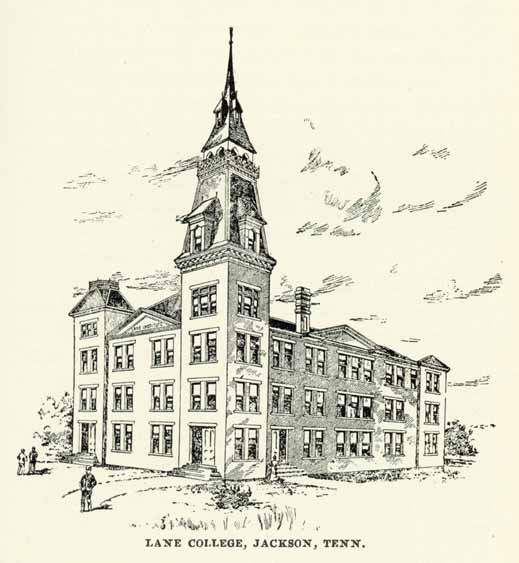
LANE COLLEGE, JACKSON, TENN.
Page 149
The General Conference was in great sympathy with Bishop Holsey, but such was its love for him and such had been his invaluable services to the Church that it threw a gloom over all the delegates to even think of being bereft of the services of its brilliant, influential, oratorical leader. Consequently the petition was rejected, the other bishops promising to lighten his episcopal labors as much as possible.
Dr. J. C. Hartsell, of the Methodist Episcopal Church, and Dr. M. G. Alexander, of the African Methodist Episcopal Church, were present as fraternal delegates from their respective Churches. They delivered able addresses. C. H. Phillips, on behalf of the Conference, replied to the former, and Elias Cottrell replied to the latter.
The General Conference of the Methodist Episcopal Church, South, being in session at St. Louis, Mo., E. W. Moseley was sent as a fraternal messenger to that body. His speech was warmly received.
Among the telegrams received during the session of the Conference was one from Cambridge, Mass., dated May, 12, 1890. It was as follows:
To the General Conference of the Colored Methodist Episcopal Church, in care of Bishop J. A. Beebe:
The New England Conference of the African Methodist Episcopal Zion Church sends fraternal greetings. May God bless your deliberations and prosper your work.
J. W. HOOD,
Bishop.
Bishop Beebe, on behalf of the Conference, sent an appropriate reply to Bishop Hood. A suitable reply was also sent to the General Conference of the Methodist
Page 150
Episcopal Church, South, which sent this greeting:
ST. LOUIS, MO., May 15, 1890.
To the General Conference of the Colored Methodist Episcopal Church in America:
The General Conference of the Methodist Episcopal Church, South, sends greetings. (1 Thess. iv. 1.)
When the Conference adjourned it proved to have been one of the most important sessions that had been held in the Connection.
The year 1891 finds Bishop Miles in poor health. So feeble was he that he found it impossible to hold many of his District Conferences in the summer, or his Annual Conferences in the fall. The three other bishops gave such attention to his episcopal district as their time would allow.
One of the most important events of this year was the meeting of the second Ecumenical Conference in Washington, D. C., in October. It was a great gathering and represented world-wide Methodism. Bishops of episcopal bodies and presidents of non-episcopal bodies presided alternately. The delegates from our Church, chosen at the last General Conference, were present, one of whom, C. H. Phillips, represented the Church on the programme by delivering an address, entitled "The Legal Prohibition of the Saloon." The enthusiasm which the Conference imparted and the information obtained through the able addresses delivered and the creditable papers read were simply invaluable.
In 1892 there were many important gatherings. The General Conference of the Methodist Episcopal
Page 151
Church met in Omaha, Neb.; the General Conference of the African Methodist Episcopal Church assembled in Philadelphia, Pa.; and the General Conference of the African Methodist Episcopal Zion Church convened in Pittsburg, Pa. In the two latter bodies the question of organic union was discussed at great length, and committees from both Conferences were appointed to meet and make arrangements for uniting. Upon the adjournment of these bodies it appeared from the surface that union was just in the distance; that plans necessary to lead up to such a desired realization had been consummated; and that a confederation of these two largest denominations of negro Methodists was no longer to be a forlorn hope. Many of the Annual Conferences on both sides voted for union, and everything seemed to be progressing finely. Suddenly some complications arose; organic union was declared impracticable, if not impossible; and at this writing there appears to be no possibility of these bodies ever uniting.
R. T. Brown was our fraternal delegate to the General Conference of the African Methodist Episcopal Church; R. S. Williams, fraternal delegate to the General Conference of the African Methodist Episcopal Zion Church; and Elias Cottrell, fraternal delegate to the General Conference of the Methodist Episcopal Church. The addresses of these delegates were well received, and our Methodisms were brought more closely together by reason of their visits to Philadelphia, Pittsburg, and Omaha. At the General Conference of the African Methodist Episcopal Zion
Page 152
Church, at Pittsburg, I. C. Clinton and Alexander Walters were elected and consecrated to the office of Bishop; at the General Conference of the African Methodist Episcopal Church, at Philadelphia, B. F. Lee, M. B. Salters, and J. A. Handy were elected and consecrated to the office of Bishop; at the General Conference of the Methodist Episcopal Church, at Omaha, there were no elections of men to the episcopal office.
In the midst of these convocations and the great interest connected with them, our preachers were busily engaged in revivals, our schools were graduating young men and women, and the whole Church appeared to be full of hope and spiritual vigor.
Page 153
CHAPTER XVI.
THE LAST SCENE.
Bishop Miles' Sickness--His Death--His Burial.
BEFORE now reference has been made to the declining health of Bishop Miles, but the year 1892 finds him unable to even leave his home to engage in episcopal labors. The writer, who was stationed in Louisville at that time, was permitted to see much of him and witness the end as it gradually came. During the year he attended divine services whenever his condition would allow him to do so.
In September the Kentucky Conference met in Louisville, and Bishop Miles' presence was a great inspiration to the preachers among whom he had lived before and since his election to the episcopal office. Two of his colleagues--Bishop Beebe, who presided, and Bishop Lane, a welcome visitor--were present. They were in the best of humor and contributed much to the life and success of the Conference.
This was the last Conference Bishop Miles ever attended, and before it he made his last speech. When he arose to speak, it was evident to the members of the Conference that he no longer possessed the great physical strength which he enjoyed in former years. Nervous, tremulous, and weak, holding to a chair in front of him, stood the senior bishop of the Colored Methodist Episcopal Church. What Asbury had
Page 154
been to American Methodism, Bishop Miles had been to our Connection. So there he stood, the cynosure of all eyes. Every eye was bedimmed with tears as he spoke slowly and pathetically. The Journal of the Conference records the following as a part of his address:
Brethren, I am glad to meet you all. I have been thinking I would not be able to meet you in this session of the Conference. I am feeble and not able to make a speech. I am very glad God did not take me to heaven last night, for I wanted to see you all once more. Brethren, I am not afraid to die. I have no more fears about dying than of going to my home, but I am not in a hurry about it. I want to stay here just as long as it pleases my Father for me to stay; and if it is left to me, I will stay at least twenty years longer. Nevertheless, I am ready to go whenever he calls me. I want you to have a good time here. I am responsible for the Conference meeting at this place, for I wanted to see you all once more. Call to see me before you leave the city.
This was the last time that this Conference ever saw his familiar form or heard his eloquent voice. He never again appeared before a public gathering. In less than three weeks after the adjournment of the Conference he breathed his last. His consolations were great. He talked cheerfully to the writer, always insisting that he was ready to die. At one time he would say, "I am not afraid of death;" at another, "I am waiting for the summons." When he was first confined to his room, it was our pleasure to see him once each week; as he grew weaker, we saw him every other day; and during the last week of his illness, we visited him every day. Possessing a genial nature, the Bishop was accustomed to calling his
Page 155
preaching brethren, "boys." With a kindly smile upon his face, displaced by an occasional frown caused by the pain which he suffered, he said to us one day: "Tell the 'boys' I do not die a coward; I am ready for the monster, Death; I have made preparations against this day." Nearing the close of his life, his attending physician said to him, in our presence: "Bishop, you cannot live; you are going to die." He replied: "I am looking to Jesus, the Great Physician, who never loses a case." He exhibited no excitement; he was perfectly composed and cheerfully resigned to the will of God. Having lost all hope of recovering, and desiring more to be with Christ than to remain in bodily suffering and mental anxiety superinduced thereby, he would frequently say: "Come, Lord Jesus, and come quickly." A day before his death, seeing that he was growing weaker and that he would soon pass into a comatose state, we said to him: "Bishop, tell us how you feel now. Are you still trusting? Is it well with your soul?" "Yes," said he, "I am still trusting. I have been serving the Lord too long for him to desert me now in these my last hours, and at a time when I need him most." These remarks were made late Saturday night, November 12. On Sunday, the 13th, after the morning service, we again called to see him; but he was unconscious and recognized no one. His testimony had been given, and, like a field of ripened grain waiting to be reaped and garnered, he lay waiting for the grim reaper, Death, and for the angels to bear him away on their snowy wings to his immortal home. On Monday,
Page 156
November 14, about 6:45 A.M., "our father" entered the paradise of God, where he shall be holier and wiser and happier forever.
Bishop Miles was buried on Thursday, November 17, at 4 o'clock P.M. On this day his remains lay in state at Center Street Church from 8 A.M. until 2 P.M., when the funeral services began. Hundreds viewed the remains of the first senior bishop. White and black looked upon the prostrate form of him who had been the great apostle of Colored Methodism. The Methodist Ministerial Union and representatives from the Baptist Ministerial Union turned out in a body to do honor to one of Louisville's most popular citizens.
At the hour of 2 o'clock, Bishop Holsey, of Georgia, followed by all the ministers of the city, walking in front of the corpse, began to read: "I am the resurrection and the life," etc. The ritualistic services were conducted by Bishop Holsey, after which he lined, with much feeling, that old, familiar song:
Servant of God, well done!
Rest from thy loved employ.
The battle fought, the vict'ry won,
Enter thy Master's joy.
Prayer was then offered by Rev. H. C. Settles, D.D., pastor of the Walnut Street Methodist Episcopal Church, South, who afterwards read, with much emotion, Psalm xxiii.
Bishop Miles had selected several songs which he desired sung at his funeral, one of which, the following, was lined by Bishop Holsey and sung with much freedom and pathos by the vast congregation:
Page 157
And let this feeble body fail,
And let it droop and die;
My soul shall quit the mournful vale
And soar to worlds on high.
While he was very fond of this entire hymn, the
Bishop was especially delighted with, and frequently
sung, this verse:
I suffer out my threescore years,
Till my Deliv'rer come
And wipe away his servant's tears
And take his exile home.
Bishop Holsey, who preached the funeral sermon, was so overcome with grief that he did not speak longer than fifteen or twenty minutes. His text was taken from Psalm xxxvii. 37: "Mark the perfect man, and behold the upright: for the end of that man is peace." He spoke tenderly of the strong character of his deceased colleague, his love of virtue, his worth to the Church, his firmness of purpose, and his strong adherence to right. He referred eloquently to the happy relation that existed for years between himself and the dead bishop; how kind and fatherly he had been to him; how he had appointed him, in 1871, to Trinity Church, in Augusta, Ga., when he had hitherto been serving poor appointments; and how intimate had been their association since that time. He spoke in this vein for several minutes, and, after expressing deep sympathy for the family, he sat down, his own eyes and those of his hearers being clouded with tears.
With reverence, Elias Cottrell, Commissioner of Education at that time, lined the hymn,
Page 158
Jesus, the name high over all,
and the congregation sung with much feeling.
C. H. Phillips, Bishop Miles' pastor, who had prepared a special sermon on his life and death, spoke about thirty minutes, founding his remarks on the words: "There is a prince and a great man fallen this day in Israel." (2 Sam. iii. 38.)
Elias Cottrell, speaking next, said he had been ordained a deacon and elder by Bishop Miles, and would always love his name and revere his memory.
When the choir had sung,
In thy cleft, O Rock of Ages,
Hide thou me,
Jehu Holiday, pastor of Twelfth Street African Methodist
Episcopal Zion Church, and who has since been
elected a bishop in his Church, said:
I have known Bishop Miles for years, and I always admired him. He was a truthful and very reliable man; you always knew where to find him. When he said, "Yes," he meant it; and when he said, "No," there was no need to try to change him. He was a firm man. May God bless the family.
Dr. Settles said:
I have known Bishop Miles for twenty-five years. I knew him before he was made a bishop, and I have known of his life and labors since.
He also spoke of the Bishop's relation to his family, all of whom he hoped would meet the deceased in heaven.
Rev. Mr. Gaddy, pastor of Green Street Baptist Church, made the last address. He said he regarded the Bishop as a good man; that he had done much for
Page 159

THE HAYGOOD MEMORIAL HALL, PAINE INSTITUTE, AUGUSTA, GA.
Page 161
the race and his Church; and that now, resting from his labors, his works would live after him.
Resolutions from the Methodist Ministerial Union and the Louisville Colored Cemetery Association, both speaking of the commendable qualities which the Bishop possessed, as well as expressing sympathy for the family, were read.
The Louisville Colored Cemetery Association, in the establishment of which Bishop Miles was foremost, and of which he became the first president, offered the following resolutions:
Whereas it has pleased an Almighty Providence to remove from our midst our friend and associate, Bishop W. H. Miles, therefore be it
Resolved, That we have lost a faithful president and member of the Directory Board, and an untiring worker, whose efforts were unlimited to advance the success of the association.
Resolved, further, That we tender our sympathy to the bereaved family in this their affliction, and that these resolutions be spread upon the minutes of the Louisville Cemetery Association.
On behalf of the association, the resolutions were signed by A. J. Bibb, Allen Johnson, Detroit Stewart, Samuel Curry, and H. C. Weeden.
The services at the church ending, Bishop Holsey dismissed the congregation, and the remains were borne to the Louisville Cemetery, where the Bishop had purchased a lot for himself and family. As the long and imposing procession headed for the graveyard, it was sad to see, occupying an important place therein, the horse and buggy once used by the Bishop. The harness and bridle were beautifully draped in
Page 162
mourning, as was also the buggy. James Clark, who had nursed the Bishop through his illness, drove the horse just behind the hearse.
The floral offerings were many and costly. Center Street Church gave a wheel with a broken spoke, with the words, inscribed in purple, "Our Hero;" a Bible, made of chrysanthemums, and given by the pastor and official board of the church, had upon it the word, "Victory;" a star in a crescent, given by the Pastor's Relief Club of the church, was a beautiful design; William Watson, the undertaker, gave two palms tied with a white scarf, with the words, "Father and Friend at Rest;" an anchor, sheaf of wheat, and other designs were given by admiring friends.
The casket was large and handsome, inside of which, dressed in a black robe (at his own request) tied with a black cord and tassel, with hands folded gracefully across his breast, lay the first bishop of the Colored Methodist Episcopal Church.
Among the ministers who came to the city to attend the funeral were Elias Cottrell, of Memphis, Tenn.; D. A. Walker, H. A. Steward, M. I. Warfield, and H. H. Johnson, from cities in Kentucky; and John Brown, a layman, of Carlisle, Ky.
The active pallbearers were: Rev. M. I. Warfield, Rev. H. A. Steward, Rev. S. H. Green, Rev. A. Grundy; and Napoleon Bonapart, Detroit Stewart, Moseley Bradley, Felix Johnson, and John Crawley, laymen. The honorary pallbearers were: Rev. Jehu Holiday, of the African Methodist Episcopal Zion
Page 163
Church; Rev. W. N. McCoomer, of the Methodist Episcopal Church; Rev. W. P. Churchill, of the Colored Methodist Episcopal Church; and Samuel Curry, C. H. Dickens, and A. J. Bibbs, laymen.
At the grave, Rev. C. H. Phillips read the burial ceremony. The body was then lowered into the grave; the cavity was filled; the sorrowing crowd dispersed; and there, on the top of a beautiful hill overlooking the city, the beloved, honored, heroic, and sainted dead was left to sleep undisturbed until the mighty flat of Jehovah shall bid him arise.
No bitter tears for thee be shed,
Blessing of being seen, and gone;
With flowers alone we strew thy bed,
O blest departed one.
Thou wert so like a form of light
That Heaven benignly called thee hence,
E'er yet the world would breathe one blight
O'er thy sweet innocence;
And thou, that brighter home to bless,
Art passed with all thy loveliness.
Page 164
CHAPTER XVII.
Movements of the Church in 1893--The Agitation of More Bishops after the Death of Bishop Miles--Remarks About R. S. Williams and Elias Cottrell--Some Able Men Mentioned--Meeting of the General Conference in Memphis, Tenn.--Lay Delegates--Some New Clerical Delegates --Bishops' Message--The Election of R. S. Williams and Elias Cottrell to the Episcopal Office--The Church No Lover of Politics--Some Measures Defeated--Financial Plan--The Contingent Fund--Memorial Services in Honor of Bishop Miles--Fraternal Delegates from the M. E. Church, South, and the A. M. E. Church--Bishop Lane a Fraternal Delegate to the M. E. Church, South-- An Opinion of the Bishops--Some Measures Passed-- Bishop Holsey Granted a Respite--Williams and Cottrell Ordained--Book Agent and Editor Elected--Some Last Acts of the Conference--Church Extension Society Abolished.
THERE were no very important movements in the Church in 1893, other than the discussions that were going on through the official organ on questions that were expected to engage the attention of the General Conference of 1894. The death of Bishop Miles and the spread of the Connection led a conservative element to believe that two additional bishops were necessary to assist in the episcopal labors of the Church; at the same time there were others who insisted upon the election of three. Quite a number of names were mentioned in connection with the office, but the three most frequently named were Robert S. Williams, Elias Cottrell, and a third man whose name it is not necessary to mention. Williams, having rounded
Page 165
out four years of great success at Columbia, S. C., is serving most acceptably at Augusta, Ga.; while Cottrell is faithfully discharging the duties of Commissioner of Education. At this time there were within the bounds of our Connection a number of able men, many of whom, though young, by reason of their zeal and the favorable results attending their efforts, were stamping themselves upon the very heart of the Church. Samuel B. Wallace, at Israel Church, in Washington, had earned the reputation of an earnest, eloquent expounder of the Truth; R. E. Hart had shaken Sydney Park Church in a great revival; Robert T. Brown, who had completed classical, theological, and medical courses at Central Tennessee College, was making an excellent record as a presiding elder; and R. A. Carter, one of the graduates of Payne Institute, and one of the most active and promising young men of the Georgia Conference, was doing a commendable work at Barnesville. Mention might be made of N. F. Haygood, the revivalist, and G. C. Taylor, the devout preacher, both of Georgia, who were doing much to build up the cause of Christ. In all the Conferences were able men who were doing much to save souls and expand our Methodism. In the fall of this year delegates were elected to the General Conference by the Annual Conferences.
Accordingly the eighth session of the General Conference met in Memphis, Tenn., Wednesday, May 2, 1894. It was the largest and most representative meeting the Church had held. Seemingly the Conferences
Page 166
had endeavored to select their best material from among both the clerical and the lay members. The number of the latter was determined by the number of clerical delegates chosen by each Conference, the laymen being equal in election, if not in attendance. In this body were many delegates who had been members of previous General Conferences, and two or three who had attended every session from the first. Among the old delegates much interest gathered about R. T. White, of the Georgia Conference, and Isaac H. Anderson, of the Mississippi Conference; the latter was in the General Conference of 1870, when William H. Miles and Richard Vanderhorst were elected our first Bishops. S. B. Wallace, R. A. Carter, G. C. Taylor, S. E. Ervin, and N. F. Haygood were among the new members. G. W. Steward, of the Alabama Conference, who had been a member of the two previous General Conferences, was a legislator of some experience and ability; the same was true of G. I. Jackson, from the same State; of R. T. Brown, A. K. Hawkins, and B. Smith, from other Conferences. In fact, the new and the old delegates blended admirably to give the Conference variety and enthusiasm, which was often produced by a divergence of views on subjects that were under discussion.
The message of the bishops was a clear statement of the condition of the Church--what was necessary to be done in order to keep it abreast of the times, and what should be the trend of legislation. Respecting the election of bishops, they said:
The death of Bishop Miles, with the growth of our Colored
Page 167
Methodism and with the increase and demand of more abundant episcopal oversight, makes it necessary that at least one more man be elected and consecrated to the bishopric. The state of society, the moral quality of the age, and the conditions that now confront us make a crisis in our history. Great interests affecting the well-being and destiny of the Church hinge upon your action in this case. In no case should you encumber the Church so as to make it top-heavy with bishops. We trust that wisdom, moderation, and sound judgment in the number and character of any who may be exalted to this high place in the Church may direct you.
Great interest centered in the election of bishops by reason of the support that some candidates received and the opposition encountered by others. The debates in favor of increasing the episcopacy were interesting and able. Some favored the election of two bishops; others favored the election of three. The former advocates prevailed, and two bishops were chosen on May 9. It had been previously arranged that the initiatory steps to the election should begin at 10:30 A.M. Upon roll call, it was found that one hundred and eleven delegates were present and ready to cast their ballots. Let us revert to the General Conference Journal for a description of the election:
B. Smith lined hymn 495:
Lord, in the morning thou shalt hear
My voice ascending high;
To thee will I direct my prayer,
To thee lift up mine eye.
The Conference and congregation (the church was crowded with colored and white people) joined in singing the above hymn.
B. Smith led in prayer.
R. T. White led in singing,
Nearer, my God, to thee.
Page 168
L. M. Martin led in singing,
Down at the cross, where my Saviour died.
Then, by special request, J. W. Luckett led in singing,
It is better further on.
F. R. Rodgers and W. T. Breeding were appointed tellers to assist the secretaries in counting the votes.
By request, the secretary called the report the second time, and only one hundred and eleven (111) brethren answered to their names.
The chairman stated that it required fifty-six votes to elect.
The first ballot was cast, with the following result: R. S. Williams, 73; C. H. Phillips, 49; E. Cottrell, 32; H. Bullock, 13; I. S. Pearson, 2; O. T. Womack, 7; W. F. Simons, 2; J. C. Waters, 1; D. W. Featherston, 1; R. E. Hart, 1; G. I. Jackson, 9; F. M. Hamilton, 2; I. H. Anderson, 10; R. T. Brown, 11; R. T. White, 1; H. W. Madison, 2; A. K. Hawkins, 5; M. F. Jamison, 2.
R. S. Williams having received the highest number of votes (73) cast, was by the chairman declared elected a Bishop of the Colored Methodist Episcopal Church in America.
Before another ballot was taken, R. S. Williams was called forward and asked to make a few remarks, which he did, thanking the brethren for the confidence they had in him and the honor conferred upon him. He assured them that they should always find in him only such principles as belong to a Christian.
Second ballot--E. Cottrell, 53; C. H. Phillips, 51; R. T. Brown, 2; S. B. Wallace, 1; H. W. Madison, 1; M. F. Jamison, 1; R. E. Hart, 1; H. Bullock, 1. No election.
Third ballot--E. Cottrell, 56; C. H. Phillips, 53; R. T. Brown, 1; J. W. Luckett, 1.
E. Cottrell having received the required number of votes, was by the chairman declared elected a Bishop of the Colored Methodist Episcopal Church in America.
E. Cottrell was called forward and asked to say a few words. He thanked the brethren for the confidence reposed in him. He said he had not aspired to the office,
Page 169

TRINITY CHURCH, AUGUSTA, GA.
Page 171
and did not feel competent for the position; but by their vote they had said he was competent. This the future would tell. He assured the Conference that he would do his best, and hoped that none would ever have cause to regret the honor they had thus conferred upon him.
C. H. Phillips, after expressing his loyalty to the Church and congratulating the bishops-elect, moved that the election be made unanimous. Carried.
F. M. Hamilton suggested that, as the election of bishops had passed off so quietly and pleasantly, he thought it would be well to unite in singing,
Praise God, from whom all blessings flow;
whereupon the Conference joined in singing the above
hymn.
R. T. White said he thought that as such a good day's work had already been done, and that on account of rejoicing nothing more could be done, it would be a good idea to adjourn; he therefore moved to adjourn until tomorrow at 9 o'clock A.M. Carried.
The Committee on Public Worship made the announcements for evening services, and the Conference adjourned.
Benediction by Bishop Lane.
There had been no election of bishops since 1873; hence the interest which this election awakened, both in the General Conference and the Church at large, can be imagined better than described.
The Colored Methodist Episcopal Church, as an organization, has never taken any part in the political questions of the day, but has rather shown a disposition to separate herself from every question that was political in tendency. We instance this by referring to a resolution offered in this General Conference to create a Committee on the State of the Country. The opposition to this committee was strong and surprising, its creation being agreed to by only a small majority.
Page 172
Efforts to establish an Appellate Court and a District Episcopacy failed; but the office of "stewardess" was created, which opened a new door of usefulness to our women.
The financial plan was revised, the general assessment being raised from twenty-five cents to thirty-five cents, five cents of which is called the Annual Conference contingent fund. The thirty-five cents is divided as follows: For bishops, ten cents; general missions, five cents; education, ten cents; publishing interests, five cents; Annual Conference contingent fund, five cents. This plan has worked well, but not without some friction. The Annual Conference contingent fund has been differently interpreted in several Conferences, and the money used in accordance with those interpretations. It was originally designed that moneys accruing from this five-cent assessment should go directly to widows, orphans, and superannuated preachers. When this item was up for passage in the General Conference, not a few of the delegates insisted that it was a local matter belonging to the Annual Conferences, a question over which the General Conference had no jurisdiction. The money had been used for so many different purposes that the General Conference of 1898 had to so hedge this contingent fund about that it could be capable of but one meaning.
On May 16, beginning at 8 o'clock P.M., memorial services were held by the General Conference in honor of the late William H. Miles. The congregation was large and representative, and the programme previously arranged was well executed.
Page 173
Dr. J. C. Waters submitted the following preamble and resolutions as the sentiments of the committee appointed to eulogize the Bishop:
Bishop William Henry Miles was born in Lebanon, Marion County, Ky., December 26, 1828, and died in Louisville, Ky., November 14, 1892; aged 63 years, 10 months, and 18 days.
After years of faithful service in the ministry, he was chosen first bishop of the Colored Methodist Episcopal Church, December 21, 1870, and for twenty-two years exemplified, by a life of devoted service, the wisdom of the choice. His last illness was long and painful, but was borne with Christian resignation. When told that he could not live, he said, "I am willing and ready to die;" and when in the grasp of the last monster, his intense interest in the Church was manifested by the frequent exclamation: "My Church, my Church! What will become of my Church when I am gone?"
Bishop Miles was an ardent lover of Methodism--its polity, dogmas, and history--and inflexibly held its Discipline as the paramount law; an unflinching defender of the right and an uncompromising foe to the wrong. He labored earnestly to extend the borders of the Church, and patiently endured the obloquy of those who shamefully misrepresented the character of the Church, as well as his aims and purposes.
But he is gone. The last enemy, who strikes down the rich man in his mansion and the poor man in his hovel, dealt the fatal blow, and the first bishop of the Colored Methodist Episcopal Church fell, to rise no more till the morning of the general resurrection, when the dead in Christ shall burst the portals of the tomb. Therefore be it
Resolved, 1. That, while bowing in humble submission to the will of God, we deplore the death of Bishop Miles as an immeasurable loss to the Church of his choice and the cause of Christ.
2. That to the earnestness of Bishop Miles, in spite of bitter and fierce opposition, is due to-day the widespread territory now occupied by the Colored Methodist Episcopal
Page 174
Church, which is daily widening as the result of his heroic labors and indomitable courage.
3. That his unswerving integrity, exhibited as an overseer of the Church, in the administration of the law, and in the exercise of all his official functions, commands our highest respect and emulation, and shall prove an heirloom ever sacred in the archives of the episcopacy of the Colored Methodist Episcopal Church.
4. That we will ever revere the name and memory of Bishop Miles for his inflexible character. Like the everlasting hills, he stood for the right, undaunted by clamor and unmoved by calumny.
5. That Bishop Miles wrote his name high on the temple of human fame as an apostle of moral purity and as a practical advocate of a high standard of ethical philosophy in pulpit and pew, as well as in the sanctuary of the home and fireside, for which he should never be forgotten.
6. That we pray God to give to Kentucky another loyal citizen, to the itinerancy another faithful preacher, to the Church another model bishop, to the world another good man, like W. H. Miles.
7. That these resolutions be spread upon the General Conference Journal and a copy be furnished to the press, and that an engrossed copy, printed on satin, be presented to the family of the late bishop.
8. That the General Conference appoint a suitable person to compile and publish the autobiographical history of Bishop Miles, the proceeds to be applied to the benefit of the family.
Respectfully,
J. C. WATERS,
B. SMITH,
H. A. STEWART,
O. T. WOMACK,
C. H. PHILLIPS.
The General Conference of the Methodist Episcopal Church, South, being in session at the same time, in Memphis, sent Bishop W. W. Duncan to bear fraternal greetings to our body. His address breathed a fraternal spirit, and met a warm and able response in
Page 175
the speech of S. B. Wallace on behalf of the General Conference. Bishop Lane was our fraternal delegate to that body, and his speech was heard with gladness. Rev. W. T. A. Thompson, the fraternal delegate from the African Methodist Episcopal Church, made a happy address and most favorably impressed the Conference.
The eligibility of W. A. Jackson as a delegate from the Ohio Mission Conference, a Conference which had been organized during the quadrennium, occasioned a long discussion. Finally the matter was referred to the College of Bishops, whose opinion will not only prove interesting, but instructive as well. Here is their opinion:
Opinion of the College of Bishops on the eligibility of the
delegate from the Ohio Mission Conference:
1. The delegate is ineligible because the organization of the Conference from which he came was unauthorized.
2. The delegate was not a member of the Conference four years at the time of the session in which he was elected.
L. H. HOLSEY,
Secretary of the College of Bishops.
This opinion of the bishops renewed the question of eligibility, many favoring it and many dissenting therefrom. At length the bishops were sustained, and subsequent developments have proved the wisdom of their course. There were absolutely too few appointments in Ohio and the possibility of extension too precarious to have justified the recognition of a Mission Conference. Whatever work we now have in the State of Ohio is attached to the Kentucky Conference.
Page 176
Ample arrangements were made for celebrating, in 1895, the twenty-fifth anniversary of the Church; the Publishing House was again located at Jackson, Tenn., the amount of $500 was authorized to be paid to the widow of Bishop W. H. Miles in quarterly installments; Texas College, at Tyler, was recognized as one of the Connectional schools; and all moneys raised on Children's Day and for "education by assessment" in Texas were allowed to be retained for this school.
Near the close of the session, Bishop Holsey, who had been in poor health for some time, asked to be relieved of episcopal work for two years, so that he might, at the advice of his physician, go to New Mexico to recuperate. The Conference granted the respite, but his financial condition was such that he never took the premeditated journey.
The election of Robert Simeon Williams and Elias Cottrell to the episcopal office on Wednesday, May 9, and their subsequent ordination on Sunday morning, May 13, made them full-fledged bishops of the Colored Methodist Episcopal Church. The General Conference Journal makes this record of the ordination services, which were held in the Auditorium, on Main street, at 11 o'clock A.M., the building being selected to accommodate the great crowds that were expected and did attend:
1. Anthem, "O Praise the Lord, All Ye People," by the choir.
2. Hymn 305, "I Want a Principle Within."
3. Prayer by Bishop Lane.
4. Scripture lesson (first lesson, Ps. xci.; second lesson, John vi.), read by Bishop Beebe.
Page 177
5. Hymn, "Life's Railway to Heaven," led by Bishop Holsey.
6. Sermon by Bishop Beebe; text, Gen. i. 1-3.
7. Prayer by F. M. Hamilton.
After a few preliminaries, Rev. Robert Simeon Williams and Rev. Elias Cottrell were ordained Bishops of the Colored Methodist Episcopal Church in America. Bishop Beebe was assisted in the ordination by Bishops Holsey and Lane, and Elders N. T. Patterson, B. Smith, and P. A. Sample.
Besides the election of bishops, there were but two other elections held. An editor of the Christian Index and a Book Agent were chosen in the order here mentioned. One ballot was cast for the election of an editor, and C. H. Phillips was elected. Twelve ballots were cast for Book Agent, and Isaac H. Anderson, present incumbent, was reëlected.
Among the last acts of the General Conference were the indorsement of the "Holsey Hymn Book" and "Manual of Discipline," by Bishop Holsey. "A Handbook on the Government of the Colored Methodist Episcopal Church," by F. M. Hamilton; and the keeping in force and operation Free-will Offering Day on the second Sunday in August of each year.
The bishops recommended the abolition of the Church Extension Society on the ground that it had not "come up to our hope and expectation," and the General Conference concurred. Thus this society, which had been only four years on trial, was suspended; but it will arise again in new form, its objectionable features will be eliminated, and it will yet answer the high purposes for which it was originally intended.
Page 178
CHAPTER XVIII.
Opening of the Year 1895--The Church Celebrates Its Twenty-fifth Anniversary--Resolution on the Celebration Adopted by the General Conference of 1894--The Celebration --"Despise Not the Day of Small Things"--The Effect of the Celebration--Death of Samuel B. Wallace-- Funeral Services--Bishop Williams Officiates--Other Ministers Present--His Body Interred--His Birth--His Rapid Rise in the Ministry--General Remarks Concerning His Useful Career--General Conferences of Several Methodist Churches--Hart, Lane, and Phillips, Fraternal Delegates--Three Methodist Bodies Elect Bishops--The A. M. E. Zion Connection a Hundred Years Old--Bishop Holsey Resumes Work--Revivals--Lane College--A Publishing House Purchased--Looking Forward to the General Conference of 1898--Bishops Beebe, Holsey, and Lane.
The year 1895 was full of interest to the Church. The General Conference which met in Memphis, Tenn., in 1894, resolved to celebrate, in May, 1895, the twenty-fifth, or quarto-centennial, anniversary of the Church. The special committee which had been appointed on the celebration submitted the following report, which was unanimously adopted:
We, your committee on the quarto-centennial celebration, beg leave to make the following report:
1. We recommend that the second Sunday in May, 1895, be set apart as Quarto-centennial Day, on which to celebrate the quarto-centennial of the Colored Methodist Episcopal Church, and that the Book Agent be requested to bring out a programme for the occasion.
2. We recommend that all money raised on that day be given to the Miles Tabernacle, at Washington, D. C.
Page 179

SYDNEY PARK CHURCH, COLUMBIA, S.C.
Page 181
3. We recommend that Miles Tabernacle, at Washington, D. C., be known hereafter as Miles Memorial Church, in memory of Bishop William H. Miles, who was so much interested in affairs concerning this church that he purchased the ground, and, through his negotiations, secured a loan of seven thousand dollars, pledging himself to see that one thousand dollars per annum would be paid for four successive years; which promise has never been carried out, owing to the deficiency of funds in the hands of the General Missionary Board. As he has done so much for the Church, and as he has fallen a victim to death, be it the sense of this General Conference that the said Miles Memorial Church be assisted, and that it be finished by the Connection and held in memory of his heroic deeds and stand as a monument to his name.
4. We recommend that all money raised on the said Quarto-centennial Day be forwarded at once to the Book Agent; and that the presiding bishop, Book Agent, and pastor in charge of Miles Memorial Church constitute a committee who shall pay said money on the debt of the church.
In accordance with these sentiments, our silver anniversary was duly celebrated. It was an occasion of general rejoicing. Appropriate exercises were held throughout the Connection; a thanksgiving offering of several thousand dollars was raised for Miles Memorial Chapel; the general funds were larger than ever before; the circulation of the Christian Index, the Church's only official organ, was greatly increased; the main building of Lane College, an imposing three story brick, was duly dedicated; and many souls were added to our Zion. These were befitting results to mark our twenty-fifth milestone. Indeed, a new era seemed to have dawned upon us. Interesting exercises were held in all our congregations; the rise, development and progress of the Church, also the life,
Page 182
labors, and death of Bishops Miles and Vanderhorst, were suggestive themes. The Christian Index celebrated the anniversary by issuing the largest number in all its history. Ordinarily the Index was a seven-column paper, but this issue was doubled and contained fifty-six columns, with eight pages. It was the greatest issue that ever appeared from our Publishing House. It contained cuts of a number of our leading men and much valuable information connected with the Church that was not found elsewhere. Never before had such an array of writers upon so many different phases of our Methodism been brought together in a single issue. All the contributors intelligently discussed the subjects assigned them, and many subscribers preserved this quarto-centennial number of the Index as a souvenir.
It was well for the Church to measure the distance over which she had come, retrospect the depth out of which she had arisen, note the progress she had made, anticipate her prospects, and move up and on in the work of man-uplifting and soul-saving. There is much wisdom and philosophy in the old sentence: "Despise not the day of small things." Five hundred years ago, King John, the Frenchman, took it into his head to found a library, and began with ten volumes; but he knew what he was doing, for that library--the Royal Library, of Paris--is now one of the most magnificent in the world, and contains more than 700,000 volumes. The Colored Methodist Episcopal Church had a small beginning, a beginning which she does not despise; and as the early trials and
Page 183
sneers and ridicule through which she passed were recounted in speech, song, sermon, and essay, many had occasion to rejoice in the checkered path along which an unerring Providence had directed the trend of our Zion.
It was pleasing to observe in this celebration the great advancement the Church had made in intelligence and piety. No Church can fulfill her mission in the world or secure the approbation and blessing of God, except in so far as she promotes vital piety-- holiness of heart and life among mankind. Wealth, education, power, zeal, and eloquence cannot make up for the lack of this. That there had been an increase of piety in the Church was palpably admissible; that the Church was more aroused over the cause of education than had been manifested before in all her history was evident to the careful observer.
Respecting this celebration, we wrote the following lines, which appeared in the quarto-centennial number of the Index:
*Representatives of the Methodist Episcopal Church, South, who were
present to assist in the organization of our Church. Find particulars in
the first four or five chapters.
Twenty-five years ago,
Without pomp, pride, or show,
Set sail our bark;
In Jackson, Tennessee,
Eighteen and seventy,
Our mother*
came to see
What course we'd mark.
Well do I remember
'Twas in bleak December--
Page 184
No need for tears;
When our fathers founded
A Church so well grounded
That it has just rounded
Twenty-five years.
O Lord, to thee we raise
Our hearts in joy and praise
This natal day.
Long may our Zion bright
Shine forth with divine light;
"Protect us by thy might"
This happy May.
When life's journey is run
And all our work is done,
Great God, our King;
O, may we live with thee
Through all eternity,
Thy face and glory see,
While angels sing!
Stimulated under the inspiration of these anniversary exercises throughout our Communion, the Church has been quickened to greater activity, and begins the half century of her existence with renewed hope and vigor.
In June, 1895, the Church was greatly shocked at the death of Samuel B. Wallace, which occurred at Washington, D. C., where he was pastor of Israel Metropolitan Church. He died on the 29th of that month. Heart trouble was said to have been the cause of his death. Not since the death of our two first bishops had a death been so universally deplored.
The funeral services took place on Monday, July 1, Bishop R. S. Williams preaching the sermon. He was assisted by Rev. Mr. Mitchell, of the Episcopal
Page 185
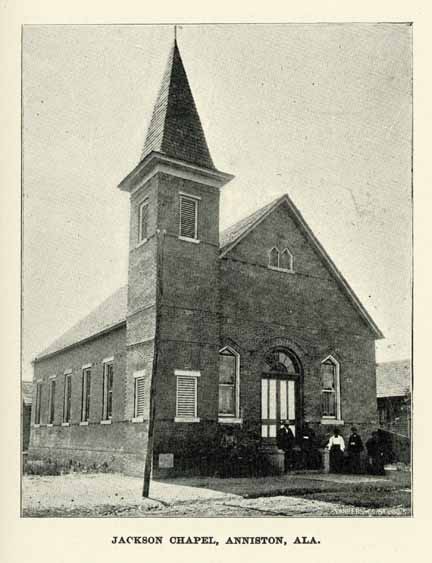
JACKSON CHAPEL, ANNISTON, ALA.
Page 187
Church; Rev. Walter H. Brooks, of the Nineteenth Street Baptist Church; Rev. A. Jenefer, of the Metropolitan African Methodist Episcopal Church; Rev. F. Grimke, of the Fifteenth Street Presbyterian Church; Rev. J. C. Martin, of the Miles Memorial Colored Methodist Episcopal Church; and other ministers of Washington. Israel Church was crowded with its own members and those of other churches, who mourned the departed dead. The remains were placed in the vault of Harmony Cemetery, where they remained until July 8, when they were interred, in the presence of a large number of friends. Bishop Williams conducted a short service at the grave, F. M. Hamilton and the writer offered short prayers, and J. C. Martin pronounced the benediction.
Dr. Wallace was born in Columbia, S. C., in 1857; was married to Miss Margaret A. Butler in 1877, five children blessing the union, two of whom are dead. No man that ever came to, or that was born in, the Colored Methodist Episcopal Church rose as rapidly as he did. After preaching a year in his own State, he was transferred to the Kentucky Conference and stationed at Center Street Church, in Louisville. During his pastorate in this city he graduated with honors from the Louisville National Medical College. Such were his qualities of head and heart, such his fitness for the duties and responsibilities of an itinerant preacher, and such the high order of his ability and the symmetrical and vigorous training of his mind, that his services became at once in great demand. When he had rounded out three years in
Page 188
Louisville, he was transferred to the Virginia Conference and placed in charge of Israel Church, at Washington. The strong feature whereby he won success was, like that of many others, his capacity for hard work. Dr. Wallace was an able, eloquent preacher, and a hard, earnest worker. With these consummate powers was united a spotless character which no calumny can sully. His bearing and address were characterized by simplicity and modesty, and the operation of his faculties was marked by accuracy and precision. As a debater, he was clear in statement and close in his reasoning. Of wit, humor, and sarcasm, some of the weapons of a debater, he possessed the last two to a remarkable degree. By reading and studying he came into the possession of a good vocabulary of words, by reason of which he was always able to express himself in choice, elegant language. His power, both as a preacher and debater, consisted in the plainness of his propositions; the clearness of his logic; the ornament of his language; and the earnestness and energy of his manner. Carrying himself with decorum, he was respectful to others, and those who knew him best loved him most. In conversation he was interesting and really charming. There was a hearty frankness, a simplicity in his manner, an unselfish intimacy in his social relation with men that at once made him attractive. His elevated sentiments inspired esteem, and his address was so easy and polite that it was not at all difficult for one to know him. But in the glory of a career flushed with new hope and brilliant possibilities, death ended his course.
Page 189
He served the Church in three appointments, and was in his fourth year at Israel Church when he died. The subject of his last sermon was: "I Will Follow Jesus." Thus, after a brief illness--an illness which, in its brevity, was like unto his distinguished career-- he passed into his rest.
The year 1896 was full of interest to the Church; and, this was so not only because of what was happening within its own territory, but because of the doings of other Methodist bodies also. Among us large revivals were held; the general funds, in the sum total, excelled those raised in 1895; and our educational institutions received larger appropriations. The General Conference of the Methodist Episcopal Church met this year, in Cleveland, O., and C. H. Phillips was sent as a fraternal delegate to that body; R. E. Hart was sent as a fraternal delegate to the General Conference of the African Methodist Episcopal Church, which met at Wilmington, N. C.; and C. W. Lane was our representative at the General Conference of the African Methodist Episcopal Zion Church. Hart and Lane made excellent addresses, and the general impression which the speeches made brought our Churches into closer fraternal relations.
The General Conference of the Methodist Episcopal Church elected two bishops, Dr. McCabe and Dr. Cranston. They discussed at great length the advisability of electing a colored man to episcopal office. When the balloting began, it became apparent that the sentiment favoring the election of a negro bishop had grown considerably since E. W. S. Hammond
Page 190
made his great speech on the same subject at the General Conference held in Cincinnati in 1880. On the first ballot, J. W. E. Bowen, D.D., received 175 votes, which were more than any other episcopal possibility obtained. We believe that every white delegate who voted for Dr. Bowen--and he received three times as many white votes as he did those of his own race, as they were not there to get--would have rejoiced at his election. Our visit to this Conference-- the opportunity which it afforded us to come in touch with its leaders, to learn their sentiments, know their feelings, and see their disposition to be fair and recognize the claims of its colored contingent--impressed upon us the conviction that the Methodist Episcopal Church will, at no distant day, elect a negro bishop, with all the powers, prerogatives, and responsibilities of a general superintendent.
At the General Conference of the African Methodist
Episcopal Church, in Wilmington, N. C., Dr.
Derrick, Dr. Embry,*
*Bishop Embry died at Philadelphia, Pa., August 11,
1897, living only a year and two months after his election to
the episcopal office. On March 23, 1898, Bishop Armstrong
died at Galveston, Texas.
and Dr. Armstrong were elected
and consecrated bishops; and Dr. G. W. Clinton,
Dr. Holiday, and Dr. Smalls were elected to the same
office by the General Conference of the African
Methodist Episcopal Zion Church, in session at Mobile,
Ala.
In October, 1896, the African Methodist Episcopal Zion Church celebrated, in New York City, its one
Page 191
hundredth anniversary. The writer, who was an invited speaker, with no delegated authority, attended, and, at the request of the Programme Committee, made an address on "The Relation of the Colored Methodist Episcopal Church to the African Methodist Episcopal Zion Church." The celebration was a great success. Prominent men and women of both races and of nearly all denominations were on the programme for essays and addresses, and from October 1 to October 12 the African Methodist Episcopal Zion Church was the cynosure of the religious world.
In the fall of 1896, Bishop Holsey, who had been granted a two-years' respite by the General Conference of 1894, resumed his labors, as his health had seemingly improved. He held the Tennessee Conference, the North Alabama Conference, and the Alabama Conference, where his sermons and lectures reminded one of his old-time vigor.
The beginning of 1897 was marked by gracious revivals in many parts of the Church. One of the most important that we know of was conducted at St. Paul Church, in Savannah, Ga., by W. A. Dinkins, the pastor. In this meeting one hundred and forty were converted and joined our Church. Dinkins, writing to the Index in May, says:
Our revival was inspired by God. Many nights the altar would be crowded with from one hundred to one hundred and fifty anxious mourners; some nights we had from fifteen to twenty conversions. All night we would stay in the church, and for five successive nights my wife, others, and myself did not pull off our clothes. Some of the mourners would fall in a trance and stay in the church,
Page 192
twenty-four hours and longer without speaking. Our congregation numbered from seven hundred to one thousand every night during the meeting.
During the winter Bishop Lane announced through the columns of the Christian Index that the debt on the main building of Lane College, which he had been laboring to liquidate, had been paid off, and that he had now turned over to the Colored Methodist Episcopal Church school property valued at $30,000.
Another significant move during the present year was in the month of January, when suitable property was secured from I. H. Anderson, the Book Agent, for a Publishing House. Bishop Lane and Bishop Cottrell; H. Bullock, of the Arkansas Conference; R. T. Brown, of the Alabama Conference; and C. H. Phillips, of the Kentucky Conference, acting under the authority of the Publishing Committee, made a payment on the property; and the Connection has, at last, a place and house that it can call home.
At this writing the mind of the Church is looking forward to the General Conference which meets in May, 1898, at Columbia, S. C. Considerable discussion is going on through the official organ on some of the questions that will likely come up for adjustment. The advisability of electing an additional bishop; the resurrection of the Church Extension Society; the necessity of putting the Woman's Missionary Society upon a better basis; the desire to alter or amend the present financial plan, reconciling its inconsistencies and perfecting its imperfections--these and other questions are being discussed in a calm, dispassionate
Page 193

OUR MISSION CHURCH, HOT SPRINGS, ARK.
Page 195
manner. At the last meeting of the various Annual Conferences, clerical delegates were elected--one to every fourteen members, in full connection, of the Annual Conference. Upon the clerical delegates as a basis, lay delegates were elected, being equal in number to the former.
This General Conference will doubtless celebrate, in a befitting manner, the twenty-fifth anniversary of Bishops Beebe, Holsey, and Lane. These faithful servants of the Church will have rounded out a quarter of a century in the episcopal office, and are worthy of whatever honors and tokens of esteem the General Conference may lavish upon them.
Page 196
CHAPTER XIX.
Pen Sketches of Bishops Miles, Vanderhorst, Beebe, Holsey, Lane, Williams, and Cottrell.
IN writing this book, much has been said, here and there, in regard to the life and labors of our bishops. It is only necessary, therefore, for us to be a little more complete in delineation and more minute in detail. We begin, of course, with our first bishop,
WILLIAM H. MILES.
He was born in Springfield, Washington County, Ky., December 26, 1828. Being a slave, he was owned by Mrs. Mary Miles, who, dying in Lebanon, Ky., in 1854, left in her will a clause setting him free. This will was contested and he was not given his freedom until a compromise was made in 1864. As a slave, the Lebanon Standard says of him:
He was distinguished for his fidelity, integrity, and intelligence --qualities which were so highly appreciated that, while other negro men were hired for $100 per year, he readily commanded $200, and sometimes as much as $250.
That high integrity of character for which he was distinguished when a slave exhibited itself throughout his subsequent career.
On December 24, 1859, he was married to Frances Ellen Arnold, at Lebanon, Ky., by Rev. Mr. Clemans, of the Methodist Episcopal Church, South. This proved to have been an old-time Isaac and Rebecca
Page 197
marriage. They lived together nearly thirty years. Eight children was the result of this union, four of whom are dead, and four, at this writing, survive him.
In August, 1855, he joined the Methodist Episcopal Church, South, on probation, under the pastorate of Rev. J. A. Woods, at the old camp ground at "Pleasant Round." On October 30, 1855, out on Maxwell's farm, about three miles from Lebanon, he professed a hope in Christ. Rev. I. H. Emberson, of the Church, South, baptized him by pouring, and afterwards received him into the Church as a full-fledged member. Five years before his death, and thirty-two years after his conversion, he wrote the following concerning the time when he gave up all and accepted Christ:
If ever I was happy, it was that night in the old Methodist church in Lebanon. Since that time I have had my bitter trials and my sweet experiences, my ups and my downs; but, thank the Great Head of the Church, I am still pulling for the shore and expect to make the landing after awhile, when my work is done.
A short time after his conversion he felt a call to the Christian ministry, and accordingly applied for license in 1856, which was not granted. However, in August, 1857, license was granted him by Rev. A. H. Redford, then presiding elder of the Lebanon District, Methodist Episcopal Church, South. His superior gifts, deep piety, and future possibilities at once impressed all those who heard him preach. Further moved, by his eminent qualifications and the results that crowned his ministry, the members petitioned the Quarterly Conference of the Church,
Page 198
South, to recommend him for deacon's orders. This was done, and in October, 1859, at Bardstown, Ky., where Rev. David Morton was pastor, and where the Annual Conference met, he was ordained deacon by Bishop Andrew.
His field of labor prior to the close of the war was confined principally to Washington and Marion Counties, Ky. In 1865 he went to Ohio with a view of settling, but, finding no place that suited his fancy, he returned to Kentucky, stopping for a short time in Louisville. At length he removed to Lebanon, and, after a short stay, he returned, in 1867, to Louisville, where he spent the remaining days of his life.
There has been considerable comment over the fact that Bishop Miles was once a member of the African Methodist Episcopal Zion Church. That future generations may thoroughly understand the circumstances surrounding this fact, it will be necessary to state the reason that led up to his connection with that Church. When he went to Ohio, in 1865, at the advice of Rev. J. A. Woods, presiding elder of the Lebanon District, Methodist Episcopal Church, South, he obtained his letter and also that of his wife; for he was informed that the Church, South, would not much longer care for its colored members. It was perfectly natural that, under the circumstances, he would join some negro Church. He preferred the African Methodist Episcopal Zion Connection to the African Methodist Episcopal Church, and accordingly he became a member of Center Street Church, at Louisville, Ky. Joining the Annual Conference of the
Page 199

BISHOP W. H. MILES.
Page 201
African Methodist Episcopal Zion Church, which was organized during the summer of 1865, he was given work. In 1867 he was appointed to the pastorate of Center Street Church, where, in 1868, he conducted a revival meeting that resulted in one hundred and twenty-eight conversions, seventy-eight of whom he baptized by pouring. In the same year he was a delegate to the General Conference of the African Methodist Episcopal Zion Church, which met in Washington, D. C., in May. It was largely through his influence that Elder Logan was at this Conference made general superintendent, and placed over the Kentucky Conference. At the session of the Annual Conference, Bishop Logan appointed Miles a missionary to travel at large and organize Churches; but as no provision was made for his support, and as he had a desire to return to his "first love"--the Church, South--he wrote out his resignation and sent it to Bishop Logan. Having refused the appointment, he attended the preachers' meeting of the Methodist Episcopal Church, South, which met in Louisville, Ky., at the corner of Fifth and Walnut streets, and they received him back into the Church of which he had originally been a member. Let it be remembered that all these things had happened before our Church had assumed organic form.
Upon his return to the "mother Church," Miles was appointed by Rev. Thomas Taylor to organize work in the State of Kentucky. By fall he had worked up a small Conference, which held its first session at Hopkinsville. Bishop McTyeire, who presided
Page 202
over this Conference, appointed him to the Lexington Station and the Lexington District. Here he encountered strong opposition. When in Lexington one time a mob was organized to kill him, but a friend informed him of the danger, and he left the city. Referring to his work in this District, many years afterwards, he said:
I had success, but I had a hard time financially, and generally walked over my district. I have often sat by the roadside, pulled off my shoes, and opened the blisters on my feet and turned out the bruised blood; but I was determined to succeed, and at this writing I feel that I want to thank God that I was allowed to suffer for the cause of our beloved Colored Methodist Episcopal Church.
The second session of the Kentucky Conference met in Winchester, and was presided over by Bishop Kavanaugh.
The third session of the Kentucky Conference was held in Center Street Church, in Louisville, in October, 1870. At this Conference the election of delegates to the first General Conference, which had been called to meet at Jackson, Tenn., in December, 1870, resulted in the choice of R. E. Marshall and W. P. Churchill. William H. Miles was elected a reserve delegate. Bishop Payne, who presided, appointed him Sunday School Agent and general missionary for the State, a position which he held up to the time of the meeting of the General Conference. Not being a regular member of the latter body, he was quiet during the session.
As Bishop McKendree was elected to the episcopal office by preaching a great sermon before the General
Page 203
Conference, so did the sermon of W. H. Miles before the General Conference of 1870, more than any other influence, elect him to the episcopacy of our Church. His sermon evidenced his metaphysical turn of mind, his powers for construction and organization, his great reasoning faculties, his uncommon judgment, and his fitness for the highest office the Church could bestow.
For nearly twenty-two years Bishop Miles went in and out before the people as the great "organizer" and "father" of our Methodism. In his preaching he looked for present results, as well as for future rewards. He knew that faith came by hearing; and hearing, by the word of God. At one time, near the close of his life, he remarked:
I have seen some fruits of my labors. Many have been converted; some have become ministers of the gospel, and others have died, leaving behind a living testimony that I was instrumental in their salvation.
Bishop Miles traveled extensively, organized Conferences, extended the work, and built up the Church. He loved Methodism not because of the splendor of its ecclesiasticism, not because of its attractive ritualism, but because of its aggressive power, its diffusive spirit, its adaptation to meet the wants of the masses, and its grand scriptural character. He loved its policy, its doctrines, its simple theology, and its standard of practical piety. He believed in the itinerant system, and always made his appointments without prejudice or revenge. Who ever heard of him appointing one of his ministers to a field of labor through malice? His appointments were made in the fear of God and
Page 204
for what he believed to be the best interest of his Church.
In his social relations with the people, he was always generous, kind-hearted, and agreeable. Being a charming conversationalist, his company was always sought, and few tired of his happy sayings and brilliant anecdotes. He had the capacity for being genial without levity, and dignified without austerity. Sublime virtues were embodied in his character and exemplified in his conduct.
We should be false to our own nature if we did not indulge in spontaneous effusions of gratitude and admiration for this lamented leader of our Methodism. True to himself, he was never false to others. He gave his time and the palmiest days of his manhood to the Church of his choice, and, quitting this mournful vale, soared away to worlds on high, where God wiped away the tears from his "servant's eyes and took his exile home."
RICHARD H. VANDERHORST.
We have already spoken of his election to the episcopal office. His father's name was Charles, and his mother's name was Diana. They had five sons-- Richard, Joseph, Charles, Henry, and Benjamin, Richard being the eldest. Georgetown, S. C., was the place of his birth, and December 15, 1813, the month and year of the same. Two maids, Betsey and Judith Wragg, owned him. They were devout members of the Methodist Episcopal Church, South. Young Richard served as a body servant until he was seventeen
Page 205
years old. His work was light, for on the Sabbath his task was to carry the hymn book and Bible belonging to his mistress to church, take a low seat by her side, and, at the conclusion of the services, carry the books back home. These religious influences were good for him, and went far toward shaping his future career. Though the institution of slavery was in full blast, he was nevertheless treated with great kindness by his owners. At the request of his parents, he was put to learn the carpenter's trade, and, as an apprentice under Sampson Dunmore, a colored man of high standing in the community, he became very well versed in the carpentry business. Such were the religious influences by which he was surrounded that he cared little for worldly amusements; he was "never found on the dancing floor or in the barroom," and was strictly "a temperance man from his boyhood to his grave." One of the best evidences of his good training and the godly example of pious parents was his sound conversion. At the age of twenty he sought the Lord, received pardon of his sins, and at once joined the Methodist Episcopal Church, South, at Georgetown.
In 1834 or 1835, when he was about twenty-two years old, Vanderhorst changed his place of residence from Georgetown to Charleston, S. C., where he was made, by the pastor of Trinity Methodist Episcopal Church, South, a member of the class of D. Nesbitt, a devout old class leader of that Church. He was not in this class long before his upright walk and Christian deportment won for him the esteem and
Page 206
confidence of the entire class. He was subsequently made assistant leader. Some two or three years after this, for convenience, he removed his membership from Trinity Church to Bethel Church, where he continued to lead a class until 1840. While exercising his rare gifts in the capacity of a class leader, he exhibited the zeal, usefulness, and oratorical powers for which he afterwards became famous. Satisfied himself that he was called to the Christian ministry, and the people being convinced that his Christian life and eminent qualifications were reasons why he should occupy a higher sphere in the Church, application was made to the pastor for license for him to preach, so far as the laws of the State and the Discipline of the Methodist Episcopal Church, South, would at that time allow. It is scarcely necessary to say that these were in "the old slave times," when the negro was only permitted to enjoy certain restricted rights and privileges.
A writer, who knew Vanderhorst long and well, says he was, "from the beginning of his work to the close of his life, noted for a free heart." The "Watchman's Banner" and "Aid Society," two institutions that were distinguished for their works of charity, and that existed for years in Charleston and other parts of South Carolina, were largely the result of his organizing genius. After the war he became a member of our Church at its organization, and, as we have seen, was elected to the episcopal office at the first General Conference.
In the fall of 1871, when we were but a boy,
Page 207
the Georgia Conference met in Milledgeville, our old home, and over this Conference Bishop Vanderhorst presided. He was a tall, erect, dignified man. Preaching at 11 o'clock on the Sabbath, he delivered an excellent sermon. He was a great preacher, and all who ever heard him called him the "old man eloquent." We have in our possession, in his own handwriting, the synopsis of a sermon which he preached some years before his death. The text is found in 2 Thess. iii. 1: "Finally, brethren, pray for us, that the word of the Lord may have free course, and be glorified, even as it is with you." In order that our readers may form some idea of his power of analysis and the homiletic arrangement he made of this text, we give below his synopsis of it in full:
1. St. Paul frequently insists upon duty, and urges the churches to give attention to its performance.
2. In his instructions to Timothy, in reference to the discharge of the public functions of his ministry, he urged the same. He mentions, first of all, that prayers, supplications, intercessions, and giving of thanks be made for all men.
3. It is upon the supposition that these feelings existed among the Thessalonians that the apostle invites them to engage in this duty referred to in the text.
4. He had prayed for them; he now beseeches them to reciprocate the important service, not so much for his own individual benefit as for the promotion of that cause which they regard with interest.
5. He here confines the subject of intercession to the work in which he was engaged, to the great execution of which he was devoting all the energies of his mind.
It will be seen from the above that Bishop Vanderhorst was a good thinker. Of course he discussed
Page 208
the above propositions at great length, and no doubt preached an able sermon. He was an orator to the manner born, and swayed thousands by his native eloquence.
Vanderhorst did not have the rare acumen or the executive ability of Miles; but as a preacher, he was second to none; and, in the future he will be revered and always regarded as the "great preaching bishop" of the Colored Methodist Episcopal Church.
JOSEPH A. BEEBE.
The early life and character of J. A. Beebe before the war would, of themselves, make a history worthy of the attention of the most erudite; but we prefer only to give an outline of one of the most remarkable men that our Church has produced. He was born in Fayetteville, N. C., June 25, 1832. He came of African parents, and, like Vanderhorst, is a pure, full-blooded Negro. His grandfather, Adam Counsel, who was born in the seventeenth century, and who lived to be one hundred and fifteen years old, was a preacher of great power. Such was his popularity that he was often called to preach for the white people. Edward Carven, father of young Beebe, was also a preacher, being one of the first Methodist preachers in Fayetteville, and died, loved by all who knew him, at the age of seventy-eight. Beebe's mother was a devout Christian. She was for many years a member of the Methodist Episcopal Church, South, and died in peace at the age of ninety-three. It would seem that the members of this family were blessed with long life.
Page 209

BISHOP J. A. BEEBE.
Page 211
His grandmother, Pheba, died when she was one hundred and one years old.
Two or three of the older members of this family were converted under the ministry of Henry Evans, who preached with such effect and power in Fayetteville and elsewhere that he was almost universally regarded as one of the most eloquent preachers in ante-bellum days, and one of the most remarkable of the race from the days of "Black Harry," servant of Asbury, to the dawn of freedom.
"Joseph," as he was familiarly called, was one of seventeen children, and the fourth preacher of his father's family. His three other preacher brothers were faithful to their Churches. When about seventeen or eighteen years of age, he was bound out to learn the shoemaker's trade. He served his apprenticeship, learned the trade thoroughly, and followed it until he entered the itinerancy many years afterwards. One of the most important events that ever occurred in his history was his conversion, in Fayetteville, in the year 1849. His call to the Christian ministry and his licensing for the same followed in 1851.
On December 30, 1858, Beebe was married to Miss Cornelia Bookrum, with whom he has lived happily during all these years.
Just after the war the African Methodist Episcopal Church and the African Methodist Episcopal Zion Church, both of which had been in existence in the North for years, came to the South and rivaled each other in gathering in colored Methodists into their
Page 212
respective Churches. The leaders of the African Methodist Episcopal Zion Church making their appearance in Beebe's town, he joined them; and in 1865, the year in which he joined the itinerant ranks, he was ordained a deacon by Bishop J. J. Clinton, of that Church. Bishop Clinton sent him to Edenton, N. C., where he served the people successfully for three years, one thousand persons being saved under his ministry. In November, 1866, he was ordained an elder by Bishop Clinton. Bishop J. J. Moore, colleague of Bishop Clinton, in 1868, appointed him to Washington, N. C., where he has resided ever since.
Shortly after the organization of our Church, Beebe resigned his connection with the African Methodist Episcopal Zion Church and, in 1871, under Bishop Miles, came back to the people with whom he had originally been connected. At the Annual Conference, Bishop Miles made him presiding elder of the Washington District, and from this position, in March, 1873, being a delegate to the General Conference, he was, as we have seen, elected and consecrated to the episcopal office. He has rounded out twenty-five years in this important position, is now the senior bishop of the Church, and is everywhere loved and honored.
Bishop Beebe is a strong, forcible preacher, and has few equals as an impromptu platform speaker. May he live long to grace and dignify the Church of which he is an able representative.
Page 213
LUCIUS H. HOLSEY.
Lucius H. Holsey makes the fourth bishop of the Colored Methodist Episcopal Church. Born in slavery, he was denied the privilege of attending school; but such were his natural endowments and insatiable thirst for knowledge, that he, despite his environments, forged his way to the front and became one of the most remarkable men of the race. He was born near the city of Columbus, Ga., July 3, 1842. He is of "mixed blood;" his father, James Holsey, was his master, but his mother was a woman of pure African descent. His father dying when he was seven years old, he became the property of his cousin, T. L. Wynn, of Hancock County, Ga. Young Holsey was not permitted to know much of the love and tender solicitude of a mother; for after he was seven years old, three or four years excepted, he never again lived with her who had pressed him to her bosom and dandled him upon her knee. Mr. Wynn dying in 1857, Col. R. M. Johnson, who resided in the same county, purchased Holsey, and with him he remained until freedom.
After emancipation he conducted a farm for about three years, near Sparta, Ga., and proved himself a successful tiller of the ground. During these years he did some hard studying, taking private lessons under Bishop Pierce, of the Methodist Episcopal Church, South. The latter, during his lifetime, frequently referred to Holsey as his student. From a youth he felt a call to the Christian ministry, and his great native energy of mind and intense application
Page 214
to a wide range of study all conspired to actuate him to qualify himself for the work to which he felt called.
In 1868 he was licensed to preach, and served the Hancock Circuit for about two years. Bishop Pierce, in 1869, assigned him to Savannah (Ga.) Station, where he did a good work, against strong and seemingly formidable opposition.
It has already been shown how he was a delegate to the first General Conference, and his services to that body. In 1871 Bishop Miles appointed him to Trinity Church, at Augusta, Ga., where he served the people with great acceptability for about two years. This charge was not only the most prominent in Georgia, but one of the best in our whole Communion. His spiritual success in this pastorate evidenced the genuineness of his call to the ministry. From this charge he was, at the General Conference which met in Augusta, Ga., in March, 1873, elected to the episcopal office.
Bishop Holsey, at the time of his election, was without doubt the youngest man ever elected to the Methodist episcopacy. He was not quite thirty-one years old when he assumed the responsibilities of his high position. More, no man ever won the office within so short a time from the beginning of his ministerial career. Licensed to preach in 1868, he was a bishop in 1873. Thus in five years he reached the heights which many, after years of labor and experience, "die without the sight." His marked ability, his clear, discriminating judgment, and his legal cast of mind brought him rapidly into prominence.
Page 215

BISHOP L. H. HOLSEY., D.D.
Page 217
As a preacher, it does not overestimate his great preaching qualifications to say that, in our opinion, Bishop Holsey is one of the finest preachers of the race. He possesses a rich vocabulary of words, and, whether in the pulpit or on the platform, they flow as naturally as the water flows from a spring. He carries judgment to his hearers not merely by his imaginative powers, but by the force of his impressive reasoning.
In 1881 he was a delegate to the first Ecumenical Conference, which met in London, England.
The General Conference which met at Washington, D. C., in 1882, sent him as a fraternal delegate to the General Conference of the Methodist Episcopal Church, South, which met at Nashville, Tenn.
Bishop Holsey is one of the prime founders of Payne Institute. He traveled extensively for that school last fall, met a large number of the Conferences of the Methodist Episcopal Church, South, and succeeded in raising over $8,000. This money will be used to defray the expenses that are being incurred in building Haygood Memorial Hall. If this building is to represent the interest of Southern Methodists for the education of teachers and preachers for the Colored Methodist Episcopal Church and the race, then it must stand also for the labors and zeal of Bishop Holsey. When the history of Haygood Memorial Hall is written, he will occupy a place as one of its pioneers and founders.
The Bishop has often referred to the time of his conversion under the pastorate of W. H. Parks, a
Page 218
member of the North Georgia Conference of the Church, South. It goes without saying that his conversion occurred during the existence of the "peculiar institution of slavery." He was subsequently baptized and received as a full member in the Church by H. H. Parks, uncle of Rev. W. H. Parks.
For twenty-five years he has gone in and out before the Church blameless in life and administration as a bishop. Though not robust in health, it is hoped that many more years may be his to enjoy for the glory of God and the development of our Methodism.
ISAAC LANE.
In point of election, Isaac Lane is the fifth bishop of the Church. Born in slavery and deprived of the advantages of an education, he applied himself to books and made such advancement by reason of his aptitude and studiousness, as to become one of the foremost leaders of the Church. In his boyhood days he had to secrete himself and get what he could out of his books when there was no one of the other race observing his actions.
Bishop Lane was born in Jackson, Madison County, Tenn., March 3, 1834, and was therefore sixty-four years old in March of this year. He was converted on September 11, 1854, and joined the Methodist Episcopal Church, South, on October 21 of the same year. He received license to exhort in the fall of 1856, and as the law forbade the licensing of Negroes to preach, he held exhorter's license until 1865, when he was regularly licensed by W. H. Lee to preach the
Page 219

BISHOP ISAAC LANE.
Page 221
gospel of the Son of God. In 1866 he was ordained a deacon by Bishop Paine, of the Methodist Episcopal Church, South, and was ordained an elder in 1867. As Conferences were being organized about this time, looking forward to the organization of the Church, he was, in 1867, appointed presiding elder of the Jackson District, which he served with marked success for four years successively. Prior to this he had preached in and about Jackson for years.
We have told of Lane being a delegate to the first General Conference, and his prominence in that body; of his being a delegate to the called session in March, 1873, and his election to the episcopacy in this General Conference. Since his election to this office, twenty-five years ago, he has been abundant in labors and fruitful in results. More than any other man among us, he has been our educational leader. Under disadvantages that would have dismayed most persons, he has built up an institution of learning at Jackson, Tenn., that must stand as a monument to his memory. Because of his calm disposition and deep piety, he has generally been called the "lamb" among his colleagues. The most conspicuous element in his character is his fervent sanctity; and while he makes no pretense of possessing this virtue, it shines the more by reason of his prominent humility.
On May 11, 1895, his wife, Frances, after having lived with him more than forty years, died in peace. Twelve children were the result of this union, four of whom are dead. He has since married Mrs. Mary Smith, an estimable woman, of Texas.
Page 222
Bishop Lane is not only interested in the cause of education, is not only remarkable for the life of usefulness which he leads, but he is noted for great strength of power and force as a preacher. He cares not for rhetorical sentences, polished figures, and studied proprieties; he rather aims to declare the eternal counsel of God in plain, simple language. An intense fervor, an elevated piety, and a rich imagery are palpably exhibited in his discourses. He is a close reasoner, and his sermons always bear ample evidence of the thought and study which he puts into them.
The history of such a man, living and acting in this eventful era of the Church, cannot fail to possess an absorbing interest to every member of our beloved Connection.
ROBERT S. WILLIAMS.
Just a few years before the disastrous Civil War had devastated our country--a war that paralyzed our commerce from ocean to ocean, but ultimately brought in its wake freedom to four millions of slaves --was born Robert S. Williams, the sixth bishop of the Church. He was a boy of some seven or eight summers when the spirit of human liberty and the newborn shouts of freedom were filling the breasts of a once enslaved people.
The subject of this sketch was born, October 27, 1858, in Caddo Parish, La. During his boyhood days he attended such schools as his communities afforded. By the benignity of Providence, he took
Page 223

BISHOP R. S. WILLIAMS, D.D.
Page 225
early to divine things; he was converted and united with the Church in 1876. He joined the Louisiana Conference in November, 1881, but was transferred at once to the East Texas Conference, his first appointment being Longview. He remained with these people three years, and great success attended his labors.
The year 1884 being the centennial of Methodism in this country, Bishop [then Elder] Williams, on a Sabbath in April of that year, celebrated the event. Of the sermon which he preached at 3:30 P.M. M. F. Jamison, a well-known divine of his Conference, who was present, writes, in the Christian Worker of March, 1884, as follows:
Rev. R. S. Williams preached a blessed sermon. He was only forty minutes delivering the discourse. His hearers were filled with the life of the Son of God; they shouted, they cried, they wept for joy. He had for his text Isa. lxii. 1. . . . He is a live man, full of Methodist fire--the fire of the Holy Spirit. I never met a young man more burdened with a deep desire to save the souls of the people.
While at Longview, Williams acted as one of the editors of the Christian Worker, doing some good editorial work for that paper, which was being published in the interest of our Methodism in the State of Texas in general, and the East Texas Conference in particular.
At the fall Conference of 1884 he was transferred to the Virginia Conference and stationed at Israel Metropolitan Church, at Washington, D. C. It was here that he gave promise of that destined high career for which he was fitted by wisdom, by virtue, and by discretion. His high moral ideas
Page 226
inspired confidence in all those who came in touch with him. Finding the Church considerably in debt and at a low ebb spiritually, he had to resort to Herculean efforts to bring things to their normal condition. He conducted a revival which resulted in more than a hundred conversions and won the esteem of the people. Nor was his financial success any less brilliant. He raised a large sum of money to remodel the interior of the church, making it, at that time, one of the most attractive in the city. He served this Church three years, and was then transferred to the South Carolina Conference and stationed at Sydney Park Church, at Columbia. Here he conducted large revivals, had large collections, and built a large, commodious church building, which was afterwards burned down, but was rebuilt by R. E. Hart, his successor. In the fall of 1891 he was transferred to the Georgia Conference and put in charge of Trinity Church, at Augusta. A beautiful frame church here stands to mark his faithfulness as a pastor, and many converts look up to him as their "spiritual father." When he was elected to the episcopal office from this church, in May, 1894, he was serving his third year among the people of old Trinity.
He was married, October 21, 1891, to Miss Willie Nichols, an estimable young woman, of Washington, D. C., and a teacher in the public schools of that city. Four children have been the result of that union, two of whom are dead. He is happy in his home, and enjoys the social side of life.
His education was received at Wiley University, in
Page 227
Marshall, Texas, and at Howard University, in Washington, D. C. He was ordained a deacon in 1881 by Bishop Lane, and was ordained an elder by Bishop Beebe in 1883.
He was a member of the General Conferences of 1890 and 1894; and, in 1892, was our fraternal delegate to the General Conference of the African Methodist Episcopal Zion Church, which met at Pittsburg, Pa., where his address received the utmost attention and met a very hearty reception from his hearers.
Bishop Williams is winding up his fourth year in the episcopal office, and has everywhere impressed the Church that no mistake was made when the General Conference elevated him to the position which he now holds. As a preacher, he is logical and forcible. He excels, however, as a manuscript preacher. His finest sermons are always delivered from manuscript. In all his discourses the intellectual and moral force are admirably blended.
The Bishop is in the zenith of his usefulness, and gives great promise, both for a long life and an illustrious career in the office which he dignifies by natural and acquired attainments and by a life of moral consistency.
ELIAS COTTRELL.
The heights by great men reached and kept,
Were not attained by sudden flight;
But they, while their companions slept,
Were toiling upward in the night.
These lines of poetry, as we shall see, find in the life and career of Bishop Cottrell a complete verification.
Page 228
Elias Cottrell was born in Marshall County, Miss., January 31, 1853. His father, Daniel, and mother, Ann, were not members of the Church, and therefore, on the whole, could not give him such religious instruction as he required. They believed, however, in a holy life and in the proper training of children. Thus inclined, it is not surprising that they should teach young Cottrell the Lord's prayer and how to read the Holy Bible. His father, after the din of war and the clash of bayonets had died away, gave this son and his other children their first training in the rudiments of education. When a boy, in the Sunday school, on the farm, and under the shade of the trees, he read and meditated upon God's word. Frequently he committed forty and fifty verses to memory and recited them on the Sabbath in the Sunday school. Thus he was early familiarizing himself with that Book which was to be his main study through life. Such was his advancement in literary studies that, in 1873, at the age of twenty, he was teaching a private school.
In August, 1874, Cottrell professed a hope in Christ, and in August, 1875, he connected himself with the Colored Methodist Episcopal Church. In November, 1875, he was licensed to preach by Beverly Ford, a remarkably fine preacher for his day. In January, 1876, he became a member of the traveling connection, on trial, in the North Mississippi Conference, and was appointed to the Olive Branch Circuit. He remained three years on this work, God blessing his labors with more than three hundred conversions.
Page 229

BISHOP ELIAS COTTRELL, D.D.
Page 231
Bishop Miles ordained him a deacon at Sardis, Miss., in January, 1877, and an elder at Verona, Miss., in December, 1878.
In 1878 our General Conference met at Jackson, Tenn., and Cottrell, out of a desire to see some of the leading men of the Church and hear them speak, visited this body. Through the influence, of I. H. Anderson, he was invited to preach, and his sermon was said to have been the best delivered during the General Conference. The writer, then a young man of twenty, and principal of the city school at Barnesville, Ga., was much interested in the report of that sermon as related to him by R. T. White, who was a delegate to the Conference. That sermon marked young Cottrell a great preacher for one of his age, and presaged the brilliant future that dawned upon him.
In December, 1878, he was transferred from the North Mississippi Conference to the Tennessee Conference, and stationed at Capers Chapel, at Nashville. He served this people two years, with great success. During his pastorate here he attended Central Tennessee College, where he devoted his time principally to theological studies, and soon convinced his classmates that he was a close student of the Word of Truth.
On January 1, 1880, he was married to Miss Catherine Davis, an excellent young woman, of Nashville, who has proved to be his helpmeet and worthy companion. One child has been the result of this union --a promising young woman she is--who is now attending Central Tennessee College.
Page 232
In November, 1880, he was transferred back to the North Mississippi Conference and appointed to the Lamar Mission. This appointment gave ample evidence of his endurance, love, and loyalty to the itinerant system. The charge being too small to give him support for his family, he farmed and otherwise labored until the year ended. The Lord gave him success in his church work. In all the charges he has served he was blessed with large revivals. During the years 1882-83 he was pastor of the Byhalia Circuit; and, in 1884, he preached at Verona.
In 1885 he was transferred to the West Tennessee Conference and appointed to Jackson Station. Afterwards he was made presiding elder of the Brownsville District; and served as pastor of Collins Chapel (Memphis) and our Church at Dyersburg. He was a member of the General Conferences of 1882, 1886, 1890, and 1894; and was Book Agent from 1882 to 1886, having been elected at the General Conference at Washington, D. C. The General Conference of 1890 elected him Commissioner of Education; and from this position he was, in 1894, as we have seen, elected to the episcopal office. In 1892 he was fraternal messenger to the General Conference of the Methodist Episcopal Church, which met at Omaha, Neb. His address before that body reflected credit upon himself and the Church which he represented.
Bishop Cottrell is an attractive preacher, a man whom the masses delight to hear. He preaches with great power and freedom, his sermons giving to the
Page 233
people everywhere satisfactory evidence of his call to the gospel ministry. Besides being an uncommon preacher, he is also an excellent platform speaker, and often delivers lectures throughout the country. Though only four years in the episcopal office, he is popular among the people, and exhibits rare executive ability. The Bishop is now in the flush of his strength, and many years of usefulness seem to open before him.
Page 234
CHAPTER XX.
OUR LITERATURE.
PROBABLY at no time in the history of the world was a revival force more necessary than at the time when Methodism was born. Spiritual life in the Church of England had died, and her clergy had grown indifferent; natural religion was popularized with ideas of the savage, and Christianity was said to be fictitious. Like the boasted fixedness of Rome, always remaining the same, and by its spontaneous appearance, it molded the ways of many branches of the Church, renewed the doctrine of the witness of the Spirit, showed how a full and fresh experience could be obtained, created the evangelical party of the established Church, and saved the non-Episcopal societies of England, as well as improved those in America. With the gradual unfolding of its institutions it became a firm believer in, and a consistent promoter and popular advocate of, the higher education.
That Methodism has had an honorable record in authorship and literary production is an admitted fact. Her literature, like the gospel, has become the common heritage of mankind. Mr. Wesley began to scatter books and tracts from the foundry as early as 1739. His own publications in sixteen years amounted to one hundred and eighty-one, and treated a variety of subjects in a manner fully up to the advance of his day. Many of these passed through
Page 235
twenty editions, and were sold at such low prices that even the poorest persons could purchase them.
The multiplicity of various publications necessitated a press and salesroom, and from these have come not only the modern "Book Concern," a term peculiar to Methodist houses of publications and sales, but also the tract houses of the Protestant world.
Methodist literature kept pace with Methodism itself, and, indeed, was one of its most potential agencies or forces in removing impediments; in silencing numerous misrepresentations; in spreading scriptural holiness throughout the land; and in preparing the way for the prosperity which she enjoys and for the influence which she is to exert in assisting Christianity to subdue and control the earth. The phenomenal extension of Methodism throughout the world; its providential and logical system of gradual development; and its crystallization into a religious movement --a movement which, by reason of its permanency and success, has challenged alike its enemies and its friends--is due to the genius of its missionary spirit and to the character and dissemination of its literature.
Methodist schools produce scholars and men of wide information; scholars and men of wide information create a literature; and a wholesome literature tends to enlighten, uplift, civilize, Christianize, and indoctrinate the people. Under the stern spiritual and educational influence of Methodist literature, many a reckless man has turned from the error of his way, and many a Christian has been trained to reach out after
Page 236
the possibilities of a higher, personal, Christian experience. Whatever may be said with regard to the lack of learning among her preachers, Methodism has always had her scholars, and no denomination has done more to lift the veil of ignorance from the masses or assisted more worthy young men in their efforts to obtain a liberal education.
Each branch of Methodism has ever labored to produce a literature peculiar to its wants and exigencies. The Colored Methodist Episcopal Church, now in its twenty-eighth year as an organized body, has had little time to produce a varied literature. It takes time for a new Church organization to produce able men, and it requires years for these able men to create reading matter worthy of being printed. A fair number of them have composed pamphlets; a few have written books. Bishop Holsey, at the request of the General Conference, compiled, with great care and skill, our only pulpit hymn book, known as the "Holsey Hymn Book;" "Holsey's Manual of Discipline" is also the product of his brain. His last work, a book of "Sermons and Addresses," is perhaps the crowning gem of his literary productions. The first edition, consisting of three thousand volumes, has just been issued by a publishing house in Atlanta, Ga. This book will doubtless have an extensive circulation throughout the Church. The "Autobiography of Bishop Miles" is in manuscript form, and the Church hopes that, at no distant day, it will be put into print. "Discipline of the Colored Methodist Episcopal Church," by the
Page 237
General Conference; "Plain Account of the Colored Methodist Episcopal Church," by F. M. Hamilton; and "Handbook on Church Government of the Colored Methodist Episcopal Church," by the same author, are among our valuable productions. Other publications are "Pastor's Memorandum Book" and "Church Register," by I. H. Anderson; and "Quarterly Conference Register," by R. T. Brown. "The Doctrines of Christ and His Church," by R. T. Brown, is one of our best publications, and stands well in the general market. Some years ago Bishop Williams published a number of excellent sermons in pamphlet form, and these had a wide and extensive sale. Among others who have written pamphlets on various subjects are the late S. B. Wallace, H. S. Doyle, R. A. Carter, M. F. Jamison, Mrs. Lucy Ellis Tappan Phillips, J. N. Clay, A. N. Stephens, V. Lynk, and others whose names we do not now recollect. The direction of Mr. Wesley to those of his day is applicable now to every leader in our Zion: "See that every house is supplied with books."
Of periodicals, we have had many. They could not breast the journalistic seas many years, but, while they were sailing, they were veritable lighthouses in their territories. Among the newspaper enterprises that flourished at different times and places in the State of Texas, away back in the eighties, were the following: Christian Advocate, M. F. Jamison and F. M. McPherson, publishers; Colored Methodist, A. H. Jones and John I. Turner, editors; and Christian Worker, C. F. Moore and R. S. Williams, editors.
Page 238
The Western Index, with W. B. West as editor, was published in 1897, at Dallas, Texas. It was first issued as a semimonthly, then as a monthly, afterwards as a daily, and now, we believe, as a monthly. The Christian Sun, of Washington, N. C., with J. W. Roberts as editor, made its début during the summer of 1897, and is yet breasting journalistic seas. The Mississippi Christian Index began its career in the early part of 1896, but suspended in the fall of 1897, during the prevalence of yellow fever at Jackson, Miss., where it was being published. We cannot say that it has resumed publication. On September 15, 1896, appeared the first number of the Gospel Trumpet, with Bishop Holsey as editor, and R. A. Carter as managing editor. The paper is published in Atlanta, Ga., is issued monthly, and its editors write fearlessly. The Louisiana Index is a new paper enterprise just launched at Crowley, with J. C. W. Smith as editor. Last, but by no means least, is the Christian Index, the only official organ of the Church. It is one of the oldest negro journals published south of Mason and Dixon's line.
In November, 1868, two years before our Church was organized, what was known as the Memphis Colored Conference of the Methodist Episcopal Church, South, met in Memphis, with Bishop Paine, of the Church, South, presiding. During the session of the Conference, Dr. T. N. Stewart, (one of the leaders of the Church at that time, but who has since died), as chairman of "a committee on a paper," presented the following, which was unanimously adopted:
Page 239
Your committee on the propriety of having a Conference newspaper, to be devoted to the use and benefit--physically, morally, intellectually, and religiously--of the Colored Methodist Episcopal Church, South, beg leave to report the following:
In view of the great importance of a more general knowledge of the nature and character of our labors to promote the present and future temporal and spiritual welfare of the colored people of this country; believing that a properly conducted periodical circulated among our people will be calculated to accomplish this end; and wishing to use all proper means to set ourselves right before the entire people, to enlighten one another and put down vice and ignorance, and to spread the Church and gospel truth; therefore be it
Resolved, 1. That we, in connection with the Kentucky Colored Conference and all the Conferences to be hereafter organized on the same principles, will make a concerted effort to establish said organ.
2. That we recommend either Memphis, Tenn., or Jackson, Tenn., as a proper location for said paper.
3. That all laudable measures be brought into requisition, and that contributions be solicited from every source to establish the same.
There can be no doubt that this effort of the Memphis Conference led up to the founding of the Christian Index. It is evident that the paper was on its mission before the organization of the Church in 1870. Dr. Samuel Watson, a reputable minister of the Methodist Episcopal Church, South, published the Index for, and in the interest of, that remnant of the colored worshipers of his Church that did not connect themselves with other Methodist bodies after the war. When the Conventional General Conference met in 1870, he was unanimously elected (or, we should say, urged) to continue as editor, which he did
Page 240
up to the time of the called session of the General Conference of 1873, when E. B. Martin was elected editor and Book Agent. The paper was then published once every month, in Memphis. In connection with his editorial work, Martin was pastor of Collins Chapel; but he soon discovered that the work was greater than he could successfully manage. In consequence of these conditions, he resigned the position of editor and Book Agent, And J. W. Bell, of Kentucky, succeeded him. After some two or three months, a misunderstanding arose between Bell and Bishop Miles, and the former vacated the editorial chair. Alexander Austin succeeded Bell and served six months, when W. P. Churchill, who was acting as business manager, was appointed editor. He served till the meeting of the General Conference of 1874, when he was reëlected, and filled the position till the General Conference met at Jackson, Tenn., in 1878. C. W. Fitzhugh was elected by this Conference, and wielded the pen until the summer of 1881, when he left the Church. W. T. Thomas, by appointment, filled out this unexpired term, and, at the General Conference of I882, was elected to the position, and held it until the General Conference of I886. This body elected F. M. Hamilton, and reëlected him in 1890; but he resigned in 1892, and I. H. Anderson, who was Book Agent, became editor also. He appointed R. T. Brown assistant editor, who did considerable writing for the paper. At the meeting of the Book Committee, in January, 1893, M. F. Jamison was appointed editor, and discharged the duties of
Page 241
that office, in connection with his duties as Church Extension Secretary, until the meeting of the General Conference, at Memphis, Tenn., in May, 1894. During the session of this body, C. H. Phillips was elected. His term expires in May, 1898. The General Conference of 1874, which met in Louisville, Ky., removed the Index and Publishing Department from Memphis, Tenn., to, Louisville. In 1882 the same supreme power ordered it removed to Jackson, Tenn., where it still remains.
The ardor with which our literary men and women read and study, and the earnest efforts of our bishops which they put forth to foster educational institutions where our young people can prepare themselves for the duties of life, are hopeful signs that our Church will increase the number of its authors and literary productions as the years go by.
Page 242
CHAPTER XXI.
OUR FUTURE AND THE NINTH GENERAL CONFERENCE.
PATRICK HENRY was of the opinion that the future could best be determined by the results and experiences of the past. Such a belief is not without some foundation. Successes of the past should inspire to greater endeavor in the future; failures of the past and their causes can be averted by a change of policy and methods and by the inauguration of new ideas and plans.
Everything considered, our past has been glorious. The forces and agencies that have been utilized in the development of our Zion will now be used to greater advantage. We have better material with which to work than we ever had before. The demand for an educated ministry is being satisfied as rapidly as possible; and our schools, by reason of being better equipped, are doing a work to-day that they could not do before. With our institutions of learning preparing young men for the ministry; with our itinerant ranks being yearly increased with proficient, qualified men; and with our mission funds augmented, by which it is possible to strengthen our stakes and extend our borders, our Church should achieve greater things for Christ and the race.
Unfortunately, the growth of our Connection can not be determined by the statistics which it presents.
Page 243
Our bishops, in a recent letter to the Christian Index, say:
Although our statistics do not keep pace or show an increase commensurate with the actual summary of the work done, it is a fact, nevertheless, that no quadrennial term since our organization has ever made the showing in round results comparing with the general reports of the Church at present. Our members throughout the Connection have been loyal, aggressive, and sacrificing in their support of the general, as well as the local, interests of the Church. We are to-day more fully established in the large cities and centers of society. As a peculiar branch of American Methodism, God has honored us with a call to do a special work such as no other Church has ever done or can do.
The Ninth General Conference, referred to in Chapter XVIII., accordingly met in Columbia, S. C., on May 4, 1898. The Conference opened with the usual formalities, all the Bishops taking part in the devotional exercises. After the organization of the Conference, a quorum being present, Bishop Holsey read the message. This able document of our chief pastors was listened to with marked attention; perfect silence prevailed during its reading. From the very beginning of the session there was a disposition on the part of the delegates to be restless and impatient. And this was so because of the opinions that existed among the delegates on general matters, and because of the smallpox scare. Not a few of the delegates favored election of an additional bishop; and not a few of them were opposed to an increase on the bench. As might be expected from such conditions, the General Conference was divided into two opposing factions--a no-bishop faction and a bishop faction. These forces were well-nigh equally divided. The uncertainty of the situation generated nervousness
Page 244
and expectancy on both sides. The nerves of the delegates were strung to their highest tension, and a vote only could relieve the situation. But this spirit of restlessness was abetted by reason of the existence of smallpox in the city. Some of the delegates returned home the day after their arrival in Columbia. Fearing the possibility of taking the loathsome disease, they thought it wise to avoid the probability by leaving the infected regions.
In many respects this General Conference was extraordinary and unprecedented. And this is so because of its short duration, because of its lack of legislation, and because of the general excitement which prevailed.
There can be no doubt that the bishop question and the smallpox conspired to shorten the session and decrease interest in general legislation. Respecting the election of another bishop, the Bishops in their message said:
As money is scarce and wages are low and great poverty is prevalent among our people, it is our earnest wish and sincere request that you elect no bishop or bishops at this session of the General Conference. We do not need them, and if we did, it would be wisdom to do without them for the present, and let the money that would be required for their expenses and support go to the missionary and extension work of the Church. We have more bishops, according to membership and number of Annual Conferences, than any other Methodist Church in the world. Since the present bench of bishops can do all the episcopal work of the Church with ease and convenience, it would be unwisdom, if not suicidal, to put others in the field to absorb the finances that should go to offer important departments of the connection, especially that of the missionary branch. We need money, and not bishops.
Page 245
A large number of the delegates shared this view of the Bishops, and a large number did not. The Committee on Episcopacy, which is composed of one delegate from each Annual Conference, met and organized with R. T. Brown as Chairman and A. K. Hawkins as Secretary. Twenty-two Annual Conferences were represented on this committee, and two were not at all represented. The majority of the Episcopal Committee reported favorably to the Conference the election of another bishop. The following twelve Conferences made the majority report: Alabama, North Alabama, North Mississippi, Kentucky, Kansas and Missouri, Indian Mission, North Carolina, West Tennessee, New Orleans, Virginia, Arkansas, and Florida. The Conferences forming the minority were: West Texas, East Texas, Texas Mission, Georgia, South Georgia, Little Rock, Tennessee, Louisiana, South Mississippi, and South Carolina. The Conferences unrepresented were Illinois and Missouri, and New Jersey.
On Friday night, May 6, the majority and minority reports were submitted to the Conference; and, after a yea and nay vote had been taken, F. M. Hamilton, Secretary of the General Conference, said that fifty-eight delegates voted to adopt the minority report, which opposed the election of a bishop, and fifty-six voted against its adoption, thus favoring an election. It will be seen, therefore, that the General Conference lacked but little of being equally divided on this question. Under such conditions it was natural for the lines to be closely drawn and for the anxiety of the delegates to run high. It was pleasing
Page 246
to observe that no delegate lost his self-control or made statements that would mar or disturb the tranquility of the General Conference. The bishop element gracefully accepted the results of the situation.
On Saturday night, May 7, the Conference proceeded to elect the Editor of the Christian Index and the Book Agent in the order mentioned.
On the first ballot C. H. Phillips received 56 votes; R. A. Carter, 33; R. T. Brown, 10; scattering, 3. Phillips, having received a majority of all votes cast, was declared by the presiding bishop duly reëlected Editor of the Christian Index for the quadrennium ending May, 1902. By motion of R. A. Carter, the election was made unanimous.
The election of a Book Agent being next in order, the first ballot was taken without any result. On this ballot H. Bullock, E. W. Moseley, G. I. Jackson, R. J. Johnson, O. T. Womack, and J. A. Hatcher received scattering votes. There was no election. On the second ballot the vote narrowed down to Bullock, Moseley, and Jackson; but there was no election. At this stage of procedure there was a disposition on the part of the delegates to adjourn; but prudence had its right of way, and it was decided to have at least one more ballot. The third ballot was accordingly taken, when H. Bullock was elected Book Agent, and duly declared so by the President of the Conference. By motion of E. W. Moseley, the election of Bullock was made unanimous.
When the Conference opened on Monday, May 9, it was soon found that a quorum had been broken, and that nothing was in order but adjournment.
Page 247
After a session lasting from Wednesday, May 4, to Monday, May 9, the Ninth General Conference, short, extraordinary, and unprecedented, was numbered among its predecessors.
Among the things accomplished were the passing of all the Bishops' characters without a dissenting voice, the providing for a committee of five and one bishop to locate the place where the next General Conference shall meet, and the reducing of the salary of the widow of Bishop Miles from $500 to $200 per year. Little else was done. The recommendations of the Bishops respecting the creation of Missionary, Epworth League, and Educational Departments were referred to the General Board and the Bishops for such consideration and disposition as, in their judgment, may subserve the best interests of the Church. There were no changes in the book of discipline, no legislation in this direction. Many resolutions looking forward to changes in the law were proposed, but were never reported back to the Conference.
No new usage or any serious change in Methodist polity or doctrine is likely to find any place among us; we shall follow in the old landmarks, believing, as we do, that the simplicity of the system of Methodism will bear the test of generations yet to come. Our future is bright, our possibilities are limitless; and, utilizing the opportunities at our hands to work for humanity, our success as we march onward should gladden the hearts of multiplied thousands.
FINIS.
Page 249
BOOK TWO
Page 250

BISHOP C. H. PHILLIPS, D.D.


Page 251
THE HISTORY
OF THE
Colored Methodist Episcopal Church
IN AMERICA:
COMPRISING
ITS ORGANIZATION, SUBSEQUENT DEVELOPMENT,
AND PRESENT STATUS.
BOOK TWO
BY
C. H. PHILLIPS, A.M., M.D., D.D., LL.D.,
A Bishop of The Church
FIRST EDITION
JACKSON, TENN.:
PUBLISHING HOUSE C. M. E. CHURCH.
H. P. PORTER, AGENT.
1925.
Page 252
COPYRIGHT, 1925, BY
C. H. PHILLIPS
Page 253
CONTENTS.
- CHAPTER XXII.
Enlargement of this History--Some General Statements-- History Brought Down to Date from 1898 and 1900 to May, 1925 . . . . . 261 -
CHAPTER XXIII.
Discussions on the Bishop Question--Opinions of Carter, Cobb, B. Smith, A. L. Scott--Papers Spring Up in the Church--Attitude of the Gospel Trumpet--Correspondents Wage a War on the Trumpet--Bishops Meet in January, 1898, in Augusta--They Criticise Editorial Management of the Index--Official Organ Had Always Published Articles Mentioning the Names of Men for the Bishopric-- The Address of the Bishops to the Church--C. H. Phillips Made No Reply--Views on the Address Expressed by S. E. Poer, M. F. Jamison, M. L. Morrison, E. W. Mosely, J. L. Armstead, S. E. Ervin, G. W. Holbert, A. J. Stinson, M. Lewis, P. H. Hunter, and Others . . . . . 264 -
CHAPTER XXIV.
C. H. Phillips Writes a Valedictory and a Salutatory Address to the Church--Defines a New Editorial Policy . . . . . 282 -
CHAPTER XXV.
General Conference Methodist Episcopal Church, South-- Election of Bishops and General Officers--Agitation Over the Collection of $288,000 from the Federal Government by Agents Barbee and Smith--Retiring of Bishop Keener --J. D. Barbee a Friend to the Negro . . . . . 287 -
CHAPTER XXVI.
The General Board Meeting--I. S. Person and R. A. Carter Elected Missionary and Epworth League Secretaries Respectively --Chairmen of the Various Boards Elected-- Episcopal Plan for 1898--R. H. King, Fraternal Delegate --G. W. Stewart Plants the Church in Mobile--Some New Leaders . . . . . 293
Page 254 -
CHAPTER XXVII.
The Church Celebrates the Twenty fifth Anniversary of Bishops Beebe, Holsey, and Lane to the Episcopal Office-- Miles Memorial College Organized By the Two Alabama Conferences--R. T. Brown Writes About the School-- Bishop Holsey and Paine College--Secretaries Carter and Persons Active--Fourth International Epworth League Convention at Indianapolis--The Church Launches Twentieth Century Thank Offering--Address of the Bishops to the Church . . . . . 298 -
CHAPTER XXVIII.
Afro-American Council--Bishop Holsey Attends the Chicago Meeting--His Letter to the Index--Platform of the Council --Tuskegee Institute and Dr. R. R. Moton--National Association for the Advancement of Colored People and Dr. Dubois--Other Race Organizations . . . . . 304 -
CHAPTER XXIX.
The Twentieth Century Movement Again--When Did the Nineteenth Century End?--The Author Visited Thirteen Conferences in the Fall of 1899--Some Impressions Formed--General Conferences of the Methodist Episcopal Church and African Methodist Episcopal Church--R. M. Cheeks Dies at His General Conference--R. A. Carter and N. C. Cleaves, Fraternal Delegates--Dr. Washington Organized the Business League in Boston--The Author's Impression of Him . . . . . 308 -
CHAPTER XXX.
Bishops Meet in May, 1900--Nashville Chosen as Place for General Conference in 1902--Christian Index Issues Twentieth Century Edition--R. W. Perks Originated Twentieth Century Movement--Perks Described--Chapter Concludes With a Reproduction of an Editorial Entitled "The Passing Century" . . . . . 313 -
CHAPTER XXXI.
The Meeting of the Third Ecumenical Conference a World-Wide Gathering--Delegates of the Colored Methodist Episcopal Church Present--Bishop Williams and C. H. Phillips deliver Addresses--Other Members of the Delegation Deliver Extemporaneous Addresses--President McKinley Shot--He Dies--H. S. Doyle Speaks--Conference Closes--Delegation Returns to the United States--Discussion in the Church--All Ready for the Nashville General Conference . . . . . 317
Page 255 -
CHAPTER XXXII.
Tenth General Conference Meets in Nashville--Its Organization --The Bishop's Message--What They Said About the Election of a Bishop--Majority and Minority Reports of the Episcopal Committee--C. H. Phillips Elected Bishop--Some Comparisons Between Election of Bishops--Election of Bullock, Brown, Person, Stout, and Carter as General Officers--Commission on Organic Union--Fraternal Delegates--C. H. Phillips Consecrated Bishop--Bishop Williams Preached the Sermon--Splendid Quadrennium . . . . . 321 -
CHAPTER XXXIII.
Bishop Beebe Fails in Health--His Death--Bishop Phillips' First Field of Labor As a Bishop--Church Organized in Cleveland, Ohio--Work of L. E. Shy--T. H. Copeland Becomes First Regular Pastor--General Conferences of the African Methodist Episcopal Church and Methodist Episcopal Church--Doyle and Carter Fraternal Delegates--Telegram from President Roosevelt--Booker Washington Delivers Address--Looking Toward the General Conference of 1906--The Election of a Bishop the Outstanding Question--Bishop Phillips' Article to the Index--Articles of B. Herron, T. J. Moppins; and G. C. Parker, N. C. Cleaves and W. M. Gladden--Elective System of Appointing Presiding Elders--A Comparison-- Chapter Concluded . . . . . 331 -
CHAPTER XXIV.
The Eleventh General Conference--Its Organization--Message of the Bishops--Recommended No Election of Bishops--Majority and Minority Reports--How the Bishops Stood--The Bishop Question--The Church Divided Into Episcopal Districts--Monument to Bishop Beebe--Fraternal Messengers--Two Commissions-- Election of General Officers--The General Board Formed --Some Personalities--Tabling Motions--Conference Adjourns . . . . . 342 -
CHAPTER XXXV.
Episcopal Plan for Quadrennium Beginning 1906 and Closing 1910--Death of I. H. Anderson--Few Words of Appreciation--Church Founded in Indianapolis, Los Angeles, and Other Cities--H. J. Johnson, Presiding Elder Nashville District--West Texas Conference Sent J. W. Reese to Los Angeles--Woman's Missionary Society of This Conference--Mission Founded in El Paso-- J. W. Tolbert, Presiding Elder El Paso District--Organizing a Mission Conference . . . . . 354
Page 256 -
CHAPTER XXXVI.
The Educational Awakening--Financial Rallies of 1907-1908-1909 --Special Efforts of Georgia, Tennessee, Alabama, and Texas--Tripartite Conference of the Bishops of the Colored Methodist Episcopal, African Methodist Episcopal, and Zion Churches--Their First Meeting in Washington, D. C., February, 1908--Twenty-six Bishops Present--Tempus Fugit--Only Seven Bishops Alive To-day Out of the Twenty-six Who Attended the Washington Meeting . . . . . 359 -
CHAPTER XXXVII.
Bishop Cottrell and His School Enterprises--The Carnegie $25,000 Donation--Bishops Williams and Phillips-- Editor Brown's Observation--General Conferences of the Methodist Episcopal, African Methodist Episcopal, and African Methodist Episcopal Zion Churches--Bishop Phillips' Fiftieth Anniversary Celebrated--Deaths of J. W. Luckett and Harriet E. Holsey--A New Conference Organized --Letter of A. W. Walker--Bishop Lane's Work in Chicago and Elsewhere--Delegates Elected to General Conference of 1910--Some General Observations on Church Issues--The Attitude of the Church--Some Prominent Writers and Reply of R. T. Brown . . . . . 368 -
CHAPTER XXXVIII.
The Twelfth General Conference--Its Organization--The Message of the Bishops--Some Recommendations-- Bishops of the Three Methodist Churches Meet in Washington --The Election of Two Bishops Recommended-- Some Comments--The Issue to Elect Two Passed-- Politics in the Conference--A Caucus Organized--"Salvation" the Password--The Work of the Caucus--M. F. Jamison and G. W. Stewart Elected Bishops--General Officers Elected--Bishops Consecrated--Bishop Phillips Preaches the Sermon--General Conference Deprived C. H. Phillips, M.D., of His Seat--Article of Bishop Phillips Published in Index on the Constitutionality of the Action of the Conference Reproduced--Two Letters from Two Distinguished Leaders--Bishop Lane Quoted --Bishops Assigned to Their Work--Conference Closes . . . . . 377 -
CHAPTER XXXIX.
Jamison, Stewart, and General Officers Begin Their Work-- Some Comments by T. H. Williams--Tragedy followed Tragedy--Bishop Jamison Encourages Changing the name of Phillips University Back to Texas College-- History of the Change--Opinions of Rawlston, King,
Page 257Whitmore--Bishop Jamison Wrote Letter to Index Concerning the Change and Bishop Phillips Replied in a Short Article--Meeting of the Tripartite Council of the Bishops of the African Methodist Episcopal, African Methodist Episcopal Zion, and the Colored Methodist Episcopal Churches at Mobile, and the Fourth Ecumenical Conference at Toronto--Delegates of the Colored Methodist Episcopal Church--Bishop Phillips Elected a Secretary-- General Board Meeting at Macon--Bullock and Moseley Resign--Deaths of Washington, West, President Walker, of Paine College, Francis Harper--Bishops Meet in Chattanooga--Haygood Elected to Fill Place of Washington --Martin and McKinney Chosen Successors to Bullock and Moseley--Bullock's Report Short--Other Reports-- General Conference Commission Selects St. Louis as Meeting Place for 1914--Deaths of Welch, Patterson, Catherine Cottrell--Hamilton--J. W. Gilbert Visits Africa With Bishop Lambath . . . . . 403
-
CHAPTER XL.
Bishop Stewart Accused of Misappropriating Money--Dr. J. A. Bray Makes Statement Against Him in a Birmingham Paper--Case Investigated--Bishop Jamison Presides --Bishop Stewart Suspended Till General Conference of 1914 . . . . . 432 -
CHAPTER XLI.
Deaths of Lucy Ellis Tappan Phillips, H. G. Armstead, W. J. White, J. K. Daniel, Bishop W. B. Derrick, and Maud Smith--Meeting of the General Board--Looking Toward the General Conference--Rumors About Bishop Cottrell--A. J. Cobb as an Editor--The Quadrennium Ends . . . . . 448 -
CHAPTER XLII.
The Thirteenth General Conference Meets in St. Louis, Mo. --Organization--The Message of the Bishops--Legislation Begins--Time Limit of Presiding Elders--Comment on the Same--Bishop Lane Voluntarily Retires--His Address--Bishop Stewart Tried for Money Shortage-- Case Compromised and He Was Retired Without Salary-- Some Comment--Bishop Cottrell Tried for Ugly, Immoral Charges--General Conference Finally Passed His Character --Some Laws Enacted--A Law Prohibiting Bishops From Serving as Treasurers of Connectional Funds-- Donations Not to be Raised at Annual Conferences--Departments of Education and Ministerial Aid Created-- Some Other Enactments--Carter and Cleaves Elected
Page 258Bishops--General Officers Elected--General Board Members --Ordination of Carter and Cleaves--Bishop Lane Delivered the Sermon--General Conference Adjourns . . . . . 455
-
CHAPTER XLIII.
The World War--Declarations By Various Countries--A Severance of Diplomatic Relations Follow--President Wilson Issues a Proclamation of Neutrality--Neutrality Ends--War Declared--Our Expeditionary Forces Land in France--The Signing of the Armistice--The Part the Negro Took--The Relation of the Races After the War-- The Forming of Interracial Commissions--The Negro Desires All the Rights and Privileges of an American Citizen--Education, Training, and Time to Aid in Inter-racial Matters--The Influence of the Churches--Chaplains Thomas, Oveltrea, and Parker--Fixing the Responsilbilty of the War--Moves for World Peace-- Scott's Ode on the Drum. . . . . . 492 -
CHAPTER XLIV.
A Meeting at Cincinnati, June 30, 1915, Called to Consider Organic Union and Co-operation--The Personnel of Those Present From the Colored Methodist Episcopal Church: Bishops Phillips, Carter, and Cleaves; Revs. J. A. Bray, J. W. Gilbert, J. A. Hamlett; and Professors D. C. Potts, W. A. Bell, and G. F. Porter--A Working Conference on the Union of American Methodism at Evansville, Ill., Feb., 1916--Subjects Discussed--Persons Who Were Present--Meeting of the Bishops in Houston, Texas-- Question of Migration--G. T. Long Expresses a View-- Bishop Carter Tours the North and East--Missions Are Planted--Some General Conferences--Deaths of Bishop Walters and R. L. Bray . . . . . 492 -
CHAPTER XLV.
The Fourteenth General Conference Meets in Chicago--Its Opening--The Message of the Bishops--Conference Begins the Study of Organic Union--G. M. Noble and Bishop Cleaves Make Statements--C. W. Holsey's Motion-- Bishops Kyles, Clement, Caldwell, and Coppin Visit the Conference--Bishops Phillips and Carter Deliver Speeches For and Against Organic Union--Conference Votes for Union--Not Much New Legislation--Some Things Accomplished-- --General Conference Elects General Officers --Appoints Committee on Union--Deaths of the Hills and Bishop Jamison--Appointments of the Bishops--No Bishops Elected--Conference Adjourns--Bishop Holsey Pronouncing the Benediction . . . . . 501
Page 259 -
CHAPTER XLVI.
Movements in 1918 to May, 1922--General Conference of the Methodist Episcopal Church, South--Bishops Elected--Centenary Movement in Methodist Episcopal, Methodist Episcopal Church, South, and Colored Methodist Episcopal Churches--The Cleveland Church--What Each District Contributed in Purchasing It--Deaths of Bonner and Stanton--General Conferences of the Methodist Episcopal, African Methodist Episcopal, and African Methodist Episcopal Zion Churches--The Methodist Episcopal Church Elects two Negro Bishops--African Methodist Episcopal Church Elects Five--Colored Methodist Episcopal Church Celebrates Its Fiftieth Anniversary-- Bishops Raise Large Sums of Money--Death of Bishop Holsey--Appreciation--His Burial--All the Bishops Present --Fifth Ecumenical Conference in London--Colored Methodist Episcopal Delegates Present--Speeches by Bishops Cleaves and Phillips, Dr. C. H. Phillips, Jr., Prof. G. F. Porter--Bishop Phillips Visits Sheffield, England --Conferences in Fall of 1921 Elect Delegates to General Conference of 1922 . . . . . 512 -
CHAPTER XLVII.
Organic Union--Submitted to Colored Methodist Episcopal Conferences Which Rejected the Birmingham Plan--Correspondence Between Bishops Smith and Williams-- Positions of Editors Wright and Walls--Fixing the Blame for Failure of Union--One Plan of Union Between the Methodist Episcopal Church and the Methodist Episcopal Church, South, Failed--Blame Put on Negro in the Methodist Episcopal Church--Failure of Union Between the Three Churches--Blame Colored Methodist Episcopal Church--Author Dissents--African Methodist Episcopal and African Methodist Episcopal Zion Churches Failed to Unite--Bishop Payne's Statement--Comments by Author--Chapter Closes With Statement from Dr. Wright . . . . . 531 -
CHAPTER XLVIII
General Conference of 1922--Its Opening and Organization --Report of Committee of Credentials--Some Comments --Message of the Bishops--Woman Delegate Denied a Seat in the General Conference--Distinguished Visitors-- Electing Four Bishops: Brown, Martin, Hamlett, McKinney --Some Comments --Bishops Consecrated-- Bishop Phillips Preaches Sermon--Election of General Officers --Bishops' Assignments for Quadrennium--Memorial Service in Honor of Bishops Jamison and Holsey-- Bishop Williams Delivers the Eulogy--No Action Taken on Organic Union--Conference Adjourns . . . . . 543
Page 260 -
CHAPTER XLIX.
Pen Portraits of Bishops Jamison, Stewart, Carter, Cleaves, Brown, Martin, Hamlett, and McKinney . . . . . 563 -
CHAPTER L.
Our Institutions of Learning--Paine College--Lane College --Miles Memorial College--Phillips College or Texas College--Mississippi Industrial College--Holsey Normal and Industrial Academy--Homer College--Haygood Seminary--The Arkansas--Haygood Industrial College --Three Other Schools . . . . . 579
Page 261
HISTORY OF THE COLORED M. E. CHURCH.
CHAPTER XXII.
Enlargement of this History--Some General Statements-- History Brought Down to Date from 1898 and 1900 to May, 1925.
THE first edition of PhiIlips' History appeared in the summer of 1898. While many editions could have been issued and sold, the supply being exhausted many years ago, it is expedient to say this history has had but two editions.
It has been twenty-seven years since the appearance of the first edition in 1898, and twenty-five years since the appearance of the second, in 1900.
It will be the purpose of the author to trace the most important events of the Church since 1898 and 1900 and thus bring this work down to this year of our Lord, 1925.
It is the duty of the historiographer to write without prejudice as he records and explains events as they affect a nation, institution, science, art, religion or Church affairs, and give philosophical explanation of their causes.
In writing the happenings in our Methodism for the past twenty-seven years it shall be our purpose to base our findings, fundamentally, upon facts as they develop during our research, and record what is simon-pure, whether it be tasteful or distasteful. History is history whether it be good or bad. The progress of the Church since 1898 has been the most remarkable
Page 262
in all its eventful history. The activity and enterprises of our Methodism have been so wide and manifold that we shall make no effort to deal in detail with them, but rather seek truth of statement as we narrate the movements and forces that have shed a benign influence far and wide upon the Church.
But this enlargement of Phillips' History shall be more than a narration of events. The author, here and there, shall express his own convictions on delicate questions, impress his personality and individuality upon many of the important happenings that have confronted the leaders of the Church, and offer a solution for a few of the problems that once engaged its mind.
Menander, one of the most celebrated of the Greek comic poets, uttered an apparent truth when he said:
Time brings the truth to light.
Many things happen during the passing of events and during the life of individuals that appear to be unexplainable. Very often motives are impugned, official acts of rulers are misrepresented, and the wisdom or unwisdom of transactions needed more time for recognition and vindication than the present allowed. The future throws light back upon the occurrences of the past and evolves and properly interprets the events of that age. Abraham Lincoln is loved more to-day than he was at the time of his death. His greatness is more pronounced. He is better understood. Far removed from the stirring scenes of his day and from the prejudices and jealousies of his contemporaneous rivals, historians and writers of the present have a clearer vision and a wider horizon to study the acts, the wonderful achievements, the
Page 263
largeness of heart, the absence of malice of our great emancipator. We can understand Shakespeare when he wrote:
Time shall unfold what plaited cunning hides.
and so the evolution of the years will shed light upon
the actions, undertakings, and happenings of many of
the deceased leaders of the Church, as well as explain
how the Church and localities were affected by them.
We shall not distort the accounts of events according to our prejudices against, or interest of, any person or persons whom we may perchance to know, but, as far as we are able, we will attempt, with cold impartiality, to ascertain and record the actual truth and the lessons which they taught with regard to human conduct. Our Church is fifty-five years old as an organization. But fifty-five years constitute such a short time in the life of an organization that the Colored Methodist Episcopal Church is yet in its infancy cannot be denied. However remarkable her growth during her first quarter of a century, her development and extension since May, 1898, to May, 1925, has been even more pronounced and outstanding. The multiplying of our schools with better equipment; the filling of the depleted ranks of our ministry with better-qualified men; the pushing of our Zion across the Mason and Dixon line; the election of additional bishops with energy, vision, and consecration, contributed to the expansion and healthy growth of the Church and its increase in numbers, territory, and influence.
Subsequent chapters will deal with this progress and such other subjects as the Church has had to observe during the evolutions of the last quarter of a century.
Page 264
CHAPTER XXIII.
Discussions on the Bishop Question--Opinions of Carter, Cobb, B. Smith, A. L. Scott--Papers Spring Up in the Church-- Attitude of the Gospel Trumpet--Correspondents Wage a War on the Trumpet--Bishops Meet in January, 1898, in Augusta --They Criticise Editorial Management of the Index--Official Organ Had Always Published Articles Mentioning the Names of Men for the Bishopric--The Address of the Bishops to the Church--C. H. Phillips Made No Reply--Views on the Address Expressed by S. E. Poer, M. F. Jamison, M. L. Morrison, E. W. Moseley, J. L. Armstead, S. E. Ervin, G. W. Holbert, A. J. Stinson, M. Lewis, P. H. Hunter, and Others.
ALLUSION was made in Chapter XXI of the short duration of the Columbia General Conference and that the smallpox scare and unwarranted restlessness contributed to that result, making the Ninth General Conference the shortest in all the annals of the Church.
In Chapter XVIII and on page 192 will be seen that we referred to the discussions that went on in the official organ on questions that would probably engage the attention of this Conference. But the question that was mostly discussed, the question that would not down, was the election of an additional bishop.
Contributors to the Christian Index not only found it difficult to write communications without discussing the bishop question, pro and con, but found it even more difficult to close their articles without mentioning the name of the man whom they desired to see elected to the episcopal office. A situation of this sort would naturally engender jealousies, coalesce those who were opposed to the election of a bishop, crystallize opposition to the man whose name was
Page 265
most frequently mentioned, and amalgamate those who favored the propaganda. There is always a consanguinity between thinkers of the same school.
We can do no better or wiser thing than select some representatives from each of the two schools of thought and let them speak for those with whom they were in perfect affinity. R. A. Carter, writing on "The Needs of the Church," in the Gospel Trumpet, the article being reproduced in the Christian Index of February 12, 1898, among other things, said:
We have read all the articles emanating from the "wise (?) men" of the Colored Methodist Episcopal Church which have appeared in the official organ from time to time concerning the needs of the Church, and we have noticed that with striking and peculiar unanimity every one of them, with a few exceptions, pointed out but one need--and that does not exist--another bishop.
The Church does not need another bishop. It does need more machinery to carry on the noble work of soul-saving and Church extension. . . . Another bishop, or a hundred bishops, cannot spread the Church without money with which to buy and build and educate.
What can a bishop do in a great city without a dollar towards spreading the Church when other bishops come to the same people, backed by thousands of dollars of Church extension and missionary and educational money? Absolutely nothing.
That was about the line of thinking of those who were opposed to the election of a bishop. A. J. Cobb, who represented another view on this question, wrote as follows in the same issue of the Index, but his article was in no respect an answer to the views of R. A. Carter:
Will the delegates to the forthcoming General Conference elect another bishop? The first thing to be settled with reference to this question is, does the Church need another bishop? If so, the bishops ought to say so in their message. If they don't, then what? Some say the Church does not need another bishop and
Page 266
give as their reason that the present number of bishops can do the work. Let us see if this statement will bear the test. Take Bishop Williams' district. He has, I believe, twenty-six or twenty-seven District Conferences to hold, under the present law of our Church, which will take him about five months beginning, say, in May, running on up to the last of September. Now do you think any bishop can go on for twenty-seven weeks, holding district meetings, replying to all the questions put to him by those who cluster about him, replying to all the letters he receives from those with whom he is not in personal contact, preaching every Sunday, lecturing and preaching all through the week, giving his attention to business matters that demand his attention from the outside world without breaking down physically? Why, no. What is true of Bishop Williams' episcopal district and himself is true, in a measure, of all the other bishops and their work. Will the bishops in their message ask for another bishop? I think not. Well, then, what? I plead for manhood upon the part of the delegates.
If to differ from the bishops you must, then do it manly and Christlike.
B. Smith, who for many years had been one of the prominent men of the Church, expressed a different view in the Index of March 12, 1898:
I for one do not think the Church needs another bishop. But if the General Conference thinks differently from me, I shall bow to the wisdom of that great body. I do not object to Dr. Phillips any more than anyone else. He is qualified for a place on the bench, but we do not need anyone now. . . . Each delegate, clerical and lay, should be at the opening in May and let each man go to work for the Church and not for any man or set of men.
If it is for the good of the Church to elect another bishop, and that should be the judgment of the General Conference, do that and let God find the man. If God wants Dr. Phillips or doctor anybody else, he will give to the Church that man regardless of what will be said by me or anyone else.
A. L. Scott, who was pastoring in Jacksonville, Alabama, in 1898, in the Index of March 5, writes that
Page 267
much has been said concerning the election of one more bishop. In my opinion, we need more bishops to help the grand men who are now at work, and to give further prestige to our cause. we need the presence of a bishop in all our District Conferences and must have them if the men can be found.
Have we got the men? Yes. There is Dr. C. H. Phillips, a preacher of righteousness, a scholar, and a high-toned Christian gentleman, who is now Editor of the Christian Index, one of the best-edited religious papers in this Southland.
"Well" says one, "if he is great he has used the paper to publish his greatness until he seems small to me." Has he said anything for himself in the way of a puff? No. I am a reader of the Index and a close one at that, and nowhere, as yet, has it been my privilege to read anything he has said of himself in the way of an advertisement.
He has only published what his friends and foes have said about him.
The communications to the Index favoring the election of an additional bishop far outnumbered those which were opposed to that action by the General Conferences. The proportion of the advocates of an election to the opposition was eight to two out of every ten contributors to the Index.
In 1897 a number of papers sprung up in different parts of the Church. We say "sprung up" because most of them lived but a short time after they were born. Among these were the Gospel Trumpet, published in Georgia by Bishop Holsey and R. A. Carter; the Colored Methodist Episcopal Fly, in Texas, by C. F. Moore; the Western Index, in Texas, by W. B. West; the Mississippi Christian Index, and the Fort Worth, Texas, Item.
Editor Moore concerning his paper said:
The duration of the Fly is unknown.
In the Index of April 10, 1897, we replied:
Rev. Moore knows how to make an amusing statement.
Page 268
The most influential of the above publications was the Gospel Trumpet. Both Bishop Holsey and R. A. Carter wielded sarcastic pens often dipped, as it were, in vitriol, and directed their criticisms at the editorial policy of the Christian Index. As editor of the Index we very largely reproduced the vitriolic paragraphs of Editor Carter and made no replies, whatsoever, to the views of Bishop Holsey. That policy neutralized the influence of the Trumpet and proved a boomerang to its editors.
To defeat the election of a bishop the Trumpet consecrated its best energies. To defeat the election of C. H. Phillips to the episcopal office was one of the real purposes for which the paper was established. From all parts of the Church correspondents waged a continuous warfare against the Trumpet in the columns of the Index, defended the policy of the official organ, and advocated its editor for the episcopal office.
Finally, the bishops took a hand and indicated to the Church what they thought of the editorial policy of the Index. What was the policy of the paper? It was simply to publish articles that named different men for episcopal preferment. The paper had always done that. We were following the course pursued by our predecessors. But ninety-eight per cent of all the writers mentioned the name of C. H. Phillips and that was considered a censurable offense by some Church partisans.
The bishops met in January, 1898, in Augusta, Ga., to survey the work of the Church during the quadrennium; to confer on the message to be delivered to the General Conference, and to make a deliverance on such problems as they thought confronted the Church.
Page 269
Upon the adjournment of their meeting they gave out an address to the Church which was duly published in the Christian Index of February 5, 1898. They congratulated the Church upon its social relations, moral status, educational attitude, continued extensions, and inviting missionary fields. They said the greatest need was money to foster and develop the mission work, the growth of the Church in numbers, the building of larger and better Church houses, the sacrificing spirit and devotion of the ministry, the liberality and loyalty of the laymen were subjects for congratulation and commendation on the part of the bishops.
They suggested that the Church observe a week of prayer commencing April 3 and run through April 10, and that Good Friday, April 8, be a special fast day. They further asked the Church to pray for the approaching General Conference and for a general awakening and thorough revival of religion throughout the bounds of the Church.
That part of the address which referred to the Christian Index was so remarkable and created such a stir among the bishop-men and no-bishop men, according the their likes and dislikes, that we deem it wise to give the document a permanent place in history, allowing it to become a precedent for commendation or criticism, as the evolution of years may evolve present and future conditions. The address was as follows:
As your chief pastors we have constantly endeavored to represent and protect all the interests of our Church in the now rapid progress of its development. And knowing the value and helpfulness of a well-edited and properly managed Church paper, we have striven hard to give it support and patronage. In our efforts to do this we have, in some instances, incurred the displeasure
Page 270
of some of our ministers, both traveling and local, by enforcing the law requiring them to take the paper. Our official organ was designed to conserve and protect the interests of the whole Church; to promote peace and harmony among the ministers and members; to help create and disseminate religious sentiment for the Church; to be an official medium of communication for the entire Connection, and to be an advocate of the enterprises and general institutions of the Church.
But we very much regret that our duty as chief counselors of the Church obliges us at this time to call attention to the hurtful and harmful editorial management of the Christian Index. There have appeared from time to time, especially more recently, expressions in the editorial columns of the Index not in keeping with our idea of a Church paper supported and maintained for the common interests of us all.
We are not aware of such indiscretions or overreaching improprieties in the administrations of the bishops of the Church, or any one of them, as to deserve the implied rebuke in recent issues of the Christian Index.
In our considerate judgment and opinion, our official organ has been perverted from its legitimate and lofty purpose as a Church paper to advocate discord and even disloyalty among the hitherto loyal legions of our membership and ministry. We had hoped that the Christian Index, which costs the Church something over four thousand dollars a year, would have brought the Church better returns. We, therefore, feel it our duty to emphasize the fact that our paper was not intended to be a partisan sheet, published at the expense of the Church, in the special interest of any man or men.
We had anxiously waited and hoped to see ere this time a change in the editorial policy of our paper. But now that there is no special reason to feel that such a change is probable, and since the opposite course has been indicated in recent issues of the paper, we feel it our duty to invite the attention of the Church to these facts and to advise against them.
For God and the Church we are, brethren, your co-laborers and chief pastors in the Lord.
J. A. BEEBE,
L. H. HOLSEY,
ISAAC LANE,
R. S. WILLIAMS,
E. COTTRELL.
Page 271
We published the address of the bishops without comment. We confess, however, after a lapse of twenty-seven years, that our decision to publish it without comment tested every virtue that we may have possessed. We had the moral courage to make reply, or what a large number of men of to-day call manhood by a misnomer. There is, in our opinion, an appreciable difference between manhood and courage. A person by making noise and injudicious statements may be impressing shallow thinkers that he has manhood. But one can display moral courage by acting rather than by saying.
To have made a discourteous reply to the bishops to show to the Church we had manhood would have exhibited palpable indiscreteness. To show to the Church that we possessed moral courage was the easier and wiser course to pursue. We took the latter course. Knowing we were following precedents; knowing that contributors had mentioned the names of R. S. Williams and E. Cottrell, from 1890 to 1894, in the columns of the Index ad libitum, we determined that writers should mention our name or any other man's name just as much as they desired, between 1894 and 1898, and, then, if we should in May, 1898, be reelected, change the policy of the paper. We made no change in the policy of the Index after the publication of the address of the bishops up to the General Conference.
That was a pretty fair example of moral courage. The composition and publication of an address of that kind within two months of the General Conference gave it a savor of Church politics. How it was received by the Church may be imagined by a few writers to the Index.
Page 272
S. E. Poer, of Georgia, who has long since gone to his reward, wrote thus in the Index of February 19, 1898:
I read the address of the bishops with great interest. It was encouraging to see from their paper that the Church is on the upward march and that our educational institutions are giving such good results. But there seems to be hidden fire burning somewhere against the editorial management of the Christian Index.
I have been a close reader of the Index ever since Dr. Phillips has been in charge, and I can say with many others that it is a grand paper and is well managed.
I have seen nothing in its editorial columns worthy of note against any of the bishops.
Bishops, treat all men alike. Do not help some men and burden others. It is God's Church and we are to meet him after a while.
M. F. Jamison, who was generally regarded an administration apologist, or a man who stood with the bishops against the election of a bishop, in the same issue of the Index where appeared the article of S. E. Poer, wrote these observations:
The bishops all united in condemning the editorial management of the Christian Index, thus dealing Dr. Phillips a dreadful blow. What will the Church say of this? All along it has been said that the Index had been wonderfully improved and made the equal of any Negro journal. But now the chief pastors come and unite in condemning it. Since the days of W. P. Churchill there never has been a man who held the quill of the Christian Index who did not meet a similar fate to that which falls upon Dr. Phillips.
Fitzhugh, Thomas, Hamilton, Brown, Jamison, and Phillips died in the slaughterhouse of the Index, crushed to death. Who next? Well, I suggest that the General Conference call on heaven for an editor, as none on earth is found worthy.
Of course, no one will deny the fact that Dr. Phillips has sadly blundered in allowing his simple and misguided friends to boom him for the office of a bishop. There was no sense in this. I felt sure it would bring the doctor into disfavor.
Page 273
Now the chances are decidedly against him; not only for the high office of a bishop but even the editorial chair.
The bishops are acting in self-defense, it seems; but it is to be regretted that they have made an issue out of Dr. Phillips. It may lead to his destruction or to his promotion. Let us watch and wait.
Prof. M. L. Morrison, a prominent layman of Ruston, Louisiana, in the issue of the Index of February 26, 1898, said:
If the Colored Methodist Episcopal Church is not going to recognize her talented, her brainy, her cultured, and her best men by putting them in front and giving them the best positions, then she had as well do away with her colleges and seminaries and let the young divines pack their trunks and leave for some other vocation. An educated man has power, though all great men are more or less feared. It was said Cæsar was a man who could brook no equal; Pompey, a man who could suffer no superior.
I believe there are leading men in our Church who, like Cæsar, can brook no equal. We all know that Dr. C. H. Phillips has no superior in the Colored Methodist Episcopal Church. . . . Socrates once said: "What higher reward could a teacher ask than to have Xenophon and Plato as pupils?" While many are working their mental vocabularies in planning what great thing to do in the General Conference, would it not be wise to ask what greater honor could they confer on the Colored Methodist Episcopal Church than to elect Dr. Phillips to the bench of bishops?
E. W. Moseley, of West Tennessee, in the issue of the Index of February 26, wrote:
Whether the whole Church will agree with the bishops' address, the future will tell. I, for my part, do not agree with the bishops respecting the editorial management of the Christian Index. I believe the majority of us are decided in our minds as to how we will vote, respecting certain issues that are likely to come before the General Conference.
I have read and pondered well the address of our chief pastors, and I believe I voice the sentiments of the majority of the whole Church when I say that it will be read thoughtfully by every delegate to the General Conference.
Page 274
In a February issue of the Gospel Trumpet R. A. Carter declared that a yea and nay vote would be taken at Columbia, so the people and Conference might know how every delegate voted. Of course, it was thought that a vote so taken would embarrass the delegates in the presence of the Bishops, and that many would vote contrary to their convictions in order to be in harmony with the feelings and views of the Bishops.
Looking back across the lapse of twenty-seven years and being an eyewitness to the proceedings of the Columbia General Conference, we do not hesitate to say that J. L. Armstead, of Oxford, Mississippi, not only spoke his views but the views of many delegates, when in the Index of March 5, 1898, he wrote these words:
R. A. Carter said in the last part of his article that the people propose to hold every delegate to a strict account for his vote. This is what everyone expects. We are not going to the General Conference to run blind ballots. But we are going to do our work for the Church and not for certain men. I shall want my vote recorded because I am going to vote my sentiments on each and every question.
Doctor, I hope you are not discouraged. You are giving us a good paper. All loyal members of the Colored Methodist Episcopal Church say so.
G. W. Holbert, writing from Nacogdoches, Texas, in the same issue of the Index with J. L. Armstead, said:
I want to say right here, coolly and dispassionately, that it is not the question of another bishop so much that drives our good brethren and opposers into a fit or stirs their souls from center to circumference. But it is the man who is so conspicuous, and on this man all eyes are fixed for the next man to grace the bench of bishops.
Page 275
It is believed by even his opposers that if any man is elected to this high and honored position, this particular man will be the one.
S. E. Ervin, of Mississippi, in the same issue of the Index with Almstead and Holbert, wrote:
M. F. Jamison, of Texas, says the "simple and misguided friends" of Dr. Phillips, by their booming him has lessened his chances not only for bishop but also for Editor; that the editorial management had been the slaughterhouse of great men; and that Dr. Phillips is thrown in the slaughter-pen to make out the number. He failed when he said Dr. Phillips' chances for the bishopric were lessened. I assume authority to say that the protest against his management of the Index has not done any harm.
If you read the law of cause and effect you will find that in order for a kite to rise it must rise against the opposition of the wind. So these winds of opposition to Dr. Phillips are helping him to rise to that sphere in this Church that he has not reached. So opposition is necessary.
They are the things that make us take our stand on the top of the mountain.
William Ponder, of Kilgrove, Texas, contributed a very thoughtful article in the Index of March 26, 1898, on what he styled "The Bishops' Address to the Church." It was as follows:
I believe I can truthfully say that there be few men who have a higher regard for our bishops than I have. But when I read their comment on the management of the Index I must confess that my ardor somewhat necessarily abated. I do not impute any unholy motives to our good bishops; no, not by any means. But in this comment I observe what I conceive to be an encroachment upon the first principles of freedom. I believe the Editor of the Christian Index is a creature of the people; and, as such, is bound to publish for his constituency articles respecting the interests of the Church when they are worded respectfully and in decent language.
In the absence of more explicit language, I take it that the "indiscreet or overreaching improprieties" referred to in the
Page 276
address was that contained in the accusation brought by M. F. Jamison against the Editor for publishing the articles of his "simple and misguided friends." A man in the discharge of a public trust is allowed to be a servant of his friends as well as his foes. But the most remarkable part of this comment is their admission that they have waited nearly four years to see a change in the conduct of a man who evidently believed himself in the right.
This waiting to see a sinner convert himself without the aid of Christian influence is such a strange doctrine that I can hardly believe the bishops serious when they make such an admission. Our good bishops have neglected the Bible and the Discipline as well. We are commanded when we have a grievance against our brother to go to him and try to righten matters and make a public exposition of his error a last resort.
M. Lewis, of Bonham, Texas, in the same issue of the Index in which the Ponder article appeared, asks:
Is there any harm for a man to be proud of being in demand by his people when his life has been one of active service and quality? All true men are looking up. . . . I think now that Dr. Phillips ought to be elected bishop. Why? Because he has made but one mistake in four years. The bishops say so. They are worthy of belief.
P. H. Hunter, of Louisiana, in the last issue of the Index of March, 1898, wrote:
It has become common to sing one more bishop and Dr. Phillips is the man. There is a time to sing and a time to stop and to think.
The way things are going on now it will be impossible to hold a General Conference. Why, men seem to run over the Church and the delegates who are to act for them.
Again, the chief pastors ought to be respected. I do not believe their meeting in Augusta, Ga., meant to defeat Dr. Phillips. No, I will never believe that. I am one of the delegates of the Louisiana Conference. I am not in favor of the election of another bishop. In my opinion, the Church has enough bishops for the next four years and if the question is sprung in the General
Page 277
Conference for another bishop, I shall not say for whom I shall cast my vote.
Dr. Phillips may be the man now but he may not be the man at the Conference. I remember very well before the General Conference met in Memphis, in May, 1894, it was Dr. Phillips for bishop.
But when the General Conference met and the votes were cast, Williams and Cottrell were elected and Dr. Phillips was left in a storm of defeat. Some of these same men that are booming Phillips now boomed him before, and then went to the General Conference and voted for Williams and Cottrell. It is rumored if you want to see your article in the Index just boom Phillips for bishop. I am sure that I am a better friend to Phillips than all the men that are doing so much talking. Now I pray God's blessing upon you, Dr. Phillips, and the whole Church. Let us go to the General Conference to do right, and God will bless us.
In the issue of the second of April, 1898. A. J. Stinson, of Augusta, Ga., wrote:
I rise to defend the bishopric of our Church. At the same time, I appreciate the fact that they are fully able to defend themselves and, therefore, do not need my little finger to touch their burdens, however great; nor my pen to champion their cause.
After saying that much, Stinson proceeded to write of the responsibilities of a bishop: of their peculiar work, of what they had accomplished, and what they had done to extend and build up the Church.
But he did not refer to the "Address of the Bishops;" did not defend them in the position they had taken in their criticism of the editorial management of the Index; did not positively define his own position on the question of the election of another bishop, nor state just what he thought of the paper and its policy.
Whatever may have been the feelings of the real strong men of the Church who were in sympathy with
Page 278
the "Bishops' Address," they did not then indicate them through the columns of the Christian Index.
And what is even more remarkable, some of the weak men of the Church who in those days were very often dubbed flatterers of the Bishops did not take up their cudgels for their defense. If, therefore, it appears that few contributors wrote against the election of an additional bishop, and fewer still in support of the Bishops, let it be remembered that it was no fault of the Editor during those exciting times, nor is it his fault now, as the author of this History. We published then what was sent to us for publication. We are putting into permanent history, now, the records of those days. History is history. It is the province of the historian to write as systematically as possible of transpiring events as they affected individuals, the Church, or any other kind of institution.
In the same issue of the Index in which the article of A. J. Stinson appeared, R. T. Brown contributed a very timely and thoughtful communication on "The Liberty of Thought." It was his conviction that
there should be no secret conclave in Church or state to crush manhood. Nor should ecclesiastical intimidation be brought to bear to force men to act irrespective of their convictions.
F. H. Williams, of Mississippi, and I. P. Norman, of Arkansas, joined the discussion. The former said:
The Church needed men who felt equal rights were guaranteed to all men who loved God, walked uprightly, would not stoop to seek the advantage of their brother, destroy the peace of the community, warrant fairness and honesty to all men, and live not to monopolize the world for themselves.
The latter, after reasoning that when "a man is prejudiced against another, it is impossible to show
Page 279
him anything reasonable," he wrote it as his opinion that the General Conference would not
have time to convince a man that is full of prejudice.
We who are in favor of Dr. Phillips do not count favors nor those who are opposed to him. We have our minds made up and will vote for our choice. I believe that the men that oppose Dr. Phillips are honest. I believe the men that favor him are honest. I believe our whole delegation, laymen and clergy, are men, and will use their own judgment and should not be criticised by anyone.
W. S. Wiggins, of Georgia, said:
When Bishops Williams and Cottrell were aspirants, men boomed them and no one objected to it. Now, why is it such a crime to say who should be bishop? Because this man uses the Church's paper to publish communications concerning himself? Put any man, in this Church or any other Church, in the place of this man and he will be in the same predicament. How can he keep from publishing communications about himself when he is Editor of the paper? If he were not Editor he could not be charged with using the paper for his personal benefit.
Thus, you see, he is not convicted.
In the Index of April 9, 1898, W. R. Neal, of Mississippi, rejoiced that
this is a day of free speech. It has been said,
continued Neal,
that I am premature and speak with discourtesy to my bishops. I am honest and have an ingenuous nature for right. I always respect my superiors and my inferiors when no assaults are imposed by either.
Some of the writers seem to oppose the election of a bishop and some do not. I agree with the latter.
I have looked well the big men of the Church over and I see none in the Church that I think would excel Dr. Phillips.
In the Index of April 30, 1898, the last before the General Conference, T. C. Little of Mississippi, and
Page 280
R. W. Warren, who was pastoring at Athens, Ala., were among those who wrote articles touching on General Conference matters.
Little closed a well-written article by saying:
Brethren, be sure to elect Phillips bishop and the Church will be satisfied.
Warren said:
If I had ten thousand votes I would cast them for Dr. Phillips because I know no other man in the Church that deserves the office more than he. I think he is a high-toned Christian gentleman.
We have given the views of a number of correspondents out of a still larger number whose articles can be found in issues of the Index, especially of 1897 and 1898, to show the growing independency on the part of the leaders of the Church and their aspirations for a larger freedom.
It was not in the mind of the leaders to be disrespectful or discourteous to the Bishops. But it was in their mind to eliminate, as far as possible, episcopal censorship of episcopal elections and restore that prerogative to the General Conference, where the fathers of Methodism had located it. Unfortunately, the Bishops had been too active in indicating who should and who should not be elected bishops.
That they had a right, in a dignified manner, to speak favorably of the man or men whom they would like to see promoted was not questioned. It was, however, not only a debatable question whether it was right to employ the agency and influence of the episcopal office to prevent the election of a bishop, but it was, at the same time, incompatible with the genius and institutions of our Church government. It was
Page 281
inherent in a General Conference to elect an additional bishop without any recommendation from the Bishops, and the Columbia General Conference made the attempt over their protest. While the vote was close, as is seen in Chapter XXI, it marked a new innovation in our episcopal history. It was the first time any General Conference of our Church had ever attempted an episcopal election without a recommendation from the bench of Bishops. That innovation was necessary to the growth and welfare of the Church. The cry of the people, through their leaders and delegates to the General Conference, was for an inculcation of the spirit of democracy throughout the Church.
They desired a voice in selecting of their bishops, and more than one man could have been elected to the episcopal office if the people could have been given the ballot.
In the evolution of years some method for the election of Methodist Bishops different from our present system will be brought nearer the people, to the rank and file of the denominations. The spirit and temperament of the Connection can well be imagined through the various writers exhibited in this chapter.
Before closing it we desire to say that the quadrennium closing at Columbia marked a new era in the editorial management of the Christian Index, so far as mentioning the names of men for the episcopal office was concerned.
Page 282
CHAPTER XXIV
C. H. Phillips Writes a Valedictory and a Salutatory Address to the Church--Defines a New Editorial Policy.
HITHERTO we have called attention to the dignified battle of words that raged through the columns of the Christian Index concerning General Conference matters and our editorial management of the paper. So many ardent correspondents defended our policy that we found it unnecessary to become involved in the political Church maelstrom.
Two weeks before the General Conference we wrote the following "Valedictory Editorial to the Church," in which we reviewed briefly our editorial experiences and reciprocated the support given, and the general encouragement extended us:
Four years ago, when we were elected Editor of the Christian Index, we made our salutatory address to the Church and bowed as gracefully as we could to those whom we were to serve. Time, in its onward flight, has pushed four years behind us and on its fleeting wings has brought us to the eve of another General Conference, where our term of office expires.
These have been years of trial, experience, and discipline. We did not assume the functions of this office without some misgivings and without a deep sense of the responsibilities that would arise out of it. True, we had been writing for newspapers for years, yet we knew nothing of those experiences that were peculiar to an editor. Consequently, we had to get out on the journalistic seas, take the oar in hand and attempt to guide our bark over the waves, shoals, and pitfalls incident to journalism.
Not the least important of the many important duties connected with this office is that of the publication of communications. As all could not be inserted, we have, conscientiously, endeavored to treat all men and all parties with fairness. We
Page 283
have reasons to believe that the great masses are inclined to the opinion that we have tried to be impartial so far as the publication of the communications of correspondents is concerned. We have not been able to please everybody; we did not hope to do so.
Perhaps no Editor of this paper has been more generally praised; certainly not one has been more persistently criticised and abused. But praise does not make us a "fool," nor abuse make us a "mourner."
Fortunately, we are used to both, and God has made us hard enough to stand both. These criticisms and abuses have been good for us. They have developed our patience, seasoned our manhood, and educated us how to be social and good-humored under trying ordeals. If any man had told us four years ago that we could have endured what we have without "losing our head," we should have said, not so. Such have been our experience and develop that now, if a brother-preacher were to call us a "liar," we could consider the source and pass the insult by unnoticed.
True moral courage and integrity of character do not consist in striking back at those who assail us, but they are evidenced when their possessor exhibits a disposition to be patient under peculiar and trying conditions. Notwithstanding the implacable prejudices, unwarranted antipathies, and groundless misstatements that have been arrayed against us, we are thankful to say that we did not avail ourselves of the opportunity we possessed to overwhelm our accusers with execration or invective.
But we shall thank them always for their great services. They have furnished the occasion for the development of that which we needed greatly--patience and forbearance. Our relation with all our exchanges has been pleasant.
Only one paper has criticised this Editor, and that paper never pointed out one rule of journalism that we have violated. When the Lord had us elected Editor at Memphis we asked him to guide and keep us from "flying off the handle." The Lord guided and kept us.
We have been struck but we struck not back again. Amid it all we have really enjoyed our hard work. We love to think; we love to write, and this position has furnished an opportunity for both. It has been a pleasant duty to have to talk to so many people through our editorials. We have tried to interest, entertain, and instruct. How far we have succeeded in this we leave it to
Page 284
a charitable and reasonable public to determine. We made our bow in coming into this office; we bow now as we are about to lay down this pen. We shall not go up to the General Conference an office-seeker.
Whatever our enemies may say to the contrary, the truth is this: We have never been one one-hundredth as anxious to be elected to any office as those who will not love us are anxious to prevent the same.
We have no claim on any office; we hold a mortgage on none. The Church has a number of able men and she is free to honor whom she will. We have always served where Providence has placed us, and we shall continue to do so in the future.
To the readers of the Index we thank you for the tolerance you manifested when your articles could not be published; for the loyal support you have given us, and for your prayers. God has wonderfully blessed us. In every issue of this paper our editorials have appeared, and we have not been sick during this quadrennium. Praise the Lord! We assure our readers that no man will be more cheerful at Columbia than the man who pushes this pen. We have committed our future into the hands of Almighty God and shall there let it remain. And, now, as there is to be but two more issues of the Index before the General Conference, we take this opportunity to say to our readers, whom we have served these years often with a heavy heart but cheerful spirit: Good-bye! Farewell! God bless you!
Shakespeare makes Hamlet, the hero of his greatest tragedy, say:
There's a divinity that shapes our ends:
Rough hew them how we will.
If there were any tragedy at Columbia, it was not our defeat for reelection to the editorship of the Index, nor did we have the anticipated stormy session.
He who, from zone to zone,
Guides through the boundless sky thy certain flight,
In the long way that I must tread alone
Will lead my steps aright.
After our reelection, mention of which as well as
other elections have already been made, in the Christian
Page 285
Index of June 4, 1898, we wrote our "Salutatory Address," which was as follows:
It was only a few weeks ago we made our valedictory address to the Church. We had rounded out four years in the editorial harness, and it was befitting for us to make some final remarks to those whom we had faithfully tried to serve.
Now that we have been commissioned to resume the duties which we discharged during the last quadrennium, it is well for us to salute the Church and give in this editorial a forecast of what our readers may anticipate. We appreciate the consideration and kindness of the General Conference in re-electing us to this position, and we shall endeavor to exhibit this appreciation by faithfully performing the functions of this office.
Four years of experience will better enable us to give the Church a paper that will be less objectionable in its general reading matter, and more satisfactory in its editorial management.
We can now improve upon many things which some considered our mistakes; we can profit by the experience of the past. Experience brings on development; development, ripeness, and ripeness, perfection.
It is common for Negro organs of ecclesiastical bodies, more or less, to mention again and again the names of those who are prominent in their Churches for whatever positions they may have to confer on the worthy. This has been done in the past; it is being done now. Some Negro paper should break away from this custom, strike out for reform, and make a precedent for other papers. The Christian Index will now take this initiative step. In the future, this man nor that man's name will not be mentioned in connection with the episcopal office, editorial position, book agency, or any other office in these columns.
Men may discuss the offices but leave out the names of those whom they might desire to see fill them. We confess this is a new departure, but it will give satisfaction in the end. The Christian Index, Christian Recorder, and Star of Zion have always allowed correspondents to mention in their columns the names of those whom they want for bishops and general officers. The Index will now start the reformation and these other papers will be bound to follow our example, sooner or later. During the last quadrennium some of our good brethren misrepresented us. They said they could not get their articles published unless they
Page 286
mentioned our name for the bishopric; others said other things equally as unjustifiable. Under our new policy there will be no more of this kind of talk. Our name nor the name of any other man will be mentioned in connection with the episcopal office in these columns.
Official organs of white Methodists pursue this course and there is no reason why Negro papers should not attain that high ideal.
We desire to have the honor of bringing the Index up to this standard. We, therefore, call upon all the bishops and our readers to help us attain this proposed excellency in Negro journalism. This will not interfere with freedom of speech. When it is time to discuss the necessity of making additional bishops in 1902, this can be done without mentioning the names of the men whom the Church should honor.
We expect a much smoother sail these four years than we had the last. If there is to be any fighting of the bishops, agent, or editor, it will certainly not be carried on in this paper.
When we see a man writing for the purpose of creating confusion in the Church, we shall consign his articles invariably to the waste-basket.
If occasion requires it, we shall not object to criticism, but we shall protest against abuse.
In making our bow to the Church we trust that these years may be years of peace and prosperity.
We shall faithfully discharge the duties of this office and do all in our power to give the Church a first-class religious journal. We ask the blessings of God upon us. We ask the prayers of the Church.
Page 287
CHAPTER XXV
General Conference Methodist Episcopal Church, South-- Election of Bishops and General Officers--Agitation Over the Collection of $288,000 from the Federal Government by Agents Barbee and Smith--Retiring of Bishop Keener--J. D. Barbee a Friend to the Negro.
WHILE our General Conference was in session in Columbia, the General Conference of the Methodist Episcopal Church, South, was in session at Baltimore.
The latter body proposed to elect two bishops, but, by an unusual happening, three were elected.
The daily papers gave this version of the election:
It was the liveliest election ever held by the Southern Methodists. The Rev. Dr. Warren A. Candler, of Oxford, Ga., and the Rev. Dr. H. C. Morrison, of Nashville, Tenn., were, undoubtedly, elected bishops. Only two ballots were taken, but many delegates were of the opinion that the Rev. Dr. E. E. Hoss, of Nashville, was also elected. The whole number of votes cast on the second ballot was 255, and Bishop Wilson announced that 128 were required to elect. Dr. Candler received 148; Dr. Morrison, 140, and Dr. Hoss, 129. The Conference had started out to elect two bishops. That limit had already been determined upon several days before the election.
As soon as Bishop Wilson announced that Drs. Candler and Morrison had been elected, there was a storm of protest. It was claimed that Dr. Hoss had also been elected. Motions were offered thick and fast, and, for a time, the Conference was in confusion.
The friends of Dr. Hoss thought of reconsidering the election, but upon the advice of the doctor the matter was dropped. Four years afterwards he was elected again and served his Church faithfully for a
Page 288
number of years, being, perhaps, its most distinguished representative up to the time of his death.
Bishop John Christian Keener, after twenty-eight years of service in the episcopal office, on account of old age and feebleness, voluntarily retired, his salary being fixed at three thousand dollars for the remainder of his life. The foreign and domestic work of the Church was doing well under its Missionary Society, and the debt of the Board, amounting to $129,144.78 at that time, was reported paid. The publishing plants was valued at $895,000, with a volume of business during the quadrennium of $1,378,858.60. The value of all kinds of Church property was estimated at considerably over $35,000,000, with a membership of 1,478,421. Of course, the growth of the Church since 1898 would be in striking contrast to what it was then. A good watch and silver service were presented Bishop Keener by the General Conference as an expression of its love and esteem. Besides the election of two bishops, the Conference elected W. R. Lambuth and J. H. Pritchell Missionary Secretaries; E. E. Hoss, re-elected Editor of the Christian Advocate, receiving 221 out of 241 votes; H. M. Dubose, Editor and Secretary of the Epworth League; Book Editor and Editor of the Review, J. J. Tigert; W. B. Murrah, Secretary of Education; Sunday-school Editor, James Atkins, Book Agents, Barbee and Smith, reelected.
Out of these general officers, in the evolution of years, Drs. Hoss, Tigert, Dubose, Lambuth, and Atkins were elected bishops of the Church. The salaries of the bishops were fixed at $3,600 and that of the general officers at $3,000. Concerning the election of Drs. Candler and Morrison to the episcopal office, Dr.
Page 289
Palmore, at that time Editor of the St. Louis Christian Advocate, paid them this compliment:
Our two new bishops are about the finest preachers in the American pulpit. They are both orthodox, earnest, sympathetic, and eloquent. Missouri, Arkansas, and the West would be delighted to have them in their first episcopal service
One of the questions which almost immediately engaged the attention of the leaders of this Church after the Baltimore General Conference was the securing of $288,000 by Agents Barbee and Smith from the Federal Government as a belated recompensation for injury done the Church property of the Church during the Civil War. Some persons, who were careful in their estimates fixed the damage at $400,000. Congress allowed $288,000. The Nashville American declared that
was shabby conduct and tardy injustice on the part of a great rich Government like that of the United States.
The critics of the Book Agents objected to the methods which they claimed were used by them to collect the money. The Church divided according to their opinions and interpretations of the methods employed. The controversy became rather personal, acrimonious, and bitter.
One of the disturbing factors that entered very largely into the problem of affairs was the $100,800 paid Mr. E. B. Stahlman as a fee for his services as the acting attorney for the Agents. The American protested. It declared that Mr. Stahlman's
contract was for only ten per cent more than had been offered a prior Agent who failed. He undertook the case at his own expense on the condition that he was not to be reimbursed if he
Page 290
lost. He gave to the matter three years of hard work. His time was valuable. He resorted to no bribery or corrupt methods in pushing the work, and this is not charged nor stated. He succeeded and he justly earned the amount paid him.
Clement C. Cary, of Cedartown, Ga., a minister of this Church, writing to the St. Louis Christian Advocate, said Barbee and and Smith should resign. He said he desired the following:
1. Return that money to the Treasury of the United States forthwith, before the hands of the Church burns or blackens it. Let us never ask for it again nor consent to receive it.
2. Let Barbee and Smith resign. If they decline let them be displaced.
3. Let McKendree Church require of Mr. Stahlman confession of his great sin publicly, and suitable promise of amendment, or else expel him. Not to do so means to have a veritable Jonah on board the ship, and to retain a real Achan in the camp.
In the Index of September 3, 1898, we wrote as follows:
Rev. Cary has a right to express his views. But there are thousands in his Church who do not believe that they should resign or be removed from office. There are two sides to this controversy and doubtless agitation, pro and con, will be kept up during the present quadrennium.
In September, Dr. J. A. Orman, Presiding Elder of the Murfreesboro District, called a committee of seven men to investigate rumors involving the moral character of Dr. Barbee in collecting the $288,000. After remaining in session thirteen hours, the Committee made the following report:
Your Committee, after prayerfully and carefully examining all the testimony, unanimously report no trial necessary.
If the author of this History is lingering long on this incident of the Church, South, it is because of our personal
Page 291
interest in Dr. Barbee. We were interested in the outcome of the case and were always delighted to know that the distinguished Book Agent never was punished by his Church other than by the mental worry and unpreventable embarrassment that must inhere in a case of that kind. The adjustment of that case naturally developed into Church politics.
Leaders succeeded and failed as they took positions on that matter, so far as their ambitions led them to seek or desire various important positions in the Church. Our sympathy was with the Agents, especially with Dr. Barbee for personal considerations besides from the merits of the case. When we were a struggling young man, just out of college, waiting for something to do while we were making some preparations before starting full-fledged into the traveling Connection, it was Dr. Barbee who procured for us a position in the city schools of Clarksville, Tennessee, where we taught a session and then went to Lane College. We appreciated his kindness; loved him while he lived, and sorrowed at the time of his death.
Dr. Barbee belonged to a school of men like Bishops Haygood, Galloway, Lambuth, Hoss, Tigert, and others whose names are too numerous to mention. At Clarksville, during his pastorate, he greatly assisted J. M. Mitchell, pastor of the Colored Methodist Episcopal Church. Occasionally he preached for our people; helped and encouraged Mitchell in his efforts to remove our church from its very undesirable location, near the Louisville and Nashville depot, to the very excellent location on Franklin Street. He gave his own means and procured help from the church which he pastored. At Nashville he was no less helpful. He preached from time to time in Capers' Chapel, helped
Page 292
in a financial way, and rendered invaluable services to Bishop Lane in his efforts to organize and build the basement of Lane Tabernacle, in East Nashville. It was not so much the assistance which he rendered us; not so much the financial help he procured that endeared him to the Negro, but it was his large sympathies, his big heart, and benignant spirit that put him side by side with Bishop Haygood, who loved his "brother in black." May the tribe of these men and others like them greatly increase in the white race!
Page 293
CHAPTER XXVI.
The General Board Meeting--I. S. Person and R. A. Carter Elected Missionary and Epworth League Secretaries Respectively --Chairmen of the Various Boards Elected-- Episcopal Plan for 1898--R. H. King, Fraternal Delegate-- G. W. Stewart Plants the Church in Mobile--Some New Leaders.
WE HAVE seen that the Columbia General Conference did not finish its work but delegated certain prerogatives to the General Board, which was composed of one representative from each Annual Conference. The members of the Board were:
- Alabama . . . . . G. W. Mills
- Arkansas . . . . . I. P. Norman
- East Florida . . . . . G. W. Coar
- Georgia . . . . . R. A. Carter
- Illinois and Missouri . . . . . G. W. Parker
- Indian Mission . . . . . H. Fergerson
- Kentucky . . . . . J. A. Hatcher
- Little Rock . . . . . J. E. McDade
- Louisiana . . . . . Arthur Daniel
- Mississippi . . . . . A. L. Jennings
- Missouri and Kansas . . . . . J. M. Rivers
- New Orleans . . . . . J. C. Phillips
- New Jersey . . . . . D.D. Tillman
- North Alabama . . . . . G. F. Welch
- North Mississippi . . . . . F. H. Williams
- North Carolina . . . . . J. W. Roberts
- South Georgia . . . . . R. J. Johnson
- South Carolina . . . . . J. C. Martin
- Tennessee . . . . . N. C. Cleaves
-
Texas . . . . . A. K. Hawkins
Page 294 - Virginia . . . . . J. W. Harris
- West Tennessee . . . . . C. W. Lane
- West Texas . . . . . B. Smith
Senior Bishop J. A. Beebe called the Board to meet in Nashville, at Capers' Chapel, July 6, 1898. Among those present were Bishops Beebe, Holsey, Lane, Williams, and Cottrell. Others present were: G. F. Welch, G. W. Mills, H. S. Doyle, R. T. Brown, and Prof. H. A. Knox, of Alabama; J. C. Martin, of South Carolina; J. W. Roberts, of North Carolina; H. Fergerson, of the Indian Mission Conference; R. A. Carter, I. S. Person, R. J. Johnson, of Georgia; C. W. Lane, N. C. Cleaves, of Tennessee; G. W. Parker, of Illinois and Missouri Conference; J. E. McDade, of Arkansas; J. C. Phillips and Arthur Daniel, the only layman on the Board, of Louisiana; A. L. Jennings, of Mississippi; J. A. Hatcher, of Kentucky, and resident ministers of the city. A. N. Stevens, the pastor of Capers' Chapel, made it delightfully pleasant for all the Board members and visitors. The Missionary Society was launched and I. S. Person, on the first ballot, was elected its Secretary.
One of the liveliest discussions of the meeting was had over the adoption of a society for the young people of the Church. Some favored the Christian Endeavor organization, others the Epworth League. The Epworth League advocates finally won out and R. A. Carter, on the second ballot, was elected its first Secretary over C. W. Lane, who was his close rival. The Board resolved to found a Quarterly Review and operate it with the Epworth League, but it was never done. It was further decided to celebrate the silver anniversary of Bishops Beebe, Holsey, and Lane to the episcopal office, at Jackson, Tenn., in May, 1899;
Page 295
to cease the publication of the Presiding Elder's Quarterly Conference appointments to stand in the Index, and unanimously endorsed "Phillips' History of the Colored Methodist Episcopal Church" as the recognized "History of the Church," the motion being offered by Bishop Holsey. The salary of the Book Agent was fixed at $1,300; that of the Editor of the Christian Index, Missionary Secretary, and Epworth League Secretary at $1,200 each. Petitions from the Alabama and the North Alabama Conferences asking the privilege to retain their pro rata of their educational moneys was read, but the request was denied the petitioners. They were allowed to retain all money raised on Children's Day in the two Conferences. It was under these discouraging conditions that the Alabama school enterprise had to face the future in the early days of its struggles.
Bishop Lane was elected Chairman of the Publishing Board; Bishop Cottrell, Missionary Board; Bishop Williams, Sunday School and Epworth League Departments; and C. W. Lane, C. H. Phillips, and R. T. Brown, with the local pastors of Jackson, a Committee to make arrangements for the silver anniversary of the three bishops.
With this organization the Church started out with a clear sky and bright prospects for the quadrennium.
Here is the episcopal plan for the fall of 1898:
- CONFERENCES . . . . . TIME--PLACE
- North Carolina . . . . . November 2--Washington
- West Texas . . . . . November 9--Ft. Worth
- Texas Mission . . . . . November 16--Houston
- East Texas . . . . . November 23--Tyler
- Little Rock . . . . . November 30
- Arkansas . . . . . December 7
BISHOP BEEBE'S DISTRICT
Page 296- South Carolina . . . . . December 14--Batesburg
- Georgia . . . . . December 7--Washington
BISHOP HOLSEY'S DISTRICT
- Indian Mission . . . . . October 5--Ardmore
- Missouri and Kansas . . . . . October 12--Richmond
- Kentucky . . . . . October 19--Lebanon
- Virginia . . . . . October 26--Anacostia, D.C.
- Southeast Missouri and Illinois. . . . . . November 9
BISHOP LANE'S DISTRICT
- New Orleans . . . . . November 9--New Orleans
- Louisiana . . . . . November 16--Ruston
- Mississippi . . . . . November 23--Centresville
- North Mississippi . . . . . December 7--Tupelo
- West Tennessee . . . . . November 30--Brownsville
BISHOP WILLIAMS' DISTRICT
- Tennessee . . . . . November 16--Nashville
- North Alabama . . . . . November 23--Anniston
- Alabama . . . . . November 30--Orrville
- South Georgia . . . . . December 7--Brunswick
- Florida . . . . . December 14--Jacksonville
BISHOP COTTRELL'S DISTRICT
Through the summer the bishops visited as many of the District Conferences as possible, and otherwise carried forward the work committed to their care.
In different parts of the Church a new leadership was rapidly developing and faithful ministers were giving good account of themselves wherever they were called to serve.
R. H. King, a versatile writer, eloquent speaker, and one of Georgia's most prominent men, was chosen by the bishops as fraternal delegate to represent the Church at the General Conference of the Church South at Baltimore.
Page 297
His address, which was published in the Christian Index, evidenced research, study, and thorough preparation. G. W. Stewart, in the Christian Index of this year, writes thus:
I left Columbia, S. C., May 10, and went directly to Mobile, Ala., where I bought a Church, to be paid for on easy payments. I found twenty-five members in number; held my first Quarterly Conference; and started the Colored Methodist Episcopal ball to rolling in Mobile.
The Church lot is 150 by 50; and the Church is 65 by 35 and cost $1,250. For twenty-five years we have been trying to get into Mobile. Now we have entered, and, if the Connection will send me a little help, I will firmly plant the Church in this great gulf city.
To-day we have a well-organized Church in Mobile. Among the new leaders, who were gradually making their way to prominence in the general Church, were: J. W. Harris, R. K. Harris, J. C. Colclough, of Georgia; J. W. Lewis, W. B. West, M. Lewis, C. Lewis, of Texas; I. P. Norman, J. E. McDade, and Hunter, of Arkansas; G. W. Stoner, J. W. Luckett, J. A. Hatcher, of Kentucky; D. W. Featherston, W. W. Seveir, of Tennessee, and many others throughout the Connection.
Page 298
CHAPTER XXVII
The Church Celebrates the Twenty-fifth Anniversary of Bishops Beebe, Holsey, and Lane to the Episcopal Office--Miles Memorial College Organized By the Two Alabama Conferences --R. T. Brown Writes About the School--Bishop Holsey and Paine College--Secretaries Carter and Persons Active--Fourth International Epworth League Convention at Indianapolis--The Church Launches Twentieth Century Thank Offering--Address of the Bishops to the Church.
IN THE fall of 1898 the various Annual Conferences celebrated the twenty-fifth anniversary of Bishops Beebe, Holsey, and Lane to the episcopal office with becoming interest and well-prepared programs. In May, 1899, the General Board met in Jackson, Tenn., where a general celebration was had, delegates coming from many of the Conferences.
The Church showed its appreciation of the invaluable services these faithful servants had rendered, and showered them with flowers, visible and invisible. Besides, a purse of a respectable size was given each. The celebration at Jackson, as well as those held throughout the Church, were quite enough to impress the bishops that their labors of love were appreciated and highly invaluable.
One of the large movements of 1898 was the creation of Miles Memorial College by the North Alabama and the Alabama Conferences.
The North Alabama Conference, which met in Anniston, elected fifteen trustees, and these met the Alabama Conference at Orrville, where fifteen trustees
Page 299
were elected from that Conference, and these thirty men formed the Trustee Board of Miles College. The Board met at once and organized thus: G. W. Stewart, President; J. W. Wills, First Vice-president; J. W. Pollard, Second Vice-president; G. E. Coley, Treasurer; W. G. Jones, Recording Secretary; G. F. Welch and J. W. Wills, Banking Committee, and R. T. Brown, Corresponding Secretary. In the Christian Index of January 21, 1899, R. T. Brown wrote as follows of the school enterprise:
The Board unanimously located the school in Birmingham and named it Miles College. Harmony prevailed and a love feast was had. Such unanimity in Church matters was never seen before. The State is baptized into Miles College. Both Conferences adopted Easter Sabbath as Children's Day.
And so began a school enterprise which has grown to be, in point of the student body, the largest in the Church.
In the fall of 1898, Bishop Holsey continued his visits to the Annual Conferences of the Church, South, in the interest of Paine College. He was traveling to raise money to assist in the building of Haygood Memorial Hall. He succeeded in raising a considerable sum of money, and by his speeches greatly strengthened the relations of the two Churches.
The Epworth League and Missionary Secretaries were moving over the Church with rapidity, getting acquainted with the Conferences and the men, and explaining and giving information concerning their departments and their operations.
In July, 1899, the Fourth International Epworth League Convention met in Indianapolis, Ind. The Colored Methodist Episcopal Church was given one place on the programme and that place was filled by
Page 300
R. A. Carter. His speech on "How to Deepen the Spiritual Life" made a deep impression upon the Convention.
Rev. J. J. Ransom, D.D., of the Methodist Episcopal Church, South, writing to the Christian Advocate of the Epworth League Convention, spoke thus of Secretary Carter's address:
Rev. R. A. Carter, D.D., introduced as of the Colored Methodist Church, compared God to the ocean and man's spiritual nature to the shallow bays and harbors that must be deepened. The ever-flowing waters of unnumbered centuries completed in the rock-ribbed strata of the earth what primeval upheavals began. By their ceaseless activity mighty gorges yawn and deep-rolling streams move on in majestic sweep where tiny rills rolled and weakly streams purled and played when creation was young. His entire address was like gorgeous rhetoric.
In the issue of the Christian Index of July 1, 1899, we published the following letter from Rev. E. L. Gilliam, Vice-president of the Executive Committee:
Indianapolis, Ind., June 20, 1899. Rev. C. H. Phillips, D.D.
Dear Sir:
I shall take pleasure in securing first-class accommodations for you. The rate will not exceed $1 per day. Drop me a postal card a day or two before your arrival and our Reception Committee will meet you. I hope you will come prepared to remain over the Sabbath. The Committee is anxious to give prominence to each Church. As there is no one representing your Church except Rev. Carter, I have you down for a sermon on the Sabbath at 10:30 A. M., in one of the leading Churches.
It is probable we will have a Special League Rally for Colored delegates one evening, when you will be wanted to take a place on the program. God bless and prosper you.
Yours truly,
E. L. Gilliam.
Page 301
Rev. Gilliam's letter furnished the facts of the cost of board and lodging. There was a current rumor that the color line would be drawn and white and black delegates would not sit together.
Along with Rev. Gilliam's letter we published this item from Rev. J. F. Berry, Secretary of the Epworth League of the Methodist Episcopal Church:
Several colored members of the Methodist Episcopal Church have been given places on the Indianapolis Convention program. They will, no doubt, acquit themselves with great credit as they have done at previous International Conventions.
Delegates of the two races will not be separated. Every person attending the Convention, White or Colored, will have the privilege of sitting where he pleases. There will be no color line.
This Convention was historic so far as the Colored Methodist Episcopal Church was concerned. It was the first time our Church had participated in the Epworth League movement as an organization. While I. H. Anderson and C. H. Phillips attended the Third Epworth League Convention, which met in Toronto, Canada, in 1897, they attended it, however, as individuals and not as representatives of the denomination. In the Christian Index of August 12, 1899, we wrote the following concerning the Indianapolis meeting:
When the question is asked in the future, who were the first members of the Church to attend an International Epworth League Convention after the Church had adopted the League as its Society for young people, the records will show the following:
Rev. R. A. Carter, Georgia; Rev. C. H. Phillips, Tennessee; Rev. C. F. Moore, Texas; Rev. G. W. Parker, Illinois; Rev. G. L. Tyus, Arkansas; Rev. J. E. McDade, Arkansas; Rev. G. E. Coley, Alabama; Rev. G. W. Stewart, Alabama; Rev. B. Herron, Tennessee; Rev. N. C. Cleaves, Tennessee; Mrs. C. H. Phillips, Tennessee, Mrs. L. D. Key, Texas.
Page 302
The League held biennial meetings for some years. But, finally, they were discontinued. Those Methodist bodies that adopted it as their Young People's Society still believe in it as a mighty force for God and an invaluable agency in promoting and deepening the spiritual life of young people.
Another important movement of the year was the launching of the "Twentieth Century Thank Offering" by the bishops of the Church. In the Christian Index of June 10, 1899, appeared the following address to the Church:
We, your chief pastors, after duly considering the forward movements of the Methodist Churches of the World for a "Twentieth Century Rally," and after considering the great need of our own special branch of Methodism, have at the earnest request of many of our leading ministers and members and of the General Board which met in Jackson, Tennessee, May 3, decided to call upon the Church for $25,000 as a Twentieth Century Thank Offering.
It will require no argument to convince the ministry and membership of the importance of this appeal for their hearty and most enthusiastic cooperation. We need money for our mission work and our schools. We have designated this call, "Twentieth Century Thank Offering."
The $25,000 when collected is to be equally divided between our educational and missionary work, all the schools sharing alike in the distribution.
We also think it proper, and have so decided, that ten per cent of the money raised in each Conference be left in the Conference where there are educational enterprises. The General Board urged that we put one of our number, Bishop Williams, at the head of the movement. This we have done; and, now, we urge that every minister and member throughout the Church rally with him to make this "Offering" the greatest achievement on the records of our great Church. Let every Conference, district and annual, take up the matter, discuss it, urge it upon the attention of the people, and adopt plans for a united effort.
Bishop Williams will inaugurate plans for general operation;
Page 303
consult him. A great opportunity is before us. Let us enter the new century with renewed zeal and spirit worthy of our great Church and race; worthy of our high and holy calling; and worthy of God our Saviour.
Now that every branch of Methodism is rallying with becoming dignity and characteristic energy, let our Church go down in history in this movement as a vigorous and aggressive member of the Wesleyan family. With high hopes of glorious results we are your chief pastors
J. A. BEEBE
L. H. HOLSEY,
ISAAC LANE,
R. S. WILLIAMS,
E. COTTRELL.
It was befitting for the Church to launch such a movement at that time. We stood, then, in the departing shadows of the nineteenth century and in the dawn of the twentieth. To transmit to posterity a stimulus and precedent for financial movements was the duty and obligation of that day. Our educational and missionary enterprises needed better fostering, and there were many reasons why the Church should have given some expression of thankfulness to Almighty God for blessing and prospering the Church in all her activities.
What was finally raised will be mentioned in some future chapter.
Page 304
CHAPTER XXVIII
Afro-American Council--Bishop Holsey Attends the Chicago Meeting--His Letter to the Index--Platform of the Council-- Tuskegee Institute and Dr. R. R. Moton--National Association for the Advancement of Colored People and Dr. Dubois-- Other Race Organizations.
ON THE eighteenth of August, 1899, the Afro-American Council met in Chicago. Bishop Holsey and C. H. Phillips were present. In the issue of the Christian Index of September 2, Bishop Holsey wrote thus of the Council:
I was anxious to meet this, perhaps the most noted organization of men and women of the Afro-American race in this country; the Church organizations being excepted. I had never met this distinguished body before, although at its last session in Washington, D. C., I was made one of its vice-presidents.
Bishop Walters, of the African Methodist Episcopal Zion Church, the President of the Council, presided with ease, fairness, and dignity. He is a very affable man with a level head, an endless patience, and a gentle spirit, sweet as the flowers of May. The Council was graced by five bishops: Walters, Turner, Clinton, Harris, and Holsey. Rev. C. H. Phillips, of our Christian Index, with his estimable wife, were on hand gleaning news and notes for the Index He read a beautiful paper to the Council which was filled with wisdom and choice wordism that was captivating, magnetic, and euphonious. There were distinguished doctors, lawyers, educators, politicians, and representatives of the professional world ready to do what they could to advance the varied interests of the race. Many noble women of the race were there to cheer the feelings, stimulate every effort, and spread the soothing balm of soft words and anthemic melodies over the sometimes agitated assembly.
Page 305
The race question, one of the most lively subjects before the American people, was discussed in many phases. The speakers were independent in their ideas and free in their expressions. The Council was established for the following objects:
1. To investigate and make an impartial report of all lynchings and other outrages perpetrated upon our people.
2. To assist in testing the constitutionality of laws which are made for the express purpose of oppressing the race.
3. To promote the work of securing legislation, which, in the individual States, shall secure to all citizens the right guaranteed them by the Thirteenth, Fourteenth, and Fifteenth Amendments to the Constitution of the United States.
4. To aid in the work of prison reform.
5. To recommend a healthy migration from terror-ridden sections of our land to States where law is respected and maintained.
6. To encourage both industrial and higher education.
7. To promote business enterprises among the people.
8. To educate sentiment on all lines that especially affect our race.
9. To inaugurate and promote plans for the moral elevation of the Negro.
10. To urge the appropriation for school funds by the Federal Government to provide education for citizens who are denied school privileges by discriminating State laws.
The Council, for the most part, had a splendid programme. It engaged the public eye a few years after the Chicago meeting, then died for the want of the proper racial support and encouragement. However, a little reflection will show that Dr. R. R. Moton and the Tuskegee Institute are fulfilling the first plank of the Council. Once a year they make report of lynchings and the outrages that are said to produce them. In a most appreciable manner, the "National Association for the Advancement of Colored People,"
Page 306
an organization founded by Dr. W. E. B. Dubois, is carrying forward the purposes of planks 2, 3, 4, 9, 10 of the old Council without any intention, on its part, of doing so. Perhaps this organization is the most effective force in the race to-day in procuring the rights of the Negro; in helping him in the presence of injustices, and in the enactment of legislation intended for his moral and civic betterment. Tuskegee Institute, Dr. R. R. Moton, and the Business League of which he is the titular head, are very much engaged in promoting the work purposed in planks six and seven. "The Urban League" executes plank five, and the "Interracial Commission of the Federal Council of the Churches of Christ" has forces and organizations that are doing more than is implied in plank eight.
In view of the above, it would seem that the race lost little "in the going" of the American Council after a life of six years. Yet its influence upon the race was good, and it did not live in vain. The "National Race Congress," led by William H. Jernagin, D.D., a Baptist minister of Washington, D. C.; Mr. Jesse Lawson, leader of the "National Sociological Society," also of Washington; "Friends of Negro Freedom;" "The Universal Uplift League;" "The African Blood Brother;" "The Universal Negro Improvement Association," headed by Marcus Gamey; "The Pan-African Congress," sponsored by Dr. Dubois, are some other forces and agencies working for the common weal of the race. Prof. Kelley Miller thinks these organizations have not had time "to make a deep or abiding impression upon the minds of the race."
These institutions, with our various Church denominations, schools and colleges, long line of benevolent and secret societies, numerous variegated
Page 307
business and economic enterprises, under God, should release more and more the phlegmatic inertia of our group and set in motion dynamic, uplifting currents of moral, religious, educational, and business enterprises that will finally result into such outstanding achievements that the race will make for itself a new place on the map of the world.
Interracial Commissions that have been organized in a number of the States, North and South, are not only allaying friction and adjusting misunderstandings between the races in different parts of the country, but they are educating both races up to the idea that this is their common country and whatever is good for one is good for the other; and that equal justice and equal opportunities constitute the foundation upon which the two races should stand together to work out their destinies.
Under the storm and the cloud to-day,
And to-day the hard peril and pain--
To-morrow the stone shall be rolled away,
For the sunshine shall follow the rain.
Merciful Father, I will not complain,
I know that the sunshine shall follow the rain.
Page 308
CHAPTER XXIX
The Twentieth Century Movement Again--When Did the Nineteenth Century End?--The Author Visited Thirteen Conferences in the Fall of 1899--Some Impressions Formed-- General Conferences of the Methodist Episcopal Church and African Methodist Episcopal Church--R. M. Cheeks Dies at His General Conference--R. A. Carter and N. C. Cleaves, Fraternal Delegates--Dr. Washington Organized the Business League in Boston--The Author's Impression of Him.
IN ALL the Conferences of the Connection held in October, November, and December of 1899, special interest was manifested in the twentieth-century movement.
The design of the movement was to raise funds with which to better equip our Methodism to measure up to her opportunities on facing and entering out upon the duties and responsibilities of the new century; to seek the baptism of the Holy Ghost and a great revival wave over our Churches.
In the Index of January 6, 1900, we wrote a short editorial on "When Does the Nineteenth Century End?" After writing a few lines we reproduced the following from the New York Christian Advocate, of which Dr. J. M. Buckley was the editor:
When do the first ten years of a century end? Plainly with the last movement in the tenth year. When does the second decade begin? Plainly with the first minute of the year eleven. When do the last ten years of a century end? Plainly at the last moment of the tenth decade, namely, at the end of the one hundredth year. When does the nineteenth century end? Plainly at the last moment of the last year in it, which is 1900.
Page 309
If a man owed you two dollars and paid you in cents, one by one, when would you get the first cent of the second dollar? When you had had ninety-nine, or not till after you had received one hundred cents?
Doctor Buckley was of the opinion that Murray's Dictionary was one of the best in the English language. That book said "the nineteenth century consists of the year 1801-1900 inclusive." Consequently, the nineteenth century ended at midnight, December 31, 1900, and the twentieth century began at midnight, January 1, 1901.
The Church used 1899 and 1900, therefore, to gather sufficient spiritual and financial momentum to give the Connection a smooth and potential start into the new century. The years 1900 and 1901 were full of interest from many viewpoints. C. W. Lane was transferred from the West Tennessee Conference to the Virginia Conference and stationed at Israel Metropolitan Church, and R. E. Hart, who was at Israel, succeeded Lane at Liberty Church, Jackson, Tenn. These prominent ministers of the Church began their ministries in January, 1900, under most favorable skies and wrought well in their appointed fields. After visiting thirteen Annual Conferences in the fall of 1899, quite a large number for one man to visit when they were being held in different parts of our Church territory, we wrote the following editorial as our impression of the Conferences visited in the Christian Index of January 13, 1900:
It is indeed gratifying for one to look on and note the moral and intellectual development of the members of the Conferences. Good, competent secretaries can be found in all the Conferences, as well as men amply qualified to serve on the various committees. That the Church is growing in all the elements and fitnesses that go to make up a progressive denomination, no
Page 310
reasonably-minded person will deny. It is an easy matter now to find a preacher who can make an intelligent speech and deliver a close, logical, and interesting sermon. But our visit to the Conferences further impressed us that the Church is making gains, not only in the intellectual personnel of their members, not only in the neatness of their general appearance, and in the development of their moral growth, but also in a material aspect. Quite a large number of preachers, out of their meager salaries, are purchasing farms, houses, and beautiful homes.
Such were our impressions twenty-six years ago. The evolution of the years has increased the efficiency of the Church in every respect and wrought a wonderful transformation in all the forces that make for good.
Among the important events of this year we might mention the assembling of the General Conference of the Methodist Episcopal Church at Chicago and the General Conference of the African Methodist Episcopal Church at Columbus, Ohio. R. A. Carter was a fraternal delegate to the first body, and N. C. Cleaves to the latter. The author was a visitor to the African Methodist Episcopal General Conference and witnessed the consecration of Revs. Evans Tyree, Morris Marcellus Moore, Charles Spencer Smith, Cornelius Thaddeus Shaffer, and Levi Jenkins Coppin to the episcopal office. The Conference was saddened by the death of R. M. Cheeks, the Editor of the Southern Christian Recorder. We recall the unusual fervor and tender pathos with which B. F. Watson, the sweet singer and Church Extension Secretary, sang "Looking This Way, Dear Ones in Glory, Looking This Way." R. M. Cheeks was the uncle of the author's present wife.
There is a reaper whose name is death,
And with his sickle keen
He reaps the bearded gain at a breath,
And the flowers that grow between.
Page 311
Out of the fourteen bishops who left Columbus at the close of the General Conference, to go to their respective episcopal districts, only Bishop Lee survives, and he is far advanced in age.
In August of this year, Booker T. Washington called together a large number of race leaders from different parts of the country to Boston, Mass., where he organized what he called a "Negro Business League." Upon the adjournment of the League, which was permanently organized, he invited T. Thomas Fortune, at that time Editor of the New York Age; C. H. Phillips, Editor of the Christian Index; Christopher Perry, Editor of the Philadelphia Tribune, and Edward Cooper, Editor of the Colored American, to spend a day with him in his summer home, on the outskirts of the city of Boston, which he, at that time, was maintaining. Until now, though we had often seen Doctor Washington, listened to his addresses, and breakfasted at his Tuskegee home, we had not been thrown in that proximity where we could advantageously study him as we desired.
The invitation and its acceptance furnished that opportunity. The Business League, which had just been organized; Tuskegee Institute, and subjects that were of vital interest to the race--social, religious, educational, political, and economic--were discussed in many phases.
The great educator, for Doctor Washington was a great man, displayed no animus toward any member of his own race or of the white race. He was not a man to hate. He was a man to love.
What is love? 'Tis nature's treasure,
'Tis the storehouse of her joys;
'Tis the highest heaven of pleasure,
'Tis a bliss which never cloys.
Page 312
At the close of the day the impression this author formed of Mr. Washington was that he was a man of wonderful, pleasing personality; an interesting conversationalist; conscientious in what he said and did; a wise dependable leader, and a natural optimist. In disposition he was jovial without levity; dignified without ostentation. His works survive him, and his name will ever be revered by the race he served so unselfishly and faithfully to the end of his eventful career.
Safe from temptation, safe from sin's pollution,
He lives, whom we call dead.
Page 313
CHAPTER XXX
Bishops Meet in May, 1900--Nashville Chosen as Place for General Conference in 1902--Christian Index Issues Twentieth Century Edition--R. W. Perks Originated Twentieth Century Movement--Perks Described--Chapter Concludes With a Reproduction of an Editorial Entitled, "The Passing Century."
AT THE meeting of the bishops, in May, 1900, at Jackson, Tenn., they chose Nashville, Tenn., as the place for the meeting of the General Conference of 1902. The Columbia General Conference, failing to select the place, appointed a Commission to perform that duty, the bishops acting in harmony with it.
On the twentieth of October, 1900, H. Bullock, Book Agent, and C. H. Phillips, the Editor, issued a "twentieth-century edition" of the Christian Index. Up to that time it was the largest edition ever sent forth from our Publishing House; and, what is even more remarkable, there has been no edition since then to equal it in the number of pages, mechanical design and beauty, and the number of copies issued. The Index was of larger size than now. This edition contained 32 pages, about 138 cuts, and as many contributors. The subjects discussed were varied, illuminating, well chosen, and happily treated. Fifteen thousand copies were printed, and to other than the regular subscribers were sold at ten cents a copy. The purpose of the issue was to create a greater interest in the twentieth century movement of the Church and bring before it the magnitude of its importance.
Like Methodism itself, this great movement had its original conception in England.
Page 314
R. W. Perks, a member of the House of Commons, a distinguished layman of the Wesleyan Methodist Church, was its author. Mr. Perks, who was generally alluded to as the leader of the "Non-Conformist Party," a layman who gave his money to the service of God, inaugurated that great "audacious movement," as Hugh Price Hughes called it, by asking British Methodists for $5,000,000.
The uniqueness of this conception was found in the fact that it had its origin in the genius and far-sightedness of a layman.
The name, therefore, of R. W. Perks will have its monument in, and association with, this movement throughout the history of Methodism.
It is not surprising to know his religious trend of mind when it is remembered that his lamented father was a minister of the British Conference and stamped good parental impressions and training upon his son.
Besides his legal acquisitions, being a lawyer by profession, Mr. Perks is a civil engineer and holds membership in the Institute of Civil Engineers.
On the last trip to London, in 1921, of this author, Mr. Perks, though far advanced in age, was not only active in Church work but the most distinguished and beloved layman in the Wesleyan Connection.
The Colored Methodist Episcopal Church raised as a thankoffering to God for his benefits and mercies of the past, and for better fostering her educational and missionary enterprises, about twenty thousand dollars. This amount of money would not be considered a large sum to-day as a Connectional enterprise. But it was considered a large amount at the time it was collected, a quarter of a century ago.
The result was worthy the effort. The spiritual
Page 315
fervor realized, the magnificent spirit with which the Church made response to the appeals of the leaders did not only contribute to the spontaneity of Methodism as a whole, evidencing its elasticity to rise to heights which she would attain, but strengthened the Church's religious sentiments and convictions and gave her a larger vision and better knowledge of her spiritual and material resources.
The Twentieth Century Movement, therefore, laid the foundation for larger undertakings, revealed to the Church her latent possibilities, and better prepared her to witness the passing of the nineteenth century and the birth of the twentieth.
We conclude this chapter with the following editorial, which we wrote and published in the Index, October 20, 1900, entitled, "The Passing Century":
We stand to-day in the shadows of the nineteenth century and in the dawn of the twentieth. No century has been marked by so many evidences of progress as the one which is now passing. Marvelous indeed has been the advance in arts and sciences; in inventions and discoveries; in literature and education; in works of poetry, religion, and philosophy. The mechanical geniuses in both the old and the new world have been surpassed by people of no age.
The advance made in the mechanical arts has been of a wonderful character. In a word, this century has been a century more crowded with great events than any of its predecessors. The abolition of slavery, the opening of railways, the establishment of factories, the development of coal and other mines all tended to enhance the material interests of the country, endowing it with a steady and healthy growth, and promising it a richer and higher plane of prosperity as it faces the new century.
The new will surpass any century in the world's history. It is the duty of the Church, therefore, to prepare to do greater things for Christ. So far as our Church is concerned, she must labor with might and main to get her forces ready to greet the
Page 316
twentieth century panoplied to play her part in the world's evangelization.
Our desires to see Christianity elevated, ennobled, beautified, and rendering happy the nations of the globe, urge us to this duty. Our prayers for the extension of our Redeemer's kingdom should actuate us to engage heart and hand in this movement which now confronts us.
The nineteenth century is passing; the twentieth, full-orbed, is just beyond the horizon. Already in the dim distance and in the perspective vista we can see the twilight and dawn of the new century. If the Church will measure up to the opportunities of the hour she will be able to meet this century equipped to discharge its manifold responsibilities.
In the new century philosophy may multiply the wonders of God; man may achieve new and startling triumphs in the fields of discovery; astronomy may give us new glimpses of the universe, glimpses which will magnify to our mind the awful mysteriousness of God. For these and other reasons the Colored Methodist Episcopal Church has done the befitting thing to acquire spiritual and financial momentum to enable her to wrestle and battle with the new problems which will require solution.
Page 317
CHAPTER XXXI.
The Meeting of the Third Ecumenical Conference a World-Wide Gathering--Delegates of the Colored Methodist Episcopal Church Present--Bishop Williams and C. H. Phillips Deliver Addresses--Other Members of the Delegation Deliver Extemporaneous Addresses--President McKinley Shot--He dies --H. S. Doyle Speaks--Conference Closes--Delegation Returns to the United States--Discussions in the Church-- All Ready for the Nashville General Conference.
THE Third Ecumenical Conference, a world-wide gathering, met in Wesley's City Road Chapel, London, England, September 4, 1901, and concluded its sessions September 17. The representatives of our Church were:
Bishop R. S. Williams, D.D.; Bishop E. Cottrell, D.D., Rev. C. H. Phillips, A.M., M.D., D.D.; Rev. R. A. Carter, A.M., D.D.; Rev. H. Seb. Doyle, AM., D.D.; Rev. J. W. Gilbert, A.M., D.D.; Rev. J. C. Martin, D.D.; Rev. G. W. Stewart, D.D.; Dr. J. F. Lane, President Lane College.
Bishop Williams delivered a timely address on "Methodism and Christian Unity," as the special representative of the Church on the general programme. The Conference was visited by deputations from other Churches, when special speakers from the body were to make replies to their addresses. Rev. Albert Clayton, a local leader and member of the Business Committee, made this statement on the floor of the Conference:
In the handbook are the names of those who represent the free Churches of this country in the great meeting at St. James
Page 318
Hall on Wednesday next. The committee suggests that the Rev. J. Luke, President of the Bible Society, preside at the meeting at St. James Hall, and say what is necessary to be said in answer to the deputation on behalf of the Eastern Churches. We suggest that Bishop J. W. Hamilton, of the Methodist Episcopal Church, and Dr. C. H. Phillips, of the Colored Methodist Episcopal Church, should reply for the Western Section. I move the approval of this Conference to those arrangements. Agreed.
Accordingly, at an adjourned meeting of the Ecumenical Conference, held at the St. James Hall, September 11, for the purpose of receiving the deputations from other Churches, after the addresses of the visiting ministers, Bishop Hamilton and C. H. Phillips made responses on behalf of the Western Section of the Ecumenical Conference.
Besides the addresses of Bishop Williams and C. H. Phillips, R. A. Carter, H. S. Doyle, and C. H. Phillips took part in the general discussions which were held at the end of the prepared addresses and essays.
The Conference was saddened, first, on September 7, by the news that the life of President William McKinley had been jeopardized by an assassin, and, second, on September 14, by the announcement that he died from the effects of the shooting.
Of course, the Conference paused in its deliberations to observe the dastardly act and express sympathy for the President and for the United States. These remarks were contributed by H. S. Doyle:
Mr. President, what shall I say? We have heard from our brethren on this side of the water. We have heard from our brethren from both sections of our country across the water. We have heard from a representative of our people. It seems that in the sad calamity that has befallen our President, all of us, loving each other when we came here, have already learned
Page 319
to love each other better. I did not know what worse could have happened when I heard this morning that our beloved President had been shot.
When I say "Our President," I mean that William McKinley is such a President that all peoples and all races of our common country can claim a part in him.
I have known Mr. McKinley for some years. The first time I saw him was when I was a student in college, and he was pleading for the supremacy of his party in the affairs of his own State, Ohio, and he closed a magnificent address with words that appealed for equal rights to all the people of the country in the administration of the affairs of the government. He then related an incident that in the battle of Fort Bodello, when the armies of the North were in danger, the colonel called his color bearer, who was a Negro, and said to him: "Take this flag; carry it into the battle; and do not come back without it." And that Colored man, with tears on his cheeks, said: "Colonel, if I do not bring back the old flag, I will report to God the reason why."
The battle began. It raged fiercely and furiously. Ascending the fort of the enemy and planting the banner upon its ramparts, a bullet pierced the body of the Colored sergeant and he fell. But ere he expired he wrapped the folds of the old flag about him. When the battle ceased, as they walked over the battlefield to collect the dead they found this Colored sergeant. He did not bring back the flag but he reported to God the reason why.
President McKinley, then Major McKinley, narrated that incident and said that people who had been so loyal to the government as that, must have all the rights that the Constitution allowed.
It was then that I began to love Major McKinley. I have not ceased to love him since. I join with you in sorrow and sympathy and pray that God may speedily restore to health, William McKinley, to hold with such pious hands, and govern with such wise counsel the affairs of our great and growing and beloved country.
In seven days, after the delivery of this address, the news reached London that the President was dead.
Page 320
The feeling of the body can better be imagined than described.
The closing of the Ecumenical Conference was a beautiful but touching scene. The delegation of our Church, after a very rough sea voyage, arrived safe in New York with memories of the Conference and trip that will abide throughout time.
In the Connection the leaders were looking forward to the General Conference of 1902. Various writers discussed topics that would likely come before that body. The bishop question was still a live subject but discussed from a different angle from that which characterized the discussions preceding the Columbia General Conference. The sentiment was clearly in favor of the election of an additional bishop; but correspondents, out of deferential regard for the new policy of the Index, restrained from mentioning the names of men for episcopal preferment.
The Church was approaching the General Conference with such equipoise and fine spirit that a harmonious and constructive session seemed apparent. All the Conferences in the fall of 1901 elected clerical and lay delegates and all things were ready for the Nashville General Conference.
Page 321
CHAPTER XXXII
Tenth General Conference Meets in Nashville--Its Organization --The Bishop's Message--What They Said About the Election of a Bishop--Majority and Minority Reports of the Episcopal Committee--C. H. Phillips Elected Bishop--Some Comparisons Between Election of Bishops--Election of Bullock, Brown, Person, Stout, and Carter as General Officers --Commission on Organic Union--Fraternal Delegates-- C. H. Phillips Consecrated Bishop--Bishop Williams Preached the Sermon--Splendid Quadrennium.
THE Tenth General Conference of the Church met in Nashville, Tenn., May 7, 1902. Senior Bishop J. A. Beebe led in conducting the opening devotions, also preached the introductory sermon from the One Hundred and Twenty-sixth Psalm and the third verse: "The Lord has done great things for us whereof we are glad."
Bishops Holsey, Lane, Williams, and Cottrell assisted in the opening exercises, and O. T. Womack and B. Smith were aids to the bishops in administering the holy communion. It is noticeable that no comment was made of the sermon. After the devotions and the roll call of delegates by the Secretary of the last General Conference, F. M. Hamilton, who had been Secretary of every General Conference since 1886, when he was first chosen, was elected Secretary; N. C. Cleaves, First Assistant, and G. S. Goodman, a layman, Second Assistant.
The organization of the Conference was further accomplished by fixing its opening each day at 9 A. M.,
Page 322
and adjournment at 2 P. M.; by electing R. T. Brown, R. S. Stout, A. J. Cobb, E. Wiley, and J. C. Phillips a Committee on Rules; J. W. Gilbert, Reporter to the Associated Press, and Bishop Cottrell, E. W. Moseley, and G. I. Jackson, Committee on Public Worship.
The bishops' message, read and written by Bishop Holsey, was a splendid document. They thought the Church had impressed itself more largely upon the public heart and widened its sphere of influence more extensively since the last quadrennial session than at any other time in its history. They recommended the raising of the General Funds from thirty cents per member to forty cents; to carefully consider the needs of the Missionary Department; to revise and place the Woman's Missionary Society upon a broader, stronger, and more practical working basis, and to make arrangements for the operation of foreign-mission work by the time opportunities present themselves. Concerning the Epworth League the message says:
It is a new department of our Church. It was instituted by the authority of the last General Conference by the General Board; a secretary was appointed and confined to that specific work. It is an important movement and largely meets the needs of our young people and the demands of the times.
We are gratified at the success it has attained and the hopeful attitude of it for the future. Its influence and results have been wholesome, far-reaching, and signal. We advise that it be continued and the salary and the other expenses of the secretary be derived from the sale of its literature and public collections.
The message touched with considerable emphasis on the question of education and the disposition of the Church to multiply schools. While no effort should be made to discourage education in its general application and operation, still, the bishops thought that the
Page 323
General Conference should proceed with moderation in establishing additional schools, lest the Church would have more school enterprises than she could maintain.
With a unanimity of aptitude that was unique, impressive, and beautiful, the bishops wrote thus of Lane College:
We recommend that Lane College be made the central school of the Connection and that the bishops be required to appoint the president, and that a sufficient percentage of the Education Fund be applied to pay his salary.
It is to the credit and sagacious vision of the bishops that they should, as far back as 1902, have seen the wisdom of having at least one outstanding school for the Church. Paradoxical as it may seem, even up to this time, the Church has not responded to that recommendation nor made any one of her schools the school of the Connection.
The bishops sought a change in the Constitution with reference to the ratio in the election of delegates to the General Conference. For years the Annual Conferences had elected delegates according to the ratio of one to every fourteen members of the clerical members of the Conferences. In the opinion of the bishops, elections according to that rule made the General Conferences too large.
They desired the second restrictive rule to read as follows:
They shall not allow of more than one representative for every twenty-five members of the Annual Conference, nor allow of a less number than one to every thirty-five.
The General Conference did not concur. There is nothing to indicate that there will be any change in that rule. Bodies are very slow in making changes in
Page 324
the Constitution when the change requires two thirds of all the delegates in a General Conference and three fourths of all the members of the Annual Conferences.
The bishops made a number of recommendations which were never acted upon. Concerning the election of a bishop the message said:
It is our opinion, that if the present number of bishops are retained in active service, we have a sufficient Episcopal force to do all the work that is needful to be done by them. Nevertheless as there are diversified opinions in the Church upon this question, we prefer to leave the election of more bishops with the wisdom, moderation, and discretion of the General Conference.
This recommendation of the bishops most clearly put them more in opposition to an election than in the attitude of favoring such action.
They were not a unit on that subject, even though the message was harmonious in all its outward appearances. That was necessary for the beauty and solidarity of their relations as bishops and real leaders of the Church.
No one questioned their right to assume any position that was pleasing to them, nor did the delegates hesitate to indicate where they stood on the bishop question.
It was generally understood that Bishops Holsey and Cottrell were very much opposed to an election; that Bishop Lane assumed a neutral attitude, and that Bishops Williams and Beebe favored the election of one additional bishop. Bishop Beebe was in failing health, which prohibited any special activity on his part in the proceedings of the General Conference. Naturally modest and reserved, he led a quiet career, but his heart was always in the right direction. Bishop Williams, who had properly interpreted the signs of
Page 325
the times, seeing that the General Conference desired and, in all probability, would elect a bishop, put himself in accord with that sentiment and became the real leader of the body.
Under the circumstances as related above it was in accordance with the nature of conditions for the Episcopal Committee to submit a majority and minority report on this question to the General Conference. On Wednesday, the fourteenth of May, the Committee on Episcopacy made Report No. 2. The majority report was read by W. L. Webster and the minority report by N. Moore. The majority report was not published in the General Conference Minutes. We are unable to devise the reason. We know, however, the majority recommended the election of one bishop and that report was laid on the table to hear the minority report, which was as follows:
"We beg to submit this, the minority report of the Committee on Episcopacy. After considering the timely message of the bishops that the present Episcopal force is sufficient to do the work; and, in view of the fact that our mission fields are suffering for the want of money to spread our Zion in the cities and rural districts as other Methodist bodies, we pray your august body:
1. To continue Bishop J. A. Beebe in the active service as he has been faithful and true and desires to die at his post in the active service of the Church.
2. We recommend that no more bishops be elected.
This we submit in behalf of our Church and the cause of Christ.
Your humble servants,
W. L. WEBSTER,
J. C. PHILLIPS,
J. M. RIVERS,
J. S. PINKARD,
N. MOORE.
The minutes show no reference, whatsoever, to the majority report. As soon as the finishing of the minority
Page 326
report had ended, D. W. Featherston moved that it be adopted by sections, and the General Conference agreed.
In disposing of the bishop question, J. C. Martin moved that the words, "no more bishops be elected," be stricken out and the words, "the election of one bishop," be inserted. After some discussion, the motion was put and carried by the opinion of the Chairman. Division having been called, the vote revealed 101 in favor of the motion of J. C. Martin and 61 against it.
The report as amended then read:
We recommend the election of one bishop.
W. B. West, Chairman of the Episcopal Committee, then moved that Thursday, May 15, at twelve o'clock be set apart as the time to proceed to the election of a bishop.
At the appointed time Bishop Lane lined hymn, "Try Us, O God, and Search the Ground." This old hymn was sung with great fervor, after which N. C. Cleaves offered an appropriate prayer and D. W. Featheston led in singing the old Methodist hymn, "Glory, Glory, Hallelujah!"
Bishop Lane appointed A. J. Cobb and W. L. Webster tellers. On roll call 164 delegates answered, 83 being necessary for a choice. The first ballot resulted in the election of C. H. Phillips, who received 131 votes; R. A. Carter, 14; I. S. Person, 7; J. W. Luckett, 3; scattering, 7. Bishop Lane announced that C. H. Phillips, having received a majority of the votes cast, was duly elected a bishop in the Colored Methodist Episcopal Church.
Without reservation and without violating the rules
Page 327
of propriety, it seems admissible for us to make some comparisons between this election and other elections held in the Church. When W. H. Miles was elected Bishop, 40 ballots were cast, 21 being necessary for a choice. He received, on the first ballot, 27 votes, six more than the required number. Bishop Vanderhorst was elected on the third ballot. At the time of the election of J. A. Beebe, L. H. Holsey, and I. Lane, Beebe and Holsey received 39 votes each out of 41; necessary to a choice, 22. Lane was elected on the third ballot. When Williams and Cottrell were elected, 56 votes were necessary for a choice. Williams, on the first ballot, received 73 votes or 17 more than was necessary. Cottrell was elected on the third ballot.
Hereafter it will be seen that R. A. Carter and N. C. Cleaves were elected bishops on the second ballot. The first received 159 votes or 21 more than was necessary for a choice, and the latter received 149 or 11 votes more than was needed. One hundred and thirty-eight votes were necessary for a choice. We shall observe in a future chapter that, at the election of R. T. Brown, J. C. Martin, J. A. Hamlett, and J. W. McKinney 238 votes were required out of a total of 475. Brown received 253, Martin, 253, both having 15 votes each to spare; Hamlett, who got 248 votes, had 10 above the necessary majority; and, at an adjourned session of the General Conference, the Secretary cast the vote of the body for McKinney.
It is apparent to close observers that the election of C. H. Phillips, at Nashville, was unprecedented. He not only received more than three-fourths of all the votes cast, but Carter, his closest rival and running next highest to him, obtained only 14 votes out of 164. When it is remembered that delegates had to put up a
Page 328
fight to open the episcopal door; when one recollects that those were stirring times--times when many strong leaders never saw any necessity for the election of bishops as long as certain men were being called for by a large part of the Church--we say, when one remembers these things, the Nashville election will appear, up to this time, without a rival in all the history of the Church.
H. Bullock was re-elected Book Agent, and R. T. Brown was elected, on the third ballot, Editor of the Christian Index, after R. A. Carter had led in the race on the first two ballots; I. S. Person was re-elected Missionary Secretary; R. S. Stout, Church Extension Secretary, and R. A. Carter, Secretary of the Epworth League Department. The Conference repealed the law requiring the bishops to attend the District Conferences, and passed a law prohibiting a minister to re-enter the Traveling Connection within five years who had been expelled from the Church and ministry. On the question of organic union very little was said, and nothing tangible was done outside of the appointing of the following Commission on that subject: Bishop L. H. Holsey, Bishop R. S. Williams, Bishop E. Cottrell, Bishop C. H. Phillips, J. C. Martin, E. W. Moseley, R. A. Carter, I. H. Anderson, R. E. Hart, H. S. Doyle, R. T. Brown, R. S. Stout, G. W. Mills, G. W. Stoner, M. F. Jamison. This Commission of fifteen was authorized to confer with a similar Commission from the African Methodist Episcopal Zion Church.
It is rather significant that no mention was made of the African Methodist Episcopal Church in the connection of union. The Commission could, however, have negotiated with that Church as well as with Zion.
The fraternal addresses of J. Q. Johnson, D.D., of
Page 329
the African Methodist Episcopal Church, and W. H. Brooks, D.D., of the Methodist Episcopal Church, were splendid deliverances and reflected credit upon themselves and their Churches.
Concerning the consecration services of C. H. Phillips, the General Conference Minutes recorded the proceedings as follows:
NASHVILLE, TENN., Sunday, May 18,1902.
The consecration services were held at 3 P. M. in Sam Jones Tabernacle. On the platform were seated all the bishops of the Colored Methodist Episcopal Church; Bishop Evans Tyree, of the African Methodist Episcopal Church; W. H. Brooks, D.D., of the Methodist Episcopal Church; and all the members of the General Conference and other distinguished visitors. Music for the occasion was furnished by the choir of Walden University. The congregation joined in singing, "My God, My Life, My Love."
Prayer was offered by Bishop Lane. Bishop Cottrell read Acts 20. 17-35. Bishop Lane read John 21. 15-17. The choir sang, "Praise Ye the Lord." Bishop R. S. Williams, D.D., preached the sermon.
He took for a text the twenty-second verse of the third chapter of the First Epistle to the Corinthians:
"Whether Paul, or Apollas, or Cephas, or the world, or life, or death, or things to come; all are yours." Subject: "The Christian's Heritage." The sermon was profound and attracted the attention of the large audience from start to finish. After the sermon and a beautiful selection by the choir, the bishops proceeded to the consecration of Bishop-elect C. H. Phillips. Bishop L. H. Holsey, assisted by the other bishops, performed the ceremony. Bishop-elect Phillips was presented by Revs. R. T. White and J. W. Harris. The obligation was administered by Bishop Holsey. Revs. E. W. Moseley, R. T. White, J. W. Harris, together with Bishop Tyree, of the African Methodist Episcopal Church and others, assisted in the laying on of hands.
Bishop Phillips was editor of the Christian Index, official organ of the Colored Methodist Episcopal Church for eight years, 1894 to 1902.
Page 330
The quadrennium was the best, in many respects, of all its predecessors. The reports of the Book Agent, Epworth League and Missionary Secretaries; the personnel of the delegates; the well-conducted conscientious proceedings of the Conference; the special religious influences under which the body legislated day by day, and the absence of bitter, polemic discussions were palpable evidences that the Church was moving forward,
With the cross of Jesus
Going on before.
Page 331
CHAPTER XXXIII.
Bishop Beebe Fails in Health--His Death--Bishop Phillips' First Field of Labor as a Bishop--Church Organized in Cleveland, Ohio--Work of L. E. Shy--T. H. Copeland Becomes First Regular Pastor--General Conferences of the African Methodist Episcopal Church and Methodist Episcopal Church--Doyle and Carter Fraternal Delegates-- Telegram from President Roosevelt--Booker Washington Delivers Address--Looking Toward the General Conference of 1906--The Election of a Bishop the Outstanding Question-- Bishop Phillips' Article to the Index--Articles of B. Herron, T. J. Moppins, and G. C. Parker, N. C. Cleaves and W. M. Gladden--Elective System of Appointing Presiding Elders-- A Comparison--Chapter Concluded.
REFERENCE has been made before now of the failing health of Bishop Beebe. On this account the General Conference of 1902 assigned him to only three Annual Conferences: two in Arkansas and the North Carolina. In the fall of this year he was so feeble that Bishops Lane and Williams found it necessary to assist him in his Arkansas Conferences. He managed to hold his North Carolina Conference unaided, except using such help as the preachers could render him. At the conclusion of his Conferences he went home a very sick man.
During the winter he rallied. In March, 1903, he suffered a relapse. In April his improvement was so pronounced that he thought, for a while, he would be able to meet the bishops' meeting in May. But disease had made its inroad upon his once strong constitution and blasted his expectations as a snowball melts away
Page 332
under the rays of the sun. He grew worse each day and, at length, locomotion became impossible.
Realizing that the end was near, he talked with his wife of his business affairs, made his will, advised his children, and then patiently waited the summons.
About a week before his death, being supported by Rev. A. L. Scott, he was lifted from his bed, preached a short sermon, had his small audience sing the old Conference hymn he had sung many times before:
And are we yet alive
And see each other's face,
then said to those about him:
Let me lie down; my work is ended.
And so it was. After preaching the Gospel fifty-two years; after serving the Church thirty-five years as a bishop, he died in the faith, June 6, 1903, at five o'clock in the afternoon.
Servant of God, well done:
Rest from thy loved employ,
The battle fought, the victory won,
Enter thy Master's joy.
The Nashville General Conference appointed Bishop Phillips to the following Conferences as his first field of labor. Tennessee Conference, West Tennessee Conference, Texas Mission Conference, West Texas Conference, East Texas Conference.
Upon the death of Bishop Beebe, the North Carolina Conference was added to Bishop Phillips' Conferences, and the two Arkansas Conferences were divided among the other bishops. A movement of special interest to the Church was the establishment of a mission in Cleveland, Ohio, at the opening of the quadrennium.
Page 333
Some members of our Church removed from Georgia to the Ohio city. At first they joined the Methodist Episcopal Church. But desiring their own denomination, they wrote Bishop Holsey, who in turn advised them to write Bishop Lane, who presided over Kentucky. The mission was organized. L. E. Shy, a local preacher, rendered splendid service in gathering the membership together and holding the new enterprise till Bishop Lane appeared on the scene.
Shy was greatly assisted by his brother, R. A. Wilson, a hard-working layman, and afterward by Peter Shy, I. T. Shy, Carr, and others. Thomas H. Copeland was the first regular minister sent to Cleveland by Bishop Lane. He did a splendid work, and in the summer of 1903 celebrated the first anniversary of the Church, Bishops Lane and Phillips being present throughout the exercises. More will be said of this Church in another chapter.
In 1904 the General Conference of the African Methodist Episcopal Church met in Chicago, and the General Conference of the Methodist Episcopal Church in Los Angeles. H. S. Doyle was the fraternal delegate of our Church to the former body, and R. A. Carter to the latter. No bishops were elected at the African Methodist Episcopal General Conference. But the Conference received a congratulatory telegram from President Roosevelt and, during the session, was addressed by Dr. Booker T. Washington.
Looking toward the General Conference of 1906, correspondents to the Christian Index, as early as two years before the assemblage of that body, began to discuss what they thought would be some needy legislation. But the outstanding question that possessed the minds and hearts of most of the writers and thinkers
Page 334
was the election or non-election of an additional bishop.
The death of Bishop Beebe, the advanced ages of Bishops Lane and Holsey, the former being sixty-five years old and the latter seventy-two; the feebleness of Bishop Phillips, who was afflicted with sickness, August 4, 1904, about two years after his election to the episcopal office and had not fully recovered during the quadrennium, were good reasons, in the opinion of many, why an election should obtain at the forthcoming General Conference. Others held that the Church could maintain its activities and at the same time further develop its facilities to meet its needs and responsibilities without the election of anyone to the episcopal office.
These divergent views were exploited by many writers and thinkers throughout the Church. In the Christian Index of March 10, 1906, Bishop Phillips contributed a very lengthy article entitled, "The General Conference and the Question of More Bishops." Among other things he said:
The General Conference is the legislative body of our Methodism. It is a unique, interesting, and inspiring convocation. Being a delegated body, the delegates possess peculiar authority, and, because of this authority, they are charged with very grave responsibilities.
Uppermost in their minds should be thoughts like these: "What are the needs of the Church?" "What can we do to better her moral, material, and spiritual conditions?" "What forces can we put into operation or re-consecrate to make the Church a greater power in the world's civilization?" "Does the bench of bishops need strengthening?" In the proportion that these and similar questions are studied and weighed will depend the future prosperity of the Church.
I have always been of the opinion--and I possess that opinion still--that delegates should go there unpledged, unbiased, unhampered,
Page 335
uninfluenced by men who stand in high or low places. Any effort to pledge delegates is political in tendency, wrong upon its face, and highly deleterious to the best interests of the Church.
The General Conference is such a high exalted body that not even the chief pastors should try to control it. There is always a certain amount of respect and honor due the bishops. They are the leaders of the Church; patterns, very often, of the preachers; moulders of public sentiment; signboards pointing out to the Church the trend of its directions. But when the bishops stand in the presence of the General Conference, they stand in the presence of a body superior to them in authority-- in the presence of a body that makes and can unmake bishops.
But they can never be impressed with the superiority of the General Conference if the delegates are as pliable in their hands as clay in the hands of the potter. I am one bishop in the Colored Methodist Episcopal Church--I do not speak for the rest--who want the brethren to love, honor, revere, and respect the bishops; agree with them as often and whenever they can; but differ from them in a dignified way when they must. Anything less than this is serfdom--Church slavery.
I abhor slavery in all its forms. If I must choose between freedom on the one hand, and severe criticism, rebuke, hatred of my brethren, and the cold shoulder of my colleagues on the other hand, I prefer the former. Let me be a free man.
Loving freedom myself, I make no effort to enslave my brethren. It pains me to my heart when I see a poor Methodist preacher afraid of his bishop who makes his appointment; afraid to own he is for this man or that measure; afraid he may get a poor appointment; afraid he may never get to be a delegate again.
In the first place, these conditions reflect on the bishops. In the second place they reflect upon the manhood of the preacher. Delegates to the General Conference should cast their ballots for the best men and for the best measures without regard to bread and butter; without regard as to what may take place four years hence; without regard to praise or criticism. In a righteous cause God never has punished a man for playing the man and he never will. What our Church needs is a dignified Christian manhood. It will take that to remedy some of its existing peculiar conditions. Think of it! There has been no recommendation for the election of bishops in our Church since the
Page 336
election of R. S. Williams and Elias Cottrell in 1894, twelve years ago.
There is no other Church having episcopal form of government that has made such a record. And what is equally as serious is, there are some who have not even conceded that the Church has needed any bishops since the election of 1894. This bishop question needs doctoring. I am opposed to this method of keeping the episcopal gate locked and barred. I believe the General Conference should at least elect one bishop. The way to determine whether the Church needs more bishops must not be limited to the number of members within her pales, but other considerations are worthy of mention and study. The territory which the Church covers, the territory which it is possible for her to cover, the work required of the bishops, the number of Annual Conferences to be held, the physical condition of the bishops, the possibilities of the quadrennium, the ages and vital force of the chief pastors should help to a solution of the bishop question. If a man is to be elected to help hold Annual Conferences merely, then such a man is not needed. Give one bishop time and he can hold every Conference in our Church.
But if you want to elect a man to help work up, expand and develop the work, then you calculate wisely. A farmer can very often plant a larger crop than he can cultivate. After he has sown the seed, unless some one comes to help him till the farm it will grow up with grass. A bishop can certainly hold more Conferences than he can cultivate. The Annual Conference season is the season for harvesting and the harvest depends upon the sowing and the cultivating.
I hope that the General Conference will elect one or two men, and keep on electing men from time to time, until some men shall fully realize that the Church has a right to elect men as bishops when she wants them; keep on electing men until the episcopal gate is opened without being forced open; until every man shall have equal opportunity to be made a bishop in the Colored Methodist Episcopal Church.
These views of the author in 1906 had, of course, some influence over the delegates who met in the Eleventh Quadrennial Session in Memphis, Tenn.,
Page 337
of this year, as we shall hereafter see. In the Index of March 10, 1906, B. Herron, of the West Tennessee Conference, a young man of great promise, at that time favored the election of more bishops. Among other things he said:
The majority of the delegates saw in 1902 that the episcopacy should be strengthened, and indeed it was a wise conclusion. If the episcopacy needed to be strengthened in 1902, it needs it in 1906. Are not our bishops older than they were then? Are the seniors on the bench growing stronger? Or are they becoming more physically impaired?
Some years afterwards Herron left the Church and joined the African Methodist Episcopal Church.
T. J Moppins, in the same issue of the Index in which the B. Herron article was published, expressed himself as follows:
It was said that the election of Bishop Phillips would bankrupt the Church, shut up the schoolhouses, draw the missionaries from the fields, and create a dark spot on the episcopal sun. And yet, with some of his enemies knifing him in the upper chamber, he bore it all. Lying flat on his back for nearly a year, he gave orders that made his district the most progressive of this great Church of ours, and, that too, while some were going over the country trying to make the people believe that Divine Providence was not pleased at his elevation to the episcopal office.
Under the present circumstances, the man that can see some of the inside workings, often finds himself standing in a secret place crying: "My God! My God! Whom shall we follow?" I have the belief that there are those who will never see the necessity of the election of another bishop while the favored sons of clan stand a poor show. It may look flattering to have a pull with the high masters in Church politics as it is being carried on in our Church at this time. But it cannot last. It is as sure to fall as right is right.
In six or seven years after writing the above, Moppins left the Colored Methodist Episcopal Church
Page 338
and joined the African Methodist Episcopal Zion Church, where he led an active, useful, vigorous life. He returned to the C. M. E. Church in the fall of 1924.
G. C. Parker, who was pastoring at Marion, Ky., in 1906, wrote as follows in the Index of April 7 of that year:
Do we need another bishop? I say emphatically, "Yes." The same conditions obtain now that did in 1902. I serve notice upon any one who is trying to bulldoze, browbeat, or thwart the people's will to get out of the way. The people always move on. It took twelve years to elect Dr. Phillips. But he could wait twelve years for such a magnificent vindication. A brother from South Carolina attempts to predicate his premises for the non-election of a bishop on ratio and proportion. If we did not know the man we would almost be tempted to think that his gray matter was becoming impoverished. The idea of basing his premises on number! If there were a bishop to every ten thousand members and those bishops did their whole duty, what difference would that make if the Church wanted them? It seems to me that most of this kick comes from the clergy and not from the laymen who have the bishops to pay. Some of those high in the Church have hinted at Bishop Phillips' retirement. Whoever thinks that will be tamely submitted to by the intelligent manhood of the Church reckons without his host. You may try it whenever you please; but, mind me, you will see such an upheaval that this Church has not seen in its history. Some man high up in Church circles said that God was afflicting Bishop Phillips for daring to ask the Church to make him a bishop. This is blasphemy, pure and simple. I have found out for the first time that the Almighty takes spite out on his creatures. I knew men would, when other men would not look up to them as superiors. But I never knew God did. This Church should remember three years ago, men lost their reason and threatened to ruin this Church by organic union foolishness. Bishop Phillips threw himself in the gap and said, "No." Where is that crowd now? Where are those that said all the brain of the Church was in favor of it? We seriously need another bishop.
Page 339
In the Christian Index of February 24, 1906, N. C. Cleaves thought the election of an additional bishop would "be a burden and a luxury on the Church." Dividing the twenty-six Annual Conferences among the five bishops, he said:
This gives four bishops five Conferences to be held in as many weeks, and one bishop six to be held in six weeks. There remains to each of our four chief pastors forty-seven weeks for recreation and study; and to one of them forty-six weeks. Does this seem like crowding the bishops?
In differing from Cleaves, Herron declared that according to his calculation,
Four bishops would have forty-seven weeks to sleep, study, fish and hunt, and the other one forty-six weeks. The bishops in their message to the General Conference in 1902 recommended that they be relieved from holding District Conferences so that they could travel and preach to the different Churches and congregations in their respective fields of labor. They have kept in view this part of their message and suited their action to their words. If a bishop travels through his work incessantly and preaches and lectures to the people he will earn what the Church gives him.
W. M. Gladden, writing from Columbia, S. C., in the Index of April 7, 1906, reminded the delegates that God lives in his Church and that
The progress of the past, the powerful influence of the leaders of the Church, and sacrificing spirit of her humble followers demonstrate those facts. Let us put God in front. Let him have the preeminence. Let him lead. Our hands in his, our feet in his tracks, our thoughts lost in his will, our souls in his care will enable us to march to victory. The best interests of the Church must be uppermost in our minds and its mission the salvation of souls. Then great will be the results.
A number of writers expressed their views on various subjects that would likely engage the attention of the
Page 340
General Conference, but the preponderance of them favored the election of a bishop. The elective system of appointing presiding elders in the early years of American Methodism, a system which was agitated by the fathers but was never adopted, hung as the sword of Damocles over the head of the General Conferences of 1820, 1824, and 1828. The measure provided for the nomination by the bishops of thrice the number of presiding elders required. And from that list the Annual Conferences would be required to elect by ballot the necessary number. Those who opposed this system did so on constitutional grounds.
They insisted that it violated the letter and spirit of the Constitution and, if adopted, would materially jeopardize, if not paralyze, the appointing power of the bishops, as well as destroy the effectiveness of the system of presiding elders.
By the determination of Bishops McKendree and Soule, assisted by other leaders of their day, that vexed question was finally adjusted in the General Conference of 1828, after being "a bone of contention" between constitutionalists and non-constitutionalists for more than sixteen years.
While our bishop question was not of a constitutional nature, it did, in many respects, resemble the presiding elder elective system-controversy which marred the peace and unity of early Methodism for many years.
The advocates of the election of bishops in our Church were contending for a great principle. There were some who never desired an election as long as certain men seemed to have a chance of being chosen.
To break down that wall that appeared to surround the episcopal office and throw open the door to worthy men that could get a majority of the votes that
Page 341
might be cast were the desiderata of those who desired an election. Back of all the agitation for bishops was the larger question--the need of an additional bishop. Bishop advocates really felt that the Church needed a bishop and that an election should be had, regardless to the man who might be chosen.
Thus, from their viewpoint, the fight for a bishop was as much a great contention for a great principle as the fight of our fathers was a great contention for a great constitutional question.
The next chapter will discuss the General Conference and the outcome of the bishop-question agitation.
Page 342
CHAPTER XXXIV
The Eleventh General Conference--Its Organization--Message of the Bishops--Recommended No Election of Bishops-- Majority and Minority Reports--How the Bishops Stood-- The Bishop Question--The Church Divided Into Episcopal Districts--Monument to Bishop Beebe--Fraternal Messengers --Two Commissions--Election of General Officers-- The General Board Formed--Some Personalities--Tabling Motions--Conference Adjourns.
THE Eleventh General Conference met in Memphis, Tenn., May 2, 1906. Bishop L. H. Holsey, the senior of his colleagues, called the body to order at 10:30 A. M. and led in the devotional exercises, being assisted by Bishops Williams, Cottrell, and Phillips. Bishop Lane being absent, Rev. A. K. Hawkins offered a fervent and appropriate prayer.
The organization of the Conference was effected by the election of F. M. Hamilton as the leading Secretary and N. C. Cleaves and G. S. Goodman, Assistants. The roll call developed the fact that 105 clerical delegates and 84 laymen were present.
The time of meeting and adjourning was fixed respectively at 9 A. M. and 2 P. M. The organization was further completed by appointing R. T. Brown, A. L. Jennings, and R. S. Stout a Committee on Rules; B. Herron and J. R. Ramsey, reporters for the various papers; one delegate from each Conference to constitute a Committee on Credentials; H. S. Doyle, J. W. McKinney, and L. H. Brown a Committee on Reception of Fraternal Messengers, and J. C. Martin, E. W.
Page 343
Moseley, and I. S. Person a Committee on Public Worship.
The message of the bishops was written and read by Bishop Holsey. It was a thoughtful document; at the conclusion of the reading, N. T. Patterson led the Conference in singing
Praise God from whom all blessings flow.
Concerning education the message spoke as follows:
Our schools and colleges are doing fairly well and we rejoice to know that much interest and zeal have been manifested in their establishment and maintenance--with a strong tendency to multiply and increase their number. While we advise caution and considerate judgment lest we should overburden ourselves, yet it will be difficult to lay down any specific measure by which their character and number may be restricted to special and specific standards or plans. But it seems clear that it is better to have too many than to have too few.
Paine and Lane Colleges have been largely helped by the Methodist Episcopal Church, South, and we are still appealing to them for aid for their maintenance.
Paine College is especially the work of the Methodist Episcopal Church, South, while both schools are looking to them for building funds and support for running expenses. In our opinion the time has arrived for us to lay plans looking to the establishment of one great central university that shall be truly and fully connectional in nature and fact; that said central university be located as near the center of our Church territory as possible. We do not advise that we should undertake such an enterprise all at once, but we believe that at this session of the General Conference a plan should be adopted to collect funds and place them on deposit until the accrument be sufficient to begin the work.
The message thought the Publishing House was doing well; the Sunday schools and Children's Day were growing in number, general interest, and influence; that a common Hymnal was very much desired, just
Page 344
like the one being used by the Methodist Episcopal Church, South, and the Methodist Episcopal Church; that the Missionary and Church Extension Departments of the Church should receive such legislation as would strengthen their stability and increase their efficiency; and that the lives of the deceased bishops should be written and published "so that the history of the Church may be regular and complete."
This item concerning the death of Bishop Beebe, which occurred during the quadrennium, appears in the message:
Since we assembled last in our general session, Rev. Joseph A. Beebe, one of our colleagues and chief pastors, has fallen asleep and passed from labor to rest, and from a long struggle and conflict to victory. His life and character were beautiful; his setting sun was unclouded; and his vision of faith and hope was clear and serene. You will, of course, have suitable memorial services for him during this session.
Concerning the election of bishops the message said:
If the present number of bishops remain in life and active service, we think we have sufficient number to do all the necessary episcopal work of the Church.
Therefore, we advise that there be no election at this session. Should any bishop be retired, we advise that the place be filled by election.
The message, so far as its recommendation with respect to the election of bishops was concerned, did not occasion any surprise to the delegates. Many of them had heard a number of times before that a majority of the bishops thought that they had a "sufficient number to do all the necessary episcopal work of the Church." They heard that conviction in 1900, at Little Rock; they heard it at Columbia in 1898; they heard it in Nashville in 1902; and now they hear it
Page 345
anew in Memphis, in 1906. Bishop Phillips was the only one of the chief pastors who favored an election. With him the election of a bishop involved a great principle. There were palpable reasons why some men never desired an election; and because those reasons were unwarranted and exceedingly reprehensible, Bishop Phillips quietly urged the delegates to resist the non-election progaganda. Just as often as the majority of the bishops recommended no election, just as often did he urge the delegates to resort to all respectable methods possible to pry open the episcopal door. Captious criticism never deterred him in his course. The author of this book really expected a reaction, in favor of an election, to ultimately set in, regardless to what the present might develop.
If all Church politics had been eschewed, there would have been an election of a bishop in this General Conference. How this question was disposed of is not without some interest. The Committee on Episcopacy submitted a majority and a minority report. The majority report follows:
The Committee on Episcopacy beg leave to make report: Having had under consideration the advisability of electing more bishops, we believe that more bishops are not necessary to the growth and general welfare of the Church. Therefore, we recommend no election.
Respectfully submitted,
J. A. RAGAN,
G. F. WELCH,
H. BULLOCK,
J. C. PHILLIPS,
H. C. FREDERICK,
W. H. DAVIDSON,
J. M. BROWN,
J. C. STAUNTON,
J. M. JONES,
H. S. DOYLE,
F. M. HAMILTON,
K. HUNTER,
J. A. WALKER,
J. M. MITCHELL,
E. WILEY,
W. H. COLEMAN,
N. C. CLEAVES, Secretary.
Page 346
The majority report, by motion of S. E. Ervin, was laid on the table till the minority report was read. This report, read by J. W. McKinney, was as follows:
Whereas, During the past quadrennium, the Church has sustained a great loss in the death of one of its bishops, the lamented Joseph A. Beebe, who died June, 1903;
Whereas, The present bench of bishops has become weakened and diminished by the advanced age of the two older ones, and the impaired constitution of the senior and junior bishops, necessitate, in our humble opinion, the strengthening of the episcopacy. The question in our mind is, can we tide another quadrennium? We believe we should provide for this contingency.
The rapid growth and development of the Church demand additional superintendency. Should this General Conference be recreant to its trust and refuse to strengthen the episcopacy it will be evident that our great Church is retrograding. Therefore, be it
Resolved, That we elect two bishops.
G. I. JACKSON,
R. A. CARTER,
W. H. PARKER,
E. W. MOSELEY,
S. E. ERVIN,
J. W. McKINNEY,
E. S. MOORE,
L. H. BROWN,
F. H. WILLIAMS.
J. W. McKinney moved to substitute the minority report for the majority report, but it was tabled by motion of E. Wiley. The majority report, favoring no election, was finally adopted after some considerable parliamentary maneuvering on both sides, by a yea and nay vote of 121 to 83. The bishop-men lost. But they won a great moral victory. With Holsey, Lane, Williams, and Cottrell opposing an election and Phillips the only bishop favoring it, those eighty-three men stand out more conspicuous and determined than the 121 in their triumph. One leader with 83 followers, in comparison with four leaders with 121, was not only
Page 347
significant but it was a precursor, a kind of prognostication of what might take place four years hence.
It was a moral victory for the bishop-men because they threw away scruples and timidity to the winds and voted their convictions without fear or favor.
More and more men were learning how to appreciate their own rights, follow their leaders when they could, but differ from them when they must. We believed then, and we believe now, that no problem before us for solution has ever demanded such independency of action and thought, has ever required so much divorcement from episcopal influence, as the question of election of bishops in our Church.
However, every moral victory enabled the bishop-men another to win. An illustration of this fact will be shown in a coming chapter.
The General Conference permitted the Church to be divided into districts according to the number of active bishops; the Annual Conferences to be grouped as conveniently as possible; the bishops to choose their own Conferences among themselves; change their districts every four years, and travel at least six months during the year throughout their episcopal districts.
As far as good judgment indicated and the best interests of the Church suggested, the bishops have endeavored to live up to these requirements.
An effort was made to limit the term of presiding elders to six years, but it failed of passage only to become a law at a later General Conference.
J. C. Stanton and A. L. St. Clair, of North Carolina, proposed that the Conference provide for the placing of a monument over the grave of Bishop Beebe, and that it would cost around $450. The suggestion prevailed and the amount was to be proportioned among
Page 348
the several Annual Conferences. Bishop Lane carried out the idea, and to-day there are appropriate monuments erected over the graves of Bishops Miles and Beebe because of his unselfish efforts.
G. C. Rawlston was fraternal messenger to the General Conference of the Methodist Episcopal Church, South, which met in Birmingham, and Revs. A. L. Gaines, of the African Methodist Episcopal Church; W. W. Pinson, of the Church, South, and S. A. Peeler, of the Methodist Episcopal Church, respectively, were fraternal messengers to our General Conference.
Their addresses breathed the fraternal spirit, strengthened the relations of the Churches, and gave a great impulse to our educational, missionary, and Church extension activities, saying nothing of the momentary impulse it gave us for our legislative program.
A Commission on Federation to confer with Methodist bodies, with a view to a closer co-operation in general church efforts and to consider the use of a common Hymnal and a common form of divine service, was appointed as follows: Bishop R. S. Williams, Bishop E. Cottrell, Bishop C. H. Phillips, Rev. F. M. Hamilton, Rev. R. T. Brown, Rev. B. Herron, Rev. M. I. Warfield, and Rev. H. B. Leach.
Another Commission to confer and co-operate with the Church South in the holding of ministerial institutes and in taking any steps that would be of help to our Church in its program to better the moral, social, religious, and educational interests of those to whom we minister was duly appointed. The Commission follows: Rev. N. C. Cleaves, Rev. N. F. Haygood, Rev. W. A. Jackson, Rev. F. H. Rodgers, and Rev. J. W. McKinney.
Page 349
The election of the general officers was spirited and interesting. H. Bullock was re-elected Book Agent on the first ballot. He received 104 votes out of 181; S. E. Ervin received 43; J. C. Martin, 27, and N. T. Everett, 6. Ninety-one votes were necessary for a choice.
R. T. Brown was re-elected Editor of the Christian Index on the second ballot. The first ballot stood: R. T. Brown, 89; R. A. Carter, 60; H. S. Doyle, 26; necessary for a choice, 91.
On the second ballot Brown received 98 votes; Carter, 80; M. F. Jamison, 1. Other elections follow: G. W. Stewart, Epworth League Secretary, on first ballot; R. S. Stout, Secretary Church Extension, on the third ballot, his election being closely contested by E. W. Moseley and G. I. Jackson, and W. B. West, Missionary Secretary, on the first ballot. West received 88 votes; G. F. Welch, 16; F. M. Hamilton, 33; necessary for a choice, 75.
The General Board, which consisted of one member from each Conference, was organized as follows:
- Alabama . . . . . G. E. Coley
- Arkansas . . . . . L. M. Bell
- Central Georgia . . . . . F. W. Hamilton
- East Florida . . . . . J. M. Jones
- East Texas . . . . . J. W. Lewis
- Florida . . . . . I. Bradley
- Georgia . . . . . R. A. Carter
- Illinois and Missouri . . . . . J. A. Winters
- Indian Mission . . . . . L. W. Moore
- Kentucky and Ohio . . . . . J. M. Mitchell
- Little Rock . . . . . A. R. Calhoun
- Louisiana . . . . . W. D. Booker
- Mississippi . . . . . H. B. Leach
- Missouri and Kansas . . . . . J. M. Brown
-
New Orleans . . . . . J. C. Phillips
Page 350 - North Alabama . . . . . G. F. Welch
- North Carolina . . . . . J. C. Stanton
- North Mississippi . . . . . E. D. Bogard
- South Carolina . . . . . J. A. Walker
- South Georgia . . . . . J. A. Ragan
- Tennessee . . . . . G. I. Jackson
- Texas . . . . . E. S. Moore
- Washington and Philadelphia . . . . . G. T. Long
- West Kentucky . . . . . M. L Warfield
- West Tennessee . . . . . E. W. Moseley
- West Texas . . . . . J. W. McKinney
CONFERENCES . . . . . MEMBERS
The quadrennium had been highly successful and forward-looking. The Church kept its face toward the rising sun and moved in a straight line with such force and energy that she smiled at hard tasks while she went forth to accomplish difficult undertakings.
The total amount of general funds raised during the four years amounted to $177,751.31, a small balance of which was left in the hands of the Book Agent. Among some of the old leaders in this General Conference were I. H. Anderson, F. H. Williams, J. N. Gilmer, and E. N. Smith, of Mississippi; E. W. Moseley, D. W. Featherston, J. C. Martin, of Tennessee; R. T. Brown, G. F. Welch, E. Weir, G. W. Stewart, G. W. Mills, H. C. Frederick, F. A. Bailey, G. G. Garner, W. S. Battle, and J. W. Wills, of Alabama; I. P. Norman, K. Hunter, H. Bullock, R. S. Stout, J. E. McDade, and A. R. Calhoun, of Arkansas; W. M. Gladden and J. A. Walker, of South Carolina; W. D. Booker, Isaac Bullock, W. L. Webster, L. M. C. Rawlston, and H. S. Doyle, of Louisiana, and G. I. Jackson, R. A. Carter, M. F. Brenson, N. F. Haygood, E. Wiley, M. F. Jamison, H. A. Stewart, T. H. Copeland, L. H. Brown, G. S. Goodman, H. A. Knox, L. F. Few, R. A. Katcliff, W. M. Crain, E. B. Barco, J. W. Gilbert, and William
Page 351
Bobo. In this General Conference were a number of new men who were attending the highest convocation of the Church for the first time. Among these were C. L. Bonner, of Georgia; J. W. Lewis, of Texas; G. W. Bell, of Alabama; S. J. Walkins, M.D., of Kentucky, and J. W. Williams, M.D., and I. S. Stafford, M.D., of Georgia.
It is the conviction of the author of this history that the representatives of this General Conference offered more resolutions, made more motions, introduced more various kinds of bills, and used the motion, "to lay on the table," more frequently than any of its predecessors. It is interesting, if not amusing, to observe how constantly delegates got rid of measures and motions that did not appeal to them by "the table route." A few samples follow: On the first day of the Conference, E. W. Moseley moved that the rules used at the Little Rock General Conference become the rules for this body. R. T. Brown moved to lay that motion on the table and that a Committee be appointed to draft rules for the government of the body, and the motion prevailed.
A contest appearing in the West Texas Conference, J. W. Wills, of Alabama, moved that all members of that Conference be left off the Committee on Credentials. By motion of W. B. West, the Wills motion was tabled. After the reading of the message, H. S. Doyle moved that it be referred to the respective Standing Committees. H. A. Stewart offered an amendment that it be referred to the Committee on Episcopacy. On motion of R. A. Carter, the amendment was tabled and the Doyle motion was adopted.
In adopting the rules, R. A. Carter moved that the fifteenth section be entirely stricken out. R. T. Brown moved to table the motion but his motion was lost.
Page 352
W. B. West offered a resolution disapproving of the removal of the General Conference from Topeka, Kans., where it was to have met, to Memphis. By a vote of 96 to 22 the motion was tabled.
The following resolution was presented by V. Washington, T. H. Williams, and A. L. Jackson.
Whereas, We cannot get the men to legislate and do the work for which they have come on account of continual wire-working and lobbying, which is destroying the peace and harmony of the delegates,
Resolved, That it be the sense of this General Conference to elect General Officers May 9, at 10 o'clock A. M.
On motion of J. R. Ramsey, the resolutions were tabled.
H. S. Doyle made a motion that the bishops be required to decide, in their council, the date of the opening of the General Conference in May. R. T. Brown amended the motion by adding the first Wednesday in May. H. S. Doyle offered an amendment to the amendment by adding the Wednesday after the first Sunday.
J. L. Armstead moved to table the Doyle amendment, and the motion prevailed. But the motion of Doyle to table the Brown motion was lost. Finally, the motion of Brown, fixing the time of the assembling of each quadrennial session of the General Conference to the first Wednesday in May, was adopted.
It is significant that the General Conference decided this question by a majority vote, when it was purely a constitutional measure, and should have been placed in the Constitution by a two-thirds vote of that body, and then to the several Annual Conferences for a three fourths vote of all the preachers in full connection. A procedure of this sort would have made it difficult
Page 353
to make any change in the time of the meeting of our General Conferences.
Whereas, as matters now stand, each recurring General Conference, if it had a disposition to do so, could alter this date. Among the last acts of the Conference was the adoption of their amendment to the financial plan, which was offered by H. S. Doyle:
That the assessment remain forty cents for each minister and member of the Church, and that the amount assessed a charge by the ensuing Annual Conference, shall remain as the assessment for four years.
J. M. Brown offered resolutions, in the name of the Conference, to the local Church for its splendid entertainment and courteous treatment. The motion of R. T. Brown, that the names of the members of the General Board and the Rules of Order appear in the Discipline, was tabled. After the tabling of this motion, which was the last one offered during the session, the Eleventh General Conference, for lack of a quorum, suspended legislation.
It was in session from May 2 through May 17.
Page 354
CHAPTER XXXV
Episcopal Plan for Quadrennium Beginning 1906 and Closing 1910--Death of I. H. Anderson--Few Words of Appreciation-- Church Founded in Indianapolis, Los Angeles, and Other Cities--H. J. Johnson, Presiding Elder Nashville District-- West Texas Conference Sent J. W. Reese to Los Angeles-- Woman's Missionary Society of This Conference--Mission Founded in El Paso--J. W. Tolbert, Presiding Elder El Paso District--Organizing a Mission Conference.
THE General Conference made the following assignment of the bishops for the quadrennium beginning May, 1906, and closing May, 1910:
- Conferences: Georgia, Central Georgia, South Georgia, Florida, East Florida.
FIRST EPISCOPAL DISTRICT
Bishop L. H. HOLSEY-
- Conferences: Missouri and Kansas, Kentucky and Ohio, West Kentucky, Southeast Missouri and Illinois, Indian Territory, West Tennessee.
SECOND EPISCOPAL DISTRICT
Bishop ISAAC LANE -
- Conferences: Washington and Philadelphia, North Carolina, North Alabama, Alabama, South Carolina.
THIRD EPISCOPAL DISTRICT
Bishop R. S. WILLIAMS -
- Conferences: Little Rock, Arkansas, Louisiana, New Orleans, Mississippi, North Mississippi.
FOURTH EPISCOPAL DISTRICT.
Bishop ELIAS COTTRELL. -
- Conferences: Tennessee, Texas, West Texas, East Texas.
FIFTH EPISCOPAL DISTRICT.
Bishop C. H. PHILLIPS.
Page 355
The bishops went to their districts in the best of spirits and planned wisely for the prosecution of the interests with which their districts were concerned.
The work of the quadrennium was just shaping itself, when in November, 1906, the sad news, that I. H. Anderson had died suddenly in Jackson, Tennessee, was heralded throughout the Church. For many years he had been one of its most outstanding and faithful leaders. He was born in Georgia, where he began his ministerial career; where he was at one time a member or the State Legislature during the reconstruction era following the Civil War, and where he early began to forecast the distinguished course which he was to pursue.
He finally removed to Mississippi, where, with the exception of E. Cottrell, he became its most favored son. His adopted State honored him by election to General Conferences one after the other and generously supported him in all his worthy ambitions. During his administration as Book Agent the present property in Jackson was purchased, and many needed additions to the machinery for printing purposes, as well as improving its physical appearance, were among his achievements. His death caused genuine regret and the most profound sorrow throughout the denomination.
In the Christian Index of March 24, 1906, appeared an article from him on general Church matters. He favored the election of one or two bishops in this article. And while there was no election, he voted his convictions in accordance to his expressed ideas in the Index.
In closing his thoughtful article he used these words:
Let us go to the General Conference prepared to act as men and legislate for the building up of our Church. I do not know what the bishops message will be; but we should give it due consideration, think for ourselves, and legislate for the general
Page 356
interests of the Church. Let unity reign supreme among us so that the Lord may be pleased with our actions and prosper our work.
These were lofty sentiments expressed by the old friend of this writer. In six months after the adjournment of the General Conference he was no more, for the Lord took him.
Oh, may the faith that fired his eye,
'Mid pangs untold and strong,
My dying pillow hover nigh,
And wake the triumph song.
Among the important movements in the Church in the latter part of 1906 was the efforts of the Tennessee Conference, over which Bishop Phillips presided, to establish a mission in Indianapolis, and the efforts of the West Texas Conference to found a mission in Los Angeles, Cal.
J. F. Taylor, a local preacher living in Indianapolis, who had formerly been a traveling minister in the Kentucky and Ohio Conferences, was encouraged by Bishop Phillips to try and organize a mission.
Taylor visited the Tennessee Conference, which met in Clarksville, November 7, 1906, and spoke encouragingly of the possibilities of the work. The Conference was further encouraged by a letter from L. H. Brown, of Louisville, who wrote feelingly of the outlook of the mission. Finally, the Tennessee Conference and Bishop Phillips took the Indianapolis Mission and assigned J. F. Taylor there, at the close of the Conference, as its first pastor. The mission was placed in the Nashville District, which was presided over by H. J. Johnson, an indefatigable and dependable presiding elder. Elder Johnson made his first visit and held his first Quarterly Conference in Indianapolis, in December, 1906. Bishop Phillips made his first visit to the mission in February,
Page 357
1907. In 1908, he bought a lot on Drake Street, near West, got a Mr. Lambert to build a Church thirty by fifty feet, financed the project, paid it out of debt, and the Church became Phillips Chapel, the first Colored Methodist Episcopal Church established in the State of Indiana.
In the last four or five years, G. I. Jackson, a Church builder of remarkable tact, having been sent there by Bishop Phillips, has built one of the largest and most representative Church edifices in the Connection. Jackson changed the name of the Church from Phillips Chapel to Phillips Temple.
Simultaneously with the Indianapolis movement was the movement to plant the Church in Los Angeles by Bishop Phillips.
The West Texas Conference met November 28,

PHILLIPS TEMPLE, LOS ANGELES, CALIFORNIA, R. W. UNDERWOOD, D.D., PASTOR. PURCHASED BY HIM, THE OFFICERS, AND CONGREGATION, IN SEPTEMBER, 1924, AT A PRICE OF $41,000. BISHOP PHILLIPS PREACHED THE FIRST SERMON IN THIS CHURCH AT ITS OPENING, ON SUNDAY, OCTOBER 12, 1924, AT 11 A. M.
Page 358
1906, in Weatherford. From this Conference Bishop Phillips sent J. W. Reese to Los Angeles, Cal., as the first appointee to the far West. He began with three members. In a short time these increased to twelve and then to twenty-two. As the Tennessee Conference fostered the Indianapolis Mission, the West Texas Conference did the same for the mission at Los Angeles.
The women of the Woman's Missionary Society of each of the two Conferences rendered an invaluable service in the planting and maintenance of the two missions.
Prior to these movements, Bishop Phillips opened a mission in El Paso, Tex., W. M. Hunt being appointed there as pastor. His work was successful. Under the administration of William Douglas a Church was built on the lot which had been selected and purchased by Bishop Phillips. Taking El Paso as a basis, the work was pushed into Arizona, New Mexico, and California. At the session of the West Texas Conference, which met in Corsicana, November 27, 1907, Bishop Phillips read the following appointments:
- El Paso Station . . . . . Wm. Douglas
- Roswell, N. Mex. . . . . . Z. Z. Johnson
- Douglas, Ariz. . . . . . A. W. Walker
- Phoenix and Tucson, Ariz. . . . . . J. R. Rector
- Los Angeles, Cal. . . . . . J. W. Reese
- Santa Monica, Cal. . . . . . F. Herod
- Carlsbad, N. Mex. . . . . . R. J. Rucker
- Bisbee, Ariz. . . . . . Wm. Selden
EL PASO DISTRICT.
J. M. TOLBERT, Presiding Elder.
The work expanded. In the fall of 1909 the above places and other missions hereinafter organized were formed into a Mission Conference, as will be seen in a former chapter.
Page 359
CHAPTER XXXVI.
The Educational Awakening--Financial Rallies of 1907-1908-1909 --Special Efforts of Georgia, Tennessee, Alabama, and Texas--Tripartite Conference of the Bishops of the Colored Methodist Episcopal, African Methodist Episcopal, and Zion Churches--Their First Meeting in Washington, D. C., Febuary, 1908--Twenty-six bishops present--Tempus Fugit-- Only Seven Bishops Alive To-day Out of the Twenty-six Who Attended the Washington Meeting.
HITHERTO reference has been made to the educational processes of the Church, the cultivation of the educational spirit; the development of the schools, and their increased and better efficiency. But the years of 1907, 1908, and 1909 witnessed an educational awakening hitherto unknown in all the history of the Church. We do not refer to the personality of the student bodies, as important as that may be; not to the constantly increasing number of students that were being matriculated, and that was no mean achievement; not the religious, moral, and educational atmosphere that pervaded the schools, and that was to be expected; but, rather, the greatly improved financial awakening that was sweeping all over the Church. The financial awakening appeared to be the lowest, as well as the slowest, of all the forces that were being used to carry forward our school activities.
We had been raising money, most assuredly, but not in large and representative amounts. But the Church and her leaders seemed to suddenly realize that if our schools and colleges were to have better
Page 360
equipment, more substantial buildings, better paid teachers, and necessary chemical laboratories, then we must have more money to accomplish these things.
With this realization came the corresponding impulse to transform these ideas into realities.
On the twenty-fourth of July, 1907, Bishop Holsey held his Fourth Inter-Conference Woman's Missionary Convention, in Macon, Ga. The object of the gathering was to raise money for education and missions. A well-prepared program was excellently executed and was attended by great crowds from all parts of Georgia. The following amounts were raised:
- DISTRICT . . . . . PRESIDING ELDER Atlanta . . . . . R. A. Carter . . . . . $590 00
- Elberton . . . . . C. L. Bonner . . . . . 368 00
- Athens . . . . . C. C. Neal . . . . . 217 00
- Washington . . . . . R. T. White . . . . . 170 00
- Augusta . . . . . A. A. Irvin . . . . . 142 00
- Total . . . . . . . . . . $1,487 00
GEORGIA CONFERENCE.
- DISTRICT . . . . . PRESIDING ELDER
- Dublin . . . . . A. J. Cobb . . . . . $366 00
- Fort Valley . . . . . H. L. Stallworth . . . . . 222 20
- Macon . . . . . F. M. Hamilton . . . . . 219 00
- Milledgeville . . . . . N. T. Patterson . . . . . 139 35
- Total . . . . . . . . . . $946 55
CENTRAL GEORGIA CONFERENCE
- DISTRICT . . . . . PRESIDING ELDER
- Savannah . . . . . Lee O'Neal . . . . . $640 40
- Valdosta . . . . . R. H. Washington . . . . . 530 62
- Columbus . . . . . M. F. Brinson . . . . . 528 40
-
Page 361Albany . . . . . R. J. Johnson . . . . . 410 00
- Cordele . . . . . C. M. Jenkins . . . . . 318 50
- Americus . . . . . J. A. Ragan . . . . . 305 50
- Total . . . . . . . . . . $2,732 42
SOUTH GEORGIA CONFERENCE.
- Donated to R. S. Stout . . . . . . . . . . 15 65 Public Collection . . . . . . . . . . 70 00 Grand Total: . . . . . . . . . . $5,251 62
Bishop Holsey was the first leader to initiate these Inter-Conference gatherings, which have grown to be very popular throughout the Church. The money went to Churches and to help the school enterprises at Cordele and Barnesville.
After operating for some years the school at Barnesville was finally suspended, but Holsey Institute, at Cordele, has taken on a new lease of life and indicates to become what Bishop Holsey and Dr. G. W. F. Phillips, its long-time faithful and efficient Principal, desired it to eventuate. Another meeting of special significance and importance was the Quarto-Centennial Celebration of Lane College, which took place in Jackson, August 22, 1907. A program suitable for the celebration was well rendered. Bishop Lane, the founder of the school, was much in evidence, despite the fact that he was seventy-four years old. Earnest and faithful, he was successfully carrying forward the work which devolved upon him. Among other leaders present were Bishop C. H. Phillips; W. B. West, Secretary of Missions; R. S. Stout, Secretary of Church Extension; T. J. Moppins; J. W. Gilbert, Professor in Paine College; R. A. Kirk, I. S. Person, E. W. Moseley, J. S. Smothers, D. W. Featherston, and a large number of visitors from the patronizing Conferences of the
Page 362
school, such as Missouri and Kansas, Tennessee, Kentucky, and Illinois. R. T. Brown, Editor of the Christian Index, made the following observation in that paper of September 7, 1907:
Bishop Phillips came on Thursday. He delivered several addresses, and, in one, gave some reminiscences of the early days of Lane College when it was called the Jackson High School.
The bishop was the first President of Lane Institute and made the motion to change the name of the school from Jackson High School to Lane Institute in honor of Bishop Isaac Lane.
Bishop Phillips was greeted with a large, intelligent, and appreciative audience at 11 A. M., on Sunday, August 25. He preached a great sermon. It was not only logical but spiritual. T. J. Moppins, of Hopkinsville, Ky., preached on Sunday night. His sermon was a splendid effort and made a good impression. The total collection during the week for the school amounted to $4,116.05. This was the largest amount of money ever raised for Lane College at one time.
Bishop Lane, writing in the same issue of the Index with Editor Brown, said:
The Quarto-Centennial Rally and Celebration of Lane College was the greatest financial success in the history of the institution.
The amount reported at the rally was increased at the close of the Annual Conferences.
The echo of the twenty-fifth anniversary of Lane College had scarcely died on the air before Bishop Williams opened, at Tuscaloosa, Alabama, on August 28, 1907, his second educational convocation. The purpose of the gathering was to awaken interest in the educational movements of the State of Alabama and to become an outstanding expression of the determination of our race group, that it means to be an integral factor in their own education. The meeting was a great success in attendance, in number of distinguished
Page 363
visitors, the attractiveness of the program, the personnel of its participants, and in the amount of money raised.
R. T. Brown, Chairman of the Auditing Committee, submitted this report on Sunday night:
- DISTRICTS . . . . . PRESIDING ELDERS
- Talladega . . . . . E. Weir . . . . . $600 00
- Anniston . . . . . J. J. Jamar . . . . . 573 00
- Decatur . . . . . T. H. Williams . . . . . 612 01
- Birmingham . . . . . W. S. Battle . . . . . 1,298 25
- Mobile . . . . . G. W. McGregor . . . . . 1,004 00
- Tuscumbia . . . . . A. L. Jackson . . . . . 707 45
- Thomasville . . . . . J. A. Jefferson . . . . . 1,242 50
- Opelika . . . . . F. P. Wheelis . . . . . 687 45
- Montgomery . . . . . C. Montgomery . . . . . 600 00
- Fayette . . . . . G. F. Welch . . . . . 780 90
- Selma . . . . . H. C. Fredrick . . . . . 607 10
- Tuscaloosa . . . . . F. A. Bailey . . . . . 1,246 40
- Preachers Paid by Subscriptions . . . . . . . . . . 1,117 55
- Concert on Friday Night . . . . . . . . . . 188 00
- Public Collection . . . . . . . . . . 96 88
- Total . . . . . . . . . . $11,364 49
Alabamians greatly rejoiced over their success. It set a new pace in the Church's educational program and greatly relieved the embarrassed condition of the Miles College. Among those present were J. W. Gilbert, C. H. Tobias, J. A. Bray, R. S. Stout, C, L. Bonner, N. F. Haygood, N. C. Cleaves, and J. D. Hammon, D.D., at that time Secretary of Education of the Methodist Episcopal Church, South. The services on the Sabbath were of unusual interest. N. F. Haygood, a strong Gospel preacher, delivered the message at 11 A. M.; R. W. Rowe, at 3 P. M., and R. L. Langford at 8 P. M.
The trustees of Miles Memorial College elected James A. Bray, a graduate of Atlanta University, its
Page 364
President, and the Misses Mattie Gaines, Callie Bonner, and Prof. H. A. Knox, members of the faculty, as among the last acts of the historic gathering.
While Bishops Holsey, Lane, and Williams were stirring their districts along educational lines, Bishop Phillips was no less active in Texas. The school at Tyler needed a representative building. So Bishop Phillips planned and executed the First Educational Convocation of the three Texas Conferences.
It met in Dallas, Wednesday, September 25, 1907. Addresses of welcome were delivered by Mr. Hay, Mayor of Dallas; by Dr. J. E. Rankins, Editor of the Texas Christian Advocate, of the Methodist Episcopal Church, South, and Prof. G. H. Harlee, Principal of the Colored High School.
On Thursday night Dr. J. G. Merrill, President of Fisk University, Nashville, Tennessee, addressed the audience. The Jubilee Singers of Texas College sang on this night, as they did also on Friday night.
The program was well arranged and well executed. The services on the Sabbath were inspiring and interesting. The total amount raised was as follows:
- DISTRICTS . . . . . PRESIDING ELDERS
- Tyler . . . . . J. W. Lewis . . . . . $1,468 00
- Mineola . . . . . M. F. Jamison . . . . . 1,329 20
- Greenville . . . . . S. J. Hynson . . . . . 1,207 85
- Marshall . . . . . E. Wiley . . . . . 1,190 10
- Henderson . . . . . J. B. Grundy . . . . . 1,005 00
- Pittsburgh . . . . . R. H. King . . . . . 1,004 61
- Ft. Worth . . . . . J. W. McKinney . . . . . 1,023 00
- Dallas . . . . . M. E. Payne . . . . . 600 90
- Corsicana . . . . . G. W. Benson . . . . . 541 08
- El Paso . . . . . A. W. Walker . . . . . 67 00
- Houston . . . . . A. H. Hughes: . . . . . 515 00
- Beaumont . . . . . M. S. Griffin . . . . . 507 00
- Nacogdoches . . . . . E. S. Moore . . . . . 376 96
-
Page 365From Students of Texas College . . . . . . . . . . 100 00
- From Public Collections . . . . . . . . . . 141 90
- Woman's Missionary Night . . . . . . . . . . 250 00
- Sale of Programs . . . . . . . . . . 54 75
- Young People's Concert . . . . . . . . . . 34 60
- Young People's Night . . . . . . . . . . 83 05
- Missionary Society of Ladonia . . . . . . . . . . 2 00
- Rev. I. H. Jones, Nashville, Tenn. . . . . . . . . . . 10 00
- Rev. H. J. Johnson, Nashville, Tenn. . . . . . . . . . . 2 25
- Total . . . . . . . . . . $11,514 25
This was not only the largest collection ever raised in Texas up to that time, but the largest, at that time, in the history of the Church. These rallies for education awakened the inert activities of the various Conferences and paved the way for larger results, results which make these efforts appear small, if not unattractive.
But, really, the rallies of Georgia, Tennessee, Alabama, and Texas were great efforts as early as 1907. They were basic and fundamentally necessary for the financial programs which the Church was putting over during those exacting times.
A gathering of peculiar interest was the Tripartite Conference of the bishops of the Colored Methodist Episcopal Church, the African Methodist Episcopal Church, and the African Methodist Episcopal Zion Church, which met in Washington, D. C., February 12, 1908. It was the first meeting of the kind ever held among Methodist bishops. It was remarkable in the spectacle which it presented, the brotherly fellowship by which it was characterized, and the harmonious action which marked the deliberations.
B. F. Lee, Alexander Watters, and C. H. Phillips were made Secretaries. With the exception of Bishops
Page 366
Handy and Lomax, of the African Methodist Episcopal and African Methodist Episcopal Zion Churches, respectively, all the bishops of the three denominations were present. Sickness preventing their presence, messages of sympathy assuring them of love and deep interest in their spiritual and physical welfare were wired them. Committees on "Federation Among the Bishops," "Federation Among the Churches," "Religious Affairs," "Political and Civic Conditions," "Liturgy and Uniformity of Service," "Hymnal and Catechism," "Transfer and Denominational Exchange," and "Clerical Vestments" were appointed.
These Committees indicated the trend of thought and deliberations of the bishops.
The following resolution was adopted by a unanimous standing vote:
Until a system of inter-denominational transfer of ministers shall be adopted by our General Conferences, we, individually and collectively, pledge ourselves to refuse an appointment to any preacher who has been suspended or expelled from a sister denomination for gross immoral conduct, until at least twelve months shall have elapsed, or until he shall have been purged of his wrong doing; provided that each bishop shall be informed of the suspension or expulsion.
If any one of the General Conferences ever acted upon this resolution, the author of this book has never been apprised of that fact.
However, interdenominational courtesy demands such an arrangement, and it may yet become an established fact.
On February 17, the bishops visited, by invitation of President Thirkield, Howard University. On behalf of the delegation, addresses were delivered by Bishops Lee, Clinton, and Phillips.
Page 367
The last act of the Tripartite Conference was to give out an address to the public which touched on race, civic, religious, educational, and other subjects. It was signed by the following:
COLORED METHODIST EPISCOPAL CHURCH.--Bishops L. H. Holsey, Isaac Lane, R. S. Williams, E. Cottrell, and C. H. Phillips.
AFRICAN METHODIST EPISCOPAL ZION CHURCH.-- Bishops J. W. Hood, T. H. Lomax, C. R. Harris, J. W. Alstork, G. W. Clinton, J. S. Caldwell, Alexander Waters, and J. W. Smith.
AFRICAN METHODIST EPISCOPAL CHURCH.--Bishops H. M. Turner, W. J. Gaines, B. F. Lee, B. T. Tanner, A. Grant, J. A. Handy, W. B. Derrick, W. J. Gaines, M. B. Salter, C. S. Smith, E. Tyree, L. J. Coppin, and C. T. Shaffer.
The old Latin sentence, Tempus fugit, "time flies," illustrates that great truth when we recall the harvest death has reaped. In this year of our Lord, 1925, seventeen years after that first meeting of the bishops of the three Churches, only six bishops out of twenty-six are alive: Lane, Williams, Cottrell, and Phillips; Caldwell, of the Zion Church, and Lee of the African Methodist Episcopal Church are the only survivors of that Washington meeting. Death, with the might of his sunbeam, touched the flesh of our sainted colleagues and their souls awakened to their title to a treasure in the skies.
Life's work well done,
Life's race well run.
Life's work well done,
Then came rest.
Page 368
CHAPTER XXXVII
Bishop Cottrell and His School Enterprises--The Carnegie $25,000 Donation--Bishops Williams and Phillips--Editor Brown's Observation--General Conferences of the Methodist Episcopal, African Methodist Episcopal, and African Methodist Episcopal Zion Churches--Bishop Phillip's Fiftieth Anniversary Celebrated--Deaths of J. W. Luckett and Harriet E. Holsey--A New Conference Organized--Letter of A. W. Walker--Bishop Lane's Work in Chicago and Elsewhere-- Delegates Elected to General Conference of 1910--Some General Observations on Church Issues--The Attitude of the Church--Some Prominent Writers and Reply of R. T. Brown.
The school enterprise in Holly Springs, Miss., under the direction of Bishop Cottrell, was meeting with unusual success. In the Christian Index of April 2, 1908, he sought to stir the preachers and laymen of his State to rally for the school on Easter Sabbath. Among other things he said:
Let each minister do the work of his life. There never was a more faithful, hard-working set of men in God's vineyard than here in Mississippi, who for eight years have given their lives for this college, raising at the same time a hundred per cent of their general funds.
Bishop Cottrell was not only leading the school enterprise in his native State, but he was also leading the school movements in Arkansas and Louisiana. Editor R. T. Brown of the Index, writing in that paper of April 2, 1908, expressed the conviction that
The Mississippi Industrial College is greatly in need of money. Mississippians, under the leadership of Bishop Cottrell, have
Page 369
outdistanced all others in raising money for education. They have a fine school but they need money. Consequently they are appealing to the pastors, presiding elders, and members to make a strong pull for education on Easter.
The collection in 1908 and 1909 for education, while not equal to those of 1907, were, at the same time, far in excess to any year prior to 1907. Bishop Williams raised $6,347.06 at Thomasville, in September, 1909, and a little more than that in Birmingham in September, 1908. It has been shown that Texas raised, in 1907, $11,514.25. It raised in 1908, $10,078, and $10,019.49 in 1909. In the Christian Index of December 16, 1909, Editor R. T. Brown wrote as follows:
Bishop Phillips raised in his Texas Conferences $10,019.49 for Phillips University. His rally was held during the three Texas Annual Conferences. Owing to the scarcity of money and great expense, he deferred a convocation. The main building cost $30,000. They borrowed $8,000 to pay off the entire debt. He told his Conferences that this $8,000 must be paid. It is a four-story brick building completed and furnished, and is the largest school building in the Connection. Bishop Phillips has not only built the largest school building in the Connection but he has broadened the horizon of the Colored Methodist Episcopal Church. He has planted Colored Methodism in California, Arizona, and New Mexico.
The erection and payment of all notes on Phillips University, a $30,000 building in three or four years, is little less than a prodigy. It was the work of a master mind; an evidence of great leadership.
There were a number of important happenings in 1908. Mention should be made of the death of J. W. Luckett, a very eloquent preacher and brother beloved at Little Rock, Ark., May 4. Rev. Luckett was a preacher of unusual gifts and power. The Church mourned his death.
Page 370
Born in Kentucky, where he spent the most of his life, he preached in Washington, D. C., and Nashville, Tenn., and was in constant demand as a revivalist and special-occasion orator.
The General Conferences of the Methodist Episcopal Church, African Methodist Episcopal and Zion Churches met in May of this year. The African Methodist Episcopal General Conference elected Revs. E. W. Lampton, J. S. Flipper, H. B. Parks, J. A. Johnson, and W. H. Heard to the episcopal office, and the Zions elected Revs. M. L. Franklin, G. L. Blackwell, and A. J. Warner. Bethel retired Bishops Tanner and Handy, the first bishops ever retired by either of the three Negro Methodisms. J. W. Gilbert was fraternal messenger to the Methodist Episcopal General Conference, which met at Baltimore, and T. J. Moppins to the African Methodist Episcopal Zion General Conference.
On May 26, 27, and 28 the three Texas Conferences celebrated the fiftieth anniversary of Bishop Phillips.
R. H. King wrote an outline of the celebration in the Christian Index of June 18. Among other things he said:
Bishop Phillips had reached his fiftieth milestone and the several Conferences over which he presided decided to honor him with a celebration.
At the proper place on the program, S. A. Broome, President of Texas College, introduced Bishop Phillips, who thanked the brethren for their liberal expression and for the purse of $310 which they had presented him. May Bishop Phillips live to celebrate his one hundreth anniversary and thereby give the Church a hundred years of useful service.
An announcement that caused profound sorrow throughout the Church was the news of the death of
Page 371
Harriet E. Holsey, wife of Bishop Holsey, at Atlanta, Ga., April 6, 1909. At sixty-two years of age, forty-three years a follower of her Lord, forty-six years the companion of her husband, the mother of fourteen children, six of whom survived her, she rested from her labors, her good works to follow her.
Another announcement, different from the one just narrated, was the information furnished by Bishop Cottrell in the Index of April 8, 1909, that Andrew Carnegie, the great philanthropist, had, in March, on conditions which the Mississippi Industrial College could comply, just given this school a donation of $25,000, and that resolutions accepting the gift and expressing sincere gratitude for the same had been sent to the donor.
That gift made certain an $85,000 building, which greatly enhanced the school plant and increased its efficiency.
With the exception of the $25,000 given to Paine College, it was the largest donation ever made to one of our schools.
A movement which created church-wide interest and favorable comment was the organization of a new Conference at El Paso, Tex., September 1, 1909. The West Texas Conference met in Abilene, November 19, 1902. It was Bishop Phillips' first time to preside over this Conference. It has already been observed that he was elected to the episcopal office in May of this year and assigned to the Texas Conferences.
He soon formed the conviction that the Church should be extended westward, and he planned in this his first Conference to execute that ideal. For the first time in the history of our Methodism in Texas, at the close of a Conference, a preacher was read out to El
Page 372
Paso, placing this rim city of the Lone Star State in the Fort Worth District.
G. C. Rawlston was the presiding elder of the district, and W. M. Hunt was appointed to the El Paso Mission. And so the work in the Far West was started.
O small beginnings, ye are great and strong,
Based on a faithful heart and weariless brain!
Ye build the future fair, ye conquer wrong,
Ye earn the crown, and wear it not in vain.
In 1903, when the Conference met in Sherman, November 11, El Paso was taken out of the Fort Worth District and made the head of a new mission district. W. M. Hunt, who served the mission one year, was changed, and A. W. Walker succeeded him and was also appointed presiding elder of the El Paso District.
The district was as follows:
- El Paso Mission . . . . . A. W. Walker
- Alamogordo Mission, New Mexico . . . . . To be supplied
- Bisbee and Douglas, Arizona . . . . . N. U. S. Lowe
- Tucson, Arizona . . . . . To be supplied
- Prescott, Arizona . . . . . To be supplied
EL PASO DISTRICT
A. W. WALKER, Presiding Elder
A. W. Walker presided 1904, 1905, 1906, and 1907. At the Conference of 1907, which met in Corsicana, November 27, Rev. Walker was sent to Douglas, Ariz., and J. M. Talbert was made presiding elder of the El Paso District. An article to the Christian Index, dated April 30, 1908, by A. W. Walker, will give some idea of the struggles and hardships encountered in the early beginning of our Western work. The letter follows:
Page 373
I was appointed to the El Paso District in the fall of 1903, November 15. Bishop C. H. Phillips sent me to the El Paso District, though a mission.
I was sent from Sherman to this mission field with only $40 from the Conference, and it cost me $97.65 to get my family out to El Paso and to get a house for them.
During the year of 1904, I received $25 from Bishop Phillips. I attended the El Paso Mission and traveled the district with three preachers. We gave two new Churches to the Conference during the year and four appointments. The fall of 1904 I attended the Conference at Gainesville; Bishop Williams presided on account of the illness of Bishop Phillips. I received from the Mission Board, by order of Bishop Williams, $90.
I was reappointed by Bishop Williams to preside in 1905, and in the fall received $80. Bishop Phillips, who was present at the Conference, reappointed me for 1906, and, at the close of that year, I was again returned to the district for 1907. In the spring of this year Bishop Phillips visited El Paso and Douglas, Ariz., to see after the work.
I received from the bishop and the West Texas Conference, during my four years on the district, $972.95.
My railroad expenses for the four years were $432.75, leaving me a balance for four years of $540.20. I did my duty as a presiding elder in everything but one, and that was this: I had two pastors on my district whom I should have turned out of the Church. I visited Los Angeles and Pasadena, and found a great opening for our Church. My two trips to California cost me $75 railroad fare. I collected $58.15.
From the fall of 1902 to the fall of 1909 sufficient places had been organized in New Mexico, Arizona, and California to form a Mission Conference.
When the preachers met, September 1, 1909, to organize the Conference, J. A. Stout was elected Secretary, and William Selden, Statistical Secretary. The Conference was named "The El Paso-Arizona-Pacific Mission Conference." The election of delegates to the General Conference was quite spirited. The contest appeared to be between B. Smith, S. L. Harris, and
Page 374
J. M. Tolbert. Rev. Tolbert was elected the clerical delegate, and J. A. Stout, who was just coming into the Conference on trial, was elected the lay delegate.
The visitors present were J. W. Lewis, J. E. McDade, W. B. West, J. W. McKinney, G. W. Benson, G. C. Rawlston, W. B. Butler, G. W. Bell, William Irvin, R. J. Rucker, and R. S. Stout, Church Extension Secretary. The following were the statistics:
- 9 traveling preachers;
- 2 local preachers;
- 140 members;
- 7 Sunday schools;
- 41 Sunday-school teachers;
- 114 Sunday-school scholars;
- 3 Epworth League Chapters;
- 70 Epworth League members;
- $3.50 raised on General Missionary Day;
- $3.63 raised for Church Extension;
- $19.00 Raised for the general Church.
- Two infants and seven adults were baptized during the year.
- El Paso Station . . . . . To be supplied
- Roswell and Carlsbad, N. Mex. . . . . . T. C. Cook
- Bisbee and Tucson, Ariz. . . . . . Wm. Selden
- Douglas, Ariz. . . . . . J. R. Realtor
- Phoenix, Ariz. . . . . . Z. Z. Johnson
- Alamagordo, N. Mex. . . . . . To be supplied
- Joint Board Finance . . . . . W. M. Selden and H. P. Page
EL PASO DISTRICT.
J. M. TOLBERT, Presiding Elder.- Los Angeles Mission . . . . . S. L. Harris
- Santa Monica Mission . . . . . J. A. Stout
- Alameda and Berkeley . . . . . J. W. Reese
- Joint Board Finance . . . . . J. W. Reese and W. T. E. Robinson
LOS ANGELES DISTRICT.
S. L. Harris, Presiding Elder.
APPOINTMENTS.
Page 375
And here the first session of this Mission Conference ended, to meet in Los Angeles in the fall of 1910. The growth of the Conference and its change of name to the California Mission Conference will be told in another chapter.
On the tenth of November, 1909, the South-East Mission and Illinois Conference met in Chicago. For years our Church had been seeking a permanent location and organization in that city. It was through the efforts of Bishop Lane that our Methodism was carried to the Windy City. During the sessions, Bishop Lane planned to purchase a Church from the Germans at a cost of $4,000. The building was of frame and located on Dearborn Street. Sixteen persons joined during the Conference. That Church has grown into large proportions, and other societies have been organized within the last few years. Bishop Lane also organized our Church in St. Louis and Kansas City, Mo., saying nothing of his extension work in a number of smaller cities.
In the fall Conferences of 1909 delegates were elected to the General Conference which was to meet in Augusta, Ga., May, 1910. The elections were spirited and, in some of the Conferences, tinged with bitterness. Many of the ministers desired to be delegates. And on being defeated complained of unfairness in the elections. The election or non-election of bishops at the forthcoming General Conference and the convictions of men on that and other related subjects did influence, to a large degree, the elections in the Annual Conferences. Exchange of divergent views on Church topics appeared in the spring of 1910, between Bishops Phillips and Williams, in the Index; between Bishop Williams and G. E. Coley, a reputable minister of the
Page 376
Alabama Conference, and some caustic criticisms of Bishop Williams' position on Church matters by G. M. Noble and T. J. Moppins.
The attitude of the real leaders of the Church indicated that a stubborn fight was going to be made in the General Conference to elect more bishops regardless of the attitude of the bishops on that question.
Controversial articles frequently appeared in the official organ. C. W. Holsey, C. L. Bonner, T. J. Moppins, and R. H. King wrote as thinkers of the same school, and A. N. Stephens, J. W. Gilbert, J. A. Hamlett, and Charles Dinkins took opposite positions on Church issues.
Perhaps one of the longest editorials that ever appeared in the Christian Index was written by Editor R. T. Brown and published April 21, 1910.
In that editorial he paid his respects to one, Horace Slatter, a newspaper writer for a number of papers, who had assailed him, Bishop Phillips, and his followers; and to J. A. Hamlett, Editor of the Western Trumpet. The temper of the Church during those exciting times was reflected and illustrated by the views of Editor Brown and the contributors to the Index. Factionalism was everywhere apparent. A certain element had long dominated the Church, and still another element longed for and was determined to possess a larger share in the preferment and government of the Connection. Naturally, views would be divergent; naturally, the Church atmosphere would be impregnated with suspicion, fear, unchurchly feelings, and unwarranted prejudices. It was under these influences and conditions that the general Church was approaching the Augusta General Conference.
Page 377
CHAPTER XXXVIII.
The Twelfth General Conference--Its Organization--The Message of the Bishops--Some Recommendations--Bishops of the Three Methodist Churches Meet in Washington--The Election of Two Bishops Recommended--Some Comments-- The Issue to Elect Two Passed--Politics in the Conference-- A Caucus Organized--"Salvation" the Password--The work of the Caucus--M. F. Jamison and G. W. Stewart Elected Bishops--General Officers Elected--Bishops Consecrated-- Bishop Phillips Preaches the Sermon--General Conference Deprived C. H. Phillips, M.D., of His Seat--Article of Bishop Phillips Published in Index on the Constitutionality of the Action of the Conference Reproduced--Two Letters from Two Distinguished Leaders--Bishop Lane quoted--Bishops Assigned to Their Work--Conference Closes.
THE Twelfth General Conference convened in Augusta, Ga., May 4, 1910. F. M. Hamilton, of the Central Georgia Conference, announced and led in singing the old hymn, "Watchman, Tell Us of the Night," after which Bishop Lane offered prayer. The second hymn was announced by Bishop Williams; Bishop Cottrell read the Thirty-seventh Psalm, and Bishop Phillips a large part of the seventh chapter of Matthew.
Bishop Lane, by appointment of his colleagues, preached the quadrennial sermon from the text found in 2 Cor. 5. 18, 19. It read:
And all things are of God who hath reconciled us to himself by Jesus Christ, and hath given to us the ministry of reconciliation: to-wit, that God was in Christ reconciling the world unto himself, not imputing their trespasses unto them; and hath committed unto us the word of reconciliation.
Page 378
The sermon was forceful, highly spiritual, and made a remarkable impression. The Lord's Supper followed the sermon, administered by all the bishops and a number of ministers, Bishop Phillips reading the prayer of consecration. The organization of the Conference was effected by the election of F. M. Hamilton as Secretary, filling that office twenty-four years, having first been elected in 1886; G. S. Goodman, Assistant Secretary, making sixteen years for him; N. C. Cleaves and B. F. Prather, Third and Fourth Secretaries respectively. A Committee on Rules consisting of R. A. Carter, R. T. Brown, J. W. McKinney, Lee O'Neal, and J. W. Gilbert was appointed, together with the various Standing Committees. The message of the bishops referred to such subjects as "Revision of the Discipline," "Time-limit of Presiding Elders," "The Financial Plan," "Deaconesses," "The Missionary Department," "Evangelists," "Publishing Department," "Sunday School and Epworth League Departments," "Church Extension and Church Building," "Laymen's Meeting," "Financial Secretary," and the "Election of Bishops."
The message made this deliverance concerning the Publishing Department:
In the intervals of the General Conference, our Publishing Department, along with the Christian Index, is under the supervision of the Publishing Committee. But as there seems to be needed a more pronounced and clear definition as to the jurisdiction of the committee, we think it would be well to make deliverances in the premises.
If possible, editorial propriety, sentiment, and expression should be in accord with the largest kindness, brotherly love, and Christian charity. While the character and tone of the official organ should be free and untrammeled, and while reasonable criticism of men and measures accord with the best interest
Page 379
of the Church, yet the unity, harmony, and peace of the Church demand respect for all, and moderation in sentiment and expression.
Concerning the Tripartite Conference of the bishops of the three Methodisms the message made this deliverance:
From the 12th of February through the 17th, 1908, the first fraternal council of the bishops of the African Methodist Episcopal, African Methodist Episcopal Zion, and Colored Methodist Episcopal Churches convened in Washington City, according to previous arrangements by the bishops of the respective Methodisms. The object of the convention of bishops was in consonance with a desire and a dominant sentiment for the chief pastors to meet in harmonious consultation upon the religious, social, and political conditions of the race, and to review and force into clearer light the great problems that seem to confront the Afro-American people. But especially was the meeting designed to promote Church unity, cooperation, and religious effort. The spirit of Christianity with its fundamental principles, demanded that we should seek a closer fellowship, a more harmonious relation, and demonstrate a capacity for a higher and a nobler type of Christian discipleship.
We rejoice to say that the meeting was happy and harmonious, and sent a thrill of good feeling and brotherly love through the great heart of our respective Methodisms.
We advise that you take into serious consideration this first meeting of the eminent prelates, and make such deliverances as the interests of the race and the Church seem to demand.
The message thought "that provision should be made, allowing each Annual Conference and each presiding district to have a laymen's meeting when there is such a call for one. But it should be left discretionary with the Annual Conference, on the one hand, and with the District Conference on the other hand, whether such a meeting should be held or not. Where conditions are favorable, we think such meetings, with the sanction
Page 380
and high authority of the lawmaking body, might accomplish great good."
Concerning the election of bishops the message made this recommendation:
We recommend that one or two men be elected and consecrated bishops to meet the sentiment of the demand for episcopal supervision in the Church. But in no case preconceived do we recommend more than two to the episcopacy.
The last paragraph of the message read as follows:
Now, in conclusion, dear brethren, we, your chief pastors, hope that love, wisdom, moderation, harmony, peace, unity, and the grace of our Lord and Saviour Jesus Christ, will characterize all of your utterances, acts, and procedure.
The grace of our Lord Jesus Christ be with you all. Amen.
L. H. HOLSEY,
ISAAC LANE,
R. S. WILLIAMS,
E. COTTRELL,
C. H. PHILLIPS.
The message was courteously received and took the channel that such documents usually take. In many respects this General Conference was one of the most memorable in the annals of the Church. The bishop question still lingered to divide the body into two factions, just as it had done in three previous quadrennial sessions. On the face of the message there was a recommendation for the election of more bishops, but it was generally understood that two of the bishops were uncompromisingly opposed to an election, two passively in opposition to the procedure, and one fully in acquiescence with the recommendation on that subject.
Naturally enough, where such conditions obtained disharmony and confusion would be the inevitable results. Out of this strong and anti-episcopal attitude
Page 381
had developed not only discordant elements but unseemly church politics.
It is not difficult, therefore, to understand how unholy rivalries and reprehensible sensitiveness could and did assume abnormal proportions and make more difficult of solution the episcopal imbroglio.
About the middle of the session the General Conference was called upon to express itself on the issue of an election or a non-election. A majority report favoring the election of two bishops and a minority report opposed to any election at all were presented for rejection or adoption, May 12. After a hard-fought battle, which was contested every inch of the way to its termination, and after a rain of dilatory motions proposed according to the notions of the initiators, the Conference decided, by a majority of four or five votes, to elect two bishops. The success of the issue to elect bishops was regarded a great victory for those who thought the Church ought to elect men to the episcopal office when they were needed, regardless to the texture of the hair or the complexion of the skin of those to be chosen. It was not hair or complexion that the Church wanted. It desired no favored class from which her leaders should be chosen. Men of religious, moral, spiritual, and physical qualifications alone should be elected. Efficiency and character were the virtues desired to be seen in men who sought preferment in the Church, and neither faction could claim all these virtues or disclaim all the vices. Only the men from every viewpoint best qualified to serve advantageously should ever be placed in the leadership of the Church.
The right to claim membership in the ministry of the Church involved an inherent right of all worthy men to have an equal opportunity for preferment in that
Page 382
ministry. The sentiment which amounted, practically, to an unwritten law, that bishops must come from a certain school of men was fundamentally wrong; an insult to decency; an imposition upon the majority of the members of the Connection; a travesty upon justice; and an outrage upon the best traditions of Methodism. Our fathers told us that Methodism was born in a college. If Methodism was born in a college, then she could not consistently attempt to reduce college men to the condition of inferiors to those leaders who were foremost in this humiliating propaganda and then expect them to submit to this program without a vigorous and solemn protest.
The time for action had come; the stroke for episcopal freedom was now to be delivered. The General Conference having decided, on the twelfth of May, to elect two bishops, May 14 was designated as the day for the election.
The vote that prized open the episcopal door, had it not been tampered with, would have been sufficient to elect bishops and all the general officers. Nobody knew that fact better than the exasperating, protesting non-bishop faction. And, right here, is where somber, reprehensible, questionable, undesirable, Church-political methods were utilized as never before by a General Conference to elect men to places of preferment in the Church. Two of the bishops organized a caucus and, assisted by some of their prominent followers, set about to procure a majority of the delegates.
The caucus met from time to time, admission to which was by a password, and the password was "salvation." It is generally supposed that the "caucus delegates" used the password "salvation," for they, in their imagination, tentatively assumed that they
Page 383
were "saving" the Church from some untoward tragedy which the "bishop-men" were about to impose.
Steadily the caucus moved on, gathering a delegate here and a delegate there, till a majority had been secured. What promises were made to delegates, what methods employed to tempt and secure them, how the majority was turned into the minority, how such a dangerous precedent, subversive of the harmony and best interest of the Church, if not its very stability, could have passed without rebuke are questions which the author leaves to the fancy of his readers. But it is enough to say that a clear, workable majority of the delegates were organized in this caucus and there the men to be elected bishops and general officers were decided upon and presented to the General Conference for election. The wheels of the caucus, with all its machinery, were so well oiled that everything moved forward without friction.
Thus, for the first time in the history of the Church its bishops and general officers were first elected in a caucus before the General Conference had an opportunity to sing and pray and seek divine aid in choosing out of the delegates present the men whom God might desire for bishops and general office positions.
When, therefore, the Conference in a kind of perfunctory manner, on the fourteenth of May, proceeded to the electing of bishops after devotional services, it was generally predicted whom the body would elect, even before a single ballot had been cast.
Only one ballot was necessary. M. F. Jamison, of Leigh, Tex., and G. W. Stewart, of Birmingham, Ala., were elected the ninth and tenth bishops of the Colored Methodist Episcopal Church, respectively.
Page 384
Bishop Williams was in the chair the day the Conference voted to elect bishops, and Bishop Phillips presided on the day of the election.
R. T. Brown, of Alabama, and J. W. McKinney, of Texas, who suffered more than any other two men from the methods of the caucus, made splendid showings in the balloting for the episcopal office. In the election of general officers the oiled machinery of the caucus operated with the same smoothness that obtained in the election of bishops. H. Bullock was reelected Book Agent; A. J. Cobb, Editor of the Christian Index; V. Washington, Missionary Secretary; E. W. Moseley, Church Extension Secretary; A. R. Calhoun, Secretary of the Epworth League; J. A. Hamlett, Editor of the Western Index; J. C. Stanton, Editor of the North Carolina Index. R. A. Carter was a close rival of Cobb; W. B. West, who had been Missionary Secretary during the quadrennium and who had wrought well in the office, ran close to Washington; and Stout was not far behind Moseley. The General Conference recognized the Western Trumpet, a semi-monthly paper which had been published in Topeka, Kans., during the quadrennium, a connectional organ and changed its name to the Western Index. Under the same stipulations as the Western Index, the North Carolina Christian Index was also recognized as a connectional paper, and both publications are now rendering the Church efficient service. The Trumpet was in sympathy with the no-bishop element, and the Editor, J. A. Hamlett, was frequently in a battle of words during the quadrennium with R. T. Brown, C. L. Bonner, and other writers on general Church problems. A feature of the Conference was the consecration of M. F. Jamison and G. W. Stewart to the episcopal
Page 385
office in old historic Trinity, at the eleven o'clock service on Sunday, May 15.
The Augusta Chronicle, in its issue of May 16, contained the following write-up of the services:
Brilliant and eloquent, yet not without a practical side, delivered with much persuasive force, was the ordination sermon preached by Bishop Charles H. Phillips, D.D., of Nashville, Tenn., who, until this Conference, was the youngest bishop of the Colored Methodist Episcopal Church.
The sermon was the feature of the ordination exercises and was based on the text, "He that ruleth over men must be just, ruling in the fear of God," 2 Sam. 23. 3. Bishop Phillips is one of the most brilliant men in the Negro race and is a product of the celebrated Walden University, established years ago in Nashville by the Methodist Episcopal Church.
He is a graduate from the College Course, from Meharry Medical College, and studied theology in the same institution. He was a student in Atlanta University before entering Walden.
His sermon yesterday was on the theme, "The office and work of a bishop," and was delivered before an audience that taxed the capacity of Trinity Church. Bishop Phillips was surrounded by all the bishops of the Church and other prominent ministers; and before him sat the two newly elected bishops, M. F. Jamison and G. W. Stewart, who listened attentively to his words.
In the course of his remarks Bishop Phillips said: "The text is capable of the following interpretation: It literally means, first, he that ruleth in man is the just one; second, the just one is the ruler among men; third, there shall be a ruler over men.
"All of these conditions, related as they are, appear to indicate that Jesus Christ rules in the hearts of his followers by the fear of God; that he is the Son of righteousness bringing salvation in his days; and that he is the light of the children of men. But our text has an everyday, commonplace, practical significance. It alludes to all persons in authority; to all rulers whether they rule in Church or State. The principal thoughts which the text suggests are: A bishop is a ruler over men; a bishop must be just; a bishop must rule in the fear of God. A bishop is a spiritual overseer, a leader and a ruler in the
Page 386
Church of God. Not an overseer in that servile sense to coerce and drive without moderation and sympathy; but a leader to direct the way, to exercise authority rather than arbitrary power; a superintendent, who, in the language of St. Paul, 'has the care of all the Churches.'"
A GREAT RESPONSIBILITY.
The office of a bishop is one of great responsibility. The spiritual and temporal needs of the Churches are frequently referred to him. The Churches must have pastors and the pastors must have Churches. The appointing of ministers to circuits, missions, stations, and districts is one of the most important functions of his office. Indefensible ministers, who have consecrated themselves to God and the Methodist itinerancy, look to him for an appointment where they may preach Christ to the people, and where out of their service they may support themselves, their wives and their children. The relation which he sustains to the preacher requires that he should love them, be of them and with them, be united with them in social ties, spiritual work, and in all the relationships and sympathies of common life.
When stripped of all its unnecessary pretensions and restored to its natural simplicity, the office is one of great dignity and influence. Great is the honor laid upon a bishop that he should be a ruler and leader of men; a co-laborer with his brethren in all good works; a fellow-worker with God himself in the world; an ambassador of Christ; a chief pastor of all the pastors; a dispenser of divine truth to the people. If a bishop would rise to the dignity of this office he must seek freely that grace and wisdom which cometh from God.
AN INCREASE OF INFLUENCE
The moment an elder is consecrated a bishop, his influence is increased either for good or evil. If he is not a good man after God's own heart, he will become arbitrary and unduly tyrannical when dealing with his brethren. It is possible for any bishop to imagine he has more power than he really possesses, and more authority than the Church has ever conferred upon him. The episcopal office confers authority and not power. There is some difference between authority and power. Power to preach the
Page 387
gospel, to win souls, to build up believers, to reclaim the backslider, to successfully administer the affairs of the Church, together with all spiritual gifts, come from God. The Church confers ministerial authority to read the holy Scriptures, to administer the holy Sacrament, and to perform such functions as its constitution dictates.
This conception of the episcopal office and a proper realization of the difference between power and authority should lead a bishop to imagine himself the servant of all, and, that the limited authority which he possesses should humble him in the dust, rather than inflate him with an air of self-importance that would make the angels weep.
He should earnestly strive to deal justly with all the brethren and the Churches. Justice is inflexible. It follows one invariable rule which seldom can be deviated from consistent with the general good. Every effort to render to every man what is due; every effort you make to be fair in the representation of facts respecting merit or demerit; every effort to conform to laws, human and divine, shall receive its reward.
AN IMPRESSIVE SERVICE
The beautiful and impressive service of the consecration of a bishop which is provided in the Discipline of Methodist Churches was carried out, after which the whole audience knelt in a fervent prayer and M. F. Jamison and G. W. Stewart were full fledged bishops of the Church. Rev. A. K. Hawkins, of Texas, and R. O. Williams, of Louisiana, participated in the opening devotional exercises.
On Monday, May 16, the General Conference began the election of general officers by electing H. Bullock Book Agent, and continued the balloting day by day until all were elected.
Mention has been made of the men elected to the various offices; it only remains to be said that J. W. Gilbert was elected Superintendent of the African Missions. Among other enactments were the creating of an Auditing Committee consisting of Frank H. Rogers, John W. Smith, and G. S. Goodman to audit
Page 388
the accounts of the Book Agent and adjust complaints that might arise in the conduct of the Publishing House business; a law to limit the term of a presiding elder to six years; the creation of a Ministerial Court of Appeals; the appointing of Bishop Williams, J. W. Gilbert, R. T. Brown, R. A. Carter, and L. H. Brown as members of our "African Mission Board," to work in co-operation with the Methodist Episcopal Church, South, looking toward the organization of Missions in Africa. Before the Conference got down to the real active work for which it had been assembled, it illegally deprived C. H. Phillips, M.D., Jr. a lay delegate from the Tennessee Conference, of his seat, to which that Conference had legally elected him. That terrible blunder committed by that body constituted an actual tragedy. The mistake of the General Conference was so serious and involved such momentous consequences that it must be narrated in this history, not to constitute a precedent to be followed, but a precedent to be avoided as long as our present Constitution remains unchanged.
The Church is making history, and whatever happens in the evolution of its history-making period, the historian should observe or record those happenings and transmit them to future generations for their information, study, and benefit.
That statement is the only apology the author can offer for dwelling so long on the actions of the Twelfth General Conference. In unseating Phillips, the Discipline and the Manual were brought into comparison. The discussion took the range as to the realm of supremacy between the Discipline and the Holsey Manual as books of law for the guidance of ministers and laymen.
Page 389
In a Methodist General Conference no such discussion should ever have arisen. No one would expect to find conflict or variance between the two books.
The Discipline contains the laws, rules, and regulations of the Church; and the Manual elucidates and makes an explanation of these. The Discipline itemizes. The Manual generalizes. The Discipline is the foundation; the Manual the superstructure. The Discipline is not built on the Manual, but the latter upon the former. The Discipline is the text of the law, and the Manual the annotations of that law. Consequently, there should be such a characteristic oneness between these two books that no one would have occasion to ask which is the law of the Church, the Discipline of the Manual? Paradoxical as it may appear, that question did arise in the Conference which really answered it contrary to its Constitution.
THE CASE STATED
At the Tennessee Conference, which met in Nashville, Tenn., October 20, 1909, two clerical delegates and two lay delegates were duly elected to the Augusta General Conference.
The two clericals were given their seats without controversy. There was only one lay representative present and his seat was taken from him. By what law he was elected and how his election was declared illegal will now be reviewed. In the Christian Index of July 14, 1910, this author wrote an article explaining the action of the General Conference in full.
The article touched all phases of the subject; for that reason it is to be reproduced. It gives the information desired on the whole matter. The error of the General Conference was too serious an action to pass
Page 390
over without notice. The perpetuity of the Church was involved in the question, which was illegally decided by a majority vote of the General Conference. The article referred to follows:
The majority voted that the layman was illegally elected, and because of this illegality he was not entitled to a seat in that body. Before arriving at this conclusion arguments were made favoring and not favoring the seating of the delegate. Those for seating held that he had been legally elected by the Discipline of the Church. Those against insisted that the Manual of the Discipline was the law of the Church and by this law he had been illegally elected.
Now, that we are out of the heat, passion, and excitement of the scenes incident to a General Conference; now that reason, good judgment, and calm deliberation can take the place of rashness, prejudice, and hasty conclusions, I arise to enter into a cool, dispassionate and constitutional argument in this case. I shall not deal in personalities; for personalities should have no place where the law of the Church is involved. This is not a question of sentiment where one appeals to the feeling rather than to reason; not a question of sympathy for me in my position; for the layman who was deprived of his seat, nor for the Manual because of its beloved and eloquent author. Sentimental and sympathetic arguments often sway when reason and principles of simple justice should triumph. Above all these considerations appears the larger question of what is right and what is wrong; the question of what is the law? When the law has been discovered let us candidly confess its discovery and supremacy. If I can prove that the Discipline contains the laws of the Church and that the Manual should in no case conflict with it, then it will be seen, beyond a reasonable doubt, that the General Conference illegally deprived the Tennessee Conference of its lay delegate.
LAW BY WHICH DELEGATE WAS ELECTED.
The General Conference is composed of an equal number of clerical and lay members and the Discipline requires them to be appointed as follows:
"The clerical representatives shall be elected by the clerical members of the Annual Conference: Provided that such representatives
Page 391
shall have traveled at least four calendar years from the time that they were received on trial, and are in full connection at the time of holding the Conference. The lay representatives shall be elected by the lay members of the Annual Conference: Provided that such representatives be twenty-five years of age and shall have been members of the Church for at least six years at the time of holding the Conference." This is the law by which the layman was elected; and there is no other law given among us by which this layman or laymen generally could or can be appointed. He met the conditions thoroughly. He was more than twenty-five years old and had been in the Church for a longer time than six years. The laymen who voted for him had been duly elected by the District Conferences, and were therefore legitimately clothed with the elective franchise. The Nashville District and the Clarkville District compose the Tennessee Conference. Each district was entitled to four lay delegates, making eight in all. These eight got together; and guided by the Discipline, elected two lay delegates. The layman whom the General Conference denied a seat, received every vote of his brother laymen. As laymen do not always attend the General Conference after they are elected, they were glad to honor this young man, because they knew he would attend. There was no contest, no protest, no complaint from the Tennessee Conference. For the General Conference to rise up, repudiate its own law and deny a delegate the seat to which he had been appointed by its own provision constitutes one of the mysteries of the twentieth century. This is the only law in our Book of Discipline bearing on this delegate question. By it the clericals have always been elected; then pray tell me upon what hypothesis can one hold that the law is valid when it relates to preachers, and then turn right around and nullify it when it relates to the laymen?
This kind of reasoning might do for children. It will not do for grown men. That paragraph contains all the legitimate law we have. We cannot accept that portion that refers to clericals and then in the next breath repudiate that portion that refers to the election of laymen. We must accept this whole section as the law of our Church. It has never been repealed, altered, or tampered with in any respect.
Since the Book of Discipline was adopted in 1870, that law has never been amended. This law was not made by Stewart,
Page 392
Jamison, Phillips, Cottrell, Williams, Lane, Holsey, Beebe, Vanderhoist, Miles, nor any General Conference of our Church. It was handed down to us as a heritage from the Methodist Episcopal Church, South. Our mother Church is using that same law to-day. They have made no change since it was enacted in 1866. If these two Churches have the same law for electing laymen to the General Conference, how can this law get one construction in our Church and still another in the Methodist Episcopal Church, South? The fact is, this law is capable of but one construction, namely:
"Any layman who is twenty-five years old and has been a member of our Church six years, is eligible for election as a delegate to the General Conference by the laymen of an Annual Conference who have been properly elected at the District Conferences."
As there is no other law in the Book of Discipline on this subject, as the Book of Discipline is the only book that is supposed to contain the rules and regulations of our Church; as no General Conference has ever attempted to add anything to or take anything from this law, it must remain our law on this question until it is repealed, amended, or disposed of otherwise. Furthermore, it must be remembered that this delegate-law-question was first introduced in the General Conference of the Methodist Episcopal Church, South, in 1866. The following resolution offered by Dr. H. N. McTyeire was accepted by that body:
"Resolved, That it is the sense of this General Conference that Lay representation be introduced into the Annual and General Conferences."
As this resolution involved constitutional alterations, the General Conference had to adopt it by a "two-third" vote. The total number of votes cast was 138. Ninety-seven voted for the resolution and forty-one against it. Having received the Endorsement of "two-thirds" of the General Conference, and having made provision for the election of lay delegates to the Annual and General Conferences, the whole system was submitted to all the Annual Conferences for their concurrence. Three-fourths of all the members of the Annual Conferences concurred with the General Conference. So, the plan for lay delegates, the manner of their election to the Annual and General Conferences were incorporated into the Discipline of the Methodist
Page 393
Episcopal Church, South. On this point our law is a reproduction of the law of the Church South. Our law requires that a layman must be twenty-five years old, and six years a member of our Church before he can be a delegate to an Annual Conference. I have already shown that this same law obtains in the election of representatives to the General Conference.
Now, having shown through what channels this law was incorporated into the Discipline, it naturally follows that if it is nullified, repudiated, amended, or is to be taken out of the Discipline, it must be wrought through the same channel by which it was incorporated. In other words, I mean to say, that no majority vote of any General Conference can declare that this is not the law of the Church. I mean to say further that it would require "two-thirds" of all the representatives voting in a General Conference and "three-fourths" of all the preachers in all the Annual Conferences to change or alter this law. As none of these things have ever been accomplished, that law is still in force in the Colored Methodist Episcopal Church.
This law is organic, basic, fundamental and constitutional. It is installed in the very constitution of the Church. It is statutory law and is protected by those limitations and restrictions that prohibit the General Conference from doing away with it as it did in Augusta.
Having given the law by which the delegate was elected, it is time now to give the law by which the General Conference declared his election illegal.
THE LAW THAT DENIED HIM HIS SEAT
In discussing this phase of our subject, I advise the reader to take McTyeire's Manual, turn to page 17, and you will find these words:
"An Annual Conference is composed of all the traveling preachers who are in full connection, and of four lay representatives (one of whom may be a local preacher) from each Presiding Elder's District."
Now, the note under this paragraph refers to the time when laymen were introduced into the Annual and General Conferences; shows that it was done in a constitutional manner, receiving a "two-third vote" of the General Conference, and "three-fourths" of the preachers in all the Annual Conferences.
Page 394
So the explanation here does not conflict with the Discipline of the Church, South.
Now, take the Holsey Manual, turn to page 18, and you will read these words:
"An Annual Conference is composed of all the traveling preachers who are in full connection, and of four lay representatives (one of whom may be a local preacher) from each Presiding Elder's District."
It will be seen that both Manuals are the same so far as this paragraph is concerned. The footnote explaining this paragraph in our Manual is as follows.
"If there is more than one local preacher elected as delegate to Annual Conference from a presiding Elder's District, only one can take his seat. The lay delegates are elected by ballot at the District Conference, and should answer to roll call on the meeting of the Annual Conference."
All this is an explanation, a correct interpretation of the law in the Discipline on this subject. If the Manual had stopped here it would have been in perfect harmony with our Book of Discipline, and the nail would have been struck squarely on its head. But continuing the Manual says, "The lay delegates to the General Conference are selected from these."
Here is disharmony and variance. The law does not say that the lay delegates to the General Conference must be selected "from" these. But if in explaining this law the Manual had said the lay delegates to the General Conference are selected "by these," it would again have struck the nail on the head. In this connection there is a world of difference between the preposition "from" and the preposition "by." The word "from" puts the Manual in opposition to the Discipline. The word "by" produces that harmony and consonance which must exist between these two books. But the Manual continues its explanation and says that "None but those that have been duly elected at the District Conference can be elected as delegates to the General Conference. That is, a lay member of the General Conference must first be elected by a District Conference to the Annual Conference, and then elected by the Annual Conference to the General Conference."
All of this purely and seriously antagonizes the Discipline. The General Conference called it a law, and as the delegate from the Tennessee Conference had not been elected by the
Page 395
District Conference to the Annual Conference, that body declared his election illegal and accordingly denied him his seat. But I must positively state that the above is no law. Even its position in the Manual is not where one would expect to find the law. It is placed where explanatory notes are located. It is not the law, because it has never been enacted into law. It is no interpretation of any existing law in the Book of Discipline. It is in truth and reality a "statement" that can not be forced upon the Church as a statutory law. It is the antithesis of all those distinguishing principles for which Methodism has ever stood. If this were the law it would say to the eight lay delegates of the Tennessee Conference: "You must elect two delegates to the General Conference. There are educated, Christian, faithful laymen in the bounds of the Conference. Indeed, here is one layman on Joint Board of Finance from the Clarksville District and one from the Nashville District, but all of these are discriminated against. You can not cast your ballot for any of these, no matter how much you might desire to do so. You must hold close communion among yourselves and cast a ballot for no one outside of your eight men." This is the spirit of that "statement" which was called a law at Augusta. Methodism is opposed to close communion. It is more noted for its inclusiveness than its exclusiveness. It is distinguished for its catholicity of spirit: its liberal views; its broadness of vision and wide-sweeping ecclesiastical horizon. In principle and practice it is opposed to the view expressed in the Manual. The constructive and gifted leaders of the Church, South, knew what they were doing when they gave themselves and us such a wide-open constitution; such an admirable platform upon which to stand. Under the constitution they handed down to us, any layman twenty-five years old and who has been a member of our Church six years is eligible for election. This does away with the close communion idea. It is not necessary for a layman to be elected by the District Conference. It is only necessary for those who are to do the voting to thus be elected. Having been elected by the District Conferences they can elect any layman who meets the age qualifications. Once more I repeat: The Manual is not the law. It does not even pretend to expiate upon every paragraph or law found in the Discipline. But it purposes to interpret such portions of the law as may seem necessary and in good taste to the author.
Page 396
For the sake of argument let us admit that the Manual is the law on this General Conference-delegate question. If it is the law, then it has a history behind it; if a history, then a record. When and where was this law enacted? What General Conference enacted it into a law? It is not enough to say that this bishop or all the bishops enforce it. It is not enough to say that all enforce it but one bishop. The question is, tell me what General Conference made it a law? Does the mere incorporation of this statement into the Manual make it a law? I positively assert that neither the General Conference Journal nor General Conference Minutes will give any information about this law. I have been attending General Conferences for twenty-four years and was a pretty lively member in all of them up to my election eight years ago, and I know that there has been no legislation along this line. Having no history behind it and no record to show that it has taken the place of the law in the Book of Discipline, we must naturally conclude that it is not the law of the Church.
HOW DID THE MANUAL GET THIS LAW?
If one wishes to know how this passage came to be installed in the Manual I will simply refer you to the Manual itself and let it answer it for us. On page three of our Manual one will see that McTyeire's Manual was refitted for our use, and at the bottom of this same page the Manual says: "What we have added is to be found in brackets thus:" [ ].
Now, turn to the Manual, page 18, and you will see that all this matter about lay delegates to the General Conference is enclosed in brackets thus: [ ]. This shows beyond contradiction that it was placed in the Manual by its author and not by General Conference enactment. Who makes laws for the Church? Turn to the Manual, page 12, and you will read that the General Conference is invested with full power "to make rules and regulations for the Church under certain limitations and restrictions." No person can make laws for the Church to enforce. They must be made by the General Conference and that body must work under certain limitations and restrictions. Not even the General Conference could make this "thought-to-be law" in the Manual without a "two-third" vote of the General Conference and "three-fourths" of all the preachers in the Annual Conferences. As there is no record of this legislation, it is perfectly clear that the General Conference made a
Page 397
very serious mistake when it repudiated the Book of Discipline for the Manual. As the General Conferences make the laws, these laws are to be enforced "by the General Superintendents," says the Manual. To all of this I most heartily agree.
WHAT IS THE DISCIPLINE
The new revised Encyclopædia Dictionary says a Book of Discipline contains "the rules, order, or method of government." The Discipline of the Methodist Episcopal Church is divided in to six parts:
I Origin, Doctrines, and Rules; II Government of the Church; III Administration of Discipline; IV Educational and Benevolent Institutions; V Temporal Economy; VI Ritual of the Church.
The Discipline of the Methodist Episcopal Church, South, is similarly divided. The bishops of this Church in recommending their Discipline say: "We esteem it our duty and privilege most earnestly to recommend to you as members of our Church our form of Discipline, which has been founded on the experience of a long series of years. . . . You ought, next to the Word of God, to procure the articles and cannons of the Church to which you belong."
I merely cite the above as pointers. No Methodist Church can afford for any reason to repudiate its Book of Discipline. The Discipline, outside of the Bible, is the most important book in Methodist literature. The preacher presides over his official board with Discipline in hand, for he needs no Manual. The Manual is merely for a reference book to him. The presiding elder presides over the quarterly and District Conferences with the Discipline on the table, which fronts him. The bishop sits in the chair at an Annual Conference and asks the questions out of the Discipline; for he needs no Manual. And yet when these two books were compared in Augusta, I had to sit there in Old Trinity and see the majority declare that the Manual and not the Discipline contained the law of the Church. This was the first time in the history of American Methodism; the first time since the "Christmas General Conference" in Baltimore in 1784, that any Methodist body repudiated the only book by which it can intelligently be governed. Do you ask me for the causes that led up to this spectacular situation? I forbear to say. I am writing that this action might go to record; that all law-loving, law-abiding men might in the future use their influence to avert
Page 398
the recurrence of such a situation again; and that an enlightened Methodist world might have the opportunity to decide for themselves whether the delegate from the Tennessee Conference was illegally elected to, or illegally denied his seat in the General Conference.
THE MANUAL OF THE DISCIPLINE
I have already stated that the Manual is to explain the laws of the Church. In doing this no writer would dare to comment on every paragraph or law incorporated in the Discipline. It deals with subjects rather than with items. But what is the Manual of the Discipline?
In 1866, the General Conference of the Methodist Episcopal Church, South, requested the bishops of that Church "to prepare for publication a Commentary on the Discipline." So, the Manual of the Discipline is the Commentary of the laws of the Church as they are found in the Discipline. If the Manual is a Commentary on the Discipline, then it can not and should not contain any law that is not found in the Discipline. I am unable to see how any intelligent Methodist can deny the above fact. If the Manual is going to say one thing and the Discipline another, there cannot be a harmonious administration of the law. In addition to being a Commentary on the law, it embraces also the decisions of the bishops. But in no case can the Discipline be shoved aside when there is conflict between it and the Manual. The Discipline was born before the Manual was thought of. Bishop McTyeire tells us that he studied "old editions of the Discipline, especially those of 1797 and 1808," when he was getting up his Manual for his Church. The Discipline is as old as Methodism itself. It is such an important book that Emory has written a learned work on the "History of the Discipline."
Our Discipline is a dear book. It has been revised every four years since 1870. The laws passed by every General Conference since 1870, are in this little black book, and it is the only book for which such a claim can be made. Our Manual has not been revised since it was put on the market in 1891. Neither does it give us any information whatever on the subject of the "District Conference." Unfortunately this whole subject is omitted. If you want any information on this subject you must go to the Discipline and not to the Manual. Yet, despite all this, the
Page 399
General Conference voted down the Discipline and up the Manual. In simple justice to a large number of the delegates, I should say that they wanted to vote to seat the layman, but they thought the Manual and not the Discipline was the law. Mistakes of this kind should never be made. The law as found in the Discipline is supreme and whether it suits our views or not, its supremacy should be maintained.
Two letters from two distinguished authorities of the Methodist Episcopal Church, South, are in point at this exigency.
Dr. H. M. Dubose, who has since been elected to the office of bishop in his Church, under date of July 25, 1910, wrote as follows:
Bishop C. H. Phillips,
317-12th Avenue, North,
Nashville, Tenn.
My Dear Bishop:
I have read your argument in reference to the action of your last General Conference. Your position is strictly in accordance with the law of the Discipline, both of your Church and mine.
I do not know what authority has been given your Manual by the General Conference, but you are correct in saying that any rule in the Manual differing from the Discipline, touching the election of delegates to the General Conference, must be established by concurrent action of the General Conference and the Annual Conferences. In that case the expanded rule should be placed amongst the other provisions of the Book of Discipline and not in the Manual.
Very truly,
H. M. DUBOSE.
The letter of Dr. G. B. Winton, ex-editor of the Christian Advocate, official organ of the Methodist Episcopal Church, South, follows:
NASHVILLE, July 22, 1910.
My Dear Bishop Phillips:
The points raised in your article as I understand it, are first, whether the Manual or the Discipline is law, and second, whether
Page 400
a man to be elected a lay delegate to the General Conference must be a lay member of the Annual Conference electing him. I am not familiar with the legislation of your Church. But, in ours, the Manual of the Discipline is not law.
As for the other point our people frequently elect men to the General Conference, laymen, who are not members of the electing Annual Conference. The law is, that such lay delegates shall be elected by the lay members of the Annual Conference. But it does not say "'from, or from among."
The author of your Manual had no right to make such an addition to the law. It would have to be enacted by the General Conference and incorporated into the Discipline in order to become law.
Yours fraternally,
G. B. WINTON.
Enough. It is clear that the General Conference erred when it deprived the lay delegate of the Tennessee Conference of the seat to which he had been legally elected. The Tennessee Conference, the unseated delegate, and his father will feel amply repaid for the great injustice done us if the highest legislative body of the Church will make such a thorough study of its own Constitution that it will be impossible to ever make such a glaring mistake again.
The General conference made the following assignments for the quadrennium:
- Conferences--Georgia, Central Georgia, South Georgia.
FIRST DISTRICT.
BISHOP L. H. HOLSEY.-
- Conferences--West Tennessee, Missouri and Kansas, Southeast Missouri and Illinois, Muskogee and Oklahoma.
SECOND DISTRICT.
BISHOP ISAAC LANE.
Page 401 - Conferences--Washington and Philadelphia, North Carolina, South Carolina.
THIRD DISTRICT.
BISHOP R. S. WILLIAMS.-
- Conferences--North Mississippi, South Mississippi, Central Mississippi, Little Rock, Arkansas.
FOURTH DISTRICT.
BISHOP ELIAS COTTRELL -
- Conferences--Tennessee, West Kentucky, Kentucky and Ohio, El Paso and Pacific Mission.
FIFTH DISTRICT.
BISHOP C. H. PHILLIPS. -
- Conferences--Texas, East Texas, West Texas, Louisiana, New Orleans.
SIXTH DISTRICT.
BISHOP M. F. JAMISON. -
- Conferences--Alabama, North Alabama, Central Alabama, Florida, East Florida.
SEVENTH DISTRICT.
BISHOP G. W. STEWART.
About 268 delegates were elected to this Conference, but all did not attend. Its personnel, however, compared favorably with any of its predecessors. Among the delegates were fourteen college graduates, ten graduates of theology, thirty graduates from the Normal Course, seven medical graduates, and two Presidents from two of our institutions of learning. We close this chapter with an impression of this General Conference drawn by Bishop Lane in his "Autobiography," on page 127:
This Conference was largely attended. As usual, the greatest interest was centered in the election of the bishops and general officers. Contrary to our custom and all precedents, some
Page 402
ambitious men resorted to political methods to promote their friends and measures. I do not mean to say that all of the previous General Conferences had been free from political trickery. Such could not be successfully maintained. But I do assert that never before was there so much boldness and effrontery as was displayed at this Conference in such methods and actions.
If a man of Bishop Lane's reservedness could pass such strictures upon the Augusta Conference, then those who know him intimately also must know that conditions were very much worse than he pictured them. To unseat Dr. C. H. Phillips, elect the bishops and general officers, first in a caucus or by a caucus, and then force the nomination through the General Conference as a matter of form, must forever hang as a Damocle's sword over the head of the Twelfth General Conference of the Colored Methodist Episcopal Church, which adjourned, sine die, May 18.
Page 403
CHAPTER XXXIX.
Jamison, Stewart, and General Officers Begin Their Work-- Some Comments by T. H. Williams--Tragedy followed Tragedy--Bishop Jamison Encourages Changing the Name of Phillips University Back to Texas College--History of the Change--Opinions of Rawlston, King, Whitmore--Bishop Jamison Wrote Letter to Index Concerning the Change and Bishop Phillips Replied in a Short Article--Meetings of the Tripartite Council of the Bishops of the African Methodist Episcopal, African Methodist Episcopal Zion, and the Colored Methodist Episcopal Churches at Mobile, and the Fourth Ecumenical Conference at Toronto--Delegates of the Colored Methodist Episcopal Church--Bishop Phillips Elected a Secretary--General Board Meeting at Macon--Bullock and Moseley Resign--Deaths of Washington, West, President Walker, of Paine College, Francis Harper--Bishops Meet in Chattanooga--Haygood Elected to Fill Place of Washington-- Martin and McKinney Chosen Successors to Bullock and Moseley--Bullock's Report Short--Other Reports--General Conference Commission Selects St. Louis as Meeting Place for 1914--Deaths of Welch, Patterson, Catherine Cottrell-- Hamilton--J. W. Gilbert Visits Africa with Bishop Lambath.
JAMISON AND STEWART, the new bishops, and the general officers, who were also new, began the work of the quadrennium in high spirit and with happy anticipations.
But the manner of their election was so unusual that people who were superstitiously inclined predicted a nemesis of some kind would overtake them.
Whether it was wise or otherwise, both Bishops Jamison and Stewart began their episcopal labors in their home Conferences, where they were received enthusiastically and most cordially.
Page 404
T. H. Williams, a presiding elder in Alabama, appeared to express the views of large numbers of his brethren when he said, in the Christian Index of July 15, 1911, that Bishop Stewart had put
The Colored Methodist Episcopal Church on wheels and she is rolling through the mission fields as well as the old appointments. He is a wonder in our school work. We are satisfied.
Bishop Jamison in the same issue of the Index wrote an article to encourage his followers. He told them his Conferences had led all the other Conferences in the fall of 1910 by $94.01, which, he thought, was a "pretty good showing for the Sixth Episcopal District and its young bishop." Thus, on a tidal wave, these brethren seemed to be borne. But, before the close of the quadrennium, tragedy followed tragedy and many unexpected things happened in different parts of the Church. In the West Texas Conference, which met in Fort Worth, November 25, 1908, a movement was made to change the name of Texas College to Phillips University, G. C. Rawlston leading the movement. The vote was unanimous. The East Texas Conference, meeting in Sulphur Springs, December 2, took similar action. The question of change was then brought before the trustees of the college at their meeting in May, 1909, and the only negative vote was that of M F. Jamison, who had voted in the affirmative at Sulphur Springs. So the school was chartered Phillips University.
Now, one of the first acts of Jamison after entering upon his episcopal duties in the summer of 1910 was to encourage a movement to change the name of the college from Phillips University back to Texas College, and that feat was accomplished in the Conferences of
Page 405
this year. In the Index of January 5, 1911, R. H. King wrote as follows:
The advisability of changing the name of Phillips University back to Texas College came as a prayer from E. Wiley's District Conference. The matter was referred to a committee. I opposed the answer to the petition for reasons expressed on the Conference floor. The former change had its birth in the West Texas Annual Conference and passed through all the Conferences of the State. It received the hearty approval of the same and asked the trustees to confirm the measure and the State of Texas to endorse the same.
In the face of the foregoing I could not see how such a change could be effected without a loss of confidence and veracity on the part of all concerned.
The State knew that the former change was wholly and solely unsolicited by the episcopal predecessor in the State. He modestly objected to such a change.
L. W. Whitmore, of the East Texas Conference, wrote as follows to the Index, in the issue of March 23, 1911:
The name of the school was changed back to Texas College, the name dear to every Texan. The change could have been made as easily in June, 1910, as in December. Thus you see Bishop Jamison was the best friend that Bishop Phillips had. He advised us to consult the common people and if they wanted it changed they could pray the Annual Conferences through their District Conferences throughout the State for the change and let the will of the people be granted; for the will of the people is the will of God.
In order to substantiate the real facts, which are worthy of being recorded, the author of this book finds it necessary to give a few historical facts in regard to the changing of the name of the school. At the Fort Worth Conference, Rawlston approached me before bringing the matter before the Conference and I advised against it. The new building, which cost around $30,000, had,
Page 406
at the instigation of our white friends in Tyler, been named Phillips Hall, and, besides, they paid for the stone in the building bearing that inscription. I told Rawlston that if the brethren wanted to evidence appreciation for the work I had done for education, I felt that naming the building Phillips Hall was as much honor as I deserved. Then, too, I insisted that I felt quite sure B. Smith and M. F. Jamison would not relish changing the name of the college to Phillips University. Rawlston differed. He then asked if I would allow the matter to be brought before the Conference. I gave consent. To my very great surprise, B. Smith endorsed the change and actually seconded the motion made by Rawlston, praying the trustees to change the name of Texas College to Phillips University. In the Minutes of the East Texas Conference of December, 1908, page 9, one can see the channel of the movement in that Conference. The record of the Secretary follows:
Having finished the reports of the Marshall District, the bishop allowed Rev. G. C. Rawlston, D.D., pastor of Gainesville Station, to come before the Conference with a series of resolutions from the West Texas Conference praying the East Texas Annual Conference, in session at Sulphur Springs, Texas, December 2-7, 1908, to cooperate in the honor of changing the name of Texas College to Phillips University. The Secretary read the resolutions.
Dr. Rawlston asked the privilege of speaking. His speech was listened to with rapt attention. He delved into ancient, medieval, and modern history to prove that in the monumental building period that every race and nationality would build monuments and name them in honor of their great men, heroes and lofty characters, to perpetuate their names to unborn generations.
He said Texas College had no name in keeping with the other Church schools. It had no great name of any of our great men. He cited Paul Quinn College, Wiley University, Bishop College,
Page 407
Willberforce, Morris Brown, and Howard to show that our College had no name and that Bishop Phillips was a very worthy character from every point of view for whom to name the college. At the close of the speech Rev. M. F. Jamison, D.D., motioned that it be the sense of the Conference in session to advise and authorize the trustees of Texas College to change the name Texas College to Phillips University.
"Praise God, from whom all blessings flow" was sung by Rev. Dr. Stout. The motion prevailed without a dissenting voice. The bishop arose and made a few remarks with reference to the honor of having the college named for him. He gave the Conference to know that the honor had not been sought or solicited by him and the Conference could truthfully defend his position if such assertions should ever be made. The matter will be confirmed by the Trustee Board of the College at the next meeting.
The motion by Dr. S. W. Broome, President of Texas College, that the resolutions be turned over to the President and faculty of Texas College, was seconded by Rev. J. B. Grundy. Carried. Doxology and benediction by the bishop. R. H. King, Secretary.
The change of the school from Phillips University back to Texas College did not honor Bishop M. F. Jamison. It did not dishonor Charles Henry Phillips. It grew out of the victory which perched upon the banner of the Augusta caucus, out of conditions generally, and out of a disposition to render retribution to the leader who led the forces which were out of harmony with the policies of that caucus. In May, 1914, at the commencement of the Mississippi Industrial College, Bishop J. W. McKinney informed me that all the legal documents of the college are executed in the name of Phillips University, as the charter had never been changed from that name.
In dismissing this school question from further notice I here reproduce an article of mine which appeared in the Index, January 26, 1911. It was entitled,
Page 408
"Bishop M. F. Jamison and Texas College," and was as follows:
The name of this school was changed to Phillips University in 1908. The change was distasteful to eighty-five per cent of the Colored Methodist Episcopals in Texas.--Bishop M. F. Jamison in the Index of January 12, 1911.
The matter was taken up in several of the District Conferences during the summer. They petitioned the Annual Conference for a change to the original name, Texas College.--Bishop Jamison in the Christian Index.
There "was" little debate in East Texas--the Bishop cut off debate--but in all of the Conferences the motion for the original name, "Texas College" was carried almost unanimously solid. Bishop Jamison in the Index.
In East Texas the whole house stood up to be counted.--Bishop Jamison in the Index.
The young bishop was too swerved to stand in the way of those determined Texans.--Bishop Jamison in the Christian Index.
There is nothing like giving the people their wishes.--Bishop Jamison in the Christian Index.
I will not make any extended remarks on the sayings of the good bishop. Now, that he has given the people their wishes as well as accomplished his own desires, he is, perhaps, the most happy of that eighty-five per cent of the people to whom the change of the name of the school was so distasteful. Bishop Jamison has accomplished a great work. His name will live in history for this great act. No bishop, living or dead, has ever gone in behind his predecessor and so far outclassed him in discourtesy in treating his brother, as he would wish to be treated, as Bishop Jamison has outclassed me. I defy any student of Methodist history to show me where any bishop has accomplished so great a change so soon after the departure of his colleague as the bishop has achieved in Texas. I congratulate Bishop Jamison upon his great achievement and wish him success in carrying forward his work in Texas in any way that will please him.
This incident closed and the curtain dropped long before
Page 409
the death of Bishop Jamison, leaving no bitterness behind.
The matter is mentioned here as a fact of history and as a link in the long chain of happenings in the aftermaths of the Augusta General Conference.
On February 9, 1911, the Tripartite Council of the bishops of the African Methodist Episcopal, African Methodist Episcopal Zion, and Colored Methodist Episcopal Churches met in Mobile, Ala. Bishops Holsey, Lane, Williams, Cottrell, Phillips, Jamison, and Stewart were all present and took part in the deliberations of the Council. Another meeting of great interest, worldwide in character, was the Fourth Ecumenical Conference, which opened in Toronto, Canada, October 4 of this year, and continued through the seventeenth of the month. The delegates of our Church were Bishops Cottrell and Phillips; Revs. C. L. Bonner, J. A. Bray, I. S. Person, T. J. Moppins, J. W. McKinney, G. L. Long, and L. E. B. Rosser.
One regular place was assigned our Church on the program and was filled by Bray, who delivered a splendid address on the subject, "Methodism as a Joyous Religion." He also contributed a five-minute address on "Church Schools and Religious Education" in the general discussion of that subject.
Bishop Cottrell contributed to the discussion on "The Church and Modern Thought"; Person, on "Mob Violence"; Moppins, on "The Church and Modern Life", and Bishop Phillips on "Home Religion and Religious Education in the Home" and on "Union and Federation."
Bishop Phillips was also elected one of the Secretaries of the Conference, being the first race man ever elected to such a position by this body. This
Page 410
Ecumenical Conference was one of the best in the history of such convocations.
Among other important happenings of 1911 may be mentioned the General Board meeting and meeting of the bishops at Jackson, Tenn., May 3; the death, in November, of J. H. White, brother of R. T. White, both well-known ministers in Georgia; death of G. E. Coley, of Alabama, August 25; death of W. B. West, who died September 25; death of George Williams Walker, President of Paine College, May 17; death of Virgil Washington, Missionary Secretary, September 10, who lived just a year and four months after his election; and the death of Frances E. W. Harper, February 22, one of the most illustrious women of the race, who labored for years with such anti-slavery workers as Julia Ward Howe, Lucretia Mott, Frederick Douglas, and others of that school. At the time of her death she was eighty-five years old. Her first volume of poems was published when she was twenty-one years of age. The death of Dr. George Williams Walker removed from the field of Christian service one of the best white men the South has produced. Interested in the welfare, progress, and development of our people, he gave the fullest days of his manhood for our race betterment. He was a big-hearted, noble-minded, hard-working man. Dr. Walker was as much noted for his quiet and unassuming bearing as for his extraordinary distinction as a scholar and an administrator. Clear and simple in statement, engaging in persuasiveness, attractive in his personality, liberal in his views, large in his sympathies, confident of the Negro's capacity for mental development, he went about his life's work with so much hope and faith, with so much happiness and cheerfulness that he was always a stimulus
Page 411
to the student-body of Paine College and a bright and shining light wherever he appeared among us. His work at Paine was difficult, too difficult to describe here. He lived down a great deal of prejudice against himself, because of the peculiar nature of his work, and proved to the South that Southern white men and black men could co-operate and work together in the moral, intellectual, and religious education of the Negro without destroying the social status of the white man. Paine College was a new experiment in Negro education, so far as Southern white men were concerned, in his higher training and real tutorship. The experiment proved successful and Dr. Walker blazed the way and became its pathfinder. After working for more than twenty years in his beloved Paine, where he led the way in educating our boys and girls for leadership in the Church and race, he was not for God took him.
Oh, change! stupendous change!
There lies the soulless clod,
The sun eternal breaks:
The new immortal wakes--
Wakes with his God!
V. Washington was prominent for some years as
pastor and presiding elder in Alabama. During his
short service as Missionary Secretary he displayed
great energy and earnestness. He wrote a pamphlet
entitled, "The Pathfinder to Foreign Missions," and a
"Constitution of the Missionary Board of the Colored
Methodist Episcopal Church." These publications
attracted considerable attention and procured an
extensive circulation throughout the Church.
Rev. T. W. Sherard, of New Orleans, makes the following observations on the last hours and death of Dr. Washington in the Index of October 19, 1911:
Page 412
Dr. Washington came to Crowley, La., on Wednesday morning, September 20, via Lake Charles. He spent the previous night in Lake Charles and was present at class-meeting, where he testified as to how his soul prospered and made a short talk concerning his work in the missionary department. He was the guest of Mr. and Mrs. Saul Smith and the writer was his bed-fellow that night. At 8 o'clock, Wednesday morning, he left Lake Charles for Crowley in company with Revs. Geo. W. Lands, R. H. Martin, A. W. Kennon, and T. W. Sherard. The writer was in his company almost every minute of the time from 7 o'clock P. M., Tuesday evening until his death, Wednesday morning at 10 o'clock A. M., and not one word did he say of feeling ill or of having any pain. Moreover, he slept soundly Tuesday night and ate with apparently his usual appetite the next morning. Dr. Washington and the brethren with him were met at the depot in Crowley by Revs. J. R. Lee, H. H. Hill, Eli Jones, and others, and we all set out at once for the church. No one in the number was more jovial than Dr. Washington, and while telling Rev. Hill of the men of Arkansas and of affairs in general, he mentioned the name of Rev. J. M. Reed. Stopping abruptly, he indulged in a bit of fun and a joke about T. W. Sherard; following which was a general hearty laugh. Just as he ceased laughing he was seen to spring suddenly forward and fall. For an instant we waited for him to rise, but instead, he turned on his back, and before we could lift him up he expired. Great excitement followed. Two doctors and a trained nurse were soon at his side, but it was too late. We carried him to the home of Mr. W. T. Clung, which was in the same block, and it was here that the body was embalmed and prepared for shipment. A short memorial service was held at the Church in the evening, at which Elder J. C. Phillips made the principal address. Elder Geo. W. Lands conducted the service. Rev. A. W. Kennon read the Scriptures. Rev. R. H. Martin prayed and Revs. H. H. Hill and Eli Jones led the singing.
Bishop M. F. Jamison arrived during the night and approved the course the brethren had decided upon for the shipment of the body. T. W. Sherard was chosen to attend the corpse to Birmingham, Ala., Dr. Washington's home. At Birmingham, the body was taken charge of by Mr. Luther Stewart, son of Bishop Stewart, who attended it to Selma, and thence to Orrville, Ala., the place of interment.
Page 413
The death of Dr. West sent a wave of sorrow throughout the Connection. He was a man of many varied qualifications. Constant in his friendship, firm in his convictions, dependable when once his word had been given, winning in his social relations, gifted in his ability to make friends and hold them, Dr. West, during all his life-time was on brotherly terms with more than a majority of the preachers of his Conference. Personally, this author rejoiced in his friendship, and sincerely lamented his death. He was born in South Carolina, where he lived with his parents till he was sixteen years old and where he attended the public schools during those years. After a time he entered Biddle, then Livingston College, where he finished his education.
Dr. West was a member of the African Methodist Episcopal Zion Church during those early years of his life. In the Christian Index of October 19, 1911, Dr. R. H. King, his life-long friend, wrote the following appreciation of him:
Dr. West joined the Colored Methodist Episcopal Church at Tocoa, Ga., under the administration of Rev. R. T. White, D.D., as presiding elder, and Bishop Miles, as presiding bishop. This young man came in the Church at a very opportune time. The Church was then greatly in need of prepared men. We had then but few strong men to carry on the work of Zion. The stars of the greatest magnitude in the ministerial sky were Revs. R. T White, W. J. Adams, A. J. Stinson, S. L. Stinson, G. W. Usher, M. H. Fluellen and C. H. Collins, the most of whom have crossed the great divide to be with their fathers. Dr. Geo. W. Usher had been assigned to the Tocoa station as pastor by Bishop Miles, after one of the most fierce conflict's between him and the bishop that we ever witnessed, and one which the Georgia Conference can never forget. Dr. Usher pastored the charge a few brief months and, dying, passed from labor to reward. This young man, West, was then principal of the City High School and was
Page 414
appointed as pastor to fill the unexpired term of Dr. Usher. This young man made good in the charge. He went from this charge to Conyers, Ga., and from there to Milledgeville, Ga., the old historic Church of the State--the Church of Bishop Phillips and all his family relations. At this place he lifted his head above the narrow horizon and decided to forge for the front rank in the Church. He saved more young people in this charge than any man since, in the same length of time. Your humble writer was his close second. He was sent from this charge to Athens, Ga., where he renovated the charge by remodeling the house of worship and building a new parsonage and adding many to the Church.
DR. WEST IN TEXAS
From Athens he accepted a transfer to Texas, where he saw broader fields and a better platform for his ministerial activities. He served some of the best charges in the State, viz.: Sherman, Corsicana, Dallas, and for six years he was the tireless presiding elder of the Dallas District. After which, he was reappointed to the Church in Dallas, where he served until his promotion to the General Secretaryship of Missions.
DR. WEST AS A GENERAL SECRETARY OF MISSIONS
By this time the Church had recognized in him a strong and forceful character. He led his delegation to the General Conference at Columbia, S. C., and was honored by his brethren in every General Conference since. He was a wise and useful legislator for the Church, and he watched keenly the interest of the same. He never fought men, but measures. He seldom lost a measure or resolution if allowed to speak to its merits. Dr. West had convictions and would stay with them at all hazards. If he favored you and believed in your administration, no foe could put him in the shadow of turning. The cause of missions did not suffer in his charge. He was faithful and constant in the discharge of his duties. Dr. West believed that a man, be he a preacher, lawyer, or doctor, should have some of this world's goods, and he labored to this end. He paid taxes on more than ten thousand dollars worth of property in the city of Dallas. He was a factor in shaping the religious, moral, and civic destiny of our people in this city. There is not a Colored enterprise in Dallas but can point to Dr. West as one of its
Page 415
supporters or its organizers. The Church has lost a strong but tender Christian; the city, a wise and helpful citizen; the wife, a devoted husband. We can say, he never did a man an intentional wrong in a local or general way, but has helped many of them to live.
DR. WEST'S FAILING HEALTH AND LAST DAYS.
His health began failing four years ago. He knew it and so expressed himself. He was a man of iron nerve with almost an unyielding constitution. He fought for life, because he desired to live to work for God and his Church. Bishop Jamison appointed him Missionary Evangelist for the State of Texas at the last annual session of his Conference, with a thousand dollar salary, to be paid quarterly in advance. Dr. West felt grateful in his heart for the good bishop, and entered upon his given task with all his soul. The bishop bade him go to the southern part of the State and prepare the way for the great Colored Methodist Episcopal Church, because he (the bishop) would soon bring the big Church along that way. Dr. West (like Paul about Rome), desired and prayed to God that he might take the mission of the Colored Methodist Episcopal Church into Galveston, San Angelo, and San Antonio. In these centers he desired to go and preach the gospel of God and the Colored Methodist Church. In view of this end he called the three Conferences of Texas to meet in Tyler, Texas, last spring to raise money and consider ways and means by which the Church might be organized and established in the above named cities. This great meeting was known as a missionary congress in which every Conference and District in the State was represented. Dr. West put his soul into the movement. The bishop indorsed it and gave the project his influence. His watchword for the congress was: "On to San Antonio with the Colored Methodist Episcopal Church." This congress resulted in cash and subscriptions more than a thousand dollars for the mission cause of the State. Dr. West desired so much to see his plans mature.
Alas, his health failed him. He sought places hoping to find a panecea for human ills of life. His wife resigned her position in school to nurse him back to health. His medical advisers suggested a change in climate. With respect to such suggestion he started North to spend the last days of summer and a few days of autumn, after which to sojourn in Mexico during the winter
Page 416
months and return home perfectly restored. But heaven had ordered otherwise. He with his family traveled as far as Muskogee, Okla., where he laid down the cross for the crown.
DR. WEST'S LAST WORDS.
To wife: "I did want to live and do more service in my Church, but I am resigned to the will of my Father."
To Mrs. Dr. Hill: "Don't bother me now, I am meeting my God sweetly and peacefully."
To wife: "Don't break down."
And breathed his last.
Reference has been made to the meeting of the General Board in May. The report of Agent Bullock showed that the finances of the Church were in bad shape. F. H. Rodgers, J. W. Smith, and G. S. Goodman, members of the Auditing Committee, published in the Christian Index of August 17, 1911, this statement:
The committee is of the opinion that the house continues to go behind and the same is largely due to poor collections, bad bookkeeping, and the fact that none of the deficit found at the General Board has been replaced, but instead, more money had been borrowed.
And, unless there is a halt along these lines, a financial crisis is but a question of time.
Before the adjournment of the Board the Agent promised to make good the deficit within a very short time. The months of May, June, July, and August passing without any tangible results, Senior Bishop Holsey called the bishops, "to meet in Chattanooga, Tenn., September 26, 1911, to consider matters pertaining to important interests connected with the wellbeing of the Colored Methodist Episcopal Church." The Publishing House, in all its varied interests, was thoroughly discussed and finally resulted in the appointing
Page 417
of Bishops Lane, Cottrell, Stewart, and Phillips a Committee to go to Jackson and find out, if possible, what became of the General Funds of 1910. Bishop Phillips, Chairman of the Publishing Committee, called his colleagues to meet in Jackson, Tenn., November 7, and invited the Auditing Committee to be present. There was a shortage of the money raised in 1910. But the exact amount of this shortage was never fully determined. The style of bookkeeping of Bullock, his known leniency toward some of his friends who imposed upon him by borrowing funds which he had no legal authority to loan, his slackness in allowing some of the leaders or Conferences to overdraw both mission and educational moneys and then fail to keep correct figures of these overdrawals or get credit for the same when the accounting time came, are some of the contributing causes that led to his embarrassment and ultimate undoing.
The Agent promised to make good all shortages by May, 1912. Accordingly, the General Board met in Macon, Ga., on May 1, 1912. After submitting his report from May, 1911, to May, 1912, Bishop Phillips appointed G. M. Noble, J. A. Ragan, N. Moore, L. H. Brown, and J. C. Stanton to study and report to the Publishing Committee the receipts and disbursements of moneys from May, 1910, to May 1911. This Committee brought a majority and minority report which differed only in a few items. Whether these committeemen were absolutely correct or not, they reported that Agent Bullock owed the Church $13,000, and that he promised to pay forty per cent of that amount. So it is clear that the Committee said the deficit was $13,000, and Bullock said it was $5,200, or forty per cent of the $13,000. It is difficult to say
Page 418
just how much of these two items was ever paid. On May 3, Bullock resigned and his successor was immediately elected. The General Board, being composed of one member from each Conference, voted as follows: First Ballot: J. C. Martin, 11; R. A. Carter, 10; O. T. Womack, 3; J. A. Ragan, 1; necessary for a choice, 13; no election. On the second ballot Martin received 14 votes and Carter 11. The Index of May 23, 1912, said:
Bishop C. H. Phillips declared that Rev. J. C. Martin, having received the required number of votes necessary for his election, was elected Book Agent to succeed Rev. H. Bullock.
At this same meeting, E. W. Moseley, Secretary of Church Extension, resigned and J. W. McKinney was elected his successor. At the meeting of the bishops in September, at Chattanooga, to which reference has been made, N. F. Haygood was appointed Missionary Secretary to succeed V. Washington, who, as we have seen, died suddenly at Crowley, La.
In two short years, from the General Conference of May, 1910, to the General Board meeting of 1912, three general officers stepped aside, one unavoidably by the hand of death and two by resignations, requiring their places to be filled by other laborers. And what was more regrettable, one could hear that the storm clouds were gathering over the head of Bishop G. W. Stewart and, ere long, would break in startling fury at his feet.
In connection with the sessions of the General Board the General Conference Commission, of which J. W. Lewis, of Texas, was the Chairman, held one or two sessions and selected St. Louis as the meeting-place for the General Conference of 1914. The members of the Commission were J. W. Lewis, G. W. McGregor,
Page 419
G. L. Word, C. L. Bonner, J. A. Winters, T. P. Ashford, G. W. Mills, J. A. Hamlett, G. G. Garner, Lee O'Neal, A. H. Hughes, J. C. Martin, and A. J. Peay. The following members of the General Board were present: Arkansas Conference: K. Hunter; Florida Conference: T. F. Gunn; El Paso-Pacific Conference, J. A. Stout; Muskogee Conference: J. E. Bradford; Oklahoma Conference: J. B. Washington; Louisiana Conference: J. T. Speed; Tennessee Conference: H. J. Johnson; Alabama: S. J. Elliott; Central Georgia: F. M. Hamilton; East Florida: A. Hall; East Texas: E. Wiley; Georgia: R. A. Carter; Illinois and Missouri: J. A. Winters; Kentucky and Ohio: L. H. Brown; Little Rock: G. W. Young; Mississippi: A. L. Jennings; Missouri and Kansas: M. I. Warfield; New Orleans: J. C. Phillips; North Alabama: F. A. Bailey; North Carolina: J. C. Stanton; North Mississippi: F. H. Williams; South Carolina: J. A. Walker; South Georgia: J. A. Ragans; South Mississippi: Thomas Sanders; Texas: N. Moore; West Kentucky: J. H. Britt; West Texas: J. W. McKinney; West Tennessee: D. W. Featherston.
Dr. Haygood, who had served but a short time in his office, reported that he had preached ninety-five sermons, delivered fifty-four lectures, traveled 10,285 miles, and raised a total of $1,726.96 for the cause of missions. Dr. A. R. Calhoun, Epworth League Secretary, raised $1,043.21, and Dr. Moseley, the retiring Church Extension Secretary, collected from the one-cent-per-capita assessment and by his own energy, $2,212.88. The General Funds collected from May, 1911, to May, 1912, amounted to just a little over $34,000.
Besides the prominent men already mentioned as
Page 420
having died during 1911, mention should also be made of G. F. Welch, who died in June, and of N. T. Patterson, who died on the twenty-ninth of December. Dr. Welch had been for many years an outstanding leader in the State of Alabama, and the same can be said of Dr. Patterson in Georgia. The latter was greatly missed at the General Board meeting in May of 1912, when it met in Macon, his old home, where he lived and died and where he was well beloved by the citizenry of the city.
In the Christian Index of July 16, 1911, Bishop Williams, in writing of the passing of Dr. G. F. Welch, among many complimentary things about him, made the following observations:
I first met Dr. Welch in 1894, seventeen years ago at "Old Carthage," Ala., at a District Conference. He was then pastoring the Orrville Circuit. I was greatly impressed with him from the very first day I met him. His cultured bearing, dignified manners, uniform politeness, and lofty Christian character were the elements of strength that finally developed into the strong man he afterwards became.
I was associated with him in his Conference work for twelve long years, and always sought his counsel on important matters pertaining to the work of the Church in general and his Conference in particular. Although conscious of his influence over the Conference and the high regard of his brethren, I have never known him for a single time to "try his strength" on any question before the Conference where sentiment was divided. He had the courage of his convictions and stood by them if he had to stand alone. He was a very poor policy man, but a man of principle. He did nothing "for policy sake." He was really too great and good to stoop to anything low and mean. In all the twelve years we were associated, I can now conscientiously, positively say that I never heard him say anything cowardly or slanderous about his bitterest opposer; nor was he a trickster or commonplace politician. All politics left out of his Conference and every man put on his merit before the brethren, G. F.
Page 421
WELCH would have been the first choice for any delegated honors.
He attended the Theological Institute at Tuscaloosa and laid the broad foundation of his wonderful preaching ability. He made no pretentions to scholarship, yet he knew more and could do more than many of those who took a regular course in a reputable college. He was a student both of books and of men. He continued to study his books and his Bible. He believed and gloried in the gospel. He loved to preach. He preached too hard and too long at times. I have many times cautioned him about this. When at his best I have known him to sway the multitudes by his matchless pulpit eloquence like a terrific storm would the bending forest. He not only preached the gospel, but he could sing it as well. I had rather hear him sing, "Death is no More Than a Dream," and, "I Want To Go There, Don't You?" than any other songs by any other singers I have ever heard.
Dr. Welch was greatly interested in the development of the young people in their moral, educational, and religious life, and this was especially true of young men of promise. He loved and sympathized with young people and knew how to counsel them and help them in their trials, temptations and struggles. No other one man perhaps in his Conference has done as much for the young men and especially young ministers as Dr. Welch. He would hold on to them, sympathize and plead with them and for them in the cabinet when others refused them and even the bishop had lost patience with them. He would often say, "Well, leave them with me, I think I can help them and yet make you proud of them."
Dr. Welch was unquestionably a man of many splendid virtues, and these virtues, as well as his ministerial qualifications, were signally appreciated and honored by his brethren.
The North Alabama Conference elected him a delegate to the General Conference which met in Columbia, South Carolina, May, 1898, being the first time he had been thus honored. From that time he had a place in the North Alabama delegation to the General Conferences of 1902, 1906, 1910.
Page 422
He met reverses and disappointments as he struggled through a useful career, but he left the marks of his footsteps on the sands of time.
At the General Conferences of the Methodist Episcopal, African Methodist Episcopal, and African Methodist Episcopal Zion Churches meeting in May, 1912, R. K. Harris, L. H. Brown, and J. W. Smith were the representatives of our Church respectively to these bodies. They creditably fulfilled their missions.
Among our prominent leaders to die during the year 1912 was J. H. Fowlkes, a young man who had a bright future before him; he left us February 24. At the time of his death he was pastoring St. Paul Church, Jackson, Tenn., where he had made a remarkable record as a pastor, preacher, and administrator. On October 1, A. K. Hawkins, a long-time leader and successful preacher, breathed his last. Born in 1855, in Mississippi, converted when he was young, joining the Conference in 1880, attending many General Conferences as a delegate, attaining great popularity as a preacher of force and unusual spiritual power, deprived of an education such as our schools and colleges furnished, Dr Hawkins rose to a most enviable place in the heart of the Connection. Dr. R. H. King, in the Christian Index of November 21, pays him this appreciation:
Dr. Hawkins was classed as being one of the foremost preachers of his day. He was never classed as a scholar and laid no claim to scholarship; but was a close student and an extensive reader and searcher after truth. He represented that class of ministers that have made it possible for the existence of the present class of to-day. He could truthfully be styled the people's preacher.
He had his peculiar method of preaching. In the presentation
Page 423
of his subject matter he would toy with his audience as if he was trying to locate some hidden element or secret treasury. He would often swing his audiences to the hill of laughter and then drive them hence to the vale of tears. This seemed to be his method of diagnosing the condition and temperature of those who heard him. Dr. Hawkins was far above the preachers who have no originality, stereotyping and plagiarizing in every word and sentence; but, rather, he had a message from God to deliver to the people. He was thoughtful, logical, fervent, and interesting on any subject of his selection.
When he had warmed up to his discourse, his words, like Ithuriel's arrow, would take fire as they went. When at his best in the pulpit, he was lofty and majestic in flights of oratory as Holsey; deep and profound as Phillips; and fervent as Lane.
Before the Church could recover from the shock occasioned by the death of Dr. Hawkins, it was again in fresh sorrow because of the death of Dr. F. M. Hamilton, at Sparta, Ga., where he was pastoring, on November 10. He had been for three or four decades one of the acknowledged leaders of the Church. During his career he had served the Church in Alabama, the old Virginia Conference, Arkansas, and Georgia. He was Book Agent and Editor of the Christian Index. He will be remembered mostly as the Secretary of the General Conference. In that capacity he served the Church from the General Conference of 1886 through the General Conference of 1910, a period of twenty-four years.
While an acknowledged leader, his leadership did not affect legislation during a session of a General Conference, nor was it a kind of leadership that gathered followers about him to take orders, whether those orders were to influence legislation or promote the aspirations of men desiring places of preferment in the Church. His leadership was negative rather than
Page 424
positive. He took orders but initiated few. He was always an administration leader, following the leadership of those leaders and under-leaders who strangely sought the perpetuation of a certain leadership in the Church. Nature did not endow him with a large capacity for friendship-making. True, he made friends, but they were friends who desired his services rather than friends who were willing to make any reasonable sacrifice to promote his advancement in the Church. Dr. Hamilton, in his early Church life, made such a headway in the ministry that the momentum he acquired carried him forward through the years reaching practically from May, 1890, when he was re-elected Editor of the Christian Index, which position he resigned before the General Conference of 1894, to May, 1910, even though he held no more general office positions by election after the General Conference of 1890. It was the Secretaryship of the General Conference which kept him in the Connectional cynosure of the Church for the last twenty-five years of his life. On the whole, he made a splendid Secretary and held the position up to this time, longer than any other man in the history of the Church. Among his productions are three small pamphlets, entitled, "The Plain Account," "Church Government," "Practical Thoughts," and a song-book known as "Love and Mercy."
Dying in Sparta, his body was carried to Macon, his home, where, on November 13, in the presence of people in Holsey Temple, his funeral obsequies were held, and from this Church his body was borne to its last resting-place, till the mighty fiat of the Son of God shall bid it rise.
The last prominent person to die in 1912 was Mrs. Catherine Davis Cottrell, wife of Bishop Elias Cottrell.
Page 425
She died on the tenth of December. Mrs. Cottrell was born in Columbia, Tenn., August 9, 1861, and moved to Nashville in her childhood days. She was married to Elias Cottrell, June 6, 1880. They had one child and one adopted child, Mary Frances and Beulah Aberdale, respectively. She professed religion in the same year, was baptized by her husband, and joined Capers' Chapel of the Colored Methodist Episcopal Church. For thirty-two years she lived a consistent Christian, devoted wife, and faithful member of the Church. The funeral sermon was preached by Bishop I. Lane. Others taking part in the services were: E. D. Bogard, F. H. Williams, H. Bullock, J. H. Moore, E. W. Moseley, A. A. Irwin, and C. M. Newell. Catherine Cottrell was kind-hearted, possessed of large sympathies, and exceedingly generous and hospitable.
She delighted to serve others, and many whom she served to this very day bear testimony to the fact that she endeavored to make all happy who came within her radius.
Sleep after toil, port after stormy seas,
Ease after war, death after life, does greatly please.
Before closing this chapter mention should be made of the fact that on September 14, 1911, J. W. Gilbert sailed from New York to London, where he was to join Bishop W. R. Lambuth, of the Methodist Episcopal Church, South, and together they would journey to the heart of Southwest Africa, where they hoped to establish a mission in the name of the Colored Methodist Episcopal Church. After several days of rough sailing on the Mauretania, a ship of the Cunard Line, Dr. Gilbert landed in Liverpool, and thence to London, where he was met by Bishop Lambuth. While in
Page 426
London they spent more than one hundred dollars in purchasing special outfits for tropical missionary travel, camping, and work. They went to Antwerp, Belgium, from London, and, on October 14, sailed for Matadi, the harbor of the Congo. From Matadi they sailed around "Livingstone Cataracts" to Leopoloville, and thence up the Congo River to Luebo, the distance on the river being about twelve hundred miles, requiring sixteen days to make the trip.
Occasionally you hear one speaking of offering himself for a candidate as bishop for mission work in Africa. Sometimes such a person knows very little of the necessary qualifications for that service. No person should even think of going to Africa as a missionary who has not the mental qualifications. Zeal, earnestness, an abundance of religion are all desired, but without mental preparation, persons possessing those fitnesses might be of some service in Christian work in America, but not in Africa. Dr. Gilbert informs us that he and Bishop Lambuth studied the native language of the Congo and Kassai Districts, known as the Baluba-Lulua, and made pretty good progress in that language.
At Teneriffe, the metropolis of the Canary Islands, they tarried some five or six hours. In his letter to the Christian Index of November 9, 1911, Dr. Gilbert wrote as follows:
It is here at Tenneriffe that we donned our helmets, khaki suits, mosquito boots, and leather leggings. The amount of special outfits for the Congo is appalling--tents, filters, walking shoes, canvas low-cut shoes, helmets, leggings, mosquito nets, double covered white umbrella covers for helmets, medicine of fifty different kinds, Austrian blankets. Indian merino gauze for underwear, spine pads, pots, pans, plates, and a myriad of other things. Ours will be a pure camp life under our tent by
Page 427
night and on our feet by day. While at present we think well of the territory near the confluence of the Kassai and Lulua Rivers, yet Bishop Lambuth seems anxious to go on clear across the continent to Lake Tanganyika, and thence perhaps to the Red Sea, or to the Indian Ocean at the mouth of the Zambezi. I shall stick to him until the last. Bishop Lambuth is so kind, considerate, brotherly, and consecrated to his African work that I love him with all my soul. One can't help it.
It is generally known that the religious services on Belgian ships are Catholic. One Sabbath, on the Congo, these two travelers desired a service of their own, so they were joined by a Mr. Powell, a white Baptist missionary, and held a service in their own stateroom. Of this service Dr. Gilbert wrote the following interesting excerpt:
The fifteenth chapter of St. John was read. Each one in turn commented on the reading, and each one in turn took the lead in prayer. There were four in that cabin, for the Holy Spirit joined us with such might and power that tears of joy and exclamations of praise to God made us forget the angry waves that lashed our vessel and the hungry deep that yawned for our bodies.
Bishop Lambuth and Dr. Gilbert desired to locate among the Batetel Tribe, some 450 miles from Luebo, after first traveling about three hundred miles into the interior of Africa, making a total of seven hundred miles from Luebo. En route they encamped in twenty-two different villages, passed through fifty-three other villages, addressed more than five thousand natives in thatch-covered arbors. In their break for the land of the Batetela they were accompanied by eighty natives. Dr. Gilbert, by studying the various mission posts, their methods, policy, and success, discovered that there were thirty-nine Protestant and fifty-three Catholic mission stations in the Congo. Probably there
Page 428
has been an increase of missions since he wrote, late in 1911. Still, these mission posts are too few to do the work among the teeming millions of that dark region. Dr. Gilbert says, in the Index of March 14, 1912, writing from Lusambo, Congo Belge, Africa:
As for me, I intend to do all in my power during the rest of my life for the evangelization of Africa. At home many preachers preach to the few. Here, a few preachers preach to the many, and they, too, being the most needy as well as the most neglected of the earth's heathen races. It certainly does seem that this field, the only mission field open to Negro Christianity, ought not to be neglected by our race. I am glad that the large Colored denominations at home have entered it in several places. The African Methodist Episcopals, the African Methodist Episcopal Zions, the Colored as well as the white brethren of the Methodist Episcopal Church, the Colored as well as the white Northern Presbyterians, the Colored and white Southern Presbyterians, Colored Baptists, white Baptists, are all here working side by side with no distinction as to color. Negro Catholics are here too in large numbers, having been trained for the work by various branches of the Catholic Church. Yes, and God helping me to be upheld in this effort by the Colored Methodist Episcopal Church, as well as by the Methodist Episcopal Church, South, I never expect to rest till my great Church is at work here too. I am willing to risk wild beasts, wild men, and a treacherous climate in order to do so. I have learned how to despise fear of death when God calls. I believe that there are many such men in the ministry of my Church.
I have heard from my family in America but twice since last September. I don't know whether death or any calamity has befallen my family since the 23rd of last October, the date of the last letter from home. But I leave all those possibilities in the hands of my God, whose humble but willing servant I am. I hope my brethren will sing:
"I am a stranger here
Within a foreign land," etc.,
and think of and pray for me when singing this song so expressive
of my heart yearnings for the salvation of these poor, heathen,
Page 429
naked brethren of mine. Don't think of me as being unhappy here in the heart of the Dark Continent. Jesus is with me as never before. Hence I am the child of the king with him as my Saviour.
Bishop Lambuth and Dr. Gilbert, after crossing rivers and streams and being daily bitten by the dreaded Tsetse fly, the bite of which causes sleeping sickness, arrived safely at the village of the great chief, Wembo-Niama, on Thursday, February 1, 1912. They regarded this a splendid location. So, here, in the village of Chief Wembo-Niama and the surrounding country, "at an altitude of 2,500 feet above sea-level and on a slope admitting of excellent drainage four degrees south of the Equator," Bishop Lambuth located a mission for his Church. Of this location the bishop says:
The climate is healthful, with cool nights. One can sleep under a blanket the year round. The food is abundant, including maize, millet; hill rice, yams, beans, mandioca or cassava, plantains, sugar cane, and pineapples. The soil is fertile and is capable of producing a variety of cereals and vegetables. One finds chickens, eggs, sheep, goats, antelope, buffalo meat, and fish in the streams. If the missionary desires it, a variety can be secured by adding snails, ants, caterpillars, and palm worms. The ants are half an inch long and are dried. With a little salt they are not bad, and resemble old bacon in taste. The caterpillars are broiled, dipped in palm oil, and swallowed head foremost. This station, the village of Wembo-Niama, is accessible, being only nine days' march from Bena Debele, on the Sankuru River, which empties into the Kassai, a southern tributary of the Congo, eighty miles above Stanley Pool. An even shorter road or trail can be cut through the forests. To reach it one would land at Matadi, at the head of navigation on the Lower Congo, travel two days by rail to Stanley Pool, take the Lapsley or a river boat, fourteen days journey up the Congo, the Kassai, and the Sankuru to Bene Debele, on the east bank, and then on foot or by hammock, nine days, through forests and open veldt.
Page 430
The Batetela, half a million strong, are a vigorous tribe of warriors who migrated westward from the Lualaba River, which was explored by David Livingstone in the seventies. The bulk of the tribe are now found between the Lubefu and the Lomani Rivers. They are independent and self-respecting, never having been in slavery. They are open-eyed, alert, expert hunters and builders, and the women are good agriculturists. I saw no native house on the Upper Congo comparable to those erected from the hard wood and the Borassus palm by the Batetela. The main streets of their village are over one hundred feet wide and have from one to two rows of shade trees.
Bishop Lambuth found an open door on all sides. In the Congo Belge and surrounding country he thought there were twenty million men and women who had not heard of Christ. A few had a faint glimmer of light and had heard of men who would bring them the Mukanda (the book), but they were long in coming, said some of them to Bishop Lambuth, and "when it did come, we could not read it," said those anxious people seeking and longing for light, longing to be taught how to read the Mukanda. In these words Bishop Lambuth made a challenge to his Church and mine:
Professor Gilbert and I have pioneered the way by five thousand miles of travel, one thousand of which was on foot. We sought the place of deepest need, and under God found it the place of greatest encouragement. We visited many tribes, not a few of them cannibals, conferred with fifty chiefs, passed through two hundred villages, ministered to over four hundred sick, and found an open door on every side. We have led the way. Who will follow?
The Methodist Episcopal Church, South, accepted the challenge and opened up a mission in the Batetela tribe. The Congo Mission includes all the work of that Church in the Congo Belge, Africa.
Page 431
The Colored Methodist Episcopal Church made a mistake, doubtless, in not taking steps, during the lifetime of Dr. Gilbert, in not accepting his and Bishop Lambuth's challenge to help assume the responsibility of Africa's evangelization.
Our Church will be recreant to the great command of our Lord "to go into all the world and preach the gospel to every creature," till she kindles the camp fires of Christianity in the very bosom of Africa.
When this is done, then will John Wesley Gilbert, the skillful linguist, the great Greek scholar, be remembered and most tenderly regarded as the pioneer, the pathfinder who blazed the way for the establishment of the Colored Methodist Episcopal Church in the Congo Belge, Africa. The Church must respond to Gilbert's challenge. It is late, but not too late, to begin to assume the obligation and to arise commensurate with the responsibility the Church owes her Lord and Master to help consummate the religious conquest and evangelization of the Dark Continent.
THE WORLD WAITS,
For help, Beloved, let us love so well,
Our work shall still be better for our love,
And still our love be sweeter for our work,
And both commended for the sake of each,
By all true workers and true lovers born.
Page 432
CHAPTER XL.
Bishop Stewart Accused of Misappropriating Money--Dr. J. A. Bray Makes Statement Against Him in a Birmingham Paper--Case Investigated--Bishop Jamison Presides--Bishop Stewart Suspended Till General Conference of 1914.
IN OUR last chapter allusion was made of coming storm clouds which threatened the peaceable skies of Bishop G. W. Stewart. At the General Board meeting held in Macon, Ga., May, 1912, one could hear behind closed doors rumors of dissatisfaction in connection with the manner with which Bishop Stewart was handling the financial affairs of his Alabama Conferences. There were misunderstandings among the leaders. Under these conditions it did not take but a small effort to put in motion currents of criticisms upon the administration of the bishop that not only embarrassed but seriously effected the harmony of his work, if not throw a shadow upon his Christian life and character.
We are not to give credence to these rumors at this time but merely give the position of Bishop Stewart as well as the position of his critics and then allow our readers to form their own conclusions.
Bishop Stewart called the Trustees of Miles Memorial College to meet at the college on May 22, 1912, at 10 A. M. The Trustees transacted the usual duties connected with their office. In the election of teachers, J. A. Bray, who had been President of the institution for the past four or five years, was removed and Prof.
Page 433
W. A. Bell, of Georgia, was elected to succeed him. It is not within our province to discuss the wisdom of Bray's removal; that was an act purely in the custody of the Trustees of the college.
But there seems to be no doubt of the fact that his removal very greatly estranged the relation between him and Bishop Stewart, causing the leaders of the State to take sides according to their convictions. In smothered tones and muffled voice, men talked of the happenings of the Trustee Board. Finally, the smoldering fires, long pent up, found egress when Dr. Bray published in the Birmingham Herald of June 2, 1912, this statement:
DR. J. A. BRAY, NOTED NEGRO EDUCATOR, MAKES STATEMENT.
To make no statement in connection with my separation from Miles Memorial College would be an injustice to the work as well as to myself. The fact that the people, white and Colored, have been generous and liberal toward this work as represented by my efforts, compels me to give the whys of this sudden change in the face of a most glowing success and the greatest satisfaction to patrons, student body, faculty and community.
In connection with the work at Miles Memorial College, I was secretary of the Executive Board of Trustees, Bishop G. W. Stewart was treasurer. I stood for certain things, which I yet stand for, which are as follows:
1. I hold that a treasurer is due to make regular reports of funds passing through his hands whether that man be a layman or bishop. As Secretary of the Executive Board, that had upon itself the putting up of a large new building at a cost of several thousand dollars, I called on the treasurer for a report of the funds. He refused to make report to the Executive Board and Building Committee.
2. I maintained and still maintain that money raised for a specific purpose be used for that purpose. The case in point: The General Education Board of New York made a donation to us of $5,000 to be used in the construction of our new building. We were pledged to that Board to use $5,400 previously raised
Page 434
for the same purpose. In addition to the above, I later turned over $1,200 to the Treasurer (Bishop Stewart), which I had raised and in raising pledged the donors that it would be applied toward putting up our dormitory. This made $11,600 pledged to be used in our new building.
But the fact is, only something more than $7,000 were thus used and our money was out. I called this breaking faith with the General Board and our local donors as well.
Later, as Treasurer, Bishop Stewart said if money had to be given with strings attached he would rather not have it, but that money must be given to be used as he saw fit to use it.
My contention was that our gifts would be few and small unless we presented some specific purpose in the use of them. As President and Financial Agent, I felt bound to urge that funds should be directed for the purpose for which raised.
3. I did not think it wise, I do not think it yet, that the Treasurer of a school fund should have that money deposited in his own name as an individual. Such is the case in our Board. If the treasurer should suddenly die all the money would be either gone or in litigation.
This, except our current expense fund which I direct, has always been deposited in the name of the college.
Bishop Stewart knows that I stand for the correct thing and if I am to be used I must be used to accomplish things on high grounds.
These are some of the conspicuous things for which I stood and yet stand.
These conditions, as stated above, are largely known over the State and there is great unrest and disapproval among the supporters of the school.
The patrons are highly pleased with my work. Our student body was content and happy. The great bulk of our people of Birmingham, Bessemer and the entire district approve of my work, my influence, and my conduct. The business houses of Birmingham will testify that our work has good credit so far as our current expense accounts are concerned.
My position on these questions of the correct management of the finances is unchanged, and I am willing to abide by the decision of the people.
"I say as I have said before: unless the financial affairs of the Board of Trustees are more carefully and more judiciously
Page 435
directed we shall find it difficult to secure money for the work of Miles Memorial College.
The affair is thus far before an unbiased public.
J. A. BRAY.
Bishop Stewart made the following reply to the above article of Dr. Bray:
To the Editor of The Age-Herald:
There appeared in the issue of your paper of June 2, an article published by one, J. A. Bray, stating, as he claimed, the reasons for his failing to be re-elected President of Miles Memorial College at the last meeting of the Board of Trustees of said college, and accusing me of misapplication of the money intrusted to me as Treasurer of Miles Memorial College. I would have made answer to these charges before now, but have been away in Florida for two weeks holding District Conferences.
In replying to the above I have this to say: As Treasurer of Miles Memorial College, I am depositing all money coming to me for the school in the name of Miles Memorial College. By explanation I would have it understood that when the presiding elders of the State of Alabama report their mission and education money to me it is held by me for them until the meeting of the presiding elders' council, an annual meeting, at which time I make report of all money received from them, and each presiding elder in turn makes his report stating the amount of money forwarded to me by him. After our reports are compared and balanced a division of the money is made. So much is appropriated for mission work and the other for education. That which is appropriated for education I then deposit in some reputable banking institution in the name of Miles Memorial College, as my bankbooks will show. It will thus be seen that no litigation would result from my sudden taking away, or any report to the Trustee Board. I made my report to the Trustee Board that elected me Treasurer and to whom I am amenable, on May 22, 1912. It was by them placed in the hands of an auditing committee, which committee after due examination, made report to the Trustee Board substantiating the correctness of my report; and the Trustee Board unanimously approved and adopted it. The donation of five thousand ($5,000) dollars from
Page 436
the General Educational Board of New York, to which reference was made by Rev. Bray, was conditioned upon the absence of any mortgage or heavy obligation carried against the school.
It was stipulated by the General Educational Board that the gift of the five thousand ($5,000) dollars would not be available for use until the property of Miles Memorial College had been cleared of all outstanding indebtedness. At this time there was a mortgage against the school carried by the Bessemer Trust and Banking Company of Bessemer, Ala., for five thousand six hundred ($5,600) dollars. I used of the money then in hand ($5,600) by order of the Trustee Board to lift this mortgage, as an affidavit hereto appended by Mr. Smith, President of said bank, will show, and, sent the mortgage, together with a certified check for $5,400 to Dr. Buttrick, Secretary of the General Education Board of New York, by the Rev. J. A. Bray, and it was upon the presentation of this redeemed mortgage and certified check that Dr. Buttrick made the gift of $5,000 to Miles Memorial College. This was August, 1911. The mortgage was paid January, 1911. Now, the Rev. Bray says that of this $11,600 raised for the Stewart Hall of Miles Memorial College, including $5,000 from the General Education Board and $1,200 raised by himself, that "only a little more than $7,000 was thus raised and our money was out." In this statement the Rev. Bray is doubly wrong; for, in the first place a total of $12,093.22 was raised for Stewart Hall, and in the second place $12,093.22 was paid on Stewart Hall, as an affadavit hereto appended and sworn to by the Rev. W. M. Crain, Secretary of the Trustee Board of Miles Memorial College will substantiate.
I have received $12,093.22 as Treasurer of Miles Memorial College for Stewart Hall and paid it out for Stewart Hall as follows:
- C. W. Hadnott & Son, Contractors . . . . . $10,985 95
- W. A. Rayfield & Co., Architects . . . . . 657 27
- Barbour Plumbing, Heating, and Electric Co . . . . . 450 00
- Total . . . . . $12,093 22
Copies of affidavits verifying these statements appear below. It will thus be seen that Rev. J. A. Bray has misrepresented the facts in the case and has wrongfully accused me of official misconduct and misappropriation of money entrusted to my keeping
Page 437
as Treasurer of the Trustee Board of Miles Memorial College, using every paper available for his attack. This has been done for the purpose of injuring Miles Memorial College, using every paper and Colored people of this district, and especially the members of the great Methodist Episcopal Church, South, all for the reason that the Trustees of Miles Memorial College did not re-elect him President of the institution. This is in accordance with his record. Five years ago he failed of re-election as President of Lane College, Jackson, Tenn., an institution of the Colored Methodist Episcopal Church, of which Bishop Isaac Lane is founder and Treasurer. He immediately thereafter attacked Bishop Lane in every paper available, charging him, as he now charges me, with packing the Trustee Board against him and unlawfully using money raised for the institution and placed with Bishop Lane as Treasurer. He made every effort he could to kill the school. His disposition is to rule or ruin. The Trustees of Miles Memorial College thought it wise not to re-elect Rev. J. A. Bray President of the institution, and I think, and so must the public, that this action since his defeat, has proven the wisdom of the trustees in not retaining him. A copy of the affidavits heretofore made reference follow:
State of Alabama, Jefferson County--SS:
Before me, the undersigned, a notary public in and for Jefferson County, Alabama, personally appeared R. F. Smith, as Cashier of the Bessemer Trust and Banking Company, who being duly sworn, says that a certain shortage dated January 17, 1908, securing five promissory notes against Miles Memorial College aggregating $5,600, signed by G. F. Welch, W. J. Turner, V. L. Bailey, H. A. Knox, R. L. Langford, H. P. Stewart, G. W. Bell, G. G. Garner, and E. Weir, as Trustees for the Colored Methodist Church in America, was fully satisfied by payment of said indebtedness on the 7th day of January.
Deponent further says that said mortgage has been released upon record and the lien created by said mortgage has been discharged.
R. F. SMITH.
As Cashier Bessemer Trust & Banking Co.
Sworn to and subscribed to before me this 10th day of June A. D., 1912.
G. R. DAVIES.
Notary Public in and for Jefferson County.
Page 438
This is to certify that I, William M. Crain, Secretary of the Board of Trustees of Miles Memorial College, turned over to Bishop G. W. Stewart, Treasurer of the Board of Trustees of Miles Memorial College, the sum of $12,093.22. This being the entire amount of money raised in the State of Alabama, including $1,200 raised by J. A. Bray, for Stewart Hall, Miles Memorial College, from May 26, 1911, to May 26, 1912. These dates cover the tenure of office of Bishop G. W. Stewart as Treasurer of the Board of Trustees of Miles Memorial College, that is, to the last meeting of the Board, when Bishop G. W. Stewart was re-elected Treasurer.
WILLIAM M. CRAIN.
Subscribed and sworn to before me, this the 11th day of June, 1912.
J. H. STEWART, Notary Public.
This is to certify that we have received as contractors for Stewart Hall, from Bishop G. W. Stewart, Treasurer of Miles Memorial College, $10,985.95. Yours very truly,
C. W. HADNOTT & SON, Contractors.
Per C. M. H., Pr.
Sworn and subscribed to before me this 10th day of June, 1912.
E. L. MILLEN, Notary Public.
This is to certify that we have received as architects for Stewart Hall, Miles Memorial College, from Bishop G. W. Stewart, Treasurer of Miles Memorial College, $657.27. Yours very truly,
W. A. RAYFIELD & CO. Architects.
Sworn and subscribed to before me this 10th day of June, 1912.
E. L. MILLEN, Notary Public.
This is to certify that we have received $450 from G. W. Stewart, Treasurer of Miles Memorial College, on the heating contract which we have in force with them on Stewart Hall.
BARBOUR PLUMBING, HEATING AND ELECTRIC CO.
Per B. C. Blackman.
Witness: C. S. Williams.
Sworn to and subscribed before me this 10th day of June, 1912.
C. S. WILLIAMS, Notary Public.
Page 439
Hoping this statement is sufficient to satisfy an impartial public, I again beg to make excuse for my delay in answering the Rev. J. A. Bray, for which reasons were stated above.
G. W. STEWART,
Presiding Bishop of the Seventh Episcopal District of the Colored Methodist Episcopal Church in America and Treasurer of Miles Memorial College.
The statement of Dr. Bray and Bishop Stewart's reply speak for themselves. It is pertinent now to study the statement of the Executive Board of Miles Memorial College, as that Board represents and speaks for the Trustees when the Trustee Board is not in session. The Alabama Christian Index, of which Dr. R. T. Brown was at that time the Editor, published the following statement, which was reproduced in the Christian Index of August 22, 1912:
The Executive Board of Miles Memorial College met on Tuesday at 10 o'clock, August 6, 1912. Rev. G. G. Garner was President, and the writer, Secretary. There was much business attended to of much vital importance.
The board reviewed the report of the Treasurer, Bishop G. W. Stewart, D.D., and after much discussion adopted the following report:
- August 29, 1911, from presiding elder's council, cash . . . . . $9,541 89
- September 5, 1911, Education Board, New York . . . . . 5,000 00
- November 20, 1911, North Alabama Conference . . . . . 692 26
- November 26, 1911, Central Alabama Conference . . . . . 285 70
- December 5, 1911, Alabama Conference . . . . . 303 25
- December 5, 1911, J. A. Bray . . . . . 1,200 00
- December 11, 1911, General Funds . . . . . 710 00
- April 25, 1912, General Funds . . . . . 418 00
- Total amount received . . . . . $18,151 10
- Borrowed . . . . . 6,000 00
- Total . . . . . $24,151 10
RECEIPTS.
Page 440
- Paid on Stewart Hall . . . . . $12,093 22
- Paid to Teachers . . . . . 4,957 28
-
- Mobile Church . . . . . 300 00
- Avondale Church . . . . . 550 00
- Cardova Church . . . . . 50 00
- Anisburg Mission . . . . . 100 00
- Travellic Mission . . . . . 25 00
- Woodlawn Church . . . . . 25 00
Paid on Churches:
- [Total] . . . . . $1,050 00
- Other expenses including $1,000 on Teachers' salary . . . . . 6,000 00
- Total Disbursements . . . . . $24,100 52
DISBURSEMENTS.
A few weeks ago, Bishop G. W. Stewart appeared before the Preachers' Union of the Methodist Episcopal Church, South, and submitted the financial report of Miles Memorial College to that distinguished body and requested of them to appoint a committee to audit his report, and report their findings to the public; that Rev. J. A. Bray, ex-president of Miles Memorial College has attempted to slander the institution and put him in false light before the intelligent white and Colored people. The President of the Union appointed three prominent members of the Union to audit the report of Bishop Stewart. After two week's investigation, Bishop G. W. Stewart was exonerated and every dime of the money accounted for which was placed in his hands. During the investigation Bishop Stewart and Dr. J. A. Bray were both present. The Alabama Christian Index man was not present when the findings of the committee were read before the Preachers' Union, but gives the information as it has been given to him from reliable sources. Bishop Stewart reported that he had received $5,000 more than what was reported by Dr. J. A. Bray. Let the unbiased public accept the report coming from three disinterested men, also from the Executive Board, which controls the affairs of the college during the interval of the Trustee Board. The Executive Board is thoroughly competent to adjust all matters pertaining to the institution. The financial affairs of Miles Memorial College are in good condition; let the members of the Colored Methodist Episcopal
Page 441
Church rally to the support of the Trustee Board and pay off the notes against the building by the first of next month. The Trustee Board condemns the action of Rev. J. A. Bray in not informing it of any irregularities concerning our financial conditions until his removal.--Alabama Christian Index.
Birmingham, Ala., Aug 6, 1912.
The Executive Board of Miles Memorial College met at the college and adopted the following resolution:
After investigating the report of the Treasurer, Bishop G. W Stewart, of Miles Memorial College, it is the opinion of the Executive Board that the report of the Treasurer is correct and the Treasurer is exonorated of any misapplication of funds as has been charged by Dr. J. A. Bray through the public press.
REV. G. G. GARNER, President.
PROF. W. A. BELL,
R. T. BROWN, Secretary.
The reply of Bishop Stewart to Dr. Bray's letter and the statement of the Executive Committee of the Board of Trustees did not quiet the clamor of the bishop's critics. However, Bishop Stewart continued to travel over the State, visiting various charges and District Conferences. In the Christian Index of August 18, 1912, Dr. A. J. Cobb, the Editor, wrote as follows of the bishop's visit to Jasper, where the District Conference of the North Birmingham District assembled:
Bishop Geo W. Stewart was present and spoke in defense of himself and work at Miles Memorial College. He spoke of how the Church in Alabama and Florida is spreading under his administration. For the building up of the Church in Florida, the bishop said during this year he had raised a dollar for mission from every member in Florida. He also spoke of how he is pushing the Church southward. He gave a good account of his work in his home State, Alabama. He has succeeded in establishing our Church in Dothan, Ala., where we have never had a Church before. Some very valuable school property of Dothan
Page 442
has also been put under the auspices of our Church through the work of the Bishop. At this Conference, they gave him a collection to help him on in this well-begun work.
Finally, the bishop was halted in his work. There were forces in action against him that were relentless and acrimonious--forces that were determined to wreck, if possible, his life and future usefulness regardless of the methods to be used to accomplish that desiderata.
In the Index of July 18, 1912, appeared an article from W. D. Coar, a layman, at that time living in Birmingham, but had his membership in the boundary of the Central Alabama Conference. Coar among other things said:
Since Bishop G. W. Stewart and Dr. J. A. Bray have about killed our school, Miles Memorial College, I think it very necessary for our senior bishop to call an auditing committee and remedy the affair and see where this $5,000 has gone. Dr. Bray claims that Bishop Stewart has used it for his own purpose, this school money. Now, why should the Church allow this? If those figures are facts, then, Bishop Stewart should be dealt with according to law; and if they are not, Dr. Bray should be dealt with. Our Church should not allow any two men to publish our school in the manner they have in the weekly and daily papers. It is a disgrace to our Connection.
Up to May, 1912, Bishop Stewart had just been on the episcopal bench two years. That he should be under the shadow of financial unfaithfulness was unfortunate both for him and the Church.
If the complaint against him had no foundation, he was, of all men, most unfortunate. If the complaint had foundation, his course was reprehensible, if not criminal. We will reserve for a future chapter our convictions as to his guilt or innocence. At this
Page 443
point it is only necessary to say that the critics of Bishop Stewart became so aggressive and restless that their actions ultimately led to an investigation of the unsavory, publicly rumored financial shortages of his treasurership of the education and mission moneys of the Alabama Conferences. An investigation having been provided for, and Bishop Jamison having accepted the responsibility to preside at the investigation, he duly and appropriately conducted the religious services at Thirgood Colored Methodist Episcopal Church, Birmingham, Ala., on October 9, 1912, at 10 A. M. R. M. McKenzie was elected Secretary.
Under an editorial, entitled, "The Investigation of Bishop G. W. Stewart," which appeared in the Index of October 17, 1912, Dr. Cobb wrote the following as the result of that investigation:
The following charge was read by the President, Bishop M. F. Jamison, to the committee of investigation, as follows: "Bishop G. W. Stewart, Presiding Bishop of the Seventh Episcopal District and Treasurer of Miles Memorial College, is hereby alleged to have misapplied school funds for the years 1910, 1911, and 1912." Committee: Revs. W. J. Turner, L. D. Fletcher and J. H. Howard. The following ministers were appointed by the Presiding Bishop as members of the committee: Revs. J. T. Speed, R. B. Martin, L. W. Whitmore, M. Lewis, F. M. McPherson, H. C. Fredrick, F. P. Wheelis, R. A. Jones, J. H. Hughes, R. F. Fulwood, J. B. Battles, and R. L. Langford. Revs. S. J. Elliot and F. A. Bailey were the counsel for the defendant. Revs. W. M. Crain and W. J. Turner were the counsellors for the Church.
For two days Brother L. B. Wallace was kept at the blackboard adding and subtracting the amounts of moneys claimed to have passed through the hands of the Bishop, and the amounts claimed by the bishop to have been paid or sent, or ordered sent by him to their rightful places--$54,000, and some over, in all, was claimed by the counsel for the Church to have passed through the hands of the bishop, including general and special mission,
Page 444
Epworth League, education General and Church Funds. After carefully examining the checks, receipts, etc. the investigating committee found $43,391.82 or thereabouts accounted for by the bishop; unaccounted for $10,608.18. About eight o'clock P. M., Thursday, October 10, 1912, Bishop M. F. Jamison charged the committee and dismissed them to go and make up their verdict. After they had been out four hours, they returned with the following verdict: "We, the committee of investigation, in the case of Bishop Geo. W. Stewart, after carefully examining receipts, checks, and documents of the bishop, find the charges of the indictment sustained, we therefore recommend a trial of the bishop necessary." Signed--J. T. Speed, R. B. Martin, L. W. Whitmore, M. Lewis, F. M. McPherson, H. C. Fredrick, F. P. Wheelis, R. A. Jones, J. H. Hughes, R. F. Fulwood, J. B. Battles, and R. L. Langford. Bishop M. F. Jamison then declared Bishop Geo. W. Stewart suspended until the sitting of the General Conference, 1914. Thus ended the first chapter--The Investigation--of one of the most epigramatic or dramatic scenes we have ever witnessed or read of in all the circles of the Methodisms of the world. This news will come as a shock to many of the members of our Church. Now let us say to the members, however much we may regret the affair and wish it had been otherwise--twelve ministers of our Church have rendered their decision. This is final in the investigation so far as the law of the Church is concerned. Suppose we cease from further discussing of the matter through the public press and wait for the final hearing and verdict of the Trial Committee at the General Conference of 1914.
And so the die was cast. What a tragedy! Just a little over two years after his election and consecration to the office, Bishop Stewart, by the men largely of his own State, by the men mostly who worked and voted for his election, with the man presiding by whose side he took the episcopal ordination vows, was suspended from his high office to await the judgment of the General Conference of May, 1914.
What a tragedy! The North Alabama Conference met in the fall of 1910, in Athens, and on November
Page 445
15, 1911, in Birmingham, in Thirgood Church. If money entrusted to Bishop Stewart's keeping were short in these two years, why did not some of the leaders detect and report this shortage upon the adjournment of each Conference?
If not at the Conference, then, why were complaints not filed at the meetings of the Trustees of Miles Memorial College in May, 1911, and in May, 1912?
The complaint against the bishop alleged that as Treasurer of the college he had "misapplied the school funds for the years 1910, 1911, and 1912."
W. M. Crain, a leader in the North Alabama Conference, wrote as follows of this Conference, which met in Birmingham, November 15, 1911, the article appearing in the Index of March 28, 1912:
Doubtless this was the greatest session in the history of this Conference. The financial reports surpassed all previous records. The peace and harmony that prevailed during the session was sublime. Bishop Stewart is developing the work in the State. He presides with becoming episcopal dignity. He is firm in his ruling and impartial in his dealings with his brethren. These beautiful attributes in Bishop Stewart, founded upon an illustrious character, has put his would-be enemies in the column of his long list of admiring friends.
Alabama is jubilant over Bishop Stewart and the success that attends his labors. . . .
Bishop C. H. Phillips, A.M., D.D., was a distinguished visitor to this Conference. He was given quite an ovation when he entered the Conference room. He was met and escorted to the rostrum and was introduced to the Conference with choice words of eloquence by Bishop G. W. Stewart. Bishop Phillips then addressed the Conference. It was not one of the bishop's spread-eagle speeches, but it was sweet greetings from the Fifth Episcopal District. He carefully reviewed his work out in the far West and his mission Conferences. Oh how our hearts burned while he spoke of how the Lord was blessing his labors in the mission
Page 446
fields. He spoke also of the General Church, of its past, present, and future. He remained with us until the close of the session on Sunday night.
In six or seven months after the publication of the above article, Dr. Crain is one of the Church's attorneys at the Stewart investigation and his subsequent suspension.
The author of this book was present at the Conference, visited the Joint Board of Finance with the Elders present and the bishop looking after all the money matters of the Conference, and heard no rumor of money shortage or disaffection among the leaders. What a tragedy!
The following letter of Bishop Stewart, which appeared in the Christian Index of November 21, 1912, giving a little outline of his work and what he had accomplished in the two years of his episcopal labors, not only expresses the deepest feelings of his soul, but it was enough to have softened the hearts of his most aggressive critics and influenced them to give him the benefit of every doubt:
I have built Stewart Hall, a Dormitory for the boys at Miles Memorial College at a cost of $35,000, and the boys are in it. This was done in twelve months. I bought and built six Churches in Birmingham, one in Troy, Ala.; paid Stewart Chapel in Mobile, out of debt; bought Jackson Temple in Mobile; one church in Dothan; also begun Stewart Chapel, a brick structure in Dothan, and built one Church in Flomaton, Ala.; rebuilt a Church in Pensacola, that had been destroyed by fire; bought a Church and parsonage in the same city; bought one Church in Marianna, Fla.; built one Church in Tallahassee; bought a Church lot in Sanford; built one Church in Plant City; bought one Church in Ft. Meade; paid the Church in Tampa out of debt, and built a Church in St. Petersburg.
I raised the money to do this without calling on the General Board for a dime. I traveled night and day, preached and
Page 447
lectured to raise the money to do this work, sometimes preaching or lecturing every night for three months. I had my men ready and had planned to organize an Annual Conference in Cuba in 1913.
I have done all I could to help men, women and children in my diocese, and everybody who knows me knows this to be true. Deep in the hearts of the people in Alabama and Florida they love me, but they were frightened, and, like Peter when the mob led Christ away, he was afraid to own his Lord. But it should be remembered that truth crushed to the earth will rise again. I make no attempt to explain what I have done for my Church, eternity alone will tell. And, now for all this work I am paid off by being forced to sit under the shadows of its monument I have built and watch the progress of my Church until 1914.
How Bishop Stewart's case was finally disposed of will be told when we discuss the doings of the General Conference to which the bishop referred.
Hope, like the gleaming tapers light,
Adorns and cheers our way;
And still, as darker grows the night,
Emits a brighter ray.
Page 448
CHAPTER XLI.
Deaths of Lucy Ellis Tappan Phillips, H. G. Armstead, W. J. White, J. K. Daniel, Bishop W. B. Derrick, and Maud Smith-- Meeting of the General Board--Looking Toward the General Conference--Rumors About Bishop Cottrell--A. J. Cobb as an Editor--The Quadrennium Ends.
THERE were no vital movements of special significance throughout the Church during 1913. However, some prominent men and women of the Church and race were called from labor to reward. On January 4, Mrs. Lucy Ellis Tappan Phillips, wife of Bishop Phillips, after a lingering illness of three years, died in peace, in Nashville, Tenn.
This author can do no better thing at this juncture than reproduce the obituary written by Mrs. Lula Crosthwait, an instructor at Fisk University and a lifetime friend of Mrs. Phillips, and read at the funeral by Dr. S. W. Crosthwait, husband of Mrs. Crosthwait. Dr. R. T. Brown acted as master of ceremonies and J. H. Crooks, the pastor, participated. The sermon was preached by Bishop Lane. The obituary follows:
Lucy Tappan Phillips was born in Helena, Ark., June 8, 1859. At the beginning of the Civil War in 1861, she came to Nashville with her parents, and she lived here continuously until her marriage with Bishop C. H. Phillips.
For a short while she was a pupil of Belleview School, while Dr. G. W. Hubbard was principal, but she soon became a student at Fisk University, graduating from the Normal Department in May, 1880. On December 16, of the same year, she married Rev. Charles Henry Phillips, who was then a young minister of the
Page 449
Colored Methodist Episcopal Church, whose home was in Milledgeville, Ga. After their marriage they went to Milledgeville, where they made their home for about five months. In the spring of 1881, while a revival was being conducted by the pastor, Rev. A. J. Stinson, she was soundly converted to the Christian religion as the result of a sermon preached one night during the meeting by her husband, from the text, "For the great day of his wrath is come, and who shall be able to stand?" Rev. 6. 17.
Since she united with the Church, Mrs. Phillips' life has been a busy one. She taught in Milledgeville, Ga.; Tullahoma, Tenn.; Lane Institute, Jackson, Tenn., and Union City, Tenn. When not serving as a teacher she united her efforts with those of her husband and helped to make his work in the Church a success. While at Union City, she was led to join the Woman's Christian Temperance Union work, became an active worker in the cause, and no costly jewel was ever worn with greater appreciation than she gave the little knot of white ribbon, the emblem of the temperance workers. She organized the work in the State and was elected the first President of the Tennessee State Woman's Christian Temperance Union in the convention held at Memphis, and held that position until the family made Washington City their home. At the latter named place she became assistant District Organizer, a position never held before by a Colored woman. In 1889 she was a delegate to the National Woman's Christian Temperance Union, which was held in Chicago. In short, everywhere Mrs. Phillips lived she held the temperance banner high. Fisk University had no more loyal graduate than our deceased friend. She loved it, she talked for it, she prayed for it, she worked for it. To help perpetuate its principles, as well as to be a means of financial aid, she organized in Nashville the first Fisk Club in the South, and was for several years its President. Until disease laid its withering hand upon her, her interest in the club did not flag. Even when confined to her home, her donations were made to its enterprises. Her name is also recorded as one of the founders of the Day Home, the organization of this institution being perfected in her home.
Lucy Phillips never recognized the march of age. Her heart kept its youthful glow and caused her to manifest a continued interest in the social life of the young people. As a result of this feeling, the Bachelor Maids Club came into existence with her
Page 450
as directress. Always following up the Club work, she became the second Vice-President of the National Association of Colored Women, which position she filled very acceptably. The work of this energetic woman was not confined to the South. When her husband's field of labor lay in the West she was by his side ever helping. She gave to Berkeley, Cal., a Woman's Christian Temperance Union, and a Woman's Club, which bears her name, the same being active to-day. The Colored women and girls of Santa Monica are also indebted to her for a club in their behalf. Going farther up the coast, Mrs. Phillips, in conjunction with Miss Elizabeth Carter, who was then President of the National Association of Colored Women, brought about the organization of a Woman's Club at Seattle, Washington. It was impossible for her to sit on the "do nothing stool." Wherever she went she just had to do something that brought the people into organized activity. Her husband can truthfully say of her, "She hath done what she could." Their family union was blessed with five children, Charles Henry, Jasper Tappan, Lady Emma, Lucy Shaw, and Carlotta Beatrice, all of whom survive their mother. Hers was a life of great activity until the last three years and a half. Since that time she has borne without complaint such suffering as few people are called upon to bear. Time after time has she rallied only to sink deeper into the clutches of disease until the night of January 4, at 11.50, she peacefully gave up the struggle.
All her children (except Dr. C. H. Phillips, of St. Louis, who arrived next morning), her husband, her aunt, Mrs. Maggie Childress, and her cousin, Mrs. Minnie Anderson, two very close friends, her pastor and his wife were with her at the end.
When it was seen that the fettered soul was approaching its freedom, the friends sang in the order named: "Nearer, My God, to Thee," "In Bright Mansions Above," "We Shall Walk Through the Valley," and "I Am Sweeping through the Gates." In a very few minutes after the last words were sung the struggle was over and all was peace.
While her dear ones grieved, they bore her departure with that fortitude that has characterized all their actions since the trouble began. On December 30, when asked by her husband whether she desired to go or stay, she said, "I want to go home." All along during her illness she gave testimony of her love to, and faith in, Christ. Bishop Lane and Revs. I. S. Person, J. H.
Page 451
Crooks, H. J. Johnson, I. H. Jones, R. T. Brown, and many other friends saw her while she was housed in, and to all she said, "I am looking up: I am trusting in Christ."
On New Year's night as the bells rang in the new year, Lady Emma kissed her mother and wished her a happy New Year; she smiled and said, "It is the last one I shall see on earth." She was conscious of her approaching change, and discussed it some time ago with her husband. She comforted him with the thought that they had done all they could for their children. Her last semi-conscious hand pressure was given to this beloved husband. Thus she left us. May we not think of her now as expressing this sentiment:
"I've wrestled on toward heaven,
'Gainst storm and wind and tide
Now, like a weary traveler,
That leaneth on his guide;
Amid the shades of evening,
While sinks life's lingering sand.
I hail the glory dawning
From Immanuel's land.
"Deep waters crossed life's pathway;
The hedge of thorns was sharp;
Now these lie all behind me.
O for a well-tuned harp!
O to join the Hallelujah
With yon triumphant band,
Who sing where glory dwelleth--
In Immanuel's land."
Solomon says, "Whoso findeth a wife findeth a good thing." She was all the word wife implies. She was my inspiration, the sacred academy of my life. I need not say more. I could not say less.
Other deaths were: J. W. Davis, of Arkansas, a young man of great promise, on January 8; H. G. Armstead, for many years a leader of influence in Georgia, in Macon, on March 17; W. J. White, of Augusta, Ga., Editor of the Georgia Baptist and for many years the
Page 452
leading Baptist minister of the State, on April 17; J. K. Daniel, of Memphis, a leader in our Tennessee Methodism for more than a quarter of a century, on April 18; Bishop W. B. Derrick, of the African Methodist Episcopal Church, April 15; L. Peters, formerly of Alabama, at Boley, Oklahoma, May 13; and Maud Smith, wife of J. W. Smith, a pastor at Liberty Street Church, on July 24. And these all died in the faith.
The General Board met in Jackson, Tenn., May 7, 1913, which was one year after the upheaval at Macon, May, 1912, and just one year distant from the General Conference of May, 1914. It was Agent Martin's first report, and the last till the meeting of the General Conference. The total receipts were $46,068.39. Adding the moneys raised by Dr. Haygood, Missionary Secretary; Dr. J. W. McKinney, Secretary of Church Extension, and Dr. A. R. Calhoun, Epworth League Secretary, the total raised from May, 1912, to May, 1913, amounted to $50,411.22.
Considering the unsettled conditions prevailing throughout the Connection by reason of the changes of General Officers at Macon, the shortages of H. Bullock before he resigned, the investigation of the financial matters of Bishop Stewart, the reports were splendid and caused Editor Cobb to write in the Index of May 15, 1913:
Confidence is being restored and the Church is settling herself down to peace and union as in days of old.
Upon the adjournment of the General Board the leaders began to look toward the General Conference. The question of the election of additional bishops was discussed in the Church papers but not with the heat and rancor of former years.
Page 453
At the Conferences in the fall, delegates were elected to the General Conference. Those Annual Conferences over which Bishop Stewart presided were assigned, by the bishops, to Bishops Holsey and Williams. The former took the Florida and the latter the Alabama Conferences.
The quadrennium had been unusually noisy and tragical. In addition to the many incidents recounted it remains now to close this chapter with a serious happening to Bishop Cottrell. During the quadrennium he became involved in a very unfortunate rumor. This rumor reflected very greatly upon his moral life and conduct and eventually forced him to defend himself in a civil suit. The trial was had in the courts of Memphis, where the charge was initiated and stubbornly fought. In the end, the bishop won his suit and received the congratulations of his friends in different parts of the country. After his vindication in the courts, the Church reserved its rights for investigation and trial at the General Conference. How the case was determined will be revealed in the proceedings of that august body.
The one outstanding fact of the quadrennium was the unusual discriminating good judgment displayed by Dr. A. J. Cobb, Editor of the Christian Index. He was not an attractive, versatile writer. But in the display of hard common sense, in determining what should not and what should go into the paper, he proved to be one of the best hard-common-sense editors the Church has ever had. More, he was impartial. Though elected, first, in a caucus, the leaders of whom he knew intimately, he was no more courteous to them than to those whom he knew were opposed to his
Page 454
ambitions and actually supported another man for the position which he held.
He was a man of a lovable disposition, and that quality of head and heart was exhibited both in his editorials and in his management of suitable matter for publication.
His term of four years was the most exciting in the Church's history. Yet he kept the papers free from personal allusions and kept the Stewart and Cottrell incidents out of its columns after they had been temporarily adjusted. He had been impressed by some of his strong friends that he stood in excellent position to be elected a bishop at the coming General Conference. His failure to reach that office and his being denied the opportunity to succeed himself as Editor, weighed heavily upon him and, no doubt, were contributing causes to his physical breakdown in a short time after the adjournment of the St. Louis General Conference.
The quadrennium ends. And all the leaders and delegates are in readiness for the Twelfth Quadrennial General Conference of the Colored Methodist Episcopal Church.
Page 455
CHAPTER XLII.
The Thirteenth General Conference Meets in St. Louis, Mo.-- Organization--The Message of the Bishops--Legislation Begins--Time Limit of Presiding Elders--Comment on the Same--Bishop Lane Voluntarily Retires--His Address-- Bishop Stewart Tried for Money Shortage--Case Compromised and He Was Retired Without Salary--Some Comment-- Bishop Cottrell Tried for Ugly, Immoral Charges--General Conference Finally Passed His Character--Some Laws Enacted--A Law Prohibiting Bishops From Serving as Treasurers of Connectional Funds--Donations Not to be Raised at Annual Conferences--Departments of Education and Ministerial Aid Created--Some Other Enactments-- Carter and Cleaves Elected Bishops--General Officers Elected --General Board Members--Ordination of Carter and Cleaves --Bishop Lane Delivered the Sermon--General Conference Adjourns.
THE Twelfth Quadrennial General Conference met in St. Louis, Mo., May 6, 1914, and closed on the twentieth of the month. During the session of the Conference the question as to whether this was the twelfth or thirteenth session was raised. It was explained that this was the "Twelfth Quadrennial of our organized existence but the Thirteenth General Conference, there having been a called session of the General Conference in Augusta, Ga., in the year of our Lord, 1873." Bishops Holsey, Lane, Williams, Cottrell, and Phillips participated in the opening of the Conference, after which N. C. Cleaves was elected Secretary, and M. F. Brinson, G. S. Goodman, and William Bobo, Assistants. A Committee on Rules, consisting of J. A.
Page 456
Bray, J. M. Reed, C. L. Bonner, G. C. Parker, R. Bates, J. A. Lester, and G. F. Porter, were appointed.
Other preliminary steps in the organization were the fixing of the bar of the Conference, the appointing of S. J. Elliot as Marshal, the electing of R. C. Simmons Reporter for the daily papers, and arranging the Conference to meet at 9 A. M. and adjourn at 2 P. M.
Upon the suggestion of R. A. Carter, the General Conference proceeded to business under the rules of the preceding Conference till the rules were offered for the government of this body. Bishop Holsey presided during this, the opening day of the Conference, and Bishop Williams, who preached the introductory sermon from the eighth verse of the first chapter of Hebrews, "Thy throne, O God, is forever and forever," from which he preached a thoughtful and spiritual sermon, then pronounced the benediction.
The message of the bishops, written and read by Bishop Williams, was delivered on the second day of the Conference. The message dealt with such subjects as "The Church," "Our Institutions of Learning," "The Epworth League," "Sunday School Department," "New Movements in the Church," "The General Departments," "Moving the Time-limit," "Raising the General Funds," "Our African Mission," "Co-operation with the Methodist Episcopal Church, South," and "The Election of More Bishops." Respecting co-operation with the Church, South, the message observed that our Church had already co-operated with that Church in educational work and that now it appeared Providence had intervened to make it possible for us to co-operate with our Mother Church to establish a mission work in Africa, Bishop Lambuth, of that Church, and John W. Gilbert, of ours, having
Page 457
founded a mission in the heart of the Dark Continent. In another chapter I pointed out the fact that nothing has been done by the Church up to this time to do mission work to any appreciable degree in Africa. Concerning the election of additional bishops the message says:
As the Board of Bishops now stand, we do not see the necessity of increasing this number. The present number of bishops is amply sufficient to give the Church reasonable supervision. But if for any cause the number now constituting the present board be reduced, then we think you should elect to the number of such reduction. One of our number, the venerable bishop of the Second Episcopal District, has expressed an inclination to be relieved. He has been long and zealous in labors for his Church and race.
His life and character are a legacy to the Church for all time to come. Beginning many years ago he has applied himself to the task of spreading the borders of the Church and to the erection of an institution of learning in which the youth of the race might attain to a splendid approach to the character and similitude of the Master in whose service he has mightily achieved. With profoundest thanks for his life and labors, with gratitude to our heavenly Father for the benediction of his character and influence, the matter of his retirement is left with you.
The bishops recommended the enactment of a law by which the bishops in the future should be retired automatically at a certain age. If we had such a law, said the message, "it would save both the Conference and the bishops much embarrassment, and would inure to the best interests of the Church."
The pronouncement on the "Time-limit" was very significant:
The time limit has worked well and should be continued, at least as far as it relates to the pastorate. It is an honor and a credit to any minister to be returned from year to year to the same pastorate with increasing popularity. The question of the
Page 458
presiding eldership is growing more and more embarrassing year by year. Not because of any special inefficiency on the part of the people properly to appreciate the office or because of any waning popularity among the membership, but because there are so many others who want and seek the position, and failing to get it, seek to embarrass those who are appointed and thereby destroy their influence among the people. Some enactment governing the appointment of presiding elders, it seems to us, would be wise and proper. Of course, exceptions could and should be made in small or missions Conferences.
With these suggestions the matter is referred to you.
At this juncture I should say that the General Conference concurred in the recommendation of the bishops and enacted a law limiting the term of a presiding elder to six years. The following petition was offered to the General Conference by E. N. Smith and J. W. Smith through the Committee on Itineracy:
No one shall be presiding elder for more than six years in succession, nor shall he be re-appointed until he has served otherwise at least two years, providing this does not refer to missionaries and workers in mission fields.
S. J. Elliot, O. T. Womack, R. W. Underwood, R. L. Baylis, G. W. Young, D. W. Featherston, R. B. Polk, Wm. Crain, J. B. Washington, J. S. Pinkard, and J. W. P. Leewood signed the majority report which recommended nonconcurrence with the petition. E. N. Smith, of Mississippi, and W. H. Parker, of the Southeast Missouri and Illinois Conference, submitted the minority report concurring with the time-limit of the presiding eldership.
The General Conference adopted the minority report and the six-year limit of presiding elders has been the law of the Church since 1914.
It is with considerable pride that I can say the Colored Methodist Episcopal Church was the first Methodist
Page 459
Church to extend the limit of the time of a presiding elder to six years and require him to do pastoral work before he is eligible for reappointment to that same office. It is interesting to observe that after the existence of this law for ten years in our Church the Methodist Episcopal Church, at its General Conference in Springfield, Mass., in May, 1924, passed a law formed very much after the model of ours.
Here is the law passed by that body:
The bishop shall not allow a district superintendent to preside in the same district more than six consecutive years, nor more than six years in any consecutive twelve in the same Annual Conference.
I would not say that the Methodist Episcopal Church had our Church even in mind when its highest legislative body enacted the above law. But I do say, without hesitation, that the Colored Methodist Episcopal Church was the first to pass a law allowing a presiding elder six years and then remand him to the pastorate before he can preside again over a district.
It would seem that the law in the Methodist Episcopal Church permits a district superintendent to preside consecutively six years in the same Conference on the same district or six years consecutively on different districts. But after this time he must pastor six years before he can preside again. The principle is not unlike our law, which requires an ex-presiding elder to pastor two years before he can be reappointed to a district.
It is illuminating to observe that the Negro Church was ten years in advance of the white Church and very truly initiated rather than imitated our white brethren in forming a law that would "prevent the formation
Page 460
and continuance of a perpetual governing class within the ranks of the Annual Conference." This law does not only minimize the control of presiding elders in the affairs of our Annual Conference but it divides this control among the leading pastors and, at the same time, gives other worthy ministers the opportunity to share whatever honors, influence, prestige, or emoluments that may inhere in the office of the presiding eldership.
The voluntary retirement of Bishop Lane was one of the outstanding incidents of the Conference. Elected to the episcopal office in March, 1873, he had rounded out forty-one years of faithful service to the Church in the highest position within its gift.
The remarks of the bishop before the General Conference were touching and interesting. Among other things he said:
There has been much said of my retiring. I am going to leave that to this General Conference. I am willing and want to be retired. I am eighty years old. I am no more a young man. My physical strength is not now what it once was. I find myself at times impatient and easily irritated. In justice to myself and to my Church, the Church of my love and labors, I tell you that I have taken this book--the Discipline, as my guide in administering the affairs of the Church. The Holy Bible has been my criterion.
My actions toward my brethren have been modelled after the Golden Rule. I have handled with clean hands and singleness of purpose the moneys entrusted to my care. If any one here or away from here can bring any claim or claims against me which are just and right, I stand ready before God and man this day to make good those claims.
My best wishes, my sincerest love, my constant prayers shall ever go out to you and for you that the God of grace may keep you and guide you in all truth and in all righteousness; that you may go on from victory to victory, and from one conquest to another conquest, till we all, having triumphed over every foe
Page 461
shall be gathered unto him who has bought us with his own blood, and has made us kings and priests unto God. To him be glory and honor and power and dominion forever. Amen.
The reader can imagine the effect of such an address, delivered by the silvery-haired prelate, who was very much loved by the Conference. The retirement of the bishop was effected on the fifteenth of May, 1914. In a former chapter reference was made to the trial of Bishop G. W. Stewart, which would take place in this Conference, for an alleged misapplication of Church funds on account of which charge had been suspended by an investigating committee.
The passage of this case through the General Conference had so many fluctuations, ebbs, and flows that a recital of its channel is worthy of observation.
On the seventh of May we had the first reference to the Stewart case, when Bishop Holsey informed the Conference that Bishop Stewart "desired his case brought before the Conference and be disposed of at the earliest time possible." G. L. Word immediately moved that the Committee on Episcopacy take the case for consideration, but J. C. Martin thought the General Conference should act.
Bishop Holsey was of the conviction that the Episcopal Committee should outline some method of procedure. At this stage of the discussion "Bishop Phillips said he had given the matter much study and would now give the house the benefit of his investigation. He outlined the method of procedure for the trial of a bishop in the Methodist Episcopal Church and in the Methodist Episcopal Church, South. He said we should be guided by these methods."
The motion made by G. L. Word failed of passage. But a substitute motion to hear the case before the
Page 462
entire General Conference prevailed. The time for hearing the case was fixed for ten o'clock, Friday, May 8.
On this day Bishop Lane was the presiding officer, but feeling very much indisposed, he requested Bishop Williams to take the chair.
The General Conference considering itself in executive session, Bishop Williams ordered all persons, except delegates and visiting ministers and laymen of the Colored Methodist Episcopal Church, to vacate the building.
H. C. Frederick, who had some connection with the case, read the charges and specifications which had not been turned over to the Secretary of the General Conference.
R. S. Stout, one of Bishop Stewart's attorneys, J. W. Wills being another, sought to non-plus the charges and specifications on the grounds that three ministers, who waited on Bishop Stewart and had been interested in the case, were now prosecutors.
Bishop Williams ruled that the objection was not founded on law and that the contention, therefore, could not be sustained. J. W. Wills then contended that the fifth restrictive rule would be violated by the trial of Bishop Stewart by the General Conference, as it destroyed his right and privilege of challenge.
The bishop ruled that the contention was not sustained, as the law he recited had reference to method and did not in any wise affect this case which the General Conference had determined to try, sitting as a committee of the whole, and which did not involve the fifth restrictive rule. "Bishop Phillips, speaking to this point, expressed the conviction that the General Conference was not in error but was proceeding along
Page 463
regular lines, in regular order. A section read by the bishop from the Discipline of the Methodist Episcopal Church, South, justified the grounds taken by him." Continuing the case, it developed that the charges and specifications, together with the minutes of the investigation and the testimony of the witnesses, made up a typewritten manuscript of 176 pages. After one hour and thirty minutes had been consumed in the reading of the voluminous document the Conference, upon the motion of J. W. McKinney, took a recess of ten minutes.
But upon the expiration of this time adjournment was had till four o'clock in the afternoon. Immediately after the opening of the afternoon session J. W. Wills made a motion to quash the further proceeding of the documentary manuscript because it had just been signed by Bishop Jamison and that the charges and specifications were illegally drawn.
"William Crain, attorney for the Church, stated that it was strange that the attorneys for the defense did not see this point at the beginning of the trial and had permitted it to go on till now, before raising an objection. The stenographer was in every way competent and had made a faithful transcript from his own record of the proceedings of this investigation."
It was Mr. Crain's purpose to show that, while Bishop Jamison may have delayed in signing the proceedings of the investigation, the validity of the document could not be questioned nor could the illegality of the charges and specifications be established. The contention of J. W. Wills being declared out of harmony with the nature and merits of the case, the presiding officer ordered a continuation of the reading of the document, which was completed at 9.45 P. M.,
Page 464
when, upon the motion of L. H. Brown, the General Conference adjourned to May 9, having had the Stewart case under study for two days.
On the ninth of May, Bishop Lane was the presiding officer. From the opening of the Conference till noon, Bishop Stewart was reading his accounts, receipts, and vouchers. The attorneys for the Church requested a blackboard for tabulating the figures of Bishop Stewart. The granting of this request was followed by a motion by W. P. Greer, that the matter of tabulating the figures be referred to a special committee and the motion prevailed. Nothing resulted from the motion, as the committee was not appointed. Considerable time was consumed in the exchanging of views as to the manner of the procedure of the case. "Bishop Williams, on coming to the chair, said that he was convinced that the case could not proceed in open Conference, and that the matter should be referred to a special committee consisting of one lay delegate and one clerical delegate from each Annual Conference." Following this suggestion, W. P. Greer, of the West Tennessee Conference, moved the appointing of such a committee.
The motion was discussed, pro and con, at great length. Finally, upon the motion of R. A. Carter, the previous question was voted and the motion made by W. P. Greer prevailed. The following committee was appointed:
- Alabama--G. W. McGregor, C. L. Bonner.
- Arkansas--L. M. Bell, Wm. Bobo.
- Central Georgia--J. H. N. Turner, J. H. T. Williams.
- East Florida--H. C. Coggins, J. H. Woods.
- East Texas--O. T. Womack, W. F. Warren.
- California Mission--J. A. Stout, L. G. Glover.
-
Central Alabama--J. B. Bolden, Chap Jenkins.
Page 465 - Florida--J. M. Jones, M. E. Leonard.
- Georgia--J. H. Wiggins, L. H. A. Bell.
- Louisiana--W. D. Booker, H. L. Jackson.
- Southeast Missouri and Illinois--W. H. Parker, W. Y. Bell.
- South Mississippi--E. B. Blackburn, S. E. Edwards.
- Tennessee--R. B. Polk, J. A. Lester.
- Texas--H. P. Porter, B. R. Adams.
- West Tennessee--J. H. Coleman, G. F. Porter.
- West Kentucky--G. C. Parker, S. G. Mallory.
- West Texas--G. H. Bell, William Crawford.
- North Carolina.--J. C. Stanton, W. J. Barnhill.
- Oklahoma--J. S. Pinkard, E. L. Smith.
- South Carolina--L. W. Gowdy, T. H. Best.
- South Georgia--W. T. Moore, D. C., Bently.
- Washington-Philadelphia--R. K. D. Garrett, J. W. Boston.
The appointment of this committee removed the case from the General Conference, but it was an unusual proceeding. In fact, the Conference erred. Having considered the case two days, the Conference should not have referred to a committee a matter which, in the last analysis, it would have to determine. The case rested Sunday, May 10; Monday, May 11, to Tuesday, May 12. During these days of rest from the Stewart case matters appertaining to the Ecumenical Conference were discussed, resolutions on "Peace and Arbitration" presented by the Federal Council of the Churches of Christ were adopted, and the addresses of Dr. Charles S. Macfarland, General Secretary of the Federal Council; Dr. J. S. Jackson, fraternal representative of the African Methodist Episcopal Zion Church, and Mr. Villiard, President of the National Association for the Protection of Colored People, proved helpful, stimulating, and a welcome divergence from the consideration of the Stewart trial.
The Conference resumed the trial on May 12, when R. S. Stout, Chairman of the Special Committee to
Page 466
which the trial was to be directed, submitted the following report, which was read by the Secretary of the committee, J. A. Stout:
ST. LOUIS, MO., May 12,1914.
Relying on the almighty God for help and on the Church and my brethren for Christian sympathy, I, G. W. Stewart, do hereby confess to be guilty on accounts to the Church to the amount of ------as charged in the indictments. I make this confession begging the mercy of the General Conference for whatever consideration it is consistent with their better judgment to grant.
And in view of the fact that I am charged with a shortage of $12,555.50, a large part of which is covered by receipts and vouchers which the Church says are illegal and invalid, I hereby agree to a compromise shortage of $5,000, this being the most just and equitable amount whereby satisfaction may be rendered and given both to Church and myself.
W. M. Crain for the Church,
G. W. STEWART.
This case was disposed of as follows, as the minutes of the General Conference of 1914 will attest:
W. J. Turner moved to adopt the paper as being satisfactory to the Conference. R. L. Langford moved to substitute for the above motion, that the document be referred to the Committee on Episcopacy. Bishop Phillips ruled the substitute motion out of order on the ground that the report being a part of the trial of Bishop Stewart did not belong to the Episcopal Committee, but was the property of the Conference itself. The motion to adopt the agreement was put and carried. Then, I. P. Norman, of Arkansas, then moved to pass the character of Bishop G. W. Stewart and retire him without salary. The question as to whether the vote should be taken by yea and nay, or by ballot arose, and Bishop Williams, who had relieved Bishop Phillips from the duties of Chairman, ruled, that since the character of Bishop Stewart was involved, the vote must be taken by ballot. The roll was called and 277 delegates were present and ready to vote. The ballot showed that 181 favored and 96 opposed the Norman motion. The chairman declared Bishop Stewart's character passed and that he had been retired without salary.
Page 467
And so the long-drawn-out unfortunate case, involving the suspension of Bishop Stewart two years after his election to the episcopal office, the heart-rending agony following it, the long two years' waiting for the General Conference to hear and pass upon the charge of the misappropriation of money alleged against him, appears to be at an end so far as its legal phases were concerned. But his mental torture, like a cancer, gnawed at his very vitals and kept up its deleterious and ceaseless work until, at last, his once strong and wonderful constitution gave down under the relentless ravages of mental worry.
Retired on the twelfth of May, 1914, Bishop Stewart died September 25, 1915. The last reference to Bishop Stewart's case occurred May 14. The case of Bishop Cottrell, to which reference will soon be made, had been under discussion and the General Conference had passed his character. No sooner had this been accomplished than E. Weir, of Alabama, made a motion to reconsider the case of Bishop Stewart, but the motion did not prevail. After this, there was no further reference to Bishop Stewart or his case.
In dealing with the Stewart case thoughtful readers and observers will notice that the General Conference completely reversed itself. It started out to try Bishop Stewart but after two days of hard work it referred the case to a Special Committee consisting of one clerical and one lay delegate from each Annual Conference. But this committee did not proceed to try the bishop. It sought and did compromise the matter. R. S. Stout, Chairman of the committee, reported to the Conference "that an agreement had been reached between the prosecution and the defense, and that said agreement had been reduced to writing." I have before
Page 468
now shown that the agreement was read by J. A. Stout and adopted by the General Conference.
A serious error was here committed. The case should have proceeded to the end just as it had begun. Bishop Stewart had been charged with misappropriating thousands of dollars. The charge was either true or false. It was not a compromise case. It was a case that should have been proven or disproven. Unfortunately, the charges and specifications do not appear in the minutes, and so persons who were not present at the trial will lose valuable information despite my efforts to be full and clear as possible. The Church, or attorneys for the Church, charged him with a shortage of $12,555.50. The Church was expected to prove this charge or fail. Juries do not compromise charges. They hear charges and affirm or negative them. The General Conference, acting as a jury, heard this case and should have demanded the attorneys for the Church to prove, without a doubt, that Bishop Stewart did misplace $12,555.50, and, failing to do so, should have decided the issue in favor of the defendant.
To any reasonably minded person it is quite clear that the Church side of this case was greatly weakened when it allowed him to name five thousand dollars as the amount of his shortage. In our Methodist polity, when charges and specifications have been drawn up against an individual, and, when that individual goes to trial upon those charges and specifications, the case cannot be compromised. It must be proved or disproved. If Bishop Stewart could be permitted --as he was--to fix his shortage at five thousand dollars, it naturally follows that the amount could have been more and it could have been less. In either dilemma, therefore, the compromise was unfair, both to
Page 469
him and to the Church. Was any outside influence brought to bear upon him to admit that he was short five thousand dollars? Did anybody advise him that the only way out of his trouble was to confess partial guilt and plead to the General Conference for mercy? I will not answer those questions. But I do not hesitate to say that any bishop with a more judicial turn of mind, with a more courageous spirit and stronger mentality, possessing an aptitude for detail in figures and financial matters generally to a larger degree than was possessed by Bishop Stewart, could have made a different impression upon the General Conference and obtained a different verdict.
Bishop Stewart was not a man who dealt in details, and this lack of business acumen was very largely responsible for his undoing.
Then, too, he was in no respect the equal of his Alabama critics who forced the complaints against him, initiated an investigation, accomplished his suspension by a vote of twelve elders, pursued him to the General Conference, and witnessed his humiliation and retirement by that body.
Before leaving this case entirely I desire to notice the motion made by I. P. Norman "to pass the character of Bishop Stewart and retire him without salary."
I was not in sympathy with the motion as it stood, for I felt it should have been divided, on the one hand, and because it was out of relation with the charges that had been preferred against Bishop Stewart on the other hand. If the bishop and his accusers had compromised on a reduction from $12,555.50 to $5,000,00, how could the General Conference stamp its approval upon such a reprehensible transaction without reflecting upon its sense of propriety and without setting a questionable
Page 470
precedent before the Church? Could the General Conference pass the character of a bishop who had misappropriated five thousand dollars of the funds of the Church? The passing of Bishop Stewart's character was one item and should have been acted upon singly. The retiring of "the bishop without salary" was quite different from the mere "passing of his character" and should not have formed a part of the original Norman motion. To "retire a bishop without salary" was a new movement in Methodist jurisprudence. It was contrary to the usages, traditions, and spirit of Methodism. It was unconstitutional. Our fathers never designed the retirement of a bishop to be a punishment for crime or offenses in the sense that the General Conference inflicted it upon Bishop Stewart. He was the first bishop to be "retired without salary" by any Methodist denomination. May he be the last! A bishop is entitled to the same courtesy and prerequisites that are conferred upon a traveling elder. When an elder is superannuated by his Conference for any cause whatsoever, he is never superannuated without his annual compensation.
To retire Bishop Stewart "without salary" was to ignore all the invaluable services he rendered the Church as a deacon, elder, Epworth League secretary, and bishop.
Unquestionably, the General Conference committed very grave mistakes in the manner of its Discipline. Bishop Stewart begged for mercy. In passing his character after his acknowledged shortage of five thousand dollars, the General Conference extended him mercy. But when he was "retired without salary" no mercy was shown him. Isolated by his retirement, denied the opportunity to share in the forward movements
Page 471
of the Church, disqualified because of his election to the episcopal office to return to the duties of pastor, presiding elder, or general officer; cut off from the regular channels by which he could maintain himself and family, it is no wonder that the well-meaning, noble-hearted but unfortunate Stewart in a very short time after his retirement gathered up his feet, gave up the ghost, and went home to be with God. Whatever may be the opinion of others, it is my conviction that, after all, it will ever remain a question in doubt as to the exact amount of money Bishop Stewart may have misappropriated, or whether he wantonly and maliciously misapplied any money at all. His inflated idea of the bishopric, for he thought a bishop could do as he pleased; his cumbersome manner of keeping records; his disregard for details; his unfounded idea that a bishop would not be called upon to report by receipts and vouchers and by witnesses for the disbursements of money entrusted to his care unquestionably had a good deal to do with his alleged shortage.
The developments in the State of Alabama during the administration of the author of this book, from May, 1918, to the fall of 1923, have led him to the opinion that George W. Stewart was also very largely a victim of Church politics, practiced by men of a different mold and strategy from himself, with whom he would greatly suffer by comparison. In the evolution of the years, greater light may, perhaps, yet dawn upon the darkness of that chapter of our Church history, and I cheerfully refer it to that future period.
As soon as the case of Bishop Stewart was disposed of the General Conference began at once a consideration of the charges which had been preferred against Bishop Cottrell, charges which grew out of an investigation
Page 472
held in Memphis, Tenn., in May, 1912, charging him with immoral conduct.
Reference to this charge and investigation were made in a former chapter. On May 13, the Committee of Episcopacy submitted to the Conference a majority and minority report on episcopal matters.
The majority report follows:
We, your Committee on Episcopacy, beg leave to submit Report No. 2.
1. We have carefully inquired into the lives and labors of Bishops Holsey, Isaac Lane, R. S. Williams, C. H. Phillips, and M. F. Jamison and find them blameless in their lives and official administrations. We find also that the journals of their several Annual Conferences have been faithfully kept and properly signed. We recommend that the character of each of the above named bishops be passed.
2. Since a controversy, over the recommendation for passing the character of Bishop Cottrell arose in our meeting, we find that he has been duly cited before a committee of investigation and that said committee after carefully considering and weighing the evidence submitted to it, rendered a verdict acquitting the bishop of any and all criminal action or intent, and raised the ban of culpability from him.
The whole affair seemed to rest on the story of two women of debased character and we are not willing to accept the statements of reprobates and hirelings against the character and standing of one of our chief pastors. We find again that the case before the civil courts of Shelby County, State of Tennessee, and the judge ordered the jury to bring in a verdict of acquittal. On these grounds, we, the undersigned, recommend that the character of Bishop Elias Cottrell be passed.
Signed:
R. W. WARREN, Chairman,
J. A. WALKER,
G. T. LONG,
H. BULLOCK,
J. D. RANKIN,
F. M. J. MASHAW,
A. L. JENNINGS,
R. L. REED,
L. M. BELL,
M. R. IVORY,
E. WILEY,
J. A. RAGAN,
R. L. LANGFORD.
Page 473
D. W. Featherston moved to lay the majority report on the table, to hear the reading of the minority report. The motion having prevailed, James A. Stout read the following minority report:
We, the undersigned members of the Episcopal Committee, make the following minority report with reference to Bishop Elias Cottrell. Inasmuch as a document, detrimental to the moral character of Bishop Cottrell, was presented to this Committee, said document involving considerable complications, make it impossible for the Episcopal Committee to be unanimous on this all-important question.
Therefore, we, the minority of said committee, do hereby present the case of the passage of Bishop Cottrell's character to the General Conference for final adjudication.
Signed:
J. A. STOUT,
J. S. WEBB,
J. A. BRAY,
C. W. HOLSEY,
N. MOORE,
J. C. MARTIN,
H. J. JOHNSON,
J. B. BROOKS,
V. L. BAILEY,
E. W. WHITE,
J. A. WINTERS.
F. C. Little moved to adopt the majority report. The Chairman ruled the motion out of order on the ground that the majority report had not been taken from the table.
It is rather surprising that the General Conference submitted to the ruling of Bishop Jamison. Little's motion was very much in order. Both reports having been submitted to the Conference, it was certainly in its province to adopt either the majority or minority report.
Before the Chairman had put one or the other of these reports before the body for adoption, Bishop Cottrell obtained the floor and delivered a very lengthy address denying the charges which had been alleged
Page 474
against him. He reminded the Conference that the Committee on Investigation and the civil court of Shelby County had exonerated him, and that he only desired fair treatment at the hands of his brethren. By this time the General Conference was in great confusion.
Some of the delegates felt that Bishop Jamison, the presiding officer, had assumed a hostile attitude towards Bishop Cottrell, and others thought that J. M. Rivers, the Church's attorney, should be given the opportunity to address the Conference. Finally, Mr. Rivers was permitted to speak.
At the conclusion of his remarks, J. A. Ragan made a motion to pass Cottrell's character. Bishop Jamison ruled the motion out of order "on the ground that the minority report was before the house and must be disposed of before any other matter could be brought forwarD.D. W. Featherston moved to hear the evidence contained in the records of the investigation of Bishop Cottrell. The Chairman declined to put the motion." E. Wiley then immediately moved to pass the character of Bishop Cottrell, the motion made by J. A. Ragan and ruled out of order for the same reason as was the Ragan motion. The house was now in great disorder. No motion appeared to be acceptable to the Chairman. In the midst of the tumult a motion was made to adjourn and the Chairman declared the motion prevailed. But the cries of dissatisfaction were so pronounced that the Chairman saw the General Conference desired to proceed with the case. The time was extended thirty minutes but nothing was accomplished. After more confusion and the offering of a number of dilatory motions, the Conference adjourned.
Page 475
On May 14, the Cottrell case was again to the front, just at the close of the devotional exercises. The preceding day had been so boisterous that R. A. Carter offered a motion that prevailed, "that all that part of the journal which referred to the disorder of yesterday be stricken from the record."
Bishop Holsey, being the presiding officer, ruled out of order the motion of D. W. Featherston to suspend the rules and begin where we left off yesterday, on the grounds that it was regular to begin with unfinished business. At this juncture, J. A. Ragan comes forward again with a motion to pass the character of Bishop Cottrell, this time by acclamation.
D. W. Featherston moved, in lieu of the Ragan motion, that the vote be taken by ballot. "Bishop Phillips made the point of order that it was proper to consider at this time either the minority or majority report. L. H. Brown moved to postpone consideration of the minority report indefinitely. The previous question was called and the question to postpone indefinitely was voted. The result being in doubt, division was called on the motion. The roll was called; to lay on the table, 104; against laying on the table, 172."
The majority report, which recommended the passing of Bishop Cottrell's character, was voted and adopted by a vote of 147 to 134. And so the case was ended. The battle was hard fought. The friends of Bishop Cottrell and his critics surged backward and forward, according as opportunities presented themselves to gain a point for or against him.
The General Conference breathed a sigh of relief over the adjustment of this case. At times the sessions were stormy and it was with the greatest difficulty
Page 476
that excited emotions and ugly feelings were suppressed.
It was the first General Conference to deal with questions involving the moral and Christian conduct of any of her chief pastors. May the Church never be called to witness such a scene again!
Among the laws enacted were: a law prohibiting the bishops from acting as Treasurers of Connectional schools; prohibiting special collections to be raised for them in Annual Conferences; the creating of a Department of Education and a Ministerial Aid Society; creating a new financial plan with an assessment of fifty cents per member; fixing the salary of the bishops at $2,250 a year and allowing $200 extra for the bishop presiding in Arizona, New Mexico, and California for traveling and incidental expenses; dividing the old historic West Tennessee Conference and making a Jackson and Memphis Annual Conference, and electing F. H. Rogers, J. W. Smith, and G. S. Goodman an Auditing Committee for the coming quadrennium.
On Friday, May 15, the General Conference decided by a vote to elect two bishops on Tuesday, May 19, at 11 A. M. Bishop Phillips, who presided on the day of the election, asked N. C. Cleaves to read a part of the first chapter of the book of Acts and had the Conference sing:
I love thy kingdom Lord,
The house of thine abode.
R. T. White, of Georgia, then offered a fervent prayer. The Chairman having appointed J. A. Bray and C. L. Bonner Tellers, the first ballot was as follows: R. T. Brown, 104; R. A. Carter, 104; N. C. Cleaves, 88; J. W. McKinney, 37; G. W. Mills, 31;
Page 477
A. J. Cobb, 23; M. I. Warfield, 13; J. C. Phillips, 11; L. H. Brown, 9; H. B. Leach, 8; J. M. Reid, 7; J. C. Martin, 7; C. L. Bonner, 5; J. B. Washington, 5; L. W. Whitmore, 5; O. T. Womack, 5; J. A. Walker, 4; R. K. Harris, 4; I. S. Person, 3; H. W. Madison, 3; F. H. Rogers, 3; M. F. Brinson, 2. As it took 138 to elect, there was no election on this ballot. On the second ballot, Carter received 159 votes; Cleaves, 149; R. T. Brown, 123; McKinney, 23; F. H. Williams, 21; G. W. Mills, 12; N. F. Haygood, 13; J. W. Gilbert, 7; Cobb, 4; L. H. Brown, 4; C. L. Bonner, 3; Washington, 4; R. K. Harris, 3; Rodger, 2; M. I. Warfield, 2.
R. A. Carter and N. C. Cleaves, having received a majority of the votes cast, were pronounced duly elected bishops of the Colored Methodist Episcopal Church. A motion of R. T. Brown made the election of R. A. Carter and N. C. Cleaves unanimous. Other elections followed. J. C. Martin was re-elected Book Agent by acclamation. Somehow, I have never favored the election of general officers in our General Conference by acclamation. The ballot is the best if not the highest expression of the will of the people.
An election by acclamation chills the ambitions of other worthy men who would like to compete with other men for positions of preferment and could not add as much popularity to a man as an election by ballot. For thirty-two years Dr. J. M. Buckley was the Editor of the Christian Advocate, the leading publication of the Methodist Episcopal Church.
During those years he was the most popular Editor if not the most popular minister in his Church. His re-election was never in question. And yet, at every recurring General Conference, he was re-elected by ballot, receiving most of the votes of the delegates and
Page 478
thereby attesting his great popularity in a manner more profound and outstanding than could have been accomplished by acclamation.
It is my conviction that bishops and general officers should always be elected by delegates to a General Conference by ballot. Two ballots were cast for the editorship of the Christian Index. On the first ballot J. A. Hamlett received 124 votes; J. W. Gilbert, 81; S. W. Broome, 19; G. C. Parker, 18; A. J. Cobb, 9; M. F. Brinson, 4; R. T. Brown, 3. There was no election. "The second ballot was ordered and ballots were distributed, but J. W. Gilbert withdrew from the race, leaving Hamlett alone as the only one of the strongest candidates. In view of this fact, a motion was made to elect Hamlett by acclamation. The motion carried and Hamlett was elected." Then came the election of J. C. Stanton and J. S. Starks respectively, by acclamation, as Editors of the North Carolina Index and the Western Index.
What has been said about the acclamation process of election applies with force to the elections of Hamlett, Stanton, and Starks.
Perhaps not with equal force, for the North Carolina and Western publications are not placed on a par with the Christian Index, Book Agent, and other general office positions. There was some rivalry for the office of Secretaryship of Church Extension. R. S. Stout received 108 votes and Lee O'Neal, 80, on the first and only ballot. R. S. Stout was elected. There was one ballot for Secretary of Missions. J. H. Moore received 103 votes; G. W. Coar, 14; J. H. Britt, 13; E. P. Murchison, 12. J. H. Moore was elected. The contest for Secretary of Education was between J. A. Bray
Page 479
and G. S. Goodman. The former, receiving 101 votes, was elected. Goodman got 60.
The Secretary of the Ministerial Aid Society was L. E. B. Rosser, who procured 59 votes, while R. W. Underwood got 52. This Ministerial Aid Society lasted in some kind of a way through the quadrennium. It was never operatable. It was not attractive. By the expiration of the four years it was sleeping so soundly and so unharmfully that no one tried to awaken it at the General Conference of 1918.
Among the last acts of the General Conference were the forming of a new Conference in Georgia and naming it the Southwest Georgia Conference, changing the name of the El Paso-Pacific Conference to the California Mission Conference, and the endorsing of the action of the bishops in entering the Federal Council of the Churches of Christ; and, further, pledged itself to "pay the amount assessed by the Council against our Church."
A law to retire a bishop at seventy-three years old was enacted, and the General Board, consisting of one from each Annual Conference, was appointed for the quadrennium. The Board follows:
- Alabama . . . . . H. C. Frederick
- Arkansas . . . . . K. Hunter
- Central Alabama . . . . . R. T. Brown
- Central Georgia . . . . . A. J. Cobb
- California Mission . . . . . J. A. Stout
- East Florida . . . . . T. F. Gunn
- East Texas . . . . . E. Wiley
- Florida . . . . . R. W. Underwood
- Georgia . . . . . J. C. Colclough
- Louisiana . . . . . W. D. Booker
- Little Rock . . . . . Geo. W. Young
-
Page 480Mississippi . . . . . A. L. Jennings
- Missouri and Kansas . . . . . M. I. Warfield
- Muskogee . . . . . J. B. Washington
- New Orleans . . . . . George W. Land
- North Alabama . . . . . W. J. Turner
- Memphis and Jackson . . . . . W. P. Greer
- North Mississippi . . . . . R. Bates
- North Carolina . . . . . F. M. J. Mashaw
- Oklahoma . . . . . J. S. Pinkard
- Kentucky and Ohio . . . . . L. H. Brown
- South Carolina . . . . . J. A. Walker
- Southwest Georgia . . . . . J. A. Ragan
- South Georgia . . . . . F. C. Shellman
- South Florida . . . . . G. W. Coar
- Southeast Missouri and Illinois . . . . . J. A. Winters
- South Mississippi . . . . . A. D Rankins
- Tennessee . . . . . H. J. Johnson
- Texas . . . . . N. Moore
- West Tennessee . . . . . D. W. Featherston
- West Kentucky . . . . . J. H. Britt
- West Texas . . . . . J. W. McKinney
- Washington and Philadelphia . . . . . G. T. Long
Because of the problem which this Conference had to solve and with which it had to deal it was, without doubt, one of the most spectacular in the history of the Church. It sought to remedy evils. It should be no wonder, then, that it enacted some peculiar laws and exhibited a spirit of restlessness and anxiety over some flagrant happenings in different parts of the Church.
The last act of the General Conference was the ordination of R. A. Carter and N. C. Cleaves, bishops-elect to the episcopal office. The General Conference Minutes describes the ordination services as follows:
Bishop L. H. Holsey announced that the Conference was ready to proceed with the ordination of Bishops-elect R. A. Carter and N. C. Cleaves.
Page 481
Bishop Lane lined and led the Conference in singing No. 294 in our Church Hymnal. Rev. G. L. Word made an earnest prayer for the consecration, faithfulness, and unselfish services of the men now to be consecrated.
He prayed that they might be humble in spirit, wise as serpents, and harmless as doves.
Bishop Lane delivered the ordination address from the subject, "Watch." While the address was only thirty minutes long it created a lasting impression upon all who heard it. Bishop Williams led the Conference in singing, "A Charge to Keep I Have."
Bishops-elect Carter and Cleaves were conducted to the altar by Revs. J. A. Ragan, A. R. Calhoun, G. T. Long, and J. A. Walker.
Each bishop read a part of the ordination service which was solemn to an unusual degree.
After laying on of hands by the bishops and many of the elders, Bishop Holsey presented parchments to the new bishops.
Bishop Lane followed this with a hearty handshake and a "God bless you."
Almost every member of the General Conference crowded to the front to shake hands with the new bishops and to bid them Godspeed.
The doxology was then sung, the benediction was pronounced, and the Thirteenth Session of the General Conference passed into history as one of the best, from many viewpoints, that has ever been held in the Church.
Page 482
CHAPTER XLIII.
The World War--Declarations By Various Countries--A Severance of Diplomatic Relations Follow--President Wilson Issues a Proclamation of Neutrality--Neutrality Ends-- War Declared--Our Expeditionary Forces Land In France-- The Signing of the Armistice--The Part the Negro Took-- The Relation of the Races After the War--The Forming of Interracial Commissions--The Negro Desires All the Rights and Privileges of an American Citizen--Education, Training, and Time to Aid in Interracial Matters--The Influence of the Churches--Chaplains Thomas, Oveltrea, and Parker-- Fixing the Responsibility of the War--Moves for World Peace --Scott's Ode on the Drum.
THE General Conference had barely adjourned before war clouds hung portentous over a part of Europe, then spread, like the waves of the sea, until the world became involved in a bloody maelstrom.
Declaration of war was made by Austria against Serbia, July 28, 1914; Austria against Russia, August 6, 1914; then Austria against Montenegro, Japan, Belgium, August 9, 27, and 28 respectively.
France, restive and nervous, declared war against Austria, August 11, 1914; against Germany, August 3 of this year; and Germany against Belgium, August 4, 1914; against France, August 3, 1914, and against Russia, August 1, 1914.
Then came Great Britain with a war declaration against Germany, August 4, 1914; against Austria, August 13, and against Turkey, November 5. Japan declared war against Germany, August 23; Portugal against Germany, November 23; Serbia against Germany,
Page 483
August 9; Turkey against the Allies, November 23. These countries mentioned were the principal nations that made war declarations in 1914. A severance of diplomatic relations followed the war declaration of those and other countries during 1914, 1915, 1916, and 1917, at different periods, until well-nigh the whole world became involved. On the fourth of August, 1914, President Wilson issued a proclamation which proclaimed the neutrality of the United States in these words:
We are a true friend to all the nations of the world because we threaten none, covet the possession of none, desire the overthrow of none. Our friendship can be accepted and is accepted, without reservation, because it is offered in a spirit and for a purpose which no one need ever question or suspect. Therein lies our greatness. We are the champions of peace and of concord.
Josephus Daniels, Secretary of the Navy, 1913-1921, in his "Life of Woodrow Wilson" says:
The days of neutrality were 976--from August 4, 1914 to April 6, 1917. They began with the invasion of Belgium. They ended with the studied invasion and disregard of just American rights and the deliberate murder of noncombatants on the high seas.
The sinking of the Lusitania off Kinsale Head, Ireland, May 7, 1915, causing the loss of more than 1,200 lives, 114 of which were American citizens; the destruction of other ships; the disregard by Germany of all those high moral motives and principles which obtain in the solution of international problems, besides other contributing causes, made it impossible for the United States to maintain its position of neutrality without sacrificing its honor as a nation.
President Wilson in his message to Congress, April
Page 484
2, 1917, made this formal declaration of the end of neutrality:
Neutrality is no longer feasible nor desirable where the peace of the world is involved and the freedom of its peoples, and the menace to that peace and freedom lies in the existence of autocratic governments backed by organized force which is controlled by their will, not by the will of the people.
We have seen the last of neutrality in such circumstance. We are at the beginning of an age in which it will be insisted that the same standards of conduct and responsibility for wrong done shall be observed among nations and their governments that are observed among the individual citizens of civilized states.
Quoting Secretary Daniels again, he says in his book:
War was declared by Congress April 6, 1917. A resolution carrying the President's recommendation that Congress declare the recent course of the Imperial German Government to be, in fact, nothing less than war against the Government and people of the United States was adopted in the Senate April 4, by a vote of 82 to 6. The House completed action at 3 o'clock on the morning of April 6 by a vote of 373 to 50, and President Wilson promptly affixed his signature. It was at the Cabinet meeting on March 20, it might be called the Day of Decision, that every member of the Cabinet counselled President Wilson that war was inevitable and the call was made for a special session of Congress to receive a communication by the Executive on grave questions of national policy which should be taken into consideration.
And so the United States entered the war. The War and Navy Departments, having anticipated the attitude of the Government, had already begun preparations.
The action of Congress increased the momentum of all preparations and, in a short time an American Army of 4,272,521 saw service overseas in a manner
Page 485
that distinguished itself before all the nations of the earth.
From the day of the beginning of the landing of our Expeditionary Forces in France, June 26, 1917, to the close of the war and the signing of the Armistice, November 11, 1918, American troops displayed a valor and courage that brought victory to our arms and to the cause of the Allies.
The Negro, up to the beginning of the war, through all stages of preparation and during all the weary, bloody days of the conflict, evidenced a loyalty to, a devotion for, the welfare of his country that characterized his actions in every conflict in which this country had ever been engaged. He aided in the Red Cross movement, purchased thrift stamps and Liberty bonds, drilled in the cantonments, fought overseas, and returned home with a larger knowledge of his own potentiality as a soldier and with an awakened consciousness of the fact that the race of which he is a representative should not only fill a larger and higher place in the eyes of the nation, but should, at the same time, be accorded all the rights, privileges, and opportunities that are accorded other American citizens.
The Negro was affected by the World War just as other people were. It made an epochal change in his consciousness.
"It brought to him," said the Southern Churchman, published in Richmond, Va., "a great awakening. He awoke to find himself able to do, and do well, a great many things he had not known he could do, and no one else had known he could do. He stands to himself to-day in an equivocal place between the old and the new."
It is a matter of common knowledge that the war opened to the Negro unforeseen opportunities. It
Page 486
brought him into the draft and into the army and into the industrial life of the country. The scarcity of laborers at the North, who left the industrial plants for service overseas, opened, in a way, the door to economic equality with the white man. Large numbers of the race migrated to the North, during the war and continued for a time after its close, where better pay and better treatment were accorded him. It is estimated that the Negro contributed $225,000,000 to the Government for Liberty bonds, gave $2,000,00 for relief work, "was cited for bravery, and awarded the croix de guerre."
He bore his full share in the struggle and naturally expected a larger freedom and better opportunities to perform and enjoy all the rights and privileges of an American citizen.
Disappointed, it became an easy matter to widen the relation between himself and the white man. Race riots occurred in Washington, D. C.; Chicago, Ill., and other cities. Then came the necessity for a better understanding between the leaders of both race's. Out of the conferences, held in various parts of the country, interracial commissions were formed, and these commissions did much to allay friction and promote concord and better cordial relations between the two races.
However, it must be understood that conferences and interracial commissions do not make a panacea for the frictions and disturbed relations of the races. These agencies, while mostly palliative, are, nevertheless, indispensably necessary and must be continued throughout the future. Considered as remedial factors for permanently solving racial disturbances, they will prove abortive and futile. The ills, distrusts,
Page 487
and wants of the Negro are too deep to be reached by mere methods of extenuation.
His ambitions and aspirations cannot be hushed by mere palliatives. Some way must be discovered to extend to him simple, elementary justice wherever it may be denied; to eliminate unnecessary and unwarranted discriminations; to confer upon him his rights as a man and citizen; to abolish lynchings, and permit him to travel over the railroads like other travelers. Rights and privileges like these are fundamental and will contribute to the permanent alleviation of friction and unrest wherever they exist, as well as promote cordial and abiding friendly relations between black and white Americans.
Out of the reconstruction of the Civil War came the thirteenth, fourteenth, and fifteenth amendments to the Federal Constitution.
Nobody expects an amendment to the Constitution as an outgrowth of the World War that could in any way benefit the Negro. Redress for his wrongs and grievances is not to come through that kind of legislation.
But rather through educational processes; by training the young of both races to love and not hate each other; by recognizing the outstanding fact that the Negro will never rest contented till he is granted all the immunities enjoyed by other people.
In this connection, it is admissible to say that time must enter into the solution of all the problems in which the Negro is vitally concerned. Through the training of the young of both races, through educational processes generally, stimulated by a healthy public opinion favoring a square deal for all races, and by an enlightened public press and sympathetic pulpit,
Page 488
in the evolution of their years, the Negro is destined to come into a brighter day and larger freedom because God lives and shapes the destinies of angels and men.
Touch us gently, Time!
Let us glide adown they stream,
Gently--as we sometimes glide
Through a quiet dream.
The World War, the opportunities it brought to the Negro at home and overseas, so awakened him and brought to him such an outstanding consciousness of his value to the nation as a man and citizen that ever hereafter he will desire to see his Government living up to and practicing that part of the Declaration of Independence which pronounces this great truth: "We hold these truths to be self-evident that all men are created equal; that they are endowed by their Creator with certain unalienable rights; that among these are life, liberty, and the pursuit of happiness."
It would be difficult to imagine the part which the Churches of America and the religious element in general contributed to the success of our arms and the arms of our Allies.
The various denominations furnished thousands of young men for the conflict; many Churches and colleges, as far as possible, kept a roll of their enlisted men and erected tablets on their walls to show the names and number of those who made the supreme sacrifice for their country. The Church not only contributed thousands to the Expeditionary Forces of this country, but it added intellectual and spiritual stimulus to these forces.
President Wilson, recognizing the Church of Jesus Christ as the center and source of all that is most
Page 489
spiritual, intellectual, and æsthetic in the life of millions of our people, and, further, believing in the Christianity of these people as well as in the effectiveness of prayer, designated Sunday, October 28, 1917, as a day of prayer for the success of the war. In the proclamation, among other things, the President said:
It behooves a great free people, nurtured as we have been in the eternal principles of justice and right; a nation which has sought from the earliest day of its existence to be obedient to the divine teachings which have inspired it in the exercise of its liberties, to turn always to the supreme Master and cast themselves in faith at his feet, praying for his aid and succor in every hour of trial, to the end that the great aims to which our fathers dedicated our power as a people may not perish among men; but be always asserted and defended with fresh ardor and devotion and through the divine blessing, set at last upon enduring foundations for the benefit of all the free peoples of the earth.
That Sabbath was observed. America was fighting a battle for Christianity, and the voice of the Christian world reached the gates of heaven and God, in his own way and time, gave victory to the Allies.
In the way of Chaplains, the Colored Methodist Episcopal Church contributed three to the army. They were: Revs. G. A. Thomas, of Georgia; J. W. Oveltrea, of Alabama, and G. C. Parker, of Kentucky. The first two rendered splendid service overseas and the last was no less faithful where he served the various posts in this country to which he, at different times, was assigned.
Before closing this chapter an opinion on the responsibility of the war might be pertinent. It is generally believed that this responsibility can be laid at the door of the Austro-Hungarian monarchy and upon Russia.
Page 490
In each of these countries a small group of wealth and power had for generations maintained itself by exploiting the masses of the people. "Against the people's restlessness and desire for change, this group of individuals had set up and maintained governments of a strong and ruthless character. In these cases, the primary economic influence at work was the demand of the masses of decent living conditions. The change implied a threat against the established governing classes, and in resistance of such threat they had set up strong governments of the character likely to provoke war in any quarter. The ultimatum to Serbia, the quick mobilization of Russia were natural reactions of governments of such a character."
It must be remembered, also, that as early as 1848 the South Slavs of Austria-Hungary initiated a movement for national independence and for a reunion with their brethren across the border. Many thinkers have not hesitated to say that if Francis Joseph had been a far-seeing statesman he would have recognized the purposes of the South Slav movement. But, however, all he could or did see was that these Slavs disturbed the existing order. When they created an uproar in the streets he called out the police to suppress the disorder when the disorder was a symptom of inner causes, about which he appeared to have no concern.
Joseph addressed letters to his ministers advising them to suppress the nuisance. But the South Slav movement grew stronger and stronger year by year, until, at last, in June, 1914, it culminated in the assassination of the Archduke Francis Ferdinand, the bringing on of the World War, and the dissolution of Austria-Hungary in its wake.
The world to-day is passing through a state of rehabiliation.
Page 491
Church leaders, statesmen, governments, and world thinkers, generally, are endeavoring to find substitutes for wars, plans to prevent them, and methods to promote peace and good will. The forming of a League of Nations, the agitation for the organization of a World Court, the high grounds taken by religious and civil bodies are looking forward to the time when nations "shall beat their swords into plowshares, and their spears into pruning-hooks; nation shall not lift up sword against nation, neither shall they learn war any more."
John Scott expresses the views of millions in this ode of his on hearing the drum:
I hate that drum's discordant sound
Parading round and round and round;
To me it talks of ravaged plains,
And burning towns, and ruined swains,
And mangled limbs, and dying groans,
And widows tears, and orphan's moans;
And all that misery's hand bestows
To fill the catalogue of human woes.
Page 492
CHAPTER XLIV.
A Meeting at Cincinnati, June 30, 1915, Called to Consider Organic Union and Co-operation--The Personnel of Those Present From the Colored Methodist Episcopal Church: Bishops Phillips, Carter, and Cleaves; Revs. J. A. Bray, J. W. Gilbert, J. A. Hamlett; and Professors D. C. Potts, W. A. Bell, and G. F. Porter--A Working Conference on the Union of American Methodism at Evansville, Ill., Feb., 1916--Subjects Discussed--Persons Who Were Present-- Meeting of the Bishops in Houston, Texas--Question of Migration--G. T. Long Expresses a View--Bishop Carter Tours the North and East--Missions Are Planted--Some General Conferences--Deaths of Bishop Walters and R. L. Bray.
THE continuance of the World War during the years 1915, 1916, and 1917, up to the signing of the Armistice, November 11, 1918, to which reference has already been made, did not prevent the assemblage of regular religious bodies which were scheduled to meet during these years.
A gathering of special importance met in Cincinnati, Ohio, June 30, 1915, at the Publishing House of the Methodist Episcopal Church, to consider questions of federation and co-operation and such other questions as might direct the attention of those in attendance to the ultimate unification of Negro Methodist bodies. The meeting was full of interest and, withal, profitable. While questions which related to organic union were approached with caution and without commitment, it was evidently certain that the meeting was called
Page 493
for the purpose to bring into closer relation the Churches represented--a relation that might, in the future, evolve into organic union.
The denominations represented were as follows: From the Colored Methodist Episcopal Church: Bishops C. H. Phillips, R. A. Carter, N. C. Cleaves; Revs. J. A. Bray, J. W. Gilbert, J. A. Hamlett elected a bishop since; and Professors D. C. Potts, W. A. Bell, From the African Methodist Episcopal Zion Church: Bishops A. Walters, G. W. Clinton, J. S. Caldwell; Revs. J. S. Jackson, and Messrs. S. G. Atkins, J. C. Dancy, and W. M. Trent. From the Methodist Episcopal Church: Bishops T. B. Neely, W. P. Thirkield, T. S. Henderson; Rev. R. E. Jones, elected bishop since; J. P. Wragg, Dr. I. G. Penn, and L. J. Price. During the deliberations of the Churchmen, Bishops Henderson, Thirkield, Neely, Walters, Phillips, and Lee presided.
If nothing tangible was accomplished, the gathering at least indicated that there were thousands of Methodists who would like to see the various Methodist bodies united. A similar gathering, known as a "Working Conference on the Union of American Methodism," was held in Harris Hall, Northwestern University, Evanston, Ill., February 15, 16, and 17, 1916, under the John R. Lindgren Foundation of the University. It ought to be said here that the purpose "of the fund as fixed by the donor is for the Promotion of International Peace and Interdenominational Harmony."
The expenses of the Conference were borne by the Lindgren Foundation.
President Abram W. Harris, of the University, and Chairman of the Committee of Direction, speaking of the Conference after the adjournment, said:
Page 494
The selection of those who presented papers was based upon wide advice, and was made without regard to personal views upon reunion. The first consideration in every case was the desire to obtain a clear, scholarly, and an unprejudiced presentation of the facts. It was called a "Working Conference," to indicate that it was not the controlling purpose of the gathering to adopt resolutions, to carry on negotiations, or to appeal to public sentiment. But it was its purpose to gather into a clear, impartial, and scholarly statement the facts and considerations relating to union, in the hope of helping to a wise decision those bodies and persons whose duty it will be to act officially.
This Conference was, perhaps, the most outstanding that has yet been called to consider the unification of American Methodism. The subjects discussed were varied and embraced quite every phase of the Unification problem. Such topics as these were discussed: "The History of the Various Separations," "History of the Agitation for Union," "Methodist Union in Great Britain and Canada," "A Review of the Existing Situation," "Sectional Characteristics," "Church Polity," "Doctrine and Ritual," "Church Discipline," "The Negro," "Work on Foreign Fields," "Work on Home Fields," "Property Holdings," "Connectional Enterprises," "Comparative Values of Federation and Organic Union," "A Suggested Working Plan for Methodist Union," "The Dynamic of a United Methodism."
Thirty-five invited speakers from the various Methodist denominations from different sections of the country discussed the above subjects in well-written papers and, during the period for open debate, contributed extemporaneous addresses on such of the subjects as they desired.
Upon the adjournment of the Conference these addresses and papers were published in book form
Page 495
under the title of "A Working Conference on the Union of American Methodism," and comprised a volume of 588 pages. Out of the thirty-five invited speakers the following eight were Colored: Dr. J. W. E. Bowen, of the Methodist Episcopal Church; Bishops G. W. Clinton and A. Walters, of the African Methodist Episcopal Zion Church; Bishop C. H. Phillips, of the Colored Methodist Episcopal Church; Bishops L. J. Coppin and J. A. Johnson, of the African Methodist Episcopal Church, and Drs. Robert E. Jones and I. Garland Penn, of the Methodist Episcopal Church.
What influence this "Working Conference" had on the Methodist Episcopal Church and the Methodist Episcopal Church, South, in helping to educate and train these two great Churches for the steps of union which they have taken, it would be difficult to determine.
But one would be safe to assume that the Conference with its publication, rendered a service that time only will be able to reveal.
It helped to create public sentiment in favor of union; it had a tendency to clarify the organic union atmosphere where it had been impregnated by questions of polity, sectional characteristics, and the Negro; and indicated, beyond cavil that large numbers of these two great Methodisms desired union. If in the quest after truth and light and a better understanding, generally, every little helps, then it can be easily imagined that the "Working Conference on the Union of American Methodism" exerted some influence upon the General Conferences of the two Churches which have voted for unification, as will be shown in another chapter. The Colored representatives reflected credit upon themselves and measured up to what was expected
Page 496
of them. Dr. Bowen read a paper on "Doctrine and Ritual;" Bishop Johnson, one on "Church Discipline;" Dr. Jones and Bishop Coppin, one on "The Negro;" Dr. Penn, one on "Work on Home Fields;" Bishop Phillips, one on "The Comparative Values of Federation and Organic Union;" Bishop Walters, one on "A Suggested Working Plan for Methodist Union;" and Bishop Clinton, one on "The Dynamic of a United Methodism." Besides the above-written addresses, Bishops Clinton and Phillips contributed to the extemporaneous discussions. The Conference closed after a three days' session. But its influence may go on to help promote the welfare of the Churches and make them a greater power for good.
The General Conference of the African Methodist Episcopal Church met in Philaelphia, Pa., May 3, 1916. The quadrennial sermon was delivered by Bishop H. B. Parks, and the quadrennial address was written and read by Bishop Coppin. The Conference deplored the deaths during the quadrennium of Bishop Moses Buckingham Salter, who died in Charleston, S. C., March 21, 1913; of Bishop William Benjamin Derrick, at Flushing, N. Y., April 15, 1913, and of Bishop Henry McNeil Turner, at Windsor, Canada, May 8, 1915. Bishop Turner, the best-known of the three, was a distinguished character, unique in his originality, a great race man, and very much admired by his race. At this General Conference William Wesley Beckett and Isaac Nelson Ross were elected bishops. J. W. McKinney, D.D., of Texas, was the fraternal delegate of our Church to this body. His address was well received.
Other important gatherings of this year were the General Conferences of the Methodist Episcopal
Page 497
Church and the African Methodist Episcopal Zion Church. C. H. Tobias was our fraternal delegate to the former, and J. S. Starks to the latter.
Perhaps the most important gathering in our Church during the year 1917 was the spring meeting of the bishops, at Houston, Texas, March 8.
In making the call for the bishops, Senior Bishop L. H. Holsey said there were matters of "great importance to be considered." The question of migration, the large number of our members to leave the South, causing depletion of our membership, and anxiety for their welfare after reaching the North, was one of the outstanding questions that required discussion.
G. T. Long, D.D., a presiding elder in the Washington and Philadelphia Conference, who was in a position to observe the trend of the migration movement in his section and, as it extended further east, to New York and Massachusetts, expressed the views of our ministers and members of his territory when he wrote as follows in the Christian Index of March 1, 1917:
The senior bishop has called the College of Bishops to meet in a few days in an extraordinary session, for the purpose of planning a solution of the pressing problem created by the exodus of the Colored people from the South, especially our members. The Church finds itself now at a crisis; not because we have not done our duty, but because in the course of the unravelling of the Divine plan, new, and unforeseen duties have come to us-- duties which bear the earmarks of a genuine test. There has never been a time in the history of the Church when the Church body needed united leadership more than at the present time. Patiently we wait the findings of this weighty meeting.
The bishops discussed the migration question in all its phases and finally appointed Bishop Carter to make a tour of the east, make a thorough investigation of
Page 498
conditions, observe where our members had gone in sufficient numbers to justify the planting of missions, and make such other observations as might appeal to him. Bishop Carter spent a part of June and most of July and August in traveling throughout the north and east. He visited New York City; Newark, N. J.; Hartford and New Haven, Conn.; Springfield, Mass.; Pittsburgh, Pa., and other cities. Bishop Carter visited Detroit, Michigan, where Bishop M. F. Jamison had already established the Church by appointing a Rev. Mr. Mitchell to that mission. The bishop's visit considerably helped Bishop Jamison in permanently founding the mission.
In time, Bishop Carter purchased a Church. That building proving too small, another Church edifice was procured and now the Detroit congregation is one of the most prosperous in the Connection. We had few congregations north of the Mason and Dixon line before the migration. Now we have a large number of places where our Church is prospering. The most rapid development of the Church, as a result of the exodus is most marked in cities like Chicago, Cleveland, Detroit, Los Angeles, New York, St. Louis, Indianapolis, and Pittsburgh, Pa., and in such States as Illinois, Pennsylvania, West Virginia, Ohio, California, Nebraska, Michigan, and other States.
While many of our members who migrated to the North were citizens of Arkansas, Mississippi, Florida, South Carolina, and North Carolina, yet the great majority went from Tennessee, Alabama, and Georgia. The Churches in Los Angeles, Oakland, Berkeley, and other California cities, as well as the Churches in Phoenix, Ariz., and Somerton, Ariz., were built up by
Page 499
migrants very largely from Texas and Oklahoma, while not a few went west from Tennessee, Georgia, Kentucky, and a few other Southern States.
If our people continue to go North and West in the next decade as they have in the past few years, we shall have as many members in the North and West as we have in the South.
On the first day of February in 1917 our Church mourned, with the African Methodist Episcopal Zion Church, the death of Bishop Alexander Walters. He was a race leader of national reputation. A Democrat in politics, he invited severe criticism. But being a man of strong moral character, his integrity was never questioned. His death was the occasion for profound sorrow, not only in his own Church, but wherever he was known.
A very short time after his death, to be exact, February 16, 1917, Rev. R. L. Bray, brother of Rev. James A. Bray, died in Birmingham, Ala., while pastoring the North Birmingham Station of our Church. Rev. Bray was very successful as a pastor and leader. He had served such Churches as Griffin, Ga.; Trinity Church, Milledgeville, Ga.; Marshallville, Barnesville, and Columbus, all in Georgia, and several charges in Alabama. He was regarded a forceful preacher, splendid financier, and a successful revivalist. Rev. Bray received his A.B. degree from Morris Brown College, after having previously studied at Clark University and Paine College.
He was in the middle of his forty-third year at the time of his death. In his last hours he said:
I am ready to live or die;
Here we must part, good-bye.
Page 500
Then, after a few more minutes, he cried:
Part of the host have crossed the flood
And part are crossing now.
John Wesley made no mistake when he said:
Our people die happily.
Page 501
CHAPTER XLV.
The Fourteenth General Conference Meets In Chicago--Its Opening--The Message of the Bishops--Conference Begins the Study of Organic Union--G. M. Noble and Bishop Cleaves Make Statements--C. W. Holsey's Motion--Bishops Kyles, Clement, Caldwell, and Coppin Visit the Conference-- Bishops Phillips and Carter Deliver Speeches for and Against Organic Union--Conference Votes for Union--Not Much New Legislation--Some Things Accomplished--General Conference Elects General Officers--Appoints Committee on Union--Deaths of the Hills and Bishop Jamison--Appointments of the Bishops--No Bishops Elected--Conference Adjourns--Bishop Holsey Pronouncing the Benediction.
THE Thirteenth Quadrennial Session of the Fourteenth General Conference met in Chicago, Ill., May 2, 1918. Senior Bishop L. H. Holsey, the presiding officer for the day, assisted by Bishops Williams, Cottrell, Phillips, Carter, and Cleaves, conducted the opening exercises. After the delivery of the quadrennial sermon by Bishop E. Cottrell, the Conference was organized by the election of M. F. Brinson, G. S. Goodman, William Bobo, J. E. Raines, and W. P. Pipkins as Secretaries.
M. F. Brinson was the principal Secretary; the others were his assistants. The time for meeting and adjourning was fixed at ten A. M. and three P. M. The usual committees were formed and the work of the body was at once begun. The Conference was composed of 350 delegates, with twenty-six absent.
The message was written and read by Bishop Phillips. Concerning migration it said:
Page 502
During the quadrennium there has been a most remarkable spontaneous exodus of our people from the South to different parts of the North.
No phase of our social condition is more characteristic of the nomadic life of our people than the spontaneity of this movement. Indeed, its outstanding feature has been its spontaneousness. Without any special organization, without any recognized leadership, they have migrated in large numbers.
The movement sprang from the people and by the people. Whatever it lacked in unity and system it was more than counterbalanced by its vitality and admirable purposes. Unprecedented industrial opportunities, superior facilities for the education of their children, better wages, and larger channels for personal, civil, and political freedom offered at the North more than at the South are some of the causes that led to the exodus and gave it a momentum and impulse sufficient to put some three or four hundred thousand of our folks across the Mason-Dixie Line.
Many of our Churches in the South have been considerably reduced in membership and some circuits entirely depleted. Two problems have grown out of this situation: (1) How best to maintain, conserve, and keep the Church at the South up to its normal standard; (2) How to organize our members in the North into Church organizations and how to finance and foster them after their organization. We recommend that you study these questions and make ample provision for the development and extension of our Church in the North.
Concerning our Methodism and the higher critics the message gave this clear deliverance:
Our Methodism is rich in inheritance: spiritual in revelation; and simple in faith and in doctrine. Indeed, our faith and doctrine in which we have been nourished are the distinguishing attributes of our great Church.
We have never been afflicted with higher critics, heretical teachers, or hair-splitting Biblical exegetists. We have never tried to interpret the Scriptures in the light of the new criticism nor to follow in the wake of those who have done so; but we have adhered to the teachings of the fathers and have presented our Methodism free from adulteration up to this very day.
Page 503
The message referred to "The Church and Prohibition," "Some Laws That Should be Repealed," "Relation of the Colored Methodist Episcopal Church to Other Churches and Movements," "To the Creating of a Superannuated Preachers' Widows and Orphans Department," "Creating a Sunday School Department," "Observing the Fiftieth Anniversary of the Church in 1920," and other subjects.
One of the important recommendations of the bishops was the abolition of the "General Board" organization which had been in use in the Church for a number of years. This Board was composed, as we have already observed in a former chapter, of one member from each Annual Conference.
Concerning this Board the message said:
It is the consensus of opinion among the bishops that the General Board as now formed is no longer adaptable for the execution of those ends for which it was originally designed.
It cannot meet the demand of our expansive and progressive Church. It is cumbersome in its operation and the results obtained, saying nothing of its economic defects, does not justify its continuance as our controlling body during the interim of our quadrennial sessions.
There is no necessity for a General Board to review the work of the different boards. It is a waste of time, men and money. After forty-eight years surely the Church has men with all the necessary qualifications to conduct its various interests as members of different boards without having their work reviewed by a General Board. In the light of this understanding we ask for its abolition and for the creation of such other boards as may be found necessary to manage the various departments of the Church.
The message spoke as follows of the "Financial Plan:"
This plan installed four years ago has brought a larger revenue to the Church than any of its predecessors. Under its provisions,
Page 504
however, eighty-four per cent of the moneys raised in each Conference is sent to the Publishing House, and only sixteen per cent is retained. Of this sixteen per cent, ten per cent is appropriated for widows, orphans, and superannuated preachers, and six per cent for a contingent fund.
This should be altered. The Conferences should have a larger per cent of the money for local disbursement.
If our general funds were raised to one dollar per member and the preachers' characters were no longer involved in its collections, but should be placed on their merits instead, thus furnishing a stimulus both for our ministry and people to increase their collections year by year; if seventy per cent of this dollar money be sent to the Financial Secretary and the thirty per cent be left in the Conferences for Conference claimants and contingent disbursements, we should have a financial plan that would give us a larger revenue, more satisfactory results than any we have had before, and would conserve our purposes for years to come.
The item concerning "Our Women" follows:
Our women furnish an example of consecration, zeal, and efficiency without parallel in any period of the Church. Their missionary efforts have been realized and localized for enterprises in charges, districts, and Annual Conferences. But in a Connectional sense their value has been negligible.
However, it is fair to say that the fault was not with them. They have never been organized by the Church for a larger initiative. Their best energies have been localized, and the sphere of their activity has been in the Annual Conferences. An open door and opportunities more vast would challenge their best endeavors, really give them a larger vision of their worth to the Church, enlarged views of their relation to all its multiplex interests, and a proper conception of their own latent possibilities.
The bishops believe that a General Woman's Missionary Society embracing the Connection would furnish the open door and vaster opportunities for the exercise of their varied gifts and talents. They could raise money independent of men, turn it into Connectional channels, and help in all the forward movements of the Church.
Page 505
The bishops thought the year 1920 should be the most unique and the most glorious in the history of the Church. The denomination was fifty years old that year. They were of the opinion that a new faith and vision should be inspired; that the Church should be enriched with a larger initiative, endowed with a better courage to undertake more difficult tasks for the spreading of Christ's Kingdom and for measuring up to its unprecedented opportunities. The statistics of 1917 gave the Church 3,285 Churches, 3,402 preachers, and 251,560 communicants. The message expressed the hope that the celebration of 1920 would carry the membership of the Church beyond the 300,000 mark and usher in a new birth of consecration on the part of the Church to all of its ideals and fundamental principles. The message thought, therefore, that the year 1920 should be big with responsibilities and opportunities undreamed of in any epoch of the Church.
On Monday, May 6, the report on organic union was made to the General Conference. The Committee reported the plan which had been adopted by representatives of the Colored Methodist Episcopal, African Methodist Episcopal Zion, and African Methodist Episcopal Churches, which met at Birmingham, Ala., April 3, 1918. The minutes of the General Conference of 1918 has this to say of this report:
C. W. Holsey moved to refer report to the proper committee. Bishops Cleaves and Phillips made explanations on organic union. The chairman requested Bishop Cleaves to cease for the present to speak on organic union. Here G. M. Noble arose and questioned some of the statements made by Bishop Cleaves and the house called hundreds of noes on Noble's question, and he was forced to take his seat. The house called for Bishop Cleaves to speak, but, instead of speaking he stated that he did not want to speak on the question of organic union any further,
Page 506
but desired to make a statement for Brother J. H. Weaver, who had the serious misfortune to lose $60. Weaver was called and Bishop Cleaves and J. C. Martin proceeded to take a collection for him of $42.21.
The Holsey motion was not disposed of, and the question of union was dropped without action for the time being. On the seventh day of May, among the distinguished visitors introduced were Bishops L. J. Coppin, of the African Methodist Episcopal Church, and Clements and Caldwell, of the African Methodist Episcopal Zion Church.
On the next day, Bishop Kyles, of the latter Church, with Rev. Mitchell, fraternal delegate of the same Church, was introduced. On the ninth, C. H. Tobias moved to hear the report from the Committee on Organic Union. The motion received no second.
The journal shows no further action on union till May 10, when the order of the day was called. The crowd was large and imposing. Distinguished visitors were present and interest was high. The spirit of union filled the air, and any other note than union produced a discordant sound. Delegates were acting far more than they were thinking. On the sixth, they refused to hear G. M. Noble make just a few remarks against unification. Then, too, every bishop was a pro-union advocate, except one. He would have been a poor student of affairs not to have seen that unification was going to prevail.
The journal has this to say of the final action of the General Conference on the question of organic union:
The report was read by N. H. Wiggins, who moved its adoption. G. W. Noble suggested an explanation on a form of agreement. It was said his suggestion had already been embodied in the paper held on files. J. A. Bray made statements to clear
Page 507
up the matter and moved that the report be read by sections. The motion prevailed. Section first was read and R. S. Stout moved its adoption. This provoked much discussion. Here the stenographer was called to take Bishop Phillip's speech, who was very much opposed to organic union, and spoke at some length against the adoption of the report.
Bishop Carter spoke at some length in favor of union. While he was speaking quite a controversy arose as to remarks made by him in reference to Bishop Phillips.
The Conference sang, "I Need Thee Every Hour." After quiet was restored Bishop Carter finished his speech and sat down in the midst of the greatest applause. He was forced to stand and accept handshakes and congratulations. Bishop Williams led in singing, "How Firm a Foundation."
R. S. Stout moved a previous question to adopt the report of the Committee on Organic Union, which was adopted with 48 against and 304 for it. Announcements and adjournment followed.
Before adjournment, short addresses were delivered by Bishops Caldwell, Kyle, and Clement, of the African Methodist Episcopal Zion Church, and Dr. Hingeley, Secretary of the Superannuated Preachers', Widows', and Orphans' Department of the Methodist Episcopal Church. The bishops expressed themselves as being highly pleased over the result of the vote for union and wished the denomination Godspeed "in this most historical effort."
Dr. Hingeley spoke of his work, endorsed the idea of the unification of all the Methodist denominations, and congratulated the Church on its progress throughout the country. And, so organic-union advocates supposed their
Fight for union was fought and won,
Whereas, the war had just begun.
That the General Conference acted in great haste and without seriously considering the very grave move
Page 508
it was taking cannot be denied. Bishops Phillips and Carter, the representatives of the anti-union and pro-union advocates, were the only persons to address the Conference. Bishop Phillips opposed the union because of the plan which the three Churches offered, while the same plan was acceptable to Bishop Carter. Too great haste was evidenced in adopting this plan, not only because just two speeches were delivered when a large number should have been made, but because also of the manner by which the vote was taken.
The first section of the plan was as follows:
Believing as we do that organic union is practicable, desirable, and feasible, we recommend: That the African Methodist Episcopal Church, the African Methodist Episcopal Zion Church, and the Colored Methodist Episcopal Church unite organically into one body, under the denominational title of: The United Methodist Episcopal Church.
It will be remembered that the General Conference, under the motion of J. A. Bray, had decided to adopt the report or plan by section. But the body did not live up to that agreement. After the speeches of Bishops Phillips and Carter, and without any further consideration of the various sections of the plan, R. S. Stout succeeded in shutting out any further debate or consideration of other sections by moving the previous question. The Conference adopted the Stout motion; repudiated in its haste its agreement to adopt by section; swallowed the entire plan without the dotting of an "I" or crossing of a "T", and then voted unification 304 to 48, as has been stated.
Another chapter will deal with the plan for union, tell how the General Conferences of the African Methodist Episcopal and African Methodist Episcopal Zion
Page 509
Churches dealt with the subject, and the final disposal of the same by the three denominations.
There was no large amount of new legislation enacted by this General Conference so far as new laws were concerned. Among the things accomplished were the creation of a Sunday School Department; a Superannuated Preachers', Orphans', and Widows' Department; the abolition of the old General Board; the creation of various Boards to conduct the affairs with which they were charged; the locating of the Publishing House at Nashville, Tenn.; fixing the boundaries of and creating new Conferences; endorsing Health Week as designated by the late Booker T. Washington; deciding to celebrate the fiftieth anniversary of the Church in 1920; making the salaries of each of the Secretaries, Editor of the Christian Index, and Book Agent at fifteen hundred dollars a year; making it lawful to create Junior Steward and Stewardess Boards; authorizing the erection of a Theological Seminary on the campus of some one of the schools; making it lawful for the local Church officials to collect ten cents a week from Church members for the support of pastors of Churches, and creating a $100,000 budget yearly for the support of the general Church.
The General Conference appointed a Committee on Organic Union as follows: Bishops--R. S. Williams, R. A. Carter, N. C. Cleaves; Ministers--J. A. Bray, J. W. Gilbert, R. S. Stout; Laymen--J. F. Lane, J. A. Lester, and W. A. Bell. The following general officers were elected: J. C. Martin, Book Agent; J. A. Hamlett, Editor Christian Index: R. S. Stout, Secretary of Church Extension; J. H. Moore, Secretary of Missions; A. R. Calhoun, Epworth League Secretary; J. W. Gilbert, Secretary of the Sunday School Department;
Page 510
T. H. Copeland, Secretary Superannuated Preachers', Widows', and Orphans' Department; J. R. Starks, Editor the Western Index. The Conference fixed the salary of a retired bishop at $1,000 and the subscription price of the Christian Index at $1.50 per year. The Conference was made sad during the sessions by the deaths of J. H. Hill and H. H. Hill and Bishop M. F. Jamison. The Hills, father and son, were asphyxiated by gas which they, by accident, turned on when they thought it was being turned out.
Bishop Jamison was stricken by a stroke of paralysis during the early part of the session and died just before the adjournment of the Conference.
The appointments of the bishops for the quadrennium follows:
- Conferences--Central Georgia, Southwest Georgia.
FIRST DISTRICT.
BISHOP HOLSEY.- Conferences--North Carolina, South Carolina, Georgia, South Georgia, Florida, Washington and Philadelphia.
SECOND DISTRICT.
BISHOP WILLIAMS- Conferences--New Orleans, Texas, West Texas, Central Texas, East Texas, Louisiana.
THIRD DISTRICT.
BISHOP COTTRELL.- Conferences--California Mission, Kentucky and Ohio, North Alabama, Central Alabama, Alabama.
FOURTH DISTRICT.
BISHOP PHILLIPS
Page 511- Conferences--Southeast Missouri and Illinois, Little Rock, Southwest Arkansas, Arkansas, South Mississippi, Mississippi, North Mississippi, East Florida.
FIFTH DISTRICT.
BISHOP CARTER.- Conferences--Kansas-Missouri, West Kentucky, Tennessee, Muskogee, Oklahoma, Memphis-Jackson, West Tennessee.
SIXTH DISTRICT.
BISHOP CLEAVES.
There were no bishops elected. The old opposition to increase the bench, because men from the opposition school of thinkers might not be preferred to other men, was quite apparent.
This element, with an indifferent class, defeated an election when the death of Bishop Jamison seemed to indicate the wisdom of the elevation of at least one man to the episcopal office. The work was heavy and entailed some hardships upon the bishops, but the progress of the Church from May, 1918, to May, 1922, was one of the most progressive periods in her history.
Senior Bishop Holsey pronounced the benediction. It was his last appearance at a General Conference, as he died during the following quadrennium.
Page 512
CHAPTER XLVI.
Movements in 1918 to May, 1922--General Conference of the Methodist Episcopal Church, South--Bishops Elected-- Centenary Movement in Methodist Episcopal, Methodist Episcopal Church, South, and Colored Methodist Episcopal Churches--The Cleveland Church--What Each District Contributed in Purchasing It--Deaths of Bonner and Stanton --General Conferences of the Methodist Episcopal, African Methodist Episcopal, and African Methodist Episcopal Zion Churches--The Methodist Episcopal Church Elects Two Negro Bishops--African Methodist Episcopal Church Elects Five--Colored Methodist Episcopal Church Celebrates Its Fiftieth Anniversary--Bishops Raise Large Sums of Money-- Death of Bishop Holsey--Appreciation--His Burial--All the Bishops Present--Fifth Ecumenical Conference in London --Colored Methodist Episcopal Delegates Present--Speeches by Bishops Cleaves and Phillips, Dr. C. H. Phillips, Jr., Prof. G. F. Porter--Bishop Phillips Visits Sheffield, England-- Conferences in Fall of 1921 Elect Delegates to General Conference of 1922.
FROM May, 1918, to May, 1922, was a quadrennium full of vital interest and many varied and important happenings in the world, our own denomination as well as throughout Methodism generally. It has already been observed that the World War ended in 1918, and that the Armistice was signed on November 11 of this year. The industrial unrest, which had been considerably intensified during the war; the government control of big industries which had raised the question of making government and municipal ownership permanent; how to lay the foundation for the rehabilitation of the industrial, economic, educational
Page 513
businesses which had been greatly disturbed by the war were among the many problems that confronted the nation. While a solution has been found for many of our problems, the National Government will be engaged for years seeking adjustments for ugly social conditions and hostile relations that had their origin in the World War and its aftermaths.
The General Conference of the Methodist Episcopal Church, South, meeting in May, in Atlanta, Ga., elected to the College of Bishops Drs. John M. Moore, William F. McMurray, Urlan V. W. Darlington, Horace M. Dubose, William N. Ainsworth, and James Cannon, Jr. The General Conference continued the Commission on Unification and voted to raise several millions of dollars during the quadrennial for education, Church extension, missionary work, and for retired ministers. It voted, also, in connection with the Methodist Episcopal Church, which pledged itself to raise $80,000,000 to celebrate the centenary of the beginning of Methodist missions, and for that purpose asked the Connection for $35,000,000.
That Church faced the quadrennium prepared to enlarge its work and to adequately execute the tasks that confronted it as the result of the World War. In 1919, these two great Methodist Churches began celebrating the centenary of Methodist missions by taking large and small subscriptions from ministers and laymen, allowing them to run four or five years, paying a certain amount each year. The movement started four years earlier, when Dr. S. E. Taylor, at that time Executive Secretary of the Missionary Centenary of the Methodist Episcopal Church, began a survey of the religious, sanitary, and educational conditions of the world. In a word, the Centenary Movement was to
Page 514
advance the cause of home missions; to awaken the Church to a full appreciation of its relation to the industrial problems of the present day; to emphasize the possibility of fundamental changes in the social order so that the Church might begin a process of adaptation if it would hold its place as the most effective force in the world for good, and to push forward foreign-mission work along evangelistical, educational, and medical lines and "give 30,000,000 pagan black people the Gospel and thus protect them from the evils of advancing European civilization."
The Colored Methodist Episcopal Church sought to raise $1,000,000 as a centenary offering for education and missions. While this amount was not raised in its completeness, it is safe to say that more money was raised for all purposes for the Church during this quadrennium than any four years in its history.
The celebration furnished an occasion for a revival in religion, education, in home and foreign missions, and in all the principles, doctrines, and spirit of Methodism generally. W. W. Pinson, D.D., a Missionary Secretary of the Methodist Episcopal Church, South, composed a song, entitled, "The Battle-Hymn of the Centenary," which was used as a rallying song throughout his Church.
This hymn is so expressive of the feelings and sentiments of Methodists wherever they may be found that it is given here in its entirety:
We are reading o'er the record of a hundred fruitful years,
In the splendor of a dawning where the Son of God appears,
And we see the radiant future through a mist of grateful tears,
As we go marching on.
Page 515
Glory, glory, hallelujah--
Glory, glory, hallelujah--
Glory, glory, hallelujah--
As we go marching on.
We have heard the Master's summons peal above the battle roar,
In the challenge of the nations ringing clear from shore to shore,
And the crimson cross is lifted where the banners streamed before,
As we go marching on.
Where our fathers sowed in weeping we will garner with a song;
Where they beat a pilgrim pathway presses on a mighty throng
To build the vision splendid on the shattered thrones of wrong,
As we go marching on.
Gird your loins and lift your banners, for the vision will not stay;
Heed the challenge, hear the summons, Sons of Wesley, while you may;
For a World is in the making in this flaming Judgment Day,
As we go marching on.
Besides the Centenary Movement there was another cause of connectional import that engaged the attention of the Church--a cause that grew out of the Centenary Movement and was both stimulated and benefitted by it. Reference is here made of the purchase of the Christian Science Church at Cleveland, Ohio, at a cash price of $50,000.
While this Church was located in the Kentucky and Ohio Conference and was presided over by Bishop Phillips, yet each bishop assisted in the initial payment, the money being contributed by the various Conferences of the Church. The harmony and co-operation were beautiful and effectual. The amounts contributed by the various episcopal districts follow:
- FIRST DISTRICT.
Bishop L. H. Holsey . . . . . $1,500 -
Page 516SECOND DISTRICT
Bishop R. S. Williams . . . . . $2,500 -
THIRD DISTRICT.
Bishop E. Cottrell . . . . . $3,000 -
FOURTH DISTRICT.
Bishop C. H. Phillips . . . . . $3,500 -
FIFTH DISTRICT.
Bishop R. A. Carter . . . . . $3,000 -
SIXTH DISTRICT.
Bishop N. C. Cleaves . . . . . $3,000 - Church Extension Department . . . . . $1,000
- Missionary Department . . . . . 5,000
- From the local Church . . . . . 4,000
The total amount contributed amounted to $26,500, leaving a balance of $23,500. Bishop Phillips procured this loan of $23,500 from the Fourth and First National Bank of Nashville, Tenn. The pastor, L. H. Brown, D.D., a man of remarkable skill and executive acumen, who looked after the details of the deal, and who led the congregation out of the old Church into its present surroundings, has since paid every dollar of indebtedness on the Church property and has just finished seven successful years in the pastorate of the finest Church building in the Connection. R. S. Stout, Church Extension Secretary, rendered splendid service to the pastor and officers in helping to arrange matters in connection with the purchase of the property.
This Church was formally opened to the public on the third and fourth Sabbaths in July, 1919. The preaching was done on the first Sabbath of the opening by Bishops Lane, Carter, and Cleaves; and on the second Sabbath by Bishop Phillips, at eleven A. M.; cornerstone laying by the Masons, at three P. M., at
Page 517

LANE METROPOLITAN CHURCH, CLEVELAND, OHIO.
Page 518
which addresses were delivered by Drs. J. A. Bray, L. H. Brown, R. S. Stout, and Bishop Phillips; at eight P. M., sermon by Dr. J. A. Bray.
The Western Index, of which Dr. J. R. Starks was Editor, in his paper of November 13, 1919, closed a splendid article on the "Grand Opening," as he styled it as follows:
A number of persons joined the Church during the opening. Visitors from the First Episcopal District, none; from the Second District, Rev. A. W. Womack, Washington, D. C., the Third, Pres. Banks, Phillips College; Fourth, Revs. Wm. McElroy, J. L. Thompson, M. Hunt, A. Alexander, Rev. J. H. Hughes, R. W. Underwood, F. A. Bailey, J. F. M. Jenkins, C. J. Nichols, S. M. Cone, T. H. Davis, S. J. Mashaw, Sr., W. J. Turner, R. M. McKenzie, J. A. Bray, Quitman Reid, and W. Goodwin; Fifth District, N. L. Smith, J. A. Winters, J. L. Bryson, Chapmans (father and son), Dr. R. S. Stout, and W. Ferguson; Sixth District, T. H. Copeland, J. A. Hamlett, Rev. White.
Besides these there were: Mrs. R. A. Carter, Mrs. C. H. Phillips, Miss Lady Emma Phillips, Mrs. Harris, of Anniston, Ala.; Mrs. Baker, Miss Mattie Spillman, Miss Carrie Shy, of Atlanta, Ga.; who put inspiration and genuine helpfulness into all the gatherings by their presence and genial spirit.
Mrs. Kitty Mitchell, Miss Phillips, and Miss Shy added much to the excellent music of the choir under the management of Mr. P. Henderson, of Youngstown, Ohio, by their charming voices, as soloists of the opening exercises.
In the midst of the opening of the Cleveland Church, which was connectional in character on July 20, C. L. Bonner, D.D., who was serving his fifth year as pastor of Trinity Church, Augusta, Ga., died in that city after a brief illness of pneumonia.
His death was the occasion for profound sorrow throughout the Church. Dr. Bonner was a man greatly beloved and admired by those who knew him best. He possessed many excellent qualities. He was very constant in his friendship, firm in his convictions,
Page 519
responsive in his nature, large in his sympathies, tender in his affections, and charming in his personality.
He was a songster, preacher, a speaker of many attractions, and an excellent leader of men. He was a member of the General Conferences of 1910, 1914, 1918, and so impressed himself upon the current movements of the Church that, had he lived, he might, in all probability, have been chosen to fill the highest place within her gift.
Young in his "Night Thoughts" says, "Death loves a shining mark, a signal blow." Bonner was young-- midway, perhaps, between forty and fifty years old. Bonner was a shining mark. The signal blow was given; he fell a victim to the stroke, died in the faith, and rested from his labors.
The first week in November of this year, just a little more than three months after the death of Bonner, J. C. Stanton, for many years a prominent leader in North Carolina, died in peace. At the time of his death he was Editor of the Eastern Index and had been a member of several General Conferences.
Soldiers, rise! The war is done;
Lo! the hosts of hell are flying,
'Twas thy Lord the battle won,
Jesus vanquished them by dying.
Pass the stream; before thee lies
All the conquered land of glory.
Hark! What songs of rapture rise:
These proclaim the victor's story.
Soldiers, lay thy weapons down,
Quit the sword, and take the crown.
Triumph! all thy foes are banished,
Death is slain, and earth has vanished.
Page 520
The year 1920 was remarkable for its large number of outstanding gatherings. In May the General Conference of the Methodist Episcopal Church met in Des Moines, Ia.; the African Methodist Episcopal General Conference at St. Louis, and the African Methodist Episcopal Zion General Conference at Knoxville, Tenn. The election of Robert E. Jones and Matthew Clair, at Des Moines, to the episcopal office was the most important feature of the Methodist Episcopal General Conference. These two men were elected full-fledged, regular general superintendents. It was the first time that Church had ever elected Colored men as regular superintendents. In 1858, Francis Burns; in 1866, John W. Roberts; in 1904, Isaiah B. Scott, and Alexander P. Camphor, in 1916, were elected missionary bishops to Africa but were without authority outside that field. The election of a general superintendent had long been the desire of the Colored membership of that Church and their friends.
When the General Conference met in Cleveland, Ohio, in May, 1896, a very serious effort was made to elect J. W. E. Bowen, D.D., to the episcopal office, but without success. He was the choice of his brethren in two other General Conferences. Then the leaders tried to succeed with M. C. B. Mason and failed. Finally, with the development of public sentiment and feeling favorable to the election of a Negro bishop, R. E. Jones and M. W. Clair were elevated to the bench. After the defeat of Dr. Bowen for a general superintendent and the election of Dr. Hartzell as missionary bishop, for we must understand that Dr. Bowen had some desire to go to Africa as a missionary bishop when the general superintendency had been denied him, Dr. J. M. Buckley,
Page 521
at that time Editor of the New York Christian Advocate, wrote as follows in his paper of July 22, 1896:
There are many who would have voted for Dr. Bowen if there had been four bishops to elect, who did not because there were but two; so that the real strength of the desire to provide still better oversight for our Colored members was greater than Dr. Bowen's largest vote. It seems difficult for some to grasp the position of those who favor the election of a Colored bishop.
We seek the greatest effectiveness of our work among the blacks, where we have more than a quarter of a million members. We believe that a thoroughly competent Colored bishop is essential to this. Therefore unaffected by race prejudice and moved simply and wholly by a desire and purpose to do better work among our Colored people, we advocate the early selection of an Afro-American bishop. We are pleased that a white man rather than a Colored man was made missionary bishop of Africa for two reasons: because such partial jurisdiction would have been an incomplete recognition of our emancipation from color prejudice; and because a bishop with episcopal powers limited to Africa could not touch our American work.
It is our home-work among the blacks which has greatest claim and greatest need.
The election of Drs. Jones and Clair, therefore, was a befitting climax to the long and patient waiting of the Colored contingent of the Methodist Episcopal Church, and further established the fact that this great body of our Protestant Christianity could rise above racial prejudice and give its Colored membership a direct leadership without fearing that the main body of the Church might be contaminated if the Colored bishops should happen to touch it here and there.
There were no bishops elected at the African Methodist Episcopal Zion General Conference. At St. Louis, the African Methodist Episcopal General Conference elected to the episcopal office Drs. William D. Johnson, A. J. Carey, W. S. Brooks, William T. Vernon, and
Page 522
William A. Fountain. The address of J. A. Hamlett, the fraternal delegate of our Church, was well received; so were the addresses of our other two representatives at the General Conferences of the Methodist Episcopal and African Methodist Episcopal Zion Churches.
The movement which gave the Church its greatest concern, furnishing it an occasion for genuine joy and gladness, was the movement to celebrate the fiftieth anniversary of the Church. From whatever avenue we review this semi-centennial, it will glow with interest and suggestiveness.
In many parts of the Church elaborate programs were executed, platform addresses were delivered by distinguished leaders, and many a quiet and more informal gathering, where invaluable statements and useful lessons being imparted to individual hearts and becoming the basis for a new self-dedication and reconsecration to the great ideals and principles of our growing and expanding Methodism, indicated that the year of jubilee had come. The progress of the Church during these fifty years was remarkable and most eventful. Back of her, at all times, has been a powerful religious impulse. The Methodist Episcopal Church, South, acted very wisely when, in 1870, she organized our Church into a separate organization, that she might have a larger vision and be given fuller play for the expression of our religious impulses and convictions.
The celebration gave a new dignity and a new place of power in our thought and program to the general Church, and furnished an opportunity for evidencing her latent financial resources and her ability to better foster educational and religious enterprises. Large sums of money were raised by Churches, colleges, and
Page 523
Conferences. The bishops led financial efforts in their Conferences and raised considerable money for education and missions.
The most outstanding collections were made by Bishop Carter, who was laboring in Mississippi, and Bishop Phillips, who was laboring in Alabama. The former raised some $50,000 and the latter $79,000. Bishop Cleaves, in those Conferences over which he presided, raised $30,000. Bishops Williams and Cottrell raised thousands of dollars, and Bishop Holsey died during the days of the celebration.
The spiritual interests of the Church were greatly stressed and magnified, and the membership enlarged and spiritually developed.
Starting out in 1870 with eight Annual Conferences, no schools, 78,000 members, and two bishops, it was an occasion for great exultation when it was contrasted that the denomination in 1920 had seven bishops, two more since 1920, 267,366 members, 3,402 traveling preachers, 3,285 Churches, and ten institutions of learning. Withal, the celebration was a magnificent success.
Under its acquired momentum and unified leadership the Colored Methodist Episcopal Church will continue her career as a potential force in the development of Christian characters, in the production of race consciousness, and in the scattering of Scriptural holiness throughout the land.
See the Gospel Church secure
And founded on a Rock;
All her promises are sure,
Her bulwarks who can shock?
Count her every precious shrine,
Tell, to after ages tell,
Fortified by power divine
The Church can never fail.
Page 524
The poet, James Montgomery, appears to have expressed the real condition of our Church when he sang:
Joys too exquisite to last
And yet more exquisite when past.
The Church was called to cease for a while from the hilariousness of the celebration to lament the death of Bishop L. H. Holsey, which occurred at Atlanta, Ga., August 3, 1920.
The bishop was at the meeting of his colleagues and the meeting of the various Boards of the Church which met in St. Louis in May of this year.
This was his last appearance among his brethren and leaders of the Connection. While he complained of being unwell, few persons who saw him realized that the end of his days was so near. Without using the word remarkable extravagantly, the author does not hesitate to say that Bishop Holsey was a remarkable man. Born in the days of slavery, denied the advantages of and an opportunity to obtain an education, he arose to the most enviable place in the galaxy of preachers, thinkers, and writers. Beginning his self-education, he tells us in his autobiography that he purchased a Webster blue-back speller, a common-school dictionary, Milton's "Paradise Lost," and a Bible. These four books constituted his literary possessions, "a library," he said, "more precious to him than gold." In the following words he describes how his preparation for his life's work began:
The white children and an old colored man taught me the alphabet, after which I fought my way unaided through the depths of my ponderous library. When night came I went to my little room, and with chips of fat pine, and pine roots that were grubbed up from the woods nearby, I would kindle a little
Page 525
blaze in the fireplace and turn my head toward it while lying flat on my back so as to get the most of the light on the leaves of the book.
Thus lying on the floor with pine knots at hand and my blankets around me, I reviewed the lessons of the day. By these means I learned to read and write a little in six months. Besides, I would catch words from the white people and retain them in memory until I could get to my dictionary. Then I would spell and define the words, until they became perfectly impressed upon my memory.
From this beginning and on this foundation he began to build and broaden his intellectual preparation by reading Milton, Watson, the works of Wesley, Stephen's "History of Methodism," Barnes' Notes, Newton on the Prophecies, and other kindred and helpful publications. Handicapped by the lack of training which our schools and colleges gave, deprived of the privilege of "rubbing his head against college walls," Holsey rose to the first place in his Church, as well as joined the ranks of the foremost leaders of the race. He possessed that which school cannot furnish--a strong mentality. He was remarkable in his mental acumen; remarkable in native eloquence and intense earnestness. He was zealous as a preacher but was possessed with a sense of humor. His wide reading, superior taste, and most extensive information eminently qualified him for impromptu speaking.
He wrote every message of the bishops from 1873 to 1914. He was the first messenger of the Church to the General Conference of the Methodist Episcopal Church, South, which met in Nashville, Tenn., in 1882; Bishop Phillips the second, when it met in Richmond, Va., in 1886, and E. W. Moseley the third, when it met in St. Louis in 1900.
Bishop Holsey represented the Church in the First
Page 526
Ecumenical Conference, which met in London in 1881. Here he delivered a splendid address and, otherwise, by the sermons preached and addresses delivered, reflected credit upon his Church and race. In the early years of his episcopal service he was very active in spreading his Church, especially in Georgia, and was the most outstanding personality in the founding of Paine College. If there is any distinction in episcopal longevity, and no doubt there is, then Bishop Holsey carried off that distinction. After some investigation this author is of the conviction that Bishop Holsey presided a longer time in the active service of the episcopacy than any Methodist preacher who was ever elected to that office. Bishop Matthew Simpson served his Church in the episcopal office thirty-two years; Bishop Edward Raymond Ames, twenty-seven years; Bishop Joshua Soule, forty-three years; Bishop J. C. Keener, thirty-six years; Bishop Kavanaugh, thirty years; Bishop Lane, forty-one. But Bishop Holsey, who was elected to the episcopal office when he was thirty-one years old, served the Church forty-seven years as a bishop and died at seventy-eight. The impressiveness of his sermons, the clearness and attractiveness with which he emphasized the cardinal doctrines of Methodism, his flights of oratory in which he frequently indulged made him a luminous, inspiring, central figure in the Church till failing health lessened his vitality and discouraged his ambition.
On August 6, the day of his burial, his body was borne to the West Mitchell Street Colored Methodist Episcopal Church, where the following program was executed:
- 1. Bishop Carter, acting as master of ceremonies, read the
burial service.
Page 527 - 2. Hymn, "Servant of God, Well Done."--Bishop Williams.
- 3. Prayer--Bishop Cottrell.
- 4. Reading, fifteenth chapter 1 Corinthians.--Bishop Williams.
- 5. Singing by the choir, "There is a Land of Pure Delight."
- 6. Sketch of his life.--Rev. J. A. Martin, D.D.
- 7. Reading telegrams and resolutions.--R. S. Stout, D.D.
- 8. Hymn of Bishop Holsey's composition.--Bishop Phillips.
- 9. Eulogy.--Bishop Lane.
- 10. Solo.--Prof. W. T. Trent.
- 11. Remarks.--Dr. W. F. Laprade, Methodist Episcopal Church, South.
- 12. Solo.--Rev. I. H. Jones, D.D.
- Benediction by J. H. Moore, D.D., Missionary Secretary.
The services were solemn and impressive. During his last illness, in the language of Francis Asbury, he could say:
My consolations are great.
The ruddy beam of morning tinges
Only his sad funeral stone,
And evening throws its crimson fringes
But on his slumber cold and lone.
To him the Master had but to say, "Well done" and he entered upon that life which is to endure throughout the years of eternity.
A gathering of peculiar significance, world-wide in character and of special interest to Methodists the world over, was the Fifth Ecumenical Conference, which met in Wesley's Chapel, London, England, September 6, 1921.
Hitherto the Colored Methodist Episcopal Church had had only nine delegates with one accredited representative on the program. But in this Conference the Church had ten delegates and three or four regular speakers.
Page 528
The names of the delegates follow:
Bishop C. H. Phillips, D.D.; Bishop N. C. Cleaves, D.D.; Rev. R. T. Brown, D.D.; Rev. G. T. Long, D.D.; Rev. J. A. Walker, D.D.; Rev. G. L. Word, D.D.; Rev. Nathaniel L. Smith, D.D.; C. H. Phillips, Jr., M.D.; Prof. G. F. Porter; Prof. Dervitt C. Potts.
All of the delegates were present. Among the visitors were Mrs. Ella Cheeks Phillips, wife of Bishop Phillips; Mrs. Edna French Phillips, wife of Dr. C. H. Phillips, Jr.; Prof. G. S. Goodman; Mrs. Carrie Dennie French, wife of the Hon. J. B. French, of Chicago, and Rev. and Mrs. L. D. McAfee, of Georgia. Before the meeting of the Conference, Bishop Phillips' party, which consisted of his wife, his son and his wife, Mrs. French, mother of Mrs. Edna Phillips, and Dr. R. T. Brown, visited Paris, Rome, Milan, Venice, points in Switzerland, Belgium, and other places. The rest of the delegation visited Paris after the adjournment of the Ecumenical Conference. At the close of the Conference, Bishop Phillips, accompanied by his wife, spent four or five days in Sheffield, England, filling some engagements made by the Rev. George H. McNeal, D.D., pastor of the work in that city. City Road Chapel has some sacred memories which are dear to the people called Methodists. Its pulpit, in which John Wesley, Adam Clarke, Joseph Benson, Richard Watson, and other distinguished Methodist preachers enshrined it in the hearts of the people as a kind of hallowed relic.
After the opening of the Conference in this historic chapel, subsequent meetings were held in Victoria Hall, a location more central and most convenient for the delegates. The Conference was composed of 550 delegates. Two hundred and twenty delegates were appointed from the Eastern section and 330 from the Western section. An Ecumenical Conference strengthens
Page 529
the ties between countries, promotes co-operation between the various denominations, recommends the fraternal spirit and mutual forbearance, deprecates the desire for denominational aggrandizement, and stresses with great emphasis the doctrine of the Fatherhood of God and the brotherhood of man.
The trend of the addresses is conservative, inspiring, and helpful. The delegates of our Church delivered splendid addresses. On the fourth day Bishop Cleaves read a well-written paper on "Interracial Brotherhood the Supreme Test of Christianity," and on the ninth day Prof. G. F. Porter did the same on "The Attitude of the People Toward Religion." On the night when the addresses of welcome and responses were delivered, Dr. C. H. Phillips, Jr., represented all the Colored delegates on the program and delivered one of the responses of the evening. The Methodist Times of September 15 makes this observation of the speech of Dr. Phillips:
Dr. C. H. Phillips, Jr., Colored Methodist Church, St. Louis, Mo., as representing two million communicants, felicitated British Methodism on its grip upon the past and hope for the future. Unlike the great Ecumenical Conference of twenty years ago, when the news of the assassination of President McKinley was received, we have not to bemoan the demise of great leaders, but to rejoice in the triumphs of the living. Out of the world chaos and confusion to-day there rise two great characters of dominant force and distinguished sagacity, the head of a grand old party, President Harding, and King George V, the pilots of the hour, and twin keepers of the brotherhood, the pillars of a people's hope and center of a world's desire.
"Dr. Phillips was a splendid type of Negro Methodist, and his cultured address was rich in literary gems of poetic thought." "It has been said by some that the Negro race had fought their fight and finished their
Page 530
course," said Dr. Phillips. "However that might be, it could be certainly affirmed that they had kept the faith. They had a firm hold of the blessed Gospel of the brotherhood of man and the fatherhood of God, and were a part of that great commonwealth of souls in which all men are on an equality in God's sight without distinction of black and white."
Of Bishop Cleaves' address, the Methodist Recorder of September 8 spoke as follows:
Bishop N. C. Cleaves, who referred to color, aroused loud applause by remarking that a man was powerless to change his color, and if he was a self-respecting man in the least degree he would not change it if he could. A public sentiment must be created that would bring about the realization of the brotherhood ideal, and the lead must be taken by those who follow in the footsteps of Christ.
Bishop Phillips delivered an impromptu address during the discussion of the subject of "Interracial Brotherhood." Besides this address he was chosen to represent all the Colored delegates of the United States at a dinner given to overseas delegates at Hotel Cecil, September 13. In all modesty, it can be said that, while all the Colored speakers quite favorably represented themselves and their denominations, none made more favorable impressions than the speakers of the Colored Methodist Episcopal Church.
The Ecumenical Conference was the last outstanding convocation of the quadrennium. In the fall of 1921 public interest lay in the election of delegates by the various Annual Conferences to the General Conference which was to meet in May, 1922, in St. Louis, and in the discussions in our Church papers of the election of bishops and Church questions generally.
Page 531
CHAPTER XLVII
Organic Union--Submitted to Colored Methodist Episcopal Conferences Which Rejected the Birmingham Plan--Correspondence between Bishops Smith and Williams--Positions of Editors Wright and Walls--Fixing the Blame for Failure of Union--One Plan of Union Between the Methodist Episcopal Church, and Methodist Episcopal Church, South, Failed-- Blame Put on Negro in the Methodist Episcopal Church-- Failure of Union Between the Three Churches--Blame Colored Methodist Episcopal Church--Author Dissents-- African Methodist Episcopal, and African Methodist Episcopal Zion Churches Failed to Unite--Bishop Payne's Statement-- Comments by Author--Chapter Closes With Statement from Dr. Wright.
IN A FORMER chapter we saw that the General Conference of 1918 decided, by a vote of 304 to 48, in favor of organic union with the African Methodist Episcopal and African Methodist Episcopal Zion Churches. The question of unification was supposed, then, to be submitted to the Annual Conferences and various missions, circuits, and stations of the Connection. Bishop Phillips, who opposed the compact at Chicago, wrote an address giving fourteen points against the union on the plan presented. As the plan was generated and adopted by the Commissioners of the three Churches at Birmingham, Ala., where the Commissioners met, the bishop named it the Birmingham plan. He delivered this address in various parts of the country and then had it printed in pamphlet form and distributed from the Publishing House. In many ways the publication procured a wide circulation and, doubtless, rendered
Page 532
some service in the defeat of the plan so far as the Colored Methodist Episcopal Church was concerned. Furthermore, it is safe to say that if these three Churches ever unite it will not be achieved by the Birmingham plan.
In the fall of 1918 the bishops of the Colored Methodist Episcopal Church submitted this plan, Bishop Carter excepted, to their Conferences. The voting in the Conferences was overwhelmingly against union.
Some of the Conferences went solidly against it, while none went solidly for it. Bishop Carter, the organic-union advocate at Chicago, knowing that unification was defeated in the Colored Methodist Episcopal Church, did not submit the question at all to his Conferences.
The defeat of the union in our Conferences assured its defeat in our Churches, consequently the local charges were not given the opportunity to vote. It was a noticeable fact that the laymen were even more averse to the coalition than were the ministers, and many regretted that they did not have the occasion to indicate by their votes their position on the uniting of the Churches.
The General Conference of the African Methodist Episcopal Church, at St. Louis, Mo., in May, 1920, and the General Conference of the African Methodist Episcopal Zion Church, at Knoxville, Tenn., in May of the same year, voted for the compact.
Bishop C. S. Smith in his "History of the African Methodist Episcopal Church," traces the efforts of his Church for union with the African Methodist Episcopal Zion Church from 1846 to the present time. But it is rather remarkable that Bishop Smith should have failed to chronicle the action of his General Conference
Page 533
on the Birmingham plan and the position of the Annual Conferences and charges of his Church with reference to it. After publishing the Birmingham plan for union in his history, Bishop Smith dismisses the subject in these words without defining the attitude of his Church on the question:
This agreement was negatived by the non-concurrence of a majority of the Annual Conferences of the Colored Methodist Episcopal Church. This adverse action was chiefly stimulated and promoted by Bishop C. H. Phillips, who circulated a manifesto containing fourteen points against organic union on the basis of the Birmingham plan.
On January 13, 1921, Bishop Smith wrote Dr. Allen, the Editor of the Southern Christian Recorder, as follows:
Dear Dr. Allen:
You will readily discern the significance of the inclosed letter. I have information from other sources of the Colored Methodist Episcopal Church confirming the statement of Bishop Williams. The information was conveyed to me through a letter direct from Bishop Williams in answer to my interrogation that I addressed to him December 22, 1920.
Fraternally yours,
C. S. SMITH.
The letter to which Bishop Smith referred as coming from Bishop Williams follows:
Augusta, GA., January 3,1921.
Bishop C. S. Smith,
Detroit Mich.
My Dear Bishop:
Your letter received. Replying, will say that the vote for organic union failed in our Church. My Conferences went almost unanimously against it. Some of the men in Bishops Cottrell's and Cleaves' Conferences voted for it, but the great majority went against it. Bishop Phillips' Conferences went
Page 534
overwhelmingly against it. I understand that Bishop Carter's Conferences did not vote on it at all.
There were many reasons for this: Chiefly the attitude of Bishop Phillips and some of the unwise or rather indiscreet things that came out in the papers of the Colored Methodist Episcopal and African Methodist Episcopal Churches. As ardent as I was for the union, and am yet, so far as that is concerned, I lost interest, for I saw that more harm would come than good if we undertook to force the question. I hope and pray that the day will yet come when these three Churches will unite for the good of the race, the salvation of the people, and the glory of God.
I am, yours in his name,
R. S. WILLIAMS.
In the Christian Recorder of January 13, 1921, Dr. R. R. Wright, Editor, were written these words:
It seems that the cause of organic union between the African Methodist Episcopal, African Methodist Episcopal Zion, and Colored Methodist Episcopal Churches have failed. Less than a majority of the Annual Conferences of the Colored Methodist Episcopal Churches passed the resolutions. It appeared that the chief argument used against organic union was an article in the African Methodist Episcopal Church Review which many of the Colored Methodist Episcopal brethren thought reflected upon their Church. We have not yet got the report from all of the African Methodist Episcopal and African Methodist Episcopal Zion Churches. But it does not matter now how they vote, organic union cannot be effected because of adverse action by the Colored Methodist Episcopal Church.
The Star of Zion, official organ of the African Methodist Episcopal Zion Church, after reproducing Bishop Williams' letter in its issue of January 20, 1921, Dr. W. J. Walls, at that time Editor but has since been elected to the episcopal office, made this observation:
From the foregoing, the matter seems to have failed. We will wait, however, until we get the official report of the Commission.
Page 535
It seems timely, however, to note that in no case has the African Methodist Episcopal Zion Church been guilty in retarding or hindering the consummation of organic union of Negro Methodism.
Fixing the blame for the failure of the unification of Methodist bodies will, of necessity, the author presumes, be accredited to some one of the participating denominations, individual or individuals, or certain causes.
When the Methodist Episcopal Church, South, and the Methodist Episcopal Church were working out plans for the unification of their Churches, the former Church rejected the proposed plan at the Atlanta General Conference in May, 1918. The number of Negro delegates was the bone of contention. The Commission of the Methodist Episcopal Church agreed to accept twelve Negro delegates in the General Conference, with a maximum of eighteen, and then, at St. Louis, refused, says the Zion's Herald, to accept eighteen, with a maximum of twenty-six. The Herald thought such a position was inexplicable. This same paper, of May 1, 1918, fixed the blame quite tersely as follows:
It has been said by certain Northern commissioners that they would have gladly supported the committee's report for a representation of eighteen for the Negro in the General Conference, with a maximum of twenty-six if the Negroes themselves had been willing to accept the proposition.
Unfortunately, our Colored leaders insisted to the last upon what they were pleased to call their rights. They could have solved the difficulty by a slight concession and made possible the union of the two greatest Protestant Churches in America, but they did not.
Their individual rights appear to have loomed larger with them than the interests of the Kingdom. It is a pity that our Negro membership should thus be put in the unhappy position of defeating unification.
Page 536
That plan failed and unification was defeated, and the Negro was regarded as one of the causes. But since 1918 these two great Methodisms have created another plan, which was adopted by the General Conference of the Methodist Episcopal Church in May, 1924, and by a called session of the Methodist Episcopal Church, South, in July of the same year. What is to be the final outcome of the efforts at union of these two denominations will take time to determine, for the proposed plan is to be presented to the Conferences and charges of both Churches.
As the Negro was pictured as being the cause for the rejection of one of the plans for the union of the two great Methodist bodies, so, it appears, that the blame for the unification of the African Methodist Episcopal, African Methodist Episcopal Zion, and Colored Methodist Episcopal Churches must be laid at the door of the Colored Methodist Episcopal Church. There was nothing in the Birmingham plan to indicate or suggest that if one of the Churches withdrew from the proposed coalition that it would destroy altogether the possibility of the compact. The other two Churches could, therefore, have continued their negotiations without the adherence of the third body.
To put the censure for the failure of unification at the door of the Colored Methodist Episcopal Church without definitely stating by the leaders of the other two Churches how the Conferences and charges of their denominations voted nor what was the attitude of their Churches generally to the question of organic union is, to say the least, interesting and significant. It is a known fact that all was not serene in the African Methodist Episcopal Church. Bishop J. S. Flipper, of Georgia, a man of unusual ability and influence, was opposed to the union and led his Conferences in
Page 537
Georgia against unification. Bishop J. W. Wood, of the African Methodist Episcopal Zion Church, while less pronounced and progressive than Bishop Flipper and Bishop Phillips, was, nevertheless, not in favor of the Birmingham plan, and if negotiations had continued, many would have depended upon him to lead the anti-union forces of his Church against organic union. It is the conviction of the author that, after all may be said and done, the African Methodist Episcopal and African Methodist Episcopal Zion Churches regarded organic union a red-hot iron which both were delighted to throw from their hands because the burning was disturbing and irritating. In other words, the author entertains the opinion that the failure at unification was far more pleasing than displeasing to the other two Churches, and so the way out is just to make the Colored Methodist Episcopal Church the scapegoat, place the failure for union upon her symbolical head and dismiss the subject without remorse or tears.
Speaking about his Church and the African Methodist Episcopal Zion Church, Editor Wright said:
It does not matter now how they vote, organic union cannot be effected because of adverse action by the Colored Methodist Episcopal Church.
Editor W. J. Walls absolves his Church in these words:
In no case has the African Methodist Episcopal Zion Church been guilty in retarding or hindering the consummation of organic union of Negro Methodism.
History seems to prove that the African Methodist Episcopal Church and the African Methodist Episcopal Zion Church have never been able to unite either with or without the Colored Methodist Episcopal Church.
Page 538
Bishop Smith in his "History of the African Methodist Episcopal Church" says that an effort was made to unite these two Churches in 1864. There was a stipulation in the plan that all the articles of agreement were to be submitted to the Annual and Quarterly Conferences of the two Churches.
The Zion Church carried out their agreement but the African Methodist Episcopal Church failed to do so. When, therefore, in 1868, the African Methodist Episcopal Church proposed a new plan for union the African Methodist Episcopal Zion Church rejected the plan because of the failure of that Church in 1864 to live up to its agreement of that year.
In 1886 the Commissions of the two Churches met in Philadelphia and adjourned to meet, in 1987, in Atlantic City, New Jersey. Bishop S. T. Jones, of the African Methodist Episcopal Zion Church, being the only bishop of his denomination present, nothing was accomplished.
Accordingly, another effort at organic union was attempted when the African Methodist Episcopal General Conference met in Philadelphia, Pa., in May, 1892, and the General Conference of the African Methodist Episcopal Zion Church met in May in Pittsburgh, Pa.
The most difficult problem of this year in the way of unification seemed to have been the adoption of a name for the united Church.
The General Conference of the African Methodist Episcopal Zion Church proposed "African Zion Methodist Episcopal Church" as the title for the Church. It appears that the Commission of the African Methodist Episcopal Church, being in attendance upon the African Methodist Episcopal Zion General Conference
Page 539
at Pittsburgh, was in constant touch with its General Conference at Philadelphia. Finally, Bishop C. R. Harris, of the African Methodist Episcopal Zion Church, telegraphed to Philadelphia that "We prefer title adopted by Commission but, in spirit of accommodation, will accept African and Zion Methodist Episcopal Church."
But all the proposed names were rejected and organic union of the two Churches failed. Bishop Smith dismissed the whole subject in these words:
Bishop Turner threw his powerful influence against the adoption of any title other than that of the African Methodist Episcopal Church and carried with him a majority of the General Conference.
The unification of these Churches was not attempted again till the Colored Methodist Episcopal Church joined the tripartite movement in 1918 and 1920. If they could not affect union when the Colored Methodist Episcopal Church was not involved, on what hypothesis could the Colored Methodist Episcopal Church be made a scapegoat because it would not accomplish for these two denominations what they could not achieve for themselves?
It is commendable to say that the failure of organic union left no bitterness in the ranks of the Colored Methodist Episcopal Church nor in any respect estranged its relation with the other two Churches. If the African Methodist Episcopal and African Methodist Episcopal Zion Churches can get any comfort out of making the Colored Methodist Episcopal Church the scapegoat for the failure of unification, then neither the Church nor the author envy them that comfort but rather rejoice with them that an untimely and
Page 540
hasty union was averted. Furthermore, if it comports with their conviction of the tripartite movement that if one Church should withdraw the whole compact should be nullified and for that reason should place the blame on the Colored Methodist Episcopal Church, then it is only necessary to say that this scapegoat, on being released, did not go into the wilderness or other church organizations but returned to its own place in the galaxy of denominations, where it will continue to work for God, the race, humanity, and the best interests of world-wide Methodism.
Organic union is one of the most difficult problems that confronts Methodism. It is a subject quite easily talked about but very difficult to accomplish. Some advocates of union, some shallow thinkers, and some superstitious individuals think it is almost sacrilegious to oppose it. They predict that some kind of a calamity will overtake those who dare to oppose it; that God will be displeased; that the Divine will is being ignored, and that some peculiar Nemesis will follow its opponents. The trouble about unification is, that nobody knows positively what is the Divine will concerning it. The frequent defeats which it has had in both black and white Churches would seem to indicate that God has not yet willed it. Who can stand in the path of the Almighty? When he is ready for the union of Methodist Churches and the union of all denominations he will speak and there will be none to hinder.
During the session of the African Methodist Episcopal General Conference at Philadelphia in 1892, where the unification of that Church with the African Methodist Episcopal Zion Church was defeated, Bishop D. A. Payne wrote and had, according to Smith's history, this remarkable statement recorded:
Page 541
The blessed Saviour, just before his betrayal by Judah to be crucified, knelt down and prayed that all his people might be a universal amity. In accordance with the spirit of that prayer I, as an individual, am willing to give up every name for the Church's sake. And I want to say now, that he who gets between the fulfillment of that prayer and God's Church will surely be crushed. God will sweep him from the face of the earth as a woman sweeps away dust with a broom. I am surprised that any brother should quibble over so small a thing as a name when it conflicts with the interest of God's Church.
The name African is not Scriptural but Zion is. Africa represents only a continent but Zion represents the Church--the whole Church. I hope that you will adopt the words of the telegram.
Bishop Payne's statement, dramatic and florid as it was, did not save the day for union.
A name for the new Church became the rock on which the contemplated organic-union ship of the African Methodist Episcopal and African Methodist Episcopal Zion Churches was wrecked, just as the Birmingham plan became the quicksands in which the unification of the three Churches was drowned.
These Churches should now undertake to cultivate on a larger scale the spirit of unity, the essence of cooperation, the beneficence of federation and fraternalism, and leave the larger and more complex question of organic union to the solution of future generations.
Our children and children's children will inherit this problem as a legacy. And if we leave them disillusioned, because of our fruitless efforts at unification, we shall, if they succeed in its solution, have transmitted to them the boundless wealth of its blessings. Looking down the vista of the ages, these Churches say to their posterity:
Our hearts, our hopes, are all with thee--
Our hearts, our hopes, our prayers, our tears,
Our faith triumphant o'er our fears,
Are all with thee--Are all with thee!
Page 542
The author closes this chapter with these words of the Editor of the Christian Recorder, which appeared in that paper January 13, 1921:
Organic union for the next twenty-five years is only a dream. But federation among organically separate Churches is possible, and, if undertaken in sincerity, will lead to organic union possibly under another generation. Let us have:
- 1. A common hymn book.
- 2. A common Discipline (as far as possible).
- 3. A common theological seminary managed by trustees from each denomination.
- 4. Common Sunday school literature.
- 5. Federated social service work.
- 6. Union evangelistic campaign.
All the above are possible and practical. We hope earnest men and women will consider them.
Let us not fall out because organic union has not passed. Perhaps God willed it so. Let us, however, still strive for a closer union of Colored Churches and of all Christians. We must find a way of getting together. Our leadership is doomed if we don't, our race is injured and the progress of God's kingdom is retarded. We must find a way or make one by which the three Churches can work in harmony.
Page 543
CHAPTER XLVIII.
General Conference of 1922--Its Opening and Organization-- Report of Committee of Credentials--Some Comment-- Message of the Bishops--Woman Delegate Denied a Seat in the General Conference--Distinguished Visitors--Electing Four Bishops--Brown, Martin, Hamlett, McKinney--Some Comments--Bishops Consecrated--Bishop Phillips Preaches Sermon--Election of General Officers--Bishops' Assignments for Quadrennium--Memorial Service in Honor of Bishops Jamison and Holsey--Bishop Williams Delivers the Eulogy--No Action Taken On Organic Union--Conference Adjourns.
SINCE the organization of the Church it has had but one called session of the General Conference and that was in 1873. When, therefore, the General Conference, as it did, met in St. Louis, Mo., May 3, 1922, it was its fourteenth quadrennial session and its fifteenth session, including the called session of 1873. That is to say, the Colored Methodist Episcopal Church has had fourteen regular quadrennial sessions and one called session of its General Conferences. The opening of the Conference was conducted by Bishop Williams, who automatically was advanced to the place of seniority by the retirement of Bishop Lane, in 1914, and by the death of Bishop Holsey in 1920. Bishop Lane, who was eighty-eight years old and who was "still with us," offered a fervent prayer. After the prayer, Bishop Cottrell lined the old hymn, "All Hail the Power of Jesus' Name," which was sung with much interest and pathos. Then the fifty-fifth chapter of Isaiah was read by Bishop Phillips and the seventeenth chapter of John by Bishop Carter.
Page 544
The General Conference Minutes describes the remaining part of the opening services in these words:
Bishop N. C. Cleaves, who had been appointed to deliver the Quadrennial Sermon, asked the great congregation to sing with him a few verses of the old familiar hymn, "Amazing Grace, How Sweet the Sound." We sang it in the good old way while the fire burned in our hearts. The bishop announced his text which read: "And gave him to be the head of the Church." Theme, "Christ the Head of the Church."
The bishop was never more at himself as he delivered a most wonderful sermon. He was caught up by the Holy Spirit, and the hallelujah fire caught the audience. The Lord's Supper was administered to approximately one thousand persons.
The Conference was organized by the election of P. A. Bryson as Secretary; G. S. Goodman, M. F. Brinson, and J. E. Raines were elected assistants. The hours nine A. M. and two P. M. were fixed for opening and adjourning the sessions.
A Committee on Credentials, consisting of one from each Annual Conference, was agreed to and to that Committee contests and kindred questions were referred. On the second day of the Conference, or May 4, the Credential Committee submitted a majority and a minority report.
W. A. Bell read the majority report, which was as follows:
St. Louis, Mo., May 4, 1922.
To the fourteenth session of the General Conference of the
Colored Methodist Episcopal Church.
Dear Fathers and Brethren:
We, your Committee on Credentials, beg leave to submit the following report: After carefully inquiring into the grounds and merits of the protests and contests made to and before the committee, we wish to make the following recommendations:
1. That all delegates elected to the General Conference from the Annual Conferences, where there is no protest, be seated
Page 545
according to the list submitted or credential given by the Presidents of the several Annual Conferences. This is a unanimous recommendation.
2. That the delegates elected in the East Florida Conference be seated. This is a unanimous recommendation.
3. That R. H. Blick be seated with the delegation of the East Texas Conference to fill the vacancy created by the death of E. Wiley. This is a unanimous recommendation.
4. That the lay delegation from the Central Alabama Conference be seated. This is a unanimous recommendation.
5. Upon thorough investigation, we find that there were irregularities in the election of the lay delegates held in the North Alabama Conference, and we recommend that in justice to all concerned, and in support of equal rights to all, that the twelve laymen elected from the North Alabama Conference be seated with a voting power of one-half vote for each man, or totaling voting power in all questions equal to six members.
This recommendation is supported by the following members of the committee: J. A. Lester, R. B. Williamson, E. A. Irvin, O. B. Hines, C. R. Golphin, E. F. Fansett, Frank H. Rogers, G. G. Gratton, C. K. Lewis, H. L. Bolden, J. G. Riley, J. F. Carter, J. W. Brunson, G. F. Porter, W. L. Liddell, John W. Boston, J. T. Phillips, J. L. Johnson, B. Ford, S. M. Ballard, W. Q. Hunter, W. A. Bell, W. R. Banks. Absent or not voting: J. A. Stout, L. C. Jones, J. W. Humphreys.
6. That A. W. Solomon be seated with the delegation from the Southwest Georgia Conference to fill the vacancy created by the absence of R. D. Dudley.
W. R. BANKS, Chairman.
W. A. BELL, Secretary.
Numbers one, two, three, and four were adopted without debate. When number five was reached, S. J. Elliott made a motion, which was adopted, that its consideration be waived till the Conference is permitted to hear the minority report.
At this stage of the proceedings, C. L. Howard read the following minority report:
Page 546
Mr. President and members of the General Conference:
Whereas, We, the Committee on Credentials, failed to agree as to the decision rendered by the majority of the committee, we hereby protest against the majority report and recommend the seating of the lay delegates of the North Alabama Conference.
1. They were legally elected by the District Conferences to the Annual Conference.
2. That the contestants from the Jasper District were not legally elected to the Annual Conference and should not affect the seating of those who were duly elected.
3. The North Alabama Conference acted within its right to unseat those who were not properly elected.
4. The evidence shows that they were elected in the Missionary Convention.
5. James Terrell was not elected from his local Church to the District Conference but was appointed by his presiding elder to make a majority of nine.
6. The local preachers who were members of the District Conference were not allowed to vote with the laymen.
7. It is unjust and unrighteous to unseat men who were elected by their Annual Conference because of the mistakes of one district.
Therefore, We protest against the adoption of the majority report.
C. L. HOWARD, Chairman,
M. THOMPSON,
J. F. M. JENKINS,
V. L. BAILEY,
S. J. ELLIOTT,
F. P. HOWARD,
W. M. HOWARD,
W. M. HILL,
A. F. JOHNSON.
Here Bishop Phillips referred to the Discipline and Manual of the Church and showed the legality of the election. S. J. Elliott made a motion to adopt the minority report, which was opposed by G. S. Goodman in a lengthy speech. However, at its conclusion, Elliott's motion was adopted by an overwhelming vote of the General Conference.
Page 547
Section five of the majority report is so unusual and remarkable that the author deems it worthwhile to tarry with it a while, with the hope that in years to come it will be impossible for the character of men who recommended its adoption in 1922 to even consider such a recommendation again. The North Alabama Conference was entitled to twelve clerical delegates and twelve lay delegates. It had seven presiding elders' districts. If the four lay delegates from the Jasper District were illegally elected and for that reason had to be thrown out by the Annual Conference, that act could in no way effect the genuineness of the election or violate its legality. The remaining lay delegates, with the exception, perhaps, of one person, saw eye to eye. Therefore, the votes of the lay delegates from this district were not needed for a successful execution of any plans the Conference might have desired to execute. If, then, there were politics involved in the election of lay delegates in a missionary convention to an Annual Conference, there were no politics involved when the Conference denied them their seats.
Section five said there were irregularities in the election and for that reason recommended that, "in justice to all concerned, and in support of equal rights to all, that the twelve laymen elected from the North Alabama Conference be seated with a voting power of one-half vote for each man, or totaling voting power on all questions equal to six members." One does not need to possess a judicial turn of mind to observe this deleterious recommendation.
No doubt the petitioners meant well. Some of them were college graduates, some ex-presidents and presidents of colleges, and some professors in the same.
Page 548
And yet, in the face of all these things, they recommended that "in justice to all concerned and in support of equal rights to all," that on all questions coming before the General Conference, that twelve men of the North Alabama Conference should "be equal to six members." Of course, the General Conference under no circumstances could have accepted such a recommendation. Its acceptance would have been rank injustice to all, a flagrant violation of the Constitution, and in the support of the equal rights of none. It would have been the worst sort of adjustment, impossible at all times, and a legislative impossibility by the General Conference at any time.
That fifth section, by the majority of the Committee on Credentials, was palpably and unquestionably at harmful variance with the propriety, utility, and plan of our Church government. The law for electing lay delegates is plain, simple, and constitutional. Here it is:
The lay representatives shall be elected by the lay members of the Annual Conference; provided, that such representatives be twenty-five years of age, and shall have been members of the Church for at least six years at the time of holding the Conference.
The constitution provides for equal ministerial and lay representation. If the North Alabama Conference had, therefore, twelve of the former, it would be entitled to twelve of the latter. The General Conference made no mistake when it, by a very large and decided vote, adopted the minority report. It furthermore established a precedent that where right and wrong are involved, that compromise is out of the question, and that the problem under consideration must be adjusted purely upon its merit.
Page 549
The message of the bishops to the General Conference was written and read by Bishop Carter. It was a splendid document. Among the subjects treated may be mentioned: "Racial Retrospect," "Race Prejudice and Race Superiority," "Aftermath of the War," "Our Racial Progress," "The Semi-Centennial of the Colored Methodist Episcopal Church," "The Church and World Conditions," "Evangelistic Department," "A Better Ministry and a Better Paid Ministry," "Our Young People and Our Schools," "The Removal of the Publishing Department," "The Department of Church Extension," "Department of Missions," "Sunday School Department," "The, Superannuate Department," "Organic Union," "We Salute the Methodist Episcopal Church, South," "Repeal of the Automatic Retirement Law," "New Bishops," and other subjects.
In regard to the relation of the Methodist Episcopal Church, South, and the Colored Methodist Episcopal Church the message breathed this fine spirit:
If the Methodist Episcopal Church, South, had done no more for us than to found Paine College in Augusta, Ga., and to help maintain Lane College in Jackson, Tenn., we would have much for which to be grateful. From these two schools have come the majority of the best trained and most efficient leaders of both sexes. But during the recent quadrennium she has graciously shared with us her great Centenary collections, giving more than a quarter of a million dollars for building and endowments to five of our schools, and giving a quarter of a million or more to Paine College alone.
And the best of all, these gifts and largesses are given out of her love for and interest in the race to which we belong and with no thought of exercising any control over our affairs in any manner. She treats her black daughter as a kind and wise mother does her child who has left the ancestral hall to keep house for herself. She realizes that the best way in such cases is
Page 550
to let the daughter live her own life in her own way, free from interference or dictation.
She is ever ready to advise if asked; to help when needed; to counsel when approached; but, until these conditions arise, she knows that her children who have left the old home to keep house for themselves are best if left to manage their affairs as best suits them. We wish to emphasize that these are the relations which exist between these two Churches.
On "Race Prejudice and Race Superiority" the message gave forth this splendid deliverance:
We marvel that in these days of scientific discoveries and ethnological research, there should be so many evidences of color prejudice and so much boasting of racial superiority by those who should know better. A scholarly African of more than princely blood discussing color prejudice says: "Speaking in terms of pure psychology we can explain color prejudice quite naturally. The presence of something that is not like ourselves always produces an emotion. It is either an emotion of adoration for something not like ourselves but higher, or an emotion of contempt for what we consider to be lower.
Color prejudice, psychologically is the emotion of contempt for something not like yourself. But there is a plane on which all color prejudice can be transcended. It is the spiritual plane on which we realize that the thing in which we are not like one another is on the surface, a matter of external color and culture. It is in the spiritual realm that prejudice disappears." It is not in good grace for any race to claim that it despises another race, not because of its color but because it has been enslaved, since history teaches that human slavery is an age-old institution, and that all races at some time in their history have been enslaved by other and stronger races. Even the now proud Britons were sold in the slave markets of ancient Rome, and the great Julius Cæsar contemptuously referred to them as "the most stupid and most degraded of the human race."
Concerning the boasted racial superiority of certain races, both science and Holy Writ are against their claims. Recent science declares that all humanity came up by evolution from the slime pools of long forgotten eons, and Holy Writ declares: "Of one blood hath God made all the nations to dwell on the face of the earth together."
Page 551
The bubble of racial superiority is ruthlessly blown away by the great English historian, H. G. Wells, in his epoch-making "Outlines of History." He says, "Humanity is one. Race distinctions are superficial and not radical. There is a universal brotherhood, originating in the universal fatherhood of God. There is no honor so great, no blessing so supreme, no hope so glorious, as this, that we are the children and heirs of God." This country would do well to ponder this warning from a distinguished writer of another nation: "If America does not cast out her devil of class hate from the midst of her, she will again be ravished by the Angel of Death as in the Civil War. The established peaceful routine of a country like America is very deceptive. All seems permanently unshakable. The new refinement, the new politeness and well-lived culture, the vast commercial organizations and press suggest that no calamity could overtake them.
The force that makes for disruption and anarchy is generated silently and secretly. It accumulates, and one day must discharge itself. Its name is resentment and its first expression is revenge."
Concerning the Evangelistic Department, the message offered to the General Conference was this recommendation:
We must seek to keep the flame of missionary zeal blown up and burning brightly. The revival spirit must not be allowed to grow dim in our ministry. It will not be amiss for this General Conference to authorize the establishment of an evangelistic department for our Church, whereby the men and women who feel called to that especial work may be organized and their efforts co-ordinated with the proper credentials to conduct revivals wherever they may be needed. Thus they may exercise their gifts to the glory of God and the building up of our Zion. We are sure such a department properly managed can do great good, and many men and women in our ranks who are peculiarly gifted in song and exhortation can be profitably and systematically employed.
The message spoke as follows on the election of additional bishops:
Page 552
Our College of Bishops has never been large and since the last General Conference our thin ranks have been so depleted by death that those of us who survive have been greatly burdened trying to carry on the work so that the Churches should not suffer too much for lack of episcopal supervision. The trend of the age is towards working all fields both in the secular and ecclesiastical world, intensively rather than extensively.
We, therefore, recommend that you elect three new bishops to strengthen the college and to assist in superintending the ever-widening field. May we remind you that "the episcopacy represents our highest leadership and its influence should be carefully conserved and protected for the sake of the Church and the Kingdom."
We urge that you bear in mind that those whom you may elect will not function within our Church alone, but will have to play a part on the stage of the world. So none but the best from every point of view should be considered for this high and exalted office.
The message made no recommendation on organic union. It merely referred to the past actions of the three Churches and their failure to unite on the Birmingham plan. The bishops thought the movement is a great one; "that many obstacles must be removed and many ecclesiastical wrinkles must be ironed out by discussion and Conference before there can be that brotherly understanding and sympathy between the constituency of the three Churches which is necessary to a perfect and abiding union." Concerning the creating of the office of Financial Secretary, and after defining some reasons why the office should be created, the message made this recommendation:
We recommend that the office of Financial Secretary be created whose sole business will be to receive and disburse all Connectional moneys. We are convinced that this action will result in stimulating the purchase and sale of books and general literature throughout our Church, and will add to the financial resources of the Church.
Page 553
The message abounded in splendid suggestions and was well received by the General Conference.
One of the most interesting questions that engaged the attention of the General Conference, giving rise to one of the liveliest discussions of the session, was the question as to the legality of seating a woman who had been elected a delegate to the body by the North Carolina Conference. On motion of G. S. Goodman, this question was referred to a special committee which was composed of one delegate from each Annual Conference. Bishop Carter, presiding on May 6, called for the report, which consisted of a majority and minority opinion. The General Conference Minutes describes the result as follows:
Mr. Thompson read the following majority report: To the bishops and members of this General Conference.
Dear Fathers and Brethren:
We, your Committee on the Constitutional status of seating a woman elected to this body, after carefully considering the law, we find it unconstitutional to elect a woman to the General Conference and seat her as a delegate under the present laws of our Church.
Respectfully submitted by the majority,
A. C. CORE,
C. A. CRAIG,
H. A. KNOX,
J. F. CARTER,
P. L. DANDRIDGE,
C. H. HENNING,
H. B. LEACH,
W. C. SMITH,
E. F. FOUSETT,
R. H. ANDERSON,
D. R. THOMPSON,
L. M. MARTIN,
J. J. LINDSEY,
W. A. J. BULLOCK,
W. E. MOORE,
A. N. STEVENS,
M. THOMPSON,
D. R. STARKS.
The majority report was then laid on the table till the following minority report was read by J. R. Starks:
Bishops and Brethren:
We, your Committee appointed to pass on the constitutionality of seating a woman delegate in this Conference, find:
Page 554
1. Nothing in the law prohibiting it.
2. The last General Conference passed a law authorizing the licensing women to preach, and since the law previously granted the rights of local preachers a seat in the General Conference as lay delegates, and that the law licensing women sets aside any previous enactment, we, therefore, recommend the seating of this woman to this General Conference as a constitutional delegate.
Respectfully submitted,
W. R. BANKS,
F. M. J. MASHAW,
L. H. WILLIAMS,
E. W. WHITE,
J. H. KINDALL,
M. JOHNSON,
J. R. STARKS,
G. S. GOODMAN.
The discussion following the presentation of the two reports was stirring and spirited. G. S. Goodman, S. J. Elliott, and J. R. Starks spoke in the interest of the minority report, and A. C. Core and E. S. Pendleton favored the adoption of the majority report. Bishop Williams, who was the President of the North Carolina Conference at the time of the election of Mrs. Roberts, wife of J. W. Roberts, a well-and-favorably-known minister of that Conference, favored the minority report, as he thought it did not violate the constitution. Bishop Phillips insisted that to seat a woman delegate would be at variance with the time-worn custom of considering the word layman as applicable to the male sex when the law refers to the election of laymen to the General Conference and would, therefore, be a very serious infringement upon the constitution. The vote was taken by Conferences, eighty-five favoring the minority report and four hundred and thirty-five the majority. G. S. Goodman, S. J. Elliott, and J. R.
Page 555
Starks, who voted with the minority, changed their vote to the side of the majority. The General Conference could not have decided it otherwise. When women are given seats in our General Conferences, special provision will have to be made for them in the usual constitutional manner of a two-thirds vote by the General Conference and a three-fourths vote of all the members of each Annual Conference.
Among the distinguished visitors were: William Pickens, a representative of the National Association for the Protection of Colored People; Carter G. Woodson, Manager of a Bureau for Research Historical Work Among Negroes; J. G. Robinson, D.D., fraternal delegate from the African Methodist Episcopal Church; O. P. O'Connell, D.D., fraternal delegate from the Methodist Episcopal Church; H. T. Carley, D.D., fraternal delegate from the Methodist Episcopal Church, South; W. L. Hamlin, D.D., fraternal delegate from the African Methodist Episcopal Zion Church, and Bishop G. C. Clement, of the same Church; the Hon. L. C. Dyer, Congressman of the Twelfth Missouri district and author of the anti-lynching bill which took his name; John Wragg, D.D., a representative of the American Bible Society. The different addresses were well received. Aside from the addresses of the fraternal delegates, the presentation speech of Congressman Dyer by Dr. C. H. Phillips, Jr., the most excellent address of the Congressman, and the response of Dr. J. A. Bray on behalf of the General Conference, deserve special mention.
Necessary changes in the constitutions of the various boards of the Church were altered to comply with their varying needs and with the demands of the interests which they served. The creation of an Evangelistic
Page 556
Department, a Financial Department fixing the assessment per member at one dollar, repealing the automatic retirement law which superannuated the bishops at seventy, creating the office of Financial Secretary, creating a commission of five men--J. C. Martin, P. J. Coleman, M. V. Lynk, G. F. Porter, and R. L. Reid--to locate the Publishing House which was placed at Nashville by the Chicago General Conference of 1918, and appointing all the members of the different Boards for the quadrennium were among the achievements of the Conference.
No greater interest was shown in any transaction than in the election of bishops. The number to be elected furnished the background for a lively discussion. Some of the delegates favored the election of three, and others the election of four bishops. On May 11, the question was finally decided in favor of the electing of four bishops by a vote of 245 against 212 for three. On Saturday, the thirteenth, the election was held. R. T. Brown, J. C. Martin, and J. A. Hamlett were elected on the first ballot. There were 475 ballots, making 238 necessary for a choice.
Brown and Martin received each 253 votes, fifteen above the necessary number to elect, and Hamlett received 248, or ten votes to spare.
Others receiving votes follow: J. W. McKinney, 177; J. H. Moore, 128; R. S. Stout, 106; C. W. Holsey, 105; J. A. Bray, 91; J. A. Walker, 72; N. F. Haygood, 71; G. T. Long, 46; F. H. Rogers, 36; N. L. Smith, 51; G. W. Mills, 32; J. M. Reid, 31; T. C. Little, 23; G. M. Noble, 18; C. H. Tobias, 15; L. H. Brown, 5; L. D. McAfee, 16; J. A. Martin, 4; S. W. Broome, 4; H. B. Leach, 13; L. E. B. Rosser, 10; W. J. Turner, 7.
Upon the election of the three bishops-elect the General
Page 557
Conference stood adjourned till six-thirty P. M., when the fourth man was chosen. The minutes of the General Conference makes this observation of the election of the last bishop:
All the candidates who had received complimentary votes for bishop in the previous session tendered their resignation from the race for bishop in favor of J. W. McKinney.
R. S. Stout moved that the rule be suspended and that the Secretary be authorized to cast the vote for the entire General Conference for J. W. McKinney. Carried. Secretary P. A. Bryson said: "By authority invested in me, with the unanimous consent of this General Conference I do hereby cast the entire vote in one ballot for John W. McKinney, the unanimous choice of this General Conference for bishop in the Colored Methodist Church, this the 13th day of May, 1922, in General Conference assembled. Benediction."
The author has long been of the conviction that the election of bishops and general officers should always be conducted by ballot. The ballot is the highest and best expression of choice and popularity or non-popularity, and evidences the true spirit of democracy. Then, too, it gives every worthy man a chance, without depriving any man of a square deal. This opinion is given here to urge future General Conferences to adhere to ballot elections rather than to criticize the manner of election of J. W. McKinney, whom this author had earnestly desired to see elevated to the episcopal office since May, 1910.
This was the largest number of men ever elected to the episcopal office at one time in the history of the Church.
On Sunday morning, May 14, the four elders, or bishops-elect, were consecrated to the episcopal office, Bishop Phillips preaching the consecration sermon. The
Page 558
General Conference journal describes the services in these words:
At 10.40 A. M., service began with a pipe organ prelude, "The Angel's Serenade." Then the choir, with violin accompaniment, sang "I Am Waiting for the Lord." Processional song, "Holy, Holy, Holy," was sung as the bishops and candidates walked down the aisle. Bishop Williams lined the hymn, "I Want a Principle Within," which was sung by the choir and congregation. Bishop Carter then led in reciting the Apostle's Creed and this was followed by a prayer by Bishop Cottrell. Bishop Carter read the thirteenth chapter of Exodus, the first twenty-seven verses, and Bishop Cleaves read Paul's second letter to Timothy, the second chapter. By request of Bishop Phillips, some brother sang, "Go Preach My Gospel, Saith the Lord."
Bishop Phillips then went to the altar and delivered the sermon from 1 Timothy 3. 1. "If a man desire the office of a bishop he desireth a good work." Subject, "A Worthy Ambition." The bishop was very analytic because he did not leave unexplained any difficult terms. The sermon will go down in the history of the literature of the Church and race, as one of the masterpieces. While the sermon was deep in thought and very scholarly, it was none the less spiritual. The house was caught up on his fiery climaxes. And when he closed he was complimented on all sides and from all sources as having delivered one of the most powerful sermons in the history of the Church.
- 1. An offering was taken.
- 2. The reading, twentieth chapter of Acts, seventeenth through the thirty-fifth verse, by L. H. Brown.
- 3. Reading, twenty-first chapter of John, fifteenth to seventeenth verses.--D. W. Featherston.
- 4. Reading, twenty-eighth chapter of Matthew, eighteenth to twenty-first verse.--A. F. Johnson.
- 5. P. J. Coleman and V. L. Bailey presented Bishop-elect R. T. Brown.
- 6. D. W. Featherston and J. A. Raines presented Bishop-elect J. C. Martin.
- 7. L. H. Brown and C. L. Howard presented Bishop-elect J. A. Hamlett.
- 8. A. F. Johnson and J. E. Raines presented Bishop-elect J. W. McKinney.
CONSECRATION SERVICE.
Page 559
The ceremony was most solemnly executed, and yet was not without its beauty and attractiveness. For the laying on of hands in perpetuating apostolic succession is always attractive and beautiful to Methodists.
At the close of the ceremony Bishop Cleaves handed the parchments to Bishop Williams, who in turn very solemnly but positively closed the ceremony with especial injunctions that always go with the granting of such certificates. The services closed with the benediction by Bishop Phillips.
On Monday, May 15, the following general officers were elected:
- Book Agent . . . . . H. P. Porter
- Sunday School Editor . . . . . J. A. Martin
- Editor Christian Index . . . . . G. C. Parker
- Financial Secretary . . . . . G. F. Porter
- Secretary Superannuated Preachers', Widows', and Orphans' Department . . . . . T. H. Copeland
- Missionary Secretary . . . . . J. H. Moore
- Church Extension Department . . . . . R. S. Stout
- Evangelistic Department . . . . . R. O. Langford
- Editor Western Index . . . . . J. R. Starks
- Education Department . . . . . J. A. Bray
- Epworth League Department . . . . . A. R. Calhoun
- General Auditing Committee--G. S. Goodman, Wm. Gladden, S. W. Broome
- Conferences--Southwest Georgia, South Georgia, Georgia, Central Georgia.
FIRST DISTRICT.
BISHOP R. S. WILLIAMS.- Conferences--Southeast Missouri and Illinois, Jackson-Memphis, West Tennessee.
SECOND DISTRICT.
BISHOP E. COTTRELL.
Page 560- Conferences--North Alabama, Central Alabama, Alabama, and the California Mission.
THIRD DISTRICT.
BISHOP C. H PHILLIPS.- Conferences--New Orleans, Louisiana, East Florida, Washington-Philadelphia.
FOURTH DISTRICT.
BISHOP R. A. CARTER.- Conferences--Kentucky and Ohio, West Kentucky, Tennessee, Kansas-Missouri.
FIFTH DISTRICT.
BISHOP N. C. CLEAVES.- Conferences.--Florida, South Carolina, North Carolina.
SIXTH DISTRICT.
Bishop R. T. Brown.- Conferences.--Texas, West Texas, Central Texas, East Texas.
SEVENTH DISTRICT.
BISHOP. J. C. MARTIN- Conferences--Muskogee, Oklahoma, Southwest Arkansas, Little Rock, Arkansas.
EIGHTH DISTRICT.
BISHOP J. A. HAMLETT.- Conferences--South Mississippi, Mississippi, East Mississippi, North Mississippi.
NINTH DISTRICT.
BISHOP J. W. McKINNEY.
EPISCOPAL ASSIGNMENTS.
FROM MAY, 1922 TO MAY, 1926.
One of the interesting features of the General Conference was the memorial service held in memory of Bishops Jamison and Holsey, on May 7, at eleven A. M.
The journal makes these observations of the service:
Page 561
At the beginning of the services the choir rendered a fine selection. The pulpit was graced with the presence of Bishops Williams, Cottrell, Phillips, and Carter. Bishop Williams lined the hymn, "How Sweet the Name of Jesus Sounds," after which W. H. Nelson offered prayer. Bishop Carter read the ninetieth Psalm for the first Scripture lesson, and Bishop Phillips the fifteenth chapter of 1 Corinthians. Bishop Carter presented Bishop R. S. Williams as the speaker of the hour. The speaker's text was Job 11. 26. "Whosoever liveth and believeth in me shall never die." A historic sketch of the lives and labors of each was given, the speaker dwelling at some length on the many-sided life of Bishop Holsey. The triumphs to each of these, our noble sires, coupled with the message of the hour, formed a memorial sermon that shall long be remembered and will go down in our Church history as the greatest ever delivered before a General Conference on such an occasion.
The Conference took no decided action on the question of organic union. After the address of Dr. J. G. Robinson, fraternal delegate of the African Methodist Episcopal Church, followed by a well-rendered solo by I. H. Jones, entitled, "Where He Leads Me I Will Follow," the journal makes this statement:
Bishop Phillips suggested the appointment of a Committee on Organic Union, stating that it was the time for the appointment of such a committee.
W. C. Smith moved to appoint the committee suggested by Bishop Phillips. C. L. Howard amended the motion by saying that we have one delegate from each Conference. S. J. Elliott then moved that the chairman of each Conference delegation be the committee, but this motion received no second. The chair then stated that the chairman of each delegation would hand in the names from each delegation to serve on the committee.
If this Committee were ever formed, it made no report to the General Conference. Practically no interest was taken in the subject, for organic union was not considered feasible or desirable, so far as the Colored
Page 562
Methodist Episcopal Church was concerned, on any plan which had been drawn. When representatives of the three Churches met in Washington, D. C., June, 1922, nothing was accomplished. The General Conference had 475 delegates present and voting, but 510 had been elected. Opening on May 3, it adjourned on the sixteenth to meet in Muskogee, Okla., May, 1926.

BISHOP M. J. JAMISON, D.D.
Page 563
CHAPTER XLIX.
Pen Portraits of Bishops Jamison, Stewart, Carter, Cleaves, Brown, Martin, Hamlett, and McKinney.
BISHOP M. F. JAMISON.
FOR many years Monroe Franklin Jamison was a picturesque character before the Church. He was the possessor of an unextinguishable enthusiasm, was a frequent writer to our Church periodicals; and enjoyed a reputation that was unique and cosmopolitan.
He was born November 27, in 1848, near Rome, Ga., and professed faith in Christ in Newburn, Ala., in October, 1867. Not long after his conversion he felt a call to preach and was accordingly licensed to exhort in 1870, and this was followed with license to preach in 1871. On January 14, 1874, he was married to Miss M. A. Flennoy. Bishop Jamison began his active career in the ministry by joining the East Texas Conference on trial in the fall of 1874, and was at once appointed to Marshall and Longview.
This was the beginning of a career which was varied, useful, and spectacular. He served many years as presiding elder, and pastored quite all the leading charges of Texas. Between 1890 and 1894, filling out the unexpired term of F. M. Hamilton, who was elected Editor of the Index in May, 1890, but who resigned during the quadrennium, he furnished the Church the opportunity to really study and know him as a writer and composer. He served the Church also as Church Extension Secretary, and was elected to the episcopal
Page 564
office in May, 1910, and died during the General Conference at Chicago, May 16, 1918. Bishop Jamison was an untrained man, having had little opportunity to procure an education. Despite this handicap, he forged his way to the front and made the Church a faithful servant.
In his early years he was polemical as a writer and very sarcastic toward his opponents when engaged in debate. In later years he changed his style, lost much of his vitality as a writer, and died at the age of seventy. He wrought well during his eight years of episcopal service.
GEORGE WASHINGTON STEWART
Bishop Stewart was born in Ambours County, Va., near Lynchburg, on February 3, 1859. In 1873 his parents removed to Courtland, Ala., where he was happily converted, joined the Church, and early felt that he was called to the Christian ministry. He was licensed to preach in 1880 and, the same year, matriculated in the old Central Tennessee College, which has since changed its name to Walden University.
In 1882, being a member of the Kentucky Conference, when that Conference met in the fall of this year at Hopkinsville, he was transferred to the Indian Territory. While there he organized several missions, built two Churches, and, after two years, was transferred to the Tennessee Conference and stationed at Caper's Chapel, Nashville, Tenn. He attended Central Tennessee College and finally graduated from its English theological course. Later, he studied at Gammon Theological Seminary. He served pastorates in Alabama, his home State; was a presiding elder for years, and served the Church as Epworth League Secretary.
Page 565

BISHOP G. W. STEWART, D.D.
Page 566
At the General Conference in 1910 he was elected to the episcopal office but served only two years for reasons stated elsewhere. Bishop Stewart was not a trained man. He went to college but was not fortunate to obtain a literary training or else he would have seen Church problems in which he was most vitally concerned from a different angle he did view them. While Epworth League Secretary his lecture "Get There First," was heard with pleasure all over the Church. He was a hard, faithful worker, a lover of his Church, and died at his home, in Birmingham, Ala., September 20, 1915, at the age of fifty-six.
BISHOP ALBERT RANDALL CARTER.
Bishop Carter was the son of Tobias and Grace Chivers Carter, and was born January 1, 1867, in Fort Valley, Ga. When old enough, he attended the public schools of Columbia, S. C., whither his parents moved while he was yet but a boy. He attended Allen University, located in Columbia, and afterwards Paine College, Augusta, Ga., from which he graduated in May, 1891, from the regular college course, being the first student to complete such a course in that institution.
He was married to Miss Janie S. Hooks, of Macon, Ga., herself a graduate of Paine, April 22, 1891. He began his ministry actively when he joined the South Carolina Conference, at Green Pond, in 1887, Bishop Miles presiding. Bishop Carter did most of his ministerial work in Georgia, where he was pastor of Churches, and presiding elder for many years. He has represented his Church in Ecumenical Conferences, Epworth League Conventions, and in the General Conference
Page 567

BISHOP R. A. CARTER, D.D.
Page 568
of the Methodist Episcopal Church as a fraternal delegate. He has to his credit as an author, "Morning Meditations," "Canned Laughter," and "Feeding Among the Lillies." As a speaker, whether in the pulpit or on the platform, he wins triumphs. Nature has possessed him with an acute, strong intellect. He reads, thinks, assimilates, and digests. With these acquired attainments he measures up fully to all the requisites of his office.
He was elected to the episcopacy in May, 1914. He has been remarkably successful in spreading the Connection and otherwise building up the Church of his choice.
Just a little over fifty-eight years old in this year of our Lord, 1925, he looks as if he may be spared for many more years to render the Church and race invaluable and yeoman service. Paine College conferred the degree of D.D., in 1901, upon him, and in 1923 gave him a place on its Trustee Board. It gave him also the degree of A.M.
BISHOP NELSON CALDWELL CLEAVES.
Bishop Lane in his autobiography says Bishop Cleaves was born on a farm, out from Oakland, Tenn., October 7, 1865. His father was named Lillon and his mother Annie. He studied in the schools of his county and made such progress that, when he entered Lane College, in 1885, he was so far advanced that he was able to graduate from the Normal Department in 1887.
After this he studied awhile in Fisk University, but ill-health caused him to desist. He taught school for some years in Tennessee and Louisiana, and was for
Page 569

BISHOP N. C. CLEAVES, D.D.
Page 570
three years principal of the English Department of Lane College, after he had founded a school at Minden, Louisiana.
He was converted and joined the Church September 12, 1882; married Miss Jennie E. Lane, daughter of Bishop Lane, August 27, 1889; joined the West Tennessee Conference on trial, at Dyersburg, in the fall of 1893. His first appointment was the South Jackson Circuit. With this beginning he pastored other charges in Tennessee, thence to Washington, D. C., and Columbia, S. C. He represented the Church as its fraternal messenger at the General Conference of the African Methodist Episcopal Church, at Columbus, Ohio, May, 1900; was a speaker at the Fifth Ecumenical Conference, London, September, 1921, and has in many other ways represented his Church with credit to himself and race. He was elected to the episcopacy in May, 1914. He has been active since his election and carries forward the work with zeal and success.
Bishop Cleaves is a sound, interesting Gospel preacher. He is pleasing in his personality; attractive in his full, resonant voice, and spiritual in his sermons.
As he is just sixty years old, he gives promise of many years of service to the Church.
BISHOP ROBERT TURNER BROWN
Bishop Brown was born February 14, 1860, in Courtland, Lawrence County, Ala. His father died when he was only two years old, leaving the responsibility of his rearing to his mother. Five years after the death of his father he and his mother went to live with his uncle, where he learned how to farm as well as how to read
Page 571

BISHOP R. T. BROWN, D.D.
Page 572
and write. These were years of struggle for him, as his uncle died in a few years, leaving him to look after his mother, though he had a brother older than himself. These are some of the high spots in the unfolding of his life and character: Converted and joined the Church September 6, 1875, under the pastorate of W. R. Palmer; licensed to preach, February 19, 1879, by R. T. Thirgood; entered Central Tennessee College in the fall of 1879; supplied different charges as a local preacher from time to time; ordained deacon December, 1881, by Bishop Miles, at Gadsden, Ala., and ordained elder by him at Hopkinsville, Ky., October 15, 1882. From Hopkinsville he was transferred to the Indian Territory, where he labored two years with marked success, and then returned, by transfer, to the Tennessee Conference. Re-entering Central Tennessee College and pastoring at the same time different charges in the Tennessee Conference, he remained in these parts long enough to finish courses in college, theology, and medicine.
Bishop Brown has served the Church as pastor of missions, circuits, and stations; as presiding elder; eight years as Editor of the Christian Index; fraternal messenger to General Conferences of our sister Churches; President of Miles Memorial College, and delegate to the Fifth Ecumenical Conference, which met in London, September, 1921. He was elected to the episcopacy in 1922. Though sixty-five years old, he is rugged and active and bids fair to give the Church many years of service. He has been twice married. His first wife, Miss Effie Utley, died, after many years of married life, in February, 1923. He married Miss Charlotte Moore, March 19, 1925.
Bishop Brown is an interesting speaker, a spiritual preacher, a good administrator. He is the author of
Page 573
"The Doctrine of Christ and His Church" and "Side Lights on My Trip to Europe."
BISHOP JOSEPH C. MARTIN.
Bishop Martin was born in Gibson County, Tennessee, February 8, 1865. He attended the public schools of his home town, Howe Institute, and Roger Williams University, and otherwise continued his education till he made his own place in the Church. He was converted in 1878; joined the Conference in 1889 and began preaching in 1887. He pastored for years in West Tennessee and then was transferred by Bishop Miles to Washington, D. C., and placed in charge of Miles Memorial Church. Here he met with signal success and was transferred to the South Carolina Conference and appointed to

BISHOP
J. C. MARTIN, D.D.
Page 574
BISHOP JAMES ARTHUR HAMLETT.
Bishop Hamlett was born in Henderson, Tennessee, April 10, 1882. He joined the Church in 1893 and began preaching in 1896. He graduated from the college department of Lane College in 1916. He has since completed courses at Garrett Biblical Institute and Northwestern University. The degree of Doctor of Divinity was conferred upon him by Lane College in 1924. Few men ever rose in the Church as rapidly as he did.
He served a few charges in West Tennessee and then was transferred to the Kansas-Missouri Conference and stationed at Topeka, which was the largest charge he ever pastored. Little was known of him before 1909 and 1910. During those years, while serving the Topeka Church, he was also Editor of the Western Trumpet, a paper published in Topeka, and did work for the Connection in that part of the country. R. T. Brown was at that time Editor of the Christian Index, and the late C. L. Bonner was a frequent contributor. R. T. Brown and C. L. Bonner belonged to the same school of thought but Hamlett to another. These writers became engaged in newspaper debates on General Conference questions, and when the controversies were over and the General Conference of 1910 had adjourned, Hamlett had gained for himself a popularity as wide as the Church. In 1914, four years afterwards, he was elected Editor of the Christian Index, over J. W. Gilbert, the great Greek scholar and linguist. After editing the Index eight years he was elected to the episcopal office, in 1922. He is a splendid writer, a good preacher, studious in his habits, young and active. He was married to Miss Lena A. Hercey in 1904. Bishop Hamlett is the youngest man the
Page 575

BISHOP J. A. HAMLETT, D.D.
Page 576
Church has elected to the episcopacy in years. He has, in all probability, many years of usefulness before him, being only 43 years old.
BISHOP JOHN WESLEY McKINNEY.
Bishop McKinney was born in Texas, in----. He joined the Church by profession of faith in 1877, and began preaching in 1883. He served the Church many years as a local preacher before he became a regular itinerant minister. He studied at Prairie View Normal, Austin College, and finally completed the preparatory course at Sherman, Texas, his home town, in 1887. Before his election to the episcopal office he was, perhaps, one of the best-known men of the race in the State of Texas. For more than fifteen years he was Grand Master of the Masons, a position which gave him an outstanding opportunity to touch the people at many angles, help them in various ways, and make his own name a household name throughout the State. As a traveling preacher, most of his work was done in the West Texas Conference.
He pastored many of the best charges; was a presiding elder for years; fraternal messenger to the African Methodist Episcopal General Conference; and served the Church as Secretary of Church Extension.
Bishop McKinney is a man of exceedingly modest demeanor, of high moral convictions, and possessor of pre-eminent qualifications for leadership. Judicious as an administrator, he knows how to sail his administrative ship to keep it from founding on sandbars or smashing against treacherous rocks. He has been twice married. In May, 1922, he was elected to the highest office within the gift of the Church.
He is no skyrocket kind of preacher or spectacular
Page 577

BISHOP J. W. MCKINNEY, D.D.
Page 578
speaker. He is earnest; he knows that he is, and right there vests the results of all his efforts with him who said:
My word shall not return unto me void, but it shall accomplish that which I please, and it shall prosper in the thing whereto I sent it.
He begins his episcopal career under the most favorable skies and with a prospective longevity that will be helpful to the Church and race.
Page 579
CHAPTER L.
Our Institutions of Learning--Paine College--Lane College-- Miles Memorial College--Phillips College or Texas College-- Mississippi Industrial College--Holsey Normal and Industrial Academy--Homer College--Haygood Seminary--The Arkansas --Haygood Industrial College--Three Other Schools.
METHODISM has had her institutions of learning from the very beginning of her providential and remarkable career. Educational movements went hand in hand with missionary activities, church extension development and expansion, and with forward-looking projects which aimed to deepen the spiritual life of its worshipers, the multiplication of church houses, and the betterment of the social, religious and moral condition of all the people.
Denominational schools are an absolute necessity. The Colored Methodist Episcopal Church has wrought wonderfully well in the field of education. She is justly proud of the schools and colleges which she has founded. A brief history of these institutions will, no doubt, appeal to the readers of this book and may furnish some information that will in some emergency prove helpful and invaluable.
PAINE COLLEGE.
Bishop Holsey figures most uniquely in the establishment of Paine College. He appeared before the General Conference of the Methodist Episcopal Church, South, which met in Nashville in May, 1882, and appealed to that Church to establish a school where young
Page 580
men could be prepared as preachers and leaders, and young women for teachers.
The address was well received. Shortly after this, Bishop George Foster Pierce, Dr. Atticus G. Haygood, of the Methodist Episcopal Church, South, and the bishops of the Colored Methodist Episcopal Church held a conference in Atlanta, Ga., and agreed to ask the Methodist Episcopal Church, South, for $50,000 and start the work as early as possible.
Rev. James Evans, D.D., was selected and appointed Commissioner; Morgan Calloway, D.D., President of the contemplated school, and George Williams Walker, D.D., assistant. All of these leaders were of the Methodist Episcopal Church, South.
Dr. Calloway and Dr. Evans went to Augusta, Ga., on the first day of January, 1883, organized the school, and gave "it type and form." Bishop Holsey, knowing of their coming, "procured rooms in an upper story of a building on Broad Street for them to begin the work." Speaking of those early struggles, the bishop says:
I bought wood and coal, water buckets, bowls, pitchers, soap, and towels. There was a hard fight on me by all the Colored people and especially the leaders for starting a school to put the Negroes back into slavery. But I did not halt or hesitate for a moment. I went over the city daily as far as I could, talking, preaching, and persuading the people to send their children to the school until we had drummed up thirty students. This number constituted the first members of Paine College. I was the first to send a half dozen of my own children; but in three months the children increased to more than one hundred.
Paine College is maintained by the Methodist Episcopal Church, South, and the Colored Methodist Episcopal Church, mostly by the former, and is an
Page 581
outstanding monument of the co-operative efforts of the two Churches. If Paine had been an experiment, an experiment to test the wisdom or possibility of the two races working together in a common cause effectively and harmoniously, it would have proven a magnificent success.
This institution is engaged in the higher education of the Negro, with the necessary equipment for the work, and from the days of Calloway, Walker, Hammond, and R. S. Tomlin, even to this very day, it has rendered a service, that cannot be calculated, in the large number of preachers it has prepared for the ministry of the Colored Methodist Episcopal Church and in the number of efficient leaders, both men and women, it has qualified for the social, moral, religious, and intellectual uplift of our people. Bishop Williams has always encouraged the educational movements of Paine College.
LANE COLLEGE.
For many years there was only one Conference of the Colored Methodist Episcopal Church in the State of Tennessee and, of course, it was called the Tennessee Conference. As early as 1868, when this Conference met in old Caper's Chapel, Nashville, Tenn., a resolution signed by Revs. C. H. Lee, J. H. Ridley, Sandy Rivers, and J. K. Daniel was offered, looking toward the establishing of a school in the State. Bishop Miles was the presiding officer. While nothing tangible was done toward purchasing grounds or buildings, it did reveal the inner thoughts of the leaders who, by 1879 under the guiding hand of Bishop Lane, had collected and treasured sufficient funds with which to make payment on a lot at Jackson, Tenn.
Page 582
The lot purchased, efforts were then made to procure money to erect a building. The first building was a two-story frame, and in this structure the school was opened in November, 1882, with Miss Jennie Lane in charge. She managed the school November and December. In January, 1883, a white man by the name of J. B. Harper, L.L.B., had charge of the school till the close of the session. During all this time the school was called "Jackson High School."
In the summer of 1883, Bishop Lane procured the services of "Rev. C. H. Phillips, A.B., M.D., a young minister of the Tennessee Conference, who took charge of the school as principal. He had two other teachers of recognised ability to assist him in the work." It was in the fall of 1883 when Dr. Phillips assumed control of the "Jackson High School." When the Trustees met in the summer of 1884, Dr. Phillips made the motion, and W. T. Thomas, at that time pastor of Liberty Street Church, seconded it, that the name of the school be changed from "Jackson High School" to "Lane Institute." Under this appellation the school was chartered and its real work begun.
Dr. Phillips laid out the first course of study and published its first catalogue. He resigned in 1885, at the close of the school term, in May, and in December of this year was appointed pastor of Collins Chapel, Memphis, Tenn. Among the principals, besides those mentioned, have been T. J. Austin, E. W. Benton, and E. A. Bailey.
In 1887 the head of the school was changed from principal to president, thus giving the institution more prestige and a larger place in the public mind. The Rev. T. F. Saunders, D.D., a reputable minister of the Methodist Episcopal Church, South, became the
Page 583
first president, and his salary was paid by his denomination.
In 1896 the regular college department was thoroughly organized and the name of the school was again changed from "Lane Institute" to "Lane College."
Dr. Saunders served the school fifteen years with marked ability and was then succeeded by J. A. Bray, D.D., who labored four years with splendid success. He began to conduct the administrative affairs of the school, September, 1913. On November 2, 1914, the college lost by fire its principal buildings. "This practically put the school which was then in session, out of doors, and threw the institution upon its own resources as never before. Appeals were made to friends everywhere, and in 1906 the new main hall was erected at a cost of $25,000. With the new building erected, the campus took on new form, and changes for the better followed each other in rapid succession. At the close of the year President Bray retired from the presidency of the college and accepted work elsewhere.
"In May, 1907, at the annual meeting of the Trustees, Prof. J. F. Lane, A.M., Ph.D., who had been connected with the school for several years as a professor, was appointed president. His term began at the opening of the school, September 25, 1907. Being an alumnus of the institution and thoroughly acquainted with its history, its aims and purposes, he has done much in furthering the work of the college. The past session was a glorious one, and indicates that the institution is still on a grand and upward march.
"The girls' hall, which was completed during the summer of 1908, is a handsome three-story brick
Page 584
structure covered with a metal roof, having stone trimming, containing a dining-hall, baths, kitchen, reception hall, laundering room, as well as dormitory rooms--built at a cost of $16,000. During the winter of 1908-09 a steam-heating plant was installed at a cost of $700, so that both of the new buildings are steam-heated and electric-lighted.
"In 1911 the General Education Board made a conditional gift of $7,000 to a fund for the erection of another building to be used as a dormitory for the boys. The conditions were promptly met and in 1914 the building was completed. This hall is a handsome three-story brick building, 138x92, costing $22,500. It is modern in all its appointments and accommodates about twenty young men.
"The school campus comprises five acres, beautifully located, having natural drainage. Jackson, Tenn., the site of the school, is a city near twenty thousand inhabitants, a little less than one-half being Negroes. The relation between the races is very cordial.
"Lane College supports departments looking to a liberal education, industrial preparation, religious service, and social uplift. The departments are College, Normal, College Preparatory, Grammar School, Industrial, Music, Domestic Science, Manual Training, and Bible Training. The teachers are graduates from the best schools of the South, several having taken special training in Northern and Western schools."
Dr. Lane, who became president in 1907, is still, at this writing, the institution's head and is rendering a better service, a more appreciative service, than at any time during his long and useful career.
Page 585
In chapter twenty-seven is given a brief outline of
the organization of Miles Memorial College. The
reader is referred to that chapter. Here it is necessary
to say that the school began to operate in 1900, though
on a very modest basis, so modest that very little was
accomplished. In 1901, Miss Mattie Welch, daughter of the late
G. F. Welch, and wife of John M. Coar, began the
work by teaching a small number of children whom she
gathered together in an old pavilion on the ground
where the school was to be located. Among the leaders who figured in the founding of
the school were R. T. Brown, G. W. Stewart, G. F.
Welch, V. L. Bailey, F. A. Bailey, H. A. Knox, H. P.
Stewart, G. G. Garner, D, Hill, and others. In the
early years the school was managed by M. E. Taylor,
R. W. Wilson, and G. M. Noble. It was under the
administration of Noble that the school, in 1905-06,
had its first Normal graduates--G. S. Judkins and a
Mr. Ellison. Bishop Williams, presiding in Alabama
during these years, raised large sums of money, as has
been observed elsewhere, for carrying forward the
school enterprise. The Trustees purchased thirty acres
of land where the school is now located and very soon
began the construction of a brick building. J. A.
Bray, D.D., was elected President of the school in
1907 and in the fall of this year assumed its control.
From 1907 to May, 1912, Dr. Bray rendered the
institution splendid service, Bishop G. W. Stewart
working with him from 1910 to 1912. Professor W. A.
Bell succeeded Dr. Bray; J. W. Gilbert succeeded
Professor Bell; Prof. G. A. Payne succeeded J. W.
Gilbert; R. T. Brown succeeded Professor Payne, and
G. L. Word, D.D., who succeeded Dr. Brown, is still
the faithful President of Miles Memorial College. Professor Bell served one year; J. W. Gilbert, one
year; G. A. Payne, four years, and R. T. Brown four
years. From 1914 to 1918, Bishop Cleaves, presiding
over the State of Alabama, had general supervision of
the work of the school and its finances. It was under
his administration that the boys' dormitory, which
had been finished at a cost of $40,000, was destroyed
by fire. Taking the moneys obtained through the insurance
on the building and other moneys by loans
and collections. Bishop Cleaves and Professor Payne
rebuilt the building, every dollar being paid by Bishop
Phillips which had not been paid by Bishop Cleaves. In an article in the Christian Index of September
28, 1922, Professor Knox makes this mention of Bishop
Phillips' work in the State: Bishop Charles Henry Phillips came to the State of Alabama
in May, 1918, and took charge of the work of the three Conferences.
Being a school man himself he made a careful survey
of the educational work in general, and it was not long before
he discovered the most imperative needs of the school and began
planning to meet them. The culmination of his plans resulted
in the Fiftieth Anniversary Celebration of the Church in 1920,
when more than $70,000 were raised for education and missions. From the proceeds of this effort every dollar of indebtedness
on the school was paid off and Miles Memorial College swung
clear of debt for the first time in its history. Greatly has he
wrought for Miles Memorial College. As long as the sun shall
feed the stars; as long as the rivers shall flow into the sea, so
long will Bishop Phillips live in the hearts of the people of
Alabama. This school has a very bright future. It has the
largest student-body of any school in the Church.
The General Education Board of New York has
recently offered this school $75,000 on condition that
it raises a similar amount. Under the leadership of
Bishop Phillips, the Trustees are endeavoring to comply
with the conditions. This school is doing full college work, a standard
high school is maintained, and courses in Music, Typewriting,
Stenography, Domestic Art, Domestic Science,
including Sewing, Cooking, and Housekeeping,
are all taught by efficient teachers. The following information of Phillips College was
written in a pamphlet in May, 1915, by J. A. Bray,
D.D.: Phillips College, located at Tyler, Smith County, Texas, was instituted
in 1884 and opened its first session January 9,1804, under
Rev. O. T. Womack, D.D., its first president. During Dr.
Womack's administration much progress was made--a farm of
101 acres was purchased and two large two-story frame buildings
were erected. With him was associated Profs. Coffin and Potts
as principals, respectively. On the resignation of President
Womack, Rev. W. B. West, D.D., was elected and became the
second president of the institution. Under his administration
the progress of the institution was continuous. General improvements
were made and other frame buildings erected. In the fall of 1905, after the resignation of Rev. W. B. West,
Rev. S. W. Broome, A.M., was elected the third President of
Texas College. Under his administration, in addition to general
improvements, the higher department was organized and the
first college class begun. During Prof. Broome's administration
Bishop Charles H. Phillips, A.M., M.D., D.D., raised in three
rallies $35,000, out of which Phillips Hall, the first brick building,
was erected. Including the basement, this building is four
stories high. Out of respect to Bishop Phillips the name of the
school was changed from Texas College to Phillips University
May 20, 1909. The first college class graduated May 20, 1909. Prof. Broome having resigned in the fall of 1911, Prof. G. L.
Tyus, A.M., was elected the fourth President of Phillips College.
Under grave disadvantages he entered upon the duties of his
office. Just a few months before his election the Administration
Building was destroyed by lightning and a few days after his
election the boys' dormitory was destroyed by fire, thus sustaining
a loss of two buildings in less than one year, and all a total loss
except a small insurance on the latter. He was confronted with
heavy debts and obstacles of various kinds, but they were all
surmounted by him and the work went steadily forward during
his administration, under the leadership of Bishop M. F. Jamison,
D.D., and Rev. E. Wiley, D.D., President of the Board of
Trustees. In addition to many improvements, such as sewer
system and water proposition, a beautiful three-story brick
building has been erected (boys' dormitory). Texas College now
has commodious brick buildings, several frame structures,
furniture, and a farm of 101 acres, a total value of $70,000. The location of the college is most desirable. Tyler is a progressive
town of about 15,000 inhabitants. The railroad facilities
are splendid, having twelve and fourteen passenger trains each
day at one station at the door of the college. Fifty-one graduates have been sent out, thirteen from the
College Department, sixteen from the College Preparatory,
nineteen from the Normal, and three from the Sewing Department.
With very few exceptions they all are doing well. The curriculum of Phillips College takes a student from the
Primary Department through a complete college course, including
music, sewing, commercial, and other lines of industrial work.
The possibilities are great. Under the leadership of Bishop Elias Cottrell, this
school opened its first session, January 11, 1906, with
nearly an enrollment of two hundred students. The
Trustees purchased a tract of land comprising 110
acres, paying $5,300 cash for it. After procuring the land, Bishop Cottrell led the
forces in raising money with which to erect suitable
buildings. This is one of the best plants in the Connection.
It has Washington Hall, the main administration
building, erected at a cost of $40,000, and is
named after Booker T. Washington. Catherine Hall,
a dormitory for girls and named in honor of Catherine
Cottrell, the first wife of Bishop Cottrell, cost $35,000
and is a well-equipped building. Then there is the
J. D. Hammond Hall, erected at a cost of $25,000,
with upper stories containing bedrooms for boys,
while the basement is used for boiler-room, carpentry
space, shoe repairing and printing shops. Toward the
erection of a real main building Mr. Andrew Carnegie
contributed $25,000, and this building has just been
completed and constitutes the most costly in all the
chain of buildings. The institution is rendering splendid service and
gives instruction in all those branches usually given in
similar institutions. This school stands as a monument to the indefatigable
labors of Bishop Elias Cottrell, on the one
hand, and the beautiful loyalty of our Colored Methodist
Episcopal Church folk in the State of Mississippi,
on the other hand. The following brief account of the rise and progress
of Holsey Normal and Industrial Institute was written
in 1915 by G. W. F. Phillips, D.D., brother of the
author of this book, who died in October, 1921: The above-mentioned institution had its origin at Lumber
City, Taliaferro County, Georgia. The people of that community
erected a building of two stories, the upper story being
used for holding lodge meetings, while the lower story was used
for school purposes. The school was then an independent one. At the session of the South Georgia Conference held in Albany,
Ga., in the fall of 1892, the building and grounds were formerly
tendered the Conference. The Conference accepted the school
and the name was changed from Union Academy to Holsey
Normal and Industrial Academy in honor of Bishop L. H.
Holsey. The Conference took control, but aside from appointing the
principal did but little. The school was conducted in conjunction
with the public school of the town, the country furnishing the
larger part of the food. Several principals had served terms before the school was removed
to Cordele, Ga., its present site. Among them may be
mentioned Profs. Blanks, E. B. Barco, Rev. T. C. Black, and
Rev. G. W. F. Phillips, who is at the head of the institution at
this time (1915). In 1902 the school was moved to Cordele, Ga., and Rev. C. A.
Waddell was made principal. He was succeeded by Rev. G. A.
Thomas and later Miss Jones. In 1906 the Church seemed to awaken from its long and inglorious
sleep to a sense of its duty in educational matters and
reorganization was effected. Rev. R. A. Carter, D.D., now
bishop, was elected President and the present incumbent principal.
After two years' service Dr. Carter resigned and Rev. H. L.
Stallworth was placed at the head. After about three months'
service he resigned and was succeeded by Rev. G. W. F. Phillips,
the principal. The school now owns property occupying the most beautiful
and elevated spot about Cordele, conservatively valued at
$22,000. The girls' dormitory, including chapel, classrooms,
kitchen, and dining room is a three-story structure, accommodating
fifty or more girls. The boys' dormitory is a two-story building consisting of
sixteen rooms. On the campus is also a neat cottage used as the
home of the principal. The campus and the grounds consist of eleven acres, seven
being used for truck farming and four for campus. The curriculum embraces a grammar school and a high school
course of four years. The average enrollment (annually) is above two hundred. The work being accomplished by these secondary schools,
which place superior advantages within reach of the masses,
fully justifies the efforts put forth by the Church.
The principal building of this school was destroyed
by fire, but, under the administration of Bishop Williams,
a brick building has been constructed and the
school has a brighter future than ever before. In 1915, when Rev. A. M. D. Langrum was President
of Homer, he wrote a short sketch of Homer
College. He died some years afterwards but his works
live after him. The following is his sketch: The work of founding Homer College was begun in the year
1880 under the auspices of a number of citizens of Homer and
vicinity, among whom were Revs. Isaac Bullock and Arthur
Daniel. They purchased some lots in the southwestern part of
the city, erected a small frame building and began a private
school with Prof. M. L. Coleman as principal. Later on some
twenty acres were bought adjoining these lots, thereby making
our campus commodious and suitable. This school was run and
maintained by private ownership until 1893, at which time the
Louisiana Conference bought out this private school. However,
previously (in 1878), under Bishop Beebe, the Louisiana Conference
purchased an eight-acre tract of land about a mile from
the school's present location. For many years this institution
was known as Homer Seminary. About eight years ago, during
the administration of Rev. C. A. Leftwich, A.M., the name was
changed from Homer Seminary to Homer College. Among those who have contributed largely to the development
of the institution as principals may be mentioned Prof. J. R.
Ramsey, A.B., now professor of mathematics at Alcorn College,
Alcorn, Miss.; Prof. Thomas W. Sherard, A.B., now principal
of the high school in New Orleans, and Prof. A. L. Vaughn,
A.B., now principal of the high school at Winfield, La. From the beginning, the purpose of the establishing of Homer
College was to provide the advantages of a Christian education
for the Colored youths of Louisiana and adjoining States. It has been the unfaltering aim of those who have been its
representatives in the college to make good in the letter and spirit
this bold and comprehensive promise. Quite a number of young men and women have gone out from
the institution as graduates and have succeeded in many lines of
endeavor through the training received at Homer College. The school owns one hundred acres of land and four buildings
for school purposes. The Administration Hall is a two-story
building with offices, parlor, music room, library, reading room,
laboratory, eight large recitation rooms, and a commodious
chapel with a seating capacity of five hundred people. The other three buildings are dormitories. Our campus and buildings are furnished with hydrants and
lighted by electricity. The college is under the auspices of the
Colored Methodist Episcopal Church. It receives a portion of
the educational money raised by the Colored Methodist Episcopal
Church, and all of the money raised by the two Conferences
in Louisiana. This school was organized in March, 1883, at Washington,
Ark., under the Quarterly Conference of that
place. In 1884 it rose to the dignity of a district school
and then it became a Conference project. The object
of Haygood has been to prepare preachers and teachers
for their callings and thus enable them to do more and
better work for the Church and race. Among the
principals and presidents have been Prof. H. R. Pinkney,
Miss Josie Beebe, Dr. W. L. Taylor, Rev. M. M.
Wilbun, and Rev. W. S. Williamson. Rev. G. L.
Tyus served this school fifteen years as President.
He constructed Tyus Hall, an Industrial Hall, and
purchased seventy acres of land, besides building a
laundry and a blacksmith shop. He resigned in 1910
to become President of Texas College. Unfortunately,
the dormitories and laundry were destroyed by fire
February 8, 1915, and, while the school carried some
insurance, the loss was very great. It cannot be said
that this school enterprise was ever a great success.
Sentiment, and because it accomplished some good, kept
it running in Washington for years. Finally, the leaders
of Arkansas and presiding bishops who worked in that
State decided to establish a school enterprise elsewhere,
whether the Washington school was continued or discontinued. This school grew out of the old Haygood Seminary.
The educational interests of the Colored Methodist
Episcopal Church in Arkansas demanded a better
location and a larger opportunity for development
than the little town of Washington furnished. The leaders caught this vision and, while Bishop
Cottrell was presiding in that State, three hundred
acres of land were purchased at Moten, a town some
four or five miles from Pine Bluff, on the Missouri-Pacific
Railroad. "The location is ideal; the scenery
beautiful; the water exceptionally good; and the environments
lend charm to the boy or girl who seeks an
education in a reserved but nonexpensive institution.
The school offers courses in College Preparatory,
Teacher Training, Junior College, Bible, Agriculture,
and Industry. The College Preparatory is a standardized
course of four years. Sixteen units are required
for graduation. The school is now one of the accredited
schools of the State; The Normal Training
course covers a period of five years of work and leads
to a Teacher's Diploma and license to teach in the
State of Arkansas, valid for two years and renewable
under certain conditions." This school enterprise is of
recent beginning. A. R. Calhoun was very helpful to Bishop Cottrell
in starting the project; Bishop Carter rendered it aid
during his administration, and Bishop J. A. Hamlett
has recently constructed "Beebe Memorial Hall" at
a cost running up into thousands of dollars. The cornerstone
was laid September 28, 1924, by Bishop Hamlett,
in the presence of a large number of leaders of
both races. This school was founded in 1916 and 1917,
and opened its first session in the fall of 1918. Thomas
M. Smith in an article in the Christian Index dated
September 11, 1924, says: All Arkansas feels proud of Beebe Memorial Hall. She has
reasons to feel proud over this great victory. This is just a
part of her educational program to be put over by Bishop
J. A. Hamlett, a leader of men. This institution has a bright future. Thomasville High School, Thomasville, Ala.; Boley
High School, Boley, Okla., and South Boston High
School, South Boston, Va., are secondary-school
projects rendering splendid services in the localities
where they are located. When Bishop R. T. Brown began his episcopal
labors in North and South Carolina in 1922, he took
immediate steps to found two Normal schools, one in
North and one in South Carolina. He has been raising
money for that purpose during this quadrennium.
What is to be the final outcome of those two projects,
it will take time to determine. The educational institutions of the Colored Methodist
Episcopal Church have rendered the Connection
a service that cannot be estimated. The designing of
their curricula, the large number of students that matriculate
in them, the constant improving of the
physical appearances of the buildings with their
equipments, the efficiency of the members of the
various faculties, the wise policies pursued by those
who manage their destinies augur well for their continued
success and usefulness.
When the proposed plan for the union of the three denominations
was presented to our General Conference at Chicago,
May 10, 1918, it was my intention to make some remarks after
others had spoken. But, to my great surprise, when the President in the Chair
asked, "Are you ready to adopt the plan or the first paragraph,"
which named the new Church, no one rose to speak. Knowing the time was short, and seeing no one seemed anxious
to address the Chair, I caught the question and replied: "I was
not ready." I knew the General Conference would adopt it,
both because all my colleagues favored it, but, most of all,
because a sweeping majority of the delegates had not studied the
plan nor the consequences of the serious step they were about
to take. It required courage, great courage, to face an audience
that I knew would vote an issue that, if carried into execution,
would paralyze, if not destroy, the very life of the Church for
which I was willing to lay down my life. I spoke to put men to
thinking. I spoke and resisted the adoption of the plan in the
presence of the General Conference because I saw it was thin
as water and because I intended to oppose union on that plan
after I left Chicago. Union on the Birmingham plan is simply to place the Colored
Methodist Episcopal Church on a silver waiter and hand it over
to the African Methodist Episcopal Church. In other words, it
would be joining instead of uniting with that denomination. It would result in the absorption, the dire absorption of the
Colored Methodist Episcopal Church. I am unwilling to see the Church of my fathers cut short in its
progressive career and be absorbed by a larger and stronger
denomination. The large vote given union at Chicago by our
General Conference and the further fact that I was the only man
who spoke for the Church of Miles, Vanderhorst, Beebe, Jamison,
and Stewart will indicate to any intelligent mind that the delegates
were not awakened to the serious consequences that union
involved. There are questions upon which Methodist bodies
should be united; but not this question of organic union. Everybody
should not favor union. Colored Methodist Episcopal
members and adherents who can favor the Birmingham plan are
going further than I can go; further than I intend to go. I feel it my duty to advise the members of my Church to think,
and think seriously on this question. Readers, when men in the
Church and out of it talk union, organic union, into your ears,
simply smile and ask them for a plan or constitution that should
be the governing instrument of the united Church. While some
are crying union, union, union, some of us cry plan, plan, plan. I take pleasure in publishing two addresses on union as it is
offered us on the proposed plan. I trust that a reading of these
addresses will at least cause the reader to reflect upon this question
and consider the criticisms which I make against the Birmingham
plan. This plan is useless as a governing document and
I do not propose to see my Church ruined by it without doing
what I can to prevent it. If leaders of the Colored Methodist
Episcopal Church will insist on union on this plan they will
proceed without me. C. H. PHILLIPS.
*[Stenographically reported May 10, 1918, when the question of
organic union was under discussion by the General Conference at
Chicago, Ill. Bishop Phillips called for the official Conference stenographer
to catch his address as he was to speak extemporaneously.
Only two addresses were delivered, one by Bishop Phillips and the
other by Bishop Carter, who favored the plan.] Mr. Chairman and Gentlemen of the General Conference: I wish to state in the outset that I do not know what channel
my remarks shall take. But I want this body to put me on record,
so that in the days that are to come, rising generations will know
the position which I took upon this very important and momentous
question. We have come to the most critical moment and the most
important crisis in the life and history of the Colored Methodist
Episcopal Church. If you adopt this first plank as laid down in this proposed plan
for union, you commit the Colored Methodist Episcopal Church
beyond all question to the proposed project of this proposed
union, between the African Methodist Episcopal and African
Methodist Episcopal Zion Churches. It requires a great deal of
courage for a man to take the position which I am to take; and
yet, there has never been a time in the history of my life, when I
could stop, when some great principle was involved, for criticism
or praise. I do not ask for either. I merely ask for the privilege
to express my own views, and I am liberal enough to accord all
men the same privileges which I would have for myself. This proposed plan for organic union is not a plan. It is a mere
subjective procedure. It does not bring to us the basis of any
union, and yet it is here for our acceptance. There is only one
way which this proposition could pass this body. It would have
to have a majority of a two-third vote of this General Conference
and then be sent down to the several Annual Conferences and to
each charge for a three-fourths majority. What could I, as a
bishop of this Church, present to my Annual Conferences? In
the first place I am opposed to this plan on organic union because
it does not bring us a plan. It is a suggestion, a simple modest
notion, and does not bring me that which I want. I want a
foundation, a platform upon which I can stand to unite. They come and say "Unite," but they do not give us the modus
operandi of the government of the three Churches if they should
unite. The commissioners from these three denominations went to
Birmingham, and in one day, one short day, brought us a plan to
unite, when the great Methodist Episcopal Church and the
Methodist Episcopal Church, South, have for years been trying
to get a plan for organic union, and up to this day have not
succeeded; and yet, I say, in one day, one little day, in one short
day, where the vital interests of three methodisms are involved;
where the life of our great Church is concerned, they bring us
this plan, worked out, in one day. If I am to unite, with the
African Methodist Episcopal and the African Methodist Episcopal
Zion Churches, and I now offer no objection, I want to know
before I unite what is to govern these bodies if we unite? We
should wait until we have this plan formed before unification is
attempted. What kind of a plan should a commission bring to an intelligent
body like this? Certainly one quite unlike the one we have. Here
is the African Methodist Episcopal Church, Dr. Walls told us last
night, with eighty odd Conferences; the Colored Methodist Episcopal
Church has thirty-four, and the African Methodist Episcopal
Zion Church has forty-four. How should these Conferences be
divided into groups, and how would the bishops be appointed to
preside over them? Why, gentlemen, it is easy enough to come here and say, "Let
us have union." It is easy enough to take a step of this kind.
But should you not stop to study the seriousness of this step?
Why did they not bring us a plan, I ask again? The Colored
Methodist Episcopal Church Commission and the members of
the Commission of the African Methodist Episcopal and the
African Methodist Episcopal Zion Churches should have done
this, and that must be done before a union can obtain. These
Churches must form a commission, and that commission must
not work out a plan in one day. That commission must take the
Discipline of the African Methodist Episcopal Church, the
Discipline of the Colored Methodist Episcopal Church, and the
Discipline of the African Methodist Episcopal Zion Church, and
study the polity of these three Books, and out of the three, weave
into a whole what is good in each, and then we can see if their
work be satisfactory enough for organic union. They must give
us a plan before I say, "Let us marry." Let us study the platform
on which we are to stand. When they have done this, then
we can say whether we want it or whether we do not. But I
proceed to a second objection. I am opposed to this proposed plan of organic union because
this General Conference has never appointed a commission to
bring it a plan on organic union for adoption. In Louisville they
got together and formed a commission, and it just happened they
started at the wrong place. This is the place to initiate organic
union and not in Birmingham or Louisville. If this General
Conference wants a commission appointed, let it start here and
start properly and let the commission go out from this General
Conference and study this question, because it is a serious one. I know you will pardon me. I had my training under William
H. Miles. I stood by his bedside in Louisville, Ky. I was standing
there when he breathed his last. Semi-conscious and semi-unconscious,
with this great Church upon his mind, and his
heart upon the work which he had accomplished, lay Miles upon
his bed, I say, half at himself and half out of himself, crying in
his deliriousness, "My Church! my Church! what will become of
my Church when I am gone!" Miles is gone, but his life and labors still linger to influence and
bless us. He has reflected himself upon the current of the ages as
the mountain mirrors itself in the gentle stream which flows at its
base. I had my training under him and I am not willing to see this
Church so easily, without a broad and deep investigation, put
itself into the mouth of the African Methodist Episcopal Church
and go down almost untouched into her stomach. Again, this plan makes no provision for the protection of the
minority. The African Methodist Episcopal Church is a great
Church. Great in numbers, great in her leaders, and great in her
history. She stands as the greatest organization among Negroes
in all this world. Should we not hesitate before we are brought
face to face with the story of Jonah and the whale? In my crossing the Atlantic four times, I have noticed that the
Gulf Stream runs without mixing with the waters of the ocean for
hundreds of miles. At least gulf waters are very discernible.
Who can guarantee the mixing of the divergent elements of these
three Churches? I do not wish to be obstinate, and I don't
believe you think I am. I am simply standing here, live or die,
sink or swim, survive or perish, to stand by the Colored Methodist
Episcopal Church. Gentlemen, before you take this important step, this is one
time that I must appeal to your very best judgment. If you commit
this Church to organic union before seeing an efficient foundation;
if you take this fatal step; you will do the most unwelcome
thing ever done in the history of our General Conferences. Think
for a moment! Down there in Georgia, the African Methodist
Episcopal Church has six or seven Conferences; the Colored
Methodist Episcopal Church has four, and the African Methodist
Episcopal Zion Church has perhaps two. When these three
Churches are united, how would you blend these Conferences?
How are you going to blend the Conferences in other States?
God of our fathers! What is the matter with this General
Conference? Gentlemen, somebody says that if the Negroes in the Methodist
Episcopal Church were out of the way, the Methodist Episcopal
Church and the Methodist Episcopal Church, South, could
easily unite. I deny the statement. I saw in Zion's Herald, in
which I recently contributed an article, that Bishop Hamilton
says that the Negroes are not the only obstacle in the way; that
the trouble is, the Church South is afraid to unite because the
Methodist Episcopal Church is so much stronger. And yet
you do not seem to fear uniting with these two Churches, especially
the African Methodist Episcopal Church. Gentlemen, be careful, be careful! Don't make a mistake;
don't make a mistake; don't proceed hastily. If you do, rising
generations, regretting your action, may have occasion to sing: I have briefly stated my opinion, and I close in the language of
the poet: "As long as the heavens shall feed the stars; as long as the rivers
shall flow into the sea; as long as the shade shall travel the hollows
of the mountain," so long shall I stand by the Colored Methodist
Episcopal Church.
The organic union of the African Methodist Episcopal Church,
the African Methodist Episcopal Zion Church, and the Colored
Methodist Episcopal Church is one of the most important as
well as serious questions that can engage the attention of these
three denominations at this present time. These bodies are considering the advisability of uniting, and
one of them, through its General Conference, has already expressed
a willingness to unite; while the other two will endorse union in
their General Conferences this May. This is no matter of small
import. The unification of these bodies is a very serious proposition
--a proposition that challenges the best efforts of analytical,
enquiring minds, the consecrated wisdom, the best thoughts of
the leaders and members of these denominations. It is a challenge to study and to investigate the movements of
other Methodist bodies toward union; to a serious reflection of
the probable and possible results of this impact; and to sincere
and earnest prayers to God for direction and guidance in a cause
which may be fraught with dire evil as well as with unmeasured
good. The glitter and glamour in which these denominations are
moving over the sea of organic union to Elysian fields and one
haven of rest where they can sing:
may be courting disaster. A coterie of writers and leaders tell us
that organic union is "desirable, feasible, and practicable."
Personally, whether organic union is desirable will depend
entirely and absolutely upon the kind of constitution these
Churches will frame as a governing instrument, or the basis of a
plan under which they will function. Would a mariner attempt to cross the wide open sea without
maps, charts, compass, or other devices? Shall these three great
denominations coalesce before a well-worked-out plan as a "basis"
of union has been devised? Shall we throw away the traditions
which our fathers handed down to us, or forget the associations
which have developed a devoted adhesion and attachment to our
several denominations such as the Jews had for Jerusalem? Time
will answer these questions. When the Israelites were in captivity
in Babylon, their feelings and circumstances, their former
associations and attachments ever present in their thoughts
and affections, and the burning embers of a holy patriotism
which possessed them, found expression in these words: "If I
forget thee, O Jerusalem, let my right hand forget her cunning;
if I do not remember thee, let my tongue cleave to the roof of
my mouth, if I prefer not Jerusalem above my chief joy." Not that they loved Babylon less, but Jerusalem more, they
remonstrated on the unreasonableness of the demand of their
tormentors to sing them one of their national songs. In regard to the unification of the African Methodist Episcopal
and African Methodist Episcopal Zion Churches with the
Colored Methodist Episcopal Church I must hesitate before
taking a "leap in the dark," not that I love the African Methodist
Episcopal and Zion Churches less, but the Colored Methodist
Episcopal Church more. "If I forget thee, O Colored Methodist
Episcopal Church, let my right hand forget her cunning; if I
do not remember thee, let my tongue cleave to the roof of my
mouth, if I prefer not the Colored Methodist Episcopal Church
above my chief joy." The impact of these Churches is a question of such vital concern,
involving such tremendous interests and unknown consequences
that, by common consent all the leaders of these bodies should
admit the wisdom in framing a constitution under which they
shall live or the formation of a basis of union that would evidence
the handiwork of Christian statesmen.
These denominations would bring together at least 1,500,000
members. Their Church government, training, and the spirit
which possesses them have been peculiarly different and noticeable. How to harmonize these differences and generate an atmosphere
so impregnated by the spirit of love and unity that the United
Church would move forward without friction, and how this
million and a half people will be governed in the new compact,
ought to be indicated in the proposed plan of union. The mighty hosts of Allen, Varick, and Miles should see the
bridge which is to span this sea of organic union. They must not only see this bridge, but they must know the
materials out of which it has been constructed. They are asked
to leave the homes in which they have lived, some for fifty, and
others for more than a hundred years, to try the realities of
another home to be known as the "United Methodist Episcopal
Church." They should know before they accept this invitation whether
this bridge is wide enough for so large a host to walk abreast to
their desired haven; whether it is hoisted high enough above the
tempestuous sea, hiding rocks, treacherous shoals, and boisterous
waves to insure the safety of the moving thousands; and, whether,
after the crossing, the bridge itself can become an integral part
of the functioning machinery of the new organization. I have
said these things to try to make it clear that if organic union is
to obtain, a well constructed plan or constitution should be
placed in the hands of all our members for their study, and,
should be so palpably adapted to the new regime, that it could
become statutory, the guiding instrument of the united Church. If there are those who say: "Join the compact and then write
the 'basis' of union and work out all important details afterwards,"
I reply by saying, that the United States Senate did not
even seriously discuss the propriety of our country entering the
League of Nations until the league constitution had been placed
before that body for its acceptance or rejection. Have we a plan for the unification of these Churches? On the
3rd day of April, 1918, representatives from the three denominations
met in Birmingham, Ala., and adopted what they were
pleased to call a "plan of organic union." To refresh our minds
with the findings of our representatives we can do no better
thing than let the articles of agreement drafted by them speak for
themselves. Their proposed plan of organic union follows: "Historically speaking, it is seen that the African Methodist
Episcopal, the African Methodist Episcopal Zion, and the
Colored Methodist Episcopal Churches originated in a similarity
of causes and therefore resulted in a similarity of effect, as regards
their respective organizations. "Then are there any good and sufficient reasons for keeping
separate these three Methodist Churches that have never had
any ecclesiastical differences among themselves? If it be true
that each and all of us are utilizing every means at our command
to consummate the same great commission to disciple the world,
then it naturally follows that our usefulness in Christian work
would be manifold multiplied by working together as a united
force. "Believing, as we do, that organic union is practicable, desirable,
and feasible, we recommend: "1. That the African Methodist Episcopal Church, the African
Methodist Episcopal Zion Church, and the Colored Methodist
Episcopal Church, unite organically into one body, under the
denominational title of The United Methodist Episcopal Church. "2. That this recommendation for oganic union be presented
for ratification to the GeneraI Conferences of the three above-named
denominations in their order of meeting, namely: to the
General Conference of the Colored Methodist Episcopal Church,
which meets in Chicago in May, 1918; to the African Methodist
Episcopal General Conference, meeting in St. Louis, Mo., May,
1920; and to the African Methodist Episcopal Zion General
Conference, meeting in Knoxville, Tenn., May, 1920. "3. Should these three named denominations at their quadrennial
meetings aforesaid approve and ratify the recommendations
herein named, we further recommend that said articles so
approved be sent for ratification to the annual conferences of
the three named denominations in the order of their annual
meetings next following ratification by the two General Conferences
meeting in May, 1920. "4. The copies of these recommendations be carried by each
presiding elder and pastor from the Annual Conference to the
district or charge to which he may be assigned, namely: each
district, circuit, station, and mission. "That said pastor, upon taking charge of his station, circuit, or
mission, as the case may be, inform the people that upon a certain
day and date, allowing at least thirty days' notice, and not later
than ninety days thereafter, they would be called together to
vote upon the resolution touching organic union between the
three denominations above named; and at said called meeting,
after at least thirty days' notice had been given, the above
resolution No. 1 be read and after mature deliberations voted
upon. "5. Should three-fourths of the members of the Annual Conferences
present and voting, and a majority of the members of
each local Church or congregation present and voting, vote for
the said resolution No. 1, on organic union, then it shall be declared
and adopted by said Annual Conferences and local
Churches or congregations. "Correct copies of the minutes bearing on this matter of union
by all the Conferences, and congregations, giving date of meeting
at which the vote was taken, the number voting for and the
number voting against, shall be presented to the next ensuing
General Conferences of the three denominations aforesaid,
meeting respectively in May, 1922, and May, 1924. "6. That a true and accurate record of this said meeting of each
congregation shall be made and kept, showing the date and place
of meeting, the number voting for and the number voting against
the said resolution on organic union, and one copy of the same
duly signed by the pastor and attested by the Church clerk or
Secretary of said meeting, shall be forwarded by mail to the
Secretaries of the commission designated by the General Conferences,
above named, and one copy duly signed by the pastor
and attested by the Church clerk or Secretary of said meeting,
shall be deposited with the pastor, and by him presented for
record at the next ensuing Annual Conference of which he is a
member. "7. If it be found that the number of conferences and congregations
necessary for ratification have voted for approval and
the measure has thus passed, General Conferences of the three
bodies shall be called to convene at such time and place as shall
be determined by the joint commission to be named by the
General Conferences of the three denominations above named.
"9. The business of said United General Conference to be the
same as any other legislative body, to legislate for the government
of the United Church; provided, however, that nothing
fundamental to Methodism in the way of doctrinal tenets and
constitution shall be changed. "10. That we agree to share alike the benefits and liabilities of
each connection that is a party to this union; and that the title of
all properties now held in the name of each separate organization
be transferred to the United Methodist Episcopal Church, and,
as far as possible, all deeds and legacies be taken over by the
United Methodist Episcopal Church either by the decision of the
courts and special enactments, when necessary, or by such
officers and authorities as may have legal right to so do. The
details of such transactions to be worked out by the General
Conferences of the three denominations above named. "11. That the bishops in office at the time of the approval of
these articles in the three above-named Churches shall continue
in the same in accordance with the laws and regulations covering
the official tenure of bishops in their respective Churches. "12. Be it recommended to our several denominations that
during the period of these organic negotiations, that the spirit
and plan of federation as outlined in the bishop's Louisville
address, or any plan which may suggest itself to the parties
concerned in this union, be encouraged; and in all cases that the
closest bonds of the association and fellowship be maintained
between our membership, an exchange of pulpits, where possible
among our ministers; and upon request of any of the bishops of
the three Churches, there be an exchange of ministers to serve
as pastors, and that the said pastors, when so exchanged, shall
have the same standing in the Church to which he is sent as was
held in the Church from which he was sent. "That we encourage the exchange of fraternal messengers to
Annual and District Conferences, Sunday School Conventions,
and Women's Missionary Meetings, particularly in States where
the three or even two denominations operate. "That our bishops invite bishops of either denomination to sit
and counsel with them at Annual Conferences, to the end that we
may become acquainted with the spirit and policy of our
Churches and that a feeling of oneness of purpose and accomplishment
might be easier and more rapidly grow." Such is the plan, the only plan offered as basis of union for
these three great denominations. As it was born in Birmingham, I initiated it in our Chicago
General Conference, the "Birmingham plan." If organic union is to obtain--without particular argument as
to its merits or demerits--it should be accepted or rejected
according to this plan. If this plan cannot stand the "acid test;" if it cannot withstand
critical examination and friendly criticism, then let it fail because
of its own inherent weakness. Timidity, fear of criticism, or
desire for popular applause should have no place in these negotiations.
Breathing out threatenings to those who may or may
not want union should not be substituted for cold, subtle argument.
It is the PLAN which our Churches must discuss and not
abuse men who may conscientiously desire or reject union
on the basis proposed. Having said this much let us come to
the discussion of the plan. Personally, I am uncompromisingly opposed to the Colored
Methodist Episcopal Church entering this compact on this proposed
plan. I advisedly say the Colored Methodist Episcopal
Church because I have absolutely nothing to do with the actions
of the other two denominations. I have rights and interests in my own Church that are natural,
inherent, and coherent. Its welfare to me is of first importance. The Colored Methodist Episcopal Church has made a history
that sparkles like diamonds and shines like the sun. She is
young, vigorous, progressive. There are no wrinkles on her
brow, and the crown she wears, for she is a queen, is decked with
fifty stars. For fifty years she has been keeping house for
herself, and has had no occasion to regret her loneliness. Ever
since I was old enough to know right from wrong, I have been
nestling in her bosom. The bed upon which she laid me has been
decked with coverings of tapestry, carved works, and fine linen.
And then to make me happy, comfortable, and contented, she
perfumed my bed with myrrh, aloes, and cinnamon. I have sniffed the aroma of these spices so long and have lived
in such an enviable, inspiring environment so many years, that
I must count the cost, the liabilities involved as well as the assets,
before I can say whether the new home and the way to get there
offer my Church and me as much as our present habitat. (1) I AM OPPOSED TO ORGANIC UNION ON THE BIRMINGHAM
PLAN BECAUSE IT IS NOT REALLY A PLAN AS A BASIS OF
UNION. A critical study of this instrument will clearly reveal
the fact that it is no plan or constitution upon which these
Churches can coalesce, and build an enduring Church organization.
It has a preamble and twelve paragraphs. I would call these paragraphs articles, but articles form part of a
constitution. I would call them planks, but planks constitute
a part of a well-devised platform. I would call them sections,
but sections refer to the divisions of a statute or some other
unusual document. The appropriate word, therefore, is "paragraphs,"
and these twelve paragraphs constitute an instrument
that is not a basis of union, but a mere vehicle outlining the
procedure, the channel through which real constitutional questions
pass, and how a real plan as a basis of union should be sent
down from our General Conferences to our Annual and District
Conferences and to all our circuits, missions, and stations. We do not need a plan to outline the submission of such
questions, for the Disciplines of our Churches furnish this information.
Examining the Birmingham plan in the light of its
own information, the outstanding fact becomes apparent, that
in all the twelve paragraphs there is only one recommendation
of special value, and that is the first, where it is recommended
that the new organization be named "The United Methodist
Episcopal Church." This name is sent to our Churches for
ratification or rejection, and paragraphs second, third, fourth,
fifth, sixth, and seventh are used to inform us how to proceed.
We are here asked to vote for Organic Union before we are shown
how it is to be consummated. There is nothing adhesive or
cohesive in this entire instrument. To name a child before it is
born is not the usual method, and that is precisely what this plan
accomplishes. It names a Church before it is formed. For this
new "United Methodist Episcopal Church" should be formed
through some process of reorganization. It is a mistaken and
very strange hypothesis that the unification of these Churches
can be effected by a wave of the hand and by a mere vote. I believe in the laws of affinity. Are the relations of these
bodies so intimate that they can be united without special provisions?
The impact of a million and a half people who have been
differently trained, functioning under a diverse Church polity,
and coming together almost suddenly and, certainly without
special preparations, cannot be looked upon lightly and without
some sense of supreme anxiety. Paragraph eight says, "Representation in the first General
Conference of the United Church shall be uniform as provided
and agreed upon by the three denominations." Here is ground
for dissatisfaction and friction. If the usual number of delegates
that compose the General Conferences of the three Churches
should constitute the first General Conference, we would have
some twelve or thirteen hundred delegates; an ungovernable,
heterogeneous crowd where pandemonium would reign and where
little efficient legislation could be enacted. In a well conceived
plan of union, we would expect to see the ratio of delegates
plainly stated and that would furnish our several General Conferences
the opportunity to acquiesce or dissent. This matter
should be adjusted before, and not after union has been voted,
because this question of delegates could be a source of irritation
and confusion. The plan should contain, therefore, some recommendation
that could be considered with reference not only to the
first but all succeeding General Conferences. Paragraph nine speaks of the prerogatives of the General Conference
of "The United Church" to legislate according to the
usual constitutional limitations found in the restrictive rules of
our common Methodism. Paragraph ten deals in property rights; transferring of titles;
sharing in assets, and inheriting the liabilities of the three
Churches. In a real plan as a basis of union the ninth paragraph,
more fully developed and expounded, would find place. But the
tenth is merely intended to give information on the subject with
which it is concerned and how all questions of property interests
are finally to be adjusted. But the strangest of all these paragraphs is the eleventh.
It reads as follows: "The bishops in office at the time of the
approval of these articles in the three above-named Churches
shall continue in the same in accordance with the laws and
regulations covering the official tenure of bishops in their respective
Churches." To this I enter a most positive and pronounced
protest. If the union of these Churches were consummated,
the bishops of the United Church, having been duly and
regularly elected by the denominations from which they came,
would not be subject to the laws and polity of the African
Methodist Episcopal, African Methodist Episcopal Zion, and
Colored Methodist Episcopal Churches, but to those of the new
coalition. How any law under which these bishops once functioned,
except it be some general law of Methodism, can militate or
operate for or against them in the face of this new alliance is
inconceivable. The Colored Methodist Episcopal Church has a
law that automatically retires its bishops at seventy. The African
Methodist Episcopal Church has no such law; the Zion Church
retires hers at 74. Now, unless our age limit law was repealed
before a union obtained, in the next fifteen years we would not
have a single bishop in the "United Church," except it should be
those who may hereafter be elected; for all our present bishops
will be seventy years old before or by that time. In unification
old things have passed away and all things have become new. Bishops, being equal, should not be favored or disfavored by
any laws under which they once functioned, but all would be
subject to the regime of the new covenant. This paragraph would
appear ludicrous were it not for the serious and deathlike stroke
which it inflicts upon the Colored Methodist Episcopal Church.
The African Methodist Episcopal Church would greatly be
benefited by this ingenious elimination and gerrymander of our
Episcopacy. All our members, adherents, and bishops, fewer than our
present number, would find themselves safely receptacled in the
wide-open mouth and rapacious maw of the African Methodist
Episcopal Church. The twelfth paragraph recommends and encourages our
members to be unselfish and sociable; ministers to exchange pulpits,
and bishops to practice all those fine ethical virtues during
negotiations for union that become leaders of three great denominations. As a recommendation it is harmless, as a plank or article or
section in a plan for union, it has no value. After a thorough
study and dissection of these twelve paragraphs, I can only
reiterate the thought already expressed: that it is not a fundamental
background for the unification of these bodies. In the absence of a plan, union would decidedly operate in
favor of the African Methodist Episcopal Church. As the
Birmingham document is no plan, union under it would simply
mean that the African Methodist Episcopal Church opened its
doors for members and the other two Churches joined. The
name, "United Methodist Episcopal Church," cannot absorb
and amalgamate these three denominations in the absence of a
well worked out constitution. To send that name down to our Churches for adoption and
then to suppose that if it is adopted union is effected, except
writing the details, is simply pathetic and does not reflect
ability, intelligence and statesmanship of the leaders of these
Churches. A woman in marriage changes her name and assumes that of
her husband, but it is accomplished by contract, both parties
contributing to it. Here are three Churches saying they desire to unite, but where
is the contract to which each should subscribe? The name does not appeal to me half as much as would a basis
of union. Put the Birmingham plan in a sifter, shake it up quite
thoroughly through the critical processes of the mind, and it will
narrow down to this simple way of procuring union: "The
Colored Methodist Episcopal Church says I want union; the
African Methodist Episcopal Zion Church says I do too, so I
move that we have union." The African Methodist Episcopal
Church, being as large as both combined, says, "The motion
prevails, we shall have union." Then the tragedy of the two
smaller Churches is enacted. Forgetting the old story of the spider and the fly, they walked
unwittingly into the "parlor" of the African Methodist Episcopal
Church. "A rose by another name would smell just as sweet."
The name "United Methodist Episcopal Church" cannot destroy
the identity of any one of these Churches. The African Methodist
Episcopal Church would be in position to dominate the
course of the new organization and would "carry" on business
about as before the union, being annoyed and pestered by the
other two denominations as a "thorn" in her flesh. A dissatisfied
minority can so disturb the peace and harmony of the majority
that it can become apparent to both that either separation or
an amicable adjustment of that which annoys is the only solution
of the difficulty. In justice to these Churches there should be no
attempt at union till an unquestioned basis has been proposed. (2) I AM OPPOSED TO ORGANIC UNION ON THE BIRMINGHAM
PLAN BECAUSE IT DOES NOT SAFEGUARD OR PROTECT THE
MINORITY. The Colored Methodist Episcopal Church is smaller than her
two big sisters. The African Methodist Episcopal Zion Church
is not as large as the African Methodist Episcopal Church.
Personally, I have no fears of the former, but I have great fears
of the latter. The African Methodist Episcopal Church has a
large number of prepared men. She has a fifty years' start of
my Church, and that has given her a lead in the number of
members and adherents; in publishing interests and preachers;
in schools and colleges; in things material; in domestic and foreign
territory possessed; in the number of men and women of means
and influence; and in the number of Churches in all the great
centers of population. It is perfectly natural that she should
feel herself the largest and best of all the Negro Methodist bodies
and evidence her self-assertiveness and dominating spirit. I entertain for this Church the highest degree of admiration and
respect. I would subtract nothing from her greatness nor do
aught to dim the light of the stars that scintillate in her crown.
Beautiful, strong, puissant, burnished after the likeness of some
majestic palace, she sits as a city on a hill which cannot be
hidden. Great as this Church is, I have no desire to see the
Colored Methodist Episcopal Church form a part of it under this
proposed plan of union. In February, 1916, at a working conference
on the union of American Methodism held in Evanston,
Ill., at Northwestern University, under the auspices of the
"John R. Lingreen Foundation," Dr. John M. Moore, who has
since been elected a bishop in the Methodist Episcopal Church,
South, said in the midst of an address: "The reason that the
proposal of Organic Union has hitherto never met with favor in
the South, and even the present movement is held in disfavor
by some, is because of this fixed belief that union in the end will be
nothing less than absorption." If the Methodist Episcopal
Church, South, should have fears of absorption by the Methodist
Episcopal Church and, because of that belief, has insisted on the
formation of a plan of union that would protect and safeguard
the rights of the minority, how much more and with what greater
vehemence the Colored Methodist Episcopal Church should
insist upon, and reject any plan that did not safeguard her
entrance into this compact. As the Birmingham plan does not
do this, I find myself unable to endorse union. Union is not
to be had or even desired at any price. For twenty-five years,
at least, a certain number of bishops and general officers should
come from each denomination contributing to the union. I
opine it would take twenty-five years for them to amalgamate,
for the members of the African Methodist Episcopal Zion and
Colored Methodist Episcopal Churches would flow on through
the African Methodist Episcopal Church unmixed, like the Gulf
Stream flows through the ocean. (3) I AM OPPOSED TO THE BIRMINGHAM PLAN BECAUSE IT
WAS PREMATURELY CONCEIVED. The Methodist Episcopal Church and the Methodist Episcopal
Church, South, have been moving toward union for fifty years.
After the separation in 1844 they first thought to establish
"fraternal relations," the Church, South, taking the lead in the
effort. In 1874, the Church, South, appointed a commission
"to remove all obstacles to formal fraternity between the
Churches," and the General Conference of the Methodist
Episcopal Church appointed a similar commission in 1876.
These two commissions, subsequently meeting in Cape May,
New Jersey, became the Cape May Commission. It made a
declaration as a basis of fraternity "between the two Churches
and defined their status" and co-ordinate relation as legitimate
branches of Episcopal Methodism. The Church, South, and the Methodist Episcopal Church, at
their General Conferences respectively in 1878 and 1880, adopted
the findings of the Cape May Commission. In 1894 the General
Conference of the Methodist Episcopal Church, South, appointed
a commission on federation for the purpose of devising some
means to stop "hurtful competitions and waste of men and
money in home and foreign fields," and requested the Methodist
Episcopal Church to appoint a similar commission, which it did
at its General Conference in 1896. The Commissions met in Baltimore, January, 1898, and
among the important recommendations formulated was one
advising "the preparation of a common catechism; a common
hymn book; a common order of public worship; the co-ordination
of missionary operations in the foreign fields." Both General Conferences adopted these recommendations
and continued the commissions. In course of time the Common Hymnal and Order of Public
Worship appeared. Out of this Commission on Federation grew
a plan as a basis of union of the two Churches and this plan will
be submitted to the General Conferences of the Methodist
Episcopal Church in 1920, and the General Conference of the
Church, South, in 1922. The plan provides for a reorganization
of the two Churches and aims to safeguard the rights of the
smaller denomination. In all these steps for union the Methodist
Episcopal Church, South, has been the leader, but it will take
time to give us the results of these negotiations. Under any plan,
organic union is difficult and serious. But in the absence of a plan, union is not to be desired or
tolerated. I have been attending the General Conferences of
the Colored Methodist Episcopal Church since 1886, and not once
during these thirty-four years has any General Conference discussed
questions of "fraternal relations" or "federation." We
have never received a commission on "fraternal relations" or
"federation" from the African Methodist Episcopal nor African
Methodist Episcopal Zion Churches, neither have we ever sent
one to these two Churches. We have nothing in common, outside of that which is common
to Methodism. We have no common hymnal; no common
catechism; no common order of public worship. The African
Methodist Episcopal and African Methodist Episcopal Zion
Churches have the Christian Endeavor Society for their young
people, and the Colored Methodist Episcopal Church has the
Epworth League. The young people of these Churches have
never met en masse like those have done of the Methodist
Episcopal Church and the Church, South. Other than the exchange
of "fraternal delegates" and the "Tri-Council of the
Bishops," nothing has been done to gradually educate these
Churches up to the point where organic union could be approached. The bishops, in their Tri-Councils, in 1908, 1911, and 1918,
resolved to have a common hymnal, a common catechism, and
some other things in common. But our resolutions cooled down
after we parted and we never carried out our promises. If bishops can neglect these elementary steps that are so necessary
in the path for organic union; if there have been no fellowshipping,
fraternizing, or amalgamating of our members and
preachers, through organizations; if we have eliminated all these
fundamental principles that must background union, then the
only conclusion to which we can possibly arrive is: The Birmingham
plan was prematurely conceived.
(4). I AM OPPOSED TO THIS PLAN BECAUSE IT WILL NOT STAND
A COMPARATIVE TEST. As I write these lines the plan of the Joint Commissioners of
the Methodist Episcopal Church and the Church, South, lies
upon my desk. If there are those who are inclined to think that the Birmingham
plan is an adequate document for what it proposes to
accomplish; if they think it is all sufficient as a basis of organic
union, let them compare it with the plan as a basis of union formed
by the joint commission of the Methodist Episcopal Church and
the Church, South, and they will readily see the insufficiency
and thinness of the Birmingham instrument. One can no more compare these two productions than the
light of a single star can be compared with the light of the sun.
Comparison, however, would serve an invaluable end if it would
cool our ardor long enough to give us time to formulate a document
that would in some respects resemble that of the two great
Churches. (5) I AM OPPOSED TO THE BIRMINGHAM PLAN BECAUSE OF
THE ATMOSPHERE IN WHICH IT WAS BORN. None of us will deny that it is fashionable to talk organic
union. The spirit of union is in the air. Talk about it and men
applaud you. Oppose it and you are called a "reactionary."
Organic union has developed into a Church fever, and this fever
has become contagious. This contagion has become so widespread and extended that,
so far as episcopal and non-episcopal Methodist bodies are concerned,
it is epidemic; not only epidemic but endemic and pandemic.
Whether this spirit of union is sporadic, ephemeral,
deep-rooted or subterranean in its nature I leave you to imagine. But it is a fact, that out of the example furnished by the two
great bodies of Methodism, as well as other influences, our
Churches have been encouraged to unite. Under these conditions it is possible for us to hasten to a consummation
a project which they have been moving forward to
accomplish for the past fifty years, forgetting the fact that our
Churches have made little or no preparation for this serious
undertaking. It was under these environments that the Birmingham plan
was born, and unless by some means it can secure the unity of the
spirit and brotherly feeling, which makes Christians one in Christ
Jesus, unless a divine afflatus can carry this movement through
with strength and thoroughness, it will surely disappoint the
sanguine expectations of its promoters. (6) I AM OPPOSED TO THIS PLAN BECAUSE EXPERIENCE
TEACHES US THAT SPORADIC, ILL-TIMED EFFORTS AT UNION HAVE
PROVED A FAILURE. In 1864 representatives of the African Methodist Episcopal
and African Methodist Episcopal Zion Churches held a convention
at which a plan of union was formulated. The plan was
unsatisfactory to the Annual Conferences of the African Methodist
Episcopal Church, for while it "expressed willingness for
union," it rejected the plan proposed. On the other hand the African Methodist Episcopal Zion
Church, through its Churches and Conferences ratified the plan
but the General Conference of 1868 refused to consider union any
further as the other Church failed to ratify. In 1864 five non-episcopal
Methodist bodies expressed a desire for unification.
They were the American Wesleyan Methodists, the Independent
Methodists, Wesleyan Methodists, the Methodist Protestant,
and the Free Methodist Churches. Delegates from these bodies met in Cincinnati in the spring
of 1866, drew up a constitution, appointed a Committee to prepare
a discipline, and named the new organization the "Methodist
Church." When this new "Methodist Church" met in its first
General Conference in Cleveland, in 1867, only a few representatives
were present and the most of these came from the Methodist
Protestant Church. The outcome of this attempt at union was, the Methodist
Protestant Church "generally went into the union, while the
Wesleyan Methodists pretty generally remained out of it." In
1870 the Methodist Protestant Church repented its going into
the "Methodist Church," and at once began an agitation to
dissolve the compact, assume its old name, and unite with the
Methodist Protestant Church of the South. Accordingly, in
Baltimore, in May, 1877, this union was effected and the "Methodist
Church," after an existence of ten years, ceased to function,
because it had not been founded in the right spirit and on a safe
foundation. These illustrations furnish unmistakable proof that
unification, built on sporadic, spasmodic, ephemeral sentiment,
built in haste and without due regard to all those fundamental
principles and ideas so necessary in framing a machinery for the
modus operandi of large bodies, will eventuate in a veritable
failure, because the gale of ephemeral popularity of organic
union will gradually subside. Push union through on the Birmingham
basis, and, in my opinion, history will once again
repeat itself. (7) I AM OPPOSED TO THE BIRMINGHAM PLAN BECAUSE IT
DOES NOT SUGGEST HOW THE CONFERENCES WOULD BE GROUPED. In the study of organic union we cannot ignore its academic,
economic and structural aspects. There must be absorption,
elimination, and retrenchment all along the line. If there is to be
a saving in the waste of men and means, then Churches must be
absorbed; Conferences eliminated; General Conference officers'
positions retrenched, and a general economic management of
affairs installed. The African Methodist Episcopal Church has
seven Conferences in Georgia; the Colored Methodist Episcopal
Church has four; and the Zion Church two. Four bishops are
now operating in that State. If union should obtain there certainly would be no need of four
bishops and thirteen Conferences in Georgia. A number of these
would be cut out, circuits and missions would be combined; and
Churches in cities merged. In this economic, structural arrangement of new conditions, a
large number of preachers would be thrown out of appointments
and even bishops could be eliminated. What is true in Georgia
would be duplicated in other States; and yet this proposed plan
for union has nothing to suggest to us in regard to these things.
To say which Churches, Conferences, or circuits should be
absorbed or eliminated would be no easy problem; for our denominational
idiosyncrasies would render these problems difficult
of solution. On the 13th day of February of this year Bishop
C. S. Smith delivered an excellent dedicatory address of Bethel
African Methodist Episcopal Church at Baltimore. He spoke of
the doubts and misgivings that prevailed when that magnificent
piece of property was purchased, and how it was thought the
uniting of Bethel and St. John could make one strong Church
organization. But, said the Bishop, "The much mooted merger
of Bethel and St. John congregations ended only in talk." If two Churches of the same denomination could not be induced
to merge, surely this plan of union should have indicated how
the circuits, missions, stations, and Conferences of these three
different denominations might be combined. But what if they
refused combination? What then?
(8) I AM OPPOSED TO THE BIRMINGHAM PLAN BECAUSE IT WAS
CONCEIVED IN ONE DAY. There are so many delicate questions to be adjusted; so many
vital and traditional interests involved; so many differences in
polity to be harmonized; so many schools and colleges to be continued
or discontinued; and these as well as other related subjects
require so much consideration, conference, and study that it is
absolutely impossible to frame a plan as a basis of union in one
day. The Birmingham plan is the work of one day, and is
remarkable for what it is not, rather than for what it is. (9) I AM OPPOSED TO THIS PLAN BECAUSE OF WHAT IT PRESUPPOSES. Evidently it is the purpose of this plan to unite these Churches
in accordance with paragraph No. 1 and work out details after
unification. Personally, I protest against this procedure. That
would be placing the cart before the horse. I am not supposed
to know whether I want union or not until I am shown the
constitution under which the United Church would function. Men may deliver orations as much as they desire upon the
advantages and disadvantages of organic union. Those questions
appeal to many. But some of us will insist that the REAL
QUESTION before us is whether we want union on the Birmingham
plan as a basis and will regard that far more important than
oratorical-sky-rocket speeches about union that do not even
suggest how a million and a half people are to be governed in a
relation and under a system quite unlike that in which they
formerly operated. (10) I AM OPPOSED TO THIS PLAN BECAUSE IT GIVES US NO
OUTLINE FOR A BOOK OF DISCIPLINE. In any kind of a proposed plan for the union of the African
Methodist Episcopal, African Methodist Episcopal Zion, and
Colored Methodist Episcopal Churches, a constitution must be
formed, and must be formed before and not after the compact.
If union were had on the Birmingham plan we would have nothing
to go into the constitution except the name of the United Church,
found in the first paragraph. In forming a constitution or plan
as the basis of union, we must take the disciplines of these three
Churches; read, examine, study, and compare them. Then
literally tear them to pieces so as to destroy the identity of the
Churches, and, out of the debris of the three books, construct
a discipline or a plan, or a constitution. Then one can determine
whether organic union is "desirable, feasible, or practical." (11) I AM OPPOSED TO THIS PLAN BECAUSE IT MIGHT DISMEMBER
RATHER THAN UNIFY OUR CHURCHES. Some of the Churches, members, preachers, and Conferences
of the Colored Methodist Episcopal Church will resist unification
under the Birmingham document. Others will refuse to be led
or coerced from the home in which they have lived fifty years,
and against which they have no complaint, only to be absorbed
by a larger and more powerful denomination. The Colored
Methodist Episcopal Church has made a most phenomenal
development since her organization; and, according to numbers
and progressive ideas, has outclassed her big sisters. She has
hoisted her banner on the lakes of the North and the gulf of the
South. She has dipped her right hand in Harlem River and her
left in the waters of the Golden Gate. Then, standing erect at
her greatest height, and bringing her arms together in an affection
fold, she broke down the Mason and Dixon line which confined
her to the South; bosomed her children who cried for her embrace
from sea to sea; and made her two big sisters throw off some
apathy and lethargy in church work, and move forward at a
more rapid pace in things spiritual and material, especially in
New Mexico, Arizona, and far-away California It were better for the Colored Methodist Episcopal Church if
she had never started out as an independent organization, than
after a stretch of fifty years to cut short her probability and
possibility of a larger, better and more puissant Church to join a
union on a plan that must prove apocryphal and hazardous. (12) I AM OPPOSED TO THIS PLAN BECAUSE IT IS A VOX ET
PRAETEREA NIHIL--"A voice and nothing more." Let any intelligent minister of any one of these three denominations
stand before his congregation with this plan in hand for the
purpose of having his congregation vote its acceptance or rejection,
and he will feel greatly embarrassed. After submitting the
first paragraph he would stop, for the second, third, fourth, fifth,
sixth and seventh, merely explain how to proceed in voting
paragraph first. The same is virtually true of the rest of the
paragraphs. We have no constitution that we can adopt article
by article, section by section. And yet the General Conference
of my Church swallowed that document without the crossing of
a "T" or the dotting of an "I." Will the other two General
Conferences do the same? I predict that they will. All in all, this proposed plan is a "voice and nothing more."
A voice that is calculated to disturb rather than promote the
harmony of our Churches. The Colored Methodist Episcopal Church is doing a great
work and should "not come down" to consider organic union on
the Birmingham basis. (13) I AM OPPOSED TO THIS PLAN BECAUSE IT UNDER-ESTIMATES
THE STUPENDOUS DIFFICULTIES THAT MUST BE OVERCOME. The "preamble" speaks of the common origin of these three
Churches and then wants to know if there are "any good and
sufficient reasons for keeping separate three Methodist Churches
that have never had any ecclesiastical differences among them?"
I am not to argue this statement. I use it merely to illustrate
the fact that this plan makes union an easy achievement simply
because these Churches have never had "ecclesiastical differences."
Difficulties in the way of union would not arise from
ecclesiastical or doctrinal sources. In matters of doctrine we have
all entered into a glorious heritage, and our common Methodism
deserves and will sure take its place among the experimental,
spiritual, and evangelical forces of the world. If any one has
ever heard of a preacher or member in any one of our Churches
being tried, convicted, and expelled for heresy, I should like to
be furnished with a record of the case. The great sources of
friction be in the polity of these Churches; traditional customs;
and operative machinery. The lives and fortune of our members
have been so long interwoven with the varying fortunes of their
several denominations that any change from the old regime must
be regarded with some aversion and with a sense of simple and
profound pathos. There are many academic and structural
difficulties to be overcome and a large number of these should
be surmounted before union obtains. (14) I AM OPPOSED TO THE BIRMINGHAM PLAN BECAUSE IT
DID NOT HAVE THE PROPER INITIATION. In February, 1918, the Tri-Council of Bishops met in Louisville,
Ky. Each Church formed a commission consisting of three
bishops, three ministers and three laymen and these commissions
decided to meet jointly in April in Birmingham, Ala., to draft a
plan as a basis of union. Bishop L. J. Coppin, in the Christian
Recorder of April 18, 1918, writing of the meeting, says: "The
Commission met and right well did it do the work. "There was absolutely no dissenting voice as to the object of the
meeting, and in all minor matters of mere phrases we soon got together,
and with a tremendous unanimous vote sent the plan down to
the General Conference of the Colored Methodist Episcopal Church
that meets in Chicago, Wednesday, May 1. The youngest sister
has the coveted privilege of first voting upon the plan--a privilege
that each of the other sisters would greatly enjoy." Who appointed this Commission? Who gave it authority to
frame or undertake to frame a plan upon which these Churches
might unite? Our General Conferences depute authority; but in
this instance it was assumed. The bishops acted without
authority and in consequence of which initiated this covenant at
the wrong place and time. Self-appointed and self-acting, the
General Conference of the Colored Methodist Episcopal Church
should have received this proposed plan of the commissioners as
mere information and then proceeded to appoint a Commission
on Organic Union, and requested the other two denominations
to do likewise. The seriousness of the scheme as well as its
regularity demanded this course of procedure. This done, the
movement for union would have been initiated by our General
Conferences, the proper tribunals to launch all matters of great
moment. If it be said I am dealing in technicalities, my only
reply is that every step the Methodist Episcopal Church and
the Methodist Episcopal Church, South, has taken toward
union has been initiated by their General Conferences. Upon
what reasonable hypothesis can it be assumed that our Churches
can afford to proceed along a different channel? Should we
hasten to a consummation, a project that requires time to form,
develop, and execute, just as if we feared the world was about to
come to an end? Whatever may be the position of others, in view of the fourteen
points which I have alleged against the Birmingham plan, I feel
it my indispensable duty to use my limited influence to persuade
the Colored Methodist Episcopal Church, the Church of Miles,
Vanderhorst, Bebee, Jamison, and Steward, to remain out of
this compact. The Colored Methodist Episcopal Church is,
perhaps, unconscious of the vantage ground she can hold in this
situation. From the mountain top of vision she can watch the
status of the colored membership of the Methodist Episcopal
Church, should that Church unite with the Church, South, and
from the same pinnacle she can view the consequences of the
union of the African Methodist Episcopal and African Methodist
Episcopal Zion Churches. In the stretch of years and the
plentitude of time she will be able to make one of three choices:
Unite with the colored element of the Methodist Episcopal
Church; with the African Methodist Episcopal, and African
Methodist Episcopal Zion Churches; or remain an independent
organization. But her present duty is to "fear not, stand still
and see the salvation of the Lord." Return to Menu Page for The History of the Colored Methodist Episcopal Church... by Charles H. Phillips Return to The Church in the Southern Black Community Home Page Return to Documenting the American South Home PageMILES MEMORIAL COLLEGE.
Page 586
Page 587PHILLIPS COLLEGE OR TEXAS COLLEGE.
Page 588
MISSISSIPPI INDUSTRIAL COLLEGE.
Page 589HOLSEY NORMAL AND INDUSTRIAL ACADEMY.
Page 590
Page 591HOMER COLLEGE.
Page 592
HAYGOOD SEMINARY.
Page 593THE ARKANSAS-HAYGOOD INDUSTRIAL COLLEGE.
Page 594
SCHOOLS IN NORTH CAROLINA AND SOUTH CAROLINA.
Page 595
Page 596ADDENDA.
A FOREWORD.
Page 597
Page 598ADDRESS DELIVERED BY BISHOP C. H. PHILLIPS
AGAINST THE PROPOSED PLAN.*
Page 599
Page 600
Page 601
"The star of the East shone brightest in the West,
The star of liberty the least the best,
It, too, has set upon her darkened shore,
And hope and freedom light up earth no more."
Page 602FOURTEEN POINTS AGAINST THE ORGANIC UNION OF
THE AFRICAN METHODIST EPISCOPAL, AFRICAN
METHODIST EPISCOPAL ZION, AND THE COLORED
METHODIST EPISCOPAL CHURCHES
UNDER THE PROPOSED BIRMINGHAM
PLAN AS A BASIS OF UNION.SUBJECT OF AN ADDRESS IN THIRGOOD COLORED
METHODIST
EPISCOPAL CHURCH AT BIRMINGHAM, ALABAMA,
BY BISHOP C. H. PHILLIPS, D.D., MARCH 16, 1920.
THIS SAME ADDRESS SINCE THEN HAS BEEN DELIVERED
IN
ST. LOUIS; PETERSBURG; CHARLOTTE, NORTH CAROLINA;
SPRINGFIELD, OHIO, AND OTHER CITIES.
We are not divided,
All one body we,
One in hope and doctrine,
One in charity.
Page 603
Page 604
Page 605PREAMBLE.
Page 606
Page 607PRESENT FEDERATION.
Page 608
Page 609
Page 610
Page 611
Page 612
Page 613
Page 614
Page 615
Page 616
Page 617
Page 618
Page 619
Page 620
Page 621
Page 622THE FINAL WORD.
Page 623