
 | Buy DocSouth Books
A History of the Negro Baptists of North Carolina:
Electronic Edition.
Whitted, J. A., b. 1860
Funding from the Library of Congress/Ameritech National Digital Library Competition supported the electronic publication of this title.
Text transcribed by
Apex Data Services, Inc.
Images scanned by
Kathryn Lofton
Text encoded by
Apex Data Services, Inc., Andrew Leiter, and Jill Kuhn Sexton
First edition, 2001
ca. 310K
Academic Affairs Library, UNC-CH
University of North Carolina at Chapel Hill,
2001.

Source Description:
(title page) A History of the Negro Baptists of North Carolina:
Rev. J. A. Whitted, D.D.
212 p., ill.
Raleigh:
Presses of Edwards & Broughton Printing Co.
1908
Call number C286.5 W62 (North Carolina Collection, University of North Carolina at Chapel Hill)
The electronic edition is a part of the UNC-CH
digitization project, Documenting the American South.
The text has been encoded using the
recommendations for Level 4 of the TEI in Libraries Guidelines.
Original grammar, punctuation, and spelling have been preserved. Encountered
typographical errors have been preserved.
All footnotes are inserted at the point of reference within paragraphs.
Any hyphens occurring in line breaks have been removed, and the trailing part of a word has been joined to the preceding line.
All quotation marks, em dashes and ampersand have been transcribed as
entity references.
All double right and left quotation marks are encoded as " and "
respectively.
All single right and left quotation marks are encoded as ' and ' respectively.
All em dashes are encoded as --
Indentation in lines has not been preserved.
Running titles have not been preserved.
Spell-check and verification made against printed text using Author/Editor (SoftQuad) and Microsoft Word spell check programs.
Library of Congress Subject Headings, 21st edition, 1998
Languages Used:
- English
LC Subject Headings:
- African American Baptists -- North Carolina -- Clergy -- Biography.
- African American Baptists -- North Carolina -- History.
- African Americans -- North Carolina -- Religion.
- Baptist associations -- North Carolina -- History.
- Baptists -- Missions -- Africa.
- Baptists -- North Carolina -- History.
- Clergy -- North Carolina -- Biography.
- North Carolina -- Church history.
- Shaw University.
Revision History:
- 2001-08-17,
Celine Noel and Wanda Gunther
revised TEIHeader and created catalog record for the electronic edition.
-
2001-03-05,
Jill Kuhn Sexton, project manager,
finished TEI-conformant encoding and final proofing.
-
2000-01-29,
Andrew Leiter
finished TEI/SGML encoding
- 2000-01-20,
Apex Data Services, Inc.
finished transcription and TEI/SGML encoding.

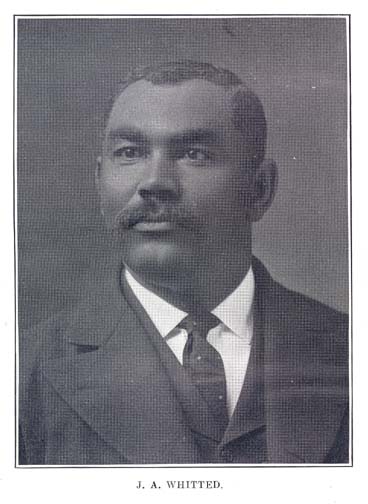
J. A. WHITTED.
A HISTORY
OF THE
Negro Baptists of North Carolina
BY
REV. J. A. WHITTED, D.D.
RALEIGH:
PRESSES OF EDWARDS & BROUGHTON PRINTING CO.
1908
Page 3
TABLE OF CONTENTS.
- CHAPTER I. The Negro Baptists of North Carolina Before the War, . . . . . 7
- CHAPTER II. The Work of the Northern Societies for the Colored Baptists of North Carolina . . . . . 18
- CHAPTER III. The Baptist Educational and Missionary Convention of North Carolina . . . . . 34
- CHAPTER IV. Foreign Missions--The Hayes and Fleming Foreign Mission Society . . . . . 53
- CHAPTER V. The Plan of Cooperation in North Carolina . . . . . 64
- CHAPTER VI. Associations . . . . . 75
- CHAPTER VII. The Women's Baptist Home Mission Convention of North Carolina . . . . . 112
- CHAPTER VIII. The Baptist State Sunday School Convention of North Carolina . . . . . 121
- CHAPTER IX. Shaw University . . . . . 146
- CHAPTER X. Secondary Baptist Schools Established and Maintained by the Negro Baptists of North Carolina . . . . . 166
- CHAPTER XI. Baptist Papers . . . . . 189
- CHAPTER XII. Biography . . . . . 199
Page 4
LIST OF ILLUSTRATIONS.
- J. A. Whitted, D.D. . . . . . Frontispiece
- Rev. Harry Cowan . . . . . 14
- Rev. Thomas Parker . . . . . 14
- Rev. R. H. Harper . . . . . 15
- S. N. Vass, D.D. . . . . . 18
- Rev. C. S. Brown, D.D. . . . . . 32
- G. W. Bullock, D.D. . . . . . 32
- Rev. S. H. Witherspoon, D.D. . . . . . 33
- Rev. A. Shepard, D.D. . . . . . 33
- Rev. G. W. Holland . . . . . 64
- First Baptist Church, Winston-Salem . . . . . 64
- N. F. Roberts, D.D. . . . . . 122
- Rev. G. W. Moore . . . . . 122
- Hon. J. T. Reynolds . . . . . 123
- Rev. A. B. Vincent . . . . . 123
- A. W. Pegues, Ph.D., D.D. . . . . . 128
- Rev. G. W. Johnson, D.D. . . . . . 132
- Prof. R. W. Brown . . . . . 132
- Col. James H. Young . . . . . 133
- Prof. John Walter Paisley . . . . . 133
- Rev. H. M. Tupper, D.D. . . . . . 144
- Charles Francis Meserve, LL.D. . . . . . 144
- Shaw Hall, Shaw University . . . . . 150
- Rev. C. H. Williamson, A.M. . . . . . 196
Page 5
PREFACE
The writer of this little book has fulfilled a long cherished desire, not in its best sense to say a history, but to lay some kind of foundation, so that the historian of the future may have something to build upon and may some day give to the world the facts concerning the service, sacrifice and achievements of the Negro Baptists of North Carolina. While the difficulty in obtaining information at times has caused discouragement and delay, the writer has never engaged in any task which has brought to him so much satisfaction and pleasure, and he will feel amply repaid if the readers find half so much pleasure and profit in the reading. The writer, too, expresses the hope when some other shall undertake to build on this foundation it will not be so difficult to obtain the necessary information. To all who have responded and have furnished data for this book the writer wishes to express his grateful acknowledgment.
Page 6
TO THE NEGRO BAPTIST MINISTRY AND CHURCHES
OF NORTH CAROLINA THIS LITTLE VOLUME
IS AFFECTIONATELY DEDICATED
BY THE AUTHOR
Page 7
A HISTORY
OF THE
Negro Baptists of North Carolina
CHAPTER I.
THE NEGRO BAPTISTS OF NORTH CAROLINA BEFORE THE WAR.
Since communication among the Negroes before the war was altogether verbal, confined to narrow limitations, and since no record was kept of his doings as a churchman, it is impossible to get anything like an accurate statement of his history previous to the emancipation. Since we know that there were in this country at the close of the war four hundred thousand Negro Baptists, and since the Negro Baptists of North Carolina formed a part of that number we know they had an existence of some kind. Considering conditions as they were at that time, and taking the statements as we gather them here and there, it is safe to say throughout the entire South they existed only in connection with the white churches. In the history of the North Carolina Baptist State Convention, by Rev. Livingston Johnson, we get the following in 1837: "The committee on religious instruction of slaves urged that places be provided for them in the houses of worship, and that their religious instruction receive special attention."
Page 8
Relating to another statement in the Convention of 1850 is the following: "The churches of the State are urged to establish schools for the oral instruction of the colored people." In some instances the colored people were allowed to hold services conducted by some member of their own race in some sections and at specified times, but such meetings were usually held under the supervision of a white man, and at his discretion these meetings were brought to a close. In very many instances such meetings were even conducted by a member of the white race. In matters of discipline, especially if a white member was involved, the colored people had no voice whatever. In matters affecting their own number often some colored brother in whom the church had confidence would make reports and recommendations. In compliance with the resolution of 1837, which we have already mentioned, in some instances provision was made in the erection of the church edifice by petition, and in the galleries for the accommodation of the colored brethren. In the communion services, after the bread and wine had been passed to the white brethren, it was passed in turn to the colored brethren. This was regarded by them as a God-sent privilege and a blessing, for which their "Amens" were often loud and lasting.
In that early day even among the white members it was not an unusual thing for a white brother or sister to give vent to their feelings in a hallelujah, and to them it did not seem strange to see tears of joy and thanksgiving flowing down the cheeks of the colored
Page 9
brother. In the appointment of missionaries among the white brethren they were instructed to devote a portion of their time to the religious uplift and instruction of the colored brother, and this they often did very much to their satisfaction. The extent of the work of the missionary and the relations of the races as master and slave, was the question which brought about the separation of the Northern and Southern Baptists in 1845. Among the Southern missionaries and ministers in North Carolina as elsewhere throughout the South there were many zealous Christians, who devoted much of their time to the condition of the colored people so much affected and improved during the days of slavery. It is hard for the biased mind and the prejudiced Negro to see God in conditions such as surrounded the race before the war religiously or otherwise, and yet we verily believe God was in it, and much of the discipline and training which he received in that early day was greatly helpful in the changes which came to him in the days of his freedom and the entire responsibility of work and of worship. It was certainly no disadvantage for one emerged from heathenism to be brought in touch with intelligence in church worship. It took Israel to suffer many cruelties to be brought right close to God, and even then, despite God's wonderful and miraculous deliverance, His people were often found going in the wrong direction.
In many localities of North Carolina special revival services were held for the colored people; often great
Page 10
numbers professed faith in Christ. The Pleasant Plains Church, of Hertford County, and many others had their beginning as a result of such meetings. In the instance of the church just mentioned it was agreed between a white Baptist and Methodist minister that they would unite and carry on a revival meeting. Large numbers professed faith in Christ, and then arose the question to which church they would unite. It was finally agreed that the Methodist should stand on the one side and the Baptist minister should stand on the other, and leave it to the option of the candidate on which side he should pass. As might have been expected at that day almost every one passed over on the side of the Baptist preacher, and the Pleasant Plains Church was immediately set apart. The same minister served them several years. It was not until Rev. C. S. Brown took charge of the school at Winton a colored man was called to serve this church. While the law expressly forbade the use of a book for the colored man, many kind and Christian masters and mistresses would gather the colored people on Sunday afternoons and teach them the word of God. In this way a great number were brought to a saving knowledge of the Christ and followed Him, not only in conversion and regeneration, but in baptism as well. There were but few Baptist preachers before the war. The first we have any knowledge of was "Uncle Harry Cowan," as he was known at that time. He was the servant of Thomas L. Cowan. His master being present at a funeral was so struck with
Page 11
his gift to preach God's word granted him "privilege papers" to preach anywhere on his four plantations. His papers were fixed up by a lawyer and read thus: "This is to certify that whosover is interested about my man Harry he has the privilege to preach and marry also; to baptize any one who makes a profession of faith." His success was so wonderful and so much of the confidence of his master was imposed in him his privileges were soon extended, and he was not only allowed to preach on his master's "plantations" but wherever he was promised "protection." God greatly strengthened his ministry and thousands of his own race and many of the white race heard this man of God in his simplicity proclaim the glad tidings of salvation as contained in the word of God. He preached the gospel not only until peace was declared, but was a leader among the pioneers for many years after the great Civil War. During the struggle in arms between the North and the South he was the body-servant of Gen. Joseph Johnston. He preached every night during the struggle except the night when General Stonewall Jackson fell in battle. Men like "Uncle Harry" were quite rare before the war, and even since few have proven such powers for the salvation of fallen humanity. Seventy years of his life were given to the gospel ministry. During that time he baptized eight thousand persons. There were others as preachers and deacons, men of decided ability and firm character. Though possessed of rare gifts few were granted the privileges granted to
Page 12
"Uncle Harry." With such men it is not surprising that North Carolina even before the war was so strongly Baptist. In Raleigh we find such men as "Uncle Harry," but they were only laymen. Among these we find Todd Palmer, Sandy Pinkin, Henry Jett, Richard Shepard and Jim Adkins. In many other sections of the State such men existed full of faith, of kindness and exhortation. The life and deeds, the midnight prayers of such men, did more to bring the freedom which afterward followed than all other means combined.
We have already said that questions of discipline were almost exclusively left to the white people, but in some instances fairness was shown to the colored brother, and his side received the proper consideration. We record a single instance of this kind. A conflict ensued between a white brother and a colored sister. When the white brother was heard a motion at once was made to exclude the colored sister without hearing her side, but others insisted and it afterward prevailed to hear her side; and when they had heard her side she was justified and allowed to retain her membership.
Notwithstanding there were many obstacles which stood in the way of the religious growth and development of the colored people before the war, there were many devoted Christians among them.
At Louisburg there was a splendid illustration of this fact, together with many others which might be named. Lewis Perry, who was known in that day
Page 13
by white and black as "Dr. Lewis Perry," was the body servant of Dr. Wilie Perry. He was granted papers to hold prayer meetings in Louisburg. He was further granted papers to exhort. His white friends said by all means he should have been granted "a horse and saddle and bridle." His name will always live in and about Louisburg, for his services were not only greatly helpful to his colored brethren but many white people heard him gladly, and were greatly benefited by his spiritual earnestness and instruction. In connection with the white church in which he held membership he was called upon almost invariably at the concluding of the sermon to lead in prayer, and as often as he did the entire congregation felt greatly lifted up through his prayers.
Whenever any colored person applied to this church for membership they had first to secure the permission of "Dr. Perry."
Many revivals were held in the basements of the Methodist and Baptist churches of Louisburg by "Dr. Perry," and many souls professed faith in Christ through these revival efforts, and were added to the church.
An opportunity to worship God was hailed with extreme delight, as was manifest in the sacrifices which they were often called upon to make for the worship of God. Some would give liberal contributions out of their meagre earnings in support of the gospel, and while many since the war would not make the sacrifice to walk a few hundred yards to hear the gospel,
Page 14
there are very many instances in which the antebellum Christians were known to walk fifteen and twenty miles to attend a midnight prayer meeting, and rejoiced for the privilege as a special benediction from above. In many instances these prayer meetings were clandestine and many, after taking such long walks, were hunted down and chased away as disturbers of the peace.
Strange to say, while the Negroes were allowed to dance all night long and were not disturbed, as soon as they began the worship of God often it was claimed they were disturbers.
While much of the religion of former years was sentimental much was sincere and practical. Even in that day of darkness such men and women impressed themselves not only upon members of their own race, but upon those who had the rule over them. Often these old antebellum Christians exerted such an influence when prayer was necessary they were called upon to lead in prayer. Instances can be recalled of some who were called to the bedside of their dying masters to offer the last sad rites. Some of the preachers who came in contact with such devoted men and women became devoted to them, and despite the changes which followed the war this devotion lasted through life. We have already mentioned the strength and devotion of some of the Raleigh members. Such a Christian spirit grew up between them and their white brethren when the time came for a separation they refused to go out from their white

REV. HARRY COWAN, Pioneer in Baptist Work in North Carolina.

REV. THOMAS PARKER, Moderator Kenansville Eastern Association.
Page 15

REV. R. H. HARPER, Bear Creek Association.
brethren, and remained with them for several years afterward. The property now owned by the colored First Baptist Church was offered to them soon after the war, but they refused to leave their white brethren and it fell into the hands of the Roman Catholics. In the special Providence of God after many years of worship near the Seaboard workshops, the Roman Catholics sold out to the colored Baptists and they at much sacrifice erected the beautiful church on the corner of the street southeast of the Capitol Square. The instance mentioned of the affection between the colored and white brethren growing out of these church affliliations is but one of many. So strong was the relation in the case of individuals that many retained their membership among their white brethren until their death.The dawn of freedom brought many changes in the church relations as well as otherwise. The prayer which these fathers prayed was "Grant the day Lord when we may worship God under our own vine and fig tree," and this prayer meant to them a separation from the white churches. Rude houses of worship were erected in every section, and where they were unable to erect houses brush arbors were thrown together, and in many instances they were content to worship under the trees. This new privilege was hailed with extreme delight everywhere, and in North Carolina as elsewhere. The fervor and devotion of the old slave father was unabating, and for years afterward it looked as if the promise of undying service
Page 16
would find in them a fulfillment. Licenses and ordinations became general, and soon there were many although unlettered who went forth in their rude way telling the joyful tidings of salvation. One of the saddest changes in the history of the denomination was to see with the growth of education and other improvements new demands for a more intelligent ministry, and to see these old landmarks falling out one by one, and men of better training taking their places. Only a few of these old ministers survived in the midst of these changes. Most of them outlived their generation. In nearly every instance when these changes became necessary the old leader would yield with extreme reluctance. It should be said that no men in any age have done more for their opportunity than these old ministers coming to the church emerging from slavery.
Some of them lived to see the brush arbor removed, and the log church erected instead, and even the log churches taken away and frame and brick churches erected. The history of Rev. G. W. Holland, of Winston-Salem, gives an instance of this kind. Not only did he remove from the brush arbor to the frame church, but from the frame church to the beautiful brick building in Winston, a monument to his energy and faithfulness. He lived not only in the memory of the old people like himself, but retained up until his death a place of highest esteem among the young people of his church and community.
Page 17
Having set apart twenty-eight Baptist churches, and having erected the beautiful structure mentioned, full of honors and noble deeds he passed with the fathers to his home of peaceful rest.
Rev. Thomas Parker was another example. Possibly in his day he baptized four thousand persons. Passing through every kind of trial and distress, he lived in spite of opposition and changes of every kind. At the time of his death he was the pastor of four of the largest churches of the Kenansville Association. For thirty years he was the Moderator of this Association.
It is easy to appreciate improved conditions when they are in evidence, but the world soon forgets those who have labored to lay a foundation. Taking everything into consideration the early fathers of the churches coming out of the little work done before the war, and taking into consideration the ante-bellum Negro Baptists, the churches for the generations to come owe them a debt of deepest gratitude.
Page 18
CHAPTER II.
THE WORK OF THE NORTHERN SOCIETIES FOR THE COLORED BAPTISTS OF NORTH CAROLINA.
THE AMERICAN BAPTIST HOME MISSION SOCIETY.
The American Baptist Home Mission Society, which was organized 1832, contemplated the uplift of all classes and conditions of the people. The Negro, although enslaved, naturally appealed to such an organization. The society, being an important factor in the general Convention of Baptists, North and South, did much in and through the early missionaries appointed to reach the Negro with the gospel. Much of the religious development and improvement, even in that dark period, may be traced to the work and influence of the society in the Negro's behalf. Much of the splendid results reported from year to year may be traced to the field work in North Carolina. It was the anxiety of the Home Mission Society, together with other Northern Baptists, which led to differences concerning this missionary work and to the final separation of the white Baptists North and South, and caused the organization of the two distinct bodies. The North contended that the institution of slavery in any form was wrong, and should be discouraged, especially by the Southern church member; the South contended for the continuance of

S. N. VASS, D.D., Superintendent of Work Among the Colored People under the American Baptist Publication Society.
Page 19
slavery, and hence separation was the inevitable result.
Not only was this upheaval in the ecclesiastical councils, but the entire nation was stirred, and in almost every question which came before the Congress of the nation the question of slavery was injected. The clash of arms was the final outcome, and victory on the side of the Federal troops after one of the most bitter struggles the world has ever known.
To the society as well as others this seemed to be the hand of God. The door of opportunity was thrown wide, and among the first Christian organizations to enter the work of uplifting the homeless, ignorant Negro was the American Baptist Home Mission Society.
Others who became lifelong benefactors to the cause of education at Shaw were influenced through the society. Being the first institution of its kind in North Carolina, not only were the Baptists greatly benefited, but every denomination in the State owes something of its power and usefulness to the men in its ranks sent out from Shaw University. The great founder of Livingstone College at Salisbury, Dr. J. C. Price, laid the foundation for his education at Shaw University; and often referred to this beginning as the foundation for the inspiration which made him the man he was. While Shaw University was established as a Baptist institution it was always quite liberal, and many hundreds of all the denominations gathered there for instruction. It was only in the
Page 20
Theological Department that the distinctive principles of the Baptists were taught, and even there representatives of other churches were gathered and better prepared to preach the gospel to their own people.
If the American Baptist Home Mission Society had done no more than to give to North Carolina colored Baptists Shaw University and H. M. Tupper, that would have been a wonderful blessing. In the twenty-five years of Dr. Tupper's active and untiring service not only was he permitted to see the blessed light of intelligence in the Normal, Classical and Theological Departments, but Law, Medical and Pharmaceutical Departments. It is said that Rev. Tupper was called to the bedside of a poor colored woman in Raleigh, and upon inquiry found out that she had no doctor in attendance, and the reason was that she could not pay any doctor for lack of means, and hence had to be neglected. From that hour he decided on the Medical Department to prepare men of the colored race for this work. It has been further stated that his own embarrassment before the courts of Raleigh in the long trials he was called upon to meet and his difficulty to secure lawyers to defend him, led to the establishment of the Law Department.
Besides the educational work carried on by the society, missionary work was instituted from the beginning of its operation in the State.
The new condition afforded them an opportunity to prosecute the work of missions, not to the slave Negro as before, but to the Negro freeman. Not
Page 21
merely to confine itself to missionary work, but to the erection of buildings for their education and general uplift. God moved upon the hearts of many noble men and women, not only to give their money to carry on this work, but to give themselves to volunteer service, both to preach to them the gospel, and to teach them in the day and night schools. The attention of the Northern philanthropist was turned to the helpless Negro in the Southland, and the society seized every opportunity to combine its forces, and while for a time much opposition was manifest to the new project, in the providence of God it was overcome, and soon the society began to pour its blessed treasures in North Carolina together with other Southern States.
It was the good fortune of North Carolina to have as its first volunteer Rev. Henry Martin Tupper, who, in the special Providence of God, saw much of the needs of the colored people while fighting in behalf of the Union and the freedom of the Negro. The argument which overcame the opposition which we have mentioned in the ranks of the society, was the fact that the education intended was to prepare men and women to teach in the schools, and especially to prepare men of the Negro race to preach the gospel to their own race. At first, according to the resolution which settled the conflict, only such money could be used even in this work as should be sent into the society specified for the mission work and education for Negroes. While everlasting gratitude is due to the heroism, ability and energy of Rev. Tupper, still
Page 22
more is due to the American Baptist Home Mission Society, which made it possible for Rev. Tupper to do the great work he did at Shaw University.
Five hundred thousand dollars were contributed by this society besides other gifts from other sources to the establishment and maintenance of Shaw University previous to the year 1908. The society not only gave out of its treasury the magnificent sum just mentioned, but opened up the way for Rev. Tupper to reach others throughout the North.
Considering the destitute circumstances and conditions of the people so recently emerged from slavery, nothing could so stimulate and strengthen all classes as the missionary who was thrown in daily contact with the people in their homes, churches and elsewhere. With the advantages of education the missionary was quite an improvement to many of the pastors in the churches, and his message was both encouraging and enlightening. He was not only required to go into the towns and cities, but in the rural sections. His work was not only to preach in churches already established, but to go where there were no churches and establish them. Many churches owe their existence to the missionary work of the American Baptist Home Mission Society. The society not only gave the missionary for this kind of work, but in many instances gave from their Church Edifice Fund the money to pay for its erection. In some instances this money was borrowed, in others it was given, just as the individual case demanded. Self-dependence
Page 23
was the instruction given to the missionary; and it proved far better where the churches were taught self-support. Indulgence in some cases proved detrimental not only to the church, but to the society. Like the Missionary Colporter of the American Baptist Publication Society, the missionary of the Home Mission Society was instructed to hold special revival services with the pastors and churches, and in this way many thousands were added to the churches through conversion in these meetings. Some of the strongest and best men in church work came to Christ through the preaching of the Home Mission Society's missionary. The Scripture that says "Iron sharpeneth iron" was often verified in the missionary of the society and the country pastor. This proved very helpful to the pastor and the church, as so many were deprived of the opportunity of an education.
While the Southern Baptist Convention, the Baptist State Convention of North Carolina formed a part of the cooperative forces in the plan of cooperation in North Carolina, it had its foundation largely in the Home Mission Society. Dr. Henry L. Morehouse, who was then corresponding secretary of the society, drew the entire plan, together with the courses of study laid down in the original plan. If the society had done no more for the colored Baptists than to formulate this plan and bring about the combination of the white Baptists South with the Negro Baptists for the prosecution of cooperation, that of itself would have been a wonderful assistance, for of all
Page 24
the work done from the Emancipation in 1863 to 1908, the few years of cooperation proved to be the most helpful. North Carolina Baptists hardly seemed like the same people. At once they took the lead of all the other denominations numerically, and in educational and missionary work.
The reports of the different secondary schools at the close of the time of the plan of cooperation showed that fifty thousand dollars were raised annually by the colored Baptists of North Carolina in support of their schools.
From 1900 to 1908 the society not only gave support to Shaw University but gave partial support to Waters' Normal Institute at Winton, N. C., the New Bern Industrial Institute at New Bern, N. C., and the Thompson Institute at Lumberton, N. C. But for the aid given these schools they could never have proven the blessing they did prove to their communities.
The American Baptist Home Mission Society did so much for the colored Baptists of North Carolina and in so many ways it was thought by some of the Baptists of other States that the society was partial to North Carolina Baptists, and to an extent the charge was doubtless true, for it was claimed by certain leading Home Mission Society representatives that the Negro Baptists of North Carolina were the most grateful and loyal people with whom they were associated in Christian and educational work, and
Page 25
hence they were necessarily inclined to do more for North Carolina.
When the disposition of many Baptists in other States and a few in North Carolina was to criticise and turn away from the society, the great majority of North Carolina Baptists stood firm and unchangeable in their high esteem and loyal support of the Home Mission Society. "Cooperation with religious bodies for the advancement of the Master's kingdom and economy in Foreign Mission work" was the watchword throughout North Carolina; and although at times the contest was bitter, even with some of the brethren of the extreme eastern and western sections of the State, the Convention stood firm and true to the great and good people of the Home Mission Society, who had stood by them in times of greatest need, and who stood ready all the way to lend the same helping hand. It was rather a sad spectacle in North Carolina to see a few men educated in the schools of the American Baptist Home Mission Society turn away with the basest ingratitude, and with their greatest efforts, though feeble at best, strike back at the society. The sincerity of the rank and file was so manifest, and God's bountiful blessing to the grateful was so constant, the opposition which at a time was so threatening soon passed away and the Baptists of North Carolina declared in unmistakable resolution their abiding faith and loyalty to the Home Mission Society and its interests in North Carolina and elsewhere as far as they were able. This spirit
Page 26
paved the way to the society's partial benefactions and to their decided and rapid growth and development along all lines.
Others may with ingratitude turn away from the Home Mission Society, but for all time the rank and file of Negro Baptists of North Carolina will hold in grateful remembrance and appreciation the great Home Mission Society which did so much to shape their destiny.
THE AMERICAN BAPTIST PUBLICATION SOCIETY.
As soon as it was practicable, after the emancipation of the negroes of North Carolina, together with the Negroes of the rest of the Southern States, the American Baptist Publication Society, with headquarters in Philadelphia, began its colportage and missionary work among them. The organization of the Sunday School forces of North Carolina is due more largely to the work of this society than to all the other forces combined. The State Sunday School Convention of North Carolina owes its existence to the society. Its first representative in North Carolina was Rev. E. E. Eagles, the ablest representative of his day. With his exceptional ability, though ignorance and superstition had lordly sway, much information was gained through his teachings and still more through the distribution of Bibles, tracts and other literature. Rev. A. Shepard, then a student at Raleigh, was appointed to the same position, and it
Page 27
was through his labors that much strength was given to the new organization. Rev. Shepard undertook to strengthen the parent body by the organization of the different counties of the State into county conventions as auxiliaries. Out of these organizations came the Oxford Orphan Asylum, which has since been turned over to the State as a State institution. Hence it may be said also that the colored Orphan Asylum of Oxford, N. C., owes its existence to the American Baptist Publication Society as well as the State Sunday School Convention.
While the American Baptist Home Mission Society of New York has done its work in North Carolina among the colored people along educational lines, secular and Christian, and through its missionary effort in the churches, side by side the Publication Society has done its work through the Sunday school missionary and the printed page.
All of the leading ministers of North Carolina among the Negro Baptists owe in part their preparation to the help given them by the Publication Society. Many of them were furnished libraries from which the greater part of their instruction was derived.
Thousands and tens of thousands have been brought to a saving knowledge of their Redeemer through teachings coming to them from the tracts and other religious literature sent out by the society. Not only have many been thus brought to a saving knowledge of Christ, but much of the soundness of their faith
Page 28
is due to this wholesome influence and instruction. Indeed, it proved an efficient means of disseminating the principles as taught by the Baptists.
Emerging from the bondage of slavery, with faint ideas of homes and home training, one of the greatest needs after securing some place which might be called by the name of home, the next greatest necessity was the proper training in the home. The work as outlined and followed by the society met this condition as nothing else could. The duty as specified to the colporter was not only to leave the literature in the home but a prayer and the necessary instruction, and hence much valuable information came to the people through this medium, which in many instances did more than the printed page which was many times cast aside in his absence, while the truth to the unlettered coming into his hearing found its way into his heart, his life and his character.
THE CLASS OF MEN APPOINTED BY THE SOCIETY.
The society could never have accomplished so much among the colored Baptists of North Carolina but for the class of men appointed to do its work. Almost without an exception the men proved themselves to be men of rare ability, Christian piety and devotion. We have already mentioned Rev. E. E. Eagles, the Baptist veteran of his day, and following him Rev. Augustus Shepard, who spent eighteen years in the society's service. He not only wielded great power in the Sunday School work, but was equally serviceable
Page 29
in the church Conventions. Possibly no one man in his day has done so much to lift up the people as did this pious servant of God. Then following him was Rev. A. W. Pegues, Ph.D.; although serving but a short time took up the work where Rev. Shepard left it
Rev. P. F. Maloy held the position for the same length of time as did Rev. Pegues, Rev. Joseph Perry, Rev. M. C. Ransom, Rev. C. H. Williamson for short periods. Then came Rev. G. W. Moore and Rev. A. B. Vincent. These two held the place for a number of years, and with these years accomplished great things along Sunday School lines. For two years Rev. J. W. Faulk, Jr., was associated with the work in the eastern section of the State. North Carolina Baptists proved their appreciation to the society to that extent that they enjoyed not only the appointments mentioned but one of the district secretaries, Dr. S. N. Vass, was born in North Carolina, and, although partly educated in an Episcopal institution, reading one of the tracts of the society saw what seemed to him the only right way, became a Baptist, and after completing his education was appointed to serve as missionary in Virginia, afterward appointed District Secretary for the Southern States.
From the beginning Rev. Vass showed rare ability, but with the advance of years he proved to be one of the ablest men of the entire race throughout the country. By the organization of a publishing company of colored men in Nashville, Tenn., and this organization
Page 30
having behind it the National Baptist Convention required able management and skill to enable the Publication Society, which it was claimed was a white concern, to hold its place in the estimation of the colored people, but Dr. Vass proved himself equal to the occasion, and, while much of the patronage of the colored people was given to the Negro Publishing House, much was left to the American Baptist Publication Society through the influence of Dr. Vass. In fact, with the extension of the Sunday School work in North Carolina among the colored people, with their growing intelligence and increasing demands for Sunday School literature, even with the introduction of the Negro Publishing House literature, the American Baptist Publication Society maintained its usual hold in point of Sunday School supplies.
After a lapse of years, just as it should have been at first, both houses received recognition according to the wishes of the individual, or according to the merits of each as seen by the schools.
SUNDAY SCHOOL INSTITUTES.
With the State Sunday School Convention fully organized and cooperating with the society in doing its work in the State; with County Conventions in every section, and with its literature spread in every destitute corner, the society found it necessary to undertake a new kind of work from the missionary and colporter. In fact the people asked for more advanced Sunday School work, and the institute plan
Page 31
was adopted and proved to be very effective in sending out men and women in the different sections better prepared and inspired to do the work of teaching in the schools. The missionary was not only seen with his budget of books but with blackboard and other facilities holding Sunday School Institutes. To meet the demands the society arranged general meetings with the missionaries of other States so as to better prepare all for their special fields, and it was not long before the schools were filled with better men and women who received much of their instruction and inspiration from the institutes. Fortunately the Home Mission Society, cooperating with the Church Convention, just as the Publication Society was cooperating with the Sunday School Convention, was holding just such meetings in connection with the churches, and sometimes even joint meetings were held, which enabled the colored Baptists of North Carolina to leap into prominence and usefulness both in their church and Sunday School work. Through such influences many strong men and women were sent forth as leaders, not only to meet the demands of the State, but in other States, and as missionaries into the regions of dark Africa.
EVANGELISTIC WORK.
We have already mentioned the many thousands who were converted to Christ through the work of the society in the distribution of its literature and its missionary work, but as in the instance of the demands
Page 32
for institutes there came as well a demand for direct means of bringing the children to a saving knowledge of Jesus. And, too, at that time evangelism was the watchword in nearly every section of the country, especially among the white Baptists of the North and West. The missionaries sent out conjointly by the society and the State Sunday School Convention were instructed to hold evangelistic meetings wherever it was practicable to do so. Such meetings always proved very helpful, and many who afterward became great leaders in Sunday School and church work were converted in these meetings.
From 1902 to 1908 the reports showed that the society paid out to its missionaries and to the District Secretary for salaries three thousand dollars a year.
When it was considered that this Christian organization began with the colored people in the days of their adversity, and did so much for them in that dark period, it is not surprising that their gratitude was too deep to turn away from them in later years.
North Carolina took the lead of all the States in its manifestation of gratitude. At the time when it looked as if all the States among the colored people would turn away North Carolina held firmly on, and while much patronage was given to the other house the orders increased to the American Baptist Publication Society. The Children's Day exercises were encouraged, and comparatively large sums were sent

REV. C. S. BROWN, D.D., President Waters Institute. President Lott-Cary Convention. President Educational and Missionary Convention of N. C.

G. W. BULLOCK, D.D., Former District Missionary, Western North Carolina.
Page 33

REV. S. H. WITHERSPOON, D.D., Corresponding Secretary Educational and Missionary Convention of North Carolina.

REV. A. SHEPARD, D.D., Pastor White Rock Baptist Church. Ex-Sunday School Missionary for North Carolina.
up from the different Sunday Schools of the State; yet it was admitted that the great good done by the society in the general uplift of the colored people of North Carolina, as well as elsewhere, could never be repaid in dollars and cents.
Page 34
CHAPTER III.
THE BAPTIST EDUCATIONAL AND MISSIONARY CONVENTION OF NORTH CAROLINA.
The Baptist Educational and Missionary Convention of North Carolina was organized in Goldsboro, N. C., in the year 1867. There were present at this organization Revs. Edward Eagles, C. Johnson, William Warwick, L. W. Boone, B. B. Spicer, H. Grimes, John Washington, Charles Bryant, Sutton Davis and R. H. Harper. To have seen these few fathers gathered with no experience in Christian work, recently emerged from slavery, no money, brush arbors and log churches in most cases, should cause the Baptist hosts of after years to look with supreme admiration and gratitude upon the sacrifices and arduous labors of the "fathers in Israel." We have been informed that there were a few of our white Baptist brethren in attendance at this first meeting of their colored brethren and helped them to plan the organization and advise for its future operation. It was evident that the organization of churches was imperatively necessary, and this the new organization determined to do. With the few ministers in the Convention and in the State, it was further evident that "more laborers were needed in the Master's vineyard," and for this the brethren earnestly prayed. In some sections it has been charged that the colored Baptists
Page 35
fostered ignorance, but as an argument to the contrary in this first organization the purchase of suitable books was urged, and an intelligent ministry as the greatest necessity.
All the ministers present were authorized to do missionary work in their immediate vicinity, and as extensively as their opportunities would allow. Although the beginning was meager and such as to dishearten and discourage weaker men, these fathers were by no means daunted. They had strong faith in God, and He in His all-wise Providence permitted many of them to see a wonderful development and growth before He took them hence to their eternal reward.
From the beginning the negro Baptists of North Carolina have felt that their white brethren, with superior advantages, could be of substantial aid to them in their religious and moral development, and they invited representatives to meet with them even in their organization of the Convention. In the annual meeting of the white Baptists at Wilmington in 1867 the request was granted; the brethren were present and rendered valuable service, bidding Godspeed to their colored brethren.
From that day there existed ever afterward the kindliest and most friendly relations between the two Conventions in North Carolina, the white brethren often going to considerable sacrifice to serve them with advice, with instruction and with their money.
As early as 1865, immediately following the bitter
Page 36
struggle in arms between the North and the South, they seemed to have lost sight of the fact that the Negroes had been their slaves, and, together with their Northern brethren, despite their poverty and discouragement, growing out of the bloody contest in arms, they sought every opportunity to do the colored brother assistance.
The records of the white Baptists will show that a resolution was passed in their first Convention following the Emancipation, which reads as follows:
"The brethren realize that a new responsibility is thrust upon them by the emancipation of the slaves, and pledge themselves to do all in their power for the religious and educational development of the Negro." 1876. "We would urge upon our pastors and churches the importance of prosecuting, so far as possible, the work of giving religious instruction to the colored people among us, and we request our mission and Sunday School brothers, as far as practicable, to give aid in organizing and expanding among their Sunday School and church privileges."
This was further shown in the struggle of North Carolina colored Baptists to maintain the principle of cooperation with the religious bodies; the white Baptists of the State stood firmly by them with their moral and financial support. While the plan of cooperation emanated from the North, the Southern white brother was ripe for such helpfulness, even prior to the plan.
Page 37
A resolution passed in the white convention, Goldsboro, and $500 was appropriated to conduct Institutes for the colored Baptists of the State.
With all the aid which came to the Negro Baptists of North Carolina, with ignorance, poverty and discouragement staring them in the face, and with conditions as the results of war, and a people set free with no homes, clotheless and often foodless, their struggles were often bitter and disappointing.
They had only the assurance that they were building upon a sure foundation--the eternal word of God; and like the Apostle to the Gentile world they rejoiced that they were "counted worthy to suffer affliction" for the cause which had brought to them light, life and salvation, and they meant as best they could to blaze their way through the dense wilderness, and tell the story which has since made many thousand rejoice together with them.
For many years comparatively little was accomplished. The growth was necessarily slow, but sure.
The annual reports were informal, and yet these annual meetings were often attended with great spiritual awakenings.
It may be said of the Convention, for thirty years after its organization it was a period of construction.
In many of the rude structures, about which mention has been made, great revivals broke out and souls were brought into the church by the thousands and tens of thousands.
Page 38
It was a feast at the close of each conventional year to hear these fathers and pioneers of the Convention telling of the presence of God in their early revival meetings.
Rev. John Washington was the first missionary sent out by the Convention. There were others whom we have mentioned laboring for the Publication Society. It is claimed that Rev. E. E. Eagles, the first missionary of the Publication Society, organized the Convention. If not, he was a great stimulus to the work, having superior advantages over most of his brethren. Rev. F. R. Howell was the second.
Rev. Howell's services as missionary added much strength and force to the Convention. Especially did his reports give the much needed information respecting the field, and caused extension of missions into unknown sections of the State.
The Convention was so stimulated and enthused through the work done and the reports of Rev. Howell until they were encouraged to appoint Rev. P. F. Maloy to succeed him as their missionary.
While Rev. Maloy was not faultless, he had superior advantages over Rev. Howell, and in many respects proved to be an ideal missionary. The appointment of these men was in the line of that Providence which was shaping the Convention for great future usefulness.
The work of the missionary was by no means so definite as in after years, and possibly it was well that it should not have been, as it left room for that
Page 39
service so necessary to meet the demand of that early stage.
Rev. A. B. Vincent came in just previous to the "Plan of cooperation." During a part of his time, as we have mentioned, the white Baptists made appropriations which were supplemented by the colored Convention, and some of the leading colored brethren volunteered their services in connection with the regular missionary, which greatly assisted him in the preparation of the different sections for the splendid gift of cooperation. It may be said, too, even prior to the appropriation of the white brethren the colored people in some sections realized the necessity of a better and a more united ministry and formed Institutes. We recall especially such meetings held by the brethren in and about Warrenton, Louisburg and in other places. Rev. T. J. Taylor, the pastor of the white Baptist Church of Warrenton, attended all of these meetings, and it was doubtless his acquaintance with the plan which led to the resolution which he offered in the Goldsboro Convention appropriating $500 to this kind of work among the colored people.
Just as the Biblical Recorder was the greatest means of organizing and strengthening the white Baptists, and which did more than all the agencies to make them what they were, so different papers representing the colored Baptists proved the same efficient means of shaping, developing and making them what they became in after years.
Page 40
At different times the Gold Dust, the Baptist Headlight, the African Expositor, the Chowan Pilot and the Baptist Sentinel.
It was unfortunate that there were so many papers, but under the circumstances these papers would but blossom, bear an early fruitage and then die. The Baptist Sentinel, like the others, though passing through biting frosts and bitter cold, came into existence to live; and despite circumstances did live, not only strengthening the State Convention, but all other organizations throughout the State which were intended for the betterment of the Baptist cause; while the annual collections of the Convention increased and many other improvements, both in point of increasing membership and better plans of work, but there was nothing like the proper organization of the forces until the meeting of the Convention at Garysburg. It was there through the plan drawn up by Dr. A. W. Pegues that the Convention organized itself into Boards which proved greatly in advance of any plan which had before been tried. The work of the Boards greatly paved the way to the plan of cooperation which soon came into existence. The death of Rev. Z. Horton was announced at the Garysburg meeting. Rev. Horton was one of the pioneers of the Baptist work of North Carolina. Suitable resolutions were passed.
An effort was on foot at this time to raise twenty-five thousand dollars, an endowment to the presidency of Shaw University. Dr. N. F. Roberts, Prof. S. N.
Page 41
Vass and Prof. A. B. Vincent canvassed the State in the interest of this project.
The Convention gave liberal contributions to this fund. It was in the Oxford meeting that the plan of cooperation was submitted and voted upon by the Convention. There was comparatively no opposition to the plan.
The general missionary and the three district missionaries were voted upon and accepted by the Convention, and the wheels set in motion for that forward movement which meant more to North Carolina than all the efforts of its past thirty years. With four of the Convention's ablest men going from place to place throughout the State, doing special missionary work, holding Ministerial Institutes, and doing house to house service, it could not serve otherwise than produce wonderful improvements and changes. It was soon evident that the colored Baptists would make history for themselves, and correct the oft-repeated story that the "Negro Baptists had no men of note." The missionary was hailed with delight in sections where he dare not go before, and it could be said in reality that the wilderness was blossoming as the rose. The fact that the great Home Mission Society of New York, the Southern Baptist Convention, with headquarters in Atlanta, and the white Baptist State Convention of North Carolina, together with the colored Convention, were behind these men, not only gave to them financial support but moral support as well; besides greatly stimulating the men
Page 42
themselves, and enabled them to do a work they could not otherwise have done.
To them it was not a question of where their salary was coming from, it was provided for in the plan. It was theirs to do their work, to do it proficiently, and at the close of each quarter and of each year to render accurate reports of work done and results as far as they were able to gather them. The results were good as evidenced on every hand. Not only did the missionary see them but the most casual observer.
Possibly no better example could be furnished than in Lumberton, where the Baptist people simply leaped into prominence materially, morally and spiritually. Not only were the colored people led to rejoice for splendid harvests and for the broad foundation, laid through their work, but their white brethren throughout the State, the North and the South rejoiced with them. The colored brother was so awakened, not only to his own advancement, but rejoiced as he read the annual reports of the white Convention at their constant and decided growth.
It was not surprising at the close of the three years that the vote in all the cooperating bodies should have been so unanimous for 'three years more of cooperation."
The thirty-third annual session of the Convention was held in the First Baptist Church of Rocky Mount, N. C., Dr. A. Shepard, of Durham, N. C., presiding. Dr. H. L. Morehouse, of New York City,
Page 43
representing the American Baptist Home Mission Society; Dr. W. M. Alexander, of Baltimore, representing the Lott-Carey Convention, and Dr. J. M. Armstead, of Portsmouth, representing the Baptists of Virginia, were present and made able speeches on the special objects they came to represent. After the speech of Dr. Morehouse on Cooperation, which had been prosecuted in the State for three years, the Convention unanimously voted to continue the work for three years more, pledging its loyal support. The Convention also voted to assume the responsibility of a teacher in the Theological Department of Shaw University. The report of the treasurer showed that two thousand, six hundred and twenty-four dollars had been raised during the year.
The new year began with bright hopes; the Convention appointed Rev. R. B. Watts, of Wilkesboro, to labor in the western and mountain section of the State, with instructions to give as much time as practicable to the section of the State beyond the Blue Ridge Mountains.
Rev. C. C. Somerville, who had labored so successfully as District Missionary for Eastern North Carolina, sent in his resignation to take effect October 1, 1899. His place was filled by the appointment of Rev. W. T. H. Woodward, of Littleton, N. C.
In the New Bern Convention, at the St. John's Church, Dr. C. F. Meserve made an able plea in behalf of Shaw University, and Rev. John E. White, the Corresponding Secretary of the Baptist State
Page 44
Convention (white), made a great talk as he usually did at the annual Conventions, on the subject "Strengthen the things that remain." Dr. White never lost an opportunity to help the colored people, and especially the colored Baptists of North Carolina, and he as no other man always made a profound impression on our Conventions.
The saintly Miss Joanna P. Moore, of Nashville, Tenn., was also present, and since she had done more than they all in behalf of the colored people, not only in one respect, but in all that pertained to their general uplift, like her blessed Savior, who gave His very life for humanity. The Convention heard her with breathless silence and appreciation. The Ministerial Union, which had been organized many years previous and had gone down, was revived at this meeting with Rev. R. H. Harper, of LaGrange, President; Rev. W. R. Mason, of Weldon, Vice-President; and Rev. S. H. Witherspoon, Secretary. The amount of the annual collections had increased a thousand dollars over the previous year. The Convention changed the time of the annual meeting from October to November, just one month later. This was an unusual year for the colored Baptists as well as for the colored people of all the denominations; especially in the eastern section of the State. A political upheaval such as the State had not known before was felt everywhere, and much of the enthusiasm of previous years was lost; many of the colored people as a result moved to other States, and hence the work
Page 45
so fairly under way was greatly retarded. And yet, according to the opinion of many men of eminence of the opposite race, cooperation in the State at such a time was providential and a great blessing. Such able representatives as the Convention had in the field and representatives of the two races, often brought together as they were in the meetings held over the State, kept up a better understanding than would have prevailed, and hence did much to remove the bitterness and friction which doubtless would have otherwise been manifest. If this was true, and we have reason to believe it was, if cooperation had done no more than allay race feeling, which was already exceedingly harmful to both races, that of itself would have been worth the amount of money expended for its maintenance. Rev. D. J. Moore, of Emerson, N. C., and Rev. A. Ellis, of Waco, N. C., were appointed to labor respectively in the southern and western sections of the State in behalf of the Convention.
Dr. C. L. P. Taliaferro, of Philadelphia, Editor of the Christian Banner, and Rev. I. Toliver, of Washington, D. C., were in attendance at the next annual session of the Convention at Franklinton, and were elected honorary members. A. W. Pegues, J. A. Whitted, E. E. Smith, C. Johnson, C. S. Brown and I. W. Holden were appointed a committee to petition the Legislature in its session following in behalf of a reformatory for youthful criminals of the colored race.
Rev. John E. White, about whom reference has already
Page 46
been made, had received a call to the Second Baptist Church of Atlanta, Ga., gave his farewell address to his colored brethren, and those who were so fortunate as to hear that address will never forget the impression it made on the Convention.
Following this meeting of the Convention Rev. P. F. Maloy, who had been the Western District Missionary since cooperation had been inaugurated, accepted the call to the Friendship Baptist Church of Charlotte, N. C., and was succeeded by Rev. G. O. Bullock, who proved to be eminently successful in putting new life, interest and confidence in the work throughout the entire West.
Like his predecessor Rev. Livingston Johnson, the Corresponding Secretary of the white Convention, met the Convention in its annual session at Lumberton. Rev. Johnson soon convinced his brethren that he was indeed a worthy successor of a great and good man. It was in the Lumberton Convention that efforts were put forth to bring about a closer union between the Educational and Missionary Convention and the Woman's Convention. Representatives of both Conventions met and held conferences on plans for a closer union. One of the plans adopted was to have a board of supervisors appointed by the Educational and Missionary Convention, whose duty it should be to advise the women in their work. A. Shepard, A. B. Vincent, J. R. Cozart, G. W. Moore and C. C. Somerville were appointed a committee to represent the Convention in the Negro Young People's
Page 47
Congress to be held in the interim of the Convention in Atlanta, Ga.
The report of the treasurer showed that six thousand eight hundred and eighty-one dollars had been raised for the different objects of the Convention during the year, which was an evidence of the rapid growth of the colored Baptists of North Carolina.
The Negro Young People's Congress, which met in Atlanta in August of that year, was by far the greatest gathering of intelligent Negroes known in the world's history. A fair estimate placed the number at eight thousand. This was a splendid opportunity to demonstrate the strength of the Negro Baptists, not only of North Carolina, but of the United States. The place they filled on the program and in the Convention bore evidence of their superior standing in the entire race of the country. This fact gave them much inspiration and encouragement. The plan of cooperation contemplated smaller appropriations from the white organizations cooperating with the colored Baptists, which necessitated larger appropriations from the colored people themselves. Realizing the great good which the plan had brought to the cause the brethren rallied manfully. Their educational work, which had too increased their burdens, made it but the harder to support the cooperative work, but they kept good their obligations, and thereby increased the confidence of their white brethren, North and South. Eight thousand dollars were reported in the Durham Convention, which exceeded any report previously
Page 48
made. This did not include the amounts raised for educational purposes. It was always difficult to get an accurate report from the different associations as it was well-nigh impossible to get all the associations in the State to report to the Convention. Some out of opposition, some from indifference and several because of the spirit only to foster and support objects at their doors. Rev. W. T. H. Woodward, failing in health, resigned as District Missionary for Eastern North Carolina. Like Dr. Somerville, Rev. Woodward did a lasting work in the eastern section of the State, and brought many in touch with the work who had not previously supported it. Rev. D. J. Avera, of Lumberton, N. C., was appointed to succeed Rev. Woodward. Rev. A. B. Vincent, who had held the place of Central Missionary, resigned his work to do pastoral work at Oxford. The eastern and western sections were extended, which made the central section smaller, and the General Missionary took this section together with his duties as General Missionary. The Kinston meeting suggested many changes. Dr. E. E. Smith was elected as one of the editors of the Baptist Sentinel. The American Baptist Home Mission Society submitted a proposition to the Convention relative to Shaw University. The Home Mission Society agreed if the colored Baptists of North Carolina would raise five thousand dollars for Shaw University they (the Home Mission Society) would give thirteen thousand dollars
Page 49
for a Tupper Memorial Building and Estey Seminary annex. The proposition was accepted, the place of General Missionary abandoned, and the Corresponding Secretary was appointed to raise the five thousand dollars within the limited time of two years. The Secondary Baptist Schools of North Carolina were formed into a confederation to receive support in part from the Convention. Although the amount of money which each school received was very small yet it stimulated the schools while it greatly increased the interest in the Convention from the different sections where these schools were located.
Very much to the regret of the Convention Rev. G. O. Bullock resigned as District Missionary for the western section to take charge of the pastorate of the Friendship Church, Charlotte, vacated by Rev. P. F. Maloy. Dr. S. H. Witherspoon, of the Ebenezer Church of Charlotte, was elected to take the place made vacant by the resignation of Rev. Bullock. After serving one year in this capacity Dr. Witherspoon was promoted to the position of Corresponding Secretary. Rev. D. J. Avery left the eastern section for the pastorate, and Rev. L. T. Bond was elected at the Wilmington meeting to succeed him. It was in the Salisbury meeting that the Convention heard with profound regret of the death of Rev. G. W. Holland, of the First Church of Winston-Salem, N. C. Few men had done more than Rev. Holland both in the extension of the church work and in his loyalty
Page 50
to the Convention, and hence his death was keenly felt by his brethren. Dr. L. G. Jordan, Corresponding Secretary of the Foreign Mission Board of the National Baptist Convention, was present in the Salisbury meeting and the brethren gave him a royal welcome, especially in view of the fact that it demonstrated the union which for the first time in many years existed between the two Conventions. Previous to this time Dr. Beckham had visited the Convention, but not in the capacity of an invited guest. We have already mentioned the differences which arose between the Educational and Missionary Convention of North Carolina and the National Baptist Convention. As a result of this difference the extreme eastern section of the State had formed themselves into an organization called "The Baptist State Convention of North Carolina." The organization was formed very much to the regret of the regular Convention brethren, and existed for a short while. The feeling between the brethren of the two Conventions was never so radical as in other States where such rival Conventions existed. Both felt that they were contending for a principle. When the union between the mother Convention of the State and the National Convention was effected there was nothing for the new Convention to feed upon, and hence instead of strengthening it weakened.
The face of Dr. J. O. Crosby, so familiar to his brethren when visiting Salisbury, was conspicuous for the absence which had called him to distant California
Page 51
to take up his future abode. For many years Dr. Crosby, one of the ablest men of the State, was identified with every interest of the Baptists.
The first report of Dr. Witherspoon was read at the Oxford Convention. Dr. Witherspoon was quite zealous and faithful in carrying forward the cause of the Convention as left to his care. There were, however, many disadvantages under which he had to labor. As we have already said according to the plan of the work he had to raise larger amounts of money, fewer and less experienced men to assist him, and himself new to the field as a whole. Yet his brethren acknowledged his faithfulness. The Baptist Sentinel, the organ of the Convention, changed in part and Dr. C. S. Brown, a man of wide experience as a writer and of exceptional ability, was made one of the editors.
Dr. A. W. Pegues, Dean of the Theological Department of Shaw University, had resigned as a necessity on account of his health, and had again assumed control of the Deaf and Dumb Institution. Dr. P. F. Morris, of Lynchburg, Virginia, was elected in his place. He made his appearance before the Convention in Oxford and presented a strong plea for the work of the Department of Theology. The tendency of so many of our people to erroneous views on the questions of Sanctification, Holiness, the "New Tongue," caused the Convention to appoint Dr. Pegues to give the Baptist view on the subject. When he was through all understood our position as Baptists
Page 52
on the questions, and all were greatly edified. Dr. Clugh, Secretary of the Educational Board of the National Baptist Convention, spoke on the establishment of a National Theological Seminary, to be under the general supervision of the National Baptist Convention. Dr. W. M. Alexander made an unusual impression in the interest of Foreign Missions. Before the next meeting of the Convention, in the Providence of God, Dr. Walter A. Patillo, of Oxford, was taken away. Dr. Patillo was a strong man taken from the ranks, loyal to every interest, and had done quite a lot of church and other kinds of Christian work. The Convention, as it appeared in 1908, was far from the Convention of even fifteen years prior. The church work in every respect had made great strides. Brush arbors and log churches were no more. In many instances brick structures had been erected. The value of church edifices and Baptist property had long since reached the hundreds of thousands of dollars. The ministry compared favorably with all the churches and the wilderness of the recent past changed to blossom into intelligence, piety and Christian dignity.
Page 53
CHAPTER IV.
FOREIGN MISSIONS--THE HAYES & FLEMMING FOREIGN MISSION SOCIETY.
The object of the Hayes & Flemming Foreign Mission Society was to aid in support of Rev. J. O. Hayes and Miss Lula C. Flemming, engaged in Foreign Mission work in Africa.
Soon after these two consecrated servants graduated from Shaw University they went to their fields of labor. Brother Hayes felt called to go to Liberia West Africa; Sister Flemming to the Congo Free State. To give them direct support, although the Nation Baptist Foreign Mission Convention was in operation, this society was organized; and while its headquarters were in Raleigh, branch societies were organized and operated in different sections of the State.
Much of the Foreign Mission spirit which afterward prevailed in North Carolina was the result of the Hayes & Flemming Society, with its branches, exerting an influence here and there.
The work became so successfully organized until almost every week during the year a Foreign Mission contribution came into the main office. This was kept up until the Foreign Mission Convention of the United States adopted Rev. Hayes as their missionary. Until this time his entire support came through this society. And, too, in that dark period
Page 54
there was nothing like the method in sending Foreign Mission money as prevailed afterward.
It was an inspiration to meet in a Hayes & Flemming Society meeting. Usually a program was provided; reports from the missionaries were read and sent broadcast, and everything to enlighten and inspire characterized these meetings. Hence the rapid growth which led to more extensive work in the Dark Continent. Hardly a Baptist meeting of any import was held in the State unless a place was provided for a missionary sermon. Dr. H. M. Tupper, President of Shaw University, was possibly the most active worker the society had, and no work of his life of usefulness appealed more closely to him than this work. As in all other work he undertook he spared neither time nor money to make the society go, and it went.
Like some lovely flower which seems born to bloom and give its fragrance and pass away, the Hayes & Flemming Foreign Mission Society existed but for a short time, but not like the fragrance of the flower to die, it can not die, for through its influence, as we have already said, life was infused into the Baptist forces of the State, and to some extent on the country; its influence was and will be felt in the redemption of precious souls on the burning sands of heathendom.
Such women as Miss Lula C. Flemming are seldom found. Whatever she undertook to do she did it fearlessly, and "with all her might." She soon went beyond human endurance. She not only undertook
Page 55
to administer to the souls of men, but she came back to Philadelphia, took a course in medicine and went back with more zeal and earnestness to administer to both soul and body. It was while contributing to the latter that she fell a victim to a disease from which she never rallied, although by a special Providence she was spared to reach her native land. Missions, the essence of Christianity, can not die. Although Miss Flemming was called to a merited rest, she adopted Rev. Tule, brought him to this country to be educated for the work of the ministry in Africa, and her mantle though worthily worn, fell on the shoulders of an energetic and faithful successor.
With Rev. J. O. Hayes in the hands and under the direction of the Foreign Mission Convention, and with Miss Flemming transported to her place of final rest, there remained no longer a cause for the existence of the Hayes & Flemming Foreign Mission Society. Hence the organization united with the National Convention forces.
THE LOTT-CAREY BAPTIST HOME AND FOREIGN MISSION CONVENTION OF THE UNITED STATES.
This Convention was organized in the city of Washington in 1897.
In the National Convention, which met in the city of Boston a year previous to the organization of the Lott-Carey Convention, great dissatisfaction was expressed by many of the delegates on the ground that
Page 56
the Convention covered too much territory, and a great deal of money could be saved to the cause of Foreign Missions by the Convention organizing itself into districts, and each district hold its annual meetings and report through the regular organization. A committee was appointed and a report was submitted to the Convention, but was voted down. Cooperation with the Northern and Southern white Baptists was on trial in several of the States. The Convention not only showed hostility to the districting plan by an open vote in Convention, but its disapproval to the plan of cooperation. The delegation from North Carolina were a unit for the district plan and for cooperation. An informal meeting was called of the brethren in Boston, and while no definite action was taken it was evident that a new convention, whose policy should be cooperation and economy in Foreign Missions, would be formed. In the fall meeting of the North Carolina Convention in Charlotte, N. C., after careful consideration a committee was appointed to issue a call to other States to unite in the formation of a Foreign Mission Convention. Delegates from Virginia, Maryland, the District of Columbia, Pennsylvania and other Eastern States, met in the city of Washington and organized a convention, afterward named the Lott-Carey Home and Foreign Mission Convention of the United States.
Dr. P. F. Morris, of Lynchburg, Va., President; Dr. W. M. Alexander, of Baltimore, Corresponding
Page 57
Secretary; Dr. A. W. Pegues, of Raleigh, N. C., Recording Secretary; Dr. C. S. Brown, of Winton, N. C., was elected President in the second annual meeting. With these men in the lead, and with the loyalty of the Conventions, associations and churches which had espoused the cause of the new convention it took on new life in the beginning.
At first the Lott-Carey Convention met much opposition from the old Convention, and led to divisions in nearly all the States composing the new Convention; but through this rivalry the forces on either side were greatly strengthened and a much greater work was accomplished on the home and foreign field.
Beginning with an annual collection of four hundred dollars, the Lott-Carey Convention soon grew to the collection of as many thousand dollars each year. The collections for the first six years were ten thousand dollars.
Standing for cooperation as one of its principles, the plan was fairly tested in North Carolina and Virginia. Not only were the organizations in these two States enabled to do the usual amount of work but by far the greatest work in their history. Their reports for their State work were much better and their Foreign Mission collections were more.
In the annual Convention held in Baltimore it was decided that the women should be organized into a separate organization, auxiliary to the regular Convention.
Page 58
The organization was formed and known as the Woman's Auxiliary Convention. The women proved at once their ability to raise money, and the first year they raised as much money as the entire Convention raised at its first session.
MISSIONARIES AND THEIR WORK.
Rev. J. O. Hayes, who had labored in Africa for a number of years and at one time missionary under the supervision of the National Baptist Convention, accepted an appointment under the Lott-Carey Convention; Rev. John Tule, a native African, was also appointed. Rev. C. C. Boone and Mrs. C. C. Boone were afterward appointed.
The labors of these missionaries were abundantly fruitful and successful. Rev. Tule, although laboring under the supervision of the Lott-Carey Convention but five years, having been removed by death, baptized three hundred native Africans. The death of Rev. Tule was quite a blow to the Foreign Mission cause, but in his death the Convention's life was by no means extinct. One of the converts of Rev. Tule was Mdodana. Soon after Mdodana was baptized he gave evidence of a call to the gospel ministry. He made known his call and a desire to prepare for his life work.
Provision was made for Mdodana in one of the Home Mission schools at Selma, Alabama, and after three years of study Rev. Mdodana was prepared to take up the mantle laid down by Tule.
Page 59
After traveling through North Carolina and certain portions of Virginia Mdodana set sail for the field December 25, 1904.
Mrs. C. C. Boone had but fairly begun her work among the heathen when she was called from labor to reward. Only eighteen months in the work; but they were months of arduous toil and care, and the accomplishments for so short a time were an inspiration to the husband still left to labor a little longer. The Missionary Union of Boston greatly facilitated the work of Rev. and Mrs. Boone. The Lott-Carey Convention, maintaining as one of its principles "cooperation with any and all Christian organizations for the advancement of the Kingdom," entered into cooperation with the Missionary Union of Boston on condition that the union should furnish "the base of operation" for its missionaries, while the salary and other expenses were to be met by the Convention. This was a great advantage to the Convention and to Rev. Boone, the first appointee under the plan. Full of zeal and faith in his ability to do the great work of soul saving, Rev. Boone proved himself a great power in the Foreign Missionary work. Many souls were brought to Christ, and a broad foundation was laid for future results.
North Carolina, first in the organization, and having two of her sons in the foreign field, had a great incentive to the activity which characterized her relations to the Convention from the beginning. Rev. James O. Hayes, the veteran missionary, hailed from
Page 60
Sampson County, North Carolina. After graduating from Shaw University he gave his whole life work to "the land of his fathers." While much of his time was given to school work, he wrote his name high on the roll of the Christian missionaries. We have already said that the rivalry between the two Conventions caused both to do more than they would have done otherwise. The missionary force from the National Convention was largely increased, more money was raised for the foreign work and more care used in its appropriations.
The first seven years, in summing up the results, the Corresponding Secretary showed that seventy per cent of all collections raised on the home field had been expended on the foreign field; that ten thousand dollars had been raised and seven hundred persons had been baptized as the direct results of the missionary work of the Lott-Carey Baptist Home and Foreign Mission Convention.
The reversal of the National Convention after seven years proved the convincing influence of the Lott-Carey Convention.
Cooperation as taught and practiced by the Lott-Carey Convention was called subordination by the parent body, but after six years the National Convention reversed itself and entered into cooperation with the Southern Baptist Convention (white), to the exclusion of the Northern Baptists. After seven years moving over a vast territory they decided to organize a district convention, and in the same
Page 61
city, just as their brethren of the Lott-Carey Convention had done seven years prior. Thus the Lott-Carey Convention was fully vindicated.
With the years the feeling between the two Conventions was better, and at their sixth annual session a commission was appointed by the Lott-Carey Convention to meet the National Convention, looking to some kind of peace terms. While little apparently was accomplished, it did much to modify the feelings of the Conventions to each other. Viewing the Lott-Carey Convention in its relation to cooperation, and its organization at a time when the plan needed a firm friend; viewing it in its bold stand for economy in Foreign Mission work, it was none other than a creature born from above, and its mission none other but a mission of righteousness.
PRACTICALLY UNITED.
Recognizing the change in the parent body, and realizing the necessity of closer relations between the two great Baptist organizations of the country, delegations clothed with authority to effect a closer unity were sent successively to the annual meetings of the National Convention in Philadelphia, Chicago and Memphis, Tenn. At first their brethren regarded their coming with some suspicion, but when they saw the earnestness of their plea for unity they received them with open arms; and while they saw the wisdom of the continuation of the district body, in spirit and in kindly interest they became united.
Page 62
Rev. Mdodana who had labored in South Africa independent to his brethren, was placed under the direction of the Foreign Mission Board of the National Convention.
The barriers which had stood in the way of the progress of both Conventions were removed, and bitterness, the worst feature of the differences which had existed for ten years, ceased.
Representatives and officers of the one Convention felt free to attend the meetings of the other. Contributions were sent from the one to the other, and a spirit of genuine love prevailed.
North Carolina Baptists, feeling themselves largely responsible for the existence of the Lott-Carey Convention, were faithful and loyal all the way. It was the meeting of the Lott-Carey Convention in the First Baptist Church of Winston-Salem, N. C., that North Carolina, in defiance of the opinion of the others, took the lead for the union which afterward followed. "First in war," when a principle was involved, and "First in peace," when opposition to this principle was removed. The Woman's Convention of North Carolina, in its annual session at Reidsville, 1907, voted the entire support to Miss Cora A. Pair, one of the young women of North Carolina who made known her call to the mission field of Africa. In 1908 she set sail for the Dark Continent to spend herself in the work of saving the heathen. Three from among Negro Baptists of North Carolina, within its short history of twelve
Page 63
years, were sent out by the Lott-Carey Convention besides its contributions in money. With the angel of peace and good will hovering over the two Conventions, and with zealous-hearted men and women on the home field and in the wilds of Africa, going forth bearing to the heathen world the gospel, great glory came both to the sender and the sent. Much of the wonderful activity and progress of the work on the home field came from the untiring efforts of the President of the Convention, Dr. C. S. Brown, of North Carolina, and much from Dr. W. M. Alexander, the Corresponding Secretary, of Baltimore, who, though hindered with the arduous duties of a city pastorate, awakened much interest throughout the bounds of the Convention.
Page 64
CHAPTER V.
THE PLAN OF COOPERATION IN NORTH CAROLINA.
The Providence which had been manifest in the welfare of the Negro Baptists since their orginization in Goldsboro in 1867, had something special in store to be brought to them in their annual meeting at Oxford, N. C., in 1894. A meeting between the Northern and Southern Baptists (white) had been held at Fortress Monroe September 12th and 13th, 1894, to devise plans by which the two sections might work together for the further uplift and development of the Negro. When this meeting was called there was much apprehension lest the effort should prove futile. God watching over the destiny of His people willed it otherwise, and what the ardent friends of the race feared did not happen. Everything presented on either side, instead of meeting with bitter opposition, was kindly received, and soon it was evident that the North and the South, so long apart, could and did reach an amicable agreement.
Another meeting was called in Atlanta in the same year. The plan, with some modifications at this next meeting, met the hearty endorsement of both sides. This plan was submitted to the colored Convention at its meeting at Oxford, N. C., for ratification. It was afterward submitted to the white Convention at Greensboro. Both adopted the report and it was immediately

REV. G. W. HOLLAND, Pastor First Baptist Church, Winston-Salem, N. C., for Twenty-eight Years.

FIRST BAPTIST CHURCH, WINSTON-SALEM, J. A. Whitted, D.D., Pastor.
Page 65
put into prosecution. The following became parties to the plan for North Carolina: The Home Mission Society, New York City; the Southern Baptist Convention, Atlanta, Ga.; the white Convention of North Carolina and the Educational and Missionary Convention of North Carolina. The work began at once. Missionaries were appointed as follows: Rev. C. S. Brown, General Missionary; Rev. A. B. Vincent, Central Missionary; Rev. P. F. Maloy, Western Missionary; J. A. Whitted, Eastern Missionary. The objects of the plan, as stated, were to effect the strongest possible combination of talent and resources for the better organization and more efficient prosecution of missionary and educational work among the colored people in North Carolina, and the Christian development of our Baptist forces in the State.
THE RELATION OF THE COOPERATIVE ORGANIZATIONS TO EACH OTHER.
For the foregoing purposes in the State of North Carolina these organizations shall be regarded as coordinate bodies, and all work undertaken under this plan of cooperation shall be with the concurrence of all their recognized officers or Boards. The work in the State shall be under the immediate direction of the State Convention or its Executive Board, in conformity with this plan of cooperation; but representatives of other cooperative bodies shall have the right to make inquiries concerning the work.
Page 66
METHODS OF WORK.
There shall be one general missionary and not to exceed four district missionaries for the State, each of the latter having a designated section for his field. The salaries of these missionaries and their expenses shall be borne as follows: For the first year one-fourth by each organization; the second year two-fifths by the State Convention, and the other three-fifths by the other bodies.
The plan further outlines the duties of the missionaries on the field; plan of reports, relation of the missionaries to the cooperating bodies and to each other. The most important feature of the plan of cooperation was the New Era Institute. One of these meetings was provided for alternately each week throughout the different districts. A thorough course of lectures was provided on Biblical Theology, Church History, Christian Missions, Christian Education and other subjects, covering a period of three years. The best talent available, both colored and white, was secured to deliver lectures in these meetings. Another feature of the plan was to do missionary work proper in the rural and destitute sections of the State, and to raise money for the furtherance of the objects of the Convention. For the twelve years of cooperation some of the ablest men of the denomination in the State were employed: Rev. C. C. Somerville, D. D.; Rev. W. T. H. Woodward, Rev. D. J. Avera, Rev. G. O. Bullock, D.D.; Rev. D. J. Witherspoon, D.D.; Rev. L. T. Bond.
Page 67
COOPERATION EMINENTLY SUCCESSFUL.
The plan of cooperation provided for only three years. The wisdom of the plan was so evident that a continuation was imperatively necessary. Throughout the State such changes were effected as to bring hope and cheer from time to time to its promoters. When cooperation began in North Carolina the Convention was comparatively weak in the scope of its missionary and educational operation and in the influence exerted even in its own ranks. Only one missionary was employed, and it was utterly impossible for one missionary over such a vast territory to do the necessary work. His work in the past was largely confined to the central sections of the State. Scarcely anything was done for ministerial education, and but little more for the missionary work. The Convention counted itself fortunate to realize as much as three hundred dollars for all purposes per annum. Few took part in deliberations. This condition caused the State to be fully prepared for a change of some kind, and the Convention to give a hearty welcome as a promise of better conditions. When the plan was proposed to the Convention which met in its annual session at Oxford, N. C., in the fall of 1895, it was gladly and almost unanimously accepted. The churches entered into it with heart and hand.
THE INSTITUTE WORK.
While North Carolina preachers compared favorably with those of any other State when the work
Page 68
began, yet they were far behind. The Institute soon awakened new life in the ministry throughout the State; many libraries were purchased, schools were better attended, even by the pastors; more attention was given to the preparation and delivery of sermons, and in many ways decided changes were realized as the direct result of these meetings held in the different and destitute sections of the State. Not only was there an awakening in the pulpit, but especially was it seen and felt in the pew; and as might be expected many changes were made in the pastorates throughout the State. Much of the sentimental and demonstrative worship gave way to intelligence and practical Christianity. As a natural consequence a change in the churches meant change in the associations and other religious organizations. At the end of the twelve years of cooperation in many respects the colored Baptists of North Carolina stood in the foremost ranks of Baptists, certainly in the management and deportment of their deliberative bodies. Such things as "points of order" and needless discussion, rows and confusions were things of the past Said a gentleman visiting our State Convention, "When are you going to fuss?" The reply was, "We are not going to fuss." North Carolina Baptists had been taught that it was not dignified, it was not religious to "fuss," and this training through which they had so recently passed had much to do with such a conclusion.
Page 69
FINANCES.
The largest collection ever reported at any session of the Convention previous to the adoption of cooperation was three hundred dollars, and when this report was made by the Treasurer the Convention united in singing "Praise God, from whom all blessings flow."
Immediately after the new plan was operated a decided change was manifest and for each one hundred dollars a thousand dollars was realized. At one session eight thousand dollars was reported as an annual contribution for all objects. The change in the amount of finance realized was by no means confined to the Convention. New life and inspiration was infused in churches and other bodies throughout the State; increased collections and hence a higher financial mark was the cry from the mountains to the seashore. Better churches were erected, more work of charity undertaken, and the missionary had a kindly welcome in sections where the work previous to this time had been hindered.
MISSIONARY FEATURE.
Shaw University, until then only partly filled, was filled to overflowing, and the twelve years of cooperation closed as should be with the beginning of a determined effort to provide facilities for still larger numbers. While all that might have been done with regard to missions was not done, owing to the requirements of the plan for an increased appropriation
Page 70
from the Convention with the increase of years, yet sections of the State were reached which had not been reached before, and sections contributed to the Convention which hardly knew before that there was a Convention. While twelve years of the work marked but a beginning, yet those twelve years will always be regarded by loyal Baptists as a Godsend from the white Baptists and at an opportune moment. Not only did the State missionaries get a hearing in sections before unknown, but many associations of these sections had missionaries of their own, and through them quite an interest was awakened. In some instances these missionaries united with the State missionaries, and thereby added new strength. The Convention of the State was encouraged to appoint local missionaries. At one time there were four such missionaries laboring side by side with the State missionaries. Associations came into the Convention with men from their fields recommended for their special section. This was not only added strength to the Convention but renewed interest to the association. This work added much support to the endeavors of the women through their State organization to reach the people. For a long time it was extremely difficult for the women to do any work, but with the increase of this missionary spirit they were enabled to reach sections which they dare not undertake to reach before the infusion of this mission spirit. Local Missions, State Missions, Foreign Missions was the cry throughout North Carolina.
Page 71
COOPERATIVE BODIES.
Much praise is due the white brethren, North and South, for this movement. They entered the work with a will and at each step their instruction and advice have done much to make it what it was. Evidently it was intended for the emergency. It came at a time when political upheavals, which the colored people regarded as alarming, prevailed throughout the South. The only star of hope, as the colored Baptists of North Carolina saw it, was held out in the work of cooperation. The white brethren brought in touch with the leaders of the new movement offered the best advice they could under the circumstances, for no one could tell the outcome; and the leaders in turn gave this kindly advice to give comfort and cheer to their depressed brethren throughout the State. One of the white brethren was heard to say, "It was the leaders in cooperation that calmed the troubled waters." To some extent this may be attributing too much to cooperation, but certainly, coming at such a time and bringing the leaders of these two strongest church forces face to face from time to time in these meetings effecting the best understanding for such a period, must have had quite a wholesome bearing upon both races.
While much credit and lasting gratitude is due the brethren of the North, much was due the South. The North contributed their pro rata in money; the South not only gave money but their time and talent,
Page 72
and, as we have already intimated, advice at a time when it was imperatively necessary. It was hard to the Negroes of North Carolina, as they saw it, when the right of franchise was taken from the vast majority. The presence of the white brother at such a time relieved the situation and helped to remove the opinion so prevalent that the white people of North Carolina had no care for the Negro.
And, too, be it said, those who came to speak on such occasions were armed with the truth and so fully prepared they gave splendid light and information on the subjects laid down in the plan for the Institutes. Nothing of the past so enabled the white brethren to understand the colored brother, and nothing had done so much to bring the colored brother in closer touch and interest with his white brother. They were brought not only to labor together, but the one to pray for the advancement of the other in the blessed cause of the Redeemer's Kingdom.
THE TUPPER MEMORIAL BUILDING AND THE ESTEY SEMINARY ANNEX.
A splendid test of the changes which had come over the colored Baptists of North Carolina came to them just at the close of ten years of the plan of cooperation. The offer of a conditional gift was made to the Trustees of Shaw University of thirteen thousand dollars for an industrial building to the memory of Dr. H. M. Tupper, founder of the University, and an annex to Estey Seminary, provided the colored
Page 73
people of the State would raise five thousand dollars additional.
The time-limit for the raising of this amount was two years. The Convention in its annual session at Kinston accepted the proposition, and the Corresponding Secretary of the Convention was appointed agent to raise the five thousand dollars. To meet these conditions not only must the five thousand be raised but an additional thousand, making six thousand in all to be raised. Responses were generous. Eighteen hundred dollars of the amount were pledged on the floor of the Convention, and wherever the agent appeared the people were ready to give. Much to the credit of the uneducated people their responses surpassed many who had the advantages of an education. With the expiration of the two years the amount was in hand, and the thirteen thousand secured. The building stands there as a mark of the respect and love of the colored people of North Carolina to the great and good man who laid the foundation and paved the way for the uplift of the Negro youth not only in North Carolina but throughout the Southland. While much of the success of the undertaking was due to the esteem in which Dr. Tupper was held by the colored people of North Carolina, much depended upon the improved condition of the people brought about through the developments of cooperation.
To have undertaken such a task previous to the new movement would have been a useless task, especially
Page 74
in so short a time, but the twelve years of giving had taught the people to give, and when called upon it was comparatively easy to meet the requirements of the gift. Lasting gratitude and praise to all who brought cooperation to North Carolina.
Page 75
CHAPTER VI.
ASSOCIATIONS.
GRAY'S CREEK ASSOCIATION.
The Gray's Creek Association was organized soon after the war in Bladen County, with only three churches in the organization: New Hope, New Light and Gray's Creek. There were present in the organization Elders John Croslin, J. M. Whitted, Samuel Boon, assisted by Elders James Register, James Toler. Five associations have been formed out of the Gray's Creek: The Lumber River, the Union, the Lake Waccamaw, the Hammond's Creek and the Kinston Lake. Elders J. Croslin, J. M. Whitted, S. Boon, S. H. McKoy, James Bright, John Marley, Mitchell Morrison, R. Johnson, T. Cain, D. Graham, C. R. Baldwin, J. A. Spaulding, H. Gore, N. Robeson, B. W. Williams, A. Thompson, E. Thompson, H. S. McNeill, N. B. Dunham, Gilbert Monroe, L. Hodge S. Chestnut. The progress of the Gray's Creek Association has been gradual. It has done some work in the direction of missions and education, and its hopes like many others are bright.
THE EBENEZER ASSOCIATION.
The Ebenezer Association was organized in the year 1890 in the Ebenezer Baptist Church, Cleveland County. There were thirteen churches in the organization. Rev. A. Ellis was the first Moderator;
Page 76
Rev. W. A. Roberts, Secretary; Brother B. Gingles, Treasurer. Like other associations this organization has fostered Home and Foreign Missions, helped weak churches and assisted in the cause of education, especially in that section of North Carolina.
THE YADKIN BAPTIST ASSOCIATION.
The Yadkin Association was organized in the Thomasville Baptist Church September 17, 1874. Rev. H. Cowan, C. Ellis and W. Leak were in the organization. The following churches composed the Association: Pleasant Hill, Pee Dee, Thomasville, Red Hill, Macedonia, Saron, Mt. Pleasant, Snuggs' Grove, Mt. Vernon, Leak's Chapel, Olive Grove, Garris Grove, Moore's Grove, Hamar's Grove, Liberty Hill, Troy-Norwood, Wadesboro.
The ministers of this Association are Elders W. Leak, B. R. Richardson, M. Ingram, H. G. Hyatt, I. M. Flake, K. W. Wall, Alfred Reed, S. D. Davis, Levi Ingram, S. A. Dunlap, P. J. Ewing. The membership in 1906 was nine hundred. The church property amounted to five thousand two hundred dollars. Altogether there were raised by the Association three thousand six hundred dollars, which was used in the cause of missions, education and aged ministers.
THE PEE DEE UNION ASSOCIATION.
The Pee Dee Union Association was organized Thursday before the third Sunday in October, 1899, by Revs. E. W. Andrews, W. H. Diggs, G. C. Bowden,
Page 77
J. E. Ellerbee and F. M. McCall, at Saron Baptist Church. The following churches compose this Association: Pleasant Grove, Providence, Mt. Moriah, Belford, Diamond Grove, Friendship and Mt. Olive. The Association had a membership of seven hundred in 1906; church property to the amount of a thousand dollars. It had, besides its usual expenses, contributed regularly to Home and Foreign Missions.
THE SHILOH BAPTIST ASSOCIATION (WEST).
The Shiloh Baptist Association northwest of Charlotte, N. C., was organized at the Washington Church, near Waco, N. C., 1867. Rev. Samuel Fox, of Waco, was the principal mover in the organization. At one time this Association formed a part of the Mecklenburg Association, and the two remained together about two years. Afterward there was a separation--the one assuming the name of the Ebenezer, while the other retained the name of Shiloh. Since that time the Association has developed the following membership: Mt. Sinai, Salem, Gold Hill, Bethel, Mt. Vernon, Fancy Hill, Springfield, Smithfield, Mt. Carmel, Dallas, Galilee, Mt. Moriah, Mt. Olive, Providence, St. Philips, Woodford Chapel, Providence, Maiden. It had a membership of eight hundred and thirty-one in 1906.
HIGH POINT MISSIONARY BAPTIST ASSOCIATION.
The High Point Missionary Baptist Association was organized at High Point, N. C., the second week
Page 78
in August, 1891. Revs. Anthony Wilborn, S. Thomas, F. R. Howell, W. D. Haden and others composed the organization. It took its name from the name of the town where the first meeting was held. This Association came out from the Rowan, and is composed of churches in the counties of Guilford, Alamance, Randolph, Davidson and Orange. Considering the Association to be one of the small associations and composed of small churches, no association in the State is more loyal to the work of the Convention than the High Point Association. Since its organization until 1906 eight hundred and fifty dollars had been raised. This amount was used in the support of missions, Home and Foreign, ministerial education, the Orphan Asylum and church extension. The following churches compose the Association: Elm Grove, Locust Grove, Jones, Gibsonville, New Light, Mt. Pisgah, Rocky Springs, Laticure, Friendship, St. John, Graham, Locust Grove (Alamance), Cross Roads, Main St., Hillsboro, Austin Grove, Mechanic, Asheboro, Randleman, Trinity, Thomasville, Mt. Pleasant, Liberty Grove, Rock Grove.
The following are the ordained ministers: A. Wilborn, S. Thomas, E. Graves, C. N. Brown, F. A. Long, J. W. Turner, C. Hughes, S. Troxler, G. W. Austin, W. W. Price, B. F. Robbins, W. E. Graves, Grimes. The High Point Association has a member ship of twelve hundred and fifty, and houses of worship valued at five thousand dollars.
Page 79
THE LAKE WACCAMAW MISSIONARY BAPTIST ASSOCIATION.
This Association was organized at the Baptist church near Lake Waccamaw, and on which account it takes its name. The organization dates from the year 1884. Five churches came out from the Gray's Creek Association and formed the Lake Waccamaw: Little Wheel of Hope, Whiteville, White Pond, Sandy Plain and Welch's Creek, with the following ministers: D. Graham, I. Cain, M. Morrison, R. Johnson, C. R. Baldwin, J. A. Spaulding and D. J. Moore.
About one thousand dollars had been raised since its organization, 1884--1906. The Association assisted the Thompson Institute at Lumberton, Home and Foreign Missions and ministerial education. St. John and St. James Churches were added to the original number. The property of these seven churches amounted to three thousand five hundred dollars. Revs. P. J. McKoy, J. S. McKoy, T. H. Crawford and A. S. Mitchell have been added to the list of ministers.
THE NEUSE RIVER BAPTIST ASSOCIATION.
The Neuse River Baptist Association was organized in the town of Halifax, N. C., in 1866. Rev. Ananias Buck, Benjamin Moore, John Washington and C. Johnson were in the organization. The churches of Northampton, Halifax, Edgecombe and a part of Warren formed this Association. The organization
Page 80
soon developed into a large body of churches. While the Association has boasted of large numbers, twenty thousand members in the different churches, comparatively little was given to missions outside its bounds, and but little educational work accomplished. A feeble effort was made to establish a school at Weldon, N. C. A site was purchased with a small building, and for two years a school was carried on, but the building burned and a tract of land was purchased outside the town of Weldon. As in all the other associations of North Carolina there were some splendid men and leaders, but somehow they exerted but little influence, and hence the small amount of good accomplished either for missions or education. In 1908 there were some additions to its forces which gave promise of better results. With such churches as compose the Association there was every opportunity for splendid results.
THE BEULAH ASSOCIATION.
This Association was formed in part out of the Neuse River Association and the West Roanoke Association. All the churches of the West Roanoke Association in Northampton County and a number from the Neuse River in 1903 agreed and formed the Beulah Association. Rev. W. T. H. Woodward, of Littleton, N. C., was the first Moderator. From its incipiency the Beulah Association was a part of and loyal to the State Convention. Its moral and
Page 81
financial support was given to the Rich Square Academy at Rich Square, N. C., and the Garysburg High School, at Garysburg, N. C. The Beulah Association was greatly hindered in its infancy on account of the indisposition of its Moderator, who was stricken down with paralysis.
THE OLD EASTERN MISSIONARY BAPTIST ASSOCIATION.
The Old Eastern Missionary Baptist Association was organized at James City in the church then known as "Slab Chapel," but since the name has been changed to Pilgrim Chapel. Its first Moderator was Rev. Samuel Peterson, with Fred Long as Secretary. Hull Grimes, Nat Benton, Elias Brown, Henry Simmons, Emanuel Reynolds, Thad Wilson, Thos. Erkett and John Washington were in the organization which took place in the fall of 1865.
In 1866 a number of the members of the Old Eastern Association obtained letters and organized an association in Halifax County, the Neuse River Association. Later on the New Bern Eastern Association was formed from the Old Eastern in the same way.
In the early history of this Association some of the delegates and preachers walked seventy-five and even a hundred miles to attend the annual sessions. In 1899 the Association numbered sixty-five churches, with church property amounting to twenty thousand dollars. In 1900 a site was purchased at
Page 82
Greenville, in Pitt County, for the purpose of carrying on an associational school. In 1904 Rev. W. A. Taylor, pastor of the church at Greenville, was elected first principal. Although the site was adjoining the graded school, which gave many disadvantages to its success, the graded school requiring no tuition, and the Tar River Institute having to require a tuition fee. Despite this the Institute was a decided success. For many years Rev. T. S. Evans was the Moderator of this Association. Much of the success of the Association was due to the untiring efforts of Rev. Evans.
THE BRUNSWICK ATLANTIC ASSOCIATION.
The Brunswick Atlantic Association was organized December 5, 1896, in Pleasant View Baptist Church, Brunswick County. There were but five churches in the organization. In 1908 there were thirteen. Rev. J. H. Rhoe and Rev. J. S. Gore were with the Association in its origin, and for many years afterward were the leaders. There were eight ordained preachers and twelve hundred members. There was a Sunday School Convention connected with this Association organized a year previous at Whiteville, N. C. Rev. D. C. Gore, G. A. Best and William Davis were the leading forces of the Sunday School Convention for several years. There were five hundred members represented in the schools composing the Convention.
Page 83
THE NEW BERN EASTERN MISSIONARY BAPTIST ASSOCIATION.
This Association, although it soon grew to be as large as the parent Association, came out from the Old Eastern Association. The first session of this body was held in the Cedar Grove Baptist Church New Bern, N. C., 1875.
There were included in this Association the churches in the counties of Pamlico, Beaufort, Hyde, Jones and Craven. There were as many as fifty and sometimes a larger number of churches represented in the annual meetings of this Association. In the early history of this vast body, representing twenty-five thousand in membership, with much ignorance predominant, bitter strife was often precipitated, and for a time it looked as if the Baptist cause throughout that section was hopeless. Possibly no forces did more to bring the change than the saintly women of New Bern and James City, Misses Waugh and Williams, sent as missionaries representing the Women's Home Mission Society of Chicago. The toils, and even sufferings at times, and the splendid work of these godly women will never be known until the deeds of men shall be read in the great judgment.
The greatest hindrances to their labors as they have often related came from the leaders of this Association, the ministers of that vast section. Like many others of our associations in the State time brought many changes, and much of the contention,
Page 84
strife and superstition of that section passed away as time advanced and these old leaders passed away. As evidence of their prejudice it was related upon good authority that this Association held one of its annual sessions in New Bern in one of the churches, while the State Convention of North Carolina was in another of the churches of the same city, and no attention whatever was paid by the Association to the great State body. We were a witness to the fact that one of the leaders of this body went around the streets of New Bern with a petition trying to get the other ministers to sign it, pledging not to attend a meeting of the New Era Institute, although the President of the State Convention, the President of Shaw University and the Corresponding Secretary of the American Baptist Home Mission Society were in attendance.
The brethren fell in line, however; the spirit to educate and go forward took hold of them; a school was erected in Brownsville, just across the river from New Bern and beyond James City, and like other sections of the State, even in the life of Misses Waugh and Williams, could the good seed they had so faithfully sown be seen to take root, spring up and begin the bearing of fruit to God's glory.
THE OAKY GROVE AND TRENT RIVER ASSOCIATION.
The Oaky Grove and Trent River Association came out from the New Bern Eastern, and was organized in 1882. But few churches at first, the number
Page 85
soon grew to twenty-two churches. Their boundaries lay west of the New Bern Eastern, and with the educational fever felt over the State they began the establishment of a school at Jacksonville, N. C. For a number of years after its establishment Revs. W. H. Moore and Everett were the leaders. With few churches and small revenues the school grew slowly but surely, and with it the Association.
THE BEAR CREEK ASSOCIATION.
The Bear Creek Association was organized in 1872 by Rev. R. H. Harper, who was in the organization of the Educational and Missionary Convention, together with Rev. W. H. Croom, Rev. J. C. Carroll, Rev. I. N. Patterson. Rev. A. A. Smith, the Secretary for many years, did much to strengthen the cause of the Bear Creek Association. Rev. W. L. Hood was for many years the Moderator. In 1906 the records contained a list of thirty-four churches, a membership of eighteen hundred and ninety-seven, and church property valued to the amount of twelve thousand one hundred and seventy-five dollars. The Association was always generous to worthy objects as was shown from their annual reports.
THE MIDDLE ASSOCIATION.
The Middle Association came out from the Shiloh Baptist Association, and was organized 1891. The Shiloh Association had purchased a school site at Warrenton, N. C., and each of the churches of the
Page 86
body was assessed to meet the annual payments on the school property. Many of the churches remote from Warrenton did not feel the same interest in the school project and complained that they were called upon to meet the assessments, and hence decided to withdraw.
Eleven churches signed a call for letters which the mother association granted, and a meeting was held at Shiloh Baptist Church, Kittrell, N. C., and an organization effected under the name of the Middle Association. Dr. W. A. Patillo was the leader in this movement. Dr. R. I. Walden, of Henderson, N. C., was elected the first President; Rev. A. B. J. Wyche, Secretary. Rev. T. H. Burwell and Rev. T. B. Hicks were also leaders in the organization. This Association had no special project on hand, but was loyal especially to Foreign Missions, ministerial education and to the interests of the State Convention.
THE MIDDLE DISTRICT ASSOCIATION.
Soon after the close of the war in the Providence of God there came to the city of Wilmington Rev. Wm. H. Banks from the State of Virginia. For a time he was the pastor of the First Baptist Church of Wilmington, N. C. For some cause a division occurred and the pastor, together with a number of the members withdrew, and organized the Ebenezer Church. Rev. Wm. A. Greene united with Rev. Banks and they began the organization of churches in New Hanover, Duplin, Sampson and Bladen
Page 87
Counties; ordaining men to the gospel and establishing the work generally. Ransom Royals, Richard Keithron, Wm. Devane were among the men and were lifelong friends of the Association which was afterwards formed. In August, 1872, a meeting was called of the churches and pastors at the Ebenezer Baptist Church, Wilmington, and the Middle District Association was organized. There were eighteen churches in the organization. Rev. Wm. Devane, Henry Andrews and E. J. Bell were appointed successively as missionaries to labor in the counties of Brunswick, Pender, New Hanover, Sampson and Duplin to organize new churches, strengthen those already organized, and to build up the work in general. The money raised in the first few years of the organization was devoted to these churches, especially the weaker churches.
The Burgaw High School was the product of the Middle District Association. This school proved a decided blessing in many respects to the Association and to that section of North Carolina.
THE MOUNTAIN AND CATAWBA ASSOCIATION.
The Mountain and Catawba Association was organized at Claremont, N. C., in the year 1875. The following ministers were present in the organization: Rev. B. F. Watts, Berry Lyons and Brother D. Lynch. The object set forth in the formation of the Association was education and missions. The Baptists in that section of the State were not so numerous
Page 88
as in other sections, and hence the Association was necessarily composed of fewer churches and leaders. The organization finally gained enough to swell the number to twenty-two, and with the increase of churches there was an increase of men. Rev. W. S. Dacons came to the Association at an opportune time. Like many other associations throughout the State in 1905 the Association, together with the Convention, which had been organized five years prior, decided to establish a school at Claremont, N. C., and Rev. Dacons, of Statesville, N. C., was appointed to take charge of the school. The Mountain and Catawba, like most of the mountain associations, for some cause did not unite with the State Convention for many years, but accomplished a splendid work in their immediate section.
THE GOLD HILL ASSOCIATION.
The Gold Hill Association embraced the churches west of the Ebenezer Association, and in 1908 had on its roll fifteen churches. Like many other associations for many years after its organization its greatest need was a sufficient number of able men to properly conduct its affairs; yet despite its hindrances its growth was seen from year to year. Together with the Ebenezer Association the Gold Hill gave its support to the Western Union Academy at Rutherfordton, N. C. The Western Union Academy, first under the leadership of Rev. W. T. Askew, and afterward Rev. R. B. Watts, gave much strength directly
Page 89
and indirectly to the Association. For many years Rev. R. A. Hemphill was its Moderator. With each year of its growth, together with other associations of the mountain section, the tendency was toward intelligence and general denominational unity.
THE MCDOWELL ASSOCIATION.
This Association lies north of the Gold Hill. The churches of this Association are still fewer and smaller than the Gold Hill; its leaders fewer and it has no special object for contribution. Up to 1908 but little inspiration had been awakened in the McDowell, but it was hoped with the passing years this condition would be changed, or the Association would see the wisdom of uniting with some stronger body
KENANSVILLE EASTERN ASSOCIATION.
The name of the Kenansville Eastern Association originated with the place of its first meeting, which was Kenansville, N. C., November, 1870; and, too, there was a white association by the same name. The following ministers were present in the organization: T. Parker, A. B. Williams, B. B. Spicer, D. T. Best and John F. Hill. The first Moderator was Rev. A. B. Williams. The following churches were represented and composed the first meeting: First Baptist Kenansville, Six Run, First Baptist Clinton, Warsaw and Hill's Chapel. The largest number of churches afterward represented at any annual session was forty-eight. The two leading spirits of the Association
Page 90
for many years were Rev. Thomas Parker. who was Moderator for twenty-four years, and Hon. A. R. Middleton, Secretary for thirty years. Rev. J. O. Hayes, for years missionary to Africa, came out of the Kenansville Eastern Association. The school at Faison, N. C., became one of the objects of the Association, and the Sunday School Convention of the same name. Foreign Missions came in for a great share of the Association's interest, and especially since one of its men was on the foreign field. The Association was represented regularly in the Convention.
THE WEST UNION ASSOCIATION.
The West Union Association came out from the Kenansville Eastern in the year 1904, soon after the old association had held its annual meeting in Wilmington, N. C. Like the mother association the West Union began with five churches, but it began at once to increase in numbers, and as it had for its object the Union Academy at Clinton it began at once to assert its usefulness and development. Soon the First Church at Clinton, which was in the organization of the Kenansville Eastern, united with the West Union. Other churches, especially from Sampson County, fell in line, which greatly strengthened the body both in size and in finance. Rev. A. A. Smith pastor of the First Church of Clinton, was the Moderator. Rev. C. T. Underwood was quite active in the organization, and was greatly helpful to its existence.
Page 91
THE WAKE BAPTIST ASSOCIATION.
The Wake Baptist Association was organized with Rev. George W. Harris Moderator, G. W. Freeman, Clerk.
"The promotion of the Kingdom of Christ," putting it in terse language, was the object of the Wake Baptist Association.
This the Association endeavored to accomplish from year to year by donating to State Missions, ministerial education, Foreign Missions, and aiding the weaker churches within its bounds. This Association has contributed larger sums to young men preparing themselves for the ministry than any other similar organization in the State. It was in the Wake Association that the Oxford Orphan Asylum was conceived. A committee was appointed to meet with others in Henderson, and as a result of this conference the Grant Colored Orphan Asylum was established. The Association has since felt a peculiar responsibility toward the asylum, making annual contributions for its maintenance. The Association in 1908 had forty-three churches, forty-two ordained and twenty-seven licensed preachers; forty-three Sunday Schools, with six thousand one hundred and thirty members to the churches, and three thousand two hundred and twenty-six pupils in regular attendance in the Sunday Schools. Many of the churches of the Wake Association have B. Y. P. U. Societies. The Association loyally supports the Lott-Carey Convention
Page 92
and the Educational and Missionary Convention of North Carolina.
THE NEW HOPE ASSOCIATION.
The New Hope Association was organized in Chatham County in 1870. Revs. C. L. Hackney, E. H. Cole, C. D. Hackney, Jack Taylor and Wm. Taylor formed the ministry in the organization. Like many other associations the New Hope has developed wonderfully since its organization. From the few scattered churches it has grown to forty-two churches, with a membership of ten thousand. Many of the ministers of the Association in 1908 were men who had advantages of Shaw University. No association of the State was more loyal to the cause of Foreign Missions and the objects of the Convention. Revs. J. H. Dunston, L. H. Hackney, B. F. Hopkins, M. W. Brown and J. H. Caldwell, following in the wake of the old men of the organization, made the New Hope Association what it was. Whatever the Baptists of the State undertook that is what these men fell in line with, and ceased not until that object was accomplished.
THE ROWAN BAPTIST ASSOCIATION.
The Rowan Baptist Association was organized in 1877 in a hospital at Salisbury, which was afterward purchased by the Baptists there and was organized as the Dixonville Baptist Church. Revs. Harry Cowan, Z. Horton and Cumbe Ellis were the ministers
Page 93
present in the organization. Rev. Harry Cowan was the first Moderator. There have presided over this body since: Revs. John Washington, Z. Horton, Gove Crowell, George Bowles, J. O. Crosby, P. S. Lewis, C. C. Somerville, C. L. Davis and G. W. Johnson.
There were three churches in the organization, and except the Dixonville, in the hospital as stated, the others worshiped under brush arbors. At the Association in Charlotte in 1908, there were sixty-five churches, with a membership of twelve thousand, and church edifices worth two hundred thousand dollars. Altogether the best edifices among the Baptists of North Carolina were to be found in the bounds of the Rowan Association. This was said as well of the leaders.
While there were many able preachers in other associations, there were more at that period in the Rowan than in any other. The school facilities were not equal by far; they had not the secondary schools as the others. At a time the Rowan Normal School was conducted by Dr. C. C. Somerville in Charlotte. While the Association made annual contributions to it, it was never adopted as the property of the Association.
When Dr. Somerville was called to Portsmouth the Salisbury people took the school there and conducted it, changing the name of it to the Piedmont Institute. The Association was liberal in its contributions to mission work and ministerial education.
Page 94
It was from this Association the strongest support came to the State Convention, especially in the early years of its history.
HAMMOND'S CREEK BAPTIST ASSOCIATION.
Hammond's Creek Baptist Association was organized in the year 1886, with the Rev. Gilbert Monroe as its first President. Seven churches met together for the advancement of Christ's Kingdom in the world. Since its organization eight more churches have been added. Such heroes as the late Revs. Joseph Mackay, Waymon Kelly, Luke Hodge, Levi P. Troy and Gilbert Monroe were present in its first meeting. The work of Rev. Luke Hodge, whose name the Hodge's Institute bears, still lives.
The Sunday School Convention in connection with the Association was an able factor in aiding the cause of organizing this Institute in our bounds. Rev. George Williams was the first President of the Convention organized in the spring of 1886, and N. McCall was Secretary. The Convention and Association acting together for the cause of education and uplifting of its members. The Hodge's Institute was organized in 1907. Rev. S. W. Smith was President of the Association and the Convention. Prof. W. T. Askew was requested to take charge of the Institute, which he did with good results. One hundred and three students were enrolled the first session. This school was situated in West Clarkton, just one mile from depot; a school building on 12 acres of land
Page 95
paid for at a cost of $600. The Board of Trustees have in view the erection of a $1,000 building.
The ministers at work in 1908 were the Revs. S. W. Smith, W. H. Monroe, N. Robinson, H. S. McNeil, M. H. Monroe, T. H. McKay, Z. T. Russ and H. Cromartie.
The Hammond's Creek Association and Convention have been loyal to the State Convention. Rev. Geo. Williams was for many years the exponent, and through him and others these bodies were loyal and faithful.
THE JOHNSTON DISTRICT ASSOCIATION.
This Association was organized in 1886 at Piney Grove Church, Johnston County. The Johnston Association was once a part of the Wake Association. Revs. E. B. Blake, P. T. Young, R. R. Johnson, John Jefferson, Charles Thompson, James Chavis, S. B. Smith, J. C. Pool, W. A. Jones were in the organization. Rev. E. B. Blake, who was then the acknowledged leader, was elected the first Moderator; Rev. W. A. Jones, who afterward took the leadership, was the first Clerk. There were eleven churches in the organization. In 1908 there were thirty-five. A Secondary Baptist School was before the Association for several years, and was put on foot, and located in Smithfield, N. C., in 1908. There were several churches in the Association, with splendid property. The thirty-five churches in 1908 might be fairly estimated at twenty thousand dollars. Much of the
Page 96
progressiveness and aggressiveness of the Association in the first years of its history was due to the energy and push of Rev. W. A. Jones, although pastor of four of the largest churches set an example by remaining in Shaw University Theological Department until he finished his course, which greatly enabled him to lead the Association, although most of his time holding a place in the ranks.
THE PEE DEE BAPTIST ASSOCIATION.
The Pee Dee Baptist Association was composed largely of the Baptist churches in Richmond, Scotland and Moore Counties. There were but few in the organization in 1870, yet like most of the associations of the State the number grew rapidly. Although the Pee Dee had one of the strongest advocates the State Convention possessed in the person of Rev. S. W. Dockery, for many years there was some opposition to the Convention; but with the accession of such men as H. I. Quick, J. J. Hines and J. S. Brown the opposition was overcome. The Pee Dee brethren fell in line with the spirit to organize associational secondary schools, and provided such a school at Hamlet, the most central location in the Association bounds.
This school did not grow so rapidly as some of the others in the State, but kept intact the churches and afforded an object about which they might rally. The Pee Dee Union Association was formed out of the Pee Dee. At first the spirit of missions was not so
Page 97
manifest in the Association, but with other growth and progress came that of missions.
THE ZION MISSIONARY BAPTIST ASSOCIATION.
The Zion Association was along the Seaboard Air Line Railroad beyond and west of the Pee Dee. From the organization to the time of the death of Rev. J. H. Ratliff, of Deep Creek, he was the much loved Moderator of the Zion Association. Possibly the most progressive and ablest minister of the Association for many years was Rev. J. F. Davis. Although a layman, A. J. Beverly, intelligent, manly and of a modest Christian spirit, added great strength to the Association, especially in the school work which was begun long after the beginning made by the Pee Dee people, but was pushed to a ripid growth and development. The Zion Academy was the pride of the Baptists of that section. For several years after its establishment Prof. E. H. Lipscombe was the principal.
As in and about Lumberton the Baptists of Anson County were greatly stimulated and encouraged by the Institute work of the New Era Institute. Their wisdom was shown in the rapid growth of the Zion Academy at Wadesboro.
THE UNION BAPTIST ASSOCIATION.
This Association, composed largely of the churches of Cumberland County, was organized 1883. The McDonalds, H. C. and J. J., N. B. Dunham, O. Watkins, J. M. Whitted and W. H. Anders were first in
Page 98
this Association for many years after its organization. Dr. E. E. Smith, of Fayetteville, Revs. J. J. Hines and J. S. Brown were added afterward. Dr. Smith had no equal in the Association, and compared favorably with the ablest men in the denomination. Soon after connecting himself with the body he became its Moderator, in which capacity he was able to lead his brethren into usefulness and prominence. There were many good men in the Union, as well as other associations of the State, and no good cause was ever turned away without aid. They were faithful and loyal to the Convention and its objects. The Theological Department at Shaw University and the Fayetteville Normal School received its largest donations for education. Like many of the associations of North Carolina, the Union had a Sunday School Convention in connection with it, which also did much good in works of education, charity and missions.
THE LANE'S CREEK ASSOCIATION.
The Lane's Creek, which was organized in 1891, was never a very large body compared with the large associations of the State, and yet small in number and in the size of the churches it was generous. The statistical table shows that there were sixteen churches and twenty-four ministers in 1897. A difference of opinion respecting the standing of one of its leading ministers was a dispute for years, and did more than all else to impair its usefulness. "Shall an individual
Page 99
be allowed to marry again if the other party is living, though the cause of separation be a Bible cause?" was the question which constantly brought confusion in the ranks of the Lane's Creek brethren. In 1907 the Association was submerged, and with two other associations helped to form a new one.
THE MUD CREEK ASSOCIATION.
The Mud Creek Association was organized near Asheville, St. John Baptist Church, 1878. There were present in the organization Rev. Caleb Johnson, B. F. and C. W. Hemphill and Rev. Lindsay. The Association, as it was finally constituted, were the Asheville First Church, St. Luke, Swannanoa, St. John, Arden, Concord, Hendersonville, Flat Rock, Mills River, Davidson River, Brevard and a few others. Altogether there are fifteen hundred members in these churches which compose the Mud Creek Association. There is also a Sunday School Union connected with the Mud Creek. This Union, together with others beyond the mountain, have purchased land at Arden and have undertaken the erection of a school building. There has been some opposition to the work at Arden on which account the school work has been greatly retarded. There is some Home Mission work done in connection with the poorer churches, and like many associations east of the Blue Ridge, there is Foreign Mission money taken when there is some one to represent the Foreign Mission cause. Rev. A. H. Wilson, A. Black and Rev. Foster
Page 100
were among the leaders of after years together, with such laymen as J. P. E. Love, B. Underwood and Thomas Furney.
THE WAYNESVILLE ASSOCIATION.
The Waynesville Association was organized 1880 at Waynesville, N. C., with the Hemphills, B. F. and Calvin; also Rev. Ponders and Rev. Frank Lindsay. It was named for the village in which it was organized. The following churches composed this Association: Waynesville, Scott's Creek, Webster, Bryson City, Franklin, Piney Grove, Birdtown (an Indian Church), Murphy and Blue Ridge, Ga. This Association unites with the Mud Creek to do Home Mission work. This is likewise done through the union. James Ritchie, A. H. Wilson, M. L. Page, Wm. Love, Calvin Hemphill, A. L. Copeland and C. L. Stewart are the leading ministers of this Association.
THE FRENCH BROAD ASSOCIATION.
This Association was united with the others in the union work until 1905, when it separated from the union and undertook its own individual work. This Association was originally formed out of the Mud Creek. Some of the churches of this Association were the Mt. Zion, Asheville, Alexander, Leicester and Madison. As we have already mentioned, Rev. J. R. Nelson was the acknowledged leader of this body.
This Association gives some assistance to the school at Madison and in its own way gives to Home
Page 101
Missions and the Foreign Mission work through the National Baptist Convention.
THE SHILOH BAPTIST ASSOCIATION.
The Shiloh Association was one of the first organized in the State, and one of the first to undertake the secondary school project. Rev. Isaac Alston was for many years its Moderator; M. F. Thornton, a prominent layman of the First Church of Warrenton, its Clerk. The growth of this Association soon placed it among the leading associations for the colored Baptists of the State. After years of progress it began to wane, the Middle Association being the first to pull away, and in its annual session of 1908 a part of the Association met in Ridgeway and the other part in Henderson. Through strenuous efforts the property purchased in Warrenton for school purposes was paid for at an original cost of six thousand dollars, but as a long standing debt amounted to eight thousand.
According to its strength and opportunity the Association did but little for missions proper, but devoted its energy to the school at Warrenton. For several years this school was the pride of the Baptists of the State, but there arose differences in the management which were never healed, and hence the usefulness of the work was greatly hindered. While the Association had many noble and able men in its ranks these differences which we have mentioned kept them from doing what they might have done.
Page 102
THE WEST ROANOKE ASSOCIATION.
As we have already mentioned, in connection with the East Roanoke Association it was thought advisable after some years of its existence that a new Association should be formed, and hence this new association was formed in 1884, and took the name of the West Roanoke Association. This was afterwards found to be not only practical but wise. The school project was already under way at Winton under the guidance and leadership of Rev. C. S. Brown, then a recent graduate of Shaw University, and this new organization was just the thing to push this movement to a happy condition.
The West Roanoke included the churches of Hertford County and a part of Northampton with Bertie County. The brethren from Bertie felt that the school at Winton in Hertford was too far away for them to enjoy its benefits, and hence they established in the county, and at Windsor, the Bertie Academy. The Northampton people, with a school of high grade at Rich Square, felt that their pro rata should come to them for the support of their school, and this caused the West Roanoke Association to divide its annual contributions with the three schools. We have mentioned the educational fever which prevailed in North Carolina at this time. Every association, with few exceptions, felt they should have a school of their own, and in the case of the West Roanoke they were content only with three. With
Page 103
years of experience it was seen to be unwise, that the schools should have been fewer, which would have given better support, and yet there was untold good accomplished in these schools throughout the State. The West Roanoke Association raised the largest amount of money raised by any association in the State: as much as twenty-five hundred dollars in an annual sitting.
Somehow the ambition to raise money and build up schools took hold of the brethren, and many sacrifices were made to carry out this ambition. It was edifying and encouraging to see deacons of the different churches, many of them unable to read themselves, struggling with their membership to bring up large sums of money to the Association for education. The Moderator of this Association for many years was the President of the Lott-Carey Convention and President of the State Convention. This was sufficient to arouse the brethren of the West Roanoke in behalf of both State and Foreign Missions; and hence the Association became prominent not only in that locality but throughout the State and elsewhere.
THE REEDY CREEK ASSOCIATION.
The Reedy Creek Association was composed of the churches north of the Shiloh and between the Shiloh and the Neuse River, including churches in Warren, Halifax, Northampton and Nash Counties. The Reedy Creek was never as large as the Shiloh or the
Page 104
Neuse River. Like nearly all the associations with a school on their hands, the Reedy Creek fostered the school at Littleton under the principalship of Mr. Warwick. While the Association was never hostile to missions, comparatively little was given in this direction; yet whenever the missionary was present and laid the cause of missions before the Association he met a welcome and a response. Rev. Jack Mayes, of Littleton, who was in this body in its origin, was foremost for many years, in fact until his death, which occurred in 1906. Rev. L. J. Alexander and Rev. S. Grigg, of Wise, N. C., took the lead in after years and did much to bring the Association abreast with the best associations of the State. In speaking of the Association it should not be thought that this Association was so far behind many others so far as the missionary spirit was concerned. The great hindrance to the Negro Baptists of North Carolina, as we find it was with the white Baptists in the days of their early history, the great need of more of that spirit which made them Missionary Baptists, the missionary spirit.
THE MIDDLE GROUND ASSOCIATION.
Not only was the West Roanoke Association formed out of the East Roanoke, but it seemed practicable and wise to the East Roanoke brethren in 1899 that letters should be granted to the remaining churches beyond the sound, and that they should be set apart into a new organization, and hence, like the original
Page 105
thirteen States which formed themselves into a union and government, thirteen of the churches lying between East and West Roanoke formed themselves into the Middle Ground. The East and West Roanoke, having some of the ablest and strongest men of the denomination as leaders, there was but little for the Association forming a wedge to accomplish, and hence their growth was slow.
LUMBER RIVER ASSOCIATION.
This Association is composed of the churches of Columbus County with a few from the adjoining counties. The Thompsons, E. M. and A. H., together with several others, organized the Lumber River Association. This Association was not among the largest in number, but did a decided service in the support it gave to the school at Lumberton, which took its name from Rev. A. H. Thompson. Like many other associations in the State, these fathers could do but little more than organize them and push them off, leaving the real work to be done by the younger men. In some cases the young men had first to contend for the place as leaders while the old men lived, but not so with the fathers of the Lumber River Association. When W. C. Pope, J. D. Harrell and James McKellar came to the front, with Avery and Knuckles in charge of the educational work, these old men gave way and with the prayers and benedictions said "Go ahead, young men, and carry the work forward where we have left off."
Page 106
These young men went ahead, and as a result three imposing buildings were erected on the school site at Lumberton, and one of the best secondary schools of North Carolina was put into successful operation. Several of the ministers of the Association, that they might have the benefit of the school and a pleasant social surrounding, erected homes near the school, making it a village in itself, attractive in appearance and the pride of the Negro Baptists of North Carolina. As an expression of its pride in the wonderful developments and improvements of the Baptists of this locality, the State Convention met with the Sandy Grove Baptist Church, which proudly lifts her spire in the midst of these school buildings and Baptist village.
THE EAST ROANOKE ASSOCIATION.
The organization of the East Roanoke Association took place in the Haven Creek Baptist Church, Roanoke Island, 1886. There were present in this organization L. W. Boone, J. T. Reynolds, C. E. Hodges, J. A. Fleming, Asberry Reid and others. Rev. L. W. Boone preached the introductory sermon and was elected Moderator; J. T. Reynolds, Clerk; J. A. Flemming, Assistant Clerk. Together with the above named Revs. J. K. Lamb, Zion H. Berry, A. Mebane, Wm. Reid and Emanuel Reynolds led the forces for many years.
At their annual session 1884 the Association, which included some of the churches across the line
Page 107
of Virginia, had grown so large until they granted letters to the churches beyond the sound to organize another association, and hence the West Roanoke was formed. Its forces grew so rapidly even afterward, in 1899, they granted letters for the formation of an association for the second time, and the Middle Ground Association, lying between the East and the West Roanoke, took its existence. Even giving off such large numbers the East Roanoke was one of the largest if not the largest Association in the State. The Association not only counted for numbers, but was second only in its contributions to its child, the East Roanoke, in its annual contributions. The reports of its work through the Roanoke Institute at Elizabeth City showed that one thousand students had been enrolled up to 1908; thirty-five graduates had been sent forth to bless the State and the world, and that among that number were several of the ablest preachers to be found anywhere in the State. Not from this school but from this Association had gone the gifted Boone, than whom North Carolina has produced no greater; George W. Lee, often called "The Daddy of Negro Preachers," and the gifted Norman of the Metropolitan Church of Washington City. Besides these Revs. G. D. Griffin, B. W. Dance, Z. W. White, W. A. Taylor, C. M. and R. R. Cartwright and I. S. Riddick. In 1908 the Association numbered twenty thousand in membership with some of the best church structures to be found in the State.
Page 108
THE CEDAR GROVE ASSOCIATION.
In 1868 the Cedar Grove Association was organized in Pleasant Grove Baptist Church, Roxboro, Person County, N. C. Pleasant Grove, Mt. Zion and Cedar Grove were in the organization. Revs. R. P. Martin, Rudley Williams, Steven Williams and Elijah Jones. The Association was first called the Pleasant Grove, and afterward at a meeting at Pleasant Grove the name was changed to the Oak Grove Association.
At the third meeting of the Association Rev. L. C. Ragland, a white minister, united with the body of colored brethren, and remained with them until his death. His scholarship and piety served his brethren well for at such a time just such a man was needed. Rev. D. A. Howell came to his brethren and greatly aided the Association in its rapid growth. Through these and other men the Association soon developed into a membership of forty-two churches. Revs. A. J. Graves, A. L. Johnson, J. R. Cozart, R. H. Harris and W. H. Toler did much to make the Association what it proved to be in missionary and educational endeavor. The unusual thing was the constant change of name, but it was afterward changed to the Cedar Grove, and kept its name as well as its faith in the principles as taught in the Scriptures. Like most of the Associations of the State, this Association caught the spirit of education to do educational work and purchased a site at Roxboro,
Page 109
N. C., but somehow there was always some objection to the project, and the school was not established. This difference and others finally led to a separation of the churches and the formation of another Association known as the East Cedar Grove Association. After this separation Rev. A. L. Johnson led in the effort and a school site was selected at Yanceyville, but even as late as 1908 there was still division on the school question which greatly weakened the body in other respects, and yet with all the division on the school question the Association was a great help in that section of the State.
THE EAST CEDAR GROVE ASSOCIATION.
This Association came out from the Cedar Grove Association and was drawn out by sectional lines from all the churches east of Roxboro. Rev. J. R. Cozart was easily the acknowledged leader of the new faction, and his influence did much to shape the child, so that it soon became stronger in every way than the parent. Revs. J. M. Taylor, W. H. Lyons and Mayes greatly assisted in the new organization. Rev. R. H. Harris, though a member of the old body, was conservative and greatly aided the new body by his prayers and counsel. The East Cedar Grove Association from its organization was a friend to missions and education, and never did they turn deaf ears to a worthy cause. It kept in line with the State and Foreign Mission Conventions, and in fact
Page 110
with every effort of the Baptists of the State which meant progress. They were not encumbered with local projects, as many of the Associations of the State, and hence were in a better condition and position to do for objects on the outside. Missions especially suffered often at the hands of associations where local interests were in the ascendency. The Wake, the East Cedar Grove and a few others were the exceptions.
Page 111
CHARITABLE INSTITUTIONS.
The Baptists of whatever nationality have always stood for charity as well as missions. Early after Emancipation the spirit of charity took hold of the fathers; they began to cast about for plans, places and opportunity to put their spirit into successful operation.
The Wake Association, located in Central North Carolina, was the proper organization in which their spirit should take form, and hence representatives were appointed from this body to meet in Henderson, N. C., in 1875. An organization was effected with Rev. A. Shepard, of Raleigh, N. C., President.
The Oxford Orphanage, 1875, was organized at Henderson; the first Association formed for the purpose at Henderson by representatives from the Wake Association. Rev. A. Shepard held the office of President more than thirty-three years.
After some consideration Oxford was decided upon as the place of location, and twenty-five acres of land was purchased from W. A. Patillo, who was elected Superintendent and who served a few years. Miss Hawkins was appointed in his stead. She gave it up and Robert Shepard was appointed.
Page 112
CHAPTER VII.
THE WOMEN'S BAPTIST HOME MISSION CONVENTION OF NORTH CAROLINA.
The Women's Baptist Home Mission Convention of North Carolina was organized 1884, with Mrs. Lizzie Neely, of Salisbury, N. C., President; Mrs. Lizzie Saunders, of Henderson, Secretary, and Mrs. Mary E. Tinsley, of Oxford, Treasurer. Mrs. B. E. Green and Miss Helen R. Jackson assisted in the organization. For more than sixteen consecutive years Mrs. Pattie G. Shepard remained at the head of the Woman's Organization of North Carolina, which was unmistakable evidence of her ability to lead women. She was modest and retiring, and yet when brought into action, with her heart of Christian devotion, her command of a choice flow of language and her great executive mind, she swayed great audiences wherever she appeared, not only of the gentler sex, but of the opposite as well. The success of the Convention for all the years of her remaining at the head was a continued success, and progress was due largely to the President, whom most of the women were glad to follow. In that blessed Providence which brings individuals to "work together for good," Mrs. S. A. Eaton, of Henderson, N. C., was brought to labor side by side with Mrs. Shepard with the only hope of reward in that
Page 113
"Blessed Beyond." While Mrs. Shepard was wielding the gavel for the Women's Convention, Mrs. Eaton was wielding the pen. Mrs. Virginia King and Mrs. A. L. Ransom have made efficient treasurers of the Convention. Mrs. Ransom holds that office now.
A number of times during their administration the place of Corresponding Secretary, so important in any organization, underwent changes: Mrs. E. E. Smith, of Fayetteville, an efficient and good woman, called from labor to a blessed reward in 1906; Miss Hannah Steward, of Salisbury, N. C., and Mrs. Annie M. Brandon, of Oxford, N. C., who held the position successfully for a number of years. Back of these women was an executive board composed of the best talent among the women of the State.
Differing somewhat from the men's convention, most of the work of the women was done through the Executive Board, and instead of their sessions being devoted to discussions of business, often useless, they were given to papers and addresses on useful topics and to songs and devotions.
At times there was so much done through the Board of the Convention some complaint was alleged, but after all much of the wisdom of such a course was seen in the avoidance of needless discussion and a waste of time and bitter feelings so often engendered in floor debates.
Page 114
The objects of the Women's Convention, as contained in their Constitution, were "To establish and improve Baptist Home Mission Societies in all the Baptist churches and destitute sections of the State; to assist in the support of the Oxford Orphan Asylum; to cooperate with the Chicago Baptist Home Mission Society, to send the gospel to Africa, and to awaken a general interest in the study of the Bible, and in the religious education of both the aged and the young by gathering them into the Sunday School."
Much of the success of the Women's Convention of North Carolina was due to their affiliation with the Baptist Home Mission Society of Women of Chicago.
Miss Mary G. Burdette, for many years the able Corresponding Secretary of that society, was one of the strongest friends the Negro Baptist women of this country ever had. Her whole soul was devoted to their uplift, and no pains were spared on her part in making provisions for the extension and progress of the work among them. While Mrs. Ellers, the first Superintendent of the Woman's Training School, in connection with the Shaw University, succeeded by Misses Miller and Hamilton, made it possible for so many to go forth throughout North Carolina prepared to do Christian missionary work, Miss Burdette was the power behind the throne which made the Training School a reality.
Page 115
What the Home Mission and Publication Societies were to the Education and Sunday School Conventions, the Chicago Society was, and even more, to the Women's Convention of North Carolina.
The Convention was required to raise what they could in support of their missionaries; the society obligated itself, and paid from year to year a sufficient amount to meet the deficit.
Despite the efforts of these Christian heroines there was always at the close of each year a considerable deficit to be met.
MISSIONARY WORK OF THE WOMEN.
What Mrs. Shepard was in the chair and Mrs. Eaton at the desk, Mrs. Sallie A. Mial, of Raleigh, was on the mission field of North Carolina. In thinking of one of these women it looks as if she was indispensable to the work, but it was equally true of the others, and it seemed good that they were kept by a special Providence to labor so ably and long. Preceding the death of Mrs. E. E. Smith, about whom mention has already been made, the Convention sustained great loss in the death of Mrs. Alice A. Patterson, of Raleigh, N. C. Mrs. Patterson was a devoted Christian woman and not only was she helpful during the sittings of the Convention with her prayers and advice, but she was at the side of the missionary whenever and wherever opportunity afforded, going into the homes and in the prayer meetings, giving encouragement and aid such as only devoted women can give.
Page 116
Mrs. Virginia King, too, situated in the distant east, made her lovely home a base of operation for the missionaries of the cross. She too was of incalculable good to the annual councils.
Some achievements can only be known in the "Great Beyond," where there shall be a general revelation of records and deeds of Christian servants.
This gives some idea of the great work done by the women in their missionary work in North Carolina.
Their work was divided into home visitation, Bible instruction, charity distribution, organizing, strengthening and building up societies already organized.
Naturally the first and greatest need of the colored people after they secured some kind of homes was to have the proper regulations and practices within the home circles. As much as they stood in need of education, as much as they needed property, the greatest need of this people emerged from slavery with all its stains, and greatest need for many years thereafter was home training, and this the Women's Convention of North Carolina through its missionaries undertook to accomplish.
How well they succeeded is best seen in the splendid homes throughout North Carolina, especially among the Negro Baptists. Mrs. Mial, about whom mention was made, had considerable influence with the brethren, so necessary for the successful prosecution of the missionary work among the women,
Page 117
since they could only be reached through the leaders of the churches, usually the ministers and deacons; often too it was necessary to appear on the floor of the Associations and Conventions as well as the churches. She was especially adapted to this.
Mrs. R. A. Morris, of New Bern, N. C., too, was employed for some years and gave excellent accounts of real work accomplished throughout the eastern section of the State, her special field of labor.
Mrs. Roberta Bunn, of Selma, N. C., the exception who had been thus appointed without the usual course at the Training School, was appointed conjointly by the Women's Convention and the Educational and Missionary Convention. Mrs. Bunn was a woman of much Christian piety and zeal. Like the two already named she was possessed of peculiar adaptation to the missionary work, being called as she felt of God for this specific work. Her reports from year to year were an inspiration and encouragement to her Convention.
THE RELATION OF THE WOMEN'S CONVENTION TO THE EDUCATIONAL AND MISSIONARY CONVENTION.
For many years after the organization of the Women's Convention strenuous efforts were made to unite the Conventions forming the women into an auxiliary of the men's Convention, but for fear of the change of the autonomy and a final submerging of their Convention they would never consent to the
Page 118
change, and no doubt their position was wise, since alone, under the guidance of God and the aid of the leading brethren, they accomplished possibly most existing separate and apart. Still there was always the kindliest feeling between the two Conventions, the women sometimes taking part on the programs of the men's Convention and the men sometimes taking part with them.
By mutual consent a commission was appointed in the men's Convention to act as an advisory board for the Women's Convention. For many years the women made annual appropriations to the men to be used in connection with their Foreign Mission work.
In the Convention at Reidsville, 1907, it was unanimously voted that the Women's Convention of North Carolina should pay the expenses of Miss Cora A. Pair to labor as missionary under the auspices of the Lott-Carey Foreign Mission Convention in Africa.
ACHIEVEMENTS.
At the meeting of the Lott-Carey Convention which met in Washington City September 2, 1908, the first quarter's salary of Miss Pair, $267, was paid in by the Women's Convention. No object appealed more readily to the generosity of the North Carolina women than Foreign Missions.
It may be truly said too, while the women were wholly dependent on the churches through which to
Page 119
organize the societies and prosecute their work, they contributed in many instances and in many ways to the general development and improvement of the churches. There are many imposing church structures throughout the State which owe their construction to the societies in the churches, and the zealous women at their helm.
We have mentioned the great good of the Convention through the women and we may as emphatically mention the good of the individual society.
Thousands of dollars were given in clothing to the naked through these societies, thousands in food for the hungry, and prayers without number at the bedside of the sick and dying.
It has been said that "many a flower has bloomed and shed its fragrance upon the desert air" unnoticed and unseen; as truly may it be said while much of these splendid deeds which we have mentioned have never come to the recognition which they deserve, yet the Heavenly Father, of whom it is said "Are not two sparrows sold for a farthing? and one of them shall not fall on the ground without your Father" sees and knows, and in the final consummation will give the reward which is their due. Possibly in no way, as a convention, did the Baptist women of North Carolina accomplish more than in one feature of their annual gatherings. At times it was thought that some of the women carried some of their views too far, but it was never thought that there was not great spiritual power and
Page 120
helpfulness in the Women's Convention of North Carolina; for wherever they met they left an indelible impression and a spiritual awakening upon the minds of many. In fact there are instances in which many souls were led to the blessed Christ and many cold and indifferent Christians awakened to new life and usefulness.
The report of the Convention of 1908, as an instance of their annual results, shows that there were eight thousand members of the different societies represented; two hundred and eighty-one dollars raised; and eleven hundred dollars expended in food and clothing. There were several other organizations existing in the State, separate and apart from the Convention, but as with the men there was a gradual unification of the forces. There was great rejoicing when the Northbound Association, with Mrs. R. A. Fitts, of Ridgeway, as President, and Mrs. W. N. Coats, of Margarettsville, as Secretary, came into the Convention with a strong force of Christian women. We close this chapter with the splendid results of this union going on and with the fields of golden harvests more evident to the Convention than ever; with zeal, anxiety and determination such as has never characterized the Convention before they go forth determined to labor on until their blessed Master calls them as He has called out of their ranks before, from persistent, faithful service, they may joyfully "lay down their cross for the crown."
Page 121
CHAPTER VIII.
THE BAPTIST STATE SUNDAY SCHOOL CONVENTION OF NORTH CAROLINA.
The Baptist State Sunday School Convention of North Carolina was organized in the First Baptist Church in the city of Raleigh, May, 1873. The object of this organization, as set forth in the call, was to prosecute Sunday School missions; to cooperate with the American Baptist Publication Society in its work already well under way in the State, and to establish an orphan asylum for the protection and care of the colored orphans of North Carolina. The Convention was organized with Rev. A. Shepard, President, and Sherwood Capps, Secretary.
But little was accomplished in the first few years of the organization; in fact the Convention was comparatively inactive until the appointment of Rev. A. Shepard, the President of the Convention, missionary and colporter for the American Baptist Publication Society.
New life and interest was soon manifest in the Sunday School work of the State, as the President of the Convention and the missionary for the society came in contact with the Sunday Schools and the Christian workers of the State. From that time continuous development and improvement was made, until it became the most intelligent organization for the Baptists of North Carolina. The fifth annual
Page 122
Convention was held with the church and Sunday School of Weldon, N. C., September 21, 1876.
Extensive reports were made at this session by Rev. A. Shepard, in behalf of the Convention and the society; also by Rev. C. Johnson, in behalf of the American and Foreign Missionary Bible Society.
These reports showed rapid and decided improvement in the work of the State. Rev. C. Johnson was elected President at this meeting. Seventy dollars was realized for all purposes.
In the sixth annual session, which was held at Battleboro, N. C., an auxiliary committee was appointed to correspond with the Sunday Schools in each county of the State. The purchase of a printing press was considered at this meeting. The constitution was so amended that each person represented in the Convention was required to pay two cents per annum. Rev. N. F. Roberts was elected President at this meeting. Hon. J. T. Reynolds, who was the most proficient Corresponding Secretary the Convention ever had up to that time, was elected at this meeting, and served in this capacity for twelve years. During these years the Corresponding Secretary threw himself into the work, and soon his influence and usefulness was manifest in the growth of the Convention financially and otherwise. In connection with his duties as Corresponding Secretary he was also appointed as Sunday School missionary for the eastern section of North Carolina. The next meeting of the Convention, which was in

N. F. ROBERTS, D D. President Baptist State Sunday School Convention of North Carolina

REV. G. W. MOORE, Sunday School Missionary for Eastern North Carolina.
Page 123

HON. J. T. REYNOLDS, Corresponding Secretary Baptist State Sunday School Convention, 1877-1888.

REV. A. B. VINCENT, Sunday School Missionary for Eastern North Carolina.
Wilmington, N. C., increased its collections to one hundred and seventy dollars. A donation from this amount was sent to the yellow fever sufferers in the valley of the Mississippi River.In the annual session at Goldsboro one hundred dollars was appropriated to the distribution of books and other literature in the poorer sections of the State. It was at this session that the Convention voted to incorporate at the next session of the Legislature with the following named persons as trustees: N. F. Roberts, A. B. Williams, A. Shepard, E. E. Smith, J. T. Reynolds, J. J. Worlds, C. Johnson, P. T. Hall, L. H. Wyche, R. I. Walden and A. J. Walker. This incorporation dates from March 14, 1879.
During the following year the Middle Ground Union District Convention was organized with all the schools east of the Chowan River auxiliary to the State Convention. This union at its organization had eleven thousand enrolled. Rev. R. I. Walden was appointed to labor in the East Roanoke Union, another auxiliary to the Convention; Mr. J. T. Reynolds in the Middle Ground Union bounds. Under the incorporation the name of the Convention was changed at the Tarboro meeting to the North Carolina Missionary Baptist Sunday School Convention. A bright and promising young man, Prof. Jerry S. Lee, represented the Caswell County Convention at the Tarboro session. To the deepest regret he soon passed into the beyond. At the next annual session
Page 126
During the interim of the Convention Revs. Joseph Perry and M. C. Ransom were appointed by the Executive Board missionary colporters, one for the western section of the State and the other for the eastern section. A western Convention had been organized somewhat antagonistic to the regular Convention, and at this Convention a committee was appointed to try to effect a union of the two Conventions, but their work was without avail, only to the extent as to bring about a spirit of harmony. Col. J. H. Young held the place as President two years. Rev. A. P. Eaton was elected the following year at Louisburg, and he held the place but a year, being succeeded by Dr. N. F. Roberts, who, like Mr. J. T. Reynolds, seemed to be indispensable to the success of the Convention. He held the place with honor to the Convention for many years with Dr. A. W. Pegues, its able Corresponding Secretary. There were many and important changes in connection with the Convention during their administration. The Girls' Education Fund was the most important feature. Through this means several hundred dollars were raised annually and partial support was given to deserving girls in Baptist schools of the State. As many as twenty girls received help from this fund during a single year. No object appealed to the support of the Sunday Schools of the State as did the Education Fund for the girls. By a wise and discreet appointment every section of the entire State was reached and with each year this fund increased.
Page 127
A book store was set apart in the city of Raleigh through the plans and management of Drs. Pegues and Roberts, which greatly increased the revenues of the Convention besides greatly helping the missionary forces, as the surplus was given to the missionary work of the State. Not only was the Convention enabled to contribute annually to the Foreign Mission work, but a donation was made to the Church Convention for its missionary work in the State. Although the two Conventions, as we have stated, met at different times and at different places, perfect harmony prevailed and each was mutually helpful to the other.
It was at this Convention in Greensboro that the death of Dr. H. C. Crosby, of Raleigh, was made known. Dr. Crosby was the first colored man to make a bequest to Shaw University, and the Convention passed strong resolutions commending his life work, and especially this splendid gift of all his earthly possessions to Shaw University.
Rev. G. W. Moore was elected missionary at this session, and, like the officers about whom mention was made, Rev. Moore labored faithfully and long in the interest of the Convention in North Carolina.
In the Durham meeting delegates were sent from the Western Convention which had previously stood apart. These delegates were gladly received as an expression of the growing unity of the two Conventions. This was the beginning of the kindly feeling which finally terminated in the joint appointment
Page 128
of certain of its missionaries and a oneness of aim and of purpose. In the Raleigh meeting which followed the Baptist Young People's Union was organized in connection with the Convention, and for many years held its annual session at the same place and time of the State Sunday School Convention.
In the Charlotte Convention six hundred and ninety-nine conversions were reported as the direct result of the Sunday School work through its State organization. Rev. E. H. Lipscombe was appointed mountain missionary to labor west of the Blue Ridge Mountains.
As an evidence of the Convention's appreciation of the work of the American Baptist Home Mission Society, and realizing the great work of Dr. T. J. Morgan, its Corresponding Secretary, learning of the death of this Christian man, passed suitable resolutions on his splendid life and the great interest he had manifested in the advancement of the colored people, not only of North Carolina, but of the entire country. Dr. S. N. Vass, who had held the position of District Secretary of the American Baptist Publication Society so admirably, was appointed in connection with his general work Superintendent of Missions for North Carolina. Rev. A. B. Vincent, for many years missionary in connection with the plan of cooperation for church work, was appointed missionary for the eastern section of the State. Rev. G. W. Moore, whom we have already mentioned, was missionary in Central North Carolina,

A. W. PEGUES, Ph.D., D.D., Formerly Dean Theological Department, Shaw University. Now Supervisor Colored Department State School for the Blind and Deaf. Corresponding Secretary of the Baptist State Sunday School Convention.
Page 129
and Rev. B. B. Hill, appointed conjointly by the Western Convention and the State Convention, was appointed for the Piedmont and western section of the State. These men, covering almost the entire State, greatly strengthened the Convention by their able services.
The reports of the different auxiliary conventions, together with the State Convention in 1908, showed that a hundred and sixty thousand persons, old and young, were gathered in the different Sunday Schools, and in a few of the schools of the State more money was realized in one year than was realized in the first ten years of the Convention's existence. The great misfortune in the schools, with few exceptions, they were composed of the children with now and then an old man or woman. In many of them not a single young man was to be seen. This was not only true in the Sunday School, but largely in the day school. In fact the Convention itself was largely composed of young women. It was encouraging, however, to find so many of the professional men of the State falling in line with the Sunday School work and helping to fill up the ranks depleted by the young men. In the First Baptist Sunday School of Raleigh was Col. J. H. Young; in the White Rock Sunday School of Durham was Dr. A. M. Moore, most earnest Sunday School superintendents. In the Providence Sunday School, Greensboro, Dr. J. E. Dellinger; in the Ebenezer School of
Page 130
Charlotte was Dr. A. A. Wyche, and others, who did very much not only in the Sunday School work but in the church work.
The work of the Convention and the Sunday School became greatly helpful to the younger people and the school itself, but with the growth of the Sunday School came the growth of the church and better pastors and officers were demanded; the Associations were better, the Conventions better, and in every way the State Sunday School Convention and the Sunday School work became helpful to the general and religious uplift of the people.
For one to have been present at the Convention held at Smithfield, N. C., after following up the Convention for twenty-five years of its previous history, he would feel like exclaiming as one of old, "What hath God wrought!" The wrangles which one heard in that early period had entirely ceased; intelligence had come in the place of ignorance, peace and harmony in the place of contention and strife. A more harmonious Convention was never held anywhere; a greater manifestation of intelligence was never known. Encouraging reports from all the missionaries, an increase of money with which to carry forward the work for the ensuing year, enthusiastic and able addresses from each and every one on the program and everything which bespoke a bright future for the Negro Baptist Sunday School workers of North Carolina.
Page 131
THE SUNDAY SCHOOL CONVENTION OF WESTERN NORTH CAROLINA.
The Baptist State Sunday School Convention of North Carolina in its annual session at Tarboro, N. C., adjourned to meet with the Dixonville Baptist Church and Sunday School of Salisbury, N. C. For some reason the Executive Board during the interim of the Convention changed this decision and determined on Louisburg. The people of Salisbury and the west had made preparation, and did not regard the reason as given by the Executive Board sufficient for the change. They held the Convention to its decision at the Tarboro meeting, and hence friction ensued. A part of the Convention met at Louisburg and a part met in Salisbury. All the officers, together with the Board, met at Louisburg, which necessitated the election of new officers for the Salisbury wing. This marks the beginning of the Western or Piedmont Convention, for it has been composed altogether of Sunday Schools from the Piedmont section. It may be said, therefore, that the Western Convention dates from 1884, in the month of September, Salisbury. The Convention for several years after its reorganization was rather crude, compared with its previous record; but its leaders were determined, and finally it took form and began to show decided gains for improvement and development. As soon as this was manifest it was also seen that one of its chief aims was better Sunday Schools,
Page 132
and progressive in every respect. After ten years of its existence this Convention realized the necessity for some kind of educational institution for the Piedmont section among the Baptists. A meeting was called at High Point, and the following was encouched in the Constitution of the Convention:
"To encourage, foster and stimulate the Sunday Schools of Western North Carolina; to organize new schools; to teach the doctrine and principles of the Baptist Church; to educate our people to a free use of the Bible and Baptist literature; to foster and encourage mission work, and to formulate general plans to systematize and unify the Sunday School work of Western North Carolina."
In the ten years from 1899 to 1908 there was a great increase in the number of schools represented and in the number of persons in the individual schools. This was largely due to the men at the helm. In the time of its greatest weakness the Convention elected R. W. Brown, of Winston-Salem, N. C., for its President, and J. W. Paisley, of Winston, for its Secretary. These two young men, associated in Sunday School and church work, and in fact brought up side by side in the schoolroom, were very much suited to each other in the development of the great Sunday School work of the Piedmont section. J. H. Elam, for several years Treasurer was also of the same city and Sunday School. While it was thought that too many came from the same church and Sunday School, it was conceded that the

REV. G. W. JOHNSON, D.D., Moderator Rowan Baptist Association.

PROF. R. W. BROWN, President Western Baptist Sunday School Convention.
Page 133

COL. JAMES H. YOUNG, Superintendent First Baptist Sunday School, Raleigh, N. C.

PROF. JOHN WALTER PAISLEY, Author Poem "The Voice of Mizraim."
wonderful growth and progress was due to the untiring energy of these men more than to any other single cause. Possibly this unusual ability of these young men, coupled with P. S. Smith, W. J. Poindexter, L. M. Morton and others, enabled the First Baptist Sunday School of Winston-Salem to take its place in the lead, not only of the Sunday Schools of this particular Convention, but of the schools of the entire State.One thousand was its enrollment in 1907; $812 its collections; six hundred and twenty-five the average attendance. Soon after these workers came to the front the first improvement was seen in the superintendency; its teaching forces; its methods, and in the increase of finances. Two hundred per cent was the general increase. The number of teachers in the various schools was soon increased to three hundred and fifty. The increase in membership was in proportion. The Convention soon found it necessary to appoint a missionary, although considerable missionary work was done previous to this time, largely by voluntary service. Rev. B. B. Hill, a man of considerable experience as pastor, both in the western section of the country and in North Carolina, was appointed the first permanent missionary. With his rich experience Rev. Hill added great strength to the Convention, both in its annual councils and in the destitute sections, carrying to them the open Bible and giving instruction, comfort and encouragement. The Convention was greatly aided
Page 134
in the accession of such men as Revs. F. R. Mason, of Salisbury; A. S. Croom, R. L. File, J. P. Alexander, of the same city; J. W. Hairston, of Advance; D. J. Avery, of Reidsville; O. S. Bullock and Jordan, of High Point; R. H. Harris, Watkins and Hairston, of Greensboro, and others. The reports of the schools showed not only that mere teaching had been conducted but practical evangelical work had been done as seen in the conversion of three hundred and twenty-two precious souls. These were some of the direct results; what the indirect results were we have no way of ascertaining only in the final accounts of the lives and deeds of men. We have mentioned the educational movement in the meeting held at High Point. The Rowan Normal and Industrial Institute, conducted in Charlotte a number of years and at Salisbury, was in part the result of this awakening through this Convention. The Convention aided these projects at each of its annual sittings. In the light of changed conditions, and in that feeling of compromise which comes to all Christians after mature deliberation, the two Conventions, which we have said went apart in 1884, were brought into more harmonious relations, and, regarding the other body as parent, the Western Convention sent correspondents and finally delegates to meet the parent body from year to year. In fact the appointment of Rev. B. B. Hill, about whom mention has been made, was made conjointly by the two Conventions;
Page 135
the parent body paying one hundred dollars of his salary and the Western Convention paying the rest. In the providence of God an orphanage was established near Winston-Salem. The Convention regarded it as a Godsent opportunity, and an object upon which to bestow its charity. The Winston-Salem Orphanage had no better friend than the Western Sunday School Convention. The Baptist Sentinel, the Home and Foreign Mission work, in fact every work which meant the furtherance of the Master's Kingdom found a hearty response in the Convention. The great State Sunday School Convention came to regard this not as a mere expression of difference and indifference formed, fostered and encouraged to hinder, but an arm of might and of power, intended to strengthen the forces in Zion and hasten that day when "the kingdoms of this world are become the kingdoms of our Lord and of His Christ."
THE NEW HOPE SUNDAY SCHOOL CONVENTION.
The New Hope Sunday School Convention was organized by Revs. L. H. Hackney and M. W. Brown in the year 1877. The object of this Convention was for the purpose of strengthening the weaker schools, helping to prosecute missionary enterprises, and building up a secondary school within its bounds for the better education of the young men, women and children. After the organization had grown to
Page 136
the number of thirty-five schools, with a membership of twenty-five hundred, a school site was purchased at New Hill, N. C. Not only did this Convention provide for the young people within their own bounds but many other similar enterprises, together with missionary objects and charity, receive help, and hence the Conventions as well as the Associations contribute generously from time to time.
THE WESTERN NORTH CAROLINA SUNDAY SCHOOL CONVENTION.
The Western North Carolina Sunday School Convention was composed of the larger number of the Sunday Schools within the territory of North Carolina west of the Blue Ridge Mountains.
The object of this Convention, as set forth in its Constitution, was for educational and missionary purposes, especially in the Sunday Schools and churches of the Blue Ridge section. In 1891 the Western Convention agreed to unite with the regular State Convention of Sunday School workers, which held its annual session of that year in the city of Charlotte. Prof. E. H. Lipscombe came from the Western Convention as its first representative.
The representative was received with open arms, and the day was hailed with gladness when the wall of separation between the two Conventions was broken down. Mr. Lipscombe made a strong appeal for aid for his mountain section, and the Convention
Page 137
responded gladly to the appeal. They agreed to give support in part to a missionary to do Sunday School mission and colportage work in that section of the State.
Prof. Lipscombe was named as the missionary for the Blue Ridge section and served several years in that capacity, doing acceptable work in the spread of gospel literature and awakening an interest throughout that region for the uplift of the Master's cause.
At that time there were about seven thousand Baptists beyond the mountains. Compared with their numbers they gave much aid to the missionary. One great hindrance, as in the eastern section of the State, it seemed hard to get the proper union and cooperation of the few scattered here and there in the mountain fastnesses and made the work of the missionary quite difficult. The President and officers of the Western Convention were in hearty sympathy with the Sunday School missionary work, and did much to foster the spirit of missions. Much of the same difficulties were met with by the white brethren in trying to do work in the mountain section of the State, but being much abler and having superior advantages made better headway.
At that time too there was considerable division even in that small company of Baptists. A contention over the literature and over the two Foreign Mission Conventions had reached that section and stood somewhat in the way of the proper union. With
Page 138
the growth of time so much of the bitterness which at first existed passed away, and a spirit of union began to grow, which meant better churches and Sunday Schools. Rev. J. R. Nelson, of Asheville, and Rev. A. H. Wilson, of Waynesville, were leading spirits for many years both in the church and Sunday School work, although the foundation for Baptist work in the Blue Ridge section was laid by the Hemphills. As the successor of Rev. Rumley, a sensational divine of his day, Rev. J. R. Nelson held the Second Church in Asheville, which gave him a conspicuous place in the affairs of the colored Baptists of the Blue Ridge, and he held it successfully for many years. He did much to shape the policy and work of the churches and Conventions.
Rev. Wilson, holding some of the most prominent churches in the mountains, and especially the church at Waynesville, gave him an opportunity for special usefulness, and in many respects he used his opportunities to advantage. Many of the Baptists of the Blue Ridge section have come from South Carolina and other States, which to some extent alienated them from the regular Conventions of the State. And too, for the most part, the churches were small, the revenues comparatively little, which did much to discourage the proper affiliation with the eastern brethren. Be it said to the credit of the eastern brethren, they entertained a deep sympathy and interest in the brethren of the distant western section
Page 139
of North Carolina, and let no opportunity pass them to render assistance, as was demonstrated in the Charlotte Convention toward Prof. Lipscombe, the representative from that section. In several instances leading brethren from the east volunteered their services and crossed the mountains bearing light, intelligence and encouragement to their more needy brethren beyond.
KENANSVILLE EASTERN SUNDAY SCHOOL CONVENTION.
This Convention was organized at Williams's Cross Roads, four miles east of Warsaw, under the auspices of the Baptist State Sunday School Convention. A. J. Stanford, of Warsaw, and A. R. Middleton, of Kenansville, being the auxiliaries for the State Convention in that section, felt that more effective Sunday School work could be done by such an organization and took the leading part in its organization. The number of schools and members of the different Sunday Schools uniting with the movement showed the wisdom of such a convention. From the few in the beginning it soon grew to forty-three schools, representing a membership of three thousand. At one time the Convention sent twenty-five dollars for the support of Rev. J. O. Hayes in Africa. They took the leading part in the purchase of the school site at Faison at a cost of fifteen hundred dollars.
Page 140
NORTHEAST AND CAPE FEAR SUNDAY SCHOOL CONVENTION.
At the annual session of the Middle District Association Convention a resolution prevailed to organize a Sunday School Convention in connection with the Association. In 1879 this Convention was organized. It was through the incentive of the Convention, as in the instance of the Kenansville Association and Convention, that the school, the property of the Association, had its origin. Together with the Association seven hundred dollars are raised annually and appropriated to the Burgaw High School. Some local missionary and even State missionary work is done also through the Convention. Much light and inspiration has been infused into the Sunday School and church work throughout the entire section in which the Convention is located, and together with the State Convention of which the Northeast and Cape Fear is an auxiliary our Foreign Mission work was aided. As in other sections of the State the future development and improvement in the ministry and church work generally depended on the Sunday School, so in the Cape Fear section, and this Convention, the child of the Middle District Association, became the central light.
THE CHOWAN SUNDAY SCHOOL CONVENTION.
The Chowan Sunday School Convention was organized in 1884 and is composed of the Sunday Schools largely of Hertford County. While this
Page 141
Convention does other work, it is practically giving its strength to the aid of the Waters Normal Institute of Winton, N. C. No Convention of its kind in the State raised as much money as the Chowan Convention. While the regular State Convention required only two cents per capita the Chowan Convention required three cents. The constitution states that the Treasurer of the Waters Institute should be the Treasurer of the Convention. The Convention did a splendid work for the cause of the institution it fostered, and made splendid offerings in its behalf.
Since it required all the energy of that section of the State to make Waters Normal School what it was, and since it was the moral, intellectual and religious development of so many who afterward become proficient and active in Sunday School work, doubtless the Convention served its highest and best purpose by giving its strength and support in this direction.
The collections have amounted to eight hundred dollars in a single year. The Convention has fostered different missionary and charitable objects, and in that respect as well as educational has done much good in the cause of humanity.
But little time was given to the literary work or to a fixed program as its session was usually but one or two days at most. The time was largely taken with money raising to advance the objects mentioned, and this seemed to give entire satisfaction
Page 142
to the different representatives. A kindly spirited competition is not only in the churches composing the West Roanoke Association, of which this Convention forms a part, but in the Convention itself. There is usually a sermon and other papers on these occasions. It may be said of this Convention and the Association through their financial aid to Waters and its other benefactions, a centre of education gets its support, which did more than all the agencies to cause "the wilderness to blossom as the rose."
THE BAPTIST YOUNG PEOPLE'S UNION ASSOCIATION OF NORTH CAROLINA.
In connection with the Baptist State Sunday School Convention, which met with the First Baptist Church and Sunday School of Raleigh, N. C., in September, 1900, a meeting was called to consider the advisability of organizing a Baptist Young People's Union Association. After some deliberation it was decided to organize such an association, which should meet annually in connection with the meeting of the Sunday School Convention. Mr. J. P. Williams, Business Manager of the Baptist Sentinel, was elected first President; Miss C. F. Blount, of Wilmington, Secretary; Miss Emma W. Sasser, of Goldsboro, Corresponding Secretary and State Organizer; J. N. Coats, of Seaboard, Treasurer.
The object of this organization, as stated in the Constitution, was the "Unification of the Baptist
Page 143
young people, their increased spirituality; their stimulation in Christian service; their edification in scripture knowledge; their instruction in Baptist history and doctrine, and their enlistment in missionary activity through existing denominational organizations."
Miss Sasser traveled in nearly every section of the State and organized a number of unions, some of which became greatly helpful, not only to the State organization, but to the local Sunday Schools and churches. Her tenure of office was of short duration, and Rev. A. B. Vincent, who had much experience in the church and Sunday School work, was appointed to succeed her. Rev. Vincent served but a year, and left the work to enter the pastorate. The growth of the B. Y. P. U. work was slow because of the lack of an organizer after the two mentioned had given up the work. Mr. Williams was succeeded by Dr. C. C. Somerville, of Charlotte, as President. Dr. Somerville served but a year, not sufficiently long to do much in the way of building up the work. He was succeeded in the session at Fayetteville by Mr. E. J. Young. Mr. Young gave some attention to the unions and to the organization of new unions but his efforts were comparatively feeble, being encumbered with business enterprises.
At the annual meeting of the Association Rev. W. H. Knuckles was elected Corresponding Secretary and State Organizer. He gave some of his spare time to the organization of new unions and visited
Page 144
some of the old unions, which added some strength to the B. Y. P. U. work in the State, and yet, after ten years of existence, its progress was far from what its friends had anticipated and hoped.
Wherever unions were organized and kept up they proved a great blessing in many respects, but their slow growth to some extent was due to the fact that many of the churches felt burdened with organizations and to some extent the young people felt discouraged.
The work did not promise sufficient salary to keep a representative on the field, and yet the success which attended the efforts which had been made in the ten years of its history gave assurances that greater effort would bring decided improvement and helpfulness to the Baptist cause in the State in general. The objects, as set forth in the constitution, from the little that had been accomplished proved to be of the greatest necessity, and in the session at Greensboro a united effort was made to prosecute the work with greator vigor than ever.
The result of the work of the Corresponding Secretary, Rev. W. H. Knuckles, for the year which came to a close at the annual meeting of the organization at Smithfield, N. C., showed that the vigorous service was not without splendid results; the report of the Corresponding Secretary showed that more unions had been organized throughout the State, inquiries of plans for organization and a general revival in the unions already organized.

REV. H. M. TUPPER, D, D. Founder and First President (1865-1893) of Shaw University.

CHARLES FRANCIS MESERVE, LL.D., President Shaw University.
Page 145
Conditions were so flattering through the efforts of Secretary Knuckles the State B. Y. P. U. elected him as President of the organization. The watchword of the meeting was "More Unions and Better Unions." From the outlook the friends of the organization were assured that North Carolina would soon take her place in the foremost ranks in this splendid work among the Baptist young people.
Page 146
CHAPTER IX.
SHAW UNIVERSITY.*
* The editor is indebted to Rev. H. L. Morehouse, D.D., Corresponding Secretary of the American Baptist Home Mission Society, New York, and President Charles Francis Meserve, L L.D., of Shaw University, Raleigh, N. C., for the data contained in this chapter.
Shaw University is situated in Raleigh, the capital of the State. It has a beautiful location within the city limits, and a few minutes' walk from the Union Station, the Capitol and the United States Government building.
Although within the city limits, it has an entire square to itself, quiet and secluded as if it were situated miles away in the country. This quiet and seclusion, together with a bountiful supply of pure water, perfect sanitation, sewerage and other city advantages, make Shaw well-nigh an ideal place for study. Its grounds are spacious and well kept, and its principal buildings large, imposing brick structures. There are 25 buildings in all owned by the institution; seven of them are large brick structures and eight are dwellings that are rented by the institution, the income from which is devoted to the aid of needy and meritorious students.
This institution of learning, that has done so much in uplifting our race in North Carolina and in all the other States of the Union where our people are found in considerable numbers, was established by Henry Martin Tupper.
Rev. Henry Martin Tupper, D.D., was a native
Page 147
of Monson, Mass. His boyhood was passed upon his father's farm in the outskirts of the town; his parents were not Christians; he attended neither church nor Sabbath School, and the district school for only a short term during the winter; but possessing a thirst for knowledge he read books and papers that came in his way with great avidity and while a mere lad had decided convictions upon the subject of slavery.
In his eighteenth year he entered Monson Academy, where he fitted for college, and while in the academy was converted.
As he was dependent upon his own exertions for means to obtain an education he frequently taught school, and while thus engaged in a town in New Jersey he became so impressed with his duty to be immersed that one Sunday afternoon he walked twenty miles to the nearest Baptist Church and asked for baptism. Having received it, he returned to his work Monday morning, and later united with the Baptist Church in Wales, Mass.
After leaving the academy he went to Amherst College, graduated in 1859; then entered Newton Theological Institution, where he was graduated June 26, 1862, on the day of the battle of Fair Oaks.
Soon after Governor Andrew, of Massachusetts, issued a call for men to "carry the musket," stating that there was already a surplus of officers, and on the fourteenth of July he enlisted as a soldier; a
Page 148
few days afterward he was ordained and joined the Army of the Potomac about the time of the battles of South Mountain and Antietam; he was in the battle of Fredericksburg and followed the Ninth Army Corps into Kentucky; was in the campaign against Vicksburg and in the raid upon Jackson, Mississippi, under General Sherman. In one engagement a shell burst so near his face that it scorched his flesh; but, though others at the right and the left were killed by the flying pieces, he was providentially spared to do his great life-work.
Although a private soldier he was constantly engaged in Christian work, holding meetings among the men, writing letters for the sick and wounded and often performing the duties of chaplain. During these years he also found many opportunities of becoming acquainted with the colored people who flocked to the camps, and of studying their condition and needs.
While a student he had been deeply impressed with a desire to labor as a missionary in Africa; and when in college had a large Sunday School class of colored youths. While in the seminary he was employed as a Sunday School missionary in Boston by the Dudley Street Baptist Church, laboring more especially among the foreign element. Thus Providence had already opened the way for him to obtain a varied and practical experience in missionary work. But the opening up of the South as a field for missionary effort had modified his views in reference
Page 149
to going to Africa, though he had not as yet formulated any definite plans as to how or where he should labor.
A few weeks after the cessation of hostilities, and previous to his discharge from the army, he received a commission from the American Baptist Home Mission Society to go South as a missionary to the "freedmen" and to select his own field. This commission, coming as it did entirely unsolicited, was regarded by him as the finger of Providence pointing to the home field. After due deliberation he decided upon Raleigh, North Carolina, as a central point for missionary operations. He was discharged from the army July 14, 1865, and on the first of the following October started with his wife for Raleigh. After a tedious journey occupying nearly a week, owing to broken lines of travel, they reached Raleigh October 10th, having purchased tickets Nos. 1 and 2 at Portsmouth, Va., and taking the first train that had passed over the Seaboard route since the close of the war.
The day following his arrival Dr. Tupper called upon the pastor of the Baptist Church, presented his credentials and made known his mission. Of course at that early date cooperation was not to be expected. It is true that hostilities had ceased, but the bitterness that war had engendered was not easily overcome and several years elapsed before much fraternal feeling was developed.
Without waiting for further recognition he at once
Page 150
commenced his work among the colored people, whose condition he found pitiable in the extreme. They were poor and destitute; many of them were refugees who had followed the army, and were literally houseless and homeless. Having been in the army, he was especially able to aid them in procuring food and clothing from the Freedmen's Bureau, and at one time had upon his list 175 persons over 75 years of age whom he regularly assisted in obtaining "rations."
But there was no place where the people could be gathered for religious instruction except under the shelter of a neighboring tree or in their low, dark, comfortless cabins.
From his diary we quote the following: "December 1st. Visited six families; held a prayer meeting; heard my theological class." Thus December 1, 1865, dates the humble beginning of the educational work of which the present Shaw University is the outgrowth.
AN HUMBLE ORIGIN.
Shaw University was started in a very humble way in a negro cabin on the outskirts of the city. The enterprise grew and larger buildings became necessary, but there was little money either for carrying on or extending the work. Accordingly with a few faithful helpers day after day he shouldered his axe and went out of the city into the woods, and together they felled huge pines and hewed the logs

SHAW HALL, SHAW UNIVERSITY.
Page 151
into timber. After many weeks of struggling and after receiving a little help from the North, the actual work of building began. A large two-story structure to be used both for a church and a school was finally erected on Blount street, a block north of the present location of the University.
The work continued to grow and again larger quarters were required. At this juncture the mansion and grounds of the late General Barringer, ex-minister to Spain, were for sale. This property, comprising several buildings and 12 acres of land, and occupying an entire square, was purchased at a cost of $13,000. Of this sum $5,000 was pledged by the Hon. Elijah Shaw, of Wales, Mass., whose honored name the institution so appropriately bears.
Dr. Tupper spent considerable time in the North raising money to complete the payment on the purchase of the Barringer property. In order to aid the students and to teach them the importance of self-help he commenced in the spring of 1871 the manufacture of brick from clay found upon the premises. The amount netted from the brick enterprise the first year, clear of all expenses, in addition to brick used in building, was between $3,000 and $4,000 which was applied toward the erection of buildings.
ESTEY HALL.
The aim of the society at first was mainly to provide schools for the training of ministers and young men as Christian workers. But Dr. Tupper early
Page 152
perceived that the education of young women was of equal importance and in 1870 he received a few coming from different parts of the State, obtaining rooms and board for them in private families. When he first proposed educating young women the idea did not meet with much favor. It was looked upon as a doubtful if not an unwise step. In the meantime the number applying for admission continued to increase until in the spring of 1872 he determined again to appeal to Northern friends for aid, and for two months held a daily prayer meeting with the students, asking the Lord to open the way that suitable accommodations might be furnished for a female department. The following summer he went North and was so far successful in obtaining the necessary funds that upon his return in the fall he commenced a dormitory for girls, which was afterward named Estey Hall in honor of Deacon Jacob Estey and sons of Brattleboro, Vermont, who gave $8,000 toward its erection.
This was the first effort of the denomination in gathering colored girls into a boarding school, and the Estey building was the first school edifice of any considerable size in the South erected solely for the accommodation of colored women for their Christian development and education.
Shaw was incorporated in 1875. At that time the work was more elementary than now, but such as was adapted to the needs of the people. The management, however, has kept pace constantly with the
Page 153
progress of the race and the demand of the times until there are today in addition to normal, college and industrial departments, schools of theology, law, medicine and pharmacy.
AN ANXIOUS NIGHT.
In the early days there were trying times and there was no social recognition of President Tupper, his devoted wife and associates on the part of the white people of the city and State. President Tupper and wife spent a night in a corn field in the rear of their humble cabin, having been threatened by the Ku Klux. Every moment of these hours of anxious suspense they expected to see the flames consume their home and all their earthly effects, but a kind, all-wise Providence guarded them through the long night watches, and when the welcome dawn tardily appeared the humble cabin was still standing and in devout thanksgiving they returned to its kindly shelter. The animosity and bitterness of the post-bellum and reconstruction days are happily things of the past, and the work now goes smoothly on with the respect of the community, and at times there is genuine sympathy and helpful cooperation.
A NOBLE CAREER ENDED.
On the 12th of November, 1893, after a prolonged illness, Dr. Tupper breathed his last. His funeral was one of the largest ever attended in the city of Raleigh, and the esteem in which he was held was
Page 154
evidenced by the large concourse of people of both races that assembled on the Shaw campus to pay their respect to his memory and in recognition of the work that he had done. His remains lie on the campus, in front of Shaw Hall, a fitting resting place for the hero who had given more than a quarter of a century of the best part of his life in the city of Raleigh to the uplifting of our race and for the betterment of the State in which he and his devoted wife had for so many years cast their lot.
THE SECOND PRESIDENT OF SHAW UNIVERSITY.
On the 17th of March, 1894, Charles Francis Meserve, a native of Abington, Plymouth County, Massachusetts, took up the work where Dr. Tupper laid it down. President Meserve had been engaged in educational work in the New England States for many years, but for some years immediately preceding his coming to Raleigh he had been Superintendent and Special Disbursing Agent of Haskell Institute at Lawrence, Kansas, at that time the largest United States Indian Industrial Training School in the West. He had served five years in this capacity and was expecting to continue indefinitely. When the call came for him to take up the work laid down by Dr. Tupper, he felt that he could not consider it. He was urged by the officers of the American Baptist Home Mission Society to visit Shaw University and look over the field and see the magnificent opportunity to continue the work of uplifting our race so
Page 155
recently in slavery and that had made such marvelous progress during the brief time we had been on the road to freedom. He was so impressed upon visiting Shaw with the importance and need of the work, aside from the fact that he was loyally devoted to the missionary and educational work of his denomination, that he consented to resign his important civil service position in Kansas and take up the work as President of Shaw University.
IMPROVEMENTS.
During the fifteen years that have elapsed since he came to Raleigh he has given his entire time and strength to the various departments of the institution, endeavoring to build it up both in the esteem of the colored and white people of the South as well as the people of the North. During these years substantial, material and spiritual progress has been made. Modern sanitation has been introduced throughout the institution and a central hot water heating plant installed, and most of the large buildings have been connected with this central plant. Aside from these important improvements the buildings generally have been repaired and renovated and put in a more modern condition. A large addition has been made to the girls' building to provide better facilities for instruction in cooking, sewing, dress-making, laundry work and all other domestic arts. The girls' department is now well equipped and well nigh perfect. A large building known as the Tupper
Page 156
Memorial, to be used as a men's industrial department, was completed last year, a fitting memorial to one who was reared on a New England farm and who was so closely in sympathy all through his life with the industrial ideas that are so essential to the development and support of any race.
The attendance has increased until it has been necessary for the last three years to refuse many applicants for lack of room. Last year the enrollment was 526 and the disbursements of the institution more than $42,000. The average age of the students was nearly twenty-three and one-half years.
An interesting feature of the work is the development of self-help on the part of our people themselves. The General Education Society in New York pledged $13,000 for additional buildings on condition that the colored people would raise $5,000 additional. J. A. Whitted, Corresponding Secretary of the Baptist State Convention, was appointed Financial Agent, and in two years of faithful and persistent work, traveling up and down the State, secured more than was necessary. This money was used in the erection of the Tupper Memorial and an addition to Estey Hall, the girls' dormitory.
Another important addition is the enlargement of the Administration Building and the extending of the heating system to this building. This was made possible by a gift of $2,500 from a generous friend in the North, assisted by several other donors and the American Baptist Home Mission Society. The
Page 157
urgent need at the present time is equipment for the Tupper Memorial, a portion of the money for which is already in hand, and the erection of a larger hospital and a laboratory for the Medical Department.
All the departments have grown through the years and there has been a growing confidence on the part of the public in the work done by all departments of the institution. There is a kindly attitude on the part of the leading white people of the city toward the work. One of Raleigh's leading citizens remarked not long ago that they felt safe as long as Shaw University was located in their midst.
More than 7,000 students of both sexes have been enrolled at Shaw University since the work was begun by Dr. Tupper in the autumn of 1865.
Over 300 men and women have been graduated from the Normal, College and Theological Departments.
The first class was sent out by Shaw University in 1878 and consisted of the following:
| Henry Clay Crosby | Plymouth. | |
| Caesar Johnson | Raleigh. | |
| Nicholas F. Roberts | Raleigh. | |
| Ezekiel E. Smith | Fayetteville. | |
| Frederick H. Wilkins | Honey Grove, Texas. | |
| Louis H. Wyche | Williamsboro. |
Of the more than 300 graduates a large number have taken the Theological Course and have become ministers of power and influence in various parts of the South.
Page 158
LEONARD MEDICAL SCHOOL.
The Leonard Medical School was established in 1880. The first class was graduated in 1886 and consisted of the following men:
| M. S. G. Abbott | Pensacola, Fla. | |
| James H. Bugg | Savannah, Ga. | |
| M. T. Pope | Raleigh | |
| A. T. Prince | Beaufort, S. C. | |
| L. A. Scruggs | Southern Pines | |
| J. T. Williams | Charlotte. |
Three hundred and one men have been sent out with the degree of M.D. and are practicing in a majority of the States of the Union, and some have located in foreign countries. The good that has been done by these medical men can scarcely be overestimated. It was thought at one time that colored youths had not the ability to acquire even an ordinary education, and when there was broached the subject of medical education it was said that it would be utterly impossible to educate colored men in medicine.
An interesting feature of the Leonard Medical School is the composition of the Faculty. From the beginning the Faculty has consisted of Southern white men of splendid training and preparation for their work,--in fact, the most skillful and influential physicians in the city of Raleigh. They have gone in and out for years before their students and it would be difficult to find an institution of learning where there is a more devoted feeling of loyalty on
Page 159
the part of students for their teachers. It will be an everlasting monument to the credit of the South that men reared in the South, descendants of slave-owners, and some of them former slave-owners themselves, took hold of this work and have carried it on so successfully and with such a magnificent spirit for so many years.
LAW SCHOOL.
While the Law Department has never been large, 43 men have been graduated. The first class was sent out in 1890 and consisted of one man, Edward A. Johnson, of Raleigh. Professor Johnson served for many years as the Instructor of the Law Department, and it was with great regret that his resignation was accepted two years ago on his departure from Raleigh to locate as a lawyer in the city of New York, where he has since been successful, as he was during his career in Raleigh.
LEONARD SCHOOL OF PHARMACY.
The first class in the Leonard School of Pharmacy was graduated in 1893 and consisted of one man, George P. Hart, of Houmah, Louisiana. A class has been graduated every year since, with the exception of 1899, the total number of graduates reaching 76.
A NATIONAL WORK.
The blessing that Shaw has been to our race can hardly be estimated. Thousands of young men and
Page 160
women have gone forth from her halls into fields of usefulness and influence. They are found in nearly every State and Territory of the Union, though naturally the largest numbers are found in the South. They are making their way in every walk of life and the majority of them are the substantial, influential leaders of the race. In the teaching profession they have made themselves particularly felt as well as in the ministry. At one time five of the seven colored normal schools of the State were presided over by principals who were Shaw men. Dr. J. O. Crosby, for some years President of the State Agricultural and Mechanical College for colored young men and young women, Dr. E. E. Smith, ex-Minister to Liberia, Hon. H. P. Cheatham, for several years a member of Congress and a former Recorder of Deeds of the District of Columbia, the general and State missionaries and the principals of the secondary schools of the denomination in the State and in other States, as well as several of the professors at Shaw, are Shaw men.
PROMINENT IN WAR AS WELL AS IN PEACE.
The Third North Carolina Regiment of the United States Infantry was composed of men of our race, and Shaw figured prominently in this regiment. Col. James H. Young, Adjt. E. E. Smith, Chief Surgeon J. E. Dellinger, Asst. Surgeons M. T. Pope and M. W. Alston, Capts. J. J. Hood and J. T. York and other officers, and many in the ranks were
Page 161
graduates or former students of Shaw. The Chief Surgeon and his assistants and Captain Hood were graduates of the Medical Department.
PROFESSIONAL SCHOOLS.
Graduates of the Law Department go into court and plead their cases with the same courteous treatment from judge and jury as is accorded to white members of the bar. Success has also been won by the graduates of medicine and pharmacy, and they are found very generally throughout the South. A. W. Benson, of Atlanta, Class of 1895, was the first colored man to obtain a license from the Virginia Board of Pharmacy Examiners. His standing in examination was slightly in excess of 95 per cent. The first man of any race to receive 100 per cent in an examination before the Virginia Board of Medical Examiners was Dr. C. R. Alexander, of Lynchburg, Class of 1891. He is located in Petersburg, Virginia, where he has practiced for many years and has the confidence and respect of the community. He has recently established a hospital that is being operated for the benefit of the poor and needy. During the Spanish-American War Dr. Alexander was Chief Surgeon of the Sixth Regiment of the United States Infantry from Virginia.
AN EDUCATED MINISTRY.
A goodly number of our young men, as has been the case from the founding of the Institution, are
Page 162
studying for the ministry. Shaw has furnished nearly all the denominational leaders in North Carolina and many in other States. In the gospel ministry her greatest influence has been exerted, for her Theological Department has always been well attended, and the minister is still the influential factor in directing the life of the great mass of colored people in every community.
AN EDUCATED LAITY.
Many of her former students are thrifty farmers, successful business men and occupy positions of honor and trust in their respective counties. The aim of the institution from the very beginning has been to turn out well-equipped Christian men and women to be leaders in the best sense of the term and thus indirectly but effectually reach the great masses of the people. This has been done with signal and gratifying success.
COEDUCATION.
Shaw believes in coeducation. Men and women meet in the class room, in the chapel and around the family board on terms of equality. The Women's Department is known as Estey Seminary. It was predicted that coeducation would be a dismal and disgusting failure, but it should be said to the great credit of the race that there never has been a scandal connected with the institution. President Meserve states that after nearly a quarter of a century spent
Page 163
in educational work among white young men and women, Indian young men and women and colored young men and women, he has found it no more difficult to maintain good discipline and proper relations between the sexes than he has in other fields with other races.
A WORLD-WIDE INFLUENCE.
The influence exerted by Shaw is well-nigh world-wide. At the present time she has students from the West Indies and Africa and has enrolled them from Central and South America. Although a home mission school, her spirit reaches out to other lands. Missionary Hayes, the well-known African missionary, was a Shaw student. Dr. Lulu C. Fleming and four others from Shaw have done missionary work on the Congo. A Prince of the Royal line, Alfred Impy, a nephew of King Kama, of the Kaffir tribe of Cape Colony, South Africa, was for some time a student. He came to Shaw to get his education, with the intention of returning to do missionary work at home. He was a fine, manly fellow and, although he could speak and write English only indifferently when he came, he made good progress and his untimely death was greatly mourned by all who knew him.
It is worthy of note that Shaw men and women do not become criminals and seldom, if ever, do educated young men and women belong to the criminal or lawless classes. Rather are they conservators of law and order and preservers of the peace. Shaw students
Page 164
and gradutes are as a rule Christian men and women of clean lives, and some of them are earnest workers in the cause of temperance and social purity. Deplorable indeed would be the condition of our people, only a generation from actual slavery, were it not for the stalwart men and pure women from Shaw now found in nearly every community, who, by their example and precept, show the possibilities of our race and exert such a strong controlling influence for good over the ignorant and less favored.
HIGH IDEALS
This sketch of Shaw University and its work would not be complete did we not emphasize the fact that President Meserve is holding the institution up to the highest standards and loftiest ideals and is keeping Shaw in touch with the best methods of the day. While there are college and normal departments and much attention is given to the institution because of her professional departments, yet the industrial idea is by no means put out of sight. Outside of the professional departments all of the students spend half a day at their books and the other half at some trade. If you were to visit the women's departments in the afternoon you would find scientific instruction right up to date given to the girls in cooking, in dressmaking, in sewing, in millinery, and in all the arts that make the home what it should be. If you were to visit the Tupper Memorial, when completely
Page 165
equipped, you will find young men learning the trade of the blacksmith, the mason, the carpenter, and you will also in other rooms find them at work at the drafting boards, preparing plans and estimates and receiving instruction in all lines of industrial work, for which there is to-day such demand.
Page 166
CHAPTER X.
SECONDARY BAPTIST SCHOOLS ESTABLISHED AND MAINTAINED BY THE NEGRO BAPTISTS OF NORTH CAROLINA.
For many years after the war the Negro youth depended largely upon the public schools and schools supported by the Freedmen's Bureau. In some places the Friends (the Quakers) established schools for their education. Shaw University at Raleigh was the first school which promised anything like a high course of study. We have already mentioned the intention of the founders of Shaw University to prepare men for the gospel ministry, and to prepare men and women as teachers. The effort was a complete success. Some of the ablest and best men who have ever gone out from Shaw were among the first to enter after its establishment; this was not only true as ministers, but teachers as well. The public schools over the State were largely supplied by men and women from Shaw. Many of them were not content to teach in the public schools but felt the need of a higher training, and hence they began here and there to establish high schools. First among these were Alexander Hicks, of Plymouth, N. C., and E. H. Lipscombe, of Dallas, N. C. The School at Plymouth, established by Mr. Hicks, a graduate of Shaw, developed into a State Normal School. Although the Dallas School was continued for several
Page 167
years and during its existence sent out several teachers and preachers, it was finally discontinued.
Possibly the causes which led to the discontinuance of the School at Dallas proved helpful to the establishment of others. It was evident to maintain such schools whole associations met and formed educational associations, and here and there over the State Baptist Schools with Baptist Associations behind them were established. The Home Mission Society came to the rescue and partial support of three of them, the others received support from the Associations, and elsewhere, as friends could be moved to their help.
SHILOH INSTITUTE, WARRENTON, N. C.
Shiloh Institute at Warrenton, N. C., was the third in the list of the secondary schools. This school was established in 1885 by the Shiloh Baptist Association. The Plummer residence, containing eight acres of land, was purchased for this purpose. This place was beautifully situated within the corporate limits of Warrenton, N. C., and offered every facility for such an undertaking. Taking the name of the Warrenton High School and conducted in that name for several years, it was afterward changed to Shiloh Institute, in honor of the Shiloh Association. During the first years of the existence of the school it was the strongest school of its kind in the State. Within twelve years after its establishment, in 1885, there were sent out one hundred and twenty-five
Page 168
teachers, in Warren and other counties of the State, besides several ministers of the gospel, who did much good along the line of the ministry.
After the property of this school was secured gradual improvements were made, and in 1906 it was valued at seven thousand dollars. Changes in the management of the school, and divisions in the Association, caused a decline in the school, and many who had patronized it turned to other similar schools scattered over the State.
THE GARYSBURG HIGH SCHOOL.
Even prior to the establishment of the Shiloh Institute there was a school established at Garysburg, N. C., by Rev. R. I. Walden, a graduate of Shaw University. This property was owned and controlled by Rev. Walden. Several efforts were made to have the Neuse River Association adopt this school, as the school of the Association, but the effort was unsuccessful, although many of the leaders of that body received their education from the Garysburg School. Much of Dr. Walden's time was given to the gospel ministry, as well as to the work of teaching. Like the Shiloh School at Warrenton, much good was accomplished and many able men and women were sent out to join the hosts of Christian workers in the State. The strength of Dr. Walden was so taxed, endeavoring to keep the school going, and the two churches, the one at Louisburg, and the other at Henderson, he finally turned the school over
Page 169
to Rev. Mr. Blacknall, one of the graduates, and moved to Henderson, N. C., where he might give his entire time to the gospel ministry. Mr. Blacknall was quite successful, enrolling two hundred during the winter months of each year.
WATERS NORMAL AND INDUSTRIAL INSTITUTE AT WINTON, N. C.
This institution, established in 1886, was by far the strongest and ablest school of its kind in North Carolina. For twenty-five years after its establishment Rev. C. S. Brown, a graduate of Shaw University, was the Principal. During the forty-three years of the history of Shaw there had not gone out from that institution a man who had done so much along the educational lines as Dr. Brown, the Principal of Waters Institute. When he went to Winton the site where the Institute was erected was a wilderness. He began with a rude structure for a boys' dormitory, and recitation rooms. In 1896 a two-story building was erected at a cost of six thousand dollars, a dormitory for girls, recitation rooms, and a dining hall.
The boys' dormitory, being destroyed by fire in the year 1907, a brick building was soon after begun and completed in 1908 at a cost of eight thousand dollars. The reports showed in 1908 that sixty-six had graduated from Waters Institute. Several had taken up the practice of medicine, six had gone into the gospel ministry and quite a number were teachers in the
Page 170
schools of North Carolina. Waters Institute received the largest amounts from the Home Mission Society given to any similar school in the State, which enabled the school to so far outstrip the other secondary schools of the State. And, too, as we have already indicated, Principal Brown was a man of rare gifts, as was shown in the success which came to the school and in many other ways, as he was interested in almost everything which meant the uplift of his race and the advancement of the Negro Baptists of North Carolina and elsewhere. This School exerted such an influence in Eastern North Carolina it not only proved helpful to the colored people but to Winton, which was little known before its establishment, and to all that section of the State. That they might enjoy the benefits of the school many of the patrons moved to Winton and, without a single exception, erected creditable and most of them beautiful buildings. As these were near the campus all added to the beauty and worth of that section of the town.
Shiloh Institute, about which mention has already been made, and Waters Institute, contributed each a missionary to the Foreign Mission forces of Africa. Miss Mary Fields, of the Shiloh Institute, and Rev. C. C. Boone, of the Waters Institute. If Waters Institute had done no more than give to the cause of African missions Rev. Boone, his services to the Dark Continent would have been worth the existence of the institution.
Page 171
While the Home Mission Society of New York, together with the Woman's Home Mission Society of New England have contributed much to the strength of Waters Institute, great credit was due the colored people of the West Roanoke Association, and especially the colored Baptists of Hertford County. Fortunately Dr. Brown was pastor of five of the largest and ablest churches of Hertford County, and the Moderator of the West Roanoke Association for a number of years, the President of the Educational and Missionary Convention of North Carolina, and the President of the Lott-Carey Home and Foreign Mission Convention, all of which contributed to his influence and to his opportunity to raise funds to carry on the work at Waters, and he used the opportunity to a great advantage.
BERTIE ACADEMY, WINDSOR, N. C.
Like the Institute at Winton the Bertie Academy at Windsor was under the auspices of the West Roanoke Association. This school was established several years after the Waters Institute and while much helpfulness came to Bertie County and the cause in general in its establishment, it was never as strong as the Waters Institute. The ministry afforded the principals to such schools opportunities to reach the people they could not otherwise have, and it may be the Principal of Waters Institute being a minister and a man of extensive influence, and the Principal of
Page 172
the Bertie Academy being a layman, had much to do with the popularity of the Waters Institute over the Bertie, and yet, considering the proximity of the two schools, the Bertie Academy did splendid work.
The Bertie Academy was not only established by the colored people, but was altogether maintained by them. The churches of Bertie County, though a part of the West Roanoke Association, invariably directed their educational funds sent up to the Association to be paid over to the Bertie Academy, while the Hertford people directed theirs paid over to the treasury of the Waters Institute.
The collections from Bertie County were usually larger than the Hertford collections, which gave evidence of their deep concern for Bertie Academy. In 1908 the buildings and grounds were valued at six thousand dollars, located near the corporate limits of Windsor. For many years after its establishment the Academy had to undergo great hardships. Through wise management the opposition was overcome and all things considered, the school enjoyed much prosperity.
THE ROANOKE INSTITUTE, ELIZABETH CITY, N. C.
The Roanoke Institute, located at Elizabeth City, is the property of the East Roanoke Association. The property purchased for this purpose was formerly used as a private school by Rooks Turner. The growth of the school was so rapid that additional buildings were soon a necessity.
Page 173
Dr. M. W. D. Norman, Dean of the Theological Department of Shaw University, was elected the first Principal. Dr. Norman had great influence with the brethren of the East Roanoke Association as well as in other sections of the State, and the much needed buildings were soon erected. Rev. G. D. Griffin succeeded Dr. Norman, and although a graduate of the Institute, had exceptional ability, and the work under his management went steadily on to success. Professor Graves succeeded Rev. Griffin. Although one of the Normal Schools of the State was located in Elizabeth City, the Roanoke Institute was crowded each year not only from the city but from the adjoining counties, over a thousand students up to 1908, with thirty-five graduates. In point of numbers the East Roanoke Association was one of the largest Associations in the State; financially the second only to the West Roanoke. This enabled the school to derive a good revenue. Self help was the motto of this Association, and the colored Baptists of that section deserved the entire credit for the Roanoke Institute, worth six thousand dollars in 1908.
THE GIRLS' TRAINING SCHOOL, FRANKLINTON, N. C.
After a few Associations had set the example and had organized themselves to do educational work. schools were established in every section of the State. While the Girls' Training School at Franklinton was not the property of the Wake Association, located in the bounds of the Wake Association, the Association
Page 174
became deeply interested in its welfare and made annual appropriations to it. Rev. T. O. Fuller, a scholarly young man, a graduate of Shaw University, became its first Principal. Rev. Fuller succeeded in interesting a few Northern friends in the school, and not only did they contribute their money, but several white ladies came down and taught in the school. The first to take hold as teacher was Miss Hawkins, who finally succeeded Rev. Fuller as Principal. Others joined her, and for several years the school was taught by white ladies. It was found expedient to change and secure colored teachers. Dr. A. W. Pegues was elected Principal. Like the other schools mentioned the Girls' Training School did much to foster Christian education, especially in the counties of Franklin, Wake and Granville. The Educational and Missionary Convention undertook to form these schools into a confederation and give partial support to them. This was kept up a few years, but afterward it was found to be impractical.
THE ADDIE MORRIS SCHOOL, WINSTON-SALEM, N. C.
The Addie Morris School, at Winston, can hardly be called a secondary school, as it was largely composed of children. The school was named in honor of the founder, Miss Addie Morris, a missionary employed by the Woman's Missionary Society in Chicago. At that time there were ten thousand colored people in Winston-Salem, and Miss Morris, seeing so many children coming up in idleness, felt that something
Page 175
should be done to change conditions, and in connection with the missionary and Bible school organized a children's school. The object of this school was not only to impart secular knowledge, but especially a knowledge of the Bible. The First Baptist Church of Winston-Salem granted the lot to the Home Mission Society and Sister Morris, and a building was erected for this purpose. This school was composed entirely of pupils from Winston-Salem, but an incentive was given to several to pursue a higher course of study in Shaw University and elsewhere. It will never be known the real good this school did in shaping the life and character of so many who came under the training of this Godly woman. Few women with even better advantages, and none with the same advantage in North Carolina, did so much to shape the lives of so many individuals. Although of little learning "Sister Morris," as she was best known, gave her life unreservedly to the cause of Christ, both among the old and the young. She not only conducted this school during her lifetime, but gave much energy and care to the establishment of an Orphan Home two and a half miles from Winston. After her death, which occurred in the spring of 1907, her sister, Mrs. Emma Simmons, took charge of the school. Mrs. Simmons's health was poor and, although the same godly woman her sister was, could do but little in carrying on the school, and with the death of Sister Morris the school work largely came to an end.
Page 176
THE ROWAN NORMAL AND INDUSTRIAL SCHOOL, CHARLOTTE, N. C.
The existence of the Rowan Normal and Industrial School was due to Rev. C. C. Somerville, who was called from the position of District Missionary for Eastern North Carolina to the pastorate of the First Baptist Church of Charlotte. Dr. Somerville was not only called to the pastorate of the First Baptist Church, but was elected Moderator of the Rowan Baptist Association, in whose boundary the school was located and for which the school was named.
The Moderator endeavored for several years to have the School adopted as the property of the Rowan Association, but the brethren could not agree to do so. They gave the school an endorsement and an annual donation, but they would never agree to adopt it as theirs. The untiring efforts and sacrifices of the Principal enabled him to carry on this school for several years. The Graded Schools, Biddle University, located in Charlotte; failure to secure the full cooperation of the Association made it hard for the Rowan Industrial, but made of an iron will, Dr. Somerville kept up the work, gathering means here and there until he was called to the pastorate of the Ebenezer Baptist Church, of Portsmouth, Virginia. The school was then moved from Charlotte to Salisbury and the name was changed to the Piedmont Institute. In the following fall the school opened in the property adjoining and belonging
Page 177
to the Dixonville Baptist Church, with Rev. D. W. Montgomery, Principal. Another effort was made to adopt the school as the property of the Rowan Association, but again the effort failed, although trustees were appointed in the meeting of the Association. The Association agreed to keep up the appropriation, but nothing more. Rev. Montgomery continued at the head but a short time and Rev. A. S. Croom, his successor at Dixonville, became the Principal.
ZION ACADEMY, WADESBORO, N. C.
The buildings of the Zion Academy were erected in the town of Wadesboro, 1903 and 1904. This school was owned and controlled by the Zion Baptist Association and, considering the capacity of the buildings, reflects credit on the Zion Baptist people.
We have already mentioned Prof. E. H. Lipscombe as the second person in North Carolina to undertake secondary schools. He was called to the Zion Academy as the first Principal of the Academy. No Association in the State was more enthusiastic over education than the Zion people, and no school advanced more rapidly than the Zion Academy. This enthusiasm did not by any means grow out of the fact that many of them were educated technically; there were but few among them educated, but they had great faith in the proper kind of education, and they went at it with a will. The first two years after the school was organized they raised and expended
Page 178
two thousand dollars. While Professor Lipscombe was scholarly he did not possess all the necessary energy and push to carry on such a work, and as a result the school was not all it might have been. No section of the State was more in need of such a school than the section included by the Zion Association, and soon after the school was established its great service was everywhere manifest.
THOMPSON INSTITUTE, LUMBERTON, N.C.
The Thompson Institute, at Lumberton, N. C., took its name from the oldest minister of the Lumber River Association at the time of its establishment, Rev. A. H. Thompson. This school is another monument to the thrift and energy of the Negro Baptists of North Carolina. Just as has been said of the Zion Academy, the Thompson Institute was of the greatest necessity in the section in which it was located. In 1880 there was not a good dwelling belonging to a Negro Baptist in the section of Lumberton; in 1900 a poor dwelling was the exception. The old dilapidated church was torn down and a beautiful and commodious building erected in its place for the worship of God, and a little village surrounded the campus, which made it but the more attractive. Rev. D. J. Avera was elected the first Principal. Rev. Avera, being there but two years, could hardly make proof of his proficiency in this kind of work, but he laid the foundation upon which another has builded with considerable success.
Page 179
Prof. W. H. Knuckles, from the Theological Department of Shaw University, was elected Principal to succeed Rev. Avera. Rev. Knuckles's efforts have been untiring, and instead of the one building partly completed there were three buildings with a faculty of five.
The school made rapid progress in every respect; large numbers gathered there from year to year from all that section of country. As early as 1905 most of the teachers from the three surrounding counties were supplied from Thompson Institute, and with the preparation were able to do splendid work in the public schools. While the annual appropriation from the Home Mission Society, of New York, was small yet the Society did make a small appropriation to the Thompson Institute, and was exceedingly helpful in the prosecution of the work. While, as we have said, much of the rapid growth of the School was due to the thrift and energy of Professor Knuckles, much was likewise due to Rev. J. D. Harrell, Moderator of the Lumber River Association, and Financial Agent of the Thompson Institute. It was through his persistency that the buildings in turn were erected, through his energy the large numbers were gathered, and through him much of the necessary funds were realized to carry on the school. In fact, the Lumber River Association was made up of many others like Brother Harrell, in their zeal for the progress of Thompson Institute.
Page 180
NEW BERN INDUSTRIAL AND COLLEGIATE INSTITUTE, NEW BERN, N. C.
This school was one of the exceptions, being the product of an individual or, better said, individuals, Rev. and Mrs. A. L. E. Weeks. Rev. Weeks was called to the pastorate of the Cedar Grove Baptist Church, New Bern, N. C. Realizing the condition of his people and the people of that vast section felt that their greatest need was the proper provision for their education, set to work at once and selected a place suitable for the planting of a school. The large lot adjoining the Fair Grounds was selected and bargained for at a cost of twelve thousand dollars. Only a man with the pluck of Rev. Weeks, with comparatively no money in sight, would have undertaken such a task; but if it occurred to Rev. Weeks that a mountain should be moved, he was the man at least to make a beginning. Undaunted he went about the raising of the money for his purchase and the erection of buildings for a beginning. Almost to a man he was told it could not be done, but he simply said do what you can, and when he or his wife left an individual they somehow felt that something must be given, whether they had it or not. In this way opinion began to take another shape, and it was said that it would be done, since Weeks was at the head.
At first the Home Mission Society was moved to give two hundred dollars, and the next year the appropriation
Page 181
was increased to four hundred dollars. This appropriation was indeed a blessing to the school struggling for life and existence. The white people of New Bern deserve great praise for the manner in which many of them stood by Rev. and Mrs. Weeks. In fact, without their moral and financial support, such as Rev. Weeks had from the beginning, it would have been utterly impossible to have established the school which would be more fitly called Weeks Institute. It was through them the beautiful and appropriate site was secured, through them Rev. Weeks was able to reach the ears of the Society, through them many friends, white and colored, in North Carolina. It is deserving of mention that Mr. Isaac Smith, a generous-hearted colored citizen, made the largest donation of any single individual, which gave the Principal much encouragement and enabled him to make a stronger appeal to others.
While the New Bern Industrial and Collegiate Institute was not directly under the supervision of any Association, as nearly all these secondary schools were, yet with his push Principal Weeks succeeded in reaching several Associations even with their own schools on their hands. How this was done only the Principal and God can tell. There was a strong effort to unite the school supported by the New Bern Eastern Association, located just across the Trent River, and the New Bern Collegiate and Industrial Institute, but the effort proved a failure. As has been said of other sections, there was much ignorance
Page 182
throughout this section, and somehow, despite his efforts to prove the worthiness of his cause and the sincerity of purpose, many of the old heads stood in awe of this young, active and able divine, and hence much he might have accomplished could not be done for this reason.
The church of which Rev. Weeks was pastor was burned in 1905, and much of the attention of the principal and pastor had to be given to church erection. A lovely brick structure took the place of the old frame structure, while the work of the school moved right on. The work of Rev. Weeks was the wonder of North Carolina. Much light was diffused and much good accomplished through this one man showing "Where there is a will, there is a way."
THE BURGAW HIGH SCHOOL.
The Burgaw High School is located at Burgaw, N. C., and is the property of the Middle District Association. At the opening of the fall term of 1907 there were two buildings erected, one for school rooms and dormitory for girls; the other a dormitory for boys.
The decided success and growth of the Burgaw High School from the beginning was due to the faithfulness and proficiency of the Principal, Mr. J. A. Fennell. In all the secondary schools of the State there was not a more unassuming and energetic prinpical than Mr. Fennell. No distance was too far, no
Page 183
task too great for this man if it meant any advancement of the Burgaw High School. Like others of the Principals, Mr. Fennell had much unnecessary difficulties to overcome, and often those who were in the position to help him stood in the way of the progress of the school. The management of these secondary schools in North Carolina especially demonstrated the fact that in some instances the schools would have been better off with no other management than the faculty. It is not meant that there were not some good men in the management other than the faculties, but many who stood in the way of everything that meant progress and improvement.
Despite every opposition the Principal and Miss Smith, his assistant, did splendid work at Burgaw. Many splendid young men and women were sent out through that section imparting the light and instruction which they received at the Burgaw High School.
THE FAISON HIGH SCHOOL AND THE UNION ACADEMY.
Both of these Schools grew out from the Kenansville Eastern Association. Unfortunately division marked the educational work of the Association almost from the beginning. A difference of opinion grew out of the place for the location, especially after the first change had been made. The Association was at the mercy of factions. Some wished the school to be located at Clinton and others at Faison. A majority voted in favor of Faison, while a strong
Page 184
faction contended for Clinton. An effort was made to have schools in both places and the Association to make equal or pro-rata appropriations to both of the schools, but in the meeting of the Association in Goldsboro it was evident that the majority opposed such a proposition, and as a natural consequence two associations were formed, the churches of Sampson composing the one and the churches of Duplin composing the other.
Mr. J. N. Bennett was elected Principal of the Faison School. Soon it was evident that still more divisions were ahead for the Faison High School. The management was not satisfactory to many of the leaders of the Association, and the differences were so great until Mr. Bennett came out in 1907 and formed an independent school. From the work accomplished it was evident, with a spirit of unity, a much better work could have been accomplished.
For some cause the Union Academy at Clinton was not what it might have been. The beginning of the school was under the direction of Professor Ashford. Professor Ashford was an earnest and good man, but the fact that Clinton was his home, upon the principle taught by our Saviour, "A prophet is not without honor, save in his own country, and in his own house," was verified in his case, and he did not do the good he might otherwise have done. The same was true of his successor, Mr. Boykin. He was also a native of the county in which the school was located
Page 185
and he, too, was a good man--but he was never able to accomplish so much as he might have accomplished. In the fall of 1897 Mr. Thomas J. Brown, of Winston-Salem, was appointed as the successor of Mr. Boykin. At once the school began to take on new strength and usefulness. At the close of the first year it was evident that the right man had been agreed upon, the people became united, the number of pupils in the school increased, and everything looked promising for a bright future for Union Academy.
THE ATLANTIC AND NORTH CAROLINA INSTITUTE, JAMES CITY, N. C.
This school was established by the New Bern Eastern Association, one of the largest Associations in point of numbers in the State. There were many divisions in the ranks of the New Bern Eastern Association, which gave many setbacks to the school project. The fact that the New Bern Industrial and Collegiate Institute was located just across the Trent River in New Bern and directed and controlled by an able and energetic young man, Rev. Weeks, stood in the way of the progress of the Atlantic and North Carolina Institute. Mr. Q. C. Mial, an old and experienced teacher from Johnston County, was elected as the first Principal. In the short time Mr. Mial was in charge of the school his work bore evidence of his splendid experience, but he soon grew tired of
Page 186
teaching and resigned. Since that time until 1908 the progress of the school was slow. Some of the old leaders of the Association have since died, and it is hoped that the new and more advanced leaders will see their way clear to unite with the New Bern and Collegiate or strengthen the work on the other side of the Trent, as such a work is so much needed in that section of North Carolina.
THE WESTERN UNION ACADEMY.
The Western Union Academy is located a mile from the town of Rutherfordton and is the property of several of the Western Associations. Two commodious buildings have been erected on the grounds and every section of that country was represented in the school.
Rev. Mr. Hobson, at that time living at Shelby, N. C., was foremost in establishing the school, in fact erected the first building. Afterward Rev. W. T. Askew, of Eastern North Carolina, who came to the school from Rich Square Academy, was proficient in this kind of service, was the first Principal, and under his leadership the school leaped into prominence and usefulness. Rev. Askew held this place for three years. Rev. R. B. Watts was elected to succeed Rev. Askew. Rev. Watts was experienced in teaching, having given many years to public school teaching and had experience in higher school work. Before leaving North Carolina Rev. Watts had quite a hold on the churches and associations of the Western
Page 187
Piedmont section, having edited a paper in that section for several years, which gave him a decided advantage in the school work, and a broad foundation having been laid by Rev. Askew he had but to move forward with the work of the Western Union Academy, which he did, and in a few years the school was on a firm footing.
The Educational Convention in forming a confederation of these secondary Baptist schools felt at that time that there were too many of them, but the associations caught the educational fever which was so prevalent especially in the administration of Governor Chas. B. Aycock, but it was afterward found that all of them did much good in bringing the Baptists to the front. They caused an interest in the associations which they would never have manifested. Hence, after all, the secondary Baptist schools were a great blessing to the cause of the denomination.
THE CLAREMONT NORMAL SCHOOL.
This school is the property of the Mountain and Catawba Association and was established at Claremont, N. C., 1904. Rev. W. S. Dacons was elected the first Principal. There were six acres of land in the tract and one building in 1908, the land and building valued at three thousand dollars. In the four years between its organization and 1908 the number of persons in attendance had increased to one hundred and twenty-five. A school of such a
Page 188
character was of such vast importance its success was assured from the beginning. The Principal was a man of energy, enterprise and push, and with but four years everything gave promise of a splendid work in the education of teachers and preachers so much in demand in that section.
Page 189
CHAPTER XI.
BAPTIST PAPERS.
THE AFRICAN EXPOSITOR.
The African Expositor was established in 1877 with Dr. H. M. Tupper, President of Shaw University, Dr. N. F. Roberts, Prof. E. H. Lipscombe, Editors; Drs. A. Shepard, C. Johnson, G. W. Perry, Business Managers. The motto of the Sentinel was "Ethiopia shall soon stretch forth her hands unto God."
The Expositor consisted of eight pages and was devoted to education, religion, temperance and general intelligence. The paper had a wide circulation throughout the State, as might have been expected with the ablest men of the denomination at its head. Representing Shaw University from time to time through its columns it had a wide circulation in many places in the North. Dr. Tupper once said, "Had it not been for the Expositor I could not have established the Medical Department." The pastors and Christian workers throughout the State took hold of the Expositor and it became a great strength to the Sunday school work as well as the church and conventional work. A portion of each issue was devoted to the Foreign Mission interests, and much of the awakening of that early period may be directly traced to the sentiment developed through the columns of the African Expositor.
Page 190
THE GOLD DUST AND THE BAPTIST HEADLIGHT.
For several years following the publication of the African Expositor there was no paper published by the Negro Baptists of North Carolina. For a while there was a paper published in Salisbury called the Gold Dust. We are not quite certain, but we think Dr. J. O. Crosby was the first editor and was assisted by Dr. C. C. Somerville. Although the Gold Dust did not exist sufficiently long to accomplish all that might have been accomplished, yet while it did exist it was greatly helpful to the cause in the State, and especially in the western section, where it was more largely read. As no one individual can arrogate to himself the sole credit of building up a great cause, so no single enterprise can lay claim to such an accomplishment. It was not the African Expositor, nor the Chowan Pilot, nor the Baptist Sentinel, but each and all serving in their turn, contributing a portion which makes a great cause go. So it was with the Gold Dust. There appeared from time to time able articles and editorials from the gifted pen of the gentleman who had the management, and from others throughout the State, which have done much to mould sentiment and marshal into line the forces which have made the Negro Baptists what they are. Certainly much of the intelligence of the Piedmont section, much of the ambition and push, much of the strength of the men and the churches is due to education and encouragement which came to the Baptists
Page 191
of that section through the publication of the Gold Dust.
THE BAPTIST HEADLIGHT.
The Baptist Headlight had its birth in Salisbury, as did the Gold Dust. Dr. Somerville was intimately associated if not at one time editor of the Headlight. For the most part Rev. A. L. Sumner was its editor. The Headlight had a longer existence than did the Gold Dust, and in fact had a more extensive circulation and support. The Headlight drew more largely on the State Convention and the different associations and other organizations of the State. While it was published at first in Salisbury when the editor was elected Principal of the Goldsboro Normal School he carried the Headlight with him, and it was published while he remained in connection with the school, at Goldsboro. From Goldsboro he went to Burgaw, and took charge of the Burgaw High School. The paper was then sent out from Burgaw. The fact that a paper invariably secures a good deal of local patronage made the Headlight more extensively read in the east as well as the western section of the State. Like the Gold Dust the Headlight did its specific work in making sentiment and paving the way for a paper which was to be the permanent organ of the Baptists of the State. It was true that the short life of these two papers and others of lesser caliber made the saying proverbial that "Baptist organs die early"; yet the good these men did and the sacrifices
Page 192
they made to run these papers as long as they did has an important place in the cherished recollections of the achievements of the blessed past.
THE CHOWAN PILOT.
The Chowan Pilot was at first edited by Dr. C. S. Brown, and had Winton, N. C., for its home. The Pilot had even greater advantages over the Headlight than the Headlight had over the Gold Dust. To begin with the East Roanoke Association took firm hold of the Pilot, and not only gave loyal support in the number of paying subscribers, but made donations to enable the editor, who was the acknowledged leader of the Association, to purchase office fixtures and press to run the paper from the office. Soon the paper was issued in connection with the school, the Waters Normal and Industrial Institute, and as a feature of the industrial department the paper was published. The students soon learned to set up the type, which greatly facilitated the work and made the cost considerably less. The editor, with that spirit so characteristic of him, met every organization of Baptists it was possible to meet, and so impressed the paper on them they felt it almost imperative to give their support, and hence the Chowan Pilot was read all over the State. And, too, it was always considered that the Baptists had no writer superior to Dr. Brown. His editorials aroused an interest in the Baptist cause as nothing else had done. Sometimes it was a political issue, and then
Page 193
a moral, and an educational, but always something which meant the uplift of the race and the denomination. If there ever lived an uncompromising Baptist it was the Editor of the Chowan Pilot. Such loyalty and decision will always demand respect and attention. With so many duties upon him as principal of a growing institution and pastor of several churches, the Editor of the Pilot felt called upon to ask that the Baptists assume control of the paper and appoint another editor, and Rev. W. A. Patillo, of Littleton, was appointed to take the editorship. Dr. Patillo had experienced something of this kind of work in connection with a Farmers Alliance sheet, besides many admirable qualities such as the former editor possessed, and the Convention felt itself fortunate to secure his services. The Pilot was not, however, published long before a great change came in connection with the conventional work which necessitated a change in its organ. The work of cooperation had its beginning. Dr. Brown was chosen to lead that work as Corresponding Secretary of the Convention and general missionary under the plan of cooperation. This work began with the publication of the Baptist Quarterly, with the general missionary editor. The quarterly was continued for ten months and a monthly took its place. Dr. Brown felt that he could not do the work of general missionary and editor and keep up the work of the Waters Institute, and he resigned this place to return to the school work and the pastorate.
Page 194
Dr. Brown was succeeded by J. A. Whitted, Corresponding Secretary and general missionary, who became his successor as Editor of the Baptist Quarterly. He edited the Baptist Sentinel Monthly and Baptist Sentinel Weekly covering a period of twelve years.
The Baptist Sentinel was established December 8, 1898, with the motto "I have made thee a watchman unto the house of Israel." Ez. 3:7. The paper was published in the city of Raleigh every Thursday. At first there were only three hundred subscribers; but it grew rapidly until soon its list increased to thirty-five hundred.
The effort to establish papers had proven so fruitless it was difficult to secure the confidence of the readers as to the permanency of the paper; but this was finally overcome, and the Sentinel gained the confidence of the State and established a record for its conservatism and for the choice matter which appeared from time to time. The plan of cooperation being in full blast at this time, and having meetings in the State somewhere each week through its missionaries, the spread of the Sentinel was greatly facilitated.
Dr. N. F. Roberts, who had served up to this time as business manager, very much to the regret of the staff resigned. Mr. J. P. Williams was elected to succeed him. At the meeting of the Convention at Kinston, N. C., 1905, Dr. E. E. Smith was elected one of the editors; Dr. S. N. Vass and Rev. G. W.
Page 195
Moore, corresponding editors; Dr. N. F. Roberts, secretary and treasurer. Dr. Roberts was well known and trusted in North Carolina, which gave much encouragement to the project. Mr. Williams gave his best energy to the paper, and its success was largely due to his faithfulness and efficiency.
As the people became convinced that the Sentinel was abiding they took hold of it and its circulation was increased to thirty-five hundred. The policy of the paper had very much to do with its growth and development. From the beginning the paper was conservative and sound in its policy, allowing nothing to come into its columns which meant to destroy the harmony and prosperity of the denomination. Throughout all the changes and commotions of that period the Sentinel stood for harmony and mutual helpfulness between the races. At times it was condemned for its conservative policy, but extraneous articles were kept out of its columns. Thus it made friends for the race and for the denomination. It proved to be one of the main levers in the uplift of the Negro Baptists, which dates from the establishment of this Baptist Sentinel.
The President of Shaw University kindly granted to the Convention a site on the campus of the University for the erection of a building for ninety-nine years for the exclusive use of the Baptist Sentinel. The grant was gladly accepted; subscriptions to the amount of four hundred and fifty dollars were taken
Page 196
for this object and the building erected as the home of the organ of the Convention.
While the Convention still held claim to the Sentinel, that it might be relieved of a part of the responsibility, granted the organization to a number of the brethren into a Sentinel Stock Company, the Convention itself taking a number of stocks. May 8 1901, this company was organized and incorporated April 27, 1905, taking the name Baptist Sentinel Publishing Company. While the Sentinel still continued as the organ of the Convention, it was under the direct supervision of the stockholders. The Sentinel Company did a great deal of job work, and for this purpose bought type and other fixtures to the amount of several hundred dollars. With this increase of strength, with its conservatism and clean publications, the Baptist Sentinel took its place among the leading weeklies of the Negro Baptists in the country. It improved its material, making an eight page sheet. It became a tower of strength, and found a welcome in thousands of homes throughout the State and in other States. The Biblical Recorder, the organ of the white Baptists of North Carolina, said of the Sentinel: "This excellent paper is conducted by Brother Williams with industry, ability and devotion. It is one of the best representatives of the colored race. In fact, such a paper goes far to create hope for the race."
While the Sentinel was the organ of the colored

REV. C. H. WILLIAMSON, A.M., Business Manager Baptist Sentinel.
Page 197
Baptists of North Carolina it was extensively read in other States, and gained considerable influence throughout the country.
The paper sustained its greatest loss in the death of Mr. Williams, Business Manager, which occurred at his home in Warrenton June, 1906. There have been men of whom it may be said they laid their life on the altar for the success of some project. This may be truly said of Mr. Williams in his relation to the Sentinel.
Eighteen months intervened from the death of Mr. Williams to the appointment of a permanent business manager. Dr. A. W. Pegues, C. L. W. Smith and G. W. Yores served in this capacity during their intervention. The Jamestown Exposition had just closed. Rev. C. H. Williamson, of Raleigh, had served in the capacity of Commissioner-General for North Carolina. His work had been so well accomplished his praises were sounded by men of distinction of both races. He had handled to splendid advantage ten thousand dollars and had made such a presentation at the Exposition the Board saw in him a suitable successor for Mr. Williams, and he was elected to that position 1907.
In the fall of 1907 J. A. Whitted, who had served as editor since the establishment of the paper, resigned, and Dr. C. S. Brown, an able and gifted writer, ripe with experience in this line, was elected to succeed him as editor with Dr. Smith. Dr. S. N.
Page 198
Vass and Dr. S. H. Witherspoon were elected field editors. The Sentinel took on new life and influence, as might have been expected with such an able staff. What the Biblical Recorder was to the white Baptists of North Carolina the Baptist Sentinel was to the colored Baptists, awakening an interest, giving life and inspiration to everything which meant the uplift of the Negro Baptists in North Carolina in particular and humanity in general.
Page 199
CHAPTER XII.
BIOGRAPHY.
While this work is by no means intended for biography it seems befitting that the readers may get some idea of the struggles of the pioneers of our cause that a short sketch should be given of a few of them. We begin with Rev. Harry Cowan, who might fitly be called the father of the Baptist preachers of North Carolina. He was born two miles west of Mocksville, N. C., January 20, 1810. He united with the church at the age of sixteen and was granted such licenses as was granted to Negro preachers of that period, at the age of eighteen. His master, Thomas L. Cowan, of Salisbury, an elder in the Presbyterian Church, heard him speak for the first time at a funeral, and was so struck with his gift granted him his "four plantations" as his "field" for the ministry. His license was drawn up by a lawyer and read thus: "This is to certify that whosoever is interested about my man Harry he has the privilege to preach and to marry; also to baptize any one who makes a profession of faith." His master made himself responsible for his protection, and allowed him to go anywhere the proper protection was guaranteed to him. God wonderfully blessed his labors and often thousands gathered in single congregations to hear him. When the war broke out he was made the body servant of General Joseph Johnston. He continued to preach
Page 200
the gospel throughout the war, preaching every night of that memorable struggle except the night when Stonewall Jackson fell. Seventy years of the life of Rev. Harry Cowan were given to the preaching of the gospel. In that time he organized forty-nine churches. This work was done following the emancipation. Eight thousand five hundred souls were baptized. Full of years and glorious service he came to the home of Mrs. H. H. Hall, his adopted daughter, of Winston-Salem, N. C., where he spent his last days peacefully and joyfully. God sent His messenger and took this faithful servant unto Himself March 11, 1904.
REV. THOMAS PARKER, OF WARSAW, N. C.
Rev. Thomas Parker, another pioneer of the Negro Baptists of North Carolina, was born October 14, 1830, Gates County, near Gatesville, N. C. From there he was carried to Fernandina, Fla. He was afterward brought back to Wilmington, N. C. He was converted at the age of thirty and was baptized and united with the Wilmington church 1863. He soon made known his call to the gospel ministry. The First Baptist Church, colored, was soon afterward organized and Rev. Parker became one of its most active members. He was ordained to the gospel ministry at the third annual meeting of the Baptist State Convention, which was held in his church in the city of Wilmington. Rev. Parker has organized during his ministry the following churches: Six
Page 201
Run, Kenansville, Hill Chapel, Little Piney Grove, Pilgrim Rest and Shady Grove. Four thousand seven hundred persons have been converted and baptized under his ministry. Rev. J. O. Hayes, the venerable African missionary, was one of this number; converted, ordained and sent out by the Six Run Church. Rev. Parker was in the organization of the Kenansville Eastern Association, and served as its Moderator for twenty-six years. He was connected with the State Convention in its early struggle, and was one of the old men who followed it until his death. Few men if any have been called upon to suffer more for the preaching of the gospel than Rev. Parker, and yet despite all God permitted him as few men to realize the results of his arduous labors. It may be said of Rev. Parker as of most men of his day he was uncompromising in what he believed concerning the teachings of the Bible. He had just sense enough not to allow any of the Word to be explained away from him.
REV. ARNOLD B. WILLIAMS.
Rev. Arnold B. Williams was born in Johnston County 1804. By extra service while a slave he earned sufficient money and purchased his own freedom. He was sent away from the South by the Quakers and remained in the North in and about Boston for sixteen years. He was connected with the Twelfth Baptist Church of Boston. It was during that time he accumulated six hundred dollars and
Page 202
undertook the purchase of his wife. When the proclamation was issued her freedom came to her without the purchase. Rev. Williams returned to the South immediately after the war; was ordained to the gospel ministry and took pastoral charge of the First African Baptist Church of Goldsboro, successor of Rev. Charles J. Nelson. Soon after this in the First African Baptist Church under the pastorate of Rev. Williams the Educational and Missionary Baptist State Convention was organized. At this first meeting in 1867 Rev. Williams was elected Treasurer of the Convention, which position he held until his death, which occurred in Goldsboro 1896. It may be truly said of the man of God he did what he could for the cause of the Negro Baptists of North Carolina. He left as his logical successor "My Son in the Gospel," Rev. J. W. Dew, who held the place made vacant by death for many years after.
REV. ANTHONY W. WELBORNE.
Rev. Welborne was born in Randolph County February 3, 1840. He united with the Liberty Grove Church in 1870, was ordained in the white Baptist Church of High Point, and took charge of Liberty Grove. He held successful charge of eighteen churches of the Piedmont section; assisted in the ordination of twenty-one persons to the gospel ministry out of these churches. Twelve hundred persons have been converted and baptized through his ministry. He was one of the pioneers of the Rowan Association;
Page 203
the Moderator of the High Point Association for many years. Although himself comparatively illiterate he stood for education and for everything which meant the advancement of humanity. What Rev. Parker was to Eastern North Carolina Rev. Welborne was to the Piedmont section and to the Baptists of North Carolina.
REV. R. H. HARPER, LAGRANGE, N. C.
Among the very few who composed the first Baptist State Convention was Rev. R. H. Harper, of LaGrange, N. C. Rev. Harper was converted at the age of eighteen. He served twelve months in the Civil War and at its close, realizing his call to the gospel ministry, entered immediately upon the call. The first year of this service was rewarded with the conversion of one hundred and sixty-five persons. In the sixty-five years of his ministry he baptized four thousand two hundred and twenty-five. When the work of these pioneers is considered it is not surprising that North Carolina was so largely Baptist. Not only did Rev. Harper take part in the organization of the Baptist State Convention but three associations and thirty-seven churches. He was pastor of the Mt. Pleasant Church, Wayne County, thirty-eight years; of another church twenty-seven and still another twenty-five. Truly it may be said of this servant that he carried out the injunctions of the Saviour to the letter when He said "Go ye, therefore, and teach all
Page 204
nations, baptizing them in the name of the Father, Son and Holy Ghost."
REV. NICHOLAS FRANKLIN ROBERTS, D.D.
Dr. Roberts was born at Seaboard, N. C., October 13, 1849. He entered Shaw University 1871 and graduated from the Collegiate Department 1876. In the fall of the same year he was elected to the Chair of Mathematics in Shaw University, his Alma Mater, which position he filled successfully for thirty-two years. Upward of five thousand young men and women came under his instruction. Dr. Roberts was interested in everything which pertained to the uplift of his denomination and the general advancement of the Master's cause. He has served as the Editor of the African Expositor, President of the Educational and Missionary Convention of North Carolina, President of the State Sunday School Convention of North Carolina for many years, and on almost every Board representing the Negro Baptists of North Carolina for forty years, which made him a conspicuous, indispensable factor in everything which meant the uplift of the denomination.
REV. GEORGE W. HOLLAND.
As the best illustration of the men of the two generations with which this work has to do is to be found in the Rev. G. W. Holland and Rev. G. W. Johnson, both of Winston-Salem, N. C.; the one representing
Page 205
the generation immediately following the emancipation, the day of brush arbors and log churches, the day of excessive "heat and burden," of ignorance and doubt; the other representing the age of frame and brick structures, the day of comparative light and intelligence, the day of wonderful growth and development.
Rev. George W. Holland was born in Virginia, 1833. Was ordained to the Gospel ministry by the High Street Baptist Church, and served as local preacher for several years, rather in the capacity of a missionary to the churches in and about Danville. In this capacity he organized and set apart fifteen churches. He came to Winston, 1878, and took charge of the First Baptist Church, which position he held until his death. Although a pastor it was the calling of Rev. Holland, it seemed, to organize and set apart churches. It was said of him many times even at midnight he would rest himself by the wayside after long journeys through the Blue Ridge Mountains, and would sit down to pick the blisters on his worn and weary feet. While Rev. Holland was uncompromising in questions of faith he had many friends in all the denominations through that kindness and generosity so characteristic of him. Three thousand persons were baptized in his ministry. Fifteen Baptist churches in Virginia and twenty-three in North Carolina organized. Sixty young men and women were sent to Shaw University
Page 206
through his influence. From his entrance into North Carolina until his death he was a faithful and true friend of the Educational and Missionary Convention. Full of years of service and individual achievements, surrounded with a host of friends of both races, twenty-nine years the pastor of the ablest church of the denomination in the State, he passed into a well-earned rest, 1906. The largest funeral procession which has honored any colored man in the State of both races followed the remains of this hero to his last resting place, where he quietly sleeps to await the resurrection of the dead in Christ.
REV. GEORGE W. JOHNSON, D.D.
Rev. G. W. Johnson was born in Person County, N. C., May, 1856. Rev. Johnson united with the High Street Baptist Church, Danville, Va., 1871, and was baptized by Rev. Harrison Scott. Realizing his call to the Gospel ministry, an ordination counsel was called, consisting of Revs. J. J. Worlds, J. L. Coleman, A. L. Avery and Dr. H. H. Mitchell, pastor. He took a three years' course in the Theological Department of Wayland Seminary, Washington, D. C., under the venerable Dr. G. M. P. King. He has served as pastor for the following churches: Lexington, Chestnut, Oak Grove, Kernersville and Mt. Zion, Winston, which place he has held twenty years. He has assisted in the organization of New Bethel, Happy Hill, Kernersville, Mt. Zion, Shiloh,
Page 207
Yadkin Star, and First Church, Trenton, N. J. Twenty-five hundred persons have been baptized through his ministry. In the annual session of the Rowan Baptist Association, at High Point, he was elected Moderator to succeed Dr. J. O. Crosby, and set a precedent in reaching directly and indirectly every church throughout the bounds of the Association, awakening an interest in the churches to the objects of the Association. In 1908 the Guadaloupe College, Texas, granted him the honorary degree of D.D. As a financier, Dr. Johnson has no superior and few equals. He has the confidence, in this respect, of all Winston-Salem, and in every respect is fully qualified to take up the work where "Father Holland," as he always called him, laid it down.
REV. AUGUSTUS SHEPARD, D.D.
Dr. Shepard was born in the city of Raleigh, N. C., March 1, 1846. When it is considered that he was the son of Richard Shepard, and had a pious mother, it is not surprising that he should have been the stalwart Baptist preacher he was. While a student at Shaw University the President of the University saw in him such fitness that he made him his assistant pastor of Blount Street Baptist Church. For eighteen years he was Colporter Missionary for the American Baptist Publication Society for North Carolina.
It was in this capacity that Dr. Shepard did his best work; and the work which gave him a
Page 208
place in the hearts of the Baptists of North Carolina, which he always held. In this capacity he stood at the foundation of the State Sunday School Convention of North Carolina. It was largely through his efforts that the Orphan Asylum at Oxford gained its strength and many churches and Sunday Schools throughout the State owe their existence largely to him. Nearly all the county Sunday School Conventions were organized directly or indirectly through him. Dr. Shepard was one of the very few men who stemmed the tide of the more intelligent ministry which swept most of the pioneers from the stage. He was regarded among the ablest ministers of the State throughout his career. This was not only due to his able ministry, but to the fact he never turned away a struggling young man. He was ever ready to give him encouragement and support. Besides the work on the field, Dr. Shepard pastored the Blount Street Church, Raleigh; the First Baptist Church of Charlotte; the White Rock Church, Durham; the First Baptist Church, Roxboro; Wake Forest Baptist Church, Warrenton, Forestville, the First Church of Henderson, and the First Church of Oxford, besides erecting and pastoring the spacious church, Roanoke Salem, Garysburg, N. C. No man in his day has contributed more to the cause of the Baptists of North Carolina than Dr. Shepard.
There are many other men who might be mentioned as able pioneers to the cause of the Negro
Page 209
Baptists of North Carolina, Dr. Cæsar Johnson, of Raleigh, without whose name the history of the Baptists can not be properly written; Lemuel W. Boone, the hero in the ministry and a politician as well, whose remains have rested under the shade in a lonely grave in Hertford County, awaiting the final reward of the just.
And, too, there are Eagles and Horton, Warwick and Banks, Burwell and Patillo, the story of whose lives would make a history in itself. They sleep in their graves, but "their works do follow them." When a more extensive work shall be written much worthy of mention in their wonderful lives will be brought to light. Upon their shoulders at the most critical period rested the destiny of the cause so dear to our hearts, and it may be truly said of them, they bore their burdens, and, like Paul, rejoiced that they were "counted worthy to bear them." They endured their afflictions as men without murmur or complaint and, despite their disadvantages of ignorance and poverty, they have left names worthy of our cherished recollections. The most fitting monument we could rear to them has been to take up the work there they have left off and hand down to our posterity achievements commensurate with our advantages and opportunities. A fair estimate of the achievements of the generation following in the wake of the fathers we have mentioned, and others equally worthy of mention, would prove them worthy of the
Page 210
trust committed to their hands. With no greater faith, devotion and loyalty, but with broader shoulders and stronger, because of superior advantages and environments, both generations have wrought well in their day. The foundation was laid in the fathers their sons have gone far with the superstructure. We have used a few illustrations of those who bore the "burden of the heat of the day" and a few of that number who have so successfully carried the work on where they left it. In the Shaw University chapter it was shown at one time, when all the Normal Schools of the State with a single exception were in charge of Shaw men, and of Baptists, as an evidence of what the denomination has been in the educational advancement of the race in North Carolina. In the establishment of the Oxford Orphan Asylum, in the contributions given by the Baptists since its establishment, with a Baptist at the head; and the same of the Winston-Salem Orphan Home, the only two Negro institutions of their kind in the State, is evidence of what the Negro Baptists were in the charitable development.
Besides its contributions to the States of the entire Union in professional men, in North Carolina were: Charlotte, Drs. A. A. Wyche, W. H. Graves; in Winston, Drs. J. W. Jones, E. R. Carter; W. A. Jones, pharmacist, owning and controlling the leading Negro drug store in the country; J. S. Fitts, a leading lawyer; Greensboro, Dr. J. Elmer Dellinger, lawyer G. H. Mitchell; Durham, Drs. A. M.
Page 211
Moore, C. H. Shepard; Raleigh, Drs. M. T. Pope, L. B. Capehart, Peter Roberts, lawyer George Lane; Fayetteville, H. H. Perry, pharmacist; Wilmington, Drs. M. D. Bowen, J. H. Alston; Wilson, Dr. F. S. Hargrave; Tarboro, Dr. N. S. McMillan; Bertie County, Dr. Sharpe; Edenton, Dr. Hines, Hon. H. P. Cheatham served several terms in the United States Congress; Dr. E. E. Smith, of Fayetteville, was Minister to Liberia during the administration of President Grover Cleveland. Members of General Assembly of North Carolina, Register of Deeds and many other places of honor and trust have been held by Negro Baptists of North Carolina. From the humble beginning of the few preachers gathered in the first Convention in the First African Baptist Church, of Goldsboro, N. C., 1867, representing just a handful of churches, have come in 1908 nine hundred preachers, many of them able and scholarly; a thousand churches, with a membership of one hundred and eighty thousand is a record worthy of proud mention. Besides the money given to Shaw University fifty thousand dollars are raised and paid annually to the secondary Baptist schools of North Carolina by the Negro Baptists of the State. The spirit to educate, as manifested by the fathers in their first Convention, is evidently alive, and constantly growing in their sons. While perfection is yet far removed, and much unification and loyalty to be brought to bear on the Negro Baptist hosts of North Carolina, they have made many and rapid
Page 212
strides, as is universally acknowledged. The discouragements which many of our remote sections have suffered, "the Baptists have no men," are fast being overcome; from the mountains to the seashore the Negro Baptists are sending men of whom they feel justly proud. With every known section of the State dotted with secondary Baptist schools, and with Shaw University in the midst of them, the pride, not only of the Baptists, but the entire race of the country, the day can not be far distant when every country church, as well as the brick structures of our cities, will be filled with men of intellectuality as well as the Divine Spirit. The writer closes with the hope that some information respecting the struggles of the past, some word of what has been wrought under so many disadvantages, may cheer those upon whose shoulders the burdens may fall. The foundation has been laid, the superstructure well under way. Continuing under that Architect Supreme, in whom our fathers have faithfully trusted, failure is impossible. Holding fast the "faith," turning neither to the right hand nor to the left, suffering reproach if need be for the eternal principles upon which we build, we have all to hope for in Him, whose fame rested on Calvary's cross, and whose final triumph will be the gathering of the redeemed unto Himself.
THE END.
Return to Menu Page for A History of the Negro Baptists of North Carolina. by J. A. Whitted
Return to The Church in the Southern Black Community Home Page
Return to Documenting the American South Home Page