
 | Buy DocSouth Books
The Life and Speeches of Charles Brantley Aycock:
Electronic Edition.
Connor, R. D. W. (Robert Digges Wimberly), 1878-1950
Poe, Clarence Hamilton, 1881-
Funding from the Institute for Museum and Library Services
supported the electronic publication of this title.
Text transcribed by
Apex Data Services, Inc.
Images scanned by
Melissa Meeks
Text encoded by
Apex Data Services, Inc., Melissa Meeks and Natalia Smith
First edition, 2002
ca. 640 K
Academic Affairs Library, UNC-CH
University of North Carolina at Chapel Hill,
2002.

Source Description:
(title page) The Life and Speeches of Charles Brantley Aycock
(cover) The Life and Speeches of Charles B. Aycock
(spine) The Life and Speeches of Charles B. Aycock
R. D. W. Connor
Clarence Poe
xxiii, 369, [1] p., ill.
GARDEN CITY NEW YORK
DOUBLEDAY, PAGE & COMPANY
1912
Call number CB a 97C c.16 (North Carolina Collection, University of North Carolina at Chapel Hill)
The electronic edition is a part of the UNC-CH
digitization project, Documenting the American South.
The text has been entered using double-keying and verified against the original.
The text has been encoded using the
recommendations for Level 4 of the TEI in Libraries Guidelines.
Original grammar, punctuation, and spelling have been preserved. Encountered
typographical errors have been preserved, and appear in red type.
All footnotes are inserted at the point of reference within paragraphs.
Any hyphens occurring in line breaks have been
removed, and the trailing part of a word has been joined to
the preceding line.
All quotation marks, em dashes and ampersand have been transcribed as
entity references.
All double right and left quotation marks are encoded as " and "
respectively.
All single right and left quotation marks are encoded as ' and ' respectively.
All em dashes are encoded as --
Indentation in lines has not been preserved.
Running titles have not been preserved.
Spell-check and verification made against printed text using Author/Editor (SoftQuad) and Microsoft Word spell check programs.
Library of Congress Subject Headings
Languages Used:
- English
- German
- Latin
LC Subject Headings:
- Governors -- North Carolina -- Biography.
- North Carolina -- Politics and government -- 1865-1950.
- African Americans -- Suffrage -- North Carolina.
- Aycock, Charles B. (Charles Brantley), 1859-1912.
- North Carolina. Governor (1901-1905 : Aycock)
- Education and state -- North Carolina.
- Democratic Party (N.C.).
Revision History:
- 2002-09-27,
Celine Noel and Wanda Gunther
revised TEIHeader and created catalog record for the electronic edition.
-
2002-01-31,
Natalia Smith, project manager,
finished TEI-conformant encoding and final proofing.
-
2001-12-11,
Melissa Meeks
finished TEI/SGML encoding
- 2001-11-20,
Apex Data Services, Inc.
finished transcribing the text.

[Spine Image]

[Cover Image]

[Half-Title Page Image]

AYCOCK IN HIS LATER YEARS
This is the last photograph taken of him.
[Title Page Image]

[Title Page Verso Image]
THE LIFE AND SPEECHES
OF
Charles Brantley Aycock
By
R. D. W. CONNOR
Secretary North Carolina Historical Commission and Author of
"Cornelius Hornett, An Essay in North Carolina History," Etc.
and
CLARENCE POE
Editor of "The Progressive Farmer," and Author of "A Southerner
in Europe." "Where Half the World is Waking Up," Etc.
GARDEN CITY NEW YORK
DOUBLEDAY, PAGE & COMPANY
1912
Page verso
Copyright, 1912, by
MRS. CORA W. AYCOCK
All rights reserved, including that of
translation into foreign languages
including the Scandinavian.
Page v
To
The Boys and Girls of North Carolina
whom he loved, for whose development he
so passionately yearned, and for whom
he ever gave the gladdest service
of his heroic life,
This Book is dedicated
Page vii
PREFACE
We have earnestly sought throughout this book to avoid writing in a spirit of eulogy or in a spirit of partisanship. We should like for every North Carolinian to know Aycock as he really was. As he said but a few months before his death in introducing Mr. William J. Bryan: "It has never been my custom in presenting a speaker to an audience to eulogize him. If he needs it, he does not deserve it; if he deserves it, he does not need it." The authors have sought to write with a full recognition of this fact. If despite our efforts our volume still appears eulogistic, it is not our fault, but because the mere faithful delineation, an untouched negative of his character, as it were, itself gives that impression. It would, in fact, be an indictment of the people of North Carolina if the man best beloved among them of all his generation had not possessed such a character. We can only assure the reader that we have sought to hold the mirror up to nature. In what we have said in this chapter about unselfishness and sincerity as the keynote of his character, for example, we have simply recorded the undoubted facts as they are -- writing no more in a spirit of eulogy than we shall write in a spirit of criticism in recording the fact that as Governor he probably pardoned too many prisoners, or as a lawyer was not methodical in business.
Page viii
We have also sought to avoid partisanship. Nevertheless, the fact remains that Aycock was a party leader and that he was an intense, insistent, unyielding, even if never bitter or vindictive, partisan. It has been necessary for us to record the facts as we see them -- and, in the main, as he saw them -- about the times in which he lived. If any statement we have made seems partisan, it is only because the bare record of the fact as we see it, itself seems partisan; and we would always have it remembered that we have set down nothing in bitterness but everything in candor.
The authors cannot too heartily thank the scores of friends of Governor Aycock who have aided us. Without their help this volume could not have been prepared. First of all, Judge Robert W. Winston should be named. We return especial thanks to Judge H. G. Connor for the chapter on "Aycock as a Lawyer" which we have inserted substantially as he wrote it. A partial list of the others to whom we are under especial obligations follows:
Dr. K. P. BATTLE, Chapel Hill; MARION BUTLER, Washington; Prof. E. C. BROOKS, Durham; Rev. W. C. COLE, Chapel Hill; W. T. CAHO, Bayboro; HUGH CHATHAM, Winston-Salem; R. D. COLLINS, Linden; JOSEPHUS DANIELS, Raleigh; R. A. DOUGHTON, Sparta; J. D. DAVIS, Fremont; C. C. DANIELS, Wilson; Judge F. A. DANIELS, Goldsboro; A. H. ELLER Winston-Salem; Rev. J. H. FOY, Roseville, Cal.; Dr. J. I. FOUST. Greensboro; Ex-Gov. A. B. GLENN, Winston-Salem; JONATHAN HOOKS, Fremont; Rev. J. D. HUFHAM, Henderson; J. ALLEN HOLT, Oak Ridge; ARCHIBALD JOHNSON, Thomasville; Dr. J. Y. JOYNER, Raleigh; Rev. LIVINGSTON JOHNSON, Raleigh; Bishop J. C. KILGO, Durham; J. D. LANGSTON, Goldsboro; FRED. A. OLDS, Raleigh; P. M. PEARSALL, New Bern; Dr. ROBERT. P. PELL, Spartanburg, S. C.; J. R. RODWELL, Warrenton; Miss FRANCES RENFROW, Raleigh; Bishop EDWARD RONDTHALER, Winston-Salem;
Page ix
WESTCOTT ROBERSON, High Point; M. L. SHIPMAN, Raleigh; Dr. C. ALPHONSO SMITH, Charlottesville, Va.; FRANCIS D. WINSTON, Windsor; Dr. GEO. T. WINSTON, Asheville; C. S. WOOTEN, Mt. Olive; Prof. H. H. WILLIAMS, Chapel Hill.
It should be added that where any reference to either of the authors has seemed necessary, the author named second herewith has used the term "the writer," and the author first named some other designation.
R. D. W. CONNOR.
CLARENCE POE.
Page xi
CHRONOLOGY
- 1859 November 1st, born in Wayne County near Nahunta (now Fremont). Parents: Benjamin Aycock, Serena Hooks Aycock.
- 1875 August 21st, his father died.
- 1876 At school at Nahunta, Wilson, and Kinston.
- 1877 Entered the University of North Carolina.
- 1879 Made his first public address in interest of education in Mangum Township, in what is now Durham County.
- 1880 Graduated at the University in June, winning Bingham Essayist Medal and Willie P. Mangum Medal for best graduating oration. In summer and fall canvassed Wayne County for the Democratic ticket.
- 1881 Began practice at law in Goldsboro with Frank A. Daniels. May 25th, married Miss Varina Davis Woodard of Wilson. July, elected Superintendent Public Instruction for Wayne County.
- 1888 Canvassed his Congressional district as Cleveland presidential elector, winning distinction as a political debater and a student of the tariff.
- 1890 Candidate for Congress before the Democratic Convention which named Hon. B. F. Grady.
-
1891 Married Miss Cora L. Woodard, younger sister of his first wife, who had died the previous year.
Page xii - 1892 Elector-at-large on the Cleveland ticket; canvassed the State with Mr. Marion Butler, Populist nominee for elector-at-large. August 14th, his mother died.
- 1893 Appointed United States District Attorney for the Eastern District of North Carolina, which position he held till 1897.
- 1894, 1896 Again canvassed the State for the Democratic ticket.
- 1898 May 12th, sounded the keynote of the "white supremacy" campaign in speech at Laurinburg with Hon. Locke Craig. Became known as the most effective Democratic speaker in this campaign, his debates with Dr. Cyrus Thompson becoming historic.
- 1900 April 11th, unanimously nominated for Governor of North Carolina, all other candidates withdrawing before the convention met. Became the leader in the campaign for the adoption of the constitutional amendment for eliminating negro vote, promising the people that if elected Governor he would wage a persistent campaign for public education.
- 1900 August 2nd, elected Governor by the largest majority over opposition ever given a candidate in North Carolina -- 60,354.
- 1901 January 15th, inaugurated Governor. Immediately began a campaign for improving the State's public schools.
-
1904 His campaigns for public education having attracted national attention, he was invited by educational authorities of Maine to canvass that State in behalf of the schools. He was accompanied in this canvass by Hon. Francis D. Winston.
Page xiii - 1905 January. He returned to Goldsboro as a private citizen, resuming his law practice with Hon. Frank A. Daniels. June 14th, received degree of LL. D. from University of Maine.
- 1908 One of the leading speakers in the campaign for State-wide prohibition.
- 1909 January. Moved to Raleigh, forming law partnership with Hon. Robert W. Winston. This partnership existed until Aycock's death.
- 1911 May 20th, announced himself a candidate for Democratic nomination for United States Senate.
- 1912 April 4th, died suddenly in Birmingham, Ala., while addressing the Alabama Educational Association on Universal Education. April 7th, buried in Oakwood Cemetery, Raleigh, N. C.
Page xv
CONTENTS
- PART I.--LIFE OF AYCOCK
- Preface . . . . . vii
- Chronology . . . . . xi
- Introduction . . . . . xix
- I. Ancestry, Boyhood and Early Education . . . . . 3
- II. From Farm Boy to University Leader . . . . . 21
- III. The Foundations on Which Aycock Built His Character . . . . . 32
- IV. Aycock as a Lawyer . . . . . 44
- V. The Menace of Negro Suffrage . . . . . 61
- VI. The Suffrage Campaign of 1900 . . . . . 73
- VII. A Progressive Administration . . . . . 90
- VIII. "The Educational Governor" . . . . . 111
- IX. Aycock's Ideals of Citizenship and Public Service . . . . . 140
- X. Aycock the Southerner: His Attitude Toward the Negro and Toward Sectional Issues . . . . . 153
- XI. Aycock the Man: His Relations to His Friends and His Fellows . . . . . 164
- XII. Intimate Glimpses of Aycock: Personal Traits, Tastes, and Characteristics . . . . . 177
- XIII. Aycock's Later Years and His Candidacy for the Senate . . . . . 189
- XIV. His Last Days and His Relations to His Family . . . . . 204
Page xvi - PART II.--AYCOCK'S SPEECHES
- I. The Keynote of the Amendment Campaign: Speech Accepting the Nomination for Governor. (1900) . . . . . 211
- II. The Ideals of a New Era: Inaugural Address. (1901) . . . . . 228
- III. A Message to the Negro; Address at Negro State Fair. (1901) . . . . . 247
- IV. Speech Defending His Policies and Administration: Democratic State Convention. (1904) . . . . . 252
- V. The South and the Union: Speech at Charleston Exposition. (1902) . . . . . 268
- VI. The Genius of North Carolina Interpreted: Greensboro Reunion Speech. (1903) . . . . . 272
- VII. How the South May Regain Its Prestige: Address at Southern Educational Association. (1903) . . . . . 279
- VIII. Aycock on the Hustings: A Typical Campaign Stump Speech. (1910) . . . . . 287
- XI. Robert E. Lee: Address. (1912) . . . . . 309
- X. Universal Education: Unfinished Speech at Birmingham, Ala., April 4, 1912 . . . . . 316
- XI. A Last Message to the People of His State: Address Prepared for Delivery in Raleigh, April 12, 1912 . . . . . 325
- Index . . . . . s365
Page xvii
LIST OF ILLUSTRATIONS
- Aycock In His Later Years . . . . . Frontispiece
- Benjamin Aycock . . . . . 8
- Serena Hooks Aycock . . . . . 16
- Aycock As a Young Man . . . . . 24
- Old South Building, State University . . . . . 28
- Aycock As He Appeared While Governor . . . . . 214
- Governor Aycock Delivering His Inaugural Address . . . . . 238
- Outline for Governor Aycock's Universal Education Speech . . . . . 322
Page xix
INTRODUCTION
IN LOOKING over the completed chapters of this volume, that which seems to stand out clearest, even where our first aim has been to record achievements and labors, is the personal character of Governor Aycock. It is well if this is true. It is, in our opinion, not his greatest distinction that he was at one time Governor of North Carolina and one of the greatest of our Governors, nor yet that he was a leader in a great revolution that established the political supremacy of the white race in North Carolina, and in another revolution that made universal education forever "a matter of course instead of a matter of debate" in the Commonwealth. His greatest distinction is rather that he was the most beloved North Carolinian of his generation.
The heritage of Aycock's achievements is indeed a treasure which his mother State will cherish, proudly and lovingly, for many generations to come; but even finer than the heritage of his achievement is the heritage of his character.
Aycock not only won the support of his fellows, but he won their trust. He not only won their trust, but he won their love. "Love," we know, is not a word that comes easily to a man's lips in speaking of other men. "He was my friend," "He is a man I always admired," "He is the man I am supporting" -- so the
Page xx
phrases usually run. But such words did not express the feeling of the people of North Carolina for the man whose life-story this book tells. When the mournful news of his death was flashed over the wires from Birmingham, not a mere select number of friends, but thousands and thousands of sturdy, rough-featured men from the mountains to the sea, from day laborers to millionaires, said in husky tones, "I loved Aycock." Scores and scores of strong men in all walks of life have sent us reminiscences for publication in this volume -- quiet men, not given to sentiment and averse to effusive speech -- and through them all runs the same vein of feeling, "We loved Aycock and the people loved him."
In fact, the knowledge of the hold that he had upon the affections of the people was one of the greatest happinesses of his latter years. The fact comes out humorously in his Asheboro speech: "Bless your life, I was for a man for Governor two years ago and he got beat. Men on the other side said I was trying to force his nomination because I had been Governor and every-body loved me. And I believe everybody did love me. But as soon as they got that report out, they went and voted for the other man just to show me that I couldn't run them."
Inevitably the question presents itself: What was the cause of this distinction? Why did North Carolinians admire other leaders, but love Aycock? And the answer must be, it was a case of love begetting love. He never knew what it was to cringe before the people for their favor or bend the knee that thrift might follow fawning. He would not have flattered Neptune for
Page xxi
his trident, or Jove for his power to thunder. But Aycock, as Governor Jarvis said, "had, like Vance, a genuine love and affection for all the people of the State." His great heart simply overflowed with love for "folks" -- he would have preferred this homely term instead of "people" -- for all sorts and conditions of "folks"; and men simply measured to him again as he had meted to them. It was only six days before his death that a friend brought to his attention a saying of Tolstoi's: "We think there are circumstances when we may deal with human beings without love, and there are no such circumstances: you may make bricks, cut down trees, or hammer iron without love, but you cannot deal with men without it." And his career affords striking proof of the truth of Tolstoi's saying. Editor Archibald Johnson stated the truth at the time of Aycock's death: "The secret of his strength was that he was a great lover. His heart was as tender as a woman's, and warm and true. His affection for the State was a passion that glowed perpetually." And this love for his fellows which was Aycock's ruling passion -- how completely it measured up to the requirements set forth by the great Apostle to the Gentiles: unselfish, "seeketh not her own, envieth not"; sincere, "vaunteth not itself and is not puffed up"; and "thinketh no evil." As an official he regarded his first duty as being to the State; as a man, to his fellows; as a Democrat, to his party; as a husband and father, to his family; as an humble Christian, to his God. He found absolutely no relation in life in which he could think first of self.
His next most remarkable trait was his absolute freedom from all pretense. As has been so well said of
Page xxii
him, he had "the simplicity of sincerity and the sincerity of simplicity."
We emphasize these things because after the intimate study of all phases of Aycock's life required in the preparation of this book, it is our conclusion that while it is well for every North Carolina boy and girl to know of Aycock the Governor, Aycock the party leader, and Aycock the educational crusader, it is even better for them to know Aycock the man.
In the finest passage in his "French Revolution," Carlyle recounts the deeds (and misdeeds) of the dead sovereign of France and then moralizes wisely: "Man, Symbol of Eternity, imprisoned into time, it is not thy works which are all mortal, infinitely little, and the greatest no greater than the least, but only the Spirit thou workest in, that can have worth or continuance."
It is not because of the offices he held, not because of the power he exerted, but because of the spirit he worked in that the echoes of Aycock's influence, in the language of his beloved Tennyson, will --
"Roll from soul to soul
And grow forever and forever"
in the State he loved and served. Not every boy who reads this volume can hold high office as Aycock held it. There is but one North Carolinian at the time among our more than two millions who can sit in the office of Governor. Not every one can sway the people as Aycock swayed them. To but one man in a generation is it given to have the love and loyalty of the people as he had them, and even his great heart and great brain could not have won for him such influence
Page xxiii
had not a crisis in the State's history also brought the opportunity for the fullest exercise of his powers. But to work in Aycock's unselfish spirit for the upbuilding of North Carolina, to share his passionate yearning for the uplift of all classes of our people, to fight always, as he fought, for "the equal right of every child born on earth to burgeon out all there is within him," and to feel, as he felt, that every civic duty, whether exercised by the humblest voter or the highest official, is a sacred trust to be used never for one's own aggrandizement or profit, but only for the public good -- these things all of us may do, and they constitute the teaching of Aycock's life.
Page 1
PART I
LIFE OF AYCOCK
Page 3
The Life and Speeches of
Charles B. Aycock
CHAPTER I
CHARLES BRANTLEY AYCOCK
ANCESTRY, BOYHOOD AND EARLY EDUCATION
THE ancestors of Charles Brantley Aycock were plain, simple farmers who cared nothing for genealogies and preserved no family records. However, the constant reappearance of the same family names through several generations enables us to trace the line of his ancestors back to colonial times with some degree of accuracy. They were among the earliest settlers upon the fertile lands that lie along the upper waters of Neuse River, and its tributaries, in what is now Wayne County, North Carolina. It appears that, some time prior to the Revolution, members of the family migrated to that section from the northeastern end of the colony. William Aycock, the first of the name in the colony of whom we have record, entered upon a grant of five hundred acres in Northampton County in the year 1744. After that date the records of the colony mention others whose names indicate a close family connection. Among
Page 4
them, besides William, were Francis, Robert, John, and Jesse, all of whose names reappear among the brothers of Charles B. Aycock. Two of these Aycocks, Robert and John, were soldiers of the Revolution.
Governor Aycock's great grandfather was probably Jesse Aycock, whose name appears in the Federal Census of 1790 as the head of a family in Wayne County, which, in the language of the Census, consisted of two "free white males of sixteen years and upward," four "free white males under sixteen years," and two "free white females" -- probably himself and wife, five sons and one daughter. He owned three slaves. The grandfather of Governor Aycock, also named Jesse, married first a Miss Wilkinson, and by her became the father of six sons, one of whom was Benjamin, the Governor's father.
The line of Governor Aycock's maternal ancestors, beyond the third generation, is equally obscure. His great grandfather was probably the Robert Hooks whom the Census records as head of a family in Wayne County in 1790, consisting of one "free white male" over sixteen, three "free white males under sixteen," and one "free white female." That he was a man of considerable wealth, as wealth was then counted in that community, is indicated by the fact that he was the master of fourteen slaves. In all Wayne County only twenty-seven persons owned a larger number. His son, Robert Hooks, married a Miss Bishop, by whom he had four sons and three daughters. The eldest of the daughters, Serena, married Benjamin Aycock, and became the mother of Charles Brantley Aycock.
Page 5
Benjamin Aycock, a man of great reserve and dignity, was a fine product of that sturdy, law-abiding, industrious rural population which has always formed the backbone of North Carolina, and has given to the State her most marked characteristics. He loved the simplicity and independence of rural life, and inculcated in the members of his family habits of economy, thrift and industry. His neighbors esteemed him for his honesty, his fine common sense and practical wisdom, and for his great strength of character. He served the people of Wayne County for eight years as Clerk of the Superior Court, and in 1864 and 1865 represented them in the State Senate.
His service in the State Senate was not without significance and interest. There was nothing of the politician about him. He performed his duties in the same straightforward, uncalculating manner, and with the same unyielding courage of conviction -- as a single instance will illustrate -- which so strongly characterized the public career of his more distinguished son. In 1864 the relations existing between the State Government and the Confederate Government bordered upon open hostility. The passage of the Conscript Act by the Confederate Congress had aroused intense opposition in North Carolina. Governor Vance, though determined to enforce the law, was known to believe it unconstitutional. A majority in both Houses of the Legislature not only believed it unconstitutional, but were resolved if possible to prevent its enforcement. In the Senate the anti-administration forces were ably led, bent upon embarrassing the Confederate Government and intolerant
Page 6
of opposition. Moreover, they had the moral support of popular sentiment. Timid men bent before the current of public sentiment, and politicians trimmed their sails to catch the prevailing winds. Senator Aycock was neither the one nor the other. He did not sympathize with these views, and came forward as one of the most active leaders in opposition to them. As chairman of a committee to report on that part of the Governor's message, which related to the Conscript Act, he declared that while he lamented the necessity for it, he did "not consider the present to be the proper time or place to decide upon the constitutionality of that measure. . . . Shall the noble-hearted men," referring to those in the army, he exclaimed, "be suffered to call and die in vain, while a man is left at home who can or ought to render aid?" In spite of intense opposition, and in the face of popular sentiment, on every vote taken in the Senate his "name always led the list of those who sought to uphold the Confederate administration, and although that party was in the minority in the Senate as well as in the House, he never flinched in the performance of his full duty to the soldiers in the field and to those who were making such Herculean efforts to achieve Southern Independence."
Benjamin Aycock had no fondness for politics, but, like his son, he considered it the duty of every good citizen to participate in public affairs to the end that good government might be established and maintained; and he neither sought, nor, when called upon by his neighbors, refused to accept public office. But it was as a private citizen that he served his country
Page 7
best. A law-abiding citizen, a good farmer, a God-fearing Christian, he impressed himself strongly on his family and his community. He was, as one of his former pastors tells us, "an excellent member and deacon of the Primitive Baptist Church; and while opening a conference at Aycock's Church in Wilson County (1875), he dropped dead of heart disease, thus falling at his post of duty as did his distinguished son."
Serena Hooks, mother of Charles Brantley Aycock, was a remarkable woman. She possessed intellectual gifts that, in a large degree, made up for her lack of early education. During the years in which her husband's public duties took him away from home, the entire management of the farm and the training of her sons, then at their most impressionable age, fell upon her shoulders. She met her responsibilities with great success. Firm and inflexible in her discipline, she was always kind and affectionate, never in a hurry and never known to lose her temper. In the evenings, during the school term, it was her custom to gather her children around her for an hour or two of study, after which she required them to recite their lessons to her; and although without any education herself, she had no trouble in telling by the expressions of their faces whether or not they knew their lessons. Charles Aycock once saw his mother make her mark when signing a deed; and this incident, as he often declared to his intimate friends, impressed him so forcibly with the failure of the State to do its duty in establishing and maintaining a public school system, that he resolved to devote whatever talents he might possess to procuring for every child born in North Carolina
Page 8
an open schoolhouse, and an opportunity for obtaining a public school education. "His mother," says one who knew her well, "inherited from her mother the strain of Quaker blood which gave her the grave, benignant manner, brevity of speech, gentleness of touch, and tenderness of affection" which she transmitted in so marked a degree to her youngest son. She was noted, too, for her "fidelity to duty, and vigor of mind and body which carried her through a long life of toil and sacrifice, patiently and faithfully borne, and tenderly and lovingly requited, until having accomplished the full measure of her days [1892], she went peacefully to her rest." Governor Aycock bore a strong resemblance to his mother both in character and in features; and to her influence and training he attributed whatever of success he achieved in life.
Benjamin and Serena Aycock had ten children, of whom Charles Brantley was the youngest. The place of his birth was in Nahunta Township, Wayne County, North Carolina. The home in which he was reared "was a quiet one in which affection, order, industry, and frugality were linked with clear thinking, directness of speech, devotion to duty, and deep religious conviction." A pen picture of the community is drawn with such skill and charm by Judge Frank A. Daniels that we reprint it in full.
"The community was wholly agricultural. The owners or their fathers or grandfathers had cleared the lands and brought them into a fine state of cultivation. The crops are usually good because cultivated intelligently and industriously. The largest land-owner

BENJAMIN AYCOCK
Father of Charles Brantley Aycock.
Page 9
was capable of doing as much work as his best hired laborer and took pride in doing it. The farm hand who could keep place with his employer in cotton chopping time was the recipient of warm congratulations. Work was looked upon as the first duty of man, and woe betide the luckless farmer who, forgetting the primal law of life, permitted his cotton to become grassy. If he escaped having his crop auctioned off to the highest bidder at the depot some Saturday evening, in the presence of his neighbors, it was only because he bound himself in the most solemn terms that the next Saturday should find it clean.
"Prosperity smiled upon the community and as wealth accumulated, more land was bought and larger crops were raised. The only investment regarded as wise was the purchase or improvements of land.
"The population was homogeneous. The original settlers were of English stock. The scanty immigration came from the same source, and was confined to the occasional arrival of an individual or family from a neighboring county. They were a strong and vigorous people, independent, industrious and religious. They had not much of the culture derived from books, but they had a culture which cannot always be obtained from books. They were well informed on political questions, kept in touch with the great movements of the day, advocated and practised, as opportunity permitted, the education of their children, exhibited a patriotic interest in the welfare of the country, and when soldiers were needed gave their best and bravest to die for their principles.
"They were an undemonstrative people. Simplicity
Page 10
of life characterized them. 'Deeds, not words,' might have been written as their motto. They strove to be accurate and literal in their statements. Exaggeration or hyperbole was foreign to them. A flood was to them a tolerably heavy rain; an enormous crop, a fair yield; a great speech, a good talk. If one was ill, he was 'not very well,' and if he was well, he frequently described himself as 'just up' or 'so as to be about.'
"They had a courage of a high order, but never vaunted it. It was of the quiet sort, that makes itself felt when occasion demands. A typical Nahunta man, whose company was charging the enemy in one of the battles of the War Between the States, engrossed in the business in hand, went his steady gait in the direction of the foe, under a storm of shot, when, not hearing his comrades, he turned and looked to see what had become of them, and found they had stopped a hundred yards or more behind him. He yelled to them at the top of his voice, 'Fellows, why don't you come on?' and stood his ground until they came. He was never able to see the point of the compliment his Captain paid him in camp that night; his only feeling seemed to be one of good-humored contempt for the 'fellows' who wouldn't 'come on.'
"The hospitality of the community was proverbial. It was kind and unostentatious, but open-handed. It was impossible to escape the kindly, cordial importunity extended on all sides, and it was no infrequent thing for twenty-five guests to sit down to dinner in one of the modest homes of that community.
"It was expected, of course, that every man should
Page 11
take care of himself and his family, and in the rare instances in which this expectation was disappointed, the thriftless or lazy wight soon had it borne in upon him in some indefinable way, that his further stay was not desirable, and ere long took his departure. The tricky and dishonest felt the frown of public condemnation, and could not thrive in that pure atmosphere.
"The hand of charity was always extended to the unfortunate, but only to the deserving. Indiscriminate giving was felt to be a wrong to the recipient as well as to the community.
"When sickness or misfortune came the spirit of mutual helpfulness was a guaranty that no harm should come to the afflicted one, and the neighbors volunteered to do the plowing, chop the cotton, or gather the crop as required.
"There was in all classes a deep-seated regard for law and order and a strong attachment to democratic government. No more democratic community, both in principle and in practice, could be found among civilized men, and coupled with this was the spirit of instant and determined opposition to misrule or oppression, which is always found where democratic principles dominate.
"The virtues of this community are traceable in great part to the strong hold of religion upon the people. The Primitive Baptist faith, strongly Calvinistic, had many adherents, and was the controlling factor. Under its influence men and women, strong in faith and character, grew up, led public sentiment, and gave tone to moral and social life."
Page 12
Multiplied by itself a sufficient number of times, Nahunta becomes North Carolina; and in this fact we find the secret of the hold that Charles B. Aycock was able to secure and retain upon the people of the State. The spirit of Nahunta was the spirit of North Carolina, and because he understood the one, he understood the other. That spirit thoroughly permeated the nature of young Aycock, and being a "typical Nahunta boy," he became by a natural process of development a typical North Carolina man. The simplicity of character, the independence of thought, the homely virtues of the people among whom he was born and reared, reached their fullest development in him. No man understood more clearly than himself the influence which his early environment had in moulding his character, in forming his habits of thought, in shaping his attitude generally toward life.
The feeling of local attachment was strongly developed in him. While Governor of the State he declared to a large audience in the State of Maine: "I love my home town better than any other town in Wayne County; I love Wayne County better than any other county in North Carolina, North Carolina better than any other State in the Union, the United States better than any other country in the world, and," he added half jestingly, half seriously, "I love this world better than the next." The same thought found fuller expression shortly before his death, in his address on Robert E. Lee. "The love of home, of family, of neighborhood, of county, of State, predominated in him. The elemental foundation of all
Page 13
free government is found in this vital fact. There can never be a free people save those who love and serve those closest to them first, and those farthest away afterward. The Gospel must be preached to all the world, but its preaching must begin at Jerusalem. It never could have begun anywhere else, and if it had, it never would have gone anywhere else." There is nothing new or original in this sentiment: thousands of others before him had said the same thing. But Charles B. Aycock believed it, and the people of North Carolina knew that it was the mainspring of his life. During the campaign of 1900, after he had spoken to an immense gathering at Goldsboro, Mr. Josephus Daniels wrote to his paper, The News and Observer:
"These Wayne County people believe so thoroughly in Aycock that they are not astonished at any feat he has accomplished. I told one to-day that in Catawba County he made the greatest speech of his life to 5,000 people. What do you think his reply was? 'I reckon Charles made a right good speech in Catawba, but I just know it couldn't hold a light to that speech he made in Great Swamp [a township in Wayne County] in 1896.' Speaking to an honest old-time Democrat, I said, 'Aycock made a powerful speech in Wake County yesterday,' 'I reckon so,' he replied, but he never can speak half as well away from home as he can at Nahunta or Pikeville. There he beats all creation."
And the "old-time Democrat" was right. It was the Nahunta boy's soul burning with desire to serve
Page 14
Nahunta that gave him his first inspiration: and as time and opportunity broadened his field of vision and of service all of North Carolina became to him as was Nahunta.
Born a little more than a year before the outbreak of the Civil War, Charles Aycock was nearly six years old at its close; and he grew to manhood during the period of Reconstruction. He was, therefore, of an age to receive vivid impressions of the events of both periods, yet not old enough to imbibe the bitterness to which they gave birth. He made frequent and effective use of his impressions of the conditions under which he passed his boyhood days in his campaign speeches, and before juries which, taken altogether, reveal the vividness of his recollections of those days. He remembered, he said, "the closing years of that great internecine strife which swept over my [his] country like a besom of destruction"; and he recalled how his own elder brothers, and other Confederate soldiers, returned from the army "weary, worn and sorrowful, to find their farms gone to ruin, their fences down, their ditches filled, their stock slaughtered, in too many instances their houses burned." "There was neither food nor raiment, and those who had in the past labored for them were free, and were enjoying their new freedom with a license which imperiled life and property, and their fields were gone to waste. They were without capital and without material with which to begin the struggle of life. They had neither teams nor agricultural implements with which to begin the work." "Mourning was everywhere in the land. Universal poverty, actual scarcity, real suffering,
Page 15
genuine want were in the State." But worst of all was the hatred which had been engendered, not only between North and South, but even among neighbors and families of the same community. He remembered "how the people hated Abe Lincoln, and how the Yankee folk hated Jeff Davis. Their pictures appeared in all the papers, they were caricatured and cartooned from one end of the country to the other. Abe Lincoln's face lent itself to the facile pen of the cartoonist to make it look hideous, while Davis's face was easy to be made monstrous. And they paraded them over the country, to the gratification of the respective partisans of either side." It was a time "when reason had lost its base, when men almost forgot God, when they became familiar with death and blood and slaughter, and lay down with hatred in their souls."
It is not necessary to describe the political conditions that prevailed in North Carolina during the era of Reconstruction: that task belongs to the general historian. Yet after 1865 there never was a moment of his life when Aycock was not under the direct influence of those conditions, for they cut deep the channels along which flowed the current of his life, and which determined the course of his public career. In 1868, the period of Congressional Reconstruction began, and Wayne County, together with the other counties of the East, passed into the control of the Carpet-baggers and their negro allies. Their brief rule was characterized by inefficiency, extravagance, violence, and unblushing corruption. On the part of the native whites, political contests assumed all the
Page 16
seriousness of a desperate struggle for the preservation of life, liberty, and property.
Too young to take any part in this struggle, Charles Aycock was old enough to be profoundly impressed, without clearly understanding it all, by what went on around him. His father's house became a favorite rendezvous for the Nahunta farmers, who, of a summer's evening, gathered on his broad piazza and discussed politics far into the night. Frequently their discussions were carried on in the hearing of an unknown auditor; for though Charles was always early ordered off to bed, he sometimes slipped out of the back window in his night clothes, crept silently around the house, and hiding under the front porch steps, lay there as quiet as a mouse, eagerly listening to the words of his elders.
It was at this period, too, that the lad heard his first political discussion when John W. Dunham, a Democrat, met James Wiggins, a Republican, in joint debate at Nahunta. Dunham was a member of the Wilson bar, an educated man, with a reputation as an experienced and vigorous campaigner. His opponent, familiarly known as "Jimmie" Wiggins, was an illiterate man, without respect for the King's English, awkward in his manner, and grotesque in his delivery. Charles Aycock, boylike, secured a seat immediately under the speakers' stand. Dunham opened the debate in his usual good style, but his speech made no impression on young Aycock. But the moment Wiggins began to speak, the boy riveted his eyes upon him, followed every gesture, and caught every word. He missed nothing. No awkward movement, no
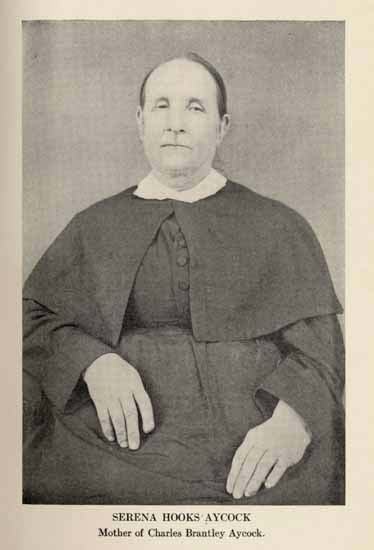
SERENA HOOKS AYCOCK
Mother of Charles Brantley Aycock.
Page 17
slang expression, no intonation of voice, no facial contortion, escaped his attention, and upon his return home he astonished his family by repeating the speech almost verbatim. For many a day after that memorable occasion it was a favorite amusement in that community to place young Aycock on a goods-box in the midst of an appreciative audience, who cheered and roared heartily as he repeated the words and mimicked the tones and gestures of "Jimmie" Wiggins.
Civil War and Reconstruction had destroyed the public school system which Calvin H. Wiley had built up in North Carolina, and young Aycock was forced to pursue his education in a haphazard sort of way at such private schools as chanced to be conducted within his reach. The first of these schools was at Nahunta, where the people of the community, by uniting their small means, had employed a teacher. Here Charles Aycock, under the chaperonage of his six older brothers, first entered school. "It was an inspiring spectacle," says one who frequently witnessed it, "to see these seven fine fellows on their way from the farm to the school. Charles was then about eight years of age, and was the pet of the family. It was no unusual sight to see Frank, the oldest, trotting down the dusty road with Charles, the youngest, on his big broad shoulders -- 'Big Sandy' and 'Little Sandy,' as Charles called his brother and himself. They carried their dinner in one tin bucket, and as all were hale and hearty young men and boys, it can easily be imagined that it required an ample one to supply their demands."
From Nahunta to Wilson, thence to Kinston, the ambitious lad pursued his search for an education.
Page 18
At Wilson he entered the Wilson Collegiate Institute, then conducted by Elder Sylvester Hassell, who declares that in young Aycock he had "a bright and exemplary pupil." One of his schoolmates remembers that the "teachers supposed Charles Aycock had not had the best preparation and accordingly put him in classes with younger boys than himself; but he soon showed that they had made a mistake, and they promoted him to classes of boys of his own age and older, where he maintained first place in many studies. He was particularly strong in Latin and grammar and English. There was no boy in the school who could touch him in these three studies. He could translate English into Latin with a facility that astounded the other boys in the school, and he seemed not only to know Latin grammar by heart but was able to apply it with accuracy and quickness; the verbs seemed to be at his tongue's end. He was not then, or at the University, strong in mathematics."
Declamation and debating, to which every Friday afternoon was devoted, formed an important feature in Mr. Hassell's scheme of education, and in these young Aycock excelled. "His voice," we are told by one of his youthful rivals, "was not melodious, and he was rather awkward in his movements, but when he rose to speak, every person within reach of his voice listened until his conclusion." His earnestness, sincerity, and directness in debate compelled attention. His schoolmates recall that at the declamations on Friday afternoons, when declaiming some of the old masterpieces with which all the schoolboys were familiar, he seemed to make them his own, and to be
Page 19
able to get hold of his audience as well as if he were making a speech that he had composed, suitable for the occasion. The teachers and children of other schoolrooms would throng the hall to hear him. It was in the moot court of the debating society, associated with his future law partner, Hon. Frank A. Daniels, now Judge of the Superior Court, and against Mr. Rodolph Duffy, afterward solicitor of the Sixth Judicial District, that the future advocate defended and won his first murder case.
"I recall," says Mr. Josephus Daniels, "that when Aycock was at school in Wilson he did not board in the school building, but two miles in the country, and walked to school every day, bringing his dinner with him and often in the noon hour, after eating, he devoted himself to study." But let it not be supposed that "studying after eating" occupied his undivided attention during the noon hour. Young Aycock was a strong, healthy lad, of sociable instincts, fond of sports, and at times he certainly did, by an exercise of strong will power, tear himself away from his books and join the other fellows in their games. Besides, among his fellow-pupils there were two sisters, Misses Varina and Cora Woodard, who certainly taught him some lessons which he did not learn from books, either before or after eating.
At Kinston, young Aycock had the good fortune to come under the influence of a masterful teacher, Rev. Joseph H. Foy, who quickly recognized his pupil's superior abilities, and took great pride in directing their development. He encouraged the boy in his ambition, fired his zeal for learning, and awoke in him
Page 20
a spirit of self-confidence. Governor Aycock never forgot, nor failed to acknowledge, the interest which this instructor took in him. Under Mr. Foy his preparation for college was completed. The family all recognized that he was no ordinary boy, and believing that he possessed talents which, with proper training, would raise him to a position of note in the State, determined that every sacrifice should be made to send him to the State University and to educate him for the bar.
Page 21
CHAPTER II
FROM FARM BOY TO UNIVERSITY LEADER
YOUNG AYCOCK entered the University of North Carolina in the fall of 1877. His appearance made a distinct impression upon his fellow-students, and many of them "recall vividly" the strong, sturdy-looking country boy, upon his first touch with a world somewhat larger than his own neighborhood. Says one of them, Hon. Francis D. Winston:
"I recall vividly my first meeting with Charles B. Aycock. He was sitting in a hack in front of Watson's Hotel on his arrival in Chapel Hill to enter the State University. A crowd of Sophomores was present to greet the newcomers with yells and cheers and other evidences of fraternal solicitude and scholarly welcome. Aycock was yet a boy in appearance and bore about him the simplicity and naturalness of one who has just left the plow handles on his father's farm. He looked as modest as a girl, but unaffected and self-reliant. He stepped out of the hack with as much composure and as little self-consciousness as if he were alighting from a load of wood at his own home. The boys yelled and cheered. I stepped forward, grasped his hand, looked into the clear, honest blue eyes of as true a man as ever lived, and felt for him the thrill of friendship that is akin to love."
Page 22
Charles Aycock entered the University at a transition period in its life, and in the life of the State. The old University had passed into history together with the Civil War and Reconstruction; the new University had its face turned toward the future.
"There was no better place, I think," says Dr. Edwin A. Alderman, "for the making of leaders in the world, than Chapel Hill in the late seventies. The note of life was simple, rugged, almost primitive. Our young hearts, aflame with the impulses of youth, were quietly conscious of the vicissitudes and sufferings through which our fathers had just passed. 'The Conquered Banner' and the mournful threnodies of Father Ryan were yielding place to songs of hope. A heroic tradition pervaded the place, while hope and struggle, rather than despair or repining, shone in the purpose of the resolute men who were rebuilding the famous old school.
"All of us were poor boys. Those who came from the towns looked, perhaps, a trifle more modish to the inexperienced eye, but they were just as poor as their country fellows, and had come out of just such simple homes of self-denial and self-sacrifice. The unconscious discipline and tutelage of defeat and fortitude and self-restraint, had cradled us all. We had all seen in the faces of our patient mothers and grim fathers something that we knew, if we could not express, was not despair, and somehow, life seemed very grand and duty easy and opportunity precious."
New problems in politics, in education, in scholarship, in industry were beginning to press themselves upon the attention of the Commonwealth, and among
Page 23
Aycock's fellow students were not a few of those who have since led the way to their solution. He strove for college honors against such men as Charles Duncan McIver, Edwin A. Alderman, James Y. Joyner, Robert P. Pell, M. C. S. Noble, Henry Horace Williams; against Francis D. Winston, Robert W. Winston, Rufus A. Doughton, Locke Craig, Frank A. Daniels, Charles R. Thomas, James S. Manning, and Robert Strange. It was no slight achievement for the raw country boy fresh from his Nahunta farm even to hold his own with these students: to become, as Aycock quickly did, an acknowledged leader among them marked him as no common youth.
Aycock entered the Sophomore class. It was his wish to complete the course required for graduation in two years, but the upper classmen protested, and the Faculty refused its permission. He had a strong, vigorous mind and a tenacious memory, and easily mastered most subjects. His general record, therefore, was good, but in science and mathematics his marks fell below the average. His term standing in mathematics once falling below the grade required for graduation, he resolved not to continue his course for his degree but to pass at once into the law school. But his friends sought earnestly to dissuade him from this course, and finally induced him to take a second examination, which, as he himself used to say, he succeeded in passing "by main strength and awkwardness." But in Latin, English, Political Economy, Logic, and Moral Philosophy he took high rank, becoming particularly distinguished for his Latin and
Page 24
English composition. His talent for the latter found a field for development on the editorial staff of the University Magazine, and in the debates and essays which formed the work of the Philanthropic Literary Society. He also edited, for a while, the Chapel Hill Ledger, a local news weekly. In his Senior year he was awarded the William Bingham Essayist's Medal; and at Commencement of his graduation, 1880, he won the Willie P. Mangum Medal for oratory, speaking on "The Philosophy of the History of New England Morals." These distinctions meant, of course, that he was the best writer and the best speaker in his class. During his Senior year, in addition to his regular college course, he read law under Dr. Kemp P. Battle, then president of the University. In spite of his strenuous classroom work, Aycock found time for a wide range of reading. He had the capacity to master books, and while at the University developed a strong love of literature which survived the shock of legal and political contests, and remained until the day of his death, one of his chief sources of entertainment and inspiration.
At that time all academic students were required to become members of one of the two literary societies -- the Philanthropic and the Dialectic -- whose history is almost co-terminous with the history of the University itself, and in which not a few of America's most eminent statesmen received their training in debate and parliamentary practice. Aycock became a "Phi," and his fellow members still tell with great glee, how on the very night of his initiation he signalized his first appearance by "cleaning up" every debater
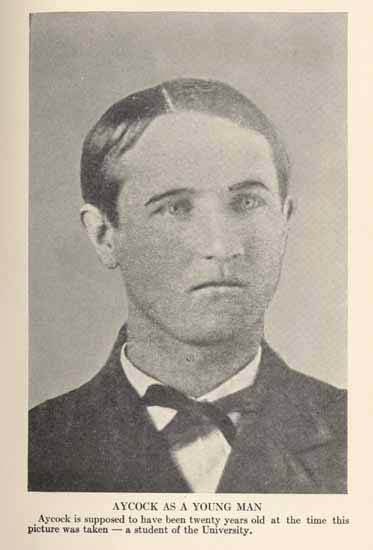
AYCOCK AS A YOUNG MAN
Aycock is supposed to have been twenty years old at the time this picture was taken -- a student of the University.
Page 25
on the floor. One of them relates the incident as follows:
"Robert W. Winston was one of the debaters for that night. After the regular debaters had finished, Judge Winston called upon the new comer, Charles B. Aycock, for a speech. The call was good natured and evidently intended to embarrass the country boy who had just entered the University. Aycock arose and began speaking. We all took notice at once, and the boys realized that they were in the presence of the most brilliant speaker in the college. He cleaned up every fellow who had gone before, and created great merriment by declaring that the illogical contentions of the debaters on the other side reminded him of the 'fellow who was looking for a black cat in a dark cellar, on a dark night, with no light, when the cat was not there.' "
All student activities, social, political, and literary were conducted through the societies, and it was in them, rather than in the classrooms that the ambitious student strove for leadership. Those who led the societies, led the University. The work of the society was Aycock's natural element, and he passed quickly, almost immediately into leadership. He loved the stimulating clash of debate, the thrill and excitement of battle -- to the college student quite as real and quite as serious as were the mightier conflicts of later days to the party leader. In college politics, as in the conflicts of state and national affairs, he struck and received swift, hard blows, but it is the testimony of all that he fought a clean, manly fight. His blows left no sting, nor did he, himself, harbor any bitterness
Page 26
of spirit. "Once I saw him," says Professor Williams, "in a royal battle for an honor in the Phi Society. He detected some ugly practice. Instantly he withdrew from the contest. Then he made the finest appeal for clean methods and high ideals I ever heard."
On another occasion he chanced to be for the time in opposition to an intimate friend, his junior in age, and his inferior in physical strength. Under the impulse of a youthful resentment at something Aycock had said, the other sprang up, exclaiming, "The gentleman from Wayne has stated what is false; I repeat, sir, what is false." For a moment the atmosphere was charged with electricity, and all awaited with apprehension the expected outburst; but Aycock, with complete self-control calmly arose and asked for permission to interrupt the speaker. "I shall never forget Aycock's words," declares the latter, "as he quietly said: 'The gentleman has used language on this floor which he well knows he would not have used but for his size and the relations heretofore existing between us.' I was, of course, overwhelmed with mortification, and replied: 'It does not matter about my size, but it does make a very great deal of difference about our relations. I spoke without thinking or realizing what I was saying. I retract the language and ask the gentleman's pardon,' and sat down in confusion. I had hardly taken my seat before Aycock had crossed the hall, dropped into the seat next to me, and putting his arms around my shoulders, said: 'It's all right, Jim. Don't let this worry you. I knew you didn't mean it, and it shan't affect our friendship.' "
Page 27
No incident of Aycock's college career shows the position of leadership which he so quickly attained more clearly than his election as chief marshal in his first year. The chief marshalship was the most coveted social honor of student life. The office alternated from year to year between the two societies. In Aycock's first year it came to the Phi Society, and early in January, 1878, Frank Wood, of Edenton, was chosen, but a few days before Commencement he resigned in order to go to the Paris Exposition. Naturally the sub-marshals expected that one of their number would be promoted to the vacancy, and they were keenly disappointed when the choice of the society fell upon Neal Archibald McLean, a popular law-student. The sub-marshals and their friends promptly protested to the Faculty against McLean's election on the ground that being a law-student he was ineligible for academic honors. The protest was argued at great length and with much warmth, and the Faculty, after deliberating all day, decided against McLean. This decision resulted in a contest long remembered by those who participated in it, one of whom, Prof. M. C. S. Noble, gives the following account of it:
"McLean had not been elected through any bitter party fight, but simply because he was a popular fellow, and when the Faculty decided against him there was much indignation that the will of the society had been thwarted and that McLean, vice-president of the society, had been declared ineligible for a Commencement honor. At once McLean's friends determined not to permit the election of any of the sub-marshals
Page 28
who had led the fight against him. Accordingly, a party was formed determined to have no Faculty interference with the prerogatives of the society, and all over the campus, groups of students gathered to indulge in earnest and heated discussions. A caucus of the new party's managers was held, and Aycock, who had not wanted the honor, was made to take it because he, too, like McLean, was a popular fellow and had been an indefatigable fighter for McLean from the moment the contest started. The machine of the new party was composed of those who were in the caucus, and the faithful on the outside were told to wait for the nominating speech to learn the name of the candidate agreed upon. When the society met and received the report of the Faculty, McLean tendered his resignation, after which the President called for nominations. For a few minutes there was an intense stillness, each side waiting for the other to move first. Then a member rose and nominated one of the sub-marshals. The President asked if there were other nominations, and 'Neal Arch' McLean, addressing the chair, spoke plainly his opinion of the Faculty's action, thanked his friends for their support of him, and then with a voice full of emotion said, 'There is one here who can serve you better than I, and I, therefore, nominate Charles B. Aycock.' The opposition was dumfounded, the vote was taken, and Aycock was elected. A student rushing out of the hall downstairs to the campus where the Di's were waiting to hear the news, yelled 'Aycock!' which the crowd received with triumphant shouts and cheers, while the college bell chimed in and lent its voice to the celebration."

OLD SOUTH BUILDING, STATE UNIVERSITY
Aycock roomed on the lower floor. The two windows seen in the pitcure immediately to the left of the well were in his room and indicate its position.
Page 29
"At Commencement in June, following his election," relates Judge Daniels, "whether by the procurement of some humorous friend or some jealous rival, or by one of those accidents which defy explanation, as he led the academic procession, arrayed in all the glory of Chief Marshal, the band struck up the then popular tune, 'See the Mighty Host Advancing, Satan leading On,' much to the amusement of his friends and somewhat to his own discomfort."
Thus within a single year Aycock had become the leader of the largest and most influential group of students in the University. His leadership had come not through scholarship, though he was by no means deficient in scholarship, but through the larger and richer life of the campus, where the college man's capacity for leadership is tested and developed. College-life is nothing less than world-life in miniature, and he who would lead the one, as well as he who would lead the other, must understand men rather than books. Professor Williams describes this college life at the University of North Carolina as "the long walk after supper when two men talk together of their hopes, their principles, their visions, their deeper selves. It is the hour of communion in the old room after midnight, when the day's work is done, the light burns low, and soul speaks to soul. It is the banter and raillery and fun of the crowd on the steps of the building for an hour after supper. It is the struggle on the campus for leadership. It is the rigid and swift judgment of the student body. It is the impartial application of standards. The judgments of this campus are to me the finest in the world. Hypocrisy
Page 30
does not long live here. The writ of value is honesty. In this sphere Aycock found his place. He saw here the food upon which right manhood must feed. He opened wide his mind and spirit. He loved it with all the depth of his great nature." He studied it, he conquered it, and he led it as he willed. It is needless to add that it was this training which fitted him to be the leader of his people in the great crises of 1898 and 1900.
It is evident that Charles Aycock made a deep and lasting impression on his fellow students and on the University. We should leave this chapter of his life incomplete if we failed to point out, though ever so briefly, the impression which the University made upon him. The University of North Carolina was established to train men for the service of the State. The true "University man" understands this, and accepts his education at her hands knowing that, if he be true to her teaching, he is under the highest sort of obligation to use the increased power which he receives through her training not for his own advancement, but for the good of the Commonwealth. When the State requires his service, he knows that he is expected to give it freely and cheerfully, regardless of any personal losses and sacrifices. Such has always been her teaching; and such has always been the spirit of her sons.
No man understood this better than Charles B. Aycock. He knew that out of the old University of ante-bellum days had come such men as Murphey and Wiley and Battle, and many others who had heard the call of the State and had never failed to respond.
Page 31
Standing upon the day of his graduation, as we have already said, at a transition period in the life of the University and of the State, he, too, heard a call for a new and distinct service. McIver heard it, and Alderman, and Joyner, and Noble. Each responded after his own fashion, but all had the same object in view. Shortly before his graduation Aycock caused to be debated in the Phi Society this query, "Ought The Public School System of North Carolina to be Abolished?" while the same evening he himself, as Senior orator, discussed in an elaborate oration, "North Carolina's Deficiency and Our Duty." He had caught a vision of an old Commonwealth re-made and revivified through universal education, and he went forth from the University pledged to give to that cause the best services of his life.
Page 32
CHAPTER III
THE FOUNDATIONS ON WHICH AYCOCK BUILT
HIS CHARACTER
WE SHALL not attempt in this volume to follow an exact chronological order. The most significant thing about a man is not a record of dates and deeds, but the silent development of his character. It is much as Carlyle says -- that "the Event, the thing which can be spoken of and recorded," is in most cases a disruption, a break, while the real growth has gone on in silence: as "the oak grows silently in the forest a thousand years" with no "event" to note until in the thousandth year it falls.
Before proceeding with the events of Aycock's life, therefore, let us pause to consider the foundations on which he built his character. That these foundations were laid before he completed his college course and before he began his career at the bar, we are assured; and it is necessary to understand them in order to understand the man. However, in attempting this estimate we shall have to select significant manifestations of his character from many periods of his career.
There are several single sentences that seem to give snapshots, as it were, of Aycock. We have already quoted some of them: Bishop Kilgo's saying: "He lived out his whole life under the despotism of duty," Archibald
Page 33
Johnson's: "He won great love because he was a great lover," and Elder Gold's: "He had the simplicity of sincerity, and the sincerity of simplicity."
Yet it often happens that in some moment of self-revelation a man unconsciously utters the best characterization of himself. So it seems to us that Aycock, but ten days before the end, and while the death-angel already beckoned him from a task he was never to finish, gave perhaps the best one-sentence characterization of himself when he read his friends from the unfinished manuscript of the speech he had prepared for delivery on April 12th: "For I am a plain and simple man who loves his friends, and has never been hated enough by any man to make him hate again in return."
Love -- simplicity. These were indeed the ruling principles of Aycock's life. It is hard to realize that a man could have been the leader in the mighty campaigns of 1898 and 1900, when the primal passions of race-feeling were stirred to white heat, and could also have dared all uncharitableness in four years of strenuous devotion to duty as Governor, and yet not have made an enemy. But so it was. And when in the sunshine of the April morning a sorrowing State welcomed back his body to the soil he loved, there were none who spoke him more fair in death than those whom he had met as rivals in fierce debate. Judge Jeter C. Pritchard uttered the sentiment of men of all parties when he wrote: "He was incapable of anything small or mean, above all low suspicion, bearing no malice in his heart. At times he was called upon to say and do things that for the moment were unpopular,
Page 34
but he had the moral courage and the manhood to do right regardless of consequences."
Perhaps no other man in Southern history, except Aycock's great ideal, General Lee, has ever fought any great fight with as little bitterness as Aycock fought his. The writer has heard Capt. E. E. Lovell, of Watauga, tell of hearing General Lee give orders in battle: "We must attack those people at yonder point." It was simply "those people": never "the Yankees," or "the enemy," but "those people."
"Hate the sin, but love the sinner," is an old theological doctrine; and Aycock, denouncing Republicanism, yet liked Republicans. In fact, he was most effective as a speaker because while powerfully arraigning what he regarded as a bad cause he would persuade and convince its advocates rather than anger them. In a letter now before us, a friend tells of hearing Aycock in Goldsboro in 1898, when the bitterness of that memorable campaign was at its height. He was interrupted in a flight of masterly eloquence by some one who called out, "Give it to Butler!" Says our correspondent: "He stopped his speech, and from the grandest oratory, descended to that gentle, persuasive tone peculiar to him, and replied in the following words: 'No, my friend, in this our supreme hour of victory, I will abuse no man!'"
This was characteristic of Aycock -- not that he did not speak with terrific earnestness and force, and with powerful conviction, but that he always spoke for something, not against something. He was speaking in 1898 not against the negro, but for the white man -- for the white man's inherent right to rule as a condition
Page 35
necessary to the welfare of both races. "I like a man who is for somebody, who is for something," he wrote but a few months before he died, "not a man who is against somebody, or against something." In other words, he believed in a life of positiveness, not of negation; of love, not of hate. In Doctor van Dyke's fine phrase, he "was governed by his admirations, not by his disgusts." And very early in his career he found in Tennyson's "Maud," the poem which he loved from his youth up, and which he knew almost by heart, an expression which may be regarded as the keynote of his endeavors:
"It is better to fight for the good than to rail at the ill."
Aycock believed as strongly as anybody in remedying the evils of trusts, but it was not because he was against trusts, but because he was for justice. No one was more earnestly opposed to the freight discriminations against the State, but it was not that he was against the railroads but for equality. No North Carolinian ever more powerfully arraigned the protective tariff, but this was not that he was against capital but for right. His tendencies were constructive, not destructive; positive, not negative. He would crowd out evil by supplanting it with good -- just as in boyhood he kept a field from growing weeds by sowing wheat on it. The Biblical injunction, "Whatsoever things are pure, whatsoever things are lovely; think on these things," -- rather than on their opposites -- was never lost on him. It was because of this fact that Aycock's nature was ever sweet, wholesome and serene. Emerson observed a long time ago: "It is easy in the
Page 36
world to live after the world's opinion; it is easy in solitude to live after our own; but the great man is he who in the midst of the crowd keeps with perfect sweetness the independence of solitude." This is what Aycock did. When criticism of his "universal education" policy was fiercest, and it was said, "Aycock couldn't even be elected a constable in Wayne County," he sat in the Governor's office, smoked his long-stem pipe and viewed the situation with composure indeed, but not with a mere stoical, martyr-like conviction that he had done his duty as he saw it and must take the consequences. That sort of feeling -- which may put iron into a man's blood but will certainly rob it of its warmth -- was not Aycock's spirit at all. He not only knew that he had done his duty and that all the powers of earth could not make him swerve from it, but he had a perfect trust in the people: absolute confidence that they would sooner or later come to recognize not only the integrity of his purpose but the wisdom of his policy. And in this spirit, in the very middle of his administration, he concluded his message to the Legislature of 1903 with these words: "There is but one way to serve the people well, and that is to do the right thing, trusting them, as they may ever be trusted, to approve the things which count for the betterment of the State."
Serena was Aycock's mother's name, and he inherited from her Quaker blood something of the fine quality which her name suggested. "I never knowingly read any article about me written in a spirit of either praise or blame," he said to the writer but a few months before his death. "If it's praise, it may unduly excite my vanity; if blame, it might arouse some animosity."
Page 37
In harmony with this statement is a story of Dr. J. Y. Joyner's. Disagreeing with Aycock, about a matter in which they were both interested, he finally sent Aycock a letter written in some heat. Regretting this on more mature reflection, he wrote in apology and received substantially this reply: "Your first letter was received, but I suspected it was a warm number, and it has never been opened. I am returning it to you." Rev. Livingston Johnson also gives this incident: "Just before he retired as Governor, I wrote him congratulating him upon his successful administration, and commending especially his constructive interest in education. He replied promptly, thanking me for the letter, and said that he turned over all such letters to his daughter who wished to preserve them, but the ones bearing adverse criticism he destroyed and forgot."
This may seem to have little to do with our initial declaration regarding love and simplicity -- or better, love and sincerity -- as the dominating qualities of Aycock's life; but in fact, it has much. It was because he loved and trusted his fellows and believed in them that he had this serene confidence in their rightness, and kept his faith that the good and wholesome things are the significant things and the only things which one should regard or remember. In the most eloquent sermon the writer ever heard from a North Carolina minister, Bishop Kilgo pointed out that the Almighty's estimate of a man is the sublimest moral height the man ever reaches -- just as Barrie's "Little Minister" insists that, "To see the best is to see most clearly," and Browning's "Abt Vogler" declares that all good shall perish "with, for evil, so much good more." Such
Page 38
was Governor Aycock's doctrine. Judge Hoke has referred to him as the finest exemplification of Lowell's sentiment:
"Be noble! And the nobleness that lies
In other men sleeping but never dead,
Will rise in majesty to meet thine own."
He maintained that one should believe in the best in people. "You can't help a child do better by reminding him of mistakes and shortcomings," he would say, "point out to him the possibilities and rewards of worthy conduct in the future." Even one's errors and failures were not valueless to a sincerely aspiring man, he insisted; and that
"Men may rise on stepping stones
Of their dead selves to higher things,"
was one of his most frequently used Tennysonian quotations.
It should not be assumed, however, that Aycock was easily deceived by men. He was not. On the contrary, he had something of a woman's intuitive promptness in "sizing up" any one to whom he was introduced, and his judgment was seldom in error. He simply preferred in all things to emphasize the good he saw rather than the bad.
Nor should any one suppose that Aycock was ever of the flattering, back-slapping, indiscriminately effusive type of politician. No man was freer from such faults. In fact, if he had to choose between abusing a man a little to his face, or paying compliments he did not believe deserved, he would undoubtedly have chosen
Page 39
to abuse him a little, because flattery would have implied insincerity, which fault of all faults he was freest from. He loved his friends, but he respected Emerson's doctrine that one "should never by word or look overstep one's real sympathy." He knew how to express his regard for any one he cared for, but he did this in such a way as never to appear effusive. As some one said just after his death: "Charlie could let you know that he loved you without ever having to say so in words." If, therefore, one should accept Judge Pritchard's estimate, "As a friend I knew him best; there was no truer, sweeter, more affectionate man," it should always be with the further understanding that Aycock was never, to use his own excellent phrase, "too sweet to be wholesome." In fact, I think he should hardly have liked for any one to accuse him of having "a sweet nature," unless some recognition of his robust manliness were added. Virile, courageous, and almost literally "six foot A1 of man, clean grit and human natur'," he impressed many others as he did Prof. J. I. Foust who says: "He was without doubt the bravest man with whom I have ever come into contact."
With all Aycock's high ideals, therefore, and his hatred of everything mean and sordid -- if, indeed, one should not even here use the positive term and rather say his love of everything high and worthy -- the writer never heard him utter a word that sounded like "preaching." He hated cant as much as he hated viciousness, and hypocrisy as much as he hated meanness. In extreme cases he might openly rebuke the guilty--as when some classmates used unfair methods in an election at Chapel Hill, or when his soul flamed out in
Page 40
hot indignation at some lewd fellows on a train who told unclean stories in the presence of a little boy -- but such instances were rare. He preferred rather to do as General Lee did, of whom he wrote:
"Lee did not criticise his people; he did not reprove them; he did not even tell them what the best things in life were. He just simply lived among them the very best things that there are in life. He was himself the best thing, and in this way he has done more to lift us up than any amount of speech or writing can ever do."
Aycock was, in the correct meaning of the phrase, the most natural man the writer has ever known. He was not the most natural man in the sense in which Walt Whitman would have used the term, meaning simply the most natural animal; but he was the most natural man -- a being in whom body, mind, and soul were properly coördinated; a being who could feel the soul's "passion for eternity" as well as "the wild joys of living" in the physical sense, or the intellectual delight of following knowledge like a sinking star "beyond the utmost bound of human thought." He was a well-rounded man -- Shakespeare's ideal in whom the elements were so mixed up -- and having body, mind, and soul in symmetry, he was natural in the sense of having a sort of divine disregard of all pretense or affectation. His unfeigning, untroubled nature would have rejoiced the heart of sham-hating Emerson. "He was just the same in the courthouse or the drawing room," as a newspaper man remarked of him; and that acute observer, Erwin Avery wrote truly: "Aycock's curious consistency of character impresses one more than anything else in his make-up. I have seen him in an old
Page 41
dressing gown, smoking a short clay pipe; have seen him surrounded by flattering women, have seen him stand within four feet of the President of the United States and make a speech that was admittedly better than the speech of the President, and yet I could see no difference in the Governor or the man. He is a rare being who is absolutely devoid of pretense or affectation."
The other basis of Aycock's character, along with love of his fellows and an unusual measure of simplicity and sincerity, was a profound religious faith. Or, perhaps, we should rather say that a profound religious faith was the basis of all that was finest in his character, including this love of others which, we are told, is "the fulfilling of the law," and sincerity which is but another name for truth, the basis of all virtue. Certainly no one believed more strongly than Aycock himself that character, to be stable, must have a religious basis. In his tribute to the Moravians at the Salem Centennial he said: "They attempted to carry out to the fullest the injunction 'to love the Lord thy God with all thy heart, and with all thy soul and with all thy strength,' and in doing this they were able to love their neighbors as themselves. For it is a truth that we can only love our neighbors as we love ourselves, for any length of time and with any certainty, when we have obeyed the first injunction. The real Abou Ben Adhem can only exist in him who has first set his heart upon God, for no one truly loves his fellowman who does not first love Him who made his fellowman."
Let us repeat that Aycock had a deeply religious
Page 42
nature. With religious ceremonials, creeds, and forms he was not much concerned; and his irregularity in church attendance during his more strenuous years might have been misunderstood by those who set much store by the outward form as well as by the inward essence of religion. Old Samuel Johnson, one must admit, was doubtless right in saying that religion, "of which the rewards are distant and which is animated only by faith and hope," needs to be constantly "invigorated and reimpressed by external ordinances, by stated calls to worship," etc; but what we are concerned with now is only to set down the simple fact that Aycock -- like his sturdy, Cromwellian English forbears -- had an innate and profound religious sense, although not active as a "church worker" after his strength became taxed with official duties. As a matter of fact, meetings, societies, functions, etc., of any kind had little attraction for him. He was a home lover, and his law practice took him so much away from home that it was hard for anything to draw him out when it was possible for him to enjoy the quiet of home and family life.
Ex-Judge Robert W. Winston has written:
"Aycock's faith in God was sublime. He had no more doubt of the divinity of Jesus Christ than he had of his own existence. He once said: 'that the best thing about the Christian religion to him was that your sins were not only forgiven, but blotted out.' "
Talking of the matter recently, Dr. J. Y. Joyner said:
"Aycock connected himself with the Baptist Church while he was a student at the University. A. C. Dixon, a brother of Thomas Dixon, was pastor of the Baptist
Page 43
Church in the village at that time and roomed in college. He was a vigorous, magnetic young man and had great influence with the boys. He is now pastor of Spurgeon's Church in London. In a protracted meeting conducted by him in the old Baptist Church of the little village, a number of students -- thirty or forty, according to my recollection -- professed conversion and connected themselves with the various churches in the village. Aycock and I were among the number that joined the Baptist Church in that meeting. He was exceedingly earnest and sincere about this as about everything else. We were baptized one beautiful Sunday by Mr. Dixon, in Purefoy's millpond, about two miles from the little village of Chapel Hill."
Young Aycock subsequently walked three or four miles in the country every Sunday afternoon to engage in Sunday-school work, and was effective in interesting other young men in religion. After returning to Goldsboro and joining the Baptist Church there, he continued active as a Bible teacher, although sometimes haunted, as he confessed to Rev. Dr. T. M. Hufham, by recollections of anti-Sunday-school teachings in the creed of his primitive Baptist ancestors.
Throughout his life he kept the simple, serene and sincere faith to which he gave utterance in one of his Thanksgiving proclamations: "For all these blessings we owe acknowledgment to the Lord. Things do not happen, but the hand of God is in every happiness that comes to our people."
On these three things therefore, the character of Charles Brantley Aycock was grounded: Faith in God, love of his fellows, and absolute freedom from all pretenses or affectation. And no man ever began a life or built a character on any better foundation.
Page 44
CHAPTER IV
AYCOCK AS A LAWYER
AYCOCK began the study of law with Dr. Kemp P. Battle during his Senior year at the University, completing the course under the direction and instruction of Mr. A. K. Smedes, a lawyer of marked ability and learning of the Goldsboro bar. He received his license from the Supreme Court at the January Term, 1881. Among the members of the class admitted to the bar at this term were William R. Allen, Associate Justice of the Supreme Court (1911), Rodolph Duffy, Solicitor (1905), John H. Small, Member of Congress (1898-1912), Francis D. Winston, Judge Superior Court (1903) and Lieutenant-Governor (1904), Thurston T. Hicks, F. A. Cline, Judge Superior Court (1910) and Frank A. Daniels, Judge Superior Court (1911). An intimate friendship with the last named, formed while at school and maintained at the University, resulted in a partnership at Goldsboro, which, with the interruption of the four-year term as Governor, continued until Aycock's removal to Raleigh during the year 1909. At the time of his admission and entrance upon the practice, the Goldsboro bar was composed of Hon. William T. Dortch, Judge William T. Faircloth, Mr. Smedes, Col. William A. Allen, Mr. Isaac F. Dortch, Mr. H. F.
Page 45
Grainger and Hon. W. S. O'B. Robinson, all strong, well-equipped lawyers. Mr. Dortch was the recognized leader of the bar of the then Fourth Circuit in which the firm of Aycock and Daniels sought and soon secured a strong position. Judge George V. Strong had removed to Raleigh but retained his practice at Goldsboro as the partner of Mr. Smedes. After the death of the latter he became the senior member of the firm of Strong, Aycock and Daniels. In other counties Aycock met and shared in the courthouse business with a number of strong and able lawyers.
No better test can be applied to the metal of which a lawyer is made than the type of those with whom he is called into honorable rivalry. In the contests of the bar it is especially true that only the worthy reach large and permanent success. That Aycock, by close attention to business, diligent study of the books, successful management of causes committed to his care and his qualities as a man and a lawyer, soon acquired and retained an honorable position and successful practice among this body of lawyers, is proof that he was justly entitled to rank high in his vocation. For learning, high standard of professional life and conduct, loyal devotion to the interests of their clients and civic duty, honorable ambition pursued by honorable methods, these lawyers and citizens have had no superiors in the State. The social and professional relations established and uniformly sustained between the young members and their elders of the Goldsboro bar, the fatherly interest and affection exhibited by the seniors for the juniors and their veneration for the elders was a source of pleasure to the first and of inspiration to the latter.
Page 46
Aycock very early developed the remarkable power for forensic debate, which had manifested itself at school and in the literary society of the University. While in no degree neglecting the first requisite of a well-furnished lawyer -- the study of the law -- he found his chief interest and his constant delight in the courthouse, before the judge and jury. Beginning with no estate or source of income upon which to rely during the days of waiting for clients and fees, he practised economy, lived within his income and laid the foundation broad and deep for the large success which awaited him. When it had come, and he was in the enjoyment of its rewards, he often recalled the fact that, during his first year at the bar, he received but $144, saying, "I worked night and day to make it. I paid twelve dollars a month for my board and borrowed the money to pay for my clothes. I made $144, and that is all I ought to have made."
Probably no partnership was ever formed by two young lawyers more congenial in its personal, or more happily adjusted in its professional and business relations than that of Aycock and Daniels which had found its origin in the sympathy and confidence of intimate friendship of school and classmates. Both partners had honorable aspirations and high ideals which guided and controlled their lives. Temperamentally they differed and in such difference was found the perfect adjustment in their work. Each found his chief pleasure in the practice of his profession in those departments best suited to his taste. Their relations continued to the end in all respects cordial, sympathetic and affectionate -- honorable to both.
Page 47
With that confidence in his ability to meet and discharge those responsibilities and duties in life which result from and are incident to the growth of full manhood, so soon as he was settled down to work young Aycock entered into the estate of matrimony with her whom his boyish "favor singled." One is reminded of Chancellor Kent's "Memoranda": "I was admitted to the bar of the Supreme Court in January, 1785, at the age of twenty-one, and then married, without one cent of property, for my education exhausted all my resources and left me in debt which it took me three or four years to discharge. Why did I marry? I answer that, at the farmer's house, where I boarded, a little modest, lovely girl of fourteen, gradually caught my attention and insensibly stole upon my affections and, before I thought of love or knew what it was, I was most violently affected. I was twenty-one and my wife sixteen when we married." With slight variations, this is the story of Charles Aycock's love affair and the fulfilment of its dream.
Until 1893, Aycock prosecuted his profession with constantly increasing reputation and success. During these years he attended the courts of the old Fourth District, appearing in many of the important litigated cases. His services were frequently called for in capital and important civil causes in other sections.
During the campaign of 1892 he canvassed the State as candidate for Presidential Elector and, upon the accession of Mr. Cleveland to the Presidency, was appointed United States District Attorney for the Eastern District of North Carolina. This was the first office which he held, other than the superintendency of
Page 48
the public schools of Wayne County and the chairmanship of the Board of Trustees of the Goldsboro Graded Schools. For four years he discharged the duties of District Attorney with marked ability and satisfaction to the Administration and the people. Hon. Augustus S. Seymour, the District Judge at that time, a lawyer of profound learning and eminent ability, held him in very high esteem, no less on account of his personal qualities than his professional attainments -- a sentiment cordially reciprocated by the District Attorney. While discharging the duties of this position, he retained and increased his practice in the state courts imposing onerous labor and constant attention. Upon the coming in of Mr. McKinley he retired from the position and, until his election and inauguration as Governor (1901), he devoted himself to the large and extensive practice which had come to the firm as the reward of the labors of his partner and himself and reputation for ability and devotion to their clients.
After four years of service to the State, Governor Aycock returned to Goldsboro and resumed the practice of the law, taking the place in the office and business kept open for him by the loyal friend and partner of his young manhood. It was known to his intimate friends -- he was not of the kind to speak to others of such matters -- that he left his high official position, after rendering honorable and invaluable service to the State, involved in debt to an amount which, to a North Carolina lawyer with a large family, was depressing. He had lived, during the term of his office, with modest economy and becoming dignity, but the salary was small and the demands upon the Chief Executive large.
Page 49
Important professional engagements promptly came to him and, with courage and devotion to duty, he began the work of paying his indebtedness and discharging his obligations to his household.
It soon became apparent, however, that his place was in the capital of the State. His love of the people, among whom he had spent his young manhood, who had always been kind and considerate, promoting, by generous sympathy and active aid, his aspirations, caused him to hesitate long to change his home. He moved to Raleigh, forming a copartnership with Judge Robert W. Winston, who came from Durham. The association was, in all respects, happy. Both were strong, well-equipped lawyers, enjoying a large clientage and prepared to receive and care for the large and lucrative business which sought their service. During the last two years of his life Aycock's health began to fail, but he met and discharged the demands upon his physical and mental powers with his accustomed energy and ability. The new firm received a large share of business both personal and corporate. Although the scene of his largest success and greatest triumphs had been in the trial of causes, Governor Aycock was recognized as a wise, safe counselor in large business affairs requiring accurate knowledge of commercial and corporation law. The reputation of a lawyer necessarily rests rather upon tradition than historical permanence; but few of his addresses to courts and juries are written or even, at this day, taken stenographically. They are so largely confined to the facts of the instant case that it is difficult to preserve, for any considerable time, a living
Page 50
interest in them. A graphic description of Governor Aycock, at his best, as an advocate, is given by Bishop Kilgo:
"His great soul, poured itself out in defence of any cause in which he had faith. Every wrong, every injustice, every harmful tendency and every need made his heart flame with the passion of resentment. Charles Aycock could not tolerate evil, he could not endure unfairness. When he stood in the courts to defend some cause, whether of the great or the small, he always went far beyond the mere limitations of a business contract. He seemed to forget his client and the one thing that seized him with dreadful grip was the thought of possible injustice and undeserved pain and, under this pressure, his voice, as he stood before the Court, rang with a note of imperial protest, his fine eye flashed with the fires of burning indignation, his splendid and noble face quivered with the emotion of an outraged soul and his magnificent body, erect and commanding, trembled with the bursting dynamics of an irresistible intent. In such a moment what a picture of mediatorial service he was. Who that ever saw him, at such a time, will forget the scene. He was a glorious example of a mighty man, who knew how to respond, with heart and conscience, and hand and voice, to the call of righteousness, as he heard it and as he felt it."
The impression made upon men by his intensity of language and manner, as an advocate, is illustrated by the prayer of an old colored man, whom it was his duty to prosecute while District Attorney. "O Lord, have mercy upon Mr. Aycock, but, O Lord, tame him down, tame him down!"
Says one who knew him well: "He loved the practice of the law -- its contests in the courthouse -- it made no difference to him whether the fee was five
Page 51
dollars and the client a poor man, or five hundred and the client a rich one -- he put himself into the contest and forgot all else save his client and his cause." Judge Daniels well says: "It was one of the great experiences of a lifetime, not to be forgotten, to have seen him at his best for the defendant in a capital case, contesting every inch, watching every development, resisting the introduction of damaging testimony, protecting his client from every aspersion and, when the case went to the jury, rising to the height of the occasion, dissecting every portion of the testimony, laying bare every motive of the prosecution and witnesses, exposing every fallacy and every falsehood, tearing away every mask of hyprocrisy with the power of reason, ridicule, satire and invective; constructing upon the evidence an impregnable defence, fortifying it with every argument, calling to his aid every resource known to ingenuity and sustaining it with overpowering eloquence until the prisoner was acquitted amid the plaudits of the spectators and the approval of the Court."
He was very happy in the cross-examination of witnesses -- one of the highest and most essential accomplishments of a trial lawyer. A striking and amusing instance is given by one present at the trial of a case brought by a man for damages against a railroad company for alleged personal injury. He claimed that his sense of hearing had been seriously impaired. After the plaintiff had given a most affecting display of his injury, with appropriate paraphernalia, Governor Aycock began the cross-examination by a line of questions interesting to the witness, but having no relation
Page 52
to his alleged injury. In a soft, low tone of voice he led the plaintiff along until, almost in a whisper, he obtained prompt answers to his questions, the witness forgetting the part which he was playing when, suddenly, Aycock said aloud, "I thought you couldn't hear." The cross-examination had the desired effect. He seldom attacked a witness, never doing so unless assured that the witness was endeavoring to deceive the jury and that this was the only mode of exposure.
He was fair and courteous to counsel, although when he felt and thought the occasion or the conduct demanded, he was crushing in humor and, rarely, but sometimes, sarcasm. He fought fairly, in perfect candor and good temper, giving and taking lusty blows. While absolutely free from flattery or undue complacency to the judge, he was frank and courteous, with personal and professional dignity of manner and language, bold and courageous in presenting and pressing his view of the law. One, before whom he frequently appeared in the trial of causes and the argument of appeals, bears testimony that, whether in dissent or agreement with his views, he always bore himself with the courtesy, the dignity, the manner and language of a lawyer and a gentleman. He knew his own rights and those of his client -- he maintained both under all circumstances, according to others the same meed of right. Nothing more can be, or should be, said of a true lawyer.
While always reverent in the use of Biblical quotations in the argument of causes, he was very happy in their appropriate use. A striking illustration is found in the trial of a case of great interest and importance
Page 53
during the last year of his life. He represented the American Tobacco Company. In the opening argument counsel for plaintiff had dwelt, at length, and with much force, upon the magnitude, the wrongdoing and the monopolistic power of the defendant. Governor Aycock began his argument by referring to these observations, reading to the jury, in a tone of impressive solemnity, the words of Leviticus: "Ye shall do no unrighteousness in judgment; thou shalt not respect the person of the poor, nor honor the person of the mighty, but in righteousness shalt thou judge thy neighbor." The effect upon the jury and the by-standers was manifest.
He loved justice, he hated injustice, but he always insisted that, in administering justice in the courts, both judge and jury should administer that justice which was guaranteed by "the law of the land." He believed that it was the right of every person to have justice administered according to law. He, therefore, had respect for precedent and authority, believing that ours is a government of laws and not of men. He believed in democracy, but in representative government, the people being the source of sovereign power and the laws made and declared by them, through their representatives, both legislative and judicial, the measure of every man's legal right and legal duty. No man more implicitly trusted the people, but no man more fully recognized the truth that the will of the people must be found in their organic law and not in their caprice or momentary, transitory opinions. His view regarding the distinction between the function of the legislature and the court is well stated in one of the last
Page 54
of his arguments. In the trial of the case against the American Tobacco Company, referred to above, one of the opposing counsel had said to the jury that the strongest anti-trust speech he had ever heard was made by Governor Aycock. To this Aycock replied: "Gentlemen, I expect that is true, and if he lives long enough he will hear another. But he will hear it in the forum for the making of laws. It is one thing to make a speech to the people who make the laws, but quite another thing to make a speech in this courthouse, where it is the duty of Your Honor and the jury not to make law but to construe and enforce existing law. If you ask me if the laws, on this subject, are adequate, I will say no; but what I do say, and say with all the sincerity of the most earnest conviction, is that these defendants have not put themselves within any law that has been written on any statute book anywhere."
Only a few weeks before his death, presenting to the Supreme Court a portrait of the late Chief Justice Shepherd, he thus expressed his thought regarding that system of refined morality administered by Courts of Equity:
"To be a great equity lawyer involves not only much learning and culture of mind, but great qualities of heart as well. It is equivalent to saying that he was fair in his dealings with men, that he not only knew right and wrong in the abstract but in the daily practice among men, that he realized obligations and duties, that he contemplated the beauty of trust and confidence and deprecated its abuse, that he was familiar with the Sermon on the Mount and believed it to be the best exposition extant of the duty of man."
That he was absolutely fearless in the discharge of his duty to his client is no unusual praise of a real lawyer.
Page 55
To have been otherwise would have been to forfeit not only his self-respect but his right to serve in the temple of justice. He expressed forcibly and clearly his attitude in this respect a short time before his death. Being called to defend a man who had, by his conduct, rendered himself odious to the right-thinking men of the community in which he lived, he felt that it was his duty to accept the employment. To the remonstrance of a citizen whom he respected, he said:
"I have never understood that, in appearing for people charged with having committed offences, I was upholding either the offence or the offender. It is fundamental that every man should have a fair trial when he is indicted. If apprehension of unpopularity should be allowed by lawyers to keep them from appearing for unpopular men, the unpopular man would be utterly unable to secure that fair hearing which is not only his right but is the safety of the people themselves. I have profound convictions on this subject, and I would not forego them in order to win any office. I believe that the safety of our people lies in the right of every man to have counsel, and this right carries with it the duty of counsel to take whatever may come to them in consequence of their appearance."
This truth he exemplified on all proper occasions. While he correctly held to and practised this view, he was very far from regarding himself or his services as a lawyer as open to all "business propositions." He drew the line of demarcation with a clear conception of the distinction between the duty and function of the lawyer and the mere trader in the law. When, after he had acquired distinction and influence by his life of labor, and the honors bestowed upon him by the people,
Page 56
offers of regular employment by the year came to him from powerful corporate interests, he replied that he was willing to appear for any person or corporation in any individual case, but he would not sell his influence or accept employment which compelled him to serve them at all times, saying: "The people of North Carolina have honored me far beyond my deserts. They have done for me much more than I ever dreamed of. They have given me some degree of honor and of influence among my fellow men and this position of mine is not for sale -- money cannot buy it."
As a student of history and constitutional development, he well understood that there must be growth and expansion to enable written constitutions to meet and adjust themselves to the wants of a free, progressive people; nevertheless he appreciated the lesson taught by experience that those limitations upon government should be guarded with jealous care and strictly construed in behalf of the liberty of the citizen and the protection of his property. He was, in this respect, a strict constructionist. Speaking with some intensity of language of the creation by the legislature of local police courts with extended jurisdiction to hear cases against persons charged with crime, without presentment or indictment by a grand jury, or trial by a petit jury, imposing heavy fines and long terms of imprisonment at hard labor, he said:
"I sincerely desired to startle the people. I am not accustomed to use polite phraseology when the liberties of the people are involved. We are wasting, in our hurry, the most precious heritage which a people ever had. Well-meaning men over-anxious for public economy
Page 57
and desirous of quick punishment have ever been eager to overthrow the barriers between government and persons charged with the commission of crime; but wise men, knowing the difficulty with which liberty is established upon the face of the earth, and that the strong arm of the government is frequently reaching out for the innocent, are alert to shield the weak against the oppressive power of the strong, and are earnestly desirous of maintaining unimpaired the security which comes from the interposition of a grand jury between the citizen and the government. Let us remove not the ancient landmark which the fathers have set."
That he was able to impress those against whom he appeared, with his powers and retain their good will, is illustrated by an incident when prosecuting a bad, dangerous man for crime, whom he denounced in strong terms. Upon coming out of the courthouse the defendant approached him, saying: "Mr. Aycock, next time I want you for my lawyer and not against me."
Many stories, with more or less adornment, are told on the circuit of Aycock's power of advocacy, of quick retort and humorous parrying of dangerous points, in the trial of causes. No one enjoyed more keenly a happy "turning of the tables" upon himself by witness or counsel. He enjoyed telling of the reply of the witness whom he sought to confuse by suddenly asking: "Whom did you marry?" "I married a woman." "Now isn't that a bright answer," retorted Aycock; "did you ever hear of anybody who didn't marry a woman?" "Well, yes," the witness quickly answered, "there is my sister -- she married a man." The witness was permitted to "stand aside."
Page 58
Those who rode the circuit with Aycock will never forget, or cease to think with pleasure upon the social side of this experience. One of his favorite courts was Snow Hill, in Green County. There, in a large, comfortable room in winter, with an open wood fire, the lawyers would gather after supper for pleasant conversation. Aycock, with his clay pipe, long reed root stem, discoursing upon poetry, politics, law and literature, was always genial, entertaining, sociable. He would sometimes take an extreme position on some subject of controversy, maintain it with spirit and resourcefulness, never conceding an inch of ground, but permitting himself to be driven to most ultra positions until the midnight hour was far gone and the crowd would break up with Aycock insisting, in the most whimsical tones, that he had routed all opponents and held the palm of victory. The long walks along the banks of Contentnea Creek, with pleasant, light conversation, or reminiscences of victories and defeats in the courthouse, would send all back with keen appetites to Mrs. Dail's bountiful table and restful beds. It was in these and such like associations that Aycock was the delightful companion, the interesting talker, the perfect lawyer "on the circuit." There are those who, in such experiences, came to sound the depths of his mind and heart, learned to feel something closely akin to manly love for him, and to receive in return his affection.
His conceded ascendancy in the trial of causes has, to some extent, overshadowed his reputation and success in the argument of appeals in the Supreme Court. He preferred to talk to the "country" -- the twelve "good and lawful men" -- rather than those who dealt
Page 59
with the "printed record," to which counsel was confined." The "rules" always "bothered" him, and he humorously insisted that he could not learn them and was in constant fear of being "dismissed" for non-compliance with their "rigid requirements." But when interested and aroused in an argument upon appeal, he was strong, resourceful, helpful and convincing. He cited but few authorities -- never a text-book. His arguments were usually upon "the reason of the thing," with apt quotations from "cases in point," or piquant expressions taken from opinions. He delighted in the application of an old principle to a new "state of facts." Those who heard him in the Supreme Court recognized that if his taste had led him into that sphere of practice he would have excelled in an eminent degree. His power of analysis and of application of legal principles to the "case in hand" marked him as a lawyer of rare power. His briefs were usually short, well prepared and helpful to the Court.
He won high praise from the Justices of the Supreme Court of the United States by his argument in the "railroad rate case." Governor Glenn, who was present and deeply interested, has given an interesting description of Governor Aycock's manner and the impression made by him upon the Court. He says: "Aycock began to speak in a low voice, almost inaudible, all present intently listening to hear him. The venerable Chief Justice remarked, 'A little louder, Governor, if you please.' He raised his voice and slowly and deliberately proceeded to lay down the contentions of the State with forceful logic and appropriate quotations from decisions. As he spoke,
Page 60
his form seemed to expand, his eye sparkled, his hands moved in commanding gesture, until he closed in a grand peroration, insisting in dignified language upon the right of the State to control the railroads free from the interference of the Federal Courts. At the close, all within the bar gladly and warmly congratulated him upon his masterly argument and eloquent defence of the rights of the State, whose chosen advocate he was." While he desired that no injustice be done the railroads, his convictions, acquired by heredity, education and experience, resented the interference by the courts in the exercise of the sovereign rights of the State. Justice Harlan, who adopted his view in a strong, dissenting opinion, said to Governor Glenn: "You have a wonderful man in Governor Aycock," declaring that his dissenting opinion "was based almost entirely upon Aycock's argument."
Any estimate of Governor Aycock as a lawyer would be incomplete which failed to emphasize his high ideals of the ethics of the profession and the practice of the law. In this respect he was well-nigh perfect. Both by precept and example he taught and practised, illustrated and emphasized the truth that the administration of justice is the highest duty as it is the highest privilege of man. The law, to him, was a jealous mistress demanding his best powers and most reverent service. In an active practice, in all of its departments, for more than a quarter of a century, no man thought or suggested that he had perverted justice, made falsehood to triumph, truth to be sacrificed, or used his privileges to minister in the courts for other than honorable ends by honorable means.
Page 61
CHAPTER V
THE MENACE OF NEGRO SUFFRAGE
WE APPROACH now a period of Aycock's career about which it is difficult to write without seeming to do so in the spirit of partisanship. We wish, therefore, at the very beginning to disclaim any consciousness of being influenced by such a spirit. Yet we realize that inasmuch as Aycock was himself a strong partisan, we should be not only untrue to history but also unjust to his fame were we to represent him in any other light. He believed sincerely in the principles of the party to which he was attached; consequently we shall be compelled to state some of those principles as strongly as possible in order to make clear the impelling motives and purposes of his life. He was passionately interested in good government; therefore it will be necessary to write plainly of the system of state and local administration which he was so largely instrumental in overthrowing. He believed that the only hope of good government in North Carolina, and the other Southern States, rested upon the assured political supremacy of the white race; therefore the effect of negro supremacy in the political affairs of North Carolina must be clearly explained. The great political movements of which he was Democracy's
Page 62
chosen leader have now passed into history, and as history we shall attempt to describe them.
Aycock was a Democrat, no less in the partisan than in the general meaning of the term, and no man has described what that term meant to him better than he, himself. Said he:
"I am a Democrat. I am not a conservative or a reactionary Democrat. I am not a progressive Democrat, for the word 'Democrat' with me is a noun substantive of so fine and large import that it admits of no addition or diminution of any qualifying word or phrase.
"What is a Democrat? He is an individualist. He believes in the right of every man to be and to make of himself what God has put into him. He is a man who believes and practises the doctrine of equal rights and the duty and obligation of seeing to it as far as he can that no man shall be denied the chances in life which God intended for him to have. He is a man who believes in the Declaration of Independence, and who is filled with that spirit of equality which has made this country of ours the refuge of the oppressed of all the world and the hope of this age and of all ages to come. . . .
"Equal! That is the word. On that word I plant myself and my party -- the equal right of every child born on earth to have the opportunity 'to burgeon out all that there is within him.' "
Herein we have the keynote not only of his professed political faith, but of his entire career of public service.
Aycock's interest in politics began almost in his infancy. He was only six years of age when the Civil War came to a close and the people of North Carolina
Page 63
found themselves face to face with the task of reorganizing their social and political systems. The situation was full of peril and required the best thought and efforts of patriotic men. The boy Aycock, as we have already related, heard the problems of good government discussed around his father's fireside, and there learned that good government cannot be secured without the constant, unremitting efforts of the best citizens. He was so accustomed to hearing the terms "Democratic party" and "good government" associated together that he grew up in the firm and sincere belief that they were synonymous. As he grew in years the study of American history confirmed his faith in the principles of that party and intensified his predilection for politics. Returning from the University in 1880, full of youthful enthusiasm, he plunged at once into the political contests of his own community, and before he was of age canvassed Wayne County in the interest of the Democratic party. From that year until his death probably no campaign was waged in that county in which his voice was not heard in support of his party principles; and for many years it was customary for him to bring each campaign to a close by a speech in Goldsboro on the night before election.
His reputation as a campaigner soon extended beyond the borders of his own county, and he was frequently drafted into service by the party in the neighboring counties. In 1888 he was nominated as the Democratic candidate for district elector, and together with his opponent made a thorough canvass of the district. This campaign strengthened Aycock's powers and
Page 64
developed his sense of humor, of which his earlier speeches, we are told, had given little indication.
The next four years added to his reputation, and in 1892 the State Convention of the Democratic party nominated him for elector-at-large. This nomination brought with it a greater responsibility than usual. The newly organized People's party, drawing its strength mainly from the Democratic party, had entered the field with full state and national tickets. Low prices of agricultural products due, it was claimed, to the demonetization of silver, extravagance in the administration of the State government, and the "restoration of local self-government" in the counties and towns of the State, were the issues upon which the new party in North Carolina appealed to the people for support. Aycock, in common with other thoughtful men, realized that this movement threatened not merely the success of the Democratic party, but what was of far greater moment, the supremacy of the white race in North Carolina. The system of county government which the Populists vigorously assailed had been made necessary by the presence in many of the eastern counties of a large and ignorant mass of negro voters, and was one of the results of the misrule of Reconstruction days. It dated from 1875, when the people, at the instance of the Democratic party, changed the Constitution and authorized the Legislature to provide for the government of the counties. Under that Constitution a system was provided which did indeed violate the principle of local self-government, but violated it in order that security of life, liberty
Page 65
and property might be maintained. "The counties of western North Carolina," as Governor Aycock said, "gave up their much-loved right of local government in order to relieve their brethren of the east from the intolerable burden of negro government." For twenty years the Republican party had waged unceasing war against this system, but so long as the great majority of the white voters of the State remained united their political supremacy in the eastern counties was in no danger. But now the Populist party, composed mainly of dissatisfied white voters who had left the Democratic party, also took up the fight on this issue, and thus began that division of the white voters which eventually resulted in the bad government, violence and bloodshed of 1898, and the adoption of the suffrage amendment of 1900.
Foreseeing the evils, which the movement threatened, Aycock threw himself into the campaign of 1892 with all the vigor and energy of which he was capable. Opposed to him was the Populist candidate for elector-at-large, Mr. Marion Butler, and a series of joint discussions was arranged between them. Two opponents could not have differed more in temperament and method. Mr. Butler was deliberate, incisive, and dispassionate; Aycock was vigorous, logical, and eloquent. Mr. Butler was argumentative and plausible; Aycock simple, direct, never trite nor vulgar, never subtle nor abstruse. It was Mr. Butler's task to convince, Aycock's to conciliate. Aycock had the power of putting his case in such a way as not to invite argument, so that his statements seemed to be less an expression of his own views than the conclusions
Page 66
reached by his hearers themselves. No campaign since the Vance-Settle campaign of 1876 had attracted so much attention throughout the State, and the debates were heard by large crowds. Aycock more than measured up to the expectations of his friends. His speeches were marked by a decided advance in style, delivery and effectiveness, and impressed all who heard them not only with his fairness and wisdom, but also with his compelling personality and wonderful power in debate.
Relying on the righteousness of his cause he refrained from personalities, and scorned to take any unfair advantage of his opponent. For instance, when Mr. Butler, without any reason or explanation being given, failed to meet him at Warrenton, one of the places appointed for a joint discussion, Aycock refused to seize upon his absence as a legitimate topic for discussion, but when he arose to speak, referred to it only to say: "I do not know what has prevented Mr. Butler's coming here to-day, but I am sure he has a good reason for his absence, for whatever else may be said of him, he can not be called a coward." And on another occasion, as related elsewhere, when some of his too enthusiastic partisans wished to hear him castigate Mr. Butler in his absence, Aycock refused to gratify them, declaring that the occasion was too great and the questions at issue too momentous to be lost sight of in personalities. It was probably the recollection of such incidents in his contest with Aycock that inspired Mr. Butler to write of him: "He was the high type of a man who could meet a strong opponent in the fiercest kind of a contest, and yet command the
Page 67
respect of his opponent more at the end than at the beginning."
In the campaign of 1892 there were three state and national tickets in the field -- Democratic, Republican, and Populist -- and in this triangular contest the Democrats won. Two years later, 1894, the Populists and Republicans fused their interests, and not only elected several congressmen and judges, but, what was far more important, captured the Legislature. In 1896, by the same methods, they secured control of all three branches of the State government and of many of the counties. The basis of their control was the solid negro vote estimated at from 120,000 to 125,000. Thus the people of North Carolina were to see tested again the experiment which had failed during the days of Reconstruction -- the effort of a party composed chiefly of a negro constituency to provide good government for a Commonwealth founded upon an Anglo-Saxon civilization.
Coming into power upon a distinct pledge to restore local self-government to the people of the State, the Fusionists proceeded to carry this pledge into execution. An act (entitled "An act to restore to the people of North Carolina local self-government") was passed which overturned the system of county government then in operation. Whether so intended or not, the new system turned over to negro rule the chief city of the State, several important towns, and many of the eastern counties. Then the country saw repeated the scenes which have made the memory of Reconstruction a nightmare to the people of the South. Negro politicians, often illiterate, always
Page 68
ignorant, generally corrupt, presided over the inferior courts, dominated county school boards and district school committees, and served as county commissioners and city councilmen. They were found on the police force of the State's chief city, they were made city attorneys, and they were numbered among county coroners, deputy sheriffs, and registers of deeds. Lawlessness, violence, and corruption followed. In some of the counties the situation became unbearable, while in such towns as Wilmington, New Bern, and Greenville neither life nor property nor woman's honor was secure. Governor Aycock did not exaggerate the situation when, in his Inaugural Address, he declared that during those years of negro rule "lawlessness walked the State like a pestilence -- death stalked abroad at noonday -- 'sleep lay down armed' -- the sound of the pistol was more frequent than the song of the mocking-bird -- the screams of women, fleeing from pursuing brutes, closed the gates of our hearts with a shock."
The historian will not undertake to say that the party in power intended to produce this condition of affairs, but he will say that Governor Aycock was right in his analysis of the situation when he declared:
"We have had but two periods of Republican rule in North Carolina -- from 1868 to 1870, and from 1896 to 1898. That party contains a large number of respectable white men, but the negro constitutes two thirds of its voting strength. Government can never be better nor wiser than the average of the virtue and intelligence of the party that governs. The Republicans insist that we have never had negro rule in North
Page 69
Carolina; that the Republican party elects white men to office, and that this fact gives us a government of white men. Governor Russell, in his message to the last Legislature, vindicates himself against the charge of appointing negroes to office, and proudly boasts that out of 818 appointments made by him, not more than eight were negroes. He misses the point which we made, and make, against his party; it is not alone that Governor Russell put eight negroes in office, and his party a thousand more, but that the 125,000 negroes put him in office over the votes of the white men -- it is the party behind the officeholder that governs, and not the officeholder himself. There is no man in the State to-day more certainly conscious than Governor Russell that he has failed of his purpose because he had behind him the negroes of the State, and not the white men. We had a white man for governor in 1870, when counties were declared in a state of insurrection; when innocent men were arrested without warrant by military cutthroats; when the writ of habeas corpus was suspended and the judiciary was exhausted. We had a white man for governor in 1898, when negroes became intolerably insolent; when ladies were insulted on the public streets; when burglary in our chief city became an every-night occurrence; when 'sleep lay down armed and the villainous centre-bits ground on the wakeful ear in the hush of the moonless nights'; when more guns and pistols were sold in the State than had been in the twenty preceding years; when . . . the Governor and our two Senators were afraid to speak in a city of 25,000 inhabitants. It is the negro behind the officer, and not the officer only, that constitutes negro government."
Such was the situation when the two parties, Democratic and Fusionist -- for in state politics the Populists and Republicans formed for the time but one party
Page 70
-- approached the campaign preceding the election of 1898. To many Democrats the situation seemed hopeless. But on May 12, 1898, before the meeting of the Democratic State Convention, Charles B. Aycock and Mr. Locke Craig, addressed an immense assemblage of people at Laurinburg, and, in language that thrilled their thousands of hearers, drew a graphic picture of the conditions in the State, and, appealing to the white people of North Carolina to forget their previous differences, called upon them to unite in putting an end to a situation that was no longer tolerable. If the test of an oration be its effect upon those to whom it is addressed, then surely no greater political orations have been heard in North Carolina than those of Aycock and Craig at Laurinburg. They sounded like a bugle call from one end of North Carolina to the other. They convinced the doubtful, inspired the wavering, and fired the hearts of the faithful. In words that all could understand and that none who heard them could ever forget they set forth the issue of the approaching contest. They aroused a quick response in the minds of thousands who were eagerly looking for wise leadership, and were accepted by the Democratic State Convention as the keynote of the campaign. The party planted itself squarely on the single issue of white supremacy, and determined upon a vigorous campaign to reunite the white people of the State, drive the Fusionists from power, and reëstablish good government once for all in North Carolina.
The Fusionists accepted the challenge. Congressman White, the most prominent of the negro office-holders
Page 71
of the State, struck the keynote of their campaign when in a speech before the Republican State Convention, he said: "I am not the only negro who holds office. There are others. There are plenty more being made to order to hold office. We don't hold as many as we will. The Democrats talk about the color line and the negro holding office. I invite the issue."
Thus the issue was joined. Thoughtful Democrats frankly acknowledged that it was an appeal to raceprejudice, recognized all the evils that it might produce by arousing the worst passions of both races, and admitted that it was full of danger. But these were the very grounds upon which they justified their course. It was far better, they declared, to face the issue, and settle it once for all, than to have it reoccurring every second year with accumulated force and danger each time. And so with grim determination they launched their campaign. The management of the campaign was entrusted to Mr. F. M. Simmons; the voice of the party was Charles B. Aycock.
Aycock's services were in demand in all parts of the State and he gave them without stint. During the campaign he was challenged to meet Hon. Cyrus Thompson, Secretary of State in the Fusion Administration, in joint debate at Concord and at Hood Swamp, a precinct in Wayne County. Mr. F. A. Daniels, who heard the debate at Hood Swamp, thus describes it:
"Doctor Thompson was probably the best furnished of all the speakers in the Populist party. He had wit in abundance, was well informed, master of satire, quick at repartee; he was a dangerous opponent.
Page 72
But Mr. Aycock was tremendous. If there was a weapon of warfare that he did not use it must have been obsolete. There was not a joint in his enemy's armor that he did not find and pierce. There was no argument that was not met, no wit that was not matched, no invective that was not equaled. His opening was full of matter so strongly put together that it was unanswerable, and his rejoinder to the inadequate reply was crushing. It was a memorable occasion and one that will never be forgotten by those who witnessed it."
This campaign determined Aycock's position as the foremost orator of his generation in North Carolina, and fixed upon him the eyes of his party as its coming leader. He was frequently introduced to the people as "the next governor," and they understood that in the event of Democratic success he was to be the leader who should finish the work of 1898 by leading his party to victory in 1900. For as the day of election approached no one doubted that Democratic success would lead to such changes in the fundamental law of the State as would eliminate the negro from politics, and that disfranchisement of the negro would be the chief issue in the next campaign. The election resulted in giving the Democrats control of both houses of the Legislature. They interpreted this result as a command from the people that they prepare an amendment to the Constitution that would make white supremacy in North Carolina perpetual. Accordingly such an amendment was prepared and submitted to the voters for ratification at the general election of 1900.
Page 73
CHAPTER VI
THE SUFFRAGE CAMPAIGN OF 1900
IN THE campaign of 1900 but one issue was presented to the people -- i.e., the Suffrage Amendment submitted by the Legislature of 1899. This Amendment provided an educational qualification for suffrage, from which, however, were excepted all persons who were entitled to vote in any State of the Union on or before January 1, 1867, and their lineal descendants; provided that all such persons should register in accordance with the requirements of the Constitution prior to December 1, 1908; after that date the educational requirement fell equally upon all persons, white and black alike. The Amendment also required as a further qualification for suffrage the payment of a poll tax.
Immediately upon the adjournment of the Legislature the opponents of the Amendment began to bombard it with all sorts of hard questions designed to excite uneasiness and apprehension in the minds of ill-informed people. Did not the proposed Amendment violate the Fifteenth Amendment to the Constitution of the United States? Might not the Supreme Court of the United States uphold the educational qualification but declare the "grandfather clause" unconstitutional and void? Would the State ever
Page 74
find it possible to provide sufficient educational facilities to enable children becoming of age after 1908 to qualify themselves for the suffrage? These were serious questions that had to be answered seriously, but perhaps they were less dangerous to the success of the Amendment than many objections of a less weighty character. It was urged that the Amendment would place the uneducated many under the complete domination of the educated few; that no illiterate white man would be permitted to vote because he would never be able to prove that his ancestors had voted before 1867; that any man who should happen to lose his poll tax receipt would be denied the right to vote; that poor boys and orphans who could not afford to go to school would be disfranchised. Industriously circulated among the people, and losing none of their force in the process, these objections raised grave doubts in the minds of thousands of voters who in 1898 had voted with the Democratic party on the white supremacy issue, and at first convinced many of them that it was better to bear the evils which they knew than to fly to those which they knew not.
The Democratic party, though fully recognizing the uncertainty of the issue, resolved to stake its future on the success of the Amendment. The rank and file, as well as the party leaders, understood the difficulty of their task, and the necessity of finding a leader who, with the power to allay the apprehensions and arouse the interest of the people, combined the learning and ability to discuss the complex constitutional questions involved with a clearness and simplicity
Page 75
that all could understand. Mr. Theodore F. Davidson of Buncombe, for eight years Attorney-General of the State; Mr. John S. Cunningham of Person, one of the largest planters in North Carolina, who had served many years in the General Assembly; Mr. M. H. Justice of Rutherford, an experienced legislator, prominent among the leaders of the Legislature who had drafted the proposed Amendment, were strongly urged for the nomination.
But since the campaign of 1898 the eyes of the party had been fixed upon Charles B. Aycock as the leader who should carry the work begun in that year to completion in 1900. His supporters urged not only his great party service, but his "preëminent power to convince the minds of men and to arouse their highest and best emotions, to enthuse them with the truths of his cause and lead them to action," which he had so notably demonstrated in the campaigns of 1892 and 1898. "The Democratic party," said they, "standing for white supremacy, has taken in hand the settlement of the one question which has obstructed the progress of the State for thirty years -- the one question which has been a source of anxious thought and grave apprehension to the wisest and best citizens of the State. The issue is made up and submitted to the decision of the people. In this contest we have foreshadowed the character and intensity of the opposition to be met and overcome. The men of eastern North Carolina, who have borne their burden and have determined with the aid of the men of the mountains to bear it no longer, are deeply interested in the result of the contest. The men of the centre and west, entering upon the development
Page 76
of their great and rich resources, embarking in great industrial enterprises, using their own and northern capital, are as deeply interested in securing good government and stable conditions. It will be well that the man who is to hold the leadership in the great argument, the appeal to the white men of North Carolina, shall come from the section wherein the curse and blight of negro domination has been felt. None can tell the story of these thirty years so well as he who has seen and felt the conditions from which we are seeking to rid ourselves."
Such reasoning, coupled with the recollections of the great ability which Aycock had displayed in former campaigns, appealed to the judgment of the rank and file of the party, and with a unanimity rarely seen in political affairs they turned to him to lead them in this contest. On February 24th the Democratic Convention of Wayne County instructed its delegates to the State Convention for him, and during the next month county after county followed the example. The other candidates, seeing that he was the undoubted choice of the party, withdrew from the contest and pledged their support to him.
The Democratic State Convention, which met in the Academy of Music at Raleigh, April 11th, was one long to be remembered. An immense crowd thronged the hall. "There was not a foot of vacant space. Every seat was taken, the aisles were packed, and the boxes and rostrum were crowded -- one great, cramped, cheering mass of humanity." "Such a call of the roll of the counties," declared Chairman Simmons, "has perhaps never before occurred in the history of
Page 77
this State. It shows every county in the State fully represented by duly accredited delegates." No body more truly representative of all that was best in the life of the State ever assembled in North Carolina. Every profession, every industry was there represented by its strongest, its most eminent leaders, all inspired by a sincere conviction that they had been called together to perform a high civic duty upon which depended the future happiness, peace and prosperity of a great State, and though enthusiasm abounded, there was nothing, in even the faintest degree, that resembled the disorder, the rowdyism, the demagoguery which characterizes so many similar bodies. An air of seriousness and determination pervaded the whole in keeping with the greatness of the occasion and the importance of the work to be done.
Aycock's name was presented to the convention by one of his former competitors, Mr. Justice. "Among the duties of this convention," he declared, "is the selection of a fit standard bearer; a man to place at the head of the ticket; a man to bear the flag. We want a representative white man -- a leader of men -- a brave heart and a clear head; one who will go into the hottest of the fight, and in the forefront of the battle, and inspire confidence in his followers. During the Civil War," said he, "a regiment was charging the enemy's works, when suddenly the line wavered, and along it passed the human shiver and chill that meant a break. The color bearer had seen battles before and knew the symptom, he sprang forward with the battle flag, and rushed toward the enemy's line. The colonel, seeing the danger, made a
Page 78
trumpet of his hands and called, 'Sergeant, bring the colors back to the men.' The Sergeant hugged the old scarred flagstaff to his bosom and cried, 'Colonel bring the men up to the colors!' Mr. President and Gentlemen, I shall name you a leader like that!" And amid a storm of tumultous cheers he presented Aycock's name. A motion to nominate him by acclamation was received with one prolonged "Aye."
Coming forward to signify his acceptance of the nomination, Aycock was received by the delegates, writes a witness of the scene, "standing and cheering like Apache Indians. The applause and cheers swelled and burst and swelled again and would not cease until the band struck up 'Dixie.' " His speech of acceptance was worthy of the man and the occasion. In language that sunk deep into the consciousness of his hearers, he explained the issues involved in the approaching contest and struck the keynote of his party's campaign. No person of intelligence and sensibility can rise from a perusal of this speech (elsewhere printed in this volume) without sincere admiration not merely for the ability, but also for the patriotism with which it lifted a contest that involved all the dangers of an appeal to race-prejudice and passion, to a plane of high and genuine statesmanship seeking only the ultimate good of both races.
Aycock's colleagues on the State ticket were W. D. Turner of Iredell, for lieutenant-governor; J. Bryan Grimes of Pitt, for secretary of state; B. R. Lacy of Wake, for treasurer; B. F. Dixon of Cleveland, for auditor; R. D. Gilmer of Haywood, for attorney-general;
Page 79
and T. F. Toon of Robeson, for superintendent of public instruction.
Both the Republican and the Populist parties nominated full State tickets, but before the campaign was fairly opened their leaders agreed on a basis of fusion by whom Dr. Cyrus Thompson, the Populist nominee for governor, was retired in favor of Mr. Spencer B. Adams, the Republican nominee, and the other places on the ticket were distributed among the several nominees of the two parties.
The outlook for the Democratic party at the opening of the campaign was discouraging. The Democratic leaders observed with alarm that their oponents had made considerable headway in their fight on the Amendment, and realized that a long campaign of education was necessary for their success. The three months preceding the State Convention, therefore, were devoted to the work of organizing such an educational campaign. When the State Convention met in April these arrangements had been completed and the situation began to look more hopeful. But immediately after the adjournment of the convention the party leaders found themselves confronted by a new and unexpected danger. The very success of the convention and the enthusaism it had aroused in the rank and file of the Democratic party, declares Chairman Simmons, had inspired "a feeling of overconfidence on the part of the Democrats not justified by the situation. As a result, nearly three weeks after the adjournment of the convention but little headway was made in the campaign, and the tide began to set alarmingly against us." To counteract
Page 80
this tendency hundreds of thousands of personal letters, documents and papers were mailed from the Democratic headquarters directly to voters in order to prepare them "to hear with interest, and understandingly, the great campaign of argument which was to be made from the stump."
This campaign from the stump was planned and executed with great skill, and in every respect surpassed all other campaigns in the history of North Carolina. A unique and successful feature was a tour of the eastern counties made by all the candidates together. At first the crowds which heard them were small, but as interest grew, they rapidly increased, and before the campaign closed Democratic speakers became used to addressing audiences estimated from 5,000 upward. A notable feature of these gatherings was the large number of women who attended and the deep interest which they everywhere displayed. The fact that with practical unanimity they favored the Amendment told powerfully in its behalf. A general review of the campaign after the lapse of twelve years inclines one to concur with the statement of Chairman Simmons: "Never before in North Carolina has such an army of great campaign orators appeared on the stump, never before were such crowds assembled in the State to hear political speeches, and never before were speeches as effective in winning votes and moulding public opinion."
Of all the orators who participated in this campaign none was heard so eagerly as the Democratic candidate for governor. The people enjoyed his unfailing good humor, applauded his frankness and courage, appreciated
Page 81
his fairness, and trusted his sincerity. It is unnecessary here to follow in detail his line of argument on the various questions presented by the Amendment. They can be read in his own words in his Speech of Acceptance and in his Inaugural Address. In his first speech after his nomination, delivered at Burlington, April 16th, he stated that the campaign presented but one issue -- "the negro question."
"For years," said he, "the Democratic party has been fighting this issue until at last it has made up its mind that it must be settled, and settled once for all. We are going to win this fight, and we want to win it with practical unanimity. I've sort of got used to the unanimous way of doing business, and I'm in favor of it."
He made no effort to conceal the real purpose of the Amendment, to explain it away, or to apologize for it, but frankly declared:
"This amendment was drawn with great skill. It was drawn after long thought, and with full knowledge of the end to be attained. It was drawn with the deliberate purpose of depriving the negro of the right to vote, and of allowing every white man to retain that right. And I tell you now and here, did I believe that it would cause the oppression of a single man, or deprive one white man, however ignorant or humble, of his suffrage, I would not support it. On the contrary its passage will mean peace to the land, it will mean an end to an era of crime and lawlessness, security to property and purity of politics. There will be no more dead negroes on the streets of Wilmington, no more rule of the incompetent and corrupt."
Page 82
Though he never minced his words when describing the conditions which negro rule had produced, his bearing toward his political opponents was such that thousands who had been taught to fear and hate him were completely won by his courtesy and fairness. Speaking at Waynesville to an audience in which were a large number of Republicans, he said:
"I shall speak the Democratic doctrine with all earnestness and yet with forbearance. No man shall go away saying that the candidate for governor of the great State of North Carolina abused him for his political faith."
And two days later at Shelby, he said:
"I do not believe the Fusionists intended to give us bad government; they simply could not help it. I assert that such a condition with them is inevitable because the party has not behind it virtue and intelligence, but it has the evil influence of 120,000 negro voters. No government can be better or wiser than the average of the virtue and intelligence of the party that governs."
That he felt no hostility toward the negro, as such, no one can doubt who reads that passage in his Speech of Acceptance, which he often repeated on the stump, in which he said:
"May the era of good feeling among us be the outcome of this contest. Then we shall learn, if we do not already know, that while universal suffrage is a failure, universal justice is the perpetual decree of Almighty God, and that we are entrusted with power not for our good alone, but for the negro as well. We
Page 83
hold our title to power by the tenure of service to God, and if we fail to administer equal and exact justice to the negro whom we deprive of suffrage, we shall in the fulness of time lose power ourselves, for we must know that the God who is Love trusts no people with authority for the purpose of enabling them to do injustice to the weak."
He justified the "grandfather clause," which admitted to the suffrage illiterate white men while excluding illiterate negroes, on the ground that the former possessed through inheritance qualifications to which the latter had no claim. Said he:
"It is admitted that an educational qualification may be required. What sort of education? Does this necessarily mean book-learning, ability to read and write, or does it go further and extend to that education tendency, instinct, whatever you may call it, which we get from our fathers and mothers by inheritance as applied to government, that facility for understanding public questions which has characterized the white man for ages? Does any human being doubt that the English barons, who wrested Magna Carta from King John at Runnymede, were more capable of self-government than any equal number of uneducated negroes that ever lived on the globe? Not one of those glorious old heroes of liberty could write his name -- indeed, they had great contempt for any person other than a clergyman who could do so. . . . Those who have experienced the suffrage for a long time and their descendants possess an education in government certainly as great as those who can merely read and write."
Nevertheless he did not believe that the white people of the State should be encouraged to rest satisfied with their qualification by inheritance.
Page 84
"We recognize and provide," said he, "for the God-given and hereditary superiority of the white man and of all white children now thirteen years of age, but for the future as to all under thirteen we call on them to assert that superiority of which we boast by learning to read and write. The schools are open and will be for four or more months every year from now to 1908. The white child under thirteen who will not learn to read and write in the next eight years will be without excuse."
To many Democrats, however, and to their opponents also, that section of the Amendment which limited the right to vote under the "grandfather clause" to a period of years, seemed, for campaign purposes, the weakest point in its armor; and while the latter laid great stress on this provision in their opposition, many of the former were disposed to relegate it as much as possible to the background and to say as little as possible about it in their speeches from the stump. Aycock was not of this number. To the convention which nominated him, he had unreservedly, even enthusiastically, endorsed this section. "I tell you," he exclaimed, "that the prosperity and the glory of our grand old State are to be more advanced by this clause than by any other one thing." He advised his party not to falter or to waver in its advocacy of this provision; while he himself derived more pleasure from discussing it than any other section of the Amendment. Said he:
"The man who seeks in the face of these provisions to encourage illiteracy is a public enemy and deserves the contempt of all mankind. . . . Gentlemen of the convention, this clause of our Amendment does
Page 85
not weaken but strengthens it. In your speeches to the people, in your talks with them on the streets and farms and by the firesides, do not hesitate to discuss this section. . . . Speak the truth, 'tell it in Gath, publish it in the streets of Askalon' that universal education of the white children of North Carolina will send us forward with a bound in the race with the world. . . . With the adoption of our Amendment after 1908 there will be no State in the Union with a larger percentage of boys and girls who can read and write and no State will rush forward with more celerity or certainty than conservative old North Carolina. The miserable demagogue who seeks to perpetuate illiteracy in the State will then have happily passed forever."
To the crowds which thronged to hear him in all parts of the State, he said:
"If you vote for me, I want you to do so with the distinct understanding that I shall devote the four years of my official term to the upbuilding of the public schools of North Carolina. I shall endeavor for every child in the State to get an education."
The newspaper correspondents who accompanied him on his campaigns invariably wrote to their papers that wherever this pledge was given, it was received with "long and continued applause."
But as the campaign progressed, the opposition made such effective use of this section of the Amendment that a large number of Democrats became apprehensive of carrying the State; and some of the more timid began an agitation to have it stricken out at the special session of the Legislature in June. Aycock was then in the very midst of his campaign in the western part
Page 86
of the State where he was devoting much of his discussion to advocating it. When he learned of the movement to have it struck out he promptly declared his opposition to such a course in terms that could not be misunderstood. He had accepted the nomination, he asserted, with the understanding that the Democratic platform was a solemn pledge to the people that the Amendment would be submitted to them as adopted by the Legislature; he had so stated on a hundred platforms during the campaign, and had staked his own honor upon the good faith of his party; and he now declared that if his party should repudiate its pledge by making the proposed change in the Amendment, he would withdraw from the campaign, resign his candidacy, and go home. His bold and determined stand dealt the movement its death blow
It was estimated that in the course of his campaign, Aycock made 110 speeches, traveled 1,000 miles by carriage, and 5,000 by rail, and addressed as many as 100,000 people. His speeches were vote-winners. It is probably no exaggeration to say that never before in the history of North Carolina did political speeches influence so many votes. Aycock had begun his campaign under inauspicious circumstances, fully appreciating the difficulty of the task before him. He realized that he was the advocate of a radical change in the organic law of the State and that the burden of proof accordingly rested upon him. He knew, no man better, the conservative character of the people of North Carolina and the hesitancy with which they leave the well-trodden paths of the fathers.
Page 87
"The North Carolina people are conservative," he said. "They do not like change. They endure for a long time unpleasant and evil things rather than make the effort to throw them off. They would not to-day change their organic law if there was any other course open to them. But thirty years of experience has satisfied them that the highest interest of the State demands a change."
It was a change easily misrepresented, easily misunderstood, and well calculated to arouse apprehension in the minds of thousands of voters. That it would accomplish its object no one doubted; what people feared was that it would accomplish more than its object, and it was difficult to convince them that it would not do so. It involved an acute race question which everybody realized to be full of danger. Not the least merit of Aycock's speeches was that they reduced this danger to a minimum. He made no appeal to race prejudice; indeed, his Speech of Acceptance had made such an appeal impossible. He spoke to the people in behalf of good government, and he undertook to convince them that the cause of good government was involved in the success of the Amendment which he advocated. His appeal was triumphantly successful, for not only did he hold in line the doubtful and wavering of his own party, but the evident sincerity of his faith in the justice and wisdom of his cause and his convincing arguments won the votes of thousands of Republicans.
An incident illustrative of the impression which he made upon open-minded men occurred at Lenoir, where he spoke June 13th. Among those who heard him that
Page 88
day was J. A. Crisp, Chairman of the Republican County Executive Committee and Republican nominee for the Legislature. After the speaking, according to his own statement, Mr. Crisp declared in the presence of a number of Democrats that he was as much in favor of white supremacy as any of them, and if Aycock would make affidavit before the Clerk of the Court that no white man would be deprived of his vote by the Amendment, he would support and vote for it. Aycock promptly accepted the challenge, sent for Crisp, and made the desired affidavit. In it he declared that he had "carefully examined and studied the proposed Amendment to the Constitution of the State of North Carolina, and that he not only believes, but is entirely confident that no white man born in the United States will be disfranchised thereby, provided that he registers at any time prior to 1908." Mr. Crisp thereupon signed an obligation to vote for it. He was not the only Republican whom Aycock's earnestness and eloquence convinced, though others required no such solemn method of testing his sincerity. It was observed that after his speech at Lenoir, as well as at other places, a considerable number of Republicans went home wearing white supremacy buttons.
The truth is, the campaign of which Aycock was the leader had created a revolution in the State far more widespread than even the most sanguine of the Democratic leaders realized. Only six days before the election, the News and Observer, never overly conservative in pre-election prophecies, editorially predicted a majority for the Amendment of 30,000. The election, held August 2d, gave it a majority of 53,932. Sixty-six
Page 89
of the ninety-seven counties gave majorities for the Amendment. Aycock himself proved stronger than his cause. He carried seventy-four of the ninety-seven counties, and was elected governor by an unprecedented majority of 60,354. The total votes on the Amendment and the governorship were as follows: for the Amendment, 182,217, against the Amendment, 128,285; for Aycock, 186,650, for Adams, 126,296. Aycock's majority was the largest ever received by any man in the history of North Carolina for the office of governor.
Page 90
CHAPTER VII
A PROGRESSIVE ADMINISTRATION
AYCOCK'S administration began "under extraordinary circumstances." Said he, "One party goes out of power and another comes in; one policy ends and a new one begins; one century passes away and a new century claims our attention; a new constitution greets the new century."
The changes in the political affairs of the State followed the bitterest contest in its history. The two races had been arrayed in fearful antagonism and the elemental passions of both had been deeply stirred. The fires of race prejudice and bitterness still smouldered in the hearts of thousands and but the slightest breath was necessary to fan them into a conflagration of fearful consequences. It was a situation which required a leader with a cool head, a clear vision, and a judicious temperament. He must have an abundance of patience, wisdom and charity. He must be a courageous man. It was no time for a time-server. He who would allay the apprehensions of the negroes and check the passions of the whites must be a statesman.
It was fortunate for the cause of civilization throughout the South that in her new governor North Carolina had found such a leader. Aycock had made the fight
Page 91
for the Amendment in no spirit of enmity to the negro. His only purpose was to secure good government, peace and prosperity for all the citizens of the State. After the fight was won, he declared that the time had come when the negro should be made to realize that while he would not be permitted to govern, his rights should be held all the more sacred on that account. He knew perhaps better than any other man how the passions of the whites had been aroused, and he realized that they were in danger of going too far. He appreciated, too, the peril of antagonizing the dominant thought in the State, but he believed that the people who had chosen him governor did so with the hope that he would be brave enough to sacrifice his own popularity, his own future, if need be, to the speaking of the rightful word and the doing of the generous act; and he appealed to the white people of the State to realize that a situation confronted them that demanded statesmanship, not passion and prejudice.
Such was the spirit with which on January 15, 1901, he took the oath of office. His Inaugural Address was a fitting supplement to his Speech of Acceptance. In it he reviewed the conditions under which his party had come into power; he defended its position on the negro question; and forecast the effects of the Suffrage Amendment. He renewed his campaign pledge on education, declared for a more just assessment of property for the purposes of taxation, demanded the passage of a fair election law, stated his determination to suppress lawlessness whether of individuals or of mobs, appealed for a just and humane policy toward the negro race, expressed the hope that the new conditions
Page 92
would bring with them "freedom of thought, of criticism and of action," and closed with a statement of the ideals which would guide him in the performance of his duties as governor. Said he:
"I have been elected as a Democrat. I shall administer the high office to which I have been called in accordance with the policies and principles of that great party, but I wish it distinctly understood that I shall strive to be a just governor of all the people, without regard to party, color or creed. The law will be enforced with impartiality and no man's petition shall go unheard because he differs from me in politics or in color. My obligation is to the State, and the State is all her citizens. No man is so high that the law shall not be enforced against him, and no man is so low that it shall not reach down to him to lift him up if may be and set him on his feet again and bid him Godspeed to better things."
In his speech to the Democratic Convention of 1904, in which he reviewed the work of his administration, Aycock said:
"In speaking of the work of the past administration I shall frequently use the personal pronoun 'I' -- not from any desire to appropriate the work done, nor, I trust, from any sense of vanity, but because of convenience of expression. I wish to say in the beginning that the work done has not been mine. Whatever good has been accomplished has had the whole body of the people behind it, and has had to execute it the united force of the able, honorable, conscientious men with whom I have had the honor to be associated."
In this chapter we shall follow Aycock's example. In referring to his work we mean the work of the administration
Page 93
of which he was the head. His Council of State was composed of the Secretary of State, J. Bryan Grimes; the Treasurer, Benjamin R. Lacy; the Auditor, Benjamin F. Dixon; and the Superintendent of Public Instruction, Thomas F. Toon, till February, 1902, after that date, James Y. Joyner. The Attorney-General, Robert D. Gilmer, was the legal adviser of the Council.
Aycock came into office on a platform pledged to a policy of more liberal pensions to Confederate soldiers, of increased facilities for the care of the insane, for the education of the blind and the deaf, for the State's higher institutions of learning, and of general improvement of the public school system. He advocated more generous support also of the boards of health, of public charities, of the geological survey, and of other boards and commissions, the building of public roads, the enactment of effective child labor legislation, the establishment of a reformatory for youthful criminals, and other progressive measures. Indeed, his administration stood for a general advance along the whole line of public activity.
Aycock realized, of course, that these things would require a revenue considerably larger than the State was then receiving. He had made no false promises of retrenchment in appropriations or reduction of taxes; on the contrary, he had declared all along that expenditures would be increased and that his administration would spend all the money that could be raised by a fair assessment of property and just taxation. To raise the revenue needed for his policies was the most pressing problem confronting his administration at its
Page 94
beginning. His predecessor had bequeathed to him a deficit in the treasury. He had found the penitentiary in debt. A large percentage of the property in the State was escaping any taxation, and all was undervalued on the tax books. To get this property on the tax books at something like its true value, to levy on it a tax sufficient to produce the needed revenue and yet not so burdensome as to retard the industrial development which Aycock had predicted and promised, was a difficult task. He declared, however, that it must be done.
"If more taxes are required," said he, "more taxes must be levied. If property has escaped taxation heretofore which ought to have been taxed, means must be devised by which that property can be reached and put upon the tax list. I rejoice in prosperity and take delight in the material progress of the State. I would cripple no industry; I would retard the growth of no enterprise; but I would by just and equal laws require from every owner of property his just contribution, to the end that all the children may secure the right to select their servants."
In spite of the fact that during its first three years Aycock's administration spent for education, pensions, and care of the insane, $1,208,228 more than his predecessor spent in a like period, and for other purposes in the same proportion, he succeeded in turning his predecessor's deficit of $177,000 into a surplus of $339,000. Under his administration the assessment of railroad property was more than doubled; the valuation of bank stocks increased in like proportion; while more than $136,000,000 were added to the valuation of all property. That these increases crippled no industry,
Page 95
retarded the growth of no enterprise, is shown by the fact that the gross earnings of the railroads during the same period increased more than 60 per cent., and the resources of the banks of the State more than 90 per cent. The increase in the number of cotton mills was 50 per cent., of spindles 75 per cent., of looms 84 per cent., and of capital invested in cotton manufacturing 75 per cent. During the three years immediately preceding his term 510 corporations, with a combined capital of $13,000,000, were organized in the State; during the first three years of his administration the corporations organized numbered 1,276, and the combined capital was more than $100,000,000.
In his speech to the Democratic Convention of 1900, Aycock predicted as a result of eliminating the negro from politics:
"Industry will have a great outburst. We shall go forward into the new century a united people, striving in zeal and in generous rivalry for the material, intellectual and moral upbuilding of the State. The morning of the new century calls. There is work to be done. Our industries are to be multiplied, our commerce increased."
In his speech to the Democratic Convention of 1904 he was able to point to the fulfilment of his prediction:
"The people have found industry the best outlet for their superabundance of energy and they are bringing to pass a wonderful day in this State. Truly, as I predicted, there has been a great outburst of industry. In 1900 there was invested in cotton mills in this State $25,840,465; since then $18,260,000 have been added to the investment. Other industries, notably the manufacture of furniture and other articles of wood, have
Page 96
fully kept pace with, if not outstript, that of cotton manufacturing. Agriculture has had a wonderful growth. Cotton has again become king. Large portions of the East have been converted into market gardens for the populous cities of the North. Men feel secure in their property. This feeling of security covers the State. This wonderful investment of capital in large business enterprises, with a full knowledge of our tax laws, of our assessments, of our needs, of our purpose to care for the weak and afflicted, and to educate the young, proves conclusively that the business men of North Carolina realize the benefit of good government and the profit to be found in an educated people."
The purposes to which the greater portion of the increased revenue of the government was devoted were education, pensions for Confederate soldiers, and the care of the insane. Of the work of his administration for education we shall speak in another chapter.
During Aycock's administration pensions for Confederate soldiers were increased by more than $200,000. Adverting to this fact in his last message to the General Assembly he declared:
"Still further provision remains yet to be made. If in your wisdom, you can see your way clear to do more than this I shall be glad, the State will rejoice, and we shall all still remain in debt to the glorious men and women who made history for us from 1861 to 1865 in such fashion that we can never be weak nor craven without falling away from the high estate to which they raised us."
Reviewing the work of his administration for the insane, Aycock said:
"We found on entering office that there were hundreds of insane in the State for whom provision had
Page 97
not been made. They were in the poorhouses, in jails, in homes where there was poverty and want. Their cry was coming up from all parts of the State; a sorrowful cry, awakening emotions of pity and forcing every true-hearted man to seek a way in which to provide for them."
His administration took up the problem with great earnestness, increased the expenditures for hospitals by more than $200,000, and provided for the care of more than 200 additional patients. But Aycock urged the making of still greater efforts to provide amply for all the insane of the State, saying to the Legislature:
"The Constitution requires it, humanity demands it, and the platforms of all parties pledge themselves to accomplish it. The State is able to bear the necessary burden for bringing about this result and nothing short of its accomplishment will satisfy the public conscience."
With his educational policy Aycock coupled a policy to curtail the liquor traffic. In his message to the General Assembly of 1903 he recommended "that a general law be passed prohibiting the manufacture and sale of liquor throughout the State save in incorporated towns." He called the Legislature's attention to the fact that more than two thirds of the counties by local acts had already so restricted the business.
"No good reason," he declared, "is apparent why the Legislature should not in all the counties apply the restriction which to-day exists in more than two thirds of them. This should be done for the reason that in the country there is no police supervision of the conduct of the business. In many places the lawlessness due to this business has driven good people who preferred to live on their farms into towns for safety."
Page 98
He thought such a law would produce good results and "meet with the approval of the best citizens of the State." His recommendation met with favor and a law, known as the Watts Law, in line with his suggestion, was enacted. The Watts Law met with no little opposition and hostile criticism on the ground that it was a discrimination against the rural sections. In reply to such criticism Aycock said:
"We have entered upon an educational awakening in this State which is seeking not only to open the door of the schoolhouse to every child but to persuade and influence every child to enter that schoolhouse. There are men who have seen a school flourish in a town close by a barroom or still, but no man has ever yet seen a school grow up and prosper by the side of a whiskey still or a barroom in the country. The Legislature, therefore, was confronted with the question whether they should open and maintain schoolhouses in the country for children, or whiskey stills and bars for the men. The Legislature made its choice and the people will ratify it at the polls. In my judgment this act is one of the best ever passed by any legislature. The conditions justified it. The demands of the people required it and the results have proven beneficial. With the passing of the years it will be found to have been a most effective agency in the cause of temperance.
This policy set in motion by the Watts Law has resulted in putting North Carolina in the column of prohibition states. The Legislature of 1905 still further restricted the liquor traffic by the passage of the Ward Law, confining it to towns of more than one thousand inhabitants. In 1908, the General Assembly, in special session, submitted to the people the question of state-wide prohibition, which was carried by a majority of 44,196.
Page 99
Aycock's educational policy, his attitude toward the negro, his exercise of the pardoning power, his efforts to suppress mob violence and to have captured and brought to punishment men who engaged in lynching parties, all subjected him to unsparing criticism. Of the criticism of the first two policies mentioned something will be said elsewhere. Of the criticism of his exercise of the pardoning power it is enough to say that he received no more than his predecessors and successors. Every governor encounters the same experience for the same reason. Thousands of convictions for which no executive clemency is asked escape public notice; pardons and commutations refused attract but slight attention, but those granted are widely published, commented upon, and frequently condemned by those who are ignorant of the facts. All this leads thoughtless people to the conclusion that it is useless for juries to convict simply to enable the governor to pardon.
Aycock was not insensible to such criticisms. His sensibilities were too keen for them not to hurt. He had too much respect for public opinion to meet it in a spirit of contempt and defiance. On the other hand he had too much moral courage to let it affect the discharge of his duty when, once having weighed and considered any question, he had determined upon the right course to pursue. To the Legislature of 1903 he said:
"I have decided upon the merits of every application in obedience to my sworn obligation, with respect for the authority of the law, and with a genuine love for humanity. The task has not been a pleasant one, but I have found more cause for regret in the pardons
Page 100
which my conscience compelled me to refuse than in the pardons and commutations granted. I have not been unmindful of the criticism of my action in regard to this matter, but I have been unable to find it consistent with my duty to let criticism interfere with the highest power vested in me by the Constitution of the State. The power to act involves a duty, and that duty, by the suffrage of the people, has been reposed in me. I should be unworthy of their respect, and too cowardly to be governor of so good and just a people if, in fear of their criticism, I should let one man undergo further punishment when my reason and conscience tell me he has been sufficiently punished. Punishment is for the reform of the criminal and for example to others disposed to offend against the law. When these two purposes have been fulfilled, suffering on the part of the prisoner becomes injustice, and so long as I remain the governor of this State, suffering shall have a hearing and those who have been chastened sufficiently shall go free."
In the days of negro rule the crime for which mob law is usually defended was so frequent, and the enforcement of the criminal law so lax, that many citizens, otherwise law-abiding, were led either to condone or but slightly to deprecate resort to lynch law. They succeeded in persuading themselves that it was the only way in which the criminal instincts of the negro, encouraged by the exercise of political power, could be kept under curb. One of the reasons urged by Aycock for the elimination of the negro from politics was that it would lessen crime and hasten the universal reign of law. "The law," he said, "must have full sway. The mob has no place in our civilization."
But the passions which the conflict between the races
Page 101
had aroused were not to be suddenly checked or immediately brought under control in either. The crime being committed, the punishment followed. During the first two years of Aycock's administration eight lynchings occurred in the State. His efforts to secure the arrest and conviction of the guilty parties resulted only in subjecting him to cruel criticism. Twice he experienced the bitter humiliation of having his requisitions on governors of other states delayed, "because of the assertion that the prisoners, if returned to this State, would be lynched." Such things wounded his pride in the State and her people.
"It ought not to be necessary," said he to the Legislature, "for the Governor of your State to have to accompany his requisition with an assurance that the prisoner will not be lynched. Our character as a law-abiding people . . . ought to be such as to furnish a guarantee everywhere of a fair trial for any prisoner for whom requisition is asked . . . I cannot too strongly urge on your Honorable Body the duty of devising some means for the efficient, certain and speedy trial of crimes, and at the same time to make such provision as will protect every citizen, however humble, however vicious, however guilty, against trial by the mob."
Aycock's efforts to suppress mob violence, of course, met with support from all law-abiding, patriotic citizens, and contributed much to the accomplishment of that end. He was able to declare in his last message to the Legislature, 1905, that lynchings had become much less frequent in the State and expressed the belief that "we are close to the time when lawlessness shall go from among us."
Page 102
"The best way to safeguard society is for good people themselves to obey the law. We cannot stop crime by committing it; we cannot teach obedience to the law by disobeying it; we cannot preserve order by the means of a mob. . . . The creating of better public opinion, the passage of laws making more effective the means of ascertaining and punishing all those participating in lynching, speedy trial and prompt punishment of criminals, shall all be invoked until we secure for ourselves the absolute and unquestioned reign of the law."
The most important business interests of Aycock's administration were the penitentiary, the South Dakota suit, and the Atlantic and North Carolina Railroad. Of his management of the penitentiary it is sufficient to say that while under his predecessor the Legislature found it necessary to appropriate more than $225,000 out of the State treasury for its support and yet turned it over to Aycock in debt, under his administration the institution was not only self-supporting, but turned into the State treasury a considerable revenue, and had on hand at the close of his term a balance of $132,867.
Something more than this must be said of the South Dakota suit. This was a suit brought by the State of South Dakota against the State of North Carolina on ten bonds of the latter, which certain brokers in New York had assigned to the former without consideration, for the purpose of evading the Eleventh Amendment to the Constitution of the United States, seeking thereby to draw into the jurisdiction of the court other bonds of the same class remaining in the brokers' hands. These bonds were part of an issue of 1866 sold for the purpose of aiding in the construction of the
Page 103
Western North Carolina Railroad and secured by a second mortgage on the State's stock in the North Carolina Railroad Company. Issued immediately after the Civil War, when the credit of the State was low, they brought prices ranging from 25 to 60 cents on the dollar. In 1879 the Legislature, realizing the impossibility of the State's paying all of its obligations, passed an act looking to the commutation and settlement of the State debt. In that settlement provision was made for the compromise of these second mortgage bonds at 25 cents on the dollar. All the bonds were easily adjusted on this basis except two hundred and fifty held by the Schafer Brothers of New York, who refused to accept the compromise offered by the State. In 1901 they memorialized the Legislature asking for a settlement, but the Legislature declined to take any action. Later they donated ten of the bonds to the State of South Dakota, and on October 7, 1901, South Dakota applied to the Supreme Court of the United States for permission to file her bill of complaint against the State of North Carolina in order to enforce the payment of the bonds. Referring to this action Aycock, in his message to the Legislature of 1905, said:
"No demand had ever been made by the State of South Dakota upon this State for the payment of said bonds so donated to her, and the first information I had of the purpose of the said State to sue this State was notice in the newspapers of the country that application had been made to the Supreme Court of the United States for permission to bring the suit."
He declared that in his judgment the settlement of 1879 was "honorable to the State and just to her creditors,"
Page 104
and accordingly he employed counsel to aid the Attorney-General in defending the suit. The Court however, by a vote of five to four, decided against the State of North Carolina.
Eminent lawyers, business men and editors, and even some members of the administration, believed that, in spite of the decision of the Supreme Court, there was no way in which the judgment could be enforced against the State; and they vigorously opposed any settlement. Aycock believed "that the jurisdiction of the United States Court over this matter had been secured by chicanery," and thought the decision wrong and unjust; nevertheless, the decision of the highest court of the land imposed a moral obligation on the State, whether the judgment could be forcibly collected or not, to bow to the decree, and he therefore recommended to the Legislature the prompt payment of the judgment, and the settlement of the bonds still in the brokers' hands on the best basis possible. He thought that it would be an easy matter to settle them "at much less than their face value." Accordingly the Legislature provided for their settlement, which was done under his successor, on a basis of 25 cents on the dollar with interest, the same basis which the State had offered in 1879.
Perhaps the most important single business interest of the State over which the Governor exercised control was the Atlantic and North Carolina Railroad. As Aycock's management of this property reveals him in an altogether different light from that in which he is best known, we do not think it out of place to treat it somewhat in detail. When he began his administration the
Page 105
affairs of the company were not in good shape. Its stock, of which the State owned something more than 70 per cent., could not be sold for more than 25 cents on the dollar. The best offer that could be obtained for a lease did not exceed 1½ per cent. on its capital of $1,800,000. Under Aycock's administration the receipts were nearly doubled, the roadbed was put in excellent repair, the rolling stock improved and the facilities for handling its business greatly increased. At the close of the third year of his management the stock was "selling readily at $50" and three offers for a lease had been filed averaging more than 5 per cent.
While the Governor was considering these offers one of the bidders, V. E. McBee, attempted to force his hands by having the road thrown into the hands of a receiver. By agreeing to pay three times their market value, he secured an option on forty-seven shares of stock, which he had transferred to one K. S. Finch of New York. Finch gave his note for the full amount to the original owner, at the same time depositing the certificates with it as collateral. Such was the basis upon which he expected to secure a standing in the Federal Court. In the meantime his complaint had already been completed except for filling in the number of his shares, which had been left blank because it was not known how many he might be able to buy. This detail finally arranged, McBee, Finch and their attorneys took a midnight train for Norfolk, Virginia, where they expected to find Judge Thomas R. Purnell, of the United States District Court for the Eastern District of North Carolina. Early the following morning their complaint, alleging mismanagement of the road, was
Page 106
duly filed. The Judge was outside of his jurisdiction; he had before him no evidence except the allegations of the complaint; no notice had been served on the State or any private stockholder. The Atlantic and North Carolina Railroad was a domestic corporation. All its property was in North Carolina. It had not absconded, nor was it alleged that there was any danger of its absconding. Its officers were all within the jurisdiction of the Court, and could easily be reached at any time. No claim was made that a delay of a few days would work injury to the property. No emergency had arisen, or was even alleged to have arisen, to make immediate action necessary. Nevertheless, in spite of all these undisputed facts, the Judge granted the prayer and appointed McBee receiver. The new receiver hurried to New Bern, where the company's offices were located, peremptorily ejected the old officials, and with much vaunting of the great things he proposed to do, took charge of the road.
But McBee had overlooked the Governor of North Carolina. Aycock was left to hear of the receivership by chance. Amazed at the action of the Federal Court, he determined to resist it with the full power of the State. Inquiry at the office of the company's treasurer revealed the fact that Finch's name did not appear on the company's stock book. Further inquiry showed that not a single creditor, not a single private stockholder had joined in Finch's complaint. On the contrary three fourths of the latter hastened to appeal to the Governor to protect their interests. After a thorough review of the whole situation, though he could not then get at all the facts, Aycock discovered enough
Page 107
to convince him that a conspiracy had been formed to despoil the State of its property, and he determined to crush it with a strong hand.
Fully realizing the danger in forcing an issue between the State and Federal authorities, he proceeded cautiously, but firmly, carefully entrenching himself behind the law in every position. At his instance Attorney-General Gilmer swore out an affidavit before Chief Justice Clark, of the State Supreme Court, charging Finch and McBee with a criminal conspiracy "to injure, damage and impoverish the property of the Atlantic and North Carolina Railroad Company." Upon this affidavit the Chief Justice issued a bench warrant for their arrest. Finch was out of the State, but McBee was promptly apprehended and brought before the Chief Justice for examination. The Governor's action was a bomb in the camp of the conspirators. Newspapers hostile to the administration assailed his course with vigor. Individuals favorable to them joined in the clamor. Others were equally outspoken in his defence. Throughout the State interest was raised to white heat. The daring of the conspirators, the boldness of the Governor, the thundering of the press, the importance of the interests at stake, stirred the State from one end to the other. When McBee, in charge of the Sheriff of Craven County, was brought before the Chief Justice, an immense crowd packed the courtroom. The presence of the Governor, the Attorney-General and other State officials, the eminence of the counsel on both sides, the eagerness with which the defendant sought to avoid examination, the persistency with which the State endeavored to force a
Page 108
disclosure of all the facts, the stubbornness with which every inch of ground was contested, and the skill with which the counsel took advantage of every legal point, all combined to make it one of the most dramatic scenes in the recent history of the State. From the unwilling defendant the State's counsel wrung a full statement of all the facts which fully justified the Governor's action. The Chief Justice bound McBee over to the Superior Court under a $2,000 bond; and the next day Circuit Judge Charles H. Simonton dissolved the receivership.
The fight, however, was not at an end. The conspirators returned to the charge, and in the name of John P. Cuyler of New York again asked for a receivership. Cuyler alleged that he owned thirty-seven shares of stock "which even at par," as Governor Aycock declared, "would not pay the expenses of a lawsuit in the Circuit Court of the United States," though as a matter of fact he did not control a single share. As Aycock stated: "The difference between Finch's suit and Cuyler's was that Finch brought suit before he got control of any stock and Cuyler brought his after he lost control of it. They were both puppets in the hands of some man or some men seeking to despoil the State of her property." As a test of Cuyler's good faith Aycock "caused an effort to be made to purchase his stock, but he declined to consider any proposition for its purchase. He would not take par for stock in a road of which he alleged the management was bad, inefficient and lawless." On May 28th Judge Purnell heard his complaint, ordered a second receivership, and appointed Thomas D. Meares receiver. Two days
Page 109
later he appointed a co-receiver, V. E. McBee, and on the same day the Grand Jury of Wake County returned a true bill against McBee for criminal conspiracy in the matter of the first receivership!
Again McBee hurried to New Bern and together with Meares again took charge of the road. But his triumph was even briefer than before. On May 31st Chief Justice Fuller of the United States Supreme Court, upon application of the State, granted a writ of supersedeas commanding that the order of the lower court "be stayed and suspended, and that the properties of the Atlantic and North Carolina Railroad Company be left in the hands of its officers until the further order of the United States Circuit Court of Appeals." Even toward this order McBee and Meares showed defiance, and refused to obey. Thereupon Aycock telegraphed to the officers of the Company at New Bern:
"Put receivers out of office. If necessary call on the sheriff to put them out. If military is needed notify me. Order of Chief Justice Fuller shall be obeyed."
But such drastic measures were not necessary. The conspirators had now learned something about the character of North Carolina's Governor, and when they were shown his telegram they prudently gave up the fight.
The Governor's course met with the approval of patriotic and law-abiding citizens. His courage was the theme of every man's conversation. But a general review of the whole matter leaves one in doubt whether most to admire his boldness or his wisdom. Every step that he took was carefully considered and completely
Page 110
vindicated by the results. The property of the State was saved from spoliation and later leased upon terms advantageous to all. This lease he made to the Howland Improvement Company which afterward transferred it to the Norfolk-Southern Railway Company. The vast improvements made in the road, the benefits received by the section through which it runs, and the revenue yielded to the State, justify Aycock's policy. At the time of his death, as counsel for a syndicate in close connection with the Norfolk-Southern Railway Company, he was taking an important part in consummating plans for the extension of the system over a large territory. Thus the policy which he pursued has resulted for the first time in giving adequate railroad facilities to the eastern section of the State, in opening up large sections of the State for development, in promoting the commercial, agricultural and manufacturing interests of the east, and in bringing it into closer touch with the rest of the State than it has ever been before. Aycock foresaw all this development and gave it, at the time of making the lease, as his reason for preferring a foreign syndicate to a home one.
When Aycock was elected governor many of his friends, though acknowledging his preëminent ability as an orator and a lawyer, were doubtful whether he had had sufficient experience as a man of affairs to manage successfully the business interests of the State. After his management of the affairs of the state prison, and other state institutions, the problems arising out of the South Dakota suit, and the Atlantic and North Carolina Railroad, no one ever again questioned his business sagacity and ability.
Page 111
CHAPTER VIII
"THE EDUCATIONAL GOVERNOR"
THE constitutional power of the governor of North Carolina to affect legislation is a negligible quantity. Possessing no veto power and but little patronage, he has no "big stick" with which he can persuade refractory legislators to see public questions as he sees them. It is related that William Hooper, after the adjournment of the Convention of 1776, that framed the Constitution of North Carolina, was asked by one of his constituents what powers the new Constitution conferred upon the governor. "Power, sir," replied Hooper, "to sign a receipt for his salary!" From that day to this no additional power over legislation has been given to the governor. There is a well-authenticated story that when a recent governor expressed the wish that he could be relieved of the trouble and worry involved in the pardoning power, a witty lawyer retorted: "Why, Governor, if the pardoning power were taken away from the governor, I'd take the job for ten dollars a month."
Nevertheless there have been governors of North Carolina who realized that the prestige of the office gives to a governor inspired with a great purpose a power for moulding public opinion and thus influencing legislation more potent than any "big stick" could ever
Page 112
give. Such in ante-bellum days was Governor Morehead who, using the prestige of his office for the advancement of works of internal improvements, won for himself a distinctive place in the history of the State; such in our own day was Governor Glenn, who, by throwing the prestige of his office behind the prohibition movement, gave to it a momentum which otherwise it never could have acquired. More strongly than any of his predecessors, or any of his successors, did Charles B. Aycock realize the effectiveness of the weapon which the office places in the hands of the incumbent. It was this that induced him to seek it. Merely to be governor meant nothing to him; to be governor with a purpose meant everything to him. And he had a purpose, and it was in order that he might throw behind this purpose all the moral influence of the office, that he desired to be governor. His purpose was to uplift all the people of North Carolina, white and black, through the power of universal education.
Aycock's interest in public education was not a sudden caprice. As a mere boy, before entering the University, he had taught a public school in Wayne County. At the University he took a deep interest in the subject. His first public office, (1881-1882) was the superintendency of the Wayne County public school system. For more than seventeen years (1887-1901, 1905-1909), he served on the Board of Trustees of the Goldsboro Public Schools, most of the time as chairman.
He always kept in close touch with the most advanced educational thought of the day. He induced
Page 113
the Board of Trustees of the Goldsboro Public Schools to grant the first pension ever given to a public school teacher in North Carolina. The education of the children of the "factory districts" deeply interested him. He opposed the segregation of the factory operatives from the other people of the community and the education of their children in separate "factory schools," because this custom, he thought, tended to create and develop a caste system, and that offended his ideals of democracy. He advocated and interested the people of his county in plans for the erection in Wayne County of a public county high school which should base its curriculum on the life and resources of the community which it was designed to serve. Agriculture, manual training, domestic science and all the household arts were to take their places in the course of study along with the so-called cultural studies. While he was considering these plans the present State High School Law was enacted designed to accomplish for all the counties of the State the purposes which he had in mind for Wayne County.
Perhaps it is some indication of the wisdom with which, as chairman, he directed the affairs of the Goldsboro schools that, during his incumbency, the list of those who served the schools as superintendent included Edwin A. Alderman, now President of the University of Virginia; James Y. Joyner, now State Superintendent of Public Instruction of North Carolina; Julius I. Foust, now President of the North Carolina State Normal and Industrial College for Women, and Eugene C. Brooks, now Professor of Pedagogy in Trinity College. "His influence," says President
Page 114
Foust, "so thoroughly permeated the community and the school board that it is almost impossible to select any definite service that he rendered. I remember his telling me at the time he was elected governor that he had rather be chairman of the Goldsboro School Board than be governor of North Carolina. He said that he never hoped to receive any honor that he would appreciate half so much as he appreciated the honor of helping to direct the Goldsboro schools as chairman of their Board of Trustees. I was superintendent of the Goldsboro schools for nine years. For most of that time Governor Aycock was chairman of the Board. He was a busy man, but I never found him too busy to give any amount of time to the consideration of questions affecting the welfare of the schools."
On January 15, 1901, the children of the Goldsboro Public Schools enjoyed a holiday because on that day, in the Capital City of the State, the chairman of their Board of Trustees was to be inaugurated governor, and to become chairman of the Board of Trustees of all the public schools of North Carolina.*
* The governor is President of the State Board of Education.
At that time, as Mr. Brooks has said, "North Carolina did not believe in public education." Only thirty districts in the State, all urban, considered education of sufficient importance to levy a local tax for the support of schools. The average salary paid to county superintendents annually was less than one dollar a day, to public school teachers, $91.25 for the term. This meant, of course, that the office of county superintendent was either a "political job," usually given to some struggling young attorney for local party service, or a public charity used
Page 115
to help support the growing family of some needy but deserving preacher; and, further, that there were no professional teachers in the public schools. Practically no interest was manifested in the building or equipment of schoolhouses. The children of more than 950 public school districts were altogether without schoolhouses, while those in 1,132 districts sat on rough pine boards in log houses chinked with clay. Perhaps under all these circumstances it was well enough that the schools were kept open only seventy-three days in the year, and that less than one third of the children of school age attended them. "Many of our most progressive towns, commercially, stood solidly against voting any taxes for schools, and one town after making the supposed mistake of voting the tax, and after trying the public schools for a year or two, voted the tax out, closed the school, and celebrated the event with bonfires and brass bands." The civilization of the State was based on an ultra-individualism, and thousands of citizens, conscientious, intelligent, patriotic, honestly could not understand why they should pay taxes to educate other people's children. Other thousands were willing to support schools for white children, but stood steadfastly and doggedly against the education of the negro; and as school taxes could not, under the Constitution, be voted for the former without being voted for the latter, these people appear to have been willing to deny education to white children in order that they might keep the negro in ignorance. Thus, to complicate a situation already sufficiently difficult, the race issue injected its poison into the very vitals of the problem.
There had been no lack of eloquent advocates in
Page 116
North Carolina to plead the cause of universal education. In ante-bellum days Joseph Caldwell, Archibald D. Murphey, and Calvin H. Wiley -- whom Aycock called "the founder of our public schools and the most eloquent advocate of them" -- had aroused no inconsiderable amount of interest in the cause, and had laid the foundation of a system that promised great things for the future. But like other progressive movements of the period, after withstanding the ravages of civil war, these schools had gone to wreck in the cataclysm of reconstruction. In the years following the period of reconstruction came John C. Scarborough, Sydney M. Finger, Charles H. Mebane, superintendents of public instruction, who established and organized the public school system of to-day. To this period of our educational history belongs, too, the pioneer work of Edwin A. Alderman and Charles Duncan McIver, whom Dr. Alderman declared to be "the most effective speaker for public education that I have known in America." In the summer of 1889, as Dr. Alderman has said, these two men undertook "a new and untried experiment in North Carolina or the South, a deliberate effort by unique campaign methods to create and mould public opinion on the question of popular education, involving taxation for the benefit of others"; and for three years, in every county in the State, they prosecuted their work with "full-blooded enthusiasm, exaltation and faith in the people. . . . And," continues Dr. Alderman, "some good seed were sown, I think, which have increased some thirty, some sixty, and some a hundredfold."
It was the harvest of these seed that Aycock came to
Page 117
reap. He did not initiate the movement of which he came to be the chief exponent and the most eloquent advocate. He did not formulate its policies. This was the work for the educational expert, and he realized it. "I have not stood alone in this work," said he. "I did not originate it." His work was to present the cause to the people and to secure their support without which all the policies of the professional educator, however wise, were futile. Aycock's distinctive service to the cause of education was that he brought to it the prestige and influence of his high office, and gave to it, without stint, the benefit of his own matchless eloquence. The people heard him because he was governor; they listened because his earnestness and sincerity were unfeigned; they followed him because his eloquence was irresistible.
The adoption of the Suffrage Amendment, with its educational test for suffrage after 1908, gave Aycock the opportunity for which he had been waiting and preparing. With this as the basis of his appeal, leaving the technical details of the problem to the Superintendent of Public Instruction and his professional advisers, Aycock went to the people upon the general issue of universal education. In his Inaugural Address, speaking to the General Assembly, he said:
"On a hundred platforms, to half the voters of the State, in the late campaign, I pledged the State, its strength, its heart, its wealth, to universal education. . . . Men of wealth, representatives of great corporations applauded eagerly my declaration. I then realized that the strong desire which dominated me for the uplifting of the whole people moved not only my
Page 118
heart, but was likewise the hope and aspiration of those upon whom fortune had smiled. . . . Then I knew that the task before us . . . was not an impossible one. We are prospering as never before -- our wealth increases, our industries multiply, our commerce extends, and among the owners of this wealth, this multiplying industry, this extending commerce, I have found no man who is unwilling to make the State stronger and better by liberal aid to the cause of education. Gentlemen of the Legislature, you will not have aught to fear when you make ample provision for the education of the whole people. . . . For my part I declare to you that it shall be my constant aim and effort during the four years that I shall endeavor to serve the people of this State to redeem this most solemn of all our pledges."
Aycock fully redeemed this pledge. As soon as the Legislature of 1901 adjourned, together with State Superintendent Toon, he started out on a canvass of the State in the interest of his educational policy. But a serious difficulty immediately presented itself. North Carolina is a large state. It has no centres of population. More than 80 per cent. of its people live on their farms widely scattered over an immense territory. The time in which a canvass of the State can successfully be made is limited to three or four months of the year. Though both the Governor and the Superintendent of Public Instruction were willing to give freely of their time and money, it was impossible for them alone to reach more than a small percentage of the people. Only a general campaign, calling into service a large number of volunteers, could accomplish this task. But there was no money for defraying the expenses of such a campaign, and this fact threatened for
Page 119
a time to impede the carrying out of the Governor's policy. The winter of 1901 brought unexpected relief, through the organization of the Southern Education Board, composed of educational philanthropists, statesmen, and teachers of all parts of the Union, for the purpose of promoting the cause of education in the South. This board proposed to supply the funds for financing such campaigns as Aycock had in mind, and Aycock eagerly accepted its aid.
Early in 1902, at the instance of Charles D. McIver, chairman of the Campaign Committee of the Southern Education Board, Aycock called into conference a number of men prominent in the educational work of North Carolina. The conference was held in his office, February 13th, and was presided over by him. Present at it, besides the Governor, were the presidents of the State University, of the State Normal and Industrial College for Women, of the North Carolina College of Agriculture and Mechanic Arts, of Wake Forest, Trinity, Davidson, and other church colleges, members of their faculties, superintendents of city and county school systems, and other teachers and educational leaders. The purpose of the conference was to allay the differences that had long divided the educational forces of the State, to unite them all in support of the educational policy of the administration, and to organize a state-wide educational campaign. There was but one man in the State who could have brought together all these warring factions and accomplished this purpose. Him all, whatever their previous differences may have been, were willing to follow.
The work of this conference began an important
Page 120
chapter in the educational history of North Carolina, and of the South. "A Declaration against Illiteracy" -- a stirring address to the people of North Carolina -- was adopted, giving a plain, unvarnished statement of the educational conditions in the State, setting forth a sort of educational platform and calling upon the people "to band themselves together under the leadership of our 'Educational Governor' and the State Superintendent of Public Instruction to carry forward the work of local taxation and better schools, to the end that every child within our borders may have the opportunity to fit himself for the duties of citizenship and social service." The conference created "The Central Campaign Committee for the Promotion of Public Education in North Carolina," composed of Aycock, Toon, and McIver. This committee's work was to organize and conduct a general and systematic campaign for local taxation, consolidation of districts, better schoolhouses, and longer school terms. In the following interview given to the press, Aycock gave his impressions of the conference:
"The Educational Conference held in Raleigh this week resulted in bringing together the forces which have heretofore worked separately in the fight against illiteracy. In the past we have been wanting in the power which comes from unity of action. We have always had among educators a common purpose, now we are going to join in the actual work. The conference was harmonious throughout. There was a free interchange of views. We faced the actual facts and have published them as they are. Before any evil can be corrected it must be known to exist. We know that 20 per cent. of our white population over ten years of age
Page 121
cannot read and write. Knowing this we determined that each year should show a decrease in this number. To this end a systematic campaign will be organized. Speakers will be sent out over the State, the newspapers -- always on the side of popular education -- will be asked to devote more space to educational matters, and the preachers are invited to join in this great work. The conference did much good. It stimulated us all and gave us renewed hope and courage."
State Superintendent Toon was prevented from attending the conference by serious illness which, a few days later, resulted in his death. In his message to the General Assembly of 1903 Aycock paid the following tribute to his memory:
"On the 19th day of February, 1902, Gen. Thomas F. Toon, Superintendent of Public Instruction for the State, fell on sleep. His record is one of which the State may well be proud. He entered the Confederate Army a young man as a private, and without outside influence, by merit alone, won promotion after promotion, until he became a Brigadier-General. He freely offered his life for the independence of the South. He finally gave it in behalf of the education of the children. He was engaged in canvassing the State in advocacy of larger educational facilities when he was attacked by pneumonia. He ended his life as he had spent it, in patriotic service for the State. As soldier, as citizen, as officer, he was always faithful and gave to the cause which he espoused his full devotion. He died as he lived, without other fear than that which we are told is the beginning of wisdom."
To succeed General Toon, Aycock selected James Yadkin Joyner, professor of English in the State Normal
Page 122
and Industrial College for Women. The new State Superintendent had spent his life in the quiet of the student's cloister, and was an unknown man to the State at large. But Aycock knew him. They had been friends in their college days. They had worked together as chairman and superintendent of the Goldsboro Public Schools. In no act of his administration did Aycock show better judgment than in selecting this "modest, retiring teacher" to become the head of the most important department of the State government; and at the close of the first decade of his service, it seemed no exaggeration to say that "whoever writes the educational history of this decade will be the biographer of James Yadkin Joyner."
Early in the summer of 1902, the Campaign Committee -- now composed of Aycock, McIver and Joyner -- opened headquarters in the office of the Superintendent of Public Instruction, and inaugurated the most unique campaign in the history of the State which has continued, with more or less interest, until the present day. Men of every profession and business volunteered their services, and in open-air meetings, in courthouses, in churches, in schoolhouses, wherever the people could assemble, they gathered to hear the most effective orators and debaters in the State discuss educational problems and policies. For the first time in the history of North Carolina politics yielded first place in public interest to education.
As in the amendment campaign of 1900, so in the educational campaign of 1902, the man whom the people were most eager to hear was Charles B. Aycock. But his work did not stop with the campaign of 1902.
Page 123
For four years he let pass no opportunity, indeed, he frequently sought opportunities to present his cause to the people. In the city and in the country, at the remotest rural school and at the State University, at colleges for women and at colleges for men, at church schools and at state schools, at institutions for whites and at institutions for negroes; before teachers' assemblies, before political conventions, before commercial clubs, before patriotic societies, before social organizations; whether addressing a conference of Northern philanthropists in Georgia or an association of Southern teachers in Florida, whether speaking to the manufacturers of North Carolina or to the farmers of Maine, whether opening a negro fair in Raleigh or responding to a toast before the North Carolina Society at the Waldorf-Astoria in New York, his theme was always the same -- the general uplift of all the people through the power of universal education. He never wearied of his theme, and the people never tired of hearing him.
Aycock's philosophy of education is embraced in his Inaugural Address ("The Ideals of a New Era"), in his speech before the Southern Educational Association at Jacksonville, Fla., on "How the South May Regain Its Prestige," and in his famous speech on "Universal Education." It was the last of these that gave him his great reputation as an educational campaigner, and brought him invitations from Maine to Alabama, from North Carolina to Oklahoma. In the summer of 1904, at the invitation of the State Superintendent of Public Instruction of Maine, he made a tour of that State speaking everywhere to large and appreciative audiences. He was delivering
Page 124
this speech to an enthusiastic, cheering audience in the State of Alabama when he fell dead. As the three speeches mentioned are printed in full in this volume it is not necessary to make any further reference to them. We think it advisable, however, to quote a few characteristic passages from addresses delivered on special occasions that were of more than passing interest.
One of these was his response to the toast, "What is North Carolina doing to meet the changed conditions brought about by the war?" at the annual banquet of the North Carolina Society in New York City, May 21, 1901. Since not a little adverse criticism of recent political events in North Carolina had appeared in influential journals throughout the North, Aycock was glad of an opportunity to speak on this topic in the great metropolis. His speech was devoted largely to a reply to the criticisms and to a plea for a better understanding of the position of North Carolina and other Southern States on the issues involved. He gave a rapid and vivid sketch of the conditions that had compelled the State to shake off the burden of negro rule, declared that the Amendment did no injustice to the negro, and described its beneficial effects on the industrial and educational life of the State. Said he
"With the solution of our suffrage question there has come larger liberty of thought and action. . . . We have gone out of politics and taken up business. . . . We have ceased to set brawn against brain. We have learned the power of skill and are training our young people in the ways of thrift and economy. . . . We are going to educate the entire population. . . . We
Page 125
spent on education this year more than half of the entire revenue of the State. . . . In educating all our people we shall not depart from the memories of the past nor forget the teachings of our ancestors. We believe in agriculture and in commerce; we want to see all the people grow in wealth, but above all we wish to maintain that sturdy fidelity to principle and that apparent disregard of life which has ever distinguished North Carolinians in every contest where heroism counted. . . .
"We are doing no injustice to any one. We have peace throughout the length and breadth of the State. The humblest negro, slave though he may have been, and unlettered as he is, can enter our courts of justice with absolute certainty of a fair trial. He can turn to the Legislature and his appeal for legislative aid in the education of his children will not go unheeded, and I declare to you that his prayer for clemency will not be unheard in the executive office. . . .
"We do not ask for charity; we are not seeking gifts; all that we want is to be let alone to work out for ourselves, in love, in peace, in quiet, in the fear of God, the great problems which confront us. We wish to be understood, and I ask you, gentlemen of the North Carolina Society, to study our situation, inform yourselves of our conditions, and in this great metropolis to let all men know the problems which confront us, and the sincerity of motive with which we are endeavoring to solve them."
Just a month after this address was delivered he spoke before the Manufacturers' Club of Charlotte. The following passage illustrates his method of appeal to the business interests of the State for support of his educational policy:
"We have entered upon a new era in the development of our State. . . . If, indeed, we are to have
Page 126
a new era we must give due regard to the ideas of other people. . . . Less than 18 per cent. of our population dwell in cities and towns. Eighty-two per cent. of them still abide in the country, and provincial as the modern man may think them, they are still the power which controls the destinies of the State, and shapes the hopes and aspirations of the entire community. . . . You cannot in the nature of things strike out on lines which are antagonistic to the views of 82 per cent. of the people. I care not how strong you may be, nor how rich you may be, after all, this is a government of the people, by the people, and for the people, and particular interests will ever find that their true course is in harmony with that of a majority of the people. Your manufacturing interests are subject to legislation, and legislation is controlled by the views of a majority of the people. . . . I am anxious to see every agency which tends to increase the wealth of the State prosper and receive that encouragement which comes from a friendly view on the part of those who possess governmental powers. . . .
"I urge you [therefore], with all your might and power to put yourselves in the front of this great movement for universal education. With education will come renewed activity, increased and better work, higher skill and consequently higher wages. Every one must recognize that the wealth of the State is dependent upon the wages which are paid to the earners, and these wages in turn are dependent upon the capacity of the wage earner, and this capacity is dependent in a large measure upon the quickness and skill which comes with an acquaintance with books.
"When the glorious day of universal education shall come, our State will stand among those in the fore rank of the nation, our opinions upon all questions will be ascertained before action. Our writers shall do justice to the memories of the past, our historians shall give us an adequate account of the sufferings and sacrifices
Page 127
of our ancestors. Our novelists shall find rich material for the illustration of the character of our people, and we shall be enriched by the culture which comes from a literature of our own.
"God speed the day when men shall be willing to labor for the good of all, and when brethren shall dwell together in unity."
Aycock never deceived himself, or anybody else, by trying to make it appear that his educational policy could be carried out without largely increased expenditures. He frankly admitted that much more money would be needed than the people of North Carolina were accustomed to spending, and that this money must be raised by increased taxes. Defending his administration before the Democratic State Convention of 1904, he exclaimed, with deep emotion and magical effect:
"It undoubtedly appears cheaper to neglect the aged, the feeble, the infirm, the defective, to forget the children of this generation, but the man who does it is cursed of God, and the State that permits it is certain of destruction. There are people on the face of the earth who take no care of the weak and infirm, who care nought for their children and provide only for the gratification of their own desires, but these people neither wear clothes nor dwell in houses. They leave God out of consideration in their estimate of life, and are known to us as savages."
Speaking on this subject before the Conference for Education in the South, held at Athens, Georgia, in 1902, he said:
"Some of our people here have said that the people are afraid of taxes. They are, and they ought to be.
Page 128
There never has been a battle fought for English and American liberty and won that has not been fought along the line of taxation. Taxation is a dangerous power, and the people ought to say at every point when and how they shall be taxed. The taxation about which we fought was taxation that was spent by a king in ostentation and oppression, and the people learned that to keep themselves from being oppressed they must keep the purse strings; but the taxation that goes for the upbuilding of the public schools is the very freedom and liberty of the people.
Let us not complain of the sensitiveness of our people upon the subject of taxation, for it is ingrained and beats with their blood. What we want is to leave off discussion and get the strength and benefit that comes from community of action. We want local taxation, for . . . eager and anxious as we are to uplift our people, we recognize that it would not uplift us if some kind-hearted people came along to pay for our instruction. Education means some self-sacrifice to achieve the higher and better things. I want to say to our distinguished friends while in conference here that I count it far more gain to the cause of education that we meet together as brethren and discuss these matters than the gift of all the millions which they could pour into this work."
Men of property frequently met Aycock's argument for extra school taxes with the declaration that they would be willing to pay the taxes for schools if the State would pass a compulsory school attendance law. He recognized the force of this position, but he opposed the remedy suggested.
"The question now confronting North Carolina," said he, "is the education of her children, and this can only be accomplished by the creation of a public
Page 129
opinion so potent that no man will dare to leave his child out of the schools. . . . Let us compel the attendance of every child, not by law, but by the power of an opinion that cannot be resisted." "I know these North Carolina people. They can be led, but it is hard to compel them. So I am in favor of writing it in the hearts of men. It will be better there. I want to get public opinion behind it. I want to create a sentiment in North Carolina that will keep any little boy or girl from having to make a support for his father who is sitting on the corner whittling a piece of white pine."
In line with this position, he favored and recommended to the Legislature the passage of an act regulating the labor of children in textile and furniture factories. His recommendation, the first of its kind ever made by a governor of North Carolina, was to forbid absolutely the employment in such factories of any child under twelve years of age, the employment for night work of any child under fourteen, and, after 1905, the employment either day or night of any child under fourteen who could not read and write. Such a clause, said he, would be "a mild form of compulsory education around factory towns." This recommendation resulted in putting on the statute books of North Carolina the first child labor law in the history of the State. He never lost interest in this problem, and until the day of his death served actively as a member of the North Carolina Child Labor Committee, whose work is gradually bringing North Carolina into line with the most progressive states of the Union on this subject.
When Aycock declared in favor of "universal education," he meant exactly what the expression implies. He included in it the education of the negro as well as
Page 130
of the white. One of the finest passages in his Inaugural Address is that in which he assured the negroes of the State that his administration would not be unfriendly to them. "Their every right under the Constitution," he declared, "shall be absolutely preserved." Among those rights was the right to a public school education, for the Constitution distinctly declares that while the two races shall be taught in separate schools, "there shall be no discrimination in favor of or to the prejudice of either race." This right Aycock was determined to maintain, not merely for the benefit of the negro, but also because he felt that the safety, prosperity and honor of the State were involved in doing so.
His position on this question was stated in April 1901, in an interview given to the New York Herald, in reply to a request for his impressions of the Conference for Education in the South at Winston-Salem:
"There was a full and frank discussion of educational problems and interchange of views that can but be beneficial. We know more of the Northern view and our visitors know more of us. We do not, probably, entirely agree, but we respect more than ever the opinions of each other. If the negro is ever educated it will be by the aid of Southern white men. The North cannot do it. Philanthropists in the North may think they can educate the negro without the help of Southern whites, but they are mistaken. . . . We are in this State in the midst of an educational revival. We favor universal education and intend to accomplish it. If our friends in the North, earnest men and women, choose to aid us in our work we shall receive their aid with gratitude. If they withhold assistance we shall nevertheless do the work which lies before us. We
Page 131
need help, but we can do the work unaided, and will rather than humiliate ourselves. . . . As to the negro we shall do our full duty to him. We are willing to receive aid for his education, but without aid we shall in the long run teach him. He is with us to stay. His destiny and ours are so interwoven that we cannot lift ourselves up without at the same time lifting him. What we want of the Northern people of right thought and upright intention, more than all their money, is a frank recognition of this undeniable fact, and we will do the rest."
Aycock's position on this question met with intense opposition in the State and subjected him to severe personal criticism. Some newspapers became openly hostile to his whole educational policy, applied the term "Educational Governor" to him in derision, and declared that it would be a blessing to the State if our "Educational Governor" should be stricken with lockjaw. Hostility to his policy, for a time, threatened to extent to him personally. But never for a moment did it cause him to swerve an inch from his course. When he found that his policy was unpopular in any particular community, that was the very community in which he desired to speak. Opening an address before the Chamber of Commerce in Charlotte, January 14, 1902, he said:
"When I received the invitation of the Chamber of Commerce to deliver an address upon the imperative need of public education in this State, I felt very highly gratified. There has grown up in this State in certain circles an idea that the men of wealth and those engaged in commerce are opposed to, or at least are not enthusiastic upon the subject of, universal education.
Page 132
Your invitation denies this suggestion, and I was, therefore, much gratified."
Addressing himself particularly to his position on the education of the negro, he said:
"I am perfectly aware that there are men, good men, and many of them, who think that the experiment of educating the negro has been a failure. . . . I find in the State men who think that the negro has gone backward rather than forward and that education is injurious to him. Have these men forgotten that the negro was well educated before the war? Do they not recall that he was trained in those things essential for his life work? He has been less educated since the war than before. It is true that he has been sent to school, but his contact with the old planter and with the accomplished and elegant wife of that planter has been broken. This contact was in itself a better education than he can receive from the public schools, but shall we, for this reason, say that he is incapable of training? Ought we not, on the contrary, to study the conditions and realize that the training which he needs has not been given to him since the war in like manner that it was before?"
Hostility to Aycock's educational policy became particularly intense in the eastern counties where the negroes form a large percentage of the population. The following incident, which occurred in Bertie County, might have occurred in any of the eastern counties. We incorporate it as related by a prominent banker of the town of Windsor.
"On April 6, 1903, Governor Aycock came to Windsor for the twofold purpose of addressing the Odd Fellows and of making a speech in defence of his administration,
Page 133
especially his policy regarding education. It is well remembered that in some sections of the State, and this was one of them, Governor Aycock, because of his determined stand on this subject, had been unfavorably criticised. The people had forgotten his promise, made before election, that educational opportunities should be increased; or they regarded it differently from what they did before the campaign. Their temper was far from serene. However, when it was advertised that the Governor would be here and speak in defence of his policy a great crowd came to hear him. The crowd was so large that the courthouse was insufficient to accommodate it, and the speaking was held in open air. It was my privilege and pleasure to present the speaker. He went at once into the discussion of his subject, reminded the people of his pre-election promise, declared that he had made it in all sincerity and candor, and repeated that it was his fixed and unalterable purpose to carry it out literally. He got hold of the crowd at once and for more than two hours held its closest attention. The effect was wonderful. His perfect honesty and sincerity, his utter lack of sham and pretence, won completely, and the opposition melted away like dew before the rising sun. I had heard him before; I heard him afterward; but never so effectively. Everybody went away in love with him and in thorough sympathy and accord with his administration. Never from that day have I heard any man in Bertie County speak of him but in praise and admiration."
Opposition to the education of the negro took the form of a demand that the Constitution be amended so as to provide for a distribution of school taxes to each race on a basis of what each paid. Bills providing for the submission of such an amendment to the people were introduced in both houses of the Legislature of
Page 134
1901. "The manifest purpose of this proposed amendment," writes Hon. H. G. Connor, who was chairman of the Committee on Education in the Lower House, "was to restrict the opportunity for the negro to become educated and qualify himself as a voter. Governor Aycock in the most unmistakable terms stated to members of the Legislature that, while he would not attempt unduly to influence their action, he should regard the adoption of such an amendment, or the enactment of such legislation, as a violation of his pledge to the people and of the plighted faith of his party; and he went so far as to declare that in such an event he would resign his office and retire to private life."
His decided stand, supported by Judge Connor and other leaders of the Legislature, prevented the bills ever coming to a vote and the matter was settled for a time. But it would not down, and during the summer of 1902 several county conventions declared in favor of such a division of the school taxes. Among these was Aycock's own county of Wayne. But Aycock, entrenched in what he believed to be the right and just position, stood firm. The most powerful passage in his message to the Legislature of 1903 is devoted to a discussion of this question. But for these instructions of the county conventions, he said, he would "make no mention of any race question." He called attention to the passages on this subject in his Speech of Acceptance, in his Inaugural Address, in his campaign speeches, and in the platforms of both parties. "It appears," said he, "that both parties represented in your Honorable Body are pledged to at least a four months' school in every school district in the State and
Page 135
this, of course, includes the negro districts." He demonstrated that the education of the negro tended to decrease crime. He declared: "It must be manifest that such a provision as this is an injustice to the negro and injurious to us. No reason can be given for dividing the school fund according to the proportion paid by each race which would not equally apply to a division of the taxes paid by each race on every other subject." Finally, the adoption of such an amendment would endanger the Suffrage Amendment. Calling attention to a decision of the Federal Court in Kentucky that such a division of the school fund was unconstitutional because it was prohibited by the Fourteenth Amendment, he said:
"It seems to me that this opinion is right, and if it is, the proposed amendment would be declared unconstitutional, and the Suffrage Amendment which we have adopted, and which promises so much to the State, would undoubtedly follow in its wake. The strength of our present amendment lies in the fact that after 1908 it provides an educational qualification, and the courts will go far toward sustaining a provision of this nature when the State is endeavoring to educate all her children, but if it should be made to appear to the Court that in connection with our disfranchisement of the negro we had taken pains for providing to keep him in ignorance, then both amendments would fall together.
"The amendment proposed is unjust, unwise and unconstitutional. It would wrong both races, would bring our State into the condemnation of a just opinion elsewhere, and would mark us as a people who have turned backward. . . . Let us not seek to be the first State in the Union to make the weak man helpless. This would be a leadership that would bring us
Page 136
no honor but much shame. . . . Let us be done with this question, for while we discuss it the white children of the State are growing up in ignorance."
Aycock's opposition to the measure determined its fate. Defeated in 1901 and in 1903, it reappeared in 1905. But Aycock's appeal to the people's sense of right and justice had found a responsive chord; the amendment could not muster a corporal's guard in 1905, and since then has not been considered even so much as in the list of debatable questions in North Carolina.
It is too early to estimate the results of Aycock's educational policy. We can merely point out a few simple facts which speak for themselves. When Aycock came in 1904 to review the work of his administration, referring to the requirement of the Constitution for a four months' school in every district in the State, he was able to say:
"Too long deferred, to the grievous injury of the State, her peace, her prosperity and happiness, we have under this administration successfully met this requirement. The patriotic legislatures chosen by the people have made provision for it, and the executive officers, under the lead of our admirable Superintendent of Public Instruction, have carried the provisions of the law into effect. To-day we can boast for the first time in the history of the State that we have redeemed our pledge, kept faith with the people, and made provision for all the children. If the child is blind, we have teachers ready to open his eyes. If he is deaf, he can be taught to speak. If he is friendless and poor, the schoolhouse door stands wide open to shed its genial warmth upon him."
Page 137
In bringing this chapter to a close we cannot do better than to quote a paragraph from the address of Mr. E. C. Brooks, President of the North Carolina Teachers' Assembly, in presenting for the Assembly to the State a portrait of Hon. James Y. Joyner. Reviewing the work of the decade from 1902 to 1912, Mr. Brooks said:
"It is so easy to-day to vote a tax for schools, erect a new building, and organize a group of teachers, that the younger generation may sometimes fail to appreciate what this decade really means, and the part it actually plays in our recent rapid development. . . . Under ten years of wise leadership, public-school expenditures have increased nearly threefold. One month has been added to the average school term and over 1,200 school districts levy a special tax for school purposes. Moreover, the amount raised by local taxation alone in these districts is greater than the total amount expended in all the rural districts ten years ago. School property has increased in valuation nearly threefold. City school property alone is to-day double the value of the total school property of a decade ago. More than 3,000 school buildings have been erected. The average salary of teachers has increased more than 50 per cent. and there are 3,500 more teachers employed to-day than ten years ago. . . . Both enrolment and average [daily] attendance of pupils show a decided gain. Ten years ago . . . less than 500 libraries were to be found among the 10,000 schools. To-day nearly 3,000 libraries are at the service of the rural children and nearly 300,000 volumes are at the command of the teachers. . . . The general tax rate has been increased from 18 cents to 20 cents, thus increasing the school fund at least $350,000. Moreover the teachers of the State have been recognized as a body of professional workers and given representation
Page 138
on the State Board, in managing the high schools, and in selecting books for the public schools."
The net result of all this work has been that during the decade from 1900 to 1910, the percentage of illiteracy among the whites of North Carolina, over ten years of age, has been reduced from 19.4 to 12.3; among the negroes from 47.6 to 31.9; and among both from 28.7 to 18.5. Though the States of Georgia, Alabama, Arkansas, and Oklahoma show a larger decrease in illiteracy among the negroes, no State in the entire Union shows so large a decrease in illiteracy among the whites as North Carolina.
But more important than all else is that which these statistics hint at, but cannot adequately express--i.e., the change -- rather let us be exact in our language, the revolution in public sentiment toward the great problems of universal education.
This revolution can be traced in no small degree to the momentum which Aycock gave to the cause, not only in North Carolina, but throughout the entire South. We would lay no claim to all the credit of this marvelous work for him, indeed, he himself would have been the first to reject the suggestion of the idea. Nevertheless, we cannot overlook the fact that during the four years in which this momentum was gathering force he was the leader of the State which was itself the leader of the South. In this work, to quote Mr. Brooks again:
"Three names must forever be associated together and if the State in the long line of coming ages is to reap the benefits that surely must come from the
Page 139
government of cultivated minds, if talent is constantly springing up on our barren hillsides and finding an avenue through our schools to the broader theatre of life where great affairs are conducted by able men, then the works of Joyner, Aycock, and McIver shall be a perpetual blessing upon all subsequent generations."
Page 140
CHAPTER IX
AYCOCK'S IDEALS OF CITIZENSHIP AND
PUBLIC SERVICE
THE best phrase Mr. Bryan has given us, and one of the best any American has originated, is that in which he describes a public official who uses his office for personal ends as "an embezzler of power."
The idea involved is one that cannot be too strongly or too persistently emphasized. As a matter of fact, a man who uses the privilege either of voting or office-holding for personal gain -- gain of money or personal advancement or what not -- is an "embezzler of power." The State does not give the right of suffrage to a man as a present for him "to have and to hold" as he might a piece of ordinary property. On the contrary, the right to vote is a trust and a privilege. The ballot is simply the symbol of a power which long generations of martyrs and patriots have fought to secure for the common man in the belief that he would use it as a weapon of the public good. The voter is the inheritor of the accumulated political wealth of all past time, and he holds this treasure not in fee-simple, but as a guardian -- for his fellows and for the future.
And if this is true of the citizen, how much truer is it of the public official -- he whom all the people have
Page 141
selected as the man of all men to whom they can entrust a power and a treasure in which they are all interested, making him indeed a trustee for the common weal. This was Aycock's view of office. He would no more have thought of using his power as Governor, a power which he had sworn to use only for the public good as God gave him to see it -- he would no more have thought of using this power for personal aggrandizement than he would have thought, had he held the position of bank cashier, of taking the funds of the depositors for his own use. Highly significant is this incident recorded among others in a number of reminiscences sent us by Col. P. M. Pearsall, Governor Aycock's close personal friend, and for four years his private secretary: "I never had but one experience with Governor Aycock which came near approaching a disagreeable one. It was my invariable custom, when he was at home, to walk with him from the office to the Mansion every afternoon. I recollect one afternoon, toward the close of his administration, we were walking along together and were discussing the appointment of some one (I do not now remember whom) to fill some small, unimportant office. I suggested a man, saying that he was thoroughly qualified in every respect, that the geographical location was a happy one, and added besides all that, that the Governor was soon to go out of office, and we could not tell what might happen in the future, and the appointment would be a good one with reference to his future. Thereupon, he stopped abruptly, caught me sharply by the shoulder, and with considerable emphasis and meaning in his voice, told me that he was sorry that I had ever had any such a
Page 142
thought; that he demanded that I should never recommend, suggest, or advise that he should do anything with reference to his own future; that he had not been prompted by any such motive in anything that he had heretofore done, and that he was going to follow this policy to the end. I assured him, which was true, that that really was the first time I had ever thought of his future with reference to any act of his while he was Governor."
The whole character of Aycock, the public official, comes out in this incident. To him grafting is grafting -- or worse -- whether one abuses the sacred trust of office-holding in order to get gain directly in the shape of money or property or to get gain indirectly by buying future support by appointments or building up a machine for one's personal advancement. In July, 1911, hearing the rumor (which afterward proved to be unfounded) that a man he had appointed solicitor was angered at Aycock's attitude in a legal proceeding and had said that but for the solicitorship appointment he would support another Senatorial candidate, Aycock wrote him: "I want to say in all sincerity that I do not believe, if that is your feeling, that you ought to support me. Men owe higher duties to their country than they do to personal friendships. I am writing this in perfect good feeling and with the sincere desire to free you from the slightest embarrassment in the premises."
It was with deep sincerity that Aycock in his last prepared speech referred to his love for North Carolina, the State of his birth, "in whose soil my body will rest when I have crossed over the river" -- as it did before the words were printed -- and added:
Page 143
"I have not always served her wisely, but I can look the entire body of her people in the face to-night and I can declare that I have ever served her zealously and with no thought as to the possible effect of my course upon my career. I have held her highest office, and under God I assert to-night that I never said a word or did a deed during the entire four years of my term of office with any view to my personal aggrandizement. I never sought to build up a personal or factional machine and I never endeavored to tie men to me by any sense of obligation by reason of favors done by me for them, for I did no man any favor as Governor, but I earnestly sought to do every man the right of equal and exact justice."
Aycock's ideals of public service and political integrity also came out strikingly in the conduct of his candidacy for the United State Senate. In fact, the letter in which he announced that he would be a candidate is so characteristic and strikes so high and fine a note, that we may not unfittingly introduce it just at this point:
RALEIGH, N. C., May 20, 1911
COL. NATHAN B. WHITFIELD,
Kinston, N. C.
DEAR SIR: I have given much consideration, not only to your letter, but to the numerous letters which I have received along the same line. I have been greatly gratified to find that, without solicitation or expectation on my part, and in spite of my previous statement that I would not be a candidate for the Senate, great numbers of people from all callings in the State have urged me, by letter, by message and in person, to reconsider the question and become a candidate. One who has been in public life and who has enjoyed the support and confidence of the people can never free
Page 144
himself from the obligation of giving due consideration to any call which the people make upon him. The requests from all parts of the State and from people in all stations of life, have been so numerous and impressive as to lead me to the conclusion that it is my duty to say to the people that, if chosen by the Democratic party and elected by the Legislature, I shall be glad to serve North Carolina in the United States Senate.
It is unnecessary for me to enunciate any personal platform, it being well known throughout the State that I have always stood on the National and State Democratic platforms without question, believing as I do that the assembled wisdom of the Democracy of the nation and State is far greater than my own. I shall make no campaign looking to my selection for the Senatorship. My financial condition is such that it is absolutely essential that I pursue my profession as a lawyer with unabated energy until such time as the people shall lay other duties upon me. I have no money to spend perfecting an organization, and if I had it, I am convinced that the greatest evil of this day, politically, is the use of money in securing nominations and elections, and I therefore would not use it if I were able to command a fund requisite for such purpose. In addition to this reason for refusing to attempt an organization in behalf of my candidacy, I have a feeling that the Senatorship would be worthless to me if secured by any such methods. If I shall go to the Senate I must go free from special obligation to any set of men, and therefore, under equal obligation to every man. Going to the Senate in this way would put me in a position to give to the people the highest service of which I am capable. I shall therefore entrust my candidacy, without reservation, to the people of the State, and shall not seek to shape their selection by organization or by personal appeals to them.
I cannot under any circumstances enter into a canvass
Page 145
with a view to presenting to North Carolinians my own deserts. If I have any, they are known to the people of this State, and they know best whether whatever talent I have is likely to be useful to them. When the time comes for the opening of the political campaign I shall next year, as in all election years heretofore, tender my services to the party organization to do battle in behalf of Democratic principles. The speeches which I shall then make will be made in the service of the Democratic party and without regard to their possible effect upon my own personal interests. If at the end of the campaign, the people select any other candidate for the United States Senate, I shall cheerfully acquiesce in the result. Public service when honestly rendered is the most difficult and painful of all service, and the satisfaction to be derived therefrom becomes manifest to one only after the service has been rendered in fidelity to the trust of the people, and when in private life he can receive the just praise of his fellow-citizens for faithfulness to their interests. I have served the people of this State once in high office. I have enjoyed since then the constant and increasing confidence of the people of North Carolina in the integrity of my purpose when Governor, and the appreciation which they have since shown me of the service which I was then able to do for the State. It is with a like hope that I permit myself to announce to the people through you, my candidacy for the United States Senate.
Very truly yours,
C. B. AYCOCK.
In the speech he had prepared for delivery April 12th, (and which is published in another part of this volume), he again emphasizes his strong warning as to the danger of money in politics; but this was no new belief with him. He had always been proud to claim
Page 146
that "the nomination and election to the Governorship didn't cost me one dollar." Any interference with the free expression of the people's will, whether by use of money or machinery, Aycock regarded as doing violence to the fundamental principle of democracy, his faith in which was almost religious in its intensity. In a letter to Mr. W. T. Parker, November 20, 1911, he said:
"I am not depending in my campaign upon a pledged support, and not even upon an organized support. It is strange after all these years of free government, that there should be an idea current, and even at times overwhelming, that men should select themselves for high public station. It is the right of the people to make this selection. If they are to be told by a thousand men in North Carolina for whom they are to vote, I am certain that they will not vote for me. I am perfectly candid in saying that I have no desire to go to the United States Senate if I have to be sent there by the efforts of a few men. At the proper time I expect to canvass the State, but in the canvass I shall seek to exploit Democracy instead of myself, and I shall certainly not seek to injure the other candidates who have heretofore enjoyed the confidence of the Democracy of the State."
The same day he wrote Mr. Orlando Elam of Shelby, as follows:
"I want to go to the Senate, but I want to go as the choice of all the people and not to secure the nomination by machinery, organized in my behalf, and to be used after my election to dictate to me how I shall serve the State. If an organization nominates me, an organization will attempt to run me, and I shall be compelled to be unfaithful either to the organization or to the people."
Page 147
"Besides you know that if I have to adopt the methods which I condemn in order to go to the Senate, I can stay at home with entire cheerfulness. If I go to the Senate, I am going there with the support of a majority of the people and with the good will of the balance of them. If I cannot go that way I do not care to go at all. The place is one in which it is difficult enough to meet the just expectations of the people when one enjoys their entire confidence. These are not platitudes; they are vital facts, and I am going to live up to them in my campaign. My faith in the people is such that I am confident of election by pursuing these methods. My faith in God is sufficient to keep me from violating my convictions if I lose my ambition by it."
"I regard my candidacy as a duty I owe the State," Aycock said to Dr. J. Y. Joyner a short time before his death. "Whether I am defeated or not doesn't matter, if I can only establish the principle that a man's candidacy should be conducted without money, machinery, or abuse of his opponents." The last political letter he ever signed, like the last political speech he ever prepared, was one in which he deprecated attacks on the other candidates. In July, 1911, he wrote Mr. E. B. Grantham: "I regret that the News and Observer has had anything to say against my competitors. I do not believe that the success of any man for the Senate is worth the danger of disintegrating our party into personal factions."
It should also be said that Aycock as a candidate for office maintained the same degree of delicacy and moral sensitiveness which he had shown as a public official. In November, 1911, a committee of distinguished
Page 148
Americans, constituting the national organization for the promotion of peace, wished to have him speak in some of the great cities of the North in behalf of the Arbitration Treaties with England and France. At first he was inclined to accept the offer, but later wrote the friend through whom the invitation came:
"I should enjoy making these speeches if I thought it were proper for me to do so, but I am a candidate for the Senate from this State, and I do not think that I ought to make speeches which are paid for, even to the extent of expenses, on a subject which I might hereafter have to act upon as a Senator. I am not laying down a rule for any one else, and I do not wish to be regarded as a crank or overly squeamish about matters of this kind, but this is my instinctive feeling about the matter and I feel that I ought to act upon it."
"I shall tell the people in my April 12th speech," he said a little while before his death, "that I shall be my own campaign manager, because if another man ran my campaign for me he would want to run me after the campaign was over."
Aycock was an intense Democrat in the party sense, but he was an even more intense Democrat in its broader sense. In fact, he was so ardent a party man chiefly because he believed as strongly as Jefferson himself in Democracy, the absolute rule of the people, and believed the Democratic Party was the party most in accord with this doctrine. Introducing William J. Bryan, in Raleigh, January 6, 1912, he said: "There are some men who have thought that there is a likeness between Mr. Roosevelt and Mr. Bryan, and there is. They are both Progressives, but Mr. Roosevelt's progress
Page 149
is toward a benevolent government of the people, while Mr. Bryan's progress is toward a beneficent government by the people. Mr. Roosevelt wants to govern the people well. Mr. Bryan wants the people to govern wisely. And these two men are typical of the two parties of which each is the most distinguished private."
He expressed the same idea in more popular fashion at a Democratic rally in Baltimore as seen in the following newspaper clipping:
"The Republicans think we need a ruler; the Democrats think we need a servant. The people should be trusted to govern themselves, and not to be ruled . . . . I am afraid of any man who rules. I won't be ruled by anybody. (Applause.) I take that back, I am married. (Laughter.) But I won't allow any man to rule me." (Storms of applause.)
Nevertheless Aycock was not the man to go up and down the State prating about his love for the "dear people." His candid spirit also rings out in the conclusion of a letter to his friend and kinsman, George Rountree, August 25, 1910 -- and we publish the whole letter because of the general interest in the subject to which it refers -- a contest before the State Democratic Executive Committee over a Congressional nomination:
"You will see from the papers the action of the Committee. I should not resist the conclusion that the Convention which nominated Clark was not regular, and I am much struck with the statement contained in the draft of our report, which of course you know was drawn by Governor Jarvis, which insists that the title
Page 150
of the Democratic nominee ought to be so clear as not to admit of debate. Certainly the nomination of either Clark or Godwin is doubtful. Under these circumstances, the only recourse is to the people, the source of all power. In these days of demagogy, I sometimes feel tempted not to use the expression which closed my last sentence, because I do get vexed with the constant harping upon 'the people.' But after all, it is the fundamental doctrine of our government, and one which I have always accepted as true that the people ought to govern themselves and not be governed."
Despite his faith in Democracy, Aycock was not known to favor the advanced plans for the initiative and referendum. He believed direct legislation was coming, he said; but he did not expect it to accomplish all its advocates expected of it. Perhaps his distrust grew in part out of his own experience and a possible conviction that if the people instead of using the slower machinery of representative government, had been able to act directly and impulsively with regard to his educational policy while he was Governor, he might never have succeeded in his great task.
But while Aycock had no patience with demagoguery he had, on the other hand, no patience with the idea held by some, as he expressed it, that "it is a certain mark of statemanship to be at odds with the people"; and no sort of aristocracy appealed to him. He always opposed a property qualification for voting, and in a letter to Mr. John Wilber Jenkins, formerly of North Carolina, but now of Baltimore, he opposed the Maryland amendment for negro disfranchisement on this ground:
Page 151
"I find your letter here upon my return. I would very gladly give you the interview because the Amendment has been of great service in North Carolina. As I understand it, your amendment has a property qualification, to which I am unalterably opposed. I am, therefore, debarred from taking any part whatever in your fight in Maryland this fall. It may be that the amendment which you had up before had this in it, but if it did, I was not aware of it. I am among the number who still believe that property has too many rights and people too few."
To make a purer democracy, to broaden human opportunity, and to strengthen the rights of the common man -- this, we are justified in saying, was the duty of the leader and the law-maker as Aycock saw it; but in working to this end he would have avoided arraying class against class, labor against capital, or resorting to the arts of the demagogue. Just before his death a friend brought to his attention a quotation from Mr. Junius Parker's 1910 alumni address at the University of North Carolina. Aycock expressed himself as so much pleased with the paragraph that he announced his determination to use it in his April 12th speech. And just as we may find in the last sentence of his letter to Mr. Jenkins -- "Property has too many rights and people too few" -- an indication as to what he regarded as the present duty of the leader in our democracy, so we may find in this quotation from Mr. Parker's speech the spirit in which he believed a leader of the people should work.
"Power of any sort, whether of wealth or intellect or education, or social position, or accident, brings duty -- the duty of truth, the duty of fairness, the
Page 152
duty of courtesy, the duty of sanity; a duty to the weak not to oppress them; a duty to the credulous, not to mislead them; a duty to one's friends, not to flatter or cajole them; a duty to one's enemies, not to malign them; a duty to the rich, not to be a sycophant; a duty to the poor, not to be a demagogue."
Page 153
CHAPTER X
AYCOCK THE SOUTHERNER -- HIS ATTITUDE
TOWARD THE NEGRO AND TOWARD SECTIONAL
ISSUES
THERE are but two Americans who tower head and shoulders above all their fellows," Aycock remarked the Sunday before his death, "and they are George Washington and Robert E. Lee." Lee was his ideal man, and he possessed Lee's distinguishing quality -- a passionate love of the South combined with entire freedom from sectional narrowness or bitterness. He never fought over the issues of the war. He was too much absorbed in practical, helpful things. He accepted the Appomattox arbitrament of the sword as he accepted the law of gravitation, and thought it as useless to fulminate about its righteousness. He expressed his own view briefly, and let the matter drop. As he said in his speech in New York City in 1901: "There are two subjects on which I take it there can be no debate -- that the States had the right to secede in 1861, and that they no longer have that right."
Two of Aycock's brothers were Confederate soldiers; his father in the State Senate was one of the stanchest defenders of the Confederate Government; and it was not without reason that Dr. R. T. Vann in the memorial
Page 154
services in Raleigh referred eloquently to Aycock's love for the aged heroes "who once wore the gray of their country, and now wear the gray of God." Only a day or so later a poorly clad workingman from Goldsboro came into the writer's office, told of Aycock's kindness to the very poor people of Goldsboro, and added, "And as for the old Confederate soldiers, he just couldn't do enough for them!" How fervidly indeed did Aycock cherish the traditions of the South was illustrated by a passage in a jury speech delivered but a few months before his death, where he illustrated some points with a reference to the Civil War:
"Gentlemen you know the bitterness of this great conflict through which we passed. You know how these North Carolina people stood here at home and clamored for the preservation of the Union, and when the hot-heads wanted to secede they stood off and said 'No, we are not going to secede,' and voted down the convention. You know, too, when one clear morning there came ringing down from the North a message from Lincoln in which he called for volunteers to fight South Carolina, then you saw a whole people just turn over and say: 'We don't want war. We love this Union. It is ours. Our fathers made it. They cemented every brick of the foundation with their own blood. We love it and we want to maintain it, but if we have got to fight we are not going to fight South Carolinians, and Georgians, and Mississippians, and Virginians. We are neighbors. If we have got to fight we will fight some folks we don't know.' Then we seceded and went out. Then followed those four years. They were four strenuous years; years that tried men's souls.
"I am getting old now, sirs, but I wish I were older. It has been the deprivation of my life that I haven't within my heart and memory a recollection of those
Page 155
great days which glorified humanity and made the South immortal."
He followed this utterance with a tribute to the magnanimity and gentleness of Lee:
"And when it was all done and our great General surrendered his sword at Appomattox and went back quietly to his home under parole from that gallant soldier, General Grant -- God keep his memory green forever for his nobility of conduct on this occasion -- Lee opened a college and called the boys together, and I am told by men who went to school to him that in his mouth there was never one word about the war, and that no man ever heard him utter one single word of reproach to the Yankee. Because of Lee's freedom from bitterness," Aycock continued, "he has won the esteem of all men, so that the North itself votes him into the Hall of Fame, and 'Dixie' has become the song not of a section, but of the nation."
In his New York speech, to which reference has already been made, Aycock gave eloquent utterance to the faith that was in him:
"I love the Union and its flag. This country is my country. I am a North Carolinian and you dwell in New York, but we are all citizens of the United States -- a glorious country, a great flag, the emblem of all that we are and hope to be, our protection in war, our guardian in peace, our hope at all times -- but neither you nor others will expect of me to forget the deeds of those who served the South. We shall make no apologies for what has passed in our lives and no promises for the future. We love the heroic deeds of those who have gone before us and who have demonstrated the strength of Southern character. We cannot forget,
Page 156
and will not, their sufferings, their trials and their fidelity. We do not stop to ask whether they were right or wrong. We merely inquire how did they bear themselves when the hour of peril came, and when we make this inquiry we are proud of the glorious men who made the charge at Gettysburg and laid down their arms at Appomattox."
The death of Worth Bagley, as emblematic of the reunion of the sections and the patriotism of the South, was mentioned by Aycock in this speech and frequently in other speeches. The following almost verbatim quotation, from his speech at the State Fair in 1902 (from notes made by the writer during its delivery), is pertinent here:
"And with our educational advance will come a twenty-fold industrial development. Nor will the deeds of our fathers be forgotten in that glorious day. From some lowly home and of humble parentage will come some divinely gifted man or woman to take up the historian's pen or artist's brush or sculptor's chisel, and reveal the history of our Commonwealth. Rich material will he find in the planting of the first English colony on Roanoke; the birth of Virginia Dare, the first Anglo-American; the expulsion of Seth Sothel, the first American uprising against a tyrannical Governor; the Mecklenburg Declaration of Independence, precursor of that at Philadelphia; the battle of Moore's Creek, the first victory of the Revolution; King's Mountain and Guilford, terrible blows to British power. And richer material will he find in the sorrowful withdrawal from the Union; in the death of Wyatt, the first martyr of the Lost Cause; in the immortal charge at Gettysburg; the last stand at Appomattox, the return of the defeated soldier to bring order out of the chaos and ruin enveloping his home. And by the side of the soldier, he will
Page 157
paint the soldier's equal -- the plain North Carolina woman, God bless her! who had no comrades to cheer her and no martial airs to inspire her, but who fed and clothed the North Carolina soldiers and struggled alone against want and terror. There is none like her! No less significant will be the picture symbolic of our reunited country -- that gallant North Carolina youth who fell beneath the Stars and Stripes in the war with Spain. He shall be painted, not as he was, but with the sternness of the Puritan and the gayety of the Cavalier, and in colors of gray fading into blue. For North and South, thank God, are together again in one Union, and it is for us to make our own State the greatest of the sisterhood."
That was Aycock's attitude. He loved the Union, was proud of the Union, but he regarded the South's record in the Civil War not as something to apologize for, nor yet as something to ignore or forget, nor yet as something the South alone should treasure and be proud of -- but something the entire reunited nation should be proud of, even as it is already proud of the incarnation of the cause in the immortal Lee. Perhaps never in his life did Aycock appear to better advantage than in his speech welcoming President Roosevelt at the Charleston Exposition in 1902, his address and the strikingly dramatic circumstances under which it was delivered being fully recorded in the second part of this volume. South Carolina never forgot that speech, and the whole State loved Aycock ever after. The courage and manly dignity of the address captivated Northerners and Southerners alike, including the impulsive Roosevelt, who began his own speech by saying: "There is but one complaint I have to make
Page 158
against the Governor of North Carolina, and that is, he said in his speech so many good things that I wanted to say -- and they were so well said that I cannot improve upon them, but I am just going to say them over again anyway."
It is not eulogy, but truth, to say that Aycock never sought to arouse the prejudices of his hearers; and this was true of him with regard to sectional feeling. He never sought to make merchandise of Southern patriotism; and he expressed himself with the same dignity and sincerity whether he was in the North or the South. If anything, he talked a little more freely in the North. He once told this story of his trip through Maine in 1904:
"Among the first appointments I had," said he, "was in a small town on the coast of Maine. The rain was coming down in cold, clammy sheets, not figuratively, but literally; I was blue, homesick, a stranger in a strange land, and about as cast down as a fellow can get. The meeting was held in a church, and when we arrived, a few scattering friends had assembled and deposited their dripping umbrellas in the entrance. A good brother soon opened the meeting with prayer and then read from Ecclesiastes: 'All is vanity, saith the preacher.' It just seemed to me that he was trying to see how bad he could make me feel. But when I arose to speak, I commenced by saying: 'Well, if I were back in Wayne County, No'th Ca'lina, I'd expect the congregation to be doing just like you are doing here -- everybody settin' on the back seats.' Whereupon the people moved up to the front, but I was feeling so low-spirited that I commenced to talk about the
Page 159
hardships we had to undergo after the war, and while I was telling about our worn, footsore and bleeding soldiers wending their way, as best they could, to their desolate homes, I noticed an old Yankee veteran just in front of me take out his handkerchief, blow his nose with a terrible snort and wipe his eyes at the same time. Then I knew I had 'em -- and from then on, I forgot all about education and talked Reconstruction days to this audience up in Maine -- one of the most appreciative audiences I ever addressed."
Aycock's attitude toward the negro, and the negro question, has already been indicated by the chapters on his 1898 and 1900 campaigns and his administration as Governor, and is further set forth in his speeches published in this volume. The negroes of North Carolina revere Lincoln, but it did not require as much courage or sacrifice for Lincoln to issue his Emancipation Proclamation as it did for Aycock to stand for the educational rights of the negro during his administration as Governor.
His object was simply the attainment of justice. The hideous injustice to the white race involved in the negro's political power was a thing against which his whole nature revolted; but a threatened injustice to the negro in the proposition to take away the educational rights of the now disarmed and helpless black man -- this stirred him just as deeply. He knew, moreover, that no one is ever really profited by a violation of justice, and that the justice of taking the ballot from the negro was a good thing for the black man, and the justice of giving an adequate education to the negro a good thing for the white man.
Page 160
Aycock believed in the right of the white man to rule as profoundly as he believed in God. He knew that the instinct of race is divinely implanted; and he could not understand those "advanced Southerners" who professed to believe that the South's intense race feeling was engendered in large measure by politicians. Of one such writer he said: "He breathes the atmosphere of the cloister. He does not know men. Even in history, his specialty, they are dim forms playing on an ideal stage and not men of blood and passions. He does not understand his people. He sees in the race antagonism nothing but political passion. He has not read aright the great unconquerable race instinct. Politics did not make it, politics merely seized it for its purpose. I am bound to admit my surprise at his real ignorance of the depth, the strength, and the righteousness of the white man's attitude toward the negro. Probably if he would read King Edward's speech to Parliament he would not regard his own folks so lightly and hold their views in such contempt. In substance King Edward says in reference to South Africa, 'My policy toward South Africa shall be one of equality for whites and justice to the blacks.' A superior race can occupy no other attitude."
From this letter we may crystallize Aycock's two fundamental doctrines regarding the political relations of the races: (1) The white man must rule. (2) He must rule in righteousness. The second proposition he regarded as being as binding as the first. He never forgot the principle of noblesse oblige; never violated that fine definition of a gentleman: "The weaker the man with whom he has to deal the more scrupulous
Page 161
is his justice; the weaker the woman with whom he has to deal the more scrupulous is his honor." The principle he laid down in his Inaugural Address, "It is true that a superior race cannot submit to the rule of a weaker without injury; it is also true in the long years of God that the strong cannot oppress the weak without destruction," was but the same to which he had given eloquent utterance in his Speech of Acceptance while the fires of race passion burned fiercest:
"If we fail to administer equal and exact justice to the negro whom we deprive of suffrage, we shall in the fulness of time lose power ourselves, for we must know that the God, who is love, trusts no people with authority for the purpose of enabling them to do injustice to the weak. We do well to rejoice in our strength and to take delight in our power, but we will do better still when we come fully to know that our right to rule has been transmitted to us by our fathers through centuries of toil and sacrifice, suffering and death, and their work through all these centuries has been a striving to execute judgment in righteousness. That must likewise be our aim, that our labor."
On no other occasion perhaps did Aycock state his complete conviction regarding the negro problem with more clearness or conciseness than in his speech before the North Carolina Society in Baltimore, December 18, 1903, and we cannot better close this chapter than by letting him speak his sentiments in his own words. After recounting evidences of recent progress in North Carolina he said:
"These are some of the reasons for my being proud of North Carolina. I am proud of my State, moreover,
Page 162
because there we have solved the negro problem which recently seems to have given you some trouble. We have taken him out of politics and have thereby secured good government under any party and laid foundations for the future development of both races. We have secured peace, and rendered prosperity a certainty.
"I am inclined to give to you our solution of this problem. It is, first, as far as possible under the Fifteenth Amendment to disfranchise him; after that let him alone, quit writing about him; quit talking about him, quit making him 'the white man's burden,' let him 'tote his own skillet'; quit coddling him, let him learn that no man, no race, ever got anything worth the having that he did not himself earn; that character is the outcome of sacrifice and worth is the result of toil; that whatever his future may be, the present has in it for him nothing that is not the product of industry, thrift, obedience to law, and uprightness; that he cannot, by resolution of council or league, accomplish anything; that he can do much by work; that violence may gratify his passions but it cannot accomplish his ambitions; that he may eat rarely of the cooking of equality, but he will always find when he does that 'there is death in the pot.' Let the negro learn once for all that there is unending separation of the races, that the two peoples may develop side by side to the fullest but that they cannot intermingle; let the white man determine that no man shall by act or thought or speech cross this line, and the race problem will be at an end.
"These things are not said in enmity to the negro but in regard for him. He constitutes one third of the population of my State: he has always been my personal friend; as a lawyer I have often defended him, and as Governor I have frequently protected him. But there flows in my veins the blood of the dominant race; that race that has conquered the earth and seeks
Page 163
out the mysteries of the heights and depths. If manifest destiny leads to the seizure of Panama, it is certain that it likewise leads to the dominance of the Caucasian. When the negro recognizes this fact we shall have peace and good will between the races.
"But I would not have the white people forget their duty to the negro. We must seek the truth and pursue it. We owe an obligation to 'the man in black'; we brought him here; he served us well; he is patient and teachable. We owe him gratitude; above all we owe him justice. We cannot forget his fidelity and we ought not to magnify his faults; we cannot change his color, neither can we ignore his service. No individual ever 'rose on stepping stones of dead' others 'to higher things,' and no people can. We must rise by ourselves, we must execute judgment in righteousness; we must educate not only ourselves but see to it that the negro has an opportunity for education.
"As a white man I am afraid of but one thing for my race and that is that we shall become afraid to give the negro a fair chance. The first duty of every man is to develop himself to the uttermost and the only limitation upon his duty is that he shall take pains to see that in his own development he does no injustice to those beneath him. This is true of races as well as of individuals. Considered properly it is not a limitation but a condition of development. The white man in the South can never attain to his fullest growth until he does absolute justice to the negro race. If he is doing that now, it is well for him. If he is not doing it, he must seek to know the ways of truth and pursue them. My own opinion is, that so far we have done well, and that the future holds no menace for us if we do the duty which lies next to us, training, developing the coming generation, so that the problems which seem difficult to us shall be easy to them."
Page 164
CHAPTER XI
AYCOCK THE MAN: HIS RELATIONS TO HIS
FRIENDS AND HIS FELLOWS
AYCOCK had a great capacity for friendship. The stories one hears of him remind one of the stories long current about Henry Clay. For example, one of the best known public men in the State said recently: "When Aycock came to Raleigh I determined not to like him, but in a week's time he could do anything he pleased with me." Says Mr. M. L. Shipman: "Thirty minutes' contact with him was enough; ever after that you were his friend." The character of the man drew others to him; he had in an unusual degree that valuable asset for a public man -- a rarely accurate memory for names and faces; and he had a winning graciousness which was the result not of design or a desire to court favor, but the simple utterance of a nature overflowing with kindliness and goodwill. His manner of dealing with a drunken man in Craven County is a good illustration of his tact. Mr. H. B. Hardy tells the story: "While Aycock was speaking, some very ardent Republican, made still more ardent by imbibing corn juice, kept interrupting him, and was inclined to make a scene; whereupon some of the crowd tried to keep the man quiet. The Governor stopped in the midst of his speech and said: 'Let him
Page 165
alone; he ain't bothering me. He is a good fellow and will be all right just as soon as he gets clear of some of that radicalism, and I'll bet a dollar he will vote the Democratic ticket in November.' " If the man didn't "go Democratic" when election time came it is certainly not for lack of tact on Aycock's part!
He not only had a warm welcome for all friends, no matter how humble, but an apt, and distinctive welcome as well. At the reception after his inauguration, a little German Jew from Goldsboro, Barna Finklestein by name, fell into line, feeling no doubt very friendless and uncomfortable among the handsomely gowned ladies, and the pomp and circumstance of the social leaders in evening clothes and the new fledged colonels resplendent with gold lace. But if Finklestein had been a Senator, Aycock would not have received him more warmly: "Wie geht's, Herr Finklestein!" he exclaimed, and then -- his German giving out as he turned to Mrs. Aycock -- "Dass ist mein frau!" An illustration both of Aycock's keen appreciation of friendship and his homely manner of expressing this appreciation is found in the following letter he sent Mr. Archibald Johnson a week before his death:
"I have received no letter from any one which is more gratifying to me than yours of the 27th. When I get down in the mouth and feel blue, and as an ancient friend of mine once said, 'old and snaggled toothed and not no account,' then I reflect that you are my friend, and straightway I feel worth while. This is the honest truth, and I want you to know it."
And as Mr. Shipman said, once Aycock's friend you were his friend ever after. As an humble acquaintance
Page 166
expressed it: "There was nothing of the big I and little you about him." He did not know how to be condescending. Equally removed from snobbishness and flattery, he met everybody on equal terms. "One of the first things he did after the inauguration," said Col. P. M. Pearsall, his private secretary, "was to detach the call-bell from his desk to my desk; whenever he wanted me he would ring for Joe, the negro servant, and call me." This further comment of Colonel Pearsall's is worth recording here:
"It was very delightful to see Governor Aycock with his personal friends. The atmosphere was one of intimacy, freedom, and congeniality that was very refreshing. He had a great many friends, but of course some were more intimate with him than others. Among the State officers who were with him, who are now dead, I cannot refrain from mentioning Doctor Dixon, the State Auditor, and Mr. S. L. Patterson, Commissioner of Agriculture. These gentlemen loved one another as brothers do. Good men, they were moved by a high and exalted purpose for the uplift of the people, and thoroughly unselfish. Indeed, Governor Aycock was never especially intimate with a person who was not an unselfish man."
Judge Oliver Allen tells of going with Aycock to a Pender County farm to see a plain old man whom Aycock had heard was in bad health. Says Judge Allen: "It was a delightful time to all of us. We talked about everything, walked over the farm during the day and admired the growing crops, smoking at intervals, and sat up until late bed time. He and Aycock loved each other; theirs were kindred spirits. It was the case
Page 167
of a great educated man and a great uneducated man communing together on equal ground and each one strengthening the other."
His kindness to children knew no limits and their response to him was always immediate, because he himself had the generous, uncalculating heart of the child. It is said that Fenimore Cooper, who wrote such delightful stories for boys, personally had no patience with the restless, mischievous youngsters his works have delighted; and many others have done much for childhood without really loving children. But this was not the case with Aycock. Mr. Hardy tells of an incident at Trenton when the marshals were trying to pull away some small boys who had crowded around the speaker's stand. "Just let the little fellows alone," said Governor Aycock, "can't you see that the last one of them are growing Democrats and interested in what I am saying?" Again, on returning with a party from a commencement address at Buie's Creek Academy he quit talking to the grown men and entered into the sports (as well as into the hearts) of some children by showing them how to blow leaves between his two thumbs. Speaking at Elon College in 1909, Senator F. M. Simmons said:
"Walking with Governor Aycock one day on the streets of New Bern, a little girl whom neither of us knew, poorly clad, approached us and looking up into his face asked if he would not tell her -- and then asked something I have forgotten what; it was some simple matter or information connected with her errand. His face beamed with a kindly smile as bending over the little tot with the solicitude of a father, he said with a
Page 168
simple kindliness I shall never forget: 'Yes, little miss, I will do anything for you.' For some time afterward we walked in silence, his tenderness making the incident too sacred for words, but I knew then as I had not known before that it was a power mightier than his brilliant intellect that had fired the people of North Carolina with a determination to be free from the slavish bonds of ignorance."
In his attitude toward women, Governor Aycock exemplified all the finest traditions of the South. The sentiment he felt was expressed not in flowery speeches or in a manner of stately courtliness nor in any form of spectacular grace or gallantry, but in a certain lofty and tender regard for all the sex. "Faith in womankind beat with his blood." Says his law partner, ex-Judge Robert W. Winston: "His respect for womankind almost passed into the domain of adoration. So great was his respect for a good woman that he almost regarded her as incapable of doing wrong."
"All women are natural aristocrats," Aycock said on one occasion, "and all men are natural democrats, and it is well it is so. The women ought to require and expect certain fine standards of manner and conduct, ought to insist on the beauties, graces, and courtesies that distinguish an aristocracy; while the men in their workaday world must give the necessary balance to human society by measuring men by the rougher democratic standard."
We have already referred to Aycock's relations to his political opponents. To them he was always fair, never striking below the belt, or taking a mean advantage. The three men oftenest pitted against him
Page 169
in party combat were ex-Senator Marion Butler, Judge Jeter C. Pritchard, and the brilliant and resourceful Dr. Cyrus Thompson. The tributes these men have paid his character are perhaps more effective than any others could possibly be. We have already quoted part of Judge Pritchard's estimate. "When fighting Aycock, I learned to love him," said Dr. Cyrus Thompson a short time before Aycock's death. Writing in his paper, The Caucasian, the week after Aycock's death, ex-Senator Butler paid him this tribute:
"He was a man of big brain and big heart. His impulses were all generous and noble. He was incapable of doing a small or a mean act. He was a man of pronounced convictions and possessed a manly courage that did not waver under adverse and trying conditions. He was the high type of a man who could meet a strong opponent in the fiercest kind of a contest, and yet command the respect of his opponent more at the end than at the beginning. It was safe to say that Mr. Aycock had more personal admirers and friends than any other man in North Carolina, and these friends were not limited to the members of his own political party. No man since Vance, was so beloved or will be so greatly missed."
Even the colored people, though he led the fight for their disfranchisement, recognized the integrity of Aycock's motives and the real friendliness he felt for them. A considerable number of them from Goldsboro wished to attend his funeral in a body, and would have done so but for the very limited capacity of the church from which the funeral was held. "Great numbers of negroes heard him speak in 1898," says Dr. J. D. Hufham, "but he spoke for a great principle and without
Page 170
bitterness and never said anything to anger or wound the blacks who listened to his eloquent appeals for white supremacy." The following letter found among Governor Aycock's papers after his death is both interesting and significant:
Henderson, N. C., Feb. 29, 1912.
DEAR BOSS:
I am writing to tell you that I show am for you and if you do not get ellected it will be because the most folks have got less sense than me. I have been on the Staff of several Governors but am for you all the time and if I dont vote for you it will be because they will not let me vote for anybody. I don't want to vote for anybody else for anythin' no how. Your servant and respectful nigger,
JAMES GILL, the Barber."
The poor and the unfortunate never had a better friend than Governor Aycock -- unless one might think that he would have been a better friend to some of them if he had been less generous. "So long as he had $50 in the bank," as one of those nearest him said, "no one who was hard up, or wanted a contribution for a church, or needed help to get out of jail, was likely to appeal to him in vain." It is fortunate that life insurance was invented before his time for otherwise it would have been difficult, with his generosity, for him to make adequate provision for his family after his death. A kinsman recalls his saying when a young man, "If I ever get to be worth over $2500, I should like to give the rest away to the poor"; and he came very near carrying out his early program. Says Judge Winston: "Governor Aycock's heart was so big he was
Page 171
unable to resist any appeal for help. His stenographer and law partner had to form a sort of bodyguard to keep those who had found out his weakness out of his office. He was known time and time again to empty his pocket to some stray beggar who had drifted in. He was ever courteous and kind to every visitor, man, woman or child. When a book agent managed to get past the 'bodyguard,' he nearly always came out with an order, and the Governor would laugh and say, 'Well, the fellow has to have a living and he's trying to get it honestly.' His office in Raleigh was a veritable resort for the under dog in the fight -- the fellow who had lost out in the battle of life -- the old Confederate soldier with his crutch under his arm, and a leg buried in Virginia. Any old fellow who was 'down and out' naturally gravitated to 'the Governor's' office. After he had given him twenty or thirty minutes of valuable time listening to his tale of woe, and after he had refreshed him with the bestowal of a dollar or more, he would meander across the hall into his partner's office and remark, half seriously and half jokingly, 'Somehow those old fellows seem to find me out.'"
Aycock did not give money, however, merely because of being unable to resist a personal appeal for help. He gave because he found a keen delight in giving, a sheer joy in aiding others, and he would go out of his way to give money to a worthy object, even if no appeal was made directly to him in its behalf. Rev. Livingston Johnson has mentioned a case in point: "Some years ago one of our most consecrated ministers wrote an article for his denominational paper, telling how he had lived on a small salary, and had reared and
Page 172
educated a large family of children. The preacher was not complaining of his hard lot, but was simply showing what could be done by economical management. In a few days after the article appeared he received a letter from Governor Aycock containing a check for ten dollars, with the words, 'I read your article and it is worth this much to me.'"
It would be a mistake to assume from what has been said, however, that Aycock would let an outright fraud impose upon him or that he would let an admittedly bad man trifle with him. For human frailty or weakness he had the greatest sympathy, but not for meanness; and if convinced that a man was deliberately trying to take advantage of his good nature and generosity, the Aycock nature lost little time in shifting its emphasis from mercy to a very rigid type of Calvinistic justice. A letter which he wrote to a client of this character January 27, 1910, found him in the latter mood:
"Yours to hand. I have definitely fixed my fee. You promised to pay me $250. Because I did not have to try the case I voluntarily cut the fee down to $125. I shall not cut it any further. There is no doubt that the case was settled because George Hood and I were retained in it. You never would have got it settled otherwise. We did you more service than we could have done by a trial. But these are things that folks are constantly overlooking. If I had insisted on the day you employed me, on your giving me your note for $250 you would not have hesitated a moment in doing so; but as the work is accomplished and the results attained, you are going to pay me half that amount and then be mad with me. Send me your note as drawn by me. Of course, the others ought to help you,
Page 173
but I do not look to them myself. All that I want is your note, and I expect this by return mail. I do not care what Mr. Hood charged you, or what anybody charged you. I do not base my fees on what other people charge. I do not estimate my own services by the estimate which other men put upon theirs. That is their business, and this is mine."
During his administration as Governor he was vigorously criticised for his alleged abuse of the pardoning power, and there is little doubt but that his sympathy for the unfortunate did cause him to free some unworthy criminals, but Aycock never regretted or apologized for this course. On the contrary, he was proud of it. Says his law partner: "On one occasion a prominent candidate for Governor criticised Aycock for pardoning people and said that the law must be upheld at all hazards, and that too many pardons were granted, and that when he was elected Governor he was going to run the pardon department according to the rules of business. When this was repeated to Aycock he said: "Yes, and he will never get to be Governor. No man will be Governor of North Carolina or is worthy to be Governor, unless he has a heart big enough to suffer with all the people." While Aycock was much criticised for exercising the pardoning power, he himself felt actual pride in what he had done for the unfortunate criminals of the State. He was heard to say only a few weeks before his death that he had never had occasion to regret a single pardon he granted. As Christmas would come around each year, there were several old convicts he had pardoned who would write him touching letters of thanks and gratitude calling
Page 174
his attention to what he had done for them. There is in North Carolina one old convict who never failed on Thanksgiving Day to write and tell him that he was living a clean life and serving God and man as best he could. Governor Aycock always found time to answer that letter and admonish him to continue in his walk of right living. The Governor's friend, Josephus Daniels, once criticised him editorially in the News and Observer for pardoning so many criminals, and when the editorial was called to the Governor's attention, he smiled and said: "What Joe says about my pardoning folks doesn't worry me a bit. The thing that keeps me awake at night is the thought of those I haven't pardoned."
It happens that after the foregoing statement was given us by Judge Winston, the convict to whom he refers as writing each Thanksgiving sent us the following letter with the request that it appear in this biography. It is an intensely interesting human document, and we have thought it well to reprint it verbatim et literatim, omitting only the writer's name and address:
The kindness and pardon of C. B. Aycock to A Prisoner:
I was givin a term of 15 months on county road at greensboro N. C., Guilford county, Aug. 18, 1902.
My crime was fiting with nife. I was assalted by a large man and a bad one full of liquar and was nocked down before I done anything to him. I had bin nocked down twice my only hope was to use a nife. I have never had any disire to hert any man, I love peas.
I had a paper from a doctor stating I had kidney trouble and was not able to hard labor but it done me no good. I had to go to the road and work as best I
Page 175
could, then in the hands of men of no mercy, my wife at home by herself. We have no children she would bring me something to eat ever Sunday. The Fair was verry comon at the camp. I am verry sorry for any man that hast to go where he has to work hard and get half enuff to eat. it is too bad. I done the best I could for 6 months it seemed like 6 years to me. my friends advised me to try for a parden so I rote to Mr Aycock in regard to the matter. he answered me at once with great sympathy telling me what I must do before he could help me.
My wife was my best friend as all women should be. she got a lot of good men in High Point to sign a pardon for me to whitch I thank them to-day. then she gets Solicitar Brooks at Greensboro to sign it, then with the nearve and love of a good woman she gets on the train and goes to Raleigh no one with her to help shair her troubles. She finds my dear friend Mr Aycock in his office he met her with a smile as I hope he met our Savior, with trimbling hand and a sad heart she told him her business. Dier Reader you can easy immaggin how she felt while he was looking over the pappers she gav him allmost my life was in his hands. I was not able to do the hard work that was required of me. When the dear man had looked them over he saw tears coming down the cheaks of my faithful wife. He sed to her. "Don't cry for joy, I will pardon him." Then gladness came to her hart, she thanked him as best she could and bade him farewell for the last time on earth, hoping to meet where there is no tears and sorrows.
She come to me as the dove to the ark to gladden my heart. I was soon at my home for the first time in 6 months. Ever since I have ritten to Mr Aycock at thanksgiving thanking him as best I could for his great kindness to me, sometimes he would answer my letters, the last on was Dec. 19, 1911.
Reads as follows,
Page 176
Mr ----, N. C.
DIER SIR:-
I am always greatful to you for your kind thanksgiving letters. they give me very great pleasure because they give me assurance that I made no mistake in the course whitch I pursued. I wish for you a long life of service and much happiness.
With the greetings of the season, I am, with best wishes,
Verry sincerely your friend,
C. B. Aycock.
he cannot rite to me any more But I love him and his grave. I never saw his face But I still hope to see him in heaven
(Signed) ----
Page 177
CHAPTER XII
INTIMATE GLIMPSES OF AYCOCK: PERSONAL TRAITS,
TASTES AND CHARACTERISTICS
THE striking lines in which Rudyard Kipling describes his brother, Wolcott Balestier, in his "Dedication to the Barrack Room Ballads," come to mind as a singularly appropriate characterization of Governor Aycock:
"E'en as he trod that day to God, so walked he from his birth
In simpleness and gentleness and honor and clean mirth----
Who had done his work and held his peace and had no fear to die."
"Simplicity, gentleness, honor and clean mirth" -- these were indeed his characteristics from the beginning. Of the first three qualities we have already written, but the fourth term suggests a trait no less marked in him. In his tribute to Lee, published elsewhere in this volume, he mentions it as one of the chief virtues of the great Confederate chieftain that he never told a story that would have brought a blush to a woman's cheek. The same thing was true of Aycock, although he had a perpetual flow of quaint humor, and a rare faculty of "mixing" with any kind of crowd, as Lee had not. What a schoolmate writes of Aycock as a boy was also true of him as a man, "He was always full of fun and naturally witty and fond of jokes, but never indulged
Page 178
in anything of a vulgar nature"; and a University roommate, Mr. J. R. Rodwell, says, "I never knew him to do or say anything as a college boy that he would have been ashamed to tell his mother." Aycock not only indulged in no vulgarity himself, but he even thought less of a distinguished scholar and statesman for a somewhat broad anecdote related in a speech in Raleigh; and he had no patience with what he called "the Ladies' Home Journal's plan of making children better by telling them all the evil there is in the world." He was too robust, manly, fun-loving and red-blooded to have any suggestion of prudishness about him, but he was simply innately clean and pure-minded and had no relish for any associations or environments of a different character. Col. P. M. Pearsall tells an amusing incident about his trip to New York City in 1901, when he addressed the North Carolina Society there: "Two of his intimate friends from North Carolina went to New York to be present and hear the speech. They were there two or three days, and one evening one of these North Carolina gentlemen invited us out to dinner with him. He carried us uptown to a hotel and we went somewhere to a quasi-private dining room, an exceedingly sporty but not disreputable place. It was all right and I knew it. Still, while I have seen uncomfortable people, I cannot recall that I have ever seen a man quite so uncomfortable as Governor Aycock was the two hours we were there."
A story of like tenor comes from Mr. F. B. Arendell: "I recall that as we were returning from an educational meeting in Oklahoma in December, 1909, we had an
Page 179
hour or two before train time in Birmingham, and so took in the busy shopping districts, landing finally in a popular-priced playhouse. The show was somewhat spectacular and was boisterously applauded by the crowded hall. There was the slightest suspicion of impropriety about it and I could see in a moment that it was not to Governor Aycock's liking. He sat quiet for a few moments but then turned and said, 'Arendell, I don't like this show and you have got no business liking it, so let's go.' And we went."
Anything approaching sacrilege also grated harshly on Aycock's spirit of reverence. Most of Mark Twain's fine humor he relished keenly, but he had no patience with "Captain Stormfield's Visit to Heaven," because it seemed to him irreverent.
"And had no fear to die." There have been few men to whom this phrase of Kipling's could have been more fittingly applied than to Governor Aycock. "I think he is the only person I ever knew who had conquered the physical, animal fear of dying," says Col. P. M. Pearsall. "He did not wish to die, of course, but he left it all in the hands of the Lord with a calm confidence as to the future. He took the position that no man ever died too early; that when his end came, it came in the appointed time, when he had accomplished all that it was intended that he should do. On the other hand, he insisted that many people live too long, live beyond the day of usefulness, and often undo many good things already accomplished. He told me many times that he would probably die as he did die -- that is, drop dead while speaking. He came to this conclusion most likely on account of the fact that his
Page 180
father and two or three of his brothers died suddenly. I, like most people, do not care very much about talking of death but Aycock really seemed, in a measure, to enjoy the contemplation of death and the entrance into a life freed from the worries, perplexities and anxieties of this world. To have known the man as I knew him strengthens one's faith in the fact that there just must be, and is, a land of rest beyond the grave."
In this connection, a letter which Governor Aycock wrote Colonel Pearsall from the University of Pennsylvania Hospital, March 5, 1912, (less than a month before his death) is worth quoting. Colonel Pearsall had written him of the death of Mr. Lamb Harvey, of Kinston. The reply follows in part.
"DEAR MURPH:
Glad to hear from you. I had not heard of Mr. Harvey's death. He was a good man and strong. He was a dear friend to me and I loved him much. He was faithful and wise. I am grieved at his death. As time rolls on one finds that most of his friends are on the other side. It is well that it is so or this world would be too attractive and sweet a place, and we would not grow in grace by service and suffering, and would shiver with fear of death."
"He knows now what makes the stars shine," Aycock would quote from "Barnaby Rudge" when a friend had passed over the river; and Col. Fred. A. Olds, whose intense love of nature made him a congenial companion for Aycock on his hunting trips around Raleigh, remarks: "He was always an optimist -- even when we walked through the cemeteries and saw the monuments, cold things like trees in wintertime,
Page 181
which seemed amid the snow to be creatures of a dead world. But he never thought of the tombstone as a dead thing, but as merely a symbol of something which by and by would show life; just as from his viewpoint the winter was not a dark and drear time, but merely one of preparation for spring -- an Easter awakening in churchyard and forest, in the one at their finality of things, and the other at each recurring spring."
Aycock had an intense love of nature and country life. He even had an aversion to walking on paved streets. Mr. Arendell recalls that on one occasion at a big hotel, while he was studying a two-page bill of fare, he remarked: "I wish we were all down at old Wiley Fort's in Wayne County where we could get some sure-enough sausage, spare-ribs, and old-fashioned chicken pie, and some corn bread with finger prints on the crust." As Colonel Olds goes on to say in the letter from which we have just quoted; "He really had at heart the things the country boy loves -- the atmosphere and life of his boyhood. To his eye a winter landscape, snow-covered, was impressive, and so was the fresh plowed field with that wonderful glint on the side of the sun-smitten clouds along the furrow. He had all the Greek love for the crimson clover of springtime, for the nodding wheatheads through which the summer wind and sunshine race together, and for the luscious and unforgettable scuppernong of autumn. I well remember driving Governor Aycock on one occasion out in the country eastward from Raleigh, and as we topped a hill overlooking a wide view of notable beauty, he laid a hand on mine and said: 'Look at that
Page 182
-- what a landscape! It rests the eye and the mind and the soul to see it. Do you know it seems to me to suggest the gentleness and charm and inspiration which a fine woman carries about her -- a visible grace and an invisible fragrance of inspiration!"
Of fox hunting, he was passionately fond. "I want to go with you sometime," he said as the writer returned from a hunt last winter, and his eye lighted up with joyous memories of the inimitable music of the hounds when he had followed them on other wintry days. On one occasion while passing Pikeville, going to Wilson, he heard a pack in the distance and knowing them to be his brother Benjamin's dogs, could not resist the temptation to get off and go toward them: "I was standing wondering what words in the English language could give expression to the matchless music of a pack in full chase, when Bill Durden, an old negro, looked up and said with enthusiasm equal to my own: 'Mr. Aycock, now ain't them dogs running politeful?' And I have adopted the word ever since for want of a better one."
Dr. Henry van Dyke somewhere makes a prayer something like this: "O Lord, keep me from caring more for art than for life, for books than for folks." Aycock always preserved the fine balance that this prayer suggests. His major interest was always in life and in "folks," but he also had a keen appreciation of intellectual pleasures. He would not, if he could, have sold the joy he found in reading Tennyson for any amount of money. Tennyson, "Lorna Doone," Shakespeare and the Bible seemed to have been his favorite books. No other one fragment of literature had
Page 183
for him half the fascination that "Maud" had. His effective quotation from it in his speech accepting the Gubernatorial nomination is still remembered by many who heard it. On one occasion while he was Governor, the writer walked with him from the Executive Mansion to the Capitol, and he drifted from talk of education to talk of Tennyson and the pleasure he had had in reading Dr. van Dyke's volume, "The Poetry of Tennyson." "He explained one thing to me I had never understood," said the Governor, "and that is the passage in 'Maud,'
'For her feet have touched the meadows
And left the daisies rosy.'
"The explanation is, that the underside of the English daisy is red."
"I never understood 'how money breeds,' as the phrase runs in 'The Brook,'" he remarked one evening in February, 1912; and then he brought in his well-fingered Tennyson and read the whole poem, pausing now and then in the reading to express delight in the poet's aptest phrases and especially his description of the horse trading.
He admired Edgar Allan Poe's short stories and thought more highly of Poe because, while Tennyson was yet a young man, Poe had said "I regard him as the very noblest poet that ever lived." Aycock, in fact, used Tennyson so much that he shortened his full title to an affectionate nickname. "Old Tenn" he called him. In concluding his last speech -- the speech he never lived to utter -- he came to the word "equal" and paused. "Now let's see what 'Old Tenn' says
Page 184
about equal," he remarked, and picking up his Tennyson, read off the passage from "The Princess" which it will be seen is next to the last paragraph in the speech. "Lorna Doone" also helped to furnish him inspiration on this occasion as it had on many others. Many of Dickens's novels were among Aycock's favorites, and some of Scott's. He also had an almost extravagant admiration for Green's "Short History of the English People," and declared that no other book except the Bible influenced him more as a young man. Henderson's "Life of Stonewall Jackson" he pronounced "the best book on the war ever written by anybody." One of the last things he read was David Grayson's "Adventures in Contentment," concerning which he wrote the friend who sent it, from the University Hospital in Philadelphia:
"I received the book this morning and have read every word of it. I have read nothing in a long time so delightful and refreshing. There is wisdom on every page. There are, too, so many quotable passages in it, for example: 'A country's progress can be measured by those things once matters of debate which are now accepted as a matter of course.' When North Carolina accepts universal education, good roads and the suppression of injurious child labor, as a matter of course, what a State we shall have!"
Political subjects, of course, interested him greatly. Ida M. Tarbell's "History of the Tariff" he regarded as one of the best recent books on that subject but he thought Gladstone's reply to Blaine in the North American Review debate in 1890, put the whole matter on the right basis -- the moral iniquity of any system of
Page 185
protection. He confessed that he had never gotten over the profound impression that Henry George's books made on him, although, of course, he did not accept all of the famous Single Taxer's conclusions. The last week in March, 1912, the writer read to Governor Aycock an address advocating a graduated tax on the unearned increment in land as well as a heavy graduated tax on inheritance shifting the main burden of taxation from the gains of thrift and industry to the gains of chance or inheritance. "You are right," was his comment, "but it will be a long time before the people see it." Edgar Gardner Murphy's "The Basis of Ascendency," he regarded as one of the ablest deliverances on Southern problems. Governor Aycock was also a constant reader of the monthly magazines, Collier's Weekly and the Saturday Evening Post and the Congressional Record; and "no great speech in England or America escaped his attention."
He was not a remarkably versatile man -- not at least when we think of versatility as incarnated in Mr. Theodore Roosevelt -- but he had a degree of culture, intensive rather than extensive, which would have surprised the average North Carolina voter. It is not every day that one finds a politician who can repeat pages of Tennyson by heart, can deliver a lecture on Joan of Arc, or amuse his children by repeating the grotesque sounds of a German rhyme. Any subject about which he was uninformed he regarded as a challenge to investigation, immediately bringing the necessary reference books or Encyclopedias to his aid. He was -- as all orators and writers should be -- a student of words and discriminating in his choice of them. He sometimes made
Page 186
effective use of some unusual or even grotesque term or phrase which had impressed him.
Aycock was extremely simple in all his tastes. His friends, his books, his pipe, plenty of money to give away and enough left to live on in quietness -- this was all he would have cared for. When he was inaugurated Governor, he would have no inaugural ball, not that he had scruples against dancing (for although a Baptist he allowed his own daughters to dance) but simply because it did not suit his ideas of simplicity. He always felt most at home among plain country people such as he grew up among, and it has been frequently stated, as Prof. E. C. Brooks says in North Carolina Education that "his greatest addresses are unpublished and will never be published, because he was greatest when speaking to an audience of country people." The showy extravagance of the newly rich, their scandals and their divorces, sickened him. He believed in men keeping their old-fashioned reverence for women, and in women keeping all the olden grace, reserve, and dignity which had prompted this reverence. As Governor of the State he took a strong ground against the divorce evil, saying in his message to the Legislature of 1905: "It is better that a few individuals should suffer from being unhappily married than that the public view with reference to the solemnity and permanence of the marriage relation should be in the slightest degree weakened. Wedlock ought not to be entered into lightly, but when it is once entered into, it ought, save for Scriptural causes, to be inviolable."
Being at once absolutely free from affectation, and a typical product of North Carolina, knowing its
Page 187
people and their history and their conditions and having shared their poverty and their toil, he illustrated Emerson's saying, "The men who carry their points do not need to inquire of their constituents what they should say, but are themselves the country which they represent: nowhere are its emotions or opinions so instant and true as in them, nowhere so pure from a selfish infusion." One of Aycock's close friends has said: "The Governor was never obtrusive or argumentative, but expressed his views in such a simple and direct way that they did not invite argument, but seemed to be the conclusions reached by his hearers themselves. And right here was one of the evidences of the power of this man. He looked at things so directly and sincerely and with such common sense -- in the literal meaning of these two words -- that his views seemed quite like reflections of one's own thoughts." On the same point another friend has written us: "Governor Aycock once gave me a definition of eloquence that was unique. He said that it was simply the response of the common sense -- the common or general mind -- to what the speaker was saying. Slumbering in the minds of men is a sense of right and justice, and the man who can interpret this feeling and give it expression, is the eloquent man, and this is why he can so mightily move men." In short, it would seem as if Aycock would have said with our greatest American philosopher that the way to speak and write what shall not go out of fashion is simply to speak and write sincerely.
The friend who reports the definition of eloquence we have just given, says in the same letter: "One night in Lexington I remarked to Governor Aycock
Page 188
that I could not understand why a young man, even if his parents were Republicans, could be willing to sacrifice the social privileges that he would be obliged to forego in certain sections of the State in order to vote with that party. I can see the earnest face of the Governor yet as he turned to me in the moonlight and said `Why that is no reason at all to a man who believes in his principles. If I knew I was right, social discrimination directed against me because of my principles would make me stronger and more determined to stand for them."
This expression was thoroughly characteristic of Aycock and illustrates at once his courage and his sincerity. Fittingly, indeed, did Mr. Charles W. Tillett say to the young men at the University that the most notable lesson of his life is that it is not necessary to be a hypocrite or a demagogue in order to be popular with the people, while, turning to President Venable, Mr. Tillett added:
"I appeal to you, sir, the President of this great University, to emblazon somewhere upon the walls of these buildings, in letters of gold, set in a frame of silver, 'The public life of Charles B. Aycock teaches that a man may have an abiding mastery over the affections of the people without sacrificing either self-respect or principle.' "
Page 189
CHAPTER XIII
AYCOCK'S LATER YEARS AND HIS CANDIDACY FOR THE
SENATE
AYCOCK'S last years were probably his happiest. He retired from the Governor's office conscious that he had dared unpopularity for the sake of principle, and that he had won the love as well as the confidence of his people, and he had that love in constantly increasing measure ever after. Colonel Pearsall's representation of his attitude is doubtless correct. "Governor Aycock of course, appreciated the honor of being Governor and especially the way in which it came to him, but he always felt the tremendous responsibility of the great office. It really was slightly oppressive to him: he was a humble man and had not the slightest tinge of vanity or conceit. He was very glad when his term of office ended, not that he wished to shirk any responsibility, but he had done all that he could do and was anxious to get back to the life of a private citizen."
Moreover, in view of the certain degree of dignity the Governor must maintain in the Mansion and before the people, and the inevitable calls upon his purse, it was a pitifully inadequate salary that the people of North Carolina paid him as Governor -- $4,000 per year. An incident he liked to tell was this: While
Page 190
Governor, he made a trip to his old home in Goldsboro, and in the course of the visit ran across an old negro, Calvin Rock, who had educated himself, learning his letters from an alphabet scrawled on a pine shingle by a country carpenter, and had also acquired considerable possessions by his industry and prudence.
"I's mighty glad to see you, Mr. Aycock," he said, "and mighty glad you are Guv'ner of the State." And then he laughed the darky's contagious chuckle. "As fer me," he continued, "you know I couldn't affo'd to be Guv'ner."
"Couldn't afford to be Governor? Why not, Calvin?"
"Cause you see, sir, I gits more fer my strawberries than North Ca'liny pays the Guv'ner for a whole year's work!"
It is not surprising that he left the Governor's office $8,000 in debt; nor is it surprising, in view of the character of the man, that he promptly suppressed a movement for a popular subscription to pay off this amount.
He resumed his law practice with his old friend and partner, Frank A. Daniels; was reëlected to his old position of trustee of the Goldsboro schools, and settled down with his growing family to the simple life of a Goldsboro citizen. He had remarked while Governor that he feared the people ever after would expect a certain uncomfortable dignity in him -- "For one thing, my friends, I can never go barefooted again" -- but he wore his honors lightly, and the poorest man in Goldsboro, white or black, did not hesitate to approach him with confidence when in "hard luck" or menaced by the blind-folded goddess. "I miss him as I would one
Page 191
of my brothers," said a poorly clad workingman formerly of Goldsboro but now of Raleigh, who was in the writer's office a short time ago. "The poor folks in Goldsboro never had a better friend; not even the poorest, nine tenths of whom never paid him. I was arrested here in Raleigh on a false charge, and he heard of it and at once went on my bond, had me taken out, and got my case out of court, and didn't charge me a cent."
Governor Aycock remained in Goldsboro from January, 1905, to February, 1909, when he moved to Raleigh, because of better business opportunities, forming a congenial and profitable partnership with ex-Judge R. W. Winston, who came from Durham to join him.
Satisfied with the political honors he had had, Aycock retired from the Governor's office content to follow the even tenor of his way, coming before the people only when his party needed his services, or some worthy friend needed his aid, when the cause of the common schools needed a champion somewhere, or some moral issue called him into the heat of the conflict. He had no craving for further honors. Soon after his retirement as Governor, President Roosevelt tendered him some appointment, which he declined. In one session of the Legislature he was approached by members who told him that they had a sufficient number pledged to elect him without doubt to the United States Senate, but he not only declined, but said he would not serve if elected.
When the campaign for state-wide prohibition was begun in 1908, he took the stump for the "dry" side
Page 192
and became one of the most powerful advocates the cause had.
"I am a Jeffersonian Democrat and was reared in a 'Hard-shell' Baptist home," he declared, "and no one believes more profoundly than I in every legitimate application of the doctrine of personal liberty." But he declared that a man who wished to have his children grow up in a community free from the menace of barrooms, had just as much legal right to this form of "personal liberty" as the whiskey advocate had to his form -- and a stronger moral right.
"Why am I a prohibitionist?" he said. "Not to take any right away from you, but to see that you do not take any right away from me. It is not to find out whether another man wants liquor sold or whether you want it sold. You talk of 'personal liberty.' The retort is, that when you force a barroom on me, you take away my liberty.
"What does prohibition mean? It means a people calmly, judiciously, sacrificing their appetite upon the altar of their children's uplift. This people like liquor -- I will say 'we' like liquor. Suppose we do. That is the test. It wouldn't cost anything to give up something we didn't want. It would give no power, no grace. How does a people become great? By gratifying their passions and appetites? No, by sacrificing them. Point out the boys who are going to make this a great strong people and you will see them willing to forego their appetites and their passions for the privilege of enjoying the glory of to-morrow. As with these individuals, so with all boys and girls, and as with them so with the State. No State ever grew great except through the willing sacrifice of appetite."
In his speech in Raleigh, he based his powerful appeal on the need of efficiency in all the people and an arraignment
Page 193
of whiskey as a foe to all forms of efficiency. "But you poor people say," he declared, "that with prohibition, the rich people can get liquor and the poor can't. Very well, you will not be hurt. If the rich allow their sons to use whiskey, wealth and power will slip away from them and your sons will themselves be the rich men of to-morrow."
As a young man of twenty-one, he cast one of his first votes for state-wide prohibition in August, 1881 -- "I was mighty lonesome then," he declared in 1908 -- and in every local option election in Goldsboro, he was a conspicuous worker for the temperance cause. "I believe prohibition will decrease the number of drunkards in our rising generation of North Carolinians fully 66⅔ per cent.," he once remarked to the writer, and he insisted that there was no conflict between prohibition and Democratic doctrine. "A Democrat is a man who believes in the individual and thinks his rights ought not to be restricted in any respect save only so far as is essential to the peace and progress of his neighbors," was his statement of the correct party principle as he gave it in 1910.
Education, temperance legislation, tariff reform and better laws about factory child labor -- these were the public questions he was most interested in during his last years. In the last letter the writer received from him, he mentioned the abolition of "injurious child labor" as one of the things most needed in North Carolina. He himself had stated the whole case most forcibly in a message to the Legislature of 1903:
"There is great necessity for the development of our industries. I am glad to see them increase in number and grow in
Page 194
prosperity. But there is no such imperative necessity for the creation and accumulation of wealth as to justify us in the sacrifice of child life to secure it. Indeed, the State will grow richer by preserving the health and developing the minds and hearts of these children than it can possibly grow by the creation of any values which their puny arms can win."
Always profoundly interested in the tariff, Aycock took an especially deep interest in the tariff legislation adopted by Congress after the Democratic victory in 1910. To him, as to Gladstone, it was always a question to be considered primarily in its moral aspects. As a matter of fact, no question of mere abstract politics had much fascination for Aycock. He was essentially a crusader and it was not without reason that Mrs. Aycock selected the Scripture reading for his funeral from the fortieth Psalm beginning, "I have preached righteousness in the great congregation." He was never at his best, either before a jury or on the stump, until he felt that he was fighting for a great moral principle or some measure of human uplift. It was this that made his educational addresses so powerful. And with him, protection was never simply a Republican policy to be combated by him as a Democrat, but a moral iniquity to be denounced as one would denounce any theft, whether recognized by law or not, whereby wealth was taken from some people and given to others. Writing to one of our United States Senators on May 20, 1909, he said:
"I am, of course, perfectly aware that a tariff levied for revenue only will necessarily result in protection, but if a tariff is honestly levied for revenue, the question
Page 195
uppermost in the consideration of tariff bills will be the revenue, and special interests will not and cannot have such power over shaping the schedules. I do not believe that we ought to break down in any degree the bar between Republicans and Democrats on this position, and I have never been able to understand how, when it suits our necessities, we can show that a tariff does not increase the cost to the consumer. Either a tariff does not benefit the manufacturer or producer, or it does increase the cost to the consumer. Of course, I am not unaware that this general principle may in special circumstances fail to work, but the general rule is unquestioned and ought always to be kept before us. . . .
"I have certain definite convictions on the subject growing out of the study of the tariff when I was a Cleveland elector in 1888 and again in 1892. I then came to the conclusion that a protective tariff was an absolute immorality, leading to all sorts of corruption and creating class interests and class feeling. I came to another conclusion, and that was that Mr. Cleveland never got beyond the A B C of tariff reform. He was dominated by the New England idea and was clamoring for free raw material. New England had about consumed her raw material and took up tariff reform, or rather took up free trade in raw material, and exploited the Democratic party along this line. The only true Democratic standpoint is, tariff for revenue, and levied with a view to producing the most revenue with the least burden upon the masses. In my conviction, any other tariff is a monstrosity."
He did not believe that the question of "incidental protection" should ever be considered, for once you waive the point that it is immoral to consider protection in any form, you break the dike and invite the whole flood of evil. In a letter to Governor Jarvis of
Page 196
April 1, 1912, he said, referring to his speech prepared for delivery April 12th: "I quote from Governor Wilson to the effect that the tariff is the chief issue of this campaign and must be reduced in accordance with Democratic doctrine and in such a fashion as not too violently to upset business. I am in just a little doubt about the wisdom of the quotation from Governor Wilson lest it should be misunderstood by zealous tariff reformers. For my part, if I were in the Senate, I would never consider the question of protection in framing a tariff bill."
In all his political career, Aycock preached and exemplified the high doctrine proclaimed by Robert Toombs fifty years ago when he told his brother Senators to abolish the mint at Dahlonega, Ga. It was not needed, he said, and he was not going to advocate an appropriation for it merely because the money would come to his own State. "I am just as much opposed to an abuse in Georgia as I am to an abuse in New York," he said; and then he uttered this sentiment which ought to be immortal: "Whenever the system shall be firmly established that the States will enter a miserable scramble for the most money for their local appropriations, and that Senator is to be regarded the ablest representative of his State who can get for it the largest slice of the treasury, from that day public honor and property are gone and all the States are disgraced and degraded." This was Aycock's doctrine, and in a letter of November, 1911, he expressed these emphatic views:
"If the people really want special privileges for North Carolina, or particular accommodations, they will
Page 197
certainly do better to select one of the other candidates. If any individual thinks more highly of himself than another and believes the Government owes to him some special favor which does not of right belong to others, he ought to vote for one of my opponents. Any one of them can serve him better than I can, for if I go to the Senate, I shall go untrammeled and with the firm determination to serve the whole people, not only of North Carolina but of the United States, and no man nor any set of men shall have the right to expect of me anything other than faithful service to all. Of course, I should not be unmindful of the fact that I was a Senator from North Carolina, and that no legislation should be passed of a sectional character or of a local character to the injury of my State, but I should certainly not expect my State to gain any special privileges."
His resentment against all injustice also went aflame when he came to consider the freight discriminations against North Carolina, which he frequently denounced. In a letter to Senator Simmons, May 12, 1911, he said. "I hope that you can do something on the long and short haul business. The discrimination against North Carolina is outrageous. If you could in any manner change this you would have accomplished the greatest work for the State, financially, that has been done in this generation."
In view of Aycock's statesman-like qualities, it is not surprising that North Carolinians were constantly expressing the wish that he were again in public service, but such things moved him not. Writing Mr. C. W. Tillett, in May, 1909, he said: "I have neither desire nor expectation of ever entering the political field again." Seven months later, when the
Page 198
demand that he become a candidate for Senator had grown more insistent, his mind had not changed and he stated his position with great clearness in a letter he addressed to the writer, January 27, 1910:
"I received your letter some time since, asserting that the people would demand my services for the United States Senate. I have given to this matter that degree of consideration to which the earnestness of my friends entitles it, and I have deliberately and finally come to the conclusion that there are no circumstances under which I would become a candidate for the Senate. I have neither inclination nor desire to run for the office. The place itself used to have some attractions for me, but even the attractions have passed away. I am content with my public career, and I believe that I have done all that my duty requires of me.
"My own conviction is, that the generation to which I belong, those in and around fifty years, will never furnish to the South the leadership which it must have. We came on during, or at the end of the war, and our environment has been such that we were compelled to devote ourselves to local issues. These issues were important; indeed, they were vital. The future of our State and section depended upon their right solution. But, vital as they were, they were narrow, and in the discussion of them and in working them out, we imbibed passions and prejudices that unfitted us for great work on the stage of the nation. It was my hope, and still is, that our labors would not be in vain, but would produce a stronger and broader leadership out of the generation to which you belong. That is my firm belief now. At present, I do not think it makes the slightest difference whom we have in the United States Senate, but in the course of fifteen or twenty years, a new day will dawn for us, and Southern
Page 199
statesmanship, well trained, well equipped, broadminded, honest, will again be in demand."
In March, 1911, being urged to reconsider, in view of the Democratic victory in the preceding election, and the greater possibilities for usefulness in Washington, his reply was: "I am not in a financial condition to enter into such a contest for Senator as seems to lie before me. If I were in such a condition, I still could not do it, because I do not believe in such a fight." The same month he had written Mr. Walter Murphey: "They [such letters] are coming daily and they are embarrassing me. All my life I have been doing as near as might be what my friends wanted me to do, and it is extremely annoying to be so situated as to appear not to appreciate the good will and kind intentions of my friends. I certainly do appreciate both, but I cannot now find it my duty to become a candidate for the Senate."
But his friends finally prevailed. As he wrote Mr. C. O. McMichael, on May 18, 1911: "Though my judgment has been and still is against entering the race, I cannot resist the insistence of my friends that it is my duty to do so." The same day he wrote former Governor Glenn: "Against my own judgment, but in deference to the wisdom of my friends, I am going to do so, and, of course, after entering the race I shall want to win."
The letter in which he announced his candidacy is printed in full elsewhere in this book. It struck a bold, clear note and provoked an instant popular response. Its only weakness was this paragraph: "It is unnecessary
Page 200
for me to enunciate any personal platform, it being well known throughout the State that I have always stood on the National and State Democratic platforms without question, believing as I do that the assembled wisdom of the Democracy of the nation and State is far greater than my own."
Aycock thought, of course, that he had expressed himself so emphatically upon all the vital political issues that it was not necessary for him to say more, but in this he was unwise. If he had immediately followed his announcement with such a ringing declaration of his beliefs as he enunciated in his speech prepared for delivery on April 12, 1912, it is impossible to say what a response he would have evoked. As it was, he actually did himself an injustice in the paragraph which we have quoted. He was not a man who would have been content to sit still and "take instructions." He not only had the most positive convictions about all the great questions of the time, but he believed so profoundly in the fundamental principles of the Democratic Party that he would not have accepted office on a platform he believed contrary to these fundamental principles. In a letter to Mr. Fred R. Yoder, November 20, 1911, he said:
"This office belongs to the people of North Carolina and they select the Senator to serve them, and they make the platform upon which he is to stand, and give him his instructions as to measures and principles which he shall advocate. I am a Democrat and would not accept the office if the Democrats were to instruct me to advocate any doctrine contrary to the principles of that party. I am willing to leave the principles of
Page 201
the party to the declaration of the people in convention assembled. If that declaration should be against any conviction of mine, involving principle, I would not accept the service of a Senator. If the declaration of principles is in harmony with what I believe, I can only refer to my past career while Governor of North Carolina for the fidelity with which I shall carry them out."
Of the feverish impatience for political aid which so many candidates betray, Aycock gave no evidence. The nearest he came to asking any man's support was to write an occasional letter when he heard of some man declaring for him: "I have been told that you favor my candidacy. I wish to express my appreciation of your friendship. If my information is incorrect, do not let this letter embarrass you in the least." He preferred to talk of other things rather than his personal ambitions, and the writer, though seeing him frequently, heard him mention his candidacy only once or twice in the six months following his announcement. Mr. M. R. Dunnaway writes us in referring to a conversation with Aycock after his address at the Oxford Orphan Asylum in 1911: "Although his candidacy for the nomination to the office of United States Senator had been announced, he dismissed the matter with a few words and ardently discoursed on the work to which his whole life had been unselfishly dedicated -- the advancement and improvement of the citizenship of North Carolina through the education of the youth."
It is useless to speculate upon what would have been the result of the Senatorial contest had Aycock lived. Whether those who think he would have won are right, or those who think he would not, does not
Page 202
concern his fame. As he said of the Confederate soldier, "We need not ask his relation to either victory or defeat, but only how he bore himself," and his conduct in this respect, the way he bore himself, constitutes a higher honor than any mere election to the United States Senate would have been. For his opponents he had only the utmost good will. When an ardent supporter came to him the week before his death with some story about Governor Kitchin, his reply was: "Well, let's hear no more of that. Governor Kitchin is a good man and I don't want my friends to cherish any bitterness toward him." To Judge Clark, he not only paid a just tribute in the manuscript of his last unpublished speech, but said to his stenographer later, "I must add a sentence or two in recognition of Judge Clark's services as a Confederate Soldier." With Senator Simmons his relations were even closer. Three days before announcing his candidacy he wrote Mr. Simmons: "I have at last concluded to enter the Senatorial race, and before making any announcement of it, I feel it my duty to say so to you. I hope you know this determination does not rise out of any antagonism to you or to your ambitions, and I sincerely trust it will not have the slightest effect on our cordial relations of a life-time friendship." Senator Simmons replied in an equally cordial vein.
But while Aycock had long had friendly relations with Senator Simmons, it cut him to the quick to have people think that he was running in Mr. Simmons's interest, or might retire in his favor. The last political letter he ever signed was in denunciation of this idea. The suggestion hurt Aycock simply because such a
Page 203
policy would have been disingenuous -- entirely out of keeping with all his life-long record for candor, openness and frank dealing with the people -- and that any one could suspect him of assuming any other attitude, or of being a party to any deception, however remote, galled his soul. "It is the first time in my life," he said, "that I have ever had reason to complain of my friends."
Page 204
CHAPTER XIV
AYCOCK'S LAST DAYS AND HIS RELATIONS
TO HIS FAMILY
IN HIS last years Aycock, was frequently attacked by the heart trouble which finally proved fatal. These attacks came almost invariably at night, and through many a weary midnight and hours slow-creeping toward the dawn, his devoted wife and family, and no less devoted brother-in-law, Dr. Albert Anderson, labored together to avert the death that more than once seemed to threaten him. But only the most exhausting or excruciating pain could keep him at home when daylight and duty called. The night before he made his address on Robert E. Lee, January 19, 1912, an attack that really threatened to prove fatal, so exhausted him that he was forced to remain in bed all next day, getting up only in time to summon his reserve vitality and deliver his speech with a serenity that belied his real condition.
In February, an examination showed his heart to be in such condition that a month's treatment by the famous specialist, Doctor Stengel, at the University of Pennsylvania Hospital, was not only advised but peremptorily ordered. The treatment seemed to be beneficial; he gained several pounds and returned in good spirits. In a letter written to his old friend, Judge
Page 205
W. S. O'B. Robinson, March 26, 1912, his optimism is illustrated:
"DEAR BILL: I am glad that you are glad, but I am the more glad that I am really much improved in every way -- stronger, better, fatter, cheerfuller. There really is no ground for your being blue. When spring really comes you will be as happy as the birds and your mind as clean and sweet as the wet violets."
This optimism Aycock maintained to the last. Even at Birmingham the day of his death, April 4, 1912, when something was said about Senator Bob Taylor's despondency having hastened his end, Aycock remarked, "That will ruin any man. Some of my friends tried to make me believe that I was going to die, but I'm not. I have gained six pounds in the last six weeks."
That night a great audience packed the Jefferson Theatre from pit to topmost gallery to hear the "Educational Governor of North Carolina." Practically every seat was taken, and Aycock was at his best. He played on his audience as some famous master on his musical instrument. His gentle humor was contagious. His homely, "folksy" illustrations carried his message to both mind and heart. And when he proclaimed with thrilling eloquence, "Oh, my friends, I thank Almighty God, who is no respecter of persons, that you cannot get the best for your boy and your girl until you are ready to give the best to my boy and my girl," the vast audience responded as if with a shout. Then as he was on the verge of illustrating a point by his frequently used story of how he spoke to the deaf children
Page 206
at Morganton, he turned to Governor O'Neal and said, "You cannot talk to an audience that cannot hear. Governor, did you ever try it? Well, I have. When I was Governor I made speeches all over North Carolina. I canvassed the State for four years in behalf of the children of the State, right straight along. Sometimes on Sundays they asked me down to the church to talk, and I always talked about education ----"
He got no further. With "education" as the last word that fell from his lips, he "threw up his hands, reeled backward and fell down dead before the thousands who had just been applauding him."
No North Carolinian ever had a more dramatic end. Death came to him without warning, unheralded; surprised him in the midst of the day's duties; and yet he had so lived that he needed no preparation and destiny itself could not have better staged his taking off. He died pleading for the cause of all causes nearest his heart -- the education of all the children. The last word he uttered was "education." The last address he had been preparing was one he expected to deliver at the unveiling of the monument to his educational co-worker, Dr. Charles D. McIver. The last political letter he ever signed was one deploring all bitterness and speaking most generously of his opponents. The last address he had concluded was one he had prepared for delivery on April 12th, so lofty in conception, so magnanimous in spirit, that not a word jarred the supporters of other candidates when it was published without the alteration of a syllable the Sunday after his funeral. And if he had foreseen that the last paragraph would be his last word to the people of
Page 207
his State, he probably would not have changed a letter of it: "EQUAL! That is the word! On that word I plant myself and my party -- the equal right of every child born on earth to have the opportunity 'to burgeon out all there is within him.' " It was also singularly fitting that his funeral was held on Easter Sunday, the day commemorative of the resurrection of the Master he served, and symbolic of the personal resurrection in which he believed with the implicit faith of a little child.
Never in the history of the State was there more universal mourning for any man. "In my long life of seventy-eight years," said the sagelike Rev. J. D. Hufham, "I have known all great North Carolinians of my time -- Graham, Manly, Morehead, Reid, Bragg, Ransom, Vance, and others -- but Aycock was without doubt the most beloved man in the history of the State. His political opponents were as sincere and unrestrained as his political friends in their sorrow for the passing of the man pronounced by common consent "the greatest North Carolinian of his time." But with all the wealth of tributes uttered by "the mighty man and the man of war, the judge and the prophet, the prudent and the ancient, the counselor and the eloquent orator," there was not another that would have so touched his great heart as that of which the minister told beside the flower-laden coffin, the story of the little girl in Raleigh, no blood or bone of his, "I wish God had let me die instead of Governor Aycock," she said to her mother. "He could do so much good and I can do so little." Some one has said, "We admire our friends for what they do; we love them for what they are." The people
Page 208
of North Carolina not only admired Aycock but loved him, and in the keeping of their love his fame is secure. As these words are written, the monument that their gratitude will erect in the capital of the State has not taken form, and the stone has not been carved to mark even "the low mound where he lies." And yet it may well be said that with the simple affection of the people he loved and served -- the poor man to whom he was ever a brother, the rich man to whom he was ever just, the State's womanhood to which he was ever reverent, and the little children whose hopes and possibilities were ever on his mind and heart -- he still, in Milton's phrase --
"Sepulchred in such pomp dost lie,
That kings for such a tomb would wish to die."
Governor Aycock was twice married -- first in 1881 to Miss Varina Davis Woodard, daughter of Elder William Woodard, of Wilson County, a young woman whose beautiful character endeared her to all who knew her. She died in 1890, leaving two children, Charles B. Aycock, Jr., (who died in 1901), and a daughter, Alice Varina, who was married May 29, 1912, to Mr. Clarence Poe, her engagement having been announced but a few weeks before Governor Aycock's death.
In 1891, Mr. Aycock married Miss Cora Lily Woodard, a younger sister of his first wife, who worthily shared his honors and his burdens for a score of years, and survives him with seven children: William Benjamin, Mary Lily, Connor Woodard, John Lee, Louise Rountree, Frank Daniels, and Brantley.
Page 209
A whole chapter might be filled, if delicacy did not forbid, with incidents illustrating the beautiful relations existing between him, his wife and children. He did not take his business cares home with him; there the Governor and the lawyer was lost in the character of the husband and father. To his wife he was ever a lover as well as a husband, to his children a comrade as well as a father. Of his oldest daughter he said but a little while before his death, "She and I understand each other like brother and sister." Unlike many busy men, he took an interest in everything about the home. Writing from the hospital a month before his death he said: "Bill really wrote me the best letter I have had from home. He told me how many eggs he is getting daily and the particular things he had planted in the garden."
In a tribute to Judge James E. Shepherd, in January 1912, he set forth his own ideal of family life: "His relations to his family were perfect. He was a most dutiful and devoted husband, attentive to his wife in small things and forgetful of her in nothing that could contribute to her comfort and happiness. With his boys he was something of an older boy than they, but not too much older to be entirely companionable. He thought their thoughts and sympathized with their ambitions and their different points of view. He knew that they did not have his experience, but he had all their experience and more, and went back to live with them from their own standpoint."
Another passage in this address on Judge Shepherd is undoubtedly autobiographical in its inspiration -- the reference to the death of Judge Shepherd's oldest
Page 210
son: "The death of his son, James E. Shepherd, Jr., while just entering upon manhood, was a blow to him so deep and profound that he never entirely recovered from it. Life from thenceforward never had so rosy a hue as before."
The death of Governor Aycock's own eldest son, Charles B. Aycock, Jr., in 1901, was perhaps the hardest cross he ever had to bear. The young man was a promising Junior at the University of North Carolina and bore a character which showed that he had observed the injunction with which his father (himself a perfect exemplification of that fine old phrase ("a high man") would always part with him, "Be a tall boy, Son, be a tall boy."
Page 211
PART II
AYCOCK'S SPEECHES
CHAPTER I
THE KEYNOTE OF THE AMENDMENT CAMPAIGN
(Address Accepting the Democratic Nomination for
Governor, April 11, 1900.)
Mr. Chairman and Gentlemen of the Convention:
THE language of gratitude ought to be brief, for inadequacy of speech is never so apparent as when it seeks to convey a sense of obligation. I am grateful to you and to the people whom you represent. I cannot tell you how deeply so. My past life and service to the State have so little justified the great confidence which you show in me to-day that I am made humbly anxious for all the rest of my life to approve to your judgment the action of your affections.
This nomination has not come to me unsought, but I can say with truth that I have sought it in honorable fashion and it has come to me free from the taint of contrivance and combination. For the office of Governor itself, dignified and honorable as it is, made glorious by the records of a long line of the State's greatest and best men, I have not wished, but I have earnestly desired that manifestation of affection on the part of
Page 212
the people of North Carolina which finds its expression in election to the Governorship. This unanimous nomination is a joy to me, because the good-will of my fellow citizens has ever been a thing of delight to me. When I consider the character, the ability, the service, the fitness of the gentlemen who were named in connection with this nomination, any one of whom would have done honor to the State, I am oppressed with the consciousness of my obligation to you, and with fear of my inability to meet the demands which your kindness makes upon me. But the fight is not mine, nor shall I claim the victory when it is won. The contest this year is to be made by the people of North Carolina and the personality of men will count for little.
The question for settlement is of the utmost importance. It touches the race question and deals with conditions. For thirty years our political battles have been fought from time to time along race lines, while we have sought in vain to make the theory of universal suffrage work out good government and private virtue. We have found by actual trial that it cannot be done. Senator Cullom tells us in his report of the Hawaiian Commission that "the American idea of universal suffrage presupposes that the body of citizens who are to exercise it in a free and independent manner have by inheritance or education such knowledge and appreciation of the responsibilities of free suffrage and of a full participation in the sovereignty of the country as to be able to maintain a Republican form of government."
Our experience has taught us that the negro has not such knowledge either by inheritance or education. The whole people of North Carolina have undoubtedly
Page 213
come to this conclusion. All parties have in different ways and to different extents recognized the incapacity of the negro for government. In 1875 the people changed the Constitution at the instance of the Democratic party, and authorized the Legislature to provide for the government of the counties. Under that constitution the Legislature provided a system of county government by which the justices of the peace in the various counties were appointed by the Legislature and not elected by the people. These justices in turn chose the county commissioners who appointed the various school committees and passed upon the bonds of the county officers chosen by the people. The counties of western North Carolina gave up their much loved right of local government in order to relieve their brethren of the east from the intolerable burden of negro government.
For twenty years the Republican party waged unceasing warfare upon us against the form of county government adopted by the Democratic party. They appeal to that desire which has always characterized our people to participate in the selection of the officers closest to them. When the Populist party came into existence it joined with the Republicans upon this issue and together they won a victory over the Democracy. They came into power with the distinct pledge to restore to the people local self-government and indeed the act changing the old system is entitled, "An Act to restore to the people of North Carolina local self-government," and yet coming into power as they did upon this distinct pledge they were afraid to trust the negro with the government and put in the statute a provision
Page 214
for the appointment by a Judge of the Superior Court of two additional county commissioners, and clothed these two with more power than the other three chosen by the people possessed. Fear of negro rule compelled the Republicans and Populists to introduce for the first time in North Carolina since the Democratic party abolished it under the leadership of that true-hearted and great North Carolinian, Governor David S. Reid, a government by freeholders, for this Act distinctly provides that the two additional commissioners shall only be appointed upon the application of 200 citizens, 100 of whom shall be freeholders. The Republicans and Populists themselves, thereby, to some extent restricted suffrage to those who owned land in order to escape from the unbearable burden of negro rule in the eastern counties. Is there any Republican, is there any Populist, who will deny that this provision was put in the statute as a safeguard against the evil of negro suffrage; will any of them pretend that any such provision would ever have been made if only white men could vote? They thereby confess, and they have put this confession in the form of a statute and written it in the law books of North Carolina forever, that the negro, where he predominates in numbers, cannot be trusted to govern. They themselves have declared his unfitness and published his incapacity.
Again, in 1897, there came into the Executive chair in North Carolina a man, who in a public speech had declared that he was not a friend to the white man nor a friend of the negro, but a friend of man. With his advent to power the negro naturally forgot the days when he was regarded as a savage and with expectant

AYCOCK AS HE APPEARED WHILE GOVERNOR
He was then much stouter than in his later years, weighing nearly 200 pounds. He was about five feet eleven inches high.
Page 215
joy listened to the inaugural address which was to usher in that new and glorious day of political equality, but before that address closed we hear this friend of man warning the Legislature not to turn the cities of the State over to the "ignorant and propertyless elements," and thereby this friend of man declared that fond as he was of universal mankind he realized that the negro is incapable of governing the cities in which he dominates, for surely it will not be contended by anybody that Governor Russell had other reference than to the negroes when he spoke of the "ignorant and propertyless elements." And the Legislature of 1897, violent as it was, determined as it showed itself to be to break all ties with the past and to repeal all Democratic legislation followed the advice of the Governor to the extent of providing for the appointment by the Governor in the cities of New Bern and Wilmington additional aldermen to those selected by the people. This act of the Legislature and this idea of Governor Russell came before the Supreme Court of North Carolina in the case of Harriss vs. Wright from Wilmington, and that body sustained the legislation and recognized alike the unfitness of the negro to rule and the right of the State to protect itself against his incompetency. Every judge on that bench knew that as a matter of fact legislation was passed to discriminate against the incapacity of the negro and yet the opinion of the court does not mention the Fifteenth Amendment nor declare the act unconstitutional. So I may be permitted to observe in passing that the courts know many things as facts which they can never know judicially. Further confirmation of the unfitness of the
Page 216
negro to govern may be found in the open letter which Senator Butler addressed to the people of North Carolina just before the election in 1898, in which he pledged the Populist candidates for the Legislature to introduce bills providing a special form of county government for certain eastern counties where necessary.
In what eastern counties did Senator Butler suppose a special form of county government was necessary and why was it necessary? Plainly he meant in those eastern counties where the negro predominated and because of the unfitness of the negro to rule. More recent and convincing evidence can be offered. Senator Pritchard in his speech delivered in the United States Senate on January 22, 1900, uses this language, "In the very nature of things it (negro domination) cannot be. From the earliest dawn of civilization to this good hour the great white race has given to the world its history, its philosophy, its laws, its government, and its Christianity, and it will continue to do so." In a recent speech delivered in Goldsboro by Major H. L. Grant before the Republican convention of Wayne County he declared that "the negro could no longer hold office and that for twenty years he had fought to put down the idea of negro supremacy; that while the negro under the Constitution has a right to hold office, public sentiment was stronger than law, and public sentiment was opposed to the negro holding office."
Indeed it has become the fashion among Republicans and Populists to assert the unfitness of the negro to rule, but when they use the word rule, they confine it to holding office. When we say that the negro is unfit to
Page 217
rule we carry it one step further and convey the correct idea when we declare that he is unfit to vote.
The causes which have brought about this consensus of opinion have in large measure forced themselves on public attention within the last few years. We have had but two periods of Republican rule in North Carolina, from 1868 to 1870, and from 1896 to 1898. That party contains a large number of respectable white men, but the negro constitutes over two thirds of its voting strength. Government can never be better nor wiser than the average of the virtue and intelligence of the party that governs. The Republicans insist that we have never had negro rule in North Carolina; that the Republican party elects white men to office, and that this fact gives us a government by white men. Governor Russell in his message to the last Legislature vindicates himself against the charge of appointing negroes to office and proudly boasts that out of 818 appointments made by him not more than eight were negroes. He misses the point which we made and make against him and his party; it is not alone that Governor Russell put the eight negroes in office, and his party a thousand more, but that the 125,000 negroes put him in office over the votes of white men. It is the party behind the officeholder that governs and not the officeholder himself. There is no man in the State to-day more certainly conscious than Governor Russell that he has failed of his purpose because he had behind him the negroes of the State and not the white men. We had a white man for Governor in 1870 when counties were declared in a state of insurrection; when innocent men were arrested
Page 218
without warrant by military cutthroats; when the writ of habeas corpus was suspended and the judiciary was exhausted. We had a white man for Governor in 1898 when negroes became intolerably insolent; when ladies were insulted on the public streets; when burglary in our chief city became an every night occurrence; when "sleep lay down armed and the villainous centre-bits ground on the wakeful ear in the hush of the moonless nights"; when more guns and pistols were sold in the State than had been in the twenty preceding years; when lawlessness walked the State like a pestilence and the Governor and our two Senators were afraid to speak in a city of 25,000 inhabitants.
It is the negro behind the officer and not the officer only that constitutes negro government.
Major Grant now repudiates Congressman White and draws the color line against negro officeholding, but it has not been two years since a Republican convention composed in part of white men applauded to the echo the declaration of White that the industry of negro officeholding had but fairly begun. We have taught them much in the past two years in the University of White Supremacy, we will graduate them in August next with a diploma that will entitle them to form a genuine white man's party. Then we shall have no more revolutions in Wilmington; we shall have no more dead and wounded negroes on the streets, because we shall have good government in the State and peace everywhere. The Governor of the State and the Senators will not be afraid to speak anywhere, for freedom of speech will become the common possession of the humblest of us. Life and property and liberty
Page 219
from the mountains to the sea shall rest secure in the guardianship of the law.
But to do this we must disfranchise the negro. This movement comes from the people. Politicians have been afraid of it and have hesitated, but the great mass of white men in the State are now demanding and have demanded that the matter be settled once and for all. To do so is both desirable and necessary -- desirable because it sets the white man free to move along faster than he can go when retarded by the slower movement of the negro; necessary because we must have good order and peace while we work out the industrial, commercial, intellectual and moral development of the State. The amendment to the Constitution is presented in solution of the problem. It is plain and simple. It proceeds along wise lines. It is carefully and thoughtfully drawn. It stays inside of the Fifteenth Amendment and, nevertheless, accomplishes its purpose. It adopts the suggestion of Senator Cullom and demands the "existence of sufficient intelligence, either by 'inheritance or education,' " as a necessary qualification for voting. It requires of the negro the qualification by education because he has it not by inheritance and demands of the white man only that he possess it by inheritance. It does not sweep the field of expedients to disfranchise the negro which is held constitutional in the Mississippi case, but seizes upon his educational unfitness and saves the whites from participation therein by boldly recognizing the claim of their hereditary fitness. The Amendment makes a distinction between a white man and a negro, but it does so on the ground that the white man has a
Page 220
knowledge by inheritance which the negro has not. Has the white man such superior knowledge? Will any man deny it? Will Senator Pritchard deny it? Hear what he said in his recent speech in the Senate. "It is absurd to contend that there is any danger of negro domination in North Carolina. In the very nature of things it cannot be. From the earliest dawn of civilization to this good hour the great white race has given to the world its history, its philosophy, its laws, its government, and its Christianity, and it will continue to do so." Why unless the white man is superior? Will Senator Butler deny it? Ask the Caucasian, evidently named in honor of the great race. Will Governor Russell deny it? Surely he will not assert that unlettered white men are no better than "savages." If then it be true that unlettered white men have a knowledge of government superior to that possessed by unlettered negroes I want to know if Senators Butler and Pritchard and Governor Russell want the Supreme Court to hold that the Fifteenth Amendment demands a lie. The Democratic party knows the truth -- it is certain that the unlettered white man is more capable of government than the negro. It is so certain of it that it has put its opinion in writing -- has printed it in the laws of 1899 -- has submitted it to the people and it now challenges any white man in North Carolina to deny it. Republicans are professing a special love for the poor and unlettered white man, but at the same time they assert that the law can make no distinction between him and the negro. The Democratic party takes the true, bold ground that a white man is superior to a negro and that the law of
Page 221
man will follow the law of God in recognition of it. If we are wrong about this, then God pity us for that sense of superiority which beats with our blood and boastfully exclaims with St. Paul "I am freeborn."
But the opponents of the Amendment attack it on another ground. They say that every child who comes of age after 1908, white and black, must be able to read and write before he can vote. This is true. The Amendment does so provide. We recognize and provide for the God-given and hereditary superiority of the white man and of all white children now thirteen years of age, but for the future as to all under thirteen we call on them to assert that superiority of which we boast by learning to read and write. The schools are open and will be for four or more months every year from now to 1908. The white child under thirteen who will not learn to read and write in the next eight years will be without excuse.
But we are told that there are orphan children in the land. And there are. But the State and the Masonic fraternity support the Orphanage at Oxford and they stand with open arms inviting orphan children to enter the doors of that noble institution. The Odd Fellows' Orphanage at Goldsboro is open for the sons and daughters of Odd Fellows, and the township in which I have the happiness to live in its public graded school teaches without money and without price, but not, thank God, without a blessing, the orphans assembled there. The Baptist Orphanage at Thomasville with its 170 pupils follows the Master and preaches the Gospel to the poor while it teaches to read and write. Barium Springs and the Thompson Orphanage and the Friends' Orphanage
Page 222
near High Point attest the interest of Presbyterians and Episcopalians and Friends in the education of poor orphans, while the Methodists are opening in this beautiful city a home and school for those to whom they owe a duty. The State and charity and philanthropy and Christianity all stand ready to aid our boast of superiority.
The man who seeks in the face of these provisions to encourage illiteracy is a public enemy and deserves the contempt of all mankind. I have heard Republican speakers grow eloquent over the impossibility of the poor white children learning to read and write in eight years. The man who makes such a speech has no such opinion of the incapacity of his own children as to suppose that they cannot learn to read and write in eight years. I would that I could reach the heart of every illiterate poor man in North Carolina and give him assurance that his children are as bright and capable as those of the demagogue who seeks to encourage him not to educate his children. I would assure him that these demagogues have their own children in school while seeking to keep those of the poor and illiterate out, their purpose being to gain a start in life for their children ahead of those whom they seek to mislead.
Gentlemen of the convention, this clause of our Amendment does not weaken but strengthens it. In your speeches to the people, in your talks with them on the streets and farms and by the fireside, do not hesitate to discuss this section. I tell you that the prosperity and the glory of our grand old State are to be more advanced by this clause than by any other one thing. Speak the truth, "tell it in Gath, publish it in
Page 223
the streets of Askelon" that universal education of the white children of North Carolina will send us forward with a bound in the race with the world. Life is a mighty combat and the people who go into it best equipped will be sure to win. Massachusetts has grown rich while we have remained poor and complained of her riches. She educated while we remained ignorant. If she has grown rich out of us it is because she knew how to do so and we did not know how to prevent it. With the adoption of our Amendment after 1908 there will be no State in the Union with a larger percentage of boys and girls who can read and write, and no State will rush forward with more celerity or certainty than conservative old North Carolina. The day of the miserable demagogue who seeks to perpetuate illiteracy in the State will then have happily passed forever.
There is one other provision of the Amendment to which I must advert and that is the payment of the poll tax by March 1st of election years as a condition to voting. The largest part of the poll tax goes to public education under the Constitution. If our boys are to be educated as a condition precedent to voting after 1908, then no man who will not contribute to that end ought to vote. Nearly all white persons liable to poll tax pay it now. If the negro wants to vote it is no hardship on him that he should be required to pay his tax to the support of these schools in which his race gets more than it pays of the public fund. The various provisions of the Amendment work together for good to all men. We are going to carry them through to success. The fight is on. We unfurl anew the old
Page 224
banner of Democracy. We inscribe thereon "White Supremacy and Its Perpetuation."
Under that banner we shall win and when we shall have won we will have peace in the land. There will be rest from political bitterness and race antagonism. Industry will have a great outburst. Freed from the necessity of voting according to our color we shall have intellectual freedom. Error will come face to face with truth and shall suffer that final crushing which the poet denies to truth. With freedom of thought will come independence of action and public questions will stand or fall in the court of reason and not of passion. To these great ends I beg your unceasing activity during the present campaign. Let your work be with zeal and earnestness. Remember that the peace of the State is at stake. Do not forget that the safety of our women is dependent upon it. Ladies refugeed from Wilmington in 1898 as they did before the advance of Sherman in 1865. The county in which we are assembled is named in honor of a woman, Esther Wake. The city in which we are is named for that gallant gentleman whose most famous act among his many great and illustrious deeds is that he spread his cloak upon the ground in order that his queen might walk dryshod. In North Carolina in every home there is a queen -- wife, sister, mother or daughter -- and in her name I demand your allegiance and service.
It is by no accident that the first child born of English parentage in America was born on North Carolina soil and was a girl. The event was both a prophecy and an inspiration -- a prophecy in foretelling that modesty which, characterizing North Carolinians, has found its
Page 225
chief pleasure in doing things rather than in proclaiming them when done; an inspiration to all North Carolina white men to forever regard the protection of the womanhood of the State as the first duty which God in the birth of Virginia Dare laid upon us for all time.
In the performance of this delightful duty the North Carolina Democracy claims no monopoly, but is willing and anxious to share with our Republican and Populist friends the glory of achieving it by establishing permanent white supremacy. There is work for us all and, in the language of Admiral Schley, glory enough to go around. If the Democratic party has seen with quicker, clearer vision the necessity for this Amendment than either of the other parties, the fact has grown out of environment and gives us no right to boast over those of our race belonging to other parties who seeing it now shall join with us in perfecting the good work. Let the adoption of the Amendment furnish us the occasion for a better understanding one with another, and while restoring to white men the rightful superiority which God gave them, let us in the assurance of better government learn, not toleration only, but respect as well for the views of those opposing us. In coming together for the common good we shall forget the asperities of past years and shall go forward into the twentieth century a united people, striving with zeal and in generous rivalry for the material, intellectual and moral upbuilding of the State.
May the era of good feeling among us be the outcome of this contest. Then we shall learn, if we do not already know, that while universal suffrage is a failure universal justice is the perpetual decree of Almighty
Page 226
God, and that we are entrusted with power not for our good alone, but for the negro as well. We hold our title to power by the tenure of service to God, and if we fail to administer equal and exact justice to the negro whom we deprive of suffrage we shall in the fulness of time lose power ourselves, for we must know that the God who is Love trusts no people with authority for the purpose of enabling them to do injustice to the weak. We do well to rejoice in our strength and to take delight in our power, but we will do better still when we come fully to know that our right to rule has been transmitted to us by our fathers through centuries of toil and sacrifice, suffering and death, and their work through all these centuries has been a striving to execute judgment in righteousness. That must likewise be our aim; that our labor.
Can you wonder then, my friends, that I feel weighed down by the honor which you have done me? The task is great and I am weak. To be the first Governor of North Carolina under the new order in the State may bring honor, but it may bring the disgrace of failing rightly to interpret and adequately to express the high ideals and the noble purposes which I am certain thrill the hearts of North Carolinians as the sun of the twentieth century begins to brighten the eastern skies. The morning of the new century calls. There is work to be done -- the old, old combat between freedom and force is even now upon us, and the mighty roar of traffic and industry cannot drown the tremendous din of that conflict. Our industries are to be multiplied, our commerce increased. We are to have an educational awakening that shall reach every son and daughter of
Page 227
North Carolina. We may not grow in numbers as rapidly as some other States, but we shall multiply many times the effective power of the State in the next ten years by the strength which comes from the wide diffusion of knowledge.
It is my happiness to have been nominated by you for the Governorship of that State in which these things are to be done. I shall come to that great office, if elected, with an honest desire to serve faithfully and well. I shall have no enemies to punish and no private ends to gain. I shall be the servant of the whole people of the State. Are you rich and powerful? Then I shall meet you as your equal, for surely he who has garnered this harvest of hearts has a goodly heritage and possesses a power which only folly can dissipate. Are you poor? Still I am your equal, possessing no other riches than the love of my friends. I shall respect the rights of property and rejoice in prosperity, but I shall not forget that they who toil constitute not only the largest class of our people, but from their labors can spare little time to urge their views upon those whom they have chosen to serve them.
Page 228
CHAPTER II
THE IDEALS OF A NEW ERA
(Inaugural Address as Governor of North Carolina, January 15, 1901.)
Gentlemen of the General Assembly, Ladies, and Fellow Citizens:
EVERY four years brings us a change of administration, but not always a change of policy. This year we meet under extraordinary circumstances -- one party goes out of power and another comes in; one policy ends and a new one begins; one century passes away and a new century claims our service; a new constitution greets the new century. For thirty years of the nineteenth century we struggled in every way against the evils of a suffrage based on manhood only. We found in the first days of that struggle that theory had outrun practice and reality had yielded place to sentiment. At that time we had just emerged from an unsuccessful and disastrous war. Our property had been swept away, our institutions had been destroyed, the foundation of our social fabric had been overturned -- we were helpless. A victorious, but ungenerous, political enemy had crushed us to the earth; they had forced upon us the recognition of theories that we knew could not be reduced to successful practice. We were poor, weak and defeated. We "accepted the situation." We did our best to prove the falsity of our convictions. We endeavored with
Page 229
sincerity to bring the negroes to a realization of the true dignity of full citizenship. We urgently strove to instil into their minds that their true interests were likewise ours; we sought with great solicitude and with much sacrifice of toil and capital to convince them that parties were the servants and not the masters of the people, and that no past services of a party, however beneficial these services might appear, justified the destruction of good and safe and economical government in order to secure its success. We provided schools for them and spent for them as we spent for our own children. We cared for their insane and opened schools for the education of their afflicted, and for the care and tuition of those who were left fatherless and motherless. We continued these efforts in the face of repeated evidence of their hostility and abated not our purposes when they repeated their follies. We still hoped that they would follow the example of the whites and divide their vote along the lines of governmental, industrial and moral issues. The result was a disappointment. The negro was always to be counted upon and our opponents did not hesitate at any excess, because they knew that they had 120,000 voters who could be relied upon to support any policy, however ruinous, which bore the stamp of Republicanism. With this vote as a certainty our adversaries when they came to power after twenty years of defeat dared new evils and wrongs. Under their rule, lawlessness stalked the State like a pestilence -- death stalked abroad at noonday -- "sleep lay down armed" -- the sound of the pistol was more frequent than the song of the mocking-bird -- the screams of women fleeing from pursuing brutes closed
Page 230
the gates of our hearts with a shock. Our opponents unmindful of the sturdy determination of our people to have safe and good government at all hazards became indifferent to or incapable of enforcing law and preserving order. Confident of the support of the ignorant mass of negro voters, the Republican party and its ally forgot the strength and determination of that people who fought the first fight at Alamance against bad government and wrote the first Declaration of Independence in Mecklenburg. They challenged North Carolinians to combat and the world knows the result. The campaign of 1898 ended in a victory for good government. That was not a contest of passion, but of necessity. When we came to power we desired merely the security of life, liberty and property. We had seen all these menaced by 120,000 negro votes cast as the vote of one man. We had seen our chief city pass through blood and death in search of safety. We did not dislike the negro, but we did love good government. We knew that he was incapable of giving us that, and we resolved, not in anger, but for the safety of the State, to curtail his power. We had seen what a struggle it required to preserve even the form of Republican government with him as a voter. The negro was not only ignorant -- he was clannish. The educated among them who realized the danger to the State in mass voting were unable to free themselves from the power of its ostracism.
THE AMENDMENT
When the Legislature of 1899 met, it was confronted with those facts and was sincerely anxious to save the
Page 231
good and suppress the evil of those forces which had made our history. They, therefore, submitted to the people for their action an Amendment to the Constitution, which forbids any man to vote who cannot read and write, but excepts from the operation of this restrictive clause all those who could vote in any State on January 1, 1867, or at any time prior thereto, or who are descended from any such voter. This provision excludes no white men except persons of foreign birth not yet familiar with our institutions, and excludes no negro who can read and write, and no negro whether he can read or write or not who could vote prior to January 1, 1867, or who is descended from one who could vote at any time prior to that date. This Amendment to our Constitution eliminates no capable negro. Indeed it sets free those negroes who, believing in certain principles of government, have been restrained by loyalty to the mass from voting their convictions. It does no injustice to the negro. It really benefits him. It does recognize the necessity of having some test of capacity, and it prescribes two rules of evidence by which the capacity may be ascertained and declares that any man capable of meeting either test shall vote. If a white man can read and write he can vote; if a negro can read and write he can vote. If a white man cannot read or write, but is descended from one who could vote on January 1, 1867, or at any time prior thereto, or if he could vote himself before that time, he can vote. If a negro cannot read and write, but is descended from a person who could vote on January 1, 1867, or at any time prior thereto, or if himself could vote before that time, he can vote. There is, therefore, in our Amendment
Page 232
no taint of that inequality provided against in the Fifteenth Amendment to the Constitution of the United States; and in order that the question might not even be suggested, and realizing the importance of educating the white and black alike, our Amendment requires every boy of whatever color now thirteen years of age to learn to read and write under penalty of losing his vote. Interpreted in this fashion we may with complacency accept the declaration of the Republican national platform that our Amendment is revolutionary. So was the war for independence distinctly known as the Revolution, and our liberties are founded upon it. Our Amendment may be revolutionary, but it is a revolution of advancement. It takes no step backward, it distinctly looks to the future; it sees the day of universal suffrage, but sees that day not in the obscurity of ignorance, but in the light of universal education. The twilight will grow into the perfect day with the sun of intelligence shining in the sky. That is our hope and promise. We shall not fail.
On a hundred platforms, to half the voters of the State, in the late campaign, I pledged the State, its strength, its heart, its wealth, to universal education. I promised the illiterate poor man bound to a life of toil and struggle and poverty that life should be brighter for him and the partner of his sorrows and joys. I pledged the wealth of the State to the education of his children. Men of wealth, representatives of great corporations applauded eagerly my declaration. I then realized that the strong desire which dominated me for the uplifting of the whole people moved not only my heart, but was likewise the hope and aspiration of those upon whom
Page 233
fortune had smiled. I had loved the North Carolina people before that time, but I never knew and appreciated the best qualities of many of our citizens until I saw the owners of many thousands as eager for the education of the whole people as I was myself. Then I knew that the hope and task before us, gentlemen of the Legislature, was not an impossible one. We are prospering as never before-- our wealth increases, our industries multiply, our commerce extends, and among the owners of this wealth, this multiplying industry, this extending commerce, I have found no man who is unwilling to make the State stronger and better by liberal aid to the cause of education.
EDUCATE ALL THE PEOPLE
Gentlemen of the General Assembly, you will not have aught to fear when you make ample provision for the education of the whole people. Rich and poor alike are bound by promise and necessity to approve your utmost efforts in this direction. The platforms of all the parties declare in favor of a liberal policy toward the education of the masses; notably the Democratic platform says, "We heartily commend the action of the General Assembly of 1899 for appropriating one hundred thousand dollars for the benefit of the public schools of the State, and pledge ourselves to increase the school fund so as to make at least a four-months' term in each year in every school district in the State," and in the campaign which was conducted throughout the State with so much energy and earnestness that platform pledge was made the basis of the promises which we all made to the people. Poor and unlettered
Page 234
men, anxious about the privileges of their children and hesitating to vote for the Amendment, were finally persuaded to accept our promise and place their children in a position in which they can never vote unless the pledges which we made are redeemed to the fullest extent. For my part I declare to you that it shall be my constant aim and effort during the four years that I shall endeavor to serve the people of this State to redeem this most solemn of all our pledges. If more taxes are required to carry out this promise to the people, more taxes must be levied. If property has escaped taxation heretofore which ought to have been taxed, means must be devised by which that property can be reached and put upon the tax list. I rejoice in prosperity and take delight in the material progress of the State. I would cripple no industry; I would retard the growth of no enterprise; but I would by just and equal laws require from every owner of property his just contribution, to the end that all the children may secure the right to select their servants. There are many important matters which will claim your attention. The problems before us are of the gravest nature, but among them all there is none that can approach in importance the necessity for making ample provision for the education of the whole people.
Appropriations alone cannot remove illiteracy from our State. With the appropriations must come also an increased interest in this cause which shall not cease until every child can read and write. The preachers, the teachers, the newspapers and the mothers of North Carolina must be unceasing in their efforts to arouse the indifferent and compel by the force of public opinion
Page 235
the attendance of every child upon the schools. It is easier to accomplish this since the Amendment to our Constitution raises its solemn voice and declares that the child who arrives at age after 1908 cannot share in the glorious privilege of governing his State nor participating in the policies of the nation unless he can read and write. This is, therefore, the opportune moment for a revival of educational interest throughout the length and breadth of the State. We shall not accomplish this work in a day, nor can it be done by many speeches. It is a work of years, to be done day by day with a full realization of its importance, and with that anxious interest on our part which will stimulate the careless and will make all our people eager to attain the end which we seek. Our statesmen have always favored the education of the masses, but heretofore interest in the matter has not approached universality; henceforth in every home there will be the knowledge that no child can attain the true dignity of citizenship without learning at least to read and write. This simple fact alone justifies the adoption of the Amendment, for it was its passage that first brought home to all our people the necessity for universal education. We enter an era of industrial development. Growth in that direction is dependent upon intelligence -- not the intelligence of the few, but of all. Massachusetts realized this fact from the day when the Pilgrim fathers landed on Plymouth Rock, and by that clear perception she has won wealth out of bleak coasts and sterile lands. Our forefathers acknowledged the same fact in their first constitution, and from that time to the present our Constitutions and Legislative acts have all looked
Page 236
toward this end; but the whole people have never before been awakened to its advocacy. From this time forth opposition to education will mark a man as opposed to the theory of our Government which is founded upon the consent of the governed, and our Constitution provides that this consent in the not distant future can be given only by those who can read and write.
We need have nothing to fear, then, from any party or any politician when we make liberal provision for education. But if there were opposition, our duty would be none the less clear. It is demonstrable that wealth increases as the education of the people grows. Our industries will be benefited; our commerce will expand; our railroads will do a larger business when we shall have educated all the children of the State. It is, therefore, of the utmost importance from a material point of view that our whole people should be educated. Care must be taken on your part, gentlemen of the Legislature, to bring the schools in the remotest districts up to the standard of the Constitution which solemnly admonishes you, as it did me but a moment ago when I took the oath to support it, that at least four months of school must be carried on in every school district in each year. Our party platform follows the Constitution and we cannot afford to violate either. If there are districts which are weak they must be strengthened by those who are strong. The Good Book tells us that the strong should bear the infirmities of the weak and the lessons of that great authority are of utility in our political life. There has grown up an idea among strenuous men that only
Page 237
the strong are to be considered and benefited; that the poor and weak are the burden-bearers who deserve no aid and are weak because of their follies. A great State can never act on this theory, but will always recognize that the strong can care for themselves while the true aim of the State is to provide equal and just laws, giving to the weak opportunity to grow strong and restraining the powerful from oppressing the less fortunate. It will be a glorious day for us if our people in the hour of their prosperity and wonderful growth and development can realize that men can never grow higher and better by rising on the weakness and ignorance of their fellows, but only by aiding their fellowmen and lifting them to the same high plane which they themselves occupy. It may require sacrifice to accomplish the promises which we have made and men may be compelled to bear additional burdens, but I am persuaded that the sacrifice will be made and the burdens borne with that cheerfulness which has ever characterized us when we were doing a righteous thing. Our fathers have done well their work. They have sought this day through many difficulties; illiterate or learned, they have ever striven to do their duty by the State, and they have laid her foundations so strong and deep that we have but to build thereon the splendid home which they saw only in anticipation. Let that home be bright with the shining of ten thousand lights emanating from as many schools. Some of these lights will shine but feebly, mayhap with but four-candlepower, while others shall shine with sixty-four and some few with the radiance of a thousand, but let them all shine together to brighten life and make the State more glorious, and
Page 238
may they all have as their source that God who first said "Let there be light."
I pledge you, gentlemen of the Legislature, such power as the Constitution vests in the Governor and all the energy of my soul and heart to the education of the people, and rely with entire confidence upon you and the promises which each of you have made. With these promises kept there will break upon us a day such as has never before dawned upon our State. Our Government is founded upon intelligence and virtue. We shall provide for intelligence by a system of schools which is designed to reach every citizen. The schools look to the preparation of the voter for the use of the ballot. We admit to the elective franchise every man capable of intelligently exercising that right and so anxious are we to approach as near as may be universal suffrage that we have made the test of intelligence simply ability to read and write, an accomplishment which can be acquired in a few months.
VOTES MUST BE COUNTED
Having thus provided for the right to vote, the further duty devolves upon you, gentlemen of the Legislature, to pass a law by which that right may be made effective, a law by which every voter qualified under our Constitution shall have the power to cast one vote and have that vote counted as cast. The safety of the State and the liberty of the citizens depend upon your action on this question. The adoption of the Amendment not only furnishes the occasion, but renders indispensable the adoption of an election law which
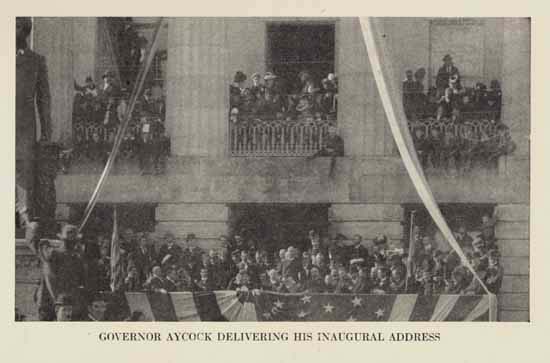
GOVERNOR AYCOCK DELIVERING HIS INAUGURAL ADDRESS
Page 239
shall be so fair that no just man can oppose it, and requires an administration of that law in such spirit that no man will doubt that the popular will has been rightly expressed and recorded. From the foundation of our State to the day when the negro was given the elective franchise the fairness of our elections was never questioned. When the ballot was given to the negro the first election thereafter was known to be a farce and a fraud. That election was held under military dictatorship, lasted three days, and the vote was counted in Charleston, South Carolina. We have denounced, and ever will denounce, that election as fraudulent. When we came to power in 1876 we changed the election law of the State, and from that time down to 1894 all elections were held under laws passed by us. Our adversaries charged that these elections were carried by force and fraud. When they came to power in 1895 they adopted a law which we denounced as providing means for the registration and voting of minors, dead, imported and convicted negroes. They carried the State under that law in 1896. We beat them in 1898 despite their law, and then we passed a new election law, which they denounced as designed to thwart the will of the people. We held the election of 1900 under that law. By the result of that election we have eliminated the ignorant negro from those entitled to vote. If what has been charged by the opposing parties be true and elections have been fraudulent and election laws unfair ever since the negro came to be a power in the State, it certainly ought to follow that with the disqualification of the ignorant negro the State should return to her ancient ways when no man questioned her
Page 240
integrity. Henceforth our laws and their administration must be so fair that the civilized world shall recognize the high purpose with which we have wrought to see this day. Let history record of us that we have fought our great fight and won our notable victory with no view to perpetuate ourselves in power, but honestly to secure good government founded on intelligence worked out through a perfectly fair election law administered as a sacred trust to be held forever inviolable. Good men go to war only for the sake of peace, and the patriotic citizens of our State have won this victory only for the sake of good government and not for party aggrandizement.
WHERE SAFETY LIES
On every platform in the late campaign I declared our purpose to be to secure good government, safety and peace, to educate all the children, and to bring about that day when even extremest partisanship should not be able to cry out against our laws and our methods. Thousands of Republicans and Populists joined with us in securing our more than sixty thousand majority. I shall, therefore, confidently expect you, gentlemen of the Legislature, without regard to party, to frame an election law fair in every purpose, clear in every detail, and to provide machinery by which every man qualified under our Constitution shall be able to vote and shall know that his vote is effective. We can have safety, security and integrity on no other basis. I now pledge you the whole power of my administration to secure this end. I declared in my speech of acceptance that I should enter upon the discharge of my
Page 241
duties if elected with great fear lest I should fail to interpret adequately the true spirit underlying our change in the Constitution; but I have never for one moment questioned that the ultimate aim of our people was to secure a constitution under which security for life, liberty and property could be found under the forms of law and not in violation of them.
IT MUST ENDURE
Our opponents have denounced the movement which we inaugurated to amend the Constitution, and which will be carried out in the spirit just suggested, as revolutionary. They sought to prevent its success by threats before the election, and in the first moments of passionate disappointment after the election they began prosecutions against certain officers of the State for alleged wrongdoing in connection with the August election. This movement of ours was carried out with such deliberate high purpose and such noble earnestness that thousands of our political opponents joined hands with us in effort to forever settle a question which had distressed us for thirty years. It was the uprising of almost an entire people. There was about it, indeed, in its spontaneousness, in its enthusiasm, in its determination and sturdiness of purpose and its high aims, something of the revolutionary spirit of 1776. That spirit still lives in the hearts of North Carolinians. It is a part, and a glorious part, of their heritage -- it cannot be destroyed by persecution. A whole people cannot be persecuted, nor will they without the utmost exertion see any of their agents made to suffer for the
Page 242
defeat of those who sought in vain to stem the mighty tide of popular opinion.
LAW MUST HAVE SWAY
We have a great State, rich in noble manhood, richer still in her high-minded womanhood; a State with countless treasures awaiting seekers; with riches in her fields and woods, streams and sounds, hills and mountains, sufficient to satisfy our dreams of wealth; with a frugal and industrious population ready to toil just awakening fully to the possibilities before them. All that we need "to complete the circle of our felicities" is peace. Let hatred and bitterness and strife cease from among us. Let the law everywhere reign supreme. The highest test of a great people is obedience to law and a consequent ability to administer justice. It shall be the earnest aim of my administration to foster good feeling and to enforce law and order throughout the State -- from Currituck to Cherokee the law must have full sway. The mob has no place in our civilization. The courts are the creation of the Constitution and the juries are drawn from the people. If changes be necessary in order to secure a better and more certain administration of justice, you, gentlemen of the Legislature, can make these changes; but it should be distinctly and finally understood of all men that safety can be found only in obedience to law.
I wish to say to the negroes of this State in this connection, that they have been misinformed if they have heard that this administration will be unfriendly to them. Their every right under the Constitution shall be absolutely preserved; they will
Page 243
find security in right conduct and certain punishment for failure to obey the law. Let them learn that crimes which lead to mob law must cease and then mob law shall curse our State no more. I call upon all upright negroes to aid me in suppressing crime in all its forms. The white people owe a high duty to the negro. It was necessary to the safety of the State to base suffrage on capacity to exercise it wisely. This results in excluding a great number of negroes from the ballot, but their right to life, liberty, property and justice must be even more carefully safeguarded than ever. It is true that a superior race cannot submit to the rule of a weaker race without injury; it is also true in the long years of God that the strong cannot oppress the weak without destruction. I said on April 11, 1900, and I now repeat it as a deep conviction, that "universal justice is the perpetual decree of Almighty God, and we are entrusted with power not for our good alone, but for the negro as well. We hold our title to power by tenure of service to God, and if we fail to administer equal and exact justice to the negro whom we deprive of suffrage, we shall in the fulness of time lose power ourselves, for we must know that the God who is Love trusts no people with authority for the purpose of enabling them to do injustice to the weak."
FREEDOM OF THOUGHT
Let us serve the State in this spirit and with wisdom and the people will continue to trust us, but if we depart from this plain and just way, power will drop from our hands, for the Amendment has, I believe and trust, brought with it a freedom of thought, of criticism
Page 244
and of action that will be swift to withdraw a trust abused.
STATE'S HIGH DESTINY
With the education of the whole people, with a fair and impartial election law, with peace everywhere, there will be nothing to prevent us from working out the high destiny of our State. Thought will be set free, opinion can have its full sway and every man will be able to declare the inmost feelings of his heart. We shall have genuine free speech; our newspapers will have an opportunity to address themselves to molding public opinion without fear of injury to the State. Discussions can then take the place of abuse, and argument will supplant passionate oratory. In this new and freer day we shall grow brighter men. Trust in all things high will come easy to us. We shall have problems and differences, but we shall have the intelligence to solve the problems and the good spirit to harmonize our differences.
WITH AN HUMBLE HEART
I come to the high task to which the people have called me with many misgivings. I know, if not adequately, something of my weakness, and I likewise know, if not to the fullest extent, the many difficulties which will beset my way. I come to the work humbly, with deep anxiety and with an earnest desire to serve the people well. The manner of my coming makes it all the more incumbent upon me to search my heart that I may have no impure motive there; one who has been trusted after such fashion as the people have trusted me owes the highest obligation of uprightness in thought and action.
Page 245
Chosen by my party unanimously, elected by the people by a majority such as has never been given to any other man, I am bound by every obligation to serve to my utmost. The task is a difficult one. I shall make mistakes. When I shall have done the right thing I shall even then sometimes be misunderstood by my friends, who will see my action not from my standpoint as the Governor of the whole people, but from theirs. When I shall have done wrong I shall not expect approval; I do not wish it. I want to know my mistakes to the end that I may correct them, because I am certain that I shall be judged at last by the whole tenor of my administration and by no one particular act.
GOVERNOR OF ALL THE PEOPLE
I have been elected as a Democrat. I shall administer the high office to which I have been called in accordance with the policies and principles of that great party, but I wish it distinctly understood that I shall strive to be a just Governor of all the people, without regard to party, color or creed. The law will be enforced with impartiality and no man's petition shall go unheard and unconsidered because he differs from me in politics or in color. My obligation is to the State and the State is all her citizens. No man is so high that the law shall not be enforced against him, and no man is so low that it shall not reach down to him to lift him up if may be and set him on his feet again and bid him Godspeed to better things.
GOD'S BLESSINGS ON US
I shall need the support of every citizen in the State. My work is your work; I am but your servant, and if I
Page 246
serve you wisely it will be because my ears shall be constantly open to counsel, and my mind shall know wisdom. But with all the aid which can come from men, I shall fail unless I have the guidance of that God who rules the destinies of States and nations and men, to Whom with reverence I commend this good State and her gracious people.
Page 247
CHAPTER III
A MESSAGE TO THE NEGRO
(Address, opening the Negro State Fair, 1901.)
IT AFFORDS me pleasure to open this fair. I wish the colored people of North Carolina to understand by every act and expression of mine that I am the Governor of the entire State and all its people, and that any interest which concerns any individual is a matter of importance to me. It has been gratifying to me that those to whom I have been opposed politically have recognized the real feeling which exists in my heart. In my duty as a servant of the State, it is of immense value that those of opposite political faith should feel that he who has been chosen to serve them is not the enemy of any person or of any race in the State.
I have earnestly endeavored, since it has been my fortune to be the Governor of the State, so the conduct the high office to which I was chosen, as to develop the industrial, commercial and educational sides of our life, because in these we have heretofore been weakest. The North Carolina people are in many respects a strong and great people. They love liberty and they are devoted to personal independence. They need no instructions along these lines. They have the courage
Page 248
of their convictions and are ever ready to assert their political and individual rights. What we have needed and what we do need is instruction along industrial, commercial and educational lines, and I have been anxious to be an humble instrument in this work.
The colored people of North Carolina are entitled to much credit for what they have done. At the close of the Civil War there were many who had grave apprehension as to the conduct which would result from the freedom of the negro. I am glad to be able to state that that apprehension proved to be unfounded. Your conduct in the main has been admirable. You have surpassed expectations. You have been sober, law-abiding, and industrious. You have created more value in freedom than you did in slavery, and taken all in all, you deserve the thanks of the Commonwealth.
But you will pardon me as one who is a friend of yours, for speaking to you to-day words which may seem unkind, but are in fact kind because truthful. There are many things in your freedom which you have neglected. There are many things yet for you to do. In glancing through the criminal statistics of the State, I find that while your race constitutes only one third of the population of North Carolina, you commit one half of the crimes. I am not unmindful of the fact that your race is poor and weak and without the influence of the dominant race, and that therefore, in proportion to actual crime committed, a few more are indicted than would be if you were rich and powerful and with the influences which tend to suppress indictments. But eliminating this unimportant factor, as one may well
Page 249
do in a just State like this, the proportion of crime in your race is startling and dangerous and ought to evoke your most earnest consideration. Before you can ever take your proper place in the world, you must learn first obedience to law. This ought to be with you a matter of constant instruction in the home, in the school, in the church, on the highway, wherever two or more of you may gather, until it becomes a part of your very existence and grows into your nature. The great strength of the white man has been his love of his home, and the consequent love of those industries which secure to him his home. It will be well for you and for your race when you shall have learned that your strength is founded upon industry and economy and that your importance in the State will increase with your growing wealth. This fair, therefore, which to some extent, but inadequately, illustrates your industries, is a matter of importance to the State. It shows what you have done and encourages you to do more.
It may not be inappropriate for me upon this occasion to express to you the hope that recent events occurring in the nation may not unduly excite you, and that you will still remember that your best friends are those who live in your State. What you wish, what you need more than recognition by the President or other people in authority, is the establishment among yourselves of a society founded upon culture, intelligence and virtue, and in no wise dependent upon those of a different race. The law which separates you from the white people of the State socially always has been and always will be inexorable, and it need not concern you or me whether the law is violated elsewhere. It will never be violated
Page 250
in the South. Its violation would be to your destruction as well as to the injury of the whites.
No thoughtful, conservative, and upright Southerner has for your race aught but the kindest feelings, and we are all willing and anxious to see you grow into the highest citizenship of which you are capable, and we are willing to give our energies and best thought to aid you in the great work necessary to make you what you are capable of, and to assist you in that elevation of character and of virtue which tends to the strengthening of the State. But to do this it is absolutely necessary that each race should remain distinct, and have a society of its own. Inside of your own race you can grow as large and broad and high as God permits, with the aid, the sympathy, and the encouragement of your white neighbors. If you can equal the white race in achievement, in scholarship, in literature, in art, in industry, in commerce, you will find no generous-minded white man who will stand in your way; but all of them in the South will insist that you shall accomplish this high end without social intermingling. And this is well for you; it is well for us; it is necessary for the peace of our section; it is essential to the education of your children that you shall accomplish this high end upon this point.
I am sure that you agree with me in what I have said and in the spirit of one who is the Governor of the whole people without regard to race. I bid you God-speed in the great work of upbuilding our State, of multiplying her industries, of increasing her commerce, of educating all her children. I find no little encouragement in the friendly coöperation of the men and
Page 251
women of your race in the task which we have undertaken to do, that of educating all the children, and I pray you that in this great work we shall not be retarded by misunderstandings.
I now formally declare, with best wishes for your success, this fair open.
Page 252
CHAPTER IV
IN DEFENCE OF HIS POLICIES AND HIS ADMINISTRATION
(From Address Before the Democratic State Convention at Greensboro,
June 23, 1904.)
SOMETHING more than four years ago -- to be perfectly accurate, on the 11th of April, 1900 -- I accepted at the hands of the Democratic party the nomination for Governor of the State. On that occasion I made a speech to the united and demonstrative Democracy. To-day I come to another Democratic convention to witness the selection of him who shall be my successor. I do not think it inappropriate upon this occasion to review the work which has been done in this State since that day in April when you nominated me and my associates for office.
The memory of that day abides with me still. I recall distinctly the fine crowd -- the sturdy and determined and deeply enthusiastic, though calm, crowd of men whom I faced that day. They had met for a high purpose. They had grown weary through the years of the struggle for good government. They were sick at heart with the makeshifts to which we had been compelled to resort in order to free the State from the danger of being controlled by an ignorant mass, voting as one man. They were calmly resolute in their determination
Page 253
once for all to put an end to these conditions and begin a new day.
I remember my greatest fear then was -- and I so expressed it -- that I should be unable rightly to interpret and adequately to express the high ideals and noble purposes which thrilled the hearts of North Carolinians at that hour. That fear still abides with me. I can merely say that I have honestly endeavored day by day to realize that the men then assembled were willing to make any sacrifice in order to secure the boon of good government.
That I have fallen short of their expectations I know. That I have failed to keep my own ideals I am certain, but the work which I have done was undertaken in the calm confidence that your generosity would forgive the shortcomings and your kindness approve in terms too strong the little that I might accomplish.
In speaking of the work of the past administration I shall frequently use the personal pronoun "I" -- not from any desire to appropriate the work done, nor I trust from any source of vanity, but because of convenience of expression. I wish to say in the beginning that the work has not been mine. Whatever good has been accomplished has had the whole body of the people behind it and has had to execute it the united force of the able, honorable, conscientious men with whom I have the honor to be associated.
The closing paragraph of the speech which I made to the convention which nominated me was as follows: "I shall respect the rights of property and rejoice in prosperity, but I shall not forget that they who toil, constitute not only the largest class of our people, but
Page 254
from their labors can spare little time to urge their views upon those that they have chosen to serve them."
That paragraph I conceive to represent clearly, if not adequately, the duty of the public servant in a representative Democracy. This administration has sought to live up to that declaration. . . .
REASONS FOR EMPHASIZING PUBLIC EDUCATION
Coming into office at a new period, when our Constitution had been amended in such fashion that after 1908 no person then coming of age could vote unless he could read and write, my mind has naturally been much occupied with this all-important question. As one should do who is charged with the enforcement of the law, I turned for guidance to that document, the product of the great thoughts of your fathers and mine -- the Constitution of North Carolina, and I read there -- "Religion, morality, and knowledge being necessary to good government and the happiness of mankind, schools and the means of education shall forever be encouraged." I read again and found "That the people have a right to the privilege of education and it is the duty of the State to guard and maintain that right."
I have earnestly endeavored, with the coöperation of my associates, to carry out these high provisions of our Constitution. I believe with Thomas Jefferson that "intelligence should ever preach against ignorance as the enemy of liberty and of moral and material progress."
Believing this, pledged to it by the platform upon which I ran, committed to it from my early boyhood, I
Page 255
have spent the greater part of my time since I have been Governor in proclaiming this doctrine and urging upon the people the importance of universal education. I have not stood alone in this work. I did not originate it. I cannot even claim the credit of having adequately presented it.
The doctrine set out in our Constitution and advocated by Thomas Jefferson was held in this State in her darkest hour, in the midst of war, when every man was needed at the front and every dollar that could be raised was necessary for the equipment of our army. It was the immortal Vance who declared in a message to the Legislature that "the common schools should surely be kept going at every cost and if sufficient inducements cannot be offered to disabled soldiers and educated women to take hold of them, the necessary males should be exempted from military service."
Calvin H. Wiley, founder of our public school system and the most eloquent advocate of it, in the very midst of that great clash of arms when darkness began to lower over the Southern cause, declared that "The crowning glory of North Carolina will be found to be that when every nerve and muscle of the country were wrought to the highest tension in a terrible and unexampled struggle for existence and independence, she still supported a vigorous and beneficent system of free and public schools which were attended by 50,000 of the children of her patriotic citizens."
From that day to this, the patriotic citizens of this State have been struggling to reach the fulfilment of that pledge of our Constitution which requires the Legislature to provide for at least four months of public
Page 256
schools in every district in the State. Too long deferred, to the grievous injury of the State, her peace, her prosperity, and happiness, we have under this administration successfully met this requirement.
The patriotic legislatures chosen by the people have made provision for it, and the executive officers, under the lead of our admirable Superintendent of Public Instruction, have carried the provisions of the law into effect. To-day we can boast for the first time in the history of the State that we have redeemed our pledge, kept faith with the people, and made provision for all the children. If the child is blind, we have teachers ready to open his eyes. If he is deaf, he can be taught to speak. If he is friendless and poor, the schoolhouse door stands wide open to shed its genial warmth upon him. . . .
To do these things has cost much money, and to raise money in North Carolina by taxation has ever been a matter liable to cause offense. None of us pays taxes cheerfully or graciously. . . . This administration has spent much money and it is glad of it. There was need for expenditure of money. There was a demand for it, and we have met it. It undoubtedly appears cheaper to neglect the aged, the feeble, the infirm, the defective, to forget the children of this generation, but the man who does it is cursed of God, and the State that permits it is certain of destruction. There are people on the face of the earth who take no care of the weak and infirm, who care nought for their children and provide only for the gratification of their own desires, but these people neither wear clothes nor dwell in houses. They leave God out of consideration
Page 257
in their estimate of life, and are known to us as savages.
The Republican party in their platform expressly declare themselves in favor of the education of the masses; in favor of generous public aid to all charitable institutions of the State and the enactment of pension laws more liberal and just to the old Confederate soldier. If they do favor these things, then they must vote the Democratic ticket this year, for what they favor, we have already accomplished and so far from being satisfied with our work, we stand ready to obey the command "that we go forward." . . .
DEMAND FOR PEACE BETWEEN THE RACES
When I was elected Governor it was after the revolution of 1898. It was in the same campaign in which we advocated and adopted the Amendment to the Constitution. These two campaigns were the occasion of much bitterness. They gave rise to intense passion. They set the two races in the State in fearful antagonism. The adoption of the Amendment was a cause of great anxiety to our colored citizens. Their disfranchisement was to them a matter of grievous import, which made them feel that they were something less than citizens and in a large measure cut them off from hope. I, in common with most of the thoughtful citizens of the State, realized this feeling of theirs. We had made the fight for the Amendment in no enmity to the negro, but for the sake of good government, peace and prosperity. When the fight had been won, I felt that the time had come when the negro should be taught to realize that while he would not be permitted to govern the State, his rights should be held the more
Page 258
sacred by reason of his weakness. I knew that our own passions had been aroused and that we were in danger of going too far. I realized to the fullest the peril of antagonizing the dominant and prevailing thought in the State, and yet I believed that the people who had chosen me Governor did so in the hope that I would be brave enough to sacrifice my own popularity -- my future if need be -- to the speaking of the rightful word and the doing of the generous act. I have therefore everywhere maintained the duty of the State to educate the negro. I have proclaimed this doctrine in many places and in doing so I have frequently met the condemnation of friends whose good opinion I esteem and whose loyalty in the past I appreciate; but, holding my views, I could not have been worthy of the confidence of the great people of this State if I had contented myself to remain silent. My position has brought satisfaction and even happiness to many humble homes in North Carolina, and the negro, whose political control I have fought with so much earnestness, has turned to me with gratitude for my support of his right to a public school education.
The Amendment drove many of them out of the State. An effort to reduce their public schools would send thousands more of them away from us. In this hour, when our industrial development demands more labor and not less, it becomes of the utmost importance that we shall make no mistake in dealing with that race which does a very large part of the work, of actual hard labor in the State. I appeal to the generous high-minded North Carolinians to realize that we are confronted with a condition which demands statesmanship
Page 259
and not passion and prejudice. While holding these views, it is needful for me to say that I have recognized that, heretofore, much injustice has in many instances been done to the whites in that in the same county schools were frequently maintained for six or seven months for the colored in certain districts and for only two or three months for the whites in other districts. It has been the aim of this administration to correct this inequality and to see to it that provision was made for the whites which should certainly be equal to that made for negroes. This has been done without any Constitutional Amendment, but under the plain provisions of our law. It may be of interest to you to know in this connection the facts about the expenditure of money for the public schools from 1883 to 1903. In 1883 there was spent for the schools for whites $306,805.55; for colored $260,955.87. There was spent $1.04 per capita for white children and $1.50 per capita for colored children -- a difference of 48 cents in favor of the negro. . . . For 1903 there was spent for the education of the white children $865,700.17 and for the education of colored children $252,820.54; per capita expenditure of $1.89 for whites and $1.14 for the colored; a difference in favor of the whites of 75 cents per capita. These are the facts and they speak for themselves.
The danger which I have apprehended is not that we shall do too much for the negro, but that becoming unmindful of our duty to him we shall do too little. Having taken from him the power to vote, it becomes a strong people to safeguard with the utmost care every right which the negro has. "We hold our title to power
Page 260
by tenure of service to God," and we can never hope to win His approval if we do injustice to the weak. Let us cast away all fear of rivalry with the negro, all apprehension that he shall ever overtake us in the race of life. We are the thoroughbreds and should have no fear of winning the race against a commoner stock.
ADVANCED TEMPERANCE LEGISLATION
The problem of dealing with the liquor traffic is admittedly the most difficult one which confronts the Government. It has to deal with the appetites of men, and in a free government, where the people rule, any legislation tending to check the manufacture and sale of liquor is compelled to run counter to the great principle of non-interference with the personal habits of the individual. A Democratic government therefore is always loath to deal with this problem and never does so except when public opinion has reached the point at which it becomes necessary to put that public opinion into legislation. The last Legislature, guided by this rule and fully recognizing its obligation within the limits of the Constitution to respond to popular demand, adopted what is known as the Watts law. That statute has met with much criticism and much praise. It proceeded along lines well established in this State. For more than twenty years each succeeding Legislature has adopted a bill prohibiting the manufacture and sale of liquor within a given number of miles of various churches and schoolhouses. The number of such places in which the manufacture and sale of liquor has heretofore been prohibited runs up into the thousands. It is perhaps not too much to say that by means of these
Page 261
various acts, liquor could neither be manufactured nor sold in nine tenths of the territory of the State. I recall one whole county that was made a prohibition county by the simple device of prohibiting the manufacture and sale of liquor within a certain number of miles of the various churches and schoolhouses in the county. The Legislature of 1903, finding nine tenths of the territory of the State "dry," decided to take direct steps to drive the manufacture and sale of liquor out of the State except in incorporated towns, readily concluding that what nine tenths of the State already enjoyed and demanded, was good for the other tenth. It wisely considered that the appetites of men not being under the control of legislation, they would obtain liquor to a more or less extent. It therefore provided that liquor could be manufactured and sold in the towns, but that even here it could only be done by permission of the people of the towns. The main reason, however, for the passage of the Watts law, and the reason which ought to satisfy and will finally satisfy every right thinking man, was that the manufacture and sale of liquor in the country was a constant menace to the peace, quiet and good order of the country. The towns and cities maintain a police force and thus are enabled to restrain and lessen the evils flowing from drunkenness. There is no police force in the country and the State is not prepared to maintain one. There is no greater menace to the quiet and good order of any country than a whiskev still and a barroom. No man will deny this.
We have entered upon an educational awakening in this State which is seeking not only to open the door of
Page 262
the schoolhouse to every child, but to persuade and influence every child to enter that schoolhouse. There are men who have seen such a school flourish in a town close by a barroom or a still, but no man has ever yet seen a school grow up and prosper by the side of a whiskey still or a barroom in the country. The Legislature therefore was confronted with the question whether they should open and maintain schoolhouses in the country for children, or whiskey stills and bars for the men. The Legislature made its choice and the people will ratify it at the polls. In my judgment this act is one of the best ever passed by any Legislature. The conditions justified it. The demands of the people required it and the results have proven beneficial. With the passing of the years it will be found to have been a most effective agency in the cause of temperance. . . .
HOW FREEDOM FROM THE RACE ISSUE PROMOTED
LIBERTY
I declared in my speech of acceptance that with the adoption of the Constitutional Amendment, "We will have peace in the land." "There will be rest," I said, "from political bitterness and race antagonism. Industry will have a great outburst. We shall have intellectual freedom. Public questions will stand or fall in the court of reason and not of passion. We shall forget the asperities of those years and shall go forward into the twentieth century a united people, striving in zeal and in generous rivalry for the material, intellectual and moral upbuilding of the State. May an era of good feeling among us be the outcome of this contest."
Page 263
There are those among us who fear that these predictions have not been fulfilled. These doubters are looking upon the surface of things. They do not look at the great underlying truth. They declare that bitterness is more rife than ever before; that the era of good feeling has not come; that criticism is more severe than ever; that freedom of speech is not permissible. They have mistaken appearance for fact. There is bitterness between individuals. There is strife and enmity between some people. There is, of course, a reckless criticism. Our people had been so long restrained by the necessity of staying united in order to face the danger of negro control of the State that when they first gained their freedom under the Constitutional Amendment they naturally felt called upon to exhibit their freedom from restraint by frequent and often undue criticism. Newspapers, which would in the old days have unhesitatingly sustained my administration at every point, have criticised it with much severity and sometimes, as I think, with much injustice. Speeches and publications which heretofore would have attracted universal approval or universal condemnation, according to the side which they were on, have met with a divided support and a divided criticism. Controversies have grown large about small things. Personalities have frequently taken the place of the discussion of great problems. All of these things have been done in assertion of our new-born freedom. They are ever the first fruits of liberty of speech. They mark the beginning of real liberty, which will hereafter be restrained by judgment. They show that the minds of our people are active; that they are alert
Page 264
even in fault-finding. They can be destructionists, but this is the beginning of the constructive power as well. If we pull down now, we shall build hereafter. If we criticise now, we shall in the future learn that effective criticism is that only which is based on fact, and then only to be indulged in for the correction of evil and for the purpose of turning men toward better things. This bitterness and this strife has not reached the great body of the people. They have gone about their work undisturbed by fault-finding and the asperities of discussion. They have found in industry the best outlet for their superabundance of energy and they are bringing to pass a wonderful day in this State.
A GREAT INDUSTRIAL AWAKENING
Truly, as I predicted, there has been a great outburst of industry. At the time of the taking of the census in 1900 there were 177 cotton mills in this State. Since then 89 more have been erected. In 1909 these mills had 1,133,432 spindles; since then 863,206 more have been put in. In 1900 there were 25,469 looms; since then 21,001 looms have been added. In 1900 there was invested in cotton mills in this State $25,840,465; since then $18,260,000 have been added to the investment. We have added 50 per cent. to our number of mills; 75 per cent. to our number of spindles; 84 per cent. to our number of looms; 75 per cent. to the capital invested. The number of employees in the cotton and woolen mills increased from 38,637 in 1900 to 50,324 in 1903 -- a fine thing in this, that the increase shows 4,000 more men than women.
For the three years of 1897, 1898 and 1899, 510 corporations
Page 265
were formed in the State. For the years 1901, 1902 and 1903, 1,276 were added. For the first three years the 510 corporations were capitalized at $12,943,080. For the last three years the 1,276 corporations were capitalized at $100,341,850. These figures almost pass belief, but they are a simple presentation of the real facts of the business revival in this State.
Other industries, notably the manufacture of furniture and other articles of wood, have fully kept pace, if not outstript that of cotton manufacturing. Agriculture has had a wonderful growth. Cotton has again become king. Large portions of the east have been converted into market gardens for the populous cities of the North. A negro tenant in my county of Wayne recently declared that he had made $3,600 on strawberries, after paying his rents, and then added, "You see I couldn't afford to be Guv'ner."
A gentleman writing to me recently from New Bern, opposing the lease of the Atlantic & North Carolina Railroad, declares that a new day has dawned in that section; that men feel secure in their property, safe in their business, and have therefore turned their attention to business and that the whole eastern section will soon become a garden out of which the Atlantic & North Carolina Railroad will grow rich. This feeling of security covers the State. This wonderful investment of capital in large business enterprises, with a full knowledge of our laws, of our assessments, of our needs, of our purposes to care for the weak and afflicted, and to educate the young -- proves conclusively that the business men of North Carolina realize the benefit of good
Page 266
government and the profit to be found in an educated people.
In view of all these facts I cordially invite every North Carolinian to become a Democrat. There are those who say that we ought to have two parties in the State. The time may come when this will be true. It will certainly come if the party in power proves unfaithful to its trust and becomes corrupt or inefficient; but for the present -- with an honest and courageous administration of the laws, with a constant thought for the needs of the weak, with a due respect to the rights of the strong, with an earnest endeavor to serve all to the uplifting of the whole State -- the Democratic party is alone sufficient. We need a united people. We need the combined effort of every North Carolinian. We need the strength which comes from believing alike. But I am no advocate of compelling belief. I would not check freedom of speech. I would set no limit to the utterances of the press, save the limit which the law always sets, that of speaking the truth. But, having spoken the truth, having printed the truth, I would have all our people to believe in the possibilities of North Carolina; in the strength of her men; the purity of her women, and their power to accomplish as much as can be done anywhere on earth by any people. I would have them to become dissatisfied with small things; to be anxious for higher and better things; to yearn after real greatness; to seek after knowledge; to do the right thing in order that they may be what they ought. I would have the strong to bear the burdens of the weak and to lift up the weak and make them strong, teaching men everywhere that real
Page 267
strength consists not in serving ourselves, but in doing for others.
I see the day coming when this State shall sit down at the common table of the Union an equal sister with all the others gathered there -- equal in wealth, equal in high performance, equal in noble ideals. Nothing short of this ought to satisfy us, and to attain this let us ever hope.
I thank you, gentlemen of the convention, for the courtesy you have extended me in permitting me to say these things. I know that the choice which you shall make to-day will be a worthy one. The State will be in good hands and I shall return to the life of a private citizen, forever grateful to the people of this State for the honor which they have done me and for the considerate courtesy which they have ever shown me.
Page 268
CHAPTER V
THE SOUTH AND THE UNION
(Speech at Charleston Exposition on "President's Day,"
April 9th, 1902
GOVERNOR AYCOCK'S speech at the Charleston Exposition in 1902 was notable for its own sake, but even more notable because of the circumstances under which it was delivered. Several persons who were present have written of the incident, but perhaps the best account is that given by Mr. J. D. Bullock, Leechville, N. C. His letter follows:
"I take pleasure and pride in calling your attention to an occasion when I believe ex-Governor Aycock showed what manner of man he was in the most impressive and thrilling way, and with such brave and forceful language, as to electrify the vast audience who heard him. I refer to the opening sentences of his speech in the Auditorium at the Charleston Exposition, April 9, 1902. You will recall that this was the occasion of the visit of Col. Theodore Roosevelt, who was at that time President of the United States. The President presented to Captain Jenkins of South Carolina, a sword, and in the exchange of flattering compliments following, the 'Mason-Dixon line' was being rapidly erased from the map of the minds of those present. Governor McSweeney of South Carolina opened up for a regular 'love feast,' declaring that he 'thanked God there was now, no North, nor South, no East, no West,' and proceeded along the line of forgetfulness of the past and apology for ever having even thought differently
Page 269
from our Northern brethren about the Civil War. When Governor Aycock rose to speak, the vast audience expected he would follow along the lines set forth by the President and the Governor of South Carolina. But not so. Facing the sea of faces that rose tier upon tier before him, he turned and looked over the crowded Auditorium, and after a word of greeting, said, in that wonderful vein and manner that has so often moved the hearts and minds of men: 'There is a South, and a glorious South, and we are not ashamed of what our fathers wrought in the days from '61 to '65.'
"Nothing I could write would convey the effect of these brave and loyal words, spoken in such an irresistible way, upon the assembled multitude. The visitors from the North knew it was true and appreciated it, and all of us from this same old 'Glorious South' knew it was true and gloried in it. The roof of the building stayed on, but we put in motion waves that were felt all over the country by our cheers and appreciation. The Charleston News and Courier on the day following, contained a description of this scene, and by referring to their files a good account of this incident can be secured which will be more in detail than I can give in my letter, as I write from memory. Not ashamed, not afraid to do right -- ah! if we could only follow the example of this friend of North Carolina, how much better and nobler our lives would be."
GOVERNOR AYCOCK'S SPEECH
(As reported in the Charleston News and Courier, April 10, 1902.)
"Mr. President: I thought that we were in Charleston, S. C., but this warm welcome gives me the impression that we are in Goldsboro, N. C. But then it does not make any difference whether it is North or South Carolina, it is Carolina. I was not aware, Mr. President, that I should be expected to say anything today, nor did I know that it was fitting that I should,
Page 270
until I reflected that in the early days all of these two great States constituted Carolina, and it takes them both to extend to the President of the United States the welcome to which he is entitled. (Applause.) There is a very fine and high sense in which, as my distinguished friend, the Governor of South Carolina said, that there is no North and no South, and yet there is another finer sense in which I am glad to say to-day that there is a South. (Applause.) When I glance over the magnificent Exposition which has been made here through the industries of these people, stricken as they had been by four years of disastrous war; when I see the mighty work that the men and the women of this section of our common country have done, I say there is a South, and a glorious South. (Applause.) And then, too, when I reflect upon the history of this country of ours and recall the glorious deeds of the noble people of this State when they were struggling with British tyranny, when, under the leadership of that great Revolutionary soldier, under that of Marion and others, I am glad to say that there is a South, and that in the number there is no truer and better State than South Carolina. (Applause.) Nor am I ashamed of the mighty deeds which you wrought from '61 to '65. (Applause.) I shall forever defend those men and women, and I must do so in order to justify the splendid courage of the President of the United States. (Applause.) They were a great folk. Sturdy, determined, hot-blooded maybe, but their blood stayed hot through four years. Your hot-blooded man cools under less than four years of suffering. But it took from Bethel to Appomattox to cool the blood of these Southern
Page 271
people. They were tired of fighting against their brethren, but they had just gotten themselves into good training for fighting the greatest battles of life. And so I say that I have ceased to talk about the fact that we are in the Union, for we never got out. (Applause.) And if there be any State -- in the Philippines or elsewhere -- that wants to secede, we will teach them that they can't get out." (Applause.)
President Roosevelt applauding: "You are all right, Governor."
"Mr. President, the old negro illustrated the Southern feeling when he said: 'You need not be talking about these Southern people being prodigal sons. If they were, they were like the fellow that walked in and said: "Look here, where's that veal?" ' No fatted-calf for the penitent sons of the South. It is our Union made after the splendid hearts and the glorious minds of Revolutionary heroes, wrought out with loss of blood and treasure and death and suffering; sustained through fifty years of a glorious peace, and made stronger in the blood shed on both sides of Mason and Dixon's line. It is our Union. As our Union I come in the name of the sister State of North Carolina to extend cordial greeting and welcome to our President. (Applause.) And I may say for the President that I know that he is happier that he may be President of a people who are proud of their history, than he would be to be President of a people who were ashamed of it. (Applause.) And so, in the name of all the manhood, and in the name of that better portion of our population, the splendid women -- than which there is no greater -- of North and South Carolina, I bid you welcome." (Continued applause.)
Page 272
CHAPTER VI
THE GENIUS OF NORTH CAROLINA INTERPRETED
(Address, welcoming visiting Sons of North Carolina, at Greensboro,
N. C., Reunion, October, 12, 1903.)
THIS State of your nativity is worthy of your love. Her history is such as to justify your pride in her. Her achievements compare with those of any other State, and make her sons, wherever they be, proud to be known as North Carolinians.
She was the first of the colonies to be settled, and, although that settlement was not successful, it is a source of gratification that it was made under the patronage of the soldier, navigator, scholar, statesman, and martyr, Sir Walter Raleigh.
On her soil the first white child born of English parentage came to bless the Western World.
Here liberty had its birth, and here it rejoices in its fullest beauty. North Carolina was settled by men who found the liberty of other colonies and States short of their desires. English, Virginians, French, New Englanders, Swiss, Germans, Huguenots, Scotch, Irish -- of whatever nationality they might be, they sought this land in order that they might found a State which should be a fit home for "the freest of the free." "They were imbued with a passion for liberty," says
Page 273
Bancroft; and in their earliest days they secured for themselves and transmitted to us both "liberty of conscience and of conduct." "With absolute freedom of conscience, benevolent reason was the simple rule of their conduct." "They were tender and open," gentle to the weak, and fierce only against tyranny. They were led to the choice of their residence from the hatred of restraint, and "lost themselves in the woods in search of independence." "Are there any who doubt man's capacity for self-government?" says Bancroft; "let them study the history of North Carolina. Its inhabitants were restless and turbulent in their imperfect submission to a government imposed on them from abroad. The administration of the colony was firm, humane, and tranquil when they were left to take care of themselves. Any government but one of their own institution was oppressive." Living far removed from contact with the government which sought to rule them, freed from the blandishments of power, "disciplined in frugality, and patient of toil," it is no wonder that our North Carolina ancestors resisted to the utmost tyranny of provincial and colonial rule. They were in constant warfare with their governors, and repeatedly turned them out of the province.
When the struggle with Great Britain came, North Carolina was in the front. . . .
It can occasion no surprise then when we are told by Mr. Bancroft that "the first voice for dissolving all connection with Great Britain came, not from the Puritans of New England, the Dutch of New York, or the planters of Virginia, but from the Scotch Presbyterians of North Carolina."
Page 274
It was another great day for liberty when the patriots of this State, on the twenty-seventh of February, 1776, gained the signal victory at Moore's Creek over the Tories who were seeking to unite their forces with those of Sir Henry Clinton. The result of that early victory for American arms broke the backbone of Toryism, and gave to the patriots a zeal and confidence which stood them in stead in the darkest hours of the war for independence.
It was your ancestors again who, in conjunction with their neighbors, won the great victory at King's Mountain.
It was your ancestors who, in this very county, fought the great fight of Guilford Courthouse, and, while suffering a defeat, so crippled Cornwallis that he was compelled to yield his sword to Washington at Yorktown.
When she had won her independence, North Carolina set such store by it that she declined to join the American Union until the sovereignty of the State and the liberty of the individual had been provided for by the proposal of the first ten amendments to the Constitution of the United States. But, once in the Union, this State loved it. The government was one of our own formation, and our people have ever been willing to yield obedience to the laws of their own enactment. Even when the people thought the Constitution had been violated, and their rights infringed, their love for the Union was so great that with singular unanimity they determined to remain in it, and secure, if possible, under the stars and stripes that protection to which they felt themselves entitled. But when the other
Page 275
Southern States went out of the Union, and we were brought face to face with the necessity of taking sides, then our people in convention assembled, without a single dissenting vote, went out of the Union, and sought at every cost to secure again that independence which our fathers had won.
Late in going out, this State offered the first life on the altar of the Southern Confederacy. Having made up her mind to fight for independence, she sent to the front more soldiers than there were voters within her borders. She lost more men in killed and wounded than any other Southern State; charged farthest at Gettysburg; laid down the greatest number of guns at Appomattox, and quit the fight with as deep regret as any of her sisters. I care not on which side one fought in that great contest; the achievements of North Carolina soldiers were too great to excite bitterness in any breast that loves heroic sacrifice and daring deeds. Her men won for humanity a still higher place for stubborn courage than had heretofore been gained. They went into the fight reluctantly, because of their deep love for the Union which their fathers had cemented with their blood. They went to the front well clothed, well fed, in high spirits, certain of success. They left at the end in tatters and rags, footsore and hungry, but their tears watered the ground where the greatest leader of soldiers, the highest type of Christian manhood, the purest and truest and the best of men, General Robert E. Lee, surrendered his sword.
They came back to the State weary, worn, and sorrowful. They found the population depleted. Their farms had gone to ruin, their fences were down,
Page 276
their ditches were filled, their stock were slaughtered, in too many instances their houses were burned. But they did not sit down in the desolation of their despair. With a courage worthy of the great men who fought during the Revolution, they turned their faces to the morning, put their trust in God, and resolutely determined to build again their homes and do honor to their mother for whom they had suffered so much. And right well have they wrought. To-day our fields abound with harvest. From the mountains to the seashore there is abundance. There is not, from Hatteras to Murphy, from Virginia to South Carolina, a man, woman, or child who is hungry to-day. North Carolina and South Carolina manufacture 60 per cent. of all the cotton manufactured in the South, and of this 60 per cent. this State claims over half. Within this county the forty furniture factories, giving employment to thousands of skilled laborers, sell their furniture in Grand Rapids, and take tribute to their superior workmanship from every State in the Union. The census shows that we more than doubled our investments in manufactures in the last decade. We grow more cotton on less acreage than ever before, while our tobacco crop in value exceeds that of any State in the Union. Our vegetable gardens have grown into fields, and we feed the crowding multitudes of the Eastern cities. In every department of human activity your brothers here are forging to the front. We stand in the morning, with our faces to the light, and gladly hear the command that "we go forward." . . .
In your travels you may have run across "the scorners who scoff at and the witlings who defame"
Page 277
this State. You may have heard that she is ignorant and provincial, but I have the pleasure to inform you what your affection already knows, that there can be found nowhere within her borders a man known out of his township ignorant enough to join with the fool in saying "There is no God." There is no man amongst us whose hand is so untrained that it does not instinctively seek his hat in the presence of a woman. There is no ear so untaught that it does not hear the cry of pity; and no heart so untutored that it does not beat in sympathy with the weak and the distressed. Illiterate we have been; but ignorant, never. Books we have not known; but of men we have learned, and of God we have sought to find out. "A gentle people and open," frank and courteous, passionate when aroused, and dangerous in conflict; capable of sacrifice, among warriors the first -- praised by men as warriors only because of the high courage manifested there, giving promise of the wonderful achievements which lie before us in peace.
These are your people; they are my people. I am proud of their history; proud of their character; and glad to introduce you to them again. Your brethren all wish you to stay among us to the utmost limit of your time, to see us and know us as we are. If you find our material condition better than it was when you left us, we claim no praise for it. If we have done well, it is because we were taught aright by those who went before us, taught at their expense; and credit belongs to them alone. We think we hold on to the truths which our fathers taught us. We believe that we still maintain a passion for liberty; that we love independence,
Page 278
and set more store by honor than by wealth, and that we seek wealth only in order that the earth may grow better by what we do. In log cabin, in frame house, in modern mansion, each and all of you will find a welcome. The latchstring hangs outside the door -- but not for you. The latchstring is for the stranger only; the door stands open for you. . . .
I extend to you all the liberties of the State, and invoke that pious benediction of Tiny Tim, "God bless us every one!"
Page 279
CHAPTER VII
HOW THE SOUTH MAY REGAIN ITS PRESTIGE
(Address Before Southern Educational Association, Jacksonville,
Fla., December, 1903.)
Mr. Chairman, Ladies and Gentlemen:
THE late Senator Hoar in an address which he delivered at Charleston a few years ago used this language:
"The American people have learned to know as never before the quality of the Southern stock, to value its noble contribution to the American character; its courage in war, its attachment to home and State; its love for rural life, its capacity for great action and generous emotions; its aptness for command and, above all this, constancy, the virtue above all virtues, without which no people can be either great or free. After all, the fruit of this vine has a flavor not to be found in other gardens. In the great and magnificent future which is before our country, you are to constitute a large measure both of strength and beauty."
When we read this the splendid tribute to the South, all of our hearts swelled with pride and were glad. We rejoiced to find appreciation at the North and a rarely beautiful expression of our real character. The prediction that a great and magnificent future for our country was to be based in large part on the strength and beauty of the South brought to all Southern people
Page 280
a distinct pleasure. The question now arises among us, however, as to whether, despite this prediction, we have any large part in the life of this nation, and if not, how can we make good and secure our proper share in the affairs of the country.
To-day it seems to me that we have less effect upon the thought and action of the nation than at any period of our history.
Before the war between the States, Southern statesmen directed the policies of the nation and filled the largest place in the eye of the people. They wrote few books, but their speeches illuminated every subject which they touched and set the fashion of political thought. In this day it is not too much to say that what any Southern man thinks of political question or governmental duty carries no weight in their final settlement. There must be a cause underlying this fact. What is it? How shall it be remedied?
Until 1865 the Southern States, while in form a Democratic government, were in fact an aristocracy, and out of this aristocracy they chose -- as aristocracies ever do -- their best men for public service. The wisest, the strongest, the most learned were ever to the front; they were the natural leaders of a brave and generous people who followed their leadership with pride and pleasure. With the close of the war the democracy arose and each man became a factor in the government of his country. Leadership was not so able or cultured. More blunders were committed and more unwise views propagated and believed in. Aristocracy was always trained. Democracy, if it is to be as effective, must likewise be trained.
Page 281
Universal education is therefore the imperative and only remedy for our loss of power in the nation. But how shall we be trained? Are we to forget the memories of the past; to break away from our traditions; to join with those who are clamoring for the adoption of the convictions which we have combated for many years? I think not. No people can ever become a great people by exchanging its own individuality, but only by developing and encouraging it. We must build on our own foundation of character, temperament, and inherited traits. We must not repudiate, but develop. We must seek out and appreciate our own distinctive traits, our own traditions, our deep-rooted tendencies, and read our destiny in their interpretation.
We must put away vainglory and boasting and take an impartial inventory of all the things that we have and are; and these things can only come to us through the training of all our citizenship. We have in the South to-day our Hills, our Lamars, our Becks, our Vests, our Vances, and our Hamptons (all of them products of the period before the war); but no man can go through the country and lay his hand on the head of any single child and say that here is a Lamar, here is a Vance, or a Vest, or a Hill, or a Hampton, or a Beck. It is the business of the schools to find for us these splendid children and develop them into these great leaders. If I believed in universal education for no other reason, this would be to me a sufficient one.
But there are other reasons. We must educate everybody in our respective neighborhoods in order that we may have the benefit of competitions and appreciation.
Page 282
You may educate your son and daughter to the fullest extent possible, giving to them the learning of all the world, and after their education, put them in a community where there are no other educated people, and they will fail to develop and grow as they would if they lived in a community where there was general culture. The man who stands easily head and shoulders above his neighbors will never be very tall. If he is to surpass his neighbors and be really great, he must have neighbors who are almost great themselves. He cannot work out of himself the best there is in him until he is forced to do so by the competition of others almost or quite as strong as he. When the trainers of horses sought to reduce the time in which it took to trot a mile, they did not go and pick out a particular colt and train him for the track, but the trainers all over the world were developing colts. Ten thousand of them were trained until year by year the record was lowered, and when at last lovers of horses wanted to reduce the record below two minutes, after training thousands of horses for the purpose, they found one which they thought could accomplish the task. And then they did not put her on the track alone, but with two running horses ridden by boys with whip and spur they pressed them on the heels of the trotter, drove her to her utmost speed, aroused her spirit of victory, maddened her with the fear of defeat, until in one last mad burst she broke the world's record to 1:58½.
Men must win their great victories after the same fashion. In the race of life, if they are to win a victory worth winning, they must run against thoroughbreds.
Page 283
If we pass under the wire ahead of a scrub, there is no honor in it.
We want the schools to find all of the strongest and best in competition one with the other until the fullest power of each shall be developed. In doing this we shall get the largest contribution to society. When we have filled each man full according to his capacity, whether that be much or little, he will overflow, and the surplus belongs to us. It is the full fountain which, because it is full, overflows and makes the green grass grow and the plants burst into flower. It is a full man who, having all he needs, can contribute to the wants of others.
It is needful, too, in order to get the best out of men, that we shall be able to recognize a fine thing when it is done. No man can speak to people who cannot hear, no musician can play for those whose ears are not attuned to harmony, and no man can paint for those whose eyes are not trained to see the beauty which he produces. There must be an appreciative audience before any man can do his best. If a woman sings her best songs and strikes the deepest chords of music when her sweetheart tells his story of love, it is because she believes that he understands and appreciates the beautiful thing she is doing. If she closes her piano and puts away her music after the wedding, it is because she has discovered that the man she loves best does not realize the splendid talent that is hers. The woman who spends her days and nights studying light, shadow, and perspective, who mixes her colors with her own lifeblood, can never create a great painting unless she feels that some heart shall understand the fine
Page 284
thing she has done and some soul be uplifted by her work.
If these things be true -- and that they are I am assured -- then it must needs be that the finest things can be done only by education of the masses.
It is education that finds and brings out for us the noblest and best. It stimulates these best to the utmost exertion and fullest development by putting them in competition with others just as well trained as themselves, and it gives to us the noblest and most appreciative audiences. When this thought shall become the guiding thought of the South, and our school-teachers shall work all the time to their utmost until every son and daughter of the South is the thing that God intended -- then, and not until then, shall we take our rightful place in the American Union.
To reach this place will cost us much -- much money, much toil, much sacrifice; but everything that is worth while always does cost much, and, indeed, the finest things can only be had at the highest prices, and then only when paid for in advance. No speech ever yet fell from mortal lips worth remembering a moment after it is delivered that did not come after the speaker had paid for it in advance. No song was ever sung that raised the hearts of the people and made them long for better things that was not sung after the singer had suffered all she sang. No preacher ever stirred the souls of his congregation and put them to yearning after "a closer walk with God" whose sermon was not made after his own hands had been nailed upon the Cross by the side of his Lord and Master. No man reaches the highest mountain peak until he has bruised his knees and
Page 285
scrambled over boulders and fallen into the gulches on his way up the height. Indeed, before he reaches there his head shall split with aching, his back shall break and the nails on his fingers shall be torn out by the roots as he pulls himself up the rugged way. But when he does reach the top, the world lies at his feet and the pathway seems to him no longer difficult. The boulders are out of sight, gently covered by the grass that grows by the wayside, while the flowers burst into the beauty of the eternal morning. The struggle upward is worth the cost, and without the cost would not be worth while.
The South, which bore so much, sacrificed all of her wealth, and gave the life of her young men in such numbers as to appal the historians -- she ought now to be able to do anything necessary to achieve the best things that are to be found in the world. We must learn all that can be learned, do all that can be done, and be all that we ought to be. The learning and doing will not give us power until we are what we ought to be, for power, permanent and lasting, must finally be based on righteousness.
When the war between the States closed and the incomparable leader of the Southern armies cast about to find the work he ought to do, he became a teacher. Gen. Robert E. Lee, the greatest soldier of the nineteenth century, was greater in peace than in war. He realized that the South could only be made great, powerful, and controlling through the schoolhouse, and he devoted the last years of his life to the high purpose of teaching. When he came to die, tossing on his last bed of illness, his mind reverted to the titanic struggle through which he had passed. He fought over again
Page 286
the great battles of that awful conflict, and as he stood in imagination before the serried ranks of the enemy he cried out to his aide: "Tell Hill he must come up."
We are fighting to-day a more terrific battle with the forces of ignorance than he was fighting then. If I had the right to use the great words of this mighty man I should call out to-night and say: "President Alderman, President McIver, President Mell, Chancellor Kirkland, Chancellor Hill, President Thatch, President Fulton, President Boyd, President Taliaferro, President Prather, President Jesse, 'you must come up.' Bring all your corps of truth and light and power. Open your batteries, for the conflict is now on with the enemy. The powers of ignorance and darkness are arrayed against us, and the fight must be to a finish. 'Tell Hill he must come up.'"
Page 287
CHAPTER VIII
AYCOCK ON THE HUSTINGS
(A Typical Campaign Stump Speech, 1910.)
Mr. Chairman, Ladies and Gentlemen:
WHEN I was in this county in 1900, ten years ago, I spoke on the Constitutional Amendment then pending before the people, and I made certain predictions as to what would be the outcome if the people chose to adopt that Amendment to the Constitution and set free the white men of North Carolina. I told you if that Amendment were adopted that we should live to see the day when North Carolina instead of being at the foot of the educational roll would proudly take her stand up toward the top of the column; and with education I told you would come better condition of farming; a better condition of manufacturing; a better commercial condition; a better banking condition. With your good schools would come good roads, I said, and we should go forward at such a pace that no other State in the American Union could keep step with us.
My Republican friends thought then that I was predicting things that were impossible of fulfilment. They denied my prophecies. They went so far as to say that if we adopted the Amendment we would disfranchise
Page 288
the white men of North Carolina, and they fooled themselves and a good many other white men into the belief that the Amendment was fraught with danger notwithstanding which the great, strong, sturdy white men of this State, backed as they were by the pure and noble womanhood, rolled up 50,000 majority for the Amendment. (Cheers.) And every word that I predicted then is history to-day.
There is not a man in North Carolina to-day, be he Democrat or Republican, who is not proud of the progress which has been made by North Carolina since 1900. We have been building a schoolhouse every day during the year, including Sundays. We are spending to-day three times as much money on the education of the children of North Carolina as we were spending the day I was inaugurated Governor. We are spending three times as much money for the support and maintenance of the old Confederate soldier -- God bless him -- as we were spending the day I was inaugurated Governor of North Carolina. (Cheers.) We are spending nearly three times as much for the insane of the State as we were spending then. And we have got three times as much money in the banks of North Carolina as we had the day I was inaugurated Governor.
And is it not a fine thing, my countrymen, that as we spend, we gain?
There be people upon the face of the earth who think that if you could kill the old, destroy the helpless, make way with the weaklings, that we should prosper and grow; that we would become a mighty and a great people; majestic in stature; fine in intellect; high in morals. But the men who think that, leave God
Page 289
Almighty out of the equation of human life, and it always happens that that people thrives most who does the most for the child, and the most for the old and the infirm. We have prospered in exact proportion as we have kept faith with God in caring for the afflicted.
It is a fine thing to be a Democrat and belong to a party that can bring about this condition of affairs in charity, in industry, in education. But we are not spending a cent to run the penitentiary, and therein lies the difference between us and the Republicans. We spend our money to run schools, and make the penitentiary contribute to them; and they spent their money to run the penitentiary and make the schools contribute to that. That is the truth. The Republican administration did not have charge of the penitentiary but two years, because the Democrats got the Legislature in 1899 and elected a Democratic board of directors, but during their two years the Republicans managed so that at the end of the time, when I came into office, it took $227,000 of the people's money to square accounts with the penitentiary. During the four years I was in office we turned $155,000 profits from it into the treasury of North Carolina, after paying all expenses. And here is the difference between a Democrat and a Republican. When Governor Glenn came into office, he turned in more than I did, and Governor Kitchin is going to turn in more than both of us did. Democrats progress upward. We will get to Heaven after a while. You Republicans progress downward. I don't know where you will go to.
Now, I take it, my countrymen, that whether we be Democrats or Republicans, that we all want good
Page 290
government, and that all this assembling of the people, this gathering in the public places, this meeting in your primaries, this holding conventions, this leaving your farms and your banks and your stores and your manufacturing plants -- all of it is designed for the good of the country. What are we in politics for? Is it personal ambition? Is it the desire to hold office? Is it the desire to be honored and glorified of men? That may be so with a few, but in all this great crowd that is assembled here to-day there are very few of you that ever held office or ever will. What are you here for? Why do you give up your time, your thought, your study, your work, in order to devote yourself to politics? It is that you may secure good government and equal opportunity for all the people. I believe there are few men in any of the parties, few among the masses of the people, who have any other hope or aspiration in their political strife than the building up of the State in which they live, so that they may have good homes for their wives and children and good schools for the children to go to, and to give to each man an opportunity in life.
WHY GOVERNMENT MUST BE KEPT CLOSE TO THE PEOPLE
That is my view of the Democratic party. Our Republican friends have been for some years asking scornfully, "What is a Democrat?" I can tell you what a Democrat is. Some Democratic speaker a short time ago said that a Democrat is a man who votes the Democratic ticket. That is the proof of faith that is in him, but that is not the faith itself.
A Democrat is a man who believes that our national
Page 291
Government has the powers which were granted to it in the Constitution and none other. A Democrat is a man who believes that the powers not granted to the national Government in the Constitution of the United States are reserved to the people or to the States. A Democrat is a man who believes that the power of taxation is the power to destroy, and that this power was never vested in any Government by a free people except to defray the expenses of the Government economically administered. A Democrat is a man who believes in the individual and thinks that his rights ought not to be restricted in any respect save only so far as is essential to the peace and progress of his neighbors. A Democrat believes in order to be responsive to the quick demands of the people the Government should be as close to the people as it is possible to bring it. A Democrat believes that when you have centralized your Government and made it strong and put it far away from the people, that the great mass of the people can't put their hands upon that Government and enforce the will of the multitude.
Let us consider these last propositions a little further. Always, everywhere under the sun, in all times, it has been the truth that the strong, the rich, the powerful, were closer to government than the weak. Isn't that true? Take the national Government at Washington which has to do with the relations of men in the States, has to do with your business affairs, with all the intimate affairs out of which grow your business, your farming, your manufacturing, everything that goes to make up life -- can you touch it? Can you reach it? It is the men who are closer to it than you that can
Page 292
reach it. Our State Government itself differs in this respect. I believe on the day that I took the oath of Governor of North Carolina that I had as earnest a desire in my soul to serve every humble citizen of North Carolina as I did to serve the strongest and the richest and the most powerful. But who was it that came to Raleigh to see me? There is not a man in this audience that I should not have been glad to see, and who would not have been welcome in the Governor's office. But who came? Was it the plain, simple man? No. It was the strong, the educated, the powerful, the men who travel, the men who go about, the men who know how to do things, and do not feel embarrassed in doing them. They were the men that came and told me what they wanted. The simple, plain men who were building up North Carolina behind the plow and in the manufacturing plant, in the forge, and in the mine and in the forest -- they did not come. They did not have time to come, and if they had had time to come they would have felt some degree of embarrassment in coming and saying what they wanted.
So you see, my countrymen, if you want good government you must have government that is right close to you, so that when the shoe pinches you can come to the shoemaker and say, "This is not a good fit, and I want a better shoe." Therefore, a Democrat is a man who believes that the government that shapes our daily lives and the things that enter into it should be a government that is close to the people. Therefore he believes in the preservation of the rights of the people and in withholding from the general government any power that is not nominated in the bond, the Constitution
Page 293
of the United States. We believe in the supremacy of the United States in all matters entrusted to it by the Constitution, but outside of the matters entrusted to it by the Constitution, we insist that every one of them belongs to the people and to the States.
TAXATION THE MOST INTERESTING SUBJECT ON EARTH
And now in the next place I wish to apply the doctrines of the Democratic party to the most interesting thing on earth, and that is taxation. Of course, I am omitting women and children. Next to them comes taxation. There never has been a battle fought or won, in behalf of the liberties of the people under the sun, that has not been fought around this question of tax. Our own liberty was gained on the question of taxation. Our people feel that now. It has been said of North Carolinians that they are the hardest people on earth to get to vote a tax. I like for a man to sit down and say, "I will not vote a tax until I hear from you on it. I know nothing can hurt me except by means of the taxing power. The Government cannot offend me unless it raises taxes. It cannot employ police, it cannot employ judges, without money. We cannot have governors or presidents without money, and it cannot oppress without money." All the oppression any government has ever done on the face of the earth has been by reason of the fact that it has had controlling power to raise money for its own purposes. It is right that our people are now and always have been touchous on this subject. I never made a speech in behalf of the tax for school in my life that I didn't congratulate the people on their attitude of opposition to taxation,
Page 294
and always told them that they ought not to vote for the tax until their reason was convinced that the tax was to be used for enlarging liberty, for enlightening the mind, instead of for strengthening the Government. That is the test.
And now let us see about the levying of taxes by the United States Government. What is the Democratic doctrine? It is that a tariff shall be levied for revenue only, for the purpose of an economical administration of the national Government. And what is the Republican doctrine? The Republican doctrine is that a tariff shall be levied for protection to those who enter into business; that there shall be a tariff levied which takes account of the differences in wages in the United States and abroad plus a reasonable profit to the manufacturer. Now I lay down this proposition: If the Congress of the United States undertakes to levy a tariff, not for revenue but for protection, it undertakes to legislate for some men and not for all men, and whenever any government undertakes to legislate for some man and not for all men, then you are beginning to have class government; and whenever you have class government and say to any set of men: "I am legislating for you and my legislation is going to affect your business; my legislation is going to make you rich," don't you see that these men whose interests are to be affected are going to crowd the halls of legislation? Why shouldn't they? You are legislating for them. Instead of the people writing the tax laws, they are written by the few men who want to use them.
Is that right? Let us see. If the Government can make me rich or make me poor, then when the Government
Page 295
is dealing with that question I must be up there and attend to my business. You elect a Congressman to Congress. He goes up there and his theory is that he has a right to use the taxing power to enrich me. You stay at home and work. I go up there and see him; stay with him; eat with him; drink with him; talk with him; send bouquets and put them on his desk, and teach him the effects and advantages of my industry, and get him to put a high price on my industry and run my price up accordingly and get rich, and you foot the bill.
When that Congressman comes around for renomination and reëlection, what do I do? Do you reckon I am going to sit still and let another fellow beat him? The other man might not do what I wanted him to do. But this fellow has made me rich; he is my Congressman; he wants to go back. I have made a million dollars by what he has done. I lay $10,000 on his table, and say to him, "My friend, take this; go again." That is the way we have been electing Congressmen, and we will continue to do so as long as it is held that they can legislate in behalf of the few.
The Democrat says that you must levy your tax for revenue only. That reaches everybody and dodges no special interest, enriches nobody and makes nobody poor. We send our Congressmen up there, and they get together and study the problem as best they can, and they levy that tax and it works equally for all people. Does anybody raise $10,000 for such a man? Not at all. He has done his duty by everybody. Nobody is going out and buy votes for him, and corrupt the constituency in his behalf, and he has to go back to
Page 296
Congress on his merits, and not by reason of buying his way in.
EFFECT OF PROTECTION ON INDUSTRY
By means of this protective tariff what has happened? You can build up an industry by it. I have never disputed that proposition anywhere. We could grow tea in South Carolina, by the operation of the protective tariff, Senator Tillman says. If you will make it high enough you can grow it in South Carolina and make some people rich. You can build up a special industry. Don't you see when they put on that high tax, and exclude foreign competition, the manufacturer starts up? One man starts with a capital of $100,000. He hurries up his plant. He has a large market and it is exclusive. The tariff has shut out all foreign competition. He goes to work and gets his goods on the market and sells them nearly as high as the tariff will allow him. He coins money, and gets rich fast. The next man sees this, and says, "If A. is making money that way, I can, too." He builds a $250,000 factory and gets rich, too. Then C. comes in and builds a factory for $1,000,000, and the prices go a little lower. And so they keep on until they have twenty-five or twenty-six plants throughout the United States, supplying the needs of the American people, and they have brought the prices down as low as the foreign market. We are reveling in low prices for these manufactured goods.
Finally the smartest one of these fellows drops a letter to the others. He says:
"MY DEAR SIR: You and I are engaged in the same line of business. For the past few years we have not been making much profit. In
Page 297
the beginning we made a great deal of money, but for the last few years, by reason of competition with one another, it is getting almost impossible for us to make a living. It is folly for us to waste our lives in this mad struggle of competition. I am going to be at the Waldorf-Astoria next Thursday at 3 o'clock P. M., where I hope to see you and have a little conference."
He sends that to the others, and the next Thursday the whole push is there. They eat a little, and drink a little, and smoke a great deal, and finally the same fellow says: "Boys, this is all foolishness; we are cutting each other's throats. We have the American market and there is no sense in barely making a living. We used to make big money, and can do it again. I want us to form what is known as a trust; that is to say, I want us to form one great big corporation. You take stock in this corporation to the extent of the value of your plant, and I will take stock to the value of my plant, and so on around, and we will have it all in one company. We won't have but one president, one superintendent, two or three drummers, and we will discharge all the rest of them and centralize these plants and the management, and produce our product cheaper and earn a bigger dividend, and not only put our plants in at the valuation they are now worth, but we will double the amount of stock and give each one twice what his plant is worth and still make a dividend."
That looks good to all of them except one fellow born a hard-shell Baptist Democrat. They are all like Paul -- "None of these things move me." He says, "I have been an independent manufacturer and am going to remain one still." They say, "All right, Bill. Good-bye." Bill goes down home and goes to work
Page 298
and overhauls his plant and oils it up and gets all the rust out of it and makes it run as smoothly as possible. He begins to economize because he knows there is a good fight on. The other twenty-five form their combination and put out their goods, and offer them on the market a little higher than before and Bill sells at the old price, so they cannot get much rise on them because Bill is offering his goods to the jobbers a little cheaper than theirs. Finally, they send a fellow down in Bill's neighborhood, and every time Bill tries to go up a little, they go down. They tell their representative, "Every time Bill goes down on those goods, you go two better." Bill goes down five points, and they go down fifteen. Bill goes down five more, and they go down fifteen.
It is beginning to wear on Bill. He is turning gray and getting pale. He has been a tactful, pleasant-faced fellow, and he used to go home in the afternoon and take his wife and children to ride in the automobile, or better, in the old-fashioned buggy. Now he does not get home until dark, and there is a scowl on his face. Mary meets him at the door and says, "William, what is the matter?" He scowls and says, "Nothing the matter with me." The trust had just gone down fifteen points the day before and he knows five points more will bankrupt him. He goes to bed and dreams dreams, and sees visions, and his visions of the devil are the most real. He gets up unrefreshed and a cold bath fails to put him in good humor. The morning is a bright, glorious, sunshiny morning, and there is a crispness in the air. Nothing appeals to Bill. Bankruptcy is before him. From being wealthy, he is about to
Page 299
descend to poverty. From having his family have everything they want, they are about to descend to want.
He finds a representative of the trust in his office. "Good morning, how are you feeling, Bill?" "Don't feel much. How are you?" "I am feeling fine. Now, Bill, there is no use in this foolishness. Come to terms. While we are in the humor, you had better get out. We don't want to hurt anybody. We are good folks. You have $100,000 in your plant. We will give you $100,000 stock in our concern, and a $50,000 check on top of it."
Bill had had visions of bankruptcy, and his wife wants a new automobile, and his children want to go to college. He is mad, but he reaches over and says: "Make out your papers," and he makes his deed, and gets his $100,000 in stock, and he sticks that check for $50,000 into his pocket and walks around town, with a stoop in his shoulders and a scowl on his face, but there is a smile lurking around the corner of his eye. He banks that check, and in a week's time Bill is beginning to smile again, and in a month's time he is driving out with his family. The world looks good to him. He votes with the Democrats for a while against the trusts, but he is softening. At the end of the quarter Bill gets a 10 per cent. dividend on that $100,000 stock, and he sticks that $10,000 into his pocket and he steps about three feet at every step now. He is still mad but he will vote the Democratic ticket, provided the fellow on the ticket is a good man.
Another quarter rolls around and another $10,000 check comes in. Well, sir, there ain't hardly room on
Page 300
the sidewalk for Bill. His thumbs have found the armholes of his vest. "I am a Democrat, but I tell you this Democratic party is getting mighty silly, putting out a heap of fool-fangled notions. Better let the business men run it. I will vote the Democratic ticket, but I am getting mighty tired of them calling on me to vote for the kind of men I have been voting for, and I am not going to do it any more."
Another quarter rolls around and then at the end of the year they send Bill a stock dividend of 25 per cent. He says, "I am getting tired of this whole business anyhow. I have long thought those Democrats had too many fool things in their heads. I believe I will vote for Taft this fall." Just as soon as the Republicans hear tell of that, they elect him chairman and at that instant they become respectable.
Oh! my countrymen! this is no fancy picture. It is the everlasting truth of history as it has been written in the United States for the past twenty years and is being written to-day. It is the history of the United States as it must needs be written and always will be written as long as the doctrine prevails that the power rests in the Government to levy taxation for any purpose other than the administration of the Government. You may take every other plank out of the Democratic platform, but I will not submit to putting power into the hands of anybody to tax me poor and to tax you rich.
INTERESTS OF LABOR AND AGRICULTURE ALIKE DEMAND
TARIFF FOR REVENUE ONLY
Nor can any man deceive me into believing that the scheme was gotten up in behalf of labor. I am a
Page 301
believer in high wages, but I know that no business can exist for any length of time, or ever has or ever will exist for any length of time, where people pay any more for wages than labor earns. And if the American laborer gets higher wages than he gets elsewhere it is simply because he earns more wages than he does elsewhere. I forget the name of the book and also of the author, but he was an English lord who built railroads throughout the world, and he wrote an admirable book on the relation of wages to production. In that book he says that Australia pays the highest wages in the world, and the men, man by man, do the most work of any laborers in the world, and that America pays the next highest wages, and that Americans, man by man, do the next greatest amount of work that is done in the world. It was Mills and Carlisle, who demonstrated in the debates twenty years ago, that labor had nothing to do with the making of this protective tariff and had no interest in it. They demonstrated that, while the American shoemaker gets twice as high wages as the English shoemaker, he makes three times as many shoes; so that the labor cost in a pair of American shoes is only two thirds the cost of the labor in a pair of English shoes. All that American labor wants is a fair field, and no favors anywhere. They will work out their destiny everywhere.
Your Republican orator is going around seeking to delude people into voting themselves rich by taxing themselves. Don't you know that building up a factory suddenly and quickly and making it make enormous profits brings about quick riches for a few? And riches bring about luxury, and luxury brings about
Page 302
vice and debauchery, and divorce and remarriage and shame throughout the land. The other policy brings about steady development through agriculture, manufacturing, railroading and banking for all the people. Good profits but not extravagant profits. Safe, but not speculative. What do safe profits do? Build character and make men. Your man whose business grows this way is steady to-day, to-morrow, and next day, and when he comes to old age he is that picture of serenity and honor spoken of by Solomon, when he says, "that a hoary head is a crown of glory," if found in the way of honor. With the other plan we make a millionaire, but destroy a man, and where we make one millionaire, we make a thousand paupers. The land that is most blessed is the land that has plenty and prosperity, that has neither riches nor poverty in the extreme. That is the land of peace and quietness and the land where God dwells.
The tariff has nothing to do with the price of your cotton. Why? Because you export cotton. You do not import cotton. The tariff does not raise the price of your cotton nor the price of your wheat. We export it and do not import it. Although they have a pretended tariff, it does not benefit or hurt anybody. The tariff doesn't affect the price of corn. We export corn. They have a tariff on corn. They are making out like they protect the farmer, but there is not a tariff on anything that the farmer grows that protects him in the least. We are exporters of what we produce on our farms.
Hear me, you young men, and put this down in your books, and when I am dead and passed away, you tell
Page 303
your children after you that I said it. That is all the memory I want of North Carolina. They have a tariff on our exports now, but we are close to the day when we are going to cease to export foodstuffs -- when we will import them. Do you know what the protective interests will do then? When we become importers of foodstuffs that tax on farm products is coming off. Why? Because the dwellers in the city are going to be clamoring for cheap bread. It came off in Great Britain.
The only salvation for the farmer is the Democratic doctrine of tariff for revenue. We would raise the revenue and you farmers would get the benefit. When you legislate for the few, you benefit the few to the ruin of the many and eventually you destroy the few. You know that this tariff question is a moral question. Men cannot put their hands into their neighbors' pockets and enrich themselves under the forms of law, and remain as strongly moral as when they worked out their own livings by the sweat of their brows. There is power in the doctrine of Democratic righteousness that nobody has a right to take your money except for the needs of the Government.
RECORD OF THE TWO PARTIES IN NORTH CAROLINA
STATE GOVERNMENT
And now let's talk about North Carolina's political affairs. In 1902 the Republican platform denounced my administration for extravagance -- and it was true that I spent more money than had been spent by any Governor that preceded me. But what did I spend it for? I spent it in order that I might open the schoolhouse
Page 304
door to every child in North Carolina; that I might give to the little son of this cotton-factory laborer the opportunity to learn to read and write; that I might put into his hand the key of knowledge in order that he might win the Governorship of North Carolina or the Presidency of the United States. I said to my critics, "If we have spent it, we are spending it to make easier the way of those dear old soldiers to the grave; those glorious men who carried farthest when the battle raged the Southern cross. If we have spent it, we have spent it in order to hush the wail of the insane as they made night hideous in the jails of North Carolina. If we have spent it, we have spent it to unstop the deaf ear of little children and bid the dumb to speak."
The people answered, and they elected the Democrats; and the Republicans met in 1904 at the same place and adopted another platform, and they denounced me because I had not spent more money. I actually converted the Radicals of North Carolina; blest if I didn't. Converted the Radicals and Fusionists! Do you know what a Fusionist is? When I was trying to find out, I went to a Baptist Church, where they were holding a revival meeting. They had worked up considerable interest, and after the preacher had warmed up the crowd, he said: "My friends, I want all of you who are Christians to stand up," and most of them stood up. Most of the people in the Baptist Church are Christians. I am one myself; that is, I am a Baptist. After he looked over the congregation for a while he said, "Be seated." Then he said, "All who are sinners, stand up," and everybody who had not stood up on the first call stood up except one man.
Page 305
That was my old friend John R. Smith of penitentiary fame; and the preacher saw him. You know he always does see you. It used to be when the preacher was preaching about my particular sin, I would try to get him to look at somebody else, but he kept his eyes on me. So he spotted John R. He said to him, "My friend, I notice you did not rise on either call -- are you not a Christian or a sinner?" John R. spoke up, "No, neither. I am a Fusionist. That is what I am."
Now having converted you, if you will bring forth fruit meet for repentance, I will take you into the Democratic church. But let me tell you, I am not going to take you into the Democratic church until you can tell me who you favor for associate justice of the Supreme Court of North Carolina. I'll bet there isn't a Radical in the county who has ever heard of that this year. Why not? You have got to nominate a chief justice. You Radicals didn't know that you had anything to do but to elect a chairman. That's all you want -- a "cheerman." You got this habit of electing a "cheerman" when the negro was in business and you can't get over it to save your lives. All you want is to say, "Mr. Cheerman, please give me a post-office." You come mighty near proving what President Taft said about you -- that you were nothing anyhow except a factional strife after federal offices. I did not say that myself, and I would not. I never did say anything that mean about you in my life. You live amongst us. Some of you are my friends. I like you, and I have been for thirty years trying to save you from damnation to come.
My friends, there is a great deal more in this little
Page 306
matter of the Republican chairmanship fight than you think for; a vast deal more. You never heard the Democratic chairman mentioned in all these spring and summer months that have gone; you never saw a reference to it in the papers. Why not? Because in the Democratic party the people rule; because in the Democratic party it doesn't make a bit of difference who the chairman is. The chairman can't run me; the chairman is of no consequence to me. He is of no consequence to you. All he is for is to call the meetings together; all he is for is to get the speakers and send them out in the campaign and to manage the campaign. He doesn't tell us who to nominate for office; if he did, we would nominate the other fellow or die. That's what we would do. But when you Republicans make your fight you have not fought over the associate justiceship; you have not fought over filling these high offices. You don't know whom you are going to support for associate justice. The reason of it is that your party is a one-man party. It is because you are used to obeying orders; it is because the men in authority and the men in place dominate your party, and you have not liberty of expression; you have not the power of dominating your own primaries and naming your own men and thinking your own thoughts and doing your own deeds; and therein hangs all the difference between a free people and people who are tending toward slavery. You want to be a Democrat, therefore, in order that every man may have an absolutely free expression of his will. And when we have it, we are not always going to get what we want. I have been there myself. I have been for certain men for office and they
Page 307
have been beaten. Bless your life, I was for a man for Governor two years ago and he got beat. I stayed with him a whole week, but he got beat. Men on the other side said I was trying to force his nomination because I had been Governor and everybody loved me, and I believe everybody did love me, but as soon as they got that report they went and voted for the other man just to show that I couldn't run them.
My countrymen, there is a difference between a Democrat and a Republican. It is not a question of respectability and non-respectability. There are respectable Democrats and respectable Republicans; and disreputable Republicans and disreputable Democrats. It is a question as to whether we shall have equal rights for all the people, or special privileges for some, whether we shall have decent government under which your children shall prosper, or whether we shall have such a government as will again set our people by the ears, and compel them to resort to weapons and physical manhood, and to maintain law and peace and order by physical prowess and courageous hearts.
We now have law and peace and order in the State. Let us continue it. We have the best State individually of any State in the Union. We have the cheapest State government in North Carolina of any State in the American Union. We have the best administration of justice of any State in the American Union. We have the cheapest administration of justice of any State in the American Union. We are making more progress, and have made more in the past ten years, under Democratic rule than any other State in the American Union. And the time is shortly before us when we shall take our
Page 308
stand in the forefront of the States of the Union. Strong, educated, virile, we have the bravest men and the purest women, and are therefore capable of accomplishing more than men less brave and women less pure. Let us maintain the benefit of this ancient government bequeathed to us by our forefathers, and may God bless you every one!
Page 309
CHAPTER IX
ROBERT EDWARD LEE
(Address Delivered in Raleigh on Lee's Birthday, January 19, 1912.)
Ladies and Gentlemen:
WE HAVE met to-night to do honor to the memory of Gen. Robert Edward Lee, a man whose position in the world is so well established, and whose fame is so strongly based that nothing which we can do or say will add to his glory. But, on the other hand, I can myself but count it a high honor to be deemed worthy to be permitted to talk about him to an intelligent and sympathetic audience.
Some years ago there was unveiled in Richmond a noble equestrian statue of General Lee. The statue has been much criticised, but there is one thing about it which always strikes every observer and compels the admiration of all for appropriateness -- the inscription on it is one word, "Lee." There have been numerous Lees, many of them famous -- Light Horse Harry of Revolutionary fame, General and Governor Fitzhugh Lee, to mention but two who were well worthy of monumental honors -- and yet no visitor to Richmond from any part of the civilized world ever asks the question, "To whom was this statue erected?" Everybody
Page 310
knows. There is but one Lee. He is the noblest, the purest, the highest possession of any people.
It has been the fortune of many to win fame, to have their deeds recorded in history, and their achievements taught throughout the world to the young as a part of their education. The desire to attain fame is a large incentive in the human heart for great action and high thought, but most men who have lived and who have been honored in story and in song and in history, and whose deeds have been perpetuated in marble, have been those who won final victory. It is the unique glory of Robert Edward Lee that, having failed to conquer, he has yet achieved a distinction beyond his fellows.
What is there about the man that thus selects and differentiates him from the group of those whom men honor as great? Why is it that every Southerner loves and reveres his memory? Why is it that the victorious North has placed him in the Hall of Fame? Why is it that English historians and army officers have vied with Southern orators in panegyric? Why is it that he for more than forty years has steadily grown in the esteem of mankind until he stands to-day the least criticised among all the heroes of the world, modern or ancient? Why is it that all mankind acknowledge the wondrous power and charm of the man and no one can be found to find fault with him? I think the reason may be found not alone in his singular "beauty of personality and emphasis of presence," in his magnificent intellect, in his perfect life, in his ideal Christian character, in his mastery of the science of war, but in that older fact which first finds exemplification in the life of Moses
Page 311
when, returning from his interview with the Lord on Mount Sinai, he found that in his absence the children of Israel had made for themselves a golden calf and were worshipping it, and he lost his temper and broke the stones and punished his people, and then went up unto the Lord to make intercession in their behalf, and said, "O Lord, these people have sinned a great sin and have made them gods of gold, yet now if Thou wilt, forgive their sin; and if not, I pray Thee blot me out of Thy book."
This was no demagogy. It was not said in the presence of the people. It was said by the creature to his Creator. It was said by one in whose face there shone the light which emanated from the Lord. It was said by one who had seen the lightnings and heard the thunders of Sinai. It was said unto the Almighty God. "If Thou wilt punish my people, punish me also." From the days of Moses to the days of Gen. Robert Edward Lee, no other man had ever done so fine a thing; for Lee, who did not believe in secession, who was an officer in the United States Army and loved the Union, who had won renown on the fields of Mexico under the stars and stripes, to whom had been offered the highest position in the command of the armies of the United States, to whose clear vision there must have appeared the certainty of the final outcome, calmly said to the Union, "If you will punish my people, punish me also. I will not fight against Virginians."
The love of home, of family, of neighborhood, of county, of State, was predominant with him. The elemental foundation of all free government is found in this vital fact. There can never be a free people save
Page 312
those who love and serve those closest to them first, and those farthest away afterward. The Gospel must be preached to all the world, but its preaching must begin at Jerusalem. It never could have begun anywhere else, and if it had, it never would have gone anywhere. General Lee was a home-lover. He was a Virginian first and an American afterward. His intellect might be convinced, and was convinced, that under the Constitution of the United States the Union was to be perpetual, and to use his own language, "It is idle to talk of secession," but when secession became a fact and Virginia had gone out of the Union, there was no logic, there was no power, there was no temptation, there was no honor, there was no hope, there was no glory, that could for one moment make him hesitate about drawing his sword on the side of Virginia.
For myself, I have always believed in the right of secession. I never doubted that each State retained to itself the power to withdraw from an unbearable Union, and my admiration for the man who did not so believe but went with his State when the States seceded is intensified by my own conviction of the lawfulness of secession. And this view makes the war between the States a thing which should give pride to Southerners for all time. It was not a fight for slavery. When men tell me that the South fought for slavery, I answer them, Gen. Robert Edward Lee freed his slaves before the war and left important military duties to go to his home in order to carry out the will of his wife's father in setting free her slaves. Let the children of the South learn rather that the fight was a fight for local self-government, without which in all its fulness and
Page 313
power there can be no such thing as a Union of coequal States. It is the old doctrine of States' Rights -- a doctrine which belongs to no section and is monopolized by no party. Indeed, the first Republican platform ever adopted was based on an idea of State rights so extreme that those of us who professed most strongly to believe in them refused to go to the extent demanded in that platform. The Republicans justified their refusal to return runaway slaves on the right of a State to legislate for itself on the subject of slavery.
There is another great fact in the life of General Lee which makes him preëminent in all his career. No one ever heard of his putting the blame of failure of any enterprise on the shoulders of any one else. When his wonderful genius had planned a battle and assigned each commander his duty, if the battle went wrong through the failure of any commander, General Lee never gave to the world any explanation of why the battle was lost. He never sought for a single instance to aggrandize his own glory by detracting from the service of any other.
Indeed, I may go so far as to say that he never seemed to be conscious of any desire for the commendation of man. His whole career is founded on the single word, "duty," which he himself declared to be the sublimest word in the English language. Having done his duty, what others said, what others thought, what misinterpretations might be made to his own hurt, seemed never to concern him, but he was always anxious that every other person connected with his enterprise should have full praise for any unusual merit exhibited by him. This trait of character approaches the fulfilment
Page 314
of the law, the whole law, which is briefly comprehended in this, "Love thy neighbor as thyself." Service to his neighbors was always his life work, and when the war was ended, we find him calmly and deliberately refusing the acceptance of a country home in England with an ample annuity; declining the presidency of a great insurance company with a large salary; and gratefully accepting the meagre salaried presidency of a broken college. What a spectacle, my countrymen, to see this commander of the greatest army that the world had ever seen, patiently, cheerfully, gladly, supervising the education of a few hundred boys! He had taught the South the mastery of war. It was his highest desire thereafter to instil into the youth of the land a love of peace and a knowledge of the ways of industry. We cannot honor the memory of a man like this. We can only ourselves catch a few rays of light from the sunshine of his face.
When the North tells me that General Grant was great, I admit it, and gladly join in praise for his graciousness to General Lee; but then I add that if he was great, he had his faults, personal and intimate, not to be mentioned in public because of the greatness of his service to the country. But General Lee was great without fault. There is nothing in his life to hide. All that we want is for the world to know him as he was. We should like for every child in the universe to be cognizant of everything he did and said, entirely confident that having learned every movement and every saying, the child would arise from his study a stronger, a better, a purer person, and with a higher ideal of life. Again, the North and the world may justly make a hero out of
Page 315
Abraham Lincoln -- I do not hesitate to recognize and proclaim the essential greatness of the man -- but there are stories which he told which I could not repeat to this audience to-night without offence. But if I could tell you all that General Lee ever said, you would rise in your seats and thank me for the gentleness, the purity the cleanness of the speech which I had made.
And yet I have read within a week a book professing to be an appreciation of General Lee which says that he failed. I cannot believe that any man has failed, or the principles for which he contended have ever failed when he has left to the world a life so rich and full, clean and serene, as to make every man who studies it desirous of doing something and being better himself.
Page 316
CHAPTER X
THE FAMOUS "UNIVERSAL EDUCATION" SPEECH
(Birmingham, Ala., April, 4, 1912.)
Ladies and Gentlemen:
I AM extremely gratified at the terms in which his excellency, the Governor of Alabama, has seen fit to present me to this magnificent audience; it is very gratifying; it is very satisfying. I knew, of course, that what he said about me wasn't the truth. (Laughter.) I am not afraid to say that the Governor does not tell the truth, because I have been a Governor myself and I know what I am talking about. (Laughter.) But I enjoyed it the more because it wasn't the truth. (Laughter.) You know, it does not make a pretty woman glad to tell her so; she knows it before you tell her; but if you want to see joy irradiate a woman, you get an ugly woman -- not in Alabama, for you couldn't find her here (laughter) -- but you go up in New England and find an ugly woman and tell her so (laughter) -- just tell her she is pretty and she will be the happiest, gladdest woman in the United States. (Laughter.)
And this is the way I feel to-night when the Governor says that I have done more for education in the South than any other Governor in it. After listening to his
Page 317
magnificent address it would be vanity on my part to believe it, but I am proud of the fact that we have built a schoolhouse in North Carolina every day since I was inaugurated as Governor, including Sundays; and I am here to-night to tell you that I am a thorough believer in education.
I believe in universal education. Did you hear what I said? You see, I am not a scary man. I believe in universal education; I believe in educating everybody. I will go further, and say that I believe in educating everything; and so do you when you come to think about it.
What do you mean by education? You mean bringing out of a thing what God Almighty put into it. I repeat that I am in favor of educating everybody and educating everything. Why, we have educated the Irish potato. You know what an Irish potato is now; but what did the Irish potato used to be when it was ignorant and had never gone to school? Why, it was a little thing, and it was tough and bitter, but some wiser man than the average found it, and he says, "I believe this thing has got good in it, and I will fetch it out." "Fetch" is a good word in North Carolina, but I do not know how it is in Alabama. I taught school myself, and I know "English as she is spoke." He said it is not good and I will fetch it out, and he proceeded to educate it; to bring out of it what it had in it. He planted and fertilized it and cultivated it, and planted it and fertilized and cultivated, and planted it, fertilized it and cultivated it, until the Irish potato has become so good that we have it three times a day, every day in the year, and we thank God when leap year comes and
Page 318
gives us one more day in which to eat Irish potatoes. (Laughter.) But you must understand that is an educated Irish potato, and that is not an ignorant Irish potato. You would not eat that old-fashioned, ignorant Irish potato on Saturday.
So education is good for a vegetable, and it is good for animals, and it is good for a mule. You know the most dangerous thing in this country is an old, unbroken mule. Josh Billings said if he had to preach the funeral of a mule he would stand at his head. (Laughter.)
But that is your unbroken mule. We call it "breaking" them. What is "breaking" a mule except training him, educating him, bringing out of him what there is in him? Why, when you buy a mule fresh from a drove it takes two white men and one Fifteenth Amendment to hitch him to a plow. (Laughter.) And when you get him hitched up he plows up more cotton than he does grass; but after you have broken him, trained him, developed him, educated him, why that old mule goes right along. He used to, in our State, when I was a farmer. Why, that old mule would go right along down the side of this cotton and when a clod dropped over on it she would keep her head so you could lift it off. (Laughter.) I have done it and I know how to do it; I say what I believe because I know that if you don't let me make a living practising law or in politics I can plow it out.
Well, if it is good for a mule it is good for a dog. Does anybody hunt foxes in Alabama? If it were day-time I could look in your faces and tell, because if there is any lovely man on the face of the earth it is one of
Page 319
these old time fox hunters. (Laughter.) When I used to travel up and down North Carolina, making political speeches, and night would be coming on and I didn't know just where I was going to stay, I would begin to look out on the roadside, and if I came to a nice place but didn't see a dog there I would go right on through; but if I got to a place and found about fifteen hounds reclining in the declining rays of the sun, I drove right in and stayed there, because I know there ain't a man in North Carolina that will feed fifteen hounds but will be glad to feed me and want me to stay a week with him.
Now, take that hound puppy, a hound puppy that hasn't run foxes. He would get up before breakfast and start a rabbit before being told to. But when you want this hound to hunt foxes you take that puppy and break him, train him, educate him. You take him out on some beautiful moonlight night in the cold crispness of the early fall or the late fall or early winter, with the old hound -- and you take the boys along with you too, if you are a good-hearted man -- and you won't have been out more than fifteen minutes before every one of those dogs will be going, "Yow, yow, yow," and the old fox hunter says, "Shut up, that is no fox; it is nothing but a rabbit." You wait until you hear the music. And by and by, away off yonder on the hill a mile away you will hear the music come, and your fox hunter says, "Stop, hush!" He waits until she gives mouth again. He says, "Hush up there." He sends the other dogs in because he knows a fox has gone along there as well as he would if he had seen the fox put his foot down there, because that music is educated and
Page 320
she speaks the truth. Let me say to you teachers that that is the very first essential of all true education, the personal verity of it, the truth telling that comes out of it. (Applause.)
Good for a hound dog? Then it is good for a pointer. Maybe you think, you bird hunters, these pointers always did point birds. No, they didn't any such thing. Why, the pointers used to hunt birds, but they hunted birds to eat, for a pointer loves a bird just as well as you love quail on toast. But away back yonder the man said, "I will take this instinct of the dog to hunt birds and I will make him hunt birds for me instead of for himself."
And he took him and trained him and taught him and educated him, and he developed, generation after generation, generation after generation. And some years ago a man who loved hunting told me that he had this experience with his dog: He took him out in the field, struck the track of a covey; he followed it down to a high rail fence. The dog jumped up on the fence and got to the topmost rail and discovered that the covey was just on the other side, and he couldn't keep his position on the fence. He knew if he sprang over that he would flush the covey; and he let himself down, step by step, until he quietly got on the ground and ran up the fence fifty yards and jumped the fence and came up on the other side, and sat, and never stirred at all, with every nerve a-tingle, with the saliva dropping down his mouth, because he wanted to spring upon the bird; but he wouldn't spring until his master said go, because he had in him the second power that comes with all true education; and that is the power of self-restraint,
Page 321
to hold on until the hour comes to strike and go. (Applause.)
Yes, it is good for dogs. Well, if it is, it is good for human beings. That is, to bring out of them all that there is in them. You understand, if there is not anything in them you can't get anything out of them. But the question I put to you is, Who appointed you to say that there isn't anything in this little child? Did God Almighty endow any man or woman in this audience with that subtle knowledge that would enable you to go in a schoolroom of children and put your hand on the head of this six-year-old boy and say that God appoints him to greatness and distinction and honor; to put your hand on the head of this other six-year-old boy and say that God Almighty intended him for the ditch or to split rails? No, God hasn't conferred that power upon any of us; but He has said to us all, Open wide the schoolhouses and give to every child the opportunity to develop all there is in him. If God didn't put anything there you and I can't bring it out; but if you and I suffer the light of such a one to be hidden under a bushel, may the sin and shame of it abide on us forevermore.
Well, my friends, you say to me, "Yes, I am in favor of education of everybody, but then I want everybody to do his own educating. I am going to educate my children, you need not bother about that, Governor; that is what I am staying awake at nights for; that is what I am working for; that is what I am saving for; that is the reason I am willing to bear the name of stingy. I am saving my money; I am going to educate my boys and girls. I am going to send them through
Page 322
the schools; I am going to send them through the college; I am going to send them through the university; if they show any high turn I am going to send them abroad; I am going to train my boys and girls. Don't be uneasy about that."
Oh, my friends, I thank God Almighty, who is no respecter of persons, that you cannot get the best for your boy and your girl until you are ready to give the best to my boy and my girl. You can take that boy of yours and send him through the schools, send him through the college, send him through the university, send him abroad, bring him back home, head and shoulders above his friends and neighbors, but he won't be very high when he is head and shoulders above his neighbors if his neighbors are ignorant and untaught and weak. You cannot get the best out of your boy unless other people's boys are educated nearly or quite as well as your boy; you have got to get the best out of your boy by competing with other boys that are near about as good as he is but not quite.
If you want to get the best out of a horse do you put that horse on the track by himself? By no manner of means. How did they break the record below two minutes? When they began training horses away back yonder when I was a boy they got him down to 2:40, and the record stayed at 2:40 so long that it became a proverb. Whenever the old folks would say a man had started to the devil by the short road they would say he was going a 2:40 gait. How did they get it below 2:40? Did they train one horse? No. They trained 10,000 horses, all over the world until they found one that broke it at 2:38, and then they trained 10,000 more

OUTLINE FOR GOVERNOR AYCOCK'S UNIVERSAL
EDUCATION SPEECH
Page 323
until they found one that broke it at 2:36, and then 10,000 more until they brought it step by step, and step by step until they got it down to two minutes, and when they got it down to two minutes and a half second they trained 10,000 other horses and some man said, "I have found one horse that I think will do it." And then did they put her on the race track by herself? No. They put her on the race track and put a boy on the running horse, and put the runner behind her, and with whip and spur he pressed her, pressed her, strong in her determination that she would win the day, that she would give up the last breath she had before this running horse should beat her under the wire, and so in one grand last burst of speed she went under the wire in less than two minutes with the runner at her heels. Your boy is going to run a race; he wants to run a race with a race horse and not with a scrub. (Applause.)
Suppose he can outrun his neighbor; if this neighbor can't make more than two miles an hour, your boy is not running much is he? Suppose he does stand head and shoulders above his neighbor: if this neighbor is not more than five feet high, he is not tall. Suppose he can throw his neighbor down, but his neighbor can't lift more than twenty-five pounds, your boy is not much strong.
Oh, no, if you want the best for your boy, thank God you have got to believe in this splendid, grand democracy and give to my boy and other people's boys the same opportunity that your boy has got, and if then your boy outruns our boys in the race he will be a winner that is worth while and he will be something that is worth being proud of.
Page 324
You are going to educate your girl; I know you are. You are going to sit up all night to educate her; you are going to save to educate her; going to economize; going to be stingy to educate her. Maybe you want her to make a musician. Well, I am going to tell you. You can send her to all the schools; you can let her burn the midnight oil; you can let her study under great musicians until she is almost blind; you can send her to the conservatory of music, you can send her abroad until her whole soul thrills and feels the glory of her gifted music, but she cannot make music to people that do not understand. You cannot talk to an audience that cannot hear. Governor, did you ever try it? Well, I have. When I was Governor I made speeches all over North Carolina. I canvassed the State for four years in behalf of the education of the children of the State, right straight along; sometimes on Sundays they would ask me down to the churches to talk, and I always talked about education ----
(At this juncture the speaker fell dead.)
Page 325
CHAPTER XI
GOVERNOR AYCOCK'S LAST MESSAGE TO THE PEOPLE OF HIS STATE
(Address Prepared for Delivery in Raleigh, April 12, 1912.)
Ladies and Gentlemen:
I OUGHT to look my happiness to-night and not be reduced to the inadequacy of words with which to express my appreciation of your greeting. I come to talk to you as a simple Democrat, talking to fellow Democrats, for I am a plain and simple man, who loves his friend and has never been hated enough by any man to make him hate again in return. And I am a Democrat. I am not a conservative or a reactionary Democrat; I am not a progressive Democrat, for the word "Democrat" with me is a noun substantive of so fine and large import that it admits of no addition or diminution of any qualifying word or phrase.
WHAT IS A DEMOCRAT?
What is a Democrat? He is an individualist. He believes in the right of every man to be and to make of himself all that God has put into him. He is a man who believes and practises the doctrine of equal rights and the duty and obligation of seeing to it as far as he can that no man shall be denied the chances in life
Page 326
which God intended for him to have. He is a man who believes in the Declaration of Independence, and who is filled with that spirit of equality which has made this country of ours the refuge of the oppressed of all the world and the hope of this age and of all ages to come.
It is this spirit of democracy and of equal opportunity -- for the terms are interchangeable and are equal to each other -- which has conquered America, causing the three millions scattered along the coast at the end of the Revolutionary War to swarm with mighty energy and power over the Alleghanies, press across the Mississippi Valley, to run with haste across the prairies, to climb with energy the mighty Rocky Mountains, and never to tire until they stood with unfagging energy and gazed upon the rolling and majestic sweep of the mighty Pacific.
One sometimes stops and asks himself why the restless energy, the untiring seeking after new land which has characterized this American people? What is it that has swept them from the Atlantic to the Pacific? What is it that has made them give up the comfort and ease of civilized homes to live in vast prairies and lonely mountains, far from one another and from all the conveniences of more thickly populated sections? The answer can be found in the determination of every American to find a larger freedom, and when this has failed him in the crowded cities and thickly settled farm districts, he has moved elsewhere to find it.
But the mountains and plains have been conquered. The lands have all been settled. There is no other place for men to seek and they must find this larger liberty at home or forego it forever. The task, therefore,
Page 327
of securing liberty comes to us afresh. It is no longer possible for men to run away from oppression and inequality. It is no longer within their power to find this larger liberty elsewhere, and they must work it out for themselves in the crowded cities and in the thickly populated homesteads. This is the task of the present hour.
THE PROBLEM OF THE HOUR
During the span of my life, now just a little more than half a century, I have seen this struggle of the people for continued and enlarged freedom tirelessly seeking to work itself out; I have seen the nation grow in wealth and enormous fortunes piled up; I have seen railroads built until every part of the country is in touch with every other; I have seen the telegraph and telephone bringing all the ends of the nation together; I have seen industry develop and grow and wax strong and mighty, producing fabulous wealth and enormous products; and I have seen the earth perform her duty in the yield to the industry and science of man until her products are enough to feed and clothe and house every human being abundantly; I have heard the great orators declaim that with the coming of this wealth there should come also a better age and a finer chance for those who sweat and struggle and toil and make the wealth, and yet I have looked in vain for the coming of that hour, and as I read the current history of the times, I find strikes and lockouts and hunger and cold and suffering greater than when Great Britain acknowledged the independence of the Thirteen American Colonies!
Page 328
We have just touched the beginning of productiveness. The scientist and the business man, the inventor and the captains of industry stand ready to-day to produce for the world all that it needs for sustenance, for comfort, and for reasonable luxury. The task of the statesmen of this hour is to devise some method by which this enormous production shall be for the utilization of the multitude rather than for the appropriation of the few. This is a task which has ever been upon the hearts of all thoughtful and well-informed men of generous disposition, but the appeal was never quite so compelling as it is at this hour. With the wealth in the country so great as to startle imagination, to stand in the presence of the thousands of hungry and cold strikers at Lawrence, Mass., and watch the struggles of the coal miners, seeking for a decent living; to see men in the greatest trust and richest organization on earth working twelve hours a day every day, including Sunday, on a wage that barely keeps body and soul together; and to realize that these things are happening in this land of freedom, of superabundance, and are happening despite the efforts of right-minded men with good hearts, humbly seeking wisdom from God sufficient to enable them to correct these conditions, makes one feel with Tennyson like
And yet I cannot bring myself to believe that the problem is unsolvable. Yea, I believe that it has
already been solved and the solution has been forgotten by us. It was solved in the single phrase, "Equal opportunity to all and special privilege to none." It found its correct exposition in the inaugural address of President Jefferson when he insisted that the Government should be economically conducted to the end that labor should be lightly burdened. This latter is a simple sentence. It has not in it a single striking quality. It is so plain, it is so easy, that it is not like the solution of a difficult problem, and being easy and plain, we have forgotten and failed to apply it. We have ever since this utterance been going steadily away from it and seeking to find equality of opportunity in the extension of special privileges to some in the hope that out of their abundance they would make easier the condition of all. We have for all these years been supposing that it was possible to better the condition of the workingman by taxing him for the benefit of special industries so that these enriched industries might in turn play my Lord Bountiful to him, forgetful of the axiomatic principle underlying Jefferson's phrase, that, after all, all taxation comes out of labor itself, for wealth is nothing but the accumulated product of labor translated into things of use. I lay down this principle: No man who is not a creator of wealth pays any tax. Custom-house officers, the collector of internal revenue, the sheriff, the tax collector, may collect taxes out of him because he has in his possession wealth created by others, but he himself does not contribute to the support of his government in any degree. When he pays his so-called tax, he charges it to some one else, and usually makes this
other person pay interest and profit on the tax which he has ostensibly paid. If this be true -- and it is true, and no man can successfully dispute it -- then there is no possibility of giving superior advantages to labor by any tax which has yet been devised by the ingenuity of man. And this brings us easily and naturally to some discussion of the method of taxation adopted by the national Government, and now in force under the legislation of the Republican party, and which has been in force, with some changes and modifications with a tendency ever upward, since 1860. There is not a tax law existing, there is not a special privilege enriching some at the expense of many now in force in the United States, which is not in force by reason of legislation passed by the Republican party. There is not a swollen fortune -- which my stenographer properly wrote, stolen fortune -- threatening the structure of our Government, the peace of the nation and the hope of the age, that is not the creation of Republican legislation; and the most of it is based upon the one question of taxation. It is no wonder that our forefathers went to war upon this great question. It is no wonder that our early English forefathers won every step in the advancement of liberty around this single question. I am almost tempted to say that no battle has been fought and won in behalf of humanity, in favor of enlarged liberty and greater opportunity, that has not been fought around this single question of taxation. The United States raises annually out of taxation on imports about
$330,000,000, and for every dollar of this $330,000,000 that goes into the treasury, at least five other dollars go into the treasuries of the special interests. Add these sums together and they make $1,980,000,000, which is $22 for every man, woman, and child in the United States. Assuming that there are five members in each family, this would be $110 to be paid by the head of each family, and this payment is a tax, and the worst feature of this tax is, that one sixth of the tax goes into the Treasury of the United States to secure for us a proper conduct of our Government, while five sixths of it go into the treasuries of great corporations upon the assumption that in their kindness and out of their ability they will increase the wages of labor. We have at last reached a time in the discussion of the tariff when it is conceded that the tariff is a tax and that this tax is paid by the people of the country that imposes it. The tax is indirect and the amount paid by each individual is never considered by him when he goes to purchase his goods, and if he thinks of it at all, he never knows how much he is paying. But the average tax on all goods imported into the United States is something more than 40 per cent. and this additional tax, collected in the first instance by custom houses when the goods are brought into the country, is added to the cost of the goods by the importer, who adds his profit on the original cost of the goods and on the tax as well, when he sells to the wholesale merchant; and the wholesale merchant adds his profit on cost, including tax when he sells to the retailer; and the retailer must add his profit on the whole cost, including the tax when he sells to the consumer. So that instead of being
something over 40 per cent., as it appears when collected at the custom house, it becomes a great deal more before it reaches the consumer. The tax on sugar has been used by Professor Taussig as an apt and easy illustration of the operation of the tariff. The duty on sugar now amounts to about one and one half cents per pound on that imported to the United States. The treasury gets out of this tax $50,000,000, but on the sugar produced in the United States the treasury does not get a single cent, but $60,000,000 goes into the pockets of the producers or manufacturers of sugar, making a total of $110,000,000 paid by the American people on the single item of sugar in the course of a year, or at the rate of $7.25 for each family. In order to make it clear to us all exactly how this works, Professor Taussig suggests that instead of the Government collecting tax at custom houses, we assume that it collects the tax through the retail grocers. On this assumption, when you buy fourteen pounds of sugar for $1.02, the grocer would inform you that his charge was 80 cents, but that when you had paid this 80 cents there were some other items that must be paid before you could get your fourteen pounds of sugar. Thereupon you would pay 10 cents to the grocer for the use of the United States Government with which to help run the Government in paying salaries and pensions, in building battleships, in maintaining the army and other expenses of the Government, and having paid this 10 cents to the Government, you would
thereupon be called upon for 12 cents more for the use of the sugar producers. If this were the method actually in force for the collection of the tariff taxes, there never would be another tax levied for the sake of protection, and no Congressman would ever vote for any tariff tax except for the direst need of the Government, and he would always be able to show to his constituents that every dollar of it was needed by the Government when administered in the most economical fashion. If a tax be hidden from observation by being withdrawn from attention, and when called to mind is covered with the pretence of being levied for the benefit of labor, it presents itself in a different aspect, and the American people have borne this tax and have suffered themselves to be exploited by a continual raise in it, until the enormous accumulations of protected industries and the tremendous wealth of trusts growing up under this protection, have startled them into an examination of the whole subject of tariff taxation. This reëxamination of the subject of tariff taxation is to-day being had. On one side we find the national Democratic party declaring that the tariff should be levied for revenue only with which to run the Government economically administered, while the Republicans, growing bolder as the years go on, have now put into their platform a declaration which they have never dared to put there before -- that is, that the tariff should be so levied as to cover the difference in the cost
of production in the United States and abroad, with a reasonable profit to the manufacturer. The coming campaign for the Presidency is to be fought out along the line marked by these two conflicting platforms. To be sure, some men who believe in a tariff for revenue only will vote the Republican ticket and some men who believe in a tariff for protection will vote the Democratic ticket, but in the main, the great body of the people voting the one ticket or the other will cast their votes in accordance with their convictions on this subject of taxation. On which side shall you and I vote and why? For my part I shall vote the Democratic ticket because I believe in a tariff levied for revenue only and do not believe in a tariff levied for the sake of protection. I know, or think that I know, that all taxation, save the income tax alone, however levied and for whatever purpose, in its nature tends to monopoly, and this tendency to monopoly becomes greater the higher the tax. And I know that all taxes, save the income tax alone, are in the ultimate paid by the men who do the labor. It must be dug out of the ground. It must be hammered into houses. It must be sweated out in the mines. For taxation cannot be raised out of idleness and is ever a burden upon industry. The men who work pay the taxes, and the men who idle eat them. You may tax some people rich by creating a monopoly by reason of taxation, but you cannot tax all the people rich. You may create monopoly and special privileges out of which the few will wax strong and mighty while the many bear the burden, but you cannot by taxation, by burdening those who labor, make all of them richer.
Taxation may be used, as it has been used, in such fashion as to change wealth from one to another, enriching some while impoverishing others, and this is particularly the case with tariff taxation, for tariff taxation is a tax upon consumption and all the people are consumers, and they are consumers not in proportion to their ability to buy but in proportion to their necessities. I am necessitated to eat and wear as much as John D. Rockefeller, and if he does eat and wear more than I, it is because of his desire and from no necessity. If he lives on what I am compelled to live on, he pays no more tax toward running the United States Government than I pay, and the tax which would be a burden to me and lessen my ability for service is no burden to him. But by keeping other people out of business for the want of adequate capital, he makes stronger his grip and monopoly over his own business. The first effect of the tariff tax is to increase the price of all articles upon which it is levied and those who produce the taxed articles in the country get the benefit of this tax in their ability to sell their productions at a higher price. This higher price means for them success; in many instances it means enormous wealth; it means tremendous fortunes. But as the people see those who are in the protected industry prosper, others turn to this industry and begin business and make money at it, swift and sure and fast, and others in turn do the same until the business is crowded and overdone and production -- which has been made at a greater cost than in foreign countries by reason of the higher
cost of everything that enters into it -- has become excessive and cannot be consumed in the home market. And then the process of elimination sets in, the strong taking hold of the weakest, and the strong taking hold of the weakest, and the strong taking hold of the weakest, until all the weak have been eliminated and the strongest has become one. And this is the genesis of your trust, of your monopoly, created, fostered, made an absolute fact by the tariff law, and with this monopoly comes the inevitable raise in prices, higher and higher and higher until they have set the whole country to wondering what is the cause of the high price of living and why is it that American manufacturers are selling abroad cheaper than they are at home; for that they do sell abroad cheaper than in America is no longer disputed. The farmer can buy his agricultural implements, the mechanic his tools, the manufacturer his machinery, the railroad builder his locomotives, the woman her sewing machine, all cheaper abroad than they can at home, and this when all the goods are made in America. Not only does the tariff tax have the effect of increasing the cost of living and concentrating wealth in the hands of the few, but it corrupts the entire body politic and makes the tariff issue a moral question which the American people must face and face now if they propose to save for their children the vital principles of equity and righteousness handed down to them by their forefathers. If it be conceded to be the duty of government
to make up to manufacturers the difference between cost of production in this country and in foreign countries and also guarantee to them a reasonable profit, then our Senators and Representatives in Congress become the agents of the people for carrying out this purpose. They hold in their hands the wealth or the poverty, the success or the failure of these protected industries, and the protected industries have a right to and do look to them to safeguard their interests. The beneficiaries of this theory come to look upon government and the representatives of the people in Congress as their government and their representatives responsible to them and not to the people for legislation. To this end they do not hesitate to lay before the Congress their selfish views, their special and particular interests, and to enforce these views and interests with subtle argument and convincing figures, and to back up the arguments and figures with threats of non-support if the representatives in Congress do not yield to such demands; and whenever they find these representatives amenable to their arguments, figures and threats, they naturally feel toward these representatives a sense of gratitude growing out of their prosperity which makes them willing to contribute liberally to the campaign funds of such representatives until now the conduct of Congressional and Senatorial elections throughout the country has become attended with such a fearful expenditure of money as to eliminate from consideration on the part of the people those candidates who are without means, or who having means, yet retain a sense of dignity, propriety and decency which forbids them from entering into a money-spending contest
for what used to be regarded as honors for the reward of service to the whole body of the people. We have recently witnessed the vindication of a Senator by the United States Senate who frankly admits that he spent in the Senatorial contest $107,000, and justifies the expenditure on the grounds that every cent of it was used legitimately and not illegitimately; and the Senate must have come to the same conclusion in order to permit him to retain his seat. The whole salary of this Senator for his six years' term amounts to less than half the sum which he spent to secure the office. And this is so common a matter that it has ceased to startle the conscience of the American people, or to awaken in them that surprise and exasperation which are necessary to correct the evil which has insistently grown into such vast proportions. Another United States Senator is charged with having gained his seat through the intervention of protected interests who are said to have raised more than $100,000 for the purpose of corrupting members of the Legislature, and it is charged that the funds so raised were actually used to this end. In connection with this matter we should not overlook the fact that the United States Government is to-day prosecuting in equity and in law the various trusts of the United States, numbering several hundred, and step by step and day by day the courts are declaring these trusts have been organized, conducted and administered in violation of law and in contempt of the
statute passed to protect the people against them, and these findings by the courts involve a finding that each one of the directors of these great corporations is guilty of a crime against the United States. It may be pleasing to some thoughtless Americans that our millionaires and multimillionaires are guilty of penitentiary offences, and there may be in their hearts the hope that they will ultimately reap the fruits of their sowing, but one who is studying his country and its development, with the hope of finding in it the prospect of betterment, cannot but feel a sense of humiliation to learn that the great captains of industry, those whom we have exploited and paraded and honored and glorified and worshipped, should, as a matter of fact, belong to the criminal classes. Rockefeller and Carnegie and Morgan and Duke and thousands of others -- leading men, great financiers, known throughout the world, parading as representative Americans, envied of us -- to-day occupy the position of being and belonging to the class of men who violate law and are subject to wear prison stripes. And this result is the outcome, the inevitable, certain and unavoidable outcome of the doctrine of protection! If the Government does owe these men a living, if it does owe them a profit, if the Senators and Representatives in Congress are under obligations to legislate for them, if they have a right to have the laws so framed as to take money out of our pockets and transfer it to theirs, is it any wonder that they, with the years, become more and more exacting, and more hasty, and more anxious, and more determined to grow rich with certainty, and with rapidity, and to treat the Government and all its functions as belonging to them,
and its laws to be disregarded by them whenever these plans stand in the way of rapid wealth? We have fed and clothed and pampered and paid them until they hold us in that contempt which ever precedes the violation of the law on the part of the strong. And it is this feeling which made actual thieves out of the sugar trust and put them into the contemptible business of loading their balances so as to under-weigh the sugar imported into this country and thereby to avoid the payment of the very tax which in some degree was levied for this trust's own benefit. Government cannot make it possible for the few to make millions of dollars by the operation of its tax laws and not corrupt these few. The millions which they can make if the tax laws suit them will be used in part to secure Representatives and Senators who will pass such laws as the favorites may want, and when so used the protected magnates and the representatives of the people have both become corrupt, and, in turn, in order to shield themselves, to quiet the people and to make their evil acts appear good, they have often subsidized the press, misled public opinion and crucified the honest advocates of public virtue upon the cross of contempt. And all of this for all these years has been going on and has been accomplished in the name of protection to the American workingman! I want to say here and now, and I want it remembered, that the poor men who labor, the men who have
not the means of creating public opinion, of compelling government favoritism, can never secure justice through advocacy of special privilege. Every dollar of this dishonest wealth is the result of the sweat of the laboring men of the United States and has been appropriated by these few men by the operation of laws fastened upon the country under the false and preposterous plea that it would eventuate in justice to the needy. Favoritism is always extended to those who do not need it. Special privilege always belongs to the few, and in the nature of the case cannot belong to the many. One of the old Latin poets, more than two thousand years ago, animadverted to the fact that apples are always given to those who have orchards; and human nature has not changed from that day to this. No worker, no toiler, no man who sweats out his daily bread, can ever hope to secure justice through governmental favoritism. His only hope for equality is in the everlasting cry for justice, "Equal rights to all, special privilege to none." There are among us those who seek to remedy the admitted evils of the present by securing special favors for the weak, but every favor which we gain for the weak, whether to persons, to States or to sections, will have to be paid for by further favors and greater favors to those who are already strong. We shall never win righteousness by joining in the cry of Senator Tillman, wrung from him by his strong sense of the hot injustice being perpetrated by the United States under the form of law, "If you will steal give me my share," but everywhere and always, in season and out of season, let us change this cry of despair into a shout of heroic virtue, "We will have
justice and equality by the abolition of all special privilege." The Republican party has always insisted that the protective tariff is essential in order to equalize wages paid in the United States with those paid elsewhere. This assumption is based upon the idea that the American workingman is not only paid more per day than the foreign workingman, but that he is paid more per output -- that is to say, that he is less efficient in proportion to his wages than his foreign competitor. I deny the truthfulness of this assumption and I stand here as the friend and champion of American labor to assert that the high wages of American workingmen as compared with the wages of foreigners are not due to favoritism shown by the American Government to employees and to American workingmen, but are the direct result and outcome of our labor's greater efficiency. The American workingman is paid more per day than the foreigner but his product, day by day and man for man, more than compensates his employer for the difference in wages. This is not only true as a historical fact, but it is true from the pure reason of the thing. All wages have to be paid in the last analysis out of production, and high wages cannot be paid out of a small production, for any length of time without the utter destruction of the business in which they are employed. Not only must labor produce all the wage which it earns, but in order to be continually employed it must produce a profit to the employers over and above the earned wage, and the higher paid American
laborer does produce this profit for his employer over and above any wage paid to him, and if he did not the employer could not continue in business. Moreover, the doctrine of universal education has become an accepted fact throughout the civilized world. This doctrine carries with it the education of the hand as well as of the mind. It develops initiative and inventive skill and efficiency. Higher wages tend directly to the increased education of each succeeding generation, and, therefore, to the increased skill and efficiency of each succeeding generation of workers. It is a fact also that men who are well fed, well clothed, and well housed are more capable and efficient workers than those inadequately fed, clothed and housed, since wages are essential to good living they increase thereby the efficiency of the men who enjoy them. To say that the American workingman produces less in proportion to his wage than the foreigner is an outrageous assault upon his capacity, his fitness, his training, and it is not the truth. It has been invented by the Republican party in order to hide behind the pretense of kindliness toward the workingman and from this hidden and cowardly retreat to levy blackmail upon every consumer. The American workingman asks no favor. He insists upon no special privilege, but given a legal opportunity and a fair chance in life, he will work out his own destiny and thank no man for charity or patronage. For my part I am tired of the assumption of the protected industries in the United
States that they are eleemosynary institutions created by the Government for the purpose of collecting from unwilling consumers tribute to be paid by them to workingmen for labor which the manufacturer insists that the workingman does not perform as efficiently as it is done elsewhere. If the workingman is as efficient as elsewhere and more efficient, then he earns his higher wage and is entitled to it as a matter of right and owes no obligation to any protected industry or to the Government of the United States for the blessings which come out of his skill and efficiency. I want to see the industries of North Carolina developed, I want to see them multiplied in number. I want to see competition among employers for labor and I want to see labor trained, educated, developed, made more efficient, and with increased efficiency I want to see increased wages, and above all I want to see every man feeling himself a free and independent citizen, owning his own soul and realizing that he is earning his bread by the sweat of his brow, and is not thankful to any one for alleged favors done in his behalf. Let us break off the fetters of commerce and give her a free opportunity to grow; let us be done with the foolishness of Republican apprehension that with lower tariff taxes our country will be flooded with cheap foreign goods. The very moment that our imports increase our exports will increase. If more goods are brought into the country they will be paid for by more goods shipped out of the country. If we are flooded with foreign goods we will flood foreign countries with our goods.
I have read during the past fall and winter the appeals of Southern Governors, the chambers of commerce, of agricultural societies and farmers' unions, of bankers and business men, urging the farmers of the South to lessen the production of cotton; and side by side with these appeals I have read in the papers of the terrible suffering of men throughout the world for the want of adequate clothing. I have known and all of us have known despite our increased production of cotton that the world is not yet adequately clad. Thousands of people die annually for want of the very raiment to be made out of cotton, the production of which we are seeking to lessen. I have realized that we must indeed lessen our production of cotton or impoverish ourselves in cultivation under existing conditions, and this has brought me to the knowledge that these conditions are wrong, for God has given to each of us the instinct to make two bales of cotton grow where one grew before, and we are educating our farmer boys with this aim in view, that they shall produce more and more each year than their fathers produced before them. But how can they work out this God-given instinct and how shall our teaching be other than a failure if we shut our cotton within the borders of the United States by building up a tariff wall against the products of other countries? Foreign trade is but an exchange of products and is not and cannot be paid for in gold. The cotton crop alone would take for its purchase all the gold in the world in a very few years. No, my countrymen, let us cease this folly. Let us break down these high walls of protection
built around us for the sake of monopoly; let us turn in the foreign goods of which our Republican brethren are so much afraid. Then we will see a demand for high prices and for more cotton than you can possibly produce, and the God-planted instinct of every man to create more and more will find its full play and our agricultural education will cease to be a humbug and a farce. Why shall we teach how to grow more and then combine to prevent the growth of more? I admit our present need along this line. I admit the absolute wisdom at this moment of lessening the cotton production, but I deny the sense, the morality, of continuing the conditions which have forced this necessity upon us. I conclude my observations on the tariff with the succinct statement of my view as to how the matter should be dealt with:
guilty of the quixotic folly of compelling my own people to bear an unequal proportion of the burdens of the maintenance of government, nor would I on the other hand exact one cent of tribute from any other section of the country in order that my own State and the South, which I love with my whole heart, should prosper at the expense of others.
For this reason I would not create division in the Democratic party upon questions like the initiative, referendum and recall, valuable as these agents are regarded by so many people as the means of securing an adequate expression of the real will of the people. Believing, as I do, that the tariff is the vital issue of the coming campaign, and that, in order to work out the political redemption, the economic advancement, and the moral revolution of the American people, it is essential to restore our tax laws to a constitutional basis,
I cannot join in any assault upon any man who has heretofore professed to be a Democrat and who will, during the pending campaign for righteousness, abide by the declarations of the Democratic party upon this great and overwhelming question. We have not too many Democrats, but too few, and, for my part, I am willing to allow much divergence of opinion on many subjects in order to have this great party to which you and I belong united on this one vital and everlasting issue: The right of the people to be freed from exploitation by means of tax laws by special interests. While I am on the subject of trusts and monopoly, let me say that there are many men as earnestly desirous as we are of correcting the inequalities and injustices of life, and of breaking down the instrumentalities which have brought about these inequalities and injustices, who honestly believe that the trust is a public benefit and needs only to be restrained by law and made to conform to the necessities of the public and not destroyed. They have arrived at this conclusion by reason of the very general feeling that great establishments are more efficient and can produce more economically than small ones, and are, therefore, capable of paying higher prices for raw material at a less cost. This belief has been so general and so strong that it has given the American people pause in dealing with this question. If it were true, as is generally believed, that efficiency and therefore economy of production is attained by volume of business, there would be much ground for hesitancy about the destruction of the trusts.
But fortunately at this juncture, Mr. Brandeis, of Boston, in his evidence before the Interstate Commerce Committee of the Senate has demonstrated beyond all peradventure that at this very point the trust fails instead of succeeds. The highest efficiency of production and the greatest economy attainable are to be found not in the gigantic plants, but in the reasonably small ones. Efficiency is due to the coöperation of every man engaged in the production, and this coöperation is largely dependent upon the esprit de corps which is developed, so that each worker in his department is necessary to every worker in every other department, and when the heads of these departments are in direct contact with all the men, and when each man feels that the business is his own. When the business grows beyond this point and the men become units instead of individuals and are counted by numbers instead of by names, inefficiency creeps in and expenses increase in the various departments. The only way to secure the highest efficiency and the greatest economy is by a large number of plants under separate and independent conduct, each one striving to the utmost limit with the power of every individual in its employment to outdo the others. This fact when laid before the public is so patent, and can be shown to be true by so many illustrations, that it is wonderful it should not have been known before. Senator Clapp, who has given much study to this subject, in a recent interview in the Saturday Evening Post, elaborates this view and illustrates it with a
power of expression well worth the attention of every thoughtful man. The trusts and monopolies of the country, therefore, are not to be regulated, but are to be divided into their constituent parts and compelled to remain separate and competitive forces in the economic world before we can attain to the highest development. With the destruction of the trusts and the upbuilding of numbers of smaller corporations, the demand for raw material will be increased, the efficiency of the workers multiplied, and the selling price of goods reduced. Instead of the few great controlling, dominating, overwhelming manufacturing plants, we shall have a great number of separate, independent, active, live, competing organizations, and with the coming of this day the old-fashioned loyalty, which was the charm of service in the former days, will be restored. This is not only true theoretically, but our past experience has proved it to be true. The great trusts are not selling their products as cheap as they were sold by the independent organizations which the trusts have succeeded, and the trusts are not producing the products either as cheaply or making them as good as they were before. This fact can be demonstrated by a simple exchange of dollars across the counter of your retailer for the goods he will deliver to you, and then comparing them with what you would have paid for the same quality of goods before the advent of the trusts. So I conclude on this subject that the trusts are not to be regulated but destroyed and supplanted by the old-time organization, willing to fight, to work, to struggle, to invent, to discover, and to initiate, willing and able to compete and actually competing for the
business of the world, asking no favor, paying for no special privilege, and eternally opposed to conferring special benefits upon others. Again, I am in favor of an income tax. One of the great curses of this hour is the extravagance of the national Government. Extravagance is like a contagious disease -- it spreads outward from the source of infection. As the government is, so are the people. A wasteful, reckless and extravagant government always creates a wasteful, reckless and extravagant people. This Government of ours has become the most extravagant upon earth. It has more than doubled its own expenditures since the administration of Grover Cleveland. The per capita expenditures have gone up from about $7 to about $12. It now costs about $60 per household to run the United States Government. No scheme is too wild, no expenditures too great, to rally around it the support of the United States Congress. The taxes collected are indirect, the people taking no note as they pay them of the fact of payment or of the amount, and since the great bulk of these taxes come out of the multitude and a very little of them come out of the few who have vast wealth, those who have the wealth have less loss in the amount of taxes which they pay than they have profit in the expenditures of the Government. The rich, therefore, are on the side of extravagance. They do not care how much the Government spends. They are always in favor of more offices and higher salaries. You can rely
upon them confidently to advocate every new scheme of the Government and to insist upon the rightfulness of every national enterprise leading to larger expenditures. They know that their part in the burden is small, and their opportunity of gaining other wealth by reason of the tax laws is great, and the rich and strong are always closer to government than the poor and weak. The laborer on the farm, the worker in the factory, the mechanic in his shop, the clerk in the store, the workers in the banks, do not go to Washington. Their acquaintance with Senators and Congressmen is limited. Their influence, if united, might be great, but they are never united: they are too busy with their own problems of bread and meat. But the strong, the rich, the powerful, the magnates, the captains of industry, the mighty men of the nation, these can be found at all seasons of the year in and around Washington when Congress is in session. They know every Senator and every Representative. They know by what majority he was elected and they know the apprehensions which each has about his ability to get back, and they are in position to help or hinder him. Whatever enterprises they want set afoot, whatever enormous expenditures they want made, are presented to the representatives of the people in Washington in the most glowing terms; the benefits are pointed out in a fashion captivating, overwhelming, convincing. The burdens are to be met by some small change in the tax laws, reaching the many, but reaching them in such a fashion that they will take no notice of it. Thus, one after another, our Government takes up new schemes, new enterprises, and increases year by year the annual expenditure
out of all proportion to the increase in population and wealth. And this will always be true until the rich are made to bear their part of the burden of increased expenditures. Wherever we shall have passed and put into operation an income tax taking from those of large incomes a reasonable sum for the expenditures of the Government, the rich will then become burden-bearers for the Government, and, at the same instant, they will become intense, active, effective advocates of economy. They can compel economy, and whenever they realize that extravagance is to be met by an increase in their income tax, they will compel it. The simplest and most direct way to make a rich man an advocate of economy in government is to make him feel that extravagance costs him some money, and when he realizes this you will hear from him, through the press, in magazines and in books. You will hear him deprecating not only the high cost of living, but the cost of high living. He will be clamoring for a return to the ways of the fathers. He will be insistent for economy -- and his voice is so potent that it will be heard throughout the nation. I am in favor of an income tax, not only for the reasons just set out, but for the further reason that the tariff tax, and, indeed, our internal revenue taxes, are taxes upon consumption and therefore fall unequally upon the rich and the poor, bearing most heavily upon the poor. As a compensation for this inequality, I
would have an income tax reaching the rich alone, and thereby shift to their shoulders some of the weight that for all these years has borne so mercilessly upon the shoulders of those least able to bear it. While on the subject of equality, it is certainly appropriate that I should make some mention of the gross injustice done by the interstate commerce railroads in their freight rates to and from North Carolina. The difference between the rates to cities in Virginia and cities in North Carolina is so gross and outrageous as to challenge the attention and arouse the indignation of every fair-minded man to whom they are represented, and we can never change these conditions by seeking favors. We are too few in numbers and too poor in commerce ever to hope that we shall gain the grace and good will of the interstate railroads. The only ground upon which we can hope for a redress of our grievances is upon the everlasting insistence of the justice of our cause. We should perpetually assault this outrageous inequality and never cease to demand rightful treatment until our clamor shall have aroused a recognition in the nation which will compel justice. A small population and a small commerce can never hope to prevail with the entrenched power and unfairness of the railroads and of the cities benefited by their injustice, but even small numbers and a small commerce can by insistence upon justice add to their weakness the power of the God who declared that He is no respecter of persons, and in this combination there can
be no defeat. I promise the people of North Carolina if elected to the United States Senate -- and I believe I shall be -- to spend so much of my time as may be necessary during the six years of my incumbency of office in bringing about a change in this condition, either by seeing that the law as it stands is enforced, or if the law is inadequate, by securing the enactment of one which will compel for us the righteousness to which we are entitled and of which we have been denied through all these years. I am in favor of the election of United States Senators by the people, and when I say by the people I mean by the people and not by money, not by organization, not by machinery. In a recent issue of the Charlotte Observer the editor declared that in the coming Senatorial contest, while my fitness for the place was acknowledged and the love of the people for me recognized, I could not be elected for the reason that I am without money, without organization, and without machinery. This prediction, when it first appeared, startled and frightened many of my friends. It had no such effect upon me. I did not want to be elected to the United States Senate by money, by machinery, and by organization. If I were elected to the United States Senate by money, by machinery, and by organization -- if I were elected by these means, I should glorify and honor the means which elected me. My father taught me that the rungs of the ladder on which I rise should be honored by me. If I rise on the rungs of wealth, organization and machinery, I know myself
well enough to realize that I should count my obligation in the Senate to these things. But if I go to the Senate as the untrammeled choice of the people of North Carolina, to them I shall owe the honor and to them shall be dedicated all the service of my heart and mind and body, under God, to the perfection of our Government and to the betterment of the conditions of mankind. The Charlotte Observer is mistaken. It may be true in some of the Northern and Western States that a man must be rich before he can go to the Senate. It may be true in Pennsylvania that he cannot go without the assent of the machine. It may be true in New York that organization is essential to the success of any candidate for office. But in North Carolina the people, who have been clamoring for the right to elect their own Senators, will not dishonor their own demand by suffering an election to turn upon false and corrupting things. Apart from any personal interest which I feel in this matter, I want to say to all North Carolinians that the test of the benefit of popular election of United States Senators is to be found in the power of the people to select their own Senators without cost and without dictation from machinery or organization. I regard this as of so great moment that I now deliberately declare that not only shall I not use money in this campaign beyond the very limited sum necessary, but I do not want my friends to use money in my behalf. I expect them to give their time and service to the proper presentation of my candidacy to the people, a task
which I have always gladly rendered to those whom I supported as freely as I breathed the air. It will be an evil day for this good State of ours when the prediction of the Charlotte Observer shall have become the history of the State. The great curse of this hour is the mad scramble after wealth, corrupting, destroying, undermining the morals of the country, and if to the things which wealth can purchase shall be added the honors which the people alone ought to bestow, the scramble after wealth will become a carnival of crime. A recent writer has truly said: "Historians know that the critical hour for every Carthage and Ephesus, every Athens and Rome, every Berlin and Paris, every London and New York, comes when avarice of money and business interests select the legislatures that make laws, the judges who interpret laws, and the rulers who execute laws, conceived in selfishness and interpreted by cupidity. The decline of every nation and every city has begun with avarice and commercial interests administering the government for the powerful and avaricious few." Yes, I am without power and without wealth, without organization and without machinery, but I am not poor and I am not helpless. I am rich in the love of North Carolinians and strong in their belief that it is my purpose now, as it ever has been in the past, to serve them as a whole without being under obligation to any special man or set of men. I would not have you leave this hall supposing that I intend to insinuate by what I have said that the other candidates differ from me in this respect. I do not insinuate, I do not charge it. I merely reply to a suggestion from a leading North
Carolina paper giving expression to what I have heard so often and from so many sources since I announced my candidacy. And now, ladies and gentlemen, I am about to do what I have never done before. I am about to announce in a public speech my candidacy for an office before my party has chosen me as its standard bearer. I have hesitated long before deciding to do this thing. It was my purpose not to enter this campaign at all, so far as the presentation of my candidacy was concerned, but the constant assertion on the part of the advocates of other candidates that I was not in the race, that I had entered it for ulterior purposes, has made it incumbent upon me in justice to my own character and in fairness to the men who are supporting me, to announce in a public speech that I am a candidate for the United States Senate and expect to remain one until chosen or defeated by the untrammeled will of the Democratic voters of North Carolina. I have given more than a quarter of a century of the best years of my life and my hardest work to the service of the Democratic party in this State. I have confined my labors almost exclusively in that behalf to this State because it is the State of my birth and in her soil my body will rest when I shall have crossed over the river, and I love her beyond any part of this great American Union. I have not always served her wisely, but I can look the entire body of her people in the face to-night and I can declare that I have ever served her zealously and with no thought of the possible effect of
my course upon my own career. I have held her highest office and under God I assert to-night that I never said a word or did a deed during the entire four years of my term of office with any view to my personal aggrandizement. I never sought to build up a personal or factional machine and I never endeavored to tie men to me by any sense of obligation by reason of favors done by me for them, for I did no man any favor as Governor, but I earnestly sought to do every man the right of equal and exact justice. If the people believe this of me and want me to serve them further, I shall be glad. If they think that either of my opponents is wiser, better or more loyal to their interests, I shall bow with humility to their registered will and come out of the contest rejoicing in the hope that Government will be wiser, more economical and more in favor of the many than it has ever been heretofore, and anxious still, as I always have been, to do my little part, whether in public or private station, for the advancement of the cause of liberty upon the earth and the upbuilding of the Kingdom of God. If any of you have come here to-night expecting me to say aught against the other candidates, you must leave unsatisfied. I cannot do it. For more than thirty years I have been battling in behalf of Democracy against Republicanism. I have been in the midst of the conflict; sometimes in the lead, more often as a private soldier, but always with my guns trained upon the common enemy and not inflicting wounds upon
those of the household of faith. If I were to attempt to assail Senator Simmons, my memory would awaken and I should recall the stirring days of 1898 and 1900, when as the captain of the mighty hosts of Democracy he led us to single, convincing, and final victory. Should I attempt to say aught against Governor Kitchin, my mind would at once revert to the dark days of 1896 when he fleshed his maiden sword in the blood of the gallang leader of the cohorts of Republicanism and went to Washington the lone Democratic Congressman, winning his great victory over the theretofore invincible Thomas Settle. If I should seek to assail Chief Justice Clark, I could but recall the many years of his eminent service on the bench, and I could but reflect that during all these years I have been steadily voting for him and proclaiming to the people of North Carolina that he was in every way fit for the highest judicial office in this State. These are the things which I have said of them when I did not seek office. These are the things which I shall be called upon to say of them again, if in the wisdom of Democracy they are chosen for office again. I cannot bring myself in my own personal struggle for advancement to say things of them now which would be out of harmony with what I have heretofore said and what I stand ready to say once more. That I do not agree with them in all things is certain. That I would have acted differently in their places on many occasions I am confident. But that they are Democrats and worthy men I shall not attempt to gainsay. We are about to enter upon the most tremendous conflict of the ages -- a fight against entrenched power, fortified by wealth so great that he
who enters into the fight in earnest must be willing to risk his all. In such a contest as this I shall recognize no enemy save those who align themselves under the banner of Republicanism. While we are seeking to overturn the power and authority of the cohorts of the plunderers I shall not turn my sword upon any man who is willing to bear a gun on our side. Have you forgotten the story of "Lorna Doone" -- how the Doones, men of high family, who had fallen under the displeasure of the Government, had betaken themselves to the Doone Valley, surrounded on all sides by precipitous mountains, and from this strongly fortified position levied their blackmail upon the surrounding country, killing and robbing and outraging the people of the land until the citizens were aroused and determined to extirpate them? Do you recall how the men of the eastern county gathered together on the eastern mountain, and the men from the western county gathered on the western mountain, with their arms and cannon ready to fall upon the Doones and destroy them, when by some untoward accident a cannon from the western ranks was trained across the valley and shot into the ranks of the men of the east, and how, inflamed by this accident, the men on the east trained their guns across the valley into the ranks of the men of the west, and while these foolish people were slaughtering one another, the Doones sallied forth and put both counties to flight and continued to rob and kill and outrage for years to come. Let us heed the lesson, my countrymen! Let me say to Governor Kitchin and Senator Simmons and Chief Justice Clark: The Doones are in the
valley. I pray you, gentlemen, train your guns a little lower. We must drive out the plunderers. We must conquer the common enemy. We must hold North Carolina in the Democratic column. We must secure for our children the blessings of education. We must together work out better conditions for our labor and for those who toil. We must in conjunction with the national Government make our public roads both the cause and evidence of our civilization. We must safeguard the suffrage and see that it remains where we put it in 1900, on a basis of intelligence. We have indeed gone far in North Carolina. A recent writer has declared that the progress of a State may be determined by the things which are now done as a matter of course which used to be the subject of debate. Tested by this standard North Carolina has advanced rapidly under Democratic rule. The right of every child to a public school education is no longer a subject of controversy but is acknowledged by every one. The duty and wisdom of adequate, excellent public roads is not only acknowledged by everybody but has recently been emphasized by the mud through which we have slowly dragged ourselves to the markets of the State. The right of children to be safeguarded in the time of their growth and development against overwork in factories is a right which no one now disputes. The duty of caring for the afflicted, whether due to age or infirmity, has been translated into so
beautiful an application and has been performed with such steadfastness as to render one who would now deny it contemptible in the sight of all the people. The holy obligation of unstopping the cars of the deaf and making the blind to see, of making easy for the old soldiers and their widows their descent on the other side of the hill that leads to the overflowing river, has become the common heritage of us all. The paramount object of the State to obtain peace and quiet and good order to the end that men may quietly work out their own destinies has been rendered emphatic by performance. And no more does any one, whatever may be his view about the efficacy of prohibition, ever expect to see again the dominance of the barroom and whiskey still in the civic and political life of this great State of ours. We stand a-tiptoe on the misty mountain height and see the morning sun make purple the glories of the east. We are entering upon a new day, the day of equality, of opportunity, the hour when every man shall be free to work mightily for himself until his soul, filled to satisfaction, shall overflow with a common benefit to mankind, owing no tribute to any one and bound only to love his fellow man and serve his God as to him may seem best.
Equal! That is the word! On that word I plant myself and my party -- the equal right of every child born on earth to have the opportunity "to burgeon out all that there is within him."
[Colophon]
"An infant crying in the night,
An infant crying for the light,
And with no language but a cry."
EQUAL OPPORTUNITY THE ONE REMEDY
Page 329
Page 330$110 A YEAR TARIFF TAX PAID BY EACH FAMILY
Page 331
Page 332HOW THE PEOPLE ARE DECEIVED
Page 333IMMORALITY AND INEQUALITY OF PROTECTION
Page 334
Page 335HOW PROTECTION BREEDS TRUSTS
Page 336PROTECTION A SOURCE OF CORRUPTION AND MORAL
CONTAGION
Page 337
Page 338DEMORALIZATION WROUGHT BY GOVERNING FOR THE
BENEFIT OF SPECIAL INTERESTS
Page 339
Page 340JUSTICE TO ALL, NOT SPECIAL FAVORS, IS THE
LABORER'S HOPE
Page 341
Page 342A LIBEL UPON AMERICAN LABOR
Page 343LABOR OWES NOTHING TO PROTECTION
Page 344
Page 345THE SOLUTION OF THE SOUTH'S COTTON PROBLEM
Page 346A TARIFF PLATFORM
Page 347
Page 348WHY MONOPOLIES MUST BE BROKEN UP
Page 349TRUST PRODUCTION IS UNECONOMIC
Page 350
Page 351INCOME TAX FAVORED
Page 352
Page 353HOW THE INCOME TAX WILL PROMOTE ECONOMY AND
JUSTICE
Page 354UNFAIR FREIGHT DISCRIMINATION AGAINST NORTH
CAROLINA
Page 355ELECTION OF SENATORS BY THE PEOPLE
Page 356THE MENACE OF MONEY IN POLITICS
Page 357
Page 358GOVERNOR AYCOCK'S POLITICAL RECORD
Page 359A TRIBUTE TO HIS OPPONENTS
Page 360
Page 361
Page 362THE THINGS IN WHICH NORTH CAROLINA IS MAKING
PROGRESS
Page 363AYCOCK'S FAREWELL TO HIS PEOPLE
"May these things be!"
Sighing she spoke;
"I fear they will not,
Dear, but let us type them now
In our own lives,
And this proud watchword rest,
Of equal."
Page 364
Page 365INDEX
Page 366
Page 367
Page 368
Page 369
Return to Menu Page for The Life and Speeches of Charles Brantley Aycock by R. D. W. Connor and C. H. Poe
Return to The North Carolina Experience Home Page
Return to Documenting the American South Home Page