
 | Buy DocSouth Books
Mill News:
Electronic Edition.
Funding from the Institute for Museum and Library Services supported the electronic publication of this title.
Text transcribed by
Apex Data Services, Inc.
Images scanned by
Matthew Kern
Text encoded by
Apex Data Services, Inc., Matthew Kern and Melissa Meeks
First edition, 2003
ca. 258K
Academic Affairs Library, UNC-CH
University of North Carolina at Chapel Hill,
2003.

Source Description:
(cover) Second Peace and Prosperity Number.
(caption) Mill News. The Great Southern Weekly for Textile Workers. Devoted to the Textile Industries.
82 p., ill.
Charlotte, N. C.
Mill News Print. Co.
1920.
Call number FC677 C85 v.22 no.16 (North Carolina Collection, University of North Carolina at Chapel Hill)
The electronic edition is a part of the UNC-CH
digitization project, Documenting the American South.
The images on pages 42 and 43 are represented in this document as one page, whereas in the text they are a double-page spread.
The text has been entered using double-keying and verified against the original.
The text has been encoded using the
recommendations for Level 4 of the TEI in Libraries Guidelines.
Original grammar, punctuation, and spelling have been preserved. Encountered
typographical errors have been preserved, and appear in red type.
Any hyphens occurring in line breaks have been
removed, and the trailing part of a word has been joined to
the preceding line.
All quotation marks, em dashes and ampersand have been transcribed as
entity references.
All double right and left quotation marks are encoded as " and "
respectively.
All single right and left quotation marks are encoded as ' and ' respectively.
All em dashes are encoded as --
Indentation in lines has not been preserved.
Running titles have not been preserved.
Spell-check and verification made against printed text using Author/Editor (SoftQuad) and Microsoft Word spell check programs.
Library of Congress Subject Headings
Languages Used:
- English
LC Subject Headings:
- Mills and mill-work -- North Carolina.
- Company towns.
- Cotton manufacture -- North Carolina.
- Textile industry -- North Carolina.
- Mills and mill-work -- South Carolina.
- Cotton textile industry -- North Carolina.
- Cotton textile industry -- South Carolina.
- Cotton manufacture -- South Carolina.
- Textile industry -- South Carolina.
- Cotton machinery.
Revision History:
- 2003-05-12,
Celine Noel and Wanda Gunther
revised TEIHeader and created catalog record for the electronic edition.
-
2003-01-24,
Melissa Meeks
finished TEI-conformant encoding and final proofing.
-
2002-05-20,
Matthew Kern
finished TEI/SGML encoding
- 2002-01-31,
Apex Data Services, Inc.
finished transcribing the text.

[Cover Page Image]
Page 3
Mill NEWS
DEVOTED TO THE
TEXTILE INDUSTRIES

[Caption Title] Mill News. The Great Southern Weekly for Textile Workers. Devoted to the Textile Industries.
VOL. XXII. NO. 16
CHARLOTTE, N. C., THURSDAY, OCTOBER 14, 1920
Entered as second class matter at the Post Office at Charlotte. N C
$2.00 A YEAR
Peace and Prosperity
A just pride in their work has led some of the cotton manufacturers to tell in this issue of MILL NEWS about their industrial plants and community enterprises. Besides, many of the plants and communities have been visited by special correspondents for this paper, and they have told in these pages what they saw and learned.
Pages 11 to 75, (both inclusive) are made up of these special articles that can give the reader some idea of the magnitude of the cotton manufacturing industry, especially in Virginia, North Carolina, South Carolina, Georgia, Alabama, Tennessee and Mississippi.
But what these pages portray most forcibly,--as they are intended to portray,--is the progress the industry is making constantly in the building of communities as well as of mills. Each year more mill owners join the march of progress and contribute more liberally of their means toward providing for the domestic contentment of the employes who make up their industrial armies.
These employes are the armies of industrial peace and prosperity, and while the present condition of the market for cotton goods is entailing losses on many manufacturers, these industrial armies must be housed, clothed, fed and trained--so the building of homes proceeds, and the scope of the mill schools broadens, whether the tide of supply and demand for mill products happens to be bringing fortunes in or carrying losses out.
And not alone is the praise in these pages confined to those who command. There is shown, throughout, a spirit of appreciation of the loyalty, the skill, and the earnestness of the men and women of the mills In their work the employes have attained a degree of skill that puts them on a level with the artisans in any of the higher trades. And in religious, educational and social life the textile worker of the Southeast is now as good a citizen as is any other artisan, business man or mechanic.
Furthermore, the special opportunities being provided in the textile mill communities especially for the workers in the textile mills, and their families, are tending to make out of the next generation a large corps of leaders for the industrial and business life of the nation.
MILL NEWS acknowledges payment by the companies represented in these special pages, for the expenses incurred in gathering, illustrating and publishing what it could not have done without such financial aid,--and the publishers wish for each and every stockholder, official, manager, and worker, a continuation of the peace and prosperity that was commemorated in the First Peace and Prosperity Number of this paper December 25, 1919.
An index of the companies whose liberality has made this Second Peace and Prosperity Number possible is given below.
SPECIAL INDEX.
(Buyers' Index, Page 82.)
- American Warehouse, Spray, N. C. 68 69
- American Yarn & Processing Co., Mt. Holly, N. C. 66
- Arkray Mills, Inc., Gastonia, N. C. 56 57
- Arlington Cotton Mills, Gastonia, N. C 56-57
- Armstrong Cotton Mills Co., Gastonia, N. C. 14-15
- Armstrong Group of Mills, Gastonia, Dallas, High Shoals, N. C., Rock Hill, York, S. C. 14-15
- Arrow Mills, Inc., Lincolnton, N. C 56-57
- Athena Knitting Mills, Leaksville, N. C. 68-69
- Avondale Mills, Birmingham, Ala.--plants at Birmingham, Alexander City, Pell City, Sycamore, Sylacauga, Ala. 34
- Carolina Cotton Mills, Maiden, N. C. 21
- Carolina Cotton & Woolen Mills Co, Spray, Draper Leaksville, N. C. 68-69
- Caswell Cotton Mills, Kinston, N. C. 61
- Catawba Spinning Co., Mt. Holly, N. C. 75
- Champion Cotton Mills Co., Dallas, N. C. 14 15
- Cheraw Cotton Mills, Inc., Cheraw, S. C. 12
- Cherryville Mfg. Co., Cherryville, N. C. 48
- Clara Mfg. Co., Gastonia, N. C 14-15
- Columbus Mfg Co., Columbus, Ga. 35
- Cross Cotton Mills Co., Marion, N C. 49
- Draper-American Mills, Draper, N. C. 68-69
- Dunean Mills, Greenville, S. C. 25
- Dunn Mfg. Co, Gastonia, N. C. 14-15
- Exposition Cotton Mills, Atlanta, Ga. 51
- Fairfax Mill, Fairfax, Ala. 42-45
- Flint Mfg. Co., Gastonia, N. C. 56-57
- Fulton Bag & Cotton Mills, Atlanta, Ga., New York City, St. Louis, Mo., New Orleans, La., Dallas, Tex. 38 39
- Glenn-Lowry Mfg. Co., Whitmire, S. C. 36-37
- Gray-Separk Group of Mills, Gastonia and Lincolnton, N. C. 56-57
- Globe Yarn Mills, Mt. Holly, N. C. 75
- Harden Mfg. Co., Worth, N. C 80
- Harriet Cotton Mills, Henderson, N. C. 18
- Helen Yarn Mills, Rock Hill, S. C. 22-23
- Henderson Cotton Mills, Henderson, N. C 18
- Highland Park Mfg. Co., Rock Hill, S C. 31
- High Shoals Cotton Mills Co., High Shoals, N C. 24
- Howell Mfg. Co., Cherryville, N. C. 48
- Hutchison Group of Textile Mills, Mt. Holly and Maiden, N. C. 66
- Icemorlee Cotton Mills Co., Monroe, N. C. 16
- Jackson Mills Co., Monroe, N. C. 13
- Johnston Mfg. Co., Charlotte, N. C. 11
- Judson Mills, Greenville, S. C. 33
- Kinston Cotton Mills, Kinston, N. C 64
- LaFayette Cotton Mills, LaFayette, Ga 53
- Lancaster Cotton Mills, Lancaster, S. C. 58
- Lanett Cotton Mills, Lanett, Ala. 42-45
- Langdale Mill, Langdale, Ala. 42-45
- Leaksville Cotton Mills, Spray, N. C. 74
- Lily Mill, Spray, N. C. 68-69
- Lockmore Cotton Mills, York, S. C. 23
- Lola Mfg. Co., Stanley, N. C. 20
- Mecklenburg Mfg. Co., North Charlotte, N. C 29
Name of Company. Page
(Concluded on Page 4.)
Page 4

Hunter Manufacturing and Commission Co.
58 and 60 Worth St.
New York, N. Y.
World Wide Distributor of Cotton Fabrics.
Visit us at the Fourth Southern Textile Exposition, Greenville, S. C., Sections 374-5-6
Selling Agents for
Southern Cotton Mills
Fabrics for Home and Export
- Boston
- Philadelphia
- Baltimore
- Greensboro
- Chicago
- St. Louis
- San Francisco
Domestic Branch Offices
- Buenos Aires, Argentine
- Caracas, Venezuela
- San Juan, Porto Rico
- Barranquilla, Colombia
- Curacao, D. W. I.
- Santiago, Chile
- Havana, Cuba
Foreign Branch Offices
- Myrtle Mills, Inc, Gastonia, N. C. 56-57
- Nantucket Mill, Spray, N. C. 68-69
- Newton Cotton Mills, Newton, N. C. 28
- Phenix Mills Co, Kings Mountain, N. C. 30
- McAden Mills, McAdenville, N. C. 60
- McComb Cotton Mill, McComb, Miss. 32
- Marlboro Mills, McColl, S. C.,--plants at McColl and Bennettsville, S. C. 46
- Melville Mfg. Co., Cherryville, N. C 47
- Meritas Mills, Columbus, Ga. 32
- Mildred Cotton Mills Co., Gastonia, N. C. 14-15
- Mobile Cotton Mills, Mobile, Ala 32
- Monarch Cotton Mills Co., Dallas, N. C. 14-15
- Morehead Cotton Mills Co., Spray, N C. 74
- Mutual Cotton Mills Co., Gastonia, N. C. 14-15
- Oakland Cotton Mills, Newberry, S. C. 50
- Orion Knitting Mills, Kinston, N. C. 65
- Pacific Mills, Hampton Department, Columbia, S. C. 55
- Parkdale Mills, Inc., Gastonia, N. C. 56-57
- Piedmont Spinning Mills Co., Gastonia, N. C 14-15
- Pinkney Mills, Inc., Gastonia, N. C. 59
- Pomona Mills, Inc., Greensboro, N. C. 60
- Proximity Mfg. Co, Greensboro, N. C. 52
- Proximity Print Works, Greensboro, N. C. 52
- Rankin Mills, Inc., Gastonia, N. C 59
- Revolution Cotton Mills, Greensboro, N. C. 67
- Rhode Island Mill, Spray, N. C. 68-69
- Ridge Mills. Inc., Gastonia, N. C. 59
- Riverdale Cotton Mills, Riverview, Ala. 42-45
- Riverside & Dan River Mills, Danville, Va. 72-73
- Selma Mfg. Co., Selma, Ala. 54
- Seminole Cotton Mill Co., Gastonia, N. C. 14-15
- Shawmut Mill, Shawmut, Ala 42-45
- Spray Bleachery, Spray, N. C. 68-69
- Spray Cotton Mills, Spray, N. C. 74
- Spray, N. C, Department of Welfare and Health 74
- Spray Woolen Mills, Spray, N. C. 68-69
- Standard Processing Co., Chattanooga, Tenn. 19
- Standard Textile Products Co., Cotton Mill Division, 320 Broadway, New York City,--plants at Mobile, Ala., Columbus, Ga., McComb, Miss., Selma, N. C. 32
- Superior Yarn Mills, East Monbo, N. C. 70-71
- Thatcher Spinning Co., Chattanooga, Tenn. 19
- Union-Buffalo Mills, Union and Buffalo, S. C. 40 41
- Vance Cotton Mills, Salisbury, N. C. 26
- Victor-Monaghan Mills, Greenville, Greer, Arlington, Victory Yarn Mills Co., Gastonia, N. C. 14-15
- Seneca, Walhalla, Jonesville, Union, S. C. 62-63
- Vivian Cotton Mills, Cherryille, N. C. 17
- Watts Mills, Laurens, S. C. 27
- West Point Mfg. Co, West Point, Ga. 42-45
- Wearwell Bedspread Mill, Leaksville, N. C. 68-69
- Wearwell Sheeting Mill, Draper, N. C. 68-69
- White Oak Cotton Mills, Greensboro, N. C. 52
- Winget Yarn Mills Co., Gastonia, N. C. 14-15
- Wymojo Yarn Mills, Rock Hill, S. C. 22
Special Index.
(Continued from Page 3.)
J. H. BAGWELL INJURED IN ACCIDENT.
East Point, Ga., Oct. 9--J. H. Bagwell, superintendent of the Couch Cotton Mill here, has been in a hospital at Fort McPherson as the result of having been struck by a train while riding in his automobile. The car was demolished and Mr. Bagwell was quite seriously injured. One of his kneecaps was broken in three places, but he is now well on the way to recovery and is able to get around a little on crutches.
Greenville, S. C., Oct. 9.--The South Carolina Cotton Manufacturers Association will meet in Greenville Tuesday October 19, during the week of the Fourth Southern Textile Exposition, it is announced. Hope Mills, N. C, Oct. 9.--Rockfish Mills, which were closed down for a short time, resumed operations this week.
MORE than 40 years in the merchandising and manufacturing of dyestuffs has given us an insight into the intricacies of the many problems with which you are confronted and a wealth of information and experience which is always available to you. We feel justified in soliciting your business by virtue of past performances and service, assuring you of our continued earnest desire to co-operate with and serve you. Aside from the line of colors made in the U. S. by CONSOLIDATED COLOR & CHEMICAL Co. and CENTRAL DYESTUFF & CHEMICAL Co. we will be glad to procure for you on Import Licenses that may be granted you by the War Trade Board such colors as are available and made by the Farbwerke-Hoechst, Farbenfabriken vorm. Fried. Bayer & Co., Leverkusen, Leopold Cassella & Co. Frankfurt, Kalle & Co., Bieberich, and Griesheim-Electron (Oehler) of Frankfurt. Licenses are granted for colors not made in the United States or not made in sufficient quantities or at reasonable prices. All products brought over on Licenses will be obtained by us at the lowest prices quoted for export to any one or any Government by the manufacturers. H. A. METZ & CO., Inc. 122 Hudson Street, NEW YORK
Page 5
Page 6
Fair a Big Success
Exhibits in Glenn-Lowry Y. M. C. A. Building
Greatly Admired.
Whitmire, S. C, Oct. 8.--The community fair held last week in the Y. M. C. A. building was a great success. The big hall lent itself admirably to the decorations in national colors. In the center of the building was the banked exhibit of potted flowers. Under the arch at one corner sat the Glenn-Lowry Y. M. C. A. Concert Band Around the walls in booths were exhibits of all kinds of needle work, garden products, canning, baking, relics, various crafts of the girls' department, and the finished products of the Glenn-Lowry Company.
Many visitors said that in design, color, and artistic work the ladies' needle-work exhibit was as good as that shown at state fairs. Relics of the past and curios from other countries created much interest. One unique article was a prize given for fancy work at the first state fair in South Carolina. A collection of four hunderd coins was also in a class to itself.
In the canning exhibit were peaches, jelly clear as crystal, and all kinds of fruit and vegetables. Wonders among garden products were the enormous pumpkins and huge peppers. Cakes, candies, and pies in the cooking booth invited covetousness.. There was a special booth of simple and elaborate work in articles made from the mill cloth. This work was done by the Senior Camp Fire.
The basketry exhibit by the two Junior Camp Fires and the Hearth Fire Girls was a marvel in design and work. Mounted kodak pictures in sets of fifties showed the many outings and good times of these girls' clubs. One hundred neatly-done pictures were on sale. A corner with pine trees and small tent showed the out-of-door life of the Camp Fire Girls. Ladies in charge of booths were dressed in patriotic costumes and girls in Camp Fire ceremonial dress presided over the girls' work.
On Friday night of the fair moving pictures were shown illustrating health crusades and anti-tuberculosis campaigns, the manufacture of lace curtains, and the proper canning of fruit and vegetables.
STOPPED ONLY FOR THE FAIR.
Gastonia, N. C., Oct. 10--Gastonia cotton mills and a number of other plants elsewhere in the county will be closed down this week in order that the operatives may attend the county fair which opens Tuesday and continues all week until Saturday. A sluggish yarn market is also a decided factor with the textile men of the county in making this decision to curtail production substantially. It is a well-known fact that the cotton yarn market is in bad shape, and that there is no brisk demand for the product of local cotton mills. Partial curtailment of from 25 to 33½ per cent has been the order in Gaston county for the past month.
DAUGHTER OF T. A. HIGHTOWER DIES.
Edgefield, S. C., Oct. 9.--Vivian Everett, two-year-old daughter of Mr. and Mrs. T. A. Hightower, died on October 2 after a brief illness The little girl's father is superintendent of Addison Mills here. The body was carried to Spartanburg, where funeral services were held and burial took place.

THE WHITINSVILLE SPINNING RING CO.
WHITINSVILLE, MASS.
SPINNING RING SPECIALISTS SINCE 1873

Lombard Foundry, Machine, Boiler Works
and Mill Supply Store.
Contractors' Machinery, Supplies and Repairs.
Wire Cable and Block.
Barrows, Shovels, Reinforcing Bars, Chains, Etc.
Cotton, Oil, Gin, Saw, Grist, Fertilizer, Cane, Shingle Mill Supplies.
Repairs and Castings.
Boilers, Flues, Stacks, Tanks, Pumps, Pipes and Fittings.
Gasoline Engines.
Wood Saws.
LOMBARD IRON WORKS, AUGUSTA, GA.

The Macrodi Fibre Head Warp
Spool
Durable.
Economical.
Added traverse with corresponding increase in yardage--an important feature of this spool.
Macrodi Fibre Company
Woonsocket, Rhode Island.

Well Drilling and Deep Well Pumps
We do the engineering, and have had 52 years experience solving water problems satisfactorily for textile mills.
We have a very efficient system of pumpping that we wish to tell you about. Write for Catalog L.
Sydnor Pump & Well Co., Inc., Richmond, Va.

Cohoes Positive Geared Drive for Slasher Cylinders can be applied to any make of slasher by your own men, and it will avoid strain on the yarn, broken ends and loss.
It will permit you to run a few ends only, in making samples.
Cohoes Iron Foundry & Machine Co. Cohoes, N. Y. Makers of Cohoes Single and double headway slashers, copper and brass rolls, size kettles, size pumps, steam traps, freight elevators, tramways.
Page 7
Cotton Mills North and South
Partial List of Users
- Passaic Cotton Mills, New Bedford, Mass., all Mills.
- Holmes Mfg. Co., New Bedford, Mass.
- Gosnold Mills Co., New Bedford, Mass.
- Wamsutta Mills, New Bedford, Mass., all Mills.
- Kilburn Mills, New Bedford, Mass.
- Booth Mfg. Co., New Bedford, Mass.
- Page Mfg. Co., New Bedford, Mass.
- City Mfg. Corp., New Bedford, Mass.
- Butler Mills, New Bedford, Mass.
- Sharp Mfg. Co., New Bedford, Mass.
- Taber Mill, New Bedford, Mass.
- Granite Mills, Fall River, Mass, repeat orders.
- Shawmut Mills, Fall River, Mass., repeat orders.
- Arkwright Mills, Fall River, Mass.
- American Printing Co., Fall River, Mass.
- Merchants Mill, Fall River, Mass.
- Hargraves Mills, Fall River, Mass.
- Weetamoe Mfg. Co., Fall River, Mass.
- Davol Mills, Fall River, Mass.
- Chace Mills, Fall River, Mass.
- Mechanics Mills, Fall River, Mass.
- American Thread Co., Kerr Mills, Fall River, Mass.
- Everett Mills, Lawrence, Mass.
- Pacific Mills, Lawrence, Mass., all Mills, North and South.
- West Boylston Mfg. Co., Easthampton, Mass.
- Berkshire Cotton Mfg. Co., Adams, Mass.
- Merrimack Mfg. Co., Lowell, Mass., all Mills, North and South.
- Massachusetts Cotton Mills, Lowell, Mass., all mills.
- Hamilton Mfg. Co., Lowell, Mass., all mills.
- Lyman Mills, Holyoke, Mass.
- Fisher Mfg. Co, Fisherville, Mass.
- Amoskeag Mfg. Co., Manchester, N. H., repeat orders.
- Nashua Mfg. Co., Nashua, N. H.
- Monadnock Mills, Claremont, N. H.
- Cabot Mfg. Co., Brunswick, Maine.
- Willimantic Mills, Willimantic, Conn., repeat orders.
- Lawton Mills Corp., Plainfield, Conn.
- Warwick Mills, Centreville, R. I.
- B. B. & R. Knight, Providence, R. I.
- Greene & Daniels Co., Inc., Pawtucket, R. I.
- The Ninigret Co., all Mills.
- Nyanza Mills, Woonsocket, R. I.
- Forestdale Mfg. Co., Forestdale, R. I.
- Victor-Monaghan Company, Greenville, S. C., all mills.
- Camperdown Mills, Greenville, S. C.
- American Spinning Co., Greenville, S. C.
- Mills Mfg. Co., Greenville, S. C.
- Alice Mills, Easley, S. C.
- Easley Cotton Mills, No. 1, Easley, S. C.
- Glenwood Cotton Mills, Easley, S. C.
- Republic Cotton Mills, Great Falls, S. C.
- Piedmont Mfg. Co., Piedmont, S. C., all mills.
- Baldwin Cotton Mills, Chester, S. C.
- Gluck Mills, Anderson, S. C.
- Equinox Mills, Anderson, S. C.
- Hamilton-Carhartt Co., Carhartt, S. C., all Mills.
- Blue Buckle Cotton Mills, Rock Hill, S. C.
- Pickens Mills, Pickens, S. C.
- Durham Hosiery Mills, Durham, N. C.
- Wiscassett Mills, Albemarle, N. C.
- Roberdel Mfg. Co., Rockingham, N. C.
- Roberdel Mfg. Co., No. 1 Mill, Rockingham, N. C.
- Leak, Wall & McRae, Inc., Rockingham, N. C.
- West Point Mfg. Co., West Point, Ga., all Mills.
- Meritas Mills, New York, all Mills.
- Columbus Mfg. Co., Columbus, Ga.
- Pelham Mfg. Co., Pelham, Ga.
- Kincaid Mfg. Co., Griffin, Ga.
- John P. King Mfg. Co., Augusta, Ga.
- Aragon Mills, Aragon, Ga.
- Dwight Mfg. Co., Alabama City, Ala.
- McComb Cotton Mills Co., McComb, Miss.
- Texas Cotton Mills Co., McKinney, Tex
- Sherman Mfg. Co., Sherman, Tex.
Over 300 Cotton Mills have adopted our system of Dustless Card Stripping and Broomless Floor Sweepers.
LETTERS OF ENDORSEMENT FURNISHED ON REQUEST
WILLIAM FIRTH, INC.
Joseph J. Smith, Treas.
200 Devonshire St. Boston, Mass.
Page 8
Mill News
FOUNDED 1899 BY GEO. S. ESCOTT.
Published Weekly by MILL NEWS PRINTING COMPANY
206 East Fifth Street CHARLOTTE, N. C.
Phone 1847
Member Audit Bureau of Circulations
Geo. S. Escott, President. Albert Escott, Editor and Manager Edward G. Rotter, Assistant Editor.
PRICE--One year, $2.00 ;six months, $1.10; three months, 60 cents. Payable in advance.
RECEIPT AND CREDIT for payment is shown by date on address label.
SUBSCRIPTIONS are promptly discontinued when time expires unless we have instructions to continue them.
CHANGE OF ADDRESS--In requesting a change it is important to give former address in full as well as the new address to which the paper should be sent.
Subscribers should notice the name label, which shows the date to which the subscription has been paid, and send renewal before the date shown on label, so as not to miss a copy of the paper. Renewals may be sent direct to Charlotte, or handed to our authorized agent at any mill. We have an agent in nearly every Southern cotton mill.
STATEMENT OF THE OWNERSHIP, MANAGEMENT, CIRCULATION, ETC., REQUIRED BY THE ACT OF CONGRESS OF AUGUST 24, 1912,
Of Mill News published weekly at Charlotte, N. C., for October 1, 1920.
State of North Carolina,
County of Mecklenburg ss.
Before me, a Notary Public in and for the State and county aforesaid, personally appeared Albert Escott, who, having been duly sworn, according to law deposes and says that he is the Editor and Manager of the Mill News and that the following is, to the best of his knowledge and belief, a true statement of the ownership, management, etc., of the aforesaid publication for the date shown in the above caption, required by the Act of August 24, 1912, embodied in section 443 Postal Laws and Regulations, to wit:
1. That the names and addresses of the publisher, editor, managing editor, and business managers are:
Publisher, Mill News Printing Co.
Editor, Albert Escott.
Business Managers, Albert Escott and G. S. Escott.
2. That the owners are: (owning or holding 1 per cent or more of the total amount of stock.)
G. S. Escott, Charlotte, N. C.
Albert Escott, Charlotte, N. C.
3. That the known bondholders, mortgagees and other security holders owning or holding 1 per cent or more of total amount of bonds, mortgages, or other securities are:
None.
(Signature) ALBERT ESCOTT.
Sworn to and subscribed before me this 4th day of October, 1920.M. G. KIRKPATRICK.
THURSDAY, OCTOBER 14, 1920
RISING VALUE OF THE DOLLAR.
The general downward tendency in prices of nearly all commodities, may properly be considered as the increasing value of a dollar. Comparing its purchasing power with what it would buy before the commencement of the world war, it is estimated that in May of this year a dollar was really worth only about 38 cents, and that it will now buy about 55 cents worth. Of course, this does not apply to all commodities, but is based on a general average of costs at these several periods.
Judging by experiences of this and other countries, after passing through such periods of inflated prices in the past, it is to be expected and hoped that in due time the dollar will come up to its full value and command its real purchasing power of one hundred cents, or, in other words, that prices will reach their normal value based on the universal law of supply and demand. It would, however, be disastrous to many business interests if this change in values should be accomplished too suddenly.
The farmer has made his crop with high priced labor and high priced fertilizers; the manufacturer has made the goods that he still has on hand from high priced material with extremely

Oil is High
Scientists say that shortage will make it even higher--so it's up to every Mill Executive to cut out every possible waste of Lubricants.
But Your Mill's Lubrication can be done at even lower cost than in years past by using
special textile lubricants
Oil--dripping and spattering all over floors, machines and goods in process of manufacture is always wasteful and expensive. But today, it is doubly so--and NON-FLUID OIL clinging closely to each bearing and giving positive lubrication until the last drop is actually used up--NON-FLUID OIL is today more economical than ever.
Then, too, NON-FLUID OIL lasts longer in bearings and need not be replaced so often as wasteful oil, saving much of the labor spent in frequent oiling.
Write today for free testing samples of NON-FLUID OIL and our latest bulletin on the lubrication of textile machinery to be sent free.
Ample Stocks at Our Branches:
Atlanta, Ga. Charlotte, N. C.
New Orleans, La.
New York & New Jersey
Lubricant Co.
401 Broadway New York
high labor costs; and the merchant has filled his shelves with goods purchased at high prices with the expectation of profits which could not be realized.
A very rapid decline in prices is equally disastrous to the laboror, who, as a result, might reasonably expect either to be out of work or obliged to accept comparatively lower wages for his services; and the same would apply also to the store clerk and the salaried man whose employment naturally depends on the general prosperity of the country.
If the readjustments are brought about gradually, the products of field and factory will be reduced, not altogether by the lowering of wages and salaries but to a considerable extent by adoption of more economical methods of production, and by stopping the leaks that have resulted from the reckless expenditure of an over-supply of cheap money.
Where labor costs in the manufacture of cotton and woolen goods have increased many fold in the past six years it has not all been paid out in the form of increased wages; but much of it is shown on the books of the manufacturer to be the result of a lower efficiency of the avergae worker, with shorter hours, more idle days and less apparent interest on the part of many operatives in the essentials of quantity and quality of production And similar conditions have been found generally in the store, the office and on the farm, all the cost of which had to be paid for by the consumer.
It is therefore to the interest of the wage earner, the salaried man and the employer, in this period of readjustment, to co-operate most heartily in every effort to secure the highest possible returns for every investment of labor or capital and thus help to reduce the cost of living with the least possible inconvenience to the producer.
Page 9
Market News
EXPECTING GREATER CURTAILMENT.
New York, Oct. 11 (Special)--Several prominent commission house men predict that the present week will see a movement for greater curtailment of mill production in the South than has yet been recorded, unless there should be a change in business conditions. The South, they point out, has been in better shape than the mills in the East, for two reasons. In the first place, the Southern mills sold ahead further at the top prices than the Eastern manufacturers. And, in the second place, when it became evident that the market was due for lower prices, the Southern mills met the second-hand situation in New York very quickly and sold as much as they could, in numerous instances.
The Eastern mills have been at least several cents above the local market--and they have, consequently, not booked much business. For the last few weeks, however, willingness to meet second-hand prices has not helped in selling goods--because price was no inducement. A number of important commission house men say that they can see no alternative but to urge their Southern mills to curtail as much as possible for the time being.
WAITING FOR FIGURES ON DENIMS.
New York, Oct. 11 (Special)--The market is now watching to see what action will be taken by the large manufacturers of Southern denims in the way of making a price. It is generally known that the present contracts which the Proximity Mills are working on will expire by the end of this month. Of course, in view of what has happened in the market a deep cut from the last prices named for these goods is expected.

Money Works!
ANY finished product represents the labor of money and credit as well as the labor of men.
Years before a ship loads its first cargo, coal and ore must be mined, steel fabricated, labor paid. The ship earns nothing until it is chartered. It never could have been built without the labor of men, money and credit.
The vast resources of the National Bank of Commerce in New York are an essential element in commerce and industry.
National Bank of Commerce
in New York
Capital, Surplus and Undivided Profits
Over Fifty-five Million Dollars

PICKER STICKS--Best N. C. Hickory
SPOOLS--Wood or Metal Head
SKEWERS--All Hickory
LUG STRAPS--Bent Wood
SCHOOL DESKS--Semi-Steel
THE IVEY MFG. CO.
HICKORY, N. C.
EASING TENDENCY CONTINUES.
New York, Oct. 12 (Special).--Easing tendency continues, with prices apparently going lower. The mills are meeting most second hand prices.
| 25 | -inch, | 55×44, | 10.55 | 6½ |
| 27 | -inch, | 44×44, | 9.50 | 7½ |
| 27 | -inch, | 56×52, | 9.00 | 7¾ |
| 31 | -inch, | 48×48, | 5.00 | 9½ |
| 36 | -inch, | 44×40, | 6.15 | 9 |
| 36 | -inch, | 48×40, | 5.50 | 8½ |
| 54 | -inch, | 68×40, | 2.20 | 35 |
| 54 | -inch, | 68×40, | 1.70 | 44 |
| 60 | -inch, | 3.90 | 19 |
| 60 | -inch, | 3.30 | 22 |
| 57 | -inch, | 4.10 | 20 |
COTTON YARN PRICES.
| Southern Single Warps. | |||
| 8s | 42 | 56 | @57 |
| 10s | 42 | 60 | |
| Southern Two Ply Skeins. | |||
| 8s | 43 | 55 | @56 |
| 10s | 43 | 57 | @58 |
| Southern Two-Ply Warps. | |||
| 8s | 43 | 56 | @57 |
| 10s | 44 | 57 | @58 |
| Southern Two-Ply Combed Peeler Skeins and Warps. | |||
| 20s | 80 | 95 | @$1.00 |
| 24s | 85 | $1.05 | @$1.10 |
| Southern Frame Spun Carded Yarn on Cones, Cotton Hosiery Yarns. | |||
| 8s | 41 | 56 | |
| 10s | 42 | 55 | |
| 12s | 43 | 55 | |
| 14s | 44 | 56 | @57 |
| 16s | 45 | 57 | @58 |
The most news of the Southern mills and mill towns--weekly and regularly--only $2.00 a year. Is your friend a subscriber? Mill News, Charlotte, N. C.
Page 10
Putting Exhibits in Place
Preparations for Textile Exposition at Greenville Are Well
Under Way.
Greenville, S. C., Oct. 11.--Exhibits to be shown here during the Fourth Southern Textile Exposition, October 18-23, are being put in place and the big hall is a scene of the greatest activity.
Several thousand rooms in private homes have been listed to date for reservations made by manufacturers and exhibitors from all parts of the country, the hotel facilities being insufficient to accommodate the crowd.
J. W. Kirkpatrick, president of the retail merchants' bureau of the Chamber of Commerce, announces that the executive committee will urge the merchant members to decorate their stores for the week of the Exposition. "This work," said Mr. Kirkpatrick, "can be done by each merchant for a very small sum"
The pageant "Harvest Moon," which is to be given at the United States Public Health Service Hospital on October 21 in connection with the Exposition, will be a strictly Greenville production, as all of the properties used will be made by students in the reconstruction department at the hospital.
Miss Margaret Shaw of New York, who is directing the pageant, is enthusiastic not only over the prospects for a successful affair, but the manner in which the student-patients have gone about making the costumes and other properties.
The cloth for the various costumes was woven at Judson Mill and donated by the mill management.
Other properties, including the huge telescope, were also made in the work shop. This is not a real telescope but is fashioned out of pasteboard and then varnished. Every other article which is to be used in the pageant will be made in the workshop at the hospital.
More than 150 persons, all of them from the hospital, will take part in the pageant. The glee club which has recently been organized will be a feature of the event. Daily rehearsals are being held.
In connection with the pageant a minstrel show will be given, many of the leading moving picture stars being impersonated. Motion pictures of the entire affair will be made by the Pathe Company.
The most news of the Southern mills and mill towns--weekly and regularly--only $2.00 a year. Is your friend a subscriber? Mill News, Charlotte, N. C.

LESS WASTE--CLEANER WASTE
Most manufacturers are adopting
Atherton
Adjustable
Pin Grids
because they will pay for themselves in a short time in the saving of good stock, at the high price of COTTON today.
ATHERTON PIN GRID BAR CO.
L. D. Armstrong, President
GREENVILLE, S. C.
PROVIDENCE, R. I.

COLORS
Acid--mordant--basic--direct--sulphur
Intermediates
Hydrosulphites
Sizing Materials
Cotton Finishes
Turkey Red Oils
Soluble Oils
Offered by
H. A. METZ & CO., Inc.
122 Hudson St. New York
Boston
Philadelphia
Chicago
San Francisco
Charlotte
Providence

BESIDES
Rubber Stamps
WE MAKE LOTS OF
Seals and Stencils
Metal Checks, Plates and Badges
Call on us when you
need anything in
this line.

BE COMFORTABLE
G-E Fans will keep you cool. BUY NOW and be prepared for the warmer days to come. We have a complete stock of these fans on hand and can take care of your needs.
Attractive proposition for Dealers.
SOUTHERN ELECTRIC CO.
Baltimore, Md. Richmond, Va.

LOMBARD IRON WORKS, AUGUSTA, GA.
Foundry, Machine, Boller Works and Mill Supply Store. Contractors' Machinery, Supplies and Repairs. Wire Cable and Block. Barrows, Shovels, Reinforcing Bars, Chains, Etc. Cotton, Oil, Gin, Saw, Grist, Fertilizer, Cane, Shingle Mill Supplies. Repairs and Castings. Bollers, Flues, Stacks, Tanks, Pumps, Pipes and Fittings. Gasoline Engines. Wood Saws.

GEAR PULLING MADE EASY
Says the Master Mechanic. The Greb Automatic Grip Puller is a One-Man Puller--Quick Acting, strong and simple in the extreme. May be locked in any desired position. Ten Days' trial. If your jobber does not have them we will send you one. Try it ten days. If not satisfactory return to us and we will refund your money. We also make the Greb Rim Tool.
The Greb Co., 241 State Street, Boston
Page 11
Johnston Mfg. Co. Charlotte, N. C.
The Johnston Manufacturing Company is one of the several cotton mill industries located in the Queen City and was built a few years ago by C. W. Johnston, president of the Highland Park Mills R. H. Johnston, the son of C. W. Johnston, has the general management of the mill and during the past few years he has made it a successful institution. The mill makes hosiery yarns from 8's to 20's, combed and carded, and these are sold through the Johnston Mills Company.
While the mill is comparatively small, having 11,800 ring spindles and 1,400 twister spindles, it employs a thrifty people. Some of them own their homes or have earned a part of the money which has gone through building and loan and other channels to

Community House, for Employes Only.

Spencer Memorial Church.
help pay for the neat cottages some of them live in and for which they hold unmortgaged deeds.
The Johnston Mfg. Co. employes will be included in the wonderful development at the old Electric Park for the employes of the Johnston and Highland Park Mills. No mill in the country has a more beautiful location for a community work and the work being done in the way of buildings, swimming pool, lake and play grounds is a thing of marvel. No community house has been erected in the State that is as pretty as the one being completed at this park for mill employes alone. A high fence has been erected around the park and only workers of the mills and their friends will be admitted. The building is brick to the second floor and then it is covered with green shingles. Stone pillars constitute the porch columns and paved walks lead to it from the street. The walls of the building are being finished in beautiful sepia and buff tint and will be like those in the Manufacturers Club in Charlotte. It is fitted up with a lobby or lounging room, reading room, dining room, kitchen, bowling alley, shower baths with hot and cold water, furnace heat, assembly room and motion picture equipment. Between the Community building and bath house is a cement pool. A valley at the back of the building has been turned into a lake and boats have been ordered for the use of the employes.
A welfare worker has a cottage adjoining the park and will have complete charge of the work. The kitchen and dining room will be utilized in teaching domestic science and other household arts.

An Employe's Home.
Page 12
Cheraw Cotton Mills, Inc. Cheraw, S. C.
Robert Chapman, Pres. and Treas.; G. W. Duvall, Vice Prest; C. C. Stokes, Sec'y.
8s to 16s Fine Quality Hosiery Yarns--Foster Cones--7,000 Spindles.

One of the Most Modern Mills in the South, Erected 1918.

Residence of J. L. Fonville, Supt.
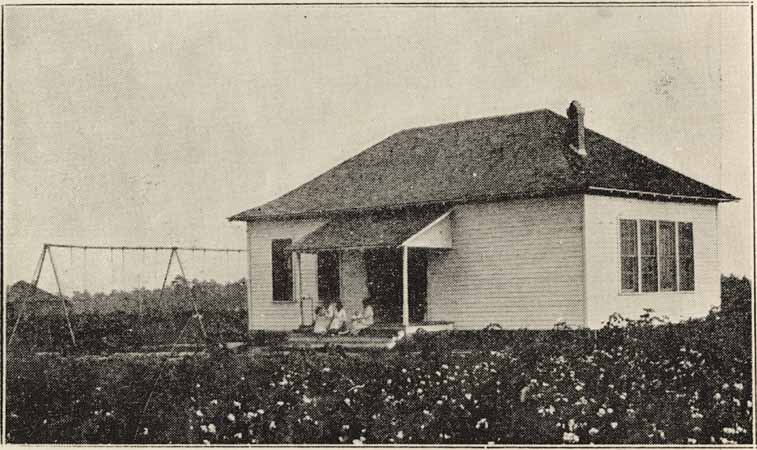
School House and Playground Under Supervision of the Cheraw City Graded Schools, to Which All Pupils of the Village Have Access.

A Street Scene in Cheraw Cotton Mill Village in Which it Will Be Noted that Ample Room is Given to Each House. Light and City Water in Every Home.
Page 13
Jackson Mills Monroe, N. C.
H. B. Heath, President
C. W. Walton, Treasurer
Manufacturers of Fine Cotton Blankets and Wide Sheetings.

Jackson Mills, Monroe, N. C.
The Jackson Mills Company, incorporated in 1913, has the distinction of having never stood idle since that time except on regular holidays. The mills have ten thousand spindles and two hundred looms.
The community building shown below is provided by the company for entertainments and social features, in co-operation with the Sunday Schools and day schools.
The Jackson Mills library is a collection of books contributed by the people of the community, and once or twice a week magazines are furnished free of charge to all who apply for them.
Jackson Mills village is located in the corporate limits of Monroe, which is a prosperous and progressive city with fine graded schools and handsome churches.
The employes are a fine class of citizens, most of

Residence of Supt. O. H. Farr.
them being people from the country near by; and they have developed into skillful workers who take pride in the quality of the product of the mills.
It is hoped that classes in arithmetic, letter-writing, and other useful things may be organized in the mill village this winter. These classes will use the Community Building which has recently been newly furnished for this purpose. A Reading Club and Debating Society may also be organized later.
The mills have baseball and basket ball equipment for their employes, and splendid grounds on their own property. The boys and girls take interest in these sports, and gain much pleasure and helpful exercise from them.
O. H. Farr, the efficient superintendent of the Jackson Mills, is not only an excellent superintendent, but he is a good friend of the people,--working right with them in their Sunday Schools and social life,--and, when there is sickness, he and his good wife are almost as good as doctors and never tiring in their services.

[Community Building]
Page 14
The Armstrong Group of Mills
- Armstrong Cotton Mills Company.
- Dunn Manufacturing Company.
- Mutual Cotton Mills Company.
- Piedmont Spinning Mills Company.
- Seminole Cotton Mill Company.
- Clara Manufacturing Company.
Gastonia, N. C.
- Victory Yarn Mills Company.
- Winget Yarn Mills Company.
- Mildred Cotton Mills Company.
Gastonia, N. C.
- Champion Cotton Mills Company.
- Monarch Cotton Mills Company.
Dallas, N. C.
- High Shoals Cotton Mills Co.
High Shoals, N. C.
- Wymojo Yarn Mills.
- Helen Yarn Mills.
Rock Hill, S. C.
- Lockmore Cotton Mills.
York, S. C.
Five years ago Col. C. B. Armstrong was managing only four cotton mills. Today he is president of fifteen. All of these are built and in operation except three, the Mildred and Champion, which are to be built, and the Helen, which is practically finished.
The capital for the construction of these mills was furnished by Col. Armstrong and the host of men who have faith in his business integrity. There is no foreign capital. And neither was any of it "willed" to Col. Armstrong. He made it himself by keeping everlastingly at it and using his head as well as his hands.
Nor has Col. Armstrong forgotten how to sympathize with the struggling man. He is like thousands of cotton mill managers today. He wants to see his help do better. And he has helped them,--helped them by assisting them to help themselves. A good many of his employees are stockholders in his mills. The Mutual Mill was built through a building and loan association in order that the employees might take stock and pay for it in small installments. The mill has been running successfully for four years, and there are a number of prosperous employes who struck it lucky during the high war prices.
Able Assistants.
It would be a physical impossibility for one man alone to build as big an industry as the Armstrong group of mills. Col. Armstrong has had the able assistance of a number of good business men connected with him, and also a host of loyal employees who have made it possible for him to sell a good product. Among these "able assistants" is A. K. Winget, the secretary and treasurer of a number of the mills. Mr. Winget is one of the best young business men in the cotton mill industry. Three of Col. Armstrong's sons are associated with him in the management of these mills. C. C. Armstrong is vice-president and assistant treasurer, and he takes the lead in managing things, along with Mr. Winget. W. R. Armstrong, who is located in Rock Hill, South Carolina, has charge of the three mills in that state. Raleigh Armstrong, the youngest member of the group, is receiving training to become a cotton mill man. Others having charge of various office departments in the big chain of mills are: W. L. Wetzell, R. W. Stowe, W. B. Roddey, Mrs. T. E. Leavitt,

The Tables Are Ready for the Annual Banquet of the Superintendents and Overseers of the Armstrong Mills.
Page 15
Miss Charlie Huss and O. L. Sappenfield, the latter connected with the High Shoals plant.
The superintendents at the various mills are as follows:
- W. F. Kincaid, superintendent, Clara Manufacturing Co.
- N. B. Davis, superintendent, Armstrong Cotton Mills Co.
- P. P. Huffstetler, superintendent, Dunn Manufacturing Co.
- B. C. Black, superintendent, Mutual Cotton Mills Co.
- W. S. Smith, superintendent, Piedmont Spinning Mills Co.
- S. W. Smith, superintendent, Seminole Cotton Mills Co.
- H. G. Winget, superintendent, Victory Yarn Mills Co.
- W. L. Smith, superintendent, Winget Yarn Mills Co.
- J. L. Gribble, superintendent, Monarch Cotton Mills Co.
- L. D. Gribble, general superintendent, Monarch and Seminole Mills.
- W. W. Crenshaw, superintendent, Wymojo Yarn Mills and Helen Yarn Mills.
- F. C. Wood, superintendent, Lockmore Cotton Mills.
Streets and Repair Work.
Repair work that is worthy of magazine notice is being done on some of the old style cottages. These are being improved beyond recognition by building bungalow roofs, quaint porches in different styles, the application of a two or three-color scheme of paint tastefully arranged, and otherwise making them modern. From all appearances, one would think they had just been built. Paved streets are laid through most of the villages and asphalt roads connect with the city. Many of the employees own cars. T. E. Leavitt has charge of this repair and street work.
Community Work.
Five community houses are either completed or in course of construction for the mills in Gastonia. These will give each village a community worker who will look after the needs of the people and give instruction along the lines of physical development. In connection with this work, play grounds are being equipped for the children.
Modern Bungalows.
The homes erected in the newer mills are modern in every particular, including lights, water and sewerage. They are bungalow in type, and are built after different plans and painted different colors.
The people make splendid wages in the Armstrong group of mills. In addition to the wages, the employes in some of the mills were given 10 per cent of the profits.
Some time ago the managers of the Armstrong group of mills voluntarily adopted a 55-hour basis, but when the high prices went higher and higher and the 10 per cent on profits was offered, the employes asked to be put back on 60 hours.
Paved roads pass through the mill villages of the Gastonia group of mills, and while some of them are some distance from the center of the city, jitney lines have been established for the accommodation of the people.

Would You Believe it, the Top Cottage was Made into the Bungalow Below?

Street Scene.--Two Homes Owned by Superintendents.--Community Garage.--Clara Mill Community House (Center).
Page 16
Icemorlee Cotton Mills Monroe N. C.
Robert Chapman, Pres.; J. H. Lee, Vice Pres.; C. C. Stokes, Sec'y & Treas.
Spinners of High Grade Yarns 10s to 24s Carded and Combed.

The Icemorlee Cotton Mills--10,000 Spindles--400 Employes.
The view presented by the Icemorlee Mills and their pretty village is one of the most attractive in the State. Thousands of dollars has been spent in beautifying the village. The houses are painted in different colors which harmonize with the foliage of the trees and present a pretty contrast with the pure white of the mill and office buildings. All houses in the village are provided with sanitary closets and lighted by electricity, the current of which is continuous for electric irons and other purposes as desired. The water which comes from deep wells and is piped to the houses was recently analyzed by the State laboratory and pronounced perfectly pure.

In the center front of this group is the office of the Icemorlee Mills, over which are lodge rooms, used free of rent by the several secret societies of the village, and by the Icemorlee Cornet band. At left of this is the residence of Supt. Robt. E. L. Iceman; and the picture on the right is a partial view of one of the village streets.
Page 17
Vivian Cotton Mills Cherryville, N. C.
John J. George, Proprietor
The Vivian Cotton Mill is owned and directed by John J. George. It manufactures coarse yarns, usually 10s to 14s and prides itself on the excellent quality it produces. The production of the mill averages from 35,000 to 40,000 pounds of yarn weekly and sometimes as high as 45,000 pounds. The most of this yarn is exported to South America. The mill is equipped with 5,380 spindles, and will soon install 2,000 more. The mill has been running steadily day and night for

Some of the Several Bungalows Erected at the Viivan Mill Village.
the last three years, and during the war it made the yarn that went into the manufacture of gas masks.
The workers at the Vivian Mill make good wages. All employes are satisfied. There is a system of prizes given in the mill, which brings out the very best efficiency, and so well is the spinning run under this system that often when a round is made in the mill there will not be a single broken back end, no cotton on the floor, all frames clean, and only one end down.
Only the best of help is employed in this mill, and people who drink whiskey and are guilty of any immorality either have to reform or leave the mill village. During the vacation of the graded school here in town most of the boys and girls work in this mill, and their parents are satisfied that everything goes all right.
Since Mr. George has taken charge of this mill a lot of nice, new, roomy, modern bungalows have been built, and ample garden space is provided for all employes. All gardens are ploughed free of charge and all the employes have to do is to plant and hoe their garden truck. Some of the nicest gardens seen in this section are around the Vivian Mill. All the mill houses are furnished with water and lights free, and as soon as the new sewerage system is completed in the town all these houses will be furnished with sewerage connections.
Mr. George came to Cherryville twenty-seven years ago. At that time Gaston county was called a prohibition county; that is, there were no bar rooms allowed in the county, though whiskey could be sold at government distilleries. At that time there were forty government distilleries in the county, and possibly one hundred or more moonshine distilleries. He organized temperance societies while he was teaching school in Cherryville, and began the fight on whiskey business. He is now mayor of the town and still continuing this fight on blockading and drunkenness. During July, August and September the fines in his court amounted to over $1,100.00. Four blockade distilleries near the town have been broken up, and the mayor is determined to break up blind-tigers.
Mr. George has many business connections besides being president of the Cherryville Building and Loan Association, and owner and director of the Vivian Cotton Mill. He is president of the Cherryville Real Estate and Improvement Association, treasurer of the N. C. and the U. S. Tin Mining Companies in Lincoln county, second vice-president of the Mauney-Steel Yarn Company, a large cotton yarn selling agency with offices in Philadelphia, Providence, R. I., and Cherryville. This company has made a great success and paid large dividends. He is also financially interested in the Henry River Mill, at Henry River, N. C, and director in several banks. He was chairman of the Lenoir College Endowment Committee last fall and in a few weeks raised over $300,000.00 for the endowment of that college. He owns about forty houses in Bessemer City, has several farms, and is now building a large new residence in Cherryville at a cost of $50,000 or $60,000.

John J. George, President and
Owner of Vivian Cotton Mill,
Mayor of Cherryville.
H. D. George, brother of J. J. George, is superintendent of the Vivian Mills. C. A. Farris and George S Fall are in charge of the office and Miss Vada Beam is stenographer.
Page 18
Henderson Cotton Mills Harriet Cotton Mills
Henderson, N. C.
Henderson, North Carolina, is the home of the Henderson and Harriet Mills, four in number. These mills have trained many an expert mill man and sent them out to become managers and superintendents and overseers of other industrial plants. These are "Little Mother Mills" in Eastern Carolina, to whom several promising mill men point with pride as the place where they learned the business.
The mills were built by D. Y. Cooper and are under his management, with the aid of his sons and other well known

(1) Harriet Cotton Mills No. 1.
(3) Harriet Cotton Mills No. 3.
mill men. The officers are D. Y. Cooper, president; Sidney P. Cooper, vice-president; J. D. Rose, secretary; J. B. Owen, treasurer; and Alex Cooper, general manager of the mills. Mr. Cooper assumed charge of affairs some time ago to relieve his father of the strain of business. J. H. Bunn is general superintendent; R. H. Craig, superintendent of Harriet No. 1; and J. D. Cooper, Jr, is superintendent of Harriet Nos. 2 and 3. The product of the Harriet Mills is cones and skeins from 30's to 60's; while the Henderson Cotton Mills make hosiery yarns from 20's to 28's.
The amount of capital invested and the number of spindles mark these as among the State's largest manufacturing plants. The Harriet Mills are capitalized at $1,264,700, with 57,792 spindles. The amount of capital stock of the Henderson Cotton Mills is $1,010,150, with 43,392 spindles.
There are more than 500 employes of the mills, and they are a steady, thrifty people, some of whom have been with the mills since they started years ago. They are experts in their line, and co-operate fully with the management,--a co-operation that has insured the success of these thriving plants.
Comfortable homes are furnished for the people, and

(2) Harriet Cotton Mills No. 2.
(4) Henderson Cotton Mills.
churches built in their midst. In fact, one finds a church-going people in these villages, and a keen interest shown in Sunday School and religious services.
Several years ago, D. Y. Cooper started a community work among his people by employing a capable woman, Miss Rose Cheatham who has full charge of the work in all of the villages. She is thoroughly interested in the advancement of the people, physically, morally and educationally, and has established herself in the hearts of the people as a necessary fixture for their happiness and welfare. Under her are various clubs for girls, mothers and boys, looking towards making them better citizens of to-morrow, and the people are taking an active interest in the work she has been doing.
Page 19
THATCHER SPINNING CO. Chattanooga, Tenn. STANDARD PROCESSING CO.

Plants of Standard Processing Co. and Thatcher Spinning Co.--(Center)
The Thatcher Spinning Company and The Standard Processing Company of Chattanooga are among the newest and most progressive manufacturing plants of Tennessee, with an intelligent class of operatives under the direction of men who manifest a keen interest in their welfare. Excellent school facilities are afforded by the city graded school, high school and night classes.
The Standard Processing Co. has capital stock of $400,000. W. Lane Verlenden is

Representative Group of Houses for Employes.
president; A. G. Thatcher, vice president; A. H. Thatcher, secretary-treasurer; and P. F. O'Neill, superintendent. The business of the company is the mercerizing, gassing and bleaching of yarns for knitting of hosiery and underwear.
The Thatcher Spinning Company, with $800,000 capital, has 30,464 spindles for the manufacture of combed yarns for mercerizing. The officers are A. G. Thatcher, president; G. H. Miller, vice president; Herbert S. Thatcher, secretary treasurer; and R. P. Clark, superintendent.

Representative Group of Houses for Employes.
Page 20
Lola Mfg. Co. Stanley, N. C.
The Lola Manufacturing Company of Stanley, N. C., has completed the new 10,000-spindle mill, which, in addition to the old mill, makes a total of 14,000 spindles now in this chain. The new mill is modern in every particular. The mills make yarns, cones, tubes, skeins and warps, which are among the best on the market.
Lola No. 1 was taken over in 1918 by Col. John C. Rankin, J. M. Springs and R. F. Craig, these gentlemen occupying the positions of president, vice-president and secretary-treasurer,

Lola Manufacturing Company, Stanley, N. C., Showing Old Mill and the New 10,000-Spindle No. 2 Mill at the Left.
respectively. In fact, Mr. Craig is general manager of the Lola Manufacturing Company and has under his control five other mills.
After taking the mill over two years ago, the mill and village were given a general renovation. New homes have been built for the employes. These are bungalow in type of construction and are modernly equipped.
One unusual feature of the Lola Mill is the jitney service operated for the benefit of some employes who live in the country. There are a number of girls and boys living on the farms as far as seven miles from the mill, and a jitney goes for them each morning, and takes them home when work is over.
Stanley has an excellent school that goes to the 11th grade. It is the only graded school in the county where a business course is taught.
Mr. Craig is assisted in the office of the mill by his son, Eugene Craig, who is learning one of the South's biggest manufacturing interests.
General Manager Craig is a man who has worked his way through the mill, and he has a fellow feeling for the boy or girl who works for him. He did his first work in the old mill at Mountain Island, starting in 1895 under W. T. Jordan, who gave him his first start. Leaving there, he went to the Iceman Mill in McColl, S. C., where he remained six months, and then came back with the Nims Mfg. Co. of Mount Holly.

New Types of Bungalos Erected in Lola Village for Employes, and Modernly Equipped.
Page 21
Carolina Cotton Mills Maiden, N. C.

Carolina Cotton Mills Maiden, N. C.
Maiden, North Carolina, may not be mentioned in the tourist's guide book, but it is on the textile map. And one of the reasons for such distinction is the Carolina Cotton Mills. The drafter of the map was kind enough to locate the particular dot of Maiden near the foothills of the Blue Ridge, and in the splendid farming county of Catawba--and right in the midst of the famous "Catawba Yam" district. Catawba County produces a bumper crop of potatoes, but not enough for world consumption. Therefore, there are many of the MILL NEWS readers who have not been fortunate enough to have tasted these delicious yams. Such unfortunates will have to content thmselves with the knowledge that some of their co-workers have been so blessed.
The Carolina Cotton Mills plant consists of two mills. The first was built about four years ago and the other is just starting. Both are progressive mills. They represent home

A Carolina Cotton Mill Home.
capital, built and operated under the management of some enterprising business men of the county. The officers are: W. B. Murray, president; J. C. Whitesides, vice-president; B. M. Spratt, Jr., treasurer, and G. E. Mauney, secretary. Messrs. Spratt and Mauney are the active managers and are assisted by a superintendent who knows cotton mill work. Mr. Spratt is also president of the Maiden Bank and a man of splendid business ability.
From 10-Cent Doffer to "Super."
Supt. W. L. Heffner, Jr., was initiated into cotton mill work as a doffer for the munificent sum of ten cents a day. That was a big price for a boy in those days. And, oh, yes, he worked for about ten or eleven hours a day. To-day he is superintnedent, a director and a stockholder. And they say he now works from 12 to 15 hours a day. The doffers in Mr. Heffner's Mills make 40 times as much, and they work only as doffers. Therefore, they have play time outside of the mill. In the former days, the doffers were required to sweep, or do something to keep them busy until time for doffing again.
Handsome Bungalow Homes.
The company has erected some very attractive bungalows, which are well-built and attractive. The homes are equipped with electric lights. Some time ago the town of Maiden, of which the cotton mill employes compose the greater per cent of citizens, voted bonds for a water and sewer system. It will be some months before this work can be completed, but as soon as it is, the Carolina Cotton Mills will install conveniences in the cotton mill homes.
There are no class districts in Maiden. The mill people represent as much of the town as any other citizens. Their children attend the same graded school, and the people the same churches. Several members of the Carolina Cotton Mill force are officers in the churches.
Recreation and Health.
The mills do not lack for social life and out of door sports. There is a sixteen-piece band in the village, baseball and basket ball teams, a splendid tennis court, playgrounds for the kiddies, and a large swimming pool is in course of construction. The equipment for the baseball and basket ball teams is furnished by the company.
The county nurse makes regular visits to the Carolina Cotton Mill village and gives instruction in health and hygiene. Needy cases are always looked after.
In order to make the cost of living as low as possible for the employes, the company furnishes them homes rent free and sells them wood and coal at cost.

The Band and Band Stand.
Page 22
Wymojo Yarn Mills Rock Hill, S. C.
The Wymojo and Lockmore Mills are two of the South Carolina cotton mills owned by the Armstrong interests. They were purchased in 1917 and 1918, respectively. W. R. Armstrong was immediately placed in charge, with offices in Rock Hill, and he has been running them successfully ever since.
With the change of management have come many improvements in the working conditions in the mills, street improvement, remodeling and repainting of homes, and the adding of more spinning machinery.
The Wymojo Mill has been increased by 2,500 spindles, making the total now 9,000, and changing from carded to combed yarns. The product is 20's to 30's yarn. The Lockmore Mill will be changed next fall to combed yarns also.
Wymojo Village Improvement
One of the splendid improvements in the Wymojo village is the laying of cement sidewalks through the village, and the installation of water, lights and sewerage. The houses were all given two coats of paint and improved inside.
The Helen Yarn Mills.
The Helen Yarn Mills, another plant added to the Armstrong group, was named for Mrs. W. R. Armstrong. It will be ready for operation during the fall months. The capacity will be 2,000 spindles. The machinery has already been installed, and it is practically ready for running.
A Pretty Village.
The residential section at the new mill is ideally located

The Spinning Room of Wymojo Yarn Mills at Rock Hill, S. C.
in a grove nearby. Very attractive bungalows have been erected, and these are equipped with modern conveniences.
A contract has been given for the erection of a community building and swimming pool for the Wymojo and Helen Mills. Besides, a community worker will be employed to take charge of the instruction work towards better living.
It is the intention of Mr. Armstrong to make his mill village

A Helen Mill Home at Rock Hill.
as attractive as possible. To this end he has employed a landscape artist to lay off streets and a park in the oak grove near the mill. The community building and pool, as well as playgrounds, will be located in the park. It is hoped to make this one of Rock Hill's "show-places."
Page 23
Lockmore Cotton Mills York, S. C.
Fine Schools.
The Wymojo and Helen Mills are within about two blocks of one of the South's best colleges, Winthrop College, where special attention is laid upon educating young women and training them for teachers. There is in connection with the college the Winthrop Training School, and the children of the mill employes attend this. It takes them through the eleventh grade, and is up-to-date in every particular. The people of the village attend the city churches and mingle in city amusements. The children also get the Winthrop athletic training courses.
Improvements at Lockmore.
All the cottages in the Lockmore village have been repainted, and the entire village given a renovated and improved appearance. Several new bungalows have been erected, and water and lights have been installed in all the old cottages as well as in the bungalows.
City Schools and Churches.
The Lockmore Mill is within the city limits of York. There fore the children of the mill village attend the same graded schools as the other children. There is no distinction as to church or school. In fact, the people of the Lockmore Mill represent a good portion of the population and are counted as "citizens." They are a thrifty, steady and saving class. Fully fifty per cent or more of them are saving their money and making good investments.
Living Costs Are Low.
It sounds rather queer to hear of cheap living these days when everything seems to have gone so high, but in the Lockmore and Wymojo villages, as at most other mills in the South, one finds the necessities of living cut to a minimum.
$9,000 Profit Division in July.
During July last the employes of the mill were given a 10
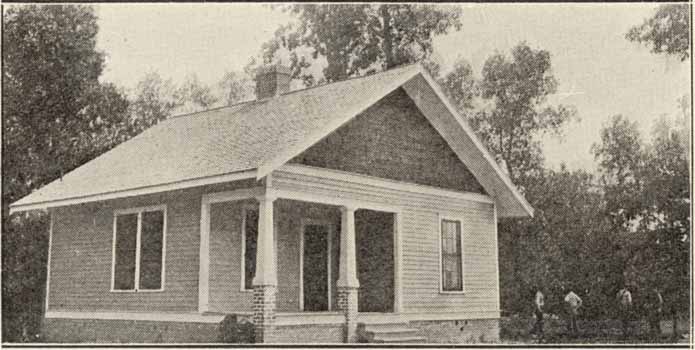
Another Helen Mill Home.
per cent profit share of the Company's business, and they received a sum total of $9,000.
Superintendents Wood and Crenshaw.
Superintendent Fred Wood of the Lockmore Mill and Superintendent W. W. Crenshaw of the Wymojo Mill are men who have been recently promoted from overseers in the mills. Mr. Wood has been with the Lockmore since it was built and was promoted last year to superintendent. He formerly worked in the Gaston County Mills. Mr. Crenshaw was promoted about two years ago. Both of these men are "making good" with both employer and employe.

The Card Room of Wymojo Yarn Mills at Rock Hill.
Page 24
High Shoals Cotton Mill Company
High Shoals, N. C.
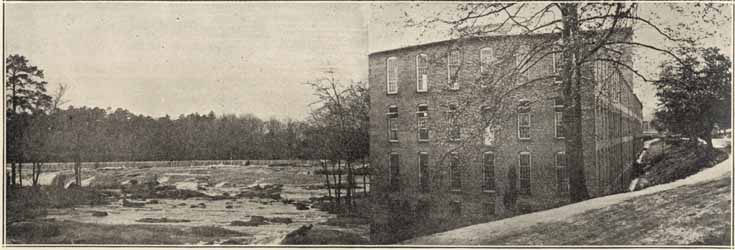
High Shoals Mill and Dam,--Said to Be the Best Power Development on South Fork River.
High Shoals is the prettiest place in Gaston County. It is endowed with natural beauty far beyond the average. The mill was built when Gaston County was better known as a whiskey distilling county than as the banner cotton mill section of the South--a reputation which it now enjoys. It is more than an industrial center; it is a quiet resort. High Shoals has the things that tired business men travel miles and spend millions every summer to enjoy. There are hills, wonderful trees, wild flowers, birds, the quiet of nature, and a river running full of fish.
The Mill.
About a year ago the High Shoals Company was purchased from the Tompkins interests by C. B. Armstrong and A. G. Myers. The mill had an 18,000-ring-spindle capacity, and since, the new owners have added 2,500 twister spindles. There are 540 looms. The output is two-ply yarns and sheetings.
Water Power Development.
The dam across the South Fork River, which generates power for the High Shoals Mill, is one of the best in this section. The construction of the mill is also of the highest standard. There is a capacity at High Shoals for more than double the amount of power used, with a little more work on the present dam.
Schools.
High Shoals has one of the best country schools in Gaston

Street Scene Showing Cottages and Paved Streets.
county. It has 11 grades and is thoroughly up-to-date in every particular. A main feature is the kindergarten.
Walks, Park and Playground.
Cement walks have recently been laid throughout the entire village, and electric lights installed in every cottage and in the streets. The homes have been improved also, in other ways.
The company has put in a complete set of playground fixtures for both young and old. The natural park along the river has been improved by equipping with lights so that it can be used at night.
Pasture For Cows and Hogs.
The people of the village are noted for their fine hogs and good cattle. The company has a large pasture along the river for the benefit of employes who keep stock. Good gardens and lots of chickens are to be seen, too, around all the cottages. Like all mill employes now, the people make splendid wages. To this end, the mill company encourages saving, and has established a savings account whereby the company takes the savings and pays six per cent, compounded quarterly, instead of the regular four per cent paid by banks. The employes also receive ten per cent of the profits of the mill paid semi-annually, in addition to their wages.
The officers are: C. B. Armstrong, president; A. G. Myers, vice-president; A K. Winget, secretary and treasurer; and C. C. Armstrong, assistant treasurer. A. Q. Kale is superintendent, and has been superintendent of the mill for 20 years.

Kindergarten Class.
Page 25
Dunean Mills Greenville, S. C.
The keynote in the welfare work in the Dunean Mills in Greenville, S. C., is the BABIES. Just at present the company is laying special stress on the health of the chiildren, and they are looked after at the expense of the mill, from the time they are born, when a trained nurse is always present, up to the time when they are school children.
The Day Nursery.
There is a splendidly equipped day nursery where several nurses attend to the babies left in their charge. Here one finds them of all ages, from the small infant to the romping youngster, some sleeping in the little white beds, some playing in the play room, some smiling, and a few, but only a very few, in tears--in case the nurse puts them down to attend to something needing to be done. Each child is given a bath every day, or as many as are necessary, and cereals and milk are furnished free.
There is a community building in charge of a housekeeper who keeps it open all the time. It is thoroughly modern in conveniences, steam heated, and has shower baths, class

A Few of the Members of the Wide-Awake Club.
rooms, etc. Here community suppers are held four times a year for all the officers of the mill from the highest to all the section hands. It is a sort of get-together meeting and has proved of much value.
The village has a trained nurse, welfare worker, and splendid school facilities. Domestic science, including cooking and sewing, are taught. A first-aid hospital has been established in the mill for taking care of any accidents, and safeguarding against the slightest injury.
The village has splendid streets with paved sidewalks, good

The Small Girls' Club at Dunean.
homes equipped with water, lights and sewerage, well screened, and these rent for 75 cents a room a month. There are 41 new houses being built.
A Community Cannery, Also.
The mill conducts a cannery. The canning is done by experts

The Living Room in the Dunean Community House.
employed for the purpose, and the canning for employes is done for actual cost.
The people have splendid gardens. Last February the company planted 1200 fruit trees and 750 shade trees. Prizes are offered for the best premises.
The popular play ground, fully equipped, is one of the features for the children. There are lodge rooms for the men, an up-to-date drug store with an attractive fountain for the beaux and belles, and a splendid co-operative store and market for the housekeeper.
Last spring a chautauqua was conducted for the benefit of

The Kindergarten at Dunean Mills.
the people, and only the best entertainments were secured. During the summer ten boys were selected who had made the best record in school, and were given a week's vacation at the Greenville Y. M. C. A. camp.
The company has adopted a unique system of business education among the employes. Each person is furnished an attractive scrap book, and each week a little card is placed in the pay envelope. Each card carries a sermon in a few words. A prize is offered to the one who keeps the most complete and neatest book and presents it at the end of the year. The series is known as "Fifty-two Success Talks."
Page 26
Vance Cotton Mill Salisbury, N. C.
At the Vance Cotton Mills of Salisbury, North Carolina, many changes have been made within the past year in the way of better homes for the employes, a more attractive village, and in general appearance of property and people.
The new addition to the mill has been completed, and by the first of the year 5,000 additional spindles will be installed, making the total 15,000.
The officers of the company are W. F. Snider, president; W. M. Crump general manager; E. B. Neave, secretary and treasurer; and J. G. McCachern, superintendent.
Several new homes have been erected for the employes. These are of the bungalow type, are supplied with water and lights, double flooring, and are comfortable and attractive. One new home especially is a beauty. It has six rooms, bath, and is equipped with water, lights and gas. The old homes are to be improved and repainted, and are supplied with water and lights.
W. M. Crump, the general manager of the mill, is taking quite an interest in the general improvement of the mill and the village. To this end he has offered prizes to the families of the village who make the most improvement of their premises.
Educational advantages are of the best. The Vance Mill is located inside the city, and one of the splendid graded schools is within a couple of blocks of the mill. There is no separation of mill children and city children. Nor is there any distinction between mill and city people in the churches. Domestic science is taught in the school, and the cotton mill girls have the advantage of this splendid training. Lunches are served by the girls at cost and this not only gives them actual training but is also a wonderful convenience to the mothers and children.
There are six garages in the Vance village, with the same number of cars belonging to the employes. One thing of interest now in these days of impossible city rents when people are paying fabulous sums for just a few rooms and in many cases dingy ones at that, is the fact that the homes furnished the Vance Mill employes rent for 12½ cents a week, and this includes electric light in each room and on the porch, and city water. Some of the people keep cows and chickens, make their own garden produce, and a few raise meat.
This paragraph is about Ralph Campbell, a thirteen-year-old boy. Ralph is one of four children and has only a mother for support. When he was seven years old he went to school one term. Then he had to stop perhaps to take care of the children while his mother worked. Last year he started to school again and made four grades in one year. Next year he will be in the fifth grade. His teachers say he is one of the brightest boys they have ever taught.
The county health nurse has done some good work among the employes of the mill. During the past summer she conducted classes in home hygiene and first aid work.

Views of the School, Homes, Office, and Prosperous Workers at Vance Cotton Mills.
Page 27
Watts Mills Laurens, S. C.
Watts Mills at Laurens, South Carolina, established long ago a high reputation for fancy shirtings, satins and silk striped voiles, poplins and dimity checks. The company has built up a strong organization of expert weavers, training them from the best native labor of upper South Carolina. These native South Carolinans have acquired the skill of the French weavers of New Bedford. The work in Watts Mills is varied, intricate and interesting for everybody who has a liking for textile art and a desire to become skilled in the production of beautiful fabrics.
Watts Mills have 984 looms and 43,200 spindles. It is a big modern plant, as can be seen in the picture on this page, and it has been further improved recently with a new opening room and a new humidifier system. The mill was repainted last year inside. Supt. E. G. Jessee has been in charge for many years and keeps the plant in first class condition. His department heads are C. R. Roberts in carding, Floyd Tidwell in spinning, E. A. Franks in weaving, J. C. Clark in cloth room, R. H. Donaldson in patterns and supplies, F. K. Taylor in the power house.
The Watts Mill village is a suburb of Laurens, and Laurens is the prosperous county-seat of one of the upper South Carolina counties. The employes thus have country life and city life and they have in their own village many modern advantages including electrically lighted homes. The company

Watts Mills, Laurens, S. C.--984 looms Making Satin and Silk Stripe Shirtings, Voiles, Poplin, and Dimity Checks.

The Watts Mill Village School--Making Industrial Leaders for Tomorrow.
is regrading the streets and laying new sidewalks. A landscape architect is completing plans for the parking of the mill village.
The workers have a twenty-one piece band, a savings bank, and a splendid graded school, and a number of community societies that help to make life pleasant.
George M. Wright is president of Watts Mills. He makes his home at Watts Mills and takes a keen interest in the development of the community for the best interests of the employes as well as the stockholders.
Page 28
Newton Cotton Mills Newton, N. C.
This mill has been overhauled, more looms and other machinery added, and generally improved as to working conditions. A. B. Kuhn, who has been with the mill for a number of years, is secretary and treasurer, and Superintendent W. E. Bacon, a well known fixture in the business, is still on the job.
From $3,000 a month to $9,000 a week is quite an increase in pay roll, but that is the record of the mill for the past ten or twelve years. Prior to the war the pay roll each week was $3,000. It is three times that now with no increase in capacity.
The town of Newton is planning a $75,000 High School to be built within the next year or so. The mill children attend the same schools and the people the same churches.
If one wants to find good gardens and good gardeners, go to Newton. Catawba county was settled by the Dutch, and it is from their ancestors that the people have learned the art of living on small patches. And they live.
About 50 per cent of the employes of the Newton Mill own their homes, and here one finds them living--actually living--on from two to eight acres of land. Some of them produce practically all their foodstuffs on their acreage. Several of them grow even their own wheat.
The employes of the mills own more automobiles than all of the other citizens of Newton put together.

Some of the Reasons for the Happy Life of the Workers at Newton Cotton Mills.
Page 29
Mecklenburg Mfg. Co. North Charlotte, N. C.
The Mecklenburg Mill is one of Charlotte's progressive industrial plants. It is a mill of several years standing and has always been run on a high plane. The working conditions of the mill are good, and the village one of the neatest little sections in any of the cotton mill centers.
The Mecklenburg Mill changed hands some time ago when J. D. Norwood, C. I. Jones and M. L. Jackson, of Salisbury, took it over. M. L. Jackson is president; C. I. Jones, vice president; J. D. Norwood is secretary and treasurer. J. T. Jordan is superintendent. The company makes print cloths, operating 14,048 spindles and 350 looms. Under the new management the company has started up night work, thus doubling the output of the mill.
The Village Improvement.
Every house in the village has been renovated and improved, and electrically lighted. The sanitary conditions are among the best. New flooring was laid, making them double-floored, and the walls and ceilings papered.
A New Village.
The Mecklenburg Mill has also a most attractive new suburb. This was built for the night help and is located beyond the reservoir of the mill, on a cool wooded knoll. This location was selected for the express purpose of furnishing a cool place for the night help to sleep during the day. Practically every house has a tree, and a free open field for fresh air breezes. So far as the mill is concerned, it is a strictly quiet place, but one finds noises there upon visiting the hill. There is the ever-present wagon with choice things of the season. It was melons the day the writer was there and the people were buying and enjoying. Then, there are children keeping things lively with laughter and song. But most striking was the fact that practically every other house had a graphophone, and they were in full blast.
The homes erected at Mecklenburg are said to be the best in this section. They are built of good material, well constructed, and equipped with modern conveniences.
Schools and Churches.
Mecklenburg Mill is just beyond the city, at North Charlotte. There is a splendid school in the village which is run in co-operation with the district. The people attend the churches of North Charlotte and of the city if they prefer The car line runs within a block or two of the village, and the things of Charlotte are theirs for amusement and convenience.
"Living at Home."
The people have splendid gardens. Some of the finest tomatoes of the season were shown as samples of the product of the village. The people of Mecklenburg Mill keep chickens, some of them raise hogs, and a place has been provided by the mill company at a safe distance from the village proper for the porkers. Fully 30,000 pounds of meat will be raised there this year. Some also keep cows, and make butter.

Some of the Homes of Employees of Mecklenburg Mfg. Co., at North Charlotte
Page 30
Harden Mfg. Co. Worth, N. C.

E. A. Smith, President and Treasurer
H. C. Dwelle, Secretary
A. A. Whitener, Vice President
Phenix Mills Company
Cotton Piece Goods
Kings Mountain, N. C.
WILSON & BRADBURY
New York and Philadelphia
SELLING AGENTS
J. R. Young, Superintendent
J. T. Hull, Overseer Carding
J. H. Pryor, Overseer Spinning
G. C. Taunt, Overseer Weaving
L. E. Holler, Overseer Cloth Room
J. C. McGinnis, Master Mechanic
The Harden Manufacturing Company, located at Worth, N. C., is another one of Gaston County's 100 mills. It is under the management of O. D. Carpenter, president and treasurer: S. B. Carpenter, secretary; W. C. Carpenter, superintendent; and Worth Carpenter, manager. The picture below tells the story of an 8,000 spindle mill with its village of comfortable cottages, school and churches, surrounded by nature's beauty, more than words could do. Three competent teachers are employed in the school. A store is operated at cost to bring down the living expenses. Cottages range from three to eight rooms and no rent at all is charged. Many of the employes have been at Worth for several years. They are progressive, live well, and are saving their money. Some of them are property owners. They keep cows, chickens, raise their meat and grow splendid gardens. The wages paid are on a par with other high priced cotton mill labor of to-day.

The Harden Mfg. Co.'s Mill--The Church--The Village. A Cotton Mill in the Heart of Nature, By Forest, Field and Stream.
Page 31
Highland Park Mfg. Co. Rock Hill, S. C.
The pay-roll of the Highland Park Manufacturing Company of Rock Hill, South Carolina, has increased 250 per cent since 1914-15, when pre-war prices prevailed. In those days loomfixers could be employed for $10.50 a week, spinners $8 and $9; weavers $10 and $12; and doffers from 60 cents to 75 cents a day and in some cases as high as a dollar. That was in the days when a dollar looked as big as the proverbial cart-wheel. To-day they all draw about three times these rates.
Improved Homes and New Ones.
The company is erecting about 15 additional bungalows for the employes, five having been completed some time ago. These are equipped with lights and water and are quite an improvement on the older type of mill cottage. Each has a large garden and the soil is especially adapted to gardening. The employes have had some splendid gardens during the past summer. The homes rent for 25 cents a week. A new house within a block of the mill village and on the same street, and not any better built than some of the mill cottages, but perhaps a room larger, sold recently for $5,250.
The company furnishes wood and coal at cost, or at $8 to $9 a ton. The same coal would cost at the wood yard around $15 a ton.
The Baseball Team.
The Highland Park Mills baseball team has won 60 per cent of the games played this season. The company furnishes the equipment and the grounds.
The Bath House.
An up-to-date bath house at the back of the mill is one of the conveniences for the people of the village. It is here that the little children of the village revel in the summer afternoons, taking a refreshing shower, getting cool and clean.
The Tar Heel Manager.
D. C. Johnston is secretary and treasurer of the mill. He is a nephew of C. W. Johnston, president of the Highland Park chain of mills. He has been working in the office since he was 16 years old. He was born in Cabarrus County, North Carolina, and is proud of it. Mr. Johnston is a young man of energy and ability, and upon the retirement of his father, E. H. Johnston, from active business, D. C. Johnston, has been managing the mill.
From Doffer to Super.
Superintendent C. N. Steed used to doff at the Randleman mill in North Carolina, for 10 cents a day. Then he worked 12 hours a day. His doffers work 55 hours now and receive fifty times as much money as he did then.

The Big Gingham Mill,

the Highland Park School,
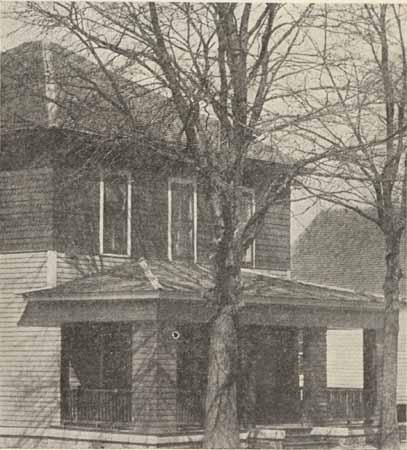
and the Company Boarding House at Rock Hill.
Page 32
Cotton Mill Division of The Standard Textile Products Co.
320 Broadway, New York, N. Y.
The Plants at Mobile, Ala., Columbus, Ga., McComb, Miss., and Selma, N. C., where the fabrics are produced that go into imitation leathers and Sanitas, a sanitary wall covering that was evolved and developed by The Standard Textile Products Company.

Mobile Cotton Mills, Mobile, Ala.

Mobile Cotton Mill Village.

The Meritas Mills, Columbus, Ga.

McComb Cotton Mill, McComb, Miss.

McComb Cotton Mill Village.
There are three mills in the Meritas group at Columbus, and they employ a thousand people. The Mobile Mills were lately enlarged. Other cotton mills of the company are at Selma, N. C., and McComb, Miss.
The cloth is finished at Rock Island Ill., Athenia, N. J., Montrose, N. Y., Youngstown, Ohio.
Page 33
Judson Mills Greenville, S. C.
The Judson Mills of Greenville, S. C., can be classed among the best cotton mill industries of the country. It has a national reputation for making a high grade quality of products. This is, of course, due to three things: Good management, good working conditions, and last, but a most essential factor, good employes who perform their work faithfully.
The Judson is the only cotton mill in the South running a silk room where the warps are made by the same mill. This department is an unusual feature. The silk is shipped from Japan, and when it reaches the mill in Greenville the silk is in perfect condition, due to the expert packing and baling.
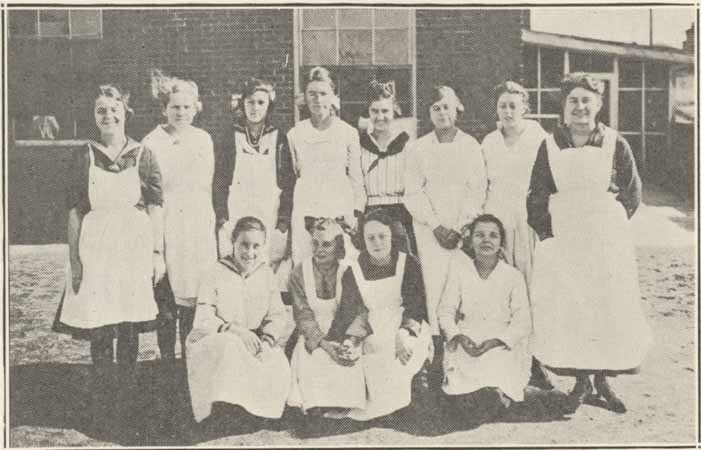
Future Home Makers.--Girls' Cooking Class at Judson Mills

New Type of Homes Erected at Judson Mills.

Making Strong Women.--Out of Door Exercise at Judson Mills.

Joan of Arc Club, a Patriotic Club Started During the War and Continued For Its Good Work During Times of Peace.
A PLACE TO LIVE.
Practically nothing has been left undone that is being done by other mills for the comfort, education, moral uplift, physical development and pleasure of the employes. Summarized it might be written in a few words as follows:
- Splendid homes with modern conveniences,
- Good streets and sidewalks,
- Up-to-date school facilities,
- Strong church organizations,
- Playgrounds, athletic organizations,
- Clubs for social development,
- Community buildings and work,
- Glee clubs, domestic science clubs,
- Model market and co-operative store,
- Established spirit of co-operation between owner and operative.
Page 34
AVONDALE MILLS
OF BIRMINGHAM, ALA.
TWILLS, SHEETING, CHAMBRAYS, DENIMS
YARNS AND ROPE
- Birmingham, Ala.
- Alexander City, Ala.
- Pell City, Ala.
- Sycamore, Ala.
- Sylacauga, Ala.
Owning and Operating Mills at

The Avondale Mill Band, Birmingham, Ala., in the Parade of the Rainbow Division, in their First Annual Reunion, Birmingham, July 14, 1920.
Page 35

Columbus Manufacturing Company
Columbus, Georgia.
Largest Sheeting Mill in Georgia
"Columbus" Sheetings
for
Foreign, Domestic
and
Manufacturing Trade
Wellington Sears & Company
Sole Selling Agents
New Weave Shed for 1,000 Looms
Pronounced the
"Finest in the South"
Page 36
Glenn-Lowry Manufacturing Co. Whitmire, South Carolina
Glenn-Lowry Manufacturing Co., manufacturers of print cloth, have at Whitmire, S. C., one of the best developed communities in the Palmetto State. The officers are E. E. Child, president and treasurer; W. M. Sherard, vice president and general manager; T. H. Watson, vice president; A. M. Watson, secretary. It is a two-million dollar corporation.
The people of Whitmire who work in the big mill have good homes, provided with water, sewerage, and electric lights. The company is constantly making improvements, now laying new side-walks and re-surfacing the street pavements.
The Whitmire school is in the heart of the mill community. It employs eleven teachers, has ten grades, and has a music department besides.
The recreation features at Whitmire are unsual. Some of them are pictured here.

A Corner of the Company's Seventy One-Thousand-Spindle Mill.
Print cloth is the Glenn-Lowry product, and it is made with a high degree of care, on modern machinery in every process of the work.

Glenn-Lowry Inn.
This is one of the hotels or boarding houses for Glenn-Lowry mill people. The guests have the benefit of practically all modern city conveniences.

The Glenn-Lowry Y. M. C. A.
One of Whitmire's popular institutions is the Young Men's Christian Association, for which the Company built and furnished this structure.

The Glenn-Lowry Community Bowling Alleys.
Here the officers of the Company vie with the lesser employes for scores that they can talk about and for the prizes that are offered at regular intervals.

Lakeview Inn at Whitmire.
Lakeview Inn is one of the town's two good hotels or boarding homes that the Glenn Lowry Company built and furnished for mill workers who do not wish to keep house.

A Part of the 1,650 Looms.
Draper automatics form the equipment of the Glenn-Lowry weave rooms. The mill is kept scrupulously clean, freshly painted and well lighted, so that each weaver can do her best.

This is the Warping Room.
Parks-Cramer humidifiers supply the moisture and automatically regulate it to suit the work and the comfort of the workers.
Page 37
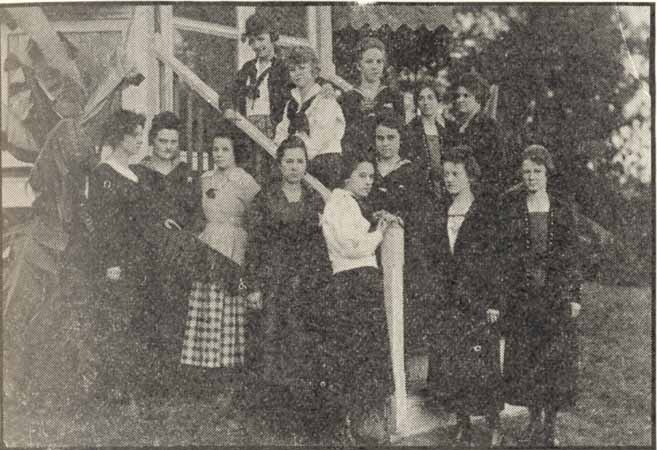
A Group of the Girl Workers.
Comment is superfluous. They show for themselves in appearance, conduct and efficiency.

Last Season's 1919 Carolina Champions.
This team won 65 and tied four out of a total of 78 games.

The Community Skating Rink.
This is only one of the many clean ways the Whitmire young people have of whiling their leisure hours away.

The Whitmire Theatre.
High class motion pictures are the leading bills in the Whitmire theater.

The Pool Tables for Glenn-Lowry Men.
Vice President and General Manager Wm. M. Sherard is here seen "shooting" against his men.

The Second Nine.
They helped to bring the pennant home.

The Glenn Lowry Y. M. C. A. Band.
This is an aggregation that helps "mightily" to make life gay when the dances, picnics and speakings are on.
Page 38
Fulton Bag & Cotton Mills
New York
St. Louis
Atlanta
New Orleans
Dallas

Social Center. the Center of our Community Life
Everybody, hereabouts, knows what the Social Center is. It is truly the center of our community life. It is a center that is active as a hive of bees. It is in this big building that we have held our vacation school, this summer, so successfully.
With moving pictures six nights out of the week and free to all Fulton Children on Wednesday afternoon, the center has become very popular with movie fans.
Home dramatic entertainments are given here two nights out of the month. These features are really more popular than the movies and are proving a fine builder of a good community spirit.

Some of the Fulton Bag & Cotton Mills New and Picturesque Bungalows
The above picture gives one a very pleasing impression of the style of the many new homes the Fulton Bag & Cotton Mills is building for its employees.
These buildings are of many very beautiful and distinctive styles giving a very artistic setting to the streets upon which they are being erected. With the new buildings complete, and ready for occupancy, together with the constant improvement of the older buildings, living conditions are all that could be desired.

A Peep at Fulton's Big Play Ground.
The big playground has placed the Fulton Bag & Cotton Mills in the lead in this particular phase of social service work. The hundreds of children who are made happy through this fine playground would testify to its success.
The Fulton people believe in athletic sports of all kinds because they not only furnish wholesome amusement and a means of healthful physical development, but develop a fine spirit of discipline and co-operation.
Page 39

Volley Ball Game By Fultonites.

A Fulton Baseball Nine.

The Fulton Cafeteria.

A Happy Group of Vacation School Children.
Our first Vacation School has just closed with a big entertainment given by the Physical Training class. While a great deal of attention and much work was given to this closing program there were two other entertainments which reached the high water mark. The Fulton children take to dramatics in a most enthusiastic manner. The quickness with which they learn their parts and the fine spirit with which they study and work puts them in a very high class.
One hundred and ninety-one enrolled in the school which kept the five teachers as busy as bees. The closing days were devoted to securing seats in the public school and enrolling pupils for the kindergarten, which opens September 6th.
Page 40
Union-Buffalo Mills Union, S. C.
Union-Buffalo Mills Co. have over 150,000 spindles, and more than 4,000 looms in their four big mills at Union and Buffalo, South Carolina. Print cloth and sheetings, drills and osnaburgs are their products, and they make them right.
The pictures show some of the things the company has provided in order to obtain and retain the best textile workers. There are provided also: modern barns for the employes' cows; laundry, day nursery; modern schools.

Mills No. 1, 2 and 3 of the Union-Buffalo Mills Co. at Union, South Carolina.

The New Moving Picture Theater and Community Building of the Union-Buffalo Mills Co.

View of Part of Village of the Union-Buffalo Mills, Union, S. C.
Page 41
Union-Buffalo Mills Union, S. C.

Buffalo Plant of the Union-Buffalo Mills Co. at Buffalo, S. C.

Type of New Five-Room Bungalow at Buffalo Mills.

Babies' Bed Room in Day Nursery at Buffalo.

Section of Mill Village, Buffalo, S. C., Showing Street Paving, Drainage, etc. These Houses, Like All Others at Buffalo, Have All Modern Improvements, Sewerage, Porcelain Baths, Enameled Kitchen Sinks and Hot Water Tanks.
Page 42
The West Point Group of Mills
West Point Ga.
Lanett, Ala.
Shawmut, Ala.
Langdale, Ala.
Riverview, Ala.
Fairfax, Ala.
Altogether these mills employ four thousand people, consume 100,000 bales of cotton annually, and the pay-roll is around $85,000 per week.
From West Point, Georgia, where the general offices of the companies are located, the distance to the farthest mill south--the Riverdale Cotton Mills--is nine miles. The other plants

Lanett Cotton Mills

Fairfax Mill

Langdale Mill

Shawmut Mill
Page 43
lie between these points, and in no case are more than two miles apart.
The West Point Manufacturing Company owns and operates the Langdale Mill, Shawmut Mill, Fairfax Mill, and West

Riverdale Cotton Mill
Page 44

Lanett School; Auditorium Shawmut; Auditorium, Fairfax; Kindergarten; Day Nursery; Kindergarten Interior; Kindergarten, Lanett.
Point Utilization Company. The capital stock of this corporation is $5,000,000. Its product consists chiefly of Wide Duck, Sail Duck, Hose and Belting Duck. It operates 1398 looms and 81,536 spindles.
The capital stock of the Lanett Cotton Mills is $1,000,000.00. This mill manufactures wide and narrow drills, twills, light
Page 45

Swimming Pool, Lanett; Methodist Church, Lanett; Christian Church, Lanett; Employes Homes, Fairfax; Langdale Band.
ducks and sheetings. It has 2339 looms and 83,532 spindles.
The Riverdale Cotton Mills has 264 looms and 11,684 spindles, and manufactures cotton ducks. Its capital stock is $350,000.00.
The entire product of these mills is sold by Wellington, Sears & Company, of Boston, New York, Chicago, Philadelphia, St. Louis, San Francisco and New Orleans.
The pictures tell of some of the ways these companies provide for the peace and prosperity of the workers in their mills.
Page 46
Marlboro Mills McColl, S. C.
PICTURING SOME OF THE COMMUNITY SCENES AROUND THE COMPANY'S SEVEN PLANTS

A Street Scene at Mill No. 3.

Main Street of the City of McColl.

The Marlboro Mills Emergency Hospital.

A Street Scene at Mill No. 5.

The Playground at Marlboro Mill No. 1.

The Marlboro Mills Concert Band.
Page 47
Melville Mfg. Co. Cherryville, N. C.
The Melville Manufacturing Company is another one of Gaston county's progressive cotton mills and is one of the several plants that put Cherryville, N. C., on the industrial map. It was built several years ago by D. A. Rudisill and named for his father, Melville Rudisill. The Rudisill's, Mauney's, Rhyne's and other names familiar in that part of the State in industry and general development are of the thrifty pioneers who settled in Lincoln county in the early days. And they are of German descent, but they were the "good" Germans who left the other side and came to this country. The 1790 census of North Carolina has a bit of interesting history. It reads: "Lincoln county was settled by the Germans who immigrated from Pennsylvania because they found the Quakers too straight for them and they turned their faces toward a sunnier clime."
In March, 1920, the Melville Mill was bought by Edgar Love, J. Frank Love and Robert C. McLean, president, secretary treasurer and vice-president, respectively.
When it comes to good roads, the late Senator Bankhead had "nothing on" Edgar Love, for immediately upon purchasing the mill, he set about to build good streets and roads throughout the village. Some new homes have been built and other improvements will be added from time to time.
The mill makes 30's two-ply yarns, tubes and cones, and uses only staple cotton.
Gardens?_ You Bet.
If some of the people in the towns and cities, with their

Some Melville Mill Homes, and Uncle Vance, Watchman.

The Melville Mill.
back yards vacant except for a few boxes, a bit of rubbish and other things they do not keep on the front side, and who buy every vegetable from the grocer and then complain about the high cost of living, could visit the Melville Mill and see the nice gardens those employes have, they would be surprised and ashamed. Not only space for the necessary vegetables is used, but they raise potatoes, plant fruit trees and otherwise stabilize themselves. They raise strawberries to eat, to can, preserve and to sell.
The people also have some fine cows. A pasture is located near the mill. Hogs are raised by the employes as another means of aiding in their support.
There is not a girl in the Melville Mill who does not make more than the average teacher or stenographer.
Saving?_ Some of Them.
Many of the employes are saving money. The building and loan association of the town has mill employes on its list. Some carry 15 or more shares. Others patronize the bank, and several have bought homes. Among these is the superintendent, R. D. Homesley, who is equally proud of the little home he recently bought and the fact that its cost was all made in the Melville Mill.
Superintendent Homesley.
R. D. Homesley has been with the Melville Mill for the past ten years and has had 21 years' experience in the mill business. He is a Lincoln county product and has the quality, typical in southern industries, of being the boss and the friend as well.
There is no segregation of mill employes and citizens. All of them attend the same churches, have equal privileges of civic pleasures and benefits, and the children attend the same school, which is one of Gaston's best. The school building, however, was burned some time ago and is to be rebuilt.
"Uncle Vance."
There is no citizen of the Melville village more respected than Old Uncle Vance Jarrell, namesake of the State's beloved governor, and a Civil War veteran. He is the trusted night watchman of the mill, and also the best fiddler and dancer in the entire community, even if he is up and around seventy. Uncle Vance works from Saturday noon until Monday morning, and though advanced in years he keeps awake during that time. In order to keep awake and for passing the time away, he takes his trusted fiddle with him to work. During the night watches his soothing notes may be heard, and there is hardly an evening passes that some one is not hovering near the mill listening to his music. President Love once made the trip there from his home in Lincolnton, taking his family along to enjoy the old man's entertainment.
Melville is a happy community and a good mill.
Page 48
Cherryville Mfg. Co. Howell Mfg. Co.
Cherryville, N. C.
This is a story about two mills in the progressive Gaston county town of Cherryville,--the Cherryville Manufacturing Co. and the Howell Mannufacturing Co. These mills are under the active management of C. A. Rudisill, who holds the position of secretary and treasurer of the former mill and treasurer of the latter. J. F. Harrelson is secretary of the Howell Mill. "Uncle" Dan Rhyne and P. C. Rhyne are president and vice-president, respectively, of both mills.
The Cherryville Manufacturing Co.'s plant was built back in '92, when cotton milling in the south was in the experimental stage, and many successful cotton mill men and women today in various industrial sections can look back to the days in this little mother mill where they learned the trade that is happily today helping them earn a fat envelope at the end of every week.
Three years ago this mill was purchased by the present owners from the Mauney interest. More than $250,000 was spent in mill and village improvements. There are 7,500 spindles and the product is cotton yarns.
The Howell Manufacturing Co. is a newer mill, having been built in 1907, and the 5,000 spindles have been increased to 10,000. It was named for Dr. Howell of Cherryville, the organizer of the mill. The products of this mill are yarns, warps, skeins and tubes.
Both the companies are stepping forward. Bungalows are being built in both villages, and the former cottages have been improved. One finds the usual "good garden" space, well cultivated and yielding under the hands of the thrifty people who live in the mill villages. Sewerage also is being installed, and this will bring the homes up to the highest standard of modern conveniences. No rent is charged, but one finds also the usual "high" wages being paid, together with the mill company's aid in lowering the cost of living by furnishing fuel at less than cost. A few years ago Mr. Rudisill adopted the plan of receiving money from the help and paying them interest. One woman, Mrs. Sarah Beam, was one of the regular depositors. Then came a time when she called for her money to make an investment. All her "I. O. U.'s" were added and they totaled $2,500.00.
J. C. Ballard is superintendent of both mills. He is a practical mill man and knows the business from the lowest job on up, for he has worked at them all, starting in when he was a mere boy. He has been living in Cherryville as superintendent for the past sixteen years.
Doffer Boys Please Read.
Now, boys, here's a man, C. A. Rudisill, who doffed for five years, working 12 hours a day. He was paid the munificent sum of 10 cents a day and was glad to get it. He hac filled also all the other jobs in the mill, and today he is secretary and treasurer of three mills, the other one being the Rhyne-Houser Manufacturing Co.'s mill, just completed.

Some of the Homes of the People at the Cherryville and Howell Mills.--Bottom right, that of Secretary and Treasurer C. A. Rudisill; who started as a doffer at 10 cents a day._ $250,000 Recently Spent in Improvements at these mills.
Page 49
Cross Cotton Mills Co. Marion, N. C.
There is a refreshing story about the Cross Cotton Mills Company of Marion, North Carolina. In that little industrial plant, sheltered by a range of the Blue Ridge mountains, one finds a spirit of co-operation between employer and employed--a spirit that has engendered peace and contentment in the hearts of the people. Thus, being a happy people, contented and knowing they will always get a "square deal" from the management they make a good product, for they take an interest in the company's business. One finds also that rare quality in human traits--gratitude.
This spirit of co-operation was cemented more closely during the "flu" epidemic, and so great was the company's care that the people have never forgotten it. There are many stories of how the mill managers did all they could when their people were stricken, but a little different story comes to light here. In addition to furnishing nurses, and taking care of their homes by employing servants to do their work, a vacant house was turned into a community kitchen. Here several cooks were employed and meals served to each family in the village. Practically all of them were sick. A nurse was sent around before each meal and a list of the things the sick people wanted was taken and the food prepared accordingly. All expenses were paid by the company.
The people have made homes out of the cottages and bungalows in which they live. No rent is charged. These are furnished with the fine water supply of Marion. Electric lights are being installed. Last spring about 150 rose cuttings were given to the people, and they are encouraged to beautify.
With water and house rent free, the people get their coal and wood at cost, and the mill company furnishes a 25-acre pasture free for the cows. There are between 35 and 40 fine milkers in the village. Last year the people raised more than 12,000 pounds of meat, or more than an average of 300 pounds for each family. They kept so many hogs that it was out of the question for them to be housed in the village. Hence, the idea originated with Mr. Cross to build a row of pens, up-to-date and sanitary,
The same course is followed with the cow stalls. They are built just outside of the village and adjoining the pasture. With this arrangement, the village is kept far more sanitary. Very little sickness is known, and during the flu epidemic only two persons were lost.
The mill company has started a small park in front of the mill, and grading has about been completed for an up-to-date playground and "funful" equipment.
The mill was organized about four years ago and has been in operation three years. Since that time, it has not lacked for help. While the mill is outside of the corporate limits of the town, it is situated within a half mile of the city.
Eugene Cross, the secretary and treasurer, built the mill. D. E. Hudgins of Marion was made president, and George C. Conley is vice-president.

Homes, Church and School at Cross Cotton Mills, in the Mountains of Western North Carolina at Marion.
Page 50
Oakland Cotton Mills
Newberry, S. C.
Oakland Cotton Mills plant is located on an ideal site in the suburban community a little more than a mile north west of the business center of Newberry, South Carolina. This mill and village were built during the year 1911 and are modern in construction and equipment. The site of the mill and village is high and well drained, and an avenue of oaks leading from the entrance through the property is of striking beauty.
Oakland was organized in 1910 under the leadership of Colonel W. H. Hunt, one of Newberry's prominent business and professional men, who has continued as president and treasurer of the mill since organization. Under his able administration the mill has attained assured financial success and a reputation for high standards of living among its operatives. The policy of the management has been liberal, as is evidenced by the continued improvements during the past few years.
The inside of the mill and all the dwellings in the village have recently been repainted and refinished. All the dwellings are equipped with sanitary indoor toilets and electric lights, which are furnished free of current cost to operatives and the dwellings are furnished free of rent charges. Deep well water, showing unusually pure analysis, and good drainage, are conducive to the splendid record of good health enjoyed

Oakland Mill Homes.

Oakland Mill Homes.
by the residents of the village. Near the center of the village is a fine union church building, erected by the company for the use of the residents of the village.
The schools at Oakland are a part of the Newberry city school system, and the instruction and supervision are of the best. The management is planning a new school building, modern in every respect, to be erected and ready for the next school year.
A splendid new boarding house has furnace heat, water and sewerage and electric lights.
Since the recent addition Oakland now has 26,432 spindles and 600 looms, under the able supervision of T. J. Digby, superintendent, and his efficient assistants: H. W. Thompson, overseer of spinning; E. G. Waits, overseer of carding; C. E. Rickard, overseer of cloth room; and H. W. Carlisle, master mechanic.

The Oakland Mill Boarding House.
Page 51
Exposition Cotton Mills Atlanta, Ga.

A Village Street, Exposition Cotton Mills

An Entrance from Marietta Street to Exposition Village
These mills have been in successful operation for more than 38 years. With the exception of a short time during 1918 on account of power shortage caused by lack of normal waterfall they have never been shut down and have curtailed operation only a few times during all these years.
This large industry is a direct result of the first and only Cotton Exposition in the South, which was held in Atlanta in 1880. At the close of this exposition the entire property of the Exposition Association was bought by some of Atlanta's leading financiers and business men, and the organization of the mill was effected.
The mill was originally organized and equipped with 30,000 spindles and 500 looms, which from time to time have been added to until the present equipment consists of 60,000 spindles and 1,600 looms, together with the necessary complementary machinery, making sheeting, drills and specialties for the converting trade.
During the more than 38 years of its existence no financial cloud has ever stopped the operation of the mill. It has always been operated by a local board of directors, all of whom have always been Atlanta citizens, thus in close contact with the management and help.
It has been the policy of the directors always to build up a close and cordial relation between the help, the officers, directors and stockholders of the corporation. This policy has prevented any labor troubles or dissatisfaction. There are a large number of employes who have been with the mill since its organization, and a pension fund takes care of those whose services have been regular and of sufficient duration.
At no time has it ever been necessary to stop the machinery for lack of help. This condition exists because of the policy of co-operation and fair dealings with the employes,--also because of the advantages of living in the biggest and best city in the South.
The city of Atlanta is built on a mountain 1,000 feet above sea level, and has a wonderfully healthful climate the year round. It offers to its citizens the best churches, best schools, best hospitals, best water, best theatres, and best neighbors in the country.
Employes of the Exposition Cotton Mills are citizens of this great city and in addition to enjoying all that goes with this citizenship in the city, they by reason of connections with the mill, enjoy good homes, good neighbors, free schools, free kindergarten, free nursery, free motion picture shows, free medical clinic, free city water, cheap coal, cheap wood, cheap ice, and a cash discount on dry goods, groceries, shoes, etc., if bought at the company's large and well-managed commissary. In the mill they find good running all-white work and excellent pay.
The mill is located within the city limits of Atlanta and on three convenient car lines. There is always something interesting and entertaining going on in the city of Atlanta.

Marietta Street Cottages of Exposition Cotton Mills.

Portion of Original Fair Building, now Used as a Weave Room
Page 52
Proximity Mfg. Co. Greensboro, N. C.
Proximity Cotton Mills White Oak Cotton Mills Proximity Print Works
The Proximity Manufacturing Company of Greensboro, N. C., has done more than produce the best denims on the market: It has developed character in its employes through the splendid welfare and educational work. The mills are the pioneers in welfare work, and the school facilities are among the best in the country. The White Oak school was the first in the state to adopt domestic arts as a part of the courses.
The company operates three large plants, the names of which appear above, and they constitute one of the largest groups in the South in number of spindles. They were built by the Cone brothers. The name of the late Ceasar Cone is known wherever cotton manufacturing is known, not only as a great manufacturer, but as a man who did a wonderful work for his employes. Since his death two brothers, Bernard M. Cone and Julius Cone, have been elected president and vice-president, respectively. Herman Cone, son of the late Ceasar Cone, is treasurer, and J. E. Hardin retains his former position as secretary and general superintendent.
The company maintains its selling
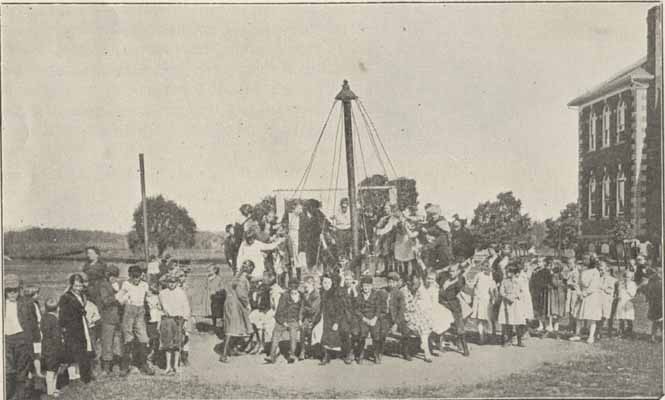
The School Children at Play.
agency, the Cone Export Company, which also is located in Greensboro, and is managed by L. H. Sellars. It is through this department that Proximity and White Oak denims are sold all over the world.
It would be impossible to tell a story about the extension welfare work of these mills in just a short article. In fact, a long story could be written about each department of it; and there are many. Practically everything that can be done to make the lives of the employes better, both as to

Proximity Kindergarten Children.
working and as to living conditions, has been provided. Homes are attractive, with modern conveniences and shrubbery and flowers. Some new stucco bungalow have been recently completed at White Oak that are the last word in the way of homes for textile workers. Streets are laid off and planted by an artist, with shrubs from the company's nursery.
Through Miss Pearl Wyche, the head of the welfare department, one of the best welfare and educational institutions in the country is conducted. She has assistants in the way of teachers for domestic arts, nurses, music teachers and other workers for carrying on one of the best up-to-the minute organizations anywhere. One of the remarkable things about the whole scheme is the "personal touch." Miss Wyche visits and knows personally every family at the four mills under her charge, and the four of them make a nice little city.
There are many organizations and clubs for social and physical development, but perhaps the one that is most pleasing is the Debating Society, which the girls and boys have organized among themselves without the superintendency of the welfare department. They select their own debaters, and their subjects for discussion, and discuss them as college-breds; and the management and welfare department are invited as "guests." This organization grew out of Sunday School work, and it is said to have been a means of getting a class of young people interested who did not seem to be impressed before.
In each village a new community house is under construction.
Page 53
La Fayette Cotton Mills La Fayette, Ga.
The LaFayette Cotton Mills at LaFayette, Walker County, Georgia, were organized in the year 1903, with J. E. Patton as president. Under his efficient management the company has continued in successful operation for seventeen years. The present officers are: J. E. Patton, president: P. D. Fortune, vice-president; R. S. Steele, secretary and treasurer; R. A. Whatley, superintendent.
The city of LaFayette, being peculiarly and picturesquely located between two mountain ranges, has the advantages of health and climate. However the company has not accepted the natural advantages as sufficient. The mill building is sanitary and well ventilated, and has a complete steam heating system. Flower beds beautify the grounds, and the

Some LaFayette Cotton Mill Girls at Play.
entire mill property presents a pleasing and delightful appearance.
We have a large and commodious welfare house in course of construction, which will be equipped with every modern convenience necessary for the use and comfort of the people of the mill village. There is an ample playground connected with the welfare, or club, house, equipped with every up-to-date playground appliance for the pleasure of all our people. Miss Louise Milam will have charge of the welfare work, and

The Mill Village Streets are Kept Clean and Neat.
under her superior management our people will have every advantage it is possible to give them.
Our village has comfortable and convenient houses, electric lights, running water in each house, and concrete sidewalks

The Plant of LaFayette Cotton Mills.
for the entire village. The environments of the village are of the very best. Cleanliness and sanitation are insisted upon. Everything that can be done that is conducive to good health and happiness is ever borne in mind by the company.
Each family is allowed to keep a cow and a pig, and have barns located in a pasture adjacent to the village. This pasture is equipped with automatic drinking trough, is absolutely free, and is for the exclusive use of the people of the Lafayette Cotton Mills.
We have the advantage of the city public schools. In the

A LaFayette Mill Playground Scene.
near future we will have our own church and Sunday school. At present our people not only have the privilege of attending the churches of LaFayette, but are also entirely welcome to the churches of the city.
Page 54

OSNABURGS STRIPES
SELMA MANUFACTURING CO.
SELMA, ALA.
J. F. Ames, Proprietor Ernest Nelson, Manager
Page 55

Graded School

Baptist Church

Homes

Kindergarten
Pacific Mills -- Hampton Dept. Columbia, S. C.
Graded School, Baptist Church, Homes, Kindergarten, Swimming Pool, Girls' Club, Cafeteria, Medical Dispensary

Swimming Pool
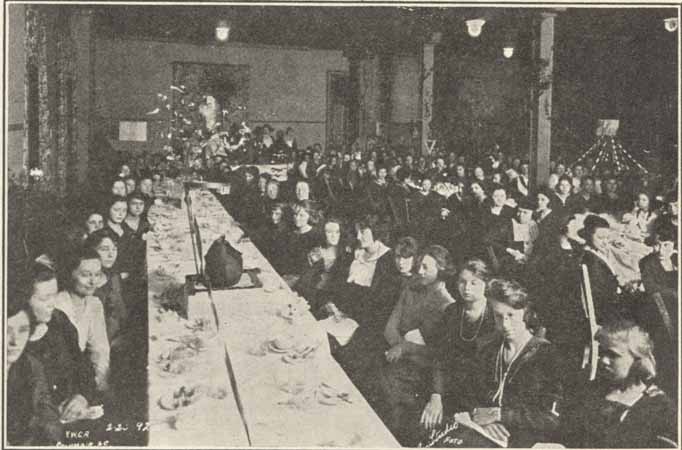
Girls' Club

Cafeteria

Medical Dispensary
Page 56
The Gray - Separk Group of Mills in Gastonia and Lincolnton, N. C.
This group is comprised of Gray Manufacturing Co., Flint Manufacturing Co., The Arlington Cotton Mills, Parkdale Mills., Inc., Arkray Mills, Inc., Myrtle Mills, Inc., and Arrow Mills, Inc. These are located in Gastonia, N. C., except Arrow Mills, Inc., which is located in Lincolnton, N. C. J. L. Gray of Gastonia, N. C., is General Manufacturing Manager of all these mills, and J. H. Separk, of Gastonia, N. C., is Secretary and Treasurer of this group of mills. Each of this group is a separate and distinct organization. All of these mills are in complete operation except Arkray Mills, Inc., which is now under construction. This is to be a complete twenty thousand spindle mill on coarse and medium counts combed yarns, comprising a range through thirties to eighties. This group of mills has a larger production in fine combed yarns than any other group in the southern states. Following are the active superintendents of the above listed mills:
- Gray Manufacturing Co., and Parkdale Mills, Inc., N. G. Cloniger.
- Arlington Cotton Mills, and Myrtle Mills, Inc., M. B. Cloniger.
- Arrow Mills, Inc., D. H. Cloniger.
- Flint Manufacturing Co., C. L. Lytton.
It is an interesting fact that these four gentlemen entered the mill business while mere boys and have, therefore, secured all of their training in active mill work. The very large success which each of these gentlemen has achieved in his chosen line, is, therefore, a very striking evidence of the reward of merit. The Messrs. Cloniger are all members of the same family, being brothers.
The management of these mills believes in furnishing every possible opportunity to the operatives to develop themselves along all the broader lines of development. With this end in view the management has sought to encourage, in every way, religious, social and educational sides of life. In this immediate group are to be found ample churches, school houses, and community buildings.
The pictures on this page represent up-to date community houses that are being constructed at these various mills. These community buildings were designed by Charles C. Wilson, architect, of Columbia, S. C., and Gastonia, N. C. Three constructions similar to these are nearing completion. One is to serve the Gray and Parkdale communities; one is to serve the Arlington community; and one to serve the Flint community. Later, similar structures will be erected at a point midway between Myrtle Mills, Inc., and Arkray Mills, Inc., to serve these two communities; and there will also be constructed one of these buildings at Arrow Mills, Inc., to serve the Arrow community.
Each of these buildings has been planned to take care of the following essential features: A commodious assembly hall, equipped with opera chairs, which will furnish easy seating for an audience of 350 to 400 people, in which hall will be a commodious stage. There will be reading rooms, library, first aid room, nurses' consultation room, modern kitchen and dining room, bath rooms, and a sanitary barber shop. Each of these departments will be equipped with furniture and fittings of the most modern construction. Not one of these buildings will bear the name of any individual but they will rather be known as the people's building at each of these mills. The management entertains no higher hope than for the operatives of the mills themselves to use these buildings for the purposes for which they are intended. It shall also be the hope of the management that the people themselves will manage, with the assistance of its nursing and community force, these buildings in their own way.

The Gray-Parkdale Community House
This is a community house being completed in Gastonia for the Gray-Separk organization, especially designed and located for the social and educational activities of the employes of the Gray and Parkdale Mills.
Page 57

The Arlington Community House
This is being completed by the Gray-Separk interests in Gastonia, N. C., for the employees of Arlington Cotton Mills.

The Flint Community House
The community of Flint Mfg. Co., in Gastonia will soon be using this new building which is erected for their use in a social way.
Page 58
Lancaster Cotton Mills Lancaster, S. C.

The New Club Rooms and Recreation Hall of Lancaster Cotton Mills.

The Sewing Class of Miss Perry, the Welfare Director.

Some of the Operating Heads in Lancaster Cotton Mills.
1--F. Gordon Cobb, general superintendent. 2--B. L. Still, superintendent No. 1 and 3 Mills. 3--L. T. Curry, overseer No. 2 weaving. 4--O. J. Whitehead, general overseer of power. 5--J. O. Edwards, general overseer No. 2 carding. 6--C. C. Brigman, overseer No. 2 spinning. 7--L. F. Hilton, overseer slashing, tyeing-in, etc. 8--C. R. Harris, night superintendent No. 3 mill. 9--O. T. Hayes, secretary to the general superintendent. Other overseers not shown in group are J. G. Brown, weaving No. 1; J. W. Mehaffey, cloth room.

At Recreation Park.
Page 59
Pinkney Mills, Inc. Ridge Mills, Inc. Rankin Mills, Inc.
If you should go to Gastonia, N. C., and make inquiries about some of the progressive mills, any Gastonian would tell you that among the number are the Pinkney, Rankin and Ridge Mills, under the management of the Rankin brothers. These young men have sprung into cotton mill prominence within the past three or four years. In 1916 the first one of the chain of three was built,--the Pinkney. During the latter part of 1919 the Rankin Mill was completed, and in the early part of 1920 the Ridge Mill was numbered among the forty-odd in the city of Gastonia.
The officers of the mills are as follows: R. G. Rankin, president; L. S. Rankin, secretary; Henry Rankin, vice-president. The products of these mills are fine combed yarns.
Being located about three miles from the center of the city, ample ground has been obtained for developing an ideal village. Elaborate plans are laid out, and are expected to be accomplished some day as prosperity comes to them. However,

Superintendent W. P. Lee.
"Rome was not built in a day" They have built one mill a year, and that is doing pretty well, their friends say.
Bungalow Homes.
The homes for the employes are bungalow in style of architecture, and are all provided with electric lights and water and the best of sanitary equipment. They are built in sizes to accommodate large or small families. The rent charged is a mere fraction of what a city man would have to pay for one of these cozy abodes.
When the Pinkney Mill was built, about four years ago, a new school house was erected along with it. With the increase of mills, a newer and larger house is required, and this is being completed. It will employ ten teachers. The company is building also a swimming pool, and by next summer this, with a play ground for the young people, will be ready for lots of healthful sport. Baseball and basket ball grounds also are being made ready.
W. P. Lee, the superintendent of all three of the Rankin chain of mills, has perhaps made more rapid strides than any other young man in the state among cotton mill "Supers" Five years ago he was an overseer in the Climax Mill in Belmont. R. G. Rankin spotted him as good material for a superintendent, and he was placed in charge of the Pinkney Mill. He made good, both with managers and help, and today has three mills under his management. Mr. Lee is assisted by H. M. Childers at Ridge Mills, Inc., and by W. A. Marley at Rankin Mills, Inc.

Supt. Lee and his assistants and overseers at Pinkney, Ridge and Rankin Mills.

The 1920 Baseball Team of Pinkney Mills.
Page 60
McAden Mills McAdenville, N. C.
The McAden Mills, McAdenville, N. C., operating 28,000 spindles and 350 looms, producing colored goods and yarns, were founded by Col. R. Y. McAden, of Charlotte. The present officers are: Henry M. McAden, president; R. R. Ray, secretary and treasurer; George K. Tate, superintendent.
The company has a nicely laid out village, with attractive homes, equipped with modern conveniences. There are good

A McAdenville Street Scene.
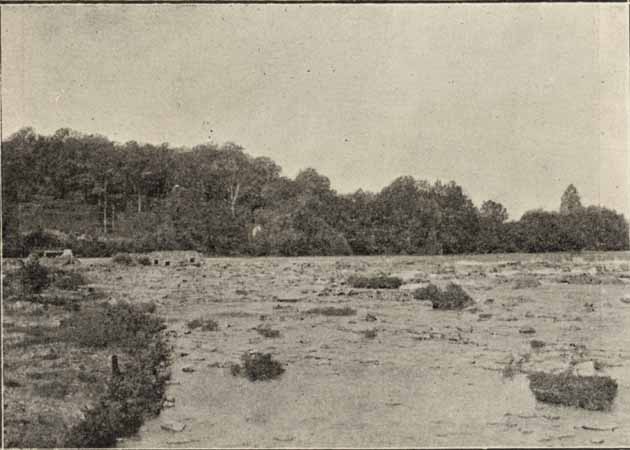
A South Fork River Scene at the Dam Near McAden Mills.
schools, churches and amusements. A splendid library, given by the late Dr. Giles M. McAden and maintained through a bequest from him is a very helpful feature of the village.
McAdenville is on the South Fork river, about 15 miles west of Charlotte, and one of the pictures on this page shows the big dam across the river near the mills. The town is a prosperous one, with well paved streets and good homes.
Pomona Mills, Inc. Greensboro, N. C.
The $400,000 addition to the Pomona Mills, Inc., of Greensboro, N. C., has just been completed, and the machinery is being installed. About 150 Crompton & Knowles looms are also being added. The working conditions of the mill are among the best, and this is one reason for the efficient work and the splendid products,--the best corduroys, coutils and romper cloth on the market. The new portion of the mill will be mostly a dye and finishing plant.
Pomona has a splendid school, but with the increase in plant and population, two class rooms have been added and five teachers employed. The company also has employed a trained worker at the head of the welfare department.
For some time the company has operated a dairy and furnishes milk for the people. This has become so popular that the number of cows has been doubled, and now there are

The Pomona Mills Baseball Team of 1920.
about forty fine registered Holstein cows. These are tested periodically and kept in fine condition. The dairy is up-to-date in every way. In connection with the dairy, the company expects to operate a truck farm next summer and furnish vegetables to the employes at the cost of production.
Pomona has a splendid 18-piece brass band, rivaling in

One of the Pomona Mills' Ready-Cut Bungalows, Furnace-Heated and Modernly Equipped.
popularity the excellent baseball team. During the past summer the ball team won 12 out of 15 games.
About seventy-five new ready-cut bungalows have been built in Pomona.
The officers of the company are J. E. Latham, president; Pierce C. Rucker, vice-president; C. W. Causey, treasurer; and D. Sutcliffe, superintendent.
Page 61
Caswell Cotton Mills Kinston, N. C.
If any person has the impression that there are no progressive mills in eastern Carolina, there is a pleasant surprise awaiting him upon his arrival at the Caswell Cotton Mill in Kinston, N. C. Officers are: J. E. Hook, president; F. C. Dunn, vice-president and treasurer; W. D. LaRoque, secretary; N. B. Hill, superintendent; and W. T. Hooker, office manager. These gentlemen believe in a clean mill and village and pleasant surroundings for the employes. And they have all of it. About seven years ago when Dr. Stiles of the U. S. Board of Health was visiting southern industrial plants, he placed the Caswell Cotton Mill as the next best mill in the South in sanitation, in his report to the Government.
Pretty Mill and Village.
Hedges, shrubbery, flowers and grass are predominant in the grounds around the mill and throughout the village, and

A Caswell Mill Cottage Home.
these have been artistically arranged with the aid of a landscape gardener. In fact one is struck with the clean premises, neat cottages and profusion of flowers. In front of the mill and office is a fountain and pool in which swim hundreds of gold fish. There are no "Keep out" signs anywhere, but the children of the village use the grounds of the mill as a play place.
Play Grounds for "Kiddies."
Several play-ground fixtures have been installed in front of the mill, and the children of the village keep them in constant use.
Sports for "Grown-Ups."
Caswell, like most other mills, has a baseball team of which
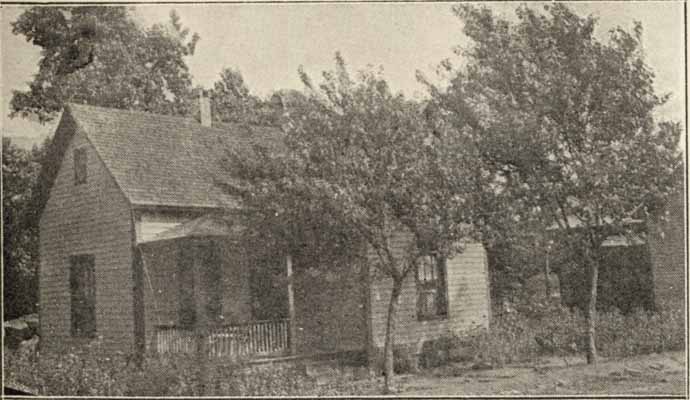
Another Caswell Mill Home.
the people are exceptionally proud. These boys have played the mills and towns near, and have won many victories.
But there is one sport at the Caswell Mill that all ages and classes enjoy--and that is the annual fish fry and barbecue. This festive occasion is always held on Saturday before

Park, Fountain and Playground in Front of the Mill.
Easter and is attended by all the employes and officers and their friends and families. The dinner is served on the mill grounds, and the food prepared out-of-doors. If you live away from the coast you don't know fish, and if you have never eaten barbecue cooked down in eastern Carolina you don't know what barbecue is. MILL NEWS readers who do not know these things must only be pitied for what they have missed.
Homes With Modern Conveniences.
The cottages of the Caswell Mill are very attractive, and

The Company Office.
are provided with lights, sewerage and artesian water. It is an unusual village because practically every house has an abundance of flowers, and everywhere it is clean and neat. The company has supplied garbage cans between the houses, and the city hauls away all trash. In this way, no litter is ever visible.
A chapel has been erected for community meetings, and for general use of the people of the village. It represents no special denomination, but will be used as a meeting place for anything pertinent to the advancement of the village or the people.
The employes make splendid wages. The company furnishes wood and coal at cost, and houses for a nominal rent. Thus, the people are enabled to save money.
Page 62
Victor-Monaghan Mills
Greenville, S. C.
Greer, S. C.
Arlington, S. C.
Seneca, S. C.
Walhalla, S. C.
Jonesville, S. C.
Union, S. C.
According to newspaper custom the first paragraph must contain the keynote of an article. Now these pages are to be about the Victor-Monaghan Mills. After weighing the many good points to be told in this story, the writer decided that the following, taken from the V-M. Quarterly contains the keynote to the kind of men who own and are employed by this chain of mills. And men are but mirrors reflecting the character of the women they have known. Therefore, the women of these mills must be of the same progressive type.
The Company's Policy.
"It is the policy of the company to promote our employes whenever there is a man worthy of promotion Records show that every superintendent employed by our mills to-day has come from our own ranks, and this holds good with most of our overseers."
That policy shows good business judgment, keen discernment of character, and a willingness on the part of the management to give their men a chance. It shows that the men employed by the mills do their duty, and perform the most faithful service.
Many mills have this same policy, but men leave them and go elsewhere for promotions, and make good. Thus, the manager who can not see the virtues of his employes loses, and the other mill manager gains. But there seems to be more insight into the character of their men by the managers of the Victor-Monaghan Mills. They believe in their men. They give them a chance. And the employes make good. Maybe that is why the V-M chain always produces such a fine quality of goods. They are made by heads and hands that know the job, and not by experimenters.
The employes of the V-M Mills are unusually steady. The company offers prizes each year to the mill in the chain making the highest average for steady work. The prize went to Wallace Plant for the past year, with the high average of 95 per cent. The general average of all the mills was 77 per cent.
There are eight mills in the Victor-Monaghan chain, which controls the greatest number of spindles in the South. The mills are:
- Monaghan, Greenville, S. C.
- Victor, Greer S. C.
- Greer, Greer, S. C.
- Apalache, Arlington, S. C.
- Seneca, Seneca, S. C.
- Walhalla, Walhalla, S. C.
- Wallace, Jonesville, S. C.
- Ottaray, Union, S. C.

The Y. M. C. A. Building at Victor-Monaghan Mill in Greenville.
The same system of welfare work is carried on throughout the whole chain. No partiality is shown.
The story about the welfare work, the people of the eight mills, and readable things about both, would fill a volume. Therefore, only mere facts can be stated in this space.
The welfare work is conducted through the Y. M. C. A., and each mill has its building, together with trained secretaries and assistants. All these work for the general uplift of the people and under and by the direction of L. P. Hollis. The Y. M. C. A. hall is the meeting place for various clubs, of men, women, girls, and boys. The clubs are for study, for fun, and for physical development in its best forms.
The Fixit Club.
One of the most unsual clubs is what is known as the Fixit Club. It is composed of the superintendents, overseers and section men of the mills. They hold monthly meetings for the purpose of discussing practical questions of how to improve their work. There they swap ideas and get the other fellow's opinion. Once every three months the superintendents and overseers of all the mills meet for joint

Girls' Class in Cooking at Victor-Monaghan Mills.
Page 63
discussion. This club has developed into one of the best organizations of the mills.
Garden Expert Employed.
The first of the year, the company employed a garden expert to take charge at all the mills for the purpose of aiding the people in this line of activity. This man is also a landscape artist, and he will assist not only in the vegetable gardens, but in the general improvement of the out-of-doors of the homes and villages.
Laundries and Swimming Pools.
Each mill is to have a laundry and a swimming pool. Four each have already been completed and the others are in the course of construction.
Savings Banks Planned.
The plan of the company is to erect savings banks at all the mills, with one central bank. The people are encouraged to save their money, and some of them are heeding the advice, while others?--well, they auto.
Prizes.
The company offers prizes in the various activities of life and work at the mills, in order to encourage and stimulate the best there is in the people. The mill making the highest production with the lowest grade of seconds is given a prize, and for the past two years an extra 5 per cent on the wages has been given. Prizes are given to the mill having the least number of accidents, and this plan has brought the injuries down to a small number.
The company carries insurance for the employes on a very liberal plan. An employe must work for six months before being able to take out a policy, and then if he should die, the beneficiary receives $50 in cash and the average weekly pay of the deceased for fifty weeks, not exceeding $10 a week.
The Homes For the Employes.
The Victor-Monaghan Company has erected homes for the employes--not mere houses. One of the mottos of the company is "More than a place to work." It provides really a place to live. The cottages are comfortable, equipped with modern conveniences, including water, lights and sewerage; and are built along city-like paved streets and sidewalks, shady and inviting, with flowers and hedges. Good churches, in which the people take the keenest interest, and where the splendid singing clubs of the villages give their famous concerts, are set over each mill community. Most up-to-date schools here too,--centers of the educational life of the villages. Domestic science and special courses are taught.
One of the strongest features is the good system of night schools held for young men and women and even older ones. Night classes are held especially for the overseers, and they are taught the theoretical processes of cotton manufacturing.
V-M's Special Arithmetic.
About two years ago the mill management had Prof. C. W. McSwain write an artithmetic containing practical cotton mill calculations that would teach the cotton mill boy the things he ought to learn. Instead of the old traditional "sums" in eggs and apples, the cotton mill boy learns to figure spindles, looms, yarn and cloth, until at last he learns to do the difficult sums in complete textile courses. Prof. McSwain, who formerly taught mathematics in Clemson College, spends his summers, or part of them, working among the various mills of the Victor-Monaghan company.
The Victor-Monaghan Company pays wages up to the top notch, and does everything possible to help bring down the cost of living for the employes. One measure adopted during the war that will be continued until the prices get normal again is the operation of stores in the various villages, where things are sold at cost plus the expense of operation.
During the past few months two men deserving special mention have been promoted in the official life of the mills. These are President W. E. Beattie, the employes' friend, and T. M. Marchant, treasurer, who has risen from the ranks of cotton mill workers. Mr. Beattie is a native of Greenville and is one of the best "mixers" in the country. He attends the meetings of his employes and enters into their lives with the greatest freedom and simplicity. His employes know he is their friend and it is said "the door to his office is always open," so they can walk in and get a friendly hearing.
Mr. Marchant is now treasurer of one of the largest groups of mills in the South, and handles the money of one of the wealthiest cotton mill companies in the country. He was once a worker in the mill. Thus, the Victor-Monaghan keynote, which may be expressed thus: "There is a chance for the employes to advance."

Boys' Class in Wood-Carving, at Victor-Monaghan Mills.
Page 64
Kinston Cotton Mills Kinston, N. C.
The Kinston Cotton Mills and Orion Knitting Mills are under the management of J. F. Taylor and his associates. That means that both are progressive institutions and that the employes are being looked after in many ways for their betterment.
These mills are located in the hustling town of Kinston, North Carolina, and are only a few blocks from the center of the town. Therefore, the people of the village are "citizens" of the town. They attend the same churches, their children go to the public schools, and the pleasures of the city are always available.
The officers of Kinston Cotton Mills, are J. F. Taylor, president and treasurer; S. H. Abbott, vice-president; T. V. Moseley, secretary; and P. A. Gwaltney, superintendent. Mr. Gwaltney came from the cotton mill section in Piedmont Carolina and is a practical mill man. He finished a textile course in Clemson College.
The Kinston Cotton Mills manufacture high grade hosiery and underwear yarn in a modern plant thoroughly equipped with the latest machinery for making both carded and combed peeler yarns in single and two ply cones and skeins.
The product is sold quite largely in the South to knitters who appreciate quality. Only high grade cotton is used. The mills are well ventilated, heated and lighted, and only high grade cotton is used. There are no objectionable features to the work in any part of the mill.
The homes for the employes are neat and attractive and are all equipped with lights, sewerage and artesian water. In order to take care of the increase in labor, the company has

R. N. Rhodes at Kinston Cotton Mills, and His Giant Princess Feather, Eighteen Inches in Diameter.

Some of the Kinston Cotton Mill Homes.

A Flower Yard at a Kinston Mill Home.

A Kinston Cotton Mill Street Scene, Showing the Interest the Employes Take in Flower Culture.
bought houses in different parts of the town. All of them have splendid garden space and the people are encouraged to cultivate gardens and flowers and keep the premises neat. Three grand prizes are given every year for the best flowers and vegetables and to the woman who is judged to be the best housekeeper. This arouses interest and rivalry. During the past summer R. N. Rhodes has grown two crops in his garden, and now has it full of things for winter use.
The company has provided playgrounds for the children and young people, complete in every particular, and thus furnish a chance for proper physical development.
Page 65
Orion Knitting Mills Kinston, N. C.
The Orion Knitting Mills plant is under the same management as the Kinston Cotton Mills and what has been said of that company as to living conditions for employes can be marked "ditto" for Orion. Both mills are located within a short distance of each other and the villages adjoin. There are, however, different officers for the Orion: Dr. Henry Tull is president; J. F. Taylor, secretary and treasurer; and H. P. Fort, a mill man of wide experience, acts as superintendent and general manager of the mill proper.
The Orion Knitting Mill manufactures ladies', children's and men's hose in different qualities and colors.
In the dye house is used only pure artesian water, and it

Some of the Orion Mill Homes.
is used also for drinking purposes throughout both this and the Kinston Cotton Mills, as well as in their villages. The product is sold in every section of the country from Boston to San Francisco.
A young woman has been in the employ of the two mills for some time in the capacity of nurse and general health promoter. She looks after the villages from a health and sanitary standpoint and reports any disease.
Plans are under way for the erection of a community building for carrying on the work to better advantage by the community nurse in the employ of the company. The young women of the village are organized into sewing clubs and are being taught domestic science and household arts. This work is being done with the assistance of the Episcopal church which is located near the village.
A night school for the coming winter is planned by the welfare department, and the community worker will give free instruction to any of the people who enroll as students It is the intention of the company also to include a textile course for the men. This school will be open to employes of

An Orion Home With Modern Conveniences on Asphalt Street
both mills.
The Orion village has splendid streets. Paved sidewalks and asphalt roads form a part of them. The homes are attractive and are equipped with light, water and sewerage.
Good wages are paid by these mills, and with the aid of the mill company in bringing down the cost of living, some of the employes are saving. A few have invested in homes of their own, and others have invested in Liberty Bonds.

Supt. H. P. Fort (center); Z. L. Canady and E. C. Lanier at left and right of Mr. Fort; and Some of the Expert Workers in Orion Knitting Mills.
Page 66
The Huchison Group of Textile Mills
Six mills constitute the present Hutchison group, of which C. E. Hutchison of Mount Holly, North Carolina, is president and treasurer; I. C. Lowe of Charlotte, vice-president; J. M. Hatch, secretary.
Five of the mills are located in Mount Holly. The Adrian Manufacturing Company, Nims Manufacturing Company, Woodlawn Manufacturing Company, American Processing Company and the Alsace Manufacturing Company. The sixth mill is located in Maiden, N. C., and is known as the Union Cotton Mills.
In addition, a new mill is in course of erection at Mount Holly, for spinning fine combed yarns.
The American Processing Company is a new plant recently

Completed Plant of the American Processing Company at Mt. Holly, N. C.
completed for mercerizing, bleaching and gassing cotton yarns and is modern in every respect.
The Alsace Manufacturing Company, recently purchased by Mr. Hutchison and associates, is being enlarged, and additional new machinery ordered.
All of the mills are now being consolidated under one corporation, known as the American Yarn and Processing Company.
All of the mills under the Hutchison management are high grade in working conditions as well as in product. They are first class mills with first class employes. The mills are clean inside, and the working conditions are made as pleasant and sanitary as possible.
Homes with Conveniences.
The homes erected for the employes in the newer mills have been equipped with all modern conveniences, including water, lights and sewerage. They are well built bungalows or two story residences, and are built in sizes to accommodate large or small families.
Opportunities For Saving.
With coal and wood at cost, house rent free, lights and water and other home expenses also paid, and the splendid wages being paid by the mills, the cotton mill employes have the best chance to save money of any citizens of Mount Holly. Some of them are investing their money for good causes. One of the marks of improvement of the town is the construction of a new bank.
Good School Facilities.
No small town in the State has a better school system than Mount Holly. The children of the mills attend the graded school with the other children. The people of the mills attend the churches of the town.
Sports.
The man of the world often scoffs at the sports of the small town. But Mount Holly has what many travel miles to enjoy,--fishing. There are two rivers, the Catawba and a small tributary, running by and through the town. Here the boys find fish and swimming holes, and also a shady current for canoes, while the banks are nature's parks. The people are very much interested in baseball and have a splendid team from among the various mills. During the past season they have won many athletic victories.

Baseball Team--The Pride of the People of Hutchison Mills.
Page 67
Revolution Cotton Mills
MANUFACTURERS OF COTTON FLANNELS
GREENSBORO, N. C.

The Revolution Cotton Mills Stores and Lodge Room.
On the northern boundary of the historic city of Greensboro, on the waters of North Buffalo Creek in a beautiful plateau section of North Carolina, is located the plant of Revolution Cotton Mills, the largest of its kind in the South.
In building these large mills, the first thought in the minds of the owners was the health, comfort and happiness of those who had to live near them and spend their time working in them. This industrious city was builded on a slight elevation so as to furnish perfect drainage and beautiful landscape views in every direction.
The snug and comfortable homes, with cool artesian water and electric lights furnished to everyone, are set well back from the streets, and are surrounded by lovely green lawns
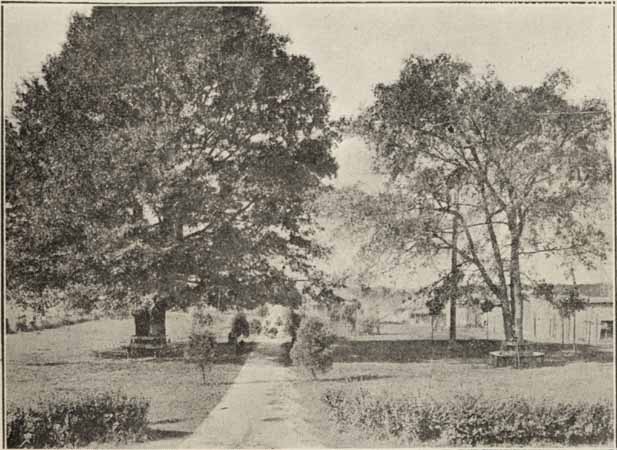
A Corner of Revolution Park.
and large shade trees. Beautiful flower gardens are in evidence everywhere, causing the village to border upon the unique.
The problem of caring for the physical and mental development of children and others was not forgotten, and to this end schools with spacious rooms and large playgrounds surrounding them, were erected. More than a dozen teachers are employed in these schools. Welfare cottages were built, and kindly disposed workers, together with trained nurses, were put on full-time duty, to care for and teach those who wish to take advantage of the privilege.
The mills are within a mile of the heart of Greensboro, N. C., and are located in a county that has a greater number of miles of hard-surface roads than any other county in the State and they are connected with the city by fifteen minute street railway schedule.
Amusements have been provided for all the folk in the village. Picture shows, bowling alley, public parks and a large recreation building are numbered among these. Living and working conditions have reached the top notch in this contented and home-like village. A walk through this industrial city, comprised of more than five hundred homes, reveals bright, happy children with faces beaming with intelligence, and contented old folks. Vigorous young manhood, as well as the blushing maiden, is in evidence here, and to judge from their appearance, one would think that their work were just play for which they got pay.
One of the biggest fellows in the whole place around Christmas time is Santa Claus, who has a date each year with the children, and has never failed to put in his appearance every time--big, fat and jolly, with his sacks over flowing he always

Peace and Prosperity Are Evident Throughout the Community
comes. He creeps into every pay envelope and every school desk. There is no home into which he does not find a way to enter. Scrooge and Marley are two characters unknown to the people who live in this modern village. Happiness and "Hello, Bill!" is the password here.
Page 68
Carolina Cotton & Woolen Mills Co.
Spray, N. C.
Draper, N. C.
Leaksville, N. C.
A great deal of work is being done by the Carolina Cotton and Woolen Mills in the villages of Draper, Leaksville, North Spray and Spray, where there are a number of mills owned and operated by it.
There are ten mills in the chain comprising the Carolina Cotton Mills. Their names and the products made at each mill are as follows:
The Mills and the Products.
Draper, N. C.: Draper-American Mills, cotton blankets; Wearwell Sheeting Mill, fine sheetings.
Spray, N. C.: Spray Woolen Mills, wool blankets; Rhode Island Mill, cotton blankets; Lily Mill, fine gingham; Nantucket Mill, ginghams and outing; Spray Bleachery, bleaches and finishes sheetings and narrow goods, and also makes up pillow cases, sheets, etc; American Warehouse finishes blankets, outings, ginghams, etc., and does the shipping for all the cotton mills.
Leaksville, N. C.: Athena Mills, ladies' and children's underwear; Wearwell Bedspread Mill, satin and crochet bedspreads.
Carolina Heights.
Carolina Heights comprise a suburb for the employes of the mills, of which any city might be proud. The entrance is through a grove, which is being developed into a park. The streets are graded, and cement sidewalks made. Stone pavement will be placed upon the streets through the village. The village consists of a number of splendid bungalows. Now these homes are "real" bungalows. They are the kind that the bette rclass in the large towns build as homes for themselves. They are modernly equipped and very attractive. Flowers and shrubs will be planted when all the work of grading and street work has been completed. It is the intention of the company to make one of the prettiest cotton mill residential sections in the state, and some of the other mills will have to make a big jump to head them in the race.
Road building committees of the various towns and counties

No Mill Company Lays More Stress Upon the Musical Feature Than the Carolina Cotton & Woolen Mills. A Few of the Many Musical Clubs Organized in the Musical Department and Not Confined to the Employes of the Mills Alone.
Page 69
would do well to visit Spray and observe the streets. The people there believe they have discovered a better road system for mill communities. First the roadbed is graded. Then it is laid with limestone chips about four or five inches deep. This is all the labor required. Travel pulverizes the stone and rain cements it. It does not wash. The road already built has been in use for 18 months and there are no signs of wearing. These stone roadways will be laid in several of the streets now being built in North Spray, Carolina Heights and Draper.
In the village of the woolen mill at North Spray, the residential section is undergoing an almost complete change in the grading of streets, laying of cement sidewalks and improving of yards and cottages. When all the work has been completed in grading, etc., flowers, shrubs and grass will be planted around the homes.
Improvements in Draper.
Draper also is receiving a share of the village street improvement. Several miles of streets and sidewalks will be laid in all three of the villages. In front of the Draper Y. M. C. A. Building, the street is being widened and new sidewalks will be laid. A limestone street will be made with a center of flowers and shrubs.
New "Y" for Leaksville.
A new Y. M. C. A or community hall is being completed in Leaksville, which will make the social and educational development of that place much more convenient than here-tofore when the people attended the entertainments at the "Y" halls in the other villages.
Play Grounds.
The company is installing play ground fixtures in North

Views on This Page Handsome Bungalows in Carolina Heights--A Modern Residential Development.
Spray and Draper. They are the most completely equipped ones in the State. The grounds at Draper cover two acres, and the grounds at the "Y" in North Spray are inadequate for the fixtures. For this reason, another play ground will be equipped at either Spray proper or Leaksville.
Textile Courses.
The textile courses inaugurated by the mills have developed into very important factors among the men and boys. Last winter the class at North Spray had 65 members, and several promotions have been made among the men who took the courses. There was a sum total of 13 classes in all the mills, with an average of 150 men and boys. The courses pursued were in carding and spinning, beaming, weaving and cloth designing. The classes lasted from 12 to 20 nights, and met twice a week. The work was done in co-operation with the State Board of Vocational Training and the Federal Board. Trained textile men were employed to teach the classes, and during the spring there were ten classes in textile arithmetic. The members of the classes were very much enthused over the work, and many of them asked for the courses to be pursued during the summer months.
Music.
The musical clubs and various pursuits of study in this branch comprise one of the big things in the life of the people of these towns. A musical director is employed at the expense of the Carolina Cotton and Woolen Mills Co. Classes are conducted in practically any line of music desired. He has in his employ several assistants. The lessons are not confined to the employes of the Carolina Cotton and Woolen Mills exclusively, but anyone in the town or the other mills may attend the classes and receive instruction. This branch of work is now about two years old and has made rapid strides in growth of membership. Here are some of the things taught in this branch: Band music, violin (65

Views on This Page Handsome Bungalows in Carolina Heights--A Modern Residential Development.
members now), Hawaiian guitar clubs, mandolin clubs, guitar clubs for girls, glee clubs, three male quartets (and splendid ones).
There are 1,000 people taking voice, in class or group singing. The children are taught in community "sings" of from 500 to 800. Group singing is one of the features upon which stress is particularly laid. The people are urged to come and sing. And they are taught simple old time songs, classical selections, religious songs, and jazz tunes of the day. The same methods are taught in group singing as are used in public schools. In the violin classes the same methods are used as are taught in the New York city public schools.

Views on This Page Handsome Bungalows in Carolina Heights--A Modern Residential Development.
Page 70
Superior Yarn Mills East Monbo, N. C.

Superior Yarn Mills.
The Superior Yarn Mills is the title that was given to the mill located on the Catawba river at East Monbo, North Carolina, when the mill was purchased from the Turner interests about ten months ago by the company now controlling it. The officers of the company are: R. L. Stowe of Gaston county fame, president; D. E. Rhyne, vice-president; and J. B. Hall, secretary and treasurer. Five men compose the board of trustees, these being the officers above named, with W. C. Wilkinson of Charlotte and J. B. Glover of Savannah, Ga.
The Location--A Natural Park.
East Monbo is 11 miles from Statesville and lies on the Catawba river. The scenery is what might be termed a natural park. It is a quiet nook in the hills, and easily accessible to the town by splendid roads. The river at the point where the mill is located is nearly a third of a mile in width and this distance is broken by a number of islands between the Iredell and Catawba county sides of the river.
Fishing, Boating, Etc.
The mill village overlooks the river and the hills typical of the Piedmont section, and it is there that one finds a number of real old-fashioned fishermen. In fact, this is one of the chief sports among the people. They have numbers of traps, but most of the fishermen go about it in real sport style, fishing in baskets, which they bring home full. And you can also hear some "fish" stories that would put Isaac Walton in the background. One of the champions of the village is "Fisherman" Gryder. The people build their own canoes and this affords a pleasant pastime during the spring and summer months. It would be needless to say that the boys and young men have their "ole swimmin' holes"
Comfortable Cottages.
The company has erected some very comfortable cottages for the employes of the village. They range from the small

Types of the Homes of the Workers in Superior Yarn Mills at East Monbo.

Types of the Homes of the Workers in Superior Yarn Mills at East Monbo.
Page 71
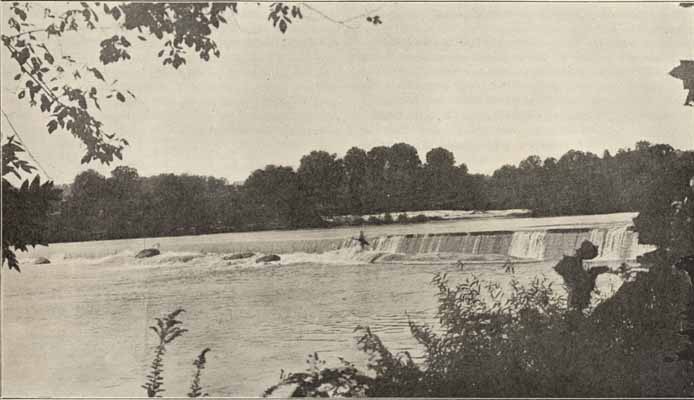
The Water Power Development on Catawba River for Superior Yarn Mills.
cottage to the two-story houses for larger families. The new company is having them repainted and put in excellent repair, which adds considerably to the appearance of the place. The houses are equipped with electric lights.
Graded Streets.
A striking improvement is found in the new graded streets through the village. These have been built with sand clay and make excellent drives for the several cars owned by the employes of the mills.
Schools and Churches.
East Monbo is a good example of what the mills do for communities in the way of bringing good schools. Before the erection of the mill, the district had a little one-room hut where the children of the country were taught the fundamentals of an education. Today it has an excellent eight-months graded school with three teachers, and the country boy or girl has the same advantage as the mill child, with the exception that he has to walk farther. There are several churches of different denominations in the community, in which the people take an unusual interest. There is one kind of institution that is always found in a cotton mill community, and that is churches; for the people who work in the mills are always a church-going people. The Sunday Schools are always well attended and are great factors for good.
The 350 people of the Superior Yarn mills are "above the average." That is what the bosses say about them. They are saving their money and are steady workers, who do their work well. That is why the 40's carded yarns made at Superior Yarn Mills are superior in fact as well as in name.
Living Costs Lowered.
Group insurance was recently put into effect, and the employes were insured free of cost to them.
At present there are a number of mothers and young girls of the village taking a course in home economics and first aid to the injured. This course is being taught through the auspices of the Red Cross.
There are two men of the village who deserve mention as good citizens and efficient in leadership. One is P. E. Adams, the superintendent. Mr. Adams is a practical mill man, who started when a mere boy and who knows the business from the lowest job on up. He started to work for 15 cents a day and worked from 12 to 13 hours a day. He is a native of Iredell county and secured his mill training in the mills of the county. The other man is J. A. Clark, the store manager and postmaster of the place.
J. B. Hall, the secretary and treasurer of Superior Yarn Mills, is a Gaston county product, and secured his training under the well-known Stowe brothers of Belmont. He has been connected with the cotton mill business for the past fifteen years.

A Group of the Girl Employes.
Page 72
Riverside & Dan River Cotton Mills
Danville and Schoolfield, Va.
To say that any one company is doing more than another in welfare work is a broad statement, but the Riverside and Dan River Mills are doing everything that has been thought of to make the lives of the employes more pleasant and profitable. The story of it is too big to attempt to tell in a small space. The real story of the many evidences of the benefits of the work cannot be told--not even in a volume.
To begin with, Schoolfield impresses one as a city. There is the city-like appearance in the well-paved streets and side-walks, the handsome buildings, the well-kept lawns, shrubbery and flowers that abound everywhere, from the mill park and grounds to the dwelling of the humblest employe. And there are thousands of hurrying feet on industry bent, well dressed young girls, boys of good physique, happy-faced mothers and satisfied-looking men,--and last but not least, cunning little boys and dainty be-ribboned little girls.
The Welfare Work is Complete.
The welfare work of these mills is under the supervision of Miss Hattie Hylton, who is a genius at organization. There are more than 80 workers in the welfare and school work at Schoolfield alone. Things that impress a visitor are the exquisite taste displayed in the selection of furniture, the harmonious effect of colors in walls and window decorations, and the splendid equipment for every department.
The School Work.
In educational work, practically everything is taught that will aid in the development of the children and the young people. Aside from the regular school courses, household arts are taught, night classes held, lessons given in music, swimming, and dramatics.
In the Welfare Building.
Just peep into the welfare building any morning and you will find a teacher busy with a number of interesting tots in the kindergarten; the nurses and resident physician in the medical department; the dentist busy with a patient; a worker in the library lending a book or exchanging a pattern with some mother of the village. In the evenings the building is turned over to Mothers' Clubs, or for social features for the young people.
Children's Savings Clubs.
The welfare department has started a Savings Club for the children. There are 1,263 members, and several boys

Making Future Citizens--Some of the Work in the Schools, Welfare and Y. M. C. A.
Page 73
have saved over a hundred dollars each within the past nine months. These are the small tots and school children. One boy is saving to pay his way through college. These children make their money carrying dinners and doing various errands.
The mill maintains a day nursery and also a milk station for the babies. Free clinics are given every Monday night
Y. M. C. A.
The Y. M. C. A. in Schoolfield is the equal in every respect of the most modern "Y's" in the cities. It is equipped with reading rooms, game rooms, volley ball, basket ball, indoor baseball, bowling, gymnasium, and swimming pool. The "Y" has been especially active in promoting out-of-door games, and during the summer organized nine ball teams in uniform and two small boys' teams. Night classes are held and play grounds and parks and out-of-door sports also take a large part of the play time of the people.
Hylton Hall.
After visiting this wonderful home for the girls who work in the mills, one feels that it should be spelled with capitals,--HYLTON HALL. It is thorough and perfect in every detail, and is everything that any girl might hope for in the way of comfort, convenience and an elegant home. The building has accommodations for 250 girls and furnishes them rooms as convenient as the most modern hotel, with hot and cold water in each, excellent dining room service amid the most pleasant surroundings, gymnasium, swimming pool, free medical aid, laundry, free lessons in cooking, sewing, music, or most anything they wish to study,--and the only charge is the sum of $30 a month.
To say that the building and its furnishings in every detail are beautiful conveys but little meaning to the average mind, It has splendid reception rooms, libraries, and reading rooms, elegant parlors, guest rooms where each girl may entertain for one week in a year a member of her family free of charge, sewing rooms, and in fact everything one could mention for comfort and convenience, even more complete than in a rich man's home.

After Study Play. Some Scenes in Schoolfield, Va., at the May Day Festival, and the Mammoth Christmas Tree in the Center, Which is an Annual Feature of the Holiday Season.
Page 74
Department of Welfare and Health Spray, N. C.
Upon arrival in Spray, a traveler finds he is in the midst of an industrial center with a population equal to some of the "big" towns or so-called cities of the State. There are really four towns, Spray, North Spray, Leaksville and Draper, and the mills are scattered through all four of them. In all of the towns except Spray, the mills are owned by the Carolina Cotton and Woolen Mills Co., and the welfare work in those places is strictly under its supervision and at its expense.
There are several interests in Spray: The Carolina Cotton and Woolen Mills Co.; the Spray Cotton Mills; Leaksville Cotton Mill, and the Morehead Cotton Mills Co. These companies have co-operated towards the development of the town and the improvement of the people. And a splendid work is being done for the health and welfare of the community.
Good business judgment has been used in the plan of the welfare work as in the management of the big mills. First of all is the head of the welfare and health department. Everything comes under his supervision. He has the general superintendency of things, from the building of employes' homes to street work and social activity.
The Y. M. C. A. hall is the center of practically all activities, for it is through this organization that all the welfare work emanates. The secretary has a number of workers for social, physical and educational work. Nurses are employed to look after the sick and teach sanitation. There is a department for women, and a young lady is in charge of this. There are sewing classes, games and various forms of entertainment and home training. It is through the "Y" that many clubs have been organized. There are Boy Scouts, Camp Fire Girls, baseball and basket ball teams, volley ball, billiard games, gym classes and Bible classes.
One of the best schools in the state is located at Spray. It is up-to-date in methods of teaching and modernly equipped. An unusual feature is the system of baths with hot and cold water.
Spray has splendid streets and paved sidewalks. Between the towns of Leaksville and Spray an asphalt road has been constructed.
Spray has a park on the river, and here the people enjoy such summer sports as boating, fishing, picnics and band concerts.
A "Production Class" was the outgrowth of the textile

Gingham Dress Party, Spray, N. C.--An Economical Movement of the Young People of Spray.
classes. Six experts held classes among the foremen and men of the mills. Foremen from all the mills were members of the classes. Out of 173 members there were 90 per cent who graduated and received diplomas.
During the past season the company leased the Phospho-Lithia Springs and hotel, up in Virginia, and about six or seven miles from Spray, for the benefit of the employes of the mills. The hotel accommodates about 75 roomers, and thus was provided a summer resort that the employes could visit at small cost.

Production Class, Which Was Composed of Overseers and Superintendents of the Mills of Spray, N. C.
Page 75
Catawba Spinning Co. Mt. Holly, N. C.
One of the greatest improvements in mill and village remodeling has been done by the Catawba Spinning Company at the old Albion Mill in Mt. Holly, N. C., which the company purchased about two years ago. The mill was built back in the days when even a brick building was considered good, but its style of architecture was very unlike the present day's methods of the modern mill. The company has about completed an addition to the mill which will increase the spindles from 4,000 to 10,000 and completely change its appearance. And it is not at the mill alone that changes are taking place, for they are building new homes and remodeling the old ones.
Good-By "Brick Dust Row"
It may be that O. Henry had seen the old brick tenement in Mt. Holly when he wrote his master story, "Brick Dust Row," and it was that to which he referred rather than the parlorless apartment in New York. The old building, although uninviting in appearance, was a splendid example of the difference in the mode of living of the mill employes in

Type of Bungalow Erected by Catawba Spinning Company at Mt. Holly.
the South, with their cottages and gardens, and the crowded condition of employes in many of the Northern mills. It was the only cotton mill tenement in the State. But the tenement is gone. In its stead are three comfortable and rather attractive two-story brick houses of eight rooms each, equipped with water, lights and sewerage. The company knocked two of the apartments out and left 24 rooms out of the 40. Now the houses have space between which has been cleaned up and planted in flowers.
Bungalows and Conveniences.
The company has built several bungalows and improved the old cottages. All houses are now equipped with water, lights and sewerage, and baths will be added later. These are given to the people free of rent, and in addition, the company furnishes wood and coal at cost.
Steady Employes.
There are a number of families living at the mill today who were there when the mill was built more than thirty years

Home Owned by Miss Etta Cavin, Employe of Catawba Spinning Co. She Has Been With the Mill for More Than Thirty Years.
ago. Some of them have saved their money and invested it in homes or bought mill stock. Among the home owners are Ed McGinnis, T. J. Stowe and Miss Etta Cavin. Miss Cavin not only owns the modernly equipped cottage shown on this page, but recently sold some lots to the mill for extension work. She has been with the company for more than thirty years and every dollar invested in her possessions was made in the mill. The people make good wages.
The company expects to do more as it succeeds. One thing planned is to employ a nurse to look after the people and give aid to those needing help.
Globe Yarn Mill.
The Globe Yarn Mill is another new mill now in the course of construction in Mt. Holly. It is being built to take care of 10,000 spindles but at first only 5,000 will be installed. The officers of the Catawba Spinning Company are John C. Rankin and T. M. McCoy, vice presidents; Globe Yarn Mills, S. M. Robinson, vice-president, while R. F. Craig and John W. Holland are president and secretary and treasurer and N. P. Bumgarner, general superintendent, respectively, of both mills. The latter have active management of the mills, and are men who know the cotton mill business from the ground floor up. Each of them has worked in the mills and has the confidence of his employes.

Employe's Home at Catawba Spinning Company. Outside it Would Rent for $20.00 a Month.
Page 76

"FUN-FUL" OCEAN WAVE. IN USE IN WASHINGTON PARK,
CHICAGO. NOTE THE CAPACITY OF IT.

BE SURE
YOUR PLAYGROUND SPECIFICATIONS INCLUDE
THE LAST WORD IN IMPROVED PLAYGROUND
EQUIPMENT.
BUY NOW, and be assured of prompt delivery. Installation can be made this fall, avoiding early spring rush and attendant delays.
We have
"Everything for the Playground"
including
Slides, Swings, Giant Strides, Ocean Waves, Gymnasium Combinations, See-Saws, etc., etc.
Write for Catalog
Southern Representative:
MR. EDW. FERGER,
276 Lucile Ave., Atlanta, Ga.
General Sales Offices:
ANDERSON, INDIANA.
HILL-STANDARD CO.
Factories:
KOKOMO, IND.
ANDERSON, IND.

A. M. Guillet, President and Treasurer
We Are the Pioneer Spindle Straighteners and Flyer Balancers of the South
DIXIE SPINDLE AND
FLYER COMPANY
INCORPORATED
Charlotte, N. C.
EXPERT OVERHAULERS AND REPAIRERS OF
Spinning And Card - Room Machinery
Spindles straightened and Re-Pointed
Flyers Repaired ad Balanced
Steel Rolls Re-Necked and Re-Fluted
Card-Room Spindles Re-Topped
Lickerins Rewound
Pressers Furnished Promptly
Second Hand Flyers and Spinning
Spindles Bought & Sold
Now is the Opportune Time to Have Your Repair Work
Done. You Can Best Afford to Stop Your Frames
At Present While Business is at a Standstill.

PAPER AND PAPER
SPECIALTIES
CLOTH - BOARDS
Wrapping Paper, Bags, Twines, Tissue, Towels, Toilet, Waterproof Case Lining, Cone Wrapping, Sealing Tape and Tape Machines, Drinking Cups, Cup Machines, Card Boards, Fibre and Corrugated Cases, and all kinds of Paper for the Printing Trade.
We carry a large stock and can make prompt shipments.
Write us for Samples and Prices.
CASKIE - DILLARD COMPANY, INC.
PAPER FOR EVERY PURPOSE
Lynchburg Virginia
Page 77

United States Color
and Chemical Co., Inc.
Office and Laboratories 93-95 Broad Street
Warehouse and Shipping Dept. 13-15 Custom House Street
BOSTON, MASS.
Factories and Laboratories
ASHLAND, MASS.
Manufacturers of
DYESTUFFS
and
INTERMEDIATES
TO BE FORMALLY OPENED OCT. 19.
Program Arranged for Exercises at New Community Building
of Pacific Mills.
Columbia, S. C., Oct. 9.--The formal opening of the handsome new community building at Pacific Mills will be held October 19. This beautifully equipped building has been remodeled from the old Y. M. C. A. building and will cost the mills about $250,000 when it is complete. It will meet practically every form of recreational life of the people. There is a fine swimming pool, which is well attended by men, women and children. There will be swimming exhibitions at the opening of the building.
Exhibitions of women's work such as cooking, sewing, canning and the like will also be on display. There will be music by the mill band, pictures, and games.
Prominent officials and others will be present to make talks and see the results of the mills' work. Among these will be Edwin Farnum Greene, treasurer of the Pacific Mills, Irving Southworth, general agent for the mills, Dr. D. W. Daniel of Clemson College, and others.
The girls' lobby in this building is a long room with soft gray tinted walls and beautiful window draperies that match the walls and hang in soft folds from the long, wide windows. The furniture is dark-enameled rattan upholstered in bright cretonne.
There is a barber shop and pressing club at the back of the building, a pool room, club rooms, banqueting hall, gymnasium and everything desired in a community building.
Jack Crawford is at the head of the community building and he is assisted by M. O J. Kreps, swimming instructor; A. J. Wallace, boys' secretary; Miss Jessie House, girls' worker; C. C. Byars, gymnasium instructor, and A. J. Bedenbaugh.
MADISON KNITTING MILLS SHUT DOWN.
Madison, N. C., Oct. 10.--The Madison Knitting Mills shut down recently on account of the dull market. The mill will begin operation as soon as the stock of finished product now on hand has been disposed of.

No Mill Equipment Is
Complete without a
SIMPLEX ROLL
CALENDERING MACHINE.
Patented May 27th, 1919.
No Extra or Skilled Labor
Required for Operating.
EVERY SPINNING ROLL
PERFECT
Rolls Out All Indentations
Polishes Drawing Surfaces
Re-enlivens Used Rolls
Reduces Percentage Broken Ends
Don't fail to see our exhibit Fourth Textile Exposition, October 18-23.
Write now for descriptive booklet.
SIMPLEX ROLL CALENDERING
MACHINE COMPANY.
Anniston, Alabama.
Page 78
Cash Mills Nearly Built
Fine Houses Erected in Village for Use of
the Employes.
Gaffney, S. C., Oct. 9.--A visit to the Cash Mills of Gaffney shows what has been accomplished within the past 12 months. Ground was broken here on the first day of August, 1919, and the mills are now almost ready to begin operations, and 50 houses for operatives have been practically completed. The mills are equipped with 250 looms and 10,240 spindles, and will manufacture wide convertibles. The machinery is of the latest and most approved type, so arranged that an accident is almost impossible. The entire building is of brick and concrete construction, nothing of wood except the floors, which are of best maple. A vacuum system is used in conveying the cotton to the picker room, where it is made ready for carding. The capital stock of the mill is $500,000, 400 shares being common stock and 100 preferred. The company owns 108 acres of land adjacent to the mills, and the plans are to double the capacity as soon as the demand for goods will justify such a step.
EDGAR LOVE KILLED BY TRAIN.
Car Is Struck at Crossing on Road Between Charlotte and
Gastonia.
Edgar Love, cotton manufacturer of Lincolnton and chairman of the ninth district democratic executive committee, was killed by a Southern passenger train Friday morning, when his automobile was struck at a crossing on the road between Charlotte and Gastonia. The crossing is the first on the railway this side of the Catawba River, about seven and a half miles from Charlotte Mr. Love was killed instantly, his body being badly mutilated.
Mr. Love was riding alone and was crossing the track at the end of a long embankment running toward the city. The top of Mr. Love's head, according to witnesses, was taken off and his left arm and leg practically severed from his body. The automobile was demolished.
Mr. Love was president of the Saxony Spinning Company and the Love Cotton Mills at Lincolnton and the Melville Mills, Nos, 1 and 2, at Cherryville. He was 50 years of age. He leaves a wife, who was Miss Katherine McLean of Gastonia, and the following children:
Frank Love, Lincolnton Miss Roberta Love, now at Agnes Scott School in Atlanta; Edgar Love Jr., Lincolnton and Miss Mary Spencer Love. Brothers surviving are J. Lee Love, member of Harvard University faculty; R. A. Love, cotton merchant, Gastonia, and J. F. Love, Charlotte. Sisters surviving are Mrs. W. W. Glenn of Gastonia, and Mrs. Charles Tate, Brunswick, Ga.
ANCHOR DUCK MILLS CHANGE HANDS.
Rome, Ga., Oct. 9.--A controlling interest in the Anchor Duck Cotton Mills, manufacturers of duck and duck specialties, has been sold by local stockholders to Wellington, Sears and Company, of Boston, Mass. Fifty-four per cent of the stock of the million dollar corporation was sold at par, $100 per share, $540,000 being involved in the transaction.

GARLAND
Rawhide and Leather
LOOM PICKERS
GALAND MFG. CO.
SACO, MAINE

National Paper Tube Co.
Manufacturers of All Kinds of
PAPER TUBES
Germantown, Philadelphia, Pa.
Bell Phone, Gtn. 1102 Lena and Armat Streets

Return Tubular and Internally Fired Boilers.
Balanced Valve and Automatic Engines.
Tanks and Towers, Oil Storage Tanks.
Smoke Stacks and Castings.
Mill Supplies.
Write us for Catalogue and Prices.
Desk "K," J. S. Schofield's Sons Co., Macon Ga.

CRESCENT BELT FASTENERS
They Sustain the Belt's Full Strength
They Make Good Belts give Better Service
They Insure Full Power Transmission
CRESCENT BELT FASTENERS CO.,
384 FOURTH AVE., NEW YORK.

LEATHEROID
Roving Cans, Cars, Boxes,
Baskets, Etc.
Sold thru the Leading Mill Supply Houses of the South
Rogers Fibre Co,. Leatheroid Sales Division
1024 Filbert St., Philadelphia, Pa.
Page 79

Classified Advertising.
(Rates effective Jan. 1, 1920).
Want ads in smallest type (8 point) same as this, 3 cents a word per issue.
Display ads (this includes anything in larger type or special spacing or arrangement), as follows:
| 1/16 page, $3.25 | 1/4 page, $13.00 |
| 1/8 page, $6.50 | 1/2 page, $26.00 |
Full Page, $49.40
Forms Close Mondays
REPAIRING AND OVERHAULING
W. G. JARRELL MACHINE COMPANY
20-26 West Fourth Street, Charlotte, N. C.
The best equipped repair shop in the Carolinas. We make a specialty of Corliss Engine and Pump repairs. Phone 367. Night or Day, Except Sundays. Night Call 2530
NOTICES
WANTED--Mrs. Annie Fulton, wife of Joe Fulton, to come to Lancaster, S. C., immediately to receive her part of grandmother's estate. F. W. Taylor, Route 7, Lancaster, S. C.
10-14-2tx.
WANTED--Information of whereabouts of W. S. Mathews. Left Atlanta four weeks ago. About 5 feet, 9 inches tall. Light complexion and hair, blue eyes. Any information will be appreciated by his wife, Mrs. W. S. Mathews, 18 Rinehards St., Atlanta, Ga.
10-14-2tx
ANYONE knowing where I can locate my son Lonnie Walden, will do me a great favor by notifying me. He left home September 25, 1920, and has not been heard from since. He is 19 years old, about five feet, ten inches in height. Dark sandy hair and has flat, turned up nose. E. W. Walden, Delgado Mills, Wilmington, N. C.
10-14-2t
NOTICE--I forbid anyone to hire or harbor my son, Cicero Dettmar, age sixteen, black hair, brown eyes, weight about 130. Notify H. C. Dettmar, Box 282, Schoolfield, Va.
10-72-2tx
WHEN YOU ANSWER an advertisement by number, in care of Mill News, enclose a two-cent stamp for forwarding.
JOHN HARRIS, last heard of at Greenville, N. C., will please send his present address to E. N. Tart, superintendent Crawford Cotton Mills, Crawford, Ga.
7-22-tf
POSITIONS WANTED
WANTED--Position in good mill as roller coverer or belt man. Married. Can change on short notice. Address No. C-72, care Mill News.
10-7-2tx
WANTED--Position as second-hand in weaving, by married man, age 33, with ten years' experience as fixer and second-hand. Also am trombonist. Address No. C-71. care Mill News.
9-30-4t
MASTER MECHANIC desires to correspond with firm in need of a wide awake man. Address No. C-74, care Mill News.
10-14-3tx
ENGINEER (Marine), desires change. Can take charge of machine shop also. Requires 30 days' notice. Address No. C-75, care Mill News.
10-14-5tx
POSITION wanted with cotton mill as roller coverer and belt man. Fifteen years' experience. Age 24. Married. Now foreman of public shop. Address No. C-76, care Mill News.
10-14-1tx
LAZENBY COP. WINDERS--Two ten-spindle, and two twelve-spindle machines in first-class condition. Apply to Mr. Thompson, Space No. 165 at Greenville Exposition, or to No. C-79, care Mill News.
10-14-5t
FOR SALE

FOR SALE
3--40" Kitson Single Beater Breaker Lappers with feeder. 3--40" Single Beater Intermediate Lappers. 3--40" Single Carding Beater Finisher Lappers. 1--40" H. & B. Bale Breaker. 1--24" Dodge Jute Picker with bit feed. 1--32" Smith & Furbush Wool Picker. 1--Smith & Furbush Willowing Machine. 1--60x42 James Smith Cone Waste Willowing Machine. 1--Kitson Thread Extractor with condenser. 4--40" Platt Cards. 4--40" Hetherington Cards. 25--Head Whitin Drawing 12" Coil Metallic Roll. 20--Head Whitin Drawing 12" Coil Leather Roll. 1--12x6 Providence Slubber, 64 spindles. 1--12x6 H. & B. Slubber, 56 spindles. 2--10x5 H. & B. Intermediate Speeders, 108 spindles. 2--4x6 Lowell Spoolers, 136 spindles each. 1--Banks Spooler, 256 spindles. 1--Payne Spooler, 56 spindles. 1--56-Spindles Collins Skein Winder for cotton or worsted for 4x6 two head bobbin. 4--6-Spindle Universal Winders, No. 50 cone and tube attachment. 3--6-Spindle Universal Winders with cone attachments No. 50 1--24-Spindle Allen Winder. 3--16-Spindle Lowell Camless Winders. 1--9-Spindle North Chelmsford Ball Winder, practically new. 1--12-Spindle Pranelin Ball Winder, 8" gauge. 2--16-Spindle Silver & Gay Ball Winders. 1--6x4 H. & B. Slasher. 1--Lowell Single Cylinder Slasher. 160--40" "A" Model Draper Looms, 24 bobbin magazine. 140--36" "A" Model Draper Looms, 24 bobbin magazine. 20--Lindsey-Hyde Reels. 6000--3x5 Wood Head Spools. 5000--4x6 Wood Head Spools. 9000 3½x6 Wood Head Spools. 20,000--3½x5 Metal Bound Spools.
C. L. UPCHURCH
Phone Ivy-5611
825 Austell Bldg. Atlanta, Georgia.
TO SUPERINTENDENTS AND WEAVE
ROOM OVERSEERS!
TRY FREE DEMONSTRATION OF OUR
MARVELOUS DRAW BACK PREVENTOR!!!
Are you troubled with draw backs? Then let us send our representative who will attach samples of our Draw Back Preventor to your looms free. It saves and improves your cloth. Simple, durable and cheap. Used and recommended by leading mills. Address: SOUTHERN TEXTILE IMPROVEMENT COMPANY. 312-13 Healey Building, Atlanta, Georgia.
9-30-4t
PATENTS
TRADE MARKS REGISTERED and Patents Procured. Full information, instruction and terms on request. Robb, Robb & Hill, Trade Mark and Patent Lawyers, 315 McLachlen Building, Washington, D. C.; 415 Schofield Building, Cleveland, Ohio.
9-16-52t
HELP WANTED
WANTED--Spinning overseer in a 10,000-spindle mill in South Carolina. Address No. C-64, care Mill News.
9-23 tf
Page 80

WHEN THE LEAVES BEGIN TO FALL
it is a good policy to get a job for the Winter.
We have a few openings for
CARDERS, SPINNERS AND WEAVERS
High Wages Short Hours
and many other good features are enjoyed by our employes
THE FULTON BAG & COTTON MILLS
ATLANTA, GEORGIA

Benjamin Franklin Inn, the attractive and comfortable boarding home for men, at LaGrange, Ga. This was built by Hillside Cotton Mills, and is conducted by the company for the employees.
Page 81
WANTED--One or two good cotton mill machinists. Apply Brookford Mills, Hickory, N. C.
9-30-4t
WANTED AT ONCE--One good twisted hand and several good Gingham weavers. Address C. Barton, overseer of weaving, or J. W. McElhannon, superintendent, Puritan Mills Co., Fayetteville, N. C.
10-7-4t
MEN--WOMEN--GIRLS over 17, wanted for U. S. Government Life Positions. Vacation with pay. No strikes or layoffs. Short hours. Common education sufficient. Pull unnecessary. Write immediately for free list positions open. Franklin Institute, Dept. D-141, Rochester, N. Y.
10-7-4tx
WANTED--Three or four families of good spinners, also one good section man. Print cloth mill running full time, fifty-five hours per week, with no reduction in wages. Village equipped with electric lights and running water, located on Seaboard in North Carolina. None but good families need apply. Address No. C-78, care Mill News.
10-14-1t
NOTICE--On another page of this paper will be found views of Cheraw Cotton Mills and village. These mills are now in position to offer regular work for two or three more good families. Those desiring work will please remember that the morals of this village are kept to the highest standard. Apply to J. L. Fonville, Supt., Cheraw, S. C.
10-14-1t
WANTED--Musicians for young 31-piece band who work in mill. Best make professional instruments furnished by mill. First class instructor employed full time. State what instrument you play and what you do in mill. Address No. C-77, care Mill News.
10-14-4t
WANTED--Snare drummer and trombone player. Pay for rehearsals. Steady work. Arthur Whiteley, Band Master, Roanoke Rapids, N. C.
10-14-2tx
WANTED MASTER MECHANICS
To read our ad. Always on Front Page.
CHARLOTTE ELECTRIC REPAIR COMPANY
The Best Equipped Electrical Repair Works in the South
LOOM FIXERS AND WEAVERS
We have jobs at good wages to offer a limited number of good Draper fixers and weavers. All white work. Table cloths and napkins. No night work. Run 55 hours per week. Pay every Saturday. No better schools, churches and place to live in North Carolina. Can work card and spinning room help in family. Our motto: A square deal to everybody.
Rosemary Mfg. Co., Rosemary, N. C.
L. S. Cannon, Assistant Supt.
WANTED--Burned Out Motors, Generators and Transformers to repair. CHARLOTTE ELECTRIC REPAIR CO. The Best Equipped Electrical Repair Works in the South.
WANTED--Weavers, spinners and speeder help. Good wages and bonus for steady workers. Aurora Cotton Mills, Aurora, Ill.
12-4-tf
WANTED--Carding, spinning and winding help for new mill on fine white work. Best of wages. Mill runs 55 hours per week Good churches and schools. Cheap house rent. Apply in person or write E. E. Hoffman, overseer of carding, or D. G. Williams, overseer of spinning and winding, Henderson Cotton Mills, Henderson, N. C.
6-17-tf
WANTED--Two or three good Draper weavers on 36-inch sheeting. Prefer family with some spinners. Apply to H. C. Roberson. Overseer Weaving, Henderson Cotton Mills. Henderson. N. C.
9-25-tf
Personal
W. D. Ballard has resigned as superintendent of the Pocahontas Cotton Mills, Petersburg, Va., to become superintendent of a new mill at San Antonio Texas
J. L. Grant has resigned as overseer of cloth room at Steele's Mills, Rockingham, N. C., to become overseer of finishing department of Roanoke Mills, Roanoke Rapids, N. C.
George David Simpkins has taken charge of spinning, spooling and warping as general overseer of the Consolidated Textile Corporation, Pelham, Ga., Division. Mr. Simpkins was formerly with the Bibb Manufacturing Company as general overseer for a year.
J. B. Driver has changed from Locke Mills, Concord, N. C., to overseer of carding at Wilson Cotton Mills, Wilson, N. C.
A. C. Banner is night watchman at Wilson Cotton Mills, Wilson, N. C.
W. D. Ingle has resigned as superintendent of Irene Mills, Gaffney, S. C., to accept a similar position with Miller Mills, Waco, Texas.
D. J. Gardner has resigned as superintendent of Adrian Manufacturing Company, Mt. Holly, N. C., to accept a similar position with Myers Mills, Gastonia, N. C.

BOSSON & LANE
Manufacturers
Castor Oil and Castor Oil Products
Alizarine Assistant
Turkey Red Oil
Soluble Oils
Oleine Oil
Monoline Oil
Monoline Soap
Bleaching Oil
Castor Soap Oil
Soluble Grease
Olo Soffene
Para Soap Oil
Victoroil
B & L Bleaching Process for Cotton
Bleachers' Bluing
Sizing and Finishing Compounds for
all Textiles.
Works and Office, ATLANTIC, MASS
Page 82
Mill Buyers' Index
- Armature Winding
- Charlotte Electric Repair Co.
- Artesian Well Drillers
- Sydnor Pump & Well Co.
- Banks
- National Bank of Commerce in New York
- Basket (Fibre)
- Rogers Fibre Co.
- Belt Hooks
- Crescent Belt Fastener Co.
- Belting
- Billington Co., Jas. H.
- Greenville Belting Co.
- Rhoads, J. E. & Sons
- Belt Dressing
- Rhoads, J. E. & Sons
- Belt Fasteners
- Crescent Belt Fastener Co.
- Belt Lacing
- Crescent Belt Fastener Co.
- Belt Rivets
- Crescent Belt Fastener Co.
- Bluings
- Bosson & Lane
- Bobbins, Spools, etc.
- Billington Co., Jas. H.
- Courtney, The Dana S. Co.
- Macrodi Fibre Co.
- Ivey Mfg. Co.
- Boilers
- Lombard Iron Works & Supply Co.
- Schofield's Sons Co., J. S.
- Boxes, Doffing
- Rogers Fibre Co.
- Broomless Floor Sweepers
- Firth, William, Inc.
- Cam Devices
- Clinton Cam Co.
- Card Strippers, Dustless
- Firth, William, Inc.
- Castings
- Lombard Iron Works & Supply Co.
- Schofield's Sons Co., J. S.
- Cement
- Carolina Portland Cement Co.
- Checks, Metal
- Dixie Steel and Stamp Co.
- Chemicals
- Atlantic Dyestuff Co.
- Atteaux, F. E. & Co.
- Bosson & Lane
- Du Pont de Nemours, E. I. & Co.
- Klipstein, A. & Co.
- Metz, H. A. & Co.
- National Aniline & Chemical Co., Inc.
- U. S. Color & Chemical Co.
- Sonneborn. L. Sons, Inc.
- Closets
- Vogel Co., Jos. A.
- Cones, (Paper)
- National Paper Tube Co.
- Cotton Goods
- Columbus Mfg. Co.
- Hunter Mfg. & Commission Co.
- Phenix Mills Co.
- Selma Mfg. Co.
- Watts & Co., Ridley
- Doffing Cars
- Rogers Fibre Co.
- Dustless Card Strippers
- Firth, William, Inc.
- Dyestuffs
- Atlantic Dyestuff Co.
- Atteaux, F. E. & Co.
- Bossom & Lane
- DuPont de Nemours, E. I. & Co.
- Klipstein, A. & Co.
- Metz, H. A. & Co.
- National Aniline & Chem. Co.
- Newport Chemical Works, Inc.
- Sonneborn, L. Sons, Inc.
- U. S. Color & Chemical Co.
- Electrical Supplies and Machinery
- General Electric Co.
- Southern Electric Co.
- Engines
- Lombard Iron Wks. & Supply Co.
- Schofield's Sons Co., J. S.
- Fasteners, Belts
- Crescent Belt Fastener Co.
- Fire Brick
- Carolina Portland Cement Co.
- Fibre Boxes and Specialties
- Rogers Fibre Co.
- Floor Sweepers, Broomless
- Firth, William, Inc.
- Flyer Pressers
- Southern Spindle & Flyer Co.
- Gear Puller
- General Electric Co.
- Greb Company
- Gears, Metal
- Lombard Iron Works & Supply Co.
- Gears, Silent.
- General Electric Co.
- Grids, Picker
- Atherton Pin Grid Bar Co.
- Hangers, Shafting
- Standard Pressed Steel Co.
- Harnesses, Loom
- Billington, J. H. Co.
- Garland Mfg. Co.
- Heddles, Steel
- Steel Heddle Mfg. Co.
- Humidifiers
- Parks-Cramer Co.
- Landscape Architect
- Lindley Nursery Co., J. Van
- Lacing, Belt
- Crescent Belt Fastener Co.
- Lubricants
- N. Y. & N. J. Lubricant Co.
- Texas Company.
- Lug Straps
- Ivey Mfg. Co.
- Lumber
- Carolina Portland Cement Co.
- Machinery
- Cole Mfg. Co., R. D.
- Saco-Lowell Shops
- Marking Pots and Brushes
- Dixie Seal & Stamp Co.
- Mill Cars (Fibre)
- Rogers Fibre Co.
- Mill Supplies
- Billington, Jas. H. Co.
- Lombard Iron Works & Supply Co.
- Schofield's Sons Co., J. S.
- Motor Repairs
- Charlotte Electric Repair Co.
- Oils and Grease. (See also Lubricants)
- Bosson & Lane
- Klipstein, A. & Co.
- H. A. Metz & Co., Inc.
- N. Y. & N. J. Lubricant Co.
- Sonneborn, L. Sons, Inc.
- Texas Company.
- Overhauling Machinery
- Charlotte Electric Repair Co.
- Dixie Spindle and Flyer Co., Inc.
- Jarrell Machine Co., W. G.
- Southern Spindle & Flyer Co.
- Paper and Paper Specialties--
- Caskie-Dillard Co., Inc.
- Pickers, Loom
- Billington, J. H. Co.
- Garland Mfg. Co.
- Picker Sticks
- Ivey Mfg. Co.
- Pipe and Fittings
- Parks-Cramer Co.
- Sydnor Pump & Well Co.
- Plaster
- Carolina Portland Cement Co.
- Playground Equipment
- Hill-Standard Co.
- Pumps
- Sydnor Pump & Well Co.
- Repairs
- (See Overhauling)
- Rivets, Belt
- Crescent Belt Fastener Co.
- Rooflng
- Carolina Portland Cement Co.
- Rolls
- Southern Spindle & Flyer Co.
- Roll Calendering Machines
- Simplex Roll Calendering Machine Co.
- Roving Cans
- Rogers Fibre Co.
- School Desks
- Ivey Mfg. Co.
- Shuttles
- Billington Co., Jas. H.
- Shambow Shuttle Co.
- Sizing
- Bosson & Lane.
- Klipstein, A. & Co.
- Metz, H. A. & Co., Inc.
- National Aniline & Chemical Co.
- Sonneborn, L. Sons, Inc.
- Size Kettles
- Cohoes Iron Foundry and Mach Co.
- Size Pumps
- Cohoes Iron Foundry and Mach. Co.
- Slashers
- Cohoes Iron Foundry and Mach. Co.
- Soaps and Softeners
- Bosson & Lane.
- Klipstein, A. & Co.
- Metz, H. A. & Co., Inc.
- Spindles
- Southern Spindle & Flyer Co.
- Spinning Rings
- Southern Spindle & Flyer Co.
- Whitinsville Spinning Ring Co.
- Spools
- (See Bobbins, Spools, etc.)
- Stacks
- Schofield's Sons Co., J. S.
- Stamps and Stencils
- Dixie Seal & Stamp Co.
- Stencil Board
- Dixie Seal & Stamp Co.
- Stencil Ink
- Dixie Seal & Stamp Co.
- Stencil Machines
- Dixie Seal & Stamp Co.
- Tanks and Towers
- Schofield's Sons Co., J. S.
- Ticket Punches
- Dixie Seal & Stamp Co.
- Tubes, Paper
- National Paper Tube Co.
- Vulcanized Fibre
- Rogers Fibre Co.
- Water Supply Contractors
- Sydnor Pump & Well Co.
- Welding Apparatus
- General Electric Co.
- Zinc Dust
- Klipstein, A. & Co.
Alphabetical List
- --A--
- Atherton Pin Grid Bar Co., Providence, R. I., and Greenville, S. C.
- Atlantic Dyestuff Co., Boston and Charlotte.
- Atteaux, F. E. & Co., Boston and New York.
- --B--
- Billington Co., Jas. H., Philadelphia.
- Bosson & Lane, Atlantic, Mass.
- --C--
- Carolina Portland Cement Co., Charleston, S. C.
- Caskie-Dillard Co., Inc., Lynchburg, Va.
- Charlotte Electric Repair Co., Charlotte.
- Clinton Cam Co., Box 1515, Washington, D. C.
- Cole Mfg. Co., R. D., Newnan, Ga.
- Columbus Mfg. Co., Columbus Ga.
- Courtney, The Dana S. Co., Chicopee, Mass.
- Cohoes Iron Foundry and Machine Co., Cohoes, N. Y.
- Crescent Belt Fastener Co., 381 4th Ave., New York City.
- Crompton & Knowles Loom Works, Worcester, Mass., and Charlotte.
- --D--
- Dixie Seal & Stamp Co., Atlanta, Ga.
- Dixie Spindle and Flyer Co., Inc., Charlotte, N. C.
- DuPont de Nemours, E. I. & Co., Wilmington, Del.
- --F--
- Firth, William, Inc., 200 Devonshire St., Boston, Mass.
- --G--
- Garland Mfg. Co., Saco, Me.
- General Electric Co., Schenectady, N. Y.
- Greb Company, 172 State St., Boston, Mass.
- Greenville Belting Co., Greenville, S. C.
- --H--
- Hunter Mfg. & Commission Co., 58 Worth St., New York, N. Y.
- Hill-Standard Co., Anderson, Ind.
- Hill-Standard Co., Chicago, Ill.
- --I--
- Ivey Mfg. Co., Hickory, N. C.
- --J--
- Jarrell Machine Co., W. G. Charlotte.
- --K--
- Klipstein, A. & Co., New York and Charlotte.
- --L--
- Leatheroid Sales Division, 1024 Filbert St., Philadphia, Pa.
- Lombard Iron Works & Supply Co., Augusta, Ga.
- --M--
- Macrodi Fibre Co., Woonsocket, R. I.
- Metz, H. A. & Co., New York, Charlotte, Atlanta.
- --N--
- National Aniline & Chemical Co., New York, N. Y.
- National Bank of Commerce in New York.
- National Paper Tube Co., Germantown, Philadelphia, Pa.
- Newport Chemical Works, Inc., Passaic, N. J.
- New York & New Jersey Lubricant Co., New York, Charlotte, Atlanta.
- --P--
- Parks-Cramer Co., Fitchburg, Mass., and Charlotte, N. C.
- Phenix Mills Co., Kings Mtn. N. C.
- --R--
- Rogers Fibre Co., 121 Beach St., Boston, Mass.
- Roy, B. S. & Son Co., Worcester, Mass.
- --S--
- Saco-Lowell Shops, Charlotte, N. C., Greenville, S. C.
- Schofield's Sons Co., J. S., Macon, Ga.
- Selma Mtg. Co., Selma, Ala.
- Simplex Roll Calendering Machine Co., Anniston, Ala.
- Shambow Shuttle Co., Woonsocket, R. I.
- Sonneborn, L. Sons, Inc., 262 Pearl St., New York, N. Y.
- Southern Electric Co., Baltimore and Charlotte.
- Southern Spindle & Flyer Co., Charlotte.
- Standard Pressed Steel Co., 20th and Indiana Ave., Philadelphia, Pa.
- Sydnor Pump & Well Co., Richmond, Va.
- --T--
- Texas Company, 17 Battery Place, New York, N. Y.
- --U--
- United States Color & Chemical Co., Boston, Mass.
- --V--
- Vogel Co., Jos. A., Wilmington, Del.
- --W--
- Watts & Co., Ridley, 44-46 Leonard St., New York.
- Whitinsville Spinning Ring Co., Whitinsville, Mass.
Return to Menu Page for Mill News. Vol. 22, no. 16 (Oct. 14, 1920) by No Author
Return to The North Carolina Experience Home Page
Return to Documenting the American South Home Page