
 | Buy DocSouth Books
Fisher's River (North Carolina) Scenes and Characters:
Electronic Edition.
Taliaferro, Hardin E., 1811-1875
Illustrated by McLenan, John, 1827-1866
Funding from the Institute for Museum and Library Services
supported the electronic publication of this title.
Text transcribed by
Apex Data Services, Inc.
Images scanned by
Melissa G. Meeks
Text encoded by
Apex Data Services, Inc., Melissa G. Meeks, and Jill Kuhn Sexton
First edition, 2001
ca. 275K
Academic Affairs Library, UNC-CH
University of North Carolina at Chapel Hill,
2001.

Source Description:
(title page) Fisher's River (North Carolina) Scenes and Characters
(spine) Fisher's River Scenes and Characters
Skitt. [pseud. for Taliaferro, Hardin E., 1811-1875.]
Illustrations by John M'Lenan
ix, [13]-269 p., ill.
New York
Harper & Brothers, Publishers
1859
Call number C813 T14f c.4 (North Carolina Collection, University of North Carolina at Chapel Hill)
The electronic edition is a part of the UNC-CH
digitization project, Documenting the American South.
The text has been entered using double-keying and verified against the original. The text has been encoded using the
recommendations for Level 4 of the TEI in Libraries Guidelines.
Original grammar, punctuation, and spelling have been preserved. Encountered
typographical errors have been preserved, and appear in red type.
All footnotes are inserted at the point of reference within paragraphs.
Any hyphens occurring in line breaks have been
removed, and the trailing part of a word has been joined to
the preceding line.
All quotation marks, em dashes and ampersand have been transcribed as
entity references.
All double right and left quotation marks are encoded as " and "
respectively.
All single right and left quotation marks are encoded as ' and ' respectively.
All em dashes are encoded as --
Indentation in lines has not been preserved.
Running titles have not been preserved.
Spell-check and verification made against printed text using Author/Editor (SoftQuad) and Microsoft Word spell check programs.
Library of Congress Subject Headings, 21st edition, 1998
Languages Used:
- English
- Latin
LC Subject Headings:
- North Carolina -- Fiction.
- Short stories, American -- North Carolina -- Surry County.
- Tales -- North Carolina -- Surry County.
- American wit and humor -- North Carolina -- Surry County.
- Fisher's River (N.C.)
- Surry County (N.C.) -- Social life and customs -- Anecdotes.
- Surry County (N.C.) -- Fiction.
- Dialect literature, American -- North Carolina -- Surry County.
Revision History:
- 2002-06-11,
Celine Noel and Wanda Gunther
revised TEIHeader and created catalog record for the electronic edition.
-
2001-09-16,
Jill Kuhn Sexton
finished TEI-conformant encoding and final proofing.
-
2001-07-20,
Melissa G. Meeks
finished TEI/SGML encoding
- 2001-07-16,
Apex Data Services, Inc.
finished transcribing the text.

[Cover Image]

[Spine Image]

THE HORN-SNAKE.
[Frontispiece Image]

[Title Page Image]

[Title Page Verso Image]
FISHER'S RIVER
(NORTH CAROLINA)
SCENES AND CHARACTERS.
BY
"SKITT,"
"WHO WAS RAISED THAR."
ILLUSTRATED BY JOHN M'LENAN.
NEW YORK:
HARPER & BROTHERS, PUBLISHERS,
FRANKLIN SQUARE.
1859.
Page verso
Entered, according to Act of Congress, in the year one thousand
eight hundred and fifty-nine, by
HARPER & BROTHERS,
In the Clerk's Office of the District Court of the Southern District
of New York.
Page v
PREFACE.
When I commenced the following sketches I did not expect to publish them. I visited my old native section in 1857, after an absence of twenty years, and while there the reminiscences of my early years naturally revived, from the influence of that strange but necessary law in man's mental structure, association of ideas, and on my return I concluded to write out some of the scenes and stories of that age and section. When I had nearly finished them, they were read to some friends, who warmly suggested their publication. I have consented, and the reader now has them, and will, of course, as one of the sovereigns of the mental world, decide upon their merits. Long prefaces are
Page vi
not generally read, and I shall say but little in that line. I hope these "Scenes and Stories" will contribute a mite toward our country's stock of humorous literature. I choose to conceal my real name, and will be known by the nickname of my boyhood,
"SKITT."
July, 1859.
Page vii
CONTENTS.
- I. DESCRIPTION OF THE COUNTRY . . . . . 13
- II. "FAMUS OR NO FAMUS" . . . . . 20
- III. JOHNSON SNOW
THE NIGHT MEETING.--HE JOINS THE CHURCH.--HE APOSTATIZES.--THE INTERVIEW AND TRIUMPH. . . . . . 28 - IV. UNCLE DAVY LANE
THE CHASE.--THE HORN-SNAKE.--THE RATTLESNAKE BITE.--THE FAST-RUNNING BUCK.--RIDE IN THE PEACH-TREE.--THE PANTHER.--THE TURKEY HUNT.--THE PIGEON-ROOST.--BIG PEACH-EATING.--SOME APPLE-EATING.--THE TAPE-WORM.--THE BUCK-HORNED SNAKE. . . . . . 50 - V. UNCLE FROST SNOW . . . . . 94
- VI. DICK SNOW
CHARACTERISTIC ANECDOTES.--COURTSHIP.--GETTING RELIGION. . . . . . 98 - VII. OLIVER STANLEY
ESCAPE FROM THE WHALE.--INDIAN AND BEAR STORY. . . . . . 124 - VIII. LARKIN SNOW, THE MILLER
STORY OF THE EELS.--FAST-RUNNING DOG. . . . . . 139 - IX. UNCLE BILLY LEWIS
THE FIRE-HUNT.--UNCLE BILLY PREACHES. . . . . . 152 - X. JOHN SENTER
THE TRIAL.--THE WEDDING. . . . . . 165 - XI. REV. CHARLES GENTRY
THE ORIGIN OF THE WHITES.--JONAH AND THE WHALE. . . . . . 186 - XII. FIGHTING
JOSH JONES AND HASH-HEAD SMITH.--BUTTING.--A QUARTER OF A DOLLAR FIGHT.--FIGHT ABOUT A KIP-SKIN. . . . . . 193 - XIII. THE CONVERT . . . . . 206
- XIV. NOT A TRAVELER . . . . . 212
Page viii - XV. COOKING.--BIG EATING, ETC . . . . . 217
- XVI. A DECLARATION OF LOVE . . . . . 222
- XVII. GLASSEL AND THE OWL . . . . . 227
- XVIII. ONE OF THE PEOPLE . . . . . 229
- XIX. A CALL TO THE MINISTRY . . . . . 233
- XX. OUTDONE . . . . . 237
- XXI. STRAW! STRAW! MORE STRAW HERE! . . . . . 241
- XXII. TARE AND TRET.--AN ALABAMA TALE . . . . . 244
- XXIII. HAM RACHEL, OF ALABAMA . . . . . 249
Page ix
ILLUSTRATIONS.
- THE HORN-SNAKE . . . . . Frontispiece.
- THE NIGHT MEETING . . . . . 38
- BENDING BUCKSMASHER . . . . . 66
- THE PIGEON-ROOST . . . . . 82
- "GOOD-MORNIN', LADIES" . . . . . 107
- ESCAPE FROM THE WHALE . . . . . 131
- THE EELS . . . . . 146
- THE FIRE-HUNT . . . . . 157
- THE WEDDING . . . . . 181
- BUTTING . . . . . 200
- THE WINDSOR CHAIR . . . . . 215
- TARE AND TRET . . . . . 247
- HAM RACHEL, OF ALABAMA . . . . . 266
Page 11
FISHER'S RIVER
SCENES AND CHARACTERS.
Page 13
FISHER'S RIVER.
I.--DESCRIPTION OF THE COUNTRY.
THE scenes and stories found in this work were enacted and told between the years 1820 and 1829. Some description of the wonderful country where such striking scenes were acted and such marvelous stories were told, and of the men who figured prominently in them, is imperatively demanded. I frankly confess, however, that I am utterly incapable of doing the subjects ample justice. But an effort must be made; apologies will not do; so I address myself to the important and mighty task, and hope that the united world will return me a vote of thanks for rescuing from Oblivion's fell grasp such important items in the history of our country.
Surry County is one of the northwestern counties of North Carolina, and joins Grayson,
Page 14
Carroll, and Patrick counties, Virginia. These scenes are laid in the extreme north-western part of this county. It is a romantic section, and produces a people equally romantic. The highest part of the majestic Blue Ridge, a branch of the great Alleghany, stands in bold view, overlooking the whole country. From its base flow many crystal streams as cold as ice-water can be made in southern cities. Some of them are dignified with the name of "river." Thus there are "Mitchell's River," "Big Fisher's River," and "Little Fisher's River;" and of creeks there are "Stewart's Creek," "Ring's Creek," "Beaver Dam Creek," and so forth. All these streams, with branches and springs constantly pouring into them, after running a short and swift course, precipitate themselves into the pure, clear, and rapid Yadkin. Near the foot of the Blue Ridge, on its spurs and ridges, and on those rivers and creeks, lived the heroes whose wondrous feats and stories are recorded in the following pages.
But "Shipp's Muster-Ground," on Ring's Creek, lying between Big Fisher's and Little
Page 15
Fisher's Rivers, being the common centre of rendezvous for the whole country, I choose to call my work "FISHER'S RIVER SCENES AND CHARACTERS." These two rivers took their names from the loftiest peak of the Blue Ridge chain of the Alleghany, called "Fisher's Peak." It is a peak of overwhelming beauty and grandeur. It was named after Colonel Daniel Fisher, who ran the line between Virginia and North Carolina to the top of this peak. The line crosses this lofty point near its centre. The tradition of the country says--and I suppose it is correct--that, Mr. Fisher being a fleshy man, the ascent of the mountain overcame him; he fell sick, died, and was buried on its height.
From the top of Fisher's Peak one has an unsurpassed view, east, west, north, and south, of mountain piled upon mountain, lifting their heads high in the immense blue horizon far as the eye can take in an object, strengthened and assisted by the clear and pure atmosphere of that elevated region. If heathen mythology were true, this might have been the place where giants piled
Page 16
mountain upon mountain to scale the walls of heaven. Then "knobs" of lesser size more modestly lift up their heads to aid and swell the grand variety, while hills and ridges assist the spectator to gradually descend to small valleys, river and creek bottoms, where now and then may be seen small farms, cabins, and houses. But the view is indescribably grand, and I shall attempt no farther description of it. One must see it to realize its grandeur.
Near the base of the mountain, and a few miles east, south, and southwest of it, lived a healthy, hardy, honest, uneducated set of pioneers, unlike, in many respects, any set of pioneers that ever peopled any other portion of the Lord's globe. They came mostly from Virginia, and a portion of them from the middle and lower parts of North Carolina, and a few from other sections--a sufficient number from all parts to make a singular and pleasing variety. The emigrants from Virginia furnished exceptions to the general claims of Virginians, most of whom claim to belong to the "first families;" but it was
Page 17
honor enough for them that they came from "Fudginny." This section was settled between the years 1770 and 1780. They had stirring times during the Revolution. The early settlers were pretty equally divided between Whigs and Tories. A majority were probably Tories, but the Whigs, headed by a few daring spirits, held the Tories in check, and drove them to the mountain fastnesses. Many thrilling incidents could be narrated, but that is not my business in these sketches. Well do I remember hearing the old soldiers of the Revolution tantalize the Tories and their descendants.
A large portion of these early settlers were wholly uneducated, and the rest of them had but a rude and imperfect rudimental education. Each settler brought with him the rustic vernacular of his native section, and held on to it with great tenacity, thus making a common stock of the richest unwritten rustic literature that ever graced any community. They had no use for grammar nor for grammarians; they had no dictionaries; what few literary questions arose among
Page 18
them were decided by Meshack Franklin, for he was the only well-educated man in the community, and had been to Congress. Jesse Franklin, for several years United States Senator, and afterward Governor of North Carolina, lived and died here. For his opportunities, he was the greatest man North Carolina has ever produced. But with most of the people a rifle, shot-pouch, butcher-knife, and an article they dubbed "knock-'em-stiff" were of vastly more importance than "larn-in';" while the younger ones preferred the sound of the "fiddle," a "seven-handed reel," and "Old Sister Phebe" to a log-pole school-house. Yet, for all this, they were a clever folk, and one raised among them, who knows their worth every way, has ventured to record some few of their deeds of daring.
It is emphatically a "poor man's country." There is but little good land in it. All the valuable land lies on the small rivers and creeks, in very narrow bottoms. No rich man will ever be tempted to live there. But, notwithstanding their long, cold winters and poor lands, the inhabitants, by hard labor
Page 19
and by the most rigid economy, live well. All extravagance, however, is necessarily excluded, and the people make the greater part of their own apparel, material and all. Money is very scarce, and corrupting fashions seldom reach them. That is one place where Paris, London, and Broadway seldom reach. I visited them in 1857, and found "sacks" and "joseys" in full fashion.
But the reader is tired, I fear, of this prelude, if he has read it at all. A long introduction to a book is treated as unceremoniously as a long grace at table when men are hungry. It is like a green field to a starving horse when the fence is sorry. But what has been said is essential to what follows, and if I have erred it has been in being too brief.
Page 20
II.--"FAMUS OR NO FAMUS."
FISHER'S RIVER was one of the last places for the importance of militia musters, in the expressive language of that section, "to give up the ghost." I account for it from the fact that a few old Revolutionary soldiers lived in the community, and kept the "militeer sperit" always at blood heat in the rising generation.
Their musters were semi-annual, held in May and November, and the old "Revolutionaries" were ever present. The "capting," "leftenant," "sargint"--all the "ossiffers"--were proud to perform "revolutions" before them. "They knowed a thing or two about militeer tacktucks, just as well as old Steuben ur Duane tharselves." And the "cap'en" never thought for once of giving the word "Right face! dismissed!" till they were gravely reviewed by the "old sogers."
Page 21
There was another matter of powerful attraction to the old "'Lutionaries" and the "'Litia"--the "knock-'em-stiff"--that was as punctual in attendance as any of the "patriots." "Nigger Josh Easley" with his "gingy cakes," and Hamp Hudson with his "licker," were men and things as much looked for as "Capting Moore with his militeer uniform."
Hamp Hudson was the only man in that whole country who kept a "still-house" running all the year; the weaker ones would "run dry." Of course, Hamp and his still-house, and all the "appurtenances thereof," were well known to the whole country.
Hamp also had a noted dog, named "Famus," as famous for being in the distillery as Hamp himself, and quite as well known in that entire region as his master.
Now it came to pass in the course of human and dog events that Famus fell into a "mash-tub" and was drowned. It was "narrated" all through the country "that Famus was drownded in a mash-tub, and Hamp had distilled the beer in which Famus was drownded, and was gwine to carry
Page 22
it to the May muster to sell." This report produced a powerful sensation in the community, and was the only topic of conversation. All appeared to believe it, and there was a general determination "not to drink one drap uv Hamp's nasty old Famus licker."
The auspicious muster-day arrives, and the people collect from Stewart's Creek, Ring's Creek, Beaver Dam, Big Fisher's and Little Fisher's Rivers, from the "Hollow," "the Foot uv the Mounting"--from the Dan to the Beersheba of that whole country. I, too, was there--though but a lad, deeply interested in the action of that important day--to see who would triumph, Hamp and Famus, or an indignant community.
As soon as they collect they meet in little squads to debate the grave question. The old "Revolutioners" are there, and their sage counsels decide all questions. "They fout for our liberties, and they must be hearn." "Uncle Jimmy Smith," a leading man among them, particularly on "licker questions," makes a speech to the crowd just
Page 23
before Cap'en Moore tells the "orderly sargint" to "form ranks." Uncle Jimmy lisps, but he is clearly understood by his waiting and attentive audience. They are "spellbound" by his nervous and patriotic eloquence. What if he has a slight impediment in his speech? his eloquence is in his subject. Hear him:
"Now, boyith, I'm an old man--wath at the storming uv Stony Pint, under old 'Mad Anthony Wayne,' ath we boyith allers called him; and I've marched and countermarched through thick and thin; hath fout, bled, and died nairly for seven long years; I hath theen many outrages, but thith Famus business caps the stack and saves the grain. Jist think uv thith feller, Hamp Hudson, to 'still the beer uv that mash-tub that Famus--that nathty, stinkin', mangy dog--was drownded in; and fur to think fur to bring it here fur to thell the nathty, stinkin' whisky to hith neighbors, Cap'en Moore and company, and to the old sogers, what fout for yer libertith. I tell you, boyith, you can do ath you pleath, but old Jimmy Smith--old Stony Pint--ain't a-gwine to tech it!"
Page 24
"Nur I!" "Nur I, Uncle Jimmy!" shouted hundreds.
The voice of the sergeant is now heard like a Blue Ridge cataract:
"O-yis! o-yis! The hour of muster have arrove! O-yis! All uv ye what b'longs to Cap'en Moore's company, parade here! Fall inter ranks right smart, and straight as a gun-bar'l, and dress to the right and left, accordin' to the militeer tacktucks laid down by Duane in his cilebrated work on that fust of all subjecks."
They fall into ranks with precision, order, dignity, and gravity, prompted by their patriotism. Besides, the old "Lutionary sogers" are looking at them.
Cap'en Moore now appears in his old-fashioned uniform, worn probably by some "'Lutionary cap'en" in many a bloody fight. 'Tis an odd-looking affair; the collar of it repulses his "ossifer hat" from the top of his "hade;" the tail, long and forked, striking his hams at every step, and two great rusty epaulets on his shoulders--enough to weigh down a man of less patriotic spirit, and on a less patriotic occasion.
Page 25
Thus equipped, "as the law directs," he commences the "drill accordin' to Duane."
I had seen every muster on that patriotic spot from the time I was able to get there and to eat a "gingy cake," but never had I seen as poor a one as that was. There was no spirit nor life in the "militeer." Instead of following Duane, they were whispering and talking about Hamp and Famus. Indeed, they greatly needed the inspiration of Hamp's barrel. Cap'en Moore bawled till he was hoarse; his "leftenant" and "sargint" were exhausted, but it all did no good. They performed no "revolutions" according to Duane, Steuben, nor any other author extant. The old "Revolutioners" could render them no assistance, and in despair the "capting" dismissed them, in deep mortification.
But where are Hamp and Famus all this time? Yonder he sits, under the shade of a large apple-tree, solitary and alone, astride of his whisky-barrel.
It is now one o'clock P.M., and his chances look bad; his whisky-barrel has not been tapped, nor has any man dared to approach
Page 26
his condemned head-quarters. "Old Nigger Josh Easley" has sold all his "gingy cakes," and is showing his big white teeth, rejoicing at his unparalleled success. Josh is the only joyful man on the "grit." The rest are all melancholy, standing or sitting in little squads, debating the mash-tub question. Hamp is quite composed, and his looks say, "Never mind, gentlemen, I'll sell you every drap uv my licker yit."
Two o'clock arrives, and no one approaches Hamp's apple-tree. His prospects are growing worse. But look yonder! The crowd has collected around Uncle Jimmy Smith. Let us approach and hear him:
"Well, boyith, I don't know tho well about thith matter. Maybe we've accused thith feller, Hamp, wrongfully. He hath allers been a clever feller, and ith a pity ef he ith innercent uv thith charge. The fact ith, boyith, it's mighty dull, dry times; nuthin's a-gwine on right. Boyith, you are free men. I fout for your freedom. I thay, boyith, you can do ath you pleath, but ath fur me, old Stony Pint Jimmy Smith, Famus or no Famus, I must take a little."
Page 27
The speech of Uncle Jimmy was satisfactory and moving. His audience was not "spell-bound," for they moved up to Hamp's head-quarters with a "double-quick step;" the "bar'l" was tapped, "Famus or no Famus," by the generous Hamp, who never reproached them for their severe accusations. Soon the condemned barrel was emptied, the money was in Hamp's pocket, and he was merry as "Gingy-cake Josh."
Uncle Jimmy soon began to sing his Revolutionary ditties, spin his yarns, and was happy enough. Cap'en Moore, "leftenant" and "sargint," soon forgot their hard day's work. The "'Litia" and others fell to discussing questions of great moment; but the whole affair ended in skinned noses, gouged eyes, and bruised heads. That was a Famus day in the annals of "Shipp's Muster-Ground."
Page 28
III.--JOHNSON SNOW.
OF all the men in that romantic and picturesque country, I must yield the palm, in many respects, to JOHNSON SNOW.
He was one of the oldest settlers of Stewart's Creek, near its head, and within a few miles of the "Flour Gap" of the Blue Ridge. "Johnson," for so he was always familiarly called, had not the advantages of even a Dilworth's Spelling-Book education. He had learned the common vernacular of the country, with a few additional eccentricities of his own, but he "axed nobody no boot, and could weed his own row, and keep it clean too--that's sartin."
Look at him, and you will believe every word of it, and more too.
He is about five feet six inches high, well set, muscularly and powerfully made; but he is good-humored, wears a generous face, and has a warm heart. Well for the "Stewart's
Page 29
Creek Suckers" that he was a good-natured man. He is also fond of good eating, and shows his keeping.
There was a long line of kings in Egypt that went by the common name of "Ptolemy," and to distinguish one Ptolemy from another the people and historians appended an adjunct expressive of the character or habits of each monarch. One of them was called "Ptolemy Physcon," or "Tunbelly." And to distinguish Johnson Snow from the numerous Snows that lived in that region, and to give the reader some idea of the effects of a good appetite, he might with great propriety be called TUNBELLY JOHNSON SNOW.
Two things he was particularly fond of, and upon which he flourished whenever he could get them--turnip greens and "hog's gullicks," the "Adam's apple" of a hog's haslet, or the "google," as it is commonly called. Johnson had departed from all technicalities, and called it "gullick."
Hog-killing time was a glorious time with Johnson--equal to herring time with seaboard North Carolinians. At meals he would say to his wife Patsey, after "sweepin'
Page 30
the platter" of the gullicks and turnip greens already on his rude, crossed-legged table,
"Hello, Patsey! God love your soul! is there any more gullicks and greens in the pot? If there is, God love your soul, Patsey! git 'um fur me."
I will add that he would help all his neighbors kill hogs for the "gullicks."
There was an arch, provoking smile ever playing upon his full face, which would attract attention in any crowd, and mark him out as a "rare bird" in any community. He had, moreover, a fund of sharp, provoking wit, running into satire when necessary, which Johnson maintained "were worth more than all yer college lingo, a plaguy sight." His waggish wit was a terror to the whole country. Woe to the man who happened to fall into some ludicrous mishap! He never heard the last of it from Johnson. He had "a rig" on nearly every man. Invulnerable himself, in one scrape only was he "cotched" --at Bellow's meeting--as you shall soon learn.
Johnson Snow was a necessary appendage
Page 31
at every public gathering. "Licker" was at them all, and he loved it as a thirsty ox does pond-water. The fact is, it sharpened his wit, and he would indulge freely for that additional reason.
He had a peculiar way of prefacing his weightiest sentences with a short word, uttered twice in a guttural manner, clearing up his throat, or his "gullick," as he would term it, just before uttering them. Henry VIII. and Johnson Snow used the same short, expressive, and significant word, though their pronunciation, action, and manner were quite different. When King Henry used his ha! men might walk a chalkline; when Johnson uttered his, some one might look out.
For instance, when he was where "candidites" for the "Legislater" were treating for votes, he would say,
"Ha! ha! boys, let's take some uv the knock-'em-stiff, fur I can't half talk to these gentlemen candidites till I'm 'bout half slewed."
Soon Johnson would have first one then another of the "candidites" aside, "borin'
Page 32
them fur the holler horn" to their hearts' content.
He now lets fly his provoking gibes in every direction, striking one, then another, producing all the time peals of laughter from all except himself. In this he resembled Dean Swift. The man that laughs heartiest Johnson turns upon him and he is "seisorified." A physician dares to laugh, and he "cotches it" thus:
"Ha! ha! hello, Doctor Oglesby, how do you come on killin' folks? You'd better be laughin' t'other side o' yer mouth, and down on yer knees a-prayin'. Ef I'd a kilt as many folks as you, wid yer callomy and jollermy, I'd now, instid o' laughin', be on the yeth, in sackcloth and ashes. Ha! ha! look a here, Doctor Oglesby, where do you bury yer dade? It's a bully grave-yard by this time, I s'pose. When you a-gwine to add any more yeth to it?"
But the above is as much space as I can give my tunbellied, merry, and illustrious Stewart's Creek hero by way of introduction, and will now bring him on the stage in a few acts and scenes.
Page 33
The first act and the first scene was at
THE NIGHT MEETING.
Johnson Snow had the bump of curiosity fully developed.
"I want to know suthin uv every thing that's a-gwine on. I'll be smashed inter piecrust--yes, inter a million o' giblets, afore I'll be as ignunt as some jewkers! Ha! ha! I've hearn uv this feller Beller's shoutin' night meetin's, and I'm a-gwine to one on 'um."
With such aspiring feelings as the above, our Stewart's Creek hero "moseyed" off, "three sheets in the breeze," to one of Parson Bellow's night meetings.
In raw-hide "stitched-down shoes," he stood six feet four inches. He was rawboned, long-faced, pug-nosed, and wide-mouthed. In size, small men were no more to him than Liliputians were to Captain Gulliver. A mountain "boomer," dressed in a linsey hunting-shirt down to his knees, with a leather band round his waist, a tow and cotton shirt, dressed buckskin pants, with a few other things of minor importance,
Page 34
made up the uniform, the surplice and gown, of the Rev. Mr. Bellow.
We will now "mosey off" with Johnson to the "night meetin'," and see what happens, for there is always music where our jolly hero goes.
Our "leather-britches parson" had a revival going on, and there was quite "a stir" among the people, for he made his mark as well as Johnson. Johnson staggers in, and with a good deal of difficulty takes his seat.
Bellow commences "the sarvices," and, notwithstanding his powerful voice, quite in harmony with his name--despite of an occasional stamp with his big snake-killing foot, enough to break through any other than a puncheon floor; with now and then a heavy blow upon the Bible with his herculean fist, and often a keen, deafening pop with his hands together, by way of variety--Johnson goes fast to sleep, and snores grandiloquently.
Johnson seems to be opposing the parson's eloquence--Bellow with his mouth, hands, and feet, Johnson only with his nose. The combat is not equal, but Johnson is
Page 35
"one on 'um." Usually snorers have but little variety in their music, and it is grating and shocking to the nerves; but not so with our hero, for he has a great and pleasing variety. He is as freakish, amusing, and as interesting in snoring as in any other relation of life. There is nothing dull and monotonous about the man. It puts one in a good humor to look at him.
The rivalry lasted for some time, and victory appeared to be doubtful; but at last the parson triumphed. At the close of his discourse--and a masterly effort it was--there was a general shout all through the congregation. Men and women mingled together, shouting and clapping their hands. Johnson's nose eloquence was "nowhar."
At last some of them--it happened to be women mostly--"crowded" Johnson, and woke him up, and the first idea that entered his "noggin" was that he was in a general "still-house" fight. He was so "slewed" when he went in that he had forgotten all his antecedents, and woke up, as he thought, in a "gin'ral row." He was no coward, and he determined to "wade through 'um."
Page 36
He rolled up his sleeves, clenched his fists, "gritted" his teeth, and commenced:
"Ha! ha! what the devil you about here? What you smackin' yer fists in my face fur? Ha! ha! ef you ar' 'umun, you'd better skin yer eyes and look sharp. I don't 'low man nur 'umun to pop thar fists in my face. No, by juckers! Hello! git out'n the track here! Rip shins and marrer bones! Wake snakes, the winter's broke! Ha! ha! here's at you! I can lick the whole possercommertatus of yer afore you can say Toney Lumpkins three times, by Zucks! Come on, yer cowards!"
By this time the people were quieted in the shouting line, and began to leave the house--some to laugh, but most of them through fear--and every body was silent in the house but Johnson. The cowardly retreat made him more furious than ever. He shouted after them,
"Ha! ha! come back here ef you dare, and face a brave man! Look him plump in the face and eyes a minnit, you cowardly villuns! You're a purty set uv ill-begotten, turkey-trottin' pukes, to raise a quarrel with
Page 38

THE NIGHT MEETING.
Page 39
a peaceubble man, and then run like a gang uv geese. Gone! gone, are you? Ha! ha! I've clared the tan-yard! I've clared the tan-yard! Hoo-pee!"
Just here Johnson discovered that the parson was the only man that maintained his position. He marched up to him, without the least respect for his reverence, and said, "Ha! ha! Beller, you're the ringleader uv all this devilment. You're the biggest rascal in this crowd. I can lick you, sir, any day, any minnit."
Rubbing first one fist, then the other, in the parson's face, he continued:
"Smell uv yer master! Smell uv yer mistiss! Smell uv yer master! Smell uv yer mistiss! Ha! ha! no fight in you? You're a purty feller, to raise a row with a peaceubble man, and then won't fight it out! Mosey! Trollop! Git out'n here, you dinged old sloomy Yahoo!"
The parson, to get rid of his furious antagonist, left the house, and Johnson was left alone in his glory, having "clared the tan-yard."
Page 40
HE JOINS THE CHURCH.
Not long after the foregoing act and scene, Johnson had a spell of sickness that reduced his abdominal dimensions considerably, and, in his own expressive language, "I got so I couldn't eat nuther turnup greens nur hog's gullicks, and like to a pegged out, and left Patsey a poor reflicted widder upon this sinful, villanus world--these mundanious shores uv mortality."
He reflected not a little on his past life, more especially about that "night-meetin' scrape." So, in a mellow state of feeling, and with quite a penitent heart, he joined Parson Bellow's church. There was great rejoicing by the class at this "triumph of grace"--at this "wonderful convarsion." The great Goliath, who had defied Israel--that Manasseh--that Saul of Tarsus--was now a humble penitent and a devout "seeker."
Johnson, being an ardent and enthusiastic man any way, made pretty rapid progress in his religious duties and life, and so encouraged
Page 41
the class that they had serious thoughts of procuring a license for him to preach; "fur," said Parson Bellow, "he sartinly has a good gift in prayer, and thar mout be a work fur him to do. He mout be the instrument to slay these Stewart's Creek sinners."
One day, in class-meeting, Johnson "got happy," and groaned, cried, shouted, and "tuck on no little." Johnson would make a "racket" any where; it was his "natur, and he didn't b'lieve in squashin' natur." Bellow was gratified, went to him, and inquired,
"How do you feel, Brother Snow?"
"Ha! ha! good--mighty good, Brother Beller, and no mistake! It beats creation all holler! Nothin' like it--not even hog's gullicks. Knock-'em-stiff's nowhar compared unto it. Brethering and sistering, one an' all, I'll give you my 'pinion, though not axed fur it: a heap uv groanin', gobs uv shoutin' and cryin', goes a grate ways toads settin' off a meeting'. It's half the battle, sartin. The old inimy has to tuck his tail and leave when he hears it."
Page 42
HE APOSTATIZES.
Johnson's "first love" did not continue sufficiently long for him to obtain a license to preach; hence he never "held forth," as was confidently expected. He imprudently went out to some public gathering, where "candidites," his old associates, were treating, got a scent of his old "inimy" knock-'em-stiff, tasted a little, and, some said, "got tight."
Be the charge true or false, he declined rapidly in his religious duties, and it was very afflictive to his preacher and class. Bellow and the class did all they could to keep him in duty's path, but all their efforts signally failed. They never gave him up till they heard, with much pain, his answers one day to Parson Bellow in class-meeting.*
* The author has no intention, in this sketch, to slur that most excellent denomination of Christians among whom his mother lived and died a pious member.
All the other members of the class had been examined in the usual way, and had reported favorably in regard to their religious prospects
Page 43
to the parson, and Johnson was the last one that was examined. He had listened attentively to every one in their turn, with looks of doubt and indignation, as they gave an account of the "good work" in their hearts, believing all the time, judging from his looks, that they were "putting too much paint in the brush." At last the parson approached him, when the following questions were asked and answers were given:
"How do you come on, Brother Snow?" asked the parson.
"I come on my feet," growled Johnson.
"But how do you feel, Brother Snow?"
"Ha! ha! nation hungry! I want some hog's gullicks and turnup greens right smack now. Ef you've got any on 'um, I'm fur 'um right off. It wouldn't hurt my feelin's ef you'd draw a bottle o' knock-'em-stiff on me nuther."
"But how do you feel in religious matters, Brother Snow? that's the question," persisted Bellow.
"Ha! ha! deng shacklin, I tell you! I hain't a thimbleful o' religion, ef it was to save yer neck from the gallows. I can't tell
Page 44
as grate tales as the rest on ye here, nur I ain't a-gwine to do it nuther. My chance is mighty slim; but I wouldn't swap it fur some uv yourn and a mess o' turnup greens to boot. Ax me no more questions, else I'll settle the hash with you all quick. That t'other time when I clared the tan-yard won't be a primin' to it."
They took the hint, opened the door, and let him out, and thus ended Johnson's religious freak.
THE INTERVIEW AND TRIUMPH.
Johnson Snow possessed, in addition to his waggish wit, a good deal of "hard common sense like a hoss." He was rich in resources and expedients, and seldom failed of a triumph in times of emergency. In all the "tight fits" and "tarnatious snarls" he got into, he would outfight, outquarrel, or outwit; out he would come with "flyin' colors."
He triumphed over one of the sternest men in the community, as the following incident will show.
There lived in the neighborhood a rigid
Page 45
Baptist and great "Scriptorian," one of the few men in that social region that would not take some of the "good critter," but hated it most cordially. His aversion went so far that he would not let a drunken man tarry with him for the night. He was highly respected by all who knew him, even by the worst drunkards, and bore two titles which were quite honorable then and there. (This was before Americans began to manufacture and apply titles indiscriminately.) He was always addressed very respectfully as "'Squire Charles Taliaferro" and "Cap'en Taliaferro."
Johnson knew him well, and was fully aware of his hatred to his friend "Cap'en Knock-'em-stiff;" but what of that? "Ha! ha! I'm ready for the old 'coon, cocked and primed, and triggers sprung. I'll show him he don't know uvry thing about Scripter afore I'm done with him. This boy has dipped into Scripter as well as still-houses, sure as gun's iron."
These sentences were uttered by Johnson at a "still-house," not long after he had quit Parson Bellow's church. He had just made
Page 46
a bet with some "jewkers" of a gallon of apple brandy that he could stay all night with "old Taliaferro, and could beat him all holler, too, talkin' on Scripter."
Chuckling as above, he leaves a "still-house" one cold evening, "high up in the picters," and arrived at Taliaferro's gate just at sunset, altered his voice, and hallooed. Taliaferro opened the door, and our hero commenced.
"Hellow, old Scripter; I'm come to stay all night with you. I want to talk all night with you on Scripter. I've hearn you was a reg'lar built screamer in that way, and I want to try my hand with you, sartin. 'Squire, I'll talk all round you. I'll ringfire you with Scripter. Ha! ha! see here, cap'en, ef you lick me out, you can beat the old Scripter-maker, sartin. I give you far warnin'. No shirkin', now, sartin."
"You can not stay, Johnson," replied Taliaferro. "Come when you are sober, and you can stay a week, if you wish; but a drunken man shall not stay all night in my house."
"Don't be too fast, old 'coon," said Johnson;
Page 47
"I'll show you a trick ur two afore I'm done, sartin. You Humph! you Humph!" (calling a negro man named Humphrey); "come here, you bandy-shanked rascal, and take my hoss. Put him up, and in the mornin', ef he ain't up to his eyes in corn and fodder, I'll larrup you well. Ha! ha! you b'longed to me once, you cathamed puke, but I gulluped you down my gullick in whisky, and sold you to this rich man, Taliaferro, who's got too big fur his britches, and won't let me stay all night with him. But I'll show him I'm a huckleberry over his 'simmon, sartin."
Orders were obeyed; the horse was taken, and our Stewart's Creek hero walked to the door and halted. He placed one foot on the door-steps, his elbow upon his knee, his chin in his hand, with a face as long as the president of a club of Pharisees, and commenced his telling speech on "Scripter."
"Ha! ha! Taliaferro, I read uv you in Scripter. You think I know nuthin' about Scripter, but I'll show you afore I'm done. I know and read of you in that holy book. You're that rich man in the parrabul, which
Page 48
you may find by sarching the 16th chapter of Luke, that fared sumptoriously uvry day, and I'm poor Lezzerus. That rich man wouldn't let poor reflicted Lezzerus come into his house, nur will you let me come into yourn nuther. Don't you see the 'nalogy? But that rich man died, and how was it with him, Taliaferro? Be alarmed, sir! Poor reflicted Lezzerus died, too, and how was it with him? Look into Abram's bosom; see him restin' thar, safe as a bar in a hollow tree in the dead o' winter. Ah! you'll see how it will go with you and me in 'that day,' as Parson Beller calls it. When I'm shinin' away in Abram's bosom, like a piece uv new money, where will you be, Taliaferro? Don't Paul, in Hebrews, tell you to be 'careful to entertain strangers--thereby some have entertained angels?' What good does all yer Scripter readin' do you, ef you don't 'ply it better? You'd better be studyin' Gale's Almynac, for the good it does you. Ha! ha! you won't let me come into yer house, and even eat the crumbs what falls from your table, now groanin' and screechin' under rich dainties--maybe some hog's gullicks on it
Page 49
too. I'll go out here" (leaving the door, and affecting to weep), "and lie down in yer fence corner, and let yer dogs come and lick my sores. You'll see how it will go with us in that day, sartin."
"Come back, Johnson," said Taliaferro, "and stay all night. I acknowledge myself beaten for once in 'Scripter.' You certainly got your lesson well while you were in Bellow's church."
Page 50
IV.--UNCLE DAVY LANE.
I MUST not forget, in these random sketches, my old friend and neighbor Uncle Davy Lane. Some men make an early and decided impression upon you--features, actions, habits, all the entire man, real and artificial. "Uncle Davy" was that kind of man.
I will mention a few things that make me remember him. His looks were peculiar. He was tall, dark, and rough-skinned; lymphatic, dull, and don't-care-looking in his whole physiognomy. He had lazy looks and movements. Nothing could move him out of a slow, horse-mill gait but snakes, of which "creeturs he was monstrous 'fraid." The reader shall soon have abundant evidence of the truth of this admission in his numerous and rapid flights from "sarpunts."
Uncle Davy was a gunsmith, and, as an evidence of the fact, he carried about with him the last gun he ever made. His gun, a
Page 51
rifle, was characteristic of its maker and owner--rough and unfinished outside, but good within. It was put in an old worm-eaten half-stock which he had picked up somewhere, and the barrel had never been dressed nor ground outside. He would visit a neighbor early in the morning, sit down with his rifle across his knees, in "too great a hurry" to set it aside, would stay all day, would lay it by only at meals, which he seldom refused, but "never was a-hongry."
He had a great fund of long-winded stories and incidents, mostly manufactured by himself--some few he had "hearn"--and would bore you or edify you, as it might turn out, from sun to sun, interspersing them now and then with a dull, guttural, lazy laugh.
He became quite a proverb in the line of big story-telling. True, he had many obstinate competitors, but he distanced them all farther than he did the numerous snakes that "run arter him." He had given his ambitious competitors fair warning thus:
"Ef any on 'um beats me, I'll sell out my deadnin' and hustle off to other deadnin's."
In sheer justice to Uncle Davy, however,
Page 52
and with pleasure I record the fact, that he reformed his life, became a Christian, I hope, as well as a Baptist, and died a penitent man.
As stated, he was never known to get out of a snail's gallop only when in contact with snakes; and the reader shall now have, in Uncle Davy's own style, an account of his flight from a coachwhip snake.
THE CHASE.
"I had a hog claim over beyant Moor's Fork, and I concluded I'd take old Bucksmasher (his rifle), and go inter the big huckleberry patch, on Round Hill, in sarch for 'um. Off I trolloped, and toddled about for some time, but couldn't find head nur tail uv 'um. But while I was moseyin' about, I cum right chug upon one uv the biggest, longest, outdaciousest coachwhip snakes I uver laid my peepers on. He rared right straight up, like a May-pole, licked out his tarnacious tongue, and good as said, 'Here's at you, sir. What bizness have you on my grit?' Now I'd hearn folks
Page 53
say ef you'd look a vinimus animil right plump in the eyes he wouldn't hurt you. Now I tried it good, just like I were trying to look through a mill-stone. But, bless you, honey! he had no more respect fur a man's face and eyes than he had fur a huckleberry, sure's gun's iron. So I seed clearly that I'd have to try my trotters.
"I dashed down old Bucksmasher, and jumped 'bout ten steps the fust leap, and on I went wusser nur an old buck fur 'bout a quarter, and turned my noggin round to look fur the critter. Jehu Nimshi! thar he were right dab at my heels, head up, tongue out, and red as a nail-rod, and his eyes like two balls uv fire, red as chain lightnin.' I'creased my verlocity, jumped logs twenty foot high, clarin' thick bushes, and bush-heaps, deep gullies, and branches. Again I looked back, thinkin' I had sartinly left it a long gap behind. And what do you think? By jingo! he'd hardly begun to run--jist gittin' his hand in. So I jist put flatly down again faster than uver. 'Twasn't long afore I run out'n my shot-bag, I went so fast, then out'n my shirt, then out'n my britches--luther
Page 54
britches at that--then away went my drawers. Thus I run clean out'n all my linnen a half a mile afore I got home; and, thinks I, surely the tarnul sarpunt are distanced now.
"But what do you think now? Nebuchadnezzar! thar he were, fresh as a mounting buck jist scared up. I soon seen that wouldn't do, so I jumped about thirty-five foot, screamed like a wildcat, and 'creased my verlocity at a monstrous rate. Jist then I begun to feel my skin split, and, thinks I, it's no use to run out'n my skin, like I have out'n my linnen, as huming skin are scarce, so I tuck in a leetle.
"But by this time I'd run clean beyant my house, right smack through my yard, scaring Molly and the childering, dogs, cats, chickens--uvry thing--half to death. But, you see, I got shet uv my inimy, the sarpunt, fur it had respect fur my house, ef it hadn't fur my face and eyes in the woods. I puffed, and blowed, and sweated 'bout half an hour afore I had wind to tell Molly and the childering what were the matter.
"Poor old Bucksmasher staid several
Page 55
days in the woods afore I could have the pluck to go arter him."
When Uncle Davy told one snake story, he must needs exhaust his stock, big and little. After breathing a little from telling his coachwhip story, which always excited him, he would introduce and tell the story of his adventure with
THE HORN-SNAKE.
"Fur some time arter I were chased by that sassy coachwhip, I were desput 'fraid uv snakes. My har would stand on eend, stiff as hog's bristles, at the noise uv uvry lizzard that ran through the leaves, and my flesh would jerk like a dead beef's.
"But at last I ventured to go into the face uv the Round Peak one day a-huntin'. I were skinnin' my eyes fur old bucks, with my head up, not thinkin' about sarpunts, when, by Zucks! I cum right plum upon one uv the curiousest snakes I uver seen in all my borned days.
"Fur a spell I were spellbound in three foot uv it. There it lay on the side uv a
Page 56
steep presserpis, at full length, ten foot long, its tail strait out, right up the presserpis, head big as a sasser, right toards me, eyes red as forked lightnin', lickin' out his forked tongue, and I could no more move than the Ball Rock on Fisher's Peak. But when I seen the stinger in his tail, six inches long and sharp as a needle, stickin' out like a cock's spur, I thought I'd a drapped in my tracks. I'd ruther a had uvry coachwhip on Round Hill arter me en full chase than to a bin in that drefful siteation.
"Thar I stood, petterfied with relarm--couldn't budge a peg--couldn't even take old Bucksmasher off uv my shoulder to shoot the infarnul thing. Nyther uv us moved nor bolted 'ur eyes fur fifteen minits.
"At last, as good luck would have it, a rabbit run close by, and the snake turned its eyes to look what it were, and that broke the charm, and I jumped forty foot down the mounting, and dashed behind a big white oak five foot in diamatur. The snake he cotched the eend uv his tail in his mouth, he did, and come rollin' down the mounting arter me jist like a hoop, and jist as I landed behind
Page 57
the tree he struck t'other side with his stinger, and stuv it up, clean to his tail, smack in the tree. He were fast.
"Of all the hissin' and blowin' that uver you hearn sense you seen daylight, it tuck the lead. Ef there'd a bin forty-nine forges all a-blowin' at once, it couldn't a beat it. He rared and charged, lapped round the tree, spread his mouf and grinned at me orful, puked and spit quarts an' quarts of green pisen at me, an' made the ar stink with his nasty breath.
"I seen thar were no time to lose; I cotched up old Bucksmasher from whar I'd dashed him down, and tried to shoot the tarnil thing; but he kep' sich a movin' about and sich a splutteration that I couldn't git a bead at his head, for I know'd it warn't wuth while to shoot him any whar else. So I kep' my distunce tell he wore hisself out, then I put a ball right between his eyes, and he gin up the ghost.
"Soon as he were dead I happened to look up inter the tree, and what do you think? Why, sir, it were dead as a herrin'; all the leaves was wilted like a fire had gone through its branches.
Page 58
"I left the old feller with his stinger in the tree, thinkin' it were the best place fur him, and moseyed home, 'tarmined not to go out agin soon.
"Now folks may talk as they please 'bout there bein' no sich things as horn-snakes, but what I've seen I've seen, and what I've jist norated is true as the third uv Mathy.
"I mout add that I passed that tree three weeks arterwards, and the leaves and the whole tree was dead as a door-nail."
Uncle Davy's mind was trained in a sort of horse-mill track, and would pass from one story to another with great naturalness and ease. No sooner was he done with the horn-snake rencounter, after giving you time to use some word of astonishment, note of exclamation--some sign of approbation or disapprobation, it made but little odds which--he would commence the story of
THE RATTLESNAKE BITE.
"I thort my sarpunt difficulties was sartinly ended arter that desput horn-snake scrape; but hush, honey! they'd jist begun.
Page 59
T'other two was jist little frightnin's; this that I'm a-gwine to narrate was a sure-enough bite. He waded inter me far enuff. It happened arter this fashion:
"I knowed whar thar was a mighty nice blackberry patch, 'bout a mile from home. I 'tarmined to have a bait out'n 'um, and some on 'um for Molly to make a pie out'n, fur I'm mighty fond uv blackberry pies--nothin' nicer, 'ceptin' a raal North Carolina puddin'. So off I piked to the old field whar they was. I didn't 'spect to see any old bucks to smash, so I didn't take old Bucksmasher with me that time, which I nairly always done, nur did I--lack-a-day!--know what were to befall me that drefful, drefful day.
"I 'riv on the spot in the cool uv the evenin', which it were mighty hot weather, waded into 'um without ceremony ur interduction, and eat a bushel on 'um afore I picked any fur the family. Last I seen a monstrous big brier full uv great big 'uns, big as hen's eggs. I were so taken with 'um, with my head as high as ef I was looking at the stars, I went up, and, says I to myself,
Page 60
'I'll soon hev my basket full uv these master fellers; they'll make bully pies.'
"I were pickin' away hard as I could clatter, barefooted as the day I were borned, when I felt suthin rakin' my feet wusser than sawbriers. But I picked on, and nuver looked down to see what were the matter, thinking all the time it were briers. But it got wusser and wusser till it were no use. I looked down to see what were the matter, and what do you think? Why, thar were the biggest rattlesnake that uver were seen or hearn tell on--would a filled a washin'-tub to the brim. There he were peggin' away at my feet and legs like he were the hongriest critter on yeth.
"I jist let all holts go, and begun to jump right up and down, full thirty foot high, fur a dozen times, I reckon, screamin' like an Injun, allers lightin' in an inch uv the same place. Ev'ry time I'd strike the yeth the cussed sarpunt would peg away at me. At last the spell were broke, and I moseyed home at an orful rate. It's no use to say how fast I did run, fur nobody would b'leeve it, but I can say in truth, the runnin' from
Page 61
the coachwhip warn't a primin' to it. No, sir!
"Now I'd hearn that sweet milk were a mighty remedy fur snake-bites, and, as good luck would have it, Molly and the childering had jist got home from the cuppen*
* Cow-pen.
with the milk of seven master cows to give milk, and I, without sayin' a word, drunk down uvry drap uv it. They looked mighty curious at me. Soon I got monstrous sick, and commenced puking at an orful rate. Up come milk and blackberries, all mixed up together, makin' a relarmin' mess to the family. They begun to beller and squall like ten thousand Injuns were arter 'um and skelpin' on 'um, and me so sick I couldn't say a word. I thort in my soul I should puke up the bottoms of my feet. No poor little mangy pig uver hove and set at a 'tater-hill wusser nur I did. When I'd hulled out uvry thing innardly, I run to the whisky-kag, snatched it up, and landed at least two gallons down me. This were the king cure-all. I went to sleep in less than no time, nuver said a word to any on 'um, and
Page 62
waked up next mornin' ready fur breakfust, and eat more'n common, seein' I were tolluble empty."
Uncle Davy has one more "sarpunt story," which I will not let him tell now, but will reserve it for his last story. I will now give the reader, for the sake of variety, some of his hunting feats and stories, which will show him to have been a hero in that ancient and honorable occupation.
We have it from ancient and the best authority that "Nimrod was a mighty hunter before the Lord." Uncle Davy was a second Nimrod at least. To allow Uncle Davy to decide the question, the Eastern hunter, Nimrod, who has been deified as Hercules for his wondrous feats, has been immeasurably eclipsed by the Western hunter, the Fisher's River Davy Lane. Hercules hunted with a club; Uncle Davy with old Bucksmasher. Hercules was doomed to hunt and perform his feats; Uncle Davy did his without compulsion. Poets and historians have sung and told the stories of Hercules; Uncle Davy tells his own stories. A fruitful
Page 63
imagination could run the analogy endlessly; but I shut down upon it.
I shall not record a tithe of the hunting stories of my Western Hercules, for they would make a ponderous volume. Only a few samples of the many shall be given; and I here take occasion to express the sincere hope that my countrymen will never return to such a state of barbarism as to deify our Fisher's River hero, as the ancients did Hercules, and make for him a mythology out of these imperfect records; for I now testify to all coming generations that Uncle Davy Lane was but a mortal man, and has been gathered to his fathers for several years. But excuse this digression: my plea is, The importance of the subject demanded it.
I will give but a few of my hero's stories, and will begin, without being choice, with
THE FAST-RUNNING BUCK.
"Now I'd smashed up so many master old bucks 'bout Fisher's Gap, Blaze Spur, Flour Gap, clean round to Ward's Gap,*
* Different crossing-places of the Blue Ridge.
I 'cluded they mout be gittin' scass, and I'd
Page 64
let 'um rest a spell, and try my luck in other woods; so I toddled off to the Sugar Loaf.*
* A lofty peak of the Blue Ridge, running up in a beautiful conical form, resembling a sugar-loaf.
"Now I know'd it were the time uv year fur old bucks to be hard'nin' thar horns, so I tuck the sunny side uv the Sugar Loaf. I kep' my eyes skinned all the way up, but nuver seen any thing tell I got nairly to the top, when up jumped one uv the poxtakedest biggest old bucks you uver seen. He dashed round the mounting faster nur a shootin' star ur lightnin'. But, howsomever, I blazed away at him, but he were goin' so fast round the Loaf, and the bullet goin' strait forrud, I missed him. Ev'ry day fur a week I went to that spot, allers jumped him up in ten steps uv the same place, would fire away, but allers missed him, as jist norated.
"I felt that my credit as a marksman, and uv old Bucksmasher, was gittin' mighty under repair. I didn't like to be outgineraled in any sich a way by any sich a critter. I could smash bucks anywhar and any time, but that sassy rascal, I couldn't tech a
Page 66

BENDING BUCKSMASHER.
Page 67
har on him. He were a perfect dar-devil. One whole night I didn't sleep a wink--didn't bolt my eyes--fixin' up my plan. Next mornin' I went right smack inter my blacksmith shop, tuck my hammer, and bent old Bucksmasher jist to suit the mounting, so that when the pesky old buck started round the mounting the bullet mout take the twist with him, and thus have a far shake in the race.
"I loadened up, and moseyed off to try the 'speriment. I 'ruv at the spot, and up he jumped, hoisted his tail like a kite, kicked up his heels in a banterin' manner, fur he'd outdone me so often he'd got raal sassy. I lammed away at him, and away he went round the mounting, and the bullet arter him--so good a man, and so good a boy. I stood chock still. Presently round they come like a streak uv sunshine, both buck and bullit, bullit singin' out, 'Whar is it? whar is it?' 'Go it, my fellers,' says I, and away they went round the Loaf like a Blue Ridge storm. Afore you could crack yer finger they was around agin, bucklety-whet. Jist as they got agin me, bullit throwed him.
Page 68
"I throwed down old Bucksmasher, out with my butcher-knife, jerked off my shot-bag and hung it on the horn uv one uv the purtiest things you uver seen. I thort I'd look at it better when I stuck my buck. I knifed him monstrous quick, and turned round to look at the curious thing I'd hung my shot-bag on, and it were gone most out'n sight. I soon seen it were the moon passin' along, and I'd hung my shot-bag on the corner uv it. I hated mightily to lose it, fur it had all my ammernition in it, and too 'bout a pound uv Thompson's powder.*
* A favorite powder with hunters in that section, made by a man named John Thompson. I have no doubt of its being the best powder in the world.
But I shouldered my old buck, moseyed home, skinned and weighed him, and he weighed 150 pounds clean weight. I slep' sound that night, fur I'd gained the victory. I went next day to look fur the moon, and to git my shot-bag, pervided it hadn't spilt it off in moseyin' so fast. Sure 'nuff, it come moseyin' along next day, jist at the same time o' day, with my shot-bag on its horn. I snatched it off, and told it to mosey on 'bout its business.
Page 69
"Now thar's some things I'll describe the best I can, and I'm a tolluble hand at it, though I say it; but I nuver will tell a human critter how that moon looked. But I'll say this much: all that talk of 'stronimy and 'lossify 'bout the moon are nonsense; that's what I know. They can't fool this old 'coon, fur what I know I know--what I've seen I've seen."
After a lazy laugh, in which he cared not whether you engaged or not--at least his looks would so indicate--Uncle Davy would straighten himself, fetch a long breath, charge his mouth with a fresh chew of tobacco, and would proceed to tell of his
RIDE IN THE PEACH-TREE.
"Now when I got my shot-bag off uv the moon, I lost no time, which I'd lost a great deal arter that old buck, as jist norated. I moseyed home in a hurry, straightened old Bucksmasher, and piked off to Skull Camp*
* A spur of the Blue Ridge, at the foot of which one or two human skeletons were found at the first settling of the country, where there were signs of an old hunters' camp; hence the name of the mountain.
Page 70
to smash up a few old bucks on that grit. Soon as I landed I seen 'bout a dozen old bucks and one old doe. I planted myself, fur they was comin' right smack to'ads me, and I waited tell they got in shootin' range, as it were. I knowed ef I smashed Mrs. Doe fust I'd be right apt to smash all the Mr. Bucks. That's the way with all creation--the males allers a-traipsin' arter the females.
"So I lammed away at her, fotched her to the yeth, and the bucks scampered off. Agin I got loadened up they come back to the doe, smellin' round, and I blazed away agin, and tripped up the heels uv one uv 'um. They'd run off a little ways uvry time, but agin I'd load up thar'd allers be one ready to be smashed, and I jist kep' smashin' away tell there were but one left, and he were a whopper.
"I felt in my shot-bag, and, pox take the luck! there warn't a bullit in it--nothin' but a peach-stone. I crammed it down, thort I'd salute him with that, and blazed away, aimin' to hit him right behind the wethers, and, by golly! ef he didn't slap
Page 71
down his tail and outrun creation, and give it two in the game. I run up, out with my butcher-knife, stuck uvry one on 'um afore you could cry 'cavy. And sich a pile on 'um, all lyin' cross and pile, you nuver seen in yer borned days.
"I moseyed home in a turkey-trot, got Jim and Sanders and the little waggin, went arter 'um, and, I tell you, we had nice livin' fur a fortnight. Some o' the old bucks would a cut four inches clare fat on the rump. Molly didn't hev to use any hog fat nur fry no bacon with 'um. We sopped both sides uv ur bread, and greased ur mouths from ear to ear. It made the childering as sassy as it does a sea-board feller when he gits his belly full uv herrin'. Thar was skins plenty to make me and all the boys britches, and to buy ammernition to keep old Bucksmasher a-talkin' fur a long time, fur he's a mighty gabby old critter to varmunts uv uvry kind, well as to old bucks, he is.
"Arter makin a desput smash among old bucks uvry whar else fur three very long years, I thort I'd try my luck in Skull Camp
Page 72
agin. I took plenty uv ammernition with me this time--didn't care about shootin' peach-stones any more out'n old Bucksmasher--and piked off full tilt.
"Soon as I got on good hunting yeth, I seen right by the side uv a clift uv rocks (I were on the upper side uv the clift) a fine young peach-tree, full uv master plum peaches. I were monstrous hongry and dry, and thanked my stars fur the good luck. I sot down old Bucksmasher, stepped from the top uv the clift inter the peach-tree--nuver looked down to see whar it were growin'--jerked out old Butch, and went to eatin' riproarin' fashion.
"I hadn't gulluped down more'n fifty master peaches afore, by golly! the tree started off, with me in it, faster nur you uver seen a scared wolf run. When it had run a mile ur so, I looked down to see what it mout mean. And what do you think? True as preachin', the peach-tree was growin' out'n an old buck, right behind his shoulders.
"I thort my time had come, for on he moseyed over logs, rocks, clifts, and all sorts
Page 73
o' things, and me up in the tree. He went so fast, he did, that he split the wind, and made it roar in my head like a harricane. I tried to pray, but soon found I had no breath to spar in that way, fur he went so orful fast that my wind was sometimes clean gone. He run in that fashion fur fifteen mile, gin out, stopped to rest, when I got out'n my fast-runnin' stage mighty soon, and glad o' the chance.
"I left him pantin' away like he were mighty short o' wind, returned thanks fur once, tuck my foot in my hand, and walked all the way back to old Bucksmasher. I seen more old bucks on my way than I uver seen in the same length uv time in all my borned days. They knowed jist as well as I did that I had nothin' to smash 'um with. Thar they was a-kickin' up thar heels and snortin' at me fur fifteen long miles--miles measured with a 'coon-skin, and the tail throwed in fur good measure, fur sure. It were a mighty trial, but I grinned and endured it. I piked on and landed at the place whar I started in my peach-tree stage, found old Bucksmasher, shouldered him, and
Page 74
moseyed fur home, with my feathers cut, fur I'd made a water haul that time, fur sure and sartin."
"To--be--shore, Mr. Lane?" said old Mr. Wilmoth, a good, credulous old man; "ef I didn't know you to be a man of truth, I couldn't believe you. How do you think that peach-tree come up in the back of that deer?"
"Bless you, man! it was from the peach-stone I shot in his back, as jist norated--nothin' plainer."
Our hero loved to tell of his adventures with other "villinus varmunts" as well as with "old bucks." We will now hear him "let off" with his marvelous adventure with that ever-dreaded and feared monster,
THE PANTHER.
"Arter this dreadful relarm jist norated, I thort I'd not go inter the Skull Camp Mountings agin soon, so I sot my compass fur Fisher's Peak to try my luck. I crossed it at the Bald Rock,*
* Near the top of Fisher's Peak, on the south side, there is a large rock, about an acre in size, called the "Bald Rock."
and went back uv it a
Page 75
piece, skinnin' my eyes all the time fur old bucks, when I come up chug upon one, dead as a mittin--jist killed. Thar warn't the sign uv a bullit on it; it were desputly scratched up and raked hither and thither, and the yeth and leaves was tore up all round. Says I, 'I'll skin you, any how, and make suthin out'n your hide.'
"I tuck off his jacket quick, hung it up, piked on furder, and found another jist in the same fix. Says I, 'This is a cheap way of gittin' old bucks' skins, fur sure. No wastin' ammernition here, for Thompson's powder and Pearce's lead*
* Hunters in that section obtained their lead at Pearce's lead mines, Poplar Camp Mountain, Wythe County, Virginia.
is mighty precious.' So I tuck off his clothin' in three shakes of a sheep's tail.
"On I moseyed tell I ondressed eight master bucks in the same way, tell I were in a lather uv sweat, fur it was tolluble hot. When I come to the ninth, the sign was fresher and fresher; it was hardly done kickin'. I ondressed him too, nuver thinkin' fur a minit what it were a-smashin' up old bucks in that drefful way.
Page 76
"Jist as I riz up from skinnin' him, I looked up in a post-oak-tree right dab over me, and there sot the biggest painter that uver walked the Blue Ridge, fur sure. Thar he sot on a limb, his eyes shinin' away like new money, slappin' his tail jist like a cat gwine to jump on a rat. I like to a sunk in my tracks. Poor, helpless critter I was. I thort about prayin', but I seen there were no time fur that; so I kep' my eyes on him, stepped four ur five steps backwards to'ads where I'd sot old Bucksmasher, thinkin' thar mout be more vartue in powder and lead than in prayers jist then. I cocked him, whipped him up to the side uv my face, drawed a bead right between the eyes, let him hev it jist as he commenced springin' on me. He fell at my feet, and died monstrous hard, like he had a thousand lives, slappin' his tail on the ground; you mout a hearn him three hundred and fifty yards.
"Thinkin' there mout be some more uv the same stock in them thar woods, I nuver tuck time to ondress him, which his skin would a bin wuth right smart uv ammernition. I gathered up my skins, and moseyed fur home."
Page 77
Uncle Davy must have had the organ of "destructiveness" pretty fully developed, for fowls, as well as "animils" and "sarpunts," were "smashed up" by him, as may be gathered from
THE TURKEY HUNT.
"Now I got mighty tired livin' on old buck meat--nairly as sick uv it as the chillun of Israel was in the willerness livin' on partridges and manna, which my teeth was most wore down to the gums eatin' it; so I thort I'd sweeten my mouf a little on turkey meat. So I piked off to Nettle's Knob,*
* A beautiful knob near the foot of the Blue Ridge, not far from the "Flour Gap," now "Pipher's Gap." The line between Virginia and North Carolina crossed it.
knowin' as how thar was a slambangin' chance uv 'um in that mounting. I seen hundereds uv old bucks as I moseyed on, but, pshaw! I told uvry rascal on 'um to git out'n the way, fur when I went a-turkey-in' I didn't go a-buckin'; so they didn't tempt me any more--fur sure they didn't.
"Now soon as I got nairly to the top uv the knob, on the south side, I seen a master
Page 78
gang uv turkeys feedin' along on beggar's lice, etc., mighty busy, comin' right to'ads me. I hid myself right behind an old ches'-nut log, sly as a wild-cat. Thar was 'bout sixty on 'um--a right nice gang. I soon seen which were the grandmamma uv the whole possercomitattus, and I determined to smash her fust. I lammed away, and down she fell to flutterin', and her feet clatterin' away like a pack uv fool boys and gals a-dancin.' The childering and grandchildering all run up to see what were the matter, hollerin' loud as they could, most splittin' their throats, 'coot! coot! coot!'
"Afore she was done a-flutterin', I lammed down another old hen; the rest run up, and the same coot! coot! tuck place. I kep' lammin' 'um down fast as I could, which was mighty fast, till the whole woods was alive with flutterin' and hollerin' coot! coot! Soon as I got about forty on 'um, I quit burnin' powder; besides, old Bucksmasher had got so hot I were afraid to put powder down him. I went up to whar they was, and, my stars! what a pile on 'um! I could a killed the last one on 'um, fur I had to
Page 79
shoo 'um off. I went home fur the boys and the little waggin, and for sure we had good livin' fur a week on baked and hashed turkey, which isn't bad eatin' any time, it ain't."
The transition from one fowl story to another was quite easy and natural to Uncle Davy. Thus he passed with great facility from the "turkey smashin' " to
THE PIGEON-ROOST.
"Now, do ye see, a man will git tired out on one kind o' meat, I don't care a drot what it is ('ceptin' Johnson Snow, who nuver gits tired o' hog's gullicks and turnup greens). So I got tireder of them thar turkeys, which thar was so many, than I uver did uv old buck meat. I hearn uv a mighty pigeon-roost down in the Little Mountings,*
* A range of mountains by that name, an offshoot from the Blue Ridge, in the "Hollows of the Yadkin."
so I 'tarmined to make a smash uv some uv 'um, to hev a variety uv all sorts o' meat. I had got to turnin' up my nose whenuver Molly sot turkey on the table, which I hated to do, fur she's a mighty kind critter.
Page 80
"So I jist fixed up old Tower,*
* The name of his musket.
and filled my shot-bag chug full uv drap-shot, mounted old Nip,**
** The name of his horse.
and moseyed off fur the pigeon-roost. I 'ruv thar 'bout two hours by the sun, and frum that blessed hour till chock dark the heavens was dark with 'um comin' inter the roost. It is unconceivable to tell the number on 'um, which it were so great. Bein' a man that has a character fur truth, I won't say how many there was. Thar was a mighty heap uv saplins fur 'um to roost in, which they would allers light on the biggest trees fust, then pitch down on the little uns ter roost.
"Now jist at dark I thort I'd commence smashin' 'um; so I hitched old Nip to the limb uv a tree with a monstrous strong bridle--a good hitchin' place, I thort. I commenced blazin' away at the pigeons like thunder and lightnin'; which they'd light on big trees thick as bees, bend the trees to the yeth like they'd been lead. Uvry pop I'd spill about a pint uv drap-shot at 'um, throwed at 'um by Thompson's powder, which made
Page 82

THE PIGEON-ROOST.
Page 83
a drefful smash among 'um. By hokey! I shot so fast, and so long, and so often, I het old Tower so hot that I shot six inches off uv the muzzle uv the old slut. I seen it were no use to shoot the old critter clean away, which I mout have some use fur agin; so I jist quit burnin' powder and flingin' shot arter I'd killed 'bout a thousand on 'um, fur sure.
"Arter I'd picked up as many on 'um as my wallets would hold, I looked fur old Nip right smack whar I'd hitched him, but he were, like King Saul's asses, nowhar to be found. I looked a consid'able spell next to the yeth, but, bless you, honey! I mout as well a sarched fur a needle in a haystack. At last I looked up inter a tree 'bout forty foot high, and thar he were swingin' to a limb, danglin' 'bout 'tween the heavens and the yeth like a rabbit on a snare-pole. I could hardly keep from burstin' open laughin' at the odd fix the old critter were in. The way he whickered were a fact, when I spoke to him--wusser nur ef I'd a had a stack uv fodder fur him ur a corn-crib to put him in."
Page 84
"How come him up thar, Uncle Davy?" said Bill Holder, a great quiz.
"Why, I hitched him to the limb uv a big tree bent to the yeth with pigeons, you numskull, and when they riz the tree went up, and old Nip with it, fur sure."
But how did you get him down?" said Bill, again.
"That's nuther here nor thar; I got him down, and that's 'nuff fur sich pukes as you ter know. Soon as I got him down I piked fur home with my pigeons, and we made uvry pan and pot stink with 'um fur one whet, and they made us all as sassy as a Tar River feller when he gits his belly full uv fresh herrin'."
BIG PEACH-EATING.
"These is the oncommonest biggest plum peaches I uver seen sense my peepers looked on daylight," said Uncle Frost Snow, in the presence of Uncle Davy Lane, while a party were making a desperate havoc of some very fine peaches. "They is 'most as good as I use' to eat in ole Albermarle, Fudginny. While I lived thar I eat a bushel on jist sich
Page 85
peaches at one eatin'." This was said to draw out a story from our hero. Uncle Frost was good at that.
"Pshaw! fidgittyfudge!" said Uncle Davy; "that's nothin' to a bait I once tuck in ole Pitsulvany, Virginny. I and Uncle John Lane went into his orchard one day, and thar was two grate big plum peach-trees so full that the limbs lay on the ground all round.
"'Dave,' said Uncle John, 'do ye see them big peaches thar? I can beat you eatin' 'um so fur that you won't know yerself.'
"'Not so fast, Uncle John,' says I.
"'I'll bet you ten buckskins,' says he.
"'Done, by Jeeminny!' says I.
"'Take yer choice uv the trees,' says he.
"'Here's at you! this one,' says I.
"And at it we went, like Sampson killin' the Philistines, with our butcher-knives, commencin' at 'bout twelve ur clock, and moseyed into 'um till 'most night.
"'How do ye come on, Dave?' said Uncle John.
"'Fust-rate,' says I--'jist gittin' my
Page 86
hand in. How do you navigate, Uncle John?' says I.
"'I gin up,' says he. 'My craw's full,' says he.
"I looked, and, Jehu Nimshi! ef we hadn't eat till all the limbs on his tree had riz from the yeth two foot, and mine had riz three foot. The peach-stones lay in two piles, and they looked fur all the world like two Injun mounds--mine a nation sight the biggest."
"Haw! haw! haw!" laughed Uncle Frost; "that takes the rag off uv the bush."
SOME APPLE-EATING.
"I'm danged," said Dick Snow, "ef I can't beat any man in this crowd eatin' apples."
"How many can you eat, yearlin'?" said Uncle Davy. "I'm a snorter in that line, sartin."
"Don't know adzackly; a half a bushel, I s'pose," said Dick.
"Bah! that's nothin.' No more'n a bar to an elephant. That same Uncle John Lane which I won the buckskins from, eatin'
Page 87
peaches, not satisfied with one lickin,' tuck me into his apple orchard, and, 'Dave,' says he, 'do you see yon two big leathercoat apple-trees?'
"'Yes,' says I; 'and what uv that?'
"'You see,' says he, 'they're mighty full, with thar limbs lyin' on the yeth?' says he.
"'Yes,' says I; 'and what does all that signify? Don't be beatin' the bush so long. Come out! Be a man, and tell me what you're arter,' says I.
"'I want to win them thar buckskins back agin,' says Uncle John.
"'Can't do it,' says I.
"'Which tree will you take?' says he.
"'This bully un,' says I.
"'Bad choice,' says he; 'but I'll beat you the easier,' says he.
"So we moseyed into 'um yearly in the mornin,' and 'bout twelve o'clock he called fur the calf-rope. I'd beat him all holler. Uncle John were swelled out like a hoss with the colic, while I looked as trim as a grayhound. We looked, and the limbs uv my tree had riz from the yeth full four foot, and his'n three foot. Thar was apple-peelin's
Page 88
and cores enough under them thar trees to a fed five dozen hogs, sartin."
"I'm danged," said Dick Snow, "ef that don't take the huckleberry off of my 'simmon."
THE TAPE-WORM.
Patent medicines go every where; so do the almanacs of the inventors of such medicines. Soon after Dr. Jayne commenced publishing his almanacs, one of them got into the Fisher's River region. It was quite a wonder. It was as great a show as the elephant. Some one showed Uncle Davy the picture of the tape-worm, and read the account of it. He was determined not to be outdone, and held forth as follows:
"Fiddlesticks and Irish 'taters! For to think that a man of larnin', like Dr. Jaynes, should prent sich a little flea-bitten story as that! He sartinly nuver seen any crape-wurrums."
"Tape-worms, Uncle Davy," said one.
"Nuver mind, and save your breath," said he, very emphatically; "I know what I'm explanigatin' about. I say Dr. Jaynes
Page 89
were mighty pushed fur a wurrum story to prent sich a little baby story as that you have jist norated frum his book. If he'd a called on me, I'd a gi'n him one what was wuth prentin'."
"Let's have it, Uncle Davy," said several voices.
"I'm a great mind not to tell it here by the side uv this poor little thing uv Dr. Jayneses. It makes me rantankerous mad to hear sich little stuff, it does. But here's at you, as you look like you'd die ef you don't hear it.
"Where I cum from, in ole Pitsulvany, Virginny, thar lived a strange-lookin' critter by the name uv Sallie Pettigrew. I sha'n't try to describe her, for it is onpossible. She were a sight, sure. She looked more like a bar'l on stilts than any thing I can think on. She could eat as much meat sometimes as five dogs, and soon arter eatin' it could drink as much water as a thirsty yoke uv oxen, sartin'. You needn't be winkin' and blinkin' thar; truth, uvry word uv it. She was monstrous fond uv fish, which it was onpossible almost to git anuff fur her to make
Page 90
a meal on. And then, arter eatin' the fish, she would drink galluns upon galluns uv water. The people got mighty tired uv her eatin' and drinkin' so much, and thort suthin must be the matter. They bought a whole bar'l uv salt herrin's; they cooked 'um, and she gulluped down the last one uv 'um. They tied her fast, so that she couldn't git to water. She hollered and bawled fur water, and seemed like gwine inter fits. They brought a bowl uv water, and placed it close to her mouth, not close enough fur her to drink, though. They helt it thar fur some time; at last they seed suthin poke its head out'n her mouth, tryin' to drink. One uv 'um run and got the shoe-pinchers and nabbed it by the head, and commenced drawin' it out. He drawed and drawed, wusser nur a man drawin' jaw teeth, till it looked like he would nuver git done drawing the critter out. At last he got done; and sich a pile! and sich a tape-wurrum! The poor 'oman fainted away, and we like to a nuver a fotched her to. But when she did cum to, Jehu Nimshi! you mout a hearn her a shoutin' two miles and a half. We detarmined to
Page 91
measure the critter. We tuck it up, and tuck it out'n doors, druv a nail through its head at the corner uv the house, then stretched it clean round the house where we started from, which the house was thirty foot long and eighteen foot wide, makin' the wurrum ninety foot long. I tell you, boys, Dr. Jayneses tape-wurrum were nothin' to it."
"Deng it! we'll gin it up," said Dick Snow.
"You mout as well," said Uncle Davy, "fur it were a whaler."
I promised the reader one more hunting story from Uncle Davy. I will now give it, as it seems to have been the cause of his reformation, and with it I close the sketches of our hunting hero. Here it is:
THE BUCK-HORNED SNAKE.
"I piked out one day," said Uncle Davy, "in sarch uv old bucks, but they was monstrous scace, and I couldn't find none. I got 'most home, and thort I hated to return havin' smashed nothin'--didn't like to be laughed at. Jist then an old sucklin' doe
Page 92
got right smack in my way. I leveled old Bucksmasher, and down she fell. I tuck her home, and, meat being ruther scace, we eat her up monstrous quick.
"I furgut to mention that it was on Sunday I smashed that old doe. My feelings sorter hurt me fur killin' her on Sunday, and frum her young fawn too, poor critter! So in two ur three days arter, I thort I'd go out and git the fawn. I made me a blate,*
* Hunters split a stick, put a leaf into it, and by blowing it can imitate the bleating of deer so as to deceive them. They call it a "blate."
went out to the laurel and ivy thicket whar I'd killed the doe, blated, and the fawn answered me, fur it thought it was its mammy, poor thing! I kep' blatin' away, and uvry time I'd blate it would answer me, but it cum to me mighty slow, sartin. I got onpatient, and moseyed a little to'ads it, and got on a log where I could see a leetle, which the laurel and ivy was monstrous thick. I blated agin, which it answered close by. I then streeched up my neck liken a scared turkey, lookin' 'mong the laurel and ivy, and what do you think I seen?"
Page 93
"I can not imagine," said Taliaferro, to whom he was relating this adventure.
"Well, I'll tell you. Thar lay the biggest, oncommonest black snake the Lord uver made, sartin--which he has made a many a one--full fifteen foot long, with a pair of rantankerous big buck's horns, big as antelope's horns. It fixed its tarnacious eyes on me, but afore it could get its spell on me I jumped off uv that log, and run so fast that I nuver hev nur nuver will tell any man--which it is onpossible to tell any man --how fast I did pike fur home. But sartin it is that the runnin' from the coachwhip on Round Hill were no more to it than the runnin' uv a snail to a streak uv lightnin'."
"What do you think it was?" inquired Taliaferro.
"I jist think it were suthin' sent thar to warn me 'bout huntin' on Sundays. It blated jist like a fawn, and I thort it were the fawn I were arter; but, Jehu Nimshi! it were no more a fawn than I am a fawn, sartin. But as sure as old Bucksmasher is made uv iron, and is the best gun in the world, I've nuver hunted on Sunday sense."
Page 94
V.--UNCLE FROST SNOW.
THE man who once saw "Uncle Frost Snow" would never forget him; and, of course, being raised under his eye, I can not forget his peculiar features and eccentric actions. He was of small stature, with a triune countenance--the sad, the quizzical, and the cheerful, the cheerful preponderating--ever ready for a loud, hearty laugh. He would laugh all over--his countenance, eyes, mouth, and body. He was energetic and eccentric in all his movements. He was fond of the "tickler," but not to excess; hated a "feller what would git down dog drunk under yer foot on the yeth."
He was raised in "Albermarle, Fudginny," and didn't care "a durn whether he b'longed to one on the fust famblys uv Fudginny ur not." He certainly came from a section where rustic literature had attained to perfection; and he clung to the language
Page 95
of his section and of his youth with great tenacity, as the following incident will show, which I record as a memento of my regard for his memory.
Uncle Frost lived on a poor, broken piece of land, on which most men would have starved, but by uncommon energy and good farming he managed to live well. He rose early and worked late, obliged to do so or starve.
He had a favorite negro boy named Anderson, who went to a neighbor's house one night, and did not get home next morning till a late hour. Uncle Frost was up early, and went out, nervously awaiting Anderson's arrival, jumping about like a mountain snowbird, hitching up his "hipped britches"--being an old-fashioned man, he wouldn't wear "gallusses," not he. "Durned ef they'd strap thar backs in old Fudginny, nur I ain't a-gwine to do it nuther." Presently Anderson came, and what took place he reported to his neighbor and particular friend, Mrs. Easley, thus:
"You see, Miss Yeasley, folks is gittin' too smart--too big fur thar britches. Larnin'
Page 96
and big quality words is ruinin' on us fast. Even the niggers is a-ketchin' big quality words. My Anderson went down t'other night ter 'squire Whitlock's to git a par o' britches cut out, and got home late, he did. Anderson's a good nigger, and I jest wanted to skeer him. I runs up ter him with a bully hickory, lookin' bagonits at him, and, says I, 'Anderson! whar you bin?' says I. His eyes looked like a skeered buck rabbit.
" 'To Mr. Whitlock's,' says he.
" 'To Mr. Whitlock's!' says I; 'and what fur?' says I.
" 'To get a pair of pantaloons cut out,' says he, mighty qualityfied.
" 'Pantaloons! pantaloons!!' says I; 'who larnt you to call 'um pantaloons?' says I. 'Gittin' above yer master? Talkin' like the Franklins and all the big quality folks, you lamper-jawed, cat-hamed puke,' says I. 'You nuver hearn yer master call 'um any thing but britches, nur you sha'n't,' says I. 'I'll larn you to puke up big quality words, you varmunt,' says I; and I larruped him well, I tell you. I 'clare, Miss
Page 97
Yeasley, I wouldn't a tetched him ef he'd a said britches; fur I'm 'tarmined my niggers sha'n't talk this big quality talk, nur shall my chillun talk it, ef I can help it; but my son John, sense he married inter yer fambly, he's quit talkin' like his daddy--got to qualityin' uv it. I'll let that go, but my niggers sha'n't do it, Miss Yeasley."
Page 98
VI.--DICK SNOW.
SPEAKING of Uncle Frost Snow, the association of ideas will naturally carry the mind to his family; and of all the members of his family, which was quite numerous, I have the most vivid and distinct recollection of his son Dick. No wonder, when we were raised together, he being a few years my senior. I shall not have occasion to ask the reader's pardon for giving my friend Dick Snow so much space in this work, for he will find him, upon farther acquaintance, an "original document"--will be pleased with him every way. I shall first give some original anecdotes illustrative of the animus of the man, and, secondly, relate his thrilling courtship.
I have just stated that Dick Snow was a son of Uncle Frost Snow, and a favorite one too, for he inherited most of the looks and eccentricities of his father; and as to the
Page 99
vernacular of his father, no Roman Catholic ever stuck closer to his creed than Dick, besides a considerable addition from other sources. The fact is, Dick had a smattering of all the rustic literature of the land--a fair representative of Fisher's River literature, overdoing the thing a little, however. Uncle Frost loved Dick much, "because he won't git above his daddy, and talks like they did in old Albermarle, Fudginny."
As to size, Dick was a little above ordinary, but well made and finely proportioned, with muscles clearly and fully developed. He was a little stoop-shouldered, and moved quickly and with great ease. His face was quite paradoxical, wearing both a vinegar and pleasant appearance. His eyes were black, small, and restless, indicating quick perception, particularly of the ridiculous. His nose was well set, indicative of decision of character, of which he evidently had much. His chin testified to the same, and so did his lips. His person and countenance combined bespoke his honesty, frankness, bravery, decision, and mischievousness.
But this must suffice for description--a
Page 100
poor one too. If the reader could see the man, he would agree with me. I will now give some
CHARACTERISTIC ANECDOTES.
When Dick was married, he settled on a very poor farm, on which no other man could have lived. His wife Sallie in due time gave him a son, and as soon thereafter as things of the kind are ever done, she presented him one night with two beautiful twin sons. In the morning, some time before daylight, Dick was heard rattling his chains and gearing his horse. His attendant friends were surprised, and remonstrated.
"Dick, where on earth are you going? What are you going to do?"
"I'm gwine to wurk--that's what. When the fambly is 'creasin' so fast, I must 'crease my wurk, by jingo!"
This was said, not by way of complaint, but from the promptings of his indomitable energy.
People in that country, at the time of
Page 101
which I speak, got nearly all their information by inquiry. They did not take the papers; the sound of the stage bugle never echoed through their hills and mountains. If a man went twenty miles from home, he might expect on his return to be quizzed not a little. Dick once went to Rockford, the seat of justice for Surry County, to court, when a certain "'Squire Byrd" was to be tried for murder. Expectation was on tiptoe. Dick returned, and was asked the news. He replied:
"Thar warn't no trial; 'twas put off, an' 'Squire Byrd has gi'n siscurity for his exspearunce at the next court, so they 'least him."
Dick had a pertinacious way of abbreviating nearly all his words, even when he knew better. He was a man of fine sense and good judgment, but he wished to take "short cuts," and "talk jest like he'd bin larnt," and was too energetic to take time to pronounce whole words. Once he returned from court, and was giving his neighbors the news in the presence of his wife, who was a
Page 102
woman of good learning for that section, and said "sich an' sich" men were "'turned to court."
His wife was amused at him, and said, "Dick, why don't you call that word right?"
"Well, ree-turned, then, ef you will have it the long way," replied Dick. "Some folks are allers gwine the long way, but that ain't me. I gits right inter it, like a homminny-bird (humming-bird) inter a tech-me-not flower."
I remember well the first time I ever heard of domestic cotton cloth. It was from my friend Dick Snow that I learned that there was such a thing. Dick had been to Waugh's store, in the "Hollows" of the Yadkin, and upon his return I inquired the news.
"I'm danged ef thar ain't some uv the cheapestest mastiss cloth at Waugh's store on top of the yeth, by jingo!"
"What?" said I.
"Mastiss cloth, dang it! on'y twenty-five cents a yard."
I saw it was useless to press the question,
Page 103
as far as Dick was concerned, but I inquired of my father, and found it to be domestic cotton cloth.
Not long after this, Dick came where I was at work. "Dick," said I, "how is your health?"
"Laus-a-day, I'm 'most dade."
"Truly," said I, "your face is quite long. What is the matter?"
"I've got the wust discontary that uver a poor reflicted critter had. It's wearin' me out fast. I'm empty as a bar'l."
"What is it?" I inquired.
"Discontary! Dang it! can't you hear? I'll pick yer ears with a handspike d'rectly."
Dick was a good farmer, and was among the first to get any new plow that came along and promised to be useful. There came into the neighborhood a valuable plow called the Dagon Cooter. Dick, determined to have one, went to the blacksmith, Meredy Edmonds, and said,
"Meredy, I'm come to git you to make me a bully plow."
Page 104
"What sort of a plow?" asked the blacksmith.
"Dang it! I furgit the name, but I b'leeve it's Caten Dooden or Doodly Dagon. It makes no odds; you know what's what--what I wants jest as well as I does."
Dragoon bridle-bits used to be in fashion. Dick had never used a pair, but, having an unruly horse, he concluded he'd try him with a pair of dragoon bits; but, not having a pair of his own, he went to a neighbor and inquired,
"I'm come to borry yer dagon bits."
"What is it?" asked the neighbor.
"Dagon bits! Cuss these hard names!
My mouf was nuver made to 'nounce 'um. Ding such big quality words."
Game of every kind was plentiful in that mountainous country, and sometimes hunters would descend from big game down to rabbit hunting. Dr. K. Thompson and Dick took a rabbit hunt one day, and when the hunt was over the doctor proposed to divide the game with Dick, to which he responded emphatically,
Page 105
"Don't want 'um. I doesn't like rabbit meat; it tastes too danged rabbity."
Dick was a man of respectability, and had a wife whom he and every body else considered number one. The best of company, even the "quality," visited his house. The Misses Franklin, daughters of Meshech Franklin, "the Congressman," went to a Methodist quarterly meeting near Dick's residence, called on, and staid all night with him. Dick was unacquainted with "quality ways," and when the ladies retired to bed up stairs, they bade the family "good-night." He didn't know what it meant, and it worried him worse than the nightmare. At last he concluded it was some "rig" the young ladies were running on him, and he resolved to retrieve what he had lost, for he was a man who did not like to be outdone. So, early next morning, he rose, built his fire, and watched the stair-steps until he heard the ladies coming down. He then ran and hid himself near the foot of the stairway. As soon as they landed on the lower floor, Dick rushed out of his hiding-place, scaring
Page 106
the misses not a little, and bawled out loudly,
"Good-mornin' at ye, ladies! I's fast anuff fur you this time. Now I'll quit ye, as we's even. You got me last night; I's got ye this mornin'."
I have never seen a place yet where politics had not reached. In that secluded spot where Dame Fashion has seldom found her way, or has met with such a cold reception that she does not care to visit it, even there the demon Politics is open-mouthed. Dick was therefore compelled to take sides. He became a warm "Dimicrat--a mortal Jackson man."
During the Revolution there were many Tories in that region, and their descendants were derided and despised by the descendants of the Whigs. Dick entered the list in controversy with the grandson of a Tory, who was a Whig in politics. Sam J--was a little too hard for Dick in discussion, and Dick turned upon him with a "jodarter," and smote him thus:
"Sam, you's chock full uv yer grandaddy's
Page 107

"GOOD-MORNIN', LADIES."
Page 109
blood. You's got his old rade coat he wore in the Revolution now put away in yer chist. Next thing you'll be wearin' on it; the first good chance you git, you'll be rippin', an' shinin', an' sailin' about in it. I'm danged ef I don't gin you a dollar to see it any day."
Speaking of politics reminds me of one more anecdote connected therewith. It was customary for "candidites" in olden times to treat with liquor; but after a while the temperance*
* The first time I ever heard of temperance societies in that section, the people called them "temple societies."
reformation reached Fisher's River, mainly through the instrumentality of Solomon Graves, Esq., of Mount Airy, and "polititioners" in treating had to change their "tacktucks" a little. Mackerel were used by some candidates instead of Johnson Snow's "knock-'em-stiff."
"Mackerel! why, didn't every body have mackerel?"
Not so fast, captious reader. Close under the Blue Ridge we had nothing but chubs, hornyheads, pikes, white suckers, sunperch, eels, speckled trout, and a few other
Page 110
small varieties of the finny tribes. Mackerel was unknown when I left in 1829.
Now it came to pass that a candidate for the suffrages of the sovereigns of Fisher's River, by the name of Reeves, procured a barrel of mackerel from Fayetteville, Wilmington, or somewhere else, at a great deal of expense, brought them into Surry, and a few of them into Dick's neighborhood, and resolved to have a mackerel supper at Wylie Franklin's. Dick was invited. Said the person inviting him, "Mr. Reeves sends his compliments, and wishes you to come over this evening to Mr. Franklin's, and take some mackerel with him."
"Ah! dang Reeves," said Dick. "That's jest like him. I knows him jest as well as the man that made him. He knowed I couldn't read his dinged newspapers and pamphlets" (Dick couldn't read); "but I'll go and hear him read 'um; I loves to hear 'um read; I loves good readin'."
Imagine Dick's surprise when he went and found his newspapers and pamphlets were converted into fish.
Page 111
Dick was a rough hand to joke people. It was a law in that region, enacted by common consent, that no one was to get angry at a joke, however rough it might be. Dick observed M. H., a married man, walking with a young lady, and conversing pretty fluently, and, as he thought, a little too amorously, in a crowd. He thought it a good chance, and blurted out loudly,
"Hellow, M--! I'll tell your wife, sir. I'm danged ef you hain't sot your coulter too deep to make a good crap. You can't fool this chile. I'se cut my eye teeth long ago."
Dick had lost none of his joking propensities when I visited that section in 1857. I wore a long beard--the whole beard--and was a perfect wonder to the people. For, as stated, Fashion either neglects that place wholly, or makes it the last place she visits. Upon my arrival, I found that Dame Fashion had just introduced in full vogue sacks and joseys among the young ladies; and as to a full-grown beard, except among the "Dunkards," it was "onhearn on." I made
Page 112
my defense one day in a large crowd, and when I was through Dick came to my relief as follows:
"Gintlemen, I knows what Hardy wears his beard for. You doesn't know him well as I does. I was raised wiz him; I knows him adzackly. You see, gintlemen, wimin's mighty 'ticin' things to men, and men's mighty 'ticin' things to wimin. Hardy is out a grate deal from home, and he doesn't want to 'tice the wimin, nur he don't want the wimin to 'tice him; so he's put on that great big, ugly beard, that there mayn't be any 'ticement neither way."
The foregoing anecdotes of Dick Snow are a few only of the many now in my memory. They have been selected at random, or nearly so. If all that are remembered were written, they would fill a large volume; but space allows no more, and I will now give the reader his
COURTSHIP.
The word "courtship" reminds one of courting and of courting days, probably long
Page 113
past. So back I go to old Surry, to the days of my boyhood. Where is the boy who has entered his teens who has not "tried his hand" at courting? His first essays in the business are quite laughable. The first time I ever attempted to court a girl, being quite bashful, we went into the cook-house, and while I was very awkwardly prefacing matters, a shrill tenor voice was heard from the "big house," which, set to music, runs thus:
"Oh, Poll, mammy says you must git dinner; and she says you must fry a piece o' meat apiece, and two for daddy."
Thinking meat was a little scarce, and being very bashful too, I unceremoniously left.
Courting was done then and there on an original scale, differing from that adopted in most other places on this green earth--very different from nowadays courting every where. Being a peculiar place, it had its own etiquette.
Most of the people walked to "meetin'." Boys and "gals," the boys mostly barefooted, would get together as by magic, and walk "side-and-side," the "gals" with their
Page 114
beautiful striped cotton home-made dresses on, with their shoes in their "redicules" till they got in sight of the "meetin'-house." They would then halt, go aside and put on their shoes, while their barefooted gallants, with tow and cotton shirts and "britches," stood in the road till their return. Reader, don't be incredulous; every word of it true. And those were happy, happy days. I love them because I was an actor in such primitive scenes of life.
There were endless ways of getting the "young folks" together. In the spring there would be "grubbings" and "log-rollings;" in summer, "reapings;" and in the fall, "corn-shuckings." On all such occasions the girls would always manage to have "quiltings" and "sewings." As soon as night came, or the work was done, the fiddle sounded, and they danced and courted all night. Christmas was a great festival. They felt grateful to and blessed the man that invented it. With the "young uns" it was a generation from one Christmas to another. For a whole week they would dance from house to house day and night, "sparkin' " going
Page 115
on at a "big lick" all the time. The old-fashioned "seven-handed reel" was the only go. A brainless, barrel-headed dancing-master (for all are such) was a perfect lion; a fiddler was next in repute; and the parson was "nowhar."
For one young man to get the advantage of another in "sparkin' " was considered quite lawful and shrewd, and it was called "cuttin' out." No duels were fought on account of it. It was a law in their courtships. The young ladies admired it; hence they would make no engagements with young men to be partners with them for a time--not even to accompany them to "meetin' " and back to their homes. No; the young misses loved to see the young "sparkers" exercise their ingenuity in the game of "catch and keep." They might start coupled, but before they arrived at their destination they would probably "change pardners" often. All right, for it has been shrewdly done, and has afforded merriment for the crowd and matter for conversation. The same was true of the few who rode on horseback; for I have been speaking of the foot
Page 116
crowd. Some fine feats of horsemanship, worthy of a Murat or a Cossack, have been performed in that region by way of "cuttin' out."
But I have wandered, yet not unintentionally, for it is necessary and prefatory to Dick Snow's courtship.
Now it came to pass, in the course of human events, that Dick fell in love with Sally Tucker, youngest daughter of William and Molly Tucker, a very respectable family. "Uncle Billy Tucker" being "well off" for that country, and Sally being an admirable girl, Dick had quite a time of it, owing to her many suitors. Algias Cave was Dick's principal opponent, and the struggle was long, hard, and doubtful. Nothing but Dick's energy and perseverance, and "gittin' on the blind side o' the old folks," caused him to succeed. Many a man would have "gi'n it up as a lost ball;" but not so with Dick; "fur," said he, "I nuver gins a thing up as long as there's a pea in the gourd."
But I must let Dick tell his own courtship.
"The fust time I uver seen Sally," said
Page 117
Dick, "I sot my 'fections on her right smack like a leech on to a fish, so that I'd a gi'n my life fur her. But I was mighty dry a lettin' her know how I was a-takin' on. I knowed the boys was a-takin' on and shinin' around her, 'tickeler Caldwell Shipp and 'Gius Cave--'Gius the wust. I knowed ef I didn't spark her soon my cake was dough. I made a 'skuse to Sally to go wim me inter the garden to show me the hollyhawks and all the purty flowers. She went wim me, and kept showin' me this, that, and t'other cussed thing, which I keered no more for 'um than a hog does fur holiday. My heart was a-spinnin' round like a top, and my breath short as pie-crust, and my body shakin' like a dog with the ager. Last I made out to ax Sally ef she'd have me. She said she'd 'sider on it a while. Now I'd ruther hearn any thing else. I didn't like that 'siderin' a bit, fur I knowed 'Gius had his eye on her like a blue-tailed hawk watchin' a chicken; but I helt a stiff upper lip; let on like I didn't care a dried-apple durn, and left.
"I staid away fur some time, and 'Gius
Page 118
was all the time knittin' away. I b'leeved I could onravel all his knittin' when I got my pegs sot; yet I was a good deal consarned about it, I must 'fees. Last I got a hint from Sally, as I tuck it. I went over and onraveled all 'Gius's knittin', and showed him whar Tony hid the wadge. Still I was sorter 'served, all to make Sally b'leeve I wasn't sich anxious arter all. Last I made a 'skuse to wuck some fur the old man, Sally's daddy. It was corn-gathering time, and, I tell you, I made things wake--wucked all day, wouldn't stop fur dinner--to show my smartness.
"Sally waited on me at supper, and I 'tarmined to wuck a new plan, and feel uv Sally's pulse in a new way. I told her I was a-gwine to court a sartin gal, widout namin' her. I seen it wucked well, fur she didn't like it. I sparked her a little that night, and told her I was a-gwine wiz her to meetin' next Sunday.
"We went, and 'bout the fust man I seen was 'Gius. I seen him cuttin' his fox eyes 'bout as I and Sally walked up to the meetin'-house door. The preachin' didn't do me
Page 119
much good that day, sartin as a turkle fallin' off uv a log into a mill-pond. They mout a shouted the top of the meetin'-house off, and I wouldn't a hearn a word on it. I was all the time doin' my own knittin', and 'siderin' how to head 'Gius gwine home, as I seen it in his foxy looks that he 'tended to gin me a clatter.
"So no sooner had they 'nounced the word 'amen' than I got Sally's eye, gin her the wink, and started wiz her. I cotch our horses, and helped Sally on, and afore I could git on my animil, 'Gius--pox take him!--like to a got in atween us. But he didn't cut me out that bout, and off we put, 'Gius close arter us. At last we cum chug up to a fence that had no draw-bars nur gate. Thar was 'Gius slinkin' along clost behind us. I thought I'd be fast anuff fur him, so I jumped down, jerked down the fence, 'tendin' to git mine and Sally's hosses over, put it up, and leave 'Gius on t'other side. But no sooner had Sally's hoss jumped over and clared the fence, than 'Gius--confound him!--jumped his over too, afore I could git up a single rail. I put up the fence in a mighty great
Page 120
hurry, and was sich anxious that I put it up and left my hoss on t'other side. The fat was all in the fire, and I caved in. Aginst I pulled down the fence and got my hoss over, Sally and 'Gius was away yender. 'Twasn't long afore we cum to another fence, and thar I slayed 'Gius, and I rode home wiz Sally arter all 'Gius's knittin'.
"This scrape made me mighty oneasy, and I 'cluded that night to make the big war-talk to Sally, hit ur miss. So I yoked her, and 'swaded and 'swaded her all night, till jest before day I got her 'sent to marry me. When I got her 'sent, I felt like I could a shouted 'most as loud as Passon Beller at a Mathodiss meetin'; but I helt my tongue.
"Next time I went over I axed fur Sally. I went over on Saturday night, but kep' puttin' it off till Sunday night, and then didn't ax fur her. I didn't sleep much Sunday night, for sartin. I fixed my plan: I'd git up afore Tommy, Sally's brother, soon in the mornin' (Tommy slep' wiz me), knowin' the old folks was yearly risers, and ax 'um fur her as soon as I got down stairs. But, bless you, mate! I wasn't more'n out'n my
Page 121
bade afore Tommy was up too, peart as a cricket. I went down stairs, Tommy a-follerin' along arter me. Dang him! he nuver got up so soon afore in all his life. I waited till the old man went out to feed his hogs, and I axed him. Said he, 'Go and ax the old 'omun.' I went, which I was in sich a sweat to git home to work that I couldn't wait till she got out'n the smoke-house. While she was in thar cuttin' meat, I axed her, and she gin her 'sent. I went home tickled to death, nearly, to see how I'd slayed 'Gius, and had onraveled all his knittin'.
"We didn't have much of a weddin', 'case as how the old man, old 'omun, and all the gals, Sally too, was sich Mathodises they wouldn't 'low dancin', and uvry thing was serious as a love-feast, 'most, only we didn't tell our 'spearances, as they does on sich 'casions. The fact is, I'd been whizzin' round all my life, and had no 'spearance uv 'ligion to tell ef I'd been axed."
GETTING RELIGION.
The foregoing are a few only of the many interesting incidents in Dick's courtship,
Page 122
which he always told with great gusto. But before I dismiss him he must tell the story of his attempt to "git 'ligion."
"Not long arter I was married, old Mister and old Miss Tucker 'menced 'swadin me to git 'ligion; as I had a fambly, I ought to set a good 'zample afore 'um, and hold fambly prayer, and all sich good 'vice. I knowed it would please them and Sally too; and, knowin' I was a poor, sinful creetur, I'cluded I'd try the 'speriment. So there cum on a quarterly meetin' at the old man's, and I 'cluded that was the time to make my Jack. I went on Saturday, wiz my face tolluble long, and 'cluded I'd make a good start at the 'ginnin'. Nobody knowed what was in my head, more'n dander, till Sunday. When they 'vited up mourners I went up, and you may s'pose there was some racket jist then. They all tuck on mightily. Besides Sally's folks, the circus-rider prayed fur me, like he was beatin' tan-bark off uv trees in dade uv winter. They beat my back wusser nur a nigger beatin' hominy in a mortar, jist like 'ligion could be beat inter a man, like maulin' rails out'n locked timber. The meetin'
Page 123
broke up, and I tried gittin' 'ligion a whole week; but I got along so shacklin' I 'cluded I wouldn't waste my time, and quit short off--short as pie-crust. So I've nuver 'fessed 'ligion to this day; I don't say this boastin'--jist state the fact."
Here, for want of space, I leave my friend Dick, only giving the reader, in the following pages, an occasional glance at him.
Page 124
VII.--OLIVER STANLEY.
OLIVER was quite a competitor in the line of big story-telling, and came to that region from the "seaboard." It did him so much good to spin his yarns and tell his feats that you would feel perfectly at ease while he laughed and "norated" one after another of his "bully scrapes." I have room for but two of them, though I could fill a volume.
But I must first attempt a description of Oliver, though a photographer could not get his inexpressibly eccentric features. He was one of your rare men whose whole physiognomy bids defiance to all picture-taking artists.
He was a small, well-set man, with a sallow, dyspeptic complexion, black eyes, wide-mouthed naturally, and it was generally spread with uproarious laughter. His stout, well-compacted body stood firmly upon, and was carried with great ease and facility by, a
Page 125
short, stubbed pair of benched legs and little feet, after the Chinese fashion. Though his skin was tanned yellow as a pumpkin by the seaboard sun, yet he was strongly attached to white garments, and with great uniformity wore that color, to present, no doubt, the striking contrast between white cloth and a yellow skin. And, to give his white shirt and pants some variety in color, he was quite careful to besmear his front well with tobacco.
But I must not take up too much time in describing an indescribable man, and will hasten to give the reader two of Oliver's stories, giving them in his own language; and, by the way, he was a good hand at coining new words. His looks and laugh I can not give, for they are not transferable to paper. The first story is
THE ESCAPE FROM THE WHALE.
"On the shank ov one monstracious nice evenin'," said the redoubtable Oliver, after spitting a stream of tobacco-juice on a very decent floor, "I toddled down to the sea-board to git a bait ov oysters, feelin' considdible
Page 126
qualmy 'bout my gizzard. I seen a passel ov men com trucklin' to me, rockin' along, see-saw one side, then see-saw t'other side. They soon fixed thar tarnul peepers on me, all on 'um at once, and charmed me to the spot, like a black snake charms a catbird, and I couldn't budge a peg for the life on me. I were tetotatiously spellbound. They come right chug up to me, and says one on 'um, 'Hellow, old landlubber! Go with us down to the boat, and we'll gin you a gullywhompin bait ov oysters.'
"So, by the same darned charm that had chained me to that fatal spot, I was forced off with 'um. I seen they was a string ov sailors, but what o' that? They had sorcerized me, and I were a done-over sucker; so I jist gin up. No sooner had we 'rove at the boat, instead o' feastin' me on gully-whompin oysters, they nabbed me quick as a snappin' turkle, put a gag in my mouf quicker nur yer could bridle a hoss, a bandage on my peepers, tied me hand and foot like a hog, shouldered me, and trolluped off with me I couldn't 'jecter whar. I had ten thousand idees in a minit, but to no use.
Page 127
"'Way in the night they loosened me, and I soon seen I were out on the 'Lantick Pond, and says I, 'What on the face ov the yeth does this mean?' says I; but they gin me no answer but a great big hoss laugh. Scissorifactions! how mad I were. I felt like I could a whipped a string o' wildcats long as Tar River. But thar they stood with pistols 'nuff to make a corn-sifter ov my hide afore you could bat yer eye, pintin' right at me, and said, 'No questions, you landlubber, else we'll send you to Davy Jones's Locker afore three strokes ov a mutton's tail.'
"I soon seen that the jig were up, and I mout as well cave in. So I jist laid down and moseyed off to the land of Nod, and staid in that blessed country ov forgitfulness till mornin'. I had sich great respect for the sun that I riz not till he did; then the cap'en come to me and explorated the whole thing. He said they was scase ov sailors, and thought they'd jist kidnump me, and make a gentleman sailor ov me. I seen my cake were dough, and that it warn't wuth while to grieve arter spilt milk, and that I'd
Page 128
make the best on it. I bowed, told him I were at his sarvice, 'tarmined to make my rent out'n 'um and 'fect my escape, whether I got out'n the big eend or the little eend o' the horn. So I went to work bully fashion.
"It were a custom ov the sailors to shave when they crossed the equinox. So they fixed to shave tharselves 'cordin' to this rule when they got into the Topic of Capincorn. Arter one on 'um, who acted as barber, had shaved several on 'um, which he done by layin' 'um flat on thar backs, he said to me, 'Oliver,' says he, 'sprawl yerself leeward, and let me shave you 'cordin' to the custom o' the world-renowned craft.'
"Says I, 'What do you lather with?' says I, for I had been 'spectin' thar nasty lather.
" 'With hog's dung and tarpintine,' says he.
"I felt orful indignunt, and looked daggerified at him, and said, 'Not I!' says I.
" 'You'll see,' says he, and made at me.
" 'Never!' says I; and, suitin' action to resolution, I kicked over the nasty gourd o' shavin' soap smack into the sea, jumped
Page 129
overboard, kitin' right arter it, co-souse! head foremost, 'tarmined to die afore I'd summit to sich an indignitorious shavin' as that.
"I duv 'bout one hundred and fifty yards, riz to the top, and outswum like creation, distancin' the sharks, and uvry other vinimus fish, fur eight hours, till a monstrus, maulbustin whale com upon me, and licked me down like I'd been a year-old herrin'.
"I soon seen I'd 'jumped out'n the fryin'-pan smack inter the fire,' as the parrabal runs. He piked right off wi' me, for all the world like I'd been a tiny bullfrog--no more'n a bug moufful fur him. When I landed at the bottom uv his paunch, and had time to survey my parlor a little, I detarmined in less nur no time that I warn't a-gwine to stay thar; it were no place fur a white man well bred. I didn't like the furnitur at all. Every thing were so nasty, I detarmined to shift my boardin' and lodgin' in short-metre time.
"I kep' in my pocket allers a tin water-tight fixin', which I toated my smokin' apperrattus in. So I detarmined to try what vartue there were in 'baccer smoke, and see
Page 130
ef I couldn't have a volcanic erucktion, and be throwed out'n his krater like rocks out'n Heckla. So I'liberately took out my pipe and 'baccer, flint, steel, and punk, struck fire, crossed my legs, lit my pipe, and went to smokin' like ketchin' herrin'. I nuver exed liberty to smoke in that parlor, fur it were so dirty I didn't think it wuth while to be perlite; so I soon filled that room with rich smoke. In little ur no time it waked up the old hoss, fur he soon shown signs uv disapperbation at my oncommon liberty. I didn't let on. Presuntly he begun to blow like a iron forge; but I smoked on, knowin' the subject were comin' to an issue fast. Soon the old feller begin to cast up fust one, then another piece uv belly-furnitur, till at last he were sharp enuff to guess that I were the cause uv all the fuss in his 'dominal regions; so he gin me a rucktion, and sent me 'bout a hundred feet right up to'ads the good world. But alas! my troubles was not eended, fur I come down right on the flat uv my back in the sea, co-slash!
"Soon as I struck water I whirled over, quick as a cat, and moseyed off fur tumma
Page 131

ESCAPE FROM THE WHALE.
Page 133
fumma. My old inimy were perfectly satisfied with me, and let me truckle off and save my bacon, so fur as he were consarned. So I drawed a bead fur land somewhar. I swum fur a whole day with sich verlocity that sea-sarpints, sharks, and uvry other vinimous monster uv the deep was no more to me than snails a-crawlin'. Jist at night I landed on a friendly island, and staid thar till a vessel come along and tuck me in fifty miles uv home, whar, through great mercy, I landed next day, to the great joy and astonishment uv my friends."
The above are the particulars of this wonderful adventure, "norated" without the least fear of contradiction, as was ever indicated in his looks of defiance. After a few hearty laughs and a fresh chew of tobacco, he would introduce, with great gusto, his
INDIAN AND BEAR STORY.
"Soon arter this kidnappering by the sailors," said the imperturbable Oliver, "I 'cluded I'd best save my bacon by leavin' the seaboard, and try my luck in the Allegany
Page 134
Mountings; fur this scrape had made a rantankerous impression on me. So I pulled up my stakes, which it warn't hard to do, and piked off to a higher latitude. I hadn't a doubt in my noggin but what I'd far a nation sight better nur I had on the seaboard. But hush, honey! thar were no rest fur Oliver Stanley, fur he were borned to rough 'ventures. It is the lot uv great men uvry whar, in uvry age.
"No sooner had I landed and marked off a little spot uv yeth fur a home, and had made a little deadnin' on it, than the cussed red-skinned Injins 'vaded my peaceful homicil, kidnumped me wusser ef possible nur the tarnacious tompaulin sailors did, as jist norated. When they got me 'way out inter the mountings, where no huming but an Injin (ef they are humings) uver trod the sile, after wavin', brandisherin', and gleameratin' thar tommyhocks over my knowledge-box for a long spell, and then thar butcher-knives in the same threatnin' aspex, they helt a council over my case, and after much glomeration of talk they decided to head me up tight in a bar'l, and let me starve to death.
Page 135
"This drefful detarmination they carried into refect, for they had toated a ile bar'l all the way with 'um on purpose, I s'pose. So they jist loosened some uv the hoops at one eend, tuck out the head, put me in, and headed me up tight as ef I'd a bin old peach brandy, all 'ceptin the bung-hole at one eend fur me to git ar. Now ef the unhuman critters had 'skluded all the ar, my wind would a bin broke quick as crockery, and my troubles would a been eended, and me at rest. But not so, bless you, mate! that were too good fur an Injun. So they jist left a bung-hole, inch and a half big, to feed me with ar till I bolted out, be it long or short.
"They put me in, as jist norated, jabbered a little, and left me to my own codgertations. I codgertated and rumbinated fast, I tell you, but it done no good. I soon got a-hongry, which I allers had a rantankerous appertite, and thought uv uvry thing to eat, good and bad, in all creation, pertic'ler uv the big, lungin', fat oysters on the seaboard. But it didn't suffy any thing; it only whetted my gizzard to think uv 'um. And the
Page 136
nasty, stinkin', tarnacious old ile bar'l stunk like thunder.
"So I detarmined to git out'n thar ur bust a trace; and so I jist pounded away with my fist, till I beat it nairly into a jelly, at the eend uv the bar'l; but it were no go. Then I butted a spell with my noggin, but I had no purchase like old rams have when they butt, fur you know they back ever so fur when they take a tilt. Now ef I'd a had a purchase to a backed, I'd a knocked the head out'n that bar'l to the astonishment uv painters and wildcats--fur the woods was full on 'um, frum the racket they made.
"So I caved in, made my last will and testerment, and vartually gin up the ghost. It were a mighty serious time with me, fur sure. While I were lyin thar, balancin' accounts with t'other world, and afore I had all my figgers made out to see how things 'ud stand, I hearn suthin' scrambulatin' in the leaves, and snortin' uvry whip-stitch like he smelt suthin' he didn't adzackly like. I lay as still as a salamander, and thought, Maybe there's a chance fur Stanley yit.
Page 137
"So the critter, whatever it mout be, kep' moseyin' round the bar'l. Last he come to the bung-hole, put his nose in, and smelt mighty pertic'ler, and gin a monstrous loud snort. I helt what little breath I had, to keep the critter from smellin' the intarnuls uv the bar'l. I soon seen it were a bar--the big king bar uv the woods, who had lived thar from time immortal. Thinks I, old feller, look out; old Oliver ain't dade yit. Jist then he put his big black paw in jist as fur as he could, and scrabbled about to make some 'scovery.
"The fust thought that struck my noggin was to nab his paw, as 'a drowndin' man will ketch at a straw;' but I soon seen that wouldn't do, fur, you see, he couldn't then travel. Thinks I, 'There's luck in leisure,' as I've hearn folks say, so I'll try it, wusser fur better and better fur wusser, as the parson says when he marries folks. So I jist waited a spell, with great flutterbation of mind.
"His next move was to put his tail in the bung-hole uv the bar'l to test its innards. I seen that were my time to make my Jack;
Page 138
so I seized holt, and shouted at the top uv my voice, weak as it was,
" 'Charge, Chester! charge!
On, Stanley! on!'
And the bar he put, and I knowed tail holt were better than no holt, and on we went, bar'l and all, the bar at full speed. Now my hope were that the bar would jump over some presserpiss, brake the bar'l all to shiverations, and liberate me from my nasty, stinking, ily prison. And, sure 'nuff, the bar at full speed, outrunning a scared wolf, leaped over a catterrack fifty foot high. Down we all went together in a pile, cowhollop, on a big rock, bustin' the bar'l all to flinderations, nairly shockin' my gizzard out'n me. I let go my tail holt--had no more use for it--and away went the bar like a whirlygust uv woodpeckers were arter it. I've nuther seen nur hearn from that bar since, but he has my best wishes fur his present and futer welfar."
The foregoing are pretty fair specimens of the story-telling of my old friend Oliver Stanley.
Page 139
VIII.--LARKIN SNOW, THE MILLER.
LARKIN SNOW was doomed to be a miller. I have ever believed that a man will fill the station for which he was designed by the Sovereign Master Overseer of mankind. Though Providence designs a man for a certain position, natural causes and agencies operate also, and, ere he is aware of it, he is fulfilling his destiny. But I will not moralize; my business is with facts.
Larkin Snow was a graduate--an old stager--in milling when I was a mill-boy; and the last time I heard of him, and no doubt at this present time of writing, he is grinding away at somebody's tub-mill, for he never owned a mill--not he. Over a quarter of a century ago I was a jolly, singing, hoop-pee mill-boy, and carried many a "grice" to William Easley's tub-mill on "Little Fish River," kept by my old friend Larkin Snow. But where am I wandering?
Page 140
After all, the reader must indulge me a little while I pay a tribute of respect to the numerous tub-mills of my native country, for it does me good to think of them and of my mill-boy days. Who has not been a romping mill-boy?
Well, I love tub-mills, and ever shall, for my grandfather was the father of them in that section.
"But who is your grandfather?"
Never mind. Go and ask Larkin Snow, for he knows every man that ever built a mill, or ever kept one in that mountain territory. His memory is a perfect genealogy of mills and millers. Uncle Billy Lewis built a tub-mill on nearly every mountain branch (and they were numerous) where he could get two or three customers. Uncle Davy Lane, who figures largely in this volume, had a tub-mill on "Moore's Fork," as lazy and slow in its movements as its owner. The truth is, Uncle Davy had the advantage, for "sarpunts" could move him to the speed of electricity, but a "good head of water" made but little difference with his mill. His son "Dave" kept it (said Dave was
Page 141
his daddy's own son), and he and I used to bake "johnny-cakes" to keep from starving while it was grinding my "grice." We ate nearly as fast as it could grind. But my old neighbor, William Easley, had the fastest tub-mill in all that country, on Little Fisher's River, and Larkin Snow was his faithful miller.
Every man has ambition of some kind, and Larkin, though nothing but a humble miller who gloried in his calling, had his share, and a good one too, of ambition. His ambition consisted in being the best miller in the land, and in being number one in big story-telling. He had several competitors, as may be seen from these sketches, but he held his own with them all, even with Uncle Davy Lane. The reader will judge best, however, when he reads the stories given as samples of Larkin's gift in that line. Larkin must pardon us, should he ever see these pages, for giving but two of his fine stories, that of the eels and the fox-dog. These stories will do him ample justice.
Larkin Snow was a patient, kind, forbearing-looking man, of ordinary size. His eyes
Page 142
squinted, and so did his sallow features. His dress was plain: tow and cotton shirt, summer and winter; striped cotton pants in summer, and dressed buckskin ones in winter; no coat in summer, a linsey hunting-shirt in winter. His hat was wool, turned up all round, gummed up with meal, and so was his entire suit. His looks were wholly unambitious--strange that he should ever strive to excel in big story-telling. But looks sometimes deceive one, and we will let Larkin speak for himself in the
STORY OF THE EELS.
"Now, you see, while I were keepin' Mr. Easley's mill," said Larkin, squinting his eyes and features, showing the remains of his little round teeth, nearly worn to the gums chewing tobacco, "I planted me a track patch near the bank uv the river, jist below the mill-dam. I knowed I could work it at odd spells, while the water were low and the mill ran slow, and I jist filled it with all sorts o' things and notions. But as all on us, the old Quilt (his wife), childering, and all, was mighty fond o' peas, I were
Page 143
mighty pertic'ler to plant a mighty good share uv them; and to make a bully crap o' Crowders and all other sorts o' peas uver hearn on, I pitched them in the best spot uv the little bit uv yeth, near the river, clost on the bank.
"We, the old Quilt and I, spilt sevrul galluns uv humin grease workin' on 'um, and they growed monstus nice. We was a-congratterlatin' ourselves on the monstus crap we'd make, when we seed suthin kept crappin' 'um, pertic'ler right on the bank uv the river. Uvry mornin' it was wuss and wuss. I soon seen the thing would be out wi' my peas ef thar warn't a stop put to it, fur thar wouldn't a bin a Crowder to sweeten our teeth with. I kept watchin' and watchin', but couldn't make the least 'scuvry. The fence were allers up good, the gate shot, and not the track of varmunts could be seen nur smelt, har nur hide. I were mighty low down in the mouth, I tell you. Starvation huv in sight; my sallet were meltin' away mighty fast.
"I were so mightily taken down 'bout it I couldn't sleep a wink; so I thort I mout
Page 144
as well watch. I sneaked along down to the bank uv the river through my pea-patch.
The moon were shinin' mighty bright, and what do you think I seen? I seen 'bout five hundred big maulbustin eels dart into the river out'n my pea-patch. I soon seen through the dreadful 'vastation uv my blackeyed Crowders; the pesky eels had done it."
"Dang it, Larkin," said Dick Snow, "whar did sich a gullbustin chance uv eels cum from?"
"Eels, you see," continued Larkin, "ef you knowed the natur on 'um, are mighty creeturs to travel, and they'd cum up--a host on 'um--fur as the mill-dam, and couldn't git no furder. They had to live, and they'd cotched uvry minner, and had eat up uvry thing in the river about thar, and they moseyed out on my pea-patch.
"Now I were fur from lettin' them eat up my crap, so I put on my studyin' cap to find out the best plan to make a smash uv the whole bilin' on 'um. I soon hit the nail on the head, and fixed on the plan.
"You see thar were but one place whar they could git out'n the river inter my patch
Page 146

THE EELS.
Page 147
uv Crowders, and that were a narrer place, 'bout three foot wide, that crossed the river. I knowed it warn't wuth while to try to hold the creeters, they was so slickery; so, you see, I sot a big, whoppin bar'l near the river whar they cum out, near thar path. I told the old Quilt to fill it full uv dry ashes durin' the day while I were grindin', which she done, fur the old creetur thought a mighty sight uv her pea-patch.
"Now when night cum on, and a dark one too--a good night fur eels to graze, and when I thort all on 'um was out a-grazin', I sneaked along by the bank uv the river, mighty sly, I tell you, till I got to the bar'l. I then listened, and hearn 'um makin' the peas wake; so I jist turned the bar'l over right smack in thar path, and filled it chug full uv the dry ashes fur ten steps, I reckon. I then went up in the patch above 'um, gin a keen holler, and away they went, scootin' fur the river. You nuver hearn sich a rippin' and clatteration afore, I reckon. I knowed I had 'um; so, you see, I called fur a torchlight to see my luck. Now when the old Quilt and the childering brought the
Page 148
light, hallaluyer! what a sight. Sich a pile on 'um, all workin' up together in the dry ashes, like maggits in carron. The ashes were the very thing fur 'um, fur they soon gin up the ghost.
"I soon, you see, 'cided what to do with 'um. We went to work and tuck out'n the ashes five hundred and forty-nine, some uv 'um master eels. All the next day we was a-skinnin', cleanin', and barrelin' on 'um up. They'd got fat out'n my peas, but we got good pay out'n 'um fur it. The fryin'-pan stunk fur months with fat eels, and we all got fat and sassy. So I were troubled no more with eels that year; fur I think, you see, we shucked out the whole river."
This story he would tell you coolly, while he would occasionally feel of his meal--while the old tub-mill would perform its slow revolutions as though it was paid by the year--to see whether it was ground fine enough to suit him. He would then give you one of his peculiar looks, having just got his hand in, and would tell you the story of the
Page 149
FAST-RUNNING DOG.
Fox-hunting was a favorite sport with many; indeed, all loved it, but only a few kept hounds and gave chase to mischievous Reynard. Foxes were quite plenty, and renowned for deeds of daring. The women hated hounds most cordially, yet they would endure them for the sake of their fowls. If their fowls were destroyed, they could neither make soup nor their rick pot-pies, both of which were much admired. Wylie Franklin was a great favorite with chicken-raisers, for if a hen-roost was invaded a hint to him was all that was needed, and the marauder was soon taken. The compositions of Mozart, Handel, and Haydn were no music to these fox-hunters compared with the voice of hounds in the chase. Sometimes there would be a great rally of fox-hunters at some point to have a united chase, to see who had the fastest and the toughest hound. This must be kept in view in reading the story of Larkin's fast-running dog.
"You see," said Larkin, "a passel uv fellers
Page 150
cum frum 'bout Rockford, Jonesville, and the Holler to have a fox-hunt, and kep' a-boastin' uv thar fast dogs. I told 'um my little dog Flyin'-jib could beat all thar dogs, and give 'um two in the game. I called him up and showed him to 'um, and you mout a hearn 'um laugh a mile, measured with a 'coonskin and the tail throwed in. I told 'um they'd laugh t'other side o' thar mouths afore it were done. They hooted me.
"We went out with 'bout fifty hounds, and, as good luck would hev it, we started a rale old Virginny red fox, 'bout three hours afore day, on the west side uv Skull Camp Mountin. He struck right off for the Saddle Mountin, then whirled round over Scott's Knob, then to Cedar Ridge, up it, and over Fisher's Peak, round back uv the Blue Ridge, then crossed over and down it at Blaze Spur, then down to and over Round Peak, then Down Ring's Creek to Shipp's Muster-ground, and on agin to'ads Skull Camp. Not fur from Shipp's Muster-ground they passed me, and Flyin'-jib were 'bout half a mile ahead on 'um all, goin' fast as the report of a rifle gun. Passin' through a
Page 151
meader whar thar were a mowin'-scythe with the blade standin' up, Flyin'-jib run chug aginst it with sich force that it split him wide open frum the eend uv his nose to the tip uv his tail. Thar he lay, and nuver whimpered, tryin' to run right on. I streaked it to him, snatched up both sides uv him, slapped 'um together, but were in sich a hurry that I put two feet down and two up. But away he went arter the fox, scootin' jist in that fix. You see, when he got tired runnin' on two feet on one side, he'd whirl over, quick as lightnin', on t'other two, and it seemed ruther to hev increased his verlocity. He cotch the fox on the east side uv Skull Camp, a mile ahead uv the whole kit uv 'um.
"Now when the fellers cum up, and seen all thar dogs lyin' on the ground pantin' fur life, and Flyin'-jib jist gittin' his hand in, they was mighty low down in the mouth, I warrant you. All the conserlation they had was seein' my dog in sich a curious fix. But I jist kervorted, and told 'um that were the way fur a dog to run fast and long, fust one side up, then t'other--it rested him."
Page 152
IX.--UNCLE BILLY LEWIS.
CLEVER old man! little did he think that his name would ever get "into prent," and be ranked among the heroes of Fisher's River. I know he never sought it; however, I love to honor an humble-minded man.
Uncle Billy Lewis came from the "Huckleberry Ponds," near Fayetteville. An unfortunate accident forced him, much against his will, to leave his native section, to which he was devotedly attached. But he was quite a philosopher, and seemed cheerful and happy in the mountains of Surry. He was ever busy, either in building tub-mills across the mountain creeks and branches, sitting on his "hunkers" cutting out mill-stones in the lonely mountains, or hunting deer, turkeys, and bees in the wild forests. Not a lazy bone in his tough, yellow-tanned skin. No Cherokee Indian was more fleet on foot than he. A quarter of a century has passed since
Page 153
I saw him, yet his image is as indelibly fixed on my mind as though I had seen him but yesterday. He was an unforgetable man.
There he stands, full six feet high, well put up for walking, more limbs than body. His rifle and shot-pouch are prominent objects, for he wears them gracefully. It is winter, and he has on his winter dress. Begin at his head and look down to his feet. He wears a smooth "'coonskin" fur hat, glazed all over with sweat and grease from his head, and looks black and sleek as a dandy's boots. A walnut-dyed linsey hunting-shirt, girded with a leathern belt--said belt looks as if it might have come from off one of Adam's calves. His "jacket" is made of calfskin tanned with the hair on. His "britches" are dressed buckskin, tight as the skin, with sole-leather buttons sewed on with a leather thong. Instead of shoes, he wears hogskin moccasins brogued with sole-leather. He wears a tow and cotton shirt, and as to drawers the deponent saith not.
But look at that odd face, long and lank, yellow and thick-skinned; forehead large and high; eyes large and white, dull-looking
Page 154
and expressive of confidence in and generosity toward men; two large upper front teeth sticking out of his mouth like iron wedges; his chin long and expressive of marvelousness. The whole countenance combined says Uncle Billy Lewis is an honest, confiding, simple-hearted, artless man, easily duped by wags and sharpers.
Uncle Billy could not speak plainly, was a little tongue-tied, and then those iron-wedged teeth prevented him from articulating distinctly. Besides, he was naturally disposed to be short and sententious in his conversation, any way. But I must not be too long in trying to bring the image of my old friend before the reader's mind. Let the old man, in his characteristic way, tell you the story of
THE FIRE-HUNT.
"This is a monstrous nice night to shine old bucks' eyes, Uncle Billy; s'pose we take a fire-hunt," said a quiz to the old man, to draw out of him the reasons that caused him to leave the "Huckleberry Ponds" of Cumberland.
Page 155
"It mout be," said Uncle Billy, with his white, leaden eyes looking very sorrowfully, "but I don' 'clude I'll fire-hunt no more. That drefful night that caused me to leave good ole Cumberland I shall never forgit. That wur the wust fire-hunt a poor mortal ever got inter. It was a dark, drizzly night --good night fur jacker-mer-lanterns and old bucks. I took O'Pan,*
* His musket.
loaded her heavy with big buck drop-shot, which I bought in Fayetteville with huckleberries, with pan and torch on a shoulder; got lost--led out'n my way by a stinkin' jacker-mer-lantern. I went bogin along, thought I was gwine right, looked afore me, seed a whole heap o'bright shiny eyes, turned the pan round and round. 'Shiny eyes--shiny eyes,' says I; 'now's the time! now's the time!'
"I whip up O'Pan, draw a bead--bang! went O'Pan; jingle, jingle, jingle went chains. I see men comin'; I throw down O'Pan, light, and all, and took through the huckleberry swamp like a 'coon. Here come men arter me, sayin', 'Here he goes, boys! here he goes!'
Page 156
"I run on, come to mud-pond, and in I went, sock! sock! sock! last up I go to my armpits, and could go no furder. Men come up and say, 'Here he went, boys! here he went!'
"I lay in the mud, still as a turkle, till they lost me. When they left me I tried to git out--had a hard time of it. Thar stood a jacker-mer-lantern grinnin' at me. I rake mud, fust with one hand, then with t'other--rake, rake. Last out I cum, muddy as a hog. I went home, told the fambly, left that night, fambly follered, and all the poor men got for my shootin' thar hosses was O'Pan and my torch-pan. That was a mem'ble night--never forgit--never firehunt since."
UNCLE BILLY PREACHES.
Uncle Billy was a Baptist, and doubtless a good man. The only thing that ever was alleged against him was shining the horses' eyes, "liftin' up O'Pan, bang!" and making the horses' chains go "jingle, jingle!" and then leaving old Cumberland between two suns, if that part of the story is correct. Whether
Page 157
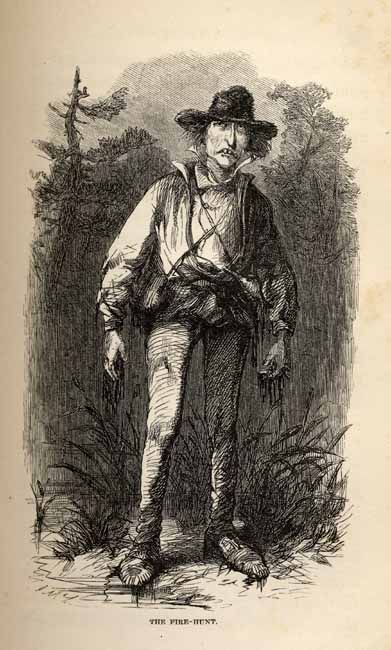
THE FIRE-HUNT.
Page 159
or not there were any horses killed, no deponent has testified. It is probable Uncle Billy thought going through the mud "sock! sock!" sinking into the mud well-nigh chin deep, and being grinned at while in that pitiable condition by that impudent and wicked "jacker-mer-lantern," was a sufficient atonment. At any rate, in old Surry, "by his fruit" he was considered by all a good man.
I have intimated that he was a very credulous man, and easily imposed upon by wags. He had wanted to preach for some time -- had some "loud calls" -- but his Church gave him no encouragement, believing some one else was "called" and Uncle Billy had answered. He was not "slow of speech," but he could lay a good claim to a "stammering tongue." His brethren, on that account, thought he could not "edify them."
There were, however, a few "outsiders" who urged the old man to "exercise his gift." Bill Holder, Hen Holder, Ike Puckett, Bill Auberry, Shack Gallion, and others, encouraged him to "hold forth." "They
Page 160
wouldn't ax the Church no boot, no how. He were a free man. We'll make you up the biggest crowds ef you'll jist hold night meetin's."
The thing took. There was a shrewd man, Jim Blevins, in whom Uncle Billy had unbounded confidence, who urged him forward to his "duty." Jim's advice was taken, and Uncle Billy made several appointments, and had "thundering crowds," mostly young people for their amusement. There they sat, with their "heads bowed down like the loonsome bulrush," as Uncle Billy poetically expressed it, weeping over their sins, as he thought, but the wicked creatures were laughing.
Jim Blevins always attended, and manufactured a good portion of the old man's thunder--would tell him what to say to "relarm the wicked folks." The last sermon Uncle Billy ever preached, Blevins, his Vulcan, manufactured some heavy thunderbolts for him.
Jim told him, one evening before he preached, that he had "suthin' relarmin' to tell him." That he had been that day on
Page 161
the Bald Rock on Fisher's Peak, and while sitting under a bunch of bushes near the edge of the Bald Rock, it being very hot, he saw a huge flying snake in the air above him, full twelve feet long, with a stinger at the end of his tail at least twelve inches long, and its eyes were like balls of fire. It would fly round the Peak and the Bald Rock, looking first on one side, then on the other, screaming worse than a panther. "I sloped," continued Jim, "back uv Fisher's Peak, but it were like jumpin' out'n the fryin'-pan inter the fire; for thar I hearn a yahoo. It was a-bawlin' louder than a cannon, 'ya-hoo! ya-hoo!' I hid, and it come by in thirty yards uv me. What a bustin critter it was! It had horns ten foot long, mouth as big as a hogshead, and teeth long as a sword and sharp as a razor. The way it kills things is, it gits them on its horns, and keeps tossin' them up till they are dead as a herrin', then he swallows them down slick as a bar swallerin' down a piece uv honey-comb. Uncle Billy, you ought to warn the people uv thar drefful danger this night. I've discharged my duty in tellin'
Page 162
you, and I now leave it with you to clare yer skirts of thar blood."
That was enough. The conscientious old man felt newly commissioned, and more thunder to his former stock was added. He met his audience, commenced, and soon got through the doctrinal part of his sermon, and then came to the "pathetic part." I shall only attempt to give the closing part of his exhortation. With great earnestness in his sad, woe-begone countenance, he said,
"Sinner, you'd better 'pent! Danger abroad! Look out, I tell ye. Skin yer eyes good. Open yer ears wide. Listen, that you may hear. Your blood mout be 'quired o' me. Jim Blevins seen--O sinner, 'pent and listen--Jim Blevins seen--O my soul!--Jim Blevins went on Fisher's Peak this mornin', and to the Baw' Rock, got tired, sot down under bunch o' bushes to rest, and what did he see? O my soul! Sinner, 'pent! He seen a flyin' snake--drefful critter--twelve foot long, stinger 'bout a feet long, eyes red like balls o' fire from Pandermonium--O sinner, 'pent! My
Page 163
bowels yearns over you--lookin' fust this way, then t'other, to see what he could see, and a-squallin' wusser nur a painter--O sinner, 'pent!--'pent, I tell you, else yer a gone sucker. For sartin and for sure, ef he pops his stinger inter you, yer gone world 'thout eend, amen, 'thout the benefit o' clargy.
"But, sinner, flyin' snakes is mighty bad; bad as they is, howsomever, 'tain't nothin' to what Jim Blevins seen arter that. Jim, soon as the flyin' snake went out'n sight, he run over back o' Fisher's Peak, and--O my soul!--what did he see? A yahoo, sinner--a yahoo! Jim hid, and it past along close by, and it was high as a house, horns ten foot long, mouf big as a hogshead--'pent, sinner, 'pent! It run by Jim, hollerin' 'ya-hoo! ya-hoo!' louder nur cannon at the battle o' Guilford Court-house, whar 'Wallis was fout by Greene. Jim says the way he kills folks--sinner, 'pent!--he gits you on his horns, he tossee up--he tossee up, jist like trouncin' a bullfrog, till life clean gone--'pent, sinner, 'pent!--then he'll take you in his mouf, and he'll lick you down like a hongry bar does a piece o' honey-comb, as
Page 164
Jim Blevins says. Sinner, I've warned you; I'm clare o' yer blood. Ef that flyin' snake or that yahoo gits you, you can't blame me fur it. No, don't blame the old man nur Jim Blevins."
The above discourse came to the ears of Uncle Billy's church, and they "called in his gift." But he never quit cutting out mill-stones, making tub-mills, and hunting bees long as his "head was above the yeth."
Page 165
X.--JOHN SENTER.
AT the mere mention of the name of John Senter I am carried in a moment to a little farm near the head of Little Fisher's River, upon which Fisher's Peak looks down with awful grandeur and majesty. This little farm is divided by the river, narrow strips of bottom land on each side, and then come in abrupt, steep hills. John Senter inherited this isolated piece of "yeth" from his good old father, Zack Senter. In a little cabin on the side of a steep laurel-hill (and a hill there is a hill), on the west side of the river, lives my friend John Senter, of happy memory. I defy any man to forget the place, or the man who owns it, after a view of both.
When I saw my friend's cabin in 1857, I took it to be in size about ten feet by eighteen; the board roof was fastened on by "weight-poles," somewhat after the Indian fashion; no "loft" in it; puncheon floor,
Page 166
split out of trees with his own hands; chimney made of sticks and clay; two or three log joists extended across, not above my head, but above the head of John and family, for they were "short stock." On these joists were hung, by way of ornament probably, and certainly for profit, some "'possum" skins and "'coon" skins, and some other fur skins too tedious to mention. I was not much pleased with their perfume, but bore for half an hour what they did all the time. The door, on the down-hill side of the "house," was sufficiently high to admit a reasonably tall man without stooping; but that door was not allowed to be used then, for the "lower yard," up to the door, was a fine green Irish potato patch. A little path led me through a patch of rye to the "upper yard," which was about three feet wide of level ground, and this narrow yard was dug out of the side of the hill. I halted, and my head was above the eave of the house. I stooped down to look for the door, and, behold, it was there, about four and a half feet high--not an inch higher. I saw John's good wife, Hollin, daughter of
Page 167
Oliver Stanley, of "whale" and "bar" memory, busily engaged in sewing, when the following salutations were passed in primitive style:
"How do you do, Mrs. Senter?" I asked.
"Lausyday, Hardy! is that you? I hearn you had come back to see yer old stompin ground. Come in."
"Thank you," I replied; "I will if I can get in."
"Stoop low, and you'll come it."
I obeyed, went in, but was greatly disappointed in not seeing my old friend John. Upon inquiry, I found he had gone out that day "harvestin'." My object was two-fold: to see my old friend John and family, and to get one of his wooden-bottomed shoes to take into my section as a curiosity to proud, spendthrift, "fast" young cocksparrows, and to ultimately deposit it in some college as a monument to John's genius and economy, and a wonder to all beholders. He had invented and worn them before I left that section in 1829, and I wished to know whether he wore them still.
"Mrs. Senter," I inquired, "does John
Page 168
wear his wooden-bottomed shoes nowadays?"
"Lausy, yes; he couldn't live 'thout 'um. He made me wear 'um for two long, tejus years; but they was so nation heavy I told him, right flatfooted, I'd go barfooted afore I'd wear 'um, both summer and winter, through frost and snow, heat and cold. Him and Sol and Zack (his sons) wear 'um still, and will, I reckon, long as thar heads is above the yeth, and I wouldn't be s'prised ef the ole man had his'n buried with him."
"Did he wear them off to-day?"
"No, not him; he went barfooted."
"Over the rocks, and in the briers of the harvest-field?"
"Shucks! his feet is tough as grissle."
"Will you be so kind as to let me look at them?"
"Sartinly; but they're mighty odd-looking critters--jist like the old man, though."
Kind Hollin went to a bed, brought them out, and threw them down before me. "Take care," said she, "else they'll mash yer toes inter mince-meat."
The admonition was a timely and a benevolent
Page 169
one, as the reader will see by the description. The bottoms were made of "dog-wood," and where they were not much worn they were an inch and a half thick. In the heels were driven several large nails, resembling horse-shoe nails, of his own make, also one large nail on the side of the bottom, at the "ball" of the foot, to answer the two-fold purpose of giving the shoe some spring or elasticity, and to keep him from slipping on the mud, snow, or ice. The vamps were made of tanned hogskin, kept soft somewhat by "'possum grease. The quarters were cowleather tanned in a log trough. Then there were leggins of tanned buckskin tacked on to the quarters, that came up the leg, to keep out snow in winter, and to ward off snakes in summer when he went hunting, and were laced up with "whangs." The leather was tacked on to the wooden bottoms with tacks--nails, rather--of his own making. He was too much of an economist to "buy tacks out'n the cussed stores."
I was anxious to procure one from Hollin, but could not, as the reader will learn from the following brief dialogue:
Page 170
"Mrs. Senter," I inquired, "can I get one of these shoes for love or money? Set your own price on it, and the money shall be forthcoming."
"That I won't! I know the ole man too well fur that. I mout as well, and better too, sell his Sunday furred hat. Come agin and see him; he mout let you hev one."
"It will be out of my power; I must return in a day or two," said I.
"Well, I knows what's what."
Next day I sent 'Squire West Freeman, and he, by paying pretty dearly for it, procured me one. Should any one wish to see said shoe, he can find it labeled "A Fisher's River (North Carolina) Dancing Pump," and deposited among the many curiosities--and the greatest curiosity of them all--of the East Alabama Baptist Female College, Tuskegee, Alabama.
But this cabin and this eccentric wooden-bottomed shoe have led me astray. I must return, and give the reader some further "insight" of friend John.
John Senter is about five feet seven inches high, round-shouldered, so much so that he
Page 171
crosses his "galluses" (leather) before and behind to keep his "britches" on him, very thin visaged, yellow "pumpkin" skin, tough and wrinkled. His eyes are small and scowling. His features are hard and rigid, indicative of spleen and general suspicion. His beard is long, full of dirt and "swingle-tow" (he is a good hand to break and clean flax). His movements are irregular, sometimes rapid, then slow and thoughtful. His impulses govern his movements in his own person and in his intercourse with others. His dress is equal in eccentricity to his looks, conversation, and movements. His summer hat is either wheat, rye, or oat straw, of his own manufacture invariably. His winter hat is wool, bought from the hatter with lambs' wool. His "Sunday go-to-meetin' " hat is an old-fashioned, smooth, bell-crowned fur hat -- his wedding hat, doubtless--which was purchased with 'coon, rabbit, mink, and musk-rat skins. His every-day coat was a "round-about," striped round like a "'coon's" tail. For Sunday and a "go-abroad" coat he wore a striped cotton, sharped, long, swallow-tailed coat.
Page 172
In winter he wore "britches" of tanned sheepskin. His "jacket" was striped Turkey red cotton. His shirt was tow and flax, with the collar so long that it hung down on his shoulders like the cape of an old-fashioned "big coat." His shoes have been already described.
THE TRIAL.
John was very fond of litigation. With him "to be in law" was no small idea. His splenetic nature naturally inclined him that way. Such was his fondness for law and of his attendance upon justice's court, that 'Squire Freeman's wife would not consent for "court" to be held in her house. She had two potent reasons: first, all the litigants begaumed her house with tobacco-juice; and, second, John's wooden-bottomed shoes, with their horse-shoe nails, made a marked impression on it. The "'squire," therefore, held "court" in the cook-house. I went into said "kitchen" to see the havoc John had made of the floor with his shoes, and it was as if a fresh-shod horse, or mule, rather, had been stabled in it.
Page 173
To show you John's fondness for law, I will give you one instance in proof. He once sued Ben Carson on the following items, and had a regular trial:
- Item 1. One half gallon soap-grease.
- Item 2. One half pint salt.
- Item 3. One half gallon sifted meal.
- Item 4. Three plants of tobacco.
Poor Ben was "cast," and 'Squire Freeman rendered judgment in John's favor.
THE WEDDING.
The marriage relation is the most time-honored institution in the world, and God, by making it the first, has sufficiently demonstrated its utility. It has withstood the rude and cunning assaults of base men and disorganizers in all ages. It has been honored in all nations from the king down to the rudest peasant. In the region of which I am treating they strictly obeyed the injunction, "Multiply and replenish the earth," as though it was "the first commandment with promise." They were unlike the disobedient young people of this age, who wait till they make a fortune before they marry; they, like
Page 174
sensible folks, married first, "and scuffled for their fortins arterwards." Now who can blame their course?
Now and then we see a hopeless case--one whom we think never can marry. Nature, in her sovereignty, has denied such persons beauty, talents, and wealth. Their chances for "holy wedlock" would be bad in some cruel, fastidious sections; not so in that section where Nature holds her sway without the artificial wants and rules of "refinement." All marry there, whether they have beauty, talents, or wealth. There appears to be a sort of happy destiny, in this respect, for them all. They may be shapped like fat-stands or look like toys, it is all the same, they marry.
Of course, John Senter's children must not be an exception--they must marry. Now it came to pass that his son Sol took it into his head to marry. Dwarfish-looking and crippled as he was, he came to the rational conclusion, "It is not good for man to be alone," in a section, too, where marrying was so popular and fashionable.
It was not difficult for him to find a person
Page 175
of like feeling in Sally Spencer, daughter of Polly Spencer, who lived in the face of the Blue Ridge, near the Blaze Spur. In addition to their warm affection for each other, an accident to each one had increased their attachment. Sol had had a white-swelling in his right leg, which had lamed him for life, and Sally's left leg had been broken, which made her equally lame. It looked like a bad chance for a support, for, in addition to these mishaps, they were as poor as "Job's turkey." But they loved each other, and were willing to link their destiny together, and "take one another better fur wusser and wusser fur better," in the graphic language of Bob Snipes, who shall tell the story of their wedding. Said Bob Snipes is a plain-spoken fellow, and tells stories in his own way.
"Now I was a-workin' fur 'Squire Freeman one flinderin hot day," said Bob, "and who should I see but Sol Senter come hop-a-kickin' along over the plowed yeth, through the cornfield, throwin' his game leg around like a reap-hook, and when he come up to the 'squire and me he was sweatin' like a
Page 176
coal-kill. Says I, 'Sol, don't knock down all the corn with that reap-hook leg o' yourn.' He nuver said a word to me, but buckled up to the 'squire, like a little dog does to a big one when he wants to show out, and, says he,
" ''Squire, I's come to swap work with you. Times is so hard, and I want's to work a day or two fur you to go as fur as dad's to marry me. I won't ax you to go as fur as Sally's house, which you know is three miles above dad's; but jist go to dad's, and I'll go and fetch Sally down thar. It shall never be said that Sol Senter got 'Squire Freeman to marry him fur nothin', and it mout be swappin' work mout do jist as well.'
"When Sol eended his speech, he looked 'mazin' anxious to hear what the 'squire'd say. The 'squire was a monstrous 'commerdatin' man, and, says he, 'Good as wheat in the mill-hopper, Sol; work for me a day, and keep up with Bob Snipes' (here the 'squire gin me the wink), 'and I'll go.'
"I'll be dinged ef, when the 'squire said that, Sol didn't look as big as Nibuchadneezer and as rich as Festus; and, thinks I,
Page 177
'Ef you keep up with me (I was a-hoein' corn), you'll not be fit to marry ('twas orful hot) soon.'
"The little feller catched holt of a hoe, and at it we went like a whirlygust uv wood-peckers. I tell you the train-ile streamed out'n both on us; but Sol buckled up ter me like a man. The thoughts o' marryin' steamed him up like a blowed-up bladder. It's anuff to say that we went it like blazes fur a whole day, and nuver did the 'squire have as many weeds killed in one day by two mortals, and one on 'um a little gameleg, taller-face, ill-begotten, turkey-trotten' creetur.
"The work over, Sol he fixed his day, and axed me to his weddin', to come with the 'squire. Says he, 'Come, and as I've showed you how I kin work, I'll show yer how I kin marry too; and I'll show yer the purtyest gal in the whole face uv the Blue Ridge, ur in any o' the knobs around about.'
" 'Look out fur me,' says I, 'fur Bob Snipes nuver takes a banter from no one, man nur 'omun.'
"The 'squire and me started tolluble
Page 178
yearly one mornin', intendin' to take ur time fur it in the cool uv the day. We had to walk, fur narry a man on God's green yeth could git to John Senter's a hossback, it is so shot up with hills and blocked wid fences. We tuck right up Little Fish Roover (the 'squire lives on it, well as John) till we come to whar Maid Holder was a-plowin', and ding my skin ef he warn't a-plowin' in his shirt-tail, 'thout anuther thing on him, 'ceptin' his old greasy wool hat. Says Maid,
"'Give an account of yerselves. Whar's yer pass? What you trespassin' on my deadnin' fur? Whar you moseyin' to? Bob Snipes, what you dressed up in the week fur fine as the 'squire? Speak, else I'll larrup you both.'
"We had to satisfy the outdacious varmunt, and axed him to go with us. Says he, 'I'll go, ef you'll jist let me go as I am.' 'In yer shirt-tail?' says I. 'Yes,' says he. 'Not I, long as yer shirt-tail is,' says I; and it was one uv the most onconcionable long shirt-tails I uver seen. It come down a long gap below his knees.
Page 179
"We left Maid gee-hawin' away, and piked on to John's. We went in, and thar sot John on a short-legged stool in the chimbly corner, lookin' fur all the world like a man that had got out'n his bed wrong eend foremost that mornin'. He was sulky and ashy, I tell you. He hardly axed us to set down. The 'squire kep' axin' John questions, to try to git him to spill some words, but his jaws were locked, as it were. Hollin and his darter was a-fixin' away, sorter like they was glad, but uvry now and then John kep' flingin' out some uv his slang at 'um 'fur fixin' so much fur them crippled creeturs, that had 'bout as much business a-marryin' as two 'possums.'
"The 'squire he made him hush his foul jaw, but he sot watchin' Hollin and the little darter, and got madder and madder, swellin' like a bullfrog. Last he riz right smack up, and, says he, 'I wouldn't be a-fixin' so much fur a couple uv ground-hogs, heffer-on-my-haslit ef I would.' He looked like he could a made a meal out'n a kag uv tenpenny nails, fur all the world.
"He then moseyed off to a bed, and
Page 180
drawed out from under it a whoppin' big gourd, with a great big corn-cob stopper in it. He sot it on the table, got a pewter cup, pulled out the stopper, and 'chug' it went as it come out. I soon larned from the smell on it that it was apple brandy, and white-faced at that. He poured out a cupful, and gin it to the 'squire fust, who bussed the cup a little, and then I bussed it. John he bussed it, and kep' a-bussin' it wusser nur a man would a purty gal, till he got in a monstrus good humor. I was mighty glad to see the refect the ole white-face brandy had upon him, fur I was nation tired uv his snaps and snarls.
"Jist as John had got in a good humor from bussin' Mrs. Whiteface, and had begun to spill his words right fast, we looked up the hill toward the Blue Ridge, and we sees Sol and Sally, dressed in thar best, a-comin' down the hill afoot, side and side, and the old lady a-traipin' along arter 'um, Sol throwin' his game leg round one way, from right to left, and Sal a-throwin' hern around t'other way, from left ter right. They kep' good time. Sal's mammy looked mighty loonsome
Page 181

THE WEDDING.
Page 183
bringin' up the rear. They came in, sat down, and John--ding him!--'peared to be as glad to see 'um as any on us.
"Soon as they had blowed a little (it was dingnation hot), and had wiped the train-ile out'n thar eyes, the 'squire he tied the Gougin knot" (the Gordian knot, I suppose Bob meant), "and we all wished 'um much joy, John 'mong the rest. (I wanted to knock him down, arter doin' as he had done.) The corn-cob stopper was pulled out'n the gourd, 'chug,' agin and agin, and we kep' bussin' the pewter cup, and we chatted away like blackbirds, 'ceptin' the 'squire, with 'bout as much sense.
"Dinner cumed next. The pot hadn't bin idle all the time; it kep' bilin' away, pottle, wottle, pottle, wottle. Hollin she sot the table along side uv the bed, to serve in the place uv chairs on one side, and a long bench on t'other side, and a short bench on each eend. It was one of these here cross-leg tables--none uv yer quality cuts. John Senter was none uv yer quality men; he opposed and hated all quality idees; nor would he 'low a quality dinner. He wouldn't
Page 184
'low but one dish, ef the 'squire was thar. He wouldn't have a pie, nur a puddin', nur nuthin' o' the sort. Hollin she tuck up the dinner, and ding my skin ef it warn't a sure-anuff dinner. Thar was a great big pewter dish full uv stewed chicken and rye dumplin's, with chunks uv bacon mixed up, anuff to sorter season it. The rye dumplin's, some on 'um, was as big as corn-dodgers, and some on 'um, which the seasonin' hadn't toch, was tough as whitleather, and you mout a knocked a bull down with 'um. But, howsomever, as Mrs. Whiteface, who dwelt in the gourd, had whettened our appetites, we done monstrus well.
"When dinner was over, the 'squire and me thought fur decency's sake we wouldn't leave right off, so we sot a little while; but we soon seen that John--ding him!--was a-gittin' monstrus onpatient. He kep' frivitin' about. Mrs. Whiteface had died away in him, and, ding him! he was too stingy to buss her any more, and the evil sperrit come on him agin. Last he walled up his eyes, and bawled out, 'You Zack! (his other son), you Zack!' 'Here!' says Zack. 'You go
Page 185
and gear up that bull' (John allers plowed a bull; he wouldn't hev a horse), 'and you go to plowin', and I'll go to hoein'. Hefferon-my-haslit ef it'll do to be wastin' so much time a-weddinin'.'
"Arter this speech the 'squire and me left."
And this is as much space as I can allow my old friend John Senter. If all his rich sayings and eccentric doings were written out, they would fill quite a volume. Now the rest of the acts of John Senter, all that he said and did, how he made wooden-bottomed shoes, how he worked in the harvest fields barefooted, how he lawed the people at the justice's courts, how he loved apple brandy, and danced the "double shuffle," etc., etc., are they not written in the memory of all who know him?
He has not yet slept with his fathers.
Page 186
XI.--REV. CHARLES GENTRY.
I MUST not entirely omit the negroes, as some of them were men of renown. I have made honorable mention of "Gingy-cake Josh Easley." What the people would have done for "gingy-cakes" at their musters and public gatherings I can not tell, had it not been for clever Josh. Josh was respected by all, white and black. His master moved to Missouri, and there Josh died. He used to keep us all alive singing corn songs at "corn-shuckings."
I could mention many good and clever negroes, but will only pay my respects to Rev. Charles Gentry. Charles was a Baptist preacher, and belonged to "Shelt Gentry." His master and mistress were Baptists, and Charles was quite a privileged character. Next to Rev. Pleasant Cocker, Charles stood highest in their estimation. He was not without "gifts," nor was he destitute of a
Page 187
proper amount of vanity. As to grammar, if he ever heard of it, he had no use for it, not he. His theology was not always sound, yet a good deal of it was quite original, as the two extracts from his sermons which I shall give the reader will abundantly prove. Rev. Charles had a penchant for controversy, and was often running up against established views, and upsetting them by the force of his cataract voice and rail-mauling gestures, if not by argument.
Naturalists have for ages been trying to account for the different forms and complexions of men. Some will have them to be of different races, not all descended from the same pair, Adam and Eve. Others contend that all have descended from the same pair, but climate and accidental causes have made the difference; hence Professor A and Professor B have their diverse theories and their disciples and admirers. When men leave the plain teachings of the Bible and go into vague speculations, one man's hypothesis is nearly as good as another's.
Page 188
THE ORIGIN OF THE WHITES.
I will now give my readers a new theory from the lips (for negroes do not write) of the Rev. Charles Gentry, and commend it to the consideration of Professor Agassiz and Dr. Nott. The Rev. Charles Gentry was "explanifying" to his "bredderin ob color" how the first white man came into existence. He held forth on this wise:
"Beloved bredderin, de white folks ar clean out of it when dey 'firm dat de fust man was a white man. I'm not a-gwine to hab any sich doctering. De fact is, Adam, Cain, Abel, Seth, was all ob 'um black as jet. Now you 'quire how de white man cum. Why, dis a-way. Cain he kill his brudder Abel wid a great big club--he walkin'-stick--and God he cum to Cain, and say, 'Cain! where is dy brudder Abel?' Cain he pout out de lip, and say, 'I don't know; what ye axin' me fur? I ain't my brudder Abel's keeper.' De Lord he gits in airnest, and stomps on de ground, and say, 'Cain! you Cain! whar is dy brudder Abel? I
Page 189
say, Cain! whar is dy brudder?' Cain he turn white as bleach cambric in de face, and de whole race ob Cain dey bin white ebber since. De mark de Lord put on de face ob Cain was a white mark. He druv him inter de land ob Nod, and all de white folks hab cum frum de land ob Nod, jis' as you've hearn."
JONAH AND THE WHALE.
Some divines, to pacify infidels and skeptics, and make, as they suppose, the Bible more acceptable to them, have a knack of explaining the miraculous truths of the Bible on natural principles and according to the teachings of human wisdom, and their preaching and expositions are, to say the least of it, semi-infidelic. Rev. Charles Gentry had heard one of those preachers somewhere who explained all miracles according to natural sequences. Charles had any amount of ambition, and wished to show his "larnin"' in the same way. Accordingly, at his next appointment, he delivered a learned dissertation on Jonah and the whale. He held his audience "spellbound" for some
Page 190
time, but I can only give the narrative part of the able discourse. It was as follows:
"Dearly beloved brudderin, dar is much said about dis Jonah and de whale business; a heap a-spoutin' about it, tryin' to outspout de whale hisself; but one half on 'um don't know what dey talkin' 'bout; dis chile does, howsomeber, 'bout de whole matter. Den listen, dat ye may hear. Well, Jonah he tries to git away from de Lord, and he gits in a ship--a big un, too--and tinks dat is de place fur him; but he miss him fur as ef he'd burnt he shirt. Dar Jonah he lie snug in de ship as a flea under a nigger's shirt collar. But, bless you, brudderin! de Lord he raise a mighty whirlygust, and de ship he rock to and fro like a drunkard man. De men dey guess what was de matter, and dey cum and take Jonah by de nap o' de neck and de hind part o' de britches, and swing him backuds and foruds; last dey pitch him head foremost, co-souse, inter de sea.
"De whirlygust he stop right smack. But, bless de Lord! whar Jonah? A great big fish he cum up and lick him down like
Page 191
salt--hardly a bug moufful fur sich a big whoppin feller. Jonah, when he gits down inter de paunch o' de fish, he squawks out, 'O Lord, what hab I done?' De fish he say, 'Hush yer mouf!' And de fish he swim, swim, swim, and kep' a-swimmin', and Jonah he bawls out de same ting. De fish he gits more in airnest, and say, 'Hush yer mouf, I tell yer!' and on he swim, swim, swim, till he cum to de Luxine Sea, as de white folk call him, but I call him Black Sea, 'caze he's black as jet, like a nigger.
"But pardon dis 'gression.
"When de fish he gits inter de Persian Gulf, near de mouf ob de old Euphrates, Jonah he gits mighty restless, and cries out agin, 'O Lord, what hab I done?' De fish he tell him to hush agin. No use; Jonah he holler louder and louder. De fish no mind him. Now Jonah he hab mighty sharp finger-nails, and he use 'um good, I tell yer. He begin ter claw and scratch the fish's paunch, 'tarmined to git out'n dar. De fish he gits sick in de craw, and he swim, swim, swim right fur land, 'tarmined to throw him up to dry. And, sure 'nuff, he gin one
Page 192
great big hee-oh, and out cum Jonah right on de flat of he back on de bank.
"De Lord he say to him, 'Gwine to preach now, Jonah?' Jonah he say, 'Yes, Lord, dat I will!' and off he moseyed to Nineveh, and done some ob de biggest preachin' ye ubber hearn tell on. Dis, brudderin and sisterin, is de true varsion ob Jonah and de whale. All de rest is false, and rotten as mud."
Page 193
XII.--FIGHTING.
JOSH JONES AND HASH-HEAD SMITH.
JOSH JONES and Hash-head Smith were both men of renown in this belligerent and romantic section. They made their mark upon their generation, in fist-fighting and scratching, if in nothing else. Josh had picked up a few Latin sentences and phrases, and could use them when he chose with great facility and dexterity. The people all hated "larnin' and college lingo," and though Josh's vernacular was no better than his neighbors'; nevertheless, his borrowed Latin made him quite a "larned man." He had the art of having his comrades in a fine glee in one moment, and "all to flinderations" the next, "fightin' rantankerus mad." He was the most popular and agreeable man in the crowd till his mischievous propensity forced him to blurt out, "e pluribus unum," "ipse dixit," "sine qua non," "sic transit
Page 194
gloria mundi," etc., and it was as if you had assaulted a ball-hornet's nest.
Our friend Smith was a chunky, well-set, muscular man, with a large buffy head, so large and destitute of brains that Martin Falkner, a shrewd wag, gave him the name of "Hash-head Smith," though he was veritably John Smith. Hash-head differed from most fleshy men, who are said to be good-natured, for he was quite sensitive, ill-natured, and hated Josh's "dog Lating," as he termed his small stock of Roman. Josh Jones took great delight in teasing Hash-head. They were quite different men in most things, but in their love of old peach brandy they were "hail fellows well met."
Now it came to pass, in the course of human events, that both of our heroes had some business at Grayson Court-house, Virginia, and on their return they called at the house of an old Quaker by the name of South, who, notwithstanding his rigid morals in most things, kept good brandies of all kinds, "pertic'ler the best old peach on the face uv the yeth." They called for it, and, in the expressive language of Josh, who was
Page 195
always graphic in speech--truly so when inspired with "old peach"--they "smote it hip and thigh with the edge uv the sword, like unto Samson smitin' the plaguy Philistines at Ramoth-lehi with the jaw-bone of a jackass, as saith the book of Judges."
Under the exhilarating influence of the Quaker's old peach, Josh soon began to roll out his Latin freely and fluently, and Hash-head "got ashy." But Josh intended to have some fun, and kept on. Hash-head considered himself degraded in the presence of the old Quaker and his wife by Josh's superior learning. He took it as a gross insult, and "walked into Josh right smack in old South's house." I will let Josh describe the rest of the scene in his own style.
"Now I were detarmined to wake up those two demure old Quakers, old Mr. and old Miss South, who sot thar, and would only say 'yea' and 'nay' to evry word I'd say to 'um. They paid no more attention to my Lating than to a blackbird a-chatterin'; so Hash-head I seen was my on'y chance. I kep' poking my old Roman at him thick and heavy, and he soon flew all to flinderations.
Page 196
But I salted him wusser and wusser, and the fust thing I knowed he struck me, co-diff; right plum between the eyes, with his maulbustin fist, quick as a ball-hornet, and sprawled me on the floor full length. I riz, and at it we went like blue blazes. We tuck it best six out'n eleven, upsettin' chairs, tables, and furniter of evry natur all over the house, hither and thither. The two old Quakers looked at us as though they b'lieved the sperrit uv the devil were turned loose, which were a fact, fur Quakers is disarners uv sperrits.
"I soon seen that Hash-head would git my note ef I didn't play some game on him, fur he were feedin' me in the short ribs in double quick time. I had seen before the scrimmage begun a big whoppin churn o' cream settin' on the ha'th by the fire, and the thought entered my pate, nolens volens, that I'd throw Hash-head by that churn o' cream, and turn it over in his face, and git out'n the scrape ef possible, fur I were shoved fur the rent. I made a desput grab, and we fell side and side by said churn jist norated, and I turned it over right smack in his face, cowhollop,
Page 197
right in his eyes and mouth. This sine qua non had the desired effect. He broke his holt as quick as when you souse a bucket uv cold water on two bull-dogs a-fightin'. I jumped up, but thar lay Hash-head, lickin' out his tongue, fust on one side then on t'other, tastin' old Miss South's yaller cream.
"The next thing I seen was old Miss South, with hands and eyes turned up to'ads the good world, which I reckon she were 'vokin' the sperrits uv Fox, Barclay, and Penn to cum to her relief and take signul vengunce, Deo volente, on me fur the loss uv her cream. And lest she mout be hearn, and fur fear Hash-head, arter he had got the cream out'n his eyes and mouth, and his belly full on it, which he were hidin' it mighty fast, mout wade into me agin, I sloped, jumped on my hoss, darted down the Blue Ridge at the Blaze Spur, and was soon in good old Surry."
BUTTING.
Fighting in that section was a common occurrence. No pistols, knives, sticks, and
Page 198
cowardly weapons, such as are now used, were resorted to; they scorned all such as beneath brave men. Only such weapons as Nature had given them would they use in attack and in defense. They would knock with their fists like a Milo, kick with their feet like a horse, bite like loggerhead turtles, gouge like screw-augers, and butt like rams; any method with the body was lawful. Bullies would keep their thumb-nails oiled and trimmed as sharp as hawk's claws. Ask them why, they would reply,
"To feel fur a feller's eye-strings, and make him tell the news."
As you passed houses going home from musters and public gatherings, those who did not go (and they were not numerous) would accost you thus: "Who fout to-day?" If you replied, "No one," there was evidently a disappointment. As Johnson Snow believed and expressed it, "That a good deal uv shoutin' and groanin' went a great ways towards settin' off a meetin'," it was the common belief of that pugilistic people "that a great deal of knockin', kickin', bitin', gougin', and buttin' went a good
Page 200
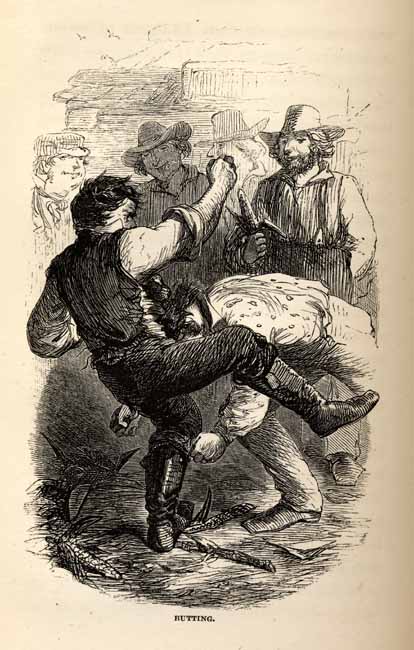
BUTTING.
Page 201
ways towards settin' off a muster or public gathering."
Sometimes a fight would come off at a "corn-shucking." On such an occasion Peyton Tally and Henry Muneas fell out and "fout." It was a short fight, for they were no sooner stripped, in the "ring," and the word given, than Peyton backed a little, and went at Henry old ram or old goat fashion, full tilt, struck him in the stomach with his head, "laid him to the land," and had well-nigh made a "finish of him." The bystanders did not like such a short fight, and remonstrated with Peyton, who coolly replied,
"I'll be dadsamped ef one good butt ain't wuth two knocks. It knocks the wind out'n you quick as thunder. Thar is great need fur the camphire bottle when you take it ram-fashion. Dadsamp ef his innards won't trouble him fur a 'coon's age. His wife and chillun will har'ly know him when they see him. He'll not be so pot-gutted in the futur, I reckon."
Page 202
A QUARTER-OF-A-DOLLAR FIGHT.
Speaking of the foregoing butting fight reminds me of a sharp fight between Sam Clark and Jim Smith, son of the renowned Hash-head Smith, about a quarter of a dollar--no more nor no less.
The people in that region were scrupulously honest--more so than any section I have ever seen. They lived remote from commerce, with its corruptions, and there was not fleece enough in all the land for sharpers to come in to corrupt their morals. Not even a wooden-nutmeg Yankee could make any thing from off them. They knew nothing but downright honesty. A man who would not pay a debt to the amount of five cents was scouted and despised most cordially. A man was never known to "make over his property." He had to pay the "utmost farthing," else public sentiment collared him. If a man's honesty was impeached, there was a fight, unless it was "taken back."
Now it came to pass in a settlement between
Page 203
Sam Clark and Jim Smith there was a misunderstanding about a quarter of a dollar. At Shipp's Muster-ground, the "potter's field" of that country, the subject was brought up for settlement while they were both pretty full of "knock-'em-stiff." They couldn't settle it, and they "drawed thar linnin" to settle the important contest. Their friends hated to see them fight about so trifling a thing, and Miller W. Easley, a friend to both, offered to pay the quarter. But nay; their honor was involved in it, and the honor of "thar chillun," and they were determined to settle it on the Fisher's River field of honor (Shipp's Muster-ground), and with Fisher's River weapons.
They made a ring, "moseyed" into it, and no cool man--one who had the least sympathy for his tabernacle--would have taken the knocks, kicks, bites, gougings, battings, etc., that were given and received by those two duelists for a trifle. After they had beaten each other into a "frozzle," and "inter mince-meat," they were parted by their "seconds," and, having vindicated their insulted honor, the matter was adjusted
Page 204
to the satisfaction of the belligerent heroes.
FIGHT ABOUT A KIPSKIN.
Here follows an account of a fight farther illustrative of the foregoing. Josh Jones, who fought Hash-head Smith at the old Quaker's, in Grayson County, Virginia, was a tanner by trade, and "tanned on shares," as well as his own hides. Davis Holder, one of his customers, was a considerable bully, and when a little "tight" boasted not a little of his manhood. Josh tanned a "kipskin" for Davis "on shares," and there was a difficulty in their settlement some way. It became a serious affair, and Shipp's Muster-ground was the place of settlement. Davis brought it up, the ring was made, and the pugilistic party went into it. I will let Josh, in his graphic style, tell the rest of it.
"I felt mighty skittish and jubus uv Davis, fur he was allers a-swaggerin', and cavortin', and boastin' about, tellin' how many men he'd licked, and so on. But I were mad as flugence, and didn't care a dried-apple cuss whether I lived ur died. I jumped
Page 205
into the ring; 'Verbum sat,' says I, and slapped my hands aginst my hips, and crowed like a game-rooster. In jumped Davis, and come full drive at me, like a fishin' hawk dartin' at a fish. I had no idee uv boxin' with him, fur his arms was long as Maypoles. So I jist hipped him, and throwed him co-whollup--a desput fall on the hard yeth--on the flat uv his back, soused my eyestring feelers sock into his eyes, and he blated like a calf. Uncle Billy Norman pulled me off, who told Davis, who was talkin' 'bout tryin' it agin, 'I could lick him any day.' So that ended Davis's bullyin', puffin', and blowin' about his manhood."
Page 206
XIII.--THE CONVERT.
AT Parson Bellow's night meetings it was not uncommon for persons "under conviction" to fall, and lie apparently dead for hours, and when they rose it was with a shout of triumph, "a clar and hopeful convarsion."
Parson Bellow held a good many of his night meetings in the "Hawks Settlement," east of the head of Stewart's Creek, not far from the Sugar-loaf Peak of the Blue Ridge. The Hawks generation was numerous, and, being much attached to each other and to their romantic section, they were never known to live far apart. The parson had held several meetings successfully for them at old Timothy Spencer's. It being a great country for apples, every man had a large orchard, and in the fall all the surplus apples were distilled into brandy. Every man had at least one "bar'l" a year. Timothy
Page 207
Spencer had one "bar'l," and kept it in his house behind the door. When the door opened the "bar'l" was concealed behind it.
Sol Hawks had seen this barrel for weeks at the various night meetings, and had used it for a seat during service. Instead of listening attentively to the parson's sermons, he was all the time thinking of the "innards uv the bar'l," the temptation was so great. His mouth watered not a little for some of the "good critter." While the "sarvices" had been going on, the crafty Sol had ascertained that the "bung" of the "bar'l" could be worked out. But what of that? He could not get at the delicious contents. It was vexatious to Sol. He couldn't stand it.
Next meeting Sol took a quill, and managed to take the same seat. While prayer and other services were going on, in which the attention of the audience was directed in another way, Sol got the "bung" of the barrel out, thrust in his quill, and drank it down as a thirsty man does water. He took too much, for, just as the benediction was pronounced, Sol, attempting to rise, fell heavily on the floor.
Page 208
The excitement was intense. The women shouted aloud, the men groaned in spirit, all supposing that the power of grace had done the deed--had felled that sturdy oak of Bashan, that tall cedar of Lebanon.
"Bless the Lord!" exclaimed Parson Bellow. "I thort I'd done no good here tonight--hadn't cast the net on the right side--that the wheels uv Zion was clogged; but hallaluyer! the Lord allers comes at a time when we ain't lookin' fur him. Glory! glory!! Bruthering and sisters, sing a mighty sperritul hyme, and lift up yer hearts in prayer. This feller has bin a-standin' it out fur a long time, but the power what fotched down Saul uv Tarshish has flung him at last--glory!"
The "hyme" was sung, fervent prayer offered, but there lay Sol speechless and seemingly lifeless.
"Bruthering," said the parson, "yer faith is too weak. Ef you'd pray in airnest, with a strong faith, he'd be convarted afore you could cry ''cavy.' "
Prayer was offered again and again, but there lay Sol helpless as ever. Other tactics
Page 209
must be used, and the parson was rich in expedients. He went to Sol, and told him what to do, "to give up," etc.
"But, Sol," continued he, "don't shout too quick. Git religion good, Sol. I know these Hawks. They needs a heap uv religion, and you, Sol, have bin monstrous bad. Religion is mighty good truck to have, Sol. You've sinned enough to fill Noah's ark chug to the brim. I'm afeered you'll fall from grace ef you shout too soon, Sol."
Thus he continued, pounding away on Sol's back with both hands every now and then, as though he would maul religion into him with his stentorian voice and herculean fists. At last he interrogated Sol thus:
"Sol, how do you feel, old feller? Do you feel like you was a poor lost creetur? a messuble sinner, lost and ondone?"
"Ah me!" groaned Sol, "I don't know. I feels mighty curious. My head is gwine round and round, and a ringin' in my ears sorter like tizzerrizzin! tizzerrizzin!"
"Pray harder, Sol," replied the parson; "you ain't half a-prayin'. You'll nuver git religion prayin' that snail fashun. But
Page 210
take care, Sol, and don't shout too soon. Be mighty keerful on that pint, Sol. Bruthering and sisters, one and all, sing that good old sperritul hyme,
"'Show pity, Lord; O Lord, forgive;
Let a repentin' rebul live;'
and pray while you sing, like you'd take heaven by storm. Who knows but what your prayers mout be hearn?"
That "hyme" and several others were sung, and several prayers offered, but there lay the stubborn Sol, the tall cedar of Lebanon. The parson thought it was time to catechize him again, to see their success--to see whether "thar prayers was hearn."
"Sol," he asked, "how do you feel now, old feller? Do you feel like you love the Lord and his people, poor soul?"
"Ah! Lord, I don't adzackly know. I feels almighty curious. I'm almost 'swaded I does."
"Bruthering and sisters," said the parson, "my stars and lovely garters, ef he ain't convarted now, ef he jist knowed it. He jist needs a little more faith. Rise up, Sol, and shout, and you'll feel happy. Bruthering,
Page 211
it ain't wuth while to be stayin' here; it's arter midnight; let's go home."
Sol got up, rubbed his eyes a little, stepped out, and went home, but he never shouted.
Page 212
XIV.--NOT A TRAVELER.
JOHN SNOW, son of Hail Snow, I believe, was "not a traveler." He indignantly repelled the idea; "he paid his way through thick and thin, and no thanks to nobody."
It came to pass that John Snow and others went a trip some distance with wagons. There were no lucifer matches then, and at night, when they "tuck up," some one would have to go for fire to the nearest house.
But here I must run off into digression to show what the people carried to market in those days. It was not whisky and brandy, for they hardly made enough for home consumption. "Things got nation dry" in summer before apple brandy came in to their relief. It was not "tar, pitch, and tarpintine," for there was but little pine there, and it was short-leafed and poor. Nor was it corn, wheat, and rye, for they were "allers
Page 213
mighty scace" before a new "crap" came in. What then? Why, butter, flaxseed, chestnuts, chinkapins, Irish potatoes, and tobacco. These were the main staples. Sam Lundy always added a few items of his own to the above when he "sloped" to market; "wannit goody," "hick'ry-nut goody," and "haze-nut goody."
As stated, with such a load as the foregoing, except Sam Lundy's, who had a clear field in his own line, John Snow and company camped near a very fine house, and John was sent to the house to get fire. He went to the door, made application for the fire, and the lady--a very polite one, doubtless--asked him to come in and be seated.
"I'm too dirty," replied John, "to come inter as fine a room as yours is; I'd ruther stand."
"Oh! never mind, good sir; travelers can not keep their clothing clean like parlor folks."
"I ain't no traveler, marm," said John; "I pays my own way." (John thought she meant traveling beggars.)
"Very well, sir," replied the lady, "you
Page 214
are right. Be seated till the servant brings the fire."
John was pacified, and took his seat in a fine parlor, on a splendid Windsor chair, till the fire came. He returned and reported the whole adventure to his company.
"I tell you, boys, with my dirty britches I sot right smack in one o' the finest Weasler chairs you uver seen in all yer borned days, and my big, mud-bustin, pis-ant-killin' shoes on thar fine carpet looked like two great big Injun coonoes. I'll be poxed ef I knowed how to hold my hands nur feet."
Page 215

THE WINDSOR CHAIR.
Page 217
XV.--COOKING, BIG EATING, ETC.
You may expect, in a healthy country like that, there would be big eaters. Stout, healthy men must eat accordingly. Their food was plain and simple--no highly seasoned viands to destroy the stomach and produce dyspepsia. Whether a French cook was better than a Fisher's River cook they knew not, nor did they care a chestnut. So they got their bacon and cabbage, chicken soup and pot-pies, Irish potatoes and hominy, and their buckwheat pancakes, tarts, and puddings, by way of dessert, all was well, A good appetite supplied the rest. A few families (called the "quality") could afford coffee once a week, only colored at that. All their "sweetnin' " was honey, of which there was great abundance, and the best in the world. Sugar and molasses were never used; they could not be afforded. Black "Gingycake Josh Easley" was the only man that
Page 218
used molasses, and where he procured it I can not tell. I never saw any till I left that country in my nineteenth year. No "change of course" at their tables; substantials, dessert, pastry, and all went on the same table, using the same plates.
Their gatherings were frequent, as previously intimated. One neighbor would help another harvest his grain, taking it in turn till they were all through. Corn-shuckings were conducted in the same way; nor could a man clear a piece of ground without inviting his neighbors, and having a "clearin'." They "swopped work." They were pre-eminently social. At such gatherings and workings, all hands would sit down to a long table, and the first dish they "moseyed into" was soup. Large pewter basins full of soup were placed along the table at a convenient distance, and several pewter spoons were placed in each basin. They "waded inter it"--never dipped it out--all that could reach in the same basin. Shadrach Franklin played a prank on "Long Jimmy Thompson" over a basin of soup once. Shadrach was the first man who dipped his spoon into
Page 219
the smoking basin, and it burned his mouth awfully; but he resolved to have his fun, and bore it without a frown. "Long Jimmy," a big eater, asked him, "Shadrach, is the soup in good kelter?" "Yes," was the serious reply. Long Jimmy tried it, and unceremoniously spirted it out all over the table, producing a soup rainbow. All right; a hearty laugh was full compensation for the shower of saliva and soup.
I have said Long Jimmy Thompson was a big eater. He was the Milo of Mitchell's River, and Mose Cackerham was the Maximius of Fisher's River. Once, at a gathering, Long Jimmy let in on a large tray of hog's feet that was set on a table. He made such havoc of them, and the bones fell so fast on the floor, that it provoked Lark Cannady to blurt out,
"Hellow, Uncle Jimmy, you hull out bones faster nur a cotting-gin can shell out cotting-seed, a nation sight. You kin beat a whole cotting-pickin' uv huming beings all holler."
But Long Jimmy paid no more attention to this witty gibe than a hungry cur would
Page 220
to a gnat. At a reaping at Uncle Billy Norman's, Mose Cackerham ate up the back-bones of several hogs, and their joles. The bones kept falling on the floor with such force and noise that Dick Snow exclaimed,
"Dang it, Uncle Mose, ef your bones don't fall as hard on the floor as ears o' corn on the floor of a empty corn-crib at a corn-shuckin', and nearly as fast. By jingo! I wouldn't feed you fur all yer wuck. You'd 'duce a famine in a man's smoke-house mighty quick."
A tinker was about the first man I remember to have seen. He was an indispensable in that section--as much so as Prince Knock-'em-stiff. A tinker, in that honest region, needed not the name of a John Bunyan to make his fraternity respectable; he was a man of distinction, and honorable. Pewter cupboard ware was all the go. The tinker made it his business once a year to visit every family to remould their broken pewter ware. We had pewter basins, dishes, plates, spoons, etc. Our cups were tin mostly; some were pewter; but few men had plain delft-ware; china was unknown. Of "yethen
Page 221
ware" there were crocks, jugs, and jars, which are essential every where. Major Oglesby, a man of some wealth, "one of the quality," had the finest delft known. It was a great curiosity to the "natives," and much talked of every where. When his plain neighbors visited him they were much embarrassed to know how to use it.
Uncle Frost Snow, William Golding, and others went to the "major's" to take a hunt. At meal milk was served in tea-cups--glass was then not used, not even by the major--and Uncle Frost, not knowing how to handle a tea-cup, turned it over, and spilled the milk on a fine table-cloth.
"Dang it, major," said Uncle Frost, "I wish you'd a gi'n me a tin cup, then I'd a knowed how to a used him. I ain't no quality no how. You can't make a quality man out'n me. I'm nobody but Frost Snow, from old Fudginny."
Page 222
XVI.--A DECLARATION OF LOVE.
THE young men did their courting almost entirely by word of mouth. Their "edication" was very poor, and they did not like to expose their "ignunce" by a love-letter. Sometimes a very bashful fellow, deeply smitten with love, would give vent to his feelings in a letter. I have been quite fortunate in securing one of these letters. I pledge my word, and can prove it, that the following is an exact copy from the original, not a word nor a letter altered. The free use of capitals is to be ascribed to the writer's deep feeling. But I will not comment. Here is the letter, leaving names out:
"Dear Miss I seat Myself To Let You Know My Heart Desire This Very Day, God Know That I Dow Love you P-- F-- And I Have you if you Will Mee,
Page 223
And I want you To write To Mee as soon as This come to Hand, And give Me satisfactions one way or other, God Know at This Time Which way you will give, God sed in His Word First Seak The Kingdom of Hevin and all His Riches shall Be Added on, And I Beliave you Love Mee, And I Guv you the First Time I Ever Thought! And Whare it wase at, Mr F--s at Metin. And I tell Why I Thout Sow, For Actions speaks Louder Than Words withe Mee, And I Write you A few Loines To Tell you The Truth, When I was Layin on my Death bed*
* He had just recovered from a severe illness, and was so carried away with the subject he writes as though he had died.
I Thought of you Moor than Evry Body Else Well P-- F-- I Never Told my Bisness in any Manner But I Hinted To you one Time And you Nuver stuttered**
** The young lady had a stoppage in her speech.
one Bit But Turned Very Red And Sed you Was Going to Uncles And you Hav not Gon Before you Married***
*** Here I am at a loss for his meaning; but it is in the copy.
And I Drop The Subjick For God Sed in
Page 224
His Word Forsak Father And Mother And Cleeve Untoo They Own Wife And if All The Twigs was Pens And the Rivers was ink And I Had the Fingers To use them I Codent Moore Than Describe The Love That I Have for You*
* She was a hard-hearted girl, else she would have been won by this eloquent passage.
And I Come A purpass To Know The Other Time I ware whether My Desires could Be Accomplished ore not And I considered I Better Wait Till I See Whether I Got Well ore not I Am not The Man I was Before But I am Sout**
** Here again I am at a loss for his meaning; but I am bound to follow copy.
as Ever and Feels as well But it is Gods Blessin that I am Writin this Day.
"I Want You Read This With A feeling Hart And Tell Mee of your Situations That Time Ef God Had call When You in Sickness***
*** The young lady had been sick; and had previously lost a sister.
And whether You Had That Hope Of Meetin your Sister ore Not in Etteernity ore Not or in Heven. I Say So That I have a Hope of Meetin My Three Little Brothers if I am Faithful For They Are
Page 225
sure And They are All That are sure And I waunt you To consider That Satisfaction is wuth All And I am A poore Man But That Dont Hender Mee from Loving you But I waunt you To Consider That Religion is Wuth all I Say Farewell if I Never See you Know Moor I Hope To Meete You in Heven Whare Evry secret of Hart shall Bee judged And you Know Then That I am Tellin Thee Truth And I Say To You That You Are older A nuff To Marry Ef you Ever expect To For I Say it is every bodys Duty To Marry if They can Suit Theirself And I Say That I can Sute Myself if you Say Sow And I have Hearn Folks Say That Love was Stronger Than Deth And I Say That it is So For when I Thout Cold Home*
* Here again I am in the dark; but I am not at liberty to alter. Copy must be followed to the letter. I set out to be a faithful copyist, and the reader has the result.
I Thout of you And I Druther See you And any Body else And I Say To you if you Turn your Face from Mee That you Turn yourself from the Dearest And I want you To write To Mee And Tell if What I Have Rit Dont Take Why is The Reason
Page 226
And I Say To You if What I Have Writ to Dont for Godsake write To Mee And Return This May God Bless you Sow Farewell
E. H. S.
"To P--F--
"N.B. You Muss scuse bad Writin and Spillin"
Page 227
XVII.--GLASSEL AND THE OWL.
A SCOTCHMAN, named Glassel, came on a bee-line from the "old country," and halted not till he arrived at the foot of the Blue Ridge Mountains in Virginia. He rested a few days, took his gun, and went into the deep gorges of the mountain hunting. While he was in one of those deep gorges, the habitation of owls, the old king owl of the gorge "let off" in trumpet tones.
Glassel had never heard the like, nor had he seen the like, when he looked up into a tree and saw that large head, those big bright eyes, and that grave, intelligent countenance. His excited imagination supplied the rest. "That," thought he, "is some enchanted or metamorphosed human being--no ordinary one at that--the work of some wicked spirit." His fruitful imagination gave it an intelligent speech, and made it speak to him in this inquisitive manner:
Page 228
OWL. Hoo-hoo-hoo-who are you?
GLASSEL. My name is Glassel, sir, at your service.
OWL. Hoo-hoo-hoo-who are you?
GLASSEL. I say, sir, my name is Glassel; and, if I might be so bold, what is your name?
OWL. Hoo-hoo-hoo-who are you?
GLASSEL. I say, sir, my name is Glassel, and if you'll let me alone I will you.
And Glassel left.
Page 229
XVIII.--ONE OF THE PEOPLE.
I ONCE lived near a town where a friend of mine named King often went, and he would uniformly stay all night with me. He lived in St. Clair County, Alabama, and by staying with me he accomplished two objects: he saved his bill (an important item with him) and enjoyed my company, of which he seemed very fond. He was a quiet, harmless creature, and the only injury he ever did me was the loss of my time in keeping him company. The only pay I could get out of him was to tease him a little.
We have no right to raise the question why a wise and sovereign Being has made some seemingly bad jobs, physically and intellectually. They belong to the great family of man, and fill some important sphere, if we could see it. Though you may regard them as nothing more than bores, not so with the sovereign Maker and Disposer. Now
Page 230
my friend King was what some would call, in the process of man-making, an intellectual failure. Here, reader, is the proof. In 1848, when General Taylor was nominated for the presidency, Friend King called on me, and, after salutations, inquiry was made after the news of the day.
AUTHOR. What is the news in St. Clair, Mr. King?
KING. Right smart.
AUTHOR. Very well, what is it?
KING. Well, thar's a man over thar runnin' fur President.
AUTHOR. Who?
KING. I b'leeve they call him Ginnerl Taylor.
AUTHOR. Where did you say he lived?
KING. Over in the back part of St. Clair, ur a little beyant.
AUTHOR. Is he running pretty well?
KING. He is that. I b'leeve he's a-gwine ter be elected. Nairly all St. Clair's a-gwine fur him.
AUTHOR. What! old Democratic St. Clair going for General Taylor? But who is this man General Taylor, any how?
Page 231
KING. Why, hain't you hearn on him? He's a-bin lickin' out the Maxicans fur some time, over thar a leetle beyant St. Clair.
AUTHOR. Are you for Taylor--as good a Democrat as you?
KING. I ain't that! not becaze I'm a Dimmicrat, but on anuther account. Sich a man can't git my vote.
AUTHOR. Why not?
KING. Hain't you hearn what he done to the Maxicans over thar at a big spring? Now I ain't no friend to the Maxicans, but they ought to be fout farly and be licked out farly, and not treated in sich a onhuman way. Now ef Ginnerl Taylor had a fout 'um far, and had a licked 'um up like a cow a-lickin' salt, I wouldn't a kearn; but the way he done it he can't git my vote.
AUTHOR. How did he do it?
KING. Thar warn't but one spring o' water in all the country, and Ginnerl Taylor got possession o' that, and wouldn't let the Maxicans have one drap o' water, which was onhuman. Last the Maxicans couldn't stand it no longer, and come runnin' to the spring, like thirsty oxen arter water, and
Page 232
Ginnerl Taylor shot 'um down like he would deer. Sich a onhuman man can't git my vote fur dog-pelter.
AUTHOR. Any more news?
KING. Nothin', on'y I'm gwine to leave Alabama, and a-gwine to Georgy.
AUTHOR. Why so?
KING. Taxes is too high; break me up; can't nur won't stand it.
AUTHOR. What is your annual tax?
KING. Seventy-five cents. Poll-tax ain't but fifty cents in Georgy.
Reader, this man is one of the sovereigns of the country. He is a KING; the only tyrant that ever ruled over him was Poll-tax. He got rid of twenty-five cents of the tyranny of King Poll-tax by moving to "Georgy," where he is doubtless congratulating himself on the economy of his removal. Should these lines ever fall under his eye, he will see that they are "according to Gunter."
Page 233
XIX.--A CALL TO THE MINISTRY.
I HAVE no doubts as to a call to the Christian ministry. I concede all that is claimed for it by intelligent orthodox Christians; but as to the "call" contained in the story below I shall not decide. My business is to detail facts.
Somebody is always telling stories about the "Hard-shell Baptists." Wags have the run on them, and they may as well be content and bear it. Here follows a tale told of them not long since. My informant locates it in the mountains of North Carolina, where the Hard-shells are quite numerous, and where they believe pretty strongly in dreams and voices. In the important matter of a call to the ministry, a dream or a voice is a thing almost indispensable.
Now it came to pass that a man by the name of Walker felt himself considerably moved to "hold forth," and kept "spreading
Page 234
the fleece," Gideon-like, to ascertain his duty in the important premises. To assist him in his pious investigations, he called at a still-house one evening to get some of the "good critter." After refreshment, the story runs, he left for home, and on the way he felt "moved" to go into a thick grove a few hundred yards from the road, "thar to wrastle on the subjeck." While he was "wrastlin' " most earnestly, scarcely outdone by the patriarch, some one passed the road with a long-eared animal, politely called a John Donkey, and John let off, as his race is wont to do sometimes, in a most moving and thrilling manner.
Walker's imagination, by his earnest "wrastlin', " was wrought up to great intensity, and he converted Major John's discordant music, which to most men resembles the filing of a saw-mill saw, into a call from heaven urging him to preach the Gospel. No time was to be lost. He rose from his knees duly commissioned, went to his church, and demanded a license, when the pastor interrogated him thus:
PASTOR. Do you believe, Brother Walker,
Page 235
that you are called of God to preach, "as was Aaron?"
WALKER. Most sartinly I does.
PASTOR. Give the Church, that is, the bruthering, the proof.
WALKER. I was mightily diffikilted and troubled on the subjeck, and I was detarmined to go inter the woods and wrastle it out.
PASTOR. That's it, Brother Walker.
WALKER. And while there wrastlin', Jacob-like, I hearn one ov the curiousest voices I uver hearn in all my borned days.
PASTOR. You are on the right track, Brother Walker. Go on with your noration.
WALKER. I couldn't tell for the life ov me whether the voice was up in the air ur down in the sky, it sounded so curious.
PASTOR. Poor creetur! how he was diffikilted. Go on to norate, Brother Walker. How did it appear to sound unto you?
WALKER. Why, this a-way: "Waw-waw-ker--waw-waw-ker! Go preach, go preach, go preach, go preach-ee, go preach-ah, go preach-uh, go preach-ah-ee-uh-ah-ee."
Page 236
PASTOR. Bruthering and sisters, that's the right sort of a call. Enough said, Brother Walker. That's none ov yer college calls, nor money calls. No doctor ov divinity uver got sich a call as that. Brother Walker must have license, fur sartin and fur sure.
The license was granted, the story goes, and Walker is now, doubtless, making the mountains ring with his stentorian lungs.
Page 237
XX.--OUTDONE.
IT is difficult to beat an experienced man at his own game; it sometimes happens, however. Methodist preachers--and no harm is intended--have ever been fond of excitement at their religious meetings. The extremes at such meetings are allowed for the sake of the overbalance of good which is accomplished. It will not do, they contend, to check extravagances in shouting and crying, for fear of doing harm to those properly exercised.
An "old stager" in camp-meetings once told me of an incident which clearly outdid him. He had encountered many camp-meeting scenes which were "hard pills," but he stood up to them all with a good grace, except this one.
He and an old yoke-fellow, his story goes, held a camp-meeting in rather a rude section, where all the ideas of the people had come
Page 238
to them in a ludicrous and crude form. They were Nature's children, and easily excited, and they had quite "a stir." In their prayers for mercy, prompted by their convictions of sin, they used the common language and imagery of the country, and they used the same vernacular and imagery in their shouts of triumph.
The meeting waxed hotter and hotter from the beginning, and on Sunday night it "boiled clean over." My friend, the narrator, stated that the "alter" was full of "mourners" and "new converts." He concluded he would go into the "packed crowd," and see what they were doing. He entered, and found one man sitting flat on the ground, in great distress, swinging his head back and forward, crying for mercy in the following earnest manner:
"Jeeminny! O Jeeminny! what shall I do?" Rising from his seat, and going through the crowd for the woods, he continued: "Jeeminny Crimony! O Jeeminny Crimony! have massy on me, a poor missuble cuss of a sinner!"
My friend let him go scooting for the
Page 239
woods, and continued his travels a little farther, and found a distressed woman seated in the same manner, and putting up her petitions very pathetically thus:
"O-yes Moses! O-yes Moses, Moses! what shall I do? O-yes Moses, Moses! have massy on me, a poor devil ov a creetur!"
"No better fast," thought my friend, and he passed on beyond the "mourners" to see how it was going with the "young converts." He did so, and heard them interrogate each other as to their hopes and prospects. It ran as below:
"How do you feel, Sister A--? Are you traveling purty fast to Caanian?"
"Five hundred miles ahead ov any thing on this grit! Gloree! gloree! Thar ain't nothin' on yeth to be compared unto it--honey, shugar, sweetnin' ov ev'ry kind, ashcakes, cracklin' bread, corn dumplin's, biscuits, pot-pies, poun'-cakes--pshaw! I won't compare any thing yethly with it."
My friend by this time was fast becoming nervous, but concluded he would move onward a little farther, and encountered two
Page 240
other happy spirits, and heard their questions and answers, which, put in "prent," stand thus:
"How do you feel, Sister B--?"
"Happee! happee! Yes, horse-fly, I'm happy, horse-fly, certain--happy as a 'possum up a 'simmon-tree ur a 'coon in a holler. Glory! gloree!"
This was the last dose my friend could bear. He went to his brother preacher, who had seen similar sights, and had heard the like sounds, and proposed to dismiss the meeting for the night, which was readily agreed to, and both acknowledged themselves outdone for once.
Page 241
XXI.--STRAW! STRAW! MORE STRAW
HERE!
A DENOMINATION of Christians is not to be blamed and held responsible for the bad conduct, freaks, and eccentricities of a few of its members. They all have their "black sheep"--freakish and eccentric members. The Methodist and Baptist, being the largest denominations, and having more to do with the masses, of course have more of the above-named material, hence some rather ludicrous and amusing scenes sometimes occur at their meetings. It is but charitable and right to conclude that all the parties are in sober earnest, even in their strangest freaks. It is their way of doing things.
These things being premised, I proceed to my straw story.
Somewhere in Middle Tennessee, in the past, a Methodist camp-meeting was held,
Page 242
and, while all the tents were good and well supplied with straw (a very necessary thing in tents and arbors), the arbor, and particularly the altar, had not been well provided with the article. Things dragged pretty heavily till Sunday night. There had been plenty of straw for what few "seekers" had come into the altar up to that time; but on Sunday night the preacher "cast the net on the right side," and scores came up, the altar was crowded, and what little straw was in the altar was occupied, and the others had to take the ground or stand up.
There was an old "amen" Methodist, of the old "shad-belly coat" tribe (now extinct). He saw the sad state of things, became nervous, and roared out at the top of his cataract voice, drowning the singing, exhortations, shoutings, every thing--
"Straw! straw! straw here! Bruthren, more straw here! A hundred souls lost here to-night for the want of straw! Run to the tents and fetch straw, else the blood of souls will be required of you! Straw, you careless souls! straw here! You mout
Page 243
a had straw anough at fust, O ye of little faith!"
He gave them no rest till the straw was brought; but how the thing went the deponent saith not.
Page 244
XXII.--TARE AND TRET: AN ALABAMA
TALE.
THIS is a rule in all our arithmetics, which originated in commerce, and for the benefit of commercial men. Tare, in commerce, means the allowance or abatement of a certain weight or quantity from the weight or quantity of a commodity sold in a cask, chest, bag, or the like, which the seller makes to the buyer on account of the weight of such cask, chest, or bag; or the abatement may be on the commodity sold. Tret, in commerce, means an allowance to purchasers, for waste or refuse matter, of four per cent. on the weight of commodities.
Now it isn't every body that understands these commercial rules, and I shall not stop to discuss the justness of them. I vouch for the above definitions, for they are taken verbatim from Webster. But all men do not see Webster nor our arithmetics, nor do they
Page 245
"cipher" as far as "Tare and Tret." "Thar ain't no use in cipherin' as fur as that," says the uneducated farmer.
On account of this neglect, a one-cotton-bale man, of Butler County, Alabama, got "sloshin mad" in Greenville, the capital of said county.
About the time the Montgomery and Pensacola Railroad reached Greenville, a copperas-breeches, piny-woods man "druv" into town with his bale of cotton, well packed and "neat as a pin," and wished to make it buy a great variety of things--a little of the "good critter" among the rest. He soon found a purchaser, for cotton was bearing a good price. The cotton was weighed, the money was "forked over," and a small deduction made for the "tare."
ONE-BALE. Tar! whar the devil is thar any tar on it? Thar warn't a tar-bucket in a mile of the gin-screw.
MERCHANT. Hold still, friend; we merchants always deduct a certain amount for the tare, which is to indemnify us against loss by the attachment of extraneous matter to the bales.
Page 246
ONE-BALE. Bull and Injens! The devil you do! By hoky! thar ain't no tar nur any o'yer extranus matter on it. It's jist as clean as the old 'oman's bed-quilt. You can't swindle this boy; he's walked too many chalk-lines fur that.
MERCHANT. I tell you, friend, the tare must be deducted. Every thing in trade must be made whole, and done up according to rule.
ONE-BALE. Jubiter Ammon! Mebbe you mean that my bale is tore, by you sayin' it must be made whole. Dem it! whar's yer eyes, man? Thar ain't a hole in it, nur a tored place. Now what you got to say, Mr. Tighty?
MERCHANT. This much: here's your money. You are the tightest customer I've run up against lately.
ONE-BALE. You mout a knowed that ef you'd a bin smart, and jist a peeped at my physmahogany. I've gi'n ye one more kink.
Page 247

TARE AND TRET.
Page 249
XXIII.--HAM RACHEL, OF ALABAMA.
EUFAULA, Barbour County, Alabama, is a beautiful city, on the banks of the deep-channeled and rapid Chattahoochee, and in 1845, the time of the incidents of my story, was the mart of commerce for Barbour, Pike, Coffee, Dale, and Henry counties in Alabama, and of several counties contiguous in Georgia.
These Alabama counties were mostly settled by a poor, plain, hardy, robust, and honest people, many of them wholly uneducated. All they cared for was "to make buckle and tongue meet" by raising stock, a few bales of cotton, and a little corn for bread. Stock--cow stock--being the chief commodity, they were denominated "cow counties."
Now, mind, these were the first settlers. Eufaula was a great city with them, like Paris, London, and New York to most folks. When a "squatter," as some naughtily called
Page 250
them, carried his one, two, or three bales to market in Eufaula, the "ole 'omun" must needs go, and maybe one or two of the "childering," to see the "big town." Hence you could see the ox-carts coming in, the "ole man" driving, and the "ole 'omun" sitting on the top of the one, two, or three bales, and the "childering" walking. The "ole 'omun" has brought with her several extra matters for sale: butter, eggs, socks, etc. Then for shopping after the "cotting" was sold. Hundreds of little notions must be bought, not forgetting a jug, at least, of the "good critter," for "ailments and sich things."
Of course Eufaula exerted a great influence over these counties in all things, particularly in politics. As the town went in politics, so did the country. Their favorite merchants were their oracles in these matters.
To illustrate:
I was in Eufaula in 1848, shortly after the candidates for the presidency, Cass and Taylor, were nominated. I was in the storehouse of Mr. G--, a Whig, when there
Page 251
came in one of the "sovereigns," a Democrat, a tall, stoop-shouldered, sallow-faced, meek, quiet, teachable-looking man, with copperas "britches" (no mistake), and a homemade cotton shirt, constituting his entire dress. His copperas was "gallused" up as high as his fork would admit, which nearly lifted him off the ground. His rustic looks and movements would have attracted the attention of the most unobserving man on earth. Mr. G. gave him a seat, which he accepted, and sat down characteristically. When seated, he looked to Mr. G. with looks indicating, "Speak, for thy servant heareth. I am as a young bird; cram any thing down me you choose."
After drawing a long breath or two in a peculiar way, he said,
"What do the people say about here in regard of the nomination for president, Mr. G.?"
MR. G. We are all for Taylor; we know him; he has fought our battles; he is one of the people; if he were to come to your cabin, he would be at home, drink buttermilk, eat bread and butter and yam potatoes
Page 252
with you. As to General Cass, he's been doing nothing all his life but scooting canoes up and down the Western waters, and knows nothing about statesmanship. Taylor is the man for the people; he'll be elected sure.
COPPERAS. Yes, I've hearn ov Ginral Taylor; he has fout the Maxicans, and licked 'um all up, like a cow licks up salt, and has kivered the nation with glory, like a bedquilt kivers a bed; but as to this man, Cass, I nuver hearn ov him afore. I didn't know thar was sich a man treadin' sole-leather.
If Mr. Copperas did not see a merchant who was a Democrat before he left, he certainly voted for Taylor.
These things premised, it was my "manifest destiny" to spend a night in Barbour County in 1845, I believe--a night never to to be forgotten. It was on the main road between Clayton, the county seat, and Eufaula, the mart of commerce. A little while before sundown I called at a very good-looking house, and requested to stay all night as a traveler. Permission was granted by the lady of the house. I saw no man. I soon
Page 253
learned that John M'D-- resided there, who had gone that day to Eufaula, and would soon return. I congratulated myself on my good fortune in getting to a quiet, good house, where I could take a refreshing night's rest. But alas! to moralize a little, how soon are our best, most sanguine hopes blasted! A man knoweth not what a night may bring forth, as well as a day.
I seated myself in the portico facing the public road, got hold of an old newspaper, almanac, or something of the kind, with which to amuse myself a little, but it was not long before I saw some half dozen wagons coming from toward Eufaula. They halted at the gate, came in with great freedom and boldness, drew water from the well, and watered their teams, as though it belonged to them, interspersing their labors with waggish remarks and blasphemy, not even respecting the presence of the lady, Mrs. M'D--. They then commenced popping their whips about in the yard loud enough to shock the nerves of nervous people, and then asked the lady if she "mout have some chickens fur sale. We hain't bin
Page 254
eatin' nothin' but dried beef so long we've wore ur corn-grinders down to the gums, and we want suthin' else by way of change."
"We've none for sale," replied Mrs. M'D--.
"No chickens!" said they. "Thar goes a durned old rooster, old as Mathuzlum, yit we'll buy him ruther than wear out ur teeth on dried beef. Won't you sell him? You've sartinly got uther roosters to sarve and take keer ov yer hens, hain't you?"
How the conference ended I can not tell, for I left, and retreated to another part of the house; but one thing I do know: those wagoners camped in the lane near the house.
As night came on I saw that the uneasiness of Mrs. M'D--increased. She would go to the door and look toward Eufaula, uttering many nervous sighs. I suspected the cause, though I did not know that her husband loved "sperrits." Some time during the night I heard a crowd coming in at the gate. One peculiar voice, in short sentences, kept up a continual din, upbraiding and cursing "ole John fur gittin so ongentlemanly dog drunk." Soon as the lady heard
Page 255
that, she understood it, and covered her face in her hands and sighed deeply. Then came the clambering of five or six men in at the door, no one speaking but that reproachful sententious voice.
I left and went into another room. Soon that tormenting voice, which I soon learned was Ham Rachel's, sang out,
"Here, boys, put the ole drunkard fool in the bed. Ef Ham Rachel hadn't a brought him home, he'd a now a bin a-lyin' in the streets ov Eufauly, ur lyin' along the road, a-keepin' company with hogs. The ole cuss, he nuver can go to Eufauly 'thout gittin' full as a bee on chamber-lye, though Ham Rachel is allers 'zortin' him like a preacher not to fill his cussed guts so full. Here, Mrs. M'D--," addressing himself to the lady, "here is yer old, poor, unfortinate husband, which Ham Rachel has had the goodness to fetch home so offen agin and agin. The Lord on'y knows how offen Ham will have ter fetch him home yit. Some ov these times, when Ham Rachel ain't about, ole Nick will git him, and will pour hot lead down his cussed throat instid o' liquor.
Page 256
Ham won't go down to ole Nick's deadnin to see ter him," etc., etc.
Thus went on Ham Rachel almost endlessly. All the difference I could see was "ole John" was "a few" the drunkest "Injun" in the crowd that accompanied him home.
I saw I was caught in a bad box, and resolved to make the best of it. My course was soon determined upon; I would have nothing to do with the crowd, and would have nothing to say to them; I would keep my own room. With this resolution I went to the table. "Ole John's" attendants must have their suppers; they were entitled to it, for they had brought the old man home. Ham Rachel, being "chief cook and bottle-washer" of the crowd, must, of course, have his supper.
After grace was said, "God bless us and ur vittuls," Ham acting parson, being all hungry, we attacked the table with great energy. At the first assault there was no politeness displayed in helping each other. Ham generalized thus:
"Ev'ry man fur hisself, and God for all.
Page 257
Help yerself, stranger; you look like you mout be a man what can weed yer own row, clean at that. I dun-no whar yer live, but down here in these piny woods uvry man waits on hisself."
Nothing more was said till the edge of our appetites was blunted; but Ham all the time kept casting his inquisitive, restless eyes upon me, trying to read me like a book. At last he grew a little polite, and handed me a plate of fried yam potatoes.
"Take some 'taters, stranger; mighty plenty down here in these sand-hills. The on'y adjections Ham Rachel has to 'um, they make him a little too cholicified; but a little number six will bring the wind from you with a dreadful racket. My old 'omun allers uses yerbs, but yerbs ain't strong enough fur Ham Rachel."
On we went with our heavy assaults upon the table, demolishing whole dishes, "smitin' them with the aige ov the soord," as Ham expressed it.
"Stranger," said Ham, "take some butter; that's half ur livin' in this cattle country. It would be mighty tight times with
Page 258
us here ef it warn't fur milk and butter, cow-peas and yam 'taters. We'd look like the peaked eend uv nothin'; though the murrin's bin mighty bad among cattle lately; but Ham Rachel has great reasons to be thankful, fur he hain't lost more'n twenty-five ur thirty head, big and little."
We "swept the platter," and supper ended. I went to my room, determined to maintain my dignity and secrecy, hard as Ham was trying to read me. Ham followed, determined to take me prisoner, read my history, and get my whereabouts, latitude and longitude. We sat down; I purposely looked mum and dignified. Ham's curiosity was aroused; he could bear it no longer.
"Stranger," said he, "you're too durned stiff and pertic'ler. Ham Rachel loves fur a man to be as plain as an old shoe, and as thick as cow-peas in thar hull. I've got to know suthin' about yer. When Ham Rachel (I wish you knowed him) begins a thing, he carries it through, ur breaks the swingle-tree."
This was prefatory; here comes the main attack:
Page 259
HAM. Ef I mout be so bold, whar do you live, stranger?
STRANGER. I "mout" live in New York, New Orleans, Mobile, or Montgomery, or any where else. That's my business.
HAM. By golly! that's durned smart. But, stranger, that answer don't co-robber-rate to yer looks. That ain't you. Ham Rachel won't answer a stranger that a-way. But I'll try yer agin, sence ye'r so ding snappish on that pint. Ef I mout be so bold, what sort o' biz'ness do yer foller, stranger?
STRANGER. That's too bold; but since you must know, it is my "biz'ness" to follow my nose--a pretty long one at that, you see.
HAM. Wusser and wusser. Durn it, I'll drap you. You're as snappish as a par o' sheep-shears.
Ham left, and went to the camp of the wagoners, who all the time had kept up every variety of noise, laughter, and vulgar witticisms. He had gone but a few minutes when "ole John" became very sick, and commenced throwing up his "rot-gut whisky." The throes were terribly painful; a human Vesuvius was in dreadful volcanic action. At
Page 260
every throe the lava would fall upon the floor like a dashing cataract, accompanied with deep-toned groans. As the action in the crater went on in rapid succession, it deepened and widened, and the streams of lava became more overwhelming and noisy. The bed creaked loudly, and every eruption looked as if it would throw him head foremost out of his resting-place.
Ham heard the noise of the volcano, and thought he would now lead the stranger out in conversation. He came running into my room with gestures the most wild and frantic, and burst forth:
"Stranger! stranger! do yer hear that ole devil pukin' out his innards? I wouldn't keer a dried-apple durn ef he would puke hisself inside outurds. He nuver will listen ter Ham Rachel, which nuver was cotch in sich a fix. Ham drinks his dram and pays his bob in all licker crowds, but he allers travels and keeps what he 'posits in his innards. He loves licker too well to be throwin' it away like ole John; besides, he's too savin' a man ter be wastin' his vittuls in that a-way. He may puke up his stockin's
Page 261
afore I'll go a-near him. Poor Miss M'D--! She'd no biz'ness a-marryin'--a 'omun ov her age--marryin' sich a dried-up ole cracklin'."
I still maintained my gravity, and Ham left and went to the noisy wagoners, who kept up their infernal din. The rest of the company--four--who came home with "ole John" and Ham, had lain down on pallets, and were running against each other in the snoring line as if some great prize were staked. No renowned artist, graphic pen, nor gifted music composer can describe the struggles and contests of these four rival snorers; of course, I shall not attempt it.
Before Ham left he gave them a blast thus:
"What the devil are you arter here? a-sawin' gourds, grindin' coffee, filin' saws, beatin' tin pans, blowin' horns, beatin' drums, blowin' fifes, shootin' pistols, and so forth, and so forth, breakin' the stranger ov his rest? I'd have a little breedin'."
I lay down about midnight, exposed to the cross-fire of three discordant batteries--the snorers, the wagoners, and the groanings
Page 262
of "ole John"--my nerves being none the better for the contiguity. I dozed a little, but was soon roused by a new sound. It was at the wagoners' camp. It was the voice, tones, and intonations of a Hard-shell Baptist preacher. The old "heavenly tone" rang loudly "in the stilly night." It had the suck-in and the blow-out of the breath, the uh! and the ah!
What! thought I, has some Greatheart of a preacher found those scapegraces and commenced a thundering sermon upon them? "Give it to them thick and heavy," said I to myself.
I was not long in suspense, for here came Ham running into the room (a dim light was burning), puffing and blowing, with eyes and hands upturned toward heaven with holy horror and indignation.
"Stranger! stranger! O stranger!" he shouted, "do you hear that? That's no preacher, stranger; they're on'y a-mockin' preachin'. They're mockin' old Eldridge, who used ter hold forth in these deadnins, but run away and went to Texas. Afore he run away he baptized these very rascals
Page 263
who is a-mockin' him. Ham Rachel seen it with these peepers o' his, and what he sees he sees. I've hearn 'um shout, sing hymns and sperritul songs with ole Eldridge. Durn ole Eldridge! (Lord forgive Ham!), he's no better nur them, but that's no reason fur them to make fun o' religion. Ham Rachel (poor devil!) is no better nur he ought to be; but, thanks ter Jubiter, he nuver made fun o' religion. Lord a massy on us, stranger! do yer hear 'um at it yit? I'm afeered the yeth will open her bowills and swaller 'um up, like it done Korum, Datum, and Byhum in the willerness. Ham Rachel's not a-gwine a-near 'um agin this night. Ham don't intend to be revolved in thar drefful catistrough; he'll fly up to roost right here."
Down he lay on one of the pallets, and was soon contending for the prize among the snorers. About this time the preacher at the camp ended his services, and all went to sleep and to snoring except "ole John" and myself. "Ole John" kept up a groaning all night.
In the morning we were all a stupid set--scarcely had energy to wash dirty hands and
Page 264
faces--until the jugs were resorted to. "Ole John" and I fared the worst: he was too sick to drink, and I was a rigid teetotaller.
Breakfast came on. The attack on the table was feeble compared with the assault the evening before. On leaving, all were "dead-heads" except myself. The rest had paid their way by bringing "ole John" home. I paid my "fare" and left, but not alone. Not I. It has ever been my destiny, if there is a bore in reach, he will find me, and cling to me like one's shadow.
While paying my bill, Ham shouldered his two jugs and prepared for traveling.
"Stranger," he said, "the roads forks jist down yender; one goes to Eufauly, and t'other by Ham Rachel's. As Ham's a-gwine home, he'll go that fur with yer, and show yer the right road."
Suiting action to words, off he "piked" for the gate. I mounted my horse, which had fared better than his master, and on we went, Ham all the way letting fly a diarrhoea of words and sentences, till we arrived at the "fork" of Ham's road. Ham halted. I then took a good parting look at him.
Page 266

HAM RACHEL, OF ALABAMA.
Page 267
There he stood, a lean, gaunt-looking specimen of freakish humanity, about five feet eight inches high, stoop-shouldered, longarmed, and knock-kneed, with a peaked dish face, little black restless eyes, long keen nose, and big ears. His dress was cotton pants, dyed black with copperas and maple bark, a coarse cotton shirt, collar large and open, no vest, coat, nor socks. His hat was old, broad-brimmed, and slouched down over his shoulders behind, and turned up before. His pants were "gallused" to their utmost capacity, leaving considerable space between his knees and the tops of his old brogan shoes; not having on "drawers," of course the skin was exposed. His two jugs were part of his dress. They hung across his shoulders, before and behind, suspended to a wide black greasy leather strap, nearly down to his knees before and his calves behind. Thus this strange figure stood before me, independent as a wood-sawyer, and made his parting speech:
"Stranger," said Ham, "that's the Eufauly road. But listen" (pointing down the road). "Do yer hear that cow-bell? Thar
Page 268
ain't less nur two hundred cattle arter that bell. That's Ham Rachel's cow-bell, and them's his cattle" (giving me a significant look and wink). "Stranger, give out yer Eufauly trip to-day, and go home with Ham Rachel, and stay a long week. He can treat yer like a king on the best these deadnins affords. Do yer see these jugs? then thar's more in Eufauly. Thar's plenty ov fiddles, gals, and boys 'bout here. I don't know whether ye'r married ur not: no odds; yer wife won't know it, and the gals won't keer a durn. You may sing, pray, dance, drink, ur do any thing else at Ham Rachel's. He's none ov yer hide-bound, long-faced cattle, which strains at gnats and swallers camels, as ole Eldridge--durn him!--allers said in his preachin'. Come, stranger, the world wasn't made in a day--took six, I think--come go wi' me."
"I thank you kindly, sir," I replied. "Your generosity is great; but my business is quite pressing, and I must be going. Good-morning to you, sir; I am much obliged."
"Good-by, stranger," replied Ham. "The
Page 269
Lord be wi' you. You'll find but few sich men in yer travils as Ham Rachel."
Ham took his road and I took mine, and that is the last I have seen or heard of him.
Page 1
POPULAR
AND
ENTERTAINING BOOKS
JUST PUBLISHED BY
HARPER & BROTHERS, Franklin Square, N. Y.
HARPER & BROTHERS will send either of the following Works by Mail, postage paid (for any distance in the United States under 3000 miles), on receipt of the Money.
A GOOD FIGHT, AND OTHER TALES.
By CHARLES READE, Author of "Love me Little, Love me Long," &c. Embracing: I. "A Good Fight."--II. "Jack of all Trades."--III. "Autobiography of a Thief." 12mo, Muslin.
THE QUEEN OF HEARTS.
A Novel. By WILKIE COLLINS, Author of "Antonina; or, The Fall of Rome. 12mo, Muslin.
FISHERS RIVER, NORTH CAROLINA.
Scenes and Characters by "SKITT, who was Raised Thar." Illustrated by JOHN MCLENAN. 12mo, Muslin.
Page 2
THE VIRGINIANS.
A Tale of the Last Century. By W. M. THACKERAY, Author of "The Newcomes," "Vanity Fair," "Pendennis," "Henry Esmond," "The Great Hoggarty Diamond," &c., &c. With Illustrations by the Author. 8vo, Paper, $1 75; Muslin, $2 00.
MRS. ELLET'S WOMEN ARTISTS.
Women Artists in all Ages and Countries. By Mrs. ELLET, Author of "Women of the American Revolution," &c. 12mo, Muslin.
THE DIARY OF A SAMARITAN,
In Narrative. By a Member of the Howard Association of New Orleans. 12mo, Muslin.
THE PRAIRIE TRAVELLER.
A Hand-Book for Overland Emigrants. With Maps, Illustrations, and Itineraries of the Principal Routes between the Mississippi and the Pacific. By RANDOLPH B. MARCY, Captain U.S. Army. Published by Authority of the War Department. 16mo, Muslin.
Page 3
PREACHERS AND PREACHING.
By KIRWAN, Author of "Letters to Bishop Hughes," "Romanism at Home," "Men and Things in Europe," &c., &c. 12mo, Muslin.
HARRY LEE;
Or, Hope for the Poor. With Illustrations. 12mo, Muslin, $1 00.
HOWITT'S HISTORY OF AMERICA.
A Popular History of the United States of America: from the Discovery of the American Continent to the Present Time. By MARY HOWITT. Illustrated by numerous Engravings. 2 vols. Large 12mo, Muslin.
A LIFE FOR A LIFE.
By the Author of "John Halifax," "The Ogilvies," "The Head of the Family," &c., &c. Library Edition (uniform with the Library Edition of "John Halifax)," 12mo, Muslin, $1 00. Also, Cheap Edition, 8vo, Paper, 50 cents.
Page 4
HENRY ST. JOHN, GENTLEMAN,
Of Flower of Hundreds, in the County of Prince George, Virginia. A Tale of 1774, '75. By JOHN ESTEN COOKE, Author of "Leather Stocking and Silk," "The Virginia Comedians," &c. 12mo, Muslin, $1 00.
LEVER'S GERALD FITZGERALD.
Gerald Fitzgerald, "The Chevalier." A Novel. By CHARLES LEVER, Author of "Charles O'Malley," "Glencore," "The Dodd Family Abroad," "Sir Jasper Carew," "Maurice Tiernay," &c. Complete. 8vo, Paper, 50 cents.
MY THIRD BOOK.
A Collection of Tales. By LOUISE CHANDLER MOULTON, Author of "This, That, and the Other" and "Juno Clifford." 12mo, Muslin, $1 00.
ADAM BEDE.
A Novel. By GEORGE ELIOT, Author of "Scenes of Clerical Life. 12mo, Muslin, $1 00.
EPISODES OF FRENCH HISTORY
During the Consulate and the First Empire. By Miss PARDOE. 12mo, Muslin, $1 00.
Page 5
DR. MACKAY'S TRAVELS IN AMERICA.
Life and Liberty in America; or, Sketcdes of a Tour in the United States and Canada in 1857-8. By CHARLES MACKAY, LL.D., F.S.A. With Ten Illustrations. 12mo, Muslin, $1 00.
AMERICAN WIT AND HUMOR.
Illustrated by J. McLENAN. 8vo, Paper, 50 cents.
MISS STRICKLAND'S QUEENS OF SCOTLAND.
COMPLETE. Lives of the Queens of Scotland, and English Princesses connected with the Regal Succession of Great Britain. By AGNES STRICKLAND. Vol. VIII. completing the Work. 12mo, Muslin, $1 00; Sets in Muslin, $8 00; Half Calf, $14 80.
WALTER THORNLEY;
Or, A Peep at the Past. By the Author of "Allen Prescott" and "Alida" (Mrs. SEDGWICK). 12mo, Muslin, $1 00.
ABBOTT'S FRENCH REVOLUTION.
The French Revolution of 1789, as viewed in the light of Republican Institutions. By JOHN S. C. ABBOT, Author of "The History of Napoleon Bonaparte," "Napoleon at St. Helena," Histories of "Josephine," "Madame Roland," "Marie Antoinette," &c. With numerous Engravings. 8vo, Muslin, $2 50.
Page 6
THE WARS OF THE ROSES;
Or, Stories of the Struggle of York and Lancaster. By J. G. EDGAR, Author of "The Boyhood of Great Men," "The Footprints of Famous Men," "History for Boys," &c. Illustrations. 16mo, Muslin, 60 cents.
JOHN HALIFAX, GENTLEMAN.
A Novel. By Miss MULOCH, Author of "A Life for a Life," "Olive," "The Ogilvies," &c., &c. Library Edition, with Four Illustrations by HOPPIN, 12mo, Muslin, $1 00; 8vo, Paper, 50 cents.
THE BERTRAMS.
A Novel. By ANTHONY TROLLOPE, Author of "Doctor Thorne." 12mo, Muslin, $1 00.
LOVE ME LITTLE, LOVE ME LONG.
A Novel. By CHARLES READE, Author of "A Good Fight," "Peg Woffington," "Christie Johnstone," "Never too Late to Mend," &c. 12mo, Muslin, 75 cents; Paper, 65 cents.
THE ROMANCE AND ITS HERO.
By the Author of "Magdalen Stafford." 12mo, Muslin, $1 00.
Return to Menu Page for Fisher's River (North Carolina) Scenes and Characters. by Hardin E. Taliaferro
Return to The North Carolina Experience Home Page
Return to Documenting the American South Home Page