An Autobiography.
The Story of My Life and Work:
Electronic Edition.
Booker T. Washington, 1856-1915
Funding from the National Endowment for the Humanities
supported the electronic publication of this title.
Text scanned (OCR) by
Aletha Andrew and Sarah Reuning
Images scanned by
Aletha Andrew, Sarah Reuning, and Chris Hill
Text encoded by
Chris Hill and Natalia Smith
First edition, 1999
ca. 800K
Academic Affairs Library, UNC-CH
University of North Carolina at Chapel Hill, 1999.
Call number E185.97 .W29 1901
(Davis Library, UNC-CH)
The electronic edition is a part of the UNC-CH
digitization project, Documenting the American
South. All footnotes are
moved to the end of paragraphs in which the reference occurs.
Any hyphens occurring
in line breaks have been
removed, and the trailing part of a word has been joined to
the preceding line.
All quotation marks,
em dashes and ampersand have been transcribed as
entity references.
All double right and
left quotation marks are encoded as " and "
respectively.
All single right and
left quotation marks are encoded as ' and
' respectively.
All em dashes are
encoded as --
Indentation in lines
has
not been preserved.
Running titles have
not been preserved.
Spell-check and
verification made against printed text using Author/Editor
(SoftQuad) and Microsoft Word spell check programs.
Library of Congress Subject Headings,
21st edition, 1998
LC Subject Headings:
Washington, Booker T., 1856-1915.
African Americans -- Southern States -- Biography.
Educators -- Southern States -- Biography.
African Americans -- Education.
Slaves -- Southern States -- Biography.
Tuskegee Institute.
Tuskegee Normal and Industrial Institute.
1999-09-13,
Celine Noel and Sam McRae
revised TEIHeader and created catalog
record for the electronic edition.
1999-06-25, Natalia Smith, project manager,
finished TEI-conformant encoding and final proofing.
1999-06-14, Chris Hill
finished TEI/SGML encoding
1999-05-29,
Aletha Andrew and Sarah Reuning
finished scanning (OCR) and proofing.
BOOKER T.
WASHINGTON AND HIS FAMILY.
AN AUTOBIOGRAPHY
The Story of My Life and Work
BY
BOOKER T. WASHINGTON
INTRODUCTION BY DR. J. L. M.
CURRY COMMISSIONER PEABODY
AND SLATER FUNDS
FIFTIETH
THOUSAND
THE ORIGINAL AUTOBIOGRAPHY
BROUGHT UP-TO-DATE WITH OVER
HALF A HUNDRED FULL PAGE
PHOTO AND HALFTONE ENGRAVINGS AND
DRAWINGS BY FRANK BEARD
J. L. NICHOLS & COMPANY
MANUFACTURING PUBLISHERS OF POPULAR
SUBSCRIPTION BOOKS ON THE EXCLUSIVE TERRITORY
PLAN
TORONTO, ONT. NAPERVILLE, ILL. ATLANTA, GA.
COPYRIGHT, 1901
By BOOKER T. WASHINGTON
ALL RIGHTS RESERVED
Entered according to act of Congress, in the year 1900
By BOOKER T. WASHINGTON
In the office of the Librarian of Congress, at Washington, D. C.
Sold only by Subscription, and not to be had in book stores. Any one desiring
a copy should address the Publishers
COPYRIGHT, 1901
By BOOKER T. WASHINGTON
ALL RIGHTS RESERVED
I HAVE cheerfully consented to prefix a few words
introductory to this autobiography. While I have
encouraged its publication, not a sentence has been
submitted to my examination. From my intimate
acquaintance with the subject, because of my
connection with the Peabody and the Slater Education
Funds, I am sure the volume has such a strong claim
upon the people that no commendation is needed.
The life of Booker T. Washington cannot be written.
Incidents of birth, parentage, schooling, early struggles,
later triumphs, may be detailed with accuracy, but the life
has been so incorporated, transfused, into such a
multitude of other lives,--broadening views, exalting
ideals, molding character,--that no human being can
know its deep and beneficent influence, and no pen can
describe it. Few living Americans have made a deeper
impression on public opinion, softened or removed so
many prejudices, or awakened greater hopefulness in
relation to the solution of a problem, encompassed with a
thousand difficulties and perplexing the minds of
philanthropists and statesmen. His personality is unique,
his work has been exceptional, his circle of friendships
has constantly widened; his race, through his utterances
and labors, has felt an upward tendency, and he himself
has been an example of what worth and energy can
accomplish and a stimulus to every one of both races,
aspiring to a better life and to doing good for others.
It has been said with truth that the race problem
requires the patient and wise co-operation of the North
and the South, of the white people and the Negroes. It is
encouraging to see how one true, wise, prudent,
courageous man can contribute far more than many men
to the comprehension and settlement of questions which
perplex the highest capabilities. Great eras have often
revolved around an individual; and, so, in this country, it is
singular that, contrary to what pessimists have predicted,
a colored man, born a slave, freed by the results of the
War, is accomplishing so much toward thorough
pacification and good citizenship.
While Mr. Washington has achieved wonders, in his
own recognition as a leader and by his thoughtful
addresses, his largest work has been the founding and the
building up of the Normal and Industrial Institute, at
Tuskegee, Alabama. That institution illustrates what can
be accomplished under the supervision, control, and teaching
of the colored people, and it stands conspicuous for
industrial training, for intelligent productive labor, for
increased usefulness in agriculture and mechanics, for self-
respect and self-support, and for the purification of home-
life. A late Circular of the Trustees of Hampton Institute
makes the startling statement that "six millions of our
Negroes are now living in one. room cabins." Under such
conditions morality and progress are impossible. If the
estimate be approximately correct, it enforces the wisdom
of Mr. Washington in his earnest crusade against "the one-
room cabin", and is an honorable tribute to the revolution
wrought through his students in the communities where
they have settled. Every student at Tuskegee, in the
proportion of the impression produced by the Principal,
becomes a better husband, a better wife, a better citizen,
a better man or woman. A series of useful books on the
"Great Educators" has been published in England and the
United States. While Washington cannot, in learning and
philosophy, be ranked with Herbart, Pestalozzi, Froebel,
Hopkins, Wayland, Harris, he may be truly classed among
those who have wrought grandest results on mind and
character.
Booker T. Washington Rehearsing his Graduating Oration at Hampton. (Original Illustration.) . . . . . 34
Teachers at Tuskegee Institute--Warren Logan, Lewis Adams, and John H. Washington . . . . . 46
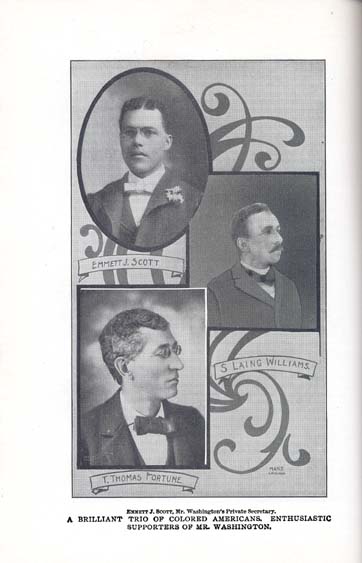
A Brilliant Trio of Colored Americans - E. J. Scott, Edgar Webber, T. Thomas Fortune . . . . . 47
A Group of Mr. Washington's Warm Friends and Supporters--Rev. R. C. Bedford, Ex-Pres. Grover Cleveland, Gov. G. W. Atkinson . . . . . 62 Page 10
Distinguished Americans who have Introduced Mr. Washington on Public Occasions--Ex-Governor Bullock, Hon. Joseph A. Choate, William Harper, Pres. of Chicago University . . . . . 63
Olivia Davidson Hall at Tuskegee Institute . . . . . 75
Cassidy Industrial Hall--Erected by Students, Tuskegee Normal and Industrial Institute . . . . . 79
Booker T. Washington's Residence, Tuskegee, Ala. . . . . . 94
Faculty Tuskegee Normal and Industrial Institute--Eighty-eight Teachers . . . . . 95
Bird's-eye View of the Grounds of the Tuskegee Normal and Industrial Institute . . . . . enclosed
Printing-press Room--They do Their Own Printing at Tuskegee Institute . . . . . 158
Many requests have been made of me to write
something of the story of my life. Until recently I have
never given much consideration to these requests, for the
reason that I have never thought that I had done enough
in the world to warrant anything in the way of an
autobiography; and I hope that my life work, by reason of
my present age, lies more in the future than in the past.
My daughter, Portia, said to me, not long ago: "Papa, do
you know that you have never told me much about your
early life, and your children want to know more about
you." Then it came upon me as never before that I ought
to put something about my life in writing for the sake of
my family, if for no other reason.
I will not trouble those who read these lines with any
lengthy historical research concerning my ancestry, for I
know nothing of my ancestry beyond my mother. My
mother was a slave on a plantation near Hale's Ford, in
Franklin County,
I am indebted to and beg to thank Mr. E. Webber for valuable
assistance rendered in connection with the preparation of this
publication. BOOKER T. WASHINGTON.
Virginia, and she was, as I now remember it, the cook for
her owners as well as for a large part of the slaves on the
plantation. The first time that I got a knowledge of the
fact that my mother and I were slaves, was by being
awakened by my mother early one morning, while
sleeping in a bed of rags, on the clay floor of our little
cabin. She was kneeling over me, fervently praying as
was her custom to do, that some day she and her children
might be free. The name of my mother was Jane. She, to
me, will always remain the noblest embodiment of
womanhood with which I have come in contact. She was
wholly ignorant, as far as books were concerned, and, I
presume, never had a book in her hands for two minutes
at a time. But the lessons in virtue and thrift which she
instilled into me during the short period of my life that she
lived will never leave me. Some people blame the Negro
for not being more honest, as judged by the Anglo-Saxon's
standard of honesty; but I can recall many times when,
after all was dark and still, in the late hours of the night,
when her children had been without sufficient food during
the day, my mother would awaken us, and we would find
that she had gotten from somewhere something in the
way of eggs or chickens and cooked the food during the
night for us. These eggs and chickens were gotten
without my master's permission or
LITTLE
BOOKER AND HIS MOTHER PRAYING TO BE DELIVERED
FROM SLAVERY.
LITTLE
BOOKER, A FAVORITE WITH HIS MASTER, IS ALLOWED
TO PEEP INTO THE PARLOR OF THE "BIG HOUSE."
knowledge. Perhaps, by some code of ethics, this would
be classed as stealing, but deep down in my heart I can
never decide that my mother, under such circumstances,
was guilty of theft. Had she acted thus as a free woman
she would have been a thief, but not so, in my opinion, as
a slave. After our freedom no one was stricter than my
mother in teaching and observing the highest rules of
integrity.
Who my father was, or is, I have never been able to
learn with any degree of certainty. I only know that he
was a white man.
As nearly as I can get at the facts, I was born in the
year 1858 or 1859. At the time I came into the world no
careful registry of births of people of my complexion was
kept. My birthplace was near Hale's Ford, in Franklin
County, Virginia. It was about as near to Nowhere as
any locality gets to be, so far as I can learn. Hale's Ford,
I think, was a town with one house and a post-office, and
my birth place was on a large plantation several miles
distant from it.
I remember very distinctly the appearance of the
cabin in which I was born and lived until freedom came.
It was a small log cabin about 12 x 16 feet, and without
windows. There was no floor, except one of dirt. There
was a large opening in the center of the floor, where
sweet potatoes were kept for my master's family during
the winter. In this cabin my mother did the cooking,
the greater part of the time, for my master's family. Our
bed, or "pallet," as we called it, was made every night on
the dirt floor. Our bed clothing consisted of a few rags
gathered here and there.
One thing I remember more vividly than any other in
connection with the days when I was a slave was my
dress, or, rather, my lack of dress.
The years when the war*
was in progress between the
States were especially trying to the slaves, so far as
clothing was concerned. The Southern white people found
it extremely hard to get clothing for themselves during
that war, and, of course, the slaves underwent no little
suffering in this respect. The only garment that I
remember receiving from my owners during the war was
a "tow shirt." When I did not wear this shirt I was
positively without any garment. In Virginia, the tow shirt
was quite an institution during slavery. This shirt was
made of the refuse flax that grew in that part of Virginia,
and it was a veritable instrument of torture. It was stiff
and coarse. Until it had been worn for about six weeks it
made one feel as if a thousand needle points were
pricking his flesh. I suppose I was about six years old
when I was given one of these shirts to wear. After
repeated trials the
torture was more than my childish flesh could endure
and I gave it up in despair. To this day the sight of a new
shirt revives the recollection of the tortures of my first
new shirt. In the midst of my despair, in connection with
this garment, my brother John, who was about two years
older than I, did me a kindness which I shall never
forget. He volunteered to wear my new shirt for me until
it was "broken in." After he had worn it for several
weeks I ventured to wear it myself, but not without pain.
Soon after my shirt experience, when the winter had
grown quite cold, I received my first pair of shoes. These
shoes had wooden bottoms, and the tops consisted of a
coarse kind of leather. I have never felt so proud since
of a pair of shoes.
As soon as I was old enough I performed what, to me,
was important service, in holding the horses, and riding
behind the white women of the household on their long
horseback rides, which were very common in those days.
At one time, while holding the horses and assisting quite a
party of visiting ladies to mount their horses, I remember
that, just before the visitors rode away, a tempting plate
of ginger cakes was brought out and handed around to
the visitors. This, I think, was the first time that I had
ever seen any ginger cakes, and a very deep impression
was made upon my childish mind. I remember I said
to myself that if I ever could get to the point where I
could eat ginger cakes as I saw those ladies eating them,
the height of my ambition would be reached.
When I grew to be still larger and stronger the duty of
going to the mill was intrusted to me; that is, a large sack
containing three or four bushels of corn was thrown
across the back of a horse and I would ride away to the
mill, which was often three or four miles distant, wait at
the mill until the corn was turned into meal, and then bring
it home. More than once, while performing this service,
the corn or meal got unevenly balanced on the back of the
horse and fell off into the road, carrying me with it. This
left me in a very awkward and unfortunate position. I, of
course, was unable, with my small strength,
to lift the corn or meal upon the horse's back, and
therefore would have to wait, often for hours, until
someone happened to be passing along the road strong
enough to replace the burden for me.
My owner's name was Jones Burroughs, and I am
quite sure he was above the average in the treatment of
his slaves. That is, except in a few cases, they were not
cruelly whipped. Although I was born a slave, I was too
young to experience much of its hardships. The thing in
connection with slavery that has left the deepest
impression
on me was the instance of seeing a grown man, my
uncle, tied to a tree early one morning, stripped naked,
and someone whipping him with a cowhide. As each
blow touched his back the cry, "Pray, master! Pray,
master!" came from his lips, and made an impression
upon my boyish heart that I shall carry with me to my
grave.
When I was still quite a child, I could hear the slaves
in our "quarters" whispering in subdued tones that
something unusual--the war--was about to take place, and
that it meant their freedom. These whispered
conferences continued, especially at night, until the war
actually began.
While there was not a single slave on our plantation
that could read a line, in some way we were kept
informed of the progress of the war almost as accurately
as the most intelligent person. The "grapevine"
telegraph was in constant use. When Lee surrendered, all of the
plantation people knew it, although all of them acted as if they were in
ignorance of the fact that anything unusual had taken
place.
Early one morning, just after the close of the war,
word was sent around to the slave cabins that all the
slaves must go to the "big house," the master's house;
and in company with my mother and a large number of
other slaves, including my sister Amanda and brother
John, I went to the "big house," and stood by the
side of my mother, and listened to the reading of some
papers and a little speech made by the man who read the
papers. This was the first public address I had ever heard,
and I need not add that it was the most effective one to
which it had ever been my privilege to listen. After the
reading of the paper, and the speech, my mother leaned
over and whispered, "Now, my children, we are free."
This act was hailed with joy by all the slaves, but it threw
a tremendous responsibility upon my mother, as well as
upon the other slaves. A large portion of the former
slaves hired themselves to their owners, while others
sought new employment; but, before the beginning of the
new life, most of the ex-slaves left the plantation for a
few days at least, so as to get the "hang" of the new life,
and to be sure that they were free. My mother's husband,
my stepfather, had in some way wandered into West
Virginia during the war, and had secured employment in
the salt furnace near Malden, in Kanawha county. Soon
after freedom was declared he sought out my mother and
sent a wagon to bring her and her children to West
Virginia. After many days of slow, tiresome traveling
over the mountains, during which we suffered much, we
finally reached Malden, and my mother and her husband
were united after a long enforced separation.
West Virginia, was the first one that had taken me out of
the county where I was born, and, of course, it was quite
an event, especially to the children of the family, although
the parting from the old homestead was to my mother a
very serious affair. All of our household and other goods
were packed into a small wagon drawn by two horses or
mules. I cannot recall how many days it took us to make
this trip, but it seems to me, as I recall it now, that we
were at least ten days. Of course we had to sleep in the
wagon, or what was more often true, on the ground. The
children walked a great portion of the distance.
One night we camped near an abandoned log cabin,
and my mother decided that, instead of cooking our frugal
meal in the open air, as she had been accustomed to do
on the trip, she would build a fire in this cabin and we
should both cook and sleep in it during the night. When
we had gotten the fire well started, to the consternation
of all of us, a large and frightful looking snake came
down the chimney. This, of course, did away with all idea
of our sheltering ourselves in the cabin for the night, and
we slept out in the open air, as we had done on previous
occasions.
Since I have grown to manhood it has been my
privilege to pass over much of the same road traveled on
this first trip to West Virginia, but my recent journeys
have been made in well-appointed
steam cars. At the time I first traveled through
that part of Virginia and West Virginia there was no
railroad, and if there had been we did not have the
money to pay our fare.
At the close of the war our family consisted of my
mother, step-father, my brother John and sister Amanda.
My brother John is director of the mechanical department
of the Tuskegee Institute, and my sister, now Mrs.
Amanda Johnson, lives in Malden, West Virginia. Soon
after we moved to West Virginia my mother took into our
family, notwithstanding our own poverty, a young orphan
boy who has always remained a part of our family. We
gave him the name of James B. Washington. He, now
grown to manhood, holds an important position at the
Tuskegee Institute.
While I have not had the privilege of returning to the
old homestead in Franklin county, Virginia, since I left
there as a child immediately after the war, I have kept up
more or less correspondence with members of the
Burroughs family, and they seem to take the deepest
interest in the progress of our work at Tuskegee.
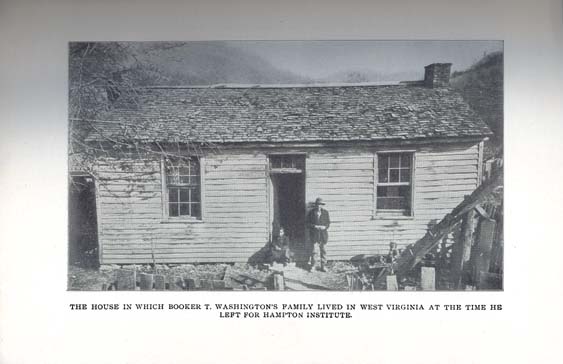
THE
HOUSE IN WHICH
BOOKER T. WASHINGTON'S FAMILY LIVED IN WEST VIRGINIA AT THE TIME HE
LEFT FOR HAMPTON INSTITUTE.
THE CABIN IN OLD VIRGINIA WHERE BOOKER T. WASHINGTON LIVED WHEN A
SMALL BOY.
We began life in West Virginia in a little shanty, and
lived in it for several years. My step-father soon obtained
work for my brother John and myself in the salt furnaces
and coal mines, and we worked alternately in them until
about the year 1871. Soon after we reached West
Virginia a school teacher, Mr. William Davis, came into
the community, and the colored people induced him to
open a school. My step-father was not able to spare me
from work, so that I could attend this school, when it was
first opened, and this proved a sore disappointment to
me. I remember that soon after going to Malden, West
Virginia, I saw a young colored man among a large
number of colored people, reading a newspaper, and this
fired my ambition to learn to read as nothing had done
before. I said to myself, if I could ever reach the point
where I could read as this man was doing, the acme of
my ambition would be reached. Although I could not
attend the school, I remember that, in some way, my
mother secured a book for me, and although she could
not read herself, she tried in every way possible to help
me to do so.
mines was marked, and by watching the letters that were
put on the salt barrels I soon learned to read. As time
went on, after considerable persuasion on my part, my
step-father consented to permit me to attend the public
school half of the day, provided I would get up very early
in the morning and perform as much work as possible
before school time. This permission brought me great joy.
By four o'clock in the morning I was up and at my work,
which continued until nearly nine o'clock. The first day I
entered school, it seems to me, was the happiest day that
I have ever known. The first embarrassment I
experienced at school was in the matter of finding a name
for myself. I had always been called "Booker," and had
not known that one had use for more than one name.
Some of the slaves took the surnames of their owners,
but after freedom there was a prejudice against doing
this, and a large part of the colored people gave
themselves new names. When the teacher called the roll,
I noticed that be called each pupil by two names, that is a
given name and a surname. When he came to me he
asked for my full name, and I told him to put me down as
"Booker Washington," and that name I have borne ever
since. It is not every school boy who has the privilege of
choosing his own name. In introducing me to an
audience in Essex Hall, London,
during my visit to Europe, in the summer of 1899,
Honorable Joseph H. Choate, the American
Ambassador, said that I was one of the few Americans
that had had the opportunity of choosing his own name,
and in exercising the rare privilege I had very naturally
chosen the best name there was in the list.
My step-father seemed to be over careful that I should
continue my work in the salt furnace until nine o'clock
each day. This practice made me late at school, and
often caused me to miss my lessons. To overcome this I
resorted to a practice of which I am not now very proud,
and it is one of the few things I did as a child of which I
am now ashamed. There was a large clock in the salt
furnace that kept the time for hundreds of workmen
connected with the salt furnace and coal mine. But, as I
found myself continually late at school, and after missing
some of my lessons, I yielded to the temptation to move
forward the hands on the dial of the clock so as to give
enough time to permit me to get to school in time. This
went on for several days, until the manager found the
time so unreliable that the clock was locked up in a case.
It was in Malden that I first found out what a Sunday
school meant. I remember that I was playing marbles
one Sunday morning in the road with a number of other
boys, and an old colored
man passed by on his way to Sunday school. He spoke a
little harshly to us about playing marbles on Sunday, and
asked why we did not go to Sunday school. He explained
in a few broken though plain words what a Sunday school
meant and what benefit we would get from it by going.
His words impressed me so that I put away my marbles
and followed him to Sunday school, and thereafter was in
regular attendance. I remember that, some years
afterwards, I became one of the teachers in this Sunday
school and finally became its superintendent.
No matter how dark the days or how discouraging
the circumstances, there was never a time in my
youth when the firm resolution to secure an education,
at any cost, did not constantly remain with me.
Next came the unpleasant coal mine experience.
My step-father was not able, however, to permit me to
continue in school long, even for a half day at the time. I
was soon taken out of school and put to work in the coal
mine. As a child I recall now the fright which, going a
long distance under the mountain into a dark and damp
coal mine, gave me. It seemed to me that the distance
from the opening of the mine to the place where I had to
work was at least a mile and a half. Although I had to
leave school I did not give up my search for knowledge. I
took my book into the coal mine, and during the spare
minutes I
tried to read by the light of the little lamp which hung on
my cap. Not long after I began to work in the mines my
mother hired some one to teach me at night, but often,
after walking a considerable distance for a night's lesson,
I found that my teacher knew but little more than I did.
This, however, was not the case with Mr. William Davis, my first
teacher.
After working in the coal mine for some time,
my mother secured a position for me as house boy in the
family of General Lewis Ruffner. I went to live with this
family with a good many fears and doubts. General
Ruffner's wife, Mrs. Viola Ruffner, had the reputation of
being very strict and hard to please, and most of the boys
who had been employed by her had remained only a short
time with her. After remaining with Mrs. Ruffner a
while, I grew weary of her exact manner of having things
done, and, without giving her any notice, I ran away and
hired myself to a steamboat captain who was plying a
boat between Malden and Cincinnati. Mrs. Ruffner was a
New England woman, with all the New England ideas
about order, cleanliness and truth. The boat captain hired
me as a waiter, but before the boat had proceeded many
miles towards Cincinnati he found that I knew too little
about waiting on the table to be of any service, so he
discharged me before I had been on his boat for many
hours.
In some way, however, I persuaded him to take me
to Cincinnati and return me to Malden. As soon
as I returned home, I returned to Mrs. Ruffner,
acknowledged my sins, and secured my old position
again. After I had lived with Mrs. Ruffner
for a while she permitted me to attend school
for a few hours in the afternoons during three
months, on the condition that I should work faithfully
during the forenoon. She paid me, or
rather my step-father, six dollars per month and
board for my work. When I could not get the
opportunity to attend school in the afternoon I
resorted to my old habit of having some one
teach me at night, although I had to walk a good
distance after my work was done in order to do
this.
While living with Mrs. Ruffner I got some
very valuable experience in another direction, that
of marketing and selling vegetables. Mrs. Ruffner
was very fond of raising grapes and vegetables,
and, although I was quite a boy, she entrusted
me with the responsibility of selling a
large portion of these products. I became very
fond of this work. I remember that I used to go
to the houses of the miners and prevail upon them
to buy these things. I think at first Mrs. Ruffner
doubted whether or not I would be honest in
these transactions, but as time went on and she
found the cash from these sales constantly increasing
her confidence grew in me, and before I
left her service she willingly trusted me with
anything in her possession. I always made it a
special point to return to her at the end of each
campaign as a salesman every cent that I had received
and to let her see how many vegetables or
how much fruit was brought back unsold.
At one time I remember that, when I passed
by an acquaintance of mine when I had a large
basket of peaches for sale, he took the liberty of
walking up to me and taking one of the ripest
and most tempting peaches. Although he was a
man and I was but a boy, I gave him to under-
stand in the most forceful manner that I would
not permit it. He seemed greatly surprised that
I would not let him take one peach. He tried to
explain to me that no one would miss it and that
I would be none the worse off for his taking it.
When he could not bring me to his way of thinking
he tried to frighten me by force into yielding,
but I had my way, and I am sure that this man
respected me all the more for being honest with
other people's property. I told him that if the
peaches were mine I would gladly let him have
one; but under no circumstances could I consent
to let him take without a protest that which was
entrusted to me by others. It happened very
often that as I would pass through the streets
with a large basket of grapes or other fruit,
many of the larger boys tried by begging and then by
force to dispossess me of a portion of what had been
given me to sell, but I think there was no instance when
I yielded. From my earliest childhood I have always had it
implanted in me that it never pays to be dishonest, and
that reward, at some time, in some manner, for the
performance of conscientious duty, will always come, and
in this I have never been disappointed.
I wish to add here that there are few instances of a
member of my race betraying a specific trust. One of the
best illustrations of this which I know of, is in the case of
an ex-slave from Virginia, whom I met not long ago in a
little town in the state of Ohio. I found that this man had
made a contract with his master, two or three years
previous to the Emancipation Proclamation, to the effect
that the slave was to buy himself, by paying so much per
year for his body; and while he was paying for himself,
he was to be permitted to labor where and for whom he
pleased. Finding that he could secure better wages in
Ohio, he went there. When freedom came, he was still in
debt to his master some three hundred dollars.
Notwithstanding that the Emancipation Proclamation
freed him from any obligation to his master, this black
man walked the greater portion of the distance back
"THIS FIRED MY
AMBITION TO LEARN TO READ, AS NOTHING HAD DONE BEFORE."
READING OF THE
EMANCIPATION PROCLAMATION. THE SMALL LAD WITH SLOUCH HAT AND STICK
IN RIGHT HAND, IS BOOKER.--Text page 19.
to where his old master lived in Virginia, and placed the
last dollar, with interest, in his hands. In talking to me
about this, the man told me that he knew he did not have
to pay the debt, but he had given his word to his master,
and his word he had never broken. He felt that he could
not enjoy his freedom till he had fulfilled his promise.
In all, I must have spent about four years in the
employ of Mrs. Ruffner; and I here repeat what I have
said more than once, that aside from the training I got at
the Hampton Institute under General Armstrong, Mrs.
Ruffner gave me the most valuable part of my education.
Her habit of requiring everything about her to be clean,
neat and orderly, gave me an education in these respects
that has been most valuable to me in the work that I have
since tried to accomplish. At first I thought that her idea
of strict honesty and punctuality in everything meant
unkindness, but I soon learned to understand her and she
to understand me, and she has from the first time that I
knew her until this day proven one of the best friends I
ever possessed.
One day, while I was at work in the coal mine, I heard
some men talking about a school in Virginia, where they
said that black boys and girls were permitted to enter,
and where poor students were given an opportunity of
working for their
board, if they had not money with which to pay for it.
As soon as I heard of this institution, I made up my mind
to go there. After I had lived with Mrs. Ruffner about
four years I decided to go to the Hampton Institute, in
Virginia, the school of which I had heard. I had no
definite idea about where the Hampton Institute was, or
how long the journey was. Some time before starting for
Hampton, I remember, I joined the little Baptist church, in
Malden, of which I am still a member.
Of my ancestry I know almost nothing. While in slave
quarters, and even later, I heard whispered
conversations among the colored people of the tortures
which the slaves, including, no doubt, my ancestors on my
mother's side, suffered in the middle passage of the slave
ship while being conveyed from Africa to America. I
have been unsuccessful in securing information that
would throw any accurate light upon the history of my
family beyond my mother. She, I remember, had a
half-brother and a half-sister. In the days of slavery, not very
much attention was given to family history and family
records--that is, black family records. My mother, I
suppose, attracted the attention of a purchaser who was
afterward my owner and hers. Her addition to the
slave family attracted about as much attention as the
purchase of a new horse or cow. Of
my father I know even less than of my mother. I only
know that he was a white man, but whoever he was, I
never heard of his taking the least interest in me, or
providing in any way for my rearing. But I do not find
especial fault with him. He was simply another
unfortunate victim of the institution which the nation
unhappily had engrafted upon it at that time.
BOOKER
T. WASHINGTON REHEARSING HIS GRADUATING ORATION AT HAMPTON. HIS
FIRST SPEECH.
After my mother and brother John had secured me a
few extra garments, with what I could provide for
myself, I started for Hampton, about the first of
October, 1872. How long I was on this journey I have
at this time no very definite idea. Part of the way I went
by railroad, part in a stage, and part on foot. I remember
that when I got as far as Richmond, Virginia, I was
completely out of money, and knew not a single person
in the city. Besides, I had never been in a city before. I
think it was about nine o'clock at night that I reached
Richmond. I was hungry, tired and dirty, and had no
where to go. I wandered about the streets until about
midnight, when I felt completely exhausted.
By chance I came to a street that had a plank
sidewalk, and I crept under this sidewalk and spent the
night. The next morning I felt very much rested, but was
still quite hungry, as it had been some time since I had a
good meal. When I awoke, I noticed some ships not far
from where I had spent the night. I went to one of these
vessels and asked the captain to permit me to
work for him, so that I could earn some money to get
some food. The captain very kindly gave me work, which
was that of helping to unload pig iron from the vessel. In
my rather weak and hungry condition I found this hard
work, but I stuck to it, and was given enough money to
buy a little food. My work seemed to have pleased the
master of the vessel so much that he furnished me with
work for several days, but I continued to sleep under the
sidewalk each night, for I was anxious to save enough
money to pay my passage to Hampton.
After working on this vessel for some days, I started
again for Hampton, and arrived there in a day or two,
with a surplus of fifty cents in my pocket. I did not let any
one know how forlorn my condition was. I feared that if I
did, I would be rejected as one that was altogether too
unpromising. The first person I saw after reaching the
Hampton Institute was Miss Mary F. Mackie, the Lady
Principal. After she had asked me many searching
questions, with a good deal of doubt and hesitation in her
manner, I was assigned to a room. She remarked at the
same time that it would be decided later whether I could
be admitted as a student. I shall not soon forget the
impression that the sight of a good, clean, comfortable
room and bed made upon me, for I had not slept in a bed
since
I left my home in West Virginia. Within a few hours I
presented myself again before Miss Mackie to hear my
fate, but she still seemed to be undecided. Instead of
telling me whether or not I could remain, I remember, she
showed me a large recitation room and told me to sweep
it. I felt at once that the sweeping of that room would
decide my case. I knew I could sweep, for Mrs. Ruffner
had taught me that art well. I think that I must have
swept that room over as many as three times, and dusted
it the same number of times. After awhile Miss Mackie
came into the room and rubbed her handkerchief over the
tables and benches to see if I had left any dust, but not a
particle could she find. She remarked with a smile, "I
guess we will try you as a student." At that moment I
think I was the happiest individual that ever entered the
Hampton Institute.
After I had been at the Hampton Institute a day or
two I saw General Armstrong, the Principal, and he
made the impression upon me of being the most perfect
specimen of man, physically, mentally and spiritually, that
I had ever seen; and I have never had occasion to
change my first impression. In fact, as the years went
by and as I came to know him better, the feeling grew. I
have never seen a man in whom I had such confidence.
It never occurred to me that it was possible
for him to fail in anything that he undertook to
accomplish. I have sometimes thought that the
best part of my education at Hampton was obtained
by being permitted to look upon General
Armstrong day by day. He was a man who could not
endure for a minute hypocrisy or want of truth in
any one. This moral lesson he impressed upon
every one who came in contact with him.
After I had succeeded in passing my "sweeping
examination," I was assigned by Miss Mackie to
the position of assistant janitor. This position, with
the exception of working on the farm for awhile, I
held during the time I was a student at Hampton. I
took care of four or five class rooms; that is, I
swept and dusted them and built the fires when
needed. A great portion of the time I had to rise at
four o'clock in the morning in order to do my work
and find time to prepare my lessons.
Everything was very crude at Hampton when I
first went there. There were about two hundred
students. There was but one substantial building,
together with some old government barracks.
There were no table cloths on the meal tables, and
that which was called tea or coffee was served to us
in yellow bowls. Corn bread was our chief food.
Once a week we got a taste of white bread.
While taking the regular literary and industrial
courses at Hampton, next to my regular studies I
was most fond of the debating societies, of which
there were two or three. The first subject that I
debated in public was whether or not the execution
of Maj. Andre was justifiable. After I had been at
Hampton a few months I helped to organize the
"After Supper Club." I noticed that the students
usually had about twenty minutes after tea when no
special duty called them; so about twenty-five of us
agreed to come together each evening and spend
those twenty minutes in the discussion of some
important subject. These meetings were a constant
source of delight, and were most valuable in
preparing us for public speaking.
While at Hampton my best friends did not know
how badly off I was for clothing during a large part of
the time, but I did not fret about that. I always had
the feeling that if I could get knowledge in my
head, the matter of clothing would take care of
itself afterwards. At one time I was reduced to a
single ragged pair of cheap socks. These socks I
had to wash over night and put them on the next
morning.
After I had remained at Hampton for two years I
went back to West Virginia to spend my four
months of vacation. Soon after my return to
Malden my mother, who was never strong,
died. I do not remember how old I was at this
time, but I do remember that it was during my
vacation from Hampton. I had been without
work for some time, and had been off several
miles looking for work. On returning home at
night I was very tired, and stopped in the boiler-room
of one of the engines used to pump salt
water into the salt furnace near my home. I was
so tired that I soon fell asleep. About two or
three o'clock in the morning some one, my brother
John, I think, found me and told me that our
mother was dead. It has always been a source
of indescribable pain to me that I was not present
when she passed away, but the lessons of truth,
honor and thrift which she implanted in me while
she lived have remained with me, and I consider
them among my most precious possessions. She
seemed never to tire of planning ways for me and
the other children to get an education and to make
true men and women of us, although she herself
was without education. This was the severest
trial I had ever experienced, because she always
sympathized with me deeply in every effort that
I made to get on in the world. My sister
Amanda was too young to know how to take
care of the house, and my step-father was too
poor to hire anyone. Sometimes we had food
cooked for our meals and sometimes we did not.
During the whole of the summer, after the death
of my mother, I do not think there was a time when the
whole family sat down to a meal together. By working
for Mrs. Ruffner and others, and by the aid of my
brother John, I obtained money enough to return to
Hampton in the fall, and graduated in the regular course
in the summer of 1875.
Aside from Gen. Armstrong, Gen. Marshall and Miss
Mackie, the persons who made the deepest impression
upon me at Hampton were Miss Nathalie Lord and
Miss Elizabeth Brewer, two teachers from New
England. I am especially indebted to these two for
being helped in my spiritual life and led to love and
understand the Bible. Largely by reason of their
teaching, I find that a day rarely, if ever, passes when I
am at home, that I do not read the Bible. Miss Lord
was the teacher of reading, and she kindly consented to
give me many extra lessons in elocution. These lessons I
have since found most valuable to me.
Life at Hampton was a constant revelation to me, it
was constantly taking me into a new world. The matter
of having meals at regular hours, of eating on a
tablecloth, using a napkin, the use of the bath-tub and
of the tooth-brush, as well as the use of sheets upon the
bed, were all now to me.
I learned at the Hampton Institute was the
use of the bath. I learned there for the first
time some of its value, not only in keeping the
body healthy, but in inspiring self-respect
and promoting virtue. In all my travels in the
South and elsewhere, since leaving Hampton,
I have always in some way sought my daily bath.
To get it sometimes when I have been the guest
of my own people in a single-roomed cabin has
not always been easy to do, except by slipping
away to some stream in the woods. I have
always tried to teach my people that some pro-
vision for bathing should be a part of every
house.
After finishing the course at Hampton, I went to
Saratoga Springs, in New York, and was a waiter
during the summer at the United States Hotel, the
same hotel at which I have several times since
been a guest upon the invitation of friends.
HOW THE FIRST SIX YEARS AFTER GRADUATION
FROM HAMPTON WERE SPENT.
In the fall of 1875 I returned to Malden and was
elected as the teacher in the school at Malden, the
first school that I ever attended. I taught this
school for three years. The thing that I recall most
pleasantly in connection with my teaching was the
fact that I induced several of my pupils to go to
Hampton and that most of them have become
strong and useful men. One of them, Dr. Samuel E.
Courtney, is now a successful physician in Boston
and has been a member of the Boston Board of
Education. While teaching I insisted that each pupil
should come to school clean, should have his or
her hands and face washed and hair combed, and
should keep the buttons on his or her clothing.
I not only taught school in the day, but for a
great portion of the time taught night school. In
addition to this I had two Sunday schools, one at
a place called Snow Hill, about two miles from
Malden, in the morning, and another in Malden in
the afternoon. The average attendance in my
day school, was, I think, between eighty and
ninety. As I had no assistant teacher it was
a very difficult task to keep all the pupils interested
and to see that they made progress in their
studies. I had few unpleasant experiences, however,
in connection with my teaching. Most of
the parents, notwithstanding the fact that they
and many of the children knew me as a boy,
seemed to have the greatest confidence in me
and respect for me, and did everything in their
power to make the work pleasant and agreeable.
One thing that gave me a great deal of satisfaction
and pleasure in teaching this school was
the conducting of a debating society which met
weekly and was largely attended both by the
young and older people. It was in this debating
society and the societies of a similar character at
Hampton that I began to cultivate whatever talent
I may have for public speaking. While in
Malden, our debating society would very often
arrange for debates with other similar organizations
in Charleston and elsewhere.
Soon after I began teaching, I resolved to
induce my brother John to attend the Hampton
Institute. He had been good enough to work
for the family while I was being educated, and
besides had helped me in all the ways he could,
by working in the coal mines while I had been
away. Within a few months he started for Hampton
and by his own efforts and my aid he went
through the institution. After both of us had
gotten through Hampton we sent our adopted brother
James there, and had the satisfaction of
having him educated under Gen. Armstrong.
In 1878 I went to Wayland Seminary, in
Washington, and spent a year in study there.
Rev. G. M. P. King, D. D., was President of
the Wayland Seminary while I was a student there.
Notwithstanding I was there but a short time,
the high Christian character of Dr. King made a
lasting impression upon me. The deep religious
spirit which pervaded the atmosphere at Wayland
made an impression upon me which I trust
will always remain.
Soon after my year at Wayland was completed,
I was invited by a committee of gentlemen in
Charleston, West Virginia, to stump the state of
West Virginia in the interest of having the
capital of the state moved from Wheeling, West
Virginia, to Charleston. For some time there
had been quite an agitation in the state on the
question of the permanent location of the capital.
A law was passed by the legislature providing
that three cities might be voted for; these were,
I think, Charleston, Parkersburg and Martinsburg.
It was a three-cornered contest and great energy
was shown by each city. After about three
months of campaigning the voters declared in
favor of Charleston as the permanent capital, by
a large majority. I went into a large number of the
counties of West Virginia, and had the satisfaction of
feeling that my efforts counted for something in winning
success for Charleston, which is only five miles from my
old home, Malden.
The speaking in connection with the removal of the
capital rather fired the slumbering ambition which I had
had for some time to become a lawyer, and after this
campaign was over I began in earnest to study law, in
fact read Blackstone and several elementary law books
preparatory to the profession of the law. A good deal of
my reading of the law was done under the kind direction
of the Hon. Romes H. Freer, a white man who was then
a prosperous lawyer in Charleston and who has since
become a member of Congress. But notwithstanding my
ambition to become a lawyer, I always had an
unexplainable feeling that I was to do something else, and
that I never would have the opportunity to practice law.
As I analyze at the present time the feeling that seemed
to possess me then, I was impressed with the idea that
to confine myself to the practice of law would be going
contrary to my teaching at Hampton, and would limit me
to a much smaller sphere of usefulness than was open to
me if I followed the work of educating my people after
the manner in which I had been
WARREN
LOGAN, Treasurer. TEACHERS
AT TUSKEGEE INSTITUTE.
EMMETT
J. SCOTT, Mr. Washington's
Private Secretary. A BRILLIANT TRIO OF COLORED AMERICANS. ENTHUSIASTIC
SUPPORTERS OF MR. WASHINGTON.
taught at Hampton. The course of events, however,
very soon placed me where I found an opportunity to
begin my life's work.
My work in connection with the removal of the capital
had not been completed long when I received an
invitation from Gen. Armstrong, much to my surprise, to
return to Hampton and deliver the graduates' address at
the next commencement. I chose as the subject of this
address, "The Force that Wins." All who heard the
address seemed pleased with what I said. After the
address I was further surprised by being asked by Gen.
Armstrong to return to the Hampton Institute and take a
position, partly as a teacher and partly as a post-graduate
student. This I gladly consented to do. Gen. Armstrong had
decided to start a night class at Hampton for students
who wanted to work all day and study for two hours at
night. He asked me to organize and teach this class. At
first there were only about a half dozen students, but the
number soon grew to about thirty. The night class at
Hampton has since grown to the point where it now
numbers six or seven hundred. It seems to me that the
teaching of this class was almost the most satisfactory
work I ever did. The students who composed the class
worked during the day for ten hours in the saw mill, on
the farm, or in the laundry. They were a most earnest
set. I soon
gave them the name of the "Plucky Class." Several of the
members of this "Plucky Class" now fill prominent and
useful positions. While I was teaching I was given
lessons in advanced subjects, among those who assisted
me in that way being Dr. H. B. Frissell, who was then
chaplain, but who is now the honored and successful
successor of Gen. Armstrong.
About the time the night class was organized at
Hampton, Indians for the first time were permitted to
enter the institution. The second year that I worked at
Hampton, in connection with other duties I was placed in
charge of the Indian boys, who at that time numbered
about seventy-five, I think. I lived in their cottage with
them and looked after all their wants. I grew to like the
Indians very much, and placed great faith in them. My
daily experience with them convinced me that the main
thing that any oppressed people needed was a chance of
the right kind, and they would cease to be savages.
I have often wondered if there is a white institution in
this country whose students would have welcomed the
incoming of more than a hundred companions of another
race in the cordial way that the black students at Hampton
welcomed the red ones. How often have I wanted to
say to white students that they lift themselves up in
proportion as they help to lift others, and that
the more unfortunate the race and the lower in the scale
of civilization, the more does one raise one's self by
giving the assistance.
This reminds me of a conversation which I once had
with the Hon. Frederick Douglass. At one time Mr.
Douglass was traveling in the state of Pennsylvania, and
was forced, on account of his color, to ride in the baggage-car,
in spite of the fact that he had paid the same fare as
the other passengers. When some of the white passengers
went to the baggage. car to console Mr. Douglass, and
one of them said to him, "I am sorry, Mr. Douglass, that
you have been degraded in this manner," Mr. Douglass
straightened himself up on the box upon which he was
sitting, and replied: "They cannot degrade Frederick
Douglass. The soul that is within me no man can degrade.
I am not the one that is being degraded on account of this
treatment, but those who are inflicting it upon me."
My experience has been, that the time to test a true
gentleman is to observe him when he is in contact with
individuals of a race that is less fortunate than his own.
This is illustrated in no better way than by observing the
conduct of the old-school type of Southern gentleman
when he is in contact with his former slaves or their
descendants.
An example of what I mean is shown in a story told of
George Washington, who, meeting a colored man in the
road once, who politely lifted his hat, lifted his own in
return. Some of his white friends who saw the incident,
criticised Washington for his action. In reply to their
criticism, George Washington said: "Do you suppose that
I am going to permit a poor, ignorant colored man to be
more polite than I am?"
At the end of my second year at Hampton as a
teacher, in 1881, there came a call from the little town of
Tuskegee, Alabama, to Gen. Armstrong for some one to
organize and become the Principal of a Normal School,
which the people wanted to start in that town. The letter
to Gen. Armstrong was written on behalf of the colored
people of the town of Tuskegee by Mr. Geo. W.
Campbell, one of the foremost white citizens of Tuskegee.
Mr. Campbell is still the president of the Board of
Trustees of the Tuskegee Normal and Industrial Institute,
and has from the first been one of its warmest and most
steadfast friends. When Mr. Campbell wrote to Gen.
Armstrong, he had in mind the securing of a white man to
take the principalship of the school. Gen. Armstrong
replied that he knew of no suitable white man for the
position, but that he could recommend a colored man. Mr.
Campbell wrote in reply that a competent colored man
would be
acceptable. Gen. Armstrong asked me to give
up my work at Hampton and go to Tuskegee in answer to
this call. I decided to undertake the work, and after
spending a few days at my old home in Malden, West
Virginia, I proceeded to the town of Tuskegee, Alabama.
I wish to add here that, in later years, I do not envy the
white boy as I once did. I have learned that success is to
be measured, not so much by the position that one has
reached in life, as by the obstacles which he has
overcome while trying to succeed. Looked at from this standpoint,
I almost reach the conclusion that often the Negro boy's birth and
connection with an unpopular race are an advantage, so
far as real life is concerned. With few exceptions, the
Negro youth must work harder and perform his tasks
even better than a white youth in order to secure
recognition. But out of the hard and unusual struggle
through which he is compelled to pass, he gets a strength,
a confidence that one misses whose pathway is
comparatively smooth by reason of birth and race.
From any point of view, I had rather be what I am, a
member of the Negro race, than to be able to claim
membership with the most favored of any other race. I
have always been made sad when I have heard members
of my race claiming rights and privileges, or certain
badges of distinction,
Before starting for Tuskegee I found it almost
impossible to find the town on any map, and had
difficulty in learning its exact location. I reached
Tuskegee about the middle of June, 1881 I found it to
be a town of some 2,000 inhabitants, about half of whom
were Negroes, and located in what is commonly called
the "Black Belt," that is, the section of the South where
the Negro race largely outnumbers the white population.
The county in which Tuskegee is located is named
Macon. Of Tuskegee and Macon County I prefer to
quote the words of Maj. W. W. Screws, the editor of
the "Montgomery (Alabama) Daily Advertiser," who
visited Tuskegee in 1898, seventeen years after the
Tuskegee Institute was founded. Maj. Screws says:
"Just at this time there is probably no place in the
United States, of similar size, so well known to the
people of the country, as this lovely little city. It has
always possessed merits which brought it
conspicuously before Alabamians, for in every locality
in this and many Southern
States are noble men and women who received their
educational training here.
"Thomas S. Woodward was one of the earliest white
settlers in Macon County, and was one of the
commissioners appointed to lay off the site for the court
house. He built the first house in the new town, which
they called Tuskegee, a corruption of the old Indian
name, Tuskigi, which is said by Dr. Gatschet to be a
contraction of Taskialgi (warriors). The old Indian town
stood in the fork of the Coosa and was the home, part
of the time, of the famous half-breed statesman,
Alexander McGillivray. The name passed in its present
form to the county seat of the new county.
"Tuskegee was settled by men who were well
to do in a material point of view. They owned
rich lands on the creeks and streams and in the
prairie section of the county. This point is on a
high, dry ridge, and from time immemorial has
been noted for its healthfulness. Here came
those who wished to build homes for their families,
to have congenial company and to give
their children educational advantages. They did
not desire the projectors of the Montgomery and
West Point, Railroad to put the town on its
route, because of the interruption it was feared
would be occasioned to the schools. From the
very beginning of its existence, education has
been the main feature of Tuskegee, and through
its schools and colleges a population gathered here
which has never been excelled in point of refinement,
politeness and all the gentle amenities which tend to
make life comfortable.
"The town of Tuskegee was first settled about 1830.
James Dent built the first house. The town was first laid
out in 1833. Mr. G. W. Campbell came to the county
with his father from Montgomery in 1835, and at that
time perhaps 150 people were in and about what now
comprises Tuskegee's territorial limits. There was no
court house building, and court sessions
were held in a small log house with a dirt floor. When
court was not in session the building was used as a
school house. The Creek Indians were in great numbers
in the neighborhood, but they were friendly and
peaceful, and in 1836 commenced to move to their far
Western home, going overland to Montgomery, where they took
steamer for New Orleans. Tuskegee is one of the
model towns in the way of good order.
"Among the white settlers here are Dr. W. J.
Gautier, and Messrs. G. W. Campbell, J. W. Bilbro,
J. O. A. Adams and W. H. Wright. They have a
perfect wealth of interesting reminiscence
connected with the early days of all East Alabama.
Although they have passed the three score years, they
are hale, healthy men, engaged in
business, and set a splendid example of energy and
active life to the younger generation. The firm of
Campbell & Wright has been in existence, possibly,
longer than any other in Alabama.
"The Montgomery and West Point Railroad is about
five miles distant from Tuskegee, the nearest station
being Chehaw: From there to Tuskegee, until about
twenty years ago, the usual mode of conveyance for
passengers and baggage was stage coach and omnibus;
while all goods were transported by wagon. It was a
tiresome, troublesome and expensive method. This difficulty
has been overcome through the Tuskegee Railroad
which now connects the two points.
"The population of Macon County before 1860,
was largely heavy landed proprietors. They
suffered immensely by the results of the war from
disorganized labor, and reverses stripped them of much
of their property. The county is almost exclusively
agricultural, and the average yield year by year, of corn,
cotton, peas, potatoes and other things grown on well
regulated farms, is fairly good."
When I reached Tuskegee, I found that Mr. Lewis
Adams, a colored man of great intelligence and thrift,
who was born a slave near Tuskegee, had first started
the movement to have some kind of Normal School
in Tuskegee for the education of colored youth. At the
time he conceived this
idea Hon. W. F. Foster and Hon. A. L. Brooks, both
white Democrats, were members of the Alabama
Legislature, and Mr. Adams so interested them in the
movement that they promised to use their influence in
the Legislature to secure an annual appropriation of
$2,000 toward the expenses of a Normal School,
provided one could be properly organized and
started. Mr. Foster and Mr. Brooks were successful in
their efforts to secure the appropriation, which was
limited in its use to helping to pay teachers. A Board
of three Commissioners was appointed to control the
expenditure of this $2,000. When the school was first
started this board consisted of Mr. Geo. W. Campbell,
Mr. M. B. Swanson and Mr. Lewis Adams. After the
death of Mr. Swanson, Mr. C. W. Hare was elected in
his stead.
When I reached Tuskegee, the only thing that had
been done toward the starting of a school was the
securing of the $2,000. There was no land, building, or
apparatus. I opened the school, however, on the 4th of
July, 1881, in an old church and a little shanty that was
almost ready to fall down from decay. On the first day
there was an attendance of thirty students, mainly those
who had been engaged in teaching in the Public schools
of that vicinity. But these little buildings, inadequate as
they were, were most
gladly furnished by the colored people, who from the
first day that I went to Tuskegee to the present time
have done everything within their power to further the
interests of the school.
One curious thing that happened in connection with
the students was, as additional pupils began to come in,
that some of them had been attending schools taught by
some of those who came to the Tuskegee school, and,
in several cases, it happened that former pupils entered
higher classes than their former teachers.
After the school had been in session in the old
church and little shanty for several months, I
began to see the necessity of having a permanent
location for the institution, where we could have the
students not only in their class rooms, but get hold of
them in their home life, and teach them how to take care
of their bodies in the matter of bathing, care of the teeth,
and in general cleanliness. We also felt that we must not only teach
the students how to prepare their food, but how to serve
and eat it properly. So long as we had the students only
a few hours in the class room during the day, we could
give attention to none of these important matters, which
our students had not had an opportunity of learning
before leaving their homes. Few of the students who
came during the first year were able to remain during
the nine months' session, for lack of money, so we felt
the necessity of having industries where the students
could pay a part of their board in cash. It was rather
noticeable that, notwithstanding the poverty of most of
the students who came to us in the earlier months of
the institution,
most of them had the idea of getting an
education in order that they might find some method of
living without manual labor; that is, they had the feeling
that to work with the hands was not conducive to the
development of the highest type of lady or gentleman.
This feeling we wanted to change as fast as possible, by
teaching students the dignity, beauty and civilizing
power of intelligent labor.
After a few months had passed, I wrote Gen. J. F. B.
Marshall, at that time treasurer of the Hampton Institute,
and put our condition before him, telling him that there
was an abandoned farm about a mile from the town of
Tuskegee in the market which I could secure at a very
cheap price for our institution. As I had absolutely no
money with which to make the first payment on the
farm, I summoned the courage to ask Gen. Marshall to
lend me $500 with which to make the first payment. To
my surprise a letter came back in a few days enclosing a
check for $500. A contract was made for the purchase
of the farm, which at that time consisted of 100 acres.
Subsequent purchases and gifts of adjacent lands have
increased the number of acres at this place to 700, and
this is the present site of the Tuskegee Institute. This has
again been enlarged from time to time by purchases and
gifts of land not adjacent until at present
the school owns farm lands to the number of about
2,500 acres.
After the school had been in session three months,
Miss Olivia A. Davidson, a graduate of the Hampton
Institute and later a graduate of the Framingham,
Mass., Normal School, was employed as an assistant
teacher.
Miss Davidson was teaching among her people
near Memphis, Tennessee, in 1879, when the yellow
fever drove her away. She went to Hampton,
entered the senior class and graduated the following
spring. She did not go to Hampton, however,
until her application to return to Memphis
to help nurse the yellow fever patients had been
refused by the authorities there. Through friends
she was able to enter the Normal School at Framingham,
Massachusetts, and graduated in the
summer of 1881; and, when an assistant at Tuskegee
was called for, she accepted the work.
Her enthusiasm had won the admiration of her
schoolmates, and from them she received much
assistance for the school at Tuskegee in after
years.
The success of the school, especially during the first
half dozen years of its existence, was due more to Miss
Davidson than any one else. During the organization of
the school and in all matters of discipline she was the
one to bring order out of every difficulty. When the
last effort had
apparently been exhausted and it seemed that things must
stop, she was the one to find a way out. Not only was
this true at the school, but when a campaign for money
had ended unsuccessfully, she would start for the North,
and money was sure to be found.
Our hardest struggle began after we had made the
first payment on the farm. We not only had to secure the
money within a few months with which to repay Gen.
Marshall's loan, but had to get the means with which to
meet future payments, and also to erect a building on the
farm. Miss Davidson went among the white and colored
families in Tuskegee and told them our plans and
needs, and there were few of either race who did not
contribute either something in cash or something that
could be turned into cash at the many festivals and fairs
which were held for the purpose of raising money to help
the school. In many cases the white ladies in Tuskegee
contributed chickens or cakes that were sold for the
benefit of our new enterprise. I do not believe there was
a single Negro family or scarcely an individual in
Tuskegee or its vicinity that did not contribute something
in money or in kind to the school. These contributions
were most gladly made, and often at a great sacrifice.
Perhaps I might as well say right here that one of the
principal things which made it easy to start
A GROUP
OF MR. WASHINGTON'S WARM
FRIENDS AND SUPPORTERS.
DISTINGUISHED
AMERICANS WHO HAVE
INTRODUCED MR. WASHINGTON ON PUBLIC OCCASIONS.
such a school as now exists near the town of Tuskegee
was the fact that Tuskegee is inhabited by
some of the most cultured and liberal white people
to be found in any portion of the South. I
have been into a good many Southern towns, but
I think I have never seen one where the general
average of culture and intelligence is so high as
that of the people of Tuskegee. We have in this town
and the surrounding country a good example of the friendly
relations that exist between the two races when
both races are enlightened and educated. Not only are
the white people above the average, but the same is true
of the general intelligence and acquirements of the
colored people.
The leading colored citizen in Tuskegee is Mr. Lewis
Adams, to whom should largely be given the honor for
securing the location of the Tuskegee Normal and
Industrial Institute in the town. Mr. Adams is not
only an intelligent and successful business man,
but is one who combines with his business
enterprise rare common sense and discretion. In the most
trying periods of the growth of the Tuskegee Institute I
have always found Mr. Adams a man on whom I could
rely for the wisest advice. He enjoys the highest respect
and confidence of the citizens of both races, and it is
largely through his power and influence
that the two races live together in harmony and peace
in the town.
After we had raised all the money we could in
Tuskegee for the purpose of paying for the farm and
putting up the new building, Miss Davidson went to
Boston, where she had many friends and acquaintances,
and after some months of hard work she secured enough
money to complete the payment on the farm and return
Gen. Marshall's loan. In addition she secured means to
complete the payment on our first building, Porter Hall.
This building was named after Mr. H. A. Porter, of
Brooklyn, N. Y., who was instrumental in assisting us to
secure the largest gifts for its erection.
All the while the farm was being paid for we were
holding school daily in the old church and shanty. The
latter at least was well ventilated. There was one
thickness of boards above and around us, and this was
full of large cracks. Part of the windows had no sashes
and were closed with rough wooden shutters that opened
upward by leather hinges. Other windows had sashes, but
with little glass in them. Through all these openings the
hot sun or cold wind and rain came pouring in upon us.
Many a time a storm would leave scarcely a dry spot in
either of the two rooms into which the shanty was divided
to make room for separate classes. These rooms were
small, but into them large classes of thirty or forty had to
be crowded for recitations. More
than once, I remember, when Miss Davidson and I were
hearing recitations, and the rain would begin pouring
down, one of the larger pupils would very kindly cease
his lessons and come and hold an umbrella over us so
that we could continue our work. I also remember that at
our boarding place, on several occasions when it rained
while we were eating our meals, our good landlady would
kindly get an umbrella and hold it over us while we were
eating.
During the summer of 1882, at the end of our first
year's work, I was married to Miss Fannie N. Smith, of
Malden, West Virginia, and we began housekeeping in
Tuskegee early in the fall. This made a home for our
teachers, who had now been increased to four in number.
My wife was also a graduate of the Hampton Institute.
After earnest and constant work in the interest of the
school, together with her housekeeping duties, she passed
away in May, 1884. One child, Portia M. Washington,
was born during our marriage. From the first my wife
most earnestly devoted her thought and time to the work
of the school, and was completely one with me in every
interest and ambition. She died, however, before she had
an opportunity of seeing what the school was destined to
be.
from the Alumni Journal, published at the time at
Hampton:
"The numerous friends of Mr. B. T. Washington will
be pained to learn of the death of his beloved wife, Mrs.
Fannie (Smith) Washington, class of '82, which occurred
at Tuskegee, Alabama, Sunday, May 4th.
"Her death is indeed a serious bereavement to Mr.
Washington, whose acquaintance and regard for the
deceased had begun in their childhood. Their happy union
had done much to lighten the arduous duties devolving
upon him in the management of his school. To his friends
he had several times expressed the great comfort his
family life was to him.
"We know that all our readers will join us in extending
to him the warmest sympathy in this sad hour.
"A bright little girl, not a year old, is left to sustain with
her father a loss which she can never know."
THE STRUGGLES AND SUCCESS OF THE WORKERS
AT TUSKEGEE FROM 1882 TO 1884.
Soon after securing possession of the farm we set
about putting it into a condition so that a crop of some
kind might be secured from it during the next year. At the
close of school hours each afternoon, I would call for
volunteers to take their axes and go into the woods to
assist in clearing up the grounds. The students were most
anxious to give their service in this way, and very soon a
large acreage was put into condition for cultivation. We
had no horse or mule with which to begin the cultivation
of the farm. Mr. George W. Campbell, however, the
president of the Board of Trustees, very kindly gave us a
horse. This was the first animal that the school ever
possessed. On the farm there was an old building that had
formerly been used as a stable, another that had been
used as a chicken coop, and still a third that had been
used as a kitchen during ante-bellum days. All of these
three buildings or shanties were duly repaired and made
to do service as class-rooms and dormitories.
We had our first services in Porter Hall on
Thanksgiving Day, 1882. Rev. R. C. Bedford, who was
then pastor of the Congregational Church in
Montgomery, and who has since been one of our trustees
and warmest friends, preached the Thanksgiving sermon.
This was the first Thanksgiving service, I think, that was
ever held in the town of Tuskegee, and a joyous one it
was to the people.
By the middle of the second year's work the existence
of the school had begun to be advertised pretty
thoroughly through the state of Alabama and even in
some of the adjoining states. This brought to us an
increasing number of students, and the problem as to
what to do with them was becoming a serious one. We
put the girls who did not live in town on the third floor of
Porter Hall to sleep. The boys we scattered around in
whatever places we were able to secure. In order to
provide a dining room, kitchen and laundry, to be used by
the boarding department, our young men volunteered to
dig out the basement under Porter Hall, which was soon
bricked up and made to answer its purpose very well.
Old students, however, who to-day return to Tuskegee
and see the large new dining room, kitchen, and laundry
run by steam, are very much interested in noting the
change and contrast.
Sometimes during the winter of the second year of the
school, we were compelled to put large numbers of
young men in shanties or huts to sleep, where there was
almost no protection from rain and cold weather. Often
during the very cold nights I have gone into the rooms of
these students at midnight to see how they were getting
along, and have found them sitting up by the fire, with
blankets wrapped about them, as the only method of
keeping warm. One morning, when I asked at the
opening exercises how many had been frost-bitten during
the cold weather, not less than ten hands went up. The
teachers were not surprised at this. Still, notwithstanding
these inconveniences and hardships, I think I never heard
a complaint from the lips of a single student. They always
seemed filled with gratitude for the opportunity to go to
school under any circumstances.
Very early in the history of the school we made it a
rule that no student, however well off he might be, was
to be permitted to remain unless he did some work, in
addition to taking studies in the academic department. At
first quite a number of students and a large number of
parents did not like this rule; in fact, during the first three
or four years, a large proportion of the students brought
either verbal or written messages from their parents that
they wanted their
children taught books, but did not want them taught
work. Notwithstanding these protests, we still stuck to
our rule. As the years went on and as the students and
parents began to see and appreciate the value of our
industrial teaching, these protests grew less frequent and
less strong. It is a sufficient explanation to say in regard
to this matter, that it has been ten years since a single
objection has been raised by parents or students against
anyone's taking part in our industrial work. In fact, there
is a positive enthusiasm among parents and students over
our industrial work, and we are compelled to refuse
admission to hundreds every year who wish to prepare
themselves to take up industrial pursuits. If we had the
room and the means we could give industrial training to a
much larger number of students than are now receiving
it. The main burden of the letters which now come from
parents is that each wants his daughter or son taught
some industry or trade in connection with the academic
branches. I also remember, during the early history of this
institution, that students coming here who had to pass
through the larger cities, or pass in the vicinity of other
institutions, had the finger of scorn pointed at them
because they were going to a school where it was
understood that one had to labor. At the present time,
however, this feeling is so completely changed that
there is almost no portion of the South where there is any
objection brought against industrial education of the
Negro on the part of the colored people themselves. On
the other hand, the feeling in favor of it is strong and
most enthusiastic.
Almost from the first I determined to have the students
do practically all the work of putting up the buildings and
carrying on the various departments of the institution.
Many of our best friends, however, doubted the
practicability of this, but I insisted that it could be done. I
held that while the students at first might make very poor
bricks and do poor brick-masonry, the lesson of self-help
would be more valuable to them in the long run than if
they were put into a building which had been wholly the
creation of the generosity of some one else. By the end
of the third year the number of students had increased
from 30, with which we began, to 169; most of them,
however, coming from nearby counties and other
sections of Alabama.
In February, 1883, the State Legislature of Alabama
increased the state appropriation for the school from two
to three thousand dollars annually, on recommendation of
the State Superintendent of Public Instruction, Hon.
H. Clay Armstrong. The Committee on Education reported
the bill unanimously to the House, and the Governor
recommended its passage. As some
of the members were not acquainted with the character
of the school, they raised objection to this increase at a
time when, by defalcation of the state treasurer, reported
only the day before, the state had lost a quarter of a
million dollars. The Speaker of the House, Hon. W. F.
Foster, a member from Tuskegee, and an ex-Confederate
soldier, left the chair, and in an eloquent and effective
speech in praise of the work of the school at Tuskegee,
urged the passage of the bill. On conclusion of Col.
Foster's speech the bill passed by a large majority vote.
Col. Foster not only interested himself in the passage of
the first bill which gave support from the state to this
institution, but has been one of the warmest and most
helpful friends from that time until the present.
In reference to the passage of the bill for an increased
appropriation for the school, Rev. R. C. Bedford, at that
time residing in Montgomery as pastor of the
Congregational Church, wrote to Gen. Armstrong as
follows:
"Gen. S. C. Armstrong, Dear Sir:--
"A short time ago I made a trip to Tuskegee, Ala., for
the purpose of visiting the State Normal School for
colored people located there, four of whose five teachers,
together with the wife of the Principal, were once pupils
of yours at Hampton Institute. I attended the session of
the
school for two days and was exceedingly pleased with the
enthusiastic spirit of both teachers and pupils. One of the
encouraging features of the school is the warm interest it
has inspired in many of the leading white citizens of
Tuskegee. Mr. G. W. Campbell and Mr. Wm. B.
Swanson are among the oldest and most respected
citizens of Macon County. They with Mr. Lewis Adams,
a prominent colored man, constitute the State Board of
Commissioners for the school. Col. Bowen, Mr. Varner,
and Col. W. F. Foster, speaker of the present Legislature,
all citizens of Tuskegee and familiar with the school, are
among its warmest friends. A short time ago, in
conversation with Hon. H. Clay Armstrong, our State
Superintendent of Education, I learned that he was so
much pleased with the work of Mr. Washington and his
associates as to recommend to the Committee on
Education to report a bill giving $1,000 per year additional
to the school. I was present during the debate on the bill.
So interested was Col. Foster in its passage that he left
the speaker's chair, and upon the floor of the House, in an
eloquent and effective speech, urged that it pass. He sat
down, and by a vote of 59 to 18, the bill was passed; and
it is now a law.
"With this example before us, we need have no fear as
to what the colored people can do if,
like Mr. Washington and his associates, they will take
hold to win."
In April, 1883, the school enjoyed a pleasant visit from
Gen. J. F. B. Marshall, the treasurer of Hampton
Institute, and the one who had been generous enough to
lend us $500 with which to make the first payment on the
farm. Gen. Marshall's visit gave us the greatest hope and
encouragement. He wrote, while at the school, to the
Southern Workman, a paper published at Hampton
Institute, as follows, concerning his visit:
"A few days' rest from office duties being enjoined
upon me recently, I determined to pay a visit to the
Tuskegee school, in which the faculty and teachers of
Hampton Institute naturally feel a special interest.
"The Tuskegee farm contains 140 acres and the boys
are at work clearing a field for sugar cane, which grows
well here. They also raise cotton, sweet potatoes,
peaches, etc. To enable them to train the students
properly they must have them board at the school. A
building is very much needed for the accommodation of
100 young men. Mr. Washington says that it will cost
$8,000, if student labor can be made available in its
construction. For this purpose he proposes to build of
brick made on the farm, which has excellent clay. The
young men are impatient to set to work on their building.
"Tuskegee is one of the very old towns in the state, an
attractive place of about 2500 inhabitants, having several
colleges and academies of high repute for the white youth
of both sexes. I was glad to find a very strong
temperance sentiment here. There were only two bars in
town and they pay a license of about $900 a year each.
No better location could have been chosen.
"The leading white citizens of the place appreciate the
importance of Mr. Washington's work, and speak of him
in high terms. He has evidently won the esteem and
confidence of all. Mr. Foster, the present speaker of the
House, in the State Legislature, lives here, and rendered
valuable aid in getting the increased appropriation of the
state for Mr. Washington, of whom he spoke to me in
high praise.
"I am reminded by everything I see here of our own
beginning and methods at Hampton. I found on my arrival
at the school, which is about a mile from the village
center, a handsome frame building of two stories with a
mansard roof. Though not yet finished it is occupied as a
school building and is very conveniently planned, for the
purpose, reminding me of the Academic Hall at
Hampton. The primary school on the Normal School
grounds bears the same relation to it as a practice school
that the Butler does to the Hampton Institute. It has 250
on the roll. They are
stored away in what was the stable, close as crayons in a
Waltham box. Let us hope they will all make their mark.
"All six teachers of the Normal and Training Schools
are colored; and to their race belongs all credit for the
work accomplished here and of the judicious use of the
funds which the friends of the school, through the efforts
of Mr. Washington and Miss Davidson, have contributed.
"The experiment, thus far so successful, is one of deep
interest to all who have the welfare of the race at heart,
and should not be suffered to fail for want of means for its
completion. It is vital to the success of this school that the
students should all be brought under the training and
supervision of the teachers by being boarded and lodged
on the premises. Our experience at Hampton has shown
us the necessity of this. I know of no more worthy object,
or one conducive to more important results, than this
school enterprise, and I trust the friends of Negro
advancement and education will not suffer it to languish
or be hampered for funds. They may rest assured that
these may be wisely expended and most worthily
bestowed.
"My three days' visit to Tuskegee was eminently
satisfactory and has inspired me with new hope for the
future of the race."
the celebration of its second anniversary, combined with
the dedication of Porter Hall, cornerstone of which had
been laid the year before. The dedication address was
delivered by Rev. Geo. L. Chaney, of Atlanta, now of
Boston, one of the Trustees of the school; and eloquent
speeches were also made by Rev. Morgan Calloway,
the associate in Emory College of its president, Dr.
Atticus G. Haygood, author of "Our Brother in Black."
Rev. Mr. Owens, of Mobile, also made an interesting
address.
During the following summer a small frame cottage
with four rooms was put up to hold sixteen young men,
and three board shanties near the grounds were rented,
affording accommodations for about thirty-six additional
students. In September a boarding department was
opened for both sexes, and as many young men as could
be provided for gladly availed themselves of the privilege
of working out about half of their board at the school.
In 1883 Mr. Warren Logan, a graduate of the
Hampton Institute, who had received special training in
book-keeping under Gen. Marshall at Hampton, came to
Tuskegee as a teacher. He had not been here long,
however, before it was clearly seen that he could serve
the school effectively in another capacity, as well as a
class room teacher, and he was soon given the position
of Treasurer and book-keeper, in addition to his duties as
an instructor. Mr. Logan has now been connected with
the school sixteen years, and has been its Treasurer
during thirteen years of this time. In addition to the
position of treasurer, he fills the position of Acting
Principal in the absence of the Principal. All of these
various and delicate, as well as responsible, duties he has
performed with great ability and satisfaction.
Mr. J. H. Washington, my brother, came to the
school from West Virginia in 1885 and took
the position of Business Agent. He was after-
wards made Superintendent of Industries and has
held that position ever since. In the meantime
the school has grown, and his duties as well as
those of Mr. Logan, have broadened and increased
in responsibility. Both he and Mr. Logan, during the absence
of the Principal, are in a large
measure the mainstay and dependence of the institution
for counsel and wise direction.
These two men, Mr. Logan and my brother John, have
been from the beginning very important forces in the
school management. As Treasurer and Superintendent of
Industries respectively their responsibilities are heavy, and
how much credit they deserve will never be fully known
till the necessity arises some day to fill their places. They,
with James N. Calloway, a graduate of Fisk University,
who is the manager of
OLIVIA
DAVIDSON HALL, TUSKEGEE
NORMAL AND INDUSTRIAL INSTITUTE.
CASSEDY
HALL, TUSKEGEE INSTITUTE.
ERECTED BY STUDENTS.
Marshall Farm, Mr. G. W. Carver, Director of the
Agricultural Department, and Mr. M. T. Driver, Business
Agent, constitute the Finance Committee of the Institute,
a sort of cabinet for the Principal.
In September, 1883, a very pleasant surprise came to
the workers in the form of $1,100, secured through Rev.
R. C. Bedford from the Trustees of the Slater Fund.
I might add right here, that the interest of the Trustees of the Slater Fund,
now under the control of Dr. J. L. M. Curry,
Special Agent, has continued from that time until
this, so that the institution now receives $11,000 from the
Slater Fund instead of $1,100 at the beginning. With this
impetus, a carpenter shop was built and started, a windmill
set up to pump water into the school building, a sewing
machine bought for the girls' industrial room, mules and
wagons for the farm, and the farm manager's salary was
also paid for nine months.
All during the summer, as was true of the previous
one, Miss Davidson and myself had been earnestly
presenting our cause at the North with so much
encouragement that the work on the new building, called
Alabama Hall, was vigorously
pushed during the fall and winter. In February, 1884,
about three years after the school was opened, $5,000
had been secured towards the
erection of Alabama Hall, which eventually cost about
$10,000.
In March, 1884, Gen. Armstrong did one of those
generous things which he was noted for all through his
life. In fact, from the beginning of Tuskegee's life until
Gen. Armstrong's death, he seemed to take as much
interest in the work of Tuskegee as in the Hampton
Institute, and I am glad to say the same generous spirit is
constantly shown by the successor of Gen. Armstrong,
Dr. Frissell. I received a letter from Gen. Armstrong
stating that he had decided to hold a number of public
meetings in such cities as Baltimore, Philadelphia, New
York and Boston, and wished me to accompany him and
speak in the interest of Tuskegee. These meetings were
advertised to be in the interest of Hampton and Tuskegee
jointly, but in reality they turned out to be meetings in the
interest of Tuskegee, so generous was Gen. Armstrong in
his words and actions at these meetings. The special
object aimed at in these meetings was to secure money
with which to complete Alabama Hall.
I quote from an address made at one of these meetings
by myself: "Our young men have already made two kilns
of bricks, and will make all required for the needed
building, Alabama Hall. From the first we have carried out
the plan at Tuskegee of asking help for nothing that we
could do for ourselves. Nothing has been bought that the
students can produce. The boys have done the painting,
made the bricks, the chairs, tables and desks, have built a
stable, and are now moving the carpenter shop. The girls
do the entire housekeeping, including the washing, ironing
and mending of the boys' clothing. Besides, they make
garments to sell, and give some attention to flower
gardening."
In due time, however, by hard work, the remainder of
the money, $10,000 in all, necessary to complete
Alabama Hall, was secured, largely in the North,
although not a little was gotten from friends in and about
Tuskegee, especially through the holding of festivals and
other entertainments.
In April, 1884, we received a visit from the Lady
Principal of the Hampton Institute, Miss Mary F. Mackie,
who was the first one to receive me when I went to
Hampton as a student. I will say here that, from the visit
of Gen. Marshall up to the present time, we have
received constant visits and encouragement from the
officers and teachers of the Hampton Institute. Miss
Mackie, writing to a friend at Hampton, said:
"The wish constantly on my lips or in my heart,
since I reached here last evening, is that you could see
this school. I am sure you would feel, as I do, that the
dial of time must have
turned back twelve years in its course. In many respects
it is more like the Hampton I first knew than the one of
today is; I was particularly struck with the plantation
melodies which Mr. Washington called for at the close of
the evening prayers; there is more of the real wail in their
music than I ever heard elsewhere. The teachers here
laugh over their exact imitation of the alma mater; even
the night school feature has sprouted; to be sure it only
numbers two students, but it is on the same plan as ours.
Do you know that Mr. -- has lately given them 440 acres
of land, making their farm now 580 acres?"
The June number of the Southern Letter, a little paper
published by the Institute, contained the following account
of commencement, which took place May 29, 1884 :
"Many visitors were present, white and colored. The great
interest was in the development of the department of
industrial training, which now includes the farm, the Slater
carpenter shop and blacksmith shop, the printing office,
the girls' industrial room, and the brick yard, where the
students were making brick for Alabama Hall. The
morning exercises, were, as usual, inspection, recitations
and review of the current news. The speaker of the
afternoon was Prof. R. T. Greener, of Washington, who
delivered a very practical and eloquent address.
Reporters were present from Montgomery and
Tuskegee."
In the spring of 1884 I was very pleasantly surprised to
receive an invitation from the President of the National
Educational Association, Hon. Thos. W. Bicknall, of
Boston, asking me to deliver an address before that body
at its next meeting during the summer. The Association
assembled at Madison, Wisconsin, and I think I am safe in
saying that there were at least five thousand teachers
present, representing every portion of the United States.
This was the first opportunity I had had of presenting the
work of the school to any large audience, especially of a
national character. It was rather late in the evening before
my time to speak came. Several speakers had preceded
me, and one especially had proven himself to be rather
tedious and tiresome by his long and rather unprepared
address, but this did not discourage me. I determined to
make the best address that I possibly could, although I
was beset by fear and trembling. The many kind words,
however, which I received after my address, assured me
that in some measure my effort had not been a failure.
Among other things I said:
"I repeat that any work looking toward the permanent
improvement of the Negro in the South must have for
one of its aims the fitting of
him to live friendly and peaceably with his white
neighbors, both socially and politically. In spite of all talk
of exodus, the Negro's home is permanently in the
South, for, coming to the bread and meat side of the
question, the white man needs the Negro and the Negro
needs the white man. His home being permanently in the
South, it is our duty to help him prepare himself to
live there, an independent, educated citizen. In order that
there may be the broadest development of the colored
man, and that he may have an unbounded field in which
to labor, the two races South must be brought to have
faith in each other. The teachings of the Negro, in various
ways, for the last twenty years, have tended too much to
array him against his white brother, rather than to put the
races in co-operation with each other. Thus,
Massachussetts, supports the Republican party because
the Republican party supports Massachusetts with a
protective tariff; but the Negro supports the Republican
party simply because Massachusetts does. When the
colored man is educated up to the point of seeing that
Alabama and Massachusetts are a long way apart, that
the conditions of life in them are very different, and that if
free trade enables my white brother across the street to
buy his plows at a cheaper rate it will enable me to do the
same he will act in a different way. More than once I
have noticed that when the whites were in favor of
prohibition, the blacks, led even by sober, upright
ministers, voted against prohibition, simply because the
whites were in favor of it, and for this reason the blacks
said that they knew it was a 'democratic trick.' If the
whites vote to lay a tax to build a school house, it is a
signal for the blacks to oppose the measure, simply
because the whites favor it. I venture the assertion that
the sooner the colored man, South, learns that one political
party is not composed altogether of angels and the other
altogether of devils, and that all his enemies do not live in
his own town or neighborhood and all his friends in some
other distant section of the country, the sooner will his
educational advantages be enhanced many fold. But
matters are gradually changing in this respect. The black
man is beginning to find out that there are those even
among the Southern whites who desire his elevation. The
Negro's new faith in the white man is being reciprocated
in proportion as the Negro is rightly educated. The white
brother is beginning to learn by degrees that all Negroes
are not liars and chicken thieves.
"Now in regard to what I have said about the relations
of the two races, there should be no unmanly cowering or
stooping to satisfy unreasonable whims of Southern white
men; but it is
charity and wisdom to keep in mind the two
hundred years of schooling in prejudice against the
Negro which the ex-slaveholders are called on
to conquer. A certain class of whites object to
the general education of the colored man on the
ground that, when he is educated he ceased to do
manual labor, and there is no avoiding the fact
that much aid is withheld from Negro education
in the South by the states on these grounds.
Just here the great mission of industrial education,
coupled with mental, comes in. It kills
two birds with one stone, viz., it secures the co-operation
of the whites and does the best possible
thing for the black man."
Unknown to me, there were a large number o people
present from Alabama, and some from my own home,
Tuskegee. These white people frankly told me afterward
that they went to the meeting expecting to hear the South
roundly abused, but were pleasantly surprised to find that
there was no word of adverse criticism in my address.
On the other hand, the South was given due credit for all
the good things they had done towards aiding the Negro.
A white lady, who was a teacher in a college in
Tuskegee, wrote back to the local paper that she was
pleased, as well as surprised, to note the credit which I
gave the white people of Tuskegee for their aid in getting
the school started. This
address at Madison, Wisconsin, was the first that I had
delivered, that, in any large measure, dealt with the
general problem of the races. Those who heard the
address seemed to be pleased with what I said, and with
the position I took.
After this address I began receiving invitations from a
good many portions of the country to deliver addresses
on the subject of educating the Negro. At the present
time these applications have increased to such an extent,
and they come in such large numbers, that if I were to try
to answer even one-third of the calls that come to me
from all parts of the United States, as well as other
countries, to speak, I would scarcely spend a single day
at Tuskegee.
From 1884 to 1894 comparatively little was heard of
the school in the public press, yet that was a period of
constant and solid growth. In 1884 the enrollment was
169. In 1894 the enrollment had increased to 712, and 54
officers and teachers were employed. Besides the
growth in the number of students and instructors, there
had also been quite an increase in the number of
buildings, and in every way the students were made more
comfortable in their surroundings. By 1893 we had upon
the school grounds thirty buildings of various kinds and
sizes, practically all built by the labor of the students.
Between 1884 and 1894, I think, the hardest work was
done in securing money. Regularly, during this period, we
were compelled, on account of lack of accommodations,
to refuse many students, but very often they would come
to us under such circumstances that, though lacking in
accommodations, we could not have the heart to turn
them away, especially after they had traveled long
distances, as was true in many cases. Students seemed
willing to put up
with almost any kind of accommodations if they were
given a chance to secure an education.
During this period either Miss Davidson or myself, or
sometimes both of us, spent a great deal of time in the
North getting funds with which to meet our ever
increasing demands. This, of course, was the hardest and
most trying part of the work. Beginning early in the
morning, the day was spent in seeing individuals at their
homes or in their offices; and in the evening, and
sometimes during the day, too, addresses were delivered
before churches, Sunday Schools, or other organizations.
On many occasions I have spoken as many as five times
at different churches on the same Sabbath.
The large increase in the number of students tempted
us often to put up buildings for which we had no money.
In the early days of the institution by far the larger
proportion of the buildings were begun on faith. I
remember at one time we began a building which cost in
the end about $8,000, and we had only $200 in cash with
which to pay for it; nevertheless the building was
completed after a hard struggle and is now in constant
use.
I remember at one time we were very much in need
of money with which to meet pressing obligations. I
borrowed $400 from a friend, with the understanding that
the money
must be returned within thirty days. On the morning of
the day that the thirty days expired we were without the
$400 with which to repay the loan, and were, of course,
very much depressed in consequence. The mail,
however, came in at about eleven o'clock, and brought a
check from a friend for exactly $400. I could give a
number of other such instances illustrating how we were
relieved from embarrassing circumstances in ways that
have always seemed to me to have been providential.
Although the institution has had occasion many times to
give promissory notes in order to meet its obligations,
there has never been a single instance when any of its
notes have gone to protest, and its credit and general
financial standing have always been good with the
commercial world. I have felt deeply obligated to the
white and colored citizens of Tuskegee for their kindness
in helping the school financially when it did not have
money to meet its obligations. We have never applied to
an individual or to either of the banks in Tuskegee for aid
that we did not get it when the banks or individuals were
able to aid us. The banks have been more than kind, often
seemingly inconveniencing themselves in order to be of
service to our institution. In the earlier days of the
institution, when we had little in the way of income, on
several occasions I have started to the depot, when I had
to make a journey
away from Tuskegee, with no money in my pocket,
but felt perfectly sure of meeting a friend in the town of
Tuskegee from whom I could get money, and I have
never been disappointed in this respect.
In 1883 we received our first donation Of $500 from the
Peabody Fund, through Dr. J. L. M. Curry, the General
Agent. At that time Dr. Curry formed his first
acquaintance with Tuskegee; and, as I have stated
elsewhere, from then until now he has been one of our
warmest and most helpful friends. The amount received
from the Peabody Fund has since been increased until it
now amounts to twelve or fifteen hundred dollars each
year.
In connection with this appropriation from the Peabody
Fund it may be interesting to relate a conversation which
took place between Dr. Curry and one of the State
officers at Montgomery, Alabama. The State officer in
question was telling Dr. Curry that there were several
other schools in the state that needed help more than
Tuskegee did; and that, because Tuskegee, through the
efforts of its teachers, was receiving money from the
North and elsewhere which other schools were not
getting, he thought we were not entitled to help from the
Peabody Fund. Dr. Curry promptly replied that because
we were making an extra effort to get funds which other
schools were not getting was the strongest reason why
we should be helped; in other words, he told the officer
plainly that we were trying to help ourselves, and for that
reason he wanted us helped from the Peabody Fund.
Through the constant efforts of Miss Davidson and
myself in the North and South, the financial report for the
first two years of the school showed receipts amounting
to $11,679.69. The rapid increase in the growth of the
school and in the confidence with the people may be
shown by the fact that, during the third year of the
existence of the school, the receipts nearly doubled
themselves as compared with the second year; we
received the third year the sum of $10,482.78, which
was nearly as much as we received during the two
previous years. By far the larger proportion of this
amount came in small sums; very often amounts came
from individuals that were as small as fifty cents. One of
the things that constantly touched and encouraged us
during the early years of the school was the deep interest
manifested in its success by the old and ignorant colored
people in and near the town of Tuskegee. They never
seemed to tire in their interest and efforts. They were
constantly trying to do something to help forward the
institution. Whenever they had a few chickens or eggs,
for example, to
spare, they would bring them in and make a present of
them to the school.
The income of the institution for the fifth year
amounted to $20,162.13; for the ninth year $30,326; for
the eleventh year, $61,023.28; for the fourteenth year,
$79,836.50.
At the end of the third year we were able to report
that the school owned property unencumbered by debt
that was valued at $30,000. During the third year
Alabama Hall, to which I have already referred, was
completed at a cost of $10,000.
The report of the school's history for the fourth year
shows that we received from all sources $11,146.07.
During that year we got into a very tight place financially,
and hardly knew which way to turn for relief. In the
midst of our perplexity I went to Gen. Armstrong, and he
very kindly loaned the school money to help it out of its
embarrassment, although I afterwards learned that it was
nearly all of the money that he possessed in cash.
In my fourth annual report to the Trustees I used the
following words: "Greater attention has been given to the
industrial department this year than ever before. Three
things are accomplished by the industrial system: (1)
The student is enabled to pay a part of his expenses of
board, books, etc., in labor; (2) He learns how to
work;
(3) He is taught the dignity of labor. In all the industrial
branches the students do the actual work, under the
direction of competent instructors." I have not had
occasion to change in any great degree the foregoing
sentences as representing the purpose for which
Tuskegee stands.
During the fifth year of our work we were able also to
add a saw mill, through the generosity of Gen. J. F. B.
Marshall, to whom I have already referred. The addition
of this saw mill enabled us to saw a large part of the
lumber used by the institution.
In order to give many worthy students an opportunity
to secure an education by working at some trade or
industry during the day and studying at night, we opened
in the fall of 1883 our our first night school. The night
school was opened with one teacher and one student.
From this small beginning the night school has increased,
until at this writing there are four hundred and fifty
students. By working in the day and going to school at
night, the night students earn money with which to pay
their expenses the next year in day school, and if they
bring a good supply of clothing they can earn enough,
together with what they earn during vacation, to keep
them in school two or three years after they enter day
school.
I cannot better indicate the constant growth
BOOKER
T. WASHINGTON'S FORMER
RESIDENCE, TUSKEGEE, ALABAMA.
FACULTY,
TUSKEGEE NORMAL AND
INDUSTRIAL INSTITUTE--88 OFFICERS AND TEACHERS.
of the school than by giving a description of our seventh
anniversary, which took place May 31, 1888. There were
more than 2,000 people present, in spite of rain that came
in showers. During the morning, from 9:30 to 12, the
regular work of the entire school was carried on in the
various departments, which were open for inspection. In
addition to the regular work, products of the shops and
farm were exhibited. The course of study then extended
over four years, with two preparatory classes. It included
the English branches for the literary part, with instruction
in one or more of the following industries throughout:
Blacksmithing, carpentry, brick-masonry, brick making,
plastering, farming, stock, poultry and bee-raising, saw-
milling, wheelwrighting, printing, mattress and cabinet
making, sewing, cutting and fitting, washing and ironing,
cooking, and general housekeeping. From these various
departments the following articles were exhibited: At the
blacksmith and wheelwright shop were seen two one-
horse wagons, plow stock, small tools, express wagon
body, wheelbarrow, spring wagon seat and various other
articles. In the carpenter shop there were wardrobes, a
center and a leaf table, wash stands, book cases,
bedsteads, wash boards, picture frames, chairs, paneling,
moulding, laths, etc. In the printing office there was an
exhibit of the general work of the office,--such
as blanks, checks, catalogues, promissory notes, diploma
blanks, minutes of associations and conventions, annual
reports, bill and letter heads, envelopes, circulars,
handbills, invitations, business cards, certificates, etc., with
samples of the two monthly papers which were then
printed at the institution, the "Southern Letter" and "The
Gleaner." From the farm and poultry yard, there were
vegetables, hogs, cattle, chickens, turkeys, guineas, geese,
a peacock, eggs, bees and honey. Mattress and chair
making were features that had been added to the
industries that year, and were especially satisfactory. The
mattresses exhibited compared favorably with those made
anywhere. In the laundry there was a tastefully arranged
exhibit of laundried bedding, dresses, collars and cuffs,
shirts, ladies' and gentlemen's underwear, table linen and
towels. The sewing room showed samples of all kinds of
ladies', gentlemen's and children's clothing, with laces,
mats, tidies, etc. At the brickyard there was a kiln of
120,000 bricks ready for burning. About the saw mill there
were stacks of its products. The cooking class had a
tempting display of its work in cakes, jellies, bread, yeast,
meats and a roast pig.
Among the first things seen by a visitor coming to the
school from any direction was a large new brick building--
Olivia Davidson Hall. This
building was almost entirely the product of student labor,
under the supervision of Mr. Brown, instructor in
carpentry at that time, who also planned the building. The
school then had three large and comfortable buildings.
Porter Hall contained recitation rooms, offices, library and
reading room, chapel and dormitories for boys, with the
school laundry in the basement. Alabama Hall, with a
large frame annex built that year, was used for girls'
dormitories, and contained, in addition, teachers' and
students' parlors and dining rooms and kitchen.
Armstrong Hall contained young men's dormitories,
reading and sitting rooms, bath room, printing office and
two recitation rooms. In addition there were several
cottages on the grounds, while a new one and a large
barn, the latter to cost perhaps $2,000, were in process of
erection.
In the early years of the school, the anniversary
exercises were held in the school chapel, which was the
small chapel in Porter Hall, but from year to year the
influx of patrons and friends from far and near had so
increased that the chapel would no longer hold a fifth of
them. That year the audience of 2,000, including the 400
students, was assembled in a rude pavilion built of rough
timber and partly covered by the wide spreading
branches of some mulberry trees. Here, after partaking
of a substantial dinner
furnished by the school and friends, students and
visitors assembled. A long procession was formed of
students, teachers and graduates, which marched from
Alabama Hall to the pavilion to music furnished by the
school band, and there the exercises of the seventh
anniversary were held.
There were ten members of the graduating class of
that year, as follows: Andrew J. Wilborn, Valedictorian,
Tuskegee, Ala.; Letitia B. Adams, Tuskegee, Ala.;
Caroline Smith, Tuskegee, Ala.; Shadrach R. Marshall,
Talbotton, Ga.; Philip P. Wright, LaFayette, Ala.; William
H. Clark, Brunswick, Ga.; Eugenia Lyman, Opelika, Ala.;
Sarah L. Hunt, Salutatorian, Sparta, Ga.; George W.
Lovejoy, Olustee Creek, Ala.; Nicholas E. Abercrombie,
Montgomery, Ala.
The total enrollment for the year was 400. The school
farm then contained 540 acres of farm and timber land.
The saw mill had furnished most of the lumber for the
buildings and other carpenter work done that year, and
for that purpose saw logs had been cut from the school
land. The school property was then worth about $80,000.
The income for the year had been $26,755.73. This
amount about covered the expenses. Including the ten
mentioned above, the school then had forty-two
graduates. During the year previous all the graduates had
been engaged in teaching for some part of the year. All
the members of
that year's class were Christians. They went out as
teachers of various kinds in the state of Alabama. The
young women had a knowledge of washing, ironing,
cooking, sewing and general housekeeping, in addition to
their intellectual attainments. One of the six young men
was a shoemaker, one a carpenter, one had considerable
knowledge of the printer's trade and one was an excellent
plasterer. The annual address at that commencement was
delivered by Hon. John R. Lynch, of Mississippi, and for
eloquence, practical thought and helpful information could
hardly have been surpassed. There were a number of
Tuskegee's best white citizens present, while the colored
citizens came out en masse to witness the exercises that
launched into life three youths from their own town.
Montgomery was represented by one of her military
companies, the "Capital City Guards," and 124 of her best
citizens, for whose accommodation special trains were
sent out.
In order to emphasize the fact that people at Tuskegee
during its early history were not idle, I give the daily
program which was in effect in January, 1886: 5 a. m.,
rising bell; 5:50 a. m., warning breakfast bell; 6 a. m.,
breakfast bell; 6:20 a. m., breakfast over; 6:20 to 6:50 a. m.,
rooms are cleaned; 6:50, work bell; 7:30, morning
study hour; 8:20, morning school bell; 8:25,
inspection of young men's toilet in ranks; 8:40, devotional
exercises in chapel; 8:55, "5 minutes" with the daily news:
9 a. m., class work begins; 12, class work closes; 12:15
p. m., dinner; 1 p. m., work bell; 1:30 p. m., class work
begins; 3:30 p. m., class work ends; 5:30 p. m., bell to
"knock off " work; 6 p. m., supper; 7:10 p. m., evening
prayers; 7:30 p. m., evening study hours; 8:45 p. m.,
evening study hour closes; 9:20 p. m., warning retiring
bell; 9:30 p. m., retiring bell.
Although the period of the school's history about which
I have written in this chapter was one of constant and
substantial growth, it nevertheless was during this period
that the school sustained a great loss, as well as I a great
personal bereavement, in the death of my beloved and
faithful wife, Olivia Davidson Washington. In May, 1889,
after four years of married life, she succumbed to the
overtaxing duties of mother and assistant principal of the
school and passed away. Her remains were laid to rest
amid the tears of teachers and students. "Her words of
caution, advice, sympathy and encouragement were
given with a judgment that rarely made an error. Her life
was so full of deeds, lessons and suggestions that she will
live on to bless and help the institution which she helped
found as long as it is a seat of learning."
Two wide-awake boys, Baker Taliaferro and Ernest
Davidson, were born to us, who were then too young to
know their loss. They are now twelve and ten years of
age respectively; and they, with my daughter Portia, are
a source of much comfort and joy to me.
Miss Davidson came to the school almost from the
very beginning, she being the next person to come after
myself. I have spoken in other places of the great
assistance she was in helping to build up the school in its
early days. As an estimate of her worth and character, I
beg to quote the words of the Rev. R. C. Bedford, a
friend who knew her worth and her great help to me and
to Tuskegee. Commenting upon her death Mr.
Bedford said:
"Olivia Davidson was born in Virginia, June 11, 1854.
When only a little child she went with her parents to Ohio,
where she grew up and received the education afforded
by the common schools of that state. At an early age she
went to Mississippi and there spent five years as a
teacher on the large plantations. In 1878 she came north
to her native state, and, that she might more thoroughly fit
herself for the work of a teacher, she entered the
Hampton Institute, from which, in one year, she
graduated with great honor. Her friend, Mrs. Hemenway,
of Boston, greatly desiring that she should prosecute
her studies still further, at her request, she entered
the Framingham, (Mass.) Normal School, from which she
graduated in two years. In August following her
graduation she came to Tuskegee, Ala., to act as
assistant to Prof. Washington, in the State Normal School
of which he had been made principal in the July previous.
From the very first it became evident that she had found
her field of labor for life. Everything tended to inspire her
to this end. The people were poor; they were numerous;
they were anxious, and aside from an act of the
Legislature establishing a school, it had, literally, to be
created. The story of her success has often been told,
and in this brief tribute cannot be repeated.
"August 11, 1885, Miss Davidson was married to
Prof. B. T. Washington, and although she at once took
upon herself the cares of a very busy home life, she still
retained a most important relation to the school, which no
amount of warning from her friends could persuade her to
drop. Her marriage with Mr. Washington proved a most
happy one, and rarely has it been the lot of two individuals
to be so thoroughly united in their life work. The coming
of little Baker into the home was an occasion of great
rejoicing, and the birth of another son just a few months
before his mother's death only served to double the joy.
at Tuskegee when the school had been in operation but
little more than a year and, as one of the trustees of the
school, I have had an intimate knowledge of her work ever
since. It would require more than human pen to tell how
deep was her love for the school and how thoroughly her
life was consecrated to it. Every grain of sand on all those
beautiful grounds and every beam and brick in the walls
must have felt the inspiration of her love. No more
touching story could be told than that of her earnest efforts
to raise money from the people about Tuskegee and of her
toilsome walks in Boston, as from house to house, and with
an eloquence that was rarely refused, she sought funds to
provide shelter for the hundreds of students that were
flocking to the school. Her character made her especially
adapted to all parts of the work in which she was engaged,
and the stamp of her influence on the higher life of the
school no time can ever efface. Among a people who
make much show of religion, but often with too little of its
spirit, hers was religion indeed, but with so little of show as
sometimes to make her life a mystery to those who did not
really know her. The blind and the poor, and above all the
aged, can tell of her religion as they recall the happy
Thanksgiving and Christmas times when they have sat at
her table and her own hands have ministered to their
wants, and when in sickness she has visited them and
relieved their sufferings. No woman ever had a truer
husband or more devoted friends; and the memory of
their kindness will rest, as a precious legacy, upon the
school and upon all who loved her as long as time shall
last."
While speaking of the financial growth of the school, I
must not neglect to indicate its growth at the same time in
students. As I have stated, the school opened with one
teacher and 30 students. By the end of the first year we
had three teachers, including Miss Davidson, Mr. John
Caldwell and myself. For the third session there were 169
students and 10 teachers. For the fifth year there were
279 students and 18 teachers. For the eighth year there
were 399 students and 25 teachers. For the tenth year
there were 730 students and 30 teachers. For the
fourteenth year, ending in June, 1895, there were 1,013
students and 63 teachers.
In the spring of 1892, at our annual commencement,
we had the pleasure and the honor of a visit from Hon.
Frederick Douglass, who delivered the annual address to
the graduating class of that year. This was Mr. Douglass'
first visit to the far South, and there was a large crowd of
people from far and near to listen to the words of that
grand old man. The speech was fully up to the high
standard of excellence, eloquence and
wisdom for which that venerable gentleman was noted.
Mr. Douglass had the same idea concerning the
importance and value of industrial education that I have
tried to emphasize. He also held the same views as I do in
regard to the emigration of the Negro to Africa, and was
opposed to the scheme of diffusion and dissemination of
the Negro throughout the North and Northwest, believing,
as I do, that the Southern section of the country where the
Negro now resides is the best place for him. In fact, the
more I have studied the life of Mr. Douglass, the more I
have been surprised to find his far-reaching and generous
grasp of the whole condition and needs of the Negro race.
Years before Hampton or Tuskegee undertook industrial
education, in reply to a request for advice by Mrs. Harriet
Beecher Stowe as to how she could best use a certain
sum of money which had been or was about to be placed
in her hands, Mr. Douglass wrote her in part as follows:
ROCHESTER, March 8, 1853.
MY DEAR MRS. STOWE:
You kindly informed me when at your house a
fortnight ago, that you designed to do something which
should permanently contribute to the improvement and
elevation of the free colored people in the United States.
You especially expressed an interest in such of this class
as had become free by their own exertions, and desired
most of all to be of service to them. In what manner and
by what means you can assist this class most
successfully, is the subject upon which you have done me
the honor to ask my opinion.
. . . I assert, then, that poverty, ignorance, and
degradation are the combined evils; or in other words,
these constitute the social disease of the free colored
people in the United States.
To deliver them from this triple malady is to improve
and elevate them, by which I mean simply to put them on
an equal footing with their white fellow-countrymen in
the sacred right to "Life, Liberty and the pursuit of
happiness." I am for no fancied or artificial elevation, but
only ask fair play. How shall this be obtained? I answer,
first, not by establishing for our use high schools and
colleges. Such institutions are, in my judgment, beyond our
immediate occasions and are not adapted to our present
most pressing wants. High schools and colleges are excellent
institutions, and will in due season be greatly
subservient to our progress; but they are the result, as
well as they are the demand, of a point of progress which
we as a people have not yet attained. Accustomed as we
have been to the rougher and harder modes of living, and
of gaining a livelihood, we cannot and we ought not to
hope that in a single leap from our low condition we can
reach that of Ministers, Lawyers, Doctors, Editors,
Merchants, etc. These will doubtless be attained by us;
but this will only be when we have patiently and
laboriously, and I may add, successfully, mastered and
passed through the intermediate gradations of agriculture
and
the mechanic arts. Besides, there are (and perhaps there
is a better reason for my views of the case) numerous
institutions of learning in this country, already thrown
open to colored youth. To my thinking, there are quite as
many facilities now afforded to the colored people as they
can spare the time, from the sterner duties of life, to
judiciously appropriate. In their present condition of
poverty they cannot spare their sons and daughters two
or three years at boarding-schools or colleges, to say
nothing of finding the means to sustain them while at such
institutions. I take it, therefore, that we are well provided
for in this respect; and that it may be fairly inferred from
the fact, that the facilities for our education, so far as
schools and colleges in the Free States are concerned,
will increase quite in proportion with our future wants.
Colleges have been opened to colored youth in this
country during the last dozen years. Yet few,
comparatively, have acquired a classical education; and
even this few have found themselves educated far above
a living condition, there being no methods by which they
could turn their learning to account. Several of this latter
class have entered the ministry; but you need not be told
that an educated people is needed to sustain an educated
ministry. There must be a certain amount of cultivation
among the people, to sustain such a ministry. At present
we have not that cultivation amongst us; and, therefore,
we value in the preacher strong lungs rather than high
learning, I do not say that educated ministers are not
needed amongst us, far from it. I wish there
were more of them; but to increase their number is not
the largest benefit you can bestow upon us.
We have two or three colored lawyers in this country;
and I rejoice in the fact; for it affords very gratifying
evidence of our progress. Yet it must be confessed that,
in point of success, our lawyers are as great failures as
our ministers. White people will not employ them to the
obvious embarrassment of their causes; the blacks, taking
their cue from the whites, have not sufficient confidence
in their abilities to employ them. Hence educated colored
men, among the colored people, are at a very great
discount. It would seem that education and emigration go
together with us, for as soon as a man rises amongst us,
capable, by his genius and learning, to do us great service,
just so soon he finds that he can serve himself better by
going elsewhere. In proof of this, I might instance the
Russwurms, the Garnets, the Wards, the Crummells, and
others, all men of superior ability and attainments, and
capable of removing mountains of prejudice against their
race, by their simple presence in the country; but these
gentlemen, finding themselves embarrassed here by the
peculiar disadvantages to which I have referred,
disadvantages in part growing out of their education, being
repelled by ignorance on one hand, and prejudice on the
other, and having no taste to continue a contest against
such odds, have sought more congenial climes, where
they can live more peaceable and quiet lives. I regret their
election, but I cannot blame them; for with an equal
amount of education
and the hard lot which was theirs, I might follow
their example.
There is little reason to hope that any considerable
number of the free colored people will ever be induced to
leave this country, even if such a thing were desirable.
The black man (unlike the Indian) loves civilization. He
does not make very great progress in civilization himself,
but he likes to be in the midst of it, and prefers to share its
most galling evils, to encountering barbarism. Then the
love of country, the dread of isolation, the lack of
adventurous spirit, and the thought of seeming to desert
their "brethren in bonds," are a powerful check upon all
schemes of colonization, which look to the removal of the
colored people, without the slaves. The truth is, dear
madam, we are here, and here we are likely to remain.
Individuals emigrate--nations never. We have grown up
with this republic, and see nothing in her character, or
even in the character of the American people, as yet,
which compels the belief that we must leave the United
States. If, then, we are to remain here, the question for
the wise and good is precisely that which you have
submitted to me--namely: What can be done to improve
the condition of the free people of color in the United
States? The plan which I humbly submit in answer to this
inquiry (and the hope that it may find favor with you, and
with the many friends of humanity who honor, love and cooperate
with you) is the establishment in Rochester, N. Y.,
or in some other part of the United States equally
favorable to such an enterprise, of an INDUSTRIAL
COLLEGE in which shall be taught
several important branches of the mechanic arts. This
college shall be open to colored youth. I shall pass over
the details of such an institution as I propose. . . . Never
having had a day's schooling in my life, I may not be
expected to map out the details of a plan so
comprehensive as that involved in the idea of a college. I
repeat, then, that I leave the organization and
administration of the institution to the superior wisdom of
yourself and the friends who second your noble efforts.
The argument in favor of an Industrial
College (a college to be conducted by the best men, and
the best workmen which the mechanic arts can afford; a
college where colored youth can be instructed to use their
hands, as well as their heads; where they can be put in
possession of the means of getting a living wherever their
lot in after life may be cast among civilized or uncivilized
men; whether they choose to stay here, or prefer to return
to the land of their fathers) is briefly this: Prejudice against
the free colored people in the United States has shown
itself nowhere so invincible as among mechanics. The
farmer and the professional man cherish no feeling so
bitter as that cherished by these. The latter would starve
us out of the country entirely. At this moment I can more
easily get my son into a lawyer's office to study law than I
can in a blacksmith's shop to blow the bellows and to
wield the sledge-hammer. Denied the means of learning
useful trades, we are pressed into the narrowest limits to
obtain a livelihood. In times past we have been the hewers
of wood and drawers of water for American society, and
we once
THE NEW
CHAPEL, BUILT BY STUDENTS.
ALABAMA
HALL. TUSKEGEE NORMAL AND
INDUSTRIAL INSTITUTE.
enjoyed a monopoly in menial employments, but this is so
no longer. Even these employments are rapidly passing
away out of out hands. The fact is, (every day begins
with the lesson, and ends with the lesson) that colored
men must learn trades; must find new employments; new
modes of usefulness to society, or that they must decay
under the pressing wants to which their condition is
rapidly bringing them.
We must become mechanics; we must build as well as
live in houses; we must make as well as use furniture; we
must construct bridges as well as pass over them; before
we can properly live or be respected by our fellow-men.
We need mechanics as well as ministers. We need
workers in iron, clay, and leather. We have orators,
authors, and other professional men, but these reach only
a certain class, and get respect for our race in certain
select circles. To live here as we ought we must fasten
ourselves to our countrymen through their every-day,
cardinal wants. We must not only be able to black boots,
but to make them. At present we are in the Northern
states, unknown as mechanics. We give no proof of
genius or skill at the county, state or national fairs. We
are unknown at any of the great exhibitions of the
industry of our fellow citizens, and being unknown, we are
unconsidered.
Wishing you, dear madam, renewed health, a pleasant
passage and safe return to your native land, I am, most
truly, your gratified friend,
James Murray, a graduate of Fisk University, who
came to Tuskegee in 1889 as a teacher. She has been in
every way as much interested in the advancement of
Tuskegee as myself, and fully bears her share of the
responsibilities and labor, giving especial attention to the
development of the girls and to work among the women
through her mothers' meetings in various parts of
Alabama and elsewhere.
In the spring of 1895 I was pleasantly surprised to
receive an invitation from the Fisk University Lecture
Bureau, in Nashville, Tennessee, to deliver a lecture
before that organization. Mr. Edgar Webber was the
president, and presided at the meeting when I spoke. This
was among the first addresses which I had delivered in
the South that was fully reported by the Southern press.
A full description of the meeting was given by the
Nashville Daily American and the Nashville Banner, and
papers throughout many portions of the South contained
editorials based upon this address. It was also my first
opportunity to speak before any large number of educated
and representative colored people, and I accepted the
invitation very reluctantly and went to Nashville with a
good deal of fear and trembling, but my effort seemed to
meet with the hearty approval of the greater portion of
the audience.
As the address delivered at Fisk University on this
occasion constitutes in a large measure the basis for
many of my other addresses and much
of the work I have tried to do, I give in full what the
Nashville American said:
"An intelligent and appreciative audience composed of
prominent colored citizens, students and quite a large
number of white people, crowded the beautiful and
commodious Fisk memorial chapel last night to hear Prof.
Booker T. Washington lecture on 'Industrial Education.'
The lecture was the first given under the auspices of the
Student's Lecture Bureau of Fisk University, and was in
every way a complete success. Mr. Washington is a
powerful and convincing speaker. His simplicity and utter
unselfishness, both in speech and action, are impressive.
He speaks to the point. He does not waste words in
painting beautiful pictures, but deals mostly with plain
facts. Nevertheless, he is witty and caused his audience
last night to laugh and applaud repeatedly the jokes and
striking points of his address.
"Booker T. Washington is doing a great work for his
race and the South. He has the right views.
"Prof. Washington was introduced by Edgar Webber,
President of the Lecture Bureau, and among other things
he said:
'I am exceedingly anxious that every young man and
woman should keep a hopeful and cheerfull spirit as to
the future. Despite all of our disadvantages and hardships,
ever since our forefathers
set foot upon the American soil as slaves, our
pathway has been marked by progress. Think of it: We
went into slavery pagans; we came out Christians. We
went into slavery pieces of property; we came out
American citizens. We went into slavery without a
language; we came out speaking the proud Anglo-Saxon
tongue. We went into slavery with slave chains clanking
about our wrists; we came out with the American ballot
in our hands.
"'I believe that we are to reach our highest development
largely along the lines of scientific and industrial
education. For the last fifty years education has tended in
one direction, the cementing of mind to matter.'
"The speaker then said most people had the
idea that industrial education was opposed to literary
training, opposed to the highest development.
He wanted to correct this error. He
would choose the college graduate as the subject
to receive industrial education. The more mind
the subject had, the more satisfactory would be
the results in industrial education. It requires
as strong a mind to build a Corliss engine as it
does to write a Greek grammar. Without industrial
education, the speaker feared they would be
in danger of getting too many 'smart men' scattered
through the South. A young colored man
in a certain town had been pointed out to him as
being exceedingly smart, and he had heard of him as
being very accomplished. Upon inquiry, however, he
learned the young man applied his knowledge and
training to no earthly good. 'He was just a smart man,
that was all.'
"Continuing, the speaker said: 'As a race there are
two things we must learn to do--one is to put brains into
the common occupations of life, and the other is to dignify
common labor. If we do not, we cannot hold our own as
a race. Ninety per cent. of any race on the globe earns
its living at the common occupations of life, and the
Negro can be no exception to this rule.'
"Prof. Washington then illustrated the importance of
this by citing the fact that while twenty years ago every
large and paying barber shop over the country was in the
hands of black men, today in all the large cities you
cannot find a single large or first class barber shop
operated by colored men. The black men had had a
monopoly of that industry, but had gone on from day to
day in the same old monotonous way, without improving
anything about the industry. As a result the white man has
taken it up, put brains into it, watched all the fine points,
improved and progressed until his shop today was not
known as a barber shop, but as a tonsorial parlor, and he
was no longer called a barber, but a tonsorial artist. Just so the
old Negro man with his bucket
of whitewash and his long pole and brush had given way
to the white man who had applied his knowledge of
chemistry to mixing materials, his knowledge of physics to
the blending of colors, and his knowledge of geometry to
figuring and decorating the ceiling. But the white man was
not called a whitewasher; he was called a house
decorater. He had put brains into his work, had given
dignity to it, and the old colored man with the long pole
and bucket was a thing of the past. The old Negro woman
and her wash tub were fast being supplanted by the white
man with his steam laundry, washing over a hundred shirts
an hour. The many colored men who had formerly earned
a living by cutting the grass in the front yards and keeping
the flower beds in trim were no competitors for the white
man, who, bringing his knowledge of surveying and
terracing and plotting land, and his knowledge of botany
and blending colors into active play, had dignified and
promoted the work. He was not called a grass cutter or a
yard cleaner, but a florist or a landscape gardener. The
old black 'mammy' could never again enter the sick-room,
where she was once known as a peerless nurse. She had
given place to the tidy little white woman, with her neat
white cap and apron, her knowledge of physiology,
bandaging, principles of diseases and the administration of
medicine, who had
dignified, beautified and glorified the art of nursing and
had turned it into a profession. Just so, too, the black cook
was going out of date under the influence of the superior
knowledge and art of cookery possessed by white 'chefs,'
who were educated men and commanded large salaries.
"'Now,' said the speaker, 'what are we going
to do? Are we going to put brains into these common
occupations? Are we going to apply the knowledge we
gain at school? Are we going to keep up with the world,
or are we going to let these occupations, which mean our
very life blood, slip from us? Education in itself is
worthless; it is only as it is used that it is of value. A man
might as well fill his head with so much cheap soup as
with learning, unless he is going to use his knowledge.'
"Prof. Washington said that he had been told that the
young colored man is cramped, and that after he gets his
education there were few chances to use it. He had little
patience with such argument. The idea had been too
prevalent that the educated colored man must either
teach, preach, be a clerk or follow some profession. The
educated colored men must, more and more, go to the
farms, into the trades, start brickyards, saw-mills,
factories, open coal mines; in short
apply their education to conquering the forces of nature.
"One trouble with the average Negro, said the
speaker, was that he was always hungry, and it was
impossible to make progress along educational, moral or
religious lines while in that condition. It was a hard
matter to make a Christian out of a hungry man. It had
often been contended that the Negro needed no
industrial education, because he already knew too well
how to work. There never was a greater mistake, and the
speaker compared, as an illustration, the white man with
his up-to-date cultivator to the 'one gallused' Negro with
his old plow, patched harness and stiff-jointed mule.
"The speaker was inclined to fear that the Negro race
laid too much stress on their grievances and not enough
on their opportunities. While many wrongs had been
perpetrated on them in the South, still it was recognized
by all intelligent colored people that the black man has far
better opportunity to rise in his business in the South than
in the North. While he might not be permitted to ride in
the first-class car in the South, he was not allowed to
help build that first class car in the North. He could
sooner conquer Southern prejudice than Northern
competition The speaker found that when it came to
business, pure and simple, the black man in the South was
put on the same footing with the white man, and here,
said he, was the Negro's great opportunity. The black man
could always find a purchaser for his wares among the
whites.
"Prof. Washington concluded with an appeal to his
race to use the opportunities that are right about them,
and thus grow independent.
"He has made a lasting impression on the minds of all
who heard him. If he continues his wonderful career he
will be classed with Douglass as a benefactor to the
Negro race."
The Memphis Commercial-Appeal a few days after
this address was delivered contained an editorial
concerning it. I quote that in full because it is among the
first editorials from a Southern newspaper concerning my
addresses and the work at Tuskegee, and also because it
shows that the efforts put forth at Tuskegee in behalf of
industrial education for the Negro have had the effect of
awakening not only the Negroes, but even the Southern
whites, to the necessity of more education of this kind.
The editorial is as follows:
"Prof. Booker T. Washington, a short time since,
delivered an address before the students of Fisk
University, in which he advocated industrial education for
the Negro race. The address has received considerable
attention and evoked many favorable comments, and the
theme is one worthy of far more consideration than it has
ever received
in the South. Our interest in the matter, however does not
particularly concern its application to the Negro. We are
chiefly interested for the Southern whites and the South
itself. The South is just about to enter an era of industrial
development that will be almost without parallel. Its
progress will be all the more rapid because of the long
delay that has allowed other fields to be exhausted before
the vast wealth of our natural resources began to be
developed. The one great drawback to the development of
the south has been the lack of skilled and educated labor,
and in the great industrial awakening that is upon us, the
skill to manage and operate our mills and factories and
convert our abundant crude material into finished products
must come from the North, unless something is done to
educate our own people in the industrial arts. The opening
of the eyes of the world to the vast natural wealth of the
South will then simply mean that strangers will come in
and dispossess our own people of their vintage and turn to
their own account the opportunities we have never
learned to employ. We must awake to the fact that we
are face to face with a new civilization. The old order
changeth, giving place to the new. We must adjust
ourselves to the changed conditions, or be left behind in
the march of progress. We must catch the spirit of
modern progress and achievement,
or be rooted out by those that have. The great men
of this generation are not statesmen, lawyers, orators or
poets. The richest rewards of intellectual effort go to
those who know how to bring the forces of nature to aid
the processes of production; in the natural era that is now upon
us this will be especially true of the South. The men who have the
capacity for taking active and effective part in the
development of our resources, for the management of
mills and factories, for contributing skilled labor to the
fashioning of crude material into finished product, these
are the men who will reap the mighty harvest and the
men who will possess and rule our country. The same is
true of the farm as well as the factory. The crude and
unskilled methods of Southern agriculture must give way
to more scientific tillage. If our own farmers cannot learn
the lesson they must be displaced by those that know it.
"All the Southern States are doing much in the way of
educating the people; but without disparaging the value of
the learning obtained in our schools, how much of it goes
to prepare the young for grappling with the conditions that
surround them or will help to make them masters or
successful workers in the great field of modern progress?
Look at the vast wealth of undeveloped resources that
encompasses almost every
Southern community. Look at the fertile fields or the worn
lands still in bondage to ignorant labor and an ante-bellum
agricultural system. Will a knowledge of grammar or of
Greek convert our coal, our iron and our timber into
wealth, or make our fields bountiful with the harvest? The
plain truth is that much of the learning obtained in our
schools is wasted erudition. The young are not only not
educated with reference to the conditions of the age, but their
minds are carefully and systematically trained in other
directions. They see no triumphs of intellect except in
politics or the 'learned professions.' Their imaginations are
inflamed by stories of how men from humble beginnings
became great statesmen, great orators and great lawyers.
The result is that thousands miserably fail because their
little book learning has diverted them from occupations in
which they might have achieved honorable success and
even distinction. These men who might have become
machinists become pettifogging lawyers, quack doctors or
small-bore politicians. Industrial education is the great
need of the South, because industrial skill and educated
labor are to be the factors of its future progress, and these
are to reap the richest rewards it will have to bestow. If
our own children cannot be prepared to take their part in
the great work, strangers will reap and enjoy the harvest."
THE SPEECH AT THE OPENING OF THE COTTON
STATES' EXPOSITION, AND INCIDENTS
CONNECTED THEREWITH.
So much has been said and written concerning the
address which I delivered at the opening of
the Atlanta Exposition in September, 1895, that it may not
be out of place for me to explain in some detail how and
why I received the invitation to deliver this address.
In the spring of 1895 I received a telegram at
Tuskegee from prominent citizens in Atlanta, asking
me to accompany a committee composed of Atlanta
people,--all white, I think, except Bishop Gaines and
Bishop Grant,--to Washington to appear before the
Committee on Appropriations for
the purpose of inducing Congress to make an
appropriation to help forward the Exposition which the
citizens of Atlanta were at that time planning to hold. I
accepted this invitation and went to Washington with the
committee. A number of the white people in the
delegation spoke, among them the Mayor and other
officials of Atlanta, and then Bishop Gaines and Bishop
Grant were called upon. My name was last, I think,
on the list of speakers. I had never before appeared
before such a committee, or made any address in the
capitol of the Nation, and I had many misgivings as to
what I should say and the impression I would make.
While I cannot recall my speech, I remember that I tried
to impress upon the Committee with all the earnestness
and plainness of language that I could, that if Congress
wanted to help the South do something that would rid it of
the race problem and make friends between the two
races it should in every way encourage the material and
intellectual growth of both races, and that the Atlanta
Exposition would present an opportunity for both races to
show what they had done in the way of development
since freedom, and would at the same time prove a great
encouragement to both races to make still greater
progress. I tried to emphasize the fact that political
agitation alone would not save the Negro, that back of
politics he must have industry, thrift, intelligence and
property; that no race without these elements of strength
could permanently succeed and gain the respect of its
fellow citizens, and that the time had now come when
Congress had an opportunity to do something for the
Negro and the South that would prove of real and lasting
benefit, and that I should be greatly disappointed if it did
not take advantage of the opportunity. I spoke for fifteen
or twenty minutes and was very much surprised at the
close of my address
FLOAT--REPRESENTING
TINNING
DEPARTMENT PASSED IN PARADE ON OCCASION OF PRES. MCKINLEY'S VISIT TO TUSKEGEE
INSTITUTE, DECEMBER 16, 1898.
BIRD'S-EYE
VIEW OF SOME OF THE FLOATS
AT TUSKEGEE INSTITUTE, DECEMBER 16, 1898.
to receive the hearty congratulations and thanks of all the
members of the Atlanta delegation, as well as the
members of the Committee on Appropriations. I will not
prolong the story, except to add that the Committee did
pass the resolution unanimously, agreeing to report a bill to
Congress in the interest of the Atlanta Exposition. Our
work, however, did not end with making these addresses
before the Committee. We remained in Washington
several days. The Atlanta committee had meetings every
day and the colored members were invited to these, and
were given a free opportunity to express their views.
Certain members of Congress were parceled out to each
member of the Atlanta committee to see, and we spent
some time in convincing as many individual members of
Congress as possible of the justness of Atlanta's claim.
We called in a body upon Speaker Thomas B. Reed. This
was the first time I had ever had the pleasure of shaking
hands with this great American; since then I have come
to know him well and am greatly indebted to him for many
kindnesses. After we had spent some time in Washington
in hard effort in the interest of the bill, it was called up in
Congress and was passed with very little opposition. From
the moment that the bill passed Congress the success of
the Atlanta Exposition was assured.
Soon after we made this trip to Washington, the
directors of the Atlanta Exposition decided that it was the
proper thing to give the colored people of the country
every opportunity possible to show, by a separate exhibit,
to what progress they had attained since their freedom.
To this end the directors decided to erect a large and
commodious building to be known as the Negro Building.
This building in size, architectural beauty and general
finish was fully equal to the other buildings on the
grounds. It was entirely constructed by colored labor and
was filled with the products of Negro skill, brains, and
handicraft.
After it was decided to have a separate Negro exhibit
it became quite a question as to the best manner of
securing a representative and large exhibit from the race.
I, in connection with prominent colored citizens of
Georgia, was consulted on a good many occasions by the
directors of the exposition. It was finally decided to
appoint a Negro commissioner to represent each
Southern State, who should have charge of collecting
and installing the exhibit from his state. After these state
commissioners were appointed, a meeting of them was
called in Atlanta for the purpose of organization and
forming plans to further the Negro exhibit. At the joint
meeting of these State Commissioners, it was decided
that a Chief Commissioner to have the general supervision
of all the exhibits should be selected. A good many
people insisted that I should accept the position of Chief
Commissioner. I declined to permit my name to be used
for this purpose, because my duties at Tuskegee would not
permit me to give the time and thought to it that the
position demanded. I did, however, accept the position of
Commissioner for the State of Alabama. After a good deal
of discussion, Mr. I. Garland Penn, of Lynchburg,
Virginia, was selected by the Commissioners, and this
choice was made unanimous. The success of the Negro
exhibit was in a very large measure due to the energy and
fidelity of Mr. Penn. No one who voted for him, I think,
ever had reason to regret doing so. Most of the states,
especially the Southern States, including the District of
Columbia, had very creditable exhibits--exhibits that in
many cases surprised not only the Negro race but the
white people as well. I think the class of people who were
most surprised when they went into the Negro Building
were some of the Southern white people who, while they
had known the Negro as a field hand and as a servant, and
had seen him on the streets, had not been in any large
degree into his homes and school-houses. At this
Exposition, they had, I believe, the first general opportunity
to see for themselves the real progress that the
Negro was making in the most vital things
of life, and it was very interesting as well as satisfactory
to hear their constant exclamations of surprise and
gratification as they walked through the Negro Building.
The Tuskegee Normal and Industrial Institute made a
special effort to prepare a large and creditable exhibit,
and in this the institution was most successful. The
Tuskegee exhibit consisted of all forms of agricultural
products, various articles made in the shops, such as two-horse
wagons, one-horse wagons, single and double
carriages, harness, shoes, tinware, products from the
sewing rooms, laundry, printing office, and academic
work, in fact all of the twenty-six industries in operation
at Tuskegee were well and creditably represented. With
the exception of the exhibit from the Hampton Institute,
Hampton, Va., Tuskegee had the largest exhibit in the
Negro Building.
As the day for the opening of the Exposition began to
draw near, the Board of Directors began to prepare their
programme for the opening day. A great many
suggestions were made as to the kind of exercises that
should be held on that day and as to the names of the
speakers to take part. As the discussion went on from
day to day, Mr. I. Garland Penn was bold enough to
suggest to the Commissioners that, as the Negroes were
taking such a prominent part in trying to make the
Exposition
a success, it was due them that they should have
some representation on the programme on the opening
day. This suggestion by Mr. Penn was discussed for
several days by the Board of Directors, none, however,
seeming to have any great objection to it,-- the only
objection being that they feared it might bring upon the
Exposition hurtful criticism. The Board, however, finally
voted to ask some Negro to deliver an address at the
opening of the Exposition. Several names were
suggested, but in some manner, largely I think due to Mr.
Penn, my name was selected by the Board, and in due
time I received an official communication from the
President of the Exposition inviting me to deliver this
address. It was the middle of August when I received this
invitation. The Exposition was to open on the 18th of
September. The papers throughout the country began at
once discussing the action of the Board of Directors in
inviting a Negro to speak, most of the newspaper
comments, however, being favorable.
The delicacy and responsibility of my position in this
matter can be appreciated when it is known that this was
the first time in the history of the South that a Negro had
been invited to take part on a programme with white
Southern people on any important and national
occasion. Our race should not neglect to give due credit
to the
courage that these Atlanta men displayed in extending
this invitation; but the directors had told the Negroes from
the beginning that they would give them fullest and freest
opportunity to represent themselves in a creditable manner at
every stage of the progress of the Exposition, and from
the first day to the last this promise was kept.
The invitation to deliver this address came at a time
when I am very busy every year preparing for the
opening of the new school year at Tuskegee, and this
made it quite difficult for me to find time in which to
concentrate my thoughts upon the proper preparation of
an important address, but the great reponsibility which had
been entrusted to me weighed very heavily on me from
day to day. I knew that what I said would be listened to
by Southern white people, by people of my own race and
by Northern white people. I was determined from the first
not to say anything that would give undue offense to the
South and thus prevent it from thus honoring another
Negro in the future. And at the same time I was equally
determined to be true to the North and to the interests of
my own race. As the 18th of September drew nearer, the
heavier my heart became and the more I felt that my
address would prove a disappointment and a failure. I
prepared myself, however, as best I could. After
preparing the address I went
through it carefully, as I usually do with important
utterances, with Mrs. Washington, and she approved of
what I intended to say. On the 16th of September, the
day before I started for Atlanta, as several
of the teachers had expressed a desire to
hear my address, I consented to read it to them in a body.
When I had done so and heard their criticisms I felt more
encouraged, as most of them seemed to be very much
pleased with it.
On the morning of September 17, 1895, together with
Mrs. Washington, Portia, Baker and Davidson, my
children, I started for Atlanta. On the way to the depot
from the school, in passing through Tuskegee, I happened
to meet a white farmer who lived some distance in the
country, and he in a rather joking manner said to me,
"Washington, you have spoken with success before
Northern white audiences, and before Negroes in the
South, but in Atlanta you will have to speak before
Northern white people, Southern white people and
Negroes altogether. I fear they have got you into a pretty
tight place." This farmer diagnosed the situation most
accurately, but his words did not add to my comfort at
that time. On the way to Atlanta I was constantly
surprised by having both colored and white people come
to the cars, stare at me and point me out, and discuss in
my hearing what
was to take place the next day. In Atlanta we were met
by a committee of colored citizens. The first thing I heard
when I stepped from the cars in Atlanta was this remark
by an old colored man near by: "That's the man that's
gwine to make that big speech out at the Exposition
tomorrow." We were taken to our boarding place by the
committee and remained there until the next morning.
Atlanta was literally packed at that time with people from
all parts of the country, including many military and other
organizations. The afternoon papers contained in large
head lines a forecast of the next day's proceedings. All of
this tended to add to the burden that was pressing heavily
upon me.
On the morning of the day that the Exposition
opened, a committee of colored citizens called at my
boarding place to escort me to the point where I was to
take my place in the procession which was to march to
the Exposition grounds. In this same procession was
Bishop W. J. Gaines, Rev. H. H. Proctor and other
prominent colored citizens of Atlanta. What also added to
the interest of this procession was the appearance of
several colored military organizations which marched in
the same procession with the white organizations. It was
very noticeable that in the arrangement of the line of
march the white officers who had control of the
procession
seemed to go out of their way to see that all of the
colored people in the procession were properly placed
and properly treated. The march through the streets out
to the Exposition grounds occupied two or three hours,
and, as the sun was shining disagreeably hot, when I got
to the Exposition I felt rather fagged out, and very much
feared that my address was going to prove a complete
failure.
As I now recall, the only colored persons who had
seats on the platform were Mr. I. Garland Penn, the
Negro Commissioner, and myself, though of course there
were hundreds of colored people in the audience. When I
took my place on the platform the colored portion of the
audience cheered vigorously, and there were faint cheers
from some of the white people. Ex-Governor Bullock, of
Atlanta, presided at the opening exercises. The audience
room, which was very large and well suited for public
speaking, was packed with humanity from bottom to top,
and thousands were on the outside who could not get in.
A white gentleman who resides in the North and is
one of my best friends, happened to be in Atlanta on the
day that the Exposition opened. He was so nervous about
the kind of reception I would receive at the hands of the
audience and the effect my speech would produce that
he could
not bear to go into the building, but walked around the
building on the outside until the exercises were over.
Gilmore's famous band played several stirring and
patriotic airs, after which Gov. Bullock arose and
delivered a short opening address and then the speaking
occurred in the following order:
Opening address, Hon. Chas. A. Collier, President
International Cotton States Exposition Company; address
on behalf of the Woman's Department, Mrs. Joseph
Thompson, President; address tendering Negro exhibit,
Booker T. Washington; address on behalf of the State,
His Excellency, Governor Atkinson; address on behalf of
the city, Hon. Porter King ; oration of the day, Judge Emory Speer.
After his introduction, when I arose to speak, there
was considerable cheering in the audience, especially
from the section of the room occupied by my own
people. The sun was shining brightly in my face and I had
to move about a good deal on the platform so as to reach
a position that would enable me to escape the rays of the
sun. I think the thing at the present time that I am most
conscious of is that I saw thousands of eyes looking
intently into my face. From the moment I was introduced
until the end of my address I seemed to have entirely
forgotten myself. The following is the address which I
delivered:
"Mr. President and Gentlemen of the Board of
Directors and Citizens:
"One third of the population of the South is of the
Negro race. No enterprise seeking the material, civil, or
moral welfare of this section can disregard this element
of our population and reach the highest success. I but
convey to you, Mr. President and Directors, the sentiment
of the masses of my race when I say that in no way have
the value and manhood of the American Negro been
more fittingly and generously recognized than by the
managers of this magnificent Exposition at every stage
of its progress. It is a recognition that will do more to
cement the friendship of the two races than any
occurrence since the dawn of our freedom.
"Not only this, but the opportunity here afforded will
awaken among us a new era of industrial progress.
Ignorant and inexperienced, it is not strange that in the
first years of our new life we began at the top instead of
at the bottom; that a seat in Congress or the State
Legislature was more sought than real estate or industrial
skill; that the political convention or stump speaking had
more attractions than starting a dairy farm or truck
garden.
"A ship lost at sea for many days suddenly sighted a
friendly vessel. From the mast of the
unfortunate vessel was seen a signal: 'Water, water; we
die of thirst!' The answer from the friendly vessel at once
came back: 'Cast down your bucket where you are.' A
second time the signal, 'Water, water; send us water!'
ran up from the distressed vessel, and was answered:
'Cast down your bucket where you are.' And a third and
fourth signal for water was answered: 'Cast down your
bucket where you are.' The captain of the distressed
vessel, at last heeding the injunction, cast down his
bucket, and it came up full of fresh, sparkling water from
the mouth of the Amazon River. To those of my race
who depend on bettering their condition in a foreign
land, or who underestimate the importance of cultivating
friendly relations with the Southern white man, who is
their next door neighbor, I would say: 'Cast down your
bucket where you are'--cast it down in making
friends in every manly way of the people of all races by
whom we are surrounded.
Cast it down in agriculture, mechanics, in commerce,
in domestic service, and in the professions. And in this
connection it is well to bear in mind that whatever other
sins the South may be called to bear, when it comes to
business, pure and simple, it is in the South that the
Negro is given a man's chance in the commercial world,
and in nothing is this Exposition
more eloquent than in emphasizing this chance. Our
greatest danger is, that in the great leap from slavery to
freedom we may overlook the fact that the masses of us
are to live by the productions of our hands, and fail to
keep in mind that we shall prosper in proportion as we
learn to dignify and glorify common labor, and put brains
and skill into the common occupations of life; shall
prosper in proportion as we learn to draw the line
between the superficial and the substantial, the
ornamental gewgaws of life and the useful. No race can
prosper till it learns that there is as much dignity in tilling a
field as in writing a poem. It is at the bottom of life we
must begin, and not at the top. Nor should we permit our
grievances to overshadow our opportunities.
"To those of the white race who look to the incoming
of those of foreign birth and strange tongue and habits for
the prosperity of the South, were I permitted, I would
repeat what I say to my own race, 'Cast down your
bucket where you are.' Cast it down among the 8,000,000
Negroes whose habits you know, whose fidelity and love
you have tested in days when to have proved treacherous
meant the ruin of your firesides. Cast down your bucket
among these people who have, without strikes and labor
wars, tilled your fields, cleared your forests,
builded your railroads and cities, and brought forth
treasures from the bowels of the earth, and helped make
possible this magnificent representation of the progress of
the South. Casting down your bucket among my people,
helping and encouraging them as you are doing on these
grounds, and, with education of head, hand and heart, you
will find that they will buy your surplus land, make
blossom the waste places in your fields, and run your
factories. While doing this, you can be sure in the future,
as in the past, that you and your families will be
surrounded by the most patient, faithful, law-abiding, and
unresentful people that the world has seen. As we have proved
our loyalty to you in the past, in nursing your children,
watching by the sick bed of your mothers and fathers, and
often following them with tear-dimmed eyes to their
graves, so in the future, in our humble way, we shall stand
by you with a devotion that no foreigner can approach,
ready to lay down our lives, if need be, in defense of
yours, interlacing our industrial, commercial, civil, and
religious life with yours in a way that shall make the
interests of both races one. In all things that are purely
social we can be as separate as the fingers, yet one as the
hand in all things essential to mutual progress.
except in the highest intelligence and development of all.
If anywhere there are efforts tending to curtail the fullest
growth of the Negro, let these efforts be turned into
stimulating, encouraging, and making him the most useful
and intelligent citizen. Effort or means so invested will
pay a thousand per cent interest. These efforts will be
twice blessed--'blessing him that gives and him that
takes.'
"There is no escape through law of man or God from
the inevitable:
'The laws of changeless justice bind
Oppressor with oppressed;
And close as sin and suffering joined
We march to fate abreast.'
"Nearly sixteen millions of hands will aid you in
pulling the load upwards, or they will pull against you the
load downwards. We shall constitute one-third and more
of the ignorance and crime of the South, or one-third its
intelligence and progress; we shall contribute one-third to
the business and industrial prosperity of the South, or we
shall prove a veritable body of death, stagnating,
depressing, retarding every effort to advance the body
politic.
"Gentlemen of the Exposition, as we present to you
our humble effort at an exhibition of our progress, you
must not expect overmuch. Starting
thirty years ago with ownership here and
there in a few quilts and pumpkins and chickens
(gathered from miscellaneous sources), remember
the path that has led from these to the invention
and production of agricultural implements,
buggies, steam engines, newspapers, books, statuary,
carving, paintings, the management of drug
stores and banks, has not been trodden without
contact with thorns and thistles. While we take
pride in what we exhibit as a result of our independent
efforts, we do not for a moment forget
that our part in this exhibition would fall far
short of your expectations but for the constant
help that has come to our educational life, not
only from the Southern States, but especially
from Northern philanthropists, who have made
their gifts a constant stream of blessing and
encouragement.
"The wisest among my race understand that the
agitation of questions of social equality is the extremest
folly, and that progress in the enjoyment of all the
privileges that will come to us must be the result of
severe and constant struggle rather than of artificial
forcing. No race that has anything to contribute to the
markets of the world is long in any degree ostracized. It
is important and right that all privileges of the law be
ours, but it is vastly more important that we be
prepared for the
exercise of those privileges. The opportunity to earn a
dollar in a factory just now is worth infinitely more than
the opportunity to spend a dollar in an opera house.
"In conclusion, may I repeat that nothing in thirty years
has given us more hope and encouragement, and drawn
us so near to you of the white race, as this opportunity
offered by the Exposition; and here bending, as it were,
over the altar that represents the results of the struggles
of your race and mine, both starting practically empty-handed
three decades ago, I pledge that, in your effort
to work out the great and intricate problem which God
has laid at the doors of the South, you shall have at all
times the patient, sympathetic help of my race; only let
this be constantly in mind that, while from
representations in these buildings of the product of field,
of forest, of mine, of factory, letters, and art, much good
will come, yet far above and beyond material benefits
will be that higher good, that let us pray God will come,
in a blotting out of sectional differences and racial
animosities and suspicions, in a determination to
administer absolute justice, in a willing obedience among
all classes to the mandates of law. This, coupled with
our material prosperity, will bring into our beloved
South a new heaven and a new earth."
Some days after my speech in Atlanta at the opening
of the Exposition I received the following letter from Dr.
Gilman, President of Johns Hopkins University, who
was chairman of the committee of jurors in connection
with the Exposition:
"Would it be agreeable to you to be one of the
judges of Award in the Department of Education at
Atlanta? If so, I shall be glad to place your name upon
the list.
Yours very truly,
D. C. GILMAN.
"A line by telegraph will be welcomed."
I was more surprised to receive this invitation to act
on the board of jurors than to receive the invitation to
speak at the opening of the Exposition, for it became a
part of my duty as one of the jurors not only to pass on
the exhibits from Negro schools but those from the white
schools as well, throughout the country. I accepted this
position and spent a month in Atlanta in connection with
my duties as one of the jurors. The board was a large
one, consisting in all of sixty members, including such
well known persons as Dr. D. C. Gilman, of Johns
Hopkins University;
Dr. I. S. Hopkins, secretary of the jury and president
of the Georgia School of Technology ; General Henry
Abbott, United States engineer ; President C. K.
Adams, president of the University of Wisconsin;
President Charles W. Dabney, of the University of
Tennessee; Miss Grace Dodge, of New York; Dr.
Charles Mohr, an expert in forestry; Mr. Gofford
Pinchot, Biltmore, N. C.; Professor Ira Remsen, editor
of the American journal of Chemistry; Professor Eugene
A. Smith, state geologist of Alabama; Professor C. P.
Vanderford, of the University of Tennessee, and others
equally prominent.
When the section of jurors on education met for
organization, Mr. Thomas Nelson Page, the Southern
author, who was a member of the board, made a motion
that I be made secretary of the section on education.
This motion was carried without a dissenting vote.
Nearly half of the board of jurors were Southern men.
We were quite intimately associated together for a
month, and during this time our association was most
pleasant and cordial in every respect. In performing my
duty in connection with the inspection of the exhibits
from the various white institutions, in each instance I was
treated with the greatest respect. At the close of our
labors
a large photograph of the group of jurors was taken. We
parted from each other with the greatest regret.
In making up their awards the board of jurors awarded
but three gold medals to institutions of learning. The
Tuskegee school received one of the three. As I was a
member of the board I insisted that Tuskegee should not
be permitted to compete for a medal, but I was overruled
in this, and the medal given, regardless of my protests.
The exhibit which the Tuskegee Normal and Industrial
Institute made, except that from the Hampton Institute,
was the largest and most comprehensive in the Negro
Building.
I will let the newspaper war correspondent who was
at that time in Atlanta as a representative of the New
York World relate the impression my speech seemed to
make. He wrote the following for the World:
"Mrs. Thompson, head of the Women's Department,
had scarcely taken her seat, when all eyes were turned
on a tall, tawny Negro sitting in the front row on the
platform. It was Prof. Booker T. Washington, president
of the Tuskegee (Ala.) Normal and Industrial Institute,
who must rank from this time forth as the foremost man
of his race in America. Gilmore's band played the 'Star
Spangled Banner,' and the audience cheered.
The tune was changed to 'Dixie,' and the audience roared
with shrill ki-yi's. Again the music changed to 'Yankee
Doodle,' and the clamor lessened.
"All this time the eyes of thousands looked straight at
the Negro orator. A strange thing
was to happen. A black man was to speak for his people
with none to interrupt him. As Prof. Washington strode
toward the edge of the stage, the low, descending sun
shot fiery rays through the window into his face. A great
shout greeted him. He turned his head to avoid the
blinding light, and moved about the platform for relief.
Then he turned his powerful countenance to the sun,
without a blink of the eyelids, and began to talk.
"There was a remarkable figure, tall, bony, straight as
a Sioux chief, high forehead, straight nose, heavy jaws,
and strong, determined mouth, with big white teeth,
piercing eyes, and a determined manner. The sinews
stood out on his bronzed neck, and his muscular right arm
swung high in the air, with a lead pencil grasped in the
clenched brown fist. His big feet were planted squarely,
with the heels together and the toes turned out. His voice
rang out clear and true, and he paused impressively as he
made each point. Within ten minutes the multitude was in
an uproar of enthusiasm, handkerchiefs waved,
canes flourished, hats tossed in the air. The fairest
women in Georgia stood up and cheered. It was as if the
orator had bewitched them.
"And when he held his dusky hand high above his
head, with his fingers stretched wide apart, and said to
the white people of the South on behalf of his race, 'In
all things that are purely social we can be as separate as
the fingers; yet one as the hand in all things essential to
social progress,' the great wave of sound dashed itself
against the walls, and the whole audience was on its feet
in a delirium of applause, and I thought at that moment of
the night when Henry Grady stood among the curling
wreaths of tobacco smoke in Delmonico's banquet hall
and said, 'I am a Cavalier among Roundheads.'
"I have heard the great orators of many countries, but
not even Gladstone himself could have pleaded a cause
with more consummate power than this angular Negro
standing in a nimbus of sunshine, surrounded by the men
who once fought to keep his race in bondage. The roar
might swell ever so high, but the expression of his face
never changed.
"A ragged, ebony giant, squatted on the floor in one of
the aisles, watched the orator with burning eyes and
tremulous face until the supreme outburst of applause
came, then the tears ran down his face. Most of the
Negroes in the audience
"At the close of the speech Gov. Bullock rushed
across the platform and seized the orator's hand. Another
shout greeted this demonstration, and for a few
moments the two men stood facing each other, hand in
hand."
The papers all over the United States the next day
after I spoke, and for months afterwards, were filled with
the most complimentary accounts of and comments upon
this speech. I quote a letter written by the Hon. Clark
Howell to the New York World, and an editorial from the
Boston Transcript, also two articles from colored papers,
as fair samples of the expressions that were made
throughout the country. The letter of Mr. Howell was as
follows:
ATLANTA, GA., September 19.
'To the Editor of the World:
" I do not exaggerate when I say that Prof. Booker T.
Washington's address yesterday was one of the most
notable speeches, both as to character and the warmth of
its reception, ever delivered to a Southern audience. It
was an epoch-making talk, and marks distinctly a turning
point in the progress of the Negro race. Its effect in
bringing about a perfect understanding between whites
and blacks of the South will be immediate.
The address was a revelation. It was the first
time that a Negro orator had appeared on a similar
occasion before a Southern audience.
"The propriety of inviting a representative of the
Negro race to participate in the opening exercises
was fully discussed a month ago, when the
opening program was being arranged. Some opposition
was manifested on account of the fear that public
sentiment was not prepared for such an advanced step.
The invitation, however, was extended by a vote of the
Board of Directors, and the cordial greeting which the
audience gave Washington's address shows that the
board made no mistake. There was not a line in the
address which would have been changed by the most
sensitive of those who thought the invitation to be
imprudent. The whole speech is a platform on which the
whites and the blacks can stand with full justice to each
race.
"The speech is a full vindication from the mouth of a
representative Negro of the doctrine so eloquently
advanced by Grady and those who have agreed with him
that it is to the South that the Negro must turn for his best
friend, and that his welfare is so closely identified with
the progress of the white people of the South that each
race is mutually dependent upon the other, and that the so-called
'race problem' must be solved in the development
of the natural relations growing
out of the association between the whites and blacks
of the South.
"The question of social equality is eliminated as a
factor in the development of the problem, and the
situation is aptly expressed by Washington in the
statement that 'in all things that are purely social we can
be as separate as the fingers, yet one as the hand in all
things essential to mutual progress.'
"The speech will do good, and the unanimous
approval with which it has been received demonstrates
the fact that it has already done good.
CLARK HOWELL,
Editor of the 'Constitution.'"
The Boston Transcript's editorial was as follows:
"The speech of Mr. Washington at the Atlanta
Exposition this week seems to have dwarfed all the other
proceedings and the exhibition itself. The crowd that
listened to it was carried away with enthusiasm, and the
sensation it has caused in the press has rarely been
equaled. The Southern papers themselves pronounce it
epoch-making, and call it the beginning of the end of the
war between the races. All this is no great surprise to
those who have kept themselves informed upon the
development of industrial and other education for
Negroes in the Negro-populated
districts of the country. Intelligent and sympathetic
observers have long been aware that it was through the
silent and serious and steady work of the school for the
Negroes that the solution of the race problem was
coming, and not through the passions of politics, stirred
and kept hot by tricky professional party managers for
use in presidential elections. Mr. Washington is no
different from what he has been: he is saying no more
than he and his backers have been saying for years. But
he is a great revelation to those who have hitherto
regarded the Negro question as one simply calling for
slang-whanging partisan and sectional abuse instead of
philosophy, patience and study."
The editor of the Texas Freeman wrote as follows:
"The address made by Booker T. Washington,
Principal of the Tuskegee Normal and Industrial
Institute, at the formal opening of the Cotton
States and International Exposition, stamps him
as a most worthy representative of a large part of
the country's citizenship. Without resort to
hyperbolic exaggeration, it is but simple justice
to call the address great. It was great. Great,
in that it exhibited the speaker's qualities of head
and heart; great, that he could and did discriminatingly
recognize conditions as they affected his
people, and greater still in the absolute modesty,
self-respect and dignity with which he presented a
platform upon which Clark Howell, of the Atlanta
Constitution, says, 'both races, blacks and whites, can
stand with full justice to each.' No better selection, among
the whole number of the race's most prominent men;
could have been made than Prof. Washington."
The Richmond Planet said:
"The speech of Prof. Booker T. Washington at the
opening of the Atlanta Exposition was a magnificent
effort and places him in the forefront of the
representatives of our race in this country. Calm,
dispassionate, logical, winning, it captivated the vast
assemblage who heard it and caused a re-echoing sound
of approval on the part of those who caught the rounded
sentences and rhetorical periods as they were flashed
over the wires.
"Reserved in his manner, earnest in the delivery,
realizing fully the heavy responsibility resting upon him, he
performed that duty with an ease that was magnetic and
grace that was divine."
As soon as I had finished my address, the first thing
that I remember is that Gov. Bullock rushed across the
stage and took me by the hand. Others sitting on the
platform did the same thing. Following my address came
a brilliant and eloquent speech from judge Emory Speer.
At the close of his address the President of the United
States, Hon. Grover Cleveland, touched a button in
Washington which started the machinery, and the
Exposition was declared open. By the time the exercises
in the Auditorium were finished it was quite late in the
afternoon and, in fact, dark. A large number of people,
both Northern and Southern, together with numbers of
colored people, congratulated me most heartily on my
address; in fact, I found it quite difficult to get out of the
building or away from the Exposition grounds. As soon as
possible I left the Exposition and went to my boarding
place.
After the opening exercises a reception was tendered
me by some of the colored citizens of Atlanta. I did not in
any large measure appreciate the excitement and deep
impression that my address seemed to create until the
next morning about ten o'clock, when I went to the city on
some errand. As soon as I entered the business portion of
Atlanta I was surprised to find myself pointed out, and I
was very soon surrounded by a crowd of people who
were bent on shaking my hand and congratulating me; in
fact, this was kept up on every street where I went, until I
found it impossible to move with any degree of comfort
about the streets, and so I returned to my boarding place.
In a few hours I began receiving
telegrams and letters from all parts of the country.
One thing I always thought was rather strange in
connection with this address, and that is that no officer
connected with the Exposition ever asked me what ground
I was going to cover in my speech, or ever suggested that
I should be careful not to say anything which would harm
the relations between the races, and thus cripple the
success of the Exposition. It would, of course, have been
very easy for me to have uttered a single sentence which
would have thrown a wet blanket over the prospects of
the Exposition, and especially the harmonious relations of
the races.
The next morning I took the train for Tuskegee. At the
depot in Atlanta and at every station between Atlanta
and Tuskegee I found a crowd of people anxious to
shake hands with me, and who were pointed out to me as
making remarks about my address.
Some days after I returned to Tuskegee, I sent the
President of the United States, Hon. Grover Cleveland, a
copy of the address I delivered at Atlanta, and was very
much surprised as well as gratified to receive from him a
letter which I here insert:
MY DEAR SIR:--I thank you for sending me a copy
of your address delivered at the Atlanta Exposition.
I thank you with much enthusiasm for making the
address. I have read it with intense interest, and I think
the Exposition would be fully justified if it did not do more
than furnish the opportunity for its delivery. Your words
cannot fail to delight and encourage all who wish well for
your race; and if our colored fellow citizens do not from
your utterances gather new hope and form new
determinations to gain every valuable advantage offered
them by their citizenship, it will be strange indeed. Yours
very truly,
GROVER CLEVELAND.
All of it was written with his own hand. From that time
until the present, Mr. Cleveland has taken the deepest
interest in Tuskegee and has been among my warmest
and most helpful friends.
After I returned to Tuskegee I continued to be
deluged with letters of congratulation and endorsement of
my position. I received all kinds of propositions from
lecture bureaus, editors of magazines and papers to
take the lecture platform and write articles. One lecture
bureau went as far
as to offer me $50,000, or $200 a night, if I would place
my services at its disposition for a given period of time.
To all these communications I replied that my life work
was at Tuskegee, and that wherever I should speak it
must be in the interest of my race and the institution at
Tuskegee, and that I could not accept any engagements
that would seem to place a mere commercial value on
my addresses. From that time until the present I have
continued to receive liberal offers from lecture bureaus
for my services. Only a few weeks ago the following
letter came to me, but I have continued to refuse, as I
expect to do in the future, to become a professional
lecturer at any price:
CENTRAL LYCEUM BUREAU,
CHICAGO, Ill., November 29, 1897.
BOOKER T. WASHINGTON, Tuskegee, Ala.
My DEAR SIR:--"If you will give us exclusive control
of your lecture business for next summer and winter,
season of 1898-99, I am confident I can make you more
money than you have made this season on the platform.
Would you consider an offer of say ten thousand dollars
and all expenses for one hundred nights. Please let me
hear from you and oblige, Yours very truly,
received a proposition from a lecture bureau in Boston
offering me at the rate of $200 per night for my lectures
for as long a time as I would give them my services at
this rate, but I declined. Although I refused to become a
professional lecturer for personal gain, I did not keep
silent, but continued to work and speak in behalf of
Tuskegee.
In the fall of 1895 I continued addressing large
audiences in the states of Massachusetts, New York,
Pennsylvania and in the Western states. During my trip to
the West I addressed the Hamilton Club and was its
guest while in the city of Chicago. The Hamilton Club is
one of the largest and most influential political
organizations of Republican faith in the West. While in
Chicago for the purpose of addressing this club, I was
invited by Dr. Harper, the president of the University of
Chicago, to deliver an address before the students of the
University, which I did, and was treated with great
consideration and kindness by all of the officers of the
University.
PRINTING
PRESSROOM. THEY DO THEIR OWN PRINTING AT TUSKEGEE INSTITUTE.
While the Atlanta Exposition was in progress, the
State Constitutional Convention of South Carolina was
in session, having been convened for the specific
purpose of passing a law that would result in
disfranchising the greater proportion of the Negro
voters. While this Convention was in session, I
addressed an open letter to Senator Benj. Tillman of
South Carolina, which read as follows:
"I am no politician. I never made a political speech,
and do not know as I ever shall make one, so it is not
on a political subject that I address you. I was born a
slave; you a free man. I am but an humble member of an
unfortunate race; you are a member of the greatest
legislative body on earth, and of the great intelligent
Caucasian race. The difference between us is great, yet
I do not believe you will scorn the appeal I make to you
in behalf of the 650,000 of my race in your State, who
are to-day suppliants at your feet, and whose destiny
and progress for the next century you hold largely in
your hands. I have been told that you are brave and
generous, and one
too great to harm the weak and dependent; that you
represent the chivalry of the South, which has claimed no
higher praise than that of being the protectors of the
defenseless. I address you because I believe that you
and those associated with you in convention, have been
misunderstood in the following dispatch to a number of
papers:
"'An appalling fact that may not be obvious at a first
glance, is that the course proposed means the end of
Negro education and Negro progress in South Carolina.
This is openly admitted by Senator Tillman and his
friends.'
"It has been said that the truest test of the civilization
of a race is the desire of the race to assist the
unfortunate. Judged by this standard, the Southern States
as a whole have reason to feel proud of what they have
done in helping in the education of the Negro.
"I cannot believe that on the eve of the twentieth
century, when there is more enlightenment, more
generosity, more progress, more self-sacrifice, more love
for humanity than ever existed in any other stage of the
world's history, when our memories are pregnant with the
scenes that took place at Chattanooga and Missionary
Ridge but a few days ago, where brave men who wore
the blue and gray clasped forgiving hands and pledged
that henceforth the interests
of one should be the interests of all--while the hearts of
the whole South are centered upon the great city of
Atlanta, where Southern people are demonstrating to the
world in a practical way that it is the policy of the South
to help and not to hinder the Negro--in the midst of all
these evidences of good feeling among all races and all
sections of the country, I cannot believe that you and your
fellow members are engaged in constructing laws that
will keep 650,000 of my weak, dependent and unfortunate
race in ignorance, poverty and crime.
"You, honored Senator, are a student of history. Has
there ever been a race that was helped by ignorance?
Has there ever been a race that was harmed by Christian
intelligence? It is agreed by some that the Negro schools
should be practically closed because he cannot bear his
proportion of this burden of taxation. Can an ignorant man
produce taxable property faster than an intelligent man?
Will capital and immigration be attracted to a State where
three out of four are ignorant and where property and
crime abound?
"Within a dozen years, the white people of South
Carolina have helped in the education of hundreds of
colored boys and girls at Clafflin University and smaller
schools. Have these educated men and women hindered
the State or
hurt its reputation? It warms my heart as I read the
messages of the Governors of Alabama, Georgia and
other Southern States, and note their broad and statesman-like
appeals for the education of all the people, none being
so black or miserable as not to be reached by the
beneficent hand of the State.
"Honored Sir, do not misunderstand me; I am not so
selfish as to make this appeal to you in the interest of my
race alone, for, thank God, a white man is as near to my
heart as a black man; but I appeal to you in the interest of
humanity. 'Whatsoever a man soweth, that shall he also
reap.' It is my belief that were it the purpose of your
convention, as reported, to practically close Negro school-houses
by limiting the support of these schools to the
paltry tax that the Negro is able to pay out of his
ignorance and poverty after but thirty years of freedom,
his school-houses would not close. Let the world know it,
and there would be such an inflowing of money from the
pockets of the charitable from all sections of our country
and other countries, as would keep the light of the school-houses
burning on every hill and in every valley in South
Carolina. I believe, Senator Tillman, that you are too great
and magnanimous to permit this. I believe the people of
South Carolina prefer to have a large part in the
education of their own citizens; prefer to
have them educated to feel grateful to South Carolina for
the larger part of their education rather than to outside
parties wholly. This question I leave with you. The black
yeomanry of your State will be educated. Shall South
Carolina do it, or shall it be left to others? Here in my
humble home, in the heart of the South, I beg to say that I
know something of the great burden the Southern people
are carrying, and sympathize with them; and I feel that I
know the Southern people, and am convinced that the
best white people in South Carolina and the South are
determined to help lift up the Negro.
"In addressing you this simple message, I am
actuated by no motive save a desire that your
State, in attempting to escape a burden, shall not
add one that will be ten fold more grievous, and
that we all shall so act in the spirit of Him who
when on earth went about doing good, that we
shall have in every part of our beloved South, a
contented, intelligent and prosperous people."
Soon after the Exposition, in reply to a request from
the editor, I addressed the following letter to the Atlanta
journal on the benefits of the Exposition:
"Without doubt the Atlanta Exposition has helped the
cause of the Negro. Before the event there was much
honest difference of opinion among members of the race
as to the advisability
of our taking any part whatever. Many of the
objectors earnestly advocated by word of mouth and
through the press the policy of 'hands off;' others as much
opposed participation, yet kept silent, and, so far as public
expression was concerned, maintained a neutral position.
From the one class no help was received by those trying
to collect an exhibit; from the other, direct opposition was
encountered. By reason of these disadvantages, the Negro exhibit,
while highly creditable under the circumstances, was not
by any means what it would have been had there been
unanimity of purpose and concentrated action. There is,
however, little difference of opinion, either within the race
or outside of it, as to the good resulting from the Negro's
part in the Exposition. Many, who for various reasons did
not sanction a Negro exhibit, are inclined now to favor our
embracing, as they are offered, these opportunities for
showing of what we are capable along the various lines of
activity. Others, still holding to what they consider the
logic of their position, yet concede and rejoice in the good
accomplished.
"In the first instance, this Exposition has given the
colored people an insight into their ability to accomplish
something by united effort. There are two points to
consider in this statement; that the colored people have
been helped to a fuller
knowledge of their capabilities, and that they have been
taught a practical lesson in the value of co-operation.
Neither of these points can be too much emphasized.
Without self-confidence, self-respect, a certain amount of
self-assurance of the proper kind, nothing can be
achieved, either by an individual or by a race. We must
believe in ourselves, if we would have people believe in
us. If we wonder, 'Can any good thing come out of
Nazareth?' what must we expect of others?
"Of but little less importance is the expressive example
afforded of the power of co-operation. Mutual distrust,
disinclination to unite forces, and inability to carry on
concentrated action, belong to the dark days and are the
badges of inferiority. We shall rise largely in proportion as
we learn to join hands and to further mutual interests by
joint action. The very effort to do something, to make
something, in connection with the Exposition, regardless
of intrinsic value of the thing produced or achieved, has
been helpful and developing in its tendencies. We learn
by doing and 'rise on stepping stones of our dead selves
to higher things.'
"The Exposition has also given thousands of white
people, North and South, opportunities to see some of the
best results of the Negro's advancement. It is a fact that
always has been recognized and deplored by the better
element of
the colored people, that most white people see and know
only the worse phase of Negro character. They live side
by side with the brother in black and yet have no
acquaintance with him beyond the slight knowledge
gained of those serving them in menial capacities. So,
perhaps, the entire race is judged by a few individuals
who have had little or no opportunities for advancement
along any of the lines that make for a higher civilization.
The homes of culture, the work of the school, the
progress in the industries, in the arts, in all things that tend
to prove the Negro a man among men, have been as a
sealed book to the vast majority of the white people in all
sections of our country, and the adverse judgments that
have been formed as to the Negro's worth and ability may
be attributed more to an unfortunate ignorance and
blindness on the subject than to any intention or desire to
be unjust. Of no class of people, probably, is this truer
than of the class commonly known as the 'poor whites' of
the South. It was both interesting and amusing to view
their surprise as they entered the Negro building at
Atlanta, and to listen to the exclamations of astonishment
which escaped them as they walked around and observed
the exhibits. 'What, this the work of niggers!' Race
prejudice received a heavy blow at Atlanta. The white
man left with increased respect for the Negro, and he will
show
it in his future dealings with the members of the race. The
Negro in turn, appreciative of the recognition accorded
him, will entertain more cordial feelings toward those
showing him such consideration. The Exposition brought
the Negro prominently before the country. The attention of
the press was drawn to him. Leading scientists and
educators sat in judgment on the products of his brain and
skill, ranged side by side with those of his white
competitors for honors. His position as a part of the body
politic was emphasized as never before. The impression
his exhibit made was not such as to render him, in the
eyes of the country, less desirable as a citizen than he had
seemed before. On the contrary, his capabilities in various
directions have been strikingly exemplified, and it has
been demonstrated that he can measure up to the full
stature of a man.
"As might have been anticipated, the showing made by
the school was most creditable. The friends and
advancers of Negro education must have felt that their
bounty has not been misplaced. Especially must the great
heart of the generous North have glowed with
gratification. It is an interesting fact that out of the four
highest awards, that of the gold medal made to
educational institutions, two went to colored
schools--Hampton and Tuskegee.
"In speaking of the helpful prominence which the
Exposition gave to the Negro's cause, we must not omit
the influence of the Negro congresses. The very
presence in Atlanta of so many well-dressed, well-behaved,
intelligent men and women of African descent,
speaks loudly in our behalf. Besides, many wise words
were uttered in the several addresses delivered and in the
discussions which followed, and in all modesty, we think
that we may claim that these black men and women
made less perplexing some of the perplexing questions
which confront us as a nation.
"Not less important among the happy results of the
exposition is that the Southern white people and the
Negro have learned that they can unite successfully in
business enterprises. They have been shown that
because men differ on some points and are not as one in
all the affairs of life, they need not stand entirely aloof
from one another. They may meet upon the level ground
of a common interest and work together towards the
accomplishment of a mutual aim without loss of dignity or
self-respect to either.
"The exposition has encouraged the Negroes to
become, more than ever before, producers. They have
been helped to realize, as they may not have realized
before, that no kind of toil is to be despised, that in every
branch of industry the highest degree of proficiency
should be sought,
that every product of labor is valuable in proportion as it
approaches the perfect ideal which should animate the
mind of every worker. Agriculture, the trades, education,
the arts, have all received an impetus which will be seen
in the more rapid advancement of the future. Above all,
we are encouraged now by the certainty that recognition
will come as it deserved. It is not too much to say that the
recognition which the Negro received at Atlanta was the
natural result of the development he has made during
these thirty years of effort. Further opportunities will
present themselves. Already other expositions are
projected whose plans include a prominent part to be
taken by the Negro.
"'All things come to him who waits,' but the Negro
must understand that he must work and wait; not idly rest
upon his oars. We must not only be prepared to make a
good showing when the opportunity comes for us to let
the world see what in us lies, but each opportunity must
find us better prepared. With the New South the New
Negro must arise and modestly, manfully, courageously,
take his place in the march of progress. The old order of
things has truly passed away, and side by side, white men
and black men must determine to work out their
destiny to a successful issue."
several audiences in various parts of the country,
notably New York, Massachusetts and, Pennsylvania. At
the meeting in New York, which was held in Broadway
Tabernacle, Hon. Joseph H. Choate presided. I also
addressed during the Winter of 1896 the Hamilton Club of
Brooklyn, New York. The most important meeting which I
attended, however, after the Atlanta Exposition, was a
large meeting held in Carnegie Hall, New York, in the
interest of the Presbyterian Mission. This meeting was
held under the auspices of the Presbyterian Church. The
meeting was of national importance in its character, and
the entire Presbyterian Church throughout the country was
interested in it. The President of the United States, Hon.
Grover Cleveland, was, the presiding officer. The speakers
included, besides the President, Rev. T. DeWitt Talmage,
D. D.; Rev. Sheldon Jackson, D. D., and myself. The hall
was packed from bottom to top with the best and most
influential people in New York and vicinity, and much
good seems to have resulted from the meeting. The
following are some of the extracts from my speech
delivered on that occasion:
"My word to you to-night will be based upon an
humble effort during the last fourteen years to better the
condition of my people in the 'black belt' of the South.
"What are some of the conditions in the South that
need your urgent help and attention?" Eighty-five per
cent. of my people in the Gulf States are on the
plantations in the country districts, where a large majority
are still in ignorance, without habits of thrift and
economy; are in debt, mortgaging their crops to secure
food; paying, or attempting to pay, a rate of interest that
ranges between twenty and forty per cent.; living in one-room
cabins on rented land, where schools are in session
in these country districts from three to four months in the
year, taught in places, as a rule, that have little
resemblance to school houses.
"Each colored child in these States has spent on him
this year, for education, about 70 cents, while each child
in Massachusetts has spent on him this year, for
education, between $18 and $20.
"What state of morality or practical Christianity you
may expect when as many as six, eight, and even ten,
cook, eat and sleep, get sick and die in one room, I need
not explain. But what is the remedy for this condition? It
is not practical nor desirable that the North attempt to
educate, directly, all the colored people in the South, but
the North can and should help the South educate strong
Christian leaders who will go among our people and show
them how to lift themselves
up. That is the great problem before us. Can this be
done? If in the providence of God the Negro got any good
out of slavery, he got the habit of work. Whether the call
for labor comes from the cotton fields of Mississippi, the
rice swamps of the Carolinas, or the sugar bottoms of
Louisiana, the Negro answers the call. Yes, toil is the
badge of all his tribe, but the trouble centers here: By
reason of his ignorance and want of training he does not
know how to utilize the results of his labor. My people do
not need charity, neither do they ask that charity be
scattered among them. Very seldom in any part of this
country do you see a black hand reached out for charity;
but they do ask that through Lincoln and Biddle and
Scotia and Hampton and Tuskegee, you send them
leaders to guide and stimulate them till they are able to
walk."
I also gave it as my opinion that the American Church
has never yet comprehended its duty to the millions of
poor whites in the South. I said: "When you help the poor
whites, you help the Negro. So long as the poor whites
are ignorant, so long there will be crime against the
Negro and civilization."
During the same year I delivered addresses in several
Western cities, including Chicago, Minneapolis, St. Paul
and Milwaukee.
Hall, on the evening of March 3, I took the train in order
to be present at the meeting of the Negro Conference
which occurred on March 5, and arrived in Tuskegee just
in time to take part in the discussion of this meeting.
Soon after my address at the opening of the Atlanta
Exposition there began to appear adverse criticisms in
some of the colored papers regarding the position I had
taken in my address. Some of these colored papers felt
that I had been entirely too liberal towards the South. I
gave no special attention to these criticisms, but in March,
1896, I accepted an invitation to speak before the Bethel
Literary Association in Washington. This, I think, is by far
the most cultured literary organization in existence among
our people, and Washington city had been the center of a
good part of the criticisms on my Atlanta speech, so I felt
that that city would be a good place in which to make my
position more clearly understood and to emphasize my
views. On the evening that I spoke in Washington, the
meeting was held in the Auditorium of the Metropolitan
Church, and I hardly need say that the building was full to
such an extent that many were unable to find seats. In
my address before the Literary Association I took very
much the same position I had taken in my address at
Atlanta, but of course went more into
detail. After my speech, those who heard me seemed to
be entirely satisfied with my position, and the newspapers
which had been criticising me, in a large measure, ceased
to do so.
MR.
WASHINGTON MAKING A SPEECH AT THE CHICAGO PEACH JUBILEE, OCT. 16, 1898.
IN THE
AUDITORIUM.--See page 224.
PRESIDENT
ELIOT CONFERRING HONORARY DEGREE UPON MR. WASHINGTON, AT HARVARD
UNIVERSITY, JUNE 24,
1896.
One of the most helpful things accomplished during
the year 1896 was an exhibit of the industrial products of
the Tuskegee Institute made in New York City, Boston
and Philadelphia, in connection with a similar exhibit
from the Hampton Institute. The Armstrong Association
in New York City was instrumental in bringing about
this exhibit. A large number of people who had no idea
of the extent of our industrial work had an opportunity at
these exhibits to see for themselves just what was being
done by Hampton and Tuskegee. Our industrial exhibit
included wagons, carriages and wearing apparel of all
kinds, manufactured by the students. The exhibit,
however, was not confined to industrial products; a
thorough exhibit of academic work was also made.
Some people have an idea that because industrial
education is emphasized at Tuskegee and Hampton,
very little attention is given to academic training. This is
an error. A close examination will prove that both at
Hampton and Tuskegee the academic training is very
thorough and far-reaching; in fact, if we had only called
this institution "University' or "College" and had given the
same course of training that we now give, we would have
met with no criticism on account of not giving more
academic training. We are thoroughly imbued with the
idea that a little training thoroughly given goes farther than
to attempt to cover a great deal of ground poorly.
Education after all is only valuable in giving mental grasp
and culture.
Six months before he died, and nearly a year after he
had been stricken with paralysis, General Armstrong
visited Tuskegee. On his arrival, which was about nine
o'clock in the evening, he was given a unique reception by
the students. According to a pre-arranged plan, the
moment that his carriage entered the school grounds, he
began passing between two lines of lighted and waving
"fat pine" wood knots held by over a thousand students
and teachers. The General was completely overcome
with happiness. He remained a guest in my home for
nearly two months, and, although almost wholly without
the use of voice or limb, he spent nearly every hour in
devising ways to help the South. Time and time again he
said to me, during this visit, that it was not only the duty of
the country to assist in elevating the Negro of the South,
but the poor white man as well. I resolved anew to devote
myself more earnestly to the cause which was so dear to
him.
Several times I have been asked what was the most
surprising incident in my life. I have no hesitation in
saying that it was the following letter from Harvard
University, asking me to be present at the
commencement at Harvard in June, 1896, for the purpose
of having an honorary degree conferred upon me.
"HARVARD UNIVERSITY.
"CAMBRIDGE, May 28, 1896.
"MY DEAR SIR: Harvard University desires to confer on you at the
approaching commencement an honorary degree; but it is our custom to
confer degrees only on gentlemen who are present. Our
commencement occurs this year on June 24th, and your presence would
be desirable from about noon till about five o'clock in the afternoon.
Would it be possible for you to be in Cambridge on that day?
"Believe me, with great regard,
"Very truly yours,
"CHARLES W. ELIOT.
"PRESIDENT BOOKER T. WASHINGTON."
Up to the time of
receiving this letter I had not the
faintest idea that any college, much less the oldest and
highest educational institution in the country, was about to
or would ever confer upon me any honorary degree. It
took me, of course, greatly by surprise.
Commencement day at Harvard, June 24, 1896, was a
memorable one, certainly one that I shall never forget. At
the appointed hour I met President Eliot and the
overseers of the College at the designated place on the
grounds, for the
purpose of being escorted in company with others to
Sanders Theatre, where the commencement exercises
were to take place and the degrees to be conferred. In
addition to the degree to be conferred on me, among
others Major-Gen. Nelson A. Miles, the Commander of
the United States Army, Dr. Bell, the inventor of the Bell
telephone system, Dr. M. J. Savage of Boston, and
others, were invited to be present at commencement for
the purpose of receiving degrees. We were assigned
places in the line of march immediately behind the
President and Overseers. As soon as we were placed in
the line, the Governor of Massachusetts, escorted by the
Lancers, arrived, and was assigned to the head of the line
of march by the side of President Eliot. In this order,
accompanied by the various officers clad in caps and
gowns, we marched to Sanders Theatre. After the usual
commencement exercises, the time for the conferring of
honorary degrees came. This at Harvard is always the
most interesting and exciting feature of commencement,
owing largely to the fact that no one knows until
commencement day on whom honorary degrees are to be
conferred, and as each name is called for an honorary
degree, the expectation rises to the highest pitch, and the
individuals receive cheers and applause in proportion as
they are popular at the college. When it came my turn I
arose, and
President Eliot conferred upon me the degree of Master
of Arts, in appropriate language. The whole ceremony
for the first time at Harvard was performed in English.
At the close of the commencement exercises I was
invited with Gen. Miles and others receiving honorary
degrees to lunch with President Eliot. After the lunch at
the residence of the President we were formed into line
again and were escorted under the guidance of the
Marshal of the Day, who in this case happened to be
Bishop Lawrence of Massachusetts, through the grounds,
in which at different points we were met and cheered by
the students, each individual who had received an
honorary degree receiving the Harvard yell. The most
interesting feature of that day was the Alumni Dinner,
which occurred at the close of our march through the
grounds. This dinner was served in Memorial Hall, and, I
think, was attended by at least a thousand graduates of
Harvard from all sections of the country, many of them
eminent in affairs of state, religion and the field of letters.
Among the speakers at the Alumni Dinner were
Governor Roger A. Wolcott, Senator Henry Cabot
Lodge, Gen. Nelson A. Miles, Dr. Savage and others.
When I was called upon to speak at the Alumni Dinner I
delivered the following address:
"It would in some measure relieve my embarrassment
if I could, even in a slight degree, feel myself worthy of
the great honor which you do me to-day. Why you have
called me from the Black Belt of the South, from among
my humble people, to share in the honors of this occasion,
is not for me to explain; and yet it may not be
inappropriate for me to suggest that it seems to me that
one of the most vital questions that touch our American
life, is how to bring the strong, wealthy and learned into
helpful touch with the poorest, most ignorant and
humblest, and at the same time make the one appreciate
the vitalizing, strengthening influence of the other. How
shall we make the mansions on yon Beacon street feel
and see the need of the spirits in the lowliest cabin in
Alabama cotton fields or Louisiana sugar bottoms? This
problem Harvard University is solving, not by bringing
itself down, but by bringing the masses up.
"If through me, an humble representative, seven
millions of my people in the South might be permitted to
send a message to Harvard--Harvard that offered up on
death's altar young Shaw, and Russell, and Lowell, and
scores of others, that we might have a free and united
country--that message would be, 'Tell them that the
sacrifice was not in vain. Tell them that by
habits of thrift and economy, by way of the industrial
school and college, we are coming. We are crawling up,
working up, yea, bursting up. Often through oppression,
unjust discrimination and prejudice, but through them all
we are coming up, and with proper habits, intelligence
and property, there is no power on earth that can
permanently stay our progress.'
"If my life in the past has meant anything in the lifting
up of my people and the bringing about of better relations
between your race and mine, I assure you from this day it
will mean doubly more. In the economy of God there is
but one standard by which an individual can succeed--there
is but one for a race. This country demands that every
race shall measure itself by the American standard. By it
a race must rise or fall, succeed or fail, and in the last
analysis mere sentiment counts for little. During the next
half century and more, my race must continue passing
through the severe American crucible. We are to be
tested in our patience, our forbearance, our perseverence,
our power to endure wrong, to withstand temptations, to
economize, to acquire and use skill; in our ability to
compete, to succeed in commerce, to disregard the
superficial for the real, the appearance for the substance,
to be great and yet small, learned and yet simple, high and
yet the servant of all. This, this is the passport
to all that is best in the life of our republic, and the Negro
must possess it, or be debarred.
"While we are thus being tested, I beg of you to
remember that wherever our life touches yours, we help
or hinder. Wherever your life touches ours, you make us
stronger or weaker. No member of your race in any part
of our country can harm the meanest member of mine
without the proudest and bluest blood in Massachusetts
being degraded. When Mississippi commits crime, New
England commits crime, and in so much, lowers the
standard of your civilization. There is no escape--man
drags man down, or man lifts man up.
"In working out our destiny, while the main burden and
center of activity must be with us, we shall need, in a
large measure in the years that are to come as we have
in the past, the help, the encouragement, the guidance
that the strong can give the weak. Thus helped, we of
both races in the South, soon shall throw off the shackles
of racial and sectional prejudice and rise, as Harvard
University has risen and as we all should rise, above the
clouds of ignorance, narrowness and selfishness, into that
atmosphere, that pure sunshine, where it will be our
highest ambition to serve man, our brother, regardless of
race or previous condition."
degree had ever been conferred upon a Negro by any
university in New England, of course it occasioned a
great deal of newspaper comment throughout the country.
I think I shall not speak further of the occurrence, but will
insert a few newspaper clippings that will tell the story
perhaps better than I feel like doing it.
Mr. Thos. J. Calloway, who was present on this
occasion, wrote as follows to the Colored American:
"First in the history of America, a leading American
university confers an honorary degree upon a colored
man. Harvard has been always to the front in ideas of
liberty, freedom and equality. When other colleges of the
North are accepting the Negro as a tolerance, Harvard
has been awarding him honors, as in the case of Clement
G. Morgan, of recent date. Her present action, therefore,
in placing an honorary crown upon the worthy head of
Mr. Washington is but a step further in her magnanimity
in recognizing merit under whatever color of skin.
"The mere announcement of this event is a great
testimony to the standing of Mr. Washington, but to any
black person who, as I did, saw and heard the enthusiasm
and applause with which the audience cheered the
announcement by President Eliot, the degree itself was
insignificant. The Boston Lancers had conducted Gov.
Wolcott
to Cambridge, and five hundred Harvard graduates
had double filed the march to Sanders Theatre. It was a
great day. Latin orations, disquisitions, dissertations and
essays in English were delivered by selected graduates,
clad in stately and classic cap and gown. Bishops,
generals, commodores, statesmen, authors, poets,
explorers, millionaires and noted men of every calling, sat
as earnest listeners. President Eliot had issued five
hundred diplomas by handing them to representatives of
the graduates in bundles of twenty to twenty-five. Then
came the awarding of honorary degrees. Thirteen were
issued, Bishop Vincent and General Nelson A. Miles,
commander of the United States Army, being among the
recipients. When the name of Booker T. Washington was
called, and he arose to acknowledge and accept, there
was such an outburst of applause as greeted no other
name except that of the popular soldier patriot, General
Miles. The applause was not studied and stiff,
sympathetic and condoling; it was enthusiasm and
admiration. Every part of the audience from pit to gallery
joined in, and a glow covered the cheeks of those around
me, proving their sincere appreciation of the rising
struggle of an ex-slave and the work he has accomplished
for his race.
"But the event of the day was the Alumni Dinner,
when speeches formed the most enjoyable
bill of fare. Two hundred Harvard alumni and their
invited guests partook of this annual dinner. Four or five
speeches were made, among them one from Mr.
Washington.
"At the close of the speaking, notwithstanding the fact
that Senator Henry Cabot Lodge, Dr. Minot J. Savage
and others had spoken, President Eliot warmly grasped
Mr. Washington by the hand and told him that his was
the best speech of the day."
Speaking of the conferring of the degree and the toast,
the papers were unusual in favorable comment.
Says the Boston Post:
"In conferring the honorary degree of Master of Arts
upon the principal of Tuskegee Institute, Harvard
University has honored itself as well as the object of this
distinction. The work which Prof. Booker T. Washington
has accomplished for education, good citizenship and
popular enlightenment in his chosen field of labor in the South,
entitles him to rank with our national benefactors. The
university which can claim him on its list of sons, whether
in regular course or honoris causa, may be proud.
"It has been mentioned that Mr. Washington is the
first of his race to receive an honorary degree from a
New England University. This, in itself, is a distinction.
But the degree was not conferred because Mr.
Washington is a colored man, or because
he was born in slavery, but because he has shown,
by his work for the elevation of the people of the Black
Belt of the South, a genius and a broad humanity which
count for greatness in any man, whether his skin be
white or black."
The Boston Globe said: "It is Harvard which, first
among New England colleges, confers an honorary degree
upon a black man. No one who has followed the history
of Tuskegee and its work, can fail to admire the courage,
persistence and splendid common sense of Booker T.
Washington. Well may Harvard honor the ex-slave, the
value of whose services, alike to his race and country,
only the future can estimate."
The correspondent of the New York Times wrote: "All
the speeches were enthusiastically received, but the
colored man carried off the oratorical honors, and the
applause which broke out when he had finished, was
vociferous and long continued."
In July of the same year I delivered one of the
addresses before the National Christian Endeavor
Convention which met in Washington. This meeting of
the Christian Endeavor Society was attended by
thousands of people from all sections of the country and
some from foreign countries. I remember that in order to
be present in time to speak at this meeting, I had to make
a long and tiresome trip from Spirit Lake, Iowa, to Washington,
and reached Washington rather late in the evening.
In fact, when I got to the church where I was to speak, I
found President F. E. Clark and the audience rather
nervous about my appearance. I found it a difficult matter
to get into the room, owing to the fact that every seat was
taken, the aisles full and people on the outside of the
church clamoring for entrance. My address was finished
about 10 o'clock that evening. At 11 o'clock I took a
train for Buffalo, New York, where I was to speak the
next night before the National Educational Association,
where 20,000 teachers were present. As I now recall the
incident, I think these two meetings caused me perhaps as
great mental strain and anxiety as I have ever experienced.
I had to prepare special and set addresses for
each meeting, and coming, as they did, so near together,
any one who has had experience in public speaking can
easily imagine the difficulty with which I had to contend.
I will give one or two short newspaper extracts that may
convey an idea of the effect of these two addresses.
The Buffalo Express gave expression in part as
follows:
"It was a great close. It began with music and it
ended with music. Not a false note was struck. Every
tone rang true, and when the
gavel rose for the final fall, the audience rose with it,
and with one mighty voice sang 'America.' All credit is
due to Booker T. Washington for the keying up of the spirit
that dominated the vast audience. His address was
magnificent. There was nothing of speculation, nothing of
theory, nothing of supposition in his speech. It was a
truthful, convincing statement of the condition of the Negro
and the remedy for his wrongs. It teemed with humor and
was arrayed in a splendid cloak of eloquence. The
audience was larger than at any of the other sessions. An
overflow meeting was held in Concert Hall, at which the
addresses of the closing session were repeated. The
overflow meeting overflowed, and over 2,000 people were
turned away. A thousand lingered outside until the
convention ended."
On July 12th the Buffalo Courier contained the
following:
"Booker T. Washington, the foremost educator among
the colored people of the world, was a very busy man
from the time he arrived in the city the other night from
the West, and registered at the Iroquois. He had hardly
removed the stains of travel when it was time to partake
of supper. Then he held a public levee in the parlors of
the Iroquois until eight o'clock. During that time he was
greeted by over two hundred eminent teachers and
educators from all parts of the
United States. Shortly after 8 o'clock, he was driven in a
carriage to Music Hall, and in one hour and a half he
made two ringing addresses, to as many as 5,000 people,
on Negro education. Then Mr. Washington was taken in
charge by a delegation of colored citizens, headed by the
Rev. Mr. Watkins, and hustled off to a small, informal
reception, arranged in honor of the visitor, by the people
of his race."
Both in Washington at the Christian Endeavor meeting
and in Buffalo at the National Educational Association
meeting I was surprised as well as gratified at the large
number of Southern gentlemen and ladies belonging to the
white race who pressed forward to shake my hand at the
close of these addresses. I have rarely spoken anywhere
in the North that a number of Southern white people did
not come forward and most earnestly thank me for my
position and words.
A Southern man writing to the Charleston News and
Courier concerning my address at Buffalo expressed
himself as follows:
"Notwithstanding the fact that the gentlemen speaking
were of great ability, the audience showed signs of
impatience; they wanted Mr. Washington, and no one else
would do. At last he came. He is quiet looking, a little
nervous, but determined. His face indicates that he has
above all qualities, patience and self-control. His address
to the second audience was very much the same as that
delivered before the first. He was a little freer; told
several amusing stories, and from the start carried the
crowd as no one else has done during this meeting."
It has been my privilege to be invited to address the
national gathering of both the Christian Endeavor Society
and the National Educational Association at almost every
session that these organizations have held, and I have
been very glad to accept the invitation as often as I could
find time to do so.
The following September I delivered the opening address
before the Brooklyn Institute of Arts and Sciences, in
Brooklyn, N. Y., and in October of the same year while
in Durham, N. C., for the purpose of speaking at the
Agricultural and Mechanical Fair held at that place by the
colored people, I was invited by the President of Trinity
College located in Durham, to deliver an address before
the students of that college. This was the first time that I
had ever received an invitation to address a white college
in the South. I accepted the invitation and was treated
with every possible courtesy both by the officers and
students of the college. After my address, as I was
preparing to leave the grounds in company with a number
SENIOR
CLASS IN PSYCHOLOGY, TUSKEGEE
NORMAL AND INDUSTRIAL INSTITUTE.
of colored friends who had been kind enough to
call with me, the students assembled in the front
yard and gave me their usual college yell in a
hearty manner.
Soon after the election of Major McKinley to the
office of President in 1896, the Washington Post, to the
surprise of nearly everybody, came out with a strong
editorial urging the President-Elect to give me a place in
his cabinet. The name of the late Hon. B. K. Bruce was
also suggested in the same connection. This editorial created
quite a journalistic discussion which extended to all parts
of the country. I give a few extracts from newspapers
that may indicate the character of this discussion.
The Washington Post, which, I think, was the first
paper to discuss the propriety of my selection as a
cabinet officer, opened the discussion with the following
article:
"There is one problem which Mr. McKinley, if he be
a just and grateful man--as we think he is--will have to
consider, and consider very seriously. We have in mind
the problem of what the Republican party proposes to do
by way of recognizing its obligations to the colored voter.
That party has owed much to the loyal and unselfish
devotion of the race in times gone by, but
never so much as in the campaign which it has
conducted to a triumphant conclusion. What, now, will
Mr. McKinley do to testify his gratitude?
"At every stage of his personal fight Mr. McKinley
has been indebted to the Negro. It was the Negro
contingent at St. Louis that made his nomination certain.
It was the Negro's firm stand for gold that forced the
sound money issue upon the convention. It was the
Negro's vote in such States as Maryland, West Virginia,
Kentucky, Ohio, Delaware and Indiana that made his
victory possible. We all know now that McKinley would
have had next to no chance at all had not the St. Louis
convention declared emphatically and unequivocally for
the gold standard. As between a simple declaration for
tariff revision on the one hand and for free silver coinage
without tariff disturbances on the other, the great
Eastern and Middle States would have had but a languid
choice. It was the solid sound money front presented
by the colored delegates that compelled the adoption of
the gold clause in the platform, and furnished Mr.
McKinley with the issue upon which he rallied to his
banner the merchants, the manufacturers, and the
moneyed corporations throughout the land. Mr.
McKinley could not have been elected but by the course
pursued by the Negroes before. during, and after the
assembling of the St. Louis
convention. Now, in what fashion does he intend
to recognize and reward their service?
"It seems to us that at least one cabinet position should
be given to the race. Let us say the portfolio of
Agriculture, for example. There are many colored men
of notable attainments, of large experience in public life,
and of the highest personal character, eminently
qualified to discharge the duties of this office with credit
to the administration and honor to themselves. We might name
such men as Hon. B. K. Bruce and Prof. Booker T.
Washington. Mr. Bruce has been a Senator of the
United States, and it may be truly said of him that in that
capacity he won the respect and esteem of all his
colleagues and served his country with distinction. He also
served a term as Register of the Treasury and another
as Recorder of Deeds under the District government,
always with notable ability. Prof. Washington is
universally recognized as one of the foremost educators
in the country. The institute over which he presides, at
Tuskegee, Ala., has become conspicuous under his
management, and is to-day ranked with the most useful
and admirable of our seats of learning. The appointment
of either of these gentlemen to the control of one of the
executive departments would be a graceful
acknowledgment of the obligations which the
Republican party has incurred, and which we
should think it would be anxious to discharge. We do
not limit Mr. McKinley to these two. There are many
other colored men abundantly fitted for a Cabinet
position. It happens simply that ex-Senator Bruce and
Prof. Washington occurred to us first in running over the
list of eligibles.
"Returning to the abstract proposition, however, it is
clear to us that Mr. McKinley owes his election, first to
the fidelity and wise foresight of the colored delegates at
St. Louis, and secondly to the loyal support of the
colored voters in half a dozen states necessary to his
election, which could not possibly have been carried for
him without their aid. He is under obligations, which, as
a man of feeling, he cannot well ignore and which he
could most felicitously acknowledge by asking some
truly representative Negro to enter his official family."
The Canton (Ohio) Repository, after discussing in a
long article a number of men, white and black, suitable
for cabinet material, concluded as follows:
"Another able man is Prof. Booker T. Washington,
the head of the Tuskegee Normal School, of Alabama.
Mr. Washington has been spoken of for Secretary of
Agriculture under the new administration, and is one of
the foremost leaders of the colored race in this country
and a pioneer
in the industrial and educational development of his
people. He is one of the younger leaders of the colored
people and fully understands their needs and hopes. His
address at the opening of the Atlanta Exposition has
been favorably commented upon by all classes of
people. He is the originator of the Normal college and is
doing a great work in the South."
There were other articles of similar character in other
papers at the time, and still others of course that
opposed vigorously the idea of placing a Negro in the
Cabinet of the President of the United States.
In a speech delivered to the colored citizens of
Boston, Mass., soon after this discussion began, I
openly declared that under no circumstances would I
accept a political appointment that would result in my
turning aside from the work which I had begun at
Tuskegee.
In the spring of 1897 I was invited by Dr. Francis J.
Grimke, pastor of the 15th St. Presbyterian Church,
Washington, D. C., to deliver an address in his church.
My subject on this occasion was "The Things in
Hand." It was just after President McKinley had been
inaugurated as President. Washington was full of people
from all over the country, and among them not a few
colored people seeking office. At this meeting I urged
as strongly as I could that the colored
people should cease depending so much on office, and give
more attention to industrial or business enterprises. This
created a wide discussion among the colored people,
especially among those who were in Washington seeking
office. I have always held that the Negro has the same
right to aspire to political or appointive offices as the white
man has, but in our present condition we will be more sure
of laying a foundation that will result in permanent political
recognition in the future by giving attention at the present
time in a very large measure to education, business and
industry, than merely by seeking political office. I would
have the Negro give up no right guaranteed to him by the
Constitution of the United States, but I am also convinced
that the way for him to secure the opportunity to exercise
his rights guaranteed to him by the Constitution is to make
himself the most useful and independent citizen in his
community.
In certain quarters, for a number of years, a certain
element of our people have opposed my plan for the
elevation of the Negroes, on the ground that they have
felt that I was not in favor of the Negro receiving a
college education. This is an error. I do not oppose
college education for our people, but I do urge that a
larger percentage of our young men and women, whether
educated in college or not, give the strength of
their education in the direction of commercial or industrial
development, just the same as the white man does. I have
tried to show my approval of college education by giving
as many college men as possible employment, and have
on our pay roll at Tuskegee, constantly, from fifteen to
twenty men and women who have been educated at the
leading colleges throughout the country. The best way to
approve of college education is to give those educated at
college something to do. The great need for the next fifty
or one hundred years among our people will be the
sending out among them of men and women thoroughly
equipped with academic and religious training, together
with industrial or hand training, so that they can lead the
masses to a betterment of their present industrial and
material condition. The young white man who graduates
at college, in nine cases out of ten, finds a business
waiting for him that he can enter into as soon as he gets
his college diploma. This business has been created by his
father, grandfather or great-grandfather years before, but
the black boy graduating from college finds no business
waiting for him; he must start a business for himself;
therefore, it is important, in our present condition, that the
Negro be so educated along technical and industrial lines
that he can found a business for himself. In the matter
of technical or industrial education the
blacks are not keeping up with the whites. Every
state has technical schools for white boys and girls, and
we can not expect to retain our hold on the industries of
the South, unless we give special attention to preparing
ourselves for doing the best work. In too many cases the
Negro carpenter, the Negro blacksmith, the Negro
contractor, and laundry woman are being replaced by
white people who have come into the South from the
North. We can only retain our hold upon the industries of
the South by putting into the field men and women of the
highest intelligence and skill. We must learn to do the
tasks about our door in a thorough manner; to do a
common thing in an uncommon manner; to be sure that
nobody else can improve on our work.
THE SHAW MONUMENT SPEECH, THE VISIT OF
SECRETARY JAMES WILSON, AND THE LETTER TO THE LOUISIANA CONVENTION.
In the spring of 1897 I received a letter from Hon.
Edward Atkinson, of Boston, inviting me
to deliver an address at the dedication of the Robert
Gould Shaw monument in Boston. I take it for granted
that my readers already know all about the history and
achievements of Robert Gould Shaw. The monument
dedicated to his memory stands on the historic Boston
Common, facing Beacon Street, and is said to be
the most perfect piece of art of the kind in this country.
The meeting in connection with the dedicatory
exercises was held in Music Hall, Boston, which
was packed from bottom to top with perhaps one of the
most distinguished audiences that has ever assembled in
Boston. In fact, there was a larger number of the old anti-slavery
element present than will perhaps ever assemble
again in this country. Hon. Roger Wolcott, Governor
of Massachusetts, was the presiding officer. On the
platform were the Mayor of Boston, the Lieutenant
Governor members of the Governor's
Council and of the city government of Boston, besides
hundreds of other distinguished persons.
As to the impression made by this address I shall let an
editorial which appeared in the Boston Transcript the
next day, together with a few other newspaper accounts,
tell the story.
I spoke as follows:--
"Mr. Chairman and fellow citizens:--
"In this presence, and on this sacred and memorable
day, in the deeds and death of our hero, we recall the old,
old story, ever old, yet ever new, that when it was the will
of the Father to lift humanity out of wretchedness and
bondage, the precious task was delegated to him who
among ten thousand was altogether lovely, and was
willing to make himself of no reputation that he might
save and lift up others.
"If that heart could throb and those lips could speak,
what would be the sentiment and words that Robert
Gould Shaw would have us feel and speak at this hour?
He would not have us to dwell long on the mistakes, the
injustice, the criticisms of the days--
'Of storm and cloud, of doubt and fears,
Across the eternal sky must lower;
Before the glorious noon appears.'
"He would have us bind up with his own undying fame
and memory and retain by the side of his monument, the
name of John A.
Andrew, who, with prophetic vision and strong arm,
helped to make the existence of the 54th regiment
possible; and that of George L. Stearns, who, with hidden
generosity and a great, sweet heart, helped to turn the
darkest hour into day, and in doing so freely gave service,
fortune and life itself to the cause which this day
commemorates. Nor would he have us forget those
brother officers, living and dead, who, by their baptism in
blood and fire, in defense of Union and freedom, gave us
an example of the highest and purest patriotism.
"To you who fought so valiantly in the ranks, the
scarred and scattered remnant of the 54th regiment, who
with empty sleeve and wanting leg, have honored this
occasion with your presence, to you your commander is
not dead. Though Boston erected no monument, and
history recorded no story, in you and the loyal race you
represent, Robert Gould Shaw would have a monument
which time could not wear away.
"But an occasion like this is too great, too sacred, for
mere individual eulogy. The individual is the instrument,
national virtue the end. That which was three hundred
years being woven into the warp and woof of our
democratic institutions could not be effaced by a single
battle, as magnificent as was that battle; that which for
three centuries had bound master and slave, yea, North
and South, to a body of death, could not be blotted out
by four years of war, could not be atoned for by shot and
sword, nor by blood and tears.
"Not many days ago, in the heart of the South, in a
large gathering of the people of my race, there were
heard from many lips praises and thanksgiving to God for
his goodness in setting them free from physical slavery. In
the midst of that assembly a Southern white man arose,
with gray hair and trembling hands, the former owner of
many slaves, and from his quivering lips there came the
words: "My friends, you forget in your rejoicing that in
setting you free, God was also good to me and my race in
setting us free." But there is a higher and deeper sense in
which both races must be free than that represented by
the bill of sale. The black man who cannot let love and
sympathy go out to the white man is but half free. The
white man who would close the shop or factory against a
black man seeking an opportunity to earn an honest living
is but half free. The white man who retards his own
development by opposing a black man is but half free.
The full measure of the fruit of Fort Wagner and all that
this monument stands for will not be realized until every
man covered with a black skin shall by patient and natural
effort, grow to that height in industry, property,
intelligence and moral responsibility, where no
man in all our land will be tempted to degrade himself by
withholding from his black brother any opportunity which
he himself would possess.
"Until that time comes this monument will stand for
effort, not victory complete. What these heroic souls of
the 54th regiment began we must complete. It must be
completed not in malice, nor in narrowness; not in artificial
progress, nor in efforts at mere temporary political gain,
nor in abuse of another section or race. Standing
as I do to-day in the home of Garrison and Phillips and
Sumner, my heart goes out to those who wore the gray as
well as to those clothed in the blue; to those who returned
defeated, to destitute homes, to face blasted hopes and a
shattered political and industrial system. To them there
can be no prouder reward for defeat than by a supreme
effort to place the Negro on that footing where he will
add material, intellectual and civil strength to every
department of the State.
"This work must be completed in the public school,
industrial school and college. The most of it must be
completed in the effort of the Negro himself, in his effort
to withstand temptation, to
economize, to exercise thrift, to disregard the superficial
for the real, the shadow for the substance, to be great
and yet small, in his effort to be patient in the laying of a
firm foundation, to grow so strong in skill and
knowledge that he
shall place his service in demand by reason of his intrinsic
and superior worth. All this makes the key that unlocks
every door of opportunity, and all others fail. In this battle
of peace the rich and poor, the black and white may have
a part.
"What lessons has this occasion for the future? What
of hope, what of encouragement, what of caution?
'Watchman, tell us of the night; what the signs of promise
are.' If through me, an humble representative, nearly ten
millions of my people might be permitted to send a
message to Massachusetts, to the survivors of the 54th
regiment, to the committee whose untiring energy has
made this memorial possible, to the family who gave their
only boy that we might have life more abundantly, that
message would be, 'Tell them that the sacrifice was not in
vain, that up from the depth of ignorance and poverty we
are coming, and if we come through oppression out of the
struggle, we are gaining strength. By the way of the
school, the well cultivated field, the skilled hand, the
Christian home, we are coming up; that we propose to
invite all who will to step up and occupy this position with
us. Tell them that we are learning that standing ground for
a race, as for an individual, must be laid in intelligence,
industry, thrift and property, not as an end, but as a means
to the highest privileges; that we are learning that
neither the conqueror's bullet
A CORNER IN MILLINERY ROOM,
TUSKEGEE NORMAL AND INDUSTRIAL INSTITUTE.
nor the fiat of law could make an ignorant voter an
intelligent voter, could make a dependent man an
independent man, could give one citizen respect for
another, a bank account, nor a foot of land, nor an
enlightened fireside. Tell them that as grateful as we are
to artist and patriotism for placing the figures of Shaw and
his comrades in physical form of beauty and
magnificence, that after all, the real monument, the
greater monument, is being slowly but safely builded
among the lowly in the South, in the struggles and
sacrifices of a race to justify all that has been done and
suffered for it.'
"One of the wishes that lay nearest Colonel Shaw's
heart was that his black troops might be permitted to fight
by the side of the white soldiers. Have we not lived to
see that wish realized, and will it not be more so in the
future? Not at Wagner, not with rifle and bayonet, but on
the field of peace, in the battle of industry, in the struggle
for good government, in the lifting up of the lowest to the
fullest opportunities. In this we shall fight by the side of
the white man, North and South. And if this be true, as
under God's guidance it will, that old flag, that emblem of
progress and security, which brave Sergeant Carney
never permitted to fall upon the ground, will still be borne,
aloft by Southern soldier and Northern
soldier, and, in a more potent and higher sense, we
shall all realize that--
'The slave's chain and the master's alike broken;
The one curse of the race held both in tether;
They are rising, all are rising--
The black and the white together.'"
From the Boston Evening Transcript of June 1st, the
following is taken:
"The core and kernel of yesterday's great noon meeting
in honor of the Brotherhood of Man in Music Hall, was
the superb address of the Negro President of Tuskegee.
Booker T. Washington received his Harvard A. M. last
June, the first of his race, said Governor Wolcott, to
receive an honorary degree from the oldest university in
this country, and this for the wise leadership of his people.
And when Mr. Washington rose up in the flag-filled,
enthusiasm-warmed, patriotic and glowing atmosphere of
Music Hall, people felt keenly that here was the civic
justification of the old abolition spirit of Massachusetts, in
his person the proof of her ancient and indomitable faith;
in his strong thought and rich oratory, the crown and glory
of the old war days of suffering and strife. The scene was
full of historic beauty and a deep significance. 'Cold'
Boston was alive with the fire that is always hot in her
heart for righteousness and truth. Rows and rows of
people who are seldom seen at any public function,
whole families of those who are certain to be out of
town on a holiday, crowded the place to overflowing. The
city was at her birthright fete in the persons of hundreds
of her best citizens, men and women whose lives and
names stand for the virtues that make for honorable civic
pride.
"Battle music had filled the air. Ovation after ovation,
applause warm and prolonged had greeted the officers and
friends of Colonel Shaw, the sculptor, St. Gaudens, the
memorial committee, the Governor and his staff, and the
Negro soldiers of the Fifty-fourth Massachusetts as they
came upon the platform or entered the hall. Chief Marshal
Appleton and Mr. Chaplain Hall had performed their
duties. Colonel Henry Lee, of Governor Andrew's old
staff, had made the noble, simple presentation speech for
the committee, paying tribute to the chairman, Mr. John
M. Forbes, in whose stead he served. Governor Wolcott
had made his short memorable speech, saying, 'Fort
Wagner marked an epoch in the history of a race and
called it into manhood.' Mayor Quincy had received the
monument for the city of Boston in eloquent words.
Professor James, brother of Adjutant James, who fell at
Fort Wagner, wounded but not killed, had told the story
of Colonel Shaw and his black regiment in gallant words.
He got at the soul of the day's
meaning when he said that the battle-instinct is strong
enough in the race, bred in our bone and blood, but what is
needed is 'that lonely kind of valor, civic courage we call it
in time of peace;' which blesses a nation with a continued
saying, and whose 'inner mystery' the precious virtue of
civil genius is preserved in perfect good temper and in
power of righteous wrath. And then after the singing of
'Mine eyes have seen the glory,
Of the coming of the Lord,'
Booker Washington arose. It was, of course, just the
moment for him. The multitude, shaken out of its usual
Symphony concert calm, quivered with an excitement that
was not suppressed. A dozen times it had sprung to its
feet to cheer and wave and hurrah, as one person. When
this man of culture and voice and power, as well as dark
skin, began with the bibical poetic touch in his first words,
and quickly uttered the names of Andrew and of Stearns,
feeling began to mount. You could see tears glisten in the
eyes of the soldiers and civilians on the platform. When
the orator turned to the colored soldiers on the platform, to
the color bearer of Fort Wagner, who smiling bore still the
flag he never lowered, even when wounded, and said: 'To
you, to the scarred and scattered remnants of the Fifty-fourth, who
with empty sleeve and wanting leg, have honored this
occasion with your presence, to you, your commander is
not dead. Though Boston erected no monument, and
history recorded no story, in you and the loyal race you
represent, Robert Gould Shaw would have a monument
which time could not wear away,' then came the climax
of the emotion of the day and the hour. It was Roger
Wolcott as well as the Governor of Massachusetts, the
individual representative of the people's sympathy, as well
as the chief magistrate, who had sprung first to his feet
and cried, 'Three cheers to Booker T. Washington.'"
One incident, however, I note that the newspapers do
not describe fully. Most of my readers will perhaps know
that Sergeant William H. Carney, of New Bedford, Mass.,
was the brave colored officer who at the battle of Fort
Wagner, was the color bearer and held on to the
American flag. Notwithstanding the fact that a large
proportion of his regiment was slain, he escaped in some
miraculous manner and exclaimed, after the battle was
over, "The old flag never touched the ground."
Before I made this address I had never met Sergeant
Carney. Sergeant Carney, however, together with a
remnant of the Fifty-fourth Massachusetts Regiment,
was present on a front seat, and he held in his hand the
same flag which he
had held on to safely during the battle of Fort Wagner.
When I turned to address the colored regiment and
referred to Sergeant Carney, he rose as if by instinct with
the flag in his hands. It has been my privilege to witness a
good many satisfactory and rather sensational
demonstrations in connection with several of my public
addresses, but in dramatic effect I have never seen nor
experienced anything that equaled the impression made
on the audience when Sergeant Carney arose. For a good
many minutes the audience seemed to entirely lose
control of itself, and patriotic feeling was at a high pitch.
In November, 1897, the Tuskegee Institute received its
first recognition from a member of the President's
cabinet, in the way of a visit from Hon. James A. Wilson,
Secretary of Agriculture. A year previous to the visit of
Secretary Wilson, I began making efforts, in connection
with friends of the institution, to raise money enough to
erect a building to be devoted wholly to the teaching of
agriculture, horticulture, dairying, fruit-gardening, market
gardening, etc. About $10,000 was secured for the
erection of this building. Secretary Wilson, whom I had
met in the West some months before, promised me that
he would try to be present at the formal opening of this
building, and he kept his promise. Secretary Wilson was
accompanied from Washington by
Dr. J. L. M. Curry, the agent of the John F. Slater
Fund, and was met at Tuskegee by Gov. Joseph F.
Johnston and a large crowd of colored and white citizens.
In addition to the persons named there were present, Ex-Gov.
Northern, of Georgia, and the State Superintendent
of Education of Georgia, Major Glenn. The occasion was
widely published throughout the country and did much to
place the work of the school prominently before the
people. The opening of this building marked the beginning
of a new era in the history of the Tuskegee Institute, as
since that time we have emphasized the teaching of
agriculture to our students. During the earlier years of the
school we found it difficult to get students to take much
interest in our farm work. They wanted to go into the
mechanical trades instead.
After the opening of this agricultural building and the
securing of Mr. Geo. W. Carver, a thoroughly educated
man in all matters pertaining to agriculture, the
Agricultural Department has been put upon such a high
plane that the students no longer look upon agriculture as
a drudgery, and many of our best students are anxious to
enter the Agricultural Department. We have demands
from all parts of the South for men who have finished our
courses in agriculture, dairying, etc., in fact, the demands
are far greater than we can supply. I often wonder why
it is, there being such excellent openings in these
directions, that so few of our young men are willing to
prepare themselves for these valuable and responsible
positions.
I shall not occupy much more of the reader's time in
detailing accounts of my various speech-making tours;
were I to do so, a good part of this volume would be
occupied in a description of them. Nearly one-half of my
time is spent away from Tuskegee addressing audiences
of various kinds in different parts of the country;
sometimes in the South, at other times in the Middle or
Eastern States and going as far West in many cases as
Denver and Omaha. There is never a day that I do not
receive a number of invitations urging me to go to some
section of the country to make an address. When I am
away from Tuskegee the portion of the time that is not
spent in making addresses in behalf of Tuskegee is spent
in seeing individuals. The latter work I consider very
important and far-reaching.
During the winter of 1898 a State Constitutional
Convention assembled in New Orleans, La., for the
purpose of passing a law which would result in
disfranchising a large proportion of the Negro voters.
Some of the members of the Convention were very
anxious to pass a law that would result in the
disfranchising of the Negro voters without disfranchising
any portion of the white
voters. The passing of any such law seemed to me so
manifestly unjust that I addressed an open letter to the
Convention, which read as follows:
"To the Louisiana State Constitutional Convention:
"In addressing you this letter I know that I am
running the risk of appearing to meddle with something
that does not concern me. But since I know that nothing
but love for our beautiful southland, which I hold as near
my heart as any of you can, and a sincere love for every
black man and white man within her borders, is the only
thing actuating me to write, I am willing to be misjudged,
if need be, if I can accomplish a little good.
"But I do not believe that you, gentlemen of the
Convention, will misinterpret my motives. What I say will,
I believe, be considered in the same earnest spirit in which
I write.
"I am no politician; on the other hand, I have always
advised my race to give attention to acquiring property,
intelligence and character, as the necessary bases of good
citizenship, rather than to mere political agitation. But the
question upon which I write is out of the region of
ordinary politics; it affects the civilization of two races,
not for to-day alone, but for a very long time to come; it is
up in the region of duty of man to man, of Christian to
Christian.
"Since the war, no State has had such an opportunity
to settle for all time the race question, so far as it
concerns politics, as is now given in Louisiana. Will your
Convention set an example to the world in this respect?
Will Louisiana take such high and just ground in respect to
the Negro that no one can doubt that the South is as good
a friend to the Negro as he possesses elsewhere? In all
this, gentlemen of the Convention, I am not pleading for
the Negro alone, but for the morals, the higher life of the
white man as well. For the more I study this question, the
more I am convinced that it is not so much a question as
to what the white man will do with the Negro, as to what
the Negro will do with the white man's civilization.
"The Negro agrees with you that it is necessary to the
salvation of the South that restriction be put upon the
ballot. I know that you have two serious problems before
you; ignorant and corrupt government on the one hand,
and on the other a way to restrict the ballot so that
control will be in the hands of the intelligent, without
regard to race. With the sincerest sympathy with you in
your efforts to find a way out of the difficulty, I want to
suggest that no State in the South can make a law that
will provide an opportunity or temptation for an ignorant
white man to vote, and withhold the same opportunity
from
an ignorant colored man, without injuring both men. No
State can make a law that can thus be executed, without
dwarfing for all time the morals of the white man in the
South. Any law controlling the ballot, that is not
absolutely just and fair to both races, will work more
permanent injury to the whites than to the blacks.
"The Negro does not object to an education or
property test, but let the law be so clear that no one
clothed with State authority will be tempted to perjure and
degrade himself, by putting one interpretation upon it for
the white man and another for the black man. Study the
history of the South, and you will find that where there
has been the most dishonesty in the matter of voting,
there you will find to-day the lowest moral condition of
both races. First, there was the temptation to act wrongly
with the Negro's ballot. From this it was an easy step to
dishonesty with the white man's ballot, to the carrying of
concealed weapons, to the murder of a Negro, and then
to the murder of a white man and then to lynching. I
entreat you not to pass such a law as will prove an eternal
millstone about the neck of your children.
"No man can have respect for government and
officers of the law when he knows, deep down in
his heart, that the exercise of the franchise is
tainted with fraud.
"The road that the South has been compelled to travel
during the last thirty years has been strewn with thorns
and thistles. It has been as one groping through the long
darkness into the light. The time is not very far distant
when the world will begin to appreciate the real character
of the burden that was imposed upon the South when
4,500,000 ex-slaves, ignorant and improverished, were given
the franchise. No people had before been given such a
problem to solve. History had blazed no path through the
wilderness that could be followed. For thirty years we
have wandered in the wilderness. We are beginning to
get out. But there is but one road out, and all makeshifts,
expedients, 'profit and loss calculations,' but lead into the
swamps, quicksands, quagmires and jungles. There is a
highway that will lead both races out into the pure,
beautiful sunshine, where there will be nothing to hide and
nothing to explain, where both races can grow strong and
true and useful in every fibre of their being. I believe that
your convention will find this highway; that it will enact a
fundamental law which will be absolutely just and fair to
white and black alike.
"I beg of you, further, that in the degree that you close
the ballot box against the ignorant, you open the school
house. More than one half of the people of your State are
Negroes.
No State can long prosper when a large percentage of its
citizenship is in ignorance and poverty, and has no interest
in government. I beg of you that you do not treat us as an
alien people. We are not aliens. You know us; you know
that we have cleared your forests, tilled your fields,
nursed your children and protected your families. There is
an attachment between us that few understand. While I
do not presume to advise you, yet it is in my heart to say
that if your convention would do something that would
prevent, for all time, strained relations between the two
races, and would permanently settle the matter of political
relations in one State in the South, at least, let the very
best educational opportunities be provided for both races;
and add to this the enactment of an election law that shall
be incapable of unjust discrimination, at the same time
providing that in proportion as the ignorant secure education,
property and character, they will be given the right of
citizenship. Any other course will take from one-half of
your citizens interest in the State, and hope and ambition
to become intelligent producers and tax-payers--to
become useful and virtuous citizens. Any other course
will tie the white citizens of Louisiana to a body of death.
"The Negroes are not unmindful of the fact that the
white people of your State pay the
greater portion of the school taxes, and that the poverty of
the State prevents it from doing all that it desires for
public education; yet, I believe you will agree with me,
that ignorance is more costly to the State than education;
that it will cost Louisiana more not to educate the
Negroes than it will to educate them. In connection with a
generous provision for public schools, I believe that
nothing will so help my own people in your State as
provision at some institution for the highest academic and
normal training in connection with thorough training in
agriculture, mechanics and domestic economy. The fact
is, that 90 per cent. of our people depend upon the
common occupations for their living, and outside of the
cities, 85 per cent. depend upon agriculture for support.
Notwithstanding this, our people have been educated
since the war in everything else but the very things that
most of them live by. First-class training in agriculture,
horticulture, dairying, stock raising, the mechanical arts
and domestic economy, will make us intelligent producers,
and not only help us to contribute our proportion as
taxpayers, but will result in retaining much money in the
State that now goes out for that which can be produced in
the State. An institution that will give this training of the
hand, along with the highest mental culture, will soon
convince our people that their salvation is in
the ownership of property, industrial and business
development, rather than mere political agitation.
"The highest test of civilization of any race is in its
willingness to extend a helping hand to the less fortunate.
A race, like an individual, lifts itself up by lifting others up.
Surely no people ever had a greater chance to exhibit the
highest Christian fortitude and magnanimity than is now
presented to the people of Louisiana. It requires little
wisdom or statesmanship to repress, to crush out, to
retard the hopes and aspirations of a people, but the
highest and most profound statesmanship is shown in
guiding and stimulating a people so that every fibre in the
body, mind and soul shall be made to contribute in the
highest degree to the usefulness and nobility of the State.
It is along this line that I pray God the thoughts and
activities of your Convention be guided."
This letter was sent out through the Associated Press
widely through the country. The leading papers of New
Orleans as well as those in many other parts of the South
indorsed my position editorially. The law that was finally
passed by the Convention, while not as bad as when first
presented, was not by any means the law that should
have been enacted. In June of the same year I delivered
the annual address before the Regents of the University
of, New York, at Albany.
CUBAN EDUCATION AND THE CHICAGO PEACE JUBILEE
ADDRESS.
Immediately after the close of the Spanish-American
war the Tuskegee Institute started a movement to bring a
number of Cuban and Porto Rican students to Tuskegee,
for the purpose of receiving training. The idea was pretty
generally endorsed, and within a reasonably short time
enough funds were donated by individuals throughout the
country to provide for the education of ten students from
Cuba and Porto Rico. These students are now at
Tuskegee taking the regular courses of training and are
making a creditable record. It is the plan to have them
return to their island homes and give their people the
benefit of their education.
Perhaps no single agency has been more potent
during the last ten years in assisting the Negro to
better his condition than the John F. Slater Fund,
to which I have already referred. The trustees
of this fund are among the most successful and
generous business men in the country, and they
are using the fund very largely as a means of
pointing the proper direction of the education of
the Negro. During 1898 the Slater Fund trustees
made an appropriation which was to be used in enabling
Mrs. Washington and myself to go into
all of the Southern cities and deliver lectures to
our people, especially in the large cities, speaking
to them plainly about their present material, financial,
physical, educational and moral needs, and trying to point
out a way by which they could improve. We spent a
portion of the summer of 1898 in going into cities in North
and South Carolina. Meetings were held in Greensboro, Wilmington,
Columbia and Charleston, and everywhere we spoke the
houses were packed full. We spoke four or five times in
Charleston, and the audience rooms were crowded at
every meeting with representatives of both races. We
have the satisfaction of feeling that these meetings
accomplished a great deal of good, and everywhere we
were overwhelmed with thanks from the people for our
words. The newspapers gave us all the space we desired
and not only helped through their news columns, but were
generous in their editorial mention.
When the Spanish-American war closed there was
great rejoicing throughout the country, and
many cities vied with each other in their effort to
celebrate the return of peace on a scale that would
command the attention of the whole country. The city of
Chicago, however, seemed to
have been the most successful in these celebrations.
Chicago was fortunate in securing the President of the
United States, together with nearly all the members of his
cabinet, and various foreign ministers and other important
officials. This gave the celebration in Chicago a national
importance such as attached to the celebration held by no
other city.
I was asked by President William R. Harper, of the
University of Chicago, chairman of the committee on
invitations, to deliver one of the addresses in Chicago. I
accepted the invitation and delivered, in fact, two
addresses, during the jubilee week in Chicago. The
principal address which I delivered on this occasion was
on Sunday evening, October 16. The meeting was held in
the Chicago Auditorium, and was the largest audience
that I have ever spoken to in any part of the country.
Besides speaking in the main auditorium, I addressed, on
the same evening, two overflow audiences held in
different portions of the city. It is said there were 16,000
people in the Auditorium, and it seems to me there were
at least 16,000 on the outside trying to get into the building.
In fact, without the aid of a policeman, it was impossible
for any one to get anywhere near the entrance. The
meeting was attended by President William McKinley, the
members of his cabinet, foreign ministers and a large
number
of army and navy officers, many of whom had
distinguished themselves during the Spanish-American
war. The speakers, besides myself, on Sunday evening,
were Rabbi Emil G. Hirsch, Father Thomas P. Hodnett
and Dr. John H. Barrows.
The speech which I delivered on Sunday evening
was as follows:
"Mr. Chairman, Ladies and Gentlemen:
"On an important occasion in the life of the Master,
when it fell to Him to pronounce judgment on two
courses of action, these memorable words fell from his
lips: 'And Mary hath chosen the better part.' This was the
supreme test in the case of an individual. It is the highest
test in the case of a race or nation. Let us apply the test
to the American Negro.
"In the life of our Republic, when he has had the
opportunity to choose, has it been the better or worse
part? When in the childhood of this nation the Negro was
asked to submit to slavery or choose death and extinction,
as did the aborigines, he chose the better part, that which
perpetuated the race.
"When in 1776 the Negro was asked to decide
between British oppression and American independence,
we find him choosing the better part, and Crispus Attucks,
a Negro, was the first to
shed his blood on State street, Boston, that the white
American might enjoy liberty forever, though his race
remained in slavery.
"When in 1814, at New Orleans, the test of patriotism
came again, we find the Negro choosing the better part,
and Gen. Andrew Jackson himself testifying that no heart
was more loyal and no arm more strong and useful in
defense of righteousness.
"When the long and memorable struggle came
between union and separation, when we knew that
victory on one hand meant freedom, and defeat on the
other his continued enslavement, with a full knowledge of
the portentous meaning
of it all, when the suggestion and temptation came to burn
the home and massacre wife and children during the
absence of the master in battle, and thus insure his liberty,
we find him choosing the better part, and for four long
years protecting and supporting the helpless, defenseless
ones entrusted to his care.
"When in 1863 the cause of the union seemed to quiver
in the balance, and there were doubt and distrust, the
Negro was asked to come to the rescue in arms, and the
valor displayed at Fort Wagner and Port Hudson and Fort
Pillow testifies most eloquently again that the Negro
chose the better part.
of the republic were threatened by a foreign foe, when the
wail and anguish of the oppressed from a distant isle
reached his ears, we find the Negro forgetting his own
wrongs, forgetting the laws and customs that
discriminated against him in his own country, again
choosing the better part--the part of honor and humanity.
And if you would know how he deported himself in the
field at Santiago, apply for an answer to Shafter and
Roosevelt and Wheeler. Let them tell how the Negro
faced death and laid down his life in defense of honor and
humanity, and when you have gotten the full story of the
heroic conduct of the Negro in the Spanish-American war--
heard it from the lips of Northern soldiers, and Southern
soldiers, from ex-abolitionists and ex-masters--then
decide within yourselves whether a race that is thus
willing to die for its country should not be given the highest
opportunity to live for its country.
"In the midst of all the complaints of suffering in the
camp and field, suffering from fever and hunger, where is
the official or citizen that has heard a word of complaint
from the lips of a black soldier? The only request that has
come from the Negro soldier has been that he might be
permitted to replace the white soldier when heat and
malaria began to decimate the ranks of
the white regiment, and to occupy at the same time the
post of greatest danger.
"This country has been most fortunate in her victories.
She has twice measured arms with England and has won.
She has met the spirit of rebellion within her borders and
was victorious. She has met the proud Spaniard, and he
lays prostrate at her feet. All this is well, it is magnificent.
But there remains one other victory for Americans to win--
a victory as far-reaching and important as any that has
occupied our army and navy. We have succeeded in
every conflict, except the effort to conquer ourselves in
the blotting out of racial prejudices. We can celebrate the
era of peace in no more effectual way than by a firm
resolve on the part of Northern men and Southern men,
black men and white men, that the trenches that we
together dug around Santiago shall be the eternal burial
place of all that which separates us in our business and
civil relations. Let us be as generous in peace as we have
been brave in battle. Until we thus conquer ourselves, I
make no empty statement when I say that we shall have a
cancer gnawing at the heart of the republic that shall one
day prove as dangerous as an attack from an army
without or within.
"In this presence and on this auspicious occasion, I
want to present the deep gratitude of
nearly ten millions of my people to our wise, patient and
brave Chief Executive for the generous manner in which
my race has been recognized during this conflict--a
recognition that has done more to blot out sectional and
racial lines than any event since the dawn of our
freedom.
"I know how vain and impotent is all abstract talk on
this subject. In your efforts to 'rise on stepping stones of
your dead selves,' we of the black race shall not leave
you unaided. We shall make the task easier for you by
acquiring property, habits of thrift, economy, intelligence
and character, by each making himself of individual worth
in his own community. We shall aid you in this as we did
a few days ago at El Caney and Santiago, when we
helped you to hasten the peace we here celebrate. You
know us; you are not afraid of us. When the crucial test
comes, you are not ashamed of us. We have never
betrayed or deceived you. You know that as it has been,
so it will be. Whether in war or in peace, whether in
slavery or in freedom, we have always been loyal to the
Stars and Stripes."
I shall not attempt to burden the reader with
newspaper comments on this address, but shall content
myself with giving a description that appeared at the time
in the Chicago Times-Herald.
Jubilee Thanksgiving services at the Auditorium contained
one of the most eloquent tributes ever paid to the loyalty
and valor of the colored race, and at the same time, was
one of the most powerful appeals for justice to a race
which has always chosen the better part.
"The speaker, who is the recognized leader of the
colored race, reviewed the history of his people from the
childhood of the nation to the present day. He pictured
the Negro choosing slavery rather than extinction;
recalled Crispus Attucks, shedding his blood at the
beginning of the American revolution that white
Americans might be free, while black Americans
remained in slavery; rehearsed the conduct of the
Negroes with Jackson at New Orleans; drew a vivid and
pathetic picture of the Southern slaves protecting and
supporting the families of their masters while the latter
were fighting to perpetuate black slavery; recounted the
bravery of colored troops at Port Hudson and Forts
Wagner and Pillow, and praised the heroism of the black
regiments that stormed El Caney and Santiago to give
freedom to the enslaved people of Cuba, forgetting for
the time being the unjust discrimination that law and
custom make against them in their own country.
"In all of these things the speaker declared that his
race had chosen the better part. And then
he made his eloquent appeal to the consciences of white
Americans: 'When you have gotten the full story of the
heroic conduct of the Negro in the Spanish-American
war, heard it from the lips of Northern soldier and
Southern soldier, from ex-abolitionists and ex-masters,
then decide within yourselves whether a race that is thus
willing to die for its country, should not be given the
highest opportunity to live for its country.'
"When Americans conquer race prejudice, the speaker
declared, they will have won a victory greater than can be
obtained through the achievements of arms. He likened
the effect of race discrimination, especially in the
Southern States, to a cancer gnawing at the heart of the
republic, 'as dangerous as an attack from an army within
or without.'
"This is not a threat, but a warning, and one to which
the white race should give heed. The only solution of the
'Negro problem' which will remove all menace to the
tranquillity and interest of the country, is a universal
recognition of the Negro's civil rights. When law and
custom cease to degrade him and place obstacles in the
way of his advancement; when we cease by unjust
discrimination to fill his heart with despair and hatred, but
instead, give him hope and aid in his efforts to fully
emancipate himself, he will solve
"The race is fortunate in having a Booker T.
Washington and other comparatively great men as living
evidence of what education and the development of
natural faculties have accomplished for the colored man,
as well as what can be accomplished in the future.
"Only through the defeat of race prejudice can the
colored man hope to acquire his full proportions as a
citizen. And in conquering race prejudice, the white race
will achieve a greater victory than both races won in the
late war. They will be choosing the better part."
The portion of the speech which seemed to raise the
wildest and most sensational enthusiasm was the part
where I thanked the President for his recognition of the
Negro in his appointments during the Spanish-American
war. The President occupied a seat in a box to the right
of the platform. When I addressed the President I turned
toward him, and as I closed the sentence thanking him for
his generosity, the whole audience arose and cheered for
some time. The cheering continued with waving of hats,
handkerchieves and canes until the President himself
arose in his box and bowed to me two or three times. This
kindled anew the enthusiasm and the demonstration was
almost beyond description.
I shall not go into all the details relating to the attention
which was shown me during this three days' visit to
Chicago. I would say that from the Mayor of the city
down, every official connected with the Peace jubilee
seemed to give me the greatest attention, and completely
put me at my ease on every occasion. I was given a
position on the President's stand during the review of the
parade, and dined twice with the President's party.
My address was reported in all portions of the country
through the associated press dispatches. One portion of it
seemed to have been misunderstood, however, by the
Southern press, and some of the Southern newspapers
took exception to some things that I said and criticised me
rather strongly for what seemed to them a reflection upon
the South. These criticisms continued for several weeks,
when I received a letter from the editor of the Age-Herald,
published in Birmingham, Alabama, asking me if
I would say just what I meant to say in my address. I
replied in the following letter, which seemed to put an end
to all criticism on the part of the Southern press, and to
satisfy the South:
"To the Editor of the 'Age-Herald:'
"Replying to your communication of recent date
regarding my Chicago speech, I would say
that I have made no change whatever in my attitude
towards the South or in my idea of the elevation of the
colored man. I have always made it a rule to say nothing
before a Northern audience that I would not say before
a Southern audience. I do not think it necessary to go
into any extended explanation of what my position is, for if
my seventeen years of work here in the heart of the South
is not a sufficient explanation, I do not see how mere
words can explain. Each year more and more confirms
me in the wisdom of what I have advocated and tried to
do.
"In Chicago, at the Peace Jubilee, in discussing the
relations of the races, I made practically the same plea
that I did in Nashville this summer the Young People's
Society of Christian Endeavor, where I spoke almost
wholly to a Southern white audience. In Chicago I
made the same plea that I did in a portion of my address
at the opening of the Atlanta Exposition, for the blotting
out of race prejudice in 'commercial and civil relations.'
What is termed social recognition a question I never
discuss. As I said in my Atlanta address, 'The wisest
among my race understand that the agitations of
questions of social equality is the extremest folly, and
that progress in the enjoyment of all the privileges that
will come to us must be the result of severe and constant
struggle rather than of artificial forcing.'
God knows that both--we, of the black race and the white
race--have enough problems pressing upon us for solution
without obtruding a social question, out of which nothing
but harm would come.
"In my addresses I very seldom refer to the question of
prejudice, because I realize that it is something to be lived
down, not talked down, but at that great meeting which
marked, in a large measure, the end of all sectional
feeling, I thought it an opportune time to ask for the
blotting out of racial prejudice as far as possible in
'business and civil relations.'
"In a portion of my address which was not sent out
by the Associated Press, I made the request that the
Negro be given every opportunity in proportion as he
makes himself worthy. At Chicago I did not refer wholly
to the South or to the Southern white people. All who are
acquainted with the subject will agree that prejudice
exists in the North as well as in the South. I naturally laid
emphasis upon the South, because, as we all know, owing
to the large proportion of blacks to whites in the South, it
is in the South mainly that the problem is to be worked
out. Whenever I discuss the question of race prejudice I
never do so solely in the interest of the Negro; I always
take higher ground. If a black man hates a white man,
it narrows and
degrades his soul. If a white man hates a black man it
narrows and degrades his soul.
"Both races will grow stronger in morals, and prosper
in business, just in proportion as in every manly way they
cultivate the confidence and friendship of each other.
Outbreaks of race feelings and strained relations not only
injure business, but retard the moral and religious growth
of both races; and it is the duty among the intelligent of
both races to cultivate patience and moderation.
"Each day convinces me that the salvation of the
Negro in this country will be in his cultivation of habits of
thrift, economy, honesty, the acquiring of education,
Christian character, property and industrial skill."
I have always made it a rule never to say any-thing
in an address in the North that I would not
say in the South. I have no sympathy with any
policy which would leave one to suppose that he
can help matters in the South by merely abusing
the Southern white man. What the South wants
is help and not abuse. Of course, when individuals,
communities or states in the South do a
wrong thing, they should be criticised, but it
should be done in a dignified, generous manner.
Mere abuse of a man because he is white or because
he is black amounts to nothing and ends in
harm. I have said more than once, and I here
repeat, that I can sympathize as much with a
white man as with a black man; I can sympathize as
much with a Southern white man as with a Northern
white man. I do not propose that my nature shall be
lowered by my yielding to the temptation to hate a man
because he is white or because he happens to live in the
South. The Negro who hates a white man is usually little
and narrow. The white man who hates a Negro is usually
little and narrow. Both races will grow strong, useful and
generous in proportion as they learn to love each other
instead of hating each other. The Negro race, of all races
in the world, should be the last to cultivate the habit of
hating an individual on account of his race. He will gain
more by being generous than by being narrow. If I can do
anything to assist a member of the white race I feel just
as happy as if I had done something to assist a member of
the Negro race. I think I have learned that the best way
to lift one's self up is to help some one else.
While writing upon this subject, it is a pleasure for me
to add that in all my contact with the white people of the
South, I have never received a single personal insult. The
white people in and near Tuskegee, to an especial degree,
seem to count it a privilege to show me all the respect
within their power, and often go out of their way to do
this.
between Dallas, Texas, and Houston. In some way it
became known in advance that I was on the train. At
nearly every station at which the train stopped, numbers
of white people, including in most cases the officials of
the town, came aboard and introduced themselves and
thanked me heartily for the work that I was trying to do
for the South.
On another occasion, in Georgia, I found in a Pullman
car two ladies from Boston whom I knew well. These
ladies, being ignorant of the customs of the South,
insisted that I take a seat with them in their section. After
some hesitation I consented. One of them, without my
knowledge, ordered supper to be served to the three of
us. When I found that supper had been ordered, I tried to
excuse myself, but the ladies insisted that I must eat with
them. I finally settled back in my seat with a sigh, and
said to myself: "I am in, for it now, sure."
At last the meal being over, I went into the
smoking-room, where most of the men by that
time were. In the meantime, however, it had
become known in some way throughout the car
who I was. When I went into the smoking-room
nearly every man came up and introduced him-self
to me and thanked me earnestly for the work
that I was trying to do for the whole South.
Phelps
Hall. Press Platform. Pres. McKinley. Mr. Washington's Cottage. Reviewing
Platform.
BIRDS-EYE VIEW OF CROWDS AND REVIEWING STAND AT TUSKEGEE, DECEMBER,
1898,
WHEN PRES. McKINLEY AND PARTY VISITED THE INSTITUTE.
Gov.
Johnston, Pres. McKinley, Principal Washington, In Reviewing Stand.
WAITING
FOR THE PROCESSION TO PASS AT THE TIME OF PRESIDENT McKINLEY'S VISIT TO
TUSKEGEE,
DECEMBER 16, 1898.
Soon after starting the Tuskegee Institute I
earnestly desired to have the President of the
United States visit it. The chance of securing
such a visit seemed to be so unattainable that
I dared not mention it to my nearest friend; still,
I resolved that such a visit should be made. The
more I thought of it, the more I became convinced
that there was but one way to secure the
attention and the interest of the President of the
United States, and that was by making the
institution so useful to the country that the attention
of the President would necessarily be
attracted to it. From the first day that the
school was opened, I tried to impress upon teachers
and students the fact that by reason of our
former condition of servitude, and prejudice
against our color, we must try to perform every
duty entrusted to us, not only as well, but better
than any one else, so as to receive proper consideration.
To-day this is the spirit which pervades
the entire school. We strive to have our
students understand that no possible prejudice
can explain away the influence of a Negro living
in a nicely painted house, with well-kept flower yards,
gardens, farm, poultry and live stock and who is at the
same time a large tax-payer in his county.
After nearly eighteen years of work and struggle, I
was more than ever determined to secure a visit from the
highest official of my country, not only that he and the
members of his cabinet might see what ex-slaves had
accomplished in the way of building an institution of
learning, but also for the sake of the encouragement that
such a recognition from the Nation's Chief Executive
would give the whole Negro race in America.
In October, 1898, I saw it mentioned in several
newspapers that President McKinley was likely to visit
the Atlanta Peace Jubilee, in December. I went at once to
Washington, and was not there a great while before I
found my way to the White House. There was quite a
crowd of people in the various reception rooms, many of
whom had been waiting some time for an audience with
the President. The size of the crowd somewhat
discouraged me, and I concluded that my chances of
seeing the President were very slim. I at once sought the
Secretary to the President, Mr. J. Addison Porter, and
very frankly told him my errand. Mr. Porter kindly sent
my card in to the President, and in a few minutes Mr.
McKinley permitted me to see him. After a most
interesting conversation regarding the condition of the
colored people in the South, in which he manifested his
interest in their development, the President told me that,
in case he saw his way clear to go to Altanta, in
December, he would try hard to go to Tuskegee, which is
a hundred and forty miles beyond Atlanta. At that time
he did not make his promise final, but asked me to see
him later.
By the middle of the following month, the President had
definitely promised to attend the Peace Jubilee at Atlanta,
Ga., December 14 and 15. I went again to see the
President. This time Mr. Charles W. Hare, a white citizen
of Tuskegee, accompanied me, and assisted in showing
the President the importance of making such a visit. While
the question was being discussed with cabinet officers,
one of the oldest and most influential white citizens of
Atlanta, one who had been a large slave-holder and who
is now an active Democrat, stepped into the room. The
President asked this gentleman's opinion of the wisdom of
his making this visit, and as to his going one hundred and
forty miles out of the way to visit such an institution. This
Atlanta citizen replied that it was the thing to do. The
reply was made without hesitation. Between my two
visits, that active and most constant friend of the Negro
race, Dr. J. L. M. Curry, agent of the Peabody and Slater
Funds, hearing of my desire to have a visit from the
President, made a personal call upon Mr. McKinley
without my knowledge, and urged him to make the visit. I
will not prolong the story, except to add that before the
day of my last visit was over, the President definitely
decided to spend the greater part of the day of December
16 in visiting the Tuskegee Institute. In connection with this
visit I had to call upon the President three or four times at
the White House, and at all times I found him kind, patient
and most cordial, apparently forgetful of the differences in
our history. The time of my last visit was but a few days
after the election riots of that, year in North and South
Carolina, when the colored people throughout the country
were feeling gloomy and discouraged. I observed by the
tenor of the President's remarks that he felt keenly and
seriously for the race. Notwithstanding a large number of
people were waiting to see him, he detained me some
twenty minutes, discussing the condition and needs of my
race in the South. When I told him that I thought a visit
from the President of the United States at that time to a
Negro institution would do more than almost anything else
to encourage the race and show to the world in what
esteem he held the race, he replied that he was
determined to show
his interest in us by acts rather than by mere words, and
that if I thought his visit to Tuskegee would permanently
help the race and the institution he would most gladly give
up one day of his administration to visit Tuskegee.
The morning of December 16 came, and at eight
o'clock the President, Mrs. McKinley, with members of
his cabinet, their families, besides several distinguished
generals, including General Shafter, General Joseph
Wheeler, General Lawton and others, arrived on special
trains from Atlanta. Invitations had been extended to Gov.
Joseph F. Johnston, of Alabama, and his staff, and they
were present. The Alabama Legislature also was invited,
and it adjourned and came to Tuskegee in a body. In all,
more than six thousand visitors came. The morning was
spent in an inspection of the grounds and in witnessing a
parade of all the work of the school, religious, academic
and industrial, represented on floats. This over, we went to
the large chapel, where the President, members of his
cabinet, the Governor, and others spoke. A few extracts
from the addresses of the President, Secretary of the
Navy Long, and Postmaster General Smith, in
commendation of Tuskegee's work, may be of interest.
The President said:
"Teachers and Pupils of Tuskegee: To meet you under
such pleasant auspices and to have the
opportunity of a personal observation of your work is
indeed most gratifying. The Tuskegee Normal and
Industrial Institute is ideal in its conception, and has
already a large and growing reputation in the country and
is not unknown abroad. I congratulate all who are
associated in this undertaking for the good work which it
is doing in the education of its students to lead lives of
honor and usefulness, thus exalting the race for which it
was established.
"Nowhere, I think, could a more delightful location
have been chosen for this unique educational experiment,
which has attracted the attention and won the support
even of conservative philanthropists in all sections of the
country.
"To speak of Tuskegee without paying special tribute
to Booker T. Washington's genius and perseverance
would be impossible. The inception of this noble
enterprise was his, and he deserves high credit for it. His
was the enthusiasm and enterprise which made its steady
progress possible and established in the institution its
present high standard of accomplishment. He has won a
worthy reputation as one of the great leaders of his race,
widely known and much respected at home and abroad
as an accomplished educator, a great orator and a true
philanthropist.
"What steady and gratifying advances have been made
here during the past fifteen years a
personal inspection of the material equipment strikingly
proves. The fundamental plan of the original undertaking
has been steadily followed; but new features have been
added; gaps in the course of instruction have been filled
in; the patronage and resources have been largely
increased until even the legislative department of the
State of Alabama recognized the worth of the work and
of the great opportunities here afforded. From one small
frame house the institution has grown until it includes the
fine group of dormitories, recitation rooms, lecture halls
and work shops which have so surprised and delighted us
to-day. A thousand students, I am told, are here cared for
by nearly a hundred teachers, altogether forming with the
preparatory department a symmetrical scholastic
community which has been well called a model for the
industrial colored schools of the South. Certain it is that a
pupil bent on fitting himself, or herself for mechanical
work can have the widest choice of useful and domestic
occupations.
"One thing I like about this institution is that its policy
has been generous and progressive; it has not been so
self-centered or interested in its own pursuits and
ambitions as to ignore what is going on in the rest of the
country or make it difficult for outsiders to share the local
advantages. I allude especially to the spirit in which
the annual conferences have been held by leading colored
citizens and educators, with the intention of improving the
condition of their less fortunate brothers and sisters. Here,
we can see, is an immense field and one which cannot too
soon or too carefully be utilized. The conferences have
grown in popularity, and are well calculated not only to
encourage colored men and colored women in their
individual efforts, but to cultivate and promote an
amicable relationship between the two races--a problem
whose solution was never more needed than at the
present time. Patience, moderation, self-control,
knowledge, character, will surely win you victories and
realize the best aspirations of your people. An evidence
of the soundness of the purpose of this institution is that
those in charge of its management evidently do not
believe in attempting the unattainable, and their instruction
in self-reliance and practical industry is most valuable.
"In the day and night schools many branches can be
taught at a small expense, which will give the men and
the women who have mastered them immediate
employment and secure their success afterwards,
provided they abide by the principles of industry, morality
and religion here inculcated. In common with the
Hampton Institute, in Virginia, the Tuskegee Institute has
been and is to-day of inestimable value in sowing the
seeds of
good citizenship. Institutions of their standing and
worthy patronage form a steadier and more powerful
agency for the good of all concerned than any yet
proposed or suggested. The practical is here associated
with the academic, which encourages both learning and
industry. Here you learn to master yourselves, find the
best adaptation of your faculties, with advantages for
advanced learning to meet the high duties of life. No
country, epoch or race has a monopoly upon knowledge.
Some have easier but not necessarily better opportunities
for self-development. What a few can obtain free most
have to pay for, perhaps by hard physical labor, mental
struggle and self-denial. But in this great country all can
have the opportunity for bettering themselves, provided
they exercise intelligence and perseverance, and their
motives and conduct are worthy. Nowhere are such
facilities for universal education found as in the United
States. They are accessible to every boy and girl, white
and black.
"Integrity and industry are the best possessions which
any man can have, and every man can have them.
Nobody can give them to him or take them from him. He
cannot acquire them by inheritance; he cannot buy them
or beg them or borrow them. They belong to the
individual and are his unquestioned property. He alone
can part with them. They are a good thing to have
and keep. They make happy homes; they achieve success
in every walk of life; they have won the greatest triumphs
for mankind. No man who has them ever gets into the
police court or before the grand jury or in the workhouse
or the chain gang. They give one moral and material
power. They will bring you a comfortable living, make you
respect yourself and command the respect of your
fellows. They are indispensable to success. They are
invincible. The merchant requires the clerk whom he
employs to have them. The railroad corporation inquires
whether the man seeking employment possesses them.
Every avenue of human endeavor welcomes them. They
are the only keys to open with certainty the door of
opportunity to struggling manhood. Employment waits on
them; capital requires them. Citizenship is not good
without them. If you do not already have them, get them.
"To the pupils here assembled I extend my especial
congratulations that the facilities for advancing afforded
to them are so numerous and so inviting. Those who are
here for the time being have the reputation of the
institution in charge and should, therefore, be all the more
careful to guard it worthily. Others who have gone before
you have made great sacrifices to reach the present
results. What you do will affect not only those who come
after you here, but many men
and women whom you may never meet. The results of
your training and work here will eventually be felt, either
directly or indirectly, in nearly every part of the country.
"Most of you are young, and youth is the time best
fitted for development both of the body and mind.
Whatever you do, do with all your might, with will and
purpose, not of the selfish kind, but looking to benefit your
race and your country. In comparing the past with the
present you should be especially grateful that it has been
your good fortune to come within the influences of such
an institution as that of Tuskegee and that you are under
the guidance of such a strong leader. I thank him most
cordially for the pleasure of visiting this institution, and I
bring to all here associated my good will and the best
wishes of your countrymen, wishing you the realization of
success in whatever undertakings that may hereafter
engage you."
Secretary Long said:
"Mr. President and Students:
"I cannot make a speech to you to-day. My heart is too
full, full of hope, admiration and pride for my countrymen
of both sections and both colors. I am filled with gratitude
and admiration for your work, and from this time forward,
I shall have absolute confidence in your progress
and in the solution of the problem in which you are engaged.
"The problem, I say, has been solved. A picture has
been presented to-day which should be put upon
canvas with the pictures of Washington and Lincoln,
and transmitted to future time and generations; a picture
which the press of the country should spread broadcast
over the land, a most dramatic picture, and that picture
is this: The President of the United States standing on
this platform; on one side, the Governor of Alabama,
on the other, completing the trinity, a representative of
a race only a few years ago in bondage, the colored
president of the Tuskegee Normal and Industrial
Institute.
"God bless the President under whose majesty such
a scene as that is presented to the American people.
God bless the State of Alabama which is showing that
it can deal with this problem for itself. God bless the
orator, philanthropist and disciple of the Great Master,
--who if he were on earth would be doing the same
work,--Booker T. Washington."
Postmaster General Smith closed as follows:
"We have witnessed many spectacles within the last
few days. We have seen the magnificent grandeur and
the magnificent achievements of one of the great
metropolitan cities of the South. We have seen heroes
of the war pass by in procession.
MATHEMATICAL
FLOAT, PRESIDENT'S
VISIT, DECEMBER 16, 1898. TUSKEGEE NORMAL AND INDUSTRIAL INSTITUTE.
We have seen floral parades. But I am sure my
colleagues will agree with me in saying that we have
witnessed no spectacle more impressive and more
encouraging, more inspiring for our future than that
which we have witnessed here this morning.
"I have thought as I sat here this morning of two men,
two great men, two great educators. One of them was
the founder and creator of the Hampton Institute, in
Virginia, and the other is the real creator and founder
and pre-eminent head of this great industrial institution
of the South. General Armstrong did a work which
cannot be measured by the breadth of his philanthropy,
the greatness of his unselfishness and the extent of his
power in educating a people. We have for years
mourned his lamented death. His memory will be
preserved among that of the great benefactors of our
people and our government. In the future, though long
may that time be distant so far as relates to the head of
this institution, in the distant future, we shall be ready to
erect in the capitol of the nation, among the heroes of
our country, among those who have contributed to its
upbuilding and to its salvation, we shall be ready to
erect a monument to these two great philanthropists
and leaders of this people, General Armstrong and
Booker T. Washington."
reference to the great pleasure and satisfaction given by
the part the white and colored citizens of the town of
Tuskegee took in this recognition of the school. A few
years before this I had gone to Tuskegee unknown and
entirely without means, but no white people, in any part
of America, could have acted more cordially and co-operated
more heartily with our school than did the
white people of Tuskegee upon this occasion. They
organized various committees, composed of both men
and women, to help us in giving the President the proper
reception. The town, from one end to the other, was
decorated with the National colors, to say nothing of
many beautiful arches and other forms of decorations.
One of the many newspaper correspondents who
accompanied the President remarked to me that he
had never seen in any town of the size such generous
and appropriate decorations.
What the President and his party thought of this visit
to the Tuskegee Normal and Industrial Institute can be
best told by the following letter, received from the
Secretary to the President:
"EXECUTIVE MANSION,
WASHINGTON, Dec. 23, 1899.
"DEAR SIR:--By this mail I take pleasure in
sending you engrossed copies of the souvenir of the visit
of the President to your institution.
These sheets bear the autographs of the President and
the members of the Cabinet who accompanied him on
the trip. Let me take this opportunity of congratulating
you most heartily and sincerely upon the great success of
the exercises provided for and entertainment furnished us
under your auspices during our visit to Tuskegee. Every
feature of the program was perfectly executed and was
viewed or participated in with the heartiest satisfaction
by every visitor present. The unique exhibition which you
gave of your pupils engaged in their industrial vocations
was not only artistic but thoroughly impressive. The
tribute paid by the President and his Cabinet to your
work was none too high and forms a most encouraging
augury, I think, for the future prosperity of your
institution. I cannot close without assuring you that the
modesty shown by yourself in the exercises was most
favorably commented upon by all the members of our
party.
"With best wishes for the continued advance of your
most useful and patriotic undertaking, kind personal
regards, and the compliments of the season, believe me,
always,
Very sincerely yours,
JOHN ADDISON PORTER,
Secretary to the President."
"To Pres. BOOKER T. WASHINGTON,
Tuskegee Normal and Industrial Institute,
Tuskegee, Ala."
Page 254
The impression which this visit of the President,
Members of his Cabinet, and other distinguished
visitors made upon the teachers and
students of the Tuskegee Institute, cannot be
overestimated. It inspired the teachers and
students with new life and hope, not only in the
work of the present, but in that of the future. It
did more. It inspired the older members of
the community, black and white, with new and
higher purposes in the hard battle of life. It
made us all feel, as we had never felt before, that
we were in a higher and nobler sense citizens of
the great Republic, and that the President of
the United States was our President, "in soberness
and truth," as much as he was of the people
of larger and more pretentious communities
than ours.
BLACKSMITH
SHOP. BUILT BY STUDENTS.
AGRICULTURAL
BUILDING. TUSKEGEE NORMAL AND INDUSTRIAL INSTITUTE.
Tuesday, February 23, 1892, was a day memorable
in the lives and fortunes of the great bulk
of the Negro population in the "Black Belt" of the
South. This day saw the beginning of a strange
and altogether new movement in which the Negro
was called upon to participate.
From the time I first began working at Tuskegee,
I began to study closely not only the young
people, but the condition, the weak points and the
strong points, of the older people. I was very
often surprised to see how much common sense
and wisdom these older people possessed, notwithstanding
they were wholly ignorant as far as the
letter of the book was concerned.
About the first of January, 1892, I sent out invitations
to about seventy-five of the common, hard-working
farmers, as well as to mechanics, ministers
and teachers, asking them to assemble at
Tuskegee on the 23d of February and spend the
day in talking over their present condition, their
helps and their hindrances, and to see if it were possible
to suggest any means by which the rank and
file of the people might be able to benefit themselves.
I quote a portion of the printed invitation which
was sent out to those invited to attend the Conference:
"In the Conference, two ends will be kept in
view: First, to find out the actual industrial,
moral and educational condition of the masses.
Second, to get as much light as possible on what
is the most effective way for the young men and
women whom the Tuskegee Institute and other
institutions are educating, to use their education
in helping the masses of the colored people to lift
themselves up.
"In this connection, it may be said that, in general,
a very large majority of the colored people
in the Black Belt cotton district are in debt for
supplies secured through the 'mortgage system,'
rent the land on which they live, and dwell in one-room
log cabins. The schools are in session in the
country districts not often longer than three months,
and are taught in most cases in churches or log
cabins with almost no apparatus or school furniture.
"The poverty and ignorance of the Negro,
which show themselves by his being compelled to
'mortgage his crop,' go in debt for the food and
clothes on which to live from day to day, are not
only a terrible drawback to the Negro himself
but a severe drain on the resources of the white
man. Say what we will, the fact remains, that in
the presence of the poverty and ignorance of the
millions of Negroes in the Black Belt, the material,
moral and educational interests of both races are
making but slow headway."
In answer to this invitation we were surprised to
find that nearly four hundred men and women of
all kinds and conditions came. In my opening
address I impressed upon them the fact that we
wanted to spend the first part of the day in having
them state plainly and simply just what their
conditions were. I told them that we wanted no
exaggeration, and did not want any cut-and-dried
or prepared speeches, we simply wanted each
person to speak in a plain, simple manner, very
much as he would if he were about his own fireside,
speaking to the members of his own family.
I also insisted that we confine our discussion to
such matters as we ourselves could remedy, rather
than in spending the time in complaining or fault-finding
about those things which we could not
directly reach. At the first meeting of this Negro
Conference we also adopted the plan of having
these common people themselves speak, and refused
to allow people who were far above them
in education and surroundings take up the time
in merely giving advice to these representatives
of the masses.
Very early in the history of these Conferences
I found that it meant a great deal more to the
people to have one individual who had succeeded
in getting out of debt, ceasing to mortgage his
crop, and who had bought a home and was
living well, occupy the time in telling the remainder
of his fellows how he had succeeded, than in
having some one who was entirely out of the
atmosphere of the average farmer occupy the
time in merely lecturing to them.
In the morning of the first day of the Conference
we had as many representatives from various
parts as we had time in which to tell of the industrial
condition existing in their immediate
community. We did not let them generalize or
tell what they thought ought to be or was existing
in somebody's else community, we held each
person down to a statement of the facts regarding
his own individual community. For example, we
had them state what proportion of the people in
their community owned land, what proportion
lived in one-room cabins, how many were in debt,
the number that mortgaged their crops, and
what rate of interest they were paying on their
indebtedness. Under this head we also discussed
the number of acres of land that each individual
was cultivating, and whether or not the crop was
diversified or merely confined to the growing of
cotton. We also got hold of facts from the representatives
of these people concerning their educational
progress; that is, we had them state whether
or not a school-house existed, what kind of teacher
they had and what proportion of the children were
attending school. We did not stop with these matters;
we took up the moral and religious condition
of the communities, had them state to what
extent, for example, people had been sent to jail
from their communities; how many were habitual
drinkers; what kind of minister they had; whether
or not he was able to lead the people in morality
as well as in spiritual affairs.
After we had got hold of facts, which enabled
us to judge of the actual state of affairs existing,
we spent the afternoon of the first day in hearing
from the lips of these same people in what way, in
their opinion, the present condition of things could
be improved, and it was most interesting as well as
surprising to see how clearly these people saw
into their present condition, and how intelligently
they discussed their weak points as well their
strong points. It was generally agreed that the
mortgage system, the habit of buying on credit
and paying large rates of interest, was at the bottom
of much of the evil existing among the people,
and the fact that so large a proportion of them
live on rented land also had much to do with
keeping them down. The condition of the schools
was discussed with equal frankness, and means
were suggested for prolonging the school term
and building school-houses. Almost without exception
they agreed that the fact that so large a
proportion of the people live in one-room cabins,
where there was almost no opportunity for privacy
or separation of the sexes, was largely responsible
for the bad moral condition of many communities.
When I asked how many in the audience owned
their homes, only twenty-three hands went up.
Aside from the colored people who were present
at the Conference who reside in the "Black
Belt," there were many prominent white and
colored men from various parts of the country,
especially representatives of the various religious
organizations engaged in educational work in the
South, and officers and teachers from several of
the larger institutions working in the South.
There were correspondents present representing
such papers as the New York Independent, Evening
Post, New York Weekly Witness, New
York Tribune, Christian Union, Boston Evening Transcript,
Christian Register, The Congregationalist, Chicago Inter-Ocean,
Chicago Advance, and many others.
At the conclusion of the first Conference the
following set of declarations was adopted as showing
the concensus of opinion of those composing
the Conference:
"We, some of the representatives of the colored
people, living in the Black Belt, the heart of the
South, thinking it might prove of interest and
value to our friends throughout the country, as
well as beneficial to ourselves, have met together
in Conference to present facts and express
opinions as to our industrial, moral and educational
condition, and to exchange views as to how
our own efforts and the kindly helpfulness of our
friends may best contribute to our elevation.
"First. Set at liberty with no inheritance but
our bodies, without training in self-dependence,
and thrown at once into commercial, civil and
political relations with our former owners, we
consider it a matter of great thankfulness that our
condition is as good as it is, and that so large a
degree of harmony exists between us and our
white neighbors.
"Second. Industrially considered, most of our
people are dependent upon agriculture. The majority
of them live on rented lands, mortgage their
crops for the food on which to live from year to
year, and usually at the beginning of each year
are more or less in debt for the supplies of the
previous year.
"Third. Not only is our own material progress
hindered by the mortgage system, but also that
of our white friends. It is a system that tempts
us to buy much that we would do without if cash
was required, and it tends to lead those who
advance the provisions and lend the money, to
extravagant prices and ruinous rates of interest.
we admit there is much laxness in morals and
superstition in religion, yet we feel that much
progress has been made, that there is a growing
public sentiment in favor of purity, and that the
people are fast coming to make their religion less
of superstition and emotion and more a matter
of daily living.
"Fifth. As to our educational condition, it is to
be noted that our country schools are in session
on an average only three and a half months each
year; the Gulf States are as yet unable to provide
school-houses, and as a result the schools are held
almost out of doors or at best in such rude
quarters as the poverty of the people is able to
provide; the teachers are poorly paid and often
very poorly fitted for their work, as a result of
which both parents and pupils take but little interest
in the schools; often but few children attend,
and these with great irregularity.
"Sixth. That in view of our general condition,
we would suggest the following remedies: (1)
That as far as possible we aim to raise at home
our own meat and bread; (2) that as fast as possible
we buy land, even though a very few acres
at a time; (3) that a larger number of our young
people be taught trades, and that they be urged
to prepare themselves to enter as largely as possible
all the various avocations of life; (4) that
we especially try to broaden the field of labor for
our women; (5) that we make every sacrifice and
practice every form of economy that we may
purchase land and free ourselves from our burdensome
habit of living in debt; (6) that we urge
our ministers and teachers to give more attention
to the material condition and home life of the
people; (7) that we urge that our people do not
depend entirely upon the State to provide school-houses
and lengthen the time of the schools, but
that they take hold of the matter themselves where
the State leaves off, and by supplementing the
public funds from their own pockets and by building
school-houses, bring about the desired results;
(8) that we urge patrons to give earnest attention
to the mental and moral fitness of those who
teach their schools; (9) that we urge the doing
away with all sectarian prejudice in the management
of the schools.
"Seventh. As the judgment of this Conference
we would further declare: That we put on record
our deep sense of gratitude to the good people of
all sections for their assistance, and that we are
glad to recognize a growing interest on the part
of the best white people of the South in the education
of the Negro.
"Eighth. That we appreciate the spirit of
friendliness and fairness shown us by the Southern
white people in matters of business in all lines of
material development.
"Ninth. That we believe our generous friends
of the country can best aid in our elevation by
continuing to give their help where it will result
in producing strong Christian leaders who will
live among the masses as object lessons, showing
them how to direct their own efforts towards
the general uplifting of the people.
"Tenth. That we believe we can become prosperous,
intelligent and independent where we are,
and discourage any efforts at wholesale emigration,
recognizing that our home is to be in the
South, and we urge that all strive in every way
to cultivate the good feeling and friendship of
those about us in all that relates to our mutual
elevation."
At the present writing eight of these Conferences
have been held. I shall not occupy space
in describing in detail each one of these annual
Conferences except to say that each Conference
has grown in numbers, interest and value to the
people. Very often as many as two thousand
representatives assemble at these meetings, which
are usually held in the latter part of February.
Representatives now come from not only almost all
parts of Alabama, but from practically all of the
Southern States. Similar Conferences have also
been organized in other states, notably Texas,
South Carolina and North Carolina. Aside from
these state Conferences, local Conferences which
meet as a rule monthly and bring together the
people in each community or county are now in
existence in many parts of the South, and the
people find these meetings a great means of helping
themselves forward. One of our teachers at
the present time gives the greater part of the
year to the work of organizing and stimulating
these local Conferences in various parts of the
South. The people look forward eagerly each
year to the assembling of the large or central
Negro Conference at Tuskegee, and they are always
anxious to give their reports. The spirit of hopefulness
and encouragement which now characterizes these
Conferences, as compared with the
rather depressed and hopeless feeling existing
when the first one met, is most interesting. At the
sessions of the Conference held in recent years
many communities have been able to report that
the people are ceasing to mortgage their crops, are
buying land, building houses with two or three
rooms, that their school terms in many cases have
been extended from three to six and eight months,
and that the moral atmosphere of the community
has been cleansed and improved. These Conferences
have served to make the people aware of
their own inherent strength; to let them feel and
understand how much they can do toward improving
their own condition when once they make
up their minds to make the effort. The results
from every point of view are most gratifying.
In order to show something of the spirit and interest
that characterize these gatherings, I give
verbatim extracts from a few addresses delivered
at a recent Conference by some of these Black Belt
Negroes. "This Conference is doing untold good,"
said a very intelligent farmer and preacher of
about fifty years of age, who has attended all the
Conferences. "Since I went back home from the
first one and told the people about it, they have
gone to work and bought over two thousand acres
of land. Much of it has already been paid for.
I thank God on my knees for these Conferences.
They are giving us homes." Another man who
could not come himself to a recent Conference
sent a letter saying that seven of his neighbors
had bought themselves homes. One woman reported
that she had raised four hundred pounds of
pork, and had also raised corn enough to enable
her to live without mortgaging her crop. Over
one hundred in all reported that they had paid for
homes. Another man said, "We are not what
we ought to be, we are sadly lacking, but we are
one hundred per cent. better than we were twenty
years ago, and we are going to be better than we
are." Another remarked with a great deal of
emphasis, "It makes a man more truthful when
he owns land, and I know when he gives his word
he cannot run away. To own property is to own
character." Another farmer from Macon County
said: "The nigger race ain't such a bugaboo as
you think. The trouble with our people is we
don't understand ourselves; we don't have self-reliance
and self-government. Eight years ago
I didn't have even a meat skin, now I have got
eighty acres of land and five mules, all paid for.
You must be a man. Say sink or swim, I'm
coming on top; if you don't you won't amount to
anything. Some of our race is so shiftless that if
their own mother should rise from the grave after
twenty years, and come into the house and say,
'Son, give me a cup of coffee, I've been walking
all night,' he couldn't do it. You make a mortgage,
and then you get everything you want, not
everything you need. I had a start once before,
and I got a couple of old horses and a buggy, and
I rid around too much and I got down. Then I
promised the Lord if he would forgive me and
help me to start again I would do better. Now
I work from Monday to Saturday. A heap of
our people don't like that part of the Bible which
says 'six days thou shalt work.' When a colored
man dies the merchant makes more than on any
other day, because you have all got to dress up,
hire buggies, and ride around and go to the
funeral. I don't want anybody's foot on my neck.
I don't go and say, 'Mas'r Joe, please sir, I wants
a little flour or I wants a little coffee for my old
lady,' but when I want anything I just go and get
it. You must not sit down and trust God; if you
do you'll starve. Get up and go to work, and
trust God, and you'll get rich."
Then Father Mitchell, who is a colored minister,
said: "Now, keep quiet; we's gettin' along slowly.
I wish our neighborhood was like dat brother's as
jest spoke. You give me a good lick for a young
man, Mr. President; but, sir, if we had twenty
men like you we'd get happy 'fore we enter
heaven. We make a heap of corn and potatoes."
"How about morals?" asked some one. "Well,
now, I'll tell you about dat. I'd thank my Redeemer
to send me some morals down to my
neighborhood. I am putting up a big Baptist
Church down on the Sam road, an' I hope I'll be
able to do my people some good."
At the time of the organization of the Annual
Negro Farmers' Conference, it was decided to
make a special effort to secure the attendance
of the representatives of the various educational,
religious and philanthropic institutions
in the South for the elevation of the Negro.
This attempt was quite successful, so much so
that in addition to the regular delegates at the
Negro Conference, quite a large number of educators
and others began assembling to witness
the proceedings of that body. During the session
of the Conference it was determined to organize
what is known as the "Worker's Conference," composed
of educators and other persons interested
in the elevation of the Negro. It was decided to
ask the members of the Worker's Conference to
be present and witness the proceedings of the regular
Negro Conference, in order that they might
get information at first hand as to the condition
and needs of the colored people. The following
day the Worker's Conference was called, and
based its proceedings in a large measure upon the
lessons learned the previous day at the Farmers'
Conference. The Worker's Conference has now
been in existence many years, and is a very important
and far-reaching institution; in fact, it is
the only organization that brings together annually
the various officers and teachers connected with
the large religious and educational enterprises in
the South. We have had regularly present at the
Worker's Conference representatives from such
institutions as the Hampton Institute, Atlanta
University, Clark University, Atlanta Baptist
College, Gammon Theological Seminary, Spelman
Seminary, Morris Brown College, Fisk University,
Central Tennessee College, Straight University,
Talladega College, Tougaloo University,
Lincoln University, Selma University, and many
others which I have not space to mention; in fact,
I think every educational institution of any importance
for the Negro has been represented at
one or more of these Worker's Conferences. Besides
these, we often have present the secretaries
of the various religious organizations doing work
in the South.
The subjects discussed in these Worker's Conferences
are of a wide range. At the last Conference
the time was occupied in a discussion of how
the various educational institutions in the South
could serve to bring about more satisfactory relations
between the two races in the South. The
discussion was free, open and most helpful. In
fact, it is well understood that in all of these
gatherings at Tuskegee there is the utmost frankness
and liberality allowed as to opinion and discussion.
The Worker's Conferences are growing
in numbers and interest, and have now become a
permanent part of the educational machinery of
the South.
BEE CULTURE AT TUSKEGEE.
DRESSMAKING
AT TUSKEGEE NORMAL AND INDUSTRIAL INSTITUTE.
In the spring of 1899 a rather notable meeting
was held in Boston, in the afternoon, at the Hollis
Street Theatre. This meeting was gotten up in
the interest of the Tuskegee Institute, by friends
of the institution, in Boston for the purpose of
raising money for the school. It was presided
over by Bishop Lawrence, Bishop of Massachusetts.
I invited to speak with me at this meeting
Dr. W. E. B. DuBois and Mr. Paul Laurence
Dunbar. Dr. DuBois read an original story, and
Mr. Dunbar recited from his own poems. The
theatre was filled with representatives of the most
cultured and wealthy men and women in Boston,
and was said to be the most successful meeting of
the kind that had been held for a good while. An
admission was charged at the door, and a generous
sum was raised for the school. This was the
first time that Mr. Dunbar had appeared in Boston,
and his readings produced a most favorable
effect. The same was true of Dr. DuBois.
During this same year I received an invitation
which surprised me somewhat. It was an invitation
from the secretary of the Birmingham, Alabama,
Lyceum, a white literary organization,
composed of the best and most cultured people in
the city of Birmingham, Alabama, inviting me to
address the Lyceum. I accepted this invitation
to deliver an address before the organization on
the 30th of March. There was some adverse
criticism and some protests through the newspapers,
and otherwise, on the part of a certain
element of white people in Birmingham; in fact,
some effort was made to prevent white ladies
from attending, but I was surprised and gratified
when I appeared before the audience to find the
room filled with representatives of the best ladies
and gentlemen of Birmingham, and I have never
spoken before any organization where my words
were more heartily and more kindly received than
was true on this occasion. This was the first
time that I had ever received an invitation to
address a white literary organization in the
South, although during the winter of the same
year I had delivered an address before the National
Farmers' Association, which met at Fort
Worth, Texas.
Immediately after the public meeting held in
Boston in the Hollis Street Theatre, some friends
of mine in Boston noted that I seemed to be rather
worn out, as a result of nearly eighteen years of
continuous work, without any vacation during
the entire time. Without our knowledge, they
quietly started a movement to raise a certain sum
of money to be used in sending Mrs. Washington
and myself to Europe, where we could rest for
two or three months. This plan was a very great
surprise to us, and it seemed difficult for us to
make up our minds to leave the school for so long
a time; but these friends insisted that we owed it
to the work and to ourselves to take the vacation.
The result was that we sailed for Europe on the
10th of May and remained abroad until the 5th
of August. We had a very pleasant and delightful
trip across the ocean, and made many friends
on the voyage. I was called upon to speak on
the steamer going and had a large and interesting
audience. After a voyage of ten days we
landed at Antwerp, Belgium, and remained there
a short time. We then took a trip through the
country in company with some New York friends
whose acquaintance we made on the voyage. In
Holland we traveled on the canal boats, which
gave us an opportunity of seeing the home life of
the country people, and also the agricultural life
of the country.
I was especially anxious to study the agricultural
and dairy systems, with a view to
utilizing the information in our work at Tuskegee.
The thorough cultivation of the soil, for which
this country is noted, made a deep impression
upon me. There are few other countries, if any,
in the world, where the soil is so thoroughly cultivated
as in Holland. The dairy interests there
present an interesting and valuable field for study.
While in Holland we visited The Hague, where
the International Peace Congress was in session,
and were shown many courtesies by the American
members of the Peace Conference. After
remaining for some time in Holland, we returned
to Antwerp and spent some time there, and afterwards
proceeded to Brussels, where we had a
pleasant stay. From Brussels we went to Paris,
where we remained nearly six weeks. In Paris
we received much kind attention from General
Horace Porter, the American Ambassador, and
his wife, as well as from other American and
French people. Soon after reaching Paris I
received an invitation to deliver an address before
the American University Club, an organization
composed mainly of American college men residing
in Paris. The American Ambassador, Gen.
Horace Porter, presided at this meeting, and in
addition to myself the speakers were Ex-president
Benjamin Harrison and Archbishop Ireland. I
was also invited to deliver an address the following
Sunday in the American chapel, which I did.
Mrs. Washington and I attended a reception
given by the American Ambassador, where we
met many prominent people.
I went to Europe mainly for the purpose of securing
complete rest, and notwithstanding the
many engagements which constantly pressed
themselves upon me, I succeeded in getting a
great deal of needed strength, especially was this
true in Paris. From Paris we went to London,
and arrived there just in the midst of the social
season. We had many letters of introduction
from friends in America to influential people in
England, and our stay in England was occupied
mainly in a continual round of social engagements.
Soon after reaching London, friends insisted
that I should deliver an address to the public on
the race problem in the South. The American
Ambassador, Hon. Joseph H. Choate, was especially
anxious that I consent to do this. A meeting
was arranged to take place in Essex Hall.
In connection with this meeting Rev. Brooke
Herford, D. D., whom I had formerly known in
Boston, gave Mrs. Washington and myself a
reception. The meeting was largely attended,
and Mr. Choate, the American Ambassador, presided.
The substance of what Mr. Choate and
myself said at this meeting was widely circulated
in England, and telegraphed to the American
press. This meeting was attended by such well-known
people as Hon. Tames Bryce, who also
spoke, and many high officials and members of
titled families in England. After this meeting I
received many invitations to speak at other
gatherings, but as far as possible excused myself
from doing so, in order that I might secure the
rest for which I went to Europe. I did, however,
consent to speak at a meeting at the Crystal Palace,
which was presided over by the Duke of
Westminster, said to be the richest man in the
world. This meeting was also largely attended.
We attended, among many other social functions,
receptions given by the Duke and Duchess of
Sutherland, by Mr. and Mrs. T. Fischer Unwin,
Mrs. Unwin being the daughter of the late
Richard Cobden. Lady Henry Somerset was
very kind in her attention to us.
While in London the following editorial appeared
in the Daily Chronicle:
"The presence in London of Mr. Booker T.
Washington, at whose address the other evening
the American Ambassador presided, calls for
a generous recognition of the remarkable work
being done in the United States for the Negro
by this gifted member of the Negro race. What
Frederick Douglass was to an older generation
that Mr. Washington is to the present. At the
recent visit of President McKinley to the South,
Mr. Washington occupied a place of honor along-side
the President, and was almost as heartily
acclaimed. When one recalls the tremendous
'color' feeling in America, such a fact is exceedingly
striking. The great work which Mr.
Washington has done has been an educational
work. Orator as he is, it is not so much his
power of speech as the building up of the remarkable
industrial institute at Tuskegee, in Alabama,
which has given this Negro leader his deserved
fame. The Civil War left the Negro legally and
nominally free, and the legislation after the war
was over made him legally and nominally a citizen.
But we know that the Negro has been in
fact in a very different position from that which
he occupied on paper. He has been insulted by
degrading legislation, he has been in many states
virtually deprived of his vote, and in not a few
cases an election dispute has afforded the dominant
white man an excuse for slaughter of the
blacks. The Negro has retaliated in his barbarous
way. Though religious in the most
emotional form, he is often non-moral, and there
can be no doubt that he has committed many
grave offenses against social order.
"Mr. Washington, though an enthusiastic
advocate of the claims of his race, is by no means
blind to the faults which render so many Negroes
almost unfit for American citizenship. He saw
long ago, what so many American politicians
who gave the suffrage to the colored population
did not see--that the most important service
which could be rendered to the blacks was to
make useful artisans and workmen of them. As
a result of his meditation on the condition of the
colored people, Mr. Washington founded the
Tuskegee Institute in the Black Belt of Alabama,
stumped the Union for funds, interested in
his great undertaking all the best minds of the
Northern States, and has had the satisfaction of
seeing this institution grow to its present status
of the largest and most important training centre
of the black race in the world. Here, where
both sexes are welcomed on terms of equality,
the Negro is taken in hand, given the rudiments
of education, taught a useful trade, taught also,
if he proves capable, the higher branches of
modern culture, subjected to high intellectual and
ethical influences, and made a man of in the true
sense of the word. No better work is being done
in America at the present hour than in this
remarkable institution in Alabama.
"That the American conscience is being roused
to its duty to the Negroes is evident from the
recent important conference at which two leading
speakers were an ex-Governor of Georgia
and a Bishop of the Episcopal Church. The
horrible burnings and improvised hangings by
white mobs, who took the law into their hands,
have awakened the people of the North, and it is
very properly asked whether those who permit
such brutalities in their own borders are fit to
assume control of black and yellow races in the
Pacific. Ex-Governor Northen, of Georgia, took
the North to task for having been more responsible
for the spread of slavery than the South, and
he defended, but without much success, the
Southern whites against the attacks made on
them. The Bishop, it is gratifying to find, took
the strong ground of the Declaration of Independence,
and asserted the equal right of black
and white to the common rights which the law
and the Constitution allow. But the important
principle which emerges clearly from the long
discussion that took place at this conference is
that a laissez faire policy is impossible in the case
of the Negro. You cannot 'emancipate' him
alone. He must be educated, his character must
be formed, he must be made a useful and self-reliant
being. This is precisely what is being
done at the Tuskegee Institute, and therefore, its
founder is solving, as far as one man can, one of
the chief American problems of the time. And
what a problem! The practical humanising
and elevation from barbarism of dusky millions
on whose own future the future of the United
States largely depends."
Perhaps the most interesting and restful part
of our visit to England was the time that we
spent as the guests of various English people in
their country homes. In order for one to appreciate
what English life really is, he should have
an opportunity to get into the daily life of an
English gentleman in his country residence.
We visited Bristol, where we were given a
reception by the Women's Liberty Club, and also
Manchester, Liverpool and Birmingham. In
Birmingham we spent several days as the guests
of Mr. Joseph Sturge, who kindly gave us a
reception, at which we met many of the prominent
citizens of Birmingham. Of course we
visited a great many places of historical interest,
and had an opportunity of looking into the methods
of education in England. We were specially
interested in the work of the large polytechnic
institutes and the agricultural colleges, from which
we got a great deal of valuable information.
While in Europe I wrote a series of letters for
the American Negro press. These letters were
widely published and commented upon.
During our stay in London I took special
pains to inquire into the opportunities for our
people to better their condition by emigrating
to Africa, and convinced myself that there
was little, if any, hope of this, largely because
Africa is almost completely divided up among
various European nations, leaving little hope
for self-government in any part of Africa,
except in the small republic of Liberia, which
is notably unhealthy and undesirable from almost
every point of view. I found out that in many
cases the Negroes are treated by Europeans
in Africa almost as badly as they have ever
been treated in the South. The letter which
I wrote from London on this subject was very
widely copied and commented upon by the
American press.
While I was in Europe, cases of lynching of
our people were especially frequent in the South,
and in order to assist in checking this injustice
perpetrated upon the race, I addressed the following
letter to the Southern people, which was
widely published throughout the country and
seemed to do much good. It was heartily commented
upon editorially in the Southern press:
"Several times, during the last few months,
while our country has been shocked because of the
lynching of Negro citizens, I have been asked by
many to say something upon the subject through
the press, and have been tempted to do so.
At the time of these lynchings I kept silent, because
I did not believe that the public mind was
in a condition to listen to a discussion of the subject
in the calm judicial manner that it would be
later, when there should be no undue feeling or
excitement. In the discussion of this or any other
matter, little good is accomplished unless we are
perfectly frank. There is no white man of the
South who has more sincere love for it than I
have, and nothing could tempt me to write or
speak that which I did not think was for the permanent
good of all the people of the South.
Whenever adverse criticism is made upon the
South I feel it as keenly as any member of the
white race can feel it. It is, therefore, my interest
in everything which pertains to the South
that prompts me to write as I do now. While it
is true that there are cases of lynchings and outrage
in the Northern and Western States, candor
compels us to admit that by far the most of the
cases of lynchings take place in our Southern
States, and that most of the persons lynched are
Negroes.
"With all the earnestness of my heart, I want
to appeal, not to the President of the United
States, Mr. McKinley, not to the people of New
York nor of the New England States, but to the
citizens of our Southern States, to assist in creating
a public sentiment such as will make human
life just as safe and sacred here as it is anywhere
else in the world.
"For a number of years the South has appealed
to the North and to Federal authorities, through
the public press, from the public platform, and
most eloquently through the late Henry W.
Grady, to leave the whole matter of the rights
and protection of the Negro to the South, declaring
that it would see to it that the Negro would
be made secure in his citizenship. During the
last half dozen years the whole country, from
the President down, has been inclined more than
ever to pursue this policy, leaving the whole
matter of the destiny of the Negro to the Negro
himself and to the Southern white people among
whom the great bulk of the Negroes live.
"By the present policy of non-interference, on
the part of the North and the Federal Government,
the South is given a sacred trust. How
will she execute this trust? The world is waiting
and watching to see. The question must be
answered largely by the protection the South
gives to the life of the Negro, and the provisions
that are made for the development of the Negro
in the organic laws of the state. I fear that but
few people in the South realize to what extent
the habit of lynching, or the taking of life without
due process of law, has taken hold of us, and
to what extent it is hurting us, not only in the
eyes of the world, but in our own moral and
material growth.
"Lynching was instituted some years ago, with
the idea of punishing and checking outrage upon
women. Let us examine the cold facts and see
where it has already led us, and where it is likely
further to carry us, if we do not rid ourselves of
the habit. Many good people in the South, and
also out of the South, have gotten the idea
that lynching is resorted to for one crime only.
I have the facts from an authoritative source.
During last year 127 persons were lynched in the
United States. Of this number, 118 were executed
in the South and 9 in the North and West.
Of the total number lynched, 102 were Negroes,
23 were whites and 2, Indians. Now, let everyone
interested in the South, his country and the
cause of humanity, note this fact--that only 24 of
the entire number were charged in any way with
the crime of rape; that is, 24 out of 127 cases of
lynching. Sixty-one of the remaining cases were
for murder, 13 being for suspected murder, 6 for
theft, etc. During one week last spring, when I
kept a careful record, 13 Negroes were lynched
in three of our Southern States, and not one was
even charged with rape. All of these 13 were
accused of murder or house-burning, but in
none of the cases were the men allowed to go
before a court, so that their innocence or guilt
might be proven.
"When we get to the point where four-fifths of
the people lynched in our country in one year are
lynched for some crime other than rape, we can
no longer plead and explain that we lynch for
one crime alone.
"Let us take another year, that of 1892, for
example. During this year (1892) 241 persons
were lynched in the whole United States. Thirty-six
of this number were lynched in Northern and
Western States, and 205 in our Southern States.
Of the 241 lynched in the whole country, 160
were Negroes and five of these were women. The
facts show that out of the 241 lynched in the
entire country in 1892, but 57 were even charged
with rape, even attempted rape, leaving in that
year alone, 184 persons who were lynched for
other causes than that of rape.
"If it were necessary, I could produce figures
for other years. Within a period of six years
about 900 persons have been lynched in our
Southern States. This is but a few hundred short
of the total number of soldiers who lost their
lives in Cuba during the Spanish-American war.
If we would realize still more fully how far this
unfortunate habit is leading us on, note the
classes of crime, during a few months, which the
local papers and Associated Press say that lynching
has been inflicted for--they include 'murder,'
'rioting,' 'incendiarism,' 'robbery,' 'larceny,' 'self-defense,'
'insulting women,' 'alleged stock poisoning,'
'malpractice,' 'alleged barn-burning,' 'suspected
robbery,' 'race prejudice,' 'attempted murder,'
'horse stealing,' and 'mistaken identity,' etc.
"The practice has grown until we are now at
the point where not only blacks are lynched in
the South, but white men as well. Not only this,
but within the last six years at least a half dozen
colored women have been lynched. And there
are a few cases where Negroes have lynched
members of their own race. What is to be the
end of this? Besides this, every, lynching drives
hundreds of Negroes from the farming districts of
the South, where their services are of great value
to the country, into the already over-crowded
cities.
"I know that some will argue that the crime
of lynching Negroes is not confined to the South.
This is true, and no one can excuse such a crime
as the shooting of innocent black men in Illinois,
who were guilty of no crime except that of seeking
labor, but my words just now are to the
South, where my home is, and a part of which I
am. Let other sections act as they will; I want
to see our beautiful Southland free from this terrible
evil of lynching. Lynching does not stop
crime. In the immediate section of the South
where a colored man recently committed the
most terrible crime ever charged against a member
of his race, but a few weeks previous to this,
five colored men had been lynched for supposed
incendiarism. If lynching was a cure for crime,
surely the lynching of five would have prevented
another Negro from committing a most
heinous crime a few weeks later.
"We might as well face the facts bravely and
wisely. Since the beginning of the world crime
TUSKEGEE
NEGRO CONFERENCE FEB. 22, '99.
NEGRO FARMERS COMING OUT OF DINING HALL.
TAILORING
DIVISION, TUSKEGEE NORMAL AND
INDUSTRIAL INSTITUTE.
has been committed in all civilized and uncivilized
countries, and a certain amount of crime will
always be committed, both in the North and in
the South, but I believe that the crime of rape can
be stopped. In proportion to the numbers and
intelligence of the population of the South, there
exists little more crime than in several other
sections of the country, but because of the lynching
habit we are constantly advertising ourselves
to the world as a lawless people. We cannot
disregard the teachings of the civilized world for
eighteen hundred years, that the only way to
punish crime is by law. When we leave this
dictum chaos begins.
"I am not pleading for the Negro alone.
Lynching injures, hardens and blunts the moral
sensibilities of the young and tender manhood of
the South. Never shall I forget the remark by
a little nine-year-old white boy, with blue eyes
and flaxen hair. The little fellow said to his
mother after he had returned from a lynching:
'I have seen a man hanged; now I wish I could
see one burned.' Rather than hear such a remark
from one of my little boys, I would prefer seeing
him laid in his grave. This is not all; every community
guilty of lynching, says in so many words
to the governor, to the legislature, to the
sheriff, to the jury, and to the judge, I have no
faith in you and no respect for you. We have
"In the South, at the present time, there is less
excuse for not permitting the law to take its
course, where a Negro is to be tried, than anywhere
else in the world, for almost without exception
the governors, the sheriffs, the judges,
the juries and the lawyers are all white men, and
they can be trusted, as a rule, to do their duty;
otherwise it is needless to tax the people to support
these officers. If our present laws are not
sufficient to properly punish crime, let the laws
be changed, but that the punishment may be by
lawfully constituted authority is the plea I make.
The history of the world proves that where law
is most strictly enforced is the least crime; where
people take the administration of the law into
their own hands is the most crime.
"But there is another side. The white man in
the South has not only a serious duty and responsibility,
but the Negro has a duty and responsibility
in this matter. In speaking of my own
people I want to be equally frank, but I speak
with the greatest kindness. There is too much
crime among us. The figures for a given period
show that in the United States 30 per cent. of the
crime committed is by Negroes, while we constitute
only about 12 per cent. of the entire population,
This proportion holds good, not only in
the South, but also in the Northern States and
cities.
"No race that is so largely ignorant and so
lately out of slavery could, perhaps, show a better
record, but we must face these plain facts. He
is most kind to the Negro who tells him of his
faults as well as of his virtues. A large amount
of the crime among us grows out of the idleness
of our young men and women. It is for this reason
that I have tried to insist upon some industry
being taught in connection with their course of
literary training. The time has come when every
parent, every teacher and minister of the gospel,
should teach with unusual emphasis morality and
obedience to the law. At the fireside, in the
school room, in the Sunday-school, from the pulpit
and the Negro press, there should be such a
sentiment created regarding the committing of
crime against women, that no such crime shall be
charged against any member of the race. Let it
be understood for all time that no one guilty of
rape can find sympathy or shelter with us, and
that none will be more active in bringing to justice,
through the proper authorities, those guilty
of crime. Let the criminal and vicious element
of the race have at all times our most severe condemnation.
Let a strict line be drawn between
the virtuous and the criminal. I condemn with
all the indignation of my soul the beast in human
form guilty of assaulting a woman. Let us all
be alike in this particular.
"We should not as a race become discouraged.
We are making progress. No race has ever
gotten upon its feet without discouragements and
struggles.
"I should be a great hypocrite and a coward if
I did not add that which my daily experience
teaches me is true, namely, that the Negro has
among many of the Southern whites as good
friends as he has anywhere in the world. These
friends have not forsaken us. They will not do
so; neither will our friends in the North. If we
make ourselves intelligent, industrious, economical
and virtuous, of value to the community in which
we live, we can and will work out our own salvation
right here in the South. In every community,
by means of organized effort, we should seek in
a manly and honorable way the confidence, the
co-operation, the sympathy of the best white people
in the South and in our respective communities.
With the best white people and the best
black people standing together, in favor of law
and order and justice, I believe that the safety
and happiness of both races will be made secure."
In closing this chapter, I repeat what I have
said on another occasion. Those who fought
for the freedom of the slaves performed their
duty heroically and well, but a duty still remains
for those who are left. The mere fiat of law
cannot make an ignorant voter an intelligent
voter; cannot make a dependent man an independent
man; cannot make one citizen respect
another. These results will come to the Negro,
as to all races, by beginning at the bottom and
gradually working up to the highest possibilities
of his nature.
In the economy of God there is but one standard
by which an individual can succeed; there is
but one for the race.
In working out his own destiny, while the
main burden of activity must be with the Negro,
he will need in the years to come the help, the
encouragement, the guidance, that the strong can
give to the weak.
THE WEST VIRGINIA AND OTHER RECEPTIONS
AFTER EUROPEAN TRIP.
Early in August we sailed for America from
Southampton, and had a very pleasant voyage on
the magnificent ocean steamer "St. Louis." On
the voyage I was called upon to speak again to
the passengers, and made many friends for our
cause.
While in Europe I received the following invitation:
"CHARLESTON, W. VA., May 16, 1899.
"PROF. B. T. WASHINGTON,
"Tuskegee Institute, Tuskegee, Alabama.
"Dear
Sir:--Many of the best citizens of
West Virginia have united in liberal expressions
of admiration and praise of your worth and work,
and desire that on your return from Europe, you
should favor them with your presence and with
the inspiration of your words. We most sincerely
endorse this move, and on behalf of the
citizens of Charleston extend to you our most
cordial invitation to have you come to us, that
RECEPTION
GIVEN BOOKER T. WASHINGTON,
AFTER HIS RETURN FROM EUROPE, BY GOVERNOR G. W. ATKINSON, AT THE
EXECUTIVE MANSION,
CHARLESTON, WEST VIRGINIA.
we may honor you who have done so much by
your life and work to honor us.
"We are, very truly yours,
"The Common Council of the City of Charleston,
"By W. HERMAN SMITH, Mayor."
This invitation from
the City Council of
Charleston was accompanied by the following:
"
PROF. B. T. WASHINGTON,
"Principal, Tuskegee Institute.
"Dear Sir:--We, the citizens of Charleston
and West Virginia, desire to express our pride
in you and the splendid career you have thus far
accomplished, and ask that we be permitted to
show our pride and interest in a substantial way.
"Your recent visit to your old home in our
midst awoke within us the keenest regret that
we were not permitted to hear you and render
some substantial aid to your work, before you
left for Europe.
"In view of the foregoing, we earnestly invite
you to share the hospitality of our city upon
your return from Europe and give us the opportunity
to hear you and put ourselves in touch
with your work in a way that will be most gratifying
to yourself, and that we may receive the
inspiration of your words and presence.
indication of the time you may reach our city
will greatly oblige,
"Yours very respectfully,
"The Charleston Daily Gazette, The Daily
Mail-Tribune, G. W. Atkinson, Governor; E. L.
Boggs, Secretary to Governor; Wm. M. O.
Dawson, Secretary of State; L. M. LaFollette,
Auditor; J. R. Trotter, Superintendent of Schools;
E. W. Wilson, ex-Governor; W. A. MacCorkle,
ex-Governor; John Q. Dickinson, President
Kanawha Valley Bank; L. Prichard, President
Charleston National Bank; Geo. S. Couch,
President Kanawha National Bank; Ed. Reid,
Cashier Kanawha National Bank; Geo. S. Laidley,
Superintendent City Schools; L. E. McWhorter,
President Board of Education; Chas.
K. Payne, wholesale merchant; C. C. Lewis, Jr.,
wholesale merchant; R. G. Hubbard, wholesale
merchant; Dan. D. Brawley, City Sergeant;
Grant P. Hall, Clerk of Circuit Court; O. A.
Petty, Postmaster; R. Douglas Roller, Rector
St. John's Episcopal Church; M. M. Williamson,
Cashier Citizen's National Bank; J. N. Carnes,
Assistant Cashier Citizen's National Bank; J. A.
Schwabe & Co., merchants; J. A. DeGruyter,
ex-Mayor; A. H. Boyd, M. D.; E. W. Staunton,
Clerk Kanawha County Court; M. F. Compton,
Pastor State St. M. E. Church; T. C. Johnson,
Pastor Charleston Baptist Church; Coyle &
Richardson, merchants; J. H. Gaines, United
States District Attorney; Sterrett Brothers, merchants;
N. S. Burlew, merchant; Joel H. Ruffner,
merchant; M. P. Ruffner, merchant; E. G. Pierson,
senator; B. R. Winkler, member City
Council; Flournoy, Price & Smith, lawyers;
Abney, Barnes & Co., wholesale merchants; Sam
D. Littlepage, member of City Council; D. W.
Shaw, Pastor Simpson M. E. Church; J. McHenry
Jones, President West Virginia Colored Institute;
Jas. M. Canty, J. C. Gilmer, Byrd Prillerman, S.
W. Starks, J. M. Hazelwood, Phil. Waters, C.
W. Hall, Judge Criminal Court; C. W. Boyd,
Principal Garnet School; B. S. Morgan, member
of City Council."
This invitation to accept a reception from the
citizens of Charleston, W. Va., where I had spent
my boyhood days, was a very satisfactory surprise.
When I left Charleston, and when I left
Malden, which is very near Charleston, I was
quite a boy, and I had not been able to spend any
great length of time there since I had first left to
enter the Hampton Institute.
I accepted the invitation for the Charleston
reception, and when I reached Charleston was
met by a committee of citizens headed by ex-Gov.
W. A. MacCorkle. The meeting in connection
with this reception was held in the opera house,
and was presided over by Gov. George W.
Atkinson. It was very largely attended by white
and colored citizens from that vicinity, a large
number of whom had known me in my boyhood
days. I must refrain from giving any detailed
account of all the kind and complimentary
things they were kind enough to say about
me at this meeting. I spent several days in
Charleston, visiting the scenes of my early boyhood,
and my sister in Malden, and many of the
older citizens who remembered me.
After this reception in Charleston I was invited
to go to Atlanta, Ga., by the white and colored
citizens, to be given a reception there. The
meeting in Atlanta was presided over by the
Governor of the State, and was largely attended.
Receptions by the citizens of Montgomery and
New Orleans soon followed. Invitations to
attend receptions in other states came to me, but
I was not able to accept them all.
In the fall of 1899 a meeting was held at Huntsville,
Ala., the spirit of which has since been taken
up by other Southern cities, which promises to
prove of lasting benefit in settling the race problem
in the South. In October a meeting was
called at Huntsville, which had for its object the
discussion of all matters relating to the upbuilding
of the South. It was well attended by representatives
from nearly every Southern State, and
was a strong body of men. Among the other
subjects discussed was the Negro problem in its
relation to the industrial progress of the South.
In connection with others, I was invited to deliver
an address. The audience was composed
mainly of Southern white men, but in it was a
large number of Southern white women, together
with quite an attendance of colored men and
women. The address which I delivered on that
occasion attracted a great deal of attention
throughout the country, and for that reason I have
taken the liberty of giving it in full:
"In all discussion and legislation bearing upon
the presence of the Negro in America, it should
be borne in mind that we are dealing with a people
who were forced to come here without their
consent and in the face of a most earnest protest.
This gives the Negro a claim upon your sympathy
and generosity that no other race can possess.
Besides, though forced from his native land into
residence in a country that was not of his choosing,
he has earned his right to the title of American
citizen by obedience to the law, by patriotism
and fidelity, and by the millions which his brawny
arms and willing hands have added to the wealth
of this country.
"In saying what I have to-day, although a
Negro and an ex-slave myself, there is no white
man whose heart is more wrapped up in every
interest of the South and who loves it more dearly
than is true of myself. She can have no sorrow
that I do not share; she can have no prosperity
that I do not rejoice in. She can commit no
error that I do not deplore. She can take no
step forward that I do not approve.
"Different in race, in color, in history, we can
teach the world that, although thus differing, it is
possible for us to dwell side by side in love, in
peace, and in material prosperity. We can be
one, as I believe we will be in a larger degree in
the future, in sympathy, purpose, forbearance and
mutual helpfulness. Let him who would embitter,
who would bring strife between your race
and mine, be accursed in his basket and in his
store, accursed in the fruit of his body and the
fruit of his land. No man can plan the degradation
of another race without being himself degraded.
The highest test of the civilization of
any race is its willingness to extend a helping
hand to the less fortunate.
"The South extends a protecting arm and a
welcome voice to the foreigner, of all nationalities,
languages and conditions, but in this I pray that
you will not forget the black man at your door,
whose habits you know, whose fidelity you have
tested. You may make of others larger gatherers
of wealth, but you cannot make of them more
law-abiding, useful and God-fearing people than
the Negro who has been by your side for three
centuries, and whose toil in forest, field and mine
has helped to make the South the land of promise
and glorious possibility.
"Before we can make much progress we must
decide whether or not the Negro is to be a permanent
part of the South. With the light that
is before us, I have no hesitation in declaring that
the great bulk of the Negro population will reside
among you. Any hesitation or doubting as to
the permanent residence of the race will work infinite
harm to the industrial and economic interests
of both races. Here, in His wisdom, Providence
has placed the Negro. Here he will remain.
Here he came without a language; here he found
the Anglo-Saxon tongue. Here he came in paganism;
here he found the religion of Christ. Here
he came in barbarism; here he found civilization.
Here he came with untrained hands; here he
found industry. If these centuries of contact with
the American has done this, can you not trust to
the wise Creator, aided by the efforts of the Negro
himself, and your guidance, to do the remainder?
At this point, are you willing to cease your efforts
and turn the work over to others for completion?
Your duty to the Negro will not be fulfilled until
you have made of him the highest type of American citizen,
in intelligence, usefulness and morality.
"The South has within itself the forces that are
to solve this tremendous problem. You have the
climate, the soil and the material wealth. You
have the labor to be performed that will occupy
many times our present Negro population.
While the calls come daily from South Africa,
from the Hawaiian Islands, from the North and
the West for the strong and willing arm of the
Negro in the field of industry, you, at your very
door, have that which others are energetically
seeking. Not only are you in possession of that
which others are seeking, but more important
than all, custom and contact have so knit the two
races together that the black man finds in these
Southern States an open sesame in labor, industry
and business that is not surpassed anywhere. It
is here alone, by reason of the presence of the
Negro, that capital is free from tyranny and despotism
that prevents you from employing whom
you please and for that wage that is mutually
agreeable and profitable. It is here that that form
of slavery which prevents a man from selling his
labor to whom he pleases on account of his color
is almost unknown. We have had slavery, now
dead, that forced an individual to labor without
a recompense, but none that compelled a man to
remain in idleness while his family starved.
"The Negro in all parts of the country is beginning
to appreciate the advantage which the
South affords for earning a living, for commercial
development, and in proportion as this is true, it
will constitute the basis for the settlement of other
difficulties. The colored man is beginning to
learn that the bed rock upon which every individual
rests his chances for success in life is securing
in every manly way--never at the sacrifice
of principle--the friendship, the confidence, the
respect of his next-door neighbor in the little
community in which he lives. Almost the whole
problem of the Negro in the South rests itself
upon the question as to whether he makes himself
of such indispensable service to his neighbor,
to the community, that no one can fill his place
better in the body politic. There is no other safe
course for the Negro to pursue. If the black
man in the South has a friend in his white neighbor,
and a still larger number of friends in his
own community, he has a protection and a guarantee
of his rights that will be more potent and
more lasting than any Federal Congress or
any outside power can confer. While the
Negro is grateful for the opportunities which
he enjoys in the business of the South, you should
remember that you are in debt to the black man
for furnishing you with labor that is almost a
stranger to strikes, lock-outs and labor wars;
labor that is law-abiding, peaceful, teachable;
labor that is one with you in language, sympathy,
religion and patriotism; labor that has never been
tempted to follow the red flag of anarchy, but
always the safe flag of his country and the spotless
banner of the cross.
"But if the South is to go forward and not
stand still, if she is to reach the highest reward
from her wonderful resources and keep abreast
of the progress of the world, she must reach that
point, without needless delay, where she will not
be continually advertising to the world that she
has a race question to settle. We must reach
that point where, at every election, from the
choice of a magistrate to that of a governor, the
decision will not hinge upon a discussion or a
revival of the race question. We must arrive at
that period where the great fundamental question
of good roads, education of farmers, agricultural
and mineral development, manufacturing and
industrial and public school education will be, in
a large degree, the absorbing topics in our political
campaign. But that we may get this question
from among us, the white man has a duty to perform,
the black man has a duty. No question is
ever permanently settled until it is settled in the
principles of the highest justice. Capital and lawlessness
will not dwell together. The white man
who learns to disregard law when a Negro is
concerned will soon disregard it when a white
man is concerned.
"In the evolution of the South it seems to me
that we have reached that period where private
PORTER
HALL. FIRST BUILDING ERECTED
OF THE TUSKEGEE INSTITUTE.
philanthropy and the Christian church of the
white South should, in a large degree, share
directly in the elevation of the Negro. In saying
this I am not unmindful of or ungrateful for what
has already been done by individuals and through
public schools. When we consider the past, the
wonder is that so much has been done by our
brothers in white. All great reforms and improvements
rest, in a large measure, upon the church for
success. You acknowledge that Christianity and
education make a man more valuable as a citizen,
make him more industrious, make him earn
more, make him more upright. In this respect
let me see how the three largest white denominations
in the South regard the Negro.
"To elevate the ignorant and degraded in
Africa, China, Japan, India, these three denominations
in the South give annually about
$544,000, but to elevate the ignorant, the
degraded at your doors, to protect your families,
to lessen your taxes, to increase their earning
power; in a word, to Christianize and elevate the
people at your very side, upon whom, in a large
measure, your safety and property depend, these
same denominations give $21,000--$21,000 for
the benighted at your doors, $544,000 for the
benighted abroad. That thirty-five years after
slavery and a fratricidal war the master should
give even $21,000 through the medium of the
church for the elevation of his former slave means
much. Nor would I have one dollar less go to
the foreign fields, but I would plead with all the
earnestness of my soul that the Christian South
give increased attention to the 8,000,000 of
Negroes by whom it is surrounded. All this has
a most vital and direct relation to the work of this
Industrial convention. Every dollar that goes
into the education of the Negro is an interest-bearing
dollar.
"For years all acknowlege that the South has
suffered from the low price of cotton because of
over-production. The economic history of the
world teaches that an ignorant farming class
means a single crop, and that a single crop means,
too often, low prices from over-production or
famine from under-production. The Negro constitutes
the principal farming class of the South.
So long as the Negro is ignorant in head,
unskilled in hand, unacquainted with labor-saving
machinery, so long will he confine himself to
a single crop, and over-production of cotton will
result. So long as this is true, you will be bound
in economic fetters; you will be hugging the
bear, while crying for some one to help you let
go. Every man, black and white, in the South,
with his crop mortgaged, in debt at the end of
the year, buying his meat from Iowa, his corn
from Illinois, his shoes from New York, his
clothing from Pennsylvania, his wagon from
Indiana, his plow from Massachusetts, his mule
from Missouri, and his coffin from Ohio, everyone
who is thus situated, is a citizen who is not
producing the highest results for his state. It is
argued that the South is too poor to educate
such an individual so as to make him an intelligent
producer. I reply that the South is too
poor not to educate such an individual.
"Ignorance is many fold more costly to tax-payers
than intelligence. Every black youth
that is given this training of hand and strength of
mind, so that he is able to grasp the full meaning
and responsibility of life, so that he can go into
some forest and turn the raw material into
wagons and buggies, becomes a citizen who is
able to add to the wealth of the state and to bear
his share of the expenses of educational government.
Do you suggest that this cannot be done?
I answer that it is being done every day at Tuskegee,
and should be duplicated in a hundred
places in every Southern state. This I take to
be the white man's burden just now--no, no, not
his burden, but his privilege, his opportunity, to
give the black man sight, to give him strength,
skill of hand, light of mind and honesty of heart.
Do this, my white friends, and I will paint you
a picture that shall represent the future, partly as
the outcome of this Industrial Convention, and
will represent the land where your race and mine
dwell:
"Fourteen slaves brought into the South a few
centuries ago, in ignorance, superstition and
weakness, are now a free people, multiplied into
8,000,000. They are surrounded, protected,
encouraged, educated in hand, heart and head,
given the full protection of the law, the highest
justice meted out to them through courts and
legislative enactment, they are stimulated and not
oppressed, made citizens, and not aliens, made to
understand by word and act that in proportion as
they show themselves worthy to bear responsibilities,
the greater opportunities will be given
them. I see them loving you, trusting you,
adding to the wealth, the intelligence, the renown
of each Southern commonwealth. In turn, I see
you confiding in them, ennobling them, beckoning
them on to the highest success, and we have all
been made to appreciate in full that,
'The slave's chain and the master's alike are broken,
The one curse of the race held both in tether;
They are rising, all are rising,
The black and white together.'"
The most encouraging thing that happened in
connection with this convention was an address
delivered by ex-Governor MacCorkle, of West
Virginia, in which he took the position that the
time had come when the Southern States must face
the race problem bravely and honestly; that the
South could not any longer afford to get rid of the
Negro's ballot by questionable methods, and that
the Southern States ought to pass a law which
would require an educational or property test, or
both, for voting, and that this law ought to be
made to apply alike to both races honestly and
fairly, and that there should be no evasion permitted
or attempted.
Governor MacCorkle is a Southern man, a
democrat. The words which he spoke on this
occasion received the most hearty cheering, and
the convention on the next day passed a resolution
without a dissenting vote recommending Governor
MacCorkle's suggestion in the settlement
of the franchise question in the Southern States.
The influence of this convention was most beneficial
on the minds of the Southern white people,
and gave encouragement to the Negro and to his
friends throughout the country.
As I write this chapter a conference is being
arranged for by the leading white citizens of
Montgomery, Ala., which it is intended shall
be there during May of each year. The object
of this conference is to afford an opportunity
for free and generous discussion of the race
problem from every point of view. This movement,
organized as it has been at the seat of the
Confederate government, is most remarkable. It
seems fitting that Montgomery should be the
place where from year to year the best thought
of the nation can assemble and assist in working
out our national problem.
In closing this chapter I simply wish to add
that I see no reason why the race should not feel
encouraged. Every individual or race that has
succeeded has done so only by paying the price
which success demands. We cannot expect to
get something for nothing. We shall continue
to prosper in proportion as each individual proves
his usefulness in the community, as each individual
makes himself such a pillar in property and
character that his community will feel that he
cannot be spared.
After advising carefully with some of the most
successful colored men throughout the country,
it was deemed by us that there ought to be in
the United States some organization that would
bring together annually the most substantial and
successful colored men and women who are
engaged in business and industrial enterprises, for
the purpose of consultation and receiving inspiration
and encouragement from each other, as well
as for the purpose of arranging for the organization
of local business leagues that would co-operate
with the national organization. Accordingly,
the, first meeting was called to meet in Boston,
in August, 1900. The meeting was in session
three days. The following is a copy of the call
sent out for the meeting:
"After careful consideration and consultation
with prominent colored people throughout the
country, it has been decided to organize what will
be known as the National Negro Business League.
"The need of an organization that will bring
the colored people who are engaged in business
together for consultation, and to secure information
and inspiration from each other, has long
been felt. Out of this national organization it is
expected will grow local business leagues that will
tend to improve the Negro as a business factor.
"Boston has been selected as the place of meeting,
because of its historic importance, its cool
summer climate and general favorable condition.
It is felt that the rest, recreation and new ideas
which business men and women will secure from
a trip to Boston will more than repay them for
the time and money spent.
"The date of the meeting will be Thursday
and Friday, August 23rd and 24th, because it is
felt that this is the season when business can be
left with least loss. Then, too, nearly all the
steamship lines and railroads have reduced their
rates to Boston to one fare for the round trip for
the entire summer.
"Every individual engaged in business will be
entitled to membership, but as far as possible the
colored people in all the cities and towns of the
country should take steps at once to organize
local business leagues, where no such organizations
already exist, and should see that these
organizations send one or more delegates to
represent them.
"It is very important that every line of business
that any Negro man or woman is engaged in be
represented. This meeting will present a great
opportunity for us to show the world what progress
we have made in business lines since our
freedom.
"This organization is not in opposition to any
other now in existence, but is expected to do a
distinct work that no other organization now in
existence can do as well.
"Another circular, giving further information
as to programme and other details of the meeting,
will be issued in a few weeks. All persons,
whether men or women, interested in the movement,
are invited to correspond with
"Yours very truly,
"BOOKER T. WASHINGTON,
"Tuskegee, Alabama, June 15, 1900."
The number and character of the men and
women who responded to this call was a surprise
and a source of gratification to everyone. Representatives
came from two-thirds of the States
in the Union, the greater proportion coming from
the South. Many of them had been in slavery
during a large portion of their lives and had
started in a most humble way, and in most cases
in poverty, and had struggled up through the
greatest disadvantages to the point where they
could be classed in the world of commerce.
They represented many of the commercial enterprises
in which white men are engaged.
There were among them bankers, real estate
Perhaps the most gratifying feature in connection
with the first session of the League was the
entire absence of anything even bordering on
bickering, greed for office, and "point of order."
In fact, during the whole meeting, there was not
a single point of order raised. The men and
women composing the organization came together
with an earnest purpose--that of doing something
--something that would permanently benefit
themselves and the race; and they would not permit
anything to turn them aside from this purpose.
While the League did not by any means underestimate
the outrages inflicted upon the race, it
was firmly of our opinion that one way to eventually
end these outrages, would be to help make
the Negro such a potent factor in the commercial
and industrial enterprises of the community in which
he lives that he would demand respect and confidence
by reason of his usefulness.
It is not the object of the League to, in any
way, place mere national success above the high
religious character and thorough mental culture,
but to make commercial success a means to the
promotion of these ends.
The choice of officers for the League resulted
in the following being elected:
Booker T. Washington, President, Tuskegee,
Ala.; Giles B. Jackson, Vice President, Richmond,
Va.; Mrs. Albreta Moore Smith, Vice
President, Chicago, Ill.; Gilbert C. Harris, Treasurer,
Boston, Mass.; Edward E. Cooper, Secretary,
Washington, D. C.; E. A. Johnson, Compiler, Raleigh, N. C.
EXECUTIVE COMMITTEE.
T. Thomas Fortune, New York, Chairman;
T. W. Jones, Chicago, Ill.; Isaiah T. Montgomery,
Mound Bayou, Miss.; Booker T. Washington,
Tuskegee, Ala.; E. E. Cooper, Washington, D. C.;
George E. Jones, Little Rock, Ark.; W. R.
Pettiford, Birmingham, Ala.; Gilbert C. Harris,
Boston, Mass; Louis F. Baldwin, Boston, Mass.
Another very encouraging phase of the Boston
meeting was the surprising number of highly
successful men and women who appeared from
different parts of the country, and who before
had not been heard from. Many expressed the
idea that the Business League had been long
wanted and had in its power to do a work which
no other organization could perform. The following
editorials from various influential newspapers
will give some of the value that was
placed upon the Business League meeting:
Convention of the National Negro Business
League, held in Boston last week, brought together
upwards of a hundred delegates, representing
over twenty different states. The members
of the convention made an excellent impression
upon the representatives of the Boston press,
both by their appearance and the intellectual
quality of their speeches. The League was
organized upon the initiative of Booker T. Washington,
and his common-sense philosophy permeated
most of the addresses. Had these been
made at a gathering of white leaders, they might
justly be condemned as materialistic. Indeed,
one of them, glorifying the 'almighty dollar' as
the 'new king that has been born,' should be so
condemned. But in the main the emphasis put
upon the acquiring of property sprang from the
desire to lift up the manhood of the Negro race;
for there is a moral difference between the
advocacy of money-getting to secure independence
and advocacy of money-getting to secure power.
Economic independence is to-day as much needed
for the further advancement of the Negro race
as was emancipation from slavery for the advance
which the present generation has witnessed.
Even so uncompromising an opponent of materialism
as Mr. William Lloyd Garrison, Jr., recognized
this and emphasized it in his address to the
convention: 'The particular word I wish to leave
with you,' he said, 'is this: Aim to be your own
employers as speedily as possible. If you are
farmers, do not rest until you control the land
from which you gain your living. If you are
mechanics, or traders, seek first to gain a home
without a mortgage, foregoing many desirable
things until you are free from debt. Independence
and debt cannot long keep company. But, in
the South, as in the North, possession of honestly
earned property will surely bring respect and
increase personal security.' Among the Negro
speakers were several men who have been
remarkably successful; among others, a slave of
Jefferson Davis who is now mayor of his little town
in Mississippi. The speeches of some of these men
telling of early struggles were full of encouragement
to Negroes everywhere. The fact that
some Negroes have succeeded in business, as well
as the fact that some have succeeded in literature
and art, forces all men to distinguish between
Negroes and Negroes, and opens the door of
opportunity to all Negroes who aspire."
From Buffalo Express: "The recent meeting
of the National Negro Business League in
Boston brought to public notice a new line of
endeavor advocated by the leading Negroes of the
country for the betterment of their race's commercial
and social position. The call for the formation
of the League was issued by President
Booker T. Washington of the Tuskegee Institute,
and that it was heartily responded to by Negro
business men in all parts of the country, was shown
by the assembling of delegates from no less than
twenty-five states. The key to the discussion
during this interesting conference is to be found
in the address of Prof. Booker T. Washington,
who said in part: 'I have faith in the timeliness
of this organization. As I have noted the conditions
of our people in nearly every part of our
country, I have always been encouraged by the
fact that almost without exception, whether in the
North or South, wherever I have seen a black
man who was succeeding in business, who was a
tax-payer, and who possessed intelligence and
high character, that individual was treated with
highest respect by the members of the white race.
In proportion as we can multiply those examples
North and South will our problem be solved.
Let every man strive to become the most useful
and indispensable man in his community. A useless,
idle class is a menace and a danger. We
must not in any part of our country, become discouraged,
notwithstanding the way often seems
dark and desolate. We must maintain faith in
ourselves and in our country.'
"This opens the line of work, the possibilities
of which are most promising. The development
of industrial life among the Negroes in the South
by schools is essential to the growth of one element
and is remedying the evil of idleness. The
new plan goes farther and aids in developing the
business instincts of the race, establishing Negroes
in mercantile pursuits and in other ways making
them important factors in the commercial circles
of the country. Already there are many examples
of the progress of the Negro in this direction. In
Chicago is a large co-operative store, where
groceries and meats are sold, while Philadelphia
and Richmond each have a large department
store conducted by Negroes. Nearly two hundred
Negroes in Chicago alone are engaged in various
lines of business. Still another example is found
in the corporation of New Jersey of an investment
and supply company in which the corporators are
Negroes. This company is authorized to furnish
supplies to families, establish stores, deal in real
estate without limit and engage generally in commercial
pursuits. It is stated in the papers that
the company will carry on a portion of its business
in the cities of New York, Philadelphia,
Baltimore, Washington, Chicago, Cincinnati,
St. Louis, Wilmington, Del., and Richmond and
Norfolk, Va., as well as in other places. The
capitalization of this company is $75,000."
From Springfield Republican: "The organization
of the National Negro Business League
by the great convention at Boston, last week, was
one of the most important steps yet taken in the
lifting of the Negro race to that equality proclaimed
implicitly by the Declaration of Independence
and explicitly by the constitutional amendments
which followed the war. Between one and
two hundred delegates were present; the South
that made the civil war for Negro slavery was
well represented; New England, New York,
Pennsylvania, were now the ruling factors in this
congress of men opening a new stage in the progress
of the race. They came as Americans,--and who has a better right than the
Negro to that
title? A few days ago a Southern white said
that the Negroes had no country, no birthright--not reflecting that he
has been given a country
by arbitrament of war, and that his birthright, in
a majority of cases, was quite as clearly traceable
to white ancestry as his traducer's own. But the
Negro race has been compelled to a solidarity
which is rare in mixed races; the man or woman
so white that no one could guess from his hair or
complexion the stain of black blood, perforce
casts in his lot with the blackest 'Afro-American'--and be it
acknowledged that he does it
proudly, for the warmest advocates of the Negro
race feeling are these very persons; they rightly
feel that the African descent is the more honorable.
"The convention
was one of such dignity and
SHOE
SHOP, TUSKEGEE NORMAL AND
INDUSTRIAL INSTITUTE.
COOKING
AT TUSKEGEE INSTITUTE, TEACHERS' HOME KITCHEN.
such seriousness, such clear-headed consideration
of the situation--views being taken in broader
horizons than those of the 'nigger' haters,--as
to win respect on all sides. And it will not be
strange, indeed, it is to be expected, that the
effect all over the country will be of the most
valuable sort. It is scarcely possible to underrate
or condemn a class of people who have so
evinced their equality in what the white man
especially prides himself on,--the faculty of concentrated
effort, the power of organization. This
has been attained by the Negro under the most
adverse conditions, as we know; even when he
has been most favored he has been scantily
helped; be has helped himself; and his small
advantages he has made the most of, proving
that he has the self-same spirit and purpose that
has made America, and is just as much an American
and as entitled to the blessings and honors
of life, as a descendant of the English Puritan or
the French Huguenots, the Hollanders, the Irish,
the Scandinavian and the German. And when
we reflect upon the motley crowds from southern
Europe that have entered our country of late
years, the comparison becomes absurd.
"The most interesting address was that of A. I.
Hillyer, a graduate of the University of Minnesota,
a prominent citizen of the National capital,
who has compiled and published three editions
of a directory of the 'colored business men and
women of Washington,' and founded, and was
first president of the 'Union League' so described.
Mr. Hillyer was appointed by the United States
Commission to make up the figures of the Negro
exhibit at the Paris exposition, and thus he spoke
with knowledge. By the census of 1890 it appears
that, twenty-five years after Emancipation, the
race had a representative in every business listed
in the census schedules. The numbers engaged
and the capital invested in many branches were
not imposing, but the beginning had been made.
That census showed 20,020 persons of Negro
descent in business. There were agents and collectors,
auctioneers, bankers and brokers (114),
druggists, dairymen, dry-goods dealers, grocers,
hotel-keepers, liquor dealers, undertakers, officials
of banks and insurance companies, journalists and
publishers, builders and contractors, photographers,
market-men, printers, blacksmiths, watch
and clock-makers and of course, barbers. Outside
of the business list over 20,000 are to
be numbered: Over 1,700 barbers; next to
these in numbers caterers, hotel and restaurant
men. Mr. Hillyer noted a stove foundry in Tennessee,
a cotton mill in North Carolina, a carriage
factory in Ohio, and several brick-making plants
with large capital. He mentioned four banks, one
in Birmingham, Ala., one in Washington, D. C.,
and one in Richmond, Va. Nor is it true that the
business patronage of these and other institutions
is confined to the Negro. Giles B. Jackson of
Richmond, who spoke concerning the Negroes
as real estate owners in that region, said that
when the city of Richmond was unable, because
of its poverty, to keep its white schools open, it
applied to all of the white banks for money in
vain. Then an appeal was made to the colored
bank. 'How much do you want?' was asked. The
reply was, 'Fifty thousand dollars.' 'You can have
a hundred thousand,' said the cashier, and this was
the sum loaned. Mr. Jackson also said that one-twentieth
of the real estate in Virginia is owned
by the colored people. The doings of the convention
have been fair, measured by the dispatches
we have published. They show an
undaunted spirit in the face of all discouragements
and a ready hopefulness in their achievements.
It was a great project to form this League, and
its principal pusher, if not its originator, was Mr.
Washington of Tuskegee, the great statesman of
the Negro race, and not the less great because he
is working without the help of the state, and
directly for his people. Not, however, solely for
them; for Mr. Washington knows, as all thoughtful
men ought to see, that the white races are on
their trial in this matter. They have to
determine whether barbarism or civilization shall
rule. Much for the future of the United States
depends upon the wise counsel of Booker T.
Washington, who is elevating his race, and also
elevating the human family itself. He is fitly
chosen the first President of the National Negro
Business League."
One of the most interesting articles about the
first session of the League was contributed by Mr.
Henry J. Barrymore, to the Boston Transcript.
It seems quite fairly the conclusion reached by
most persons who attended the session of the
League:
"New Orleans, New York and Akron on the
one hand; the Negro business convention on the
other! It is a round-about logic--but nevertheless
a good one--that answers race antipathy
with commercial success. Mr. J. H. Lewis got
close to the root of things when he told that convention
that the Negro problem was at bottom
a mercantile problem; that the business world
knows nothing of color, that human selfishness,
the desire of every man to get money, would
eventually banish prejudice. The almighty dollar
is thoroughly color-blind. Money commands
respect. Rare is the merchant or manufacturer
who will refuse to shake hands with a hundred
thousand dollars.
" 'But what hope has the Negro to succeed in
business?' said Mr. Lewis. 'If you can make a
better article than anybody else, and sell it
cheaper than anybody else, you can command
the markets of the world. Produce something
that somebody else wants, whether it be a shoestring
or a savings bank, and the purchaser or
patron will not trouble himself to ask who the
seller is. This same great economic law runs
through every line of industry, whether it be
farming, manufacturing, mercantile or professional
pursuits. Recognize this fundamental law
of trade; add to it tact, good manners, a resolute
will, a tireless capacity for work, and you will
succeed in business. I have found in my own
experience of thirty years in business, that success
and its conditions lie all around us, regardless
of race or color. I believe that it is possible
for any man with the proper stuff in him to
make a success in business wherever he may be.
The best and only capital necessary to begin with
is simply honesty, industry and common sense.'
This is good reasoning.
"It is also both practical and practicable.
Results prove it. Mr. Booker T. Washington,
in his travels through widely separated regions
of the United States, found so many Negroes
engaged in profitable commercial pursuits that
he thought the time had come to put the Negro
business men on terms of mutual acquaintanceship
and mutual helpfulness. Then, with that
rare insight which characterizes the man's really
indisputable genius, he conceived a big convention,
where the Negro business world should take
to itself a voice that must at once impress the
white man and encourage the black man. The
plan worked as per specification. Newspapers
saw space in it--space, and timeliness and vital
human interest, with here and there a touch of
the sensational. The business Negro is, therefore,
getting the public notice he so genuinely
deserves. It will do us all good.
"For one, it did me good. I confess I went to
the Parker Memorial with ill-stifled chuckles of
expectant amusement. My chuckles ceased as I
entered, for there was something impressive in
the splendid show of bunting, something impressive,
too, in the gravity of the colored audience,
and something wonderfully earnest about the big
banner at the back of the stage. That banner
made plain, blunt use of the word Negro. So
did the speakers. Racial pride is beginning to
assert itself. These men have little to say of the
'colored' people or of the 'Afro-American.'
They are outgrowing all that sort of affectation.
They do, however, insist that the word Negro
shall be written with a capital N. And why
should they not? We capitalize the Indian, the
Chinaman, the Filipino; shame to withhold so
small an honor from the Negro!
"Another confession. I looked for the tall silk
hat and the flashy suit of clothes. They were
there, but not among the delegates. The silly,
uneducated, shiftless Negro puts his pay on his
back; the business Negro puts his pay in the
bank. Here were men who had penetrated the
real secret of success, men who understood that
the only sure basis of progress is economic, men
who would sacrifice to-day's indulgence for
to-morrow's independence, men who cared so
much for social and educational advancement
that they had come to despise the puerile strut
and brag of the Negro dandy.
"Their faces surprised me as much as their
clothes. There is a certain contemptible type of
Caucasian who affects an equally contemptible
inability to tell one Negro from another. At the
Negro convention he would have had no excuse
for such downright stupidity. No white audience
ever showed a more interesting variety of feature
and countenance, and yet, for all that, I thought
I could class those men by types--the cake-walk
Negro, the old-Confederate-Colonel Negro, and
the well-to-do-merchant Negro. The cake-walk
Negro--round-faced, shavey-headed, black as a
coal scuttle, clad in rainbow-tinted cheap finery--
came from Pleasant street. No seat on the
platform for him! the old-Confederate-Colonel
Negro--gray moustache and imperial, gold-bowed
spectacles and somber dress--this was the
man from the South. The well-to-do merchant
Negro hailed from nowhere in particular, and,
save for his color, was in no striking respect very
different from white men of a similar rank in the
world of trade. Sometimes the color was puzzling.
A gentleman from Dixie was as white as
I am. A handsome fellow he was, with a firm,
stocky figure and beautifully chiseled features.
Readers of Mr. Charles W. Chesnutt's current
series in the Transcript would view that colored
Southerner with a keen ethnological interest.
Which reminds me: A year or so ago I took
lunch in Cleveland with Mr. Chesnutt himself.
That was before his books had called world-wide
attention to his color. I had read his stories in
the Atlantic and said: 'Tell me, Mr. Chesnutt,
how did you ever come to know the Northern
darkey so well?' Mr. Chesnutt replied that he
had had rather unusual opportunities for observing
the Northern darkey at close range. Six
months later I learned I had had the pleasure of
lunching with a cultured 'Negro,' and that Mr.
Chesnutt had been bubbling with merriment ever
since. I did not suspect it at the time. The
business convention abounded with just such
unrecognizable Negroes. Under the yellow glare
of the evening lights it was difficult, in many
cases, to tell who was white and who was 'colored.'
In fact, I began to wonder whether I was
white myself.
"The ear was as often deceived as the eye.
Had I been blind, I should have said the speakers
were white Southerners. With hardly an exception,
their grammar was perfect and their pronunciation
excellent. I had expected some marvelous
Negro malapropisms. I heard none. I
came with the writer's usual hunger for 'color,'
but nothing could have been more hopelessly
devoid of color than the colored congress. Those
black men had even to a considerable degree, the
common Caucasian foibles; uniformly, when told
they had only five minutes left, they consumed
four minutes at least in explaining how sorry
they were that there remained but five minutes;
uniformly, they wasted precious time in introducing
their speeches with irrelevant stories; uniformly
they put themselves at altogether unnecessary
pains to explain that Boston was the
grandest city in North America or anywhere else.
"It pleased me to see how brave the Negro
could be and how patient. I waited for outbreaks
of protest against white oppression, and
especially against recent white cruelty. I heard
none. No one 'cried baby.' The spirit of the
whole occasion was distinctly hopeful. Regarding
material advancement as the basis of every
other sort of progress, the convention listened
eagerly to every account of Negroes, once poor,
who had built houses, bought land, opened places
of independent business and established solid
bank accounts. Repeatedly it was pointed out
that men born slaves had actually become rich;
also that the total material progress of the Negro
race had been accomplished in only thirty-five
years--a happy augury for the future! Such
utterances called out tumultuous cheers, mingled
with the shrill 'rebel yell' of the Southerners.
Yet there was scarcely any tendency to indulge
in racial self-laudation. More than once the
speakers insisted that the commercial superiority
of the white man must be frankly recognized and
that the Negro must learn to copy the white
man's methods. In general, the convention
depreciated the Negro's desire to flatter the
Negro. 'Far from that, let us look the conditions
honestly and courageously in the face. Let us say
the things that will help our people, whether those
things are pleasant or otherwise.' To be sure, a
good many of those beneficial deliverances were
sheer platitudes, but the Negro race is in need of
platitudes. It is fortunately developing a relish
for platitudes. It has reached that stage of moral
and intellectual evolution where it has come to
realize the vital importance of plain, home-spun,
brown-colored truths. It is laying the basis for its
social philosophy by making sure of its axioms.
"Supposably, an enormous fund of emotional
dynamics was walled in and roofed over at the
Negro convention. Nevertheless the convention
left the impression of a deliberative council seriously
at work. Somebody says the best test of
the earnestness and intelligence of an audience is
to see how the audience acts when a little interruption
occurs. The convention was put to that
test. In the midst of Mr. William Lloyd Garrison's
stirring address, the fire company, stationed
just across the way, responded to an alarm.
There was pandemonium in the street below, but
not an eye left the speaker. Just once the convention
lost complete control of itself. A tall,
slender youth had spoken some moments in a
vein so modest that the chairman interrupted:
'Gentlemen,' said he, 'the speaker hasn't much
to say for himself, so I'm going to put in a word
of my own. I can't help it. That man, gentlemen
--that man there was in the front of the
charge at San Juan!' At that the air seemed
suddenly to be composed of equally active parts
of handkerchiefs, hats and hilarious cheers. The
slender youth bowed acknowledgments and said
his speech ought to take a military turn, but that
he hesitated to say the thing he had in mind.
'It was not a pleasant thing.'
Theodore Roosevelt. Roosevelt, said he, had
slandered the Negro soldier; and there was really
no braver soldier in the world. The Negro never
flinched, never retreated. 'Why, gentlemen,
way back in the old days there was a Negro in
the fight. And as for what Col. Roosevelt says
about Negro soldiers being dependent upon white
officers, I'll tell you the truth. There wasn't any
officer in control on San Juan Hill--or rather,
every Negro private was a Negro captain!'
"Then I knew what Stephen Crane meant by
'red yells.' But this, as I say, was an isolated
instance of rampant emotionalism. The uproar
was not repeated. And think what the orderly,
decorous, well dressed, educated assemblage
represents? Think of the change brought by
thirty-five years of Negro progress--slaves,
freedmen, laborers, capitalists, reformers, leaders
of a struggling race, and all in scarcely more
than a generation of time! Think of the millions
who are still coming up, the millions who have in
them the possibilities of success, the millions
whom we must judge by the standards of the
business convention, and not by the standards of
the criminal courts. The convention, now that
it has come and gone, leaves a memory of heroic
hopefulness and patience, not unmingled with
pathos. It was significant and altogether appropriate,
that a Negro singer (on Thursday evening)
should have sung the 'Recessional' with its
double refrain, 'Lord God of hosts, be with us
yet!'"
After considering the matter carefully it was
decided to make the League a permanent organization
that should meet annually.
The second session was held in Chicago, Illinois,
August 21, 22 and 23, 1901, and was even
more largely attended than was the first meeting.
This meeting was made noteworthy in one
respect by the result of the following telegram
of congratulation from the late President of the
United States:
"CANTON, OHIO, August 22, 1901.
"PRESIDENT BOOKER T. WASHINGTON,
"Convention of the National Negro Business
League:
"I have received your recent letter, but regret
that I will be unable to accept your kind invitation
to attend the meeting of the National Negro
Business League, to be held in Chicago this
week. Please accept for yourself and those
assembled my best wishes for the advancement
and prosperity of your race.
"WILLIAM McKINLEY."
The second meeting was
free, as was the first
one, from those unseemly and useless parliamentary
wrangles which too often mar the character
of public meetings among our people. The second
meeting was composed, as was the first, of
hard-headed, earnest men and women who met
for a purpose and were determined that success
should crown their efforts.
The following programme will give some idea
of the scope and character of the Chicago
meeting:
Wednesday, August 21, 10 A. M.
Meeting Called to Order.
Invocation.
Address of Welcome, on behalf of the State,
His Excellency, Governor Richard Yates.
Address of Welcome, on behalf of the City of Chicago,
His Honor, Mayor Carter H. Harrison.
Address of Welcome, on behalf of the Colored Business Men
and Women of Chicago, . . . . . Mr. W. F, Taylor.
The President's Address.
Appointment of Committees,
(a) Credentials.
(b) Resolutions and Organization.
The Business League of Virginia,
Giles B. Jackson, Richmond, Va.
Business Features of the Order of True Reformers,
W. L. Taylor, Richmond, Va.
What the Twin-City Business Association is Accomplishing,
J. A. Wilson, Kansas City, Mo.
Can the Negro Succeed as a Business Man?
Theodore W. Jones, Chicago, Ill.
Evening, Session, 8 P. M.
The Negro Women's Business Club of Chicago and its Achievements,
. . . . . Mrs. Albreta M. Smith, Chicago, Ill.
Merchandising, . . . . . Charles Banks, Clarksdale, Miss.
The Grocery Business, William Oscar Murphy, Atlanta, Ga.
The Hampton Building and Loan Association,
Harris Barrett, Hampton, Va.
Negro Business Enterprises, of Mobile,
A. N. Johnson, Mobile, Ala.
The Drug Business, . . . . . Dr. Willis S. Sterrs, Decatur, Ala.
Mistakes to be Avoided, . . . . . S. R. Scottron, Brooklyn, N. Y.
Merchant Tailoring, . . . . . L. G. Wheeler, Chicago, Ill.
Colored Business Women of the East,
Mrs. Dora A. Millar, Brooklyn, N. Y.
The Game and Poultry Business,
Walter P. Hall, Philadelphia, Penn.
Dress-making and Millinery, Mrs. Emma L. Pitts, Macon, Ga.
Representing the Kansas City Coal and Feed Company, and The
Wyandotte Drug Company,
I. F. Bradley, Kansas City, Kan.
NO NIGHT SESSION.--A banquet was tendered the officers
and delegates of the National Negro Business League by the
citizens of Chicago, Thursday evening, August 22d, at First
Regiment Armory, Sixteenth and Michigan Boulevard.
Friday, August 23, 10 A. M.
Carriage Manufacturing, . . . . . F. D. Patterson, Greenfield, Ohio.
Real Estate, . . . . . J. C. Napier, Nashville, Tenn.
The Negro in Insurance, . . . . . W. F. Graham, Richmond, Va.
The Negro as a Silk Operative,
T. W. Thurston, Fayetteville, N. C.
The Negro Publishing House, . . . . . R. H. Boyd, Nashville, Tenn.
Catering, . . . . . C. H. Smiley, Chicago, Ill., Jno. S. Trower, Philadelphia, Pa.
Report of Officers.
Report of Committee,
(a) Resolutions.
(b) Organization.
Evening Session, 8 P. M.
The Negro as a Manufacturer and Jobber,
Anthony Overton, Kansas City, Kan.
The Logic of Business Development,
T. Thomas Fortune, New York, N. Y.
The Founding of a Negro City, . . . . .S. L. Davis, Hobson City, Ala.
Isaiah T. Montgomery, Mound Bayou, Miss.
The reception tendered the members of the
League by the citizens of Chicago at Armory
Hall brought 2,500 of the most intelligent and
cultured colored people that it has ever been my
privilege to meet in any part of the country. I
am sure that no one could have come in contact
with those attending the reception and have sat
for three days' session of the League without
being convinced that the race has made tremendous
progress since the days of slavery.
The present officers of the National Negro
Business League elected at Chicago, August 23d,
are as follows:
President--Booker T. Washington, Tuskegee,
Alabama; First Vice-President--Giles B. Jackson,
Richmond, Virginia; Second Vice-President
--Mrs. D. R. Robinson, St. Louis, Missouri;
Third Vice-President--Charles Banks, Clarksdale,
Mississippi; Recording Secretary--Edward
E. Cooper; Corresponding Secretary--Emmett
J. Scott, Tuskegee, Alabama; Treasurer--Gilbert
C. Harris, Boston, Massachusetts; Compiler--S.
Laing Williams, Chicago, Illinois; Registrar--
P. J. Smith, Jr., Boston, Massachusetts; Executive
Committee--T. Thomas Fortune, Chairman,
New York; Dr. S. B. Courtney, Boston, Mass.;
T. W. Jones, Chicago; George E. Jones, Little
Rock, Ark.; N. T. Veler, Brinton, Pa.; W. L.
Taylor, Richmond, Va.; T. A. Brown, San Francisco,
Cal.; J. C. Napier, Nashville, Tenn.; M. M.
Lewey, Pensacola, Fla.
YOUNG
WOMEN AT WORK IN THE SEWING ROOM, TUSKEGEE INSTITUTE.
GIRLS
AT TUSKEGEE, ENGAGED IN (HORTICULTURE) GARDENING.
Having, through nearly twenty years of incessant
toil, succeeded in securing for Tuskegee the
annual expenses for running the school and the
money with which to purchase its present
plant and equipment, valued at about $300,000,
it has been for several years clearly seen by
the trustees and myself that the thing needed to
secure Tuskegee in the future was a permanent
endowment fund. Not only is an endowment
fund necessary as an assurance that the work of
Tuskegee shall go on in the future, but it is necessary
in order to relieve the Principal of the hard
work of remaining in the North the greater portion
of his time begging and speaking in order to
raise the amount annually necessary to carry on
the work. An endowment fund, the interest from
which would be sufficient to meet, partially, the
current expenses of the institution, would enable
the Principal to devote his time to the executive
work of the school, and this would obviously lead
to greater perfection in the work there, both in the
academic and industrial branches. Improved
methods and facilities would redound to the benefit
of each person educated at the institution.
Various appeals, for the last year or two, have
been made to the friends of Tuskegee for an endowment
fund, and within the past year we have
received by gifts and bequests $38,848.93 for this
purpose. The United States Congress, in the
winter of 1899, donated to Tuskegee 25,000 acres
of land out of the public domain of Alabama, the
proceeds of this grant to be added to the endowment
fund.
No organized effort, however, was made to interest
the friends of Tuskegee in the matter of
raising a permanent endowment until the fall of
1899. It was then thought by the trustees and
myself that the time was ripe for putting forth
specific effort in this direction. Accordingly, it
was decided to hold a public meeting in December,
1899, in the city of New York, at which the
work of Tuskegee might be set forth by capable
speakers, and the good the school was accomplishing,
not only among the Negroes of the
"black belt" but for the whole country, might be
brought forcibly to the ears of the public. This
meeting was held in the concert hall of Madison
Square Garden, in the City of New York, on the
evening of December 4, 1899. I take pleasure in
giving a description of this meeting and in mentioning
some of its immediate results, because it
proved to be a magnificent tribute to the cause
for which Tuskegee stands.
Ex-President Grover Cleveland had very kindly
consented to be present and to preside at this
meeting. The beautiful concert hall, which holds
about 2,000 people, was packed that night so that
it was difficult to procure even standing room.
Many prominent people occupied seats upon the
platform and in the boxes. Among the former I
might mention Mr. Morris K. Jesup, Mr. Wm. E.
Dodge, Mr. Alexander Orr, Mr. Robert C. Ogden,
Mr. George Foster Peabody, Rev. Dr. C. H.
Parkhurst, Rev. Dr. D. H. Greer, Mr. Charles E.
Bigelow, Mr. Arthur Curtiss James, Mr. John A.
Stewart, Mr. A. S. Frissell, Mr. George McAneny,
Mr. Horace White, Hon. John M. Barrett, Mr.
Walter H. Page, Hon. Seth Low, Hon. E. M.
Shepard, Hon. Levi P. Morton, Dr. N. M. Butler,
Mr. J. G. Phelps Stokes, Mr. John E. Parsons,
Hon. Carl Schurz, Rev. P. B. Tompkins, Mr.
Samuel P. Avery, Mr. R. F. Cutting, Mr. J. S.
Kennedy, Mr. C. P. Huntington, Mr. C. S.
Smith, Mr. R. W. Gilder, Chancellor H. K.
McCracken, Mr. William G. Low, Mr. W. P.
Ware, Prof. Chas. Sprague Smith, Mr. Wm. Jay
Schieffelin, Mr. Charles Lanier, Mr. J. Hampden
Robb, Mr. Dorman B. Eaton, Mr. Horace E.
Deming, Mr. Joseph Lorocque, Mr. J. Kennedy
Todd, Mr. LeGrand B. Cannon, Mr. Charles S.
Fairchild, Mr. August Belmont, Mr. Jacob H.
Schiff, Mr. Gustav Schwab, Mr. James C. Carter,
Mr. John L. Cadwallader, Mr. Cleveland H.
Dodge, Rev. Dr. H. Heber Newton, Mr. Edward
Hewitt, Dr. Hamilton W. Mabie, Mr. Wheeler
H. Peckham, Mr. Everett P. Wheeler, Mr. I.
Fredk. Kernochan, Col. Wm. Jay, Mr. Chas. C.
Beaman, Rev. Dr. Wm. R. Huntington, Rev.
Dr. Morgan Dix, Rev. Dr. Lyman Abbott, Mr.
William Dean Howells, Gen. Wager Swayne,
Hon. W. L. Strong, Mr. Charles H. Marshall, Mr.
Henry Holt, Mr. J. Pierpont Morgan. Among
those who occupied boxes were Mr. Robert C.
Ogden, Mr. and Mrs. W. E. Dodge, Mrs. C. R.
Lowell, Mr. Henry Villard, Mr. C. D. Smith,
Miss Putnam, Mr. George Foster Peabody, Mr.
and Mrs. John D. Rockefeller, Mrs. Fredk. Billings,
Miss Olivia Stokes, Mrs. C. A. Runkle,
Miss Matilda W. Bruce, Miss Mary Parsons,
Mr. W. H. Baldwin, Jr., Mr. and Mrs. Morris K.
Jesup, Mr. and Mrs. Theodore K. Gibbs, Mrs.
W. H. Harkness, Mrs. C. B. Hackley, Miss
Bryce, Mrs. F. C. Barlow, Mr. and Mrs. A. T.
White, Mr. and Mrs. C. M. Pratt, Mr. C. E.
Bigelow.
The day before the meeting was to be held Mr.
Cleveland found himself confined to his house by
illness, and wrote me of his inability to be present.
The letter proved to be almost, if not quite, as
great an encouragement to the object of the meeting
as Mr. Cleveland's presence would have been.
The letter was read at the meeting, and I think
the reader will not complain if I quote it here. It
is as follows:
PRINCETON, N. J., Dec. 3, 1899.
"MY DEAR MR. WASHINGTON:
"My inability to attend the meeting to-morrow
evening, in the interest of Tuskegee Institute, is a
very great disappointment to me. If my participation
could have, in the slightest degree, aided
the cause you represent, or in the least encouraged
you in your noble efforts, I would have felt that
my highest duty was in close company with my
greatest personal gratification.
"It has frequently occurred to me that in the
present condition of our free Negro population in
the South, and the incidents often surrounding
them, we cannot absolutely calculate that the
future of our nation will always be free from
dangers and convulsions, perhaps not less lamentable
than those which resulted from the enslaved
Negros, less than forty years ago. Then the cause
of trouble was the injustice of the enslavement of
four millions; but now we have to deal with eight
millions, who, though free, and invested with all
the rights of citizenship, still constitute, in the
body politic, a mass largely affected with ignorance,
slothfulness and a resulting lack of appreciation
of the obligations of that citizenship.
"I am so certain that these conditions cannot
be neglected, and so convinced that the mission
marked out by the Tuskegee Institute presents
the best hope of their amelioration, and that every
consideration makes immediate action important,
whether based upon Christian benevolence, a love
of country, or selfish material interests, that I am
profoundly impressed with the necessity of such
prompt aid to your efforts as will best insure their
success.
"I cannot believe that your appeal to the good
people of our country will be unsuccessful. Such
disinterested devotion as you have exhibited, and
the results already accomplished by your unselfish
work, ought to be sufficient guarantee of the far-reaching
and beneficent results that must follow
such a manifestation of Christian charity and good
citizenship, as would be apparent in a cordial and
effective support of your endeavor.
"I need not say how gratified I am to be able
to indicate to you that such support is forthcoming.
It will be seen by the letters which I enclose,
that already an offer has been made through me,
by a benevolent lady in a Western city, to contribute
twenty-five thousand dollars toward the
Endowment Fund, upon condition that other subscriptions
to this fund aggregate the amount required.
With so good a beginning I cannot
believe it possible that there will be a failure in
securing the endowment which Tuskegee so
much needs.
Yours very truly,
"GROVER CLEVELAND."
"BOOKER T. WASHINGTON, ESQ."
In the absence of Mr. Cleveland, the Hon. Carl
Schurz consented to preside at the meeting; and,
as might be expected of one so ripe in experiences,
he proved to be all that could be desired of a
presiding officer. His short speech on taking the
chair showed a hearty sympathy with the work
that is being done at Hampton and Tuskegee.
Mr. Schurz is a well-known German-American,
who has been a general in the war of the Rebellion,
a Senator in Congress and a member of the
Cabinet of President Hayes. He has been for
years a foremost worker in the Civil Service
Reform movement. He is a writer of ability and
a man who needs no introduction in the United
States.
The Tuskegee Male Quartette was present and
rendered plantation melodies, to the great delight
of the audience.
The first speaker of the evening was Mr.
Walter H. Page, a native of North Carolina,
but for several years the editor of the Atlantic
Monthly, in Boston. The effort of Mr. Page
was truly wonderful. He is a native Southerner,
who has studied the Negro question for more
than twenty years, from every point of view, as
he alleged. He was well prepared to speak, and
with irresistible logic and unusual eloquence,
pointed out the benefits of the Tuskegee plan for
the solution of the race problem. He claimed it
to be the only solution that had been discovered.
He pointed out how hopeless was the condition
of the race, unless the problem was solved by
industrial and moral training, and how hopeful
would be its condition if the problem were settled
in this way.
At the conclusion of Mr. Page's address, Mr.
William H. Baldwin, Jr., one of our trustees,
and a member of the Committee on the Investment
of the Endowment Fund, spoke in behalf
of the trustees, as follows:
"It is my privilege to speak to you as a
trustee of Tuskegee Institute on the subject of
its finances. The generous friends who have
made Tuskegee possible should know its exact
business condition. It has been a hard but beneficial
struggle for Mr. Washington to raise the
funds necessary to pay the current expenses of
the Institution, to acquire the 2,267 acres of land,
and to erect the forty-two buildings now comprising
the school.
"During the eighteen years of development,
there have been imperative demands from time to
time for buildings for which no specific funds were
available. The rapid growth of the work, the
constantly increasing number of students, with
applications for admission far beyond the capacity
of the buildings, put a burden on the trustees
which compelled them in their positions as
trustees, to advance some of the unrestricted
contributions for the construction of buildings to
protect the general welfare of the Institution.
"During this period, enough money has been
collected to pay the current expenses, and to
accumulate $300,000 in plant and equipment, and
an endowment fund of $62,253.39.
"No mortgage has ever been placed upon the
property, and the trustees desire to pay any and
all indebtedness without mortgaging the property,
and without using other resources which should
be used for endowment, or for increased plant.
"The grant of 25,000 acres of land from the
United States Government in 1897, is valued at
a minimum of $100,000, and that land, together
with unrestricted legacies to be received, are
obviously full security for the advances made by
the trustees. But these resources should be
kept for permanent uses, and to care for the constantly
increasing demands of the School.
31, 1899, amounted to $110,161.59. The current
expenses for running the Institution were $64,386.70,
showing very economical administration
for the care of nearly 1,200 people. The balance
of income was used in the construction and completion
of buildings, and in reducing a part of
the indebtedness. The endowment fund received
$38,848.93 last year.
"In order that the accounts of the School
should be kept on a strictly business basis, the
trustees, in 1897, appointed an auditor, a certified
public accountant of New York, to direct and
supervise all the accounts. The trustees are in
position to assure you that any contributions
made, are properly and rigidly accounted for;
and furthermore, that all expenditures are made
with great economy and wise discretion.
"In short, Tuskegee has a good business
organization, and warrants the entire confidence
of its friends. Its endowment fund will be
strictly preserved. Special contributions for
buildings or other specific purposes be kept
separate for their particular uses, and the contributions
for current expenses will be expended
economically and effectively.
"Though the School is still in need of simple
buildings for dormitories, classrooms and shops,
the trustees determined in 1898 that a point of
development had been reached when the Institute
should not go into debt for any new buildings,
and that in future no buildings should be erected
until all the necessary funds are guaranteed for
the purpose.
"There are two interests to be served by the
upbuilding and strengthening of Tuskegee--the
whole Negro race, and the country as a whole.
The industrial education of the Negro--the
education from the foundation up, as practiced at
Tuskegee, is of vast business importance to all of
us. The difference between ten million ignorant
Blacks and ten million reasonably educated industrial
workers, means more than sympathy, more
than sentiment, more than our duty--it means
wealth to the community.
"There is no longer the old problem of what
to do with the Negro. That question has been
settled. The problem now is one of co-operation
and help and work.
"Booker Washington represents the evolution
of this problem. His untiring devotion to the
cause of the Blacks, his modesty, integrity,
ability, in short, his greatness in dealing with this
question, has brought about such a complete
change in the understanding of the problem
within the last few years that we can hardly
repay the debt.
"Can we stand by and see a man who has such
power to lead and educate his people, begging
from door to door for the funds necessary to carry
on his work? Is it not our duty to raise such a
fund as will enable him to spend most of his time
in the South, where he is needed, and where he
can serve his people, and all of us, as no other
man can do?
"Now is the time and the opportunity to show
our recognition of the wonderful service he has
done his people and his country, and to make the
opportunity for him to be free to work to the
best advantage. He asks an endowment fund
of $500,000--a very modest request. Now that
the White and the Negro of both the North and
the South, and the authorities of the State of
Alabama, and the President and Congress of the
United States, have all agreed that Tuskegee
and Booker Washington show the true way, we
feel confident that there will be a quick response
to the appeal to place Tuskegee on a firm financial
standing.
"The friends of Tuskegee, in the past, have contributed
generously to work out a problem. The
problem is now solved--and it should be a privilege
to us all to aid in this work, with the full
knowledge that every dollar expended by Tuskegee
will aid the Negro race in the only effective
way, and that our whole country will profit by the
investment."
was introduced to the audience by the presiding
officer. In my speech I told the audience, among
other things, that the White people North and
South, and the Negroes as well, had practically
agreed that the methods of Tuskegee and Hampton
offered the best solution of the perplexing
Negro problem that had been put forth. In other
words, that the whole country had agreed upon
this solution of so important an economic, political
and social problem. It was the duty, therefore,
of those who could, to supply the means for an
effective solution in this way. I will not burden
the reader with extracts from that speech.
After I had concluded, Rev. Dr. W. S. Rainsford,
Rector of St. George's Church, New York,
made a few extemporaneous remarks which were
regarded as a strong appeal in behalf of the purpose
of the meeting. I only wish I could lay before
the reader the remarks of this gentleman in
full. He said, among other things, that Tuskegee
was doing a work for humanity--not only for
the "Black Belt," but for the whole country.
Pointing to me, he said, "It is our duty to do for
that man, engaged in that noble work, what we
failed to do for General Armstrong. We allowed
General Armstrong to go around begging, begging
from door to door, to carry on the work at
Hampton, until it killed him. It is our duty to
save Mr. Washington from an untimely death,
brought on in this way. It is our duty to save
him for useful service by endowing Tuskegee."
As may be partly gleaned from Mr. Cleveland's
letter, the results of this meeting began to be felt
immediately.
A few days after the lady in the West, mentioned
in Mr. Cleveland's letter, gave notice that
she would give us $25,000 on condition that the
whole amount sought for was raised, we were
very pleasantly surprised to receive her check for
the $25,000, she having decided to remove the
condition. Counting this $25,000 with the $50,000
given by Mr. Huntington and $10,000 by Mr.
John D. Rockefeller, the result of the meeting was
$85,000; Mr. Rockefeller's $10,000, however,
being given for current expenses. Adding what
was received as a result of this meeting to our
previous endowment fund, we have now (1901)
in the hands of our endowment committee about
$290,000 from which the school is receiving
interest. This does not, of course, include the
value of the unsold 25,000 acres of public land.
A DESCRIPTION OF THE WORK OF THE TUSKEGEE INSTITUTE.
The reader has doubtless noted that much
space has been occupied in this volume in detailing
the history of the Tuskegee Institute, and to
the casual reader this may have appeared out of
place in an autobiography. When it is borne in
mind, however, that the whole of my time,
thought and energy, for the past eighteen years,
have been devoted to the building up of this
Institute, it will be conceded that in any autobiography
of mine, a history of the Tuskegee
Institute is unavoidable and necessary. When
the history of Tuskegee Institute, since its founding
until now, shall be completely written, you
will have also a history of my life for the same
space of time. It shall be my purpose in this
chapter, therefore, to give some definite idea of
the extent to which the Institute has grown, and
also to describe with some degree of accuracy
the work that is being accomplished there in its
various departments, agricultural, mechanical,
domestic science, nurse training, musical, Bible
training, and academic.
school began in 1881 with only the State appropriation
of $2,000 per annum, specifically for the
payment of teachers' salaries, and for no other purpose.
The method by which we have succeeded
in securing the 2,500 acres of land which the
school now owns has heretofore been described.
This land is mainly comprised in two tracts.
The tract that forms the site of the Institute is
composed of 835 acres, and is known as the "home
farm." The other large tract, which is about
four miles southeast of the Institute, composed
of 800 acres, is known as "Marshall farm."
Upon the home farm are located the fifty-two
buildings, counting large and small, which make up
the Tuskegee Institute. Of these fifty-two buildings,
Alabama, Davidson, Huntington, Cassedy
and Science Halls, the Agricultural, Trades and
Laundry Buildings, Carnegie Library, Rockefeller
Hall, Dorothy Hall and the Chapel are built
of brick. There are also two large frame halls--
Porter Hall, which was the first building built of
the Tuskegee group, and Phelps Hall, a commodious
and well appointed structure dedicated to
the Bible Training department. The other buildings
are smaller frame buildings and various
cottages used for commissary, store rooms, recitation
rooms, dormitories and teachers' residences.
There are also the shop and saw mill,
with engine rooms and dynamo in conjunction.
Principal Washington. Gov. Johnston. Pres. McKinley. PRESIDENT McKINLEY AND PARTY WATCHING THE PARADE.
SCIENCE
HALL, ERECTED BY STUDENTS
AT TUSKEGEE NORMAL AND INDUSTRIAL INSTITUTE.
The brickyard, where all the bricks that
have been used in building our brick buildings
were made, is also situated near the school.
Last year alone the brickyard made 1,500,000
bricks. It is equipped with excellent and
improved machinery for brickmaking, and is
under the immediate supervision of Mr. William
Gregory, a graduate of Tuskegee. The total
valuation of the property, including the yards and
all buildings, the home and the Marshall farms is
placed at $300,000. This does not include the
endowment fund.
The Agricultural Department of the school has
at its head Prof. G. W. Carver, a graduate of the
Iowa State University, and a man of experience
as a scientific farmer and a scientist of no mean
acquirements. He has eight assistants who help
in looking after the divisions of dairying, stock-raising,
horticulture and truck farming embraced
in this department. The State of Alabama appropriates
annually the sum of $1,500 for the
maintenance of an agricultural experiment station
in connection with our agricultural department.
Some of the experiments of Prof. Carver have
attracted much attention, and it is recognized that
his conduct of the station is doing much to show
what improvements upon the old methods of farming
may be wrought by scientific agriculture.
This department is well housed in a beautiful brick
building, containing a well equipped chemical
laboratory, erected at a cost of $10,000, adapted
to the purposes of agricultural experiment, and
other apparatus necessary for the dairy and other
divisions.
It is through the direction of the Agricultural
department that the vast amount of farm and
garden products, used by the 1,200 people constituting
the population of the school when in
session, is grown. About 135 acres of the home
farm are devoted to the raising of vegetables,
strawberries, grapes, and other fruits. The
Marshall farm, with 350 acres in cultivation, is
utilized for the growing of corn, sugar cane (from
which syrup is made), potatoes, grain, hay and
other farm products.
Mr. J. N. Calloway is the manager of the
Marshall farm. It is worked by student labor,
from thirty to forty-five boys being employed on
it constantly. There is also a night school upon
this farm, for the accommodation of students who
work there, which is a branch of the main night
school at the Institute. At present the farm
night school requires the services of two teachers.
The Marshall farm not only produces a large
amount of the farm products that are used by the
school and its 800 head of live stock, counting
horses, mules, cows, oxen, sheep and hogs, but
also furnishes opportunity for students to learn
the art and science of farming, at the same time
attending night school and making something
above expenses to be used when the student
enters day school.
A large portion of the Marshall farm, about
400 acres, is utilized as pasture for the dry cows
and beef cattle. Everything grown upon the
farm is sold to the school at market prices. The
expenses of running the farm are also accurately
kept. At the end of the year a balance is struck.
Last year the Marshall farm come out over $500
ahead including in the expense account the salary
of the manager.
The mechanical department of the institution
is now housed in the well equipped trades building,
recently completed at a cost of $36,000.
This is known as the Slater-Armstrong Memorial
Trades Building. It was dedicated and formally
opened on Wednesday, January 10, 1900, and is
the largest building on the Tuskegee Institute
grounds. It stands between the Agricultural
Building and the new chapel. The shape is that
of a double Greek cross, having an open court
85x112 feet in the center. When completed, it
will measure 283x300 feet, the main or central
portion being two stories high, the wings one
story. This measurement does not include a
room for the sawmill, which is to come at the
extreme rear end. Owing to the fact that sufficient
money has not yet been obtained, the rear
portion of the building, consisting of seven rooms,
has not been completed. It is built entirely of
brick, and contains twenty-seven rooms. In round
numbers, it took ten hundred thousand bricks to
construct the building thus far, and every one of
these bricks was made by students under the instructor
in brickmaking, and laid in the wall by
students under the instructor of bricklaying.
The plans and specifications of the building were
drawn by Mr. R. R. Taylor, formerly in charge
of the architectural and mechanical drawing department
of the Institute. The general oversight
of both the planning and construction was, of
course, exercised by Mr. J. H. Washington,
Director of Industries.
The interior arrangements of the building are
well suited to the teaching of the trades. The
rooms, while varying in size from 37x42, the
smallest, to 37x85, the largest, will average
37x55, the ceiling being 13 feet high. On the first
floor there are the director's office, reading room,
exhibit room, wheelwright shop, blacksmith shop,
tin shop, printing office, carpenter shop, repair
shop, woodworking machine room, ironworking
machine room, foundry, brickmaking and plastering
rooms, general stock and supply room, and a
boiler and engine room. The second floor contains
the mechanical drawing room, harness shop,
paint shop, tailor shop, shoe shop, and electrical
laboratory, and a room for carriage trimming and
upholstering. Each shop has a cloak and tool
room connected with it. Better lighted rooms
could scarcely be found in any building. Each shop
receives light from two sides and end. The
office, reading room, and exhibit room are finished
with wainscoting to window sills, and plastered
from there up and overhead. In the drawing
rooms the walls are plastered, but overhead the
ceiling of this room is of yellow pine, panelled so
as to show design. This ceiling is painted white.
The other rooms are not plastered or sealed, but
have what is called a yellow ochre finish on the
walls. The machinery in the building is run by
a 125-horse power engine and 75-horse power
boiler, both donated by Mr. C. P. Huntington, of
New York.
Each division is well supplied with all of the
tools, appliances and machinery necessary to its
successful working and to the accurate teaching
of the trades. The director of this large and important
department is Mr. J. H. Washington,
who has under him twenty-two instructors for the
various divisions.
We believe it is wise to give our girls the most
thorough training in all those occupations suitable
and adapted to woman, without in the least
neglecting those moral and intellectual powers
which elevate any race. With this in view we
have the following departments for the training
of our young women.
The department for the teaching of the Domestic
Sciences has for its directress Mrs. Booker T.
Washington. This department embraces laundering,
cooking, dressmaking, plain sewing,
millinery, mattress making, horticulture, gardening,
and poultry raising. It is in Dorothy
Hall. Not only are the trades above named
taught in this department, but the young women,
under the motherly direction of Mrs. Booker T.
Washington, are taught the duties of systematic
and orderly housekeeping and duties pertaining
thereto.
The nurse training department is conducted
in connection with the school hospital and has
for its instructors our resident physician and a
competent trained nurse. It has not been constituted
a separate department, but has formed
one of the divisions under the Director of the
Mechanical Department. The increasing demand
for trained nurses in the South has necessitated
the establishment of a regular Training School
for Nurses in connection with the school hospital.
A complete course of three years has been
laid out, two years of which consist of daily
work and instruction in the hospital, and the third
year of lectures and bedside instructions, while
one or two days of each week are devoted to
hospital work. There are special provisions
for those who apply for this department only.
The school is open also to those who do not
wish to follow the work as a profession, but
desire to know how to intelligently care for the
sick.
The division of music is under the supervision
of the Director of the Academic Department, and
like the nurse training department it has not been
constituted an independent department. While
the study of music has always been encouraged at
Tuskegee, and considerable work has been done,
we have been able only within the last few years
to furnish a systematic and thorough course of
study. The course in pianoforte embraces four
years. The institution owns eight pianos, two
cabinet organs and a library of music. Vocal
music is taught to the classes in the academic
department throughout the entire course.
Tuskegee students are famous for their fine
singing of plantation melodies, and it is the object
of the Institute to make these old, sweet, slave
songs a source of pride and pleasure to the
students.
There are at Tuskegee the following
musical organizations: A choir, consisting of
seventy-five voices; a choral society, consisting
of one hundred and fifty voices, organized for the
study of music from the masters; glee club, consisting
of forty male voices; glee club, consisting of
twenty female voices; and a male quartette, whose
work is to travel in the North. The institution
maintains an excellent brass band of thirty pieces,
which is instructed by a competent director,
employed by the school. Any student possessing
knowledge of wind instruments, will be given a
chance to enter the band; but this knowledge is
not essential to membership. The band plays
every school day morning for inspection and drill.
One of the most important branches of the
Music Department is the orchestra, which consists
of fourteen pieces. The same rule regarding
membership in the band holds good for the
orchestra. The orchestra plays every week
night at evening devotions. Many students who
have played in the orchestra have developed
into competent musicians. The director of the
band has charge of the orchestra. All students
belonging to the orchestra are subject to certain
rules governing this organization.
The Bible Training Department was established
in 1893. The desire for increased opportunities
for those who wish to fit themselves for
the ministry, or other forms of Christian work in
the South, had been long felt. To meet this
need, a generous lady in New York erected at
Tuskegee a building called Phelps Hall, a picture
of which is herewith given, containing a chapel,
library, reading room, office, three recitation
rooms and forty sleeping rooms, to be used as a
Bible School. The donor of this building furnished
each room in a comfortable and convenient
manner, making it one of the most
beautiful and desirable buildings on the school
grounds. The instruction is wholly undenominational.
It is the aim of this new department to
help all denominations, and not to antagonize any.
The Bible School is not in opposition to any
other theological work now being done, but it is
simply a means of helping. The faculty is composed
of some of the strongest men in the country.
Rev. Edgar J. Penney is in charge of the work,
assisted by Rev. B. H. Peterson. Rt. Rev. B. T.
Tanner, Rev. C. O. Boothe, D. D., and Rt. Rev.
George W. Clinton have been engaged to give a
regular course of lectures during each term.
The members of the Bible School are required
to do mission work on the Sabbath in the neighboring
churches--preaching and teaching in the
Sunday Schools whenever their services are
needed--and to make weekly reports in writing of
the work done.
It is not necessary to have a special call to the
ministry to enter the Bible School at Tuskegee.
Many who desire to do only missionary work or
to become intelligent teachers of the Bible in the
Sunday Schools, will be greatly benefited and
helped; indeed, quite a few of those who are now
members of this department are fitting themselves
for this kind of work.
The demand for an educated ministry is growing
throughout the South, and those who expect
to preach must prepare themselves for the work.
This department was established for the
express purpose of giving colored men and
women a knowledge of the English Bible;
implanting in their hearts a noble ambition to go
out into the dark and benighted districts of the
South and give their lives for the elevation and
Christianizing of the South. Last year eighty-three
students attended this department. This
was the largest attendance since the department
was founded.
Last, but not least, I mention the Academic
Department, which offers a thorough course of
instruction, nearly, if not quite, equal to the high
school courses of the Northern and Western
States. No language, however, except English,
is taught. It is our aim to correlate the work of
the Academic Department with the Industrial
Departments, and it is the policy of the school
not to give any student a diploma of graduation
who has not completed the course in at least one
division of one or another of the industrial
departments.
Last year, of the 1,164 students who attended
the Institute, except a part of those in the Bible
Training School, all were talking studies in this
department, either in the night or day school,
they being about equally divided between the
night and the day school.
The night school course is so arranged that a
student is enabled to do just half the amount of
work in night school as in day school. A student
in night school will therefore cover a year's work,
as laid out for day school students, in two years.
In 1899 there were seventy-seven graduates
from all of the departments.
We received twenty thousand dollars from
Mr. Andrew Carnegie for a new library building.
Our first library and reading-room were in a
corner of a shanty, occupying a space of about
five by twelve feet. It was ten years from my
first effort before I was able to secure Mr. Carnegie's
interest and help. The first time I saw
him, ten years before, he seemed to take but little
interest in our school, but I was determined to
show him that we were worthy of his help. The
following letter will explain itself:
December 15, 1900.
MR. ANDREW CARNEGIE,
5 W. Fifty-first Street, New York.
DEAR SIR: Complying with the request which you
made of me when I saw you at your residence a few
days ago, I now submit in writing an appeal for a
library building for our institution.
We have 1,100 students, 86 officers and instructors,
together with their families, and about 200 colored
people living near the school, all of whom would make
use of the library building.
We have over 12,000 books, periodicals, etc., gifts
from our friends, but we have no suitable place for
them, and we have no suitable reading-room.
Our graduates go to work in every section of the
South, and whatever knowledge might be obtained
in the library would serve to assist in the elevation of
the Negro race.
Such a building as we need could be erected for
about $20,000. All of the work for the building, such
as brickmaking, brick masonry, carpentry, blacksmithing,
etc., would be done by the students. The money
which you would give would not only supply the building,
but the erection of the building would give a large
number of students an opportunity to learn the building
trades, and the students would use the money
paid to them to keep themselves in school. I do not believe
that a similar amount of money often could be
made to go so far in uplifting a whole race.
If you wish further information, I shall be glad to
furnish it.
Yours truly,
BOOKER T. WASHINGTON, Principal.
The next mail brought the following reply: "I
will be very glad to pay the bills for the library
building as they are incurred, to the extent of
twenty thousand dollars, and I am glad of the
opportunity to show the interest I have in your
noble work."
Shepard
L. Harris. John W. Robinson.
Jas. N. Calloway. Allen L. Burks.
The party that went to Africa in the employ
of the German Government to teach cotton raising in the German colony of
Toga.
As illustrating the value of the work which we
are doing at Tuskegee, I am glad to add that
I was agreeably surprised during the summer of
1900 to receive a letter from the German Consul
at Washington, asking me to meet him for a conference.
In the conference it developed that his
government had heard of the value of the agricultural
work being done at Tuskegee, and that
he was commissioned by the Committee of Agriculture
of the German Government to secure
four persons from Tuskegee to go to Africa
to introduce cotton raising into the German
colony of Togo. After considering the matter
in all its details, Messrs. John W. Robinson,
Allen L. Burks, Shepard L. Harris as graduates
of the institution were selected, and with them
Mr. J. N. Calloway, who for a number of years,
had been in charge of one of the school farms,
went to serve as superintendent and executive
manager of the enterprise. This experiment
is being watched with the greatest interest
throughout this country. Germany has an
African dominion amounting to 925,000 square
miles, which is a third larger than the total area
of the American cotton producing states. It has
been found that this territory is fertile, fairly
well watered, and not too hot for cotton. Togo,
in which the experiment is being tried, is north
of the Gulf of Guinea and four hundred miles
north of the Equator. It is a little larger than
South Carolina and has an estimated Negro
population of two and one-half millions.
The party sailed from New York, November
3, 1900, carrying with them plows, hoes, cotton gin
and press, ties and several varieties of cotton seed.
The German government has enjoined secrecy
upon those interested in the experiment and so
no detailed information can be published aside
from the fact that the experiment is succeeding
admirably.
Messrs. Robinson and Burks are graduates of
the academic and agricultural departments of
the school; Mr. Harris is a graduate of the
academic and mechanical departments. The
latter has charge of the matter of building gin
houses and such other structures as my be
needed.
It is true that the action is experimental, but
those engaged in it are most hopeful. The young
men under the careful guidance of Mr. Calloway
are perhaps the pioneers in a movement which
may mean much in the economic history of the
world. The German government in committing
this experiment to the hands of graduates of
Tuskegee has shown a breadth of view which is
appreciated. If any people can make a success
in cotton raising in West Africa, we believe that
the graduates sent out from Tuskegee will do it.
I cannot close this chapter without making
some special reference to the chapel at Tuskegee,
since this is regarded as the architectural gem of
the Tuskegee group of buildings. It was planned
by Mr. R. R. Taylor, who was then our teacher
in architecture and mechanical drawing. The
work of construction, even to the making of the
bricks, was done wholly by students. The cost
of erection of the building was valued at
$30,000.
The following is a description of the building,
a cut of which is also given in this volume: The
plan of the chapel is that of a Greek cross, the
main axis extending from northeast to southwest.
The extreme dimension from northeast to southwest,
extending through nave and choir, is one
hundred and fifty-four feet six inches. The dimension
from northwest to southeast, through transepts,
is one hundred and six feet. The roof is of
the hammer beam construction. The clear span
of the main trusses is sixty-three feet, which is the
width of the nave and transept. The angle trusses
have a clear span of eighty-seven feet, projections
from the walls under trusses slightly decreasing
the span. The gallery on back is thirty feet wide,
extending over girls' cloak room and twelve feet
into main auditorium.
In the rear are choir room, study for minister,
and two small vestibules, one on either side of
chapel, giving entrance to choir room, study and
main auditorium. A large basement is provided,
and in this the steam heating plant is located. At
the northeast end of the auditorium is the pulpit
platform, which is large enough to seat the entire
faculty of eighty-eight members. This platform
is two feet six inches above the main floor. Immediately
behind this and elevated three feet
above it, is the choir stand, with seating capacity
for one hundred and fifty persons. The chapel is
sufficiently supplied with windows to give abundant
light and ventilation, a very pretty effect
being secured by the use of delicately tinted
colored glass.
The woodwork is all of yellow pine with hard
oil finish, except the floor, which is of oak. The
seating capacity of the auditorium is 2,400. One
million two hundred thousand bricks were used in
the construction, all made and laid by students.
All the mouldings, casings and caps used were
made by students. The floor is bowled. The
height of the walls from top of floor is twenty-four
feet six inches; from floor line to highest
point of ceiling, forty-eight feet six inches. The
height of tower from line of ground to top of
cross which terminates it, is one hundred and
five feet. The electric lighting is from three
main chandeliers, with thirty lights each, ten of
two lights each, twelve of one light each, and
A VIEW
OF MACHINE SHOP.
STUDENTS AT WORK. TUSKEGEE NORMAL AND INDUSTRIAL INSTITUTE.
HARNESS
MAKING AND CARRIAGE DRESSING AT TUSKEGEE INSTITUTE.
from a reflecting disc of forty lights over the
choir stand.
Gradually, by patience and hard work, we have
brought order out of chaos, just as will be true
of any problem if we stick to it with patience and
wisdom and earnest effort.
As I look back now over our struggle, I am
glad that we had it. I am glad that we endured
all those discomforts and inconveniences. I am
glad that our students had to dig out the place
for their kitchen and dining-room. I am glad
that our first boarding place was in that dismal,
ill-lighted, and damp basement. Had we started
in a fine, attractive, convenient room, I fear we
would have "lost our heads" and become "stuck
up." It means a great deal, I think, to build on
a foundation which one has made for himself.
When our students return to Tuskegee now,
as they often do, and go into our large, beautiful,
well ventilated, and well lighted dining-room, and
see tempting, well-cooked food--largely grown
by the students themselves--and see tables, neat
tablecloths and napkins, and vases of flowers
upon the tables, and hear singing birds, and note
that each meal is served exactly upon the minute,
with no disorder and with almost no complaint
coming from the hundreds that now fill our dining-room,
they, too, often say to me that they
are glad that we started as we did, and built
ourselves up, year by year, by a slow and natural
process of growth.
The school is regularly incorporated under the
name of "The Tuskegee Normal and Industrial
Institute." The charter was granted by special
act of the Legislature of Alabama. It provides
for a board of nineteen trustees. As now constituted
(October, 1901), their names are:
George W. Campbell, President, Tuskegee,
Ala.; Rev. G. L. Chaney, Vice-President, Leominster,
Mass.; Rev. R. C. Bedford, Secretary,
Beloit, Wis.; Warren Logan, Treasurer, Tuskegee,
Ala.; Lewis Adams, Tuskegee, Ala.; Charles
W. Hare, Tuskegee, Ala.; Booker T. Washington,
Tuskegee, Ala.; George Foster Peabody,
New York; Robert C. Ogden, New York; John
C. Grant, LL. D., Chicago, Ill.; J. W. Adams,
Montgomery, Ala.; Rev. George A. Gordon,
D. D., Boston, Mass.; Rev. Charles F. Dole,
Boston, Mass.; J. G. Phelps Stokes, New York;
S. C. Dizer, Boston, Mass.; Wm. H. Baldwin, Jr.,
New York; R. O. Simpson, Furman, Ala.; Hugh
H. Hanna, Indianapolis, Ind.
Mr. Campbell has been president of the board
from the beginning and, in the twenty years of
its history, has never missed a meeting.
My work at Tuskegee has always been of a
three fold nature. First, the executive work of
the institution proper; second, the securing of
money with which to carry on the institution;
and, third, the education through the public press
and through public addresses of the white people
North and South as to the condition and needs
of the race. On the grounds, in addition to the
ordinary task involved in educating and disciplining
over a thousand students, is added the responsibility
of training them in parental directions, involving
systematic regulations for bathing, eating,
sleeping, the use of the tooth brush and care of
health. In performing these duties, especially in
collecting money in the early years, I have often
met with many discouragements, but I early
resolved to let nothing cause me to despair completely.
The first time I went North to secure money
for the Tuskegee Institute, I remember that on
my way I called to see one of the secretaries of
an organization which for years had been deeply
interested in the education of our people in the
South. I supposed, of course, that I should
receive a most cordial and encouraging reception
at his hands. To my surprise he received me
most coldly and proceeded to tell me in the
most discouraging tones possible that I had made
a mistake by coming North to secure aid for our
school, and he advised me to take the first train
South. He said that I could not possibly succeed
in securing any funds for Tuskegee. In fact, he
told me very frankly that I would not secure
enough money to pay my traveling expenses. I
confess that this bucket of cold water thrown
upon me at a time when I needed encouraging
and sympathetic words more than anything else,
rather tended to take the heart out of me, but
I determined not to give up, but to keep pressing
forward, until I had thoroughly demonstrated
whether or not it was possible for me to secure
funds in the North. I will not prolong this story
except to say that within a period of four years
after I was so coldly received by this secretary,
he introduced me where I was to speak at a
large public meeting in New York City in the
interest of Tuskegee; and, in introducing me to
the large audience, he used the most flattering
language and praised me without stint for the
successful work that I was engaged in doing. I
do not know whether he remembered, while he
was introducing me, that I was the young man
he had discouraged only four years before.
I shall never forget my first experience in
speaking before a Northern audience. Before I
went North Gen. Armstrong had talked to me a
good deal about what to say and how to say it.
I shall always remember one of his injunctions,
which was, "Give them an idea for every word."
When I first went into the North to get money I
began work in one or two of the small towns in
the Western part of Massachusetts. As I remember
it the first town that I reached was Northampton.
As I expected to remain in the town
several days, my first effort was to find a colored
family with whom I could board, but as very few
colored families lived in that town I found this not
an easy job. It did not once occur to me that I
could find accommodation at any of the hotels in
Northampton.
As an indication of Gen. Armstrong's deep
interest and helpful influence in the establishment
and progress of this institution, I insert a letter
of recommendation he gave me to be used among
people in the North. These letters were always
given most freely, and the General was constantly
in search of opportunities to serve the school:
"This is to introduce Mr. Booker T. Washington,
the head of the Tuskegee, Alabama,
Colored Normal and Industrial School.
"It is a noble, notable work; the best product
of Negro enterprise of the century. I make this
statement advisedly. I beg a hearing for Mr.
Washington, he is a true 'Moses.'
"As much as any man in the land, he is securing
to the whole country the moral results which the
Civil War meant to produce.
"Tuskegee is the bright spot in the Black Belt
of the South. It is a proof that the Negro can
raise the Negro.
"S. C. ARMSTRONG."
On the day before Gen. Armstrong was stricken
with the paralysis which finally resulted in his
death, I remember that I met him on Beacon
Street, in Boston, and told him that some ladies
in New York were discussing the matter of
giving us a new building, but seemed somewhat
undecided as to the wisdom of doing so. I was
talking to the General about interceding in order
to get these friends to decide to furnish the
building. He seemed greatly interested in the
matter and promised to either see or communicate
with these New York ladies. Before we
finished our conversation, however, we were
interrupted by some one and we did not finish the
talk about the building. The next day Gen.
Armstrong was stricken with paralysis, and no
one was permitted to see him for several days.
After several days had passed by, the doctors
seemed to be convinced that he could not live but
for a few hours, and I, in company with several
other persons, was allowed to see him in his room
at the Parker House. To my surprise, the
minute I entered the room, he took up the thread
of our conversation concerning the building where
it was broken off several days previously on
Beacon Street, and began at once advising how
to secure the building. The General did not
recover from this stroke of paralysis, but lived
about eight months after it. In January, 1893,
that is, about four months before he died, he came
to Tuskegee, or rather was brought to Tuskegee,
because he was too weak to travel alone, and
remained a guest at my home for three weeks.
During these weeks he suffered intensely at
times, but was always in good spirits and cheerful.
His heart was so wrapped up in the elevation of
the Negro that it seemed impossible to induce
him to take any rest. Most of the time when he
was not asleep he was planning or advising concerning
the interest of the black man, and spent
much time in writing articles for newspapers and
to friends in the North. He was present during
the session of our Negro Conference in February,
1893, and it was a memorable sight to see him
carried by the strong arms of four students up
the stairs of the chapel, and into the presence of
the Conference. The impression that the sight
of Gen. Armstrong made upon the members of
the Conference is almost indescribable. All felt
as though he was their most strong and helpful
friend, and they had a confidence in him that they
had in no other being on earth. It was at this
Conference that Gen. Armstrong made his first
attempt to speak in public after he was stricken
with paralysis, and his success in being heard and
understood was so encouraging that he spoke to
audiences on several other occasions.
I must not neglect to mention the manner in
which Gen. Armstrong and Mr. Howe, the farm
manager at Hampton, were received at the school
on the occasion of this visit, for this was the
second visit that the General had made to the
school. Both students and teachers were most
anxious to do him all the honor possible, and for
several weeks previous to his coming we were
quite busily engaged in devising some plan to
receive the General in a proper manner. At last
it was decided to ask the authorities of the Tuskegee
Railroad to run a special train from
Tuskegee to Chehaw to meet the General. This
request the railroad authorities very kindly
granted. He arrived upon the school grounds at
about nine o'clock at night. Each student and
teacher had supplied himself with a long piece of
light wood, or "litted," as the colored people are
in the habit of calling it. A long line was formed,
and when he came upon the school grounds, the
General was driven between two rows of students,
each one holding one of these lighted torches.
The effect was most interesting and gratifying.
I think I never saw anything done for the General
which seemed to make him so happy and give
him such satisfaction as this reception.
The first public address that I delivered in the
North was in Chicopee, a town not far from
Springfield. I spoke in the Congregational
Church in the morning, but was careful to commit
my entire address to memory. I was a little
embarrassed after the morning meeting was over
when several of the members of the congregation,
in congratulating me over my success, stated that
they had enjoyed my morning address so much
that they had planned to go to Chicopee Falls,
an adjoining town, to hear me speak in the
evening. As I had only the one address to
deliver one can easily see that I was in rather an
embarrassing position.
While the greater portion of my speaking has
been before Northern white audiences, I also improved
every opportunity to speak to my own
people, both in the North and in the South. In
fact, during the earlier years of the institution I
carried on a regular campaign of speaking among
the colored people in the South, going to their
churches, Sunday-schools, associations, institutes,
camp-meetings, conferences, etc. They did not,
as I have stated, take kindly to the idea of industrial
education at first, and it was largely by
reason of my efforts in these public meetings that
I succeeded in converting them to the idea of
favoring it. At one time I hired a team and
took one of the older students with me, and we
drove for many miles, stopping at the homes of
individuals and at churches to explain to them,
the work of the school.
The first opportunity I had to speak to a
Southern white audience was on the occasion of
the gathering of the Christian Worker's Convention,
which was held in Atlanta, in 1893. It
seems that it was largely because of the impression
that I made upon this audience in Atlanta
that the authorities of the Atlanta Exposition
were led to extend me an invitation to deliver an
address at the opening of that exposition. I shall
let an account given in the Christian World, published
in New Haven, Conn., take the place of
my own words in regard to this address before
the Christian Worker's Convention:
Tuskegee, Ala., Normal and Industrial Institute,
was given a place on the program at the Convention
of Christian Workers held at Atlanta, Ga.,
in 1893, for a five minutes report of progress, the
time being thus brief on account of the fact that
a full report with questions and answers covering
three-quarters of an hour had been given at the
Convention the year previous, held in Tremont
Temple, Boston. When he made the engagement
he doubtless expected to be either at Tuskegee,
which is not far from Atlanta, or spending
the Convention days with other Christian Workers
in Atlanta. It came about, however, that he
found it necessary to make engagements in the
North immediately before and after the date on
which he was announced to speak at Atlanta. To
keep his Atlanta engagement it was necessary
that he should leave Boston for that city, reaching
there on the last train arriving before he was
announced to speak, and to return North on the
first train leaving Atlanta after his brief address.
It was a great sacrifice for a five minutes' address.
Mr. Washington said simply that it
was his duty to keep his appointment. It does
not appear, that the fact that he would be compelled
to travel about five hundred miles for every
minute of his address, had much weight or even
consideration. To do his duty was not small or
unimportant. The results of this address were
great, great beyond all human thought. Mr.
Washington has since stated that he had never
before made an address to the white people of
the South. His audience of over 2,000 leading
Christian people, ministers, business men, legislators,
law makers, judges, officials, representatives
of the press, from Atlanta, from Georgia
and from other states of the South, were charmed
by his personality and the passionate earnestness
with which he set forth the magnificent scheme
of Christian effort at Tuskegee, and pleaded
for the upbuilding of his race under Southern
skies. This representative audience saw before
them a representative of his race such as they had
not been wont to see. His address was flashed
over the wires by sympathetic press agents
through the South, and he probably never before
spoke to a larger and more influential audience.
But in the providence of God there were still
greater results."
I have always made it a rule to keep engagements
of a public nature when I have once made
a promise to do so. On one occasion I had an
appointment to speak in a small country church
not far from Boston. just before night a severe
snow storm came up, and although I knew this
storm would keep every one from the meeting, I
made it a point to be present. When I got to
the church there was no one present except the
sexton. The minister himself did not come, and
when I saw him later he was surprised to find
that I had been at the church on the night
appointed, and told me he felt sure I would not
be present on account of the storm.
In the earlier days of the institution, of course,
it was a difficult task to secure interviews with
persons of prominence and wealth in the North,
but Gen. Armstrong's recommendations, which
he was always willing to give, in most cases
served to secure me a hearing. It was equally
difficult in our early history to secure opportunities
from ministers and others to speak before
their congregations. Such calls on ministers
were, of course, very numerous, and one can
hardly blame them for shutting out those with
whom they were not well acquainted. I have
often been surprised to note the number of irresponsible
and unworthy colored men and women
who spend their time in the North attempting to
secure money for institutions that in many cases
have no existence; or when they exist at all, are
in such a feeble and unorganized condition as in
no way to have a claim upon the generosity of
the public. Many of these schools, of course,
within a radius of a mile or two, do reasonably
good work, but I am quite sure the time has
come when the North should confine its gifts
wholly to the larger and well organized institutions
which are able to train teachers or industrial
leaders who will go out and show these local
communities how to build up schools for themselves.
Three or four hundred dollars given to
one local community may serve to help it for a
time, but there are a hundred thousand other
communities that need help just as much; scattering
a few hundred dollars here and there among
local communities amounts to little in putting the
people upon their feet, but putting it into a teacher
who will show the community how to help itself
means much in the way of the solution of our
problem.
The constant work of appealing to individuals,
speaking before churches, Sunday-schools, etc.,
gradually served to make the institution known
in most parts of the country. This was true to
such an extent that in 1883 we received our first
legacy Of $500 through the will of Mr. Frederick
Marquand of Southport, Conn. This was a
most pleasant and gratifying surprise to us, as
we had no thought of any one's remembering
us in this way. Since then, however, hardly a
year has passed that we have not been remembered
by a legacy. The largest sum that we
have received in this manner has been $30,000
through the will of Mr. Edward Austin, of Boston.
Mr. Austin's case is another one which shows, as
I have already mentioned, that one should try to
cultivate the habit of doing his duty to the full
extent each day and not worry over results.
I remember that the first time I saw Mr. Austin
was about the year 1885 when the late Dr. W. I.
Bowditch, of Boston, gave me a letter to him.
At that time Mr. Austin gave me his check for
$50, but gave nothing between 1885 and 1896
and seemed to take little interest in the school,
in fact I had supposed that he had forgotten all
about us. I tried on several occasions to get
another audience with him but did not succeed.
In 1896, while in Boston, I was very much surprised
to receive an invitation from Mr. Austin
to call at his home. He was then very feeble,
being over ninety years of age, but he told me
that he had remembered us in his will, and that
as it would not be possible for him to live much
longer, we would likely come into possession of
the money within a reasonably short time, which
proved to be true.
On another occasion, I walked a long distance
out into the country during a cold winter day, to
see a gentleman who lived near Stamford, Conn.
More than once, I was rather inclined to blame
myself for exposing my body to the cold on what
might prove a fruitless journey. When I arrived
at the gentleman's house rather late in the evening,
he gave me, after considerable hesitation, a
small check, but did not seem to take a great
deal of interest in the school. The following
year, however, I succeeded in obtaining from him
a check for a somewhat larger amount. His
interest, however, continued to grow from year
to year, so that in 1891 he surprised us all by
sending a check for $10,000. Up to that time
this was the largest single gift in cash that the
institution had ever received, and my readers can
well imagine that the receipt of this large sum
caused a day of general rejoicing on the grounds
at Tuskegee.
I have referred already to the gift of $400
from a friend who helped us when we were in an
embarrassing position. I might add that the
following year this same friend sent us a check
for $3,000, and since that time she and her sister
have given regularly to us $3,000 each year.
These two friends have done as much, if not
more, to keep the institution on a firm footing
than any one else that I know of.
I have had, in my eighteen years of experience
in collecting money for the Tuskegee Institute,
some very interesting episodes. On the whole,
collecting money is hard, disagreeable, wearing
work, but there are some compensations that
come from it. In the first place, it brings one
into contact with some of the best people in the
world, as well as some of the meanest and most
narrow ones. Very often, when I have been in
the North seeking money, I have found myself
completely without cash. I remember one time
while in Providence, R. I., that when I had spent
all the money I had and was still without breakfast,
when, in crossing the streets, I found twenty-five
cents near the sidewalk. With this I bought
my breakfast, and with the added strength and
courage which that breakfast gave me, I went in
quest of donations for Tuskegee, and was soon
rewarded by several large gifts.
As an example of the way in which I have
used my time from year to year, there have been
many occasions when I have slept in three different
beds in one night, while traveling through
different portions of the country. I give here a
portion of a schedule which I followed on a recent
lecture tour in the West. This will enable
my readers to judge whether or not to speak from
night to night is the easy job that many people
take it to be: I spoke at Mt. Vernon, Iowa, January 19, 1900,
8 P. M., then took the 11 o'clock train for Cedar
Rapids, where I arrived in about twenty-five
minutes. Laid over in Cedar Rapids until 3:15
o'clock, A. M., then took the Burlington, Cedar
Rapids & Northern railway for Columbus
Junction, where I arrived about 5 o'clock in the
morning, remaining in Columbus Junction until
about 8 o'clock, when I took the Chicago, Rock
Island & Pacific, railway for Centerville, Iowa
where I arrived at 12:37, January 20, much
fatigued and worn out from the long journey over
three different railroads. At 8 o'clock I again
spoke, and at 12:18 A. M. again took the train
for Chicago, where I was billed to speak twice
the same day, and on the following morning I
took the train for a long journey westward, finally
ending in Denver, and in returning stopped off at
Omaha and other places.
During 1892 I was asked by Rev. Lyman
Abbott, D. D., editor of the Outlook, to write an
article for his paper which would let the country
know the exact condition and needs of the Negro
ministry in the South. In this article I told as
fully and frankly as I could, just what the condition
of the ministry was mentally, morally and
religiously. A very large proportion of the
colored ministers throughout the country became
greatly incensed at what I said, feeling that I
had injured the Negro ministry very materially
by my plain language. For almost a year after
this article was written scarcely a Negro conference
or association assembled in any part of the
country that did not proceed to pass resolutions
condemning me and the article which I had written.
This went on for some time, but I was determined
not to in any way yield the position which I had
taken, for the reason that I knew that I was right,
and had spoken the truth. At the time when the
discussion and condemnation of myself were at the
highest pitch, the late Bishop D. A. Payne, of the
A. M. E. Church, wrote a letter endorsing all the
statements which I had made, and adding on his
own account that I had not told the whole truth,
This of course added fresh fuel to the flames and
the Bishop for several months came in for his
share of the condemnation.
At the present time, after the lapse of eight
years, I feel that the institution at Tuskegee and
myself personally have no warmer friends than
we have in the Negro ministers. Almost without
exception at the present time they acknowledge
that the article which I wrote has done the
whole body of ministers a great deal of good;
that bishops and other church officers were made
to realize the importance of not only purifying
the ministry as far as possible, but demanding a
higher standard in the pulpit, so far as mental
education was concerned. I scarcely ever go
anywhere without receiving the thanks of ministers
for my plain talk. They feel that they are
greatly indebted to me for much of the improvement
that has taken place within recent years.
Of course when it is considered that at the time
I wrote this article a very small proportion of
the colored ministers had had an opportunity to
secure systematic training that would give them
mental strength, and moral and religious stamina,
it could not have been expected that any large
proportion would have been fitted in the highest
degree for the office of ministers. The improvement
at the present time is constantly going on,
and within a few years I believe that the Negro
church is going to be quite a different thing from
what it has had the reputation of being in the
past.
At all times, during the discussion and condemnation
of myself, there were not wanting strong
and prominent persons in different parts of the
country among our own race who stood valiantly
and bravely by the position which I had taken.
Among them, as leader, was Mr. T. Thomas Fortune,
the editor of the New York Age. Mr.
Fortune in this matter, as in all other matters
where he has considered my position the correct
one, has defended and supported me without
regard to his personal popularity or unpopularity.
While he and I differ and have differed on many
important public questions, we have never allowed
our differences to mar our personal friendship.
In all matters pertaining to the welfare of our race
in the South I have always consulted him most
freely and frankly. For example, in the preparation
of the open letter to the Louisiana State
Constitutional Convention, Mr. Fortune and
myself sat up nearly one whole night at Tuskegee
preparing this letter. I have seldom ever
given any public utterances to the country that
have not had his criticism and approval. His
help and friendship to me in many directions have
been most potent in enabling me to accomplish
whatever I have been able to do.
In the same class with Mr. Fortune I would
put my private secretary, Mr. Emmet J. Scott,
who, for a number of years, has been in the closest
and most helpful relations to me in all my work.
Without his constant and painstaking care it
would be impossible for me to perform even a
very small part of the labor that I now do. Mr.
Scott understands so thoroughly my motives,
plans and ambitions that he puts himself into my
own position as nearly as it is possible for one
individual to put himself into the place of another,
and in this way makes himself invaluable not
only to me personally but to the institution. Such
a man as Mr. Scott I have found exceedingly
rare, only once or twice in a lifetime are such
people discovered.
There is only one way for an individual to
collect money for a worthy institution, as there is
only one way for him to succeed in any line of
work, and that is to make up his mind to do his
duty to the fullest extent and let results take care
of themselves.
In the earlier years of the institution I called
to see a rich gentleman in New York, who did
not even ask me to take a seat, but in a gruff and
cold manner handed me two dollars, as if to say,
I give you this to get rid of you. Since that
time this same individual has given to Tuskegee
as much as ten thousand dollars in cash, at one
time. In other cases, where I found it impossible
to secure an audience, in the early days of this
work, I have since been sent for by these same
individuals and asked to accept money for the
institution. In many cases I have gone to individuals
and presented our cause only to receive
an insult or the coldest and most discouraging
reception. Perhaps the next individual on whom
I called would politely and earnestly thank me
for calling and giving him an opportunity to
make a gift to Tuskegee.
During the early struggles of our work, in
many instances I went to ministers in the North
to secure opportunity to speak in their churches,
but received "No" for my answer. Often where
I have received such answers, I have since received
letters from these same ministers urging that I
would deliver lectures in their churches; and
naming large sums of money as compensation
for my lectures.
The institution has now reached a point where
it conducts all of its affairs on a more strictly cash
basis than in its earlier years; in fact, the general
policy of the school at present is to undertake no
enterprise in the way of improvements until it
has the money in hand for such improvements.
This policy could not be carried out very well in
the early years of the school, when we were so
hard pressed for buildings. One thing which I
have always thought has helped us a great deal
is that we have always made it a point to have
the strictest and most approved system of bookkeeping
in connection with all of our financial
transactions. Our books have been at all times
open to the inspection of the public. In accounting
for our income and expenditures, Mr. Logan,
our Treasurer, from the first has been of the
highest service to the institution. We have never
allowed any carelessness in the matter of bookkeeping.
I have often been asked by young men how
they can succeed in this or that direction. My
advice to them is to make up their minds carefully,
in the first place, as to what they want to do,
and then persistently devote themselves to accomplishing
that end, letting nothing discourage them.
If I may be allowed a little pardonable pride in
connection with this statement, I would add, to
show how mistaken that secretary was who
attempted to discourage me by telling me that I
would not secure enough funds to pay my traveling
expenses, that since the institution at Tuskegee
was started I have collected myself, or been
instrumental in causing others to help me secure,
all told, fully $1,000,000 for the permanent plant,
endowment and the annual expenses of Tuskegee.
Were I to attempt to give an account of all the
ways and means by which individuals have tried
to discourage me since I began at Tuskegee, this
little book would contain little else than that. I
have always found it easy to find people who
could tell me how a thing could not be accomplished,
but very hard to find those who could
tell me how a thing could be accomplished. In
my opinion the world is much more interested in
finding people who know how to accomplish
something than those who merely explain why it
is impossible to accomplish certain results.
I have been asked many times how I have
succeeded in this thing or in that thing. In almost
every case I have replied that it has required
constant, hard, conscientious work. I consider
that there is no permanent success possible with.
out hard and severe effort, coupled with the
highest and most praiseworthy aims. Luck, as I
have experienced it, is only another name for
hard work. Almost any individual can succeed
in any legitimate enterprise that he sets his heart
upon, if he is willing to pay the price, but the
price, in most cases, is being willing to toil when
* Fifty-eight pages are here added to the folios to include full page
halftones not before numbered.
others are resting, being willing to work while
others are sleeping, being willing to put forth the
severest effort when there is no one to see or
applaud. It is comparatively easy to find people
who are willing to work when the world is looking
on and ready to give applause, but very hard
to find those who are willing to work in the
corner or at midnight, when there is no watchful
eye or anyone to give applause.
I end this volume as I began, with an apology
for writing it. It is always highly distasteful to
me to speak about myself, and in writing what I
have, I have attempted in a small degree, at least,
to subordinate my own personal feelings with a
view to giving the public as much information as
possible. I hope that some permanent good will
result from my effort.
Lynching, address to Southern people concerning . . . . . 281, 282, 283;
number of, in U. S. . . . . . .284, 285;
in Illinois . . . . . . 286
M
Mackie, Mary F. . . . . . 36, 41, 81
McKinley, Pres. Wm. . . . . . 193, 224;
at Tuskegee . . . . . 239-254;
his address at Tuskegee . . . . . 243-249
MacCorkle, Gov. W. A. . . . . . 306
Madison, Wis. . . . . . 83
Malden, W. Va., Washington's new home . . . . . 20, 21;
teacher at . . . . . 43, 296
Manual labor . . . . . 60;
opposition to . . . . . 70
Marshall, Gen. J. B. F. . . . . . 41, 62, 74, 81, 94
Marshall farm . . . . . 352, 353
Master of Arts, degree granted by Harvard . . . . . 178
Mechanical Department . . . . . 353
Mitchell, Father . . . . . 268
Miles, Gen. Nelson A. . . . . . 179
Montgomery, Ala., reception at . . . . . 296
Mortgage system . . . . . 256
Mother . . . . . 39;
Death of . . . . . 40
Murray, Miss Maggie J. . . . . .111
Music . . . . . 357
N
Name, Washington's . . . . . 24, 25
National Educational Association, at Madison, Wis. . . . . . 83;
at Buffalo, N. Y. . . . . . 187, 189;
Negro Business League . . . . . 309;
Christian Endeavor Association . . . . . 186, 189, 190
Negro Building, at Atlanta Exposition . . . . . 129, 130, 146
Negro Conference . . . . . 173, 255;
Washington's invitation to . . . . . 256;
declarations adopted by . . . . . 260-264;
short addresses at . . . . . 266-268, 307
Negro, faithful to trust . . . . . 30;
emigration to Africa . . . . . 105;
his right . . . . . 198;
per cent. of crime by . . . . . 288
New Orleans . . . . . 296
Night School . . . . . 47, 361
Normal School . . . . . 57, 61
Nurse Training Department . . . . . 356
P
Page, Thomas Nelson . . . . . 145
Page, Walter H. . . . . . 341
Paris . . . . . 274
Peabody Fund . . . . . 91
Peace Conference . . . . . 274
Peace Jubilee . . . . . 234
Penn, I. Garland . . . . . 129, 130, 131, 135
Philadelphia, exhibit at . . . . . 175
Porter, Gen. Horace . . . . . 274
Porter Hall . . . . . 64, 68, 77, 97
Porto Rico, students from . . . . . 222
Post Graduate address at Hampton . . . . . 47
Program, daily at Tuskegee . . . . . 99
Program, Business League . . . . . 333
Q
Quotations, from newspapers, Boston Globe . . . . . 186
Boston Post . . . . . 185 Boston Transcript . . . . . 151, 152, 208, 322 Buffalo Courier . . . . . 188 Buffalo Express . . . . . 187, 315 Canton Repository . . . . . 196 Charleston News and Courier . . . . . 189 Chicago Times-Herald . . . . . 229-232
Page 454
Colored American . . . . . 183 London Daily Chronicle . . . . . 276-279 Nashville American . . . . . 114-123 New York Times . . . . . 186 New York World . . . . . 146-149, 149-151 N. Y. Outlook . . . . . 313 Richmond Planet . . . . . 153 Springfield Republican . . . . . 317 Texas Freeman . . . . . 152 Washington Post . . . . . 193
R
Rape . . . . . 284, 285, 287, 289
Reed, Thomas B. . . . . . 127
Richmond, Va., Washington in . . . . . 35
Rockefeller, John D. . . . . . 348
Ruffner, Mrs. Viola . . . . . 27
Roosevelt, Theodore . . . . . 227
S
Salt . . . . . 26
Salt mining . . . . . 24
Saratoga Springs, Washington waiter at . . . . . 42
Smith, Postmaster General, his address at Tuskegee . . . . . 250 , 251
Spanish-American War . . . . . 223, 227
Speeches and addresses of Booker T. Washington, at the North . . . . . 80;
at National Teachers' Association . . . . . 83, 84;
at Fisk University . . . . . 114;
at Atlanta . . . . . 137-143;
before Hamilton Club . . . . . 158;
at New York . . . . . 170-172;
at Alumni dinner, Harvard . . . . . 180-182;
before National Christian Endeavor Convention, Washington, D. C. . . . . . 186;
before National Educational Association, at Buffalo . . . . . 187;
before Brooklyn Institute of Arts . . . . . 190;
before Durham, N. C., College . . . . . 190;
at Washington, D. C. . . . . . 197;
at dedication of Shaw Monument . . . . . 202-208;
open letter to Louisiana Constitutional Convention . . . . . 215-221;
to Regents of New York University . . . . . 221;
at Chicago Peace Jubilee . . . . . 225-229;
to Age-Herald . . . . . 233-236;
before Birmingham, Ala., Lyceum . . . . . 271, 272;
before National Farmers' Association . . . . . 272;
in Boston . . . . . 271;
in Paris . . . . . 274;
at Essex Hall, London . . . . . 275;
at Huntsville . . . . . 297-306;
at New York on Endowment Fund . . . . . 347;
State Fund . . . . . 57, 71
Statistics . . . . . 350, 351, 352
Stepfather . . . . . 26
Students at Tuskegee, number of . . . . . 104
Sunday School . . . . . 25
Surname, Washington's . . . . . 24
T
Teaching, Washington at Malden . . . . . 43
Tillman, Senator, address to . . . . . 159-169
Tuskegee, Washington goes to . . . . . 51;
begins work at . . . . . 53;
location and history of . . . . . 54;
first year . . . . . 59;
Page 455
described . . . . .75;
history of from 1884 to 1894 . . . . . 88, 89;
exhibit at Atlanta . . . . . 130;
President McKinley's visit to . . . . . 239-254;
citizens of . . . . . 252;
Negro Conference at . . . . . 255, 265
V
Vacation in Europe . . . . . 271
Valuable lessons . . . . . 41, 42
Virtue, bathing promotive of . . . . . 42
W
Washington, Booker T.,birth and childhood . . . . . 13;
his mother . . . . . 14;
birthplace . . . . . 15;
his dress . . . . . 16;
in school . . . . . 24;
naming himself . . . . . 24;
joins Baptist Church . . . . . 31;
ancestry unknown . . . . . 31;
father, a white man . . . . . 32;
starts for Hampton . . . . . 35;
death of his mother . . . . . 40;
graduates from Hampton . . . . . 41;
waiter at Saratoga Springs . . . . . 42;
studies law . . . . . 46;
teaches at Hampton . . . . . 47;
at Tuskegee . . . . . 53;
first marriage . . . . . 65;
death of first wife . . . . . 66;
second marriage . . . . . 102;
death of second wife . . . . .100;
third marriage . . . . . 112;
chosen to deliver address at Atlanta Exposition . . . . . 131;
trip to Atlanta . . . . . 133;
his address at Atlanta . . . . . 137-143;
judge in Educational Department at Atlanta Exposition . . . . . 144;
his letter to Senator Tillman . . . . . 159-169;
at Harvard University . . . . . 178;
receives degree A. M. from Harvard . . . . . 179;
his address at Alumni dinner . . . . . 180-182;
urged for Cabinet position . . . . . 193;
refuses political appointment . . . . . 197;
his speech at Shaw Monument . . . . . 202-208;
at Chicago . . . . . 225-229;
letter to Age-Herald . . . . . 233-236;
personal experiences . . . . . 237, 238;
visits President McKinley . . . . . 241;
visit to Europe . . . . . 273;
addresses in Europe . . . . . 274, 275;
letter to the Southern people on Lynching . . . . . 281-290;
reception by Southern cities . . . . . 295, 296
Washington, Mrs. Fannie N. Smith . . . . . 65;
her death . . . . . 66
Washington, Mrs. Olivia Davidson . . . . . 102;
death of . . . . . 100
Washington, Mrs. Maggie Murray . . . . .111
Washington, John H . . . . . 40;
goes to Hampton . . . . . 44;
business agent . . . . . 78;
director of industries . . . . . 354, 355
Washington, Portia . . . . . 65
Wayland Seminary . . . . . 45
West Virginia, Washington removes to . . . . . 20;
stumps the state . . . . . 45

 | Buy DocSouth Books