
 | Buy DocSouth Books
The Planter's Northern Bride:
Electronic Edition.
Hentz, Caroline Lee, 1800-1856
Text scanned (OCR) by Krista Ann Eberl
Text proofread by Stephen Railton
Images scanned by Elizabeth S. Wright
Text encoded by Don Sechler and Natalia Smith
Second edition, 2003
ca. 863K
Academic Affairs Library, UNC-CH
University of North Carolina at Chapel Hill,
2003.

Source Description:
(title page) The Planter's Northern Bride
(cover) Peterson's Uniform Edition of the Complete Works of Mrs. Caroline Lee Hentz
(spine) Planter's Northern Bride
Mrs. Caroline Lee Hentz
xi, 579 p.
Philadelphia
T. B. Peterson and Brothers
1854
Call number PS1919.H4 P4 1854 (Davis Library, University of North Carolina at Chapel Hill)
The electronic edition is a part of the UNC-CH digitization project, Documenting the American South.
This electronic edition has been created by Optical Character Recognition (OCR). OCR-ed text has been compared against the original document and corrected.
The text has been encoded using the recommendations for Level 4 of the TEI in Libraries Guidelines.
Original grammar, punctuation, and spelling have been preserved. Encountered typographical errors have been preserved, and appear in red type.
All footnotes are inserted at the point of reference within paragraphs.
Any hyphens occurring in line breaks have been removed, and the trailing part of a word has been joined to the preceding line.
All quotation marks, em dashes and ampersand have been transcribed as entity references.
All double right and left quotation marks are encoded as " and " respectively.
All single right and left quotation marks are encoded as ' and ' respectively.
All em dashes are encoded as --
Indentation in lines has not been preserved.
Running titles have not been preserved.
Spell-check and verification made against printed text using Author/Editor (SoftQuad) and Microsoft Word spell check programs.
Library of Congress Subject Headings
Languages Used:
- English
- French
- Latin
LC Subject Headings:
- Southern States -- Race relations -- Fiction.
- Plantation life -- Southern States -- Fiction.
- Sectionalism (United States) -- Fiction.
- Southern States -- Social life and customs -- Fiction.
Revision History:
- 2003-10-28,
Elizabeth S. Wright
updated the TEI Header for the second edition.
- 2003-08-01,
Stephen Railton
finished proofreading the second edition. -
1997-06-15,
Natalia Smith, project manager,
finished TEI-conformant encoding and final proofing.
-
1997-06-01,
Don Sechler
finished TEI/SGML encoding

[Cover Image]
PETERSON'S UNIFORM EDITION OF THE COMPLETE WORKS OF MRS. CAROLINE LEE HENTZ

[Spine Image]
Planter's Northern Bride. BY Mrs. Caroline Lee Hentz
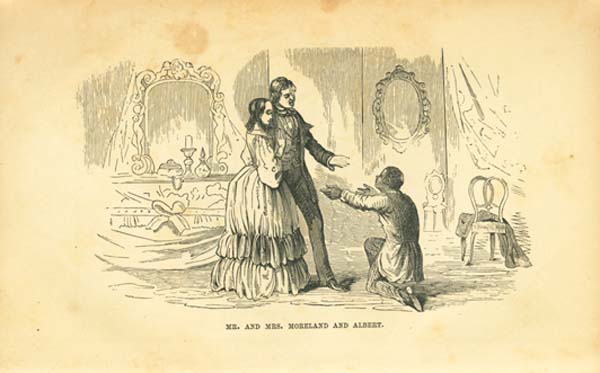
[First Frontispiece Image]
MR. AND MRS. MORELAND AND ALBERT.

[Second Frontispiece Image]
MORELAND ENTERING NANCY'S COTTAGE.

[Title Page Image]
[Title Page Verso Image]
THE
PLANTER'S NORTHERN BRIDE.
BY
MRS. CAROLINE LEE HENTZ.
AUTHOR OF "LINDA," "RENA," "COURTSHIP AND MARRIAGE," "LOVE AFTER MARRIAGE," "THE BANISHED SON," "EOLINE," ETC.
Complete in one large volume, bound in cloth, price One Dollar and Twenty-five cents, or in two volumes, paper cover, for One Dollar.
READ WHAT SOME OF THE LEADING EDITORS SAY OF IT:
"It is unquestionably the most powerful and important, if not the most charming work that has yet flowed from her elegant pen; and though evidently founded upon the all absorbing subjects of slavery and abolitionism, the genius and skill of the fair author have developed new views of golden argument, and flung around the whole such a halo of pathos, interest, and beauty, as to render it every way worthy the author of 'Linda,' 'Marcus Warland,' 'Rena,' and the numerous other literary gems from the same author,"--American Courier.
"We have seldom been more charmed by the perusal of a novel; and we desire to commend it to our readers in the strongest words of praise that our vocabulary affords. The incidents are well varied; the scenes beautifully described; and the interest admirably kept up. But the moral of the book is its highest merit. The 'Planter's Northern Bride' should be as welcome as the dove of peace to every fireside in the Union. It cannot be read without a moistening of the eyes, a softening of the heart, and a mitigation of sectional and most unchristian prejudices."--N. Y. Mirror.
"The most delightful and remarkable book of the day."--Boston Traveler.
"The characters are finely drawn, and well sustained, from the beginning to the end of the work."--Boston Morning Post.
"Written with remarkable vigor, and contains many passages of real eloquence. We heartily commend it to general perusal."--Newark Eagle.
MRS. CAROLINE LEE HENTZ'S OTHER WORKS.
T. B. Peterson having purchased the stereotype plates of all the writing of Mrs. Hentz, he has just published a new, uniform and beautiful edition of all her works, printed on a much finer and better paper, and in far superior and better style to what they have ever before been issued in, (all in uniform style with the Planter's Northern Bride,) copies of any one or all of which will be sent to any place in the United States, free of postage, on receipt of remittances. Each book contains a beautiful illustration of one of the best scenes. The following are the names of these celebrated works:
Page 2
"We hail with pleasure this contribution to the literature of the South. Works containing faithful delineations of Southern life, society, and scenery, whether in the garb of romance or in the soberer attire of simple narrative, cannot fail to have a salutary influence in correcting the false impressions which prevail in regard to our people and institutions; and our thanks are due to Mrs. Hentz for the addition she has made to this department of our native literature. We cannot close without expressing a hope that 'Linda' may be followed by many other works of the same class from the pen of its gifted author."--Southern Literary Gazette. "Mrs. Hentz has given us here a very delightful romance, illustrative of life in the South west, on a Mississippi plantation. There is a well wrought love plot; the characters are well drawn; the incidents are striking and novel; the dénouement happy, and moral excellent. Mrs. Hentz may twine new laurels above her 'Mob Cap.'"--Evening Bulletin. "We cannot admire too much, nor thank Mrs. Hentz too sincerely for the high and ennobling morality and Christian grace, which not only pervade her entire writings, but which shine forth with undimmed beauty in the now novel, Robert Graham. It sustains the character which is very difficult to well delineate in a work of fiction -- a religious missionary. All who read the work will bear testimony to the entire success of Mrs. Hentz."--Boston Transcript. "The thousands who read 'Linda, or, the Young Pilot of the Belle Creole,' will make haste to procure a copy of this book, which is a sequel to that history. Like all of this writer's works, it is natural and graphic, and very entertaining."--City Item. "A charming novel; and in point of plot, style, stud all the other characteristics of a readable romance, it will compare favorably with almost any of the many publications of the season."--Literary Gazette. "'Rena; or, the Snow Bird' elicits a thrill of deep and exquisite pleasure, even exceeding that which accompanied 'Linda,' which was generally admitted to be the best story ever written for a newspaper. That was certainly high praise, but 'Rena' takes precedence even of its predecessor, and, in both, Mrs. Lee Hentz has achieved a triumph of no ordinary kind. It is not that old associations bias our judgment, for though from the appearance, years since, of the famous 'Mob Cap' in this paper, we formed an exalted opinion of the womanly and literary excellence of the writer, our feelings have, in the interim, had quite sufficient leisure to cool; yet, after the lapse of years, we have continued to maintain the same literary devotion to this best of our female writers. The two last productions of Mrs. Lee
Hentz now fully confirm our previously formed opinion, and we unhesitatingly commend 'Rena,' now published in book form, in beautiful style, by T. B. Peterson, as a story which, in its varied, deep, and thrilling interest, has no superior."--American Courier. "This book, by one of the most popular authors in the country, has been issued in the publisher's very best style. There are but few readers of the current literature of the day, who are not acquainted with the name, and the stories of this Authoress. Her style is a pleasing one, and her stories usually strongly marked in incident. The volume now published abounds with the most beautiful scenic descriptions, and displays an intimate acquaintance with all phases of human character; all the characters being exceedingly well drawn. The moral is of a most wholesome character, and the plot, incidents, and management, give evidence of great tact, skill and judgment, on the part of the writer. It is a work which the oldest and the youngest may alike read with profit."--Dollar Newspaper. "It is a tale of Southern life, where Mrs. Hentz is peculiarly at home, And so far as we have had time to examine it, it gives proofs of possessing all the excellencies that have already made her writings so popular throughout the country. The sound, healthy tone of all Mrs. Hentz's tales makes them safe as well as delightful reading, and we can safely and warmly recommend it to all who delight in agreeable fictions. Mr. Peterson has published it in a beautifully printed volume."--Evening Bulletin.
"This work will be found, on perusal by all, to be one of the most exciting, interesting, and popular works that has ever emanated from the American Press. It is written in a charming style, and will elicit through all a thrill of deep and exquisite pleasure. It is a work which the oldest and the youngest may alike read with profit. It abounds with the most beautiful scenic descriptions; and displays an intimate acquaintance with all phases of human character; all the characters being exceedingly well drawn. It is a delightful book, full of incidents, oftentimes bold and startling, and describes the warm feelings of the Southerner in glowing colors. Indeed, all Mrs. Hentz's stories aptly describe Southern life, and
are highly moral in their application. In this field Mrs. Hentz wields a keen sickle, and harvests a rich find abundant crop. It will be found in
plot, incident, and management, to be a superior work. In the whole range of elegant moral fiction, there cannot be found any thing of more
inestimable value, or superior to this work, and it is a gem that will well repay a careful perusal. The Publisher feels assured that it will give entire satisfaction to all readers, encourage good taste and good morals, and while away many leisure hours with great pleasure and profit, and be recommended to others by all that peruse it."
"Every succeeding chapter of this new and beautiful nouvellette of Mrs. Hentz increases in interest and pathos. We defy any one to read aloud the chapters to a listening auditory, without deep emotion, or producing many a pearly tribute to its truthfulness, pathos, and power."--Am. Courier. "It is pleasant to meet now and then with a tale like this, which seems rather like a narrative of real events than a creature of the imagination."--N. Y. Commercial Advertiser. "We venture to assert that there is not one reader who has not been made wiser and better by its perusal -- who has not been enabled to treasure up golden precepts of morality, virtue, and experience, as guiding principles of their own commerce with the world."-- American Courier. "This is a charming and instructive story--one of those beautiful efforts that enchant the mind, refreshing and strengthening it."--City Item.
"The work before us is a charming one."--Boston Evening Journal.
"The 'Banished Son' seems to us the chef d'oeuvre of the collection. It appeals to all the nobler sentiments of humanity, is full of action and healthy excitement and sets forth the best of morals."--Charleston News. "We do not think that amongst American authors, there is one more pleasing or more instructive than Mrs. Hentz. This novel is equal to any which she has written." --Cincinnati Gazette. Copies of either edition of any of the foregoing works will be sent to any person, to any part of the United States, free of postage, on their remitting the price of the ones they may wish, to the publisher, in a letter. Published and for Sale by T. B. PETERSON, BY
Thomas MacKellar
IT was the intention of the author to have
given this book to the world during the course
of the past season, but unforeseen occurrences
have prevented the accomplishment of her purpose.
She no longer regrets the delay, as she believes
it will meet a more cordial reception at the present time. When individual or public feeling is too highly
wrought on any subject, there must inevitably
follow a reaction, and reason, recovering from the
effects of transient inebriation, is ready to assert
its original sovereignty. Not in the spirit of egotism, do we repeat what
was said in the preface of a former work, that we
were born at the North, and though destiny has
removed us far from our native scenes, we cherish
for them a sacred regard, an undying attachment.
It cannot therefore be supposed that we are actuated
by hostility or prejudice, in endeavouring
to represent the unhappy consequences of that
intolerant and fanatical spirit, whose fatal influence
we so deeply deplore. We believe that there are a host of noble,
liberal minds, of warm, generous, candid hearts,
at the North, that will bear us out in our views
of Southern character, and that feel with us that
our national honour is tarnished, when a portion
of our country is held up to public disgrace and
foreign insult, by those, too, whom every feeling
of patriotism should lead to defend it from ignominy
and shield it from dishonour. The hope that they
will appreciate and do justice to our motives, has
imparted enthusiasm to our feelings, and energy to
our will, in the prosecution of our literary labour. When we have seen the dark and horrible
pictures drawn of slavery and exhibited to a gazing
world, we have wondered if we were one of
those favoured individuals to whom the fair side of
life is ever turned, or whether we were created
with a moral blindness, incapable of distinguishing
its lights and shadows. One thing is certain,
and if we were on judicial oath we would repeat
it, that during our residence in the South, we
have never witnessed one scene of cruelty or
oppression, never beheld a chain or a manacle, or
the infliction of a punishment more severe than
parental authority would be justified in applying
to filial disobedience or transgression. This is
not owing to our being placed in a limited sphere
of observation, for we have seen and studied domestic,
social, and plantation life, in Carolina, Alabama,
Georgia, and Florida. We have been admitted into
close and familiar communion with numerous families
in each of these States, not merely as a passing visiter,
but as an indwelling guest, and we have never been
pained by an inhuman exercise of authority, or a wanton
abuse of power. On the contrary, we have been touched and
gratified by the exhibition of affectionate kindness
and care on one side, and loyal and devoted
attachment on the other. We have been especially
struck with the cheerfulness and contentment
of the slaves, and their usually elastic and
buoyant spirits. From the abundant opportunities
we have had of judging, we give it as our
honest belief, that the negroes of the South are
the happiest labouring class on the face of the
globe; even subtracting from their portion of
enjoyment all that can truly be said of their trials
and sufferings. The fugitives who fly to the
Northern States are no proof against the truth
of this statement. They have most of them been
made disaffected by the influence of others--
tempted by promises which are seldom fulfilled[.]
Even in the garden of Eden, the seeds of discontent
and rebellion were sown; surely we need
not wonder that they sometimes take root in the
beautiful groves of the South. In the large cities we have heard of families
who were cruel to their slaves, as well as unnaturally
severe in the discipline of their children.
(Are there no similar instances at the North?)
But the indignant feeling which any known
instance of inhumanity calls forth at the South,
proves that they are not of common occurrence. We have conversed a great deal with the
coloured people, feeling the deepest interest in
learning their own views of their peculiar situation,
and we have almost invariably been delighted and
affected by their humble devotion to their master's
family, their child-like, affectionate
reliance on their care and protection, and above
all, with their genuine cheerfulness and
contentment. This very morning, since commencing these
remarks, our sympathies have been strongly
moved by the simple eloquence of a negro woman
in speaking of her former master and mistress,
who have been dead for many years. "Oh!" said she, her eyes swimming with tears,
and her voice choking with emotion, "I loved
my master and mistress like my own soul. If I
could have died in their stead, I would gladly
done it. I would have gone into the grave and
brought them up, if the Lord had let me do it.
Oh! they were so good--so kind. All on us
black folks would 'ave laid down our lives for
'em at any minute." "Then you were happy?" we said; "you did
not sigh to be free?" "No, mistress, that I didn't. I was too well
off for that. I wouldn't have left my master and
mistress for all the freedom in the world. I'd
left my own father and mother first. I loved
'em better than I done them. I loved their children
too. Every one of 'em has been babies in
my arms--and I loved 'em a heap better than I
done my own, I want to stay with 'em as long
as I live, and I know they will take care of me
when I get too old to work." These are her own words. We have not
sought this simple instance of faithful and enduring
love. It came to us as if in corroboration of
our previous remarks, and we could not help
recording it. The history of Crissy and the circumstances of
her abduction are true. The character of Dr. Darley is drawn from life.
Though death has now set the seal of eternity
on his virtues, we would not violate the sanctity
of private life by bringing his real name before
the public. Should those he loved best on earth
recognise the lineaments we have attempted to
draw, may they accept this imperfect tribute to
his exalted worth, his brilliant and commanding
talents, as well as his pure and genuine
philanthropy. Many of the circumstance we have recorded
in these pages are founded on truth. The plot
of the insurrection, the manner in which it was
instigated and detected, and the brief history of
Nat, the giant, with his domestication in a Northern
family, are literally true. If any one should think the affection manifested
by the slaves of Moreland for their master
is too highly coloured, we would refer them to
the sketch of Thomas Jefferson's arrival at Monticello
on his return from Paris, after an absence of five
years. It is from the pen of his daughter, and no one
will doubt its authenticity. "The negroes discovered the approach of the
carriage as soon as it reached Shadwell, and such
a scene I never witnessed in my life. They collected
in crowds around it, and almost drew it
up the mountain by hand. The shouting, &c.,
had been sufficiently obstreperous before, but the
moment the carriage arrived on the top it reached
the climax. When the door of the carriage was
opened, they received him in their arms and bore
him into the house, crowding around, kissing his
hands and feet, some blubbering and crying,
others laughing. It appeared impossible to satisfy
their eyes, or their anxiety to touch, and even
to kiss the very earth that bore him. These
were the first ebullitions of joy for his return,
after a long absence, which they would of course
feel; but it is perhaps not out of place to add
here, that they were at all times very devoted in
their attachment to their master. They believed
him to be one of the greatest, and they knew him
to be one of the best of men, and kindest of masters.
They spoke to him freely, and applied confidingly
to him in all their difficulties and distresses; and he
watched over them in sickness and health; interested
himself in all their concerns; advising them, and
showing esteem and confidence in the good, and
indulgence to all." We can add nothing to this simple, pathetic
description. Monticello is hallowed ground, and
the testimony that proceeds from its venerated
retreat should be listened to with respect and
confidence. The same accents might be heard
from Mount Vernon's august shades, where the
grave of Washington has been bedewed by the
tears of the grateful African. But we have done. If we fail to accomplish the purpose for which
we have written, we shall at least have the consolation
of knowing that our motives are disinterested, and
our aim patriotic and true. Should no Northern heart respond to our earnest
appeal, we trust the voice of the South will
answer to our own, not in a faint, cold, dying
echo, but in a full, spontaneous strain, whose
reverberations shall reach to the green hills and
granite cliffs of New England's "rock-bound
coast." CAROLINE LEE HENTZ.
MR. MORELAND, a Southern planter, was travelling
through the New England States in the bright season of a
Northern spring. Business with some of the merchant
princes of Boston had brought him to the North;
but a desire to become familiar with the beautiful
surroundings of the metropolis induced him to linger
long after it was transacted, to gratify the taste and
curiosity of an intelligent and liberal mind. He was rich
and independent, had leisure as well as wealth at his
command, and there was something in the deep green
fields and clear blue waters of New England that gave a
freshness, and brightness, and elasticity to his spirits,
wanting in his milder, sunnier latitude. He found himself one Saturday night in a sweet
country village, whose boundaries were marked by the
most luxuriant shubbery and trees, in the midst of which
a thousand silver rills were gushing. He was pleased
with the prospect of passing the ensuing Sunday in a
valley so serene and quiet, that it seemed as if Nature
enjoyed in its shades the repose of an eternal Sabbath.
The inn where he stopped was a neat, orderly place, and
though the landlord impressed him, at first, as a hard,
repulsive looking man, with a dark, Indian face, and
large, iron-bound frame, he found him ready to perform
all the duties of a host. Requesting to be shown to a
private apartment, he ordered Albert, a young mulatto
who accompanied him on his journey, to follow him with
his valise. Albert was a handsome, golden-skinned
youth, with shining black hair and eyes, dressed very
nearly as genteelly as his master, and who generally
attracted more attention on their Northern tour. Accustomed
to wait on his master and listen to the conversation of refined
and educated gentlemen, he had very little of the dialect of the
negro, and those familiar with the almost unintelligible jargon
which delineators of the sable character put into their lips, could
not but be astonished at the propriety of his language and
pronunciation. When Mr. Moreland started on his journey to the
North, his friends endeavoured to dissuade him from
taking a servant with him, as he would incur the danger
of losing him among the granite hills to which he was
bound:--they especially warned him of the risk of taking
Albert, whose superior intelligence and cultivation would
render him more accessible to the arguments which would
probably be brought forward to lure him from his allegiance. "I defy all the eloquence of the North to induce Albert to
leave me," exclaimed Mr. Moreland. "Let them do it if they
can. Albert," he said, calling the boy to him, who was busily
employed in brushing and polishing his master's boots, with
a friction quick enough to create sparkles of light. "Albert,--I
am going to the North,--would you like to go with me?" "To be sure I would, master, I would like to go
anywhere in the world with you." "You know the people are all free at the North,
Albert. " "Yes, master. "And when you are there, they will very likely try
to persuade you that you are free too, and tell you it is
your duty to run away from me, and set up for a gentleman
yourself. What do you think of all this?" Albert suspended his brush in the air, drew up his
left shoulder with a significant shrug, darted an oblique
glance at his master from his bright black eyes, and then
renewed his friction with accelerated velocity. "Well, my boy, you have not answered me," cried
Mr. Moreland, in a careless, yet interested manner,
peculiar to himself. "Why, you see, Mars. Russell (when he addressed his
master by his Christian name, he always abbreviated his
title in this manner, though when the name was omitted
he uttered the title in all its dignity),--"you see, Mars.
Russell,"--here the mulatto slipped the boot from his
arm, placed it on the floor, and still retaining the brush
in his right hand, folded his arms across his breast, and
spoke deliberately and earnestly,--"they couldn't come
round this boy with that story; I've hearn it often enough
already; I ain't afraid of anything they can say and do,
to get me away from you as long as you want me to
stay with you. But if you are afraid to trust me, master,
that's another thing. You'd better leave me, if you
think I'd be mean enough to run away." "Well said, Albert!" exclaimed Mr. Moreland,
laughing at the air of injured honour and conscious
self-appreciation he assumed; "I do trust you, and shall
surely take you with me; you can make yourself very
amusing to the people, by telling them of your home
frolics, such as being chained, handcuffed, scourged,
flayed, and burned alive, and all those little trifles
they are so much interested in." "Oh! master, I wish I may find everybody as well
off as I am. If there's no lies told on you but what I
tell, you'll be mighty safe, I know. Ever since Miss
Claudia"-- "Enough," cried Mr. Moreland, hastily interrupting
him. He had breathed a name which evidently awakened
painful recollections, for his sunshiny countenance became
suddenly dark and cold. Albert, who seemed familiar
with his master's varying moods, respectfully resumed
his occupation, while Mr. Moreland took up his hat
and plunged into the soft, balmy atmosphere of a
Southern spring morning. It is not our intention to go back and relate the past
history of Mr. Moreland. It will be gathered in the
midst of unfolding events, at least all that is necessary
for the interest of our story. We will therefore return
to the white-walled inn of the fair New England village,
where our traveller was seated, enjoying the long, dewy
twilight of the new region in which he was making a
temporary rest. The sun had gone down, but the glow
of his parting smile lingered on the landscape and
reddened the stream that gleamed and flashed through
the distant shrubbery. Not far from the inn, on a gradual
eminence, rose the village church, whose tall spire,
surmounted by a horizontal vane, reposed on the golden
clouds of sunset, resembling the crucifix of some gorgeous
cathedral. This edifice was situated far back from the road,
surrounded by a common of the richest green, in the centre
of which rose the swelling mound, consecrated by the
house of God. Some very handsome buildings were seen
at regular intervals, on either side of the road, among
which the court-house stood conspicuous, with its
freestone-coloured wall and lofty cupola. There was
something in the aspect of that church, with its
heaven-ascending spire, whose glory-crown of lingering
day-beams glittered with a kind of celestial splendour,
reminding him of the halo which encircles the brows
of saints; something in the deep tranquillity of the hour,
the soft, hazy, undulating outline of the distant horizon,
the swaying motion of the tall poplars that margined the
street far as his eye could reach, and through whose
darkening vista a solitary figure gradually lessened on
the eye, that solemnized and even saddened the spirits
of our traveller. The remembrances of early youth and
opening manhood pressed upon him with suddenly
awakened force. Hopes, on which so sad and awful a
blight had fallen, raised themselves like faded flowers
sprinkled with dew, and mocked him with their visionary
bloom. In the excitement of travelling, the realities of
business, the frequent collision of interests, the
championship of oft invaded rights, he had lost much
of that morbidness of feeling and restlessness of
character, which, being more accidental than inherent,
would naturally yield to the force of circumstances
counter to those in which they were born. But at the
close of any arbitrary division of time, such as the last
day of the week or the year, the mind is disposed to
deeper meditation, and the mental burden, whose weight
has been equipoised by worldly six-day cares, rolls back
upon the mind with leaden oppression. Moreland had too great a respect for the institutions
of religion, too deep an inner sense of its power, to
think of continuing his journey on the Sabbath, and he
was glad that the chamber which he occupied looked out
upon that serene landscape, and that the morning shadow
of the lofty church-spire would be thrown across his
window. It seemed to him he had seen this valley before,
with its beautiful green, grassy slopes, its sunset-gilded
church, and dark poplar avenue. And it seemed to him also,
that he had seen a fair maiden form gliding through the
central aisle of that temple, in robes of virgin white,
and soft, down-bending eyes of dark brown lustre, and brow
of moonlight calmness. It was one of those dim reminiscences,
those vague, dream-like consciousnesses of a previous
existence, which every being of poetic temperament is
sometimes aware of, and though they come, faint shadows
of a far-off world, quick and vanishing as lightning, they
nevertheless leave certain traces of their presence,
"trails of glory," as a great poet has called them,
proceeding from the spirit's home. While he sat leaning in silence against the window
frame, the bell of the church began to toll slowly and
solemnly, and as the sounds rolled heavily and gloomily
along, then reverberated and vibrated with melancholy
prolongation, sending out a sad, dying echo, followed by
another majestic, startling peal, he wondered to hear
such a funeral knell at that twilight hour, and looked up
the shadowy line of poplars for the dark procession
leading to the grave. Nothing was seen, however, and
nothing heard but those monotonous, heavy, mournful
peals, which seemed to sweep by him with the flaps of
the raven's wings. Twenty times the bell tolled, and
then all was still. "What means the tolling of the bell?" asked he of
the landlord, who was walking beneath the window.
" Is there a funeral at this late hour?" "A young woman has just died," replied the landlord.
"They are tolling her age. It is a custom of our village." Moreland drew back with a shudder. Just twenty.
That was her age. She had not died, and yet the death-bell
might well ring a deeper knell over her than the being who
had just departed. In the grave the remembrance of the
bitterest wrongs are buried, and the most vindictive cease
to thirst for vengeance. Moreland was glad when a
summons to supper turned his thoughts into a different
channel. There might have been a dozen men seated around
the table, some whose dress and manners proclaimed that
they were gentlemen, others evidently of a coarser
grain. They all looked up at the entrance of Moreland,
who, with a bow, such as the courteous stranger is
always ready to make, took his seat, while Albert placed
himself behind his master's chair. "Take a seat," said Mr. Grimby, the landlord,
looking at Albert. "There's one by the gentleman.
Plenty of room for us all."* "My boy will wait," cried Mr. Moreland with
unconscious haughtiness, while his pale cheek visibly
reddened. "I would thank you to leave the arrangement
of such things to myself." "No offence, I hope, sir," rejoined Mr. Grimby.
"We look upon everybody here as free and equal. This
is a free country, and when folks come among us we
don't see why they can't conform to our ways of thinking.
There's a proverb that says--'when you're with
the Romans, it's best to do as the Romans do.' " "Am I to understand," said Mr. Moreland, fixing his
eye deliberately on his Indian-visaged host, "that you
wish my servant to sit down with yourself and these
gentlemen?" "To be sure I do," replied the landlord, winking his
small black eye knowingly at his left-hand neighbour.
"I don't see why he isn't as good as the rest of us.
I'm an enemy to all distinctions myself, and I'd like to
bring everybody round to my opinion." "Albert!" cried his master, "obey the landlord's
wishes. I want no supper; take my seat and see that you
are well attended to." "Mars. Russell," said the mulatto, in a confused and
deprecating tone. "Do as I tell you," exclaimed Mr. Moreland, in a
tone of authority, which, though tempered by kindness,
Albert understood too well to resist. As Moreland
passed from the room, a gentleman, with a very
preposessing countenance and address, who was seated on the
opposite side of the table, rose and followed him. "I am sorry you have had so poor a specimen of
Northern politeness," said the gentleman, accosting
Moreland, with a slight embarrassment of manner. "I
trust you do not think we all endorse such sentiments." "I certainly must make you an exception, sir,"
replied Moreland, holding out his hand with involuntary
frankness; "but I fear there are but very few. This
is, however, the first direct attack I have received,
and I hardly knew in what way to meet it. I have too much
self-respect to place myself on a level with a man so
infinitely my inferior. That he intended to insult me, I
know by his manner. He knows our customs at home,
and that nothing could be done in more positive violation
of them than his unwarrantable proposition." They had walked out in the open air while they were
speaking, and continued their walk through the poplar
avenue, through whose stiff and stately branches the
first stars of evening were beginning to glisten. "I should think you would fear the effect of these
things on your servant," said the gentleman,--"that
it would make him insolent and rebellious. Pardon me,
sir, but I think you were rather imprudent in bringing
him with you, and exposing him to the influences which
must meet him on every side. You will not be surprised,
after the instance which has just occurred, when I tell
you, that, in this village, you are in the very hot-bed of
fanaticism; and that a Southern planter, accompanied by his
slave, can meet but little sympathy, consideration, or
toleration; I fear there will be strong efforts made to induce
your boy to leave you." "I fear nothing of that kind," answered Moreland.
"If they can bribe him from me, let him go. I brought him
far less to minister to my wants than to test his fidelity and
affection. I believe them proof against any temptation or
assault; if I am deceived I wish to know it, though the pang
would be as severe as if my own brother should lift his hand
against me." "Indeed!--I did not imagine that the feelings were ever
so deeply interested. While I respect your rights, and resent
any ungentlemanlike infringement of them, as in the case of
our landlord, I cannot conceive how beings, who are ranked
as goods and chattels, things of bargain and traffic, can
ever fill the place of a friend or brother in the heart." "Nevertheless, I assure you, that next to our own
kindred, we look upon our slaves as our best friends." As they came out of the avenue into the open street,
they perceived the figure of a woman, walking with slow
steps before them, bearing a large bundle under her arm;
she paused several times, as if to recover breath, and once
she stopped and leaned against the fence, while a dry,
hollow cough rent her frame. "Nancy," said the gentleman, "is that you?-- you should
not be out in the night air."
The woman turned round, and the starlight fell on a pale
and wasted face. "I can't help it," she answered,--"I can't hold out any
longer,--I can't work any more;--I ain't strong enough to
do a single chore now; and Mr. Grimby says he hadn't got any
room for me to lay by in. My wages stopped three weeks
ago. He says there's no use in my hanging on any longer,
for I'll never be good for anything any more." "Where are you going now?" said the gentleman. "Home!" was the reply, in a tone of deep and hopeless
despondency,--"Home, to my poor old mother. I've
supported her by my wages ever since I've been hired out;
that's the reason I haven't laid up any. God knows--" Here she stopped, for her words were evidently choked
by an awful realization of the irremediable misery of her
condition. Moreland listened with eager interest. His
compassion was awakened, and so were other feelings.
Here was a problem he earnestly desired to solve, and he
determined to avail himself of the opportunity thrown in his
path. "How far is your home from here?" he asked. "About three-quarters of a mile." "Give me your bundle--I'll carry it for you, you are too
feeble; nay, I insist upon it." Taking the bundle from the reluctant hand of the poor
woman, he swung it lightly upward and poised it
on his left shoulder. His companion turned with a look of
unfeigned surprise towards the elegant and evidently
high-bred stranger, thus courteously relieving poverty and
weakness of an oppressive burden. "Suffer me to assist you," said he. "You must be very
unaccustomed to services of this kind; I ought to have
anticipated you." "I am not accustomed to do such things for myself,"
answered Moreland, "because there is no occasion; but it
only makes me more willing to do them for others. You look
upon us as very self-indulging beings, do you not?" "We think your institutions calculated to promote the
growth of self-indulgence and selfishness. The virtues that
resist their opposing influences must have more than
common vitality." "We, who know the full length and breadth of our
responsibilities, have less time than any other men for self-indulgence. We feel that life is too short for the
performance of our duties, made doubly arduous and
irksome by the misapprehension and prejudice of those
who ought to know us better and judge us more justly and
kindly. My good woman, do we walk too fast?" "Oh, no, sir. I so long to get home, but I am so ashamed
to have you carry that bundle." He had forgotten the encumbrance in studying the
domestic problem, presented to him for solution. Here was
a poor young woman, entirely dependent on her
daily labour for the support of herself and aged mother,
incapacitated by sickness from ministering to their
necessities, thrown back upon her home, without the means
of subsistence: in prospective, a death of lingering torture for
herself, for her mother a life of destitution or a shelter in the
almshouse. For every comfort, for the bare necessaries of
life, they must depend upon the compassion of the public;
the attendance of a physician must be the work of charity,
their existence a burden on others. She had probably been a faithful labourer in her employer's
family, while health and strength lasted. He was an honest
man in the common acceptation of the word, and had doled
out her weekly wages as long as they were earned; but he
was not rich, he had no superfluous gold, and could not
afford to pay to her what was due to her stronger and more
healthy successor; he could not afford to give her even the
room which was required by another. What could she do
but go to her desolate home and die? She could not
murmur. She had no claim on the affection of the man in
whose service she had been employed. She had lived with
him in the capacity of a hireling, and he, satisfied that he
paid her the utmost farthing which justice required,
dismissed her, without incurring the censure of unkindness
or injustice. We ought to add, without deserving it. There
were others far more able than himself to take
care of her, and a home provided by the parish for every
unsheltered head. Moreland, whose moral perceptions were rendered very
acute by observation, drew a contrast in his own mind,
between the Northern and Southern labourer, when reduced
to a state of sickness and dependence. He brought his own
experience in comparison with the lesson of the present
hour, and thought that the sick and dying negro, retained
under his master's roof, kindly nursed and ministered unto,
with no sad, anxious lookings forward into the morrow for
the supply of nature's wants, no fears of being cast into the
pauper's home, or of being made a member of that unhappy
family, consecrated by no head, hallowed by no domestic
relationship, had in contrast a far happier lot. In the latter
case there was no sickness, without its most horrible
concomitant, poverty, without the harrowing circumstances
connected with public charity, or the capricious influence of
private compassion. It is true, the nominal bondage of the
slave was wanting, but there was the bondage of poverty,
whose iron chains are heard clanking in every region of
God's earth, whose dark links are wrought in the forge of human
suffering, eating slowly into the quivering flesh, till they
reach and dry up the life-blood of the heart. It has often
been said that there need be no such thing as poverty in this
free and happy land; that here it is only the offspring of vice
and intemperance; that the avenues of wealth and
distinction are open to all.
and that all who choose may arrive at the golden portals of
success and honour, and enter boldly in. Whether this be
true or not, let the thousand toiling operatives of the
Northern manufactories tell; let the poor, starving
seamstresses, whose pallid faces mingle their chill, wintry
gleams with the summer glow and splendour of the
Northern cities, tell; let the free negroes, congregated in the
suburbs of some of our modern Babylons, lured from their
homes by hopes based on sand, without forethought,
experience, or employment, without sympathy, influence, or
caste, let them also tell. When Moreland reached the low, dark-walled cottage
which Nancy pointed out as her home, he gave her back her
bundle, and at the same time slipped a bill into her hand, of
whose amount she could not be aware. But she knew by the
soft, yielding paper the nature of the gift, and something
whispered her that it was no niggard boon. "Oh, sir," she cried, "you are too good. God bless you,
sir, over and over again!" She stood in the doorway of the little cabin, and the dull
light within played luridly on her sharpened and emaciated
features. Her large black eyes were burning with
consumption's wasting fires, and a deep red, central spot in
each concave cheek, like the flame of the magic cauldron,
was fed with blood alone. Large tears were now sparkling in
those glowing flame-spots, but they did not extinguish their
wasting brightness.
"Poor creature!" thought Moreland. "Her day of toil is
indeed over. There is nothing left for her but to endure and
to die. She has learned to labour, she must now learn to wait." As he turned from the door, resolving to call again before
he left the village, he saw his companion step back and
speak to her, extending his hand at the same time.
Perceiving that he was actuated by the Christian spirit,
which does not wish the left hand to know what the right
hand doeth, he walked slowly on, through an atmosphere
perfumed by the delicious but oppressive fragrance of the
blossoming lilacs, that lent to this obscure habitation a
certain poetic charm. During their walk back to the inn, he became more and
more pleased with his new acquaintance, whose name he
ascertained was Brooks, by profession an architect of
bridges. He was not a resident of the village, but was now
engaged in erecting a central bridge over the river that
divided the village from the main body of the town. As his
interests were not identified with the place or the people,
his opinions were received by Moreland with more faith
and confidence than if they issued from the lips of a native
inhabitant. When they returned to the inn, they found Albert
waiting at the door, with a countenance of mingled vexation
and triumph. The landlord and several other men were
standing near him, and had evidently been engaged in
earnest conversation. The sudden cessation
of this, on the approach of Mr. Moreland, proved that he
had been the subject of it, and from the manner in which
they drew back as he entered the passage, he imagined
their remarks were not of the most flattering nature. "Well, Albert, my boy," said he, when they were alone in
his chamber, "I hope you relished your supper." "Please, Mars. Russell, don't do that again. I made 'em
wait on me this time, but it don't seem right. Besides, I don't
feel on an equality with 'em, no way. They are no
gentlemen." Moreland laughed. "What were they talking to you about so earnestly as I
entered?" asked he. "About how you treated me and the rest of us. Why,
Mars. Russell, they don't know nothing about us. They
want to know if we don't wear chains at home and manacles
about our wrists. One asked if you didn't give us fodder to
eat. Another wanted to strip off my coat, to see if my back
wa'n't all covered with scars. I wish you'd heard what I told
'em. Master, I wish you'd heard the way I give it to 'em." "I have no doubt you did me justice, Albert. My feelings
are not in the least wounded, though my sense of justice is
pained. Why, I should think the sight of your round, sleek
cheeks, and sound, active limbs would be the best
argument in my favour. They must believe you thrive
wonderfully on fodder."
"What you think one of 'em said, Mars. Russell? They
say you fatten me up, you dress me up, and carry me 'bout
as a show-boy, to make folks think you treat us all well, but
that the niggers at home are treated worse than dogs or
cattle, a heap worse. I tell 'em it's all one big lie. I tell 'em
you're the best--" "Never mind, Albert. That will do. I want to think--" Albert never ventured to intrude on his master's thinking
moments, and, turning away in respectful silence, he soon
stretched himself on the carpet and sunk in a profound
sleep. In the mean time Moreland waded through a deep
current of thought, that swelled as it rolled, and ofttimes it
was turbid and foaming, and sometimes it seemed of icy
chillness. He was a man of strong intellect and strong
passions; but the latter, being under the control of
principle, gave force and energy and warmth to a character
which, if unrestrained, they would have defaced and laid
waste. He was a searcher after truth, and felt ready and
brave enough to plunge into the cold abyss, where it is said
to be hidden, or to encounter the fires of persecution, the
thorns of prejudice, to hazard everything, to suffer
everything, rather than relinquish the hope of attaining it.
He pondered much on the condition of mankind, its
inequalities and wrongs. He thought of the poor and
subservient in other lands, and compared them with our
own. He thought of the groaning serfs of Russia; the
starving sons of Ireland; the
squalid operatives of England, its dark, subterranean
workshops, sunless abodes of want, misery, and sin, its
toiling millions, doomed to drain their hearts' best blood to
add to the splendours and luxuries of royalty and rank; of
the free hirelings of the North, who, as a class, travail in
discontent and repining, anxious to throw off the yoke of
servitude, sighing for an equality which exists only in name;
and then he turned his thoughts homeward, to the enslaved
children of Africa, and, taking them as a class, as a distinct race
of beings, he came to the irresistible conclusion, that they were
the happiest subservient race that were found on the face of the
globe. He did not seek to disguise to himself the evils which were
inseparably connected with their condition, or that man too
oft abused the power he owned; but in view of all this, in
view of the great, commanding truth, that wherever civilized
man exists, there is the dividing line of the high and the low,
the rich and the poor, the thinking and the labouring, in view
of the God-proclaimed fact that "all Creation toileth and
groaneth together," and that labour and suffering are the
solemn sacraments of life, he believed that the slaves of the
South were blest beyond the pallid slaves of Europe, or the
anxious, care-worn labourers of the North. With this conviction he fell asleep, and in his dreams he
still tried to unravel the mystery of life, and to reconcile its
inequalities with the justice and mercy of an omnipotent
God.
MORELAND breakfasted in his own room, and the
peace of the Sabbath morning brooded on his heart. He took
his seat at the window, and watched the shadows of the
trees playing on the white walls of the church, and the
golden gleam of its vane flashing on the blue of the sky. He
was glad when the deep-toned bell called the worshippers
together, and the people began to ascend the grassy slope
that led up to the house of God. Mr. Brooks, his new friend,
offered to accompany him and usher him to a seat; an offer
he gratefully accepted. The pew to which he conducted him
was situated at the right hand of the pulpit, in one of the
wings of the church, so that he was facing the congregation,
and could see them without appearing to gaze, as they
glided, one by one, up the central aisle, to their accustomed
places. The interior of the church was very simple and pure. The
green curtains and hangings of the pulpit, and the green
screen that ran around the gallery, made a charming
contrast with the unsullied whiteness of the
walls, and harmonized with the green boughs that shaded
the windows, and the green grass that carpeted the
common. There was no organ, with gilded pipes and sounding
bellows, to give dignity to the orchestra, but Moreland
caught a glimpse of white robes behind the curtain of the
gallery, and he was sure some beautiful daughters of Zion
were assembled there to sing praises to their God. He
wanted the service to commence, so that he could see the
figures of that vestal choir, as well as hear their mingling
voices. His ear was gratified before his eye, for while waiting
the coming of the minister, an anthem began to roll forth
from the invisible band, whose notes filled the intervals of
sound between the echoing peals of the bell. The
commencing words of the anthem were grand. Moreland
had heard them before, but they came to him with a new
sense, because he was prepared to receive new
impressions. Among the voices that gave utterance to these adoring
words, was one which, though sweet and soft and feminine
beyond expression, seemed to drown every other. It rose,
like the imagined hymn of an angel, clear and swelling, and
then died gently away, to rise again with richer, fuller
harmony. Moreland, whose devotional
feelings were always exalted by sacred music, listened with
breathless rapture, wondering what sweet bird of song had
folded its wings behind that green enclosure. At the conclusion of the anthem, where it is affirmed that
when again and again the sublime refrain was repeated, that
single voice alone fell upon his ear. On that alone the
"rolling years" seemed borne onward to eternity. Other
voices sang, and their notes died away; but hers kept
rolling and warbling round the arching walls of the church,
till the house was filled with their melody, and Moreland
kept looking up, almost expecting to see them forming into
something visible, as well as audible, into silvery or crystal
rings, sparkling and glittering on the eye. He held his breath
so long, that the act of respiration became painful, when
renewed, and so intensely had he listened that the moisture
gathered on his brow. The anthem ceased as the venerable minister walked up
the aisle and ascended the pulpit. He looked congenial with
the music that heralded his approach, with his silver hair,
mild, benignant countenance, and deep set thoughtful
eyes. He was just such a minister as on would associate in
idea with that pure, simple church and white-robed singing
band. His prayer breathed the very spirit of devotion. It
reminded Moreland of the "Lord, save or we perish" of
drowning Peter--"God
be merciful to me a sinner" of the weeping publican. After
the reading of a beautiful opening hymn, the choir rose, and
the eyes of Moreland rested on one fair face, which he
knew, by intuition, belonged to the minstrel maiden whose
voice had so charmed his ear. It rose above the green
curtain like a lily from its bed of sheathing leaves, so fair, so
spiritual, so serene, it was impossible not to imagine an
atmosphere of fragrance surrounding its purity and bloom.
He was right. The hymn commenced, and the same sweet
strains gushed from the lips, on which he was now gazing.
He could not see the colour of her eyes, for they were
downcast, but he could see the soft shadow of long, dark,
drooping lashes on her cheeks, and he could see the bright,
deep hue of chestnut brown that dyed her hair. He
remembered the vision that had flitted before him the
preceding evening, and it seemed to him that he had met
this maiden stranger in some of the dim-remembered scenes
of a past eternity. He could not shake off this wild
idea, born of a poetic temperament and excited imagination.
What was there about this young female that so singularly
attracted him;--him, who had lately abjured the very
thought of woman, in a widowhood of heart, far deeper and
sadder than that which death creates; who had torn from
his bosom the wilted garlands of love, and cast them, in
indignation and despair, at the feet of a fallen and degraded
idol? She was not more beautiful than some of her
companions, perhaps
not as beautiful as some, and yet he gazed only on her,
watching the lifting of her drooping lids, as the Persian
watches the rising of the star of day. It was not till the close
of the hymn, the beginning of the sermon, after the curtain
was drawn on one side and the singers seated, that she
raised her eyes and fixed them steadily on the evangelical
countenance of the pastor. Though bent on another,
Moreland felt their dark magnetism to his heart's core. This
sudden, powerful attraction, exercised by the simple village
maiden, would not have been so strange had he been a
young, romantic boy; but he was a man of some sad
experience, who, before he entered that church, believed
himself cold and insensible to the most seductive charms of
womankind. At length, roused to the reflection that he might
attract observation by the intensity of his gaze, he turned
also towards the minister and endeavoured to rivet his
attention on the truths he uttered. It is not to be supposed
that a distinguished-looking stranger would pass entirely
unnoticed in a village church, and there was many an eye
perusing his face, while his was bent on the gallery; and
there were some who thought his fixed and earnest gaze the
bold, free stare of conscious wealth and arrogance. They
had heard that a Southern gentleman, accompanied by a
mulatto slave, had stopped at the inn the preceding night,
and they were not slow in identifying the individual with the
handsome stranger before them. There were a few, however,
who did not judge
him in this harsh manner, who had heard--(strange how
quickly such things are winged in a country village)--how
he had carried Nancy Brown's bundle all the way home for
her, and put in her hand a ten dollar bill, without saying a
word about it, and they lifted up their hearts and blessed
him, though he knew it not. When the benediction was pronounced, and the
congregation passed out, Moreland lingered in the
vestibule waiting for the choristers to descend. SHE came
at last, leading by the hand a little girl of about five years of
age, whose countenance bore a strong resemblance to her
own. So many people were crowded in the doorways, she
was obliged to pass so close to Moreland that her white
dress floated against him; and if it had been
the wing of a seraph he could not have felt a thrill of deeper
reverence. She did not look at him, but he felt, by the colour
that glowed on the lilies of her cheek, that she was aware of
his presence and his gaze. "Eula!" said the little girl, "don't walk so fast; Papa is
coming." Eula!--blessings on that cherub mouth for pronouncing
the name he so longed to know. But that large bustling
gentleman, with reddish-auburn hair and florid complexion,
and small, keen, restless black eyes, was that Eula's father?
To be sure, it must be, for does she not take his arm with an
affectionate, confiding air; and does not the little smiling
five-year old thing frisk round to the other side of him,
catching hold of his
hand as if it were an ingot of gold she was grasping,
instead of four freckled fingers and one stout thumb! "Who is that reddish-haired gentleman?" asked
Moreland of Mr. Brooks, as they walked slowly in the wake
of light the sweet-voiced maiden seemed to leave behind
her. "His name is Hastings," replied his companion, "one of
the most conspicuous characters in the village. He is
considered a very shrewd, intelligent man, and, although
not at all popular, has nevertheless a great deal of influence
in the community." "What is his profession?" "He cannot be said to have any exclusive profession.
He prepares young men for college, edits a paper called the
"Emancipator," writes essays, delivers public lectures on
all the leading topics of the day, and, among these, as you
are doubtless prepared to hear, slavery, or rather
anti-slavery, occupies a very conspicuous place." "Indeed!" cried Moreland, with an unaccountable
feeling of pain at the intelligence; "and is that young lady
on his right arm his own daughter?" "Yes! that is Miss Eulalia Hastings, or, as she is often
called, the Flower of the village. She sings like an angel.
You heard her voice in church. She is highly educated and
accomplished, though she is so modest and retiring she
makes no display. She is universally beloved and admired,
and makes friends even of her father's enemies."
"Of course, she inherits all her father's prejudices against
the South?" remarked Moreland, in a tone that seemed to
ask a negation. "Very probably; though they must be softened by
passing through such a medium. I heard him say once, that
if wife or child of his were languishing in a consumption, and
he knew he could add ten years to their lives by sending
them to the milder climate of the South, his conscience
would not justify the act, so utterly does he abhor its
institutions." "You think, then, he would not allow his daughter to
marry a Southerner?" This was said in a light, sarcastic
tone, which was followed by one more serious. "Is he a
man of wealth as well as influence?" "No, not at all. His father left him considerable property,
but he has wasted it in fruitless speculations and visionary
schemes for the improvement of the age. He always has a
hobby which he rides without mercy or judgment. The one
on which he is mounted at present is the immediate
emancipation of the negro race. You must not feel slighted
if he invites your servant (I do not like the word slave) to
come and break bread with him, without extending towards
you the rites of hospitality." "Is there a possibility of his doing this?" asked
Moreland. "We can only judge of the future by the past," replied
the architect. "Not very long ago, while travelling
in a neighbouring state, he came across, a runaway
negro, one of the most repulsive objects I ever
saw,--gigantic in stature, black as ebony, with coarse and
brutal features, and manners corresponding to his
appearance. He took him at once under his protection, gave
him a seat in his carriage, brought him home, introduced
him to his family, gave him a seat at table between his wife
and eldest daughter, put him in their best bedroom, and
appeared to feel himself honoured by having such a guest." "I like this," interrupted Moreland; "it shows that he is
sincere, and is willing to put his principles to the proof. But
Miss Hastings, surely this must have been very repugnant
to her feelings; she could not willingly submit to such an
infliction." He said this with a shudder of inexpressible loathing, as
he looked on the delicate, graceful figure walking before
him, and imagined it placed in such close juxtaposition with
the rough, gigantic negro. "I suspect Miss Eulalia did not relish it very much," said
Mr. Brooks; "but filial respect closed her lips. She
happened to fall sick immediately after his arrival, whether
as a consequence I know not, and thus escaped further
personal contact. But the best part of the story is to come.
Mr. Hastings, after he had gained sufficient éclat for his
philanthropy and great-heartedness, was very willing to
transfer his protegé to some of his neighbours, but no one
was willing to accept the
responsibility, and the fellow liked his quarters too well to
think of leaving them. He grew very insolent and
overbearing, and his host was at last compelled to turn him
out of the house. Since then, he has had a double bolt
fastened to his doors; and his dreams, I suspect, are
haunted by black spectres, armed and equipped for murder
and robbery." The attention of Moreland was diverted by the diverging
steps of the party before him. They turned aside into a path
leading to a neat, modest-looking dwelling, shaded by
sycamore trees, beside whose deep green, the scarlet
berries of the mountain ash gleamed with coral splendour.
Like most of the other houses, it wanted the graceful
verandah,--the pillared piazza of Southern climes,--and
gave one an impression of glare and exposure; but the
smooth, beautiful green that surrounded it, and the richness
of branching shade that embosomed it, compensated for the
want of these artificial embellishments. As Mr. Hastings
opened the gate that shut in the front yard, and held it open
for his daughters to pass through, the handkerchief of
Eulalia dropped from her hand, and a light breeze blew it
back directly at the feet of Moreland; he caught it with
eagerness, and as she turned immediately, with a
consciousness of the loss, he stepped forward and
presented it, with a respectful and graceful bow. He was
thus brought face to face with her, and the soft,
electric-beaming eyes seemed to shed into his bosom a flood
of living light. With an impulse bold as irresistible, he, pressed
the hand which received the handkerchief from his; and
though he saw the startled crimson rush to her cheek, he
could not repent of his presumption. He could not help doing
it,--it was an expression of sympathy as involuntary as it was
sincere. He felt as if a mighty barrier of prejudice separated
him from one to whom he was irresistibly attracted, and he
was forced in this, perhaps their only meeting, to give
expression in some way to his suddenly awakened, but
passionate emotions. It was like taking the hand of a friend
through the grate of a convent, the bars of a dungeon, in
token of a long farewell. He walked in silence the rest of the
way; and his companion smiled to himself at the impression
the Flower of the Village had evidently made on the Southern
planter. Moreland had the good sense to tell Albert to remain in
the kitchen during meal-times, so that the equilibrium of the
landlord might not be disturbed by an appearance of
servility on one part, and aristocracy on the other. And,
whether Mr. Grimby thought he had taken an ultra step the
preceding evening, or whether he was influenced by
Albert's warm praises of his master, and his evident
attachment and devotion to him, he was much more polite in
his deportment and respectful in his manners. Still, he was
anxious to draw him into a political or sectional discussion,
for he believed himself, in strength of argument, superior to
even his oracle, Mr. Hastings.
So, in imitation of the play of the fox and glove, he went
round and round, ready to drop the gauntlet at the most
favourable moment. But Moreland's mind was preoccupied,
and he did not think the Sabbath calm should be ruffled by
the contentions of party, or the warrings of self-love. He did not attend church the after part of the day. He was
resolved to struggle with the weakness which he blushed to
feel. He would not place himself again within the influence
of that seraph voice, or that fair, music-breathing face. He
could not bridge the gulf of prejudice that yawned between
them; and he would not linger on the opposite side sighing
for the flowers that bloomed in vain for him. So he seated
himself at the window, with book in hand, respecting himself
for the dignified stand he had mentally taken; but the
position he occupied was very unfavourable for the
strength of his resolution. The church was so near that
through its open windows he could hear distinctly the
venerable accents of the minister, and the sweet and solemn
notes of the choristers. He could distinguish the nightingale-voice,
which, once heard, never could be forgotten,--it
came flowing out into the sunshine, mingling with and
melting into the blue waves of ether; rolling in the "upper
deep;" it came floating across the gulf, over whose
bridgeless depths he had been lamenting, on soft and downy
wings, like a messenger dove, bearing promises of peace
and love; it hovered over the
dim retreats of memory, and its thrilling strains blended with
the echoes of a voice which had in other hours enthralled
his soul;--but that had breathed of the passions of earth,
this of the hopes of immortality. Of course he could not
read, and, suffering the book to fall from his fingers, he
sunk into a long, deep revery. Intending to recommence his journey early the following
morning, he thought he would walk out before sunset, and
take his last look of the charming valley in which the village
was set, like a polished gem. Not seeing his agreeable and
intelligent new friend, the architect, he sauntered along
without any companion but his own thoughts, turning into
by-paths, without knowing whither they went, assured they
would lead him only to green fields and tranquil waters, or,
perchance, to some garden of the dead. He was surprised to
find himself close to Nancy Brown's little cottage. He
recognised the pale purple of the lilac bushes through the
old dark fence, and the air was heavy with their fragrance. A
natural movement of humanity urged him to enter, and see if
he could do anything more for the poor invalid, who had
interested his feelings so much. The door was open, and he
stood on its threshold without having his approach
perceived. She was there, the white-robed singing maiden
worshipper of the temple, and she had already heard the
story of his kindness and liberality from the lips of the
grateful Nancy. She had just been listening to it, and the
glow was on her heart
when he entered. A smile of welcome, involuntary as the
heart-beat, which at that moment was quickened, dawned on
her lips, but was instantaneously overcast by a cloud of
reserve. It was probably the recollection of his
presumptuous act in the morning, which drew the sudden
cloud over her dawning smile. It is impossible to describe
the effect of her appearance in that little, low, dark cottage,
in contrast with extreme age and decrepitude on one side,
and deadliness and emaciation on the other. She sat
between Nancy and her mother, and each poor, pale,
drooping figure caught something of life and brightness
from her youthful and benignant aspect. She was pale too,
but hers was the pallor of moonlight, so fair, so lustrous, it
diffused around a kindred softness and repose. When
Moreland first stepped upon the threshold, a very quick,
slight, vanishing blush flitted over her cheek, then left it as
colourless and calm as before. Nancy, whose eyes were fixed on her face, did not
perceive as quickly the entrance of her benevolent visiter. "There is a gentleman at the door," said Eulalia, rising
from her seat. Nancy turned round, and, recognising the kind an
liberal stranger, asked him to walk in, and offering him her
own chair, took a seat on the side of the bed. Her surprise
and embarrassment brought on a violent fit of
coughing, whose hollow, wasting sound reverberated
painfully in the narrow apartment. "This is the good gentleman I was just telling you
about," said she, as soon as she could recover breath.
"Mother, this is the gentleman that carried my bundle for
me, and gave me that money last night. Oh, sir, I don't know
what to say to you. I never did know how to talk, but there
are a heap of words here, if I could only get 'em out." Here
Nancy pressed her wasted hand on her heart, with a great
deal of expression, though with little grace. "The Lord bless you, sir!" cried the old mother, her voice
trembling and quavering with age and imbecility. "The Lord
reward you for your good deeds! Well, well, I never would
have believed such a fine gentleman as you would have
carried Nancy's bundle for her. I never would. Well, it's a
blessed thing not to be proud. Just like Miss Euly here. She
ha'in't got one bit of pride. She's just as willing to wait on
such a poor old creator as me, as if I was of some account in
the world." It was pleasant to the ear of Moreland to find himself
associated with Eulalia Hastings, even in the mind of this
humble, indigent creature. There was another thing that
pleased him. The woman was not mercenary. She
appreciated more highly the simple act of condescension,
the carrying of the bundle, than the money which was
given to relieve their wants. He had too much ease of
manner, had seen too much of the world,
to suffer himself to be embarrassed by this unexpected
meeting. He thought there was something peculiar in it; the
accidental arrangement of circumstances which brought him
in contact with the lovely chorister. The distance between
them seemed wonderfully diminished. When he first saw her,
in her elevated position in the gallery, singing the praise of
God in words of surpassing grandeur, his imagination exalted
her into one of that celestial band who stand in white robes
about the throne, day and night, chanting the eternal chorus,
"Hallelujah! the Lord God omnipotent reigneth." Now, she
was on a level with himself, seated near him in the abode of
indigence and suffering; he heard her gentle, speaking
accents, fraught with human sympathy and sensibility. He
began to think it possible that he might defer his journey a
few days longer. There was nothing particularly to hasten
his return. It was far better for him to be away, far from the
remembrances that darkened his home. He could not
possibly find a more quiet resting spot than in this beautiful
valley, where Would it not be well to seek an acquaintance with
Mr. Hastings, and endeavour, with earnestness and
deliberation, to remove his prejudices and give him juster
views of his fellow beings? While he thus communed
with himself, Mrs. Brown was not idle. In the innocence
and curiosity of second childhood, she sat gazing on
their elegant visiter, through the spectacles, which she
wiped at least a dozen times with the corner of her checked
apron, so as to assist her faded vision. "May I make bold to ask your name, sir?" said she. "I
know most everybody that lives hereabouts, but I don't
think you live in these parts, do you?" "I should ask your pardon for not introducing myself
sooner, madam," was the courteous reply. "My name is
Moreland. I reside in the distant South." "The South!" repeated the octogenarian. "Well, that is
far off. What part of the South?" "I reside in Georgia." "The South!" again repeated she, bewildered by the idea
of such immense distance. "Ain't it there where they have
so many black folks to wait on 'em, with great iron chains
on their hands and feet? Well, well, who would have
thought it? You don't look as if you come from among such
a dreadful set of people--not one bit. Law me! you don't
say so!" Here she again took off her spectacles, wiped them
laboriously, readjusted them, and fixed her dim, glimmering
glance once more on the face of the Southern stranger. She
was probably searching for those lineaments of harshness
and cruelty, those lines of tiger grimness and ferocity, she
had so often heard described. "Mother!" exclaimed Nancy, whose natural delicacy of
feeling and deep gratitude were greatly shocked by
these remarks, "you'll offend the gentleman. She don't
mean any harm, sir--no more than a child." "Do not fear that I shall be offended," said Moreland,
with an irrepressible smile at the old lady's persevering
scrutiny. "I like to hear what people think of us. It may do
us good. You are mistaken, madam," added he, addressing
the mother; "our black people do not wear chains, unless
outrageous and criminal behaviour force us to such
severity." Perhaps Moreland would not have thought it worth the
effort, to refute the charges of a poor, imbecile, ignorant
woman, who only repeated what she had heard from higher
powers, had not the daughter of Hastings been present to
listen to his words. But he could not bear that she should
look upon him as one of that "dreadful set," represented as
dwelling amid clanking chains and galling manacles, and
banqueting on human blood. He saw, that though her eye
was cast modestly downward, she was no inattentive or
uninterested listener. "Well," ejaculated the old lady, half in soliloquy and half
in harangue--"I don't mean to give offence, to be sure.
You've been mighty good to Nancy, and I can't take away
the blessing that's gone up to heaven for you now, if I
wanted to. But I'm sorry such a likely, kindhearted
gentleman as you seem to be, should live where such a
sinful traffic is carried on. I've hearn Squire
Hastings tell such awful things about it, it e'enamost
made my hair stand on end. He used to lecture and
speechify in the school-house close by, and as long as I
could hobble out doors I went to hear him, for it always
helped me powerfully in spirit. He's a mighty knowing man,
and has a way of telling things that makes one's flesh
creep. He's her father, Squire Hastings is. She ain't
ashamed to hear me tell on't." Eulalia made a scarcely perceptible shrinking, backward
motion, at this eulogium on her father. She had heard it
many a time before, but it never had seemed so exaggerated
or ill-timed as at the present moment. "I am sorry you have been led to believe us so awfully
wicked and cruel, my good woman," said Moreland, looking
at Eulalia's evidently troubled countenance, though his
words were addressed to Dame Brown. "I cannot wonder
so much at yourself, who have probably lived secluded
from the world, and received your opinions from those
around; but that those, who have had abundant
opportunities of knowing what we really are, beings of like
passions with themselves, as upright in principle, as honest
in opinion, as kind in action, should represent us as such
monsters of iniquity, does indeed seem wonderful. We
claim no exemption from the faults and failings of poor
fallen humanity, but we do claim a share of its virtues. The
clanking chains of which you speak are mere figures of
speech. You hear instead merry voices singing in the fields
of labour or filling up the pauses of toil. Sadly have I missed
in my northern
travels, the joyous songs and exhilarating laughter of our
slaves." "You don't say so! Well, well! One does hear such
strange things. You don't say they ever sing and laugh!
Why, I thought they did nothing but cry and groan and
gnash their teeth, all the day long. Well, it is hard to know
what to believe." "I wish you were able to travel so far," said Moreland,
looking compassionately at Nancy's hectic cheeks, "and
occupy a cabin in one of my plantations, where the balmy
air would restore you to health. One day passed in the
midst of the negroes would be worth a thousand arguments
in our favour. You would see there, age free from care or
labour, sickness tenderly nursed, and helplessness amply
provided for. The poor invalid is not compelled to leave the
master whom she has served, when health and strength are
exhausted, but, without any care or forethought of her own,
is watched over as kindly as if born of a fairer race." Nancy sighed. She thought of her days of servitude, her
waning health, her anxious fears and torturing
apprehensions of future want, and it seemed to her the mere
exemption from such far-reaching solicitudes must be a
blessing. She thought, too, of the soft, mild atmosphere that
bowed around those children of toil, and wished she could
breathe its balm. "I wish it was not so far off," she exclaimed; "but," she
added, with a deeper sigh, "I never could live to
reach there. And if I could, mother is too old to bear the
journey. And then we couldn't afford it." Moreland was sorry he had suggested an impracticable
idea. He did not intend to raise hopes which could not
be realized, though so uncalculating was his benevolence he
would willingly have paid the expenses of the journey, if by
so doing he could have restored health to her frail and
broken constitution. "We've mighty good friends here," said the old lady,
wiping away the falling tears with the corner of her apron.
"Miss Euly is just like an angel to us; and there are others
too, who, if they don't look as pretty, are 'most as kind as
she is." Eulalia rose to depart. She had lingered in the hope that
Moreland would go, but the sun was darting his horizontal
rays through the window, throwing rosy lines across her
fair face, and she felt he was waiting her motion. She felt
embarrassed when he also rose, doubting the propriety of
being escorted by a stranger. "I will see you again," were his parting words to Nancy
and her mother. So it was evident he had made up his mind
not to leave on the morrow. "May I escort you home?" he asked, when he opened
the gate for her to pass out. "Though we have had no
formal introduction, I have announced my own name, and I
know it is Miss Hastings whom I have the honour of
addressing." "We village maidens are quite independent," she
replied, with a smile; "we are not accustomed to escorts in
our rural walks, especially when leading from such lowly
dwellings. Strangers seldom find out as readily as you have
done, sir, the abodes of poverty." "It was accident," he answered, gratified by her manner,
which implied approbation, if not interest, "I can claim no
credit for seeking. Though you must have discovered that I
am disposed to arrogate to myself all the merit I can
possibly lay hold of, I hope you will not think me a vain
boaster." "I think you have the power of making the worse appear
the better reason," she said, with a smile that softened the
sarcasm of her words. "You have no pleasing impressions, I fear, of our
beautiful South, Miss Hastings. You have had dark and
forbidding pictures drawn of it. You look upon it as a moral
Aceldama, and shudder at the view. Is it not so?" "I love to think of your sunny clime," she answered,
while a dawning colour mingled with the glow of sunset on
her cheek, "of your magnolia bowers and flowery plains. I
have heard a great deal of your chivalry and liberality, and
love to listen to their praises; but I do not love to think of
the dark spot in your social system, that is gradually
spreading and deepening, and destroying all its beauty and
happiness. I do shudder when I think of this. I did not mean
to say so much, but you have forced it from me."
"I admire your candour. I did not expect to hear you
speak so mildly, considering the prejudices of birth and
education. Your father is, I understand, an avowed
champion of what he believes to be truth, and it is perfectly
natural that you should respect his opinions and adopt
them as your own. Yet, if you grant me the privilege of your
acquaintance, I hope to be able to convince you that those
opinions are erroneous, and that though we have a dark
spot in our social system, like every other cloud, 'it turns its
silver lining to the light.' " "My father does not adopt his opinions lightly," said
she, with modest emphasis; "he has been a great student
from his youth up, and something of a traveller, too. He
does not wish to believe evil of mankind, neither does he,
until the conviction is forced upon him." "But you would not regret, if I could prove to you that he
was mistaken in his estimate of Southern character,--that
there is far less of cruelty, oppression, and sorrow in our
midst than you now believe,--would you?" This was said with such irresistible frankness, that had
Eulalia been a more obstinate adherent than she was to her
father's sentiments, she could not have uttered a cold
negation. Naturally as reserved as she was modest, she was
surprised at the freedom of her conversation with an utter
stranger. His morning boldness, which she had at first
deeply resented (though she
made no commentary on it to her father), now occurred to
her as accidental; he had probably merely intended to take a
firm hold of the handkerchief, and grasped her hand instead.
She could not help being pleased with the ease and grace
of his manners; and the kindness and condescension she
had witnessed in Mrs. Brown's cottage were genuine
passports to her favour. It was not often, in the retirement
of her village home, that her exquisite sense of refinement
was so fully gratified; she had lived in a world of her own,
whose visionary inhabitants were very much such beings
as Moreland. He did not seem like a stranger, but rather as
the incarnation of her own bright and beautiful idealities.
She wanted her father to know him, to hear him talk, and
listen to his eloquent self-defence. She was astonished
when she reached their own gate, the walk had seemed so
very short, and wondered what had become of the setting
sun,--she had not marked its going down. "Sister Eula! have you come back?" exclaimed a sweet
voice, through the bars of the gate, and a little sunshiny
head was seen beaming behind it. She, Eula's morning
companion, stood with her feet on the lower round of the
gate, and, when it was opened, swung back with it, laughing
merrily at having secured so brave a ride. Moreland, who was very fond of children, caught her in
his arms, promising her a better and longer ride than the
limits of the gate could furnish.
"I've seen you before," said she, peeping at him through
her bright hair, which fell shadingly over her brow; "I saw
you this morning; you picked up sister Eula's handkerchief.
Papa said--" "Dora!" interrupted Eulalia, "here are some flowers for
you. Nancy gave them to me. Don't you want them?" "Oh, yes!" exclaimed the child, eagerly extending her
hand, and forgetting what papa had said, which Moreland
would have very much liked to hear. Papa was standing in the door, looking very portly and
dignified, not a little surprised at seeing the stranger whom
he had so keenly observed in the morning, walking quietly
up his own yard, in company with one daughter, and
bearing the other, perched like a bird on his shoulder. "Papa, don't you see me riding?" cried Dora, from her
elevated seat, long before they reached the door. Mr. Hastings descended the steps, and the child leaped
into his arms. "Little romp!" cried he, setting her down very kindly,
"go to your mother." And away she flew to tell her mother
of the stranger's coming, and her own marvellous
adventure. "Mr. Moreland, father," said Eulalia."He met me at Mrs.
Brown's cottage, and it being late, he accompanied me
home." Moreland felt something as if a gimlet were boring
in his flesh, while enduring the piercing glance of the
philanthropist; but he did not wince under the infliction,
though it somewhat galled him. "Won't you walk in, sir?" said Mr. Hastings, holding
out his hand. "Glad to see you, if you have time to sit
down." This was an unexpected condescension, of which
Moreland unhesitatingly availed himself. He wanted to
enter the home of Eulalia, and see her in the midst of
domestic associations. "He has not seen the tiger's claws," thought Moreland;
"or, perhaps, like the keeper of a menagerie, he confronts
the wild beast that he may have the glory of taming him." They entered a very neat and modestly furnished parlour,
curtained with white muslin and carpeted with domestic
manufacture. The furniture was of the simplest kind, though
there was an air of taste and even elegance diffused over the
room. There was a pretty work-box inlaid with pearl and
surrounded by handsomely bound books, on the centre
table. These he set down at once as the property of Eulalia.
There were beautiful flowers, not in gilded vases, but set in
crystals on the mantelpiece. These, he was convinced, had
been arranged by the hands of Eulalia. He looked in vain for
a piano or guitar, as accompaniments to her enchanting
voice. "Take a seat, sir," said Mr. Hastings, trying to
draw forward a prim-looking arm-chair, which was known in
the household by the patronymic of old maid, from its
peculiarly precise appearance--"and make yourself at
home. We don't use any ceremony here." "Ceremony is the greatest enemy of enjoyment," said
Moreland, waiving the chair of state, and seating himself in
one of less ambitious appearance. "I trust I am not
encroaching on your hospitality, by accepting your
invitation too readily. This is a Sabbath evening, and you
may be accustomed to pass it with your family alone. A
stranger may intermeddle with your joys. If so, I would not,
for any consideration. intrude." "Not at all, not at all, sir," replied his host. "We
commence our Sundays on Saturday night, and when the
Sabbath sun goes down, we feel privileged to enjoy social
intercourse with our neighbours and friends; quiet, sober
intercourse of course, but we do not object to a friendly
call. Stay and take tea with us. We will be happy to have
you. Eula, tell your mother a gentleman will partake of our
family supper." How could Moreland refuse such a cordial invitation?
Of course he did not, but accepted it with all imaginable
readiness. He could not account for this unexpected
hospitality, where he had looked scarcely for ordinary
courtesy. He was unconsciously doing Mr. Hastings great
injustice. It does not follow, because a man is narrow and
one-sided in his views, and bitter and obstinate in his
prejudices, that he is destitute of social graces
and domestic virtues. Moreland had his prejudices too,
though he did not know it. He had imagined there was very
little hospitality at the North, and that strangers were
looked upon with a cold and suspicious eye. He thought
the hearts of people were cold in proportion as they
receded from the burning sun of the tropics, and that
passion, the great central fire of the human bosom, giving
life and splendour to every other element, was wanting in
the less genial latitude he was now crossing. Mr. Hastings, like most men, was actuated by mixed
motives. He believed in the good old scripture injunction of
hospitality to strangers, and he was exceedingly fond of
making impressions, and enlarging the bounds of his
influence. He took great pride in his argumentative powers,
and thought he should have a dazzling opportunity to
display them. He saw in prospective a glorious field of
disputation, where he would gather more laurels than he
could possibly dispose of. His prophetic glance pierced still
further, and he beheld one black wave rolling after another
from the Southern shores, before the resistless gales of his
eloquence. He was very fond of distinction. He loved to have
strangers call at his house, assured that when they left the
place, they would carry the impression that Mr. Hastings
was the greatest man in the village, nay more, the greatest
man in the country. Then he was very fond of his children.
Eulalia was the pride of his heart and the delight of his eyes.
The simple attention of
escorting her home pleased him. The caressing kindness to
little Dora charmed him; and, though the stranger belonged
to a class of men whom he denounced as devoid of
humanity, principle, or religion, against whom he had
commenced a deadly crusade, with all the fanaticism of
Peter the Hermit, and the rashness of Richard Coeur de
Lion; moved by all these blended motives, he smiled
blandly upon him, giving a gentle friction to his hands, as if
to warm and ignite his hospitable feelings. It was not long before little Dora came into the room with
a hop-skip-and-jump step, announcing that supper was
ready; and Mr. Hastings, with a courteous bow, ushered his
guest into an adjoining room, where the family board was
spread; here he was introduced to "my wife,"--a very
intelligent and dignified-looking lady,--and "my son
Reuben," a handsome, bright-eyed, auburn-locked youth of
about seventeen, who perused the stranger's lineaments
with vivid curiosity--"Eulalia, my daughter, you have
already seen." Yes! he had seen Eulalia,--it was a
circumstance he was not likely to forget. He had seen her in
the house of God, surrounded by a halo of music and
prayer;--he had seen her in the cottage of the poor, making
the dark and lowly places of life beautiful by her
presence;--he now saw her presiding with quiet grace and
self-possession at her father's board, for she occupied her
mother's seat at the head of the table, behind an old-fashioned,
massy silver urn. This shining relic of antiquity reflected
brilliantly the
lamp-light that flowed from the contra of the table, and it
also seemed to reflect the soft, virgin lustre of Eulalia's
illuminated face. It was a real patriarch, this old tiger-footed
silver urn, having descended through three generations,
and it set off the table wonderfully. Dora slided into a seat on the left hand of Moreland,
who, in gratitude for the compliment, helped her most
munificently to butter and honey, which a glance from her
mother's eye admonished her not to eat too lavishly. "We are accustomed to wait upon ourselves at table,"
said Mr. Hastings, as Moreland received his cup of coffee
from Eulalia's hand; "I fear our independent mode of living
cannot be very agreeable to you, sir, whose customs are so
different." "On the contrary, nothing can be more agreeable than a
family circle like this, uninterrupted by the presence of
attendants, oftentimes as useless as they are annoying." "Indeed! I thought a table at the South was never
considered properly set without a negro placed at the back
of every chair." "I do not think the number of chairs governs the
number of attendants," answered Moreland, with a smile;
"though there is usually a superfluity. Yielding to the force
of habit, I allow myself to be waited on, without thinking of
it, though I consider it by no means indispensable." "I am glad you can conform so readily to our plain
republican habits. How do you like our Northern portion of
the country, sir?" "I see much to admire in the luxuriance of your
vegetation, your rich, blooming clover fields and cultivated
plains. I admire it most as a proof of the energy and
industry of the sons of New England, which can convert
your hard and granite soil into regions of beauty and
fertility, rivalling the spontaneous richness of the South. I
am charmed with your delightful summer climate, so soft,
yet invigorating; and I honour your noble institutions.
But," he added, "I admire, most of all, the intelligence,
refinement, and loveliness of the daughters of New
England, to which description has never done justice." Surely, Moreland was trying to ingratiate himself in the
favour of the family, by this fine and flattering speech; but
though it sounded very much like one prepared and
polished for the occasion, it was nevertheless spontaneous
and sincere. By pluralizing the daughter of Mr. Hastings,
he had ventured to express an admiration becoming too
strong for repression. He forgot the barriers which a few
hours before had seemed so insurmountable; he forgot that
Mr. Hastings was the avowed enemy of his dearest social
and domestic rights and privileges; that probably the very
seat which he now occupied was lately filled by a gigantic
negro; that the fair hands of Eulalia had poured coffee for
him from that silver urn; and that the smile of welcome
beamed
as kindly on one as the other. He remembered only the
loveliness of her person, the sweetness of her manners, the
inexpressible charm that drew him towards her. "Sister Eula stamped that butter," whispered Dora, as
his knife severed a yellow rose from its stem. "She made
that plum cake, too." Moreland smiled at the communication, imparted with the
innocent desire of elevating Sister Eula in his estimation,
and thought the butter and the cake had a double relish. No
one had heard Dora's whispered secret but himself, she had
brought her rosy little mouth in such close proximity with
his ear. "It is not polite to whisper at table, Dora," said her
mother, gently, but reprovingly, and Dora hung her head
and put her finger in her mouth, with suddenly acquired
awkwardness. Moreland, excessively amused by the remark
and its consequences, glanced at Eulalia's hand, which
happened to be raised at that moment to shade back a
loosened ringlet from her cheek. The glance was suggested
by the thought that the hand which had been employed in
moulding and spatting the golden ball, and manufacturing
that excellent cake could not possess much feminine
delicacy of colour or lineament, but he was pleased to see
that it was fair and symmetrical. Not so dazzlingly white as
Claudia's snowy, but perjured hand, but pure from the
stains of labour, and harmonizing with the delicacy of her face.
The truth was, Eulalia knew nothing of the drudgery of
housekeeping, and but little of its cares. She was
wonderfully expert with her needle, as her father's and
brother's shirts, her mother's and sister's dresses could
testify, had they tongues to speak. But her mother who was
very proud of Eulalia's beauty, and very careful to keep it in
high preservation, had habituated her to sew in gloves, with
truncated fingers, ingeniously adapted for such a purpose.
She swept and garnished her own room every day till it was
a miracle of neatness; but she had been taught, as a regular
duty, to draw on a pair of thick woollen mittens before she
wielded the broom and exercised the duster. Had it not been
for her mother's watchfulness, Eulalia's hands might not
have justified the admiration of the fastidiously observing
Moreland. Though no servant attended the supper table, and Mr.
Hastings boasted of their independence, they had a woman
of all work in the kitchen, whose labour would have
shamed the toil of three of Moreland's stoutest slaves. She
rose with the dawn of day, and continued her tread-mill
course till its close. She baked and brewed and washed and
ironed and scrubbed and scoured, hardly giving herself
time to talk, or sitting down but to eat. It is true, Mrs.
Hastings assisted her in many of these operations, but the
heavy burden of toil rested on her, and they dreamed not,
because she was willing to assume it for the weekly stipend
she
received, that they exacted too much of her health and
strength. It is true, that every night, to use her own words,
"she was fagged out and tired e'en a'most to death, but she
had it to do, and there was no use in grumbling about it. If
she didn't take care of herself, who would? If she didn't try
and lay up something for a rainy day, she wondered how
she was to be taken care of, if she was sick and had to be
laid by." So Betsy Jones toiled on, and her one dollar and a
half per week, supplied clothes for herself and orphan
brother, who was incapacitated, by lameness, from earning
his daily bread. The physician's fees, who attended him,
were also drained from the same source. How much she had
to lay up for a rainy day may be easily imagined. Betsy had
none of the false pride which is often found in her class.
She had no ambition to put herself upon a perfect equality
with her employers. She did not care about sitting down
with them at meal time, nor did she disdain the summons of
a tinkling bell. "I should look putty," she said, "sitting down in my dirty
duds by the side of Miss Euly fixed off in all her niceties. I
don't care about sitting down till I've done all my drudgery
and all my little chores, and then I'm too jaded out to think
of primping and furbishing up for company. If I've got to
work I'll work, and done with it, let alone trying to be a
lady." But with all Betsy's humility, she had a just appreciation
of herself, and could assert her dignity, when
occasion required, with due emphasis. When Mr. Hastings
installed his sable protegé into the honours of the
household, when she saw him introduced into the guest
chamber, where he swathed his huge limbs in the nice linen
sheets she had so carefully bleached and ironed, and she
was called upon to make up the bed and arrange the room,
she stoutly rebelled, and declared "she wouldn't do no
such thing. She wasn't hired to wait upon a nasty runaway,
who she knew never had to work half as hard as she had.
Great, lazy, good-for-nothing fellow, that he was. He talk
about being abused like a dog! Why he was as fat as stall-fed
beef, and as strong as a lion." "Well, Betsy, I must do it myself then," said Mrs.
Hastings, "rather than waste any more words about it. I
am sorry, however, to see that you have no more
compassion for a poor, hunted, persecuted being, whom
my husband has seen fit to receive under his sheltering
roof." "If the kitchen is good enough for me, it is good enough
for such as him," exclaimed Betsy, opening all the windows
energetically, and whisking the counterpane and sheets
over the sill. "I shall make it myself, Betsy," said Mrs. Hastings, with
heroic determination, "I don't want to hear any more
grumbling." "Just as you please, Miss Hastings," cried Betsy,
leaving the room with a resounding step. "He's no more
persecuted than I am, the Lord knows." Whatever were Mrs. Hastings's feelings, she expressed
no opposition to the will of her lord and master, whom she
looked up to as the great philanthropist of the age, as one of
those martyr spirits who, though they may weave for
themselves a crown of thorns in this world, will exchange it
for a diadem of glory in the next. After this unexpected digression, caused by little Dora's
whisper, we will return to the supper table, or rather to the
parlour, for there is no one at the table now but Mrs.
Hastings and Betsy, who are both busy in putting away the
best china, the cut glass preserve dishes, and silver urn,
brought out for the occasion. "Now, that's a real gentleman," said Betsy, peeping
into the parlour through the crack of the door. "I'd as
lieves wait upon him as not. He's as handsome as a pictur,
and he don't look a bit proud neither, only sort of grand, as
t'were. If I was Miss Euly--la sus!" "Betsy!" said Mrs. Hastings, in a tone of grave
rebuke, "you had better attend to your dishes." Betsy flourished her napkin, but she would peep a little
more. "La me!" she exclaimed, "if they ha'n't got the singing
books out, and, there, they are all sot round the middle
table. Did you ever? Well! Miss Euly does sing like a
martingale." As there is no use in peeping through an aperture
when we have the freedom of the house, we will enter the
parlour and seat ourselves in the old maid, which, being
too heavy to be moved with convenience to the centre
table, chances to be standing vacant in the corner. Mr. Hastings was proud of his daughter's singing, as
well he might be. It was really music to his soul, as well as
his ear. He had a fine voice himself, and so had Reuben.
And even little Dora had been taught to sing the praises of
her God and King, with childhood's cherub tones. "It is our custom," said Mr. Hastings, rubbing his hands
slowly and gently, "it is our custom, Mr. Moreland, to have
some sacred music every Sunday evening. We have no
instruments but those which God has given us, and which
we try to tune to His glory. My daughter, here, has a
tolerable voice, my son sings a pretty good bass, and I
myself can get through a tune without much difficulty. Will
you join us, sir? You look as if you could help us, if you
pleased." "With all my heart," replied Moreland, taking a seat at
Eulalia's side, and appropriating a singing book for their
mutual benefit. "If I can do nothing better, I can at least
turn the leaves, as I listen." But he could do a great deal better, and it was not long
before his voice was heard mingling with the sweet
hosannas of Eulalia, while bending over the same book, so
near, that her warm, pure breath floated against his glowing
cheek. He was carried back to the days of
his childhood, when his mother taught him the songs of
Zion, while cradled in her arms or pillowed on her knee. The
recollection softened and moved him to such a degree that
his voice choked and then ceased. Eulalia involuntarily
turned and looked in his face, and, surprised at the emotion
she saw depicted there, her own voice faltered. There was
something so exquisitely soft and sympathetic in the
expression of her dark hazel eyes, so innocent, yet so full of
intelligence, that Moreland felt bewildered by the glance. "Oh!" thought he, and it was with difficulty he refrained
from expressing his thoughts aloud, "I am oppressed with
a sense of beauty and sweetness unknown before. All that is
pathetic and holy in the past rises up to hallow and subdue the
intoxication of the present moment. Strange, that I, born amid
the sunny groves of the South, should come to the cold clime
of New England to find an influence as warm, as powerful
and instantaneous as is ever felt under the glowing skies of the
tropics." "We do not seem to make out quite as well with
that tune as the others," said Mr. Hastings, thinking Moreland was
probably out of practice and could not help stumbling over some difficult
notes; "perhaps we had better try another; or perhaps we had better stop
altogether. This must be dull amusement to you, sir." "On the contrary, my feelings have only been too
deeply interested," replied Moreland, ashamed of the
interruption he had caused. "This sweet family music,
these words of adoration and praise, heard under the
stranger's roof, reminded me so vividly of my own early
home, that my heart is softened to almost boyish
weakness. I pray you to continue." After singing some charming anthems, in which Mrs.
Hastings, whose voice was only less sweet than Eulalia's,
also joined, the books were closed, the chairs moved back,
and Moreland reluctantly rose to depart. "No hurry, sir," said Mr. Hastings; "happy to have you
sit longer. Happy to have you call again. How long do you
think of remaining in our village?" "I did think of leaving to-morrow," replied his guest;
"but," involuntarily looking at Eulalia, "I may probably
remain a few days longer." "You stop at Mr. Grimby's?" "Yes." "Well, I shall call and have a few hours' chat with you. I
like you, sir--excuse my frankness--and I want to do you
good. I think I can. I am a man who have read and studied
and reflected a great deal, and have arrived, I flatter myself,
at very just views of men and things. In the mean
time,"--here he opened a secretary, whose glass doors
were lined with green silk, and took out a bundle of
papers--"allow me to present you with these papers. Give
them, if you please, a careful perusal, and if you are a
candid man, as I trust you are, you cannot fail of being a
convert to my opinions.
Yes, sir," continued he, warming with his subject, " you will
find my arguments unanswerable. They are founded on
truth. 'The eternal days of God are hers,' and it is in vain to
contend against her omnipotent power." Moreland reddened; he saw the package consisted of
numbers of the "Emancipator," edited by Mr. Hastings
himself. The gauntlet was now thrown down; he must take
it up and enter the lists of controversy, coute qui coute. "I am an earnest seeker of truth, myself," replied he,
"and, as you say, I trust a candid one. Should you prove to
me that my preconceived opinions are erroneous, I will most
ingenuously acknowledge it. But I, too, have read and
studied and reflected, and if I have arrived at different
conclusions, I shall call upon you to examine mine, with
equal frankness and impartiality." "Certainly, certainly," cried the philanthropist;--"there's
not a more impartial man in the world than myself, or one
more open to conviction. But once convinced I am right, you might as well attempt to move the everlasting hills from
their base, as shake the groundwork of my firm and rooted
opinions. I will call and see you to-morrow." And thus, after exchanging the usual courtesies of the
parting moment, terminated Moreland's first visit to the
home of Eulalia Hastings.
WHEN Moreland returned to the inn, not seeing Albert,
and feeling very thirsty, he walked through the passage
leading to the back part of the house to a bench where a
bucket of water was usually standing. In so doing, he had
to pass the kitchen, which, unlike those of the South,
belonged to the main suite of apartments, and was only
separated from the dining-room by an apartment which
served as a store-room or pantry. Though it was a warm
summer evening, the blaze roaring in the large chimney
illuminated the whole passage through the open door. A
woman was seated on the hearth stirring something in a
large oven with a long stick, and, as she stirred, the
aromatic smoke, which rose from the iron censer, was
impregnated with the rich odour of burning coffee. Albert
was standing on the opposite side of the fire-place, with a
very nonchalant air, watching the operation and inhaling
the aroma in his expanded nostrils. The perspiration was
dripping from the poor woman's brow, which she kept
wiping with one hand, while she plied with the other her
oaken wand. Moreland recognised
the landlady, Mrs. Grimby, whom he had seen bustling
about the house, though she had never made her
appearance at table. His chivalrous regard for woman was
quite pained at seeing her thus unpleasantly and
laboriously occupied, while his boy stood idly gazing by;
and, stepping across the threshold, he accosted the
landlady, much to her surprise and embarrassment. She had
no cause for shame, for nothing could be more neat or well
arranged than the kitchen furniture; and the white floor,
unstained by grease, bore evidence of a thorough
Saturday's scouring. Rows of shining tin utensils, bright
and glittering as burnished silver, adorned the walls on one
side, shelves of white crockery the other. It was altogether
an attractive, rejoicing-looking room; and had it been a
December instead of a June evening, and the atmosphere
sparkling with frost instead of silvering in a summer mist,
Moreland could have made himself very comfortable in the
midst of that culinary finery. "Why don't you make my boy assist you, madam?" said
he; "he has nothing else to do, and can stand the heat
much better than yourself." "Thank you, sir," she replied, dusting a chair, and
placing it near the door while she was speaking; "I couldn't
think of setting him to work, I'm sure. This is nothing but
play, to what I've been doing these several days,--my best
help is gone home, Nancy Brown, she did the work of two
common girls; but
she got sick, and I do think she's done her last job in this
world. I hain't been able to get any one in her place yet,
and somebody's got to do the work; it's, as Mr. Grimby
says, them that keeps tavern are as bad off as the slaves
are, and I know it's true; but folks are bliged to live." "Albert, stir that coffee," said his master; "I am
astonished you have not offered to do it yourself." The mulatto sprang forward, seized the stick, and, giving
it first a graceful flourish round his head, began to stir, with
vigorous hand, the brown and smoking kernels. "Why, Mars. Russell," said he, with an apologetic smile,
"you must 'xcuse me this time; I have been conversing with
the lady, and forgot all about offering to help her; I'm
willing, though." "Yes," said Mrs. Grimby, "he seems mighty kind. It is
warm work," she added, drawing back from the glowing
hearth, and exposing her fervid face to the evening breeze
that came in through an open casement. "I beg you will take the liberty to call upon my boy
whenever you wish his assistance," said Moreland, pitying
the poor overtasked woman; "he can do almost anything;
you will find he has a light foot and an active hand." "Who's going to wait on you, Mars. Russell?" asked
the mulatto, with a slight shrug of the shoulders. "Who's
going to brush your clothes, black your boots, and do a
heap of things beside?"
"You can do all that I require, and have a great deal of
time left, Albert," replied his master. "I expect you will
conform to my wishes, and do credit to your Southern
training. Do you find it difficult to supply yourselves with
servants, madam?" said he, addressing the landlady, not
from mere curiosity, but a desire to inform himself of the
true condition of the labouring class. "We never think of calling them servants," replied Mrs.
Grimby; "they won't allow us to do that. They wouldn't
stay with us if we did. We speak of them as help, hired
help, but never as servants. Yes, it is sometimes next to
impossible to get anybody for love or money. All the girls
are for going to the factories, where they have higher wages
and lighter work. I don't think we can blame them much,
though for my part, I'd rather, a great deal, do housework,
than stand all day long behind the wheels and looms, with
the cotton fuz choking the lungs and stopping up the
nostrils. They think it more genteel; but I don't see any
difference, for my part. I never did think there was any
disgrace in work; if I did, I should lead a mighty mean life of
it. "You took tea at Squire Hastings', didn't you?" said
she, first making the assertion, and then asking the
question. "Yes," replied Moreland, with a sudden bounding of
the heart, which it was well the landlady could not see.
"Are you acquainted with the family?" "To be sure I am. There's not many families in the village
that I don't know. I used to visit Mrs. Hastings, but since
Mr. Grimby took the tavern I've no time to go nowhere.
Squire Hastings is the knowingest gentleman anywhere
about, and Miss Eulaly is the nicest girl I ever saw in my
life. I don't suppose there's a girl in the county that's had as
many good offers as she has; but she don't seem to take to
anybody. I don't blame her for setting store by herself, for
beauty is her least merit." Moreland thought the landlady a very discerning as well
as industrious woman, and felt more than ever disposed to
give her the assistance of his leisurely servant. He also
thought her a woman of delicacy; for in the course of their
conversation she had neither directly nor indirectly attacked
those habits and customs, so at variance with her own. He
would willingly have remained longer, listening to the
praises of Eulalia, but he did not care about Mr. Grimby's
coming into the kitchen and finding him so familiarly
established there; so leaving Albert at his post of honour,
he retired to his own chamber, and began to peruse the
documents which Mr. Hastings had placed in his hand. At first he glanced over them carelessly, as if fulfilling an
irksome task imposed upon him; then his attention became
fixed; sometimes a disdainful smile curled his
lip, then a hot flush rose to his temples, or an indignant
frown contracted his brow. The articles were well written,
and calculated to give an impression of extreme candour
and philanthropy. There was much truth in them, but the
true was so ingeniously woven with what was false, none
but the most experienced eye could detect the tinselry from
the gold. There were facts, too, but so distorted, so
wrenched from their connexion with other extenuating
facts, that they presented a mangled and bleeding mass of
fragments, instead of a solid body of truth. "Is it possible," he exclaimed, "that such things can be
published and circulated and read by a rational and
intelligent community as truth, as Christian truth,
published, too, under the broad banner of philanthropy,
nay, more, under the banner of the cross of Christ? Were
they speaking of the dark ages of the world, over whose
sanguinary archives the dim and mouldering veil of
antiquity is floating, we might not wonder; but that such
misrepresentations should be made of our own times, of
our own country, by those who might inform themselves of
the reality, is indeed incredible. Why, if I believed
one-fourth part of what I see stated here, I would forsake my
native regions, the grave of my mother, the home of my
youth, the friends of my manhood, property, reputation,
everything, making my whole life an expiatory sacrifice for
the involuntary sins of my bygone years. I should think
every gale wafted from our sweet
jessamine bowers was laden with pestilential exhalations,
and every sunbeam darting from our lovely skies would
turn into a burning arrow, fastening into the soul." He rose, greatly excited, and walked to the window that
looked out upon the village church. He drew back the curtain
and gazed on the tranquil beauty of the night scene. He
could see the outline of the lofty dome, crowned with the
jewelry of heaven, and a little farther, he distinguished a
lighted window, glimmering through the foliage, which he
believed belonged to the chamber of Eulalia. How peaceful it
looked, that solitary light, streaming through the dewy
shades and mingling with the stellar splendours of the
heavens! Gradually he raised his thoughts above that
solitary light, above those stellar glories, above the deep,
ethereal blue of the zenith, till, ascending higher and higher,
they reached the great Source of all. For a few moments his
soul seemed to bask in the blaze of eternal truth. The
passions of men, their vain strife, their petty controversies
and warring interests, dwindled down into little specks,
scarcely distinguishable in the full blaze of the Godhead.
"He who sitteth in the heavens shall laugh," thought
Moreland, during his brief apocalypse. "He shall laugh at
the pitiful devices of man, and sweep away every refuge of
lies. In the great golden scales of immutable justice our
motives will be weighed, and when they are found wanting, as
they too oft will be, frail and fallible beings as we are, the
angel of mercy will plead in our behalf.
Oh, glorious thought! that we are to be judged hereafter
by God, not man." With this sublime reliance he fell asleep, and dreamed
that he was wandering in his own native bowers, by the
side of Eulalia Hastings. At a rather late hour of the next afternoon, Mr. Hastings
called and was received by Moreland, with due courtesy
and cordiality. He invited him into the parlor, but Mr.
Hastings suggested a seat in the passage, where a fine
current of air was flowing. Moreland would have preferred a
less public place, for the passage of a country inn is a
thoroughfare for loungers and smokers and drinkers, who
feel that they have as good a right to be there as the
greatest nabob in the land. But Mr. Hastings was so
accustomed to speak in public and to feed on public
applause, that he did not like to confine to the individual
ear, sentiments which would undoubtedly enlighten and
regenerate mankind. He required the excitement of numbers
to elicit the latent enthusiasm of his intellect. His
arguments, like the claws of the lion, were embedded in a
soft covering, and it was only when he came in collision
with others that their strong gripe was felt and their
clenching power acknowledged. "Well, sir!" said he, applying the usual friction to his
ready matches, "I hope you are pleased with the papers I
gave you for perusal?" "Pleased!" repeated Moreland, and, in spite of his desire
to keep it back, a haughty flush swept over his
brow; "you did not expect that I should be pleased with
what, if true, would make me one of the veriest scoundrels
on the face of the earth." "Softly, softly, sir. We make no individual remarks,--conscience may apply them, but they are of general
signification. The man who is not willing to merge all
personal feelings in the good of the human race, is
unworthy the name of a philanthropist or a Christian. We
are the champions of truth, justice, and humanity, and
wage eternal war with falsehood, oppression, and cruelty.
Like the ancient warriors, who went forth in their
war-chariots, from which a thousand scythes were gleaming,
ready to mow down all opposing ranks,--we suffer the
wheels of justice to roll down, though the votaries of error
be crushed in their majestic evaluations." "You have made a very happy comparison, sir,"
answered Moreland, from whose brow the angry flush had
entirely faded; "your blows are as indiscriminate and
aimless as the bristling weapons to which you allude. As
you seem to have so much respect for ancient authorities,
suppose we imitate the famous example of the Roman and
Alban brothers, who decided, by their threefold combat, the
destinies of their countries. I am willing to stand forth as the
champion of mine, for you compel me to draw a dividing line
between the North and the South, thus anticipating that
division of interests which your uncalculating zeal will
surely bring about."
By this time, the bar-room, which was nearly opposite
them, was filling up with eager listeners, whose ears were
open and distended, but from whose mouths the fumes of
tobacco were steaming, till the hall was clouded with this
incense of the tavern. Moreland was glad to see his friend,
the bridge architect, making his way through the crowd and
taking a quiet seat by the door. "Well, let us begin the combat by one plain, positive
question?" said Mr. Hastings, his keen black eyes
sparkling like ignited coals. "Do you justify slavery?" "Were you to ask me if I justified the slave trade,--that traffic forced upon us, by that very British government
which now taunts and upbraids us with such bitterness and
rancour for the institution whose cornerstone itself has
laid,--I would answer No! but if you mean the involuntary
slavery which surrounds me and my brethren of the South, I
reply, I can justify it; we had no more to do with its
existence than our own. We are not responsible for it,
though we are for the duties it involves, the heaviest
perhaps ever imposed upon man." "Do you assert that you are not responsible for its
continuance; that you have not the power to break the
chains another's hand has forged; to restore the freedom
which was as much the birthright of their ancestors as your
own?" "We have the powerto do many things which reason
and right forbid. We have the power to cast thousands
of helpless, ignorant, reckless beings on their own
resources, or to commit them to the tender mercies of those
who, while they rave of their injuries, hold out no hand to
redress them; but we believe it our duty to take care of
them, to make the life of servitude, which seem
their present destiny, as much as possible a life of comfort
and enjoyment; and, while we reap the benefit of their
labour and the fruit of their toil in their day of vigour, to
nurse them in sickness, provide for them in old age, and
save them from the horrors and miseries of want." "I should like to know how many masters believe this
their duty," interrupted Mr. Hastings; "or, believing it, fulfil
the obligations you have described. I should like to have
you explain the tales of cruelty and suffering, the cries of
anguish that have rent the very heavens, and moved the
spirit of men to a resistance that can never again be
subdued to passiveness." "That there are hard and cruel masters," replied
Moreland; "that there is in consequence much suffering
and wrong, I grieve to acknowledge; for wherever human
nature exists, man has abused his privileges, and the cry of
human suffering pierces the ear of the Almighty. But no
sufferings which they can possibly endure, no degradation
to which they are ever forced in their present
condition, can compare to the misery, the degradation and
hopelessness of their lot, in their native Africa, where they
are doomed to a slavery more galling
than imagination can conceive, and steeped in a superstition so dark and loathsome that til the soul shudders at the
contemplation. Have you never read of the hecatombs of
human victims slaughtered at the grave of a barbarian chief,
or the shrieks and groans of wives, sacrificed with the most
terrific rites, to the manes of their husbands? I will not
speak of the horrors of cannibalism. There is no need of
calling up such revolting images. I only wished to present
before you a faint picture of the native African, and
contrast it with even the most degraded of our Southern
slaves." "Sir," exclaimed Mr. Hastings, "pardon me for saying
it--you are begging the question. You could give no
better proof of the weakness of your cause, than the manner
in which you elude our arguments. I do not pretend to
speculate upon their condition in their native country. We
know but very little about it, and I doubt not the accounts
we hear are highly coloured and monstrously exaggerated. I
never presume to arraign the Almighty for any of his
arrangements and dispensations. He placed the negro in
Africa, and there he ought to remain, in spite of the avarice
and cupidity of his white brethren." "Indeed!" replied Moreland, "I am astonished that you
do not question the justice and mercy of God, in, creating
this subservient and benighted race, with lineaments so
devoid of beauty and grace, and swathing them in a skin,
whose hue is the blackness of darkness, making
a boundary line between us, as distinct, yea, more
distinct than that which severs the noonday from midnight.
The mulatto, in whose veins the blood of the white man is
flowing and brightening their dusky tide, partakes of the
beauty and intelligence of our race,--but take the native
African, examine his lineaments, features, and peculiar
characteristics, and say if he came from the hands of God in
a state of equality with ourselves, endowed with equal
physical and intellectual powers, intended for our bosom
companions and familiar friends." "If you are about to hide yourself in the counsels of the
Almighty," cried Mr. Hastings, with increasing excitement of
manner, "I give up the discussion. I see you close up every
avenue to conviction, and indulge in a sophistry I consider
unworthy of an honest, upright mind. Sir, we might talk in
this way for six thousand years without changing my
immutable conviction, that, as long as you allow the
existence of slavery, you are living in sin and iniquity, that
you are violating the laws of God and man, incurring the
silence of heaven, and the retributions of eternity. I use
strong language, sir, for the occasion justifies it. I am a
philanthropist sir, a champion of truth, and I have sworn to
defend it at any sacrifice, yea, that of life itself, if the
offering be required." "But if you could be convinced," said Moreland,
becoming more calm and energetic as his opponent grew
fiery and vehement, "that, by your premature efforts, and
overheated zeal, you increase the evils, which time alone
can remedy; that you only rivet more closely the bonds you
rashly attempt to wrench asunder by the hand of violence;
that, instead of being the friends, you are in reality the
worst enemies of the bondman whose cause you espouse;
that, by adopting a kinder, more rational course, you would
find in us co-labourers and brethren, instead of
antagonists; if you could be convinced of all this, sir,
would you not lay down your weapons, and reflect on the
consequences that may flow from your present course of
action?" "I never can be convinced, sir; it is utterly impossible. I
know that I am right, and that you are wrong. This
conviction is one of those first, great truths, which are
learned by intuition, not by the slow process of reasoning.
God is both the teacher and the judge. You are wasting
breath, sir. I am sorry to inform you of it, but you are
wasting much precious breath on me." "I have not sought this discussion," replied the
Southerner, "and I have no wish to prolong it, at the risk of
kindling feelings of personal animosity. I came among you,
a peaceful stranger, pressing upon you no claims, assuming
no privileges, but what you all freely share. It is true I have
met with much liberality and expansion of feeling, much
hospitality and generous appreciation, especially among
the princely-spirited Bostonians, where I found many a
brother in heart and soul. I have
become acquainted, too, with noble, liberal, and candid
men wherever I have travailed in your Northern regions;
but I have also met with those whose vocation it seemed to
trample on our rights, to tread upon them as they would
grapes in the winepress, though blood instead of purple
juice gushed up beneath their feet. It has been mine to
oppose the shield of defence to the sword of aggression,
though I would gladly lay aside all belligerent weapons,
and cultivate that friendly communion, which no sectional
interest should disturb or destroy." Moreland had an exceedingly clear, sweet, and finely
modulated voice. He never lost the command of it by
passion or excitement, it never became indistinct through
diffidence or confusion of ideas; but, swelling like a
well-tuned melodious instrument, charmed the ear, while it riveted
the attention. In this respect he had a great advantage over Mr.
Hastings, whose voice often shivered and broke, when
pitched on too high a key, or became thick and incoherent
in the vehemence of argument. The loungers in the
bar-room, who had long been accustomed to the eloquence of
the latter, listened with a keener, deeper interest, to the
thrilling accents of the former. The tones, the manner, the
sentiments were new. They began to think there could be
two sides to a question; that there was a possibility,
though Squire Hastings was certainly a remarkably great
man, one of the greatest men that ever lived, that other men
had some sense too. The stranger had a good deal of spunk
--they liked to see it. They liked a man who knew how to
stand up for himself, even if he wasn't on the right side of
the argument. They were for giving him fair play, sea-room
and land-room, and waited, with segars suspended in the
air, and necks stretched eagerly forward, for the
continuation of the scene; but Mr. Hastings, fearful of the
fascinating influence of his opponent on the minds he
considered subservient to his own, closed the discussion
by a sudden and unexpected stroke of policy. Advancing
with great frankness of manner towards Moreland, he held
out his hand, saying, "We had better renew our conversation some future
hour. We are both getting a little too warm for the season. I
hope, however, you will not believe me actuated by
personal hostility. On the contrary, as I said before, I like
you very much as a man. Come and see me again while you
stay, and I have no doubt we shall understand each other
better. I do not want you to go away with the impression
that Northern hospitality and liberality are confined to the
walls of our metropolis." Moreland did not forget that it was the father of Eulalia
that thus addressed him, and he suffered his hand to close
over the hand of the philanthropist, and promised to renew
the social pleasures of the preceding evening. "Well," said Mr. Grimby, after Mr. Hastings had retired,
"I never saw the squire in such a tight fix before.
He's got somebody now that knows how to talk about
as well as he does, and I'm glad to see him pushed a little. I
shouldn't wonder if you deserved the most credit, for it is
harder to be smart on the wrong side than the right.
Ha! ha! ha!" The laugh was echoed in the bar-room, for the landlord
had the reputation of being a wit, and all his sayings
received their full amount of credit. Moreland was not sorry
to escape from so uncongenial an atmosphere; and joining
his friend, the architect, he recovered, in a long walk
through the skirts of the village, the serenity of his temper
and the equilibrium of his mind. There was something in the
clear good sense and calm rationality of Mr. Brooks,
inexpressibly soothing to his chafed and wounded spirit. It
was pleasant to meet with one who had broad and
comprehensive views of men and things, views which were
not confined to the narrow horizon of the present, but
extended into the boundlessness of the future. That night, as he stood near the window in deep
meditation, deliberately drawing on his gloves, Albert came
and stood before him, with a very dissatisfied countenance. "Mars. Russell," said he, putting his left hand in his
bosom and giving a kind of flourish with his right, "please,
how long you going to stay here, in this little, mean,
no-account place?" Moreland started. It was the very question he was
asking himself, though put in a very different manner, and
he had no answer ready for either interrogator. "Why, are you tired, Albert?" "Yes, master, that I am. And if I've got to work for
Mistress Grimby all this time, I don't care how soon we
start. She's kept me on the go ever since the day broke, a
scrubbing and scouring on all fours, till I can hardly stand
up straight. She took you at your word, Mars. Russell, I can
tell you. She's had a real day's work out of my bones." Albert sucked in his breath, and, stooping down, rubbed
his knees, with a significant gesture. "Then, I'm so dirty,
master. I'm really ashamed to look you in the eye. I'm willing
to do anything for you, Mars. Russell, but I have no
opinion of making myself a dog, for folks that ain't no
quality after all." Moreland could not help thinking that his politeness
had been understood in its broadest sense, and he regretted
the benevolent impulse which had urged him to
make the offer. He knew he should give more offence
by withdrawing his services, than he had won gratitude
by their spontaneous offer. He sympathized, too, with
Albert's wounded aristocracy, which had never bled so
copiously before. "My poor boy," said he, smiling at Albert's half-comic,
half-rueful look, "you have not been used to such hard
usage, I must acknowledge. It is well to have a taste of what
the Northern bondwomen have to endure,
so that you may be more contented with your own lot. I
suppose the good lady herself worked as hard as yourself." "Yes, master, there's no denying that, and she didn't
grumble neither, not much. I do have a feeling for women,
and am willing to do as much for them as anybody else--but there's bounds, Mars. Russell." "I will see about it, Albert. You need not do anything
more to-night; I shall not be abroad late." He was about to close the door, when Albert's "Mars.
Russell," in an unusually deprecating tone, arrested his
steps. "Please, master, how long you going to stay?" "I cannot tell, Albert,--are you getting home-sick?" "Yes, that I am, master; I'm most pined away to a
skeleton already. They give me a plenty to eat, but not of
the right sort. I hadn't set eyes on a mouthful of bacon and
greens since I ben here. I've got nobody to sing and dance
with; and I've most forgot how to laugh. Hi, Mars. Russell,
if I ever get back home again, the way I'll jump Georgia
motions will be a caution." "We will be at home soon," cried Moreland, laughing,
while a vision of bright ebony faces, dancing and singing
by the light of the moon, under the boughs of the old
pine-trees, rose to his remembrance. A few minutes later, he
stood under the dewy branches of the sycamores, which
seemed, as they rustled in the night gale, to whisper the
sweet name of Eulalia.
He was invited into the family sitting-room, and
welcomed with great cordiality. There was a delightful
home-atmosphere diffused around every object. Mr. Hastings
was sitting, with a book, in which he seemed earnestly
engaged, in his right hand, while his left arm was thrown
round Dora, who was enthroned on his knees. Reuben, the
student youth, was bending over a heavy and
venerable-looking tome that was spread open before him; his head
was leaning on his hand, which was half buried in a mass of
dark red, glowing curls. Mrs. Hastings was busily engaged
in knitting, that most cosy and domestic of all occupations;
and Eulalia's hand held a roll of snowy linen, in which her
threaded needle was brightly glittering. The graceful
paraphernalia of woman's industry was round her. Her
dress was the perfection of neatness and taste; she rose at
his entrance, while her soft yet thrilling eye beamed with
the welcome her modest lips dared not think of uttering. Dora bounded from her father's knee with the lightness
of a fawn, and openly expressed her rapture at seeing him
again. Moreland's warm heart responded to her joyous
greeting. No barrier of ceremony interposed its cold
restraint between him and his sweet child friend. He could
take her in his arms, kiss her blooming cheek, and feel
drawn closer to Eulalia by these tender, innocent caresses.
He could take many a liberty, under pretext of amusing his
little companion, which he would
not have done without her participation. He would not
have dared to penetrate into the mysteries of Eulalia's
rosewood work-box, but Dora drew it towards her, and
displayed her politeness by exhibiting, one by one, its
hoarded treasures. Almost everything it contained had a
history, which the young chatterbox was eager to tell. "My dear, I fear you are troublesome," said her mother.
"You had better get down and sit in a chair. You must not
appropriate Mr. Moreland's visit to yourself" "Who did you come to see?" asked the child, looking
smilingly into his eyes--"Sister Eula?" Every one laughed at this abrupt question, even Eulalia,
though the pale blush of her cheek indicated a transient
confusion. "What makes you think I came to see Sister Eula, more
than yourself?" asked Moreland, thinking the child had
most marvellous penetration. "Cause you look at her so hard," cried Dora, in a
confidential half-whisper, "and cause she's so pretty." The pale blush-rose on Eulalia's cheek turned to crimson,
and Moreland himself was conscious of an uncomfortable
glow, while the student youth actually shouted with
laughter. "My dear," said Mrs. Hastings gravely, "you are
entirely too forward. You talk too much for a little girl. You
must go to bed immediately."
"Please, ma, I won't talk any more," exclaimed the little
culprit. "I ain't a bit sleepy." Moreland pleaded eloquently in her behalf. He said she
deserved a reward for calling such a bright and beautiful
colour to her sister's cheek; that he admired her
discrimination, and thanked her for giving him credit for so
much good taste and judgment. So sportively and
gracefully did he bear himself through the awkwardness of
the moment, that it was soon forgotten, and conversation
flowed on without pause or interruption. There was a
cluster of cowers standing in the centre of the table. "You like flowers, do you not?" said he to Eulalia. "Like is too cold a word," she replied. "I love them next
to human beings. They have a language to me, deeper than
words, sweeter even than music." "If you want beautiful flowers, you must come to the
South," he said. "All that you cultivate here with so much
care, grows wild in our forests and enamels our green
savannas. The yellow jessamine gilds our woods with its
blossoming gold, the virgin's bower twines its soft purplish
wreath with the rosy clusters of the multi-flora and the coral
honeysuckle rivals the scarlet bloom of your mountain
ash-trees. You have no conception of the beauty of some of our
Southern landscapes, the luxuriance of our gardens, the
fragrance of our flowers." "As I never expect to witness these beautiful scenes,"
replied Eulalia, "I must be content with the productions
of our colder soil. As I cannot compare them with yours, I
enjoy ours as far as my taste has been developed, though I
am conscious of capacities of beauty which have never yet
been exercised--and probably never will be." As she said this, her voice saddened, and her eye
looked pensive under the shade of its drooping lashes. "I wish I could see those pretty flowers!" said Dora.
"Do you live a great way off?" "A great way," replied Moreland; smiling, "but I'll take
you home with me, if you'll go. I'll make you a bower of
roses, and you shall be Queen of the blooming year!" "Will you?--may I?" she exclaimed, then jumping
down, she ran to her father, who seemed in profound
meditation. "Pa, may I go home with Mr. Moreland, and
live with him in a beautiful bower?" "Foolish, foolish child!" he cried, "you know not what
you ask." The words were nothing in themselves,--they might
refer to the distance to be overcome, to the impractibility of
the thing; but Moreland felt there was a deeper meaning,
and if literally translated would read thus:-- "Foolish child! you know not that beneath those
beautiful bowers is concealed the bite of the serpent, the
sting of the adder. Though fair and smiling to the
eye,--thou bright and sunny land!--yet it shall be
better for Sodom and Gomorrah in the day of judgment
than for thee." "I should like to travel in the South," cried Reuben,
lifting his eyes from his book, and speaking with great
animation. "I should like, of all things, to visit the Southern
States?" "Why, my son?" asked Mr. Hastings, in a tone of
grave surprise. "I have heard so much about them, I want to judge for
myself," replied the youth, with decision. "Come and visit me," said Moreland, observing a fire
and intelligence in the countenance of the youth which he
had not noticed before, "the woods of Carolina and
Georgia furnish rare sport for the hunter, and our streams
abound in fish." "Reuben has tasks before him somewhat less fascinating
than hunting and fishing," said his father; "but rather more
indispensable. We have not quite as much leisure here as
you gentlemen of the South. Time, with us, is wealth; and
we realize, in its fullest sense, the meaning of golden
moments and the diamond sands of the hour-glass. Sir,"
added he, fixing his keen eyes steadfastly on Moreland's
face, "I presume, from the hospitalities you are offering my
children, that you are a married gentlemen." "I have been married," replied Moreland, turning very
pale, then reddening even to the hue of crimson. "Your wife is dead?" continued Mr. Hastings.
"No, sir; she who was my wife still lives; but she no
longer bears my name. I am free from the marriage bond,
but not by death." There was a pause after these unfortunate questions.
Mr. Hastings hemmed and cleared his throat, and
Moreland, perhaps fearful of being probed still deeper,
turned towards him and said-- "It is very painful to me to allude to these
circumstances. Being a stranger, I cannot explain them. I
therefore prefer to remain silent. It was more to escape from
sad and bitter recollections, than to attend to the demands
of business, that I left my Southern home and became a
wanderer here." He paused in great agitation. The soft, dark eye of
Eulalia met his own, beaming with sympathy and glistening
with sensibility. There was no reproach, no suspicion in its
clear depths of light. Her delicacy was wounded by her
father's abrupt inquisitiveness. She wanted to apologize for
him, to soothe the pain he had inflicted,--but what could
she say, or do? She felt, too, an inexplicable shock. She
had never dreamed that Moreland was a married man; true,
he was divorced, but that was so shocking. He had loved
and wedded. The ties were broken; but could hearts be
wrenched asunder by the hand of violence, without for
ever bleeding? She wished she had not known it, or
knowing so much, that more could be revealed. "I am sorry that I touched upon an unpleasant
theme," said Mr. Hastings. "I had no intention of intruding
on domestic misfortunes. We Yankees are accused of being
inquisitive, and perhaps we are a little so. It is natural,
however, for us to feel some interest in those who are
brought in contact with us. You see us here in the bosom of
our families--just as we are--without disguise or mystery.
In this respect you have a decided advantage, who give us
nothing but your name in return." "You are right, Mr. Hastings. A stranger should always
bear credentials with him, proving his claims to a hospitable
reception. I have these in my trunk, which I would be happy
to show you, if it would not trespass on your attention. I
brought letters of introduction from some of the first men of
the South, which have given me a passport to the best
society of New York and Boston. I would be glad if my
private history were fully known, knowing that your
sympathies would be all enlisted in my favour; but I cannot
win them by a process so exquisitely painful." "Let us say no more about it," said his host. "I intended
this evening to avoid every unpleasant subject, every
national difference, and have a real social, free and easy
time. Supposing we have a little music. We can have some
songs to-night. Eula, give us one of your little simple Scotch
airs--one of the melodies of Burns. Burns is my favourite
poet, sir. He wrote as if there were burning coals upon his
heart. He was a
man as well as a poet. Come, Eula, you are always ready.
You have no instrument to tune. I believe you are fond of
music, Mr. Moreland?" "Passionately so--especially the music of the human
voice." And Eulalia sang till the very air seemed to ripple as her
melodious breath mingled with its wares. She needed no
accompaniment. Why should she? The nightingale has
none.
DAY after day passed away, and still Moreland
lingered in the village, unable to break the spell that bound
him to the spot. Week after week passed away and still he
lingered, feeling the spell that bound him stronger and still
more strong. He no longer sought to liberate himself from
the enchantment. He resolved that Eulalia Hastings should
be his wife, if he had the power to win her affections, in
spite of the terrible warfare her father was making against
his principles and practice. In spite of the awful declaration,
he so well remembered, recorded in one of her father's
written documents, "that he would rather a daughter of his
should be laid in the deepest grave of New England than be
wedded to a Southern slaveholder," he resolved to triumph
over all opposition, and transplant this Northern flower to
his own sunnier clime. "For many virtues had he admired several women," and
one he had loved, with all the vehemence of
passion--loved "not wisely, but too well." He had loved,
in spite of the resistance of reason, the warnings of
prudence, and trusted against the admonitions of
friendship and the pleadings of affection. Now reason and
prudence justified, instead of opposing his choice. Eulalia
possessed every qualification wanting in the brilliant, but
misguided Claudia. There was about her a pure, sweet,
fresh womanliness, a virgin delicacy, a strong but guarded
sensibility, a deep, genuine, but unobtrusive piety. She was
fair without vanity, intelligent and highly cultivated without
pedantry or display, admired, caressed, and beloved,
without pride or vainglory. Yet with all these charming and
engaging qualities, he could see that her character was only
half developed; that there was a latent strength and
enthusiasm, a sleeping power, which, like lightning, is born
only of the night-cloud and the storm. The good landlady,
while boasting of her many lovers, had remarked "that she
took to none of them," and it was probable, that the portals
of her heart, that temple adorned with such pearls and
precious gems, had never yet opened and closed on the
divinity destined to be enshrined and worshipped there. And what were Eulalia's feelings? Her youth had been
gliding over a smooth, unrippling stream, calmly and
quietly, yet monotonously. Now the current quickened and
swelled, and sunbeams and shadows chased each other
over the surface. New life was born within her. She lived in
a new and more glorious world. All that her pure heart had
ever imagined of manly excellence,
or imagination dreamed of manly grace, she found
realized in Moreland. His homage humbled, while it exalted
her; for she deemed herself unworthy to receive it. She began to believe in the existence of a second love,
stronger than the first. He offered to tell her the history of
his former ill-fated attachment, and the causes which had
destroyed it; but though her curiosity had been strongly
excited, she refused to hear what she knew would give him
pain to reveal. With implicit confidence in his honour and
truth, she believed him blameless in the transaction, and
she shrunk with unconquerable repugnance from hearing
from his lips the name of Claudia. It was mentioned no more. It is not to be supposed that village gossip was mute,
when there was such abundant fuel to feed its loquacity, or
that parental solicitude was slumbering, when there was so
much to excite and alarm it. Mr. Hastings found himself in a
most awkward and distressing situation. He was an
exceedingly ambitious man--ambitious for himself and his
children. Had wealth been at his command, he would have
loved to make a display of magnificence and pomp, that
would have dazzled the eyes of the more lowly and obscure.
He wanted his daughter to marry a distinguished man, who
would give consequence to the family, and increase his
own influence. Here was a gentleman of wealth beyond his
most sanguine expectations, of most refined and captivating
manners, intelligent, accomplished, and bearing the
highest credentials of his birth and standing--a man of
whose alliance he would be proud; but he belonged to a
class which, for years, he had been denouncing as
unworthy of the fellowship of Christians; he dwelt in a
portion of the land doomed by him as the Sodom and
Gomorrah of modern times, over which the God of
retribution was brooding in the awful might of coming
vengeance. His principles, his consistency, his reputation
were at stake. He had always believed the Southerners a
selfish, aristocratic, lazy, self-indulging, cruel set of people;
he had whetted and sharpened his prejudices on the rough
grindstone of popular ignorance, till they had acquired the
edge and keenness of the razor. The unexpected
appearance of a Southern gentleman in his own immediate
circle, the first with whom he had ever become familiarly
acquainted, was an exciting incident in the village
monotony of his life. He could not help admiring him as an
individual, he could not help acknowledging the truth and
candour of many of his arguments; but the champion of
truth must never admit the possibility of his having been in
error, and the character for consistency must be preserved
at any sacrifice. "What, marry my daughter!" he exclaimed, when the
crisis arrived for which he had been preparing all the
ammunition of his intellect. "Sir, I am sorry, very sorry, but
it can never be. There is a great gulf between
us,--one that I fear will never be filled. Were I to consent to
this union, I should destroy, by a single act, the labour and
devotion of years. Were you a poor New England farmer, I
would willingly receive you as my son; but holding the
position and advocating the principles you now do, you
can never be to me more than you have hitherto been,--the
guest of my household, the companion of the passing
hour." "Is the future happiness of your daughter a question of
no interest in your mind?" asked Moreland, who had
nerved himself to encounter the most vigorous opposition;
but who believed that patience and perseverance and will
could finally overcome it. "Does she know of your application?" asked the father,
anxiously. "She does. It is with her sanction that I come; and I am
authorized to say, that her happiness as well as my own is
involved in your decision." "You should not have done this. You knew what my
sentiments were. You had read from my own pen a sentence
I know you must have remembered, 'that I would rather see
a daughter of mine laid in the deepest grave of New
England than wedded to a Southern planter.' You had
received my answer before making the proposition. You
have trifled with my daughter's affections, and endangered
her peace. You should not have done this--you should
have made your first appeal to me, sir."
"I have done nothing clandestine, sir," replied Moreland,
proudly; "from my very first visit, you must have
perceived my admiration of your daughter. I have never
attempted to conceal my feelings,--they have been as
open as the day. I had read the awful declaration to which
you refer; but I did not, could not believe it the real
language of your heart. I looked upon it as a figure of
rhetoric, and nothing more. Sir, your daughter's heart is
mine,--I have won it by no subtle arts, no secret means. It
is the reward of my pure affection,--my strong and ardent
love. Give her to me, and I will receive her as the dearest,
holiest trust ever given to man. Give her to me, and I will
bear her to a clime more congenial to the delicacy of her
constitution than this, where eastern blasts wither so early
the fairest bowers of life; I will guard her with a tenderness
and devotion equalled only by her loveliness and worth." "Mr. Moreland," cried Mr. Hastings, putting his hands
behind him and walking up and down the room with short,
quick steps, "you agitate me very much. Eulalia is a dear
child to me--blessed child. From her cradle to the present
hour she has never, to my knowledge, deserved reproof or
blame. I love all my children, but Eulalia is the darling of my
heart. God forgive me if I have sacrificed her happiness to
my imprudence!" "You have not sacrificed her happiness, you have
secured it, sir. She will be the centre of a happy home.
She will be surrounded by affluence and comfort, the
mistress of faithful, affectionate beings, by whom she will
be beloved and adored. She will bring light and joy to
scenes darkened by domestic disappointment, and exercise
a mother's holy influence over the child, doomed to the
saddest of all orphanages." "Ah! I am glad you mentioned this. Were there no other
objection, I could not consent to her marriage with one who
has been divorced. She might be exposed to much sorrow
and misconstruction. Besides, it proves that your affections
are easily excited, and probably easily subdued. You will
soon forget my daughter." "I cannot wonder at your want of faith in my stability
and constancy, but I have been more unfortunate than
blameworthy. I was very young when I married, and if I
erred in my choice I may be forgiven on the plea of youth
and inexperience. Passion may die away, but love, such
love as I bear Eulalia, can never change.
She was as created for me in the great counsels of eternity. The
moment I saw her my soul claimed her as its own. I was led
here for no other purpose but to find her, my heart's
immortal counterpart. I have remained for no other purpose
but to win her, and I will stay till love, stronger than the
trumpet blast of Israel's priests, shall break down the
Jericho of prejudice and fanaticism." Moreland was losing his usual self-possession. A hot
flush crimsoned his cheek; his voice became husky and
tremulous. He was beginning to feel as proud as Lucifer.
Mr. Hastings seemed a very insignificant object to be
placed in opposition to the mightiness of his will. Mr.
Hastings felt the influence of this regal passion of the
moment, and a dark reddish spark kindled in his ye. "Do you threaten me?" he exclaimed, looking steadily in
the face of Moreland. "I tell you, young man, that lofty
tone will have far less effect than the one you used awhile
ago. I am a sturdy, independent Yankee, and high words
have no more power on me than the summer wind on the
century-rooted oak. When I believe I am in the right I am
as firm as my own granite hills, and you might as well
attempt to move them as me." Moreland, who had never withdrawn his eye one moment
from the dark red spark burning so intensely on him, felt the
power of an inexorable will grasping and clenching him, till a
cold numb feeling came over him. The hot colour died away
on his cheek, leaving him as pale as marble. He could not,
would not, even for Eulalia's sake, humble himself before
this obstinate, immovable man, only to be trampled on and
crushed. He moved towards the table and took up his hat.
There was a wild rose in it, which he had plucked by the wayside,
intending to give it to Eulalia. It was wilted, but surpassingly
sweet in odour. The sight of that withered flower
softened his feelings, and turned them in a new channel. It
seemed an emblem of Eulalia, doomed to a
heart-blight, beneath which her youth and beauty would
languish and fade. He thought less of his own sorrow than
hers, of whose love he had every assurance ingenuous
modesty could impart. "Am I to understand that your decision is unalterable?"
he asked, in a tone far less regal than that which had so
exasperated Mr. Hastings. "Is it your inexorable resolution
that I shall not wed your daughter?" "It is." Moreland laid his hand on the latch and was passing out,
when Mr. Hastings added, with an entire change of
manner--"I am sorry to part with one unpleasant feeling on
either side. I do not wish to give you pain. You have paid
my daughter a great compliment, which we shall all
appreciate. You must perceive that I am actuated by
principle alone. I am a poor man, and you are rich. Were my
judgment to be influenced by personal accomplishments,
yours would be irresistible. I have but one objection, but
that is insurmountable. Were you an humble missionary to
some heathen land, I would give her to you in the name of
the living God; I would give her as the firstling of my flock; I
would devote her as a lamb without spot or blemish, to a
good and glorious cause." "I look upon myself as a missionary," replied Moreland,
with a kindling countenance. "I look upon every master
and mistress in our Southern land, as missionaries
appointed to civilize and christianized the sons and
daughters of Africa. To them Ethiopia is stretching out its
sable hands, and through them they are lifted to God. If all
the efforts of all the missionaries in our country were
concentrated in the dark regions of Africa, they could not,
judging of the success of their labours elsewhere, make
one-tenth part of the number of converts that are found in our
households and plantations. In our towns and villages, the
churches of the negroes rise side by side with our own.
Their prayers of faith, their hymns of praise, ascend on the
same breeze, and are borne upward to the same heaven.
Once more, then, I entreat you, give me your daughter, and
look upon her evermore as the wife of a Christian
missionary." "I cannot consent to evil that good may come," was the
emphatic reply. "But one condition I will make. Liberate
your slaves; remove the curse from your household and
your land; come to me with a pure, unburdened conscience,
and I will oppose no barrier to your love." "I have offered many of them their freedom, on condition
that they go to Liberia, but they will not listen to the
proposition. And I cannot, even to secure Paradise itself,
cast upon the Northern world the large family dependent
upon me for comfort and support. Under such
circumstances, the freedom for which you plead would be
their direst curse, instead of their greatest blessing. I
believe, in God's good time, the day of
liberation will come, if man will wait his leading. No, sir, I
cannot accede to your proposition; nor is it from mercenary
motives that I refuse. Heaven knows I am above such
considerations. If I can purchase happiness only at the
sacrifice of duty, then I must be for ever wretched." "May you live to have very different ideas of duty from
what now govern you! You have decided the question
yourself, and I am glad of it. You can no longer reproach
me for destroying the happiness of Eulalia." "You might have spared me that," exclaimed Moreland,
with irrepressible bitterness. Then, fearing to trust himself
to say more in his present maddened state of feeling, he
made a silent bow and left the house. As he passed through the yard he met Dora, with her
hands laden with flowers. She sprang to meet him, with a
bright and joyous smile; but on seeing his pale, stern, and
agitated countenance, she seemed bewildered and
frightened, and the flowers dropped from her hands. "What's the matter?" she cried. "What makes you look
so sorry and angry? Don't you love me any more?" Without saying a word, he took the child in his arms and
pressed her to his bosom, with a wild passion, of which he
was not aware. He identified her for the moment with
Eulalia, and felt as if he could no longer restrain the
overflowings of his love and despair.
"Please don't!" said the little girl, entreatingly--
shrinking from the arms which had always before so gently
encircled her--gazing earnestly and fearfully in his face. "Dora, I am going home," he exclaimed. "I am going,
never to return." "Going? when?" cried the child. "To-morrow." "Let me go and tell Eula," said Dora, running two or
three steps from him in her eagerness to tell the tidings,--
then returning and taking hold of his hand, she burst into
tears. "What makes you go when we all love you so? Why
can't you live here all the time?" "It is because I love you that I must leave you. Tell Eula--
but it is no matter--I must see her once more before I go." Bending down and kissing the fair forehead now clouded
with grief, he passed from under the shade of the sycamore
boughs, through the white gate and into the open street.
He thought he caught a glimpse of a pale face, at an upper
window,--a white, faint gleam like a vanishing star,--but
he dared not look back again. He dared not think of the
anguish he was leaving behind,--he could hardly bear the
weight and intensity of that which he was bearing away. "Albert," said he, as soon as he found himself in
his own room, "get everything ready; we shall go
tomorrow." "Bless you for the news, Mars. Russell!" exclaimed the
overjoyed mulatto; "I'm mighty glad to hear it. Won't I see
old Georgie again? Wont I say howdy to all the blessed old
darkies? But,"--pausing abruptly, while a sudden
seriousness settled on his bright face,--"what the matter,
master? Anything happened to worry you? Any bad news
from home?" "No! I only wish to be perfectly quiet. Don't talk to
me." Throwing himself into a chair by the window, he leaned
his throbbing temples on his hand, and fixed his gloomy
gaze on the God-devoted temple,--the birthplace of his
love and his sorrow. There he sat, without change of
position, till supper was announced. "I want no supper," said he, without moving. "Indeed, Mars. Russell, you'll be sick, at this rate," said
Albert, watching with increasing anxiety his pale and
altered countenance; "indeed, you are sick now," he
added, laying his hand humbly but affectionately on his
master's burning forehead; "you've got fever, sure enough,
this minute. 'Spose I go and get a doctor, master?" This act might seem too familiar, to those unaccustomed
to the caressing freedom of manner often permitted to a
favourite slave. One of Albert's, chief
delights was to brush his master's hair, and bathe his
temples, when suffering from a sick and aching head. "Don't be foolish, boy," he cried; "I tell you again,
there's nothing the matter with me." "But, Mars. Russell, you don't know how hot your head
is." The smooth, bronze-coloured fingers gently threaded
the dark hair that fell heavily on his master's brow. "You shall see how easily I can cool it," said Moreland;
and, wishing to relieve the anxiety of his humble friend, he
rose and approached the wash-stand, intending to plunge
his aching temples in the brimming basin; but he reeled,
and would have fallen, had not Albert's arms supported
him. "I do feel strangely here," said he, putting his hand to
his head. "I had better lie down awhile." Albert smoothed the pillow under his head, as gently as
a woman could have done; then bringing the basin to the
bed-side, he bathed his forehead and moistened his hair, till
the throbbing veins seemed less wiry to the touch. He
stood, dark and gentle as the twilight, now stealing soft
and stilly round the room, and hanging a dusky curtain
over the bed. That night, when the family of Mr. Hastings gathered
round the supper table, the place of Eulalia was vacant--she had a sick headache--she was lying down--she did
not want any supper. Mrs. Hastings looked very sad; Mr.
Hastings had a grave, contracted brow,
and even Dora's sunny brow of childhood wore the gloom of
solemn thought. The first word uttered was by her, after
looking at her father. "Papa, is it right to say grace if one isn't thankful?" "What makes you ask such a strange question, child?" "I thought you didn't look thankful to-night, papa, that's
all." Reuben laughed, but Mrs. Hastings drew a deep sigh.
She felt that the blessing was wanting at the board, from
which the sweet face of Eulalia was banished by reason
of sorrow. She knew the sorrow must be deep and full,
which she had not the power to confine within her
own unselfish bosom. The submissive and unquestioning
wife was merged in the anxious, sympathizing mother,
and her heart instinctively rebelled against her husband's
cold and harsh decree. She admired and esteemed the gentle
and gallant stranger, whom she would probably never more
behold, and loved him, because he loved her Eulalia. He had
come among them like a beam of light, and what darkness
and chillness he would leave behind! "How sorry I am Mr. Moreland is going away!" exclaimed
Dora, again breaking the heavy silence. "Papa, what makes
him go? And what made him look so strange and sorry when
he went away?" "He wanted to take your sister Eula away with him,
and I would not let him," replied the father, laying down his
knife and fork. "But he would bring her back again, papa!" "He wanted her to live there all the time. You would not
be likely ever to see her again. We should no more hear her
sweet voice in the temple of God or at the altar of home. She
would be just as if she were dead; for the places that now
know her would no more be gladdened by her presence." He looked at his wife while he was speaking, and the
words sunk deep in her soul. He had touched the right chord.
She shuddered at the desolation of the prospect he presented,
and wondered she had not realized its dreariness and
darkness. "I am sure he is rich enough to bring her home to visit us,
every year or two," cried Reuben, whose heart Moreland
had completely captivated, "and I think him good enough
to do it, if you ask him." "Evil was the day the Southern stranger came among
us," exclaimed Mr. Hastings sternly, "if he has made all
my children aliens from their father's principles." "You have always encouraged us, sir, to express
independent opinions," said Reuben manfully. "I must
acknowledge that I have a very different opinion of the
South and Southern people, since Mr. Moreland came
here. When I am a man I intend to travel among them,
and judge for myself." "Really, young man, you are mapping out a glorious
future," exclaimed his father, sarcastically. "Perhaps you are
looking forward to the time when you can purchase a
plantation, fill it with live human stock, and flourish your
whip with as much grace as any other lordly slave-master.
Perhaps you have been thinking the sacrifice of your sister
a trifling thing in comparison with your own advancement." "Father, you know I am above such meanness," cried the
youth, his keen black eye actually corruscating as he
spoke; "besides, I do not think my sister would be
sacrificed by marrying such a man as Mr. Moreland. If she
ever sees another like him in this part of the world, it is more
than I imagine." Reuben, too much excited to command his temper, got up
suddenly and left the table, followed by the gentle reproach
of his mother's eyes. Mr. Hastings seemed thunderstruck at
this first outbreak of independence in his son, whom he still
looked upon as a mere child, bound to think exactly as he
thought, and to do exactly as he did. It was altogether an
uncomfortable meal, and when Betsy came to clear away the
dishes she found them nearly as full as when she put them
on the table. Shrewd and intelligent as she was, she had not
been unobservant of the signs of the times, and was not
without her suspicions of the cause of Eulalia's sudden
indisposition. She had reasons of her own for wishing to see
her; so, upon the pretext of bearing her a hot cup of tea, she
entered her chamber.
The lamp was placed upon the hearth, burning against a
back-ground of odorous, fresh pine boughs, that filled with
dark green shade the place occupied in winter with glowing
flame. The bed on which Eulalia lay was in a kind of
twilight, and her pallid face was hardly distinguishable from
the pillow, save by the dark framework of her dishevelled
hair. "Here, Miss Eula, is a cup of tea," said Betsy, softening her
voice to its lowest key, and approaching the bed; "it will do
your head good. I couldn't get along no how in
the world, if it wer'n't for my tea o'nights. It helps one
mightily." "No, I thank you, Betsy," answered Eulalia, covering
her eyes with her hand, to hide the moist and swollen lids.
"I shall be well in the morning. Don't trouble yourself
about me." "It's mighty strange," said Betsy, seating herself and
absently sipping the fragrant beverage rejected by Eulalia,
"it's strange how it happened, but Mr. Moreland's sick,
too. While the folks were at supper, I run over to Miss
Grimby's to borrow a handful of hops, and they all seemed
in a powerful fright. Albert was running after a doctor,
saying his master was in an awful way, taken all of a
sudden, or so." Eulalia started from her pillow and leaned eagerly
forward, as if to catch the lowest sound of Betsy's nasal
tones. "Oh! Betsy, are you sure this is all true?" she
exclaimed, pushing back her hair with both hands, and
gazing wistfully in her face. "To be sure it is true, or I wouldn't be the one to say it,"
replied Betsy, emphatically. Now Betsy had a habit of exaggeration, in which she
unconsciously indulged, and she used the epithets powerful
and awful without meaning all that the lexicographer
attributes to them. "I declare," continued she, "that Albert
is the lovingest creatur I ever beheld. The way he loves his
master, I couldn't begin to tell--and I don't wonder at it,
for a nicer gentleman never came into these parts. He's
given away ever so much money to the poor, besides what
he's done to Nancy. It's well Albert's there to take care of
him. Mrs. Grimby's got a new gal to help her, the
awkwardest thing I ever set eyes on; and she's been
working so hard lately, she looks herself as if she'd been
dragged through a knot-hole." While Betsy's tongue ran on, with a kind of railroad
speed, Eulalia had risen and thrown one arm around the
bed-post, against which she stood leaning. Her heart had been
faint and sick before, under the cold burden of
disappointed hope; now it ached and throbbed with
sudden anxiety and dread. Moreland sick, and perhaps
dying, at an inn! Had he come, had he lingered only for
this! "Does father know of it?" she asked. "No! I
know he does not. Tell him, Betsy, and he will go and see
him." "I expect there's not much use in the Squire's going,"
muttered Betsy, "unless he'll give him the right medicine.
I've seen all that's been going on; and, tho' I've no right to
say it, I'm desperate sorry, at the way things have turned.
He'd make you a grand, good husband, and you'd live like
the lady you was born to be. As for the stories they tell
about whipping and slashing the niggers, I don't believe a
word on't. Albert says they are all lies,--that he'd a heap
rather live there than here, and be as free as the rest of us.
Free!--I wonder what they call free?" continued Betsy,
feeling of the knots and callouses of her toil-worn hands.
"I know I ain't free, or I wouldn't work, like a pack-horse,
from one year's eend to another. I'm obliged to work to live,
and to make others live, and God knows I'm willing; but I
should like to know what rest and pleasure I have? I
haven't sot down before since I got up this blessed
morning. Albert says the niggers sing and dance as much
as they please, when their work is done up. I wonder how I
would look singing and dancing! Now, don't be angry,
Miss Euly, but the Squire's standing in his own light this
time. There ain't a lady in the land but what would envy
you, not one. You'll never get such another chance, as sure
as you're born." "Betsy " said Eulalia, sinking down on the bedside,
still embracing the post with the clinging hands, "I know
you mean to be kind, but you must not talk in that way.
Please go and tell father how very sick he is." "I'll tell him," she answered reluctantly, and slowly
rising, with the now empty cup in her hand, and taking a
step or two towards the door. "I'll tell him, though it's no
use. You are as sick as he is, I dare say. You look as white
as a ghost, and as limber as a wet rag. I'll tell you what I will
do, Miss Euly, if it will be any comfort to you. I'll run over
to the tavern again, after I've done up all my chores, and
see how the gentleman really is, and if he needs watchers
I'll set up with him myself, for I know nobody can beat me
nussing, when I try--my poor lame brother knows that's
true." "You are too tired, Betsy. You have been working too
hard; but you are a kind nurse--I know it well myself." "Albert can spell me," cried Betsy, nodding her head, "and if I do set up at night, it don't make me lazy next day.
Folks can do with a heap less sleep than they think they
can, if they only try it." Mrs. Hastings entered, and Betsy withdrew, having
rested herself from the toils of the day by pouring into
Eulalia's ear her affectionate sympathy. Mr. Hastings was really troubled when he heard of the
illness of Moreland, and immediately walked over to the
inn to ascertain the truth of the statement. He
found the physician there, who talked professionally of
inflammatory symptoms, of a tendency of blood to the
brain, and the necessity of perfect quietude. He
pronounced it a most sudden and violent attack, one that
would require great skill to conquer, and experience to
understand Mr. Hastings was not so much alarmed as be
would have been, had he not known that almost all the
Doctor's patients had very violent and dangerous attacks,
and that he pronounced their cure as little short of a
miracle. Still he felt very uncomfortable, and walked
homewards with slow and heavy steps. The image of
Eulalia, when he had told her of the decree which had gone
forth; the deadly pallor of her complexion; the unutterable
anguish of her glance, turned from him to heaven, as if
appealing to its mercy; the sudden pressure of her hand
upon her heart, as if an arrow were quivering there--came
to him in the darkness like accusing phantoms, and would
not vanish away. The countenance of Moreland, too,
when he asked him "if that was his unalterable decision,"
so pale, agitated, and stern, would rise before him, drawn
only too vividly on the shadows of night. He could not
help asking himself, if he were doing right to separate
those whom God seemed to have united by a love so
passing strong, so transcending all he had ever witnessed
in the romance of life. He questioned his own principles,
his own motives' and wondered if it were really his duty to
sacrifice his daughter's happiness to his own reputation.
He seemed much less in his own estimation, walking alone,
under the great dark dome of night, whose starry
hieroglyphics proclaimed an antiquity deep as eternity; he
felt much less, we repeat, with these solemn influences
around him, than when acting as the demagogue of a party,
and feeding on the husks of popular applause.
THE Parsonage! what a sweet, lovely spot it was!
Parsonages almost always are lovely. They are selected
with a view to the sacred character of the inmate, far from
the noise and bustle of the working-day world, with a
smooth, green lawn stretching out in front, a profusion of
shade trees sheltering that green lawn from the bronzing
sunbeams, and a pure white paling running all round it.
Such was the dwelling-place of Parson Ellery, as he was
called by the country people, and if goodness and piety
could consecrate a spot, it was indeed holy ground. But
though the good country people called him parson, he
owned a loftier title, which the villagers preferred--Doctor
Ellery, he having been honoured with a D. D., by the
faculty of a neighbouring university. Though now a
somewhat aged man, he had never married, a circumstance
which continued to excite wonder in those who knew him
best. He had come among them, a stranger, in the meridian
of his days, and no one knew the history of his youthful
life. He was what may emphatically be styled a man of God,
devoting himself to His service with apostolic simplicity
and evangelical devotion, dividing his time between the
seclusion of the study, the homes of the poor, and the
chambers of the sick and the dying. He was also a man of
peace, and grieved when any jarring elements were set in
motion in the heart of the community. He did all he could to
counteract the blind fanaticism which Mr. Hastings had
kindled and continued to fan with his fiery breathings; and
in so doing, he had excited in the latter feelings of personal
animosity, the more bitter, because policy induced him to
conceal them. He did not wish to appear at variance with a
man so popular and universally beloved; therefore he
smiled blandly upon him, was a constant attendant on
public worship, and a respectful observer of all the
ordinances of religion. Still, the minister knew that Mr.
Hastings disliked and distrusted him, feared his influence,
and did all he could, in secret, to weaken and undermine it. Though unmarried, as a most excellent and respectable
housekeeper presided over his establishment, he was
visited by all the matrons and maidens of the parish.
Among these none was so welcome or beloved as Eulalia
Hastings. She had grown up under his eye, from a lovely
young child into a still lovelier young woman, and,
forgetting the lapse of time, she was still to him the
innocent and confiding child, who always seemed to him,
sweet as the rose of Sharon and fair as the lily of the valley.
She it was, who brought him the first
flowers of spring, the first strawberries of summer, and the
first fruits of autumn. He had accustomed all the
children to call him father, and Eulalia still addressed him
by that endearing name. He was now seated in his study, in a large arm-chair,
with a slab, covered with green baize in front, which served
as a table, and on which paper, pen, and ink were laid. But
though the paraphernalia of writing was before him, the
pen lay idly by the pure blank paper, and his hand
supported on its palm, his drooping head. He seemed lost
in sad and profound meditation, when a low, sweet voice,
breathing his name at the open door, roused him from his
deep revery. "Eulalia, my child, come in." "Do I intrude, father?" It was thus that, from childhood,
she had addressed him, and never did her spirit cling with
more yearning fondness and sacred trust to all that name
implies, than at the present moment. He answered by rising, taking her kindly by both hands,
leading her to a seat near the window, and taking another
near her. She looked so pale and sad, so fair, so delicate, he
felt as if he must place her as he would a wilting flower,
where the summer breeze could fan her. She sat awhile in
silence, but the quivering of her lip and the tears glittering
on her long, dark, drooping lashes showed, more
eloquently than words, the sorrow that sighed for
consolation. The good man knew all
her history. It was that on which he was pondering when
she entered. He had been bearing her in the arms of faith
and prayer, to the mercy seat of heaven; and when he told
her of this, in gentle, soothing words she bowed her head,
and the tears rained down her cheeks. "Oh! dear father," she cried, "my soul is oppressed
with the burden of its sorrow. I came to you for comfort
and support. The clouds are very dark around me. You have
told me that religion would sustain me in life's saddest
trials; but, oh, in vain I pray. I sink lower and lower. Hope,
joy, and faith, all--all are leaving me." "Ah! my child, you have basked in sunshine till this
hour, while thousands have sat cold and weeping behind
the hidings of God's countenance. I fear your religion is
indeed built upon the sand, if the first wave of suffering
that beats against it shakes it from its foundation. The
children of God must all pass through some ordeal to prove
their divine affiliation. Some pass through the fire, some the
flood, and some are cast into the lion's den of oppression;
yet, strengthened by angels, they faint not, but triumph,
and look back upon every trial as a stepping-stone to glory
and happiness." "I think I could bear any suffering that affected me
alone," said Eulalia, raising her tear-dimmed eyes; "but to
be the cause of misery, sickness, and perhaps death
to others,--there is something so crushing, so terrible
in the thought." "Sickness and death are the ministers of God," replied
the pastor, "and they always stand ready to do his
bidding. The illness of this unfortunate stranger may have
been excited by contending passions, but not produced.
Change of climate, and a thousand causes unknown to us,
may have brought about this result. I learn from his
servant, that he has had a similar attack, and that then, as
now, his case was considered hopeless. You have no cause
of self-reproach, my child; and, whatever be the issue, you
have nothing left but submission." "You have seen him to-day, father. Do you indeed give
up all hope?" "No! while an omnipotent God watches over him.
To-night, I am told, will be the crisis of his malady. We must
pray,--we must wrestle in prayer for his recovery, but
always with one reservation, my dear Eulalia, "Not my will,
but thine, O, God! be done." "One thing, let me ask, father,--did he speak?--did he
know you?" "No! my child,--he lies still, pale and unconscious as the
unbreathing marble. His faithful slave stands weeping and
sobbing by his bedside, an image of the truest and fondest
affection I ever witnessed. Friends are waiting round him,
ready to administer to his sufferings, when awakened to
their consciousness. Be comforted,
my daughter,--all that man can do has been done;
but it is in moments like these, man feels his impotence,
and can only prostrate himself in sackcloth and ashes,
at the feet of infinite wisdom and mercy." "In your presence, I do feel the possibility of submission;
but I dare not tell you all my rebellion and despair,
when there is no one near to soothe and sustain. How
kind, how sympathizing you are!--you, who never knew
the tumult of earthly passions. What gentleness and
tenderness you manifest for weaknesses you never felt!" The minister raised his mild gray eyes to heaven, then
turned them on Eulalia with an unutterable expression.
There was a sudden glow, a lighting up in them, that sent a
flash over his brow and warmed with transient colour his
pallid cheeks. "Perhaps the history of passions subdued, of
weaknesses overcome, and sorrows endured and sanctified
through grace, may teach you how to subdue and endure
your own," said he in a low, agitated voice. Eulalia looked
at him with a countenance of the most earnest interest. It
glowed with the reflection of his own emotions. "Calm and passionless as you see me now," he added,
"nature moulded me out of very strong and warring
elements. My father was in affluent circumstances, and I,
being an only son, was indulged to an extent that I have
never seen equalled. Had it not been for the
counterpoising influence of a pious, restraining mother, my
extravagance would have been as boundless as my means
were unrestricted. When I became of age my mother died,
and it seemed to me that the star of home set for ever
behind her death-cloud. I became restless and ambitious. I
longed for new scenes of action. I wanted to travel, to see
more of the world and mankind. While in college I had
become acquainted with several young men from the
South, one of whom was the intimate friend of my youth." Here Eulalia bent forward in an attitude of deeper
attention. "This young man," continued the minister, "whose
name was Livingston, was a Virginian, and he had so often
described his home to me, in bright and glowing colours,
that I resolved to visit it, and become familiar by personal
observation with those manners and habits, which, I am
sorry to say, are so often misrepresented and painted in the
darkest and most forbidding colours. My father gave his
consent, and I accompanied my friend over the mountains
of Virginia to his home, in one of the loveliest valleys of the
world. I shall never forget the greeting we received. Had I
been a son or brother I could not have been more warmly,
cordially welcomed--not only by the white family, from
whom I expected hospitality and kindness, but by the
household negroes and the plantation slaves, who
constituted one large community in themselves. I had
heard many a
tale of the woes and sufferings of this enslaved race; but I
looked in vain for scars and stripes and chains. I saw
comfortable cabins erected for their accommodation,
comfortable raiment and food provided for them. They went
forth to their labour with cheerful faces, and returned at
night to pastime or rest, often with the song upon their lips.
I was not prepared for such a state of things, nor for the
kindness and familiarity with which young Livingston
treated these dependents, who on their part seemed to
adore their young master. With the recollection of these
scenes still vivid in my memory, it is not strange that I have
mourned deeply over your father's prejudices, and the zeal
he manifests in a cause he is only injuring by his
vehemence. It is not strange that I should have regretted
the recent decision he has made, and sought with all my
influence to induce him to change it." "And have you done so?" exclaimed Eulalia. "Oh! I did
not know. I feared you might blame my want of filial
submission. Oh! bless you, sir, for this last, this greatest
kindness." "Far be it from me to lessen your filial reverence,"
continued Doctor Ellery. "Your father has many virtues,
and, I doubt not, thinks he is doing God service by the
course he is pursuing. I wish I could turn his zeal and
talents into a different channel; but I am placed as a
watch-light on the hill of Zion, and must keep myself,
as much as possible, aloof from the storms
and strifes of contending parties. Eulalia, that was a happy
home to which young Livingston bore me. The father was
a warm-hearted, hospitable, genial gentleman, fond of
hunting and fishing, a noble equestrian, a Nimrod in the
chase; a kind, just master, an indulgent father, a tender,
affectionate husband. The mother, a dignified, intelligent
lady, who looked well to the ways of her household,
directing and superintending everything with the eye of a
mistress, yet never sacrificing one lady-like grace or
accomplishment. And the daughter, Emma Livingston,--"
here his voice faltered, and he paused. A faint red began
to tinge the cheek of Eulalia. A strong sympathy drew her
still nearer her evangelical friend. "Emma Livingston," he resumed, "I will not attempt to
describe. She had the bloom, the beauty, the gayety, and
innocence of youth; but a bloom so soft, a beauty so
winning, a gayety so tempered by modesty, and an
innocence so exalted by wisdom, that her character
presented a rare and lovely combination. Eulalia, you have
heard a great deal of the selfishness and hardheartedness
of Southern females; and so had I. Here was a young girl, an
only daughter, brought up in the midst of attendants, to
whom her slightest word was law. You, my dear child are
not more gentle and self-sacrificing than she was. You do
not speak more gently to your little sister than did she to
her household slaves. I have seen her lavish the tenderest
caresses on their
little infants. I have seen her hang in anxious watchfulness
over their sick-beds. I have seen her weep over their humble
graves. She taught them to read. She read the Bible to them
herself, and never seemed happier than when administering
to their necessities. Surely it was not wrong to assimilate
her to an angel of light, as she glided among these sable
beings, twining with the roses of affection, their links of
bondage. I could dwell for hours on those days of love and
happiness, for I feel as if I had lifted a heavy stone from the
fountain of memory, and that I cannot stay the gushing
waters. For years I have not uttered her name; and
now,--when moved, by a strong and holy impulse for your
soul's good, to break the silence that has so long closed
over my sorrows,--it seems as if I must breathe it alone,
and breathe it for ever. I was then young and impassioned,
and all that youth and passion ever breathed of love, I felt
for Emma. I was the beloved friend of her brother, the
favoured guest of her father,--every circumstance was
propitious to my wishes. Her own heart was mine. The
esteem and affection of her kindred were mine. I wrote to my
father, who gave his cordial consent to a union which the
gifts of fortune as well as nature so liberally blessed. We
were to divide our time between the North and the South.
In the summer I was to bear my bride to my native North. In
the winter we were to return to her beloved Virginia. What
was wanting, my child, to complete my felicity? Nothing
but the consent of Almighty God? I did not ask for
that. I dreamed not of its being withheld. Why should I
dream? The rose of health blushed on the young cheek of
Emma, and its sunbeam sparkled in her clear azure eye.
Exercise in the open air gave vigour to her frame and
elasticity to her step. She delighted most in riding on
horseback, as the daughters of Virginia are wont to do. She
had her own favourite horse, black and shining as ebony,
which, though fleet and spirited as the deer, seemed gentle
as a lamb. She would ride with her brother and myself over
mountain and plain, swift and fearless as the eagle. And
now, my daughter, I come to that dark era of my life, which
I must hurry over, lest reason plunge headlong in the
grave of memory. I cannot relate the particulars; but, once,
during those mountain rides, just two weeks before our
appointed nuptials, her horse took fright and leaped over a
precipice, whose brink--God of heaven!--was covered
with wild roses and flowering vines." The minister rose and walked the length of his study,
back and forth, and back and forth, with clasped hands,
and eyes darkened by the memory of despair. Eulalia could
not speak. She was gazing, in imagination, on the mangled
body of Emma, at the foot of that awful precipice,--on the
horse and the rider, both quivering and bleeding in the
agonies of death,--on the anguish of surviving friends;
she was dwelling on the appalling uncertainty of every
earthly blessing,--the terrible
penalty love is doomed to pay for its short dream of
joy,--on the sad, sad doom of mortality; she wept as if her
heart would break,--wept for herself, wept for her minister,
and for all the sons and daughters of humanity. The sound of her suppressed sobs roused the minister
from his own paroxysm of grief. He resumed his seat, and
wiped the cold moisture that had gathered on his brow. "I can never tell you," he added, "the anguish that
succeeded the first tempest of sorrow,--the despair that
brooded over my mind. For a long time, I thought I should
die. I prayed but to die, to throw off the cold, heavy burthen
of life. I prayed to die, not because I sighed for the joys of
heaven, but that I was weary of the gloom of earth. I
thought not so much of meeting the spirit of my Emma
above, as losing the remembrance of her awful fate below.
Had I then died, dark indeed would have been my doom;
but I lived for repentance, for faith, and hope. One of those
blessed servants of God, who are anointed for a peculiar
mission, found me, and dragged me up out of the depths of
the abyss of blackness in which my soul was plunged; he
poured oil and balm into my wounds, bound them in the
swaddling bands which wrapped the babe of the manger,
and left me not till he had laid me a weeping penitent at the
foot of the cross. Then a divine warmth penetrated my
heart. I looked upon this world only as the dim vestibule
of a great and glorious temple, and I said, 'I had rather
be a doorkeeper in the house of my God, than to dwell in
the tents of wickedness.' I looked upon it as a frail bridge
over the river of time: and I said, 'Let me guide my
fellow-pilgrims over the tottering planks to the
beautiful shores of the promised land,--that land
whose celestial beauties my eyes have been opened to
behold.' I said, 'O, my God! I dedicate myself to thee, body
and soul, in life and death, for time and eternity.' Eulalia, I
have been true, as far as poor frail humanity can be, to the
solemn vows of my great consecration. I see now why I
was led through such a thorny path. My soul was so
wedded to earth, nothing but a mighty wrench could have
torn it from my grasp. It was all right. 'Be still, and know
that I am God.' We must sooner or later obey this mandate;
if not in the sorrows and tribulation of time, mid the
thunders and lightnings of eternal judgment." Eulalia sat pale with awe, listening to the solemn accents
of the minister, and gazing on his countenance, now
flashing with a sublime fire. She felt humbled by the
selfishness of her grief, the rebelliousness of her will, the
conviction she had brought with her, that "there was no
sorrow like unto her sorrow." "My father," at length she said, "I will try to profit by
this sad lesson; but pray for me, for I am very weak." A short time after, she rose to depart, but, after she
had bidden adieu, she lingered on the threshold, as if
something still remained unuttered. "Whatever be the event of this night," she said, in a
faltering voice, "remember, father, that he is a Christian." "To the Christian's God let us commend him, in faith and
hope, and, above all, in entire submission; and should our
prayers be heard, my daughter, as something whispers that
they will, I believe Providence has a mission for you to
perform, the way of which will be made smooth beneath
your feet. You will be a golden link of union between the
divided interests of humanity, and inherit the peculiar
blessing reserved for those who shall be called the children
of God." Those prophetic words remained with Eulalia and
strengthened her through that long, long, sleepless night.
POOR Albert! with what faithful affection, what
unwearied devotion and unutterable sorrow did he watch
night and day by his sick and apparently dying master! He
would not leave him, though every kindness and attention
was lavished upon the stranger, so far from home and
friends, that compassion could dictate or sympathy impart.
Though others watched, he could not, would not sleep. The
only times he would leave the room, was when his grief was
wrought up to a paroxysm that was perfectly uncontrollable,
and he feared to disturb the patient by his bitter cries.
Then, he would rush out doors, throw himself upon the
ground, and give vent to the most heart-rending
lamentations. The idea of his master's dying, and leaving
him alone in that strange land, filled him with the wildest
terror as well as the deepest anguish. He shrunk with horror
from the sight of Mr. Hastings, whom he believed his
master's enemy; though whenever he entered the chamber
he watched him with the keenness of the basilisk.
He could not bear to see him look at his master, and could
he have done so, he would have interposed a screen before
his pallid face, to save it from the influence of what he
fully believed to be an evil eye. In the architect, Mr. Brooks,
who devoted every moment he could spare from
professional labours to the sick-bed of his friend, he had
the most affectionate confidence, and he loved the good
minister, who was now his daily visiter. He would watch
their countenances with the most intense eagerness, as if
he could read in those solemn tablets the secret of his
master's fate. Nothing could exceed the interest manifested by the
whole neighbourhood in the sick stranger, whose humanity
and courtesy had softened many a bitter prejudice, and
inspired feelings of warm personal regard. The charm of
romance, which even the most matter-of-fact beings
appreciate, gave an attraction to the sufferer, that deepened
the sympathy he awakened. The story of his love for Eulalia
Hastings, of his rejection by her father, of Eulalia's own love
and sorrow, were known far and near. Perhaps Betsy's
garrulous tongue had told the secret; but through whatever
channel it came, it had been circulated from house to house,
till it was the theme of every tongue. Various were the
commentaries it called forth. Some condemned the stern
fanaticism of the father; others praised him as a glorious
martyr to truth and humanity. Eulalia was too much beloved
to be envied, save by a jealous few, and
even envy was transformed to pity in the contemplation of
her blighted hopes. Quite an affecting incident occurred the very evening
that Eulalia visited the minister. Nancy, who had heard with
great sorrow of the illness of her benefactor, and who had
for days been confined to her bed, felt one of those sudden
revivals of strength peculiar to the victims of consumption.
She heard that morning that the Southern stranger must
surely die, and she resolved to see his face again, before it
was hidden by the clods of the valley. In vain her poor old
mother told her she was too weak, too ill to go. She
dragged her feeble footsteps to her former home, stopping
every now and then to rest by the wayside, and stooping
to pick up the wild flowers that grew in her path, thinking
they might gladden the sick man's fading sight. When she
presented herself before the landlady, she started as if
a spectral illusion were bewildering her senses. "Why, Nancy--where in the world did you come from?"
exclaimed Mrs. Grimby, giving her a chair as she spoke,
into which the wearied creature sank breathless and
exhausted. "How is the sick gentleman? Is he really going to die?"
was Nancy's first interrogation. "So the Doctor says," replied Mrs. Grimby, "and he
knows best. Poor man! I feel so sorry for him. It is so hard
to be taken away, when none of his kin can be near him.
He's such a kind, pleasant gentleman,
one couldn't help liking him. Albert, too, that poor yellow
boy, takes on so desperately, it is enough to make one's
heart ache to hear him. I never would have believed it if I
hadn't seen it--never in this world. It sometimes seems as if
he would go raving distracted." "May I see him?" asked Nancy, while a tear dropped
upon the wild flowers she held in her poor emaciated hand. "Lord bless you!--they won't let anybody but the
Doctor and the minister and Mr. Brooks go into the room
now. They say it's the criticallest time of his whole sickness.
He don't take no notice of anybody or anything; but looks
just like a piece of white marble. No, Nancy, I wouldn't dare
to let you in, to save my life." "I'll just look at him and come out, without saying one
word," pleaded the invalid. "If he's going now I shall follow
soon--and I want to see him only once. I got out of my bed
to come, though mother tried hard to keep me from it. You
don't know how good he has been to us. He gave us
money, and what is more, the kindest words and the most
pitying looks. He doesn't despise the poor." "Yes--he's been kind to me," said Mrs. Grimby, and her
voice choked. Nancy hailed this symptom of sensibility as propitious
to her prayer--and she pleaded so earnestly, with her large
hollow eyes fixed so mournfully on her, with that
burning hectic spot on either cheek, that Mrs. Grimby
consented, on condition that she should walk on tiptoe,
stay but one moment, and not open her lips while she
remained. The affectionate, grateful heart of the sick girl
swelled almost to bursting as she gazed on the inanimate
and altered countenance of her friend. Where was the kind
and sunny smile, the darkly-beaming glance, the glow of
life and health, which had so lately lighted up their humble
cottage and left their bright reflection on its gloom? And
Albert, too, who stood at the bed-head mute as a statue--
how dim and ashy looked his golden skin--how dull and
melancholy his bright black eye! "Come," whispered Mrs. Grimby, seeing Nancy's bosom
heave, and fearing the commencement of one of her
racking coughs. "Come, you must not stay any longer." Nancy slid softly down on one knee and laid her flowers
on the pillow, as reverently as one scatters them over the
shrouded dead; then, rising and putting her handkerchief
to her face, left the apartment. "Stop, and let me give you a glass of wine before you
go, Nancy," said the landlady, "and bite a piece of cracker
with it. You mustn't take on so. It's the Lord's doing, and
we must all die at last." Mrs. Grimby felt very sorry for the poor girl, who had
entered her service a strong, blooming maiden. She
remembered how faithfully she had laboured, even
after the clutch of the destroyer was on her. She feared she
had let her work too hard, that she had not been as kind
and considerate as she ought to have been. She feared she
had sometimes spoken quickly and harshly to her, and
though she had never spared herself, she thought she
ought to have spared her more. "I wish I could send you home, Nancy," said she,
following her to the door. "I do hate to see you walk." "Thank you. I don't mind walking. I won't forget how
kind you've been, Mrs. Grimby. I hope the Lord will bless
you for it." She did not mean the wine and the bread, which had
really strengthened her exhausted frame, but the transient
glimpse she had given her of the pale face and scarcely
breathing form she never more expected to behold. And what did the morning bring to the anxious watchers
round that still couch, over which the shadows of death
seemed slowly, darkly gathering? What did it bring to the
throbbing heart, which had counted the weary moments by
its own wild beatings? It brought hope--hope born from
the bosom of despair; and the tidings was like a
resurrection from the dead. As the minister had said, there is hope, as long as there is an omnipotent God to watch
over us. The convalescence of the invalid was slow, but cheered
by so many acts of kindness, he could not murmur at his
imprisonment. As soon as he was able to be moved,
Doctor Ellery insisted upon taking him to the Parsonage,
where, in perfect quietude, he could wait his complete
restoration. Albert, whose joy was as demonstrative as his
grief had been, was enraptured at the change, for he could
not hear a slamming door or a resounding step in the house,
without trembling for his master's weakened nerves. The
change was indeed a grateful one from the bustle of an inn,
to the deep tranquillity of that pastoral home. The minister
treated him with even parental tenderness; and the good
housekeeper made for him the nicest panada, the most
delicious wine whey, and every delicacy medical wisdom
permitted the invalid to taste. And Dora, sweet little Dora,
came every day to see him, laden with flowers, with which
she decorated his room, and sometimes playfully adorned
the folds of his dressing-gown. She told him how sad and
sorry they all were, when he was so sick, and that even
now, sister Eula never smiled. "Do you know," said she, in a low, confiding tone, "that
I heard mamma talking to papa about sister Eula, and she
said she was afraid she would fall into a consumption. Oh!
wouldn't that be dreadful? Poor Nancy Brown has got it,
and don't she look bad?" Moreland felt icy-cold shivers run through his frame. "And what did your papa say?" he asked. "He didn't say nothing; but put his hands behind him,
so, and walked up and down, and up and down, just as he
always does when anything pesters him.
Then mamma said, if Eula was only in the South, there
wouldn't be any danger." "Did your mother say that? God, bless her!" exclaimed
Moreland, drawing the little chatterer closer in his arms;
"and what did your papa say then?" "He kept saying, 'God knows, God knows,' and went
right out of the room. Then I saw mamma was crying, and I
went and kissed away her tears." While Moreland listened to the artless prattle of the child,
a new and powerful motive of action was born within him.
The proud spirit which had told him never to hazard a
second rejection should be subdued. What were the hazard
of a thousand rejections to Eulalia's danger? He would
snatch her from a clime where the damps of death are so
often mingled with the soft dew of night,--he would save her from a doom, the very thought of which froze his veins
with horror,--if there was power in man or help in Heaven,
he would do it. The energy of his purpose gave him
strength. He rose and sought the minister; he told him all
his past history, his present intentions, his future hopes. He
besought his influence and co-operation, his counsels and
his prayers. All these were promised, and they were all
given. No one knew what passed between the minister and
Mr. Hastings but every day the former was seen to visit the
latter, and after long private interviews they would
separate, with the impress of deep thought on
MR. HASTINGS AND THE MINISTER.
their brows. They also took long walks together in
sequestered by-paths, and sometimes they wandered to the
graveyard, and, leaning on some old gray tombstone, would
converse earnestly and gravely with each other. The
villagers, who were well aware of the want of harmony in the
sentiments of the two parties, wondered at this unwonted
communion, though many were shrewd enough to divine
the cause; and they shook their heads, and said that the
good minister might talk till every hair of his head turned to
silver, and he never would make such an obstinate man as
Squire Hastings change his purpose. As soon as he was able to walk abroad, Moreland called
at Mr. Hastings's. Dora flew to the gate to meet him, almost
wild with joy, and ushered him into the sitting-room, with
delighted eagerness. "Mamma, sister Eula--here's Mr. Moreland come again.
Ain't you glad?" Mrs. Hastings came forward and extended her hand, with
a most heartfelt expression of pleasure. Eulalia, too, while a
bright rosy cloud swept over her lovely face, suffered her
hand to linger in the greeting pressure of his, and her eye,
so soft, yet thrilling, mingled for a moment its glad rays with
the languid but now kindling fires of his own. In vain he
assured them that he disclaimed all the privileges of an
invalid. The easy chair was brought forward; a glass of
sangaree, rich with the aroma of the nutmeg, prepared for
his refreshment He
was even threatened with a pillow, for the repose of his
head, but this he strenuously refused. He was forced,
however, to acknowledge that he was weary from his walk,
and that there was much comfort in the soft depths of that
"old arm-chair." He looked very pale and interesting; and
there was a grace in his languor, more attractive than the
vigour of health. He had no reason to be displeased with his reception. Mr.
Hastings came in rubbing his hands, with his "very happy
to see you" air. Reuben shook his hand most vehemently,
and Betsy's honest face shone upon him through the
half-opened door. "You look a little the worse for the wear," said Mr.
Hastings. "I am sorry to see it. I fear you will carry away
with you unfavourable impressions of our climate." "I had a similar attack at home," replied Moreland; "so I
must think my malady independent of the latitude where I
dwell. I sometimes think," he added with a smile, "that I
might have escaped this last infliction had not the alarmed
affection of my boy placed me in the hands of the doctor." "I believe you are free from the scourge of our climate--
consumption," observed Mr. Hastings. "Your mild, uniform
temperature is favourable to the lungs." "Yes," replied Moreland, looking at Eulalia, from whose
transparent complexion the rosy hue had faded, leaving it of
waxen delicacy. "The frail and delicate from other regions
are safe when they breathe our genial
atmosphere. The consumptive sometimes finds a grave
beneath our flowers; but it is when they come too late for
restoration." Here a slight cough from Eulalia made Moreland start. He
gazed long and anxiously upon her. She was thinner than
when he first saw her--and so exquisitely, so delicately fair!
The faint blue meandering of her temple veins was visible
through her alabaster skin. Then her eyes of such velvet
softness, such languishing brightness--had they not the
fatal beauty which marks the victims of consumption?
Those long, pensive, dark lashes--did they not seem to
weep over the radiance doomed to an early fading? Eulalia
looked up, and meeting his earnest gaze, understood its
meaning. "If you were as familiar with colds," she said, with a
sweet, assuring smile, "as we are here, you would think a
cough of very little consequence." "Did you ever read the story in the 'Diary of a Physician,'
called A Slight Cold?" asked Moreland. "It is made of some
consequence there." "If you are not too much fatigued," said Mr. Hastings,
rising with considerable embarrassment of manner, "I
would like you to walk into my study with me a few
moments, Mr. Moreland. You will find an arm-chair there
also, for my wife has an eye to my comfort as well as that of
her guests." Moreland rose with alacrity, and obeyed the movement of
the Philanthropist. As he passed out of the
doorway, he saw Eulalia cast a look at her father so tender
and beseeching, he thought he must be made of stone to
resist the mute appeal. When they reached the study, Mr.
Hastings went through every possible preliminary, to retard
the conversation he had sought. He moved the chairs, the
books and papers on the table, opened the windows, wiped
his face with his handkerchief, and dusted the knees of his
pantaloons. "Mr. Moreland," said he, at length seating himself,
drawing a heavy volume towards him, and poising it over the
table, "circumstances have arisen since our last
conversation, which have somewhat modified the views I
then expressed. My principles are unchanged, my views of
your Southern institutions are unchanged, but I am led to
believe that the will of God demands of me a sacrifice, and to
that will I am constrained to bow. Do not interrupt me. I wish
to explain myself, so that you may understand I am not acting
in an inconsistent manner. I did not know, when I conversed
with you last, the strength of your attachment to my
daughter. I did not know that her happiness was involved in
this union. I find that your hearts are drawn towards each
other in a very strong and peculiar manner; and I begin to see
the dealings of Providence in this dispensation. Eulalia is a
delicate child. I have brought her up in fear and trembling. In
short, she is a tropic flower, born to be nurtured beneath
milder skies than ours. To preserve her health, to prolong her
life, I am willing to
hazard the high social position I at present occupy. Sir, I
shall falsify myself to save my daughter. I have said in
public and in private, that I would never suffer wife or child
of mine to live at the South, even if I could add ten years to
their existence; and I meant what I said--but we are all weak
and fallible. I thought I had more firmness; but so many
counter influences have been acting upon me! Your
dangerous illness immediately following my rejection; my
daughter's fading health; the prayers of my wife; the
counsels of our minister; the opinions of my best friends all
have actuated me to revoke the decision I had made. There
is another motive. You said you looked upon yourself as a
missionary, appointed by heaven for the good of a
benighted race. That remark has had great weight with me.
More than all else, it has induced me to sacrifice my
daughter." "Call it not a sacrifice!" exclaimed Moreland, who had
waited with glowing impatience for the conclusion of this
long harangue, "call it a gift, the most precious gift of
Heaven, and I bless you for the bestowal. Believe me, sir,
you never will repent this yielding of your will to the
pleadings of affection, the urgings of reason. Eulalia, I will
watch over and cherish her, as never yet was woman loved
and cherished. She will be adored by the affectionate
community over which she will preside. Yes! I feel that her
lot will be a happy one. As for your son, consider me from
this moment as his elder
brother, the joint guardian of his best interests. And should
your darling Dora ever need a father's care, that sacred care
be mine. Oh! sir, you have made me a very happy man; I
thank you, I bless you for it. I feel new life, new health,
flowing into my veins. Let me go. I am but half blest till
Eulalia shares my joy." "No, no!--I will send her to you," replied the, father,
clearing his throat of a strange huskiness. He was softened
by the outgushings of that warm, generous heart; he was
pleased with himself, for the great sacrifice he thought he
had made--he was exalted in his own estimation. And now
he had actually passed the Rubicon of his prejudices, he
could not help contemplating the worldly advantages of the
union. It would be a fine thing for Reuben to have a rich,
influential brother-in-law; it would be well, if himself and
Mrs. Hastings should be called away, to have a fair and
opulent home for the orphan Dora. Eulalia, cradled in the lap
of wealth and fanned by the fragrant breezes of the South,
would bloom like its wild-wood blossoms. Then, she would
go forth as a missionary, to bind up the bleeding wounds
and smarting stripes of the poor slaves (for he had dwelt so
long on the picture his imagination had drawn, it was an
indelible reality to him),--she would teach their darkened
minds the way of salvation, and draw them out of their
bondage and chains, into the glorious liberty of the children
of God. These thoughts comforted him, and gave a benignant
expression to his countenance, as he sought Eulalia, which
was beautiful to her as the sunshine of heaven. She knew
that all her earthly happiness hung on the issue of that
hour. She had waited in trembling apprehension its close,
hoping, fearing, doubting; and now when her father opened
the door and beckoned her to him, with a smile, she felt sick
and giddy with the excess of her emotion. She rose to meet
him, but seated herself--again, for the room darkened around
her. "Come, my daughter," said he, approaching her, and
putting one arm around her,--"come into the fresh air; it
will revive you." He led her through the garden path to the door of the
study. He was silent, preparing a speech for the occasion,
which would be a striking display of philanthropy and
parental tenderness combined; but when he placed her
hand in that of Moreland, his voice choked, his pompous
declamation utterly failed, and he turned abruptly and left
the room. Though privileged to remain, we will follow his
example. Joy is the best physician, after all. From this hour
Moreland gained strength and elasticity. Eulalia's cheek
recovered its soft oval outline, and the pale virgin rose once
more blushed under its transparent surface. The rumour of the approaching wedding circulated
through the village, and there was more than the usual
amount of admiration and interest. Mr. Hastings found
himself a perfect lion, and was of course pleased, in spite
of his great sacrifice. "Well, Squire, I hear you're going to give your
daughter to a Southerner, after all. How are you going
to reconcile it to your principles?" "I am only yielding to a higher power. Man
proposes, but God disposes. The life of both was at
stake, and had I persisted in my first decision I might
be arraigned hereafter for the crime of murder.
Besides, I send my daughter forth as a missionary,
just as much as if she were bound for Burmah or
Hindostan. I trust my friends will not accuse me
of inconsistency." Thus his neighbours addressed him, and thus
he answered. He was establishing the reputation
of a martyr. The fiery locks that wreathed his brow
were assuming the character of a flaming crown
of glory.
MORELAND sat in the same seat he had occupied many
Sabbaths before. The same majestic anthem rolled round
the walls of the church, consecrating it for the approach of
the minister. It was the last Sunday he expected to worship
there; the last Sunday the angel voice of Eulalia would
mingle with her sister choristers in hymns of praise and
hosannas of adoration. In the midst of the closing strains,
when in clear, sweet, ascending, and sublime accents, she
repeated the burden of the anthem,
that she relinquished? Father, mother, brother, sister,
pastor, idolizing friends, the scenes of her happy childhood, her sheltered, peaceful youth? Yes! his love, passing
as it did the love of man, should indemnify her for all. And
in that heaven-dedicated place, he made a vow before God,
that her happiness should be the first aim of his existence. Eulalia sat behind the curtain, her face bowed on her
hands, which covered her falling tears. Her companions
respected her emotions, and, even after the minister
commenced the solemn rites of the day, they suffered the
green screen to remain, that concealed her from the gaze of
the congregation. Their own eyes glistened, when they
thought that, on another Sabbath, that fair form and sweet
face and celestial voice would be wanting in the village
choir. Eulalia sat behind the curtain, oppressed with the
solemnities of the place, and borne down by the weight of
her own feelings. Her thoughts wandered from the past to
the future, forgetful of the purposes of the present hour.
The minister seemed to be repeating in her ear the tragic
story of his early love, instead of the mysteries and glories
of revelation. The sighing boughs of the elms, as they
whispered through the windows of the gallery, told her
sweet histories of her youth, and breathed a sad and
lingering farewell. She was going to a land of strangers, to
be surrounded by a girdle of darkness, from which there
was no escape,--where, she
had learned to believe, the fires of insurrection were for ever
smouldering. But she was going with Moreland, and the
companionship of such a being would make a Paradise of
even the frozen regions of Nova Zembla,--how much more
of the beautiful and flower-enamelled South! How
unworthy was she, the humble village maiden, of the love of
one so gifted and so noble! Was she indeed to become his
wife, the mother of his child? She, the young and
inexperienced? Like the handmaid of the Lord, she
pondered on all these things, while the deep-toned voice of
the minister fell in grave and solemn music on her ear.
Forgive her wandering thoughts, for she is passing the
great crisis of her being. She tries to bring them home to
God, but in vain. She feels, in imagination, the child's soft
arms clinging round her neck, its fair head cradled on her
breast. She is breathing up to Heaven prayers for its
helpless innocency,--prayers for wisdom to guide, for
strength to guard, for power to go before it, in the purity
and light of a Christian example. She sees its tender,
appealing eyes lifted lovingly to her own. Are they the eyes
of Moreland, or of the unhappy Claudia? She cannot bear
the suggestion. That name always comes chillingly over her
glowing heart. It is not jealousy, but dread. She dreads to
think of one, who, once blessed with the heart of Moreland,
could cast away such a gem. As they walked home from church, Mr. and Mrs.
Hastings arm and arm, Moreland by the side of Eulalia,
with Dora's hand clinging to his; not a word was spoken by
either, till Dora, as usual, broke the silence. "What's the reason you didn't sing, sister Eula? and
what's the reason you don't talk any now? 'Tisn't a sin to
talk going home from church, is it?" "No, my child," said her father, turning round; "many
things are lawful, which are not expedient under particular
circumstances." "I don't know what you mean!" cried Dora. "I mean that your sister feels more like thinking than
talking just now, and so we all do. Supposing you try to
think of what good Doctor Ellery said, till we reach home." "I love to think loud," replied the child. "What good
does it do to think, if we don't tell anybody of it?" "She is right," said Moreland, in a low voice to Eulalia;
"it is not good to brood too long over our own solitary
thoughts. I think I understand your feelings; but if you
have one unexpressed regret, if you have one wish
concealed, breathe it now, assured it shall be gratified, if it
be in the power of man to do it." "I have wept over the blessings I am about to resign,"
replica Eulalia; "for they magnify like the sun, when his
parting rays shine upon us. But at this moment I regret,
most of all, my unworthiness of the blessings for which I
exchange them." Had Eulalia been a fashionable belle, she never would
have made this meek, depreciating speech; but she was
truth, simplicity, guilelessness, and purity--and Moreland
loved her all the more for these unworldly attributes. If he
did not reconcile her to herself, it was because the heart
has no rhetoric, language no inspiration. The wedding was to be very simple. It was to take place
on the morning of their departure, without any display,
waiters or attendants. But though no bridal pomp
accompanied her nuptials, Eulalia was not suffered to depart
without the most abundant tokens of affection and
appreciation. Gifts were showered upon her--not costly
ones, such as diamonds and precious stones, but
heart-tokens far more precious in her estimation. The
Sabbath-school children whom she had taught so faithfully and
lovingly, brought her bouquets of flowers and trifles of their
own manufacture. Even the poor, whom her bounty,
restricted as it was obliged to be, had so often relieved; and
whom her sympathy and cares, which were ever unlimited,
had so often blessed, crowded round her with their
blessings and their homely offerings. One poor woman,
whose hands were half paralyzed, gave her an
ironing-holder, which she had made of patchwork and quilted;
another, near eighty years of age, presented her with a
comb-case, framed of pasteboard and covered with calico,
manufactured by her own aged and tremulous fingers. Very
homely as were these gifts,
Eulalia received them with a tear and a smile, and
promised to keep them as long as she lived. "What shall I do," said a feeble octogenarian, wiping
the tears from her silver lashes--"what shall I do, when
you are gone? Who will read me God's blessed word, and
talk to me so sweetly of a Saviour's love and the joys laid
up for the righteous in Heaven?" "Dora shall take my place. She can read now as well as I
can, and in a few years she can talk to you of all these
things, and you will teach her lessons of meekness and
piety, even as you have done to me." "What shall I do," exclaimed a poor sick mother, reclining
on a couch of pain, by which Eulalia had ofttimes knelt and
prayed--"when you are gone so far away? Who will love
and care for my orphan children as you have done? Who
will teach them to be good and keep them out of bad
company as you have done " "My mother will still be your friend, and as Dora grows
older she will do all that I have done, and I trust far more. I
am going to leave her a precious legacy, which, young as
she is, she will consider sacred." "It is so hard to give you up," said another. "It seems as
if I could be willing, Miss Euly, if you weren't going among
such awful people. But I am so afraid you'll repent on't. You
are going to have a fine husband, to be sure, and you'll ride
in a fine carriage and live in a grand house, and you'll never
be obliged to wet your fingers' ends; but the riches that
don't come righteously
won't bless a body. I wouldn't use money that was
got by selling a human being, any more than I would take
up live coals out of the chimney and eat 'em." "You need not fear for me," said Eulalia, gently. "I do
not expect such trials as that." The evening before her marriage she accompanied
Moreland to Dame Brown's cottage, for Nancy could not
come to her. The walk she took to visit the apparently
dying Moreland had accelerated the progress of her fatal
malady, and she was now confined to the house, and most
of the time to her bed. Albert had told him of that visit, and
he never recalled it without the deepest emotion. Albert,
with a delicacy of feeling seldom found in the uneducated,
had picked up the wilted flowers she left upon his pillow,
after they had fallen under the feet, and preserved them in
water till his master's brightening vision could rest upon
the gift. "This is very good of you to come and see me, when you
have so many friends to take leave of," said Nancy, leaning
forward with eagerness to greet her. "And you too, sir," she
added, holding out to Moreland her wasted and burning
hand. "I never expected to see you in this poor cabin again--
never; but it's wonderful what the Lord can do!" "She looks dreadful bad, don't she?" asked Dame
Brown, who sat in an old arm-chair by the side of Nancy's
bed. "She can't hold out much longer. She
coughs all night long, and you can hear her breath
e'enamost out of doors." "I feel easier now, mother," said she. "Don't worry
them by talking about what can't be helped. Every pain
helps me on my journey home! I shall soon be there! Oh,
yes! I shall soon be there!" She lifted up her large, intensely bright eyes, with
smile that gleamed wildly on her sunken features. "You are willing to die, Nancy?" cried Moreland seeing
that Eulalia was too much affected to speak, and on whose
face she now turned an eager, wistful gaze. "You are not
afraid of the sting of death? You look upon Heaven as
your everlasting home?" "Oh! sir," she replied, solemnly, "my Saviour has taken
away the sting of death, and given me victory over the grave.
Why should I fear to die? why should I wish to live? I've
struggled with poverty all my life and it has been a bitter
warfare. When I was strong and could labour for my poor
mother, I was willing to work the livelong day, though it
seemed ever so long. But I havn't had much pleasure in life,
even at the best, for the life of the poor and toiling has many
a thorn and but few roses. Oh! sir," she cried, suddenly
raising herself in the bed and clasping her thin hands over
her knees, "I am so glad you are going to take her away from
here! She might get the consumption, for she's one
of the fair and beautiful ones that are sure to be singled
out. I used to have round, blooming cheeks, and the people
of the tavern praised me for my looks." One sigh to the memory of her departed beauty
convulsed the breast of the dying girl. "Yes!" said her mother, " they used to call her pretty
Nancy. Her cheeks were as rosy as you ever saw, and she
had pretty holes in them, when she laughed; and now, they
are so hollow, and such an awful round red spot right in the
middle. Oh! Lord a mercy, what will become of me when
she's gone, and you not by to comfort me, Miss Euly?" "God will take care of you. God will comfort you," said
Eulalia; "you will never want for friends." "Only to think," said the old woman, following the
lead of her rambling thoughts, as she looked from Eulalia
to Moreland, and forgetting, for the moment, her
own sorrow,--"only to think of the Squire's letting you
go off with a furrener, after making such an ado about
the way they carry on. I don't see how he can get over
his speeches and writings, and the awful things he's told
the people about the South folks. Well, well, I am
glad for one account,--Miss Euly's going to have a
kind, handsome husband, if there ever was one, and a
rich one; and she'll do a power of good with her money.
I know you can't be cruel to anybody, sir; and if she
sees folks happy about you and her, she'd better not
fret and worry about other folks. Do all the good you
can, and leave the rest to Providence. I'm nothing but
a poor old creature now, and havn't any business to talk and
advise my betters; but I was reckoned smart in my day, and
sometimes it seems as if I could see through a kind of loophole,
brighter than I ever did before. I've been thinking a mighty deal
about these affairs since you've come among us, and have been
so good to us, and your yellow boy has brought us so many
nice things, and Miss Euly is going off with you; and I know
there's been wrong said and done. Your boy told us how kindly
you treated 'em all, and how they all loved you, and how
everybody round you was good, and didn't practise the
iniquities they tell us of. Lord a mercy,--how monstrous
difficult it is to get at the truth!" The good woman fairly paused for breath, and Nancy
repeated, as she had often done before, "She don't mean any harm, any more than a child." When Eulalia rose to depart, Nancy drew her down and
whispered to her to open the upper bureau drawer and bring
her a breast-pin, fastened to a little round pincushion.--It
was a low, old-fashioned bureau, and the breast-pin was
also old-fashioned, being in the form of a heart, set round
with pearl. It had a glass in the centre, beneath which hair
was intended to be set. Eulalia brought it to the bedside,
well divining her purpose. "And now," said Nancy, "please take the scissors
hanging by the window, and cut off a lock of my hair and
have it put under that glass when I am dead and
gone, to remember me by. The one that gave me that
breast-pin is dead, so there's no harm in my giving it away." Moreland and Eulalia exchanged a quick flashing
glance of intelligence. A history of love and fidelity
was contained in those few words. The form of the heart
was emblematical; even the pearls were significant of the
tears of sorrow, which had probably bedewed this simple
pledge. It was henceforth sacred in Eulalia's eyes. She took
the scissors, and Nancy, bending forward shook down the
matted tresses of her long black hair, once so smooth and
shining. Eulalia separated one from the rest, and attempted
to sever it from the head it once adorned, but her eyes were
blinded by tears, and her fingers had no strength. Moreland
took the scissors gently from her hand, and cut two locks from
the heavy mass that shaded the pillow. "One for her, Nancy, and one for myself."--"Oh! sir!"
exclaimed Nancy, bursting into tears. Not another word
was spoken before they left the cottage, for the hearts of all
were full. They knew that, in all human probability, they
would not meet again, till they met in the light of eternity. Moreland left with Mrs. Hastings a sum for the support of
Nancy. If it lasted longer than her life, it was to be given
to the poor and aged mother. Every token of love to Eulalia
was also paid with usury. The patchwork
holder was transmuted into gold, and the calico
comb-case went through the same chemical process. That night, when Moreland bade adieu to the family and
turned his steps to the parsonage, Mr. Hastings
accompanied him. "I know how it will be in the morning," said he. "There
will be no time for talking in the midst of sad leave-takings;
and I feel as if I had much to say. As far as you are
concerned, I have confidence to believe that you will make
my daughter happy; but, when I think of the entire change
in her mode of living, and the peculiar sensitiveness of her
character, I have many misgivings. I think she has a
remarkable antipathy to negroes. I have tried to conquer
it in every possible way, but it, nevertheless, still exists." "Indeed!" cried Moreland, in a tone of surprise and
regret. "How has she manifested this unusual repugnance?
She sees so few of the race here, I can hardly conceive
how this antipathy could develop itself." "About a year ago," continued Mr. Hastings, "I met in
my travels a poor runaway negro--half-clothed,
half-starved, the victim of an inhuman master, who, like the
persecuted Son of Man, had not literally where to lay his
head. Sir, I had compassion on him. I looked upon him as a
man and as a brother. I took him into my carriage, brought
him to my home, welcomed him to my board and my best
household cheer. He told me the story of his sufferings and
wrongs, and they were
enough to move the very stones to cry out for vengeance.
He remained with me for weeks, and during all that time
Eulalia manifested a loathing so unnatural that it distressed
me beyond expression. She could not eat seated at his side;
she actually languished and sickened, and did not revive
till he left me." "I have heard the history of your hospitality to that
vagabond," cried Moreland--and he could not help
speaking in an excited and indignant voice--"and I have
traced him from the beginning of his infamous career. He is
a vile scoundrel, who, having first robbed and then
attempted to murder his master, fled and hid himself from
pursuit in the Dismal Swamp of his native state. His whole
story was a lie. I am sorry your compassion was called forth
by so unworthy an object. I am sorry your hospitality was
degraded so low. I do not wonder that Eulalia shrunk with
horror from the approach of such a wretch; that her intuitive
delicacy and purity felt the contamination and withered
under its influence. Why, I am told you were obliged to turn
him out of doors for his insolence." "Granting that I was deceived in him, it does not follow
that the principle upon which I acted was wrong. I should
do the same thing, under the same circumstances. My
fellow men shall never call upon me in vain for redress or
protection." "I am glad to hear you utter that sentiment," exclaimed
Moreland; "and on its faith and strength I call
upon you, in the name of my Southern brethren, for redress
and protection. Believe not all the tales of the vagrants, who
are mostly fugitives from justice, not oppression. In your
zeal for one portion of humanity forget not the interests of
another, to which you are more closely allied. And one
thing let me tell you, sir; if Eulalia's happiness and life are
dear to your soul, if you would not arm the hand of the
assassin, and kindle the brand of the incendiary, suspend
your fiery efforts in the cause of emancipation. You are
blowing the flames of insurrection, and no language can
convey the faintest conception of the horrors that may
ensue. You know not what you are doing. The time will
come when waves of blood may roll over the land--and
where will Eulalia be? Can my single arm hold her up above
the crimson billows, my single breast shield her from the
unimaginable horrors of servile warfare?" They had reached the grove of the Parsonage--and they
both stopped involuntarily and gazed upon each other. The
moon at that moment came out from behind a cloud, and the
dark eyes of Moreland flashed back its resplendent lustre.
Mr. Hastings looked very pale in the silver light-- "I cannot expose my daughter to the possibility of such
a fate," he cried. "Thank God, it is not too late!" "Your word is pledged, and, as a man of honour you
cannot retract," exclaimed Moreland, startled into
consciousness of his imprudence. "I was only lifting a
warning voice. I was endeavouring to arrest a course of
action which must inevitably result in ruin. I did not intend
to express myself so strongly. Indeed, so firm is my reliance
on the fidelity and affection of my own negroes, I believe, if
an insurrection really took place, they would die in my
defence." "So every one thinks of their own," was the caustic
reply. "Self-love,--nothing but self-love, Mr. Moreland.
This is a serious view of the subject,--a very serious view.
I must take time for reflection. The wedding cannot be
consummated on the morrow." "Good Heavens!" cried Moreland, "I never will submit
to this wanton trifling with my hopes and affections. Why,
it is worse than the tortures of the Inquisition!" At this critical moment, when angry passions were
swelling in the bosoms of each, the slender but majestic
form of the minister came gliding, in his student's robe of
flowing black silk, under the boughs of the trees, now
involved in thick shadows, now illuminated by the white
moonbeams, and stood before them, with his serene,
thoughtful brow, and religious-beaming eyes. He had heard
their excited tones, and he came to soothe and to reconcile.
And there he stood, talking with them long and earnestly,
regardless of the night-chill to which he so seldom
exposed himself. He spoke with the benignity of the
Christian, blended with the authority that invests his divine
office. He would not suffer them to
separate till harmony was restored, promises renewed, and
the hopes of the morrow born anew. Eulalia, in the mean time, unconscious of the agitating
interview between her father and her lover, was sitting a her
chamber window, with no light but that of the moonbeams
which streamed in through the casement. She had
extinguished the candle, lest it should bear witness to her
tears; but she could not extinguish the greater glory of the
heavens. It gushed in through the muslin curtains, and
flowed round her as she sat in her loose white robes, making
her look like an angel of light. It flooded one side of the bed,
where little Dora lay sleeping, as tranquilly as if there were
no such thing as parting in the world. Mrs. Hastings had
just left the apartment, and Eulalia had been breathing out
all her filial love, gratitude, and sorrow on her breast. Who
can wonder that she wept the last night she was to sleep
under that dear, paternal roof she might never again behold!
Who can wonder that she trembled in the prospect of that
long, long journey, when she had never travelled more than
twenty miles from home before! How she wished she could live over again her youthful
years; that she might show more love and devotion and
tenderness to her parents, more affection to her brother and
sister, more consideration for all around her! How much
more she might have done for others, how much less for
herself! "How selfish I have been!" thought she; "how
absorbed in my own thoughts and feelings! I might have
saved my dear mother so many weary steps, if I had only
thought of it. Poor Betsy, too! How hard she has been
working for me! I ought not to have permitted it. I wish
father could afford to hire another woman to lighten her
labours. And I--I shall have more servants than I know
what to do with. Surely toil divided among so many cannot
be so wearing as it is here." The door slowly opened, and Betsy stole in, shutting it
very softly behind her. She came near the window where
Eulalia was sitting, and sunk wearily on a trunk, all packed
and strapped for travelling. "Poor Betsy! how tired you must be!" said Eulalia, and
her voice, always sweet and gentle, never sounded so
sweet and gentle before to Betsy's weary ears. "Yes, that I am, Miss Euly; but I thought I must creep in
and see you a few moments to-night. There'll be such a
bustle in the morning, I couldn't get in a word edgeways, I
know. I'm dreadful sorry to lose you, but I hope our loss
will be your gain. I guess you'll be well off--a powerful
sight better off than the rest of us. Your pa has to scuffle
mightily to get along, and if your ma was not the best
manager in the world, he couldn't make the ends of the
year meet. I save all I can, gracious knows, tho' I tries to
have everything in a genteel style. I thinks more of the
appearance of the house than Miss Hastings does herself."
"Yes, Betsy, I know how faithful and economical you are,
how industrious and good. I shall feel happy in thinking my
mother has such a helpmate and friend. Promise me, Betsy,
for my sake, that you will not leave her. I know she never
could supply your place. I only wish she could afford to
keep more help, so that you would not have to work so
hard. But you will have less to do when I am gone, Betsy." "No, that I sha'n't, for you're always helping me about
my little chores. Besides, it don't seem work, what I do for
you. Your washing is as easy as nothing. When folks is
sweet-tempered, like you, their clothes just go in and out of
the water, and they're as nice as a snow-ball. As for leaving
your mother, I ain't thinking on it. She's a good woman, and
I guess I'm as well off here as anywhere else, as long as I
have to work--and that I shall have to do as long as I live.
Some helps is always dissatisfied, grumbling, and changing
about; but I'm not of that sort. Some wants to sit down at
the first table, and primp up and make believe they are
ladies; but I'm not of that sort, either. You don't know, Miss
Euly, what a discontented set most helps is. They never
know when they're well off, and think everybody that
employs 'em is beholden to 'em." "They are not all so, Betsy, I am sure. You and Nancy
are exceptions--and many others besides. And now, Betsy,
let me thank you for all your kindness to me, and forgive
me, if I have ever exacted too much of
you. I have been thoughtless, I know, but never
intentionally unkind." Betsy, whose heart was brimful, just ready to run over,
could not stand this appeal. She bowed her head down into
her checked apron and wept aloud. "Don't, Betsy!" cried Eulalia, putting her arm over her
neck, thus prostrated in grief. "You'll break my heart if you
go on in this way. Don't!" "You've allers been just as good as you could be, and as
innocent of harm as a baby in the cradle. You mustn't talk
in that way to me, Miss Euly. It makes me feel too cheap. I
come to tell you what Mr. Moreland done, and I got to
talking so it clean went out of my head for the time. I
declare, if he ain't the most significant man that ever was
seen in this part of the world. To-night, when I was milking,
under the great big appletree the cows love to stand under,
he come along and stopped, and spoke to me as chirp as a
bird, 'Betsy,' says he, 'here's a trifle, if you will accept of it.
You sat up with me when I was sick. Not that money could
pay such a service; but it may do you some good, and help
you to take care of your lame brother.' How in the world did
he hear about that? He slipped this piece of silver in my
hand and went off, 'fore I had time to thank him. How much
is it, Miss Euly? A quarter, ain't it? It was kinder dark when
I took it, and I've been too busy to look at it since." Eulalia took it, well knowing that Moreland would not
give so small a boon, and as the moonlight gleamed upon
it, it gave back a bright, golden gleam. "This is an eagle, Betsy. It is worth ten dollars. You
might know Mr. Moreland would give you more than a
quarter, if he gave you anything." "Well! did you ever? you don't say so? I declare it
seems like robbery to take so much--most equal to ten
weeks' wages. Really, it don't seem right to keep it. Ain't he
a gentleman? I was thankful for a little, but so much as this
makes me feel really queer." "Keep it; he is rich, and can well afford it. It makes him
happier to give than you to receive. And now, Betsy, you
are tired and ought to go to bed. You will have to rise early,
and so will I. We must all be cheerful in the morning--
remember that, Betsy. I would not sow in tears, though I
trust to reap in joy." Betsy retired, gazing fondly through her tears at the
golden eagle, almost believing it an optical illusion--and
Eulalia laid herself down by the sleeping Dora, and pressed
her cheek against the warm and glowing cheek pillowed so
sweetly there. Albert was quite mortified that his master's wedding
should be such a plain and matter-of-fact business. He
remembered the splendour of his former marriage,--the
festal pomp, the crowding guests, the wreathing garlands,
the illuminated halls, and the exhilarating dance. He
remembered the jubilee among the negroes; the cake and
lemonade distributed among them, the music
of the banjo, the muffled thunders of the tambourine. He
was not at all pleased with the idea of his master's marrying
a poor Yankee girl, especially a daughter of Mr. Hastings,
for whom he had conceived a supreme dislike. Then, to be
married in the morning, and start right off on a journey.
Albert could not "see one bit of fun in that." He did not
express his dissatisfaction but he comforted himself by
expatiating to Betsy on the splendid style in which
they had such things got up at home,--many barbecued
pigs they had, stuffed hams and roasted turkeys, to say
nothing of cakes, confectionaries and wines. "I'm sure," said Betsy, jealous of the family dignity,
"there can't be any nicer cake than that, if I did make it, with
Miss Hastings's help, myself; that in the middle of the
waiter is made of loaf sugar, and it's as light as a feather,
and as white as the driven snow. There never was nicer
cake in this world, I guess." Betsy pointed to a waiter, which rejoiced in the burden of
various kinds of cake, in the centre of which rose one, in the
form of a pyramid, covered with a dazzlingly white coat of
icing, and crowned with a cluster of white rosebuds. This
was Betsy's pride and glory,--the bride-cake, the
dream-cake, the cake of all other cakes. She looked at
Albert, expecting a burst of admiration. "Is that all the cake you're going to have?" he asked,
with a supercilious smile. "Why, we give more
than that to the niggers. We've had more than a dozen
cakes baked at once, a heap bigger than that." "Well, you must be the extravagantest, wastefullest folks
that ever lived," cried Betsy, her brown face reddening
with mortification, "that's all I can say. What's the use, I
want to know, of having such a sight of things, when
there's no company and people; going right off, too,--after
breakfast, besides, when folks have eat all they want to. Let
alone," jerking the napkin from his hand. "You needn't help
me. You're too smart." Albert laughed, excessively amused at Betsy's anger.
Having succeeded in impressing her with an exalted idea of
his aristocratic mode of living, he condescended to say,
that the cake looked very nice, what there was of it. "Talk about the black folks at the South having such a
dreadful time!" muttered Betsy, half to herself and half to
him. "I want to know who has an easier time than this
fellow? If I hadn't more to do, I should get so lazy I'd want
somebody to laugh for me. I'm ten times more of a slave,
this minute, than you are, and have been all my life." "That's the truth, Miss Betsy. You'd better come and
live with Mars. Russell. 'Spose you do." "I wish I could go with Miss Euly," she answered, with
a sigh; "but there's no use in pining. The Lord knows
best."
Brief, yet solemn, was the marriage rite. The carriage
stood at the door, which was to bear them on their first
day's journey to meet the railroad, the trunks were strapped
on, everything was ready for their departure, before Doctor
Ellery pronounced the thrilling words, "that what God had
joined together let no man put asunder." Eulalia, in a simple
travelling dress, and pale from suppressed emotion, bore
little resemblance to the brilliant and magnificently
decorated being who had once before clasped Moreland's
plighted hand in hers; but the vows she pledged were pure
and holy, to be broken only by death--second only to the
covenant that bound her to her God. She had taken her real
farewell of her own family the night before, and resolved, if
possible, to spare her parents the anguish of seeing her
weep at parting; but when her minister came, and, taking
her trembling hand, blessed her and committed her to the
keeping of her Heavenly Father, with so much tenderness
and affection and solemnity; borne down by an irresistible,
reverential emotion, she knelt before him and bowed her
head on his hand. Inexpressibly affected, he bent down,
imprinted a kiss on her fair, drooping brow, and left the
room. Albert, notwithstanding his objections to the marriage,
had too chivalrous a sense of politeness, not to seize the
fitting moment to come forward and congratulate his
master. "Albert," said Moreland, "I introduce you to your
new mistress. You will henceforth devote yourself to her
service, with all zeal and fidelity, even as you have done to
mine." Eulalia held out her hand, with a countenance of such
angelic sweetness, lifting, at the same time, such a grateful,
confiding look to Moreland's face, that Albert's prejudices
were quite melted away. He was insensibly won by the
divine charm of goodness, exalted by loveliness, and
forgot that she was nothing but a poor Yankee girl. Dora was so excited and mystified by all around her, so
pleased and astonished at being dressed in her best white
frock, and having cake to eat so early in the morning, that
she looked on in wondering silence. Then, she was to ride
with Reuben, in a one-horse carriage, behind the big
carriage, as far as the next town, a great event in her young
life. She got into the vehicle before the horse was fastened
to it, she was so afraid it would start without her. She did
not know yet, poor child, what it was to miss such a sister
as Eula. When Eulalia took leave of her parents, her face was as
white as marble, one moment, the next, it was pushed and
burning. She found herself in the carriage without knowing
how she was placed there--her husband at her side; she
felt the motion of the revolving wheels, she saw the
sycamore boughs wave towards her, then vanish, the
scarlet berries of the mountain ash flash a moment,
and then vanish. She realized that the home of her youth
was forsaken for the stranger's hearth. "Do not hold back your tears, my Eulalia," said a gentle
voice, while the arm which was henceforth to be her shield
and support, fondly encircled her. "You have wrestled
nobly with your sorrow. But think me not so selfish as to
be jealous of a daughter's tenderness, gratitude, and
devotion. I feel the sacrifice you are making. Accept in
return the consecration of my life." The tears thus sanctioned, hallowed by an embrace so
tender, by soothings so kind and words so endearing,
flowed in a gentle, relieving shower. The tension of her
nerves relaxed, the girdle that pressed upon her heart
loosened, and the morning twilight of joy stole on the
shadows of grief.
IT is not our intention to describe with minuteness the
journey of our Northern heroine to her Southern home; but
some of the impressions of so artless and inexperienced a
traveller have a novelty and freshness that cannot fail to
inspire interest. She had never seen a car, and when she first
saw a train rushing towards the depot, with the iron monster
at its head, belching fire and smoke and screeching like a
tortured demon, she started as if a fiend from the infernal
regions was approaching her. But when she found herself
borne along with such supernatural velocity; when she felt
herself winged over hill and dale with equal speed; when
trees, rocks, and buildings went racing by, at a rate that
mocked her credulity, she was exhilarated, excited--she felt
the joy of motion. And, though the thundering sound of
the machinery drowned the accents she most loved to hear,
she was seated at her husband's side--his hand was
clasped in hers--his eye ever answered, with assuring love,
the timid glance of hers. She now dwelt
far less on the memories of the past than the hopes of the
future. She had never been on board a steamboat. She had never
even seen those eagles of the river, with beaks of fire and
breath of smoke, skimming the foaming waters. Born in a
little inland town, whose winding stream bore no heavier
vessel than the school-boy's light canoe, and confined by
circumstances to one peculiar spot, it is not strange she
knew so little of the world beyond. The first time she
entered a boat it was in the night--and it was in the dark
night. The river looked of inky blackness, in contrast with
the blazing light proceeding from the fiery bowels of the
machinery. The black smoke rolled above in long,
serpentine convolutions, spangled with glittering red, while
the imprisoned steam howled in its iron tubes. As Eulalia
walked the narrow plank that bridged the water between the
boat and the shore, and which vibrated at every step of her
light foot, she clung impulsively to the hand of her
husband, and dared not cast her eye down to the cold
abyss below. "You are but a young traveller," said Moreland, smiling
at her childlike apprehensions,"but by and by you will
mind it no more than rambling by moonlight on your own
green lawn." As they stepped upon the deck, there seemed a
commotion and a crowd that impeded their progress. A
man, bearing a torch, walked by the side of half a dozen
others, who seemed bending under the weight of a heavy
burthen. "Move one side," said one of them, "don't you see
there's a lady coming?" "Who is this?" asked Moreland, seeing that it was the
body of a man they were bearing, and moving so as to
intercept Eulalia's view of it. "It is a negro," answered one, "who fell into the river just
now. The mate jumped in and got him out, but I expect the
poor fellow is drowned. He is a runaway, and somebody
told him his master was behind. In running over the plank
his foot slipped, and in he went." "He may be resuscitated," exclaimed Moreland. "I once
restored a man to life, myself. Carry him on, and I will
follow immediately." Eulalia, as her husband almost carried her by, caught one
glimpse of the face, on which the torchlight threw a strong,
red gleam, and recognized the features of the gigantic
negro whom her father had once made his guest. "Good heavens!" she cried, "it is Nat, The Giant!" (By
this name he had announced himself, and the villagers
always added the apposition of Nat.) Sick and faint, she turned from the dripping form, and
leaned on her husband's shoulder for support. "I must leave you now," said he, when they reached the
ladies' cabin. "If we succeed in resuscitating the
poor fellow, I will return and tell you. I grieve for the shock
you have received; but let it not, I entreat you, depress
your spirits. Retire to your berth, and you will sleep as
gently as if rocked in a cradle bed." "Oh, no, I shall not sleep to-night--but do not think of
me. Do what you can for the drowned man. Poor fellow! I
am not afraid of him now." Eulalia lingered at the door, listening to the music of
Moreland's retreating footsteps, for it was music to the
dreary blank of her feelings--then entered the cabin with a
sinking heart. Could she only have sat up on deck with
him, with nothing but the starless night around them, she
would have been happy; but she felt so strange, so very
strange, so unaccustomed to the scene in which she found
herself, she hardly knew what to do. The berths were all
occupied but one--an upper one, which the chambermaid
directed her to occupy. She did not like to commit herself to
this very smart and independent-looking girl; but the idea
of mounting so lofty a couch was quite terrific to her. She
expected to see some steps or ladder for her
accommodation; but she discovered she must do without,
unless the angels came down and made her one, as they
did in Jacob's dream. Most of the passengers were unawakened by the bustle
on deck; but one old lady had risen and was seated in a
rocking-chair, which seesawed one way, while the boat
rocked another, in the strong gust of the
swelling wind. She presented a very extraordinary
figure, and had not Eulalia's mind been saddened by
the dreadful accident which had just occurred, she
would have found it difficult to suppress her smiles. A
loose wrapper enveloped her person, and over this a
large blanket shawl was pinned, so that the folds rose
above the ears, making her appear as if her head were
sinking out of sight. A broad strip of flannel passed
over the top of her head and was pinned under her
chin. As her face was very pale and long and meagre,
this band gave her a most shocking and corpselike
appearance. Eulalia, disposed as she was to view
everything in its fairest light, thought she saw the
Nightmare embodied before her; and not knowing the
lady's name, she identified her by that in her mind. She
did not like to look at her, though she perceived that
she was an object of intense scrutiny herself.
Unwilling to retire till she had heard the tidings her
husband had promised to bring her, she took a seat at
a respectable distance from the formidable lady, and
taking off her bonnet, began to arrange her beautiful
but somewhat disordered hair. "This is going to be a stormy night," said the
Nightmare. "There isn't a star to be seen, and the
clouds are as black as charcoal. Don't you see how
the boat rocks?" "Does it rock more than usual?" asked the
ignorant Eulalia. "Why, can't you tell, yourself?"
"It is the first time I was ever in a steamboat. I
thought they always rocked in this manner." "No, indeed. You ain't much of a traveller, then." "This is my first journey, madam." "Indeed! Where did you start from?" "I came from Massachusetts, and"--anticipating
the next question--"from the town of----" "How far are you going to travel?" "As far as Georgia." "Ah! you are going South, are you? Well, I am
sorry for you; for a meaner country there never was
on the face of the whole earth. Are you going to
teach school there?" "No, madam." "A governess in a private family, perhaps?" "No, madam," answered Eulalia, a mischievous
smile playing on her lip. "You are not travelling alone, are you?" "No, madam." "You look too young to be married!" Eulalia was silent. "May I ask what you are going to the South for?" "For a home." "Ah, poor thing! you are an orphan, I suppose.
Take my advice, and try to get a living where you are.
They are the proudest folks there that ever lived, and
they look upon poor people as no better than white
negroes. I lived a year there myself, and know what I
am saying. I have a daughter married in North Carolina, and
I went on to make her a visit. Her husband is not a Southern
man himself. He was born in Vermont; but, when he was
quite young, he went to the South and taught school. He
made a good deal of money that way (it is a good place to
make money, there's no denying that),--bought a farm and
some negroes, and then came home and married my daughter.
They had been engaged three years. Nothing would do, but
I must come on and see them, and I was fool enough to go." "What did you dislike so much?" asked Eulalia, early
impressions crowding on her mind. "Oh! everything,--the country, the people, their way of
living, their style of building, and, worse than all, the lazy,
dirty, good-for-nothing negroes! They did not do as much
work in one week as a white servant will accomplish in one
day; you have to look after them all the time, and keep
everything under lock and key." "They were not unkindly treated, then," said Eulalia,
"or they would have worked harder, I suppose?" "They were treated a great deal too well, I think. I went
there, expecting to see a great deal of cruelty; but it was not
so, excepting now and then I would hear of such a thing,
but I never saw it. My son-in-law used to bluster and
threaten a great deal, but his threats were never put in
execution; and my daughter was a timid, inexperienced
thing, ten times more afraid of them than
they of her. I tried to set matters right, while I stayed, but
they only grew worse. I could not put up with the
saucyness of the negroes. They would not call me anything
but old mistress, and my daughter Miss Lucy, as if she was
not a married woman." "Did your daughter seem very unhappy?" "No! It provoked me to see her so contented, buried in
the pine-woods, living in a log cabin, no neighbour within a
mile's distance, no visitors, except those who came to stay
all day or all night. To be sure, she had everything that was
comfortable and plentiful; her husband is very kind, and
she thinks there is nobody like him. She even seems
attached to the negroes, and says she takes pleasure in
providing for their wants." "I thought you said she was afraid of them. I should
think that would make her very uncomfortable." "She will not acknowledge it, though I know she is, by
the soft tone in which she always speaks to them. Who is
that?" A tap at the door made Eulalia spring from her seat, for
she was sure it was her husband. And so it was. His
thoughtful, serious countenance suggested what his lips
confirmed, their efforts were unavailing. Nat the Giant had
indeed finished his wanderings, and was destined for a
gloomier home than the Dismal Swamp of Virginia. "I fear you may be sea-sick," he added; "for the night is
very tempestuous. I have told Albert to bring
you a glass of brandy, which is said to be a sovereign
remedy." Eulalia shook her head and smiled; but she,
nevertheless, took the glass from Albert's hand, because
Moreland had prescribed it, and she would not seem
ungrateful for his soothing attentions. She was certain she
would not need it herself, but perhaps her friend the
Nightmare might, who was listening eagerly behind the
half-open door. "Who is that gentleman?" asked she, when Eulalia
returned into the cabin. "My husband, madam." "Why, I thought you said you were not married." "I did not deny the fact." "You did not say anything, which was the same thing.
Who was that with him?" "Albert, his servant." "His slave, you had better say." "His slave, then," replied the weary young bride,
placing the glass on the table, for the boat rocked so, the
dark, amber fluid threatened to overflow. "What's that in that tumbler?" continued the
persevering inquisitor, though fully aware of its generous
contents. "A remedy for sea-sickness, my husband says. Are you
troubled with it?" "Yes, dreadfully! I have been sick ever since the wind
began to blow, but I never make any complaint.
That is the reason I left my berth, I thought I should feel
better sitting up. Oh! mercy, how the boat pitches, I am as
sick as death." Her lower jaw fell down so frightfully, her eyes rolling
upwards at the same time, that Eulalia was alarmed, and
hastened to offer her the brandy. She swallowed a
copious draught, which seemed to revive her. "I ought to have diluted this with water," said Eulalia.
"You must pardon me, I did not think of it. It must have
burned your throat very badly." "It has more effect that way," answered the old lady;
"and I can bear anything better than this awful sickness.
Your husband is a thoughtful man." Eulalia devoutly hoped the anodyne would compose her
new friend to sleep, for her own eyelids began to be heavy
from fatigue. While preparing for rest, she cast many a
glance at her airy bed, wondering how she was to attain so
undesirable an elevation; but the difficulty, like most others,
vanished in the act of overcoming it. A light spring was all
that was needed, and she looked down in triumph on the
flannel-girdled head sinking in its dark recess. As she lay
perfectly still, she supposed the old lady imagined her
asleep, for, before she deposited herself in her own berth,
she stole to the table and took another portion of the
sovereign remedy. It was probably caused by a sudden tilt
of the boat, but the last drop went down her throat, and an
empty glass was left upon the table.
"Do you feel worse?" asked Eulalia, thinking her throat
must be a chimney, to bear such a fiery draught, and willing
to let her know that she observed the appropriation of the
fluid. "Oh, yes, a great deal worse. I don't think I could have
lived till morning, if it had not been for this medicine. Your
husband is a good man--a thoughtful, kind-hearted man. I
am grateful for his goodness. Oh! mercy! how my head
aches! I have the rheumatism in my head terribly. I must
have caught it in North Carolina, for I never had it before I
went there." The old lady continued to talk, till her voice seemed to
mingle with the wail of the night-gust, the murmur of the
waters, and the heavy plunging sound of the engine, so
monotonous and dreary. Eulalia could not sleep. That
large, black, dripping form, with glazed, half-opened eyes,
and mouth through which the ghastly ivory gleamed,
seemed lying before her, huge, cold, and still. Was it not an
evil omen, that it should thus meet her on the very first step
of her watery way? Moreland had told her the history of
his crimes, but the last victim is the one most deeply pitied.
She tried to rid herself of the hideous image that haunted
her couch. There it lay--a black, gigantic barrier between
her and the fair, flowery land to which her bridegroom's
hand was leading her. The excitement of her imagination
was owing, in a great measure, to the close, oppressive air
of the cabin, which was made still more oppressive
EULALIA AND THE NIGHTMARE.
by the odour of the burning oil. Could she have seen the
waters dashing round the paddle wheels, and roaring
behind the boat; could she have seen the trees rustling and
bowing in the wind, as they went hurrying and thundering
by, the sense of sublimity would have absorbed that of
terror; but her inexperience magnified the rushing sound of
the river, into the wrath of whitening billows, and the moan
of the stormy night-gust into the wail of the wrecking
tempest. At length, a mistiness stole over her mind, and it
seemed as if she heard low, soft, sweet strains rising on the
rising blast,
sweet sister-child! I feel thy little arms entwining my
neck--thy loving head nestling in my bosom. And, oh! I
feel too that a love stronger even than thine, my mother, or
thine, my darling sister, is near to protect and bless me.
And God over all--the God of my fathers--the God of my
home. Let me sleep when such blessings make a golden
guard around me." And sweetly, soundly did the young traveller sleep, till
the awakening day. What a change did the morning sunshine bring! Eulalia,
with the elastic feelings of a child, rebounded from
despondency to rapture. Leaving all her companions still
asleep in their berths, her voluble friend, the old lady,
fortunately passive under the influence of the "sovereign
remedy"--she stole on deck and joined her husband in a
morning promenade, delightful and exhilarating beyond
expression. The stormy wind was lulled into a gentle breeze
that curled the face of the river into ten thousand dimples,
and in every dimple a silver sunbeam sparkled. Not a solitary
cloud, not even a white one as large as the wing of a dove,
flecked the blue of the heavens. Bright, clear, resplendent
they bent their eternal arch above;--bright, trembling,
sparkling, they looked up from the sunlit depths below. All
the time the boat went gliding onward with a motion
graceful and uniform as the bird's, whose pinions were
cleaving the azure sky, and the green shores smiled and the
tall trees bowed as they passed. Eulalia, leaning on the arm of
Moreland, and borne on without any will of her own,
through the most enchanting scenery she had ever
witnessed, felt the happiest of human beings. The lovelight
kindled in her eye, and coloured with a brighter tint the pale
rose of her cheek. That grand, that beautiful river, how it
swelled in comparison with her own native stream, she had
once thought so broad and affluent! How the world
enlarged upon her vision! How her spirit amplified within
her! The bell which summoned them to the breakfast table
opened upon her a new and less attractive scene. Glancing
along the line of strange faces that margined the board, she
recognized her old friend, who nodded very familiarly, and
pushed forward to a seat nearly opposite. Instead of the
swathing band of flannel, she wore a black silk kerchief over
her head, the ends of which were fastened under her chin by
a large glass breast-pin. The white border of a cap peered
from under this gloomy head-gear, and contrasted as
strongly with the sallow hue of her complexion as it did with
the sable folds that so nearly shrouded it. Near her, but
evidently having no connexion with her, was a young and
blooming girl, whose bright, ingenuous eyes rested on the
bridal pair with such undisguised admiration, they could not
but forgive the scrutiny, for the sake of the sentiment which
inspired it. Eulalia's heart felt drawn towards her by a
congenial charm, and, by the magnetic telegraph which
passes from soul to soul, they
understood each other's thoughts and emotions. There was
a gentleman on her right, whose thoughts she could also
read, and they were not an agreeable study. He had a
coarse, vulgar look, self-satisfied and pompous withal;
satisfied with himself but at variance with the rest of the
world. There were two perpendicular wrinkles between his
brows, and the strong lines round his mouth and at the
corners of his eyes denoted habitual discontent. He was
well dressed, but that air of unmistakeable refinement which
marks the gentleman was wanting. In the course of the
breakfast, Albert came in, and, standing behind his master,
said something to him in a very low, respectful tone. The
eyes of the bourgeois gleamed with a peculiar expression.
They fastened upon Moreland, and perused his lineaments
with an insatiable stare. They devoured the features and
figure of the mulatto, with a kind of malicious curiosity
mingled with triumph. Moreland did not notice this rude and
prolonged gaze, being engaged in earnest conversation with
a gentleman whom he had met in Boston, and whose
intelligence, liberality, and courtesy had then made a deep
impression on him; but Eulalia did, and she was sure
Moreland had an enemy in this scowling stranger, though
he knew it not. She wanted to put him on his guard, but
sought in vain for the opportunity. The old lady, whose
name was Haskell, fastened herself upon her like the old man
of the sea, in the cabin, on the deck, wherever she went. She
talked to her till her
ears grew dizzy with the continuous buzzing. Fortunately
the effect of her proximity was somewhat neutralized by the
companionship of the bright-eyed, blooming girl, who
beautified, with the garlands of her youth, the hoar ruins of
age. In the mean time, Moreland found himself drawn into a
vortex which he vainly endeavoured to shun. He disliked
coming in collision with the rough and ignorant, and for this
reason avoided, as far as was compatible with politeness,
his frowning neighbour of the breakfast table. But he would
not be avoided; he forced himself into his path, followed
him into the social hall, and dragged him into the depths of
disputation. Nor was this all. It was only preliminary to a
direct personal attack, which the high-spirited Southerner,
driven to the defensive, indignantly repelled. "Sir," said the man, who bore the name of Horsely, "I
believe you are from the South?" "I am." "There are a great many Southerners travelling North
now-a-days." Moreland was silent. "I should not think they would like coming into this part
of the country so well. They must meet with a great many
things that are not agreeable to them." "They do," was the emphatic reply. "I wonder they ever think of bringing their slaves with
them. It seems to me downright madness. Sir,
there are men who think it their duty to enlighten these
poor, degraded beings, and let them know what their real
condition is. Sir, I am one of that class; I am no hypocrite; I
do nothing in the dark. I give you fair warning. I would tell
your mulatto to his face, if he were present, that he was a
free man--as free as I am, as free as you are yourself, sir,
and that you have no right to hold him in bondage." "Tell him so," replied Moreland haughtily. "I am not
intimidated by such a threat. He has been told so a hundred
times already. He has been told so in the city and the
country, in the bar-room and the street,--it has been rung
in his ears with trumpet-tongues. He has heard all that you
can tell him, yet you may repeat it a thousand times more, if
you will. He will not leave me." "It seems that all your slaves are not as faithful," replied
Horsely, with a sneer. "The poor fellow who was drowned
last night, preferred, it would appear, the river's bed to the
tender mercies of the master from whose pursuit he was
fleeing, and whose approach drove him to desperation." "Do you imply that I had any interest in that wretch,
beyond what humanity inspires?" "A master's interest, as far as that goes. At least, I have
been told so." Moreland's face reddened, but he preserved his
calmness of tone.
"You are mistaken, sir. I know the master of that
man,--a kind, just, humane man. This negro, whose
herculean strength was only equalled by his dark, strong
passions, was a very dangerous individual. For the robbery
and attempted murder of his master, he fled, and has long
imposed upon the credulity of the public, by his false,
demoniac tales. He, who deserved the hangman's rope, has
been exalted to the honours of martyrdom, and all the
opprobrium of his crimes transferred to their innocent
victim." "This may be so," cried Horsely, with an incredulous
shrug of the shoulders; "but you cannot deny that many
and many a poor fugitive slave has escaped from cruelty
and oppression, to our free and sheltering institutions.
These are facts that stare you in the face. You cannot shut
them out. The eyes of the North are opened to the wrongs
of the slave, and as sure as there is a God of justice and
mercy, those wrongs will yet be redressed. Why, I have
heard stories told by some of these poor starving fugitives
myself, that almost turned me to stone. You do not pretend
to say they are all lies?" "I grant that some of these tales of cruelty are true; for,
that man is sometimes a deadly tyrant, the annals of history
too darkly prove. But, generally speaking, they are nothing
but gross fabrications, invented to enlist the sympathies of
credulous fanatics. Why, if we opened our homes and our
hearts to all the criminals and
vagrants of the North; if we enticed them by hopes of gain,
and bribed them by promises of reward, our beautiful South
would soon become a Botany Bay, and its orange bowers
peopled with the vilest convicts. I'll tell you what I saw, not
many weeks since, in passing Charles's river bridge--not in
the darkness of night, but the blaze of day. There was a
rushing sound of trampling feet; a dark cloud of men
gathering and hurrying on in the eagerness of pursuit. A
fugitive was borne on before that cloud, as if on the wings
of a mighty wind. He was a white man. The cry of "murder"
rose from the mob and rung over the river. One moment
and the fugitive would have been arrested; but he vaulted
over the railing, plunged into the water, and was drowned,
even like the gigantic felon, the responsibility of whose fate
you have been endeavouring to roll on me. Did I condemn
the Bostonians as a cruel, bloodthirsty people, because the
cry of blood for blood, which rung in the ears of the first
murderer, went up in their midst? Did I attribute this crime
to their institutions, or to the strength of man's unlicensed
passions, which, whether at the North or the South, scatter
ruin and death in their path? I heard of worse things than
this--of men in the high walks of life, butchered like the
beasts of the stall, mangled and cut up and burned, till
every trace of the human form was extinct; and I did not
impute it to the social system to which they belonged, but
to that spirit of man, which, when divorced from
God, is given up to the dominion of demons and the
powers of darkness. One would suppose, to hear you talk,
that the North was one wide garden of the Lord, where
nothing but the peaceable fruits of righteousness
grow--and the South a howling wilderness of sin and crime
and pollution." "You draw your own conclusions," said Horsely, knitting
his brows with vexation. "I said no such thing. I do say,
however, that the North is a peaceable country--the best
country in the world. Here, every man attends to his own
business--" "Pardon me," interrupted Moreland; "there certainly are
some exceptions." Some of the auditors who had gathered near to listen to
the conversation laughed aloud at Horsefly's disconcerted
and angry countenance. Looking fiercely at the offenders,
he withdrew, resolved to whet his weapons for a new
conflict. Meeting with Albert, he gave vent to his
exasperated feelings, lashing the master over the slave's
back. He told him that he was a fool to stay in a state of
bondage, when freedom was in his reach; that he had only
to claim his birthright, and he would find himself
surrounded by a body-guard of friends and supporters.
Albert laughed, and said that he was as free as any one
whom he saw--that he would not change places with
anybody. He had money enough and leisure enough, and
the best master that ever lived. "Can't catch this boy with chaff, master," said the
mulatto, turning on his heel and showing his white and
glittering teeth. Shall we follow our travellers wave by wave, till the boat
is exchanged for the thundering car, the car again for one of
the floating palaces of the river? Shall we describe Eulalia's
parting with the garrulous old lady and the rose-checked
maiden, whose faces she never expected to behold again,
but which would long remain in the picture-gallery of
memory? Or shall we pass over these varying yet
monotonous scenes, and arrive at the moment when the
planter welcomed his Northern bride to his home in the
dew-dropping South? One more scene on a boat, by way of
contrast. A night of moonlight gentleness and peace, when
drawing nearer and nearer the wished-for haven; the soft,
bland atmosphere of a Southern clime smoothed and
uncurled the wrinkled surface of the water, as soon as the
vessel had ploughed its liquid face. They were on the
sea--the deep, deep sea, and though gliding comparatively
near the coast, it was invisible to the eye, and the view had
all the boundlessness and grandeur of the ocean's midst.
Eulalia sat on deck, by her husband's side, with glory above
her and glory below, and both the downward and the
upward glory were reflected on her soul, making an intense
inward glory, which was again reflected resplendently from
her face. Gently rocked on the undulating waters, cradled on
the arm of Moreland--that arm which seemed to her as the
wing of an angel, protecting and
sheltering her--bathed in that calm, celestial light, that deep,
tranquil, silver ocean, whose horizon was another silver
ocean, distinguishable only by a kind of quivering
splendour, fanned by a pure and inspiriting breeze, Eulalia
approached nearer a state of beatitude than she had ever
dreamed of attaining. Oh! to be borne on for ever over those
rippling diamonds, thus companioned, soul linked to soul,
heart bound to heart--looking up to heaven, seeing nothing
but heaven, earth only a memory, something far off and
separate--could there be a Paradise more holy and blissful? "There is but one thing wanting to complete the magic of
the scene," said Moreland, in a low voice, after they had
gazed long and silently "on the moonlight food," "and that
is music. Sing one song or hymn, my Eulalia, such as I have
heard you sing, where the shadow of the sycamore leaves
played upon your brow." Eulalia looked up and smiled, while the moisture gathered
in her eyes. She was carried back to her native home; she
was in the folding of a mother's arms; the fair locks of Dora
fluttered against her cheek. She sang one of the sweet and
simple songs of her New England village, and her
nightingale voice floated over the waters and echoed from
the vine-wreathed bluffs by which they were gliding. The
passengers left the cabin and drew softly near to listen. The
pilot leaned over the green railing to drink in a melody,
liquid as the waves over which it flowed. Albert came and
stood behind
his master, his bright though dingy face lighted up
with a rapturous expression, for the spirit of the negro is
tuned to harmony, and is strung with chords which vibrate
to the breath of music. "Well, I never heard anything that could beat that"
cried he, making a long and audible inhalation, after the
songstress paused, blushing at the notice she had
attracted. "Netty sings mighty sweet, but she can't come
up to that, no way she can fix it!" "And who is Netty?" asked Eulalia, not insensible to
this tribute of admiration, however humble. "It's a yellow girl, that waits in the house, mistress,"
replied Albert, with an air of consciousness, which brought
a smile to his master's face. "She goes singing about her
work like a bird, and we can all work better to hear her--and
she, herself, too." "You must know," said Moreland, "that Netty is the
object of Albert's especial admiration. To pay her for her
singing, he serenades her on the banjo, and sometimes
puts in a flourish of the tambourine. I should not wonder if
we had a wedding one of these days, and then you will see
how finely we get up these things at the South." "Now, Mars. Russell," exclaimed Albert, putting his red
silk handkerchief to his face, "you know you say what you
please. Miss Eulaly see for herself, bimeby." "I shall be glad to see Netty and all the servants,"
said Eulalia, a shade of thought passing over her brow.
Then turning to Moreland, she added--"I fear I shall make
a poor, inefficient mistress. I shall look to you for
instruction and guidance. Though timid and inexperienced,
you will find me, I trust, teachable and willing to be
instructed." Albert, obeying his master's glance, retired, and was
soon stretched on the hurricane deck, looking up
steadfastly at the moon, and wondering if Netty were not
looking at the same object. "I have no misgivings for them," answered Moreland;
"they will adore you as a mistress, and rejoice under your
firm, yet gentle sway. You have every attribute to win their
admiration, as well as their love The negro has an intense
appreciation of beauty and grace, and feels the influence of
mental superiority. I know you better than you know
yourself, my too self-distrusting bride. There is a greal deal
of latent energy reposing under those downy flakes of
gentleness, and should occasion require, it will wake and
astonish yourself by its power. I fear but one thing." "And what is that?" asked Eulalia. "Your own repugnance to the African race. You must
struggle with this from the first, and it will surely be
overcome. It is of unnatural birth--born of prejudice and
circumstance. The few specimens you have seen of the
negroes have been of the most repulsive kind. It is certainly
a strong argument in favour of
their condition at the South, that the free negro is generally
far more degraded, more low in the scale of being, than the
slave. The air of freedom, which gives luxuriant growth to
his vices, does not foster his peculiar virtues. His social
character degenerates. The philanthropists who interest
themselves so much in his destiny at home, leave him to his
own resources when brought within the sphere of their
assistance. They will not hold social communion with one
on whom God has affixed the seal of a darker dispensation.
At a distance, they stretch out their arms, and call him
brother, and exclaim, 'Are we not the children of the same
Father?' but when near, they forget the ties of
consanguinity, and stand back with a holier than thou
written on their brows." "My father doth not so," said Eulalia, with earnestness;
"he took one of these wandering Parias by the hand, and,
making no distinction of colour, treated him as a companion
and friend. I tried to imitate his example, for I believed it my
duty; but I cannot express the abhorrence I felt, the
struggle of principle with inclination." "And how was your father's kindness repaid?" "I am sorry to say, with insolence and ingratitude. When
we ascertained his true character, I was glad to believe that
it was an instinctive horror of vice which I felt, instead of a
loathing for his kind." "My dear Eulalia, God never intended that you and
I should live on equal terms with the African. He has
created a barrier between his race and ours, which no one
can pass over without incurring the ban of society. The
white woman who marries a negro, makes herself
an outcast, a scorn, and a byword. The white man who
marries a negress forfeits his position as a gentleman, and is
excluded from the social privileges of his brethren. This is
the result of an inherent principle of the human breast,
entwined, like conscience, with our vitality, and inseparable
from it. The most ultra Northern philanthropist dare not
contradict this truth. He may advocate amalgamation with
his lips, but in his heart, he recoils from it with horror. He
would sooner see a son or daughter perish beneath the
stroke of the assassin than wedded to the African, whom he
professes to look upon as his equal and his friend. Nature
has marked a dividing line, as distinct as that which separates
the beasts of the field, the birds of the air, and the
fishes of the sea. And why should any one wish to violate
this great law of nature,--this principle of
homogeneousness? The negro feels the attraction of his
kind, and forms, like ourselves, congenial ties." "But, alas!" exclaimed Eulalia, "how often are those ties
broken by the rude hand of violence and oppression. How
many heart-strings are bruised and torn by the stroke of
the auctioneer's hammer. This is an evil which, kind and
feeling as you are, you must deplore."
"I do; and it is one which good masters avert, in every
possible manner. It is an evil which has never yet
approached my plantation or household, and never shall,
unless necessity lays its iron hand upon me." "Ah! if all masters were like you, slavery would be
robbed of its terrors and its gloom." "I am no better than the majority, perhaps not as good. I
know of some bad masters, and, what is still worse, bad
mistresses; but public opinion brands them with its curse.
Their character is considered as unnatural and execrable as
the cruel and tyrannical parent of the North. There is no
such thing as irresponsible power at the South. We are
made responsible to man as well as to God, as our tribunals
of justice can prove by abundant facts.
But, my dear Eulalia, you will soon judge for yourself.
You will see the negro, not as he is at the North, an isolated,
degraded being, without caste or respectability,--a single
black line running through a web of whiteness,--but
surrounded with the socialities of life, and, though doomed
to labour, yet free from the cares and anxieties that rest so
heavily on us. You will compare the reality of their condition
with the pictures drawn on your imagination, and make your
own commentaries. And now let us change the subject, and
think of the household joys that await us; let us talk of the
home that is to be gladdened by your presence, and illumined
by your love. Eulalia, I feel that I owe you a sacred debt, one
that my whole
life can never cancel. You have loved me in the face of
opposition, prejudice, and reproach. You have given me a
virgin's heart, and accepted in return one wounded and
betrayed. You have confided in my power to make you
happy, though so dark a cloud has rested on my home. You
have assumed the cares of maternity, young and
inexperienced as you are, under circumstances more painful
than death creates. Let me go on, Eulalia, and enumerate
your claims on my honour, devotion, and love, for you
dream not of their existence, in the lowliness of your
self-estimation." "No, no--let us talk of your child. You know not how
my heart yearns towards it; how I long to fulfil towards it a
mother's duties!" "I fear," said Moreland, and his eyes flashed up, then
darkened, under his suddenly contracted brows,--"I fear
you will find a father's as well as a mother's duties
devolving on you. Think me not a wretch, Eulalia, but I
cannot love my child. Though beautiful as a cherub, I shun
its sight, and shrink involuntarily from its innocent
caresses. I do not wonder you look at me so reproachfully,
but it is in vain to endeavour to conceal what you will so
soon discover. It has never lacked for tenderness, however,
for my sister loves it as she does her own soul, and its
black nurse feels for it more than love--worship and
adoration." "And you too shall love it," said Eulalia, her face lighted
up with the holy expression of the Virgin Mother.
"You shall love it for my sake, if not for its own. I shall
make it a condition of my happiness and affection. This
little cherub will be to me a younger, lovelier Dora, and I
shall still retain my character of sister-mother." "I believe you to be the most irresistible," replied
Moreland, the dark expression passing from his countenance,
and the smile of the bridegroom returning, "as I
know you to be the most loveable of human beings. Yes, for
your sake I would promise to love the whole universe. I
would bind the North as well as the South in one common
embrace. You have already been to me an angel of
conciliation, softening the bitterness of my feelings when
made to drink the wormwood and the gall distilled from the
lips of rancorous prejudice. Oh! Eulalia! you and Ildegerte
will love one another. You will find in her a dear and noble
sister." "Ildegerte!" repeated Eulalia, her voice lingering on the
name--"that is a Scandinavian name. It has a peculiar
sound." "There is a noble romance in it, that suits well my
sister's high-toned character. My mother found it, I believe,
in some Runic legend, associated with the charm of poetry
and love. But see, the silver mist curling along the shore.
The river breeze wafts it in wreaths around us. I cannot
trust you any longer in this moonlight, lovely as it is."
Eulalia felt as if she were in a different world, when
immured once more in the close walls of the cabin; but her
thoughts wandered to the world beyond--the Ultima
Thule of her hopes and wishes--her beautiful Southern
home.
THE residence of Mr. Moreland to which he first bore
his Northern bride, was situated in the town of----,
and about two days' journey from his plantation. It
was large and handsome building, stuccoed and
painted in imitation of marble, surrounded by a piazza,
supported by massy pillars, which were covered with the
same artificial porphyry. A wide passage ran through the centre
of the house, opening into the garden through
doors of green lattice-work, and making a channel
through which waves of fresh air were constantly flowing.
The yard in front was laid out in terraces, and
semicircular hedges of roses and cape jessamines enclosed
two airy and vine-mantled summer-houses, on either side
of the avenue. Two lofty oaks, whose gray trunks
were twined with the dark green ivy, stood as sentinels
over these domes of flowers, and gave an air of dignity
to the tasteful elegance of the scene. A hedge of cedars,
shaven on the top into a kind of table-land, on which
the gossamer spread its silvery wed, margined the yard,
and relieved by its deep, rich verdure, the white paling
that surrounded it. As this dwelling faced the east, the
cool evening shadows rested on the piazza, and made it
a pleasant gathering place in the after part of the day. It might be supposed, that dwelling in a more sultry
clime, and warmed by the beams of a more burning sun,
the children of a Southern latitude would sink in a lassitude
and languor unknown at the North. But it is not so. It is
true, during the noonday heat, when the very flowers bow
their heads before the intensity of meridian glory, they
yield to the pervading influence; but when the heat begins
to assume a mellow, golden tint, they come out in the open
air, that revels in their ample piazzas or airy verandahs, and
their spirits acquire the freshness, elasticity, and buoyancy
of the breeze that fans them. At such an hour as this, we will introduce the members
of the household, over which our Northern bride now presides. Do you see that lady, seated by one of the pillars,
with the vine-leaves which entwine it, resting like a
chaplet on her black and shining hair? Her eyes, of
the same colour as her hair, have the softness and
richness of satin, though a spark in the centre, of quick,
flashing light, shows that there is fire beneath that gentle
brilliancy. Her figure is slender and pliant, and her hand,
which plays with the green leaves that crown her, is
dazzlingly fair. It is Ildegerte, the sister of Moreland;
and that very pale, delicate, fair-haired, blue-eyed
young man, seated near her, is her husband. A more
striking contrast in personal appearance could scarcely be
presented. She, radiant in blooming health,--he, pallid,
drooping, languid, the victim of a constitutional malady. Of
Northern birth, Richard Lauren brought to the South the
germs of hereditary consumption, too deeply seated to
admit of remedy or cure. Since his marriage, they have
developed themselves with fatal rapidity, and every one but
his young wife reads the doom that is written on his
emaciated and altered features. She will not see it. The
cough that racks his frame is the result of a cold,--nothing
but a cold; his debility, the effect of the summer heat; his
variable and fastidious appetite, caused by want of exercise
and change of air. There is a well-spring of hope in her
heart, inexhaustible as her love, and by both these unfailing
fountains the wilting blossoms of her husband's life derive
their chief renovation. He is a physician, and has
commenced the practice of his profession under the most
favourable auspices; but arrested by disease, he is obliged
to turn himself to the healing art by which he had hoped to
relieve the sufferings of humanity. Poor fellow! it is hard,
with such brilliant prospects before him, with so much to
endear and enrich life,--such a happy home, and, more
than all, such a beautiful and loving wife,--it is hard to think
of dying He will not do it,--he cannot. He cannot give up
existence with such strong ties to bind him to it. They
are cable cords, and cannot be broken. On the morrow,
accompanied by his wife, he is to commence a journey to
the West. The physician with whom he studied resides in
the Queen City of Ohio,--a man as highly distinguished for
genius and virtue as professional skill. He is sure of finding
restoration with him. Miracles, almost divine, might be
expected from his touch. His only regret is, that he has not
sought his saving influence sooner. You recognise Eulalia. There needs no new description of
her peculiar and spiritual loveliness. She looks at home in
the midst of the refinements and elegancies which wealth
only can command. Her new household dignity sits
gracefully upon her. She is already familiar with her duties,
and no longer blushes when addressed by the unwonted
title of mistress. Even the name of mamma, lisped by the
little fairy frolicking round her, has become a sweet and
familiar sound to her ear. You have never seen that three-year-old child--the child of the misguided Claudia. The
child whom the injured Moreland did not, could not love;
because its mother's spirit flashed from its eyes of gipsy
hue and brightness. But Eulalia says it has its father's smile,
and that is
In the infantine face of little Effie, the features of both
parents are singularly combined, giving her a twofold and
varying expression. Sometimes she looks at
you with a bold, mischievous, wicked glance, as if she
mocked the very thought of restraint; then again, an
exquisite softness will steal over her countenance, and a gentle,
winning smile beam with hereditary sweetness. She is the
spoiled child of indulgence, for Ildegerte never could
attempt to discipline the little deserted orphan, and Aunt
Kizzie, its black nurse and mammy, would as soon have
thought of cutting off her head, as refuse to gratify its most
unreasonable wishes. She is an elf, a sprite, a fairy, a cherub,
a tricksy, wayward, fascinating little creature, that already
gives its young stepmother a world of anxiety. She makes a
charming picture, does she not, at this moment? She has
been running about the yard, pulling off the most beautiful
flowers (for hers are privileged fingers, and if the moon and
stars were reachable, they would have been plucked long
since for her gratification), and now, with her little white
apron full and overflowing with blossoms, she has toiled up
the steps and seated herself at the feet of Eulalia, her cheeks
glowing with exercise and her jetty hair tossed back from her
moistened brow. She stoops down and sticks the flowers in
the binding of Eulalia's slippers; she throws them sportively
in her face, then, clapping her hands, bursts into wild
laughter, and, jumping up, scatters the broken and remnant
leaves in a shower on the door. "Oh! Miss Effie! you so bad," cries Aunt Kizzie,
waddling up behind her, her ebony face shining like the
sun, and her thick African lips flattened in the broad smile
that parts them; "you make such a litter you keep a body
trotting arter you all day long. It mighty hard work to be
picking up trash, tho' it ben't much to peak of." Kizzie's audible grunt, as she stoops to gather up the
trash, is an emphatic commentary on her words. "Never mind, Aunt Kizzie," says Eulalia, "let her
amuse herself. Betty can brush away the leaves." "Bless your pretty face, mistress," exclaims the nurse,
straightening herself with another demonstration.
"You's got a heap of consideration. If it wer'n't for
the 'flammatory rheumatiz that took me last winter, I
wouldn't want Netty's help, no manner of way. But
praise the Lord, I'm up and living, and able to see arter
this blessed child. It never would let nobody do nothing
for't but Aunt Kizzie. Would it, honey?" Effie crooked her dimpled elbow, and raising it above her
head, peeped at Kizzie through the triangular opening with
a cunning, mischievous expression, as much as to say--"I
make you do just what I please." "Here, you Netty," said Kizzie, pointing with an air of authority
to the floor, "wait on little missy." Netty, a nice, trim-looking mulatto girl, with a yellow
handkerchief twisted coquettishly round her crisped yet
shining hair, was tripping across the passage, and
immediately obeyed the mandate of her sub-mistress; for
nurse is a person of great dignity, and speaks as one having
authority over the other servants. "Move, little Missy--just a leetle bit," cried Netty, in a
pleasant, coaxing voice, taking hold of her gently with her
left hand, while she held in her right a large, mottled turkey wing. "I won't," said Effie, pouting her red lips, and looking defiantly
at the mulatto. "Can't you let her be?" said Kizzie, reprovingly.
"What need of pestering her?" "But Effie, my darling," cried Eulalia, bending down and
speaking in a low, gentle voice, "it is very wrong to say 'I
won't.' If you do not like to do anything, you must say 'I
had rather not.' Will you not repeat it after me?" "I won't," exclaimed the child, still more emphatically,
peering at her stepmother through her long black lashes,
with her elfish, glittering eyes. "Do you expect to make that little witch mind you?"
exclaimed Ildegerte, bursting into a gay laugh. "I should not
think of teaching children obedience before they were five
years old." "I should never expect it afterwards, if I had not required
it before," replied Eulalia gravely. "As soon as a strong will
is manifested, the discipline of the temper should
commence." "One would think, to hear you talk, that you were a
grandmother Lois, if they did not look in your youthful
face," cried Ildegerte, laughing still more heartily. "But pray
make her say 'I had rather not.' It will be the most amusing
scene in the world. Here comes brother to witness it." Moreland, entering at the back door, came forward in a
hunting dress of "Lincoln green," a rifle in his hand, an
Indian pouch swinging over his shoulder, from the mouth
of which protruded the brown heads of many a partridge,
hanging from limber and rumpled necks; a beautiful white
pointer, spotted with bright bistro colour, following his
steps, with joyous bounds and a countenance sparkling
with human intelligence. "Down, Fido, down!" he exclaimed, as the dog leaped
up and laid one of his quivering paws on his shoulder."I
only allowed you to come in and pay your respects to your
mistress. Here, Eulalia, I lay my trophies at your feet." "Really, I am very weary," added he, throwing himself
carelessly on the upper step and casting his pouch at her
feet; "but home seems doubly sweet, after roughing it
awhile in the woods. What has given you such a beautiful
colour, Eulalia?" Eulalia was conscious of a bright glow on her cheeks, in
consequence of Ildegerte's playful but satirical remarks. She
did not wish them repeated to Moreland, knowing that he,
too, believed a child of that age too young to be disciplined
into obedience--and that he would naturally express that
opinion in the hearing of
Effie, whose uncommon intelligence took in meanings
they imagined above her comprehension. "Your wife has been trying to make Effie obey her,"
said Ildegerte. "Don't you think she has a task before
her?" Moreland laughed, as Eulalia expected he would. "Oh! you must leave all that to Kizzie for the
present," said he. "Time enough, by and by, for you to
trouble yourself with her waywardness. But, tell me, little
despot," he cried to the child, who had been looking
earnestly in Eulalia's face the last minute, "what have you
been doing, to displease this gentle lady?" "I--I--had rather not," cried Effie, a sweet, roguish smile
dimpling her round cheeks; "I had rather not." "A miracle!" exclaimed Ildegerte, clapping her hands.
"Eulalia has triumphed. She must have the gift of magic." "The Lord hear her!" cried Aunt Kizzie, who had
retired into the background at the coming of her master
"Who'd a thought it, the little, knowing cherrup!" While Ildegerte related, with sportive grace, to her
brother, the scene we have described, Eulalia lifted the
child in her arms, and covered her smiling face with kisses.
She was equally astonished and enchanted at her docility,
after witnessing so many instances of her waywardness
and obstinacy to others. Of all things, she had a horror
of a spoiled child--sthat tyrant of a household, more
despotic than Nero, more formidable
than an army with banners. That Moreland did not love the
indulged and imperious little pet, whom Kizzie declared to
be "the living military of its mother," she could not so
much wonder; but she wanted to make him love her, to
mould her into such moral loveliness that he would be
constrained to love her. She hailed this incident as an
omen of success, as a proof of her own influence and the
child's attraction towards her; and again caressing
her, she told her she was a dear, good, sweet child, and
every one would love her better than they had done
before. "I had rather not," whispered Effie in her ear, apparently
charmed with her new lesson, and repeating it like a little
parrot. Moreland watched them both, till the exceeding
tenderness he felt for Eulalia diffused itself over the child
she thus folded to her young and loving bosom. It seemed
to lose its painful resemblance to its mother, and assimilate
itself to her, who now filled that mother's forfeited place. He
longed to clasp them both in his arms, and tell Eulalia the
feelings with which his heart was swelling. He could not
help rising and bending over the back of her chair, and
saying, in those low tones she had so often heard under
the sycamore boughs, "Make her like yourself, Eulalia, all that is lovely and
good, and I will forget she ever had another mother."
Eulalia bowed her head still lower over Effie's
blooming face, to hide the tears that gushed into
her eyes. She wondered she had ever thought herself
happy before, so full was her content, so deep her
gratitude. In the brief moment of silence that followed,
she lived an age of thought. She travelled back to New
England, and blessed her mother for her inculcations
of wisdom and love. She travelled into the future, and
saw her self surrounded by blessings that multiplied as
she gazed. She looked up into eternity, and prayed that
she might be true to the past and worthy of the future. "What a sweet, lovely creature she is!" whispered
Ildegerte to her husband. "Who would believe that the
North gave birth to such an angel?" "You forget that I was born at the North," replied her
invalid husband, with a languid smile. "Poor Richard!" said his wife, passing her hand
caressingly over his fair, waving locks, the only youthful
beauty which sickness had not dimmed and impaired. "You
will be yourself again when Dr. Darley can prescribe for
you. To-morrow, Richard, you know we start to-morrow. I
wish we had gone long ago." "I wish so too, Ildegerte. Heaven grant that it may not
be too late. I sometimes think it is selfish in me to take you
with me, and expose you to all the inconveniences of
travelling with a sick husband,--you, who
never knew what care or privation is. But, if I should die, all
I pray is, that it may be in your arms." "Don't talk so, Richard. You will not die. You will soon be
as well as ever. You are so young, and naturally so healthy.
Even now, what a fine rosy colour you have! We shall
enjoy so much travelling together, and then the West is
such a grand magnificent region! You forget that Crissy is
to go with me, the most faithful and attached creature in the
world." "We are going to a sad place to carry slaves," said
Laurens, dejectedly. "They will leave no means untried to
lure her from you. What a dreadful situation you would be
in, if I should die, and you be left alone among strangers,
many of whom are hostile to your best interests." "For heaven's sake, don't talk so, Richard. I don't know
what is the matter with you to-night. I never saw you so
desponding before. Did not brother take Albert with him as
far as Massachusetts? was he not beset by abolitionists
on every side, and had one the power to shake his loyalty
and attachment? I am sure that Crissy loves me, better
even than Albert loves his master. She has a husband and
children, too, whom she will leave behind, and to whom she
will be anxious to return. I should as soon think of
doubting your affection as hers, Richard." After supper, instead of returning to the piazza as usual,
they busied themselves in preparations for the
morrow. Moreland looked forward to the journey with many
hopes and many fears. He had heard so much of Dr. Darley,
that, like Laurens, he sometimes thought he had omnipotent
skill, and was invested, like the primitive disciples, with the
healing touch. Under other circumstances, he would gladly
have accompanied his sister; but he could not leave his
Northern bride--a stranger in a strange land. Ildegerte did
not ask or wish such a sacrifice. She was so full of health
and hope and love, she saw no difficulties to deter them, no
obstacles to impede the holy pilgrimage for which she was
girding herself. The trunks were packed, the little medicine chest
carefully attended to, and all things placed in the passage,
preparatory for the morning journey. Then a feeling of
blankness and oppression, succeeding unusual bustle and
excitement, settled coldly on the heart of Ildegerte. Her
hopefulness seemed suddenly extinguished, and the future
looked dark and threatening. All at once, she realized the
precarious tenure of her husband's lease of life. If he should
die in a land of strangers, what would become of her?
Sitting down on her trunk, and leaning her head upon her
hand, tears, which gushed before she was aware, rained
upon her lap. She could hear his dry, continuous cough
through the closed door of her room, and never had it
sounded so dismal, so knell-like before. Poor Ildegerte! you
should not have seated yourself on that trunk, all locked and
strapped
and labelled. It is a mournful seat, suggestive of separation,
uncertainty, and unknown trials. "Dr. R. Laurens,
Cincinnati, Ohio," written in large, black letters on the lid of
the other trunk, looks very much like an inscription on a
coffin. She tried to turn away from it, but her eyes would be
drawn back to the obituary emblem. "What is that, Crissy?" she asked, as a negro woman
came in, with something dark swinging from her arm,
something whose heavy flapping reminded her of a pall. "Nothing but Mars. Richard's cloak, Miss Ilda. I 'fraid he
miss it in the morning. Is that all, missus?" "Yes. You had better go to bed, so as to wake bright and
early. But stop a moment, Crissy. What makes you look so
sober? Do you feel badly about going away?" "I hates to leave my old man and the little children, just
at the last pinch; but I ain't going to make a fuss, no how.
You've got trouble enough of your own, missus, let alone
being bothered with tother folks." "I am sorry to take you from your family, Crissy, but we
shall not be gone very long; and you know, Mammy will
take as good care of your children as if they were her own.
But I don't want you to go at all, Crissy, if you are not
willing. I can take Netty, who has no husband nor children,
and you can do her work in the house, if Mrs. Moreland
will consent. I preferred you, because I know what a good,
kind nurse
you are, and you have always been used to waiting on me." "Don't talk, Miss Ilda. Don't say nothing. It hurts me
mighty bad to hear you talk 'bout Netty's going. She ain't fit
for nothing but sweep house and ding her fol-de-rols, jist
as if we're all ear, no hands, no feet, no nothing. No, no,
Miss Ilda, I not gwine to give up to no 'rangement of that
sort. I hadn't waited on you this long to give my place to
nobody--and you sich a 'dulgent missus. You go, I go;
Mars. Richard sick, I nuss him; take care of you. Never
mind Jim and the children. Leave 'em to Lord Almighty. He
knows what's best." "But, suppose they try to get you away from me, Crissy,
as they did Albert from brother? Can I trust you? Will you
promise to be faithful to me, whatever may betide? I cannot
say, as brother did to Albert, 'go, if you will,' for I shall have
nobody to depend upon but you." Never before had Ildegerte acknowledged her
dependence on a menial. She had always been kind and
indulgent; but there was a certain loftiness and self-reliance
about her that made her seem sufficient in herself for all
things. But now, the strange oppression of her feelings
made her lowly, and she leaned unconsciously on the
sympathy and affection of the negro, whose faithful
attachment was coeval with her existence. Crissy had not
the young, bright, smart-looking
appearance of Netty. She had a quiet, subdued air, and a
pale, grayish tinge dimmed the blackness of her skin. She
was thin, and had a slight cavity in her cheeks, which gave
her somewhat of a melancholy cast of countenance. Unlike
the negroes in general, she exhibited no fondness for gay
colours, preferring drab to scarlet; her greatest finery
consisting of a white apron and gold ear-rings. The fine
dresses and ornaments which Ildegerte lavished upon her
she loved to hoard, and every Sunday she had a grand
review of her treasures, which had an hebdomadal increase.
The negro is generally prodigal, having no need of
forethought or care for the supply of the morrow's wants. If
he has money (and he always does have money), he spends
it; if fine clothes are given to him, he wears them, certain of
a future supply. But Crissy was an exception to the general
rule. She did love to hoard, and her chest, always carefully
locked, and covered with a spread of white dimity, fringed
with tasselled netting, was sacred to her as the ark of the
covenant to the children of Israel. Netty--the gay,
coquettish, warbling Netty--called her a "stingy old
thing," and teased her about her clothes mouldering to
pieces, stuck away in a musty chest. She declared
everything Crissy wore had a mouldy smell and a
moth-eaten look, and that her money was gangrened, it
had been put away so long. In consequence of this hoarding
propensity, which is always linked with selfishness, Crissy
was not a favourite
with the other servants; but she was invaluable in the
household, for her neatness, industry, and fidelity. She was
endeared to Ildegerte by long habit, and her extreme
kindness in sickness. She was associated with all the
comforts of her childhood and the enjoyments of her youth.
She had another quality, remarkable in one of her colour,
wakefulness. The negro's sleep is deep and sound as a
magnetic slumber. He can sleep anywhere and
everywhere,--reclining, sitting, standing, even walking. He
can sleep, we verily believe, on the ridgepole of a house, or
the apex of a church-dome; but Crissy seemed a stranger to
this soporific influence. She was never caught napping or
nodding in the daytime, and the lowest sound of Ildegerte's
voice awakened her at night. This was probably owing to her
unusual prudence and forethought, anxious watchers by
the bed of the white man, but strangers to the couch of the
African. Ildegerte inhaled the inspiration of hope with the
morning breeze. Richard had had such a quiet night, such
refreshing slumbers, was so brightened and encouraged
himself, that she was quite ashamed of the despondency of
the preceding evening. They were to travel the first day's
journey in their own carriage, Moreland accompanying
them on horseback, so it seemed more like an excursion of
pleasure than the commencement of a long and weary
pilgrimage. The travellers were seated in the carriage, Moreland
mounted ready to escort them, Eulalia standing by one of
the lofty gate-posts, in the shade of a coral honey-suckle,
that climbing to its summit tossed its glowing wreaths to
the gale, so near him that her hand could play with the
horse's shining mane; Kizzie, in all her well-fed rotundity
and consequential dignity, on the other side, holding little
Effie in her arms, who frisked from shoulder to shoulder, not
forgetting an occasional vault to the top of her head, in her
wild, elfish pranks; and a row of household negroes,
gathered in a body-guard round the carriage. But where
was Crissy? Everything was ready but Crissy. A messenger
was despatched to hasten her movements, when she
appeared with a large bundle on her head, while Jim toiled
on after her with a tremendous box on his head, so large
and heavy it seemed to flatten it on the top into a pancake
form. "What are you going to do with that box, Jim?" inquired
his master. "Don't know, massa. It's Crissy's plunder. She tell me to
tote it to the carriage." "That box! that big, heavy, clumsy thing!" exclaimed
Ildegerte, impatiently. "Why, Crissy, you must be crazy, to
think we could carry that. It can never go in the world. And
here you have kept us waiting half an hour already." "I'm obleeged to take my clothes, missus. Hain't got
nothing else to put 'em in."
"You might have had that small trunk in my dressing
closet. Why didn't you tell me before?" cried Ildegerte,
laughing in spite of herself at Crissy's rueful countenance.
"Go, this minute, and put what you need in that. Make
haste. We ought to have been gone an hour ago." "Ain't you shamed to entertain your missus in this way?"
said Kizzie, removing Effie's foot from her mouth, who
was now frolicking all round her head. "Go long. What you
want to carry them duds to look over every Sunday for?
Nobody wants to steal 'em. Hi--smell too musty for me." "Come 'long, Jim," said Crissy, giving a jerk to the arm of
her obedient Benedick, who went toiling back, receiving as
he went innumerable directions about taking care of her
property during her absence, and keeping the moths from
her woollen things. "You had better go in, Eulalia," said Moreland,
dismounting, and coming to her side. "You will be weary
standing here. This is a specimen of the way our servants
entertain us, as Aunt Lizzie says. Now, I think, in spite of the
dreadful stories they tell of us, we are a marvellously patient
people." "I think so too," cried Ildegerte, leaning from the carriage-window,
and pushing back the thick, shining black tresses
that fell over her forehead (for her bonnet lay carelessly in
her lap). "Tell me, my dear, sweet Northern sister, do your
servants at home take greater
liberties than ours? Are your Northern masters and
mistresses more enduring than this brother of mine, or
his very meek and forbearing sister? Did you not expect to see
him spring from his horse and make Jim and Crissy dance a
gallopade through the yard to the music of his whip?" "No, indeed," answered Eulalia, smiling, though
blushing at the recollection of what she would have
expected a few months ago. "I expected no such thing.
Neither did I expect to see you bear the delay with so much
grace and good-humour." "Russell says I am the most impatient creature in the
world; but don't believe him, sweet Eulalia. I want you to
think most kindly and lovingly of me while I am gone, and
imagine me all that is gentle and lovely and of good report.
As you have robbed me of the first place in my brother's
heart," she added, smiling through the tears that gathered
into her brilliant eyes, "it is no more than just that you should
indemnify me, in some way." "The place she occupies was never given to another,"
replied Moreland, looking from Ildegerte to Eulalia, with
the tenderness of the brother and the love of the husband
beaming in his eyes. "It is one set apart,--and holy for an
angel's residence." "That's the way Richard used to talk," said she,
turning to the pale, fair-haired young man at her side;
"but he knows now that a woman is a better nurse than
an angel would be. They can't make jellies and custards as
well as we can, though they may be smarter in other
respects." The reappearance of Jim and Crissy checked the
conversation. Jim looked as if he had sadly dwindled with
his diminished head-piece, and Crissy, as if she had parted
with her last friend, in the capacious box. "Good by, Jim," said she, to her anxious spouse, who
was drawing his left hand briskly under his nose, while he
shook hands with her with his right; "mind what I tell you,
and the children too." "Now, Crissy, you 'member, you not to run away," cried
Jim, in a meek, snivelling voice; "if you do, you 'pent in
saccloth and ashes." "No danger!" exclaimed Albert, laughing; "she'll be glad
enough to come back, you see if she ain't. May be they set
her scrubbing too hard," continued Albert, rubbing his
elbows and knees, with a comical expression. "Give my
respects to Mistress Grimby, Crissy, may be you see her." As the carriage-wheels rolled down the green slope
which led up to the house, Eulalia's tearful glance followed
their evolutions. Alas! how much she feared that those fair
locks would lie low beneath the greensward of the West,
and the sparkling light of Ildegerte's eyes be quenched in
the tears of widowhood. But her last gaze was fixed upon
the horseman, who ever and anon turned and bowed his
head and kissed his hand in
token of farewell. A sudden winding in the road took them
from her sight. It was the first time she had been parted
from Moreland, and it seemed to her a cloud rested on the
landscape. He was to return on the morrow; but what a
long, long day was before her! She stood, for a moment,
leaning against the gate-post, drawing a wreath of the
honeysuckle before her eyes, as a veil to her emotion,
thinking of the possibility of her having to endure such a
trial as Ildegerte seemed doomed to bear. Could she bear it, and live? Could she see the pale shadows of the grave
slowly, slowly stealing over that countenance, whose light
was now the glory of her soul, as well as the warmth,--the
vitality of her heart,--and live? Oh! no. Why does she call
up a vision so dark and sad? God in mercy spare her such
a blow! "You've got a mighty tender heart, missus," said Aunt
Kizzie, in the same soothing, affectionate tone in which a
mother would address a child. She would speak in a
domineering manner to the servants, but her language and
manner were gentle as a lamb's to Eulalia and Effie. She
adored her master; and, when he introduced his Northern
bride to the assembled household, in all her beauty,
sweetness, and timidity, distinguishing her as a faithful
friend of the family and the kind nurse of his child, she was
so proud, so happy, so full of admiration and delight, she
could scarcely restrain from hugging them both in her
ample arms. She had disliked,
nay, even hated Claudia, who had either kept her at a
haughty distance, very unusual in a Southern mistress, or
tyrannized over her with the most capricious despotism,
and whom, with a true perception of character, she
believed unworthy of the love of her noble young master. "You've got a might tender heart, honey,"
repeated she, setting down the restless Effie, who,
scampering oft lighted like a butterfly among the roses;
"the Lord keep it from rough handling. And you've got
a good husband, if there ever was one. He's a gentleman,
a real gentleman. 'Tain't no sham, nuther. It's sound clean
through. Black folks knows it as well as white folks. There
ain't a nigger a hundred miles round but what'll take off his
hat as soon as Mars. Russell come in sight. Bless a Lord
for good masse. Bless a lord for good missus, too. Oh!
you get along, Kizzie; you nothing but big baby, no how." The tears were fairly dropping down her black shiny
cheeks, as she concluded her hosannas, and Eulalia's heart
felt drawn towards her with strong and tender chords. The
praises of Moreland were music to her ears. How she
wished her father could hear them from the lips of the
Africans themselves, with all those demonstrations of
sensibility which proved their sincerity and truth. How
grieved and indignant she felt at the recollection of the
injustice and wrong her husband had suffered, in
consequence of the prejudices and misconstruction
he encountered from her father's partisans at the
North! How she honoured him for his Christian
forbearance; and how deep was her gratitude for the love
which, overlooking all this, had chosen her from all others,
made her the presiding Queen of his princely home, and
was crowning her with daily blessings! Gratitude! who
would not smile at the idea of her feeling gratitude for the
love of any one? Of her, who was the incarnation of all that
is pure and good and lovely in woman? But nothing is so
lowly and self-depreciating, as true love. In proportion as it
exalts another it humbles itself. It places its idol on a throne
high as the heavens, and bows, a trembling worshipper,
below. Eulalia could not help feeling slightly embarrassed at
finding herself alone, for the first time, saving the little
Lottie, with the negro members of the household. It was a
mystery to her how they could all find employment in so
small a family, yet it was astonishing how much they found
to do. There was the cook, who had an under vassal to pick
up chips, tote water from the spring, &c.; the washwomen
who had nothing to do but wash and iron and scrub floors;
Aunt Kizzie, the nurse and plain seamstress--that is, she cut
and made the other negroes clothes, hemmed tea-towels, sheets, &c.;
Netty, the chambermaid and fine seamstress, the maker of her
master's shirts and Effie's wardrobe; Albert, the valet de
chambre and gentleman at large; the coachman, who was
also the gardener; and Jim, who did a little of
everything and not much of anything, puttering about the
grounds, mending a broken paling, sawing off a dried
branch, making the kitchen fires, and airing Crissy's
clothes. Then, there was Kizzie's mother, an infirm
old woman, who had a nice little cabin of her own, where
she sat with a white handkerchief pinned under her chin,
not much whiter than her wool, knitting or patching, or
holding the baby, if there happened to be one in the establishment.
She was a kind of elect lady, to whom all paid respect and reverence.
She was a simple-hearted, pious old soul, who had been
favoured with marvellous revelations from the other world,
and thus acquired the influence of a prophetess among her
people. She had seen three white doves sitting one
moonlight night at the head of her old mistress's grave; she
had heard a voice from heaven, telling her "that her sins
were forgiven;" and once, when she was praying and
asked the Lord to give her a token that her prayer was
heard, a piece of white paper flew into the window, and
rested right on the top of her head. It would have been cruel
to have wrested from old Dicey her unquestioning faith in
these miracles, it made her so happy. The horse-shoe
suspended over her door did no harm to others, and a great
deal of fancied good to herself. The vial filled with a
decoction of bitter herbs, which was deposited under the
threshold, hurt nobody, and was a charm of great power in
her estimation. If any one could find any poor, old, infirm
woman at the North,
happier than Dicey, more kindly treated, more amply
provided for, living in a more nicely furnished cabin, and
more comfortably clothed, we should like to see them and
congratulate them on their favoured destiny. Did you ever
see a whiter counterpane than that spread as smooth as
glass over Dicey's bed? Look at her pillowslips, all
luxuriating in broad, flaunting ruffles. Sleep must come down
in state when such royal accommodations await it. But that
counterpane, and those pillowslips, were not intended for
the dark unseeing night. They were taken off when bedtime
arrived, and more plebeian ones substituted. There is
nothing in which the negress prides herself so much as a
nice bed. She saves all the feathers she can get held of, till
they form a mass large enough to be diffused with generous
thickness over the given surface, and then makes a bed
which she is for ever sunning and adorning. It is true they
can roll themselves in a blanket and sleep as soundly on the
bare floor, but they must have the bed to look at and admire.
We have been more particular in describing this little cabin,
because an old Aunt Dicey is found in almost every large
household establishment at the South. The old family nurse,
often the tutelary genius of three generations, the faithful
servant, who has devoted the vigour of her youth and the
energies of her womanhood to her master's interests, and to
his children's service, and dandling his children's children
on her aged knees, looks upon them with worshipping tenderness, and
dreams that the babes of Paradise are cradled in her dusky
arms. Dicey had been the nurse of Moreland's mother, she
had been his own nurse, and now in gratitude and affection
he drew around the evening twilight of her existence the
curtain of repose, that she might wait in quietude and peace
the dawning of an eternal morning. It may be said that this
is a remarkable instance, but it is not so. Cruel indeed is the
master or mistress who imposes a hard task on an aged slave,
or leaves them to neglect and suffering; and the ban of society
rests upon them. We have seen a whole family drowned in
tears by the death-bed of a slave: the head of the strong man
bowed on his breast in wordless sorrow, while woman's softer soul We will pause a moment in our story, to relate an incident
which occurred when we were a guest of the household,
and eye and ear-witness of its truth. Perhaps it may add
force to the illustration, if we say that our hero belonged to
the governor of the state, whose body-servant and
coachman he had been for many years. It was a bright, clear, winter's morning, when Lem
harnessed his master's fine black horses--a span very
precious to the governor's heart--to the wagon, and drove
them into the woods for a load of pine. In felling a tree, the
trunk fell upon his own body and one of the noble horses,
which was killed instantaneously by the
crash. A young son or nephew of the governor, who was
riding about the woods on horseback, witnessed the
accident, heard the groans of Lem, who lay mangled and
bruised under the gray, old, crushing trunk, and, flying
homeward in grief and terror, told the story of his danger
and sufferings. His mistress wept unrestrainedly; the
children burst forth into audible demonstrations of sorrow. "Father!" said the boy who brought the tidings, "it is
your best horse that is killed, your blackest and strongest." "I don't care," exclaimed the governor, wringing his
hands, "if both horses are killed, if poor Lem is spared.
Give me that horse directly. Take another, and go after Dr.
H*****. Ride like a streak of lightning, and tell him to meet
me in the woods. Wife, have a bed sent to spread in the
bottom of the wagon." It was a sad and touching scene when Lem was brought
home, half-fainting from excessive agony. Yet amidst the
sadness one could hardly forbear smiling at the strange
manner in which his wife expressed her grief. She was one
of the pillars of the African church; but her husband,
though faithful, honest, temperate, industrious, and of
irreproachable morality, had never made a profession of
religion. "Oh, mercy! Lord a mercy!" she cried in piteous and
bewailing accents; "I wouldn't mind it so much, 'cause the
Lord a mighty done it; but Lem is sich a
sinner, sich an awful sinner. He ain't fit to die. Oh! oh! how
awful I'll feel way up in heaven, singing the praises of the
kingdom, when I see Lem way down in the great black pit.
Lord have mercy, and make him 'pent of his 'niquity." "Hush," said the eldest boy, in indignant tones; "if Lem
don't get to heaven you won't, nor any of the rest of us." "We must have a light elastic mattress," cried the
Doctor, "to lay him on. This is too hard." "Take mine," exclaimed his mistress; "it is the best in
the house." Immediately, with her own hands, she bared her bed of
its covering, and sent her new, unsoiled mattress to be
placed under the negro's bleeding limbs. She sent him two
sheets of soft, fine linen, that he might have every
appliance that luxury could furnish to soothe his
sufferings. His thigh-bone was broken, his limbs mangled
and torn, and it was thought he had received some internal
injury that might prove fatal. Never have we seen a sick
person more carefully, tenderly watched. "If I was the Gubenor hisself," said he, tears of gratitude
streaming from his eyes, "I couldn't hab no more done for
me. I most willing to die, eberybody so good to poor Lem." After months of anxious and unwearied care and
watching, he recovered the use of his limbs, and then
gradually his strength returned; and to the inexpressible
joy of his better half professed the religion whose
influences had long been acting on his heart. In a letter
written by his mistress, some time after, she thus
affectingly alludes to the death of his wife:-- "We are all in deep affliction for the loss of Charity, our
old and faithfully attached servant and friend. She
belonged to my mother, and loved me, and my children
after me, as if we were her own children. She was so much
beloved by us all, that it seems as if the void made in our
household can never be filled. I have been dreading this
event, but it is hard to be reconciled to it." Why cannot those who speak and write bitter things of
the South, record such incidents as these, when they are
far, far more frequent than the dark scenes which they
seem to take a strange delight in depicting in the blackest,
most revolting colours? Why do they pass over everything
that is fair and pleasant to the moral sense, and gather
every shadow, which, darkening under their touch, rolls
into a mass of gloom and horror, oppressive and sickening
to the soul? Why are they ready to believe the most awful
tales of the abuse of the slave which imagination can
conceive and calumny invent, and turn a deaf ear to the
history of the master's kindness, humanity, and
benevolence? Why, with frantic zeal, do they light the
brand of discord, and throw it blazing into the already
burning heart of a community, when the stars of the Union may be
quenched in the smoking, and the American eagle flap its
wings in blood? Would it not be well to pause and think of the
consequences of all this? Can you sever the interests of the
North and the South without lifting a fratricidal hand? Sir,
perhaps you have a son, who, finding no outlet for his
energies, no field of enterprise in a New England clime, has
come an adventurer to the South, and made a fortune from
its rich resources. He has married one of its dark-eyed
daughters, and the blood of the North and the South
mingles in the veins of their children. Woman! it may be
that you have a daughter or a sister wedded to one of the
sons of the South, whose interests and affections are so
closely, entwined with his, that the stroke aimed at one
must cut the life-chords of the other. Man! you have a
friend, the friend and brother of your youth, whom you
once loved as your own soul, whose path of life diverging
from your own has led him to seek a home beneath a
Southern sky. Here he lives prosperous and happy, and the
fragrant gale that fans his brow whispers to him sweet
memories of his early days, and the friends who then made
the sunshine of his life. It whispers to him of you, whom he
left on your native granite hills, and his heart throbs over
the reminiscences of childhood. Sir, if through your instrumentality the fires of
insurrection are kindled in the land, and the knife
sharpened
in the hand of the assassin, the blood of your son may cry
to you from the ground; your daughter, clasping her
innocent babes to her bosom, may lift her dying eyes to
heaven, feeling the conviction, keener than her last
death-pang, that a father's hand guided the blow of which
she is the victim. Your sister, your brother, your friend may
rise up in judgment against you, when their accusing
spirits meet yours at the bar of God! Have you not said,
have you not written, that it was the duty of the slave to
plunge the steel in the bosom of his master, rather than
submit the vassal of his will?--that it would be right to roll
a fiery wave of insurgency over his sleeping dwelling, and
leave only the "blackness of ashes to mark where it stood!" England, too, lifts her coroneted brow, and stretches out
her jewelled hands over the waters to loosen the fetters of
the African, and pour the vials of avenging wrath on the
tyrants who enthral him. Thou! on whose magnificent empire the sun never casts
its setting ray, turn thy glorious eye to the slaves whose
life-blood thou art draining at the threshold of thy own
doors. See that pale and ghastly and multitudinous band of
females imprisoned within close and narrow walls, most of
them in the springtime of life; but, oh! what a cold,
blighted, barren spring!
And it is "stitch, stitch, stitch," from the chill gray,
morning twilight, to the dim gray evening twilight, and then,
by the light of a dripping candle, they "stitch, stitch,
stitch," till the long, long midnight hour; nay, more, till one,
two, three o'clock of another day, then, crawling into some
miserable, crowded, airless hole, lie down to a few feverish,
restless, unrefreshing dreams. And so it goes on for weeks,
months, and years, till the needle drops from their poor
wasted fingers, and they lie in a deeper, colder, but scarcely
darker bed. You may say that this mode of existence is
voluntary on their part; that they are free, and freedom is
sufficient of itself to enrich the most abject and miserable of
human beings. It is false. They are not free. Poverty, with a
scourge of iron and a scorpion lash, stands behind them
and urges on the life-consuming task. Starvation, with grim,
skeleton features, and wild, hollow eyes, stares them in the
face, and shame and dishonour stand on either side,
weaving a winding sheet for their souls. They have no
choice left. They must work or starve; work or die; work or
sell themselves to the demon of temptation. Freedom! God
of the white man, as well as the black, if this is freedom, give
us bondage and chains instead. Where, in all the broad
lands of the South, is a negro doomed to work for eighteen
or twenty hours out of the twenty-four, in silence and
hopelessness and anguish that passeth show? Do songs
ever gush from those bloodless, pallid lips? Do those
weary feet
ever spring in the light and joyous dance? Alas! no! The
breath of life comes struggling from the weak and wasting
lungs, and every step is impeded by the dull, heavy, leaden
weight of despair. Imperial England! Island-queen of the ocean! There are
thousands of these pallid slaves, whose bleeding hearts are
bound in iron chains to the chariot wheels of thy wealth
and power; whose sufferings the African may well pity,
rejoicing in his happier lot. And yet one gem from your
royal diadem would scatter plenty mid these starving
throngs. Bring forth your mountain of light, whose focal
splendours illuminated the crystal walls that enclosed a
congregated world--bring it forth, fuse it (perchance the
chemic miracle may be performed) in the flaming forge of
human suffering, and pour it in dazzling streams through
the dry, deep channels of poverty and want. Bring forth
your glittering diamonds, your costly pearls, your jewels
and precious stones, for the relief of your famishing
vassals, and then talk of philanthropy, and justice, and
compassion. In the great day of revelation, when the earth
and the ocean shall give up their dead, and the different
races of men stand before the judgment bar of God, think
you no cry for vengeance on the oppressed will be heard,
save from the dusky lips of the African? that no scars of
suffering will be seen on any soul but his? Methinks, on
that day, when the motives of every act, the spring of every
thought will be visible in the full blaze of
eternity, the judgments of God will be found very different
from those of man, and many a spirit on whom the curse of
public opinion has fallen with withering power, will be
exalted to the right hand of glory, and crowned with
immortal honours. There will be many a grateful Lem, whose
tears of gratitude have been preserved in the vials of the
saints; many a good old Dicey, who will bless the humane
master, who made her declining years serene as an autumn
sunset. And hark! a voice as of many meeting waters, comes
from the excellent glory-- "I will say to the North, give up, and to the South, keep
not back: bring my sons from far, and my daughters from
the ends of the earth. "Even every one that is called by my name, for I have
created him for my glory. I have formed him. Yea, I have
made him. "Bring forth the blind that have eyes, and the deaf that
have ears. "Let all the nations be gathered together, and let the
people be assembled. Who among them can declare this,
and show us former things? Let them bring forth their
witnesses, that they may be justified; or let them hear, and
say--It is truth."*
says--"I hope and trust you will never be imbued with anti-slavery
doctrines: and if many could witness the ruin of interest, both moral
and material, the misery of families, and the desolation of all which
I now see around me, occasioned by the emancipation of the
Negroes, there would be less agitation in your country on that much-
vexed question. I hope the people of the South 'will hold their own.
Emancipation means confiscation and misery to both races. Let people
come to Jamaica and judge for themselves, and witness the white race
driven from their hearth and home by the destructive policy of the
mother country. An Exodus of the white race has already
commenced, and I am preparing to join in the stream, and I abandon a
worthless and ruined country."
WE break, for the first time, the unity of our story, to
follow Ildegerte and her invalid husband to the Western
city. We leave Eulalia, for a while, happy beyond the
charter of her sex, receiving new and bright impressions,
and transmitting them with added brightness to her
Northern kindred. There is scarcely a ripple now on the
smooth wave on which she is borne,--no cloud on the blue
heaven that bends over her, in sunny or in starry love; but,
by and by, there may be darkness for brightness, and angry
billows for smoothness, and the storm-gale of the North
sweep cold and blighting ever her Southern bower. Rejoice,
in thy happiness, sweet Eulalia! gather up the manna that
falls in a honey-shower upon thy path, but forget not to
garner portion for the day when none may fall. Richard Laurens appeared to acquire new life and vigour
as the distance widened between him and his Southern
home, and, just in proportion, the spirits of Ildegerte
sparkled and bounded in their original brilliancy
and elasticity. Crissy remained taciturn and rather
sullen for some time, brooding over the remembrance of the
goods and chattels she was compelled to leave behind; but
gradually her gloom dispersed before he generous promises
of Ildegerte, who pledged herself to reward her a
hundredfold for every sacrifice she had required.
Everything was novel and therefore exciting to the young
and ardent Southerner. She had never before left the
boundaries of her native state, having been educated at a
Southern college, and she carried the freshness, brightness,
and impulsiveness of a child into scenes where she was to
learn some of the bitterest experiences of the life of woman. When borne upon the Mississippi's deep, majestic
stream, margined by such grandeur and luxuriancy, she was
filled with the most enthusiastic admiration; and when
gliding on the silver bosom of its gentler tributary, Ohio,
she was equally enchanted. The weather was delightful, having the mild, uniform
temperature of departing summer. Everything seemed to
favour the travellers, and Ildegerte declared her
determination to travel every year in the warm season. "Next summer, Richard, we will go to Saratoga and
Niagara; the summer after, to Europe. Russell and Eulalia
will go too--and what a charming family party we shall
make! There is so much to see and admire in the world, it is
a shame to stay in one place all the time, looking at the
same things."
"If I live, Ildegerte." "But you are so much better, Richard. You get better
every day. Indeed, you are almost well. I thought it was
only a long protracted cold that had weakened your lungs.
I will not hear that cold and doubting if. Is he not a
thousand times better, Crissy, than when we left home?" "I think Mars. Richard does look a heap better than he
did. I 'specs he go back right fat and peart." Ildegerte and Richard both laughed at his prospective
obesity, for in his most robust days he had more of the
slender grace of the stripling than the vigorous proportions
of the man. "There is room for improvement in you too, Crissy,"
said she, playfully touching the sink-holes in her
grayish-black cheeks. "You are something of Pharaoh's lean
kine order. I am afraid the people will think we don't use you
well. You must tell them you get a plenty to eat and
drink--and wear too, if I have doomed you to a small trunk
in travelling. You must look smart and bright, Crissy, and
put off that down way of yours." "I wants to see Jim and the children, missus." "And the big chest, Crissy. Never mind. You will see
them all soon. Don't I want to see my brother, and his sweet
wife, and that dear little witch of an Effie? And don't I wan't
to see old Dicey, and Aunt Kizzie, and all the precious
darkies?"
"You have got him by you, you loves best of all,
missus. 'Spose he way off--'spose you never see him no
more--'spect you wouldn't feel funny, missus, like you do
now?" "And do you really love Jim so much, Crissy? I had an
idea that you thought him inferior to you; that you didn't
think him very smart or genteel. I am glad you are such an
affectionate wife." There was a merry sparkle in Ildegerte's eye, that
illumined the meaning of her words. "I knows Jim ain't none of the smartest," said Crissy,
with a conscious expression; "but he's the willingest
creator and the best conditioned that ever was. It 'pears
now like I never sot as much by him as I oughter." "We never appreciate the blessings within our reach,"
said Ildegerte; "but oh! Richard,"--turning to her
husband, who was listening to the voice of the dashing
wavelets--"when you are restored to perfect health I will
always prize the blessing, and be the most contented and
grateful of human beings." "For your sake, more than my own, I pray for returning
health," he replied, gratefully pressing the beautiful white
hand that was laid gently on his arm. "I sometimes think I
have been very selfish in taking you with me, when you
may be left alone in a land of strangers. I blame myself, too,
for not taking Albert, whom your brother pressed so
earnestly upon me; but I
thought it would be an admission of weakness and
helplessness on my part, which I shrunk from acknowledging. It
seemed so unnecessary, such a superfluous expense. You
will have Crissy, however, whatever may happen, on whose
attachment and fidelity you can rely with implicit
confidence." The white hand was pressed upon his lips, while she
called his attention to the flowering vines that hung trailing
from tree to tree, and festooned the shore with rich and
gaudy wreaths. She would not allow him to give utterance
to one gloomy thought, one sad misgiving. If every cloud
has a silver lining, that which hung over them was fringed
by her with a golden edging too. As they approached the city to which they were bound,
which rose like a Queen above the stream that rolled in
majesty at its feet, they gazed with rapture at the beautiful
panorama presented to the view. Crowning the gradually
ascending shore, Cincinnati looked down in its loftiness,
across the severing river, on the green plains of Kentucky,
that stretched out before it. Its spires and domes were
defined on a misty blue background of swelling hills. These
beautiful hills were enriched by cultivation; and many a
lordly mansion and elegant cottage seemed climbing their
verdant heights, or reigned enthroned on their brows. They
arrived at an appropriate hour; for all the pomp of closing
day was gathering in the West to gild and beautify its
Queen. The blue, misty hills put on a drapery
of golden purple; golden arrows, tipped with fire, shot up
from the roofs and turrets and fanes; the dark blue river
changed to glowing saffron and rippling crimson; and the
emerald fields of Kentucky sparkled with the gleam of the
topaz. The dark eyes of Ildegerte reflected the radiance, and
even the pale blue orbs of Richard were lighted up with
their wonted lustre. "Beautiful? beautiful!" exclaimed Ildegerte. "Is not this
glorious sun-burst an omen of joy, Richard? I hail it as such." "And I too, am catching the inspiration of your hopes,"
cried Richard, a bright colour kindling in his face. "This city
of refuge," continued he, quoting the language of Scripture,
"let me reach it, and my soul shall live!" "Beautiful!" repeated Ildegerte. "Is it not, Crissy?" She pitied the lonely Crissy--without any companion of
her own colour--and was constantly encouraging her to
express her thoughts and feelings to her. "La, missus, it goes up like a big corn-hill. Is this where
the niggers is all free?" "Yes, Crissy, but I don't believe one of them is half as
well off as you are. Do you?" "Don't know, missus; don't know nothing 'bout them. I'm mighty well satisfied; got nothing to complain of. Don't
see what a body want more." Crissy never was demonstrative, like Kizzie. Their
manner differed as much as the warm, shining black
skin of the one, from the cold, grayish darkness of the
other. "I don't want to see none of 'em, while I stay," she
added, after looking up earnestly into the streets of the city,
and turning up her nose with an expression of contempt. "I
'spise the free niggers as much as I do poor white folks." "But you should not despise poverty, Crissy, nor
negroes, either, because they are free. If I die before you, I
am going to set you free. Would not you like that?" "Don't want to be free, Miss Ilda; heap rather live with
you and Mars. Richard. Don't know how to take care of
myself, no how. Jim 'most a fool. What'll I do with the
childen? Lord bless you, missus! don't say nothing more
'bout that. Wish I was at home agin. 'Pears like I been gone
a year." With such sentiments as these, Crissy followed her
mistress to the hotel, which was to be her temporary home,
wondering what it was that made people free there more
than in any other place. She had heard so much talk about
the free States, she expected to see an entirely different
aspect of nature. She expected to breathe a different
atmosphere, and to see a set of people looking very
different from any she had seen before. She glanced from
one side to the other, with a vague dread of being pounced
upon and carried off, where she would never see her
mistress, or Jim, or her hoarded
possessions any more. She watched the servants at the
hotel very narrowly, and thought they did not look any
happier than her fellow-labourers at home, nay, not half as
happy, and she was sure they had to work a great deal harder. Richard, who had despatched a note to Dr. Darley soon
after his arrival, waited his coming with mingled hope and
fear. He thought he could ascertain, from one glance of his
penetrating and truth-beaming eye, the reality of his
condition. When the servant announced that he was
below, he turned excessively pale, and sunk back in his
chair, trembling with agitation. "I will go and meet him," exclaimed Ildegerte, "and bring
him here. In the mean time, pray get composed, Richard. He
will think you a great deal more sick than you really are,
and then you will be discouraged." Ildegerte hastened to meet the doctor, in the confidence
of finding a friend as well as physician; one on whose
kindness and sympathy she could trustingly rely, on
whose wisdom she could lean for counsel and guidance,
whose skill, she had been led to believe, was almost
supernatural. She had strong reasons of her own for
wishing to see him first; and, without hesitation or
embarrassment, she introduced herself as Mrs. Laurens,
the wife of his former student. The doctor rose at her
entrance, and, making at first a very deep and rather formal
bow, advanced with extended hand and smiling eye to
greet her.
"Is this Dr. Darley?" was Ildegerte's first thought. "I
expected to have seen a much older-looking man." And this was the expectation of almost every one, who,
being familiar with his wide-spread reputation, associated
his image with the venerable characteristics of age. He was
past the meridian of his days, but youth lingered in the
short, crisped curls of his brown hair, undimmed by a
single touch of frostiness; youth sparkled in the bright,
intense, smiling glance of his grayish eye, and the earnest,
animated expression of his whole countenance. Intellect, in
all its youthful freshness and vigour, beamed upon his
features, and, what to Ildegerte was far more attractive, a
generous, noble heart, in all its young warmth of feeling,
unchilled by contact with a cold and selfish world, imparted
fervour and interest to his whole face. The doctor, who had a keen perception and pure love of
the beautiful, gazed with affectionate admiration on the
young and handsome woman, who seemed to his poetic
imagination a rich tropic flower, transplanted to a colder
clime. Excitement had given the brilliant bloom of the
brunette to her cheeks and lips, and her eyes had that
velvet blackness so seldom seen, but so inexpressibly
bewitching. "Is your husband very ill?" he asked, in a tone which
struck her as grave and solemn, in contrast with his smiling
eye. "No, sir. I think he is convalescent now. He has
been much more sick, and all our friends feared that he was
in danger of consumption. I believe, now, that his cough is
the result of a severe cold. He has such unbounded
confidence in you, he feels sure that if he has any serious
malady, you can heal it. I wanted to see you first, doctor, to
tell you that you cannot judge tonight how he really is. He
is weary, excited, and agitated. Do not let him think he is ill.
Do not discourage him--he will be so much better
to-morrow." "Is he easily discouraged? is he prone to despondency?"
inquired the doctor. "No, not much,--that is, not often; but he is not near as
hopeful as I am." "Are you alone with him? Did no friends accompany
you?" "No one but a faithful black woman. She is a host in
herself. We need no other assistance." "This is a very dangerous place to bring a slave," said
the doctor. "I wish you had brought a white servant
instead. Living, as we do, on the very borders of slavery,
our city is the resort of runaway negroes; and, what is still
worse, those who are making every effort to swell their
number. I advise you to keep your woman as constantly
with you as possible." "Oh! sir, I have no fears for Crissy. No temptation, I am
assured, would induce her to leave us. She is fidelity itself,
and is very strongly attached to our family. No, no, I feel
very easy on that subject. But
Richard, I know, feels very impatient to see you, and will
think I am encroaching on his rights." Leading the way, with a light step, to the upper
apartment, appropriated to them, she ushered in the doctor,
watching his countenance, as he addressed her husband,
as if her own life depended upon its expression. "Why, Laurens," cried he, giving his dry and feverish
hand a long and affectionate pressure, "is this the way you
commence your professional career? I taught you to heal
others, not to be sick yourself" "I have come to you for invigoration, doctor," replied
the young man, with a languid smile. "I already feel the
inspiration of your presence. I feel so much better than I
did when I left home, I fear you will think me foolish, to
come. Yet I can never regret meeting you again, and feeling
once more the kindly pressure of your guiding hand." He looked earnestly, thrillingly in his face as he spoke,
while the fever-spot burned brightly on his own. The hand
which had pressed his so affectionately, now lingered on
his wrist, and he knew that its quick pulsations were being
counted with professional accuracy. Agitated by this
consciousness, he began to cough. It was a short, dry,
hacking cough. It always made Ildegerte gasp for breath,
and press her hand on her heart, when she heard it. It was
an involuntary motion, but her heart literally ached, and she
could not help
pressing it. Yet she would not acknowledge that it was an
alarming cough,--it was only an obstinate one, and so she
told the doctor. As he suffered the pale hand which he had
been holding to slide gently from his, she caught his quick
and quickly receding glance. It seemed to her that the
bright, merry spark that burned there, was quenched in
moisture. There was an expression of unutterable
sympathy, compassion, and tenderness, transient as
lightning, but as intense too. Ildegerte, who stood a little
behind Richard's chair, turned pale, and cold and sick. She
felt as if his death-warrant had been pronounced, and that
hope had indeed bidden the world farewell. "Come," said the doctor, in a cheerful tone, "what you
need to-night is rest. Your nerves are excited. Your pulse
quickened at my touch like a love-sick girl's. We must
cultivate more composure. Recline on this sofa and put
yourself perfectly at ease, while I make myself acquainted
with Mrs. Laurens." Ildegerte's freezing veins thawed in the kindly warmth of
his manner. She must have mistaken his glance. How
foolish, how childish she was! What a baby he would think
her! She would show herself more worthy of his respect!
She soon found that no effort was necessary to feel
interested in the conversation he commenced with her,
while Richard, obedient to his counsel, assumed a
recumbent position, and was soon folded in tranquil
slumbers. There was something so fresh, so
sparkling, so original in his ideas, it seemed as if every word
he uttered was sprinkled with morning dew. There was a
vein of poetry and romance, too, pervading his mind, like
golden ore imbedded in the solid rock. He told her
something of his own early history; of the death of his wife,
whom he had lost in the bloom and beauty of her
womanhood; of his belief in the constancy, the eternity of
love; that it was only its germ that was planted on earth;
that it was reserved for the gales of Paradise to fan it into
blossom. "I do not feel separated from my wife," he said, his
countenance kindling into rapturous emotion. "She is still
associated with all my hopes and my joys. I never read the
works of genius and sensibility without feeling the
participation of her sympathy. I never listen to the sweet
strains of music without being conscious of the presence of
her listening spirit. So positive to me is this intimate and
divine communion, that I should no more think of wedding
another than if she were living and breathing at my side. I
am called an enthusiast. Perhaps I am one; but I would not
relinquish this abiding, inextinguishable sense of her
continuing love, for all else the world can offer. Death does
not really divorce us from the object of our affection. It only
destroys the material tie--the spiritual, the immortal still
remains." "But it takes from us the form we love," said Ildegerte,
shivering; "it lays it in the cold grave. Everything
else seems so shadowy, so unreal. For my part, I
would have no wish to survive the friend I loved best on
earth. One coffin, one grave, would be my soul's prayer." "We should pray rather for faith to sustain, for patience
to endure, and for submission and resignation. The silver
chords which bind earthly hearts together must be broken.
If they writhe and struggle under the loosening hand, they
may bleed and suffer in every vein and fibre, but they will
nevertheless be torn asunder. It is better to lie still and be
gently parted." "We are not to be parted, are we?" asked she, in a very
low voice, impelled by an irresistible impulse, as her eye
rested on the reclining figure of Richard, who lay with one
cheek supported by his hand and his fair locks partly
shading the other. There was a boyish grace in his attitude,
which combined with the hectic bloom of his complexion to
throw the illusion of health around him. "God alone can answer that question," he answered,
with gentle solemnity. "The issues of life and death are
with Him. I trust, my dear young lady, you have learned to
look to him as a Father, as well as a God." Ildegerte bowed her head, but the tears she could not
suppress glittered in the lamplight. Yes! he was preparing
her--she knew it, she felt it--for the coming blow. Once
more her elastic spirits sunk, and a cold shadow flitted over
her.
"You will come early in the morning, doctor," she said,
when he rose to take leave, "will you not?" "Certainly; 'Richard will be himself' then, I hope." Strange, what magic there may be in a few little words!
This old, old quotation,--she had heard it repeated a
hundred times, and yet how reviving it sounded! Poor
Ildegerte!--to what an alternation of hope and fear was she
doomed, as day followed day, without fulfilling her constant,
unwearied prophecy "He will be better to-morrow." As for
him, he had read his doom in Dr. Darley's undeceiving eye.
He knew that he must die; and, with that pliancy with which
the finite will bows to the Infinite, when the inevitable fiat is
gone forth, he yielded, without a murmur. But he could not
tell Ildegerte the terrible truth,--he could not rend all hope
from her bosom. Often and often, had Dr. Darley resolved to
inform her of the hopelessness of his condition; but she had
a strange, elusive power that baffled his intentions. Since the
first night, when the question "We are not to be parted?"
was forced irresistibly from her lips, she had never asked him
his opinion of his patient; and when he began to express it,
unasked, she would turn the conversation at once into a
different channel, find an excuse for leaving the room, or for
being occupied with something present. In the mean time, Crissy was forming new acquaintances
and acquiring new ideas. Ildegerte had her
meals brought to her own room, and saw nothing of the
other boarders; while Crissy ate hers in the kitchen with the
servants, and as she was a stranger, and a slave, she was an
object of peculiar attention to them. By attention, we do not
mean respect, but observation, curiosity. They evidently
thought her far beneath them in position; and Crissy as
evidently demeaned herself as a being of superior order. If
they turned up their noses at her, she turned up hers at
them, till there was a kind of nasal warfare between them.
There was one free black woman, who occupied the place of
an underling, whose freedom consisted in doing the
greatest part of the drudgery of the kitchen, and in the
privilege of being called "a good-for-nothing nigger" by the
high-life-below-stairs Irish gentry. Her name was Judy, an
unpardonable offense to one of the Irish women, whose
name was also Judy, and who henceforth denominated
herself Julia. Judy must have had a lower extraction than
Crissy, for she did not express herself with half the
elegance, saying "dis and dat," and "gwine," and "high and
ki," and all those phrases which characterize the corn-field
negro. Crissy pretended she had never heard such
gibberish, and the Irish brogue, which was much less
familiar to her ears, she pronounced a horrible jargon. There
were three distinct classes in the kitchen. The Irish and
German servants constituted one class; Judy, the free
negress, a second: and Crissy, the slave, a third. So
many incongruous elements could not fail at times to
produce a discord, particularly as the first class were
constantly changing their forms,--the black-haired cook
of one day being a red-haired one the next. That is,
there was a constant ebbing and flowing in the white
population. For the slightest cause of dissatisfaction
they would relinquish their office, leaving the vacancy
to be supplied by other servants till another supplied
the place. As it was a large establishment, they were
frequently obliged to employ raw, unpractised hands,
whose ignorance was the cause of blunders equally
provoking and amusing. One day one of the raw material was cooking her
first dinner. She had recommended herself as a
"suparior cook," who understood all the mysteries of the
culinary department, but Crissy watched her movements
with contemptuous wonder. "Why don't you pluck out them are pin feathers?"
cried Crissy, "and you ain't going to put 'em in the
oven with their legs sprawling and kicking every which
way!" "I'm going to do just as I plase, you impertinent
cratur," answered indignant Erin. "I should like you
to show me a pin in the feathers. And don't the legs
look gracefuller loose, than tethered like a slave, as you
ba yourself?" With that, she gave the oven a tremendous ding,
right in the midst of a blazing fire, hot as that in which
Shadrach, Meshach, and Abednego were cast, where the
devoted twins scorched and blackened and shrivelled,
till they appeared the most wretched, spindle-shanked
pair that ever were seen side by side. "Why don't you drudge and baste them chickens?"
exclaimed Crissy, quite scandalized at her ignorance and
self-conceit. "Who ever seen potry done dry afore, and
burnt all to cinders besides?" "Do you call me a drudge and a baste, you mane,
black, woolly-headed thing?" cried cook, her face in as
great a blaze as the fire; "say it again, and I'll bate
you across the back with this poker. What are you but
a slave, I want to know? Can't you demane yourself
better to your superiors?" "I don't see as I'm more a slave than the rest on
ye," said Crissy, shrugging her shoulders till they
touched the tip of her ears."You all have to work a
heap harder than I do, and don't get much thanks,
nuther." "But we get wages for our work, and I'd like you to
show me the blessed copper you ever got for yourn." "I wouldn't touch a copper, leave 'em to poor folks,"
said Crissy."I got a heap of money at home--all in
silver,--more than you'll ever lay by, I 'spect. We
don't have no coppers where we come from. We 'spises
em." "A hape of silver! Och! I'd like to spake to it,
and ask who it belonged to. And you've got any number
of silks and satins, hav'n't you?" "I've got more fine dresses than you know how to
count--or any other buckra. I don't wear 'em tho', 'cept
'mong quality folks." "Oh! you spake up for the quality, do you? Won't the
craturs lie still?" She was trying to compose the burnt and sprawling
limbs of the chicken on an elliptical dish, but their feet
would kick up in the air, in the second and fifth position. "I never saw such an uneven dish," she muttered. "I like
to have the conveniences where I cook. What you got in
this stewpan?" "It's Mars. Richard's broth. He won't taste of a drop but
what I makes for him." "Mars. Richard! Och! before I'd call a man or woman my
master, I'd ate my tongue betwane my teeth." Just then an exclamation of horror was heard behind
them, so sudden and piercing that Erin jumped at least two
feet in the air, in her consternation and affright. The
mistress of the hotel, finding the dinner hour arrived,
without the warning bell, had entered the premises, and,
beholding the specimens of cookery surrounding the fire, a
shriek of astonishment burst forth from her lips. "Is that your cooking?" she cried, pointing to the fire. "To be shure it's mine."
"Didn't you tell me that you understood all kinds of
cooking, that you were an experienced, first-rate hand?" "Well, indade, ain't I exparienced, I should like to know?"
said Erin, flaring up like a candle in the wind. "May I be
spacheless if I didn't cook for Miss Wallis a wake and
sixteen days over. And didn't she tell me to roast the bafe
brown and crisp?" pointing to a stately sirloin, covered
with a dry, black crust, that looked more like a chunk of
charcoal wood than meat. "And here's my dinner spoiled--not one thing fit to eat,
and the boarders pouring in as fast as they can! It is
enough to provoke a saint. If there was such a thing as
keeping a steady cook--but as soon as one has a good
one, they take a miff at nothing at all, and off they go. I
have had three different cooks in the last three weeks, and I
shall have another to-morrow! Take your things and march,
miss; and never let me see your face again in this part of
the world. Cook, indeed! Why I should think you had just
taken a shovel of coals and dashed over the dishes." The lady was not a scolding lady, but certainly her
patience was put to a severe test. Erin was not the only
one who had spoiled a dinner, and made the most awful
and ridiculous mistakes. An incident which had occurred a
few weeks before, rose fresh in her memory. A girl, whom she had hired to wait in the dining-room,
and who professed to be au fait in her line, was told to put
seasoning in the castors.
"What sasoning, if you plase, ma'am?" "Why, pepper, and vinegar, and mustard, and catsup,
to be sure." The girl did not know what castors were, but, ashamed
of her ignorance, she would not acknowledge it. But hearing
some one tell the servant, who was rolling a table back
against the wall, not to let the castors catch in the carpet,
indicating the little brass wheels with his index, she exulted
in having acquired the desired information without
exposing herself to ridicule, though what good in the world
sasoning would do to them, she could not tell.
Nevertheless, faithful to her instructions, she got down on
her knees under the table, and plastered them with mustard,
sprinkled them with pepper, and bathed them with vinegar.
Not knowing what was meant by catsup, she ventured to
omit that ingredient, much to the benefit of the carpet,
already saturated with vinegar. These occasional
misfortunes were caused by the necessity of employing
emigrants, fresh from some mud-walled cabin or
chimneyless roof. They may serve as sources of
amusement in the retrospect, but in the moment of
endurance require a Spartan spirit to bear. "I wonder what that is, if it ain't having a missus,"
thought Crissy, as Erin, gathering up bundle, bonnet, and
shawl, marched towards the door with the air of one who
owned the whole establishment. "She needn't brag over
me, the Lord knows." "You'd better take her for a cook," exclaimed Erin,
in a scornful tone, as she closed the door. "Interfaring
with me all the time, and nothing but a born slave." "Do you know how to cook, girl?" asked the lady, when
the wrathful figure of the Irish woman disappeared. "I believe I does, missus; tho' it ain't my rig'lar business." "I have a great mind to hire you and try you for a
while." "La, missus! I couldn't hire my time to nobody. I
belongs to Miss Ilda, and couldn't leave her no way." "That's all nonsense," replied the lady. "You are as free
as she is, if you only knew it. She has no more right to your
services than I have, and you are a fool to work for
nothing, when you might be getting good wages. I would
not stay with her another day if I was in your place." "When Mars. Richard so sick and she feel so bad, way
off from all her kinfolk! Oh! missus, I couldn't do that.
Somethin' here keep me from it. She bin mighty good to
me, and it would be ugly to turn my back on her, when she
in trouble. 'Sides, I don't see freedom what it's cracked up to
be. It does mighty well for rich folks: but poor, working
folks can't be free any way. Long as I got to work I'll work
for my own master and missus, 'cause they cares for me." "Poor, foolish, ignorant creature!" said the lady, in
a tone of mingled compassion and contempt. "Look
at Judy here--how much better off she is. She has all she
earns, and does what she pleases with it." "I'd a heap ruther be in my place than Judy's," said
Crissy, looking down at her own neat, genteel apparel, and
then casting a furtive glance at Judy's coarse and slovenly
dress. "If I don't get reg'lar wages, I gets everything I needs
without the 'sponsibility. I'm willing to help you when I've
time, missus, for nothing, but don't say nothing more 'bout
my leaving Miss Ilda, for I ain't a going do it." That night after supper, when the servants had a respite
from their labours, Judy was sitting on the threshold of the
back kitchen door, her elbows resting on her knees, and her
head resting on her hands. "Let me go by," said Crissy. "You needn't get up, only
don't spread yourself out like a fodder stack." "You jist sit down, one minnit, Crissy, and let me say
someting ben on my mind dis long time. 'Spose you ask
your massa to buy me?" She uttered this in a low voice in
Crissy's ear, who had seated herself at her request, pressing
her clothes close to herself, to avoid the contact of Judy's
soiled garments. "You!" cried Crissy in astonishment; "I thought you
free!" "So I be--dat is, dey call me so; but dat don't make me
so. I run way from old massa, 'cause be treat me bad. He
live way over de river, in old Kentuck. I thought if I got
among free folks I'd be de fine lady,
equal to de white folks; but I'm noting but a nigger arter
all--noting but poor Judy. That ain't my name tho'. They call me
Judy for short, but the Lord named me Julia. What o' dat?--no
matter. You got good massa and missus--wish I had--den I'd
have somebody to take care of me. Don't know how to take care
of myself--folks 'pose on me. White folks call us niggers
brudders and sisters way off; but when dey close to us I
dey find out we noting but niggers. Please ask your
massa to buy me, and say noting 'bout it." "He's no use for you; he's got plenty now," said Crissy;
"and Mars. Russell don't approve of buying or selling. He
jist keeps what he's born to, and won't have nothing to do
with speculators. You'd better staid at home, and not run
away. The last words Jim see to me, 'Crissy,' ses he, 'don't
you run off. You'll 'pent of it, long as you live.' " "I tell you what, Crissy, when de nigger have good massa
and good missis, dey well off. When dey have bad massa
and missis, dey bad off. Talk 'bout us being on a 'quality with
white folks, no such ting. De Lord never made us look like
dem. We mustn't be angry wid de Lord, for all dat; He knows
best, I 'spose. Look a' me, black as de chimney back,--dey,
white as snow; what great, big, thick, ugly lips I got,--dere's
look jist like roses. Den dis black sheep head, what de Lord
make dat for? Dey got putey, soft, long hair, just like de silk
ribbons. Now look at dat big, long
heel, will you?" added Judy, putting out her bare foot in
the moonshine, giggling and shaking; "who ever saw de
white ladly with sich a heel as dat? I do wonder what the
Lord made us nigger for? I 'spect de white dust gin out,
and he had to take de black."* "I wouldn't talk 'bout myself in that way," said Crissy,
whose personal pride was quite wounded by the
association; "all the coloured people ain't black. I ain't
black myself." "I'd heap sooner see 'em black, den gray or yellow. It's
more 'spectable. La sus! how my bones does ache. I've
scrubbed de house from top to de bottom. Dat my Saturday
work. Bless a Lord! I rest some to-morrow." All that occurred in the kitchen department only made
Crissy more contented with her own lot, and rather
confirmed than shook her fidelity and loyalty. But she was
assailed by a more dangerous influence, which, gradually
winding round her, found where she was most vulnerable,
and fastened on the weak spot. There was a gentleman and lady boarding at the hotel,
bearing the somewhat peculiar name of Softly. Their
appearance and manner corresponded so well with their
name, it seemed to have been made on purpose for them.
Mrs. Softly had the softest voice in the world, and the
softest step. She seemed shod with
velvet, like a cat, and stole along the passages, leaving no
echo of her footfalls, giving no warning of her approach.
She had very light hair, and very light eyes, almost white,
with no perceptible eyebrows or eyelashes, and having
altogether a most crude and unfinished look. Her husband
was the softened image of herself, having, if possible, still
lighter hair and eyes,--and, if possible, still more indefinite
brows. Like her, he had a soft, doughy, sodden appearance;
and they both dressed with Quaker-like precision and
neatness. Mrs. Softly had called on Ildegerte, and Ildegerte
had returned the call; but she did not seek to conceal the
feeling of repulsion she experienced in her presence. She
was too impulsive for policy, too careless of the opinion of
others, to affect an interest which she did not feel. Her
coldness and indifference probably gave offence to Mrs.
Softly, for she discontinued her visits, and spoke of her as
very proud and haughty. Crissy had to pass her room in going up and down stairs.
The door was often left open, and Mrs. Softly generally had
a soft, pleasant word for Crissy, and sometimes she asked
her to come in and take a seat. Crissy was not insensible to
this kindness and attention, an thought her one of the
nicest and best ladies she ha ever seen. Mr. Softly, too,
always reflected his wife's courtesies, and talked to Crissy
in a condescending, patronizing way, that was quite
irresistible. By and by, it seemed to be a matter of course to
drop in as she
passed, and before she knew it she had related everything
concerning the family of Moreland, going back to the first
generation. Sometimes she heard them talking about her,
for their soft voices would glide into the passage in a
marvellous manner. "Poor thing!" Mrs. Softly would say, "how I pity her!
How melancholy and subdued she looks! No spirit left in
her. How hollow her cheeks are! Such a nice, lady-like person,
too!" "Yes," responded Mr. Softly, "if she were only free,
what a respectable member of society she would make! We
must exert our influence upon her, and not suffer he to
remain in bondage and degradation." At first Crissy resisted with respectful firmness all the
arguments which her new friends urged upon her
understanding; but there was one temptation held out,
which became gradually stronger and stronger. She could
make a great fortune, all her own. She could do it in a
hundred ways, with her smartness and industry. Then she
could buy her husband and children, and their could all live
together in a fine house, and hold up their heads as high as
anybody. Moreover, she was living in sin and shame and
misery and degradation, and when the means of deliverance
were held out to her she would never be forgiven by the
Almighty if she refused to accept them. Crissy's weak point was a love of money--a love of gain.
It was on this the incision was made, which
reached at length to the heart's core. The fine house, fine
furniture, and fine ladyism loomed up in her imagination,
like the spires and domes of a distant city. She began to think
that if she had been happy and contented before, it was
only because she didn't know any better. She began to
think that she had been abused without knowing it, and
that her master and mistress, whom she had been silly
enough to believe kind and liberal, were cruel and
tyrannical, and the worst enemies she had in the world. "If Massa Richard wan's sick," she said, "I wouldn't
mind it." "Can't she hire as many servants and nurses as she
likes?" asked Mrs. Softly. "Is not she rich and independent?
She can fill your place in a moment; but you, if you let this
opportunity slip, will never have another." "Never," echoed Mr. Softly. "But where shall I go?" exclaimed Crissy, bewildered
and agitated, as the crisis of her destiny approached. "We will direct you. Leave everything to us. There is a
nice place, where you can conceal yourself a while, and
where you will be treated like a lady, not a slave." Thus beset, day after day, poor Crissy grew weak and
impotent, till she became a passive tool in their soft,
insinuating hands. She stayed now as little time as possible
in the room of her mistress, whose confiding trust in her
fidelity and attachment was a dagger to her
faithless and alienated heart. Ildegerte unconsciously
favoured the designs of her enemies, by allowing her to be
away from her more than she had been accustomed to be.
Dr. Darley, who was a real philanthropist, conversed a
great deal on the sectional difficulties of the country, and
she thought it best that Crissy should not hear all that was
said. He was pained and distressed by the fierce and bitter
feelings, the fiery fanaticism, the frantic zeal, which, reckless
of all consequences, was spreading through the land. His
far-reaching mind beheld the inevitable consequences of
these, and he lifted up his voice in public as well as private,
endeavouring to arrest the burning tide of prejudice and
intolerance. His piercing intellect, and large, generous heart,
took in the whole, instead of a part of the social system, the
interests and rights of the white race as well as the black.
He believed that both would be injured and destroyed by
coercive measures, unsanctioned by law, and unauthorized,
above all things, by the great golden law written on the
tablet of every human heart.
"AND must he die?" she exclaimed clasping her hands
passionately together, and looking wildly upward. "Oh! Dr.
Darley, must he die? Is there, indeed, no hope?" "Has no voice told you this before?" asked he, in grave
and solemn tenderness. "Has not its whisper come to you
lately with every rising sun? have you not heard it as you
watched its setting beam? He asked me to tell you, but you
knew it all before." "I feared, doctor, but still I hoped. Take not hope away
from me, or my heart will break. Why did he bring me here,
if you cannot save him? Why have you stopped the
remedies from which we hoped so much?" She spoke wildly, and knew not that her language was
upbraiding. "Because all medicines are unavailing," he replied, with
gentleness; "we can only smooth his passage to the grave.
The arm of an archangel could not snatch him from it now,
how much less my bounded skill, or
your human love! My dear Mrs. Laurens," added he,
unclasping her clenched hands, and pressing them kindly in
his own, "by the great love you bear him,--by your belief
in the sovereignty of God,--and by your faith in a crucified
Redeemer, I entreat you to submit, with meekness and
resignation, to a doom common to all the sons and
daughters of Adam. Wrestle not, in impatient despair, with
the mighty hand of God! I pity you, from my soul, I pity
you; but what can I do for him or you that has not been
done already?" "You have been kind, more than kind--heaven bless
you for all your goodness! but oh, doctor, it is so hard--you do not know what it is!" "I know what it is to see the flower of one's life languish
and fade away, leaving nothing but a waste and howling
wilderness. I know what it is to watch the glimmering spark
one would gladly feed with their own vitality, go out,
leaving nothing but the blackness of darkness. I have
travelled the same thorny path you are now treading, with
bleeding feet and sinking frame. I know what it is. I found no hope, no comfort, no support, but in God. Neither
will you. There is but one refuge from the life-storms which,
sooner or later, sweep over every human heart, and that is,
the cleft Rock of Ages." The wild despair of Ildegerte's countenance yielded to a
softer expression, as the Christian physician thus solemnly
and affectionately addressed her. Bending
her head till the loosened darkness of her hair wove itself
into a veil for her sorrow and her tears, she wept and
sobbed like a gentle, heart-broken child. The doctor did not
attempt to check these gushing tears; he knew they would
have a relieving influence. He was going away from the
city, to be absent days, perhaps weeks, on professional
business that could not be deferred. He regretted this
circumstance, for though his skill in this instance was
impotent to save, his sympathy and friendship were
powerful to sustain. "You are going to leave us, doctor," she said, as, with
slow steps, they turned towards the chamber of the
invalid, "and we have no friend but you." "You are wrong there. You are surrounded by friends
whose kind offices would be proffered the moment you
required them. Then your black woman is the best nurse in
the world. You must not forget her." "Poor Crissy! yes, I am ungrateful. She is a faithful
friend, who never will forsake me. What could I do without
her? But, oh! Richard--" Another burst of grief; another struggle for composure; a
mighty effort to keep back the welling waters, and to roll the
stone against the door of the fountain. Poor Ildegerte! she
thought her cup of bitterness was brimming; but there was
another drop of gall to be infused into it, of which she little
dreamed. That night, after the doctor had bidden them farewell,
with a cheerful voice, but moistened and averted eye,
promising to return at the earliest possible moment. Ildegerte
sat in silence by her husband's couch, on which the pale and
solemn moonlight fell in silvery glory. There was no other light
in the room, the lamp having been removed to the passsage;
and it seemed as if every lunar beam clustered round that
pale and fading, form, leaving the remainder of the
apartment in deep shadow. As the light of life grew dim in
Richard's eye, he loved more and more the benignant and
holy lustre of the moon. He would have his couch wheeled
to the window, through which it looked in all its calm and
heavenly beauty, and there he would lie in silence, gazing
upward into the deep, deep dome, where that glorious
chandelier was hung. His lungs were so weak, his breath
came so quick and short, and then that terrible racking
cough, ready to seize him on the slightest exertion, that he
seldom talked now. He was gentle, quiet, patient, and
childlike, repaying every tender care with a glance of
unutterable gratitude and love. "Dear, dear Ildegerte!" he
would say,--then followed the upward, prayful look, and
she knew he was commending her to the mercy of Him in
whose presence he was shortly to be. The deep silence of the hour was interrupted by the
entrance of Crissy, who came in softly and stood beside her
mistress. She stood silently gazing on her master's pallid
and illuminated face,--on the burning flame-spot on either
cheek,--on the palsy gold locks that fell lifelessly
on the pillow,--till something rose swelling and
choking in her throat, and she turned to her mistress as if
to avoid a sight too harrowing. But Ildegerte's dark,
melancholy eyes met hers with such a wistful, desolate
expression,--her face looked so pale and sorrowful, with
her black hair all loose and dishevelled, making such a
thick, mournful drapery,--she could not bear to see it. The
choking in her throat grew worse. "Is Mars. Richard worse to-night?" she at length asked. Ildegerte shook her head, she could not speak. Richard
did seem better, more quiet and composed than he had for
many nights. "I'll go out a little while, if missus don't want me just
now," said the negro, trying to clear her swelling throat. Ildegerte merely bowed her head in token of assent, then
making a painful effort, for a dull lethargy was succeeding
her late stormy emotions, she said-- "Don't stay long, Crissy. What makes you look at me so
hard, Crissy?--how strange you look! What is the matter?" "Nothing, missus; I was just thinking of you and
Mars. Richard." Richard held out his feeble hand, as Crissy turned to the
door, and taking her dusky palm in his, said, in a low,
husky voice,
"God bless you, Crissy! be faithful to her when I am
gone." "God bless you, Mars. Richard!--oh! master, God
bless you and missus too!" cried Crissy, bursting into a
passion of tears, and sinking on her knees by the couch.
"Oh! master, I poor, sinful creatur; pray forgive poor
Crissy!" "Don't, Crissy, don't!" said Ildegerte, trying to raise her
from the ground, where she lay actually writhing. "You hurt
him; you'll make him cough. Pray go, quick!" Crissy partly raised herself, but not before she had
kissed again and again the hem of Ildegerte's dress, and
then she kissed the white hand extended to lift her,
and wet it with her tears. "Oh! Miss Ilda, God bless you and make master well! I
feel like I could die for you and Mars. Richard." Overcome by her own feelings and Crissy's impassioned
sympathy, the more affecting for being in contrast
with her usual calmness, Ildegerte threw her arms round
her dark neck, and weeping on her bosom, exclaimed,-- "Oh, Crissy! Crissy! I shall soon have no friend left but
you. You will never forsake me,--no, no!" she repeated,
"you will never forsake me!" "I can't stand that, missis!--oh, Lord! I can't
breathe! I 'most dead! I wish I was dead,--I wish I dead
this minnit!" "Go, Crissy!" said a faint voice from the couch. "I would
sleep, if it were quiet." Crissy gave a quick, spasmodic spring, and vanished.
Tossing her hands above her head, and flying through the
long passage, she rushed into Mrs. Softly's room, more
like a maniac than a sane person. "I can't go to-night. I can't never go. I can't leave Miss
Ilda. I can't leave master, I love 'em too much. I'll die fuss.
Wish I could die this minnit." Mrs. Softly looked at Mr. Softly and Mr. Softly looked at
Mrs. Softly as if they were in extremity, straining their white
invisible eyebrows as they looked. This was the night selected for Crissy's exodus. They
had arranged everything themselves, very nicely and
carefully. She was not to have any trouble in the world. Mr.
Softly was to take her to a particular friend of his, whose
house, situated about ten miles below the city, near the
banks of the river, was a kind of negro caravansary. He was
to take her in a boat, and they were to have a charming sail
in the depths of the moonlight night. She was to remain
there awhile, till the excitement of her flight was over, and
then return to the city and commence making the fortune
that was to elevate her so high in the scale of being. And
after all these preparations, so benevolent and
disinterested on the part of her new friends, the weak,
foolish, ungrateful
creature comes weeping and wringing her hands,
declaring she will die rather than leave her master and
mistress! It is no wonder that they were astonished and indignant,
that they upbraided her for her perfidy and ingratitude,
that they placed before her in the strongest colours,
the enormity of her offenses, and the consequences of her
transgressions. It is no wonder that the poor bewildered
creature again yielded herself to their influence, and
promised to be guided passively by their will. Why did this man and woman, who had enrolled
themselves under the banner whose angel-inscribed motto
is "peace and good will to all men," thus labour and travail
to rend asunder the bonds of affection and gratitude which
united this faithful heart to the master and mistress she so
fondly loved? They saw her contented, perfectly
unconscious that servitude was a burden, without one
wish to exchange situations with the hirelings, who had the
liberty of going from place to place and serving many
masters instead of one. Why were they not willing to leave
her so? What had that sad young wife done to them, that
they thus toiled to deprive her of her chief comfort and stay
in the night-time of her sorrow and despair? Had they no
compassion for that pale, patient, gentle, dying stranger,
that they thus stole from him his attendant and nurse, at
the very moment
when the death-dew is falling beneath the silver
moon? What motive, we ask, in the name of all that is kind,
and Christian, and holy, could have actuated them in the
present instance? What, but the carrying out of a fixed,
inflexible purpose, at any cost, at any sacrifice; the triumph
of an indomitable will; the gratification of prejudice
and intolerance? No matter what flowers are in the
pathway, trample them down, though they be sweet as the
blossoms of Paradise. You have marked out your course,
and must not turn to the right or to the left. No matter if
hearts lie palpitating and bleeding below, let the chariot
wheels roll on, crushing and mangling them. You have
mounted your car--you have sworn to rush on, with a
sword in one hand and a torch in the other; and, though
blood and flame may gurgle and crackle around you, your
purpose must be accomplished, your mission fulfilled. That night the midnight moon looked down on the
bosom of the Ohio, as a small batteau glided swiftly over its
glittering surface. A stout black man sat at one end,
propelling it over the water; a white man occupied the
centre, folded carefully in a cloak, for the river-damp might
be dangerous at such an hour; while a negro woman
crouched at the other end, with her head bowed on her
kneels, and dull and heavy in her ears was the sound of the
dipping oar. She had no outer covering to shield her from
the night-damps,--her guardian
and protector had not thought of that; why should he? and,
in her trepidation, remorse, and anguish, she had forgotten
to wrap her shawl round her. After a while she lifted her
head and looked about her, with a wild frightened
countenance. She looked at the banks, with their dark
fringe-work of swaying boughs, and shuddered,--it
seemed so like the sweeping of Ildegerte's long black hair.
She looked down into the river, the deep, rippling, shining
river,--and looking right up to her, through the quivering
brightness; she could see her master's large, languishing
blue eyes, and his long fair hair curling in the water. She
looked up, and right over her head, distinctly seen in the
dark-blue of the sky, she could still see those languishing
eyes fixed mournfully and reproachfully on her. She heard voices, too, calling to her from the dark places
on shore. Sometimes it was the voice of Jim, saying,
"Crissy, Crissy, I told you neber to run away. You'll neber
see poor Jim no more!" Sometimes they were the voices of
little children, crying, "Mammy, mammy, ain't you neber
coming agin?" She could see their little black faces and
woolly heads peeping at her through the thick, rustling
foliage. Sometimes she saw something long and whitish in
the distance,--it was the large wooden chest, the ark of her
wealth, the garner of her gifts and treasures; and then, all at
once, they all vanished, and she could see nothing but the
figure seated directly in front,--stiff and perpendicular
with its cold, doughy, indefinite face, and lank white hair.
Splash went the oar!--on went the boat!--more
and more chill blew the river breeze! Where were they
bearing her to? She did not know. What was she going to
do? She did not know. She only knew that she had left all
she loved behind, and that a cold, dark, uncertain future
was before her. The midnight moon looked down on another scene. Ah,
midnight is a solemn and mysterious hour! It was at
midnight that the destroying angel flapped its raven wings
over the Assyrian camp, and the dead lay in thousands
beneath its folds. It was at midnight that the same
commissioned angel passed over the thresholds of Egypt,
and slew the first-born of Pharaoh that sat upon the
throne, and the first-born of the maid-servant that was
behind the mill. It is the hour when the cry of new-born life
is oftenest heard in the household,--when the wail over
the dying is borne on the still and dewy air. Ildegerte sat by the couch of her husband, who, soon
after the departure of Crissy, had fallen into a deep and
tranquil sleep. She watched for a while his unusually gentle
breathing, then, exhausted by weeping, her own eyes
closed, and she too slept, with her head reclining on the
arm of her chair and one hand clasping Richard's. She had
seen nothing in the unwonted agitation of Crissy but deep
sympathy and affection, and the last feeling of which she
was conscious before falling asleep was gratitude for the
possession of this humble and
faithful friend. She was awakened, she scarcely knew how,
but starting from her chair she uttered a piercing shriek.
Richard's head was slightly raised on his left hand. There
was a gurgling sound in his throat, and a red stream
flowing from his mouth on the pillow, the sheet, and her own
white dress. The moon was still shining, though it was
higher in the heavens and did not gleam directly on the
couch. She could see it all though--the drooping head, the
flowing blood, the white, white face, where the hectic fire
was all extinguished; and in agony and terror that baffles
description she looked wildly round for Crissy--for Crissy
at that moment gliding away on the shining river. She flew
to the door and shrieked her name;--no answer. Her own
voice echoed mournfully in the winding passage. "Oh! Richard!" she cried, coming back and throwing
herself on her knees by his side, "speak to me, look at me,
tell me that you will not die and leave me here alone!" He opened his eyes and gave her such a look--but he
spoke not, and the red stream still kept flowing on, till the
folds of her dress were all dabbled and stained. "Oh! God!" she cried, "he is dying, and I am alone!
What shall I do! Oh! brother, brother, would to God you
were near! I must find somebody! He must not perish so!" The wire which communicated with the bell in her room
was broken, so that she could not ring it. The
only way was to go for help herself, and leave him bleeding,
dying there. Rushing through the passage, she knocked
vehemently at Mrs. Softly's door, under which a light was
glimmering, and opened it without waiting for admission.
The lady had not retired to bed, having sacrificed sleep on
the altar of benevolence and mercy. She was just about to
say her prayers, with a feeling of unusual self-complacency,
when the loud knocking came thunderingly to her door, it
was burst open, and Ildegerte stood before her, pale as a
corpse, her black hair sweeping wildly back from her brow,
and her white dress crimsoned with blood. "Mercy! mercy!" screamed Mrs. Softly, recoiling as from
an avenging spirit, and spreading both hands before her
face. "For God's sake, come and help me!" cried Ildegerte,
seizing her frantically by the arm and dragging her towards
the door. "Richard is dying--bleeding to death! I can't
find Crissy! Have you seen her? Do you know where she
is? I must have her with me! I can't do without her! Dr.
Darley is gone! I am all alone! Oh! my God! is there
nobody to help him?" Thus wildly ejaculating, she kept her hold on the
frightened, shrinking woman, dragging her along with her
into the room where Richard lay, all ghastly in his blood. Ildegerte snatched up the lamp from the passage floor
and held it over the couch. As she held it, her
trembling hand grew steady, as if clenched with iron
fingers. She realized at once that she was in the presence of
that mighty power whose coming she had so long dreaded,
and a sudden, instantaneous, awful calmness settled on the
wild tossings of her soul. She felt as one might, who, borne
on the rushing wings of a whirlwind to the mountain top,
looks down upon a waveless, boundless sea of glass. Her
spirit was preternaturally illuminated; and, above the
darkness and stillness and fearfulness, there appeared to
her a glory like the body of heaven in its clearness. "Richard! Richard!" she cried, stretching her arms
upwards as if he were already ascending. "The Lord is
coming. He is coming to bear thee away." The eyes which she had thought for ever closed, opened
for one moment and looked steadfastly upon her. Through
the glaze and mistiness of death, a ray of heavenly joy and
love flashed, quivered, and was gone. Every nerve of
Ildegerte's frame thrilled, as if unsheathed, beneath that last
intense, burning ray of life. Her own soul seemed leaving
her body and mingling with his. "Yes," she said faintly, "oh, yes!" and falling forward,
she lay as cold and insensible as the form her failing arms
vainly attempted to enfold. When consciousness returned, the whole scene was
changed. She was in another room, lying on a strange bed,
and faces that looked strange and dim were looking
at her through the curtains. There was a strong odour of
camphor and hartshorn, and when she put up her hand to
shade back the hair from her brow, she found it heavy and
wet. "Oh! it is blood!" she murmurred. "I remember it now."
Rising on her elbow, she sent her glance piercingly
round the room, in search of an object which she could not
find. "What have you done with him?" she shrieked, trying to
spring from the bed. "I will not be separated from him! Take
me back--Crissy will take me! Where is she? Why does
she stay away so long?" Mrs. Softly, in whose bed she was laid, shrunk from the
keen questioning of those wild, dark eyes. More than once
during the night had her self-complacency been disturbed;
and Ildegerte's imploring cry for Crissy sounded like
anything but music in her ears. "What have you done with Crissy?" repeated Ildegerte,
with delirious earnestness. "Tell me, have you sent her
away?" "Mercy on me!" cried Mrs. Softly, with a kind of
hysterical spasm. "What have I to do with Crissy? How
should I know? I am sure I am not her mistress." Ildegerte lay still a moment, then suddenly exclaimed-- "Where is Mr. Softly? Is he gone too?" This abrupt and startling question entirely destroyed
the equilibrium of Mrs. Softly. Blushing and stammering,
her fringeless eyes, incapable of hiding themselves, rolled
from side to side as if in search of escape. Her
embarrassment and evasion, the strange absence of Crissy,
the absence of Mr. Softly, also, a thousand little
circumstances, unnoticed before, but rising up with
vividness and distinctness now, all told the story of
desertion and wrong. Husband, servant, friend--all taken,
and she left desolate and alone. Were God and man
leagued against her? Gone was the supernatural
illumination; gone the glory-vision that gilded the solemn
death-hour. Gone, too, the crushing sense that followed
the brief apocalypse of being under the awful pressure of
God's almighty hand. It was man with whom she had now
to contend--man in his littleness and spite, and all the
scorn and indignation of her soul flashed up and mingled
with the fast-kindling fires of delirium that gleamed in her
eyes. "You, you have done me this foul wrong!" she cried,
"and may God avenge me in his own good time! When
Richard and I stand with you before the judgment-seat of
Christ, oh! may He remember the bitter anguish of this
hour!" Another fainting fit followed this paroxysm of agony,
and thus the night waned away. The morning star--one of
that glorious company that sang for joy at the birth of
creation--shone in between the parted curtains, through
which the moonbeams lately stole. But its
voice of music was now hushed. It looked in sadness
on a cold, still, shrouded form, with folded arms and
moveless feet, and divinely placid brow. The lips, from
which the life-stream was so lately flowing, were composed
with an angelic smile, and all the charm and tenderness of
youth, which disease and suffering had impaired and
partially obliterated, were restored to the calm, reposing
features. Shine on, thou beauteous star! type of the bright and
morning star, that rose upon a sin-darkened world. Star of
the manger!--star of the cross! shine upon the
nightshades of sorrow and death, and usher in the day-spring
from on high! Ildegerte lay for weeks on a sick-bed. Though her own
nurse had been decoyed from her, she did not want for
kindness and sympathy. Dr. Darley, who had returned, took
her under his parental care, and every one lavished upon
her the tenderest attention. Mr. and Mrs. Softly had left the
house, suddenly discovering a deficiency in their
accommodations which they had not noticed before--and
every one seemed rejoiced at their departure. As no proof existed, but the coincident absence of Mr.
Softly, that he or his wife had any agency in the flight of
Crissy, nothing could be done to convict them. Indeed, the
circumstance of negroes being bribed to leave their
masters, was too common to excite more than a passing
remark.
Ildegerte, on whose bruised and wounded heart the
gentle courtesies of strangers fell softly and balmily, silent,
patient, and mournful, came slowly back to life and health.
Dr. Darley had written to her brother immediately on his
return. He had seen the body of Richard deposited in the
stranger's vault, ready to be removed where it could mingle
with Southern dust. He had ministered to the young and
sorely stricken widow, as physician, friend, comforter, and
father. She had another devoted friend, of whose sympathy she
for some time took little heed; but, as her perceptions
quickened, she was conscious that a dark form often
lingered in her apartment at night, and sometimes when she
awakened it was shading her pillow. At first, she would
start, and utter the name of Crissy, but she soon learned to
distinguish its lineaments from hers. They were very ugly,
but there was a redeeming expression of honesty and
sincerity, which prevented them from being altogether
repulsive. It was nobody but Judy, who, after having
accomplished her daily work, would put on her cleanest
clothes, and steal up into the room where Crissy's young
mistress lay, and watch by her, as if she were a little child. "You are very good," said Ildegerte, one night, when
she was left alone with Judy; and, forgetting that she was
in a free state, she added, "To whom do you belong?" "I belongs to a mighty mean missus, just now, honey
--dat's my own ugly, black self. I'm tired of being my own
missus, dat I am. Wish you'd take me, missus--won't ask
you one copper--only let me live wid you. I tells Crissy to
beg you--tells her a heap of times how miserable I
was--but she done run off herself, like de aggravatinest
fool that ever was born." "Poor Crissy!" said Ildegerte, gently. "I am not angry
with her." "Lord bless you, missus; if you ain't an angel, there ain't
none in de kingdom come. Crissy was great big fool, dat
she was; but dem white-eyed, no-account people--dey
wan's no quality folks, missus--sorter bewitched her and
made her uneasy and uncontented. She neber run away of
her own cospiracy. Hunded times she say to me--'Judy,'
ses she, 'I've got the best missus and massa in de whole
universe. Dey neber gin me one single stripe, scarce eber
speak de cross word or gin de cross look.' 'Crissy,' ses I,
'tank de Lord for his goodness. Good massa de great
blessing. If de Lord had gin 'em me I neber run away in de
life.' " "And did you run away, poor creature, from a cruel
master?" asked Ildegerte, compassionately. "Yea, honey. He mighty bad man. Eberybody 'spise him,
black and white. He treated his wife awfully. I do b'lieve
she done dead of de broken heart. He got drunk and beat
her, and left de black Satan mark on her bosom. No wonder
he whip and beat de niggers, when he neber spare good
missy. She neber
'buse us--she treat us mighty kind, but hi! didn't he make
up for's, raring and taring and swearing like old Sam heself?
Well, he kept on aggravating me, worse and worse, when
one night he sent me tramping in de cornfield arter
someting I neber left dere. I kept tinkering 'bout de big riber
and de free folks over de riber, and I come down to it jist as
de boat gwine to cross, jist as de smoke go puff, puff in de
air. Heap of folks gwine to cross. I steals in behind dem.
Dat's de way I run off; but bless de heart, missus, I've seen
sights since dat time. I go to white folks--ask for de work
dey say dey no use for de cornfield nigger like me. When I
get work dey make me do all de drungery of de bus'ness.
Den I get sick--nobody care--pay de doctor bill, pay de
board. Wonder how much got left?" Judy paused for breath, and drew the sleeve of her left
arm across her face. Ildegerte felt very weary, and would
gladly have been left to her own sad thoughts; but she
pitied the poor, forlorn being, who knew so little how to
appropriate the freedom she had won. She thought of
Crissy and sighed--Crissy, who had been so tenderly
cared for, now perhaps friendless and homeless. "Won't missus let poor July wait on her? I'd go down,
crawling all de way on he hands and knees, if you only let
me go back to de South when you go." At the mention of her Southern home, the vision of its
sweet acacia groves, flowering vines, and bowers of
roses, associated with the remembrances of her early
love, rose bloomingly before her,--then she recollected her
desolate widowhood, and burst into an agony of tears. To
go back a widowed wife, a forsaken mistress! Oh! how
sad! "The Lord forgib me for dis!" cried Judy. "I no
business to talk and make her cry--bless her tender little
heart." "Don't talk any more now," said Ildegerte, when she had
subdued her emotion. "I will not forget you, and if I live to
return, you shall go with me in place of poor faithless
Crissy." It were vain to attempt a description of Judy's joy and
gratitude. She laughed and cried at the same moment,
then ran out of the room, that she could give more noisy
vent to her feelings; then coming back immediately,
rocked herself backwards and forward pressing the
palms of her hands together and whispering "glory."
Poor Judy had never known what real kindness and
sympathy was, before. Under the dominion of a harsh and
brutal man, the discipline of her life had developed but
two traits--sullen endurance of wrong one time, and a
bitter, galling sense of them at another. Her master was
cruel to her, cruel to all his negroes but more cruel to his
wife and children, because their hearts felt the wounds of
his unkindness more keenly. But he was not irresponsible for all this. He was looked upon with the same detestation that
the criminal
is, who violates the immutable laws of God and man. Good
men shunned his fellowship, and the social ban was on his
brow. After having gained her freedom, Judy knew not how to
enjoy it. She always spoke of herself in such a depreciatory
manner that people, judging her by her own
estimate, thought her a "good-for-nothing nigger," and
refused to employ her. When fortunate enough to obtain
employment, the white servants looked upon her as an
underling, and imposed upon her the most laborious and
servile tasks. Crissy's description of her Southern home, of
the contentment and comfort that reigned there, of the
kindness of her mistress and master, and the many
privileges she enjoyed, had excited an intense desire to
belong to the same household. All the latent sensibilities of
her nature were called forth by the sufferings of the
beautiful young creature left so desolate, so lone; and she
was perfectly sincere when she said that she was willing to
crawl on her hands and knees, if she were only permitted to
follow her, all the days of her life. We would not depreciate the value of freedom. It is
a glorious possession, but its glory depends upon the
character of the nation or individual that owns it. Has
it yet reflected glory or honour on the negro race? Let
the voice of history answer. Turn to the islands where
the emancipated slave revels in unmolested freedom.
Turn to St. Domingo, where, more than sixty years
since, it placed upon its brow a sable crown, and took into its
hands an ebon sceptre, and abjured the dominion of the
white man. Under the most propitious influences it
commenced the exercise of its regal power. What aspect
does its government and society now present?
Lawlessness, rapine, and murder defy, with furious license,
the laws of the first, and idleness, licentiousness, and
blasphemy are the distinguishing features of the last. Too
indolent to labour, too reckless to provide for future want,
with scarcely energy enough to pluck the delicious
productions of their rich tropic clime, the lords of this
beautiful isle live like the brutes that perish; indulging in
vices as exuberant as their vegetation, and fierce and
desolating as the storms of the equinox. Do the British West India Isles exhibit a nobler
administration, a purer morality? Emancipation there has
been the work of a later day, and yet the same dark scenes
of violence and rapine destroy the brightness of these
gems of the ocean, and change to the hue of blood their
emerald dye. Unlicensed liberty riots amid the ruins of
industry, order, and peace. Even the most awful visitations
of heaven, to which these glowing regions are subject,
have no power to check their crimes or to chasten their
unhallowed spirits. Amid the convulsions of nature, the
throes of the earthquake, the shrieks of the tempest, they
indulge in the wildest excesses of sin, and commit the
most fearful outrages. Has liberty proved a blessing to this
lawless and degenerate
people? Can the ark of freedom float secure over
these turbid and billowy waves of passion, strife, and crime? Could Great Britain have anticipated the result, when
she lavished her hundred millions for the emancipation of
these islands, so glorious in their beauty, so wondrous in
their fertility, now in moral ruin and decay, would she not
have appropriated it to the relief of her own starving
children, of her nominally free, but literally and practically
enslaved poor? For thousands of years past, the Africans have existed in
their own country as a separate people, free, as they came
from the hands of God; yet what one solitary step have they
taken in the great march of civilization, beneath whose
majestic tramp the universe is resounding? While other
nations, all around and about it, have been advancing with
mighty strides, Africa has remained, as a nation, in the same
low, degraded condition in which it pleased the Great Creator
to place her. Surrounded by the gorgeous beauty and
luxuriance of a tropic clime, with such magnificent materials
ready for its use, can agriculture show one improvement
made by its slothful hands? Do the mechanic arts owe it one
invention? Does the music of manufacture echo over its
rolling streams? No; in the depth and darkness of the
ignorance, slothfulness, sensuality, and heathenism in
which it was sunk nearly four thousand years ago, it still
exists, and God has not laid bare his
omnipotent arm to exalt it in the scale of being. As it was in
the beginning, so it is now. Why not arraign the Almighty with injustice and partiality, in
creating one nation for glory and honour, and another for
dishonour and degradation? Why not arraign Him, in whose
sight all the nations of the earth are but as grasshoppers, and as
a drop of water in the boundless ocean of infinitude? Him, who
in the mighty work of creation, has exhibited a gradually
widening and ascending glory, through all the vast range
of inanimate and animated nature,--from the worm that
writhes in the dust, Have you ever stood at the foot of the ladder, and then
mounted, yea, from the lowest abyss of earth? The steps
are at first muddy and slimy and loathsome, but as you go
upward and upward they become golden rounds, and by
and by, you can see the angels of God ascending and
descending, as in the dream of the patriarch. Why this
great graduated scale? Son of man, answer!--why? But is Africa free, as a nation? Its negro population is
estimated at sixty millions, and of this number, probably
forty thousand are slaves,--slaves under a bondage of
iron, a yoke of thorns.* The African master
is indeed irresponsible; he has the power of life and death
over his vassals; and when the infirmities of age throw
them helpless and therefore useless on his hands, he
crushes them as regardlessly as you would the reptile
crawling in the dust. On the death of a king or a chief,
whole hecatombs of slaves are slaughtered to bear him
company in the grave, and bow to his sovereignty in the
spirit-land,--thus extending their idea of servitude beyond
the dividing line of time and eternity! Nor is this all; when
once the thirst of blood is kindled by the sacrificial knife,
they ofttimes keep the sword of massacre unsheathed till
whole towns are bathed in the crimson tide! And most of
these direful deeds are perpetrated in the name of religion,
showing how dim and dark and awful are their ideas of
God and futurity! how thick, how impenetrable the blackness
that shrouds their moral and spiritual vision! That Africa is not a fallen nation, degraded from its
original position, is proved by abundant testimony. In no
part of the continent, where the native negro exists, are there
any remains of antiquity, any ruins or hieroglyphics, to
prove a state of past civilization and refinement. He has left
no more monuments than the beasts
of the field, or the fowls of the air. Nature reigns there in all
the grandeur and beauty of its virgin prime; but man has
left no records of his plastic and improving
hand. It is not so in other lands. Look at Asia--no matter
how low and degraded some of its regions may be, you will
find the traces of ancient art and civilization. You will see
the ruined temple, the deserted shrine, the dilapidated
dwelling, telling of a once cultivated if now degenerate
race. Even statuary and painting, the two most glorious
handmaids of art, have left the print of their gilding
footsteps, amid the desolation and gloom. Look at our own continent. The Aborigines of America,
with a few exceptions, were in as dark and savage
condition as the native African. Yet, here were found
similar ruins and evidences of ancient art. Indeed, wherever
the white man and the bronze and red man exist, there is
the indubitable stamp of present or ancient civilization; but
no lingering ray of former genius or art, streaming on her
night of darkness, tells that poor degraded Africa ever
enjoyed a more exalted destiny. At home, she is involved in shadows whose blackness,
intense as the hue of her skin, is unrelieved by the brightness
of the day-star of hope. In our own Southern land, amid
lowliness and slavery, she has learned to lift up her hands
unto God. Of her three million children dwelling in servitude
here, more than six hundred thousand
are the professed followers of Jesus Christ, and
have enrolled their names with the sacramental host of
God's elect. Rejoice, benighted Africa! Is not He, who led the
children of Israel through bondage and chains to the green
borders of the promised land, leading thee also, in His own
appointed way, to the glorious liberty of the children of
God? "I am the Lord and there is none else, there is no God
besides me. I girded thee though thou hast not known me. "That they may know from the rising of the sun, and
from the west, that there is none beside me. I am the Lord,
and there is none else. "I form the light and create darkness; I make peace and
create evil. I the Lord do all these things." "Woe unto him that striveth with his Maker. Let the
potsherd strive with the potsherds of the earth. Shall the
clay say to him that fashioned it, What makest thou? or
thy work, He hath no hands?"
"Will you go to the plantation with me to-morrow,
Eulalia?" asked Moreland of his wife, a few days after the
departure of Ildegerte. "Oh, yes!" she answered with eagerness; "there is
nothing I desire so much." "As the season has advanced with uncommon rapidity,"
said he, "they have already commenced the picking of
cotton, which will be something of a novelty to you. The
fields are whitening for the harvest, and the labourers are
gathering it in. But oh! my sweet Northern wife!" he added
with a smile, "what a trial it will be of your love, to see your
husband in the full exercise of his despotic power! You
have only seen me in the household, and have thought me,
perhaps, tolerably gentle. But what will you say when you
see me driving
the poor creatures through the cotton rows with a knotted
lash, and making the white bolls red with their dripping
blood? Can you love me still, and plead the force of
custom in my behalf?" "You speak mockingly. I fear no such test of the
strength of my affection. You allude to what I once
believed, to what so many of my Northern friends still
believe; and I cannot wonder so much at the scornful smile
that curls your lip. I know you too well now to credit such
enormities. How I wish father were here, even for a little
while! Cannot we induce him to come?" "I hope so. I hope to see all your family, my Eulalia,
gathered round your Southern home. Reuben is to be a
lawyer. The professions are all crowded at the North; here
he will have a wider scope and more abundant materials to
work upon. Plenty of litigation here. I promised Dora to
build her a bower of roses, and people it with canaries and
mocking birds, expressly for her accommodation. Mark my
prophecy, Eulalia. You will have all your family here,
true-hearted Southerners, by and by." "And Betsy with them?" said Eulalia, smiling. "Oh, yes! I plighted my vows to Betsy, before our
marriage, and I must not falsify them. She is an honest,
industrious creature, worth a dozen of our pampered
negroes. You must have perceived, even now, how much
heavier the burthen of servitude is at the
North than here, where the labour is divided among so
many." "Yes! in the town; but I suppose on the plantations they
must work very hard indeed, even when they have humane
masters and overseers." "You shall judge for yourself. They have their appointed
tasks, and then, if they choose, they labour for themselves.
There is one trait in the negro character of which you may
not be conscious. You cannot make them work habitually
beyond their strength. You can get a certain amount of
labour out of them, and beyond that they will not go.
Masters and overseers, having learned this fact from
experience, seldom attempt to push them over this
boundary. If they do, they meet with an obstinate
resistance which coercion never can overcome. This
peculiarity is one of the negro's greatest safeguards from
the requirements of selfish power. The self-interest of his
employer is enlisted on his side, and we all know what a
powerful principle it is. A certain amount of labour is a
blessing to every human being. That God willed it to be so,
is proved by the withering curse of ennui, resting on the
idler. You think, perhaps, it must be a curse to work under
the burning sun of our sultry clime. It would be for me; it
would be for the white man; but the negro, native of a
tropic zone, and constitutionally adapted to its heat,
luxuriates in the beams which would parch us with fever. I
have studied him physiologically as well as
mentally and morally, and I find some remarkable
characteristics, perhaps unknown to you. In the first place, his
skull has a hardness and thickness far greater than our
own, which defy the arrowy sunbeams of the South. Then
his skin, upon minute examination, is very different from
ours, in other respects as well as colour. It secretes a far
greater quantity of moisture, which, like dew, throws back
the heat absorbed by us. I could mention many more
peculiarities which prove his adaptedness to the situation
he occupies, but I fear I weary you, Eulalia." "Oh, no! I have heard the subject discussed since my
earliest recollection, yet I acknowledge my profound
ignorance. Every circumstance you mention is new to me." "No man living," added Moreland, with a countenance
of deep and earnest thought, "regards the negro with more
kindness and sympathy than myself. I would sooner give
my right hand to the flames than make it the instrument of
cruelty and oppression to them. They are entwined with my
affections as well as my interests. I was born and brought
up in their midst, and they are as much incorporated with
my being as the trees which have shaded my infancy and
childhood, and the streams on whose banks I have been
accustomed to wander. I never dreamed, when a boy, that it
was possible to separate my existence from theirs, any more
than I could flee from the shadows of night. How little do
the people
of the North reflect upon all this! How little do they
understand the almost indissoluble ties that bind us to each
other! And yet," he cried, excited to greater warmth as he
proceeded, "strong as are these ties, and dear as are these
interests, I can never look upon the negro as my equal in
the scale of being. He has a heart as kind and affectionate
as my own, a soul as immortal, and so far I claim him as my
brother; but he is not my equal physically or mentally, and I
do not degrade him or exalt myself by this admission. When
Africa, as a nation, stands side by side with the other
nations of the world in the arts and sciences, in literature
and genius, by its own inherent energies and powers, then
I will subscribe to this equality, but not till then. God has
not made all men equal, though men wiser than God would
have it so. Inequality is one of Nature's laws. The
mountains and the valleys proclaim it. It is written on the
firmament of heaven. It is felt in the social system, and
always will be felt, in spite of the dreams of the enthusiast
or the efforts of the reformer." Moreland paused. The shadow of a great thought rested
on his brow. Eulalia looked anxiously towards him. He
smiled. "You must not mind me when I fall into revery. It is my habit. But come, my Eulalia,"--there was inexpressible
grace and tenderness in the manner in which he thus
expressed his ownership--never had her name
sounded so sweet, never had the possessive pronoun
seemed so significant or appropriate--"sing me one of
your own charming songs. I have heard a great deal of
music, but never anything that thrilled my heart like the
voice of the village chorister." Eulalia looked at the superb piano that stood near, silent
beneath its crimson cover, at the guitar swathed in green,
leaning against the wall, instruments which the fingers of
Claudia had once swept, and a blush rose to her cheeks.
Moreland interpreted the glance and blush. "Will my wife become a pupil, for my sake?" asked he,
drawing her towards him. "Will she learn the use of those
now silent keys and loosened chords?" "Gladly, most gladly," she answered. "I have always
sighed for such advantages, but I never expressed the
wish. I knew my father toiled to supply us with the
comforts of life. How could I be selfish enough to beg for
its luxuries?" "Well, as soon as we return from the plantation we will
arrange our plans. You shall have the best of music
masters, and I know you will make a marvellous pupil. But
after all there is no instrument comparable to the God-tuned
human voice!" As soon as Eulalia began to sing, the little Effie came
flying in, and nestling in her arms, listened, as if an angel
were singing. She sat with her head thrown
slightly back, her red lips parted, and her wildly brilliant
eyes suffused with a glistening moisture. "More!" she cried, when Eulalia paused. "Effie good
girl, when mamma sing." "She will make a musician," said Eulalia, turning to
her husband, while she fondly caressed the child. "I
never saw so young a child exhibit such a passionate love
of music. Several times, when she has stubbornly resisted
my authority, I have subdued her into the gentlest
obedience, by singing a few simple strains." "I do not wonder at it," said Moreland, gazing with
passionate tenderness on the lovely young stepmother,
cradling in her arms the brilliant little sprite, whom she was
teaching him to love. "I am sure if I were in the wildest
paroxysm of anger, your voice would soothe me into peace." "But you never have such paroxysms," said she, with a
smile; "so I shall have no opportunity of proving my
power on you." "You do not know me, my Eulalia. My bosom is the
couchant lion's lair." "I have never seen you angry. I think the lion must be very tame. I do
not fear it." "You need not," said he, looking fixedly upon the sweet,
confiding, angelic countenance; "you could bind it with a
silken thread. I remember, when a boy, reading about a holy
virgin going on a pilgrimage through the wilderness, and
the wild beasts hushed their
howlings, and crouched submissively at her feet. The
serpent that came hissing from the crevices of the rocks,
curled in loving folds innnoxious in her path; and the birds
flew down and nestled in her bosom. You have taught me
the meaning of that allegory, my gentle wife." He stooped down, kissed her, and left the room. He
seemed moved, agitated. There was a world of sensibility
in the darkening lustre of his eyes. She knew he had been
thinking of Claudia, whose name had never been breathed
between them since she had taken her place as the mistress
of his home. A thousand times had it hovered on her lips,
yet she had never dared to utter it; and the past seemed a
sealed book to him. The servants had evidently been
instructed not to talk of their former mistress; and Eulalia
had too much delicacy to question them on a forbidden
theme. Sometimes Kizzie would say, looking at Effie, "Just see, ain't she the living military of her mother?
--them black eyes, and that red, saucy mouth of hers. Bless
your soul, Kizzie!" clapping her hand over her own broad
lips, "what that you talking 'bout? What your Mars. Russell
tell you? Poor master! he had a heap of trouble!--all over
now, tho', bless a Lord!" Eulalia well knew that Kizzie longed to relate all that she
knew; and, had she questioned her, she would have
considered herself bound to obey her mistress, even in
opposition to her master's commands, for had he not
told her himself, to obey her in all things? But Eulalia's
respect for her husband equalled her love, and she
considered his domestic misfortunes too sacred for
curiosity. Yet the image of Claudia was for ever flitting
before her. She would have given anything for one glimpse
of the face, the haunting face, her imagination had drawn. It
was not jealousy she felt, for she was sure of her husband's
undivided love; but he had loved and wedded another, and
death had not broken the nuptial bond. She lived!--where,
how near, she knew not. She had a conviction that they
must one day meet, and a thrill of indescribable emotion
penetrated her, at the thought. She knew that, whatever
were the circumstances of the separation, Moreland was
not the offending party; but she also knew, by the dark
expression that sometimes swept over his countenance,
how much and deeply he must have suffered. "Oh, never, never may he suffer through me!" was her
soul's most fervent prayer; "let sorrow, danger, death come,
if God will, but let our hearts still be one. Welcome any
thing, every thing but estrangement from him!" The next morning, at an early hour, they commenced their
journey to the plantation. It was a two days' ride, and Kizzie
made sumptuous preparations for their comfort. She packed
up the greatest quantity of cake, biscuits, cold ham, and
tongue, for their wayside luncheons,
not forgetting the generous cordial and the sparkling wine. "You must think, Kizzie, that your mistress and myself
are blest with fine appetites," said Moreland, laughing. "Ain't I going too, Mars. Russell, and ain't Miss Effie
to be provided for? Besides, one likes to give a bit to the
driver, you know, master." "Is it your wish to take the child?" asked he, in some
surprise, turning to Eulalia. "Certainly--that is, if you have no objection." "Oh, no! but will she not trouble you?" "Even if she did, I would not like to leave her behind." "Then I will go on horseback, as your escort, Kizzie will
occupy a very comfortable space in the carriage, and Effie
frisks about like a little monkey, wherever she is." "Let us leave her by all means, then," said Eulalia. "I did
not think of its depriving you of a seat. How inconsiderate I am!" "Effie, my darling," added she, taking her up in her arms, "I
am sorry we cannot take you; but Aunt Kizzie will be very good
to you while we are gone. And you will be very good, will you not?" "No! I won't be good! I'll go too!" cried the child, struggling
and kicking like an angry kitten. "I won't stay! Kizzie sha'n't stay!"
The little creature's eyes actually blazed on her stepmother. "Take her away, Kizzie," said her father; "she is a
perfect little tigress. It is no wonder," muttered he, in a low
voice, and with a reddening face. "Wait a moment," said Eulalia, entreatingly; "you know
you said I could tame the beasts of the field." Then whispering in Effie's ear a few words which seemed
to have the effect of magic, while she bent upon her her
soft, serene, dark eyes; the child remained perfectly still a
moment, while the angry crimson faded from its cheek,
then, looking up with the gentleness of a lamb, lisped-- "I had rather not, mamma!" "Well! you are certainly a female Van Amburg," said
Moreland, wondering at the sudden transformation from
passion to gentleness; "let her go, Eulalia. Keep her with
you, by all means. I really prefer going on horseback; I do
not feel half a man pent up in a carriage. Nothing but your
company could reconcile me to it, and that I can enjoy
through the open windows." Effie, wild with delight, was perched upon the seat
before the others were half ready, swinging her little gipsy
straw hat by one string, till it looked like a twisted cord. It
took a long time for Aunt Kizzie to deposit her "goodies,"
as she called them, to her own satisfaction in the
carriage-pockets and by-places; and it took her a long time
to go up and down the steps of the
carriage, as she had a good deal to carry besides her
bundles and bottles. Albert, who stood near, holding his
master's high-mettled and prancing steed, laughed at the
audible grunt, by which she relieved her fatigue, every time
she stooped. He laughed, too, to see little Effie punch her
with her feet, as she tucked away the packages; but he
laughed still more, when Kizzie sailed majestically by him,
pretending to be angry and consequential, her face
beaming with good-nature the whole time. When Eulalia was about to take her place at Effie's side,
she was astonished at seeing two nice pillows on the seat. "Why are these here?" she asked. "I am no invalid,
Aunt Kizzie, to require propping. Please take them out." "Wait a little, missus, while I tells you the real reason.
When we stops at night, you won't find a pillow-slip fit to
scrape your feet on, let alone your honey-sweet face. There
ain't no quality folks at the stopping-places, and the
piny-woods people have mighty curous ways of doing things, I
tell you, missus." "You had better let Kizzie arrange everything; you can
rely on her judgment and experience," said Moreland,
mounting the beautiful horse, whose caracoling and
prancing made Eulalia tremble for the fearless rider. "You
are not familiar with the phases of backwoods life, Eulalia.
They will at least have the freshness of novelty."
While the inspiring breeze of morn was blowing, and the
dew yet glittered on the grass of the wayside, their ride was
delightful and exhilarating. The bright-green tassels of the
silver pine showered odours as they waved above them;
the sturdy blackjack, the graceful willow oak, the
shining-leaved magnolia, alternately shaded them from the
sunshine, and thrust, here and there, a projecting bough
into the carriage window as they passed. Eulalia's spirits
were so elastic, she could have bounded, like Effie, to catch
the festoons of hoary moss that hung in gray loops from
the branches; and when the noonday-heat made the sandy
road turn under the horses' fetlocks, and flecks of foam
whiten the rich, mahogany-coloured skin, and they all
stopped near a beautiful spring, that gushed right out of a
rock, and sat down on the mossy ground, while Kizzie
fumbled after the goodies, and spread them out on a broad,
flat stone, close to the spring, and put the bottles in the
bubbling water to cool, Eulalia's rapture burst forth in
joyous ejaculations. Moreland was charmed with her
childlike enthusiasm, and dipping the silver cup, which the
aristocratic Kizzie had not failed to bring, in the heart of
the fountain, he drank sportively to the health of his
Northern bride. "Stay a moment," he said, tossing the silver cup on the
grass. "I must teach you how to drink from a greenwood
goblet." Then gathering some large, fresh, glabrous oak leaves,
he wove them together in a mysterious manner, so as to form
a rural cup. Eulalia declared she had never tasted a draught
so delicious or food so refreshing; while Kizzie looked on
with a comfortable, motherly, liberal expression of
countenance, as if she had not only provided the feast, but
the spring, the greenwood, and the covering heavens
themselves, for their accommodation. An air of serene
repose was diffused over every object, and every sound
breathed of tranquillity. The water murmured and gurgled as
sweetly and softly as if it feared to disturb the shadows that
played upon its bosom. The trees dipped lightly their long,
swaying branches in the fountain, and the low, musical buzz
of insect life gave one the idea of an all-pervading,
void-filling, infinite existence. The horses stood quietly feeding in
the shade, wrinkling their glossy sides and flapping their
tails, as the flies lit upon their moist hides; the driver
reclined lazily near them, trailing his whip in the water with
an occasional glance at the sun to see how late it was
getting, and, fast asleep on the shady grass, with her little
gipsy hat lying by her side, her cheek flushed with heat and
moist with perspiration, Effie presented the anomalous
picture of a noonday fairy. Moreland and Eulalia sat side by
side, feeling that exquisite sense of heart-communion which
silence only can express. They sat so still, so near, they
could hear the beating of each other's hearts, and there was
no need of any other language. Eulalia remembered the hour
when she thus sat
on the deck of the steamboat, in the hush of the moonlight,
wishing she could glide on for ever over the shining river.
Even so she wished she could sit for ever, indulging in that
quiet dream of happiness in the midst of the languishing
brightness of noon; but the journey was before them, and
after a little bustle and considerable Aunt Kizzieism, they
again started. After travelling a few miles they began to
ascend a long, sandy, winding hill, and so slow was their
progress, the wheels sometimes appeared to stand still.
Moreland rode close to the carriage, keeping up a gay
conversation with Eulalia, in which Aunt Kizzie occasionally
joined with the freedom of a privileged member of the family,
when they caught a glimpse of a carriage slowly
descending, and Moreland turned his horse into a side
path, to give the two carriages room to pass each other.
Eulalia looked out with the interest one feels in meeting
strangers on a solitary road, where the sight of a log-cabin
is an event worth remembering, and even a grave-stone has
a social aspect. A lady sat lolling indolently on the back seat, with her
arms folded in a drapery of black lace. She was young and
handsome; but what chiefly distinguished her was a pair of
large, brilliant black eyes, that glanced carelessly and
haughtily towards the travellers she was about to meet. The
moment Eulalia met that cold, bright, haughty glance, she
started as if it had pierced her bosom, and leaned against
the window side,
keeping her own eyes fixed upon the stranger with an
intense, magnetic gaze. She saw the brilliant, haughty orbs
turn from her to Moreland and suddenly flash up like
burning gas, while every feature expressed scorn, hatred
and revenge. Never had she seen such an expression on a
woman's face, and her own turned pale as marble as she
gazed. She looked at her husband; he was lividly pale, and
his lips had the rigidness of stone. Again the scorching
glance flashed back into the carriage and riveted itself on
Eulalia with withering scrutiny. Effie, with the eager
curiosity of childhood, stood up on tiptoe, and, leaning
over Eulalia's lap, exclaimed in a clear, ringing, decided tone,
peculiar to herself, "Let me see, mamma." At sight of the child, at the sound of its voice, an
instantaneous change passed over the lady's countenance.
The proud, scornful, defying lip quivered with sudden
emotion; tenderness, anguish, and remorse swept in clouds
over her haughty features. The arms so disdainfully, yet
gracefully folded, opened as if to clasp her to her
breast,--but, with one more revolution of the wheels, it all
fled like a vision. Where the dark, bright, avenging angel or
demon, whichever it was, appeared, there was empty space,
with the white glare of the sand below. When they reached the summit of the hill, the driver
stopped the panting horses to give them breath, and
Moreland approached the carriage; the shadow of the
thunder-cloud yet lingered on his brow.
"Eulalia," he exclaimed, startled by her deadly paleness,
"Are you ill? Are you faint?" She shook her head, but so great was her agitation her
lips faded to a pale ashy hue. "Give her some wine, Kizzie! She is faint! She will
faint! There is no water to be had!" Kizzie fumbled in the pocket for the silver cup, declaring
in her trepidation, that she believed "her fingers was all
thumbs." Moreland, with a gesture of impatience, threw his
bridle reins to the driver, and, jumping into the carriage,
placed Effie in Kizzie's lap, seated himself by Eulalia and
put his arm around her. "It is all over now," she said, the cold, benumbing
sensation passing away. "I am sorry to have troubled
you so." "Troubled!" he repeated. "Don't talk in that way, my
Eulalia, when you know I would lay down my life at any
moment to save you from suffering." Yes! she knew he would--she had not one doubt of his
exclusive devotion to herself,--then why the sickening
anguish she had just endured? Was it jealousy of the past
or dread of the future? or were the mingling shades of both
rolling darkly over her soul? She had been so happy a few
moments before. Why had this woman come in her dark,
splendid, terrible beauty, between her and her happiness?
Yet, had she not yearned to behold her with strong,
irrepressible desire? Yes! but now that desire was fulfilled,
she would give anything
to shut out the image of that flashing, passionate,
haunting countenance. Ashamed of her want of self-
possession, she raised her eyes and met those of her
husband fixed so earnestly and sadly upon her, that every
other feeling was swallowed up in sympathy for him. What
untold agony he must have suffered, and yet he cared only
for her, foolish, childish, selfish as he must think her! Sure
it was her place to soothe and comfort him, and beguile him
of the remembrance of his wrongs. "I am better," said she, with a smile; "nay, I am quite
well. You must not feel anxious if I do look pale now and
then. You shall find that I am a heroine, for all that." "I believe you," he replied, his grave, sad countenance
lighting up in her smile. "Kizzie, supposing you take my
seat on horseback and let me lounge in the carriage a while?" "Oh, master, wouldn't I look funny on that are fine beast?
Wouldn't young missus laugh till she done dead?" "A merry laugh would do her no hurt;--but you ride
like an Amazon, Kizzie. Come, I am not afraid to trust
you." Eulalia thought him in jest, but Kizzie knew that he was
in earnest, and prepared to obey with great good-nature.
She had no objection to stretch her limbs and carry on a
social chat with the driver. She had been
brimming with indignation at the sight of Claudia, whose
evil eye she had no doubt had made her young mistress
sick, and she was bursting to have a talk with some body. "Let me ride with mammy," exclaimed Effie, springing up
with elfish lightness; "I so tired sitting here--I most sick!" "Yes, Mars. Russell, let me have little missy right here,"
said Kizzie, who had mounted the spirited animal from the
steps of the carriage with an agility that surprised Eulalia,
considering her rheumatic affection. The next moment Effie
lighted on the pommel of the saddle, like a bright-winged
bird, and burst into wild, exulting laughter. Nor did she
laugh alone--for Kizzie's figure did form an extraordinary
contrast to her young master's. She looked very much like a
large ball of India rubber, with a butterfly sticking to it; but
the ball, though it seemed to roll about, this side and that,
and threaten to tumble off, kept its place, as if it knew what
it was about. It bounded up and down, when the horse
pranced, as he always would when any one first mounted
his back, but it settled in the right spot, and in spite of a
quivering, jelly-like motion, maintained its equilibrium to the
last. "Laugh away, young missus," said she, "it does me
good to hear you. Mars. Russell put me here purpose to
make you laugh. What I going to do with this here
strap? Can't get my big foot where master does his!
Hi--see how Kizzie's long heel stick out!" As she was not encumbered with long, flowing skirts,
the form of her feet and ankles were liberally displayed.
Eulalia could not help laughing, and the horse, turning his
head entirely round and gazing at his new rider, seemed to
enter into the spirit of the change, and twinkling his eyes
merrily, jogged on, like a cornfield animal, accommodating
itself to circumstances. Moreland had accomplished his object. He had diverted
the thoughts of Eulalia from the dark channel in which they
were flowing, and he was left alone at her side. Then he
opened to her his whole heart, and told her all the history of
the past, without any reservation. From the perfect
confidence of this hour, "that perfect love which casteth
out fear" was born in Eulalia's bosom. She felt as one does,
who, after gazing in quaking terror on the ghost which
imagination has created, finds it, on approach, a mass of
shadows or a bundle of moonbeams. The interdicted name,
the forbidden subject, the deserted dwelling, are always
invested with a dread charm, which vanishes with
familiarity. While there is one forbidden theme to a husband
and wife, it will rise between them a cold, icy barrier, freezing
by slow degrees the living warmth of love. It was well that
Moreland felt the truth of this in the morning glow of their
wedded life, when the dew was on the flower and the
freshness on the leaf and the glory in the sky. It
kept off the mildew and the cloud. It kept away the
tempest and the whirlwind. "Is this where we are to rest for the night?" asked
Eulalia, as they stopped about twilight at the door of a
log-cabin, whose dark and dingy walls were unrelieved by a
single pane of glass, the light and air being admitted
through wooden shutters. "Even so," answered her husband, as he assisted her to
alight. "Are you sorry you came?" "Oh, no! it makes me think a little of poor Nancy's
cottage, only hers has glass windows." "Are you very tired, Kizzie?" said she, hearing several
expressive grunts, as she descended from the saddle,
fearing she had purchased the happinesss of her husband's
company at the expense of Kizzie's comfort. "I does feel sorter bruised, missus, but not more than I
can bear; you see I ain't used to master's saddle no how,
and it makes me a little oneasy and discomforted. Never
mind, missus; if you and Mars. Russell is satisfied, Kizzie
won't complain." Though it was a warm evening, a bright lightwood fire
burned in the large tumble-down looking chimney. It was
the lamp that lighted the cabin, and displayed, in its broad
illumination, the persons of its occupants. A man,
hard-favoured and sun-browned, who had evidently been at
work in the field, sat in his shirt-sleeves, smoking a long
pipe, in the back-door. A woman,
nearly as brown as himself, dressed in the coarsest home
spun, stood looking out of the front window, while two girls,
one about twelve, the other fifteen, with short thick, coarse
brown hair hanging in masses over their eyes, while dark
calico sunbonnets covered their heads were peeping over her
shoulders. They all appeared very clean and tidy, though
rough and uncouth. Their frocks were of a dark indigo colour,
and they all wore dark-blue woollen mitts, with long points
reaching over the backs of their hands. Why they were so
careful of these members, which were of the hue of
mahogany, was a mystery, especially the two girls, whose
feet were bare as Eve's were in Paradise. Their costume gave
Eulalia such an impression of warmth, that, combined with
the bright blaze and long wreaths of blue smoke curling up
round the warm, brown face in the back door, made her feel
very sultry and uncomfortable. She was sure she would melt
and suffocate; but she was very much amused,
notwithstanding, with the rustic greeting that welcomed
them. Her husband was received as a known guest, and
evidently an honoured one. Aunt Kizzie was also recognized
kindly; but on her, as the Squire's new lady, they bestowed
most abundant attention. They came up to her, extending
their hands in a straight line, while the long blue tongues on
the back of their hands flapped up and down, and gave her
the true, hearty, backwood gripe. Then the two girls walked
around her, looking at her admiringly through
their short, thick hair, and taking an inventory of her dress.
The little Effie too received her due share of admiration,
and, being a child, they ventured to approach her, as she
sat enthroned on Aunt Kizzie's lap, and even slipped their
fingers into her coal black ringlets. But the little lady was
tired, sleepy, and consequently cross and inaccessible.
Nothing could exceed the haughtiness with which she
repelled their advances. "Get away!" she cried, drawing up her right shoulder
and pushing them with her feet; "you too ugly--you
shan't touch me!" "Shame, little missy," said Kizzie, gathering the
offending feet in her black fingers--"Is that the way
quality ladies talk?" Eulalia, though shocked at the child's imperious
rudeness, knew it was not the moment to correct it. She
thought of the eyes, so full of pride, disdain, and
vindictiveness--eyes that seemed burning on her still, and
trembled to think that those dark passions might have been
transmitted to the bosom of her offspring. Then she
remembered the look of yearning anguish she had cast
upon her child, the opening arms, the bending figure, and
intense pity quenched her aversion. "You had better put Effie to bed, Kizzie," said she,
looking round the room, with a vague feeling of anxiety
about their accommodations for the night. Moreland was
watching her bewildered, half-frightened glance, and could
not forbear smiling. There seemed to be but that
one room in the whole house, for the rafters overhead
indicated that there was no upper story. There were four
beds in the room, one in each corner, two of them covered
with white counterpanes, having a deep border of netting,
and the two others with patchwork quilts The corners
occupied by the white beds were evidently considered the
guest-chambers of the establishment, and in one of these
Kizzie deposited the now sleeping Effie. Eulalia had reason to thank the providing care of Kizzie,
in having supplied them so liberally with home dainties, for
she could taste nothing at supper but a cup of milk.
Tumblers and goblets were unknown luxuries to this family
of primitive habits. A large dish of bacon and greens,
flanked by tremendous hoe-cakes, was the crowning glory
of the table. A remnant of a cold sweet-potato pie, and some
gingerbread cakes, as large as cheeses, were extra
flourishes of gentility, introduced in honour of the guests.
But what chiefly attracted Eulalia's admiration was the
candlestick which dignified the centre of the table--a large
gourd, with a tall, majestic handle, truncated to receive a
dim compound of beeswax and tallow, stood upright and
towering as Cleopatra's Needle, giving an occasional
contemptuous sputter, and shooting upwards a long, fierce,
fiery wick. "Come, squire," said the lord of the feast, "set yourself
convenient, and lay to and help yourself. We don't stand
for ceremony in the piny woods--not a bit. Your lady there
don't eat one mouthful. I 'spose she
ain't used to such coarse vittles. She don't look as if she
was. I tell you what, squire, you oughter leave her in the
woods a while, and let her scuffle about with my gals a
while. Then she'd have an appetite. See how brown and
strong they look!" "I do sometimes envy the labouring man his keen
appetite and sound sleep," answered Moreland; "but we
indulged in too late a luncheon to do justice to your
hospitality." "Well, squire, it's the truth," said the farmer, laying down
his knife and fork, and using his sleeve for a napkin;
"there's nothing like work to make a man contented. I
wouldn't changes places with nobody--I wouldn't give a
snap for a fine house. What's the use, I want to know, of so
much paint and white-wash? It just shows the dirt. Who
wants to sit on anything better than a good
splint-bottomed chair? Not I. As for eating, I wouldn't give this
bacon and greens for all your stuffed nonsense and made
up-dishes. It's a great thing, squire, to know what you're
eating. Here's my old woman and I hadn't had a day's
sickness, to speak of, since we was married, and the gals
are as tough and healthy as all out doors." "Do you never have chills and fevers?" asked
Moreland. "Pho! what's that? We don't call that sickness. Shake a
little one day, up and smart as a pipestem the next. I mean
your right down, regular, doctor-bill sickness, that takes all
a man earns to pay for. There's
only one thing I want, and that is, to give my gals an
eddication. I am going to send them to school next year, if I
have a good crop this. Eddication is a beautiful thing in a
woman; it don't matter so much in a man, 'cause he's got
more natteral smartness; but it does set a woman off
mightily. My old woman, here, is a right good scholar. She
can write as good a hand-write as anybody need want to
see." The good lady really blushed at this compliment from
her husband, but was evidently pleased and grateful.
Eulalia began to like her new acquaintances, for their
homely good sense, contentment, and appreciation of each
other. There was one fact that impressed her as very
strange. The father spoke as if his daughters had their
education yet to begin, though the eldest was fast
approaching the years of womanhood. She thought of the
superior advantages of the children of New England, where
the blessings of education are as diffusive as the sunbeams
of heaven, gilding the poor and lowly as well as the rich. "Are you very weary?" asked Moreland of his wife,
after the supper-table was removed and the farmer had
smoked another pipe. "No! I have been so much interested in studying
character," she remarked in a low voice, "that I have quite
forgotten my fatigue." "Let us walk, then, awhile. The night is mild and starry,
and the scenery around wild and picturesque."
Knowing the early habits of this class of people, he
knew they would have an opportunity of retiring during
their ramble, to their own peculiar corners, and that poor
Eulalia would thus be saved from unspeakable
embarrassment. They extended their walk to a spring, whose gushings
made soft music in the ear of night. The back-wood farmer
always pitches his tent near some welling spring, where his
horses and his cattle can be abundantly watered and his
own thirst slaked at will. A beautiful grove of willow oaks
surrounded it, and a sweet, low, quivering sound went
through their branches. "What a lonely life this family must lead!" said Eulalia;
"no neighbours, no friends, no intercourse with society,
save what the passing stranger permits them to enjoy. It
seems like living in a wilderness." "And so it is; and yet, you see, this life has its own
peculiar enjoyments. You must recollect that it is
comparatively but a few years since the red man was lord
of these woods and plains, and the wild beast made its lair
in their shades. This man, energetic and intelligent, is
breaking in, as they say, a new portion of the country, and
by and by the wild places will show the beauty of
cultivation. He has already made money enough to
purchase some negroes, who assist him in the field, he
being chief workman, as well as overseer. His children, I
doubt not, will be rich, and be associated with the
magnates of the land. Our social system is
like the tree now bending over you, Eulalia--its roots
without grace or beauty, are hidden in the earth, from
which they derive strength and support; its hardy trunk
rises, without ornament, brown and substantial; then
the branches extend, green with foliage, and the birds of the
air make their nests among the leaflets. Hark! there is a
mocking-bird singing now." Yes! the nightingale of the South was just over their
heads, and rills of melody, clear, silvery, liquid as the
waters of the spring, came flowing down, and bubbled and
sparkled around them. It sounded as if a whole orchestra of
birds were practicing their wild overtures and cavatinas for
a great concert, so rich and varied were the notes. Surely
such waves of music could not roll from one little, slender,
feathered throat! Ah! the mocking-bird is the Jenny Lind of
the wild-wood, and her single voice has echoed through
the world! A very different serenade greeted them when they
returned into the cabin. A deep, sonorous bass was rising
from under one of the patchwork bed-covers,--showing
that the weary were resting from their labours. Every one
was wrapped in profound slumber. Kizzie, whose pallet was
spread upon the floor by the side of little Effie, was nodding
in a chair to some invisible potentate, while waiting for her
young mistress to retire. In spite of the novelty of her
situation, and the loud, stentorian breathing within the
room, Eulalia was soon wandering in the far-off land of
dreams. When she
awoke, the patchwork quilts were smoothly spread, the
workman abroad in the field, his wife busy with her
household duties, with the family poke on the top of her
head; the girls, in their long-pointed blue mitts and dark
calico sun-bonnets, seeming ready for any emergency;
and Effie, bright as the morning, frolicking all over Aunt
Kizzie. Moreland had gone out to meet the sun, whose
coming was heralded by banners of crimson and gold
unrolled in the East. Eulalia's toilet was soon completed,
but when she looked round in perplexity for a ewer, that
she might wash her face and hands, Kizzie made
mysterious signs for her to come to the door. "You see, missus," she whispered, "these is nobody but
Georgia crackers; they just lives any which way; the way
they washes, they pours water out of the gourd on their
hands, and then scrubs their faces. I brought some towels,
and if you'll just step down to the spring I'll bring 'em, and
little missy, too,--there's where massa washed hisself." Eulalia was quite delighted with Aunt Kizzie's
arrangement, and felt the joy of childhood glowing in her
heart, as she bathed her face in the cool, gurgling fountain,
and moistened the soft waves of her dark-brown hair. It
brought a pale but beautiful bloom to her cheek, which the
master of the house complimented, by telling her she looked
'most as well as his gals did. "You going to put me horseback to-day, Mars. Russell?"
asked Kizzie, putting on a rueful look, when the
horses and carriage were at the door. "No, Kizzie. I think that would be too great a task." "Lordy, master, I didn't mean that. I mean you going to
ride in the carriage this time?" "I believe I will ride in the open air this morning," he
replied, to the great joy of Kizzie, who had an impression
that she did not appear to particular advantage as an
equestrian, and who was not partial to the exercise in
general. The parting benediction of the family was a cordial
"wish you well" and "be sure and come agin;" and it
probably had more heart in it than the graceful adieus and
au revoirs of the fashionable world. It was just before sunset when they arrived at the
plantation, and Moreland welcomed Eulalia to her country
home. And now for the first time she realized that she was the
wife of a Southern planter. All around, far as the eye could reach, rich, rolling fields
of cotton, bearing the downy wealth of the South, stretched
out a boundless ocean of green, spotted with white, like the
foam of the wave. Long rows of whitewashed cabins,
extending back of the central building, whose superior style
of architecture distinguished it as the master's mansion,
exhibited some black sign at every door, to show the colour
of the occupants. Though it
wanted something of the usual time, as Moreland wished
Eulalia to witness a true plantation scene before the
duskiness of twilight, he ordered the bugle blast to
sound which called the labourers home, and its echoes
rolled over the whitened plains with clear and sweet
reverberations. Soon, returning in grand march from
the fields, came the negroes, poising on their heads
immense baskets, brimming with the light and flaky cotton.
Little children, looking very much like walking semicolons,
toddled along, balancing their baskets also, with an air
of self-importance and pride. Eulalia gazed with a kind
of fascination on the dark procession, as one after another,
men, women, and children, passed along to the gin house
to deposit their burdens. It seemed as if she were watching
the progress of a great eclipse, and that soon she would be
enveloped in total darkness. She was a mere speck of light,
in the midst of shadows. How easy it would be to extinguish
her! She recollected all the horrible stories she had heard
of negro insurrections, and thought what an awful thing it
was to be at the mercy of so many slaves, on that lonely
plantation. When she saw her husband going out among
them, and they all closed round, shutting him in as with a
thick cloud, she asked herself if he were really safe.
Safe! Napoleon, in the noonday of his glory, surrounded
by the national guard, was not more safe--more honoured
or adored. They gathered round him, eager to get within
reach of his hand, the sound of his voice, the
glance of his kind, protecting, yet commanding, eye.
More like a father welcomed by his children than a king
greeted by his subjects, he stood, the centre of that sable
ring. Eulalia thought she had never seen him look so
handsome, so noble, so good. She had never felt so proud
of being his wife. An impression of his power, gently used,
but still manifest, produced in her that feeling of awe,
softened by tenderness, so delicious to the loving, trusting
heart of woman. He appeared to her in a new character. She
had known him as the fond, devoted bridegroom; now he
was invested with the authority and responsibility of a
master. And she must share that responsibility, assist him in
his duties, and make the welfare, comfort, and happiness of
these dependent beings the great object of her life. He had
twined round her the roses of love, but she was not born to
sit idly in a bower and do nothing for those who were
toiling for her. He had adorned her with the gems of wealth,
but she must not live in selfish indulgence while the wants
of immortal souls were pressing upon her, while the solemn
warning "Thou must give an account of thy stewardship"
was ringing in her soul. Never before had she made an elaborate comparison
between the white and the black man. She had so often
heard her father say that they were born equal--equal in
mind, body, and soul, having only the accidental difference
of colour to mark them--that she had believed it, and
loathed herself for the feeling of superiority over
them, which she could not crush. But as she looked at her
husband, standing in their midst, the representative of the
fair sons of Japheth, wearing on his brow the signet of a
loftier, nobler destiny, every lineament and feature
expressive of intellect and power, and then at each of that
dark, lowly throng, she felt a conviction that freedom, in its
broadest latitude, education, with its most exalted
privileges, could never make them equal to him. Gradually they dispersed to their several cabins, and
Moreland rejoined his wife. "To-morrow, I will take you to their cabins," he said.
"They are all anxious to see their young mistress." "Why not now?" "You are too weary." "No, I am not. I have been watching their reception of
you with such interest! Oh! my husband! I never
dreamed that slavery could present an aspect so tender
and affectionate! What a kind, indulgent master you must
be, to inspire such warm attachment! Ah! I fear there are
not many such!" "Sceptic in all goodness but mine! That is not right, my
Eulalia. I must not be complimented at the expense of my
brethren. I am no better, perhaps not as good as the
majority of masters, as you will find out after having dwelt
longer at the South. The cruel ones you will not see, as we
have no fellowship with them. I would far sooner make the
negro my social companion
than the man who abuses him. Are not those cotton fields
beautiful? Do you see the white blossoms blooming on
the surface, some of them shaded with a pale golden tinge,
others with rose colour, while the snow-white tufts are
bursting from the bolls below? Did you ever see a Northern
flower-garden half as beautiful? Do you say you are not
tired? Let us go then to some of the cabins. I acknowledge
I am impatient to introduce to them my sweet Northern
bride." We will not attempt to describe all the Aunt Dilsys and
Dinahs and Venuses, the Patsys and Pollys, the Uncle
Bills and Dicks and Jupiters and Vulcans--to whom
Moreland presented his bashful, blushing wife. She really
felt more trepidation in passing this ordeal than she would
in attending one of the President's levees. He carried her first to Aunt Dilsy's cabin, she being the
most ancient and honourable matron of the establishment.
There Miss Effie was sitting on a little piece of carpet,
tossing up a large, scarlet pomegranate, with her lap full of
all kind of goodies. Dilsy was not as old as Dicey, but her
wool was profusely sprinkled with the ashes of age, and
time had made many a groove on her face, where its
shadows gathered. The locks of the white man grow gray
as life wears on, but the negro's black skin, as well as his
wool, assumes a dim and hoary aspect, as the dawn of a
brighter day approaches. "Bless you, for a sweet angel, as you be!" cried
Dilsy, whose salutation was a sample of the others,
and whose dialect Eulalia at once observed differed
from the household slaves;--"bless you, young missis,
and make you de name and de praise of many generations,
dat luv de Lord Jesus Christ. I didn't 'spec to see young
missus 'fore I die; but, praise de Lord, she come,--and
young massa look so happy. Well! he deserves it, de
Lord knows. I've had him a baby in dese arms, and his
moder before him. I've been praying my Hebenly Massa
to send him good wife, good crishen wife, to be his
'zilary in 'nevolence and piety. Now poor Dilsy willing
to lay down and neber wake up no more." "I will try to deserve your blessing, and be a kind and
faithful mistress," answered Eulalia, with unaffected
humility, the tears trembling in her soft dark eyes,
while she pressed the dry and wrinkled hand of the aged
negro. Dilsy wept like a child, completely melted by
such sweetness and condescension, and really believed
that the Lord had sent an angel among them. In one of the cabins, a young, bright-looking negro girl
seemed quite beside herself with rapture, at the sight of
her master's lovely young bride. She gazed upon her with
distended eyes, showing every tooth of dazzling ivory,
then threw herself on the floor, and rolled over several
times, shaking with convulsive laughter.
"What is the matter with her?" asked Eulalia timidly,
fearing she had fallen in a fit. "Oh! you're so putty, missus," said the girl, sitting up
and rubbing her eyes,--"I can't help it. Oh, Luddy! I
never seed any ting like it, since I ben born. I grate big fool,
I know, but I can't help it." Here she burst into a fresh peal of laughter, and covered
her face with both her hands. Moreland, laughing
at this hysterical tribute to his young wife's beauty, drew
her away, to receive new testimonies of the personal
magnetism, whose drawings he had felt when the
choral strains first thrilled his soul, in the village church. Eulalia, who had never seen the negro at the North, but
as an isolated being, beheld him now in his domestic and
social relations, and, it seemed to her, that he must
be a great deal happier thus situated, bearing the name
of a slave, than wandering about a nominal freeman,
without the genial influences of home and friends. She
had seen the Northern labourer return after a day of
toil to the bosom of his family, feeling rest more grateful and
refreshing because it was enjoyed there. So the negro
returned to his cabin and sat down with his wife and
children, and smoked his pipe, and ate his supper, and
appeared to think himself very comfortable. But there
is one difference. The Northern labourer has anxious
thoughts for the morrow, fears that the daily
bread for which he is toiling may be withheld, that
sickness may paralyze his strong arm, and his children feel
the pangs of destitution. The slave thinks not of the
morrow, lays up nothing for the future, spends his money
for the gratification of the present moment, and gives care
and trouble to the winds. No matter how hard he has been
at work, if it be a moonlight night, he steals off on a
'possum hunt, or a fishing frolic, or if he hears a violin, he
is up and dancing the Virginia breakdown, or the Georgia
rattlesnake. If he be one of the "settled ones," to use one
of their favourite expressions, he may be heard singing the
songs of Zion, in that plaintive, melodious voice peculiar
to his race. Do the spirits of the labourers in Northern factories ever
rebound more lightly than this, after laying down the
burden of toil? Do the two hundred thousand poor that
throng the royal streets of London breathe forth a more
gladdening strain, or lie down to rest with more
contentment or gratitude? Do the hundreds and
thousands buried in the black coal-pits and wretched dens
of Great Britain, who have never heard, in their living
graves, of the God who created, the Saviour who redeemed
them, pass their sunless lives in greater comfort or fuller
enjoyment? Are Russia's forty millions of slaves more free
from care and sorrow? Can the victims of Austrian and
Prussian despotism boast of greater privileges? Does the
groan of oppression, rising above the vine hills of France,
speak of joys more dear? Alas!
all these are forgotten, and the "bolt, red with uncommon
wrath,"is hurled at the devoted South; as if all the
rest of the world were basking in a blaze of freedom and
slavery, condensed into the blackness of darkness, dwelt
alone with her. "Free! I wonder who is free?" exclaimed the Northern
Betsy. We repeat the exclamation. We wonder who is really
free in this great prison-house the world. One is bound to
the Ixion wheel of habit, and dare not break the fetters that
enthral him; another is the slave of circumstances, and
writhes till the iron enters his soul. Bigotry stretches one on
its Procrustes bed, dragging out the resisting muscles into
torturing length, or mangling and mutilating the godlike
proportions the Almighty has made. Fanaticism hurls
another into an abyss of flame, and laughs over the
burning agonies she has created. Poverty! most terrible of
masters! We have tried already to depict some of the
sufferings of its slaves. Let them pass here. Ask that pale, majestic statesman, in whose travailing
soul and toiling brain a nation's interests are wrought, who,
month after month, is doomed to exchange the sweet
atmosphere of home for the feverishness and strife of a
political arena, whose sleepless nights are passed in the
forge of intense and burning thought, and whose days in
gladiatorial combats with warring intellects,--if he is free! Ask him who sits in the White Palace, chief of this
great republic, filling the grandest station in the vast
globe,--if he is free! Are you free? Are we? No! There is
a long chain, winding round the whole human race, and
though its links be sometimes made of silver and gold,
nay, even twined with flowers, it is still a chain, and if
the spirit struggle for liberation, it will feel the galling
and the laceration, as much as if the fetters were of
brass or iron. For six thousand years the cry for freedom
has been going up from the goaded heart of humanity--freedom from the bondage and mystery and necessity
of life--and still it rends the heavens and echoes over
the earth. And the answer has been, and now is, and
ever will be--"Be still, and know that I am God."
EULALIA was soon initiated in the mysteries of
plantation life. With ever-increasing interest she studied the
scenes around her, and the character of the community of
whose dark circumference she was made the central light.
Though possessing little skill or experience as a rider, she
accompanied her husband to the bounds of his dominions,
through cotton and cornfields, all along the beautiful
hedges of Cherokee roses, that, instead of fences, divided
the land. At first she only ventured to go on a gentle little
pony; but soon, emboldened by practice, she was not afraid
to mount the most spirited and high-mettled horse. She
visited the saw-mill and grist-mill, built on the margin of a
roaring, stream; the blacksmith's shop, that, isolated from
the other buildings, looked as if it were cooling its fiery forge
in the fresh green expanse that surrounded it, and where the
stalwart artisan, begrimed by nature, heeded not the black
soot that settled on his dusky skin; the carpenter's shop,
where all the furniture necessary for the negroes was made,
even to "a right sharp bedstead
or bureau." as the workman told her. She went to the weaving
and spinning rooms, where cotton and woollen webs
were manufactured for negro clothing, and counterpanes
of curious devices. Everything necessary for comfort and
use was of home-work, and everything was done with a
neatness, order, and despatch that surprised the young
mistress of the plantation. The cabins of the negroes,
each with their own well-cultivated plot of ground,
poultry yard, and melon patch, she loved to visit, for
wherever she turned her eye she saw abundant proof of
Moreland's considerate kindness and liberality. The
watchful guardian providence of the whole
establishment, he seemed to see and command
everything at a single glance. The overseer was required
to give an account of every transaction that occurred
during his absence, and his presence was a signal for
justice to ascend its throne, ready to weigh in its impartial
balance every wrong or dubious act--while mercy knelt
at its footstool pleading for the delinquent or offender,
and softening its stern decree. Eulalia admired the systematic arrangement of
everything. The hours of labour were all regulated--the
tasks for those hours appointed. For all labour beyond
those tasks the negroes were paid an adequate
remuneration. Their master purchased of them all the
produce, the cotton and corn they had the privilege of
raising for themselves, giving them the uttermost farthing.
Thus they had an ample supply of spending money--
not being obliged to use one cent of it for the necessaries
of life. One evening one of the men came in and asked his
master to take care of his purse till Christmas, when he
wanted to buy something fine for his wife. It was nothing
but an old woollen mitten, but the contents were quite
respectable, being fifty-five dollars. "Have you earned all this, Cato?" asked his master. "Sartain, massa, sartain--ebery cent. Hope massa don't
think I steal it!" "Oh, no, Cato! I know you are as honest as you are
faithful and industrious. I must treat you as the Lord in
Scripture did his servant, who brought him his five talents,
to which he had added five talents more. I must give you
your own with usury." Taking out his own purse, he emptied the contents into
Eulalia's hand, reserving a half-eagle which he left in the
bottom. Then pouring the money from the old mitten into
it, he tossed the fragment to the smiling negro. "There, Cato, you deserve a better purse than that. You
may make a present of it to your wife." "Massa, you too good! Thank you, massa, twenty times
over! May you and beautiful young missus live a tousand
years, and a tousand arter, besides!" "Pray, don't make wandering Jews of us, Cato, or at
least save us from eternal old age." Cato laughed and chuckled, as if he thought it an
excellent joke which he did not quite understand, and went
away with a jubilant spirit. "What shall I do with this?" said Eulalia, blushingly
clasping her fingers over the dripping money. "Simple-hearted child! buy sugarplums or candy. How
can you ask me how to dispose of such a trifle?" "Trifle! I think it a great deal! At least, it is more than I
ever had the disposal of before!" Moreland smiled at her simplicity, and, clasping the
hand which contained the money in his own, exclaimed,-- "All that I have, and all that I am, is thine, my sweet
Eulalia. Had I millions on millions, they should be at your
command. Do with me and my fortune all that your pure
and generous heart dictates. Have you no wish, my wife,
that wealth can gratify, no friend whom your bounty can
bless? Are there no poor in your native village, whose
wants were forgotten when you left them? Would you not
like to send some kind memento home?" "I would like them to know how blest, how happy I am;
how good, how noble you are!" cried Eulalia, for the first
time throwing her timid arms round his neck; then,
blushing at her boldness, would have withdrawn them, but
he imprisoned them in his own, and retained her in willing
bondage. "There is a poor family," she said, falteringly, still feeling
that it was presumptuous in her to suggest to
him objects of charity, "whom my mother mentioned in her
last letter, as having suffered much from protracted
sickness. I thought, when I read of their distresses how
sweet it would be to relieve them. I intended to tell you of
their wants, but you gave so much to the poor of our
village, I was ashamed to ask for more." "Foolish, foolish Eulalia! your only fault is too great
timidity, too much self-distrust. You must trust me, or I
shall not think you love me. You must feel that I live for
your happiness; that your slightest wish has the authority
of a command--an authority second only to the canons of
God. So perfect is my confidence in your purity and
rectitude of principle, that I would hesitate as soon to
execute the commission of an angel as I would yours. I
have once been deceived, and I thought all confidence was
wrenched from my bosom, but it is not so. My trust in you
is as firm as that which rests upon the Rock of Ages." "If I ever prove unworthy of that trust, may I forfeit the
favour of my God!" cried Eulalia, awed by the deep
tenderness of his voice and manner, and lifting her eyes of
holy innocence to heaven. "My confidence is based on your piety and truth,
Eulalia," said he, after a pause, in which his mind went back
to the past. "Your unhappy predecessor was destitute of
this restraining influence, and became the slave of her own
wild passions. Born of an Italian mother, and inheriting
from her a warmth and vehemence
of character that nothing but religion could
control--but why do I speak of her now!--why recall her
at this moment, sacred to joy and love!" "There is one favour I would ask," said Eulalia, when the
tone of their conversation was a little lowered; she was
growing startlingly bold, it seems, in consequence of his
excessive indulgence. "I want you to call me Eula. It was
my name of endearment at home. It used to sound so sweet
from the lips of Dora. I love it so much better than Eulalia." "Eula, Eula!" repeated he; "well, henceforth and
evermore be it Eula. I remember the first time I heard that
name breathed by Dora's sweet lips, as I was following you
out of church. I wanted to catch her up in my arms and kiss
her, for teaching my heart the name it was throbbing to
learn. But what will you call me? I don't believe you have
ever addressed me by name yet?" Eula, as she resolved to be called, blushed and smiled.
She had often been perplexed how to address him, and was
glad he had introduced the subject. "Call me Russell, as Ildegerte does. It makes me feel like
a boy to be called by my Christian name,--the name I
received at the baptismal font." "That would sound too familiar for me. I feel too much reverence to admit of it. I never could get accustomed to it." "Anything then, but Mr. Moreland. I cannot consent
to that. What a pity I have not the dignity of a title; but,
rife as they are in this country, I am neither colonel, major,
or general: only a plain, unhonoured man." "Moreland, then!" she repeated, in a low voice,--"that
name is music to my ears." This was a very trifling matter to arrange, and yet Eulalia
(we will try to get into the habit of calling her Eula, thinking
with her, it has a more home-endearing sound,) felt a little
happier for it. It was one more link in the golden chain of
love and confidence, wreathed round her heart. She became so much pleased with plantation life, that,
whenever her husband spoke of returning to town, she
entreated him to remain, saying, she could do so much more
good where she was. The injunction of her father, to be a
missionary to the poor benighted slaves, often recurred to
her; but she found the heralds of the gospel had preceded
her, and that the ground on which she stood was
consecrated by the footsteps of Christianity. Moreland had
erected a chapel in the heart of the plantation, and though,
like the cabins, it was constructed of logs, and the seats
were only rustic benches, it was hallowed by as sincere
devotion and childlike faith as ever filled with incense the
heaven-dedicated dome. No proud, intellectual
self-sufficiency,--no cold, questioning philosophy,--no
God-defying strength of reason impeded, in their simple
minds, the reception of evangelical truths.
Moreland paid a regular salary to an itinerant preacher
for supplying this rustic pulpit on the Sabbath, and there
was a black preacher besides, who, if he had not the
learning, emulated the zeal of St. Paul. Eulalia was
astonished at his knowledge of Scripture, and
the occasional inspiration of his language. His name was
Paul, and he was looked up to with as much veneration by
the coloured people as if he were the great Apostle of the
Gentiles. During the week they had prayer meetings at
night, and their choral voices uniting in hymns of praise
often rose in the stillness of the midnight hour. In the
exercises of these meetings Aunt Dilsy took a
conspicuous part. She was regarded as another daughter
of Phanuel, who, by holy fastings and prayers, had
become completely sanctified, and her exhortations were
received as the oracles of truth and wisdom. She was a
great singer; and though her once musical voice was
untuned by age, no one was thought to sing with the
sperrit as Aunt Dilsy did, or to shout hosannas of glory
with such thrilling devotion. Eulalia loved to witness their simple religious rites.
Ofttimes, when she and her husband were walking out in
the coolness of evening, in the path that led by the chapel,
they heard their names as good massa and missus borne
on the wings of prayer above the silent, listening stars;
and they felt as if blessings came down upon them with
the stilly dews. Sometimes they went in and united in spirit
with the dark worshippers; and beautiful
was the contrast of Eulalia's fair, ethereal face with the
black visages and coarse features of the Africans. And
sometimes, moved by an irresistible impulse, she suffered
her seraphic voice to mingle with theirs, and it had a tone
of more than mortal sweetness. One night she missed the old prophetess Dilsy in the
evening assembly. This was such an unusual occurrence,
she begged Moreland to accompany her to her cabin and
see if she were ill. As they approached the door they heard
low, monotonous, ejaculatory sounds issuing from within.
They recognized the accents of prayer, and entered
reverently. By a lamp glimmering on the hearth they
distinguished the figure of Aunt Dilsy on the outside of
the bed, looking so shrivelled and drawn up, it seemed to
have lost half of its usual dimensions. "Oh, masse! oh, missus!" she cried, in answer to their
anxious inquiries--"I struck with death I know! Such a
misery in my breast! 'Pears like a knife in dare! Poor old
creetur!--time to go; been long time cumberer of de
ground! Thank de Lord, I'm willing to mind his blessed
summons! I'm ready, 'cause he gin me de white wedding
garment to put on, arter he wash it all over clean in his
'toning blood!" Here a violent paroxysm of pain interrupted her
utterance, and she lay panting and groaning, and her
sunken eyes rolled upward with such an expression of
mortal agony that Eulalia believed her soul was immediately
departing. Her physical sufferings were relieved by
some specific which Moreland applied, so that she was
able to speak once more; but it was evident that the hour
of her departure was arrived, and that the Son of Man was
come. She wanted the negroes to be called in to receive her
last farewell, and they were summoned. They stood in dark
circles, one behind the other, gazing with unspeakable awe
on the dying prophetess. Drawn by the mysterious and
awful fascination of death, they pressed nearer and nearer,
till Moreland was compelled to wave them back, lest every
breath of air should be excluded from the expiring woman. "Let 'em come, massa," she said, with a beckoning
motion. "Can't hurt me now. Oh! brudders and sisters in
de Lord Jesus! I most got home. I see de golden streets
way up yonder. I see de grate house not made by hands,
wid de door wide open, ready to let poor ole sinner in.
Somebody, all shining like de sun, stand right in de door
and say:--'Come in, Dilsy! Set down at de right hand of de
Lord.' " The most ecstatic expression it is possible to conceive
lighted up her poor withered features. It seemed that a
vision of glory, such as is never vouchsafed to any but the
dying, was sweeping down upon her, wrapping her soul in
folding sheets of splendour and bliss. Inexpressibly awed,
Eulalia knelt by her bedside, clasping the hand of her
husband, who stood reverently gazing on
the aged negress, who, through nearly three generations
had been the faithful servant and humble friend of his
family. Her children and her children's children were
gathered round her; but as the vision gradually faded
away, and her clouding eye turned wistfully to earthly
objects, it was on the face of her master she gazed, with
such an expression of affection, gratitude, and humility
combined, that his answering glance was dimmed with
tears. "Good by, massa!" she cried, fumbling with the bed
cover, thinking it was his hand she was grasping.
Perceiving her motion, he took hers in his. It was damp and
cold as ice. "Good by, massa! my Hebenly Massa has bought me
wid his own precious blood, and he say I must leave you.
You been good, kind massa. I'll tell the Lord when I git
home to glory, all you've done for de soul and body of
poor nigger. Oh! massa! 'spose you don't know poor Dilsey
when you git to heben, 'cause she'll be beautiful, white
angel den; but you jist look hard at de hebenly throng, and
de one dat lub you best of all, wid her new eyes--dat will
be me." "Dilsy," said her master, in a voice husky from emotion,
"you have been a good and faithful friend to me and mine.
You are going to receive the reward of your fidelity. You
will hear the voice of God pronounce the glad sentence:
'Come, thou good and faithful servant,
enter thou into the joy of thy Lord.' If I am ever
admitted into the kingdom of heaven, I expect to
meet and recognize you as an angel of light." Amid the loud sobs that burst forth from the circling
negroes, there went up a shout of "glory;" and several
voices echoed it till the hosannas seemed too swelling for
that little cabin. The sinking faculties of life gathered new
energy from the jubilant sounds. "Yes! brudders and sisters!" she cried, clapping her cold,
feeble hands, "rejoice that ye eber hearn of de Lord Jesus
and de blessed herarter. If we'd all staid in de heathen land,
where all de black folks come from, we'd neber known
noting 'bout heben, noting 'bouts de hebenly 'deemer or de
golden streets of de new Jerusalem. Tink of dat, if Satin
eber tempt you to leave good massa and missus." Looking at the weeping Eulalia, she said-- "Please, young missus, sing one of de songs of Zion.
'Pears like I'll go to glory on it. Someting 'bout Jesus and
de Lamb." Eulalia felt as if she had little voice to sing, but she
could not refuse the last request of the departing Christian.
Low and trembling she began, but the notes grew clearer
and sweeter as she continued; sometimes low and soft, as
if they came murmuring from the depths of ocean, then
swelling in volume, they seemed to be rolling from the
bosom of a cloud.
These were the words she sang,-- She paused, but the half-closed eyes opened, and the
gasping breath whispered "More, dear missus, more!" Again she sang,-- As the last lines died on the ear, the shadow of the
mighty wing of the death-angel visibly darkened the brow
of the departing negress. There was an awful hush, for a
few moments, and then an eager pressing forward, as if the
eye could behold, in the rifted clay, where the struggling
soul had rent its passage to eternity. Moreland drew Eulalia
from the cabin, assuring her that every respect would be
paid to the remains of the now enfranchised Dilsy.
All night the negroes watched by her body, singing, in
choral strains, of the triumph of redeeming love. They even
added another verse to the immemorial hymn of good old
Daniel, enrolling Dilsy among the immortal worthies who
have entered the promised land,-- The next day, a little before sunset, Dilsy was laid in the
green enclosure where some of her children already slept. It
was the burying-ground of the plantation, surrounded by a
neat, whitewashed paling, and shaded by evergreens and
shrubbery. On some graves, flowers were growing,
showing that the taste which loves to beautify the places
of death is sometimes found in the bosom of the African. A
long procession followed the body of the ancient matron,
headed by the master whom she had loved in life, and
blessed in death. He walked before them all, with folded
arms and measured tread--stood, with uncovered head,
while they lowered the coffin into the deep, dark, narrow
cavity scooped to receive it; threw the first shovelful of
earth on the hollow-sounding
lid, and waited till the cold abyss was filled, and the damp
clay heaved above it. "Oh, God!" he silently ejaculated, lifting his eyes
heavenward, "I have tried to do my duty to this poor dust
committed to my care. I received it, as a part of my
inheritance, as a trust for which I shall be responsible to
thee, and thee alone. If I have failed, thou great Searcher of
all human hearts, forgive me! and show me wherein my error
lies. Here, by this solemn new-made grave, I renew the
dedication of my soul to thy service, and the good of my
fellow-beings." Then, turning to the negroes who stood leaning on their
shovels, looking down mournfully on the hillock they had
made, he said-- "You heard the words of the dying Dilsy. You heard
what she said to you and to me. She told you to be grateful
that you were brought away from a land of darkness and the
shadow of death, to regions where the light of the gospel
shines upon your souls, where you are taught that the
grave is a passage to glory and happiness, where you are
prepared to meet, in faith and hope, the dark hour through
which she has just safely passed. Did you believe her
words? Do you think she would deceive you, when her
gasping breath was about leaving her body?" "No, massa!" answered Paul, the preacher; "sartain she
wouldn't! We know she spoke the truth." "Then you would not think freedom without a God,
freedom without a Saviour, without hope of a hereafter,
without the promises of eternal life, a blessing?" "No, massa! not a bit, not a bit." "Would you think freedom a blessing, if I should scatter
you all at this moment to the four winds of heaven, give up
all care and guardianship of you and your children, suffer
you to go where you please, leaving you to provide for the
necessities of the morrow and all future wants?"* "You heard," added Moreland, with solemnity, "her
dying blessing upon your master. You heard what she said
she would repeat before God and his angels. Do you
believe her words were true? Have I been kind and just to
all? Or do you look on me as a tyrant, from whose
dominion you long to be free?" Here the denial was still more earnest and emphatic.
Tears were streaming down the cheeks of those around the
grave, and sobs were heard in the back-ground. "Then," said Moreland, "let us make a new covenant
together, and let this grave be a witness between us all,
that we do it in sincerity and truth. I call upon you all to renew
your promises of fidelity and obedience. I pledge myself
anew to watch over your best interests for time and
eternity. If I ever forget my vow, if I ever become unjust,
unkind, or tyrannical, you may lead me to this clay-cold
bed and remind me of my broken faith. And now, Paul,"
turning to the weeping preacher, whose sensibilities were
all melting and flowing from his eyes, "let us all kneel
together, while you consecrate this burial spot by the
breath of prayer." Just as the last words of Paul's devout and eloquent
prayer, the ascription of praise and thanksgiving, was
uttered, the setting sun, which had been curtained by a
cloud parallel with the horizon, so that all thought the
twilight was begun, suddenly gleamed forth, sending out
innumerable radii of crimson and gold, from its red and
glowing disk. It gilded the pale and earnest countenance of
Moreland with a kind of supernatural radiance, bronzed the
crisped wool and black glossy skin of the Negroes, and
gave a tinge of ruddiness to the cedar's dark green foliage.
Was it a token from heaven? Was it fire from above
descending on the altar of the heart, showing that the
sacrifice was accepted? So thought Paul, the preacher. So
thought all the Africans; and they were as sure, ever
afterwards, that Dilsy was in glory, as if they had seen her
with victorious palms in her right hand and a golden lyre in
her left. It was not till several weeks afterwards that her
"funeral was preached," as the negroes say, and then the
slaves from adjoining plantations came to do honor to the
memory of this sable mother in Israel. It was some time
before the solemnity caused by her death passed away. No
music was heard at night but choral thrills; and the step of
the dancer was still. But the banjo's monotonous
thrumming at length was heard, rather faintly at first, then
giving out a bolder strain, and then the violin's melodious
scraping called out the little darkies from their nooks and
crannies to jump Georgia motion with their India-rubber toes. It was with reluctance that Eulalia left the plantation. All
her fears and repugnance of the black race were gone,
leaving, in their stead, the sincerest attachment and the
deepest interest. She wrote to her parents the most
enthusiastic description of the life she had witnessed; and,
while she made her mother the almoner of her husband's
bounty to the poor, dwelt upon all his excellent and noble
qualities with fond and eloquent diffuseness. "Happy!--do
you ask if I am happy?" she added. "I tremble at the
excess of my felicity, knowing that it cannot be always
thus. On the blue and cloudless firmament I watch for the
rising cloud." Poor Eulalia!--the cloud was near at hand. A letter from
Dr. Darley was awaiting their return, involving the
necessity of Moreland's immediate departure. It was
written after the death of Richard, and the abduction
of Crissy, while Ildegerte was languishing on a sick-bed.
The moment the letter was given into his hands, Eulalia
knew that it was the messenger of sad tidings, for she
caught a glimpse of the black seal; but she did not
anticipate the extent of Ildegerte's sorrow. She watched her
husband's countenance as he read. At first it was sad, very
mournful, but gently so. The grief that shaded it was of
that nature which sympathy might soothe, and she drew
near, that he might feel her readiness to participate in all his
sorrows, and laid her hand, with soft, unobtrusive motion,
on his shoulder; when suddenly starting up, shaking it
unconsciously from his arm, he knit his brows fiercely,
while angry lightning flashed from his eyes. "Mean, cowardly, cruel!" he exclaimed, clenching the
letter with such force that he shivered and rent it in his
grasp. "When God afflicts, it is easy to submit; but when
the blow comes from man,--comes in the dark, with the
cruelty of an assassin, and the baseness of a robber,--by
Heaven, it is hard to bear!" Eulalia trembled and turned pale. She had never before
seen her husband angry, and there was something terrible
in the wrath of that usually serene and beaming
countenance. She dared not question him, save with her
beseeching eyes. Crushing, as it were, his vehement
emotion as suddenly as he had done the letter, he said, in a
more subdued but still indignant tone,
"Forgive my violence; I did not mean to alarm you.
Richard is dead!--God took him,--it is well. Crissy is gone!
Lured from her mistress, in the hour of her bitterest
agony,--miserable dupe that she is! Let her go, let her
go! But Ildegerte lies on a sick-bed,--no friend but Dr.
Darley by her. Eulalia,--Eula, I must go to her. I must
leave you for a while. You would not wish me to stay." "Oh, no!" she exclaimed, bursting into tears, "she
needs you more than I. Alone among strangers; with a
broken heart!--how sad! How could Crissy leave her,
when she seemed to love her so dearly, and promised so
faithfully to abide by her!" "Blame not her," said Moreland; "poor, ignorant,
deluded creature! She was probably assailed by arts which
her simplicity was powerless to baffle. I feel only pity for
her. But for those who inflicted this wrong on my
unoffending sister, whose situation should have inspired
the deepest sympathy and commiseration, I have no words
to express my indignation. Give me the foe that braves me
face to face in the blaze of noonday; but shame on the
coward who skulks in ambush, with the smiling lip and the
assassin hand! Had they broken into Ildegerte's room, rifled
her of her gold and her raiment, the act would have been
less unprincipled, for her heart would not have suffered.
They have stolen from her a friend, in the hour of her
extremest need, and added dreariness and anguish to the
desolation of widowhood!
Great God! what will the end of these things be!
What will be the end of unprovoked attack, injustice, and
aggression on one side, and exasperated feeling, wounded
honour, and disregarded brotherhood on the other! Oh!
my wife! my dear wife! if it were not for thee, I would
rather rend asunder, with one mighty effort, the ties which
bind the South and the North, than live with this burning
under-current accumulating strength from a thousand
sources, and undermining our institutions, our prosperity
and happiness! Perish the body, if the spirit be wanting
there! Madness to talk of union, with bitterness and
rancour and every evil passion rankling in the heart's
core!" Moreland was excited beyond the power of self-control.
What could Eulalia say? Was not her own father a leader
in the party whose influence he deprecated with such
indignant vehemence? But every thought was soon
swallowed in the idea of approaching separation. He was to
leave her on the morrow, to be gone she knew not how
long; he was going on a sad errand--to bring back a
widowed sister, accompanied by the lifeless body of her
husband. In the contemplation of Ildegerte's sorrows she
tried to forget her own; but she felt that absence was the
shadow of death, and it hung dark and chill over her soul. Moreland was anxious that she should invite some
female companion to cheer her solitude, but she shrunk
from the suggestion. She would a thousand times
rather be alone, or with no companion but little Effie, who
was becoming every hour more dear to her affections. In
instructing Effie's heart, and through her heart finding the
avenue to her understanding; in her music lessons, books,
letters; the care of her servants, the superintendence of her
household, she would pass the dreary hours of absence
and wait his return. Early in the morning he took his departure. Eulalia did
not stand under the blossoming wreaths of the now fading
honeysuckle to witness his going, as she had done once
before. Her face was buried in the window curtain of her
chamber. She had not the courage to look upon his
departing figure. Just as he was leaving the gate, poor Jim
detained him to repeat once more the injunction not to
come back without Crissy. He seemed quite broken-hearted
by her desertion, and could not speak of her without tears.
There was no place for resentment in his soft, uxorious heart. "Tell her, massa, I done forgive her. 'Tain't none of her
doings, no how; but her things will spile sure as she be
alive. Tell her I got no heart to air 'em no more. Don't care if
they drop to pieces!" Notwithstanding this assertion, Jim pored over the
contents of the big chest with increasing devotion, and
early on many a bright sunny morning a long line of
parti-coloured garments rejoiced in the freshening breeze.
A VERY unexpected visitor interrupted the monotony of
Eulalia's life, during the absence of Moreland.
She was sitting one morning alone, in the parlour
practicing her last music lesson with all the assiduity of a
school-girl, wishing to surprise her husband with her
proficiency, on his return, when the door opened and a
lady entered, unannounced. The music drowned the sound
of her entrance, and Eulalia's first consciousness of her
presence was so startling that it made her spring from her
seat, as if penetrated by an electric shock. She heard no
step, and yet, an inexplicable sensation induced her to turn,
and close to the instrument she beheld the haughty, yet
graceful figure, whose lineaments, once seen, could never
be forgotten. There were the large, black, resplendent, yet
repelling eyes, that were for ever haunting her,--the red
lips of scorn, the pale olive cheek, the bold, yet classic
brow--all the features daguerreotyped on her memory. They stood for several moments without speaking,
gazing at each other,--the repudiated wife and Northern
bride of Moreland,--two of the most striking images
that womanhood can present, of material beauty and spiritual
loveliness. They were both young, both beautiful, but evil
passions had darkened and marred the brilliant face of the
one, while purity, goodness, truth, and love had imparted to
the other an almost celestial charm. "And you are now mistress here!" exclaimed the lady,
sweeping her proud, bright glance round the apartment,
her lip curling and quivering with undefinable emotion. "I am," replied Eulalia, her self-possession returning
as the voice of the stranger broke the spell which seemed
thrown around them both. Her tone was cold and
unnatural. She paused, as if waiting an explanation of this
unexpected and unwelcome visit. Then, her native
courtesy and gentleness, mingled with compassion for the
unhappy woman before her, induced her to add-- "Will you be seated, madam?" Claudia threw herself on a sofa, in an attitude of careless
independence. The crimson velvet of the covering brought
out, in strong relief, the handsome, but bold outlines of her
figure, which swelled through the dark mistiness of a black
lace drapery. She sat, wrapping this drapery round her
exquisitely white hands, all glittering with rings, then,
suddenly untying the strings of her bonnet, she tossed it
down by her side, and shook her raven black hair back
from her brow. Her air of
proud assurance, the careless home-attitude she assumed,
as if she had come to dispossess the sweet young creature
before her of the throne she deemed still her right to occupy,
roused all the woman in Eulalia's breast. The colour came
warm and bright to her cheek and brow. "To what am I indebted for a call as unlooked for as
undesired?" she asked with dignity, without resuming her
seat. "To any motive you please," replied the lady, with a
deriding smile. "I presume I am not the first lady who has
called to pay their respects to the new Mrs. Moreland. Is it
a Northern custom to ask one's guests the reason of their
coming, the very moment of their arrival, too?" "At the North, as well as the South," said Eulalia, her
mild eyes flashing with unwonted fire, "the woman who has
forfeited her position as a wife and mother is excluded from
the social privileges she has wantonly abused. She may be
an object of charity, pity, kindness; but of friendship and
esteem, never!" "Do you dare say this to me?" exclaimed Claudia,
starting to her feet, with a look that threatened annihilation. "Yes, madam, and far more!" cried Eulalia, emboldened to
candour by the insolence of her visiter. "Were you in want,
I would most willingly relieve you; were you in suffering,
either in body or mind, I
would gladly administer succour and consolation; were
you bowed down by remorse and sorrow, I would kneel at
your side, praying the Saviour of sinners to have mercy on
your soul! But when you come with haughty defiance,
glorying in your shame, to the home you once desecrated,
placing yourself on an equality with the virtuous and pure,
I am constrained to say, that your presence is unwelcome
and intrusive." Grave, serene, and holy, in her youthful purity and
sanctity, stood Eulalia, before her predecessor, as stood
the angel before transgressing Eve. "And you believe his story!" exclaimed Claudia,
bursting into a scornful laugh. "You believe I am really the
vile thing he represents me to be. Yes!--he believes it, too.
I wanted him to. I would not undeceive him. I trampled him
in the dust of humiliation,--willing to endure obloquy and
disgrace myself, since shame and dishonour rested on
him!" "Impossible!--impossible!" cried Eulalia; "woman
never sunk so low!" She recoiled from her, as if she were a serpent or a
demon. Could it be, that the man whom she so idolatrously
loved, had inspired such bitter hatred and revenge! "Yes!" continued Claudia,--walking backwards and
forwards, with the fierce grace of a leopardess,--"I hated
him so intensely, that I was willing to destroy myself,
provided I involved him in ruin. I was fool
enough to think I loved him when I married. Yes, was the
fool then you are now! I thought I married a lover! he
turned into my master, my tyrant! he wanted me to cringe to
his will, like the slaves in the kitchen, and I spurned his
authority!--I defied his power! He expected me to obey
him,--me, who never obeyed my own mother! He refused
me the liberty of choosing my own friends, of receiving
them in my own house! He even had the audacity to
command me to shut the doors upon my mother's face!
Did he tell you of that? If he did not, I do!" She paused for breath, panting from angry excitement.
Eulalia beheld a faint specimen of that irascible and
indomitable temper which, resisting every moral and
religious influence, had made its wretched possessor an
alien and an outcast. "He did tell me. Shall I repeat the cause?" said Eulalia. "No! I will not hear it; it is slander,--the vilest slander!
Because my mother was a foreigner, they accused her of all
that was evil, and forbid me to associate with her. But, I can
tell you, the spirit of the Italian is resilient, and will not be
held down. You!--the daughter of a Northern clime,
without impulse or passion, cold as your wintry
snows,--may wear the yoke without feeling it, and yield
the will without knowing it. You are wondrously happy, are
you not?" Eulalia felt a quick, sharp pang at her heart, at the
sudden storm of passion rising and surging within. She knew
not before that such powerful elements were slumbering
in her breast. At every scornful and mocking word, dashed,
as it were, in her face, answering scorn sent its flash to her
eye and its bitter taunt to her lip. But the flash went out, the
taunt died away without utterance. The angel of consideration
did not forsake her, but she could have wept at the introspective
view that moment of passion had given her. Without trusting
herself to speak, fearing she would say something which she would
hereafter regret, she turned away, wondering how this strange
and harrowing scene would terminate. Claudia made no movement of departure. She was
restless, nervous, constantly looking towards the door,
sometimes walking with impatient gesture, then throwing
herself back on the sofa, and squeezing the crimson
cushion with clenching fingers. Once she sat down at the
piano, and running her fingers over the keys, produced a
wild, passionate burst of harmony, in which a minor note of
wailing softness strangely mingled, then, dashing into a
gay, reckless strain, the ivory seemed to sparkle under her
touch. At this moment the door suddenly opened, and Effie,
running in, exclaimed-- "See, mamma, what a beautiful necklace. Netty made it!"
The child held up a string of wild berries that
encircled her neck and also passed round her waist. Claudia sprang towards the child so suddenly, that the
little creature, trembling and terrified, ran to Eulalia,
leaped into her lap, and locked her hands tightly round her
neck. "Give me the child!" cried Claudia, with a vehemence
that increased Effie's terror, and made her cling still more
closely to Eulalia's throbbing bosom. "She is mine! I will
not give her up! Has not the mother a right to her own
child? Look at me, Effie! Speak to me, Effie! I am your
mamma! Come and go with me!" "No, you ain't my mamma!" answered the child, making a
repelling motion with her foot, still keeping her arms tightly
folded round her stepmother's neck. "This is my mamma--
my sweet, pretty mamma! I love her! I won't leave her! Go
'way! I don't want you to look at me so hard!" An expression of unutterable anguish passed over the
features of Claudia, and she pressed her hand upon her
bosom, as if it were closing over a wound. Then Eulalia
pitied her, pitied her from the bottom of her heart. Over the
wreck of all womanly charities and graces and sensibilities,
maternal love cast a ray of redeeming lustre. Like a plume
dropped from the wing of a departed angel, it was a token
of vanished glory. For a moment the young stepmother doubted her
CLAUDIA AND EULALIA.
right to resist the pleadings of nature. Had not the mother
purchased her child by the pains and sorrows of maternity,
and could any legal decision annul the great law of God,
which makes the child a mother's almost life-bought property? "She isn't my mamma, is she" whispered Effie,
glancing obliquely at Claudia through her long, curling
black lashes. "Make her go away--I don't love her!" Eulalia clasped the child closer to her bosom, feeling still
more intensely for the unhappy mother. What answer
could she give to this direct question? Moreland had
insisted that Effie should never know of the existence of
her own mother; that her name should never be uttered in
her hearing; that to Eulalia alone her filial thoughts should
be directed, her filial obedience paid. Could she, knowing
this prohibition in all its length and breadth, say to the
child that the woman, from whose large, black,
wildly-beaming eyes she was shrinking in terror and
repugnance, was indeed her mother? "Is she my mamma?" repeated Effie, impatient at
Eulalia's silence. "Answer her!" cried Claudia, sternly; "answer her!
Tell her no, at the peril of your soul's salvation!" "Why--why have you come hither, to bring confusion
and sorrow into a home no longer yours!" answered
Eulalia, the purity and strength of her moral principles
conquering the softness and tenderness of her nature.
"This child is mine--committed to my guardianship by
the father, who has abjured your maternal right! The
conduct by which you forfeited your position as a wife,
made you unworthy to fulfil a mother's duties! Even if
virtually innocent, as you declare yourself to be, and you
have allowed disgrace and shame to rest upon you through
hatred and revenge, you are guilty of blacker, more
deliberate sin, than if you were the victim of passion and
temptation! Go!--this child is mine! I never will resign her!
Go!--your presence makes me very unhappy! The air is
oppressive! I cannot breathe freely!" She looked very pale, and really panted for breath. Little
Effie was half-suffocating her with her clinging arms; and
the eyes of Claudia, so dark and sultry, like the lurid
dog-star, seemed surrounded by a hot, stifling atmosphere. "I will have the child! By Heaven! I'll not return without
her!" exclaimed Claudia, snatching Effie with frantic
violence from her arms and rushing to the door. With a
shriek that rung through the house, Eulalia sprang after
her, but Claudia had gained the outer door, smothering the
cries of Effie by pressing her hand tightly on her mouth.
She there met an unexpected impediment in the ample
person of Aunt Kizzie; and right behind her were Albert
and Netty, all drawn by that one piercing shriek. Claudia
struggled to pass them, commanding them to give way,
with the authority
of a queen, and the look of a lioness fighting for her
young. "What you doing with little missy, I want to know?"
cried Kizzie, holding out her strong arms to the child, who
was writhing and coiling herself up so that it was almost
impossible to hold her. "Give her here!--you got nothing
to do with her now! Putty story to tell master when he
come back home! Don't cry, honey, mammy got you, sure
enough! Folks as wants to carry you off better look sharp--
see if Kizzie ain't somewhere 'bout! Good morning, missus;"
making a mocking curtsy--"won't keep you standing!" Claudia, baffled and insulted by the very vassals she
once tried to trample under her feet, turned furiously upon
Kizzie, and struck at her with frantic rage. Kizzie dodged
her head at the exact moment, and Claudia's hand came
down upon the door frame with such force that the blood
gushed from her fingers. Albert and Netty both laughed.
They were revenging themselves for her former haughtiness
and insolence. Infuriated by this fresh insult, she again
lifted her hand to strike, but the sight of her bleeding
fingers suddenly arrested her. Perhaps she realized for
the first time the impotence of her passion, the disgrace
she was bringing on herself. Gathering the rich drapery
of lace that was falling from her shoulders, and folding
it round her arms with such a quick, passionate gesture,
the delicate meshes were rent like a cobweb, she flew
down the steps, entered the
carriage, and was driven rapidly away. Eulalia, who stood
faint and trembling in the inner doorway, saw her put her
head from the carriage just as it rolled away and gaze at the
house and its surroundings, with a wild, lingering glance,
such as was once turned upon the forfeited bowers of
Paradise by earth's first tempted and exiled. It was long before Eulalia recovered from the shock of
this interview. She was afraid to have Effie absent from her
sight one moment. She did not feel safe herself from the
violence of this fearful woman. She was humiliated by the
knowledge of such deep depravity in one of womankind. It
was exquisitely painful to her to think that Moreland had
ever loved such a being. It seemed to detract from the
purity, the dignity of his love for her. True, it was a boyish
passion, caused by a fascination such as the serpent
exercises on its victim, but she would have given worlds if it
had never existed. Then she reflected that she knew this
before she married, that Moreland had never deceived her,
and that whatever his feelings had once been for Claudia,
she herself now reigned sole mistress of his reclaimed
affections. It was weak, it was sinful in her to indulge in
these morbid regrets. Who was she, that, of all the
daughters of humanity, she should gather the roses of joy,
and find no thorns beneath, that she should quaff the
sparkling wine, and find no lees in the cup? Had not her
husband far more to regret than she? For her sake he
had borne with injustice, misconstruction, and prejudice;
he had bowed his pride and subdued his will, and
sacrificed all personal feeling. Her next emotion was unalloyed compassion for the
erring Claudia. Had she been good and true, the village
maiden of the North would never have been the Southern
planter's bride. We said in the beginning of this history, we should say
no more of Moreland's past life than was necessary for a
clear understanding of passing events. We will only say a
few words here, to vindicate him from the charges brought
against him by the unhappy Claudia. She was the daughter
of Italian parents, who trained her from childhood for public
exhibition in the song and the dance. They themselves
were itinerant minstrels, wandering through the American
cities, leading a kind of wild, gipsy life, satisfied if the
wants of the present moment were supplied. The little
Claudia, dressed in fantastic and gaudy attire, attracted the
admiration of all by her singular and brilliant beauty, and
her wild, elfin graces. It was to her the silver was tossed,
which she caught as lightly and gracefully as the wind
catches the blossom from the trees, and every act of
bounty was acknowledged by a fairy-like curtsy and a kiss
wafted by the tiny hand to the delighted donor. Once they stopped in front of a stately mansion in a
Southern city; a widow lady of wealth and high standing
was the occupant. She had no children of her
own; and, as she looked from her curtained window on the
beautiful child, doomed to such a reckless, vagabond life, her
heart yearned towards her, and she resolved to rescue her
from the degradation in which she would inevitably plunge.
She took the child, exacting a promise from the parents to
relinquish all claim to and intercourse with her, which they
willingly gave, for the sake of the gold she so liberally
bestowed upon them. Claudia gave a great deal of trouble to
her benefactress by her wilful, passionate temper, which had
never known correction or management; but she was so
beautiful graceful, and intelligent,--was so much caressed
and admired by all her visiters,--that it was an easy task to
forgive her childish offences. She grew up with every
advantage of education that wealth could impart; and, as the
adopted daughter of Mrs. ----, took her position at the head of
fashionable life. When Moreland was in the first glow of
manhood, he met her in the ballroom, where the airy graces
she had cultivated in childhood hung round her, like gay and
flowering festoons, giving a wild charm to her beauty that
rendered it irresistible. Moreland was young, handsome, and
rich. This was all that Claudia asked in a husband. They
seemed drawn by a mutual attraction,--nay, it was mutual, for
Claudia then felt for Moreland all the love her vain and
selfish heart was capable of feeling. Soon after their marriage,
her benefactress died. A great restraining influence was thus
unfortunately removed;
and Claudia began to display those violent and passionate
traits of character she had cunningly concealed from the lover
she had wished to charm. The slightest opposition to her
wishes, the mildest admonition or reproof, created such a
storm of passion in her, he often turned from her in
consternation and dismay, almost believing he had been the
victim of an evil spirit, who, assuming the form of a beautiful
woman, had ensnared his heart, and was seeking the
destruction of his soul. Another source of misery and
contention was the reappearance of her mother, claiming to be
received into their household. Her husband was dead; and as
the adopted mother of Claudia was no more, she was released
from the promise which bound her to her. This was a bitter trial
to Moreland, but he could not refuse admittance to the mother
of his wife. But when he discovered that she had been leading
an abandoned life,--that, even then, she was introducing her
unprincipled companions into his household during his
absence, and making his home a scene of midnight
revelry,--he commanded her to depart, promising, at the same
time, to provide liberally for her future wants. We will not
attempt to describe the frantic violence of Claudia at this just
decree. Not that she loved her mother much but she loved the
associations of the wild lawlessness of her early life, awakened
by her presence; and she had more fellowship of feeling with
the gay, unprincipled men, who had lately frequented the
house, than with
her noble and highminded husband. She was now a mother,
and Moreland dealt very tenderly with her on that account.
He endeavoured to win her by gentleness and love to a
wife's duty,--a mother's holy cares. But with all this
tenderness and gentleness, he never forgot his own dignity
and self-respect. There was one of her countrymen whom
she welcomed as a visiter whom he knew to be unworthy and
unprincipled. He forbade her to associate with him. She
laughed at the prohibition, continued to meet him at every
opportunity abroad, and received him clandestinely at home.
Arrested by detection in her mad career, she justly forfeited
her reputation, her position, and her name. The fortune
bequeathed to her by her adopted mother was still her own,
Moreland had settled it upon her at the time of their
marriage; so, in all the glory of independence, she launched
anew into the world; but found, by fatal experience, that
neither wealth, nor accomplishments, nor beauty, can give a
passport in society to the woman whose fame is clouded by
suspicion, or stained by ignominy. It was about two years after his legal emancipation from
these unhallowed bonds, that Moreland travelled in New
England, and first met Eulalia Hastings in the village
church. Was it a mysterious magnetism that drew him
towards her, after having abjured the love of woman? Was
it not, rather, the divine sweetness of her voice, the
heavenly serenity of her countenance, the
simplicity and tranquillity of her manners, presenting so
striking a contrast to the stormy electrical splendour of
Claudia's beauty, her impassioned gestures, and wild
paroxysms of mirth or anger? Is not the truth of God, proclaimed mid the thunders and
lightnings of Sinai, and written with the burning finger of
Almighty justice there, "that the sins of the fathers should
be visited on the children, even unto the third or fourth
generation," fearfully shown by instances like these? Evil
qualities, like physical diseases, are often hereditary, and
descend, like the leprosy, a clinging, withering curse,
ineradicable and incurable. The taint was in Claudia's blood.
Education, precept, and example kept down, for a while, her
natural propensities, but when circumstances favoured their
growth, they displayed a rankness and luxuriance that could
proceed only from the strongest vitality. She had
transmitted to her child her passionate and wilful temper,
but Effie also inherited her father's heart, and heaven gave
her into Eulalia's keeping. Happy influences, in her case,
neutralized the transmitted curse, or rather, converted it into
a blessing. But it is not always so. Let the man who,
infatuated by passion, is about to marry a woman taken
originally from the dregs of social life, beware, lest he entail
upon his offspring the awful judgment pronounced by a
jealous God.
DOES any one wish to know what became of Crissy,
whom we left floating on the moonlighted bosom of the
Ohio? When she awoke the morning after her flight she looked
round her with bewildered gaze. She sat up on her pallet,
and rubbing her eyes very hard, endeavoured to realize
where she was and how she came there. The room was
unplastered, not even lathed, and when she looked up she
knew by the slanting rafters overhead that she had been
sleeping in a garret. She was conscious of having overslept
herself, for the roof was already radiating upon her the rays
of the morning sun. The air was very close and oppressive,
there being but two small windows at each end, too high for
the ventilation of anything but the angle of the roof. There
was no furniture in the room but old chests and boxes, and
large bags, and a pile of feather beds, with the hot down
oozing through the worn tick, jammed under the eaves.
Crissy felt as sultry and uncomfortable as if one
of those gushing feather beds were pressed upon her breast.
She got up and tried to look out of the window, but it was
too high for her reach. Then she was conscious of a
soreness and aching in her limbs, a heaviness and weight
upon the brain, that made her want to lean against
something for support. The chill damp night air in which she
had been bathed, followed by the stifling heat of the garret,
had brought on a malady from which she had sometimes
suffered in her Southern home. She began to feel deadly
cold. Chill, shivering sensations went creeping up and down
her back, while hot water seemed splashing on her face. Her
hands were like ice, and the blood settled, in purplish
darkness, under her nails. Presently her teeth began to
chatter like a windmill, and, throwing herself back on the
pallet, she delivered herself up to all the horrors of a shaking
ague. She had felt them before, but then she had somebody
to take care of her. Old Dicey would have her brought to her
room, and see that all kinds of warm possets were made for
her relief. Jim always fussed and puttered about her, bringing
the supreme remedy, red pepper tea; and if it chanced to be
Sunday, he would stand by her bedside all day, smothering
her with blankets when the process of congelation was
going on, or fanning her when the fever fit was on her.
Ildegerte too--how kind and sympathizing she was in
sickness! How often her soft, white hand, had bathed the
negro's aching brow, or swathed her head with
cloths saturated with camphor and cologne! Crissy
remembered all these things in her lonely garret, with an
acuteness of anguish she had never felt before. Then she
began to recollect how she came in that garret; how Mr.
Softly landed her at night at the door of a large, tall,
dark-looking house; how he talked a long time with a large,
somewhat rough-looking man, while she stood weary and
frightened at a little distance, not knowing what they said,
but certain that they were talking about her. Then she
recollected that a sullen looking negro woman came with a
light and told her to follow her, and that she went climbing
and climbing after her, till she reached her present altitude.
Mr. Softly had returned immediately in the boat, so she had
no opportunity of appealing to him, as she would gladly
have done, for permission to return to her deserted
mistress. He had taken every precaution to prevent such a
contingency. He had brought her by water, so that she
could not trace her path backward. He had given particular
instructions to the master of the house not to allow her any
facilities for departure, advising him to take charge of her
money, of which he was assured she had a tolerable
supply. It was very strange that Mr. Softly should have taken so
much trouble about this woman, that he should have
carried her off so far, when she could have been secreted
so easily in some of the by-lanes and corners of a large
city. But no matter how secure was her retreat there,
she could at any time wend her way back, if she found her
first draught of freedom dashed with bitterness.
Mr. Softly had no idea of allowing any such thing. She
must be free! She should be free! It was her duty to be so,
whether she desired it or not. It was his duty to make her so,
in spite of her resistance and remorseful scruples. If she
was such a fool as to wish to remain in bonds because she
had a pleasant home and kind mistress and security against
future want, it did not lessen the responsibility that rested
on him. He was a liberator, and his system must be carried
out, let circumstances be what they might. Opposition only
gave energy to his purpose and fuel to his zeal. The very
fact of Crissy's being content with her lot and unwilling to
change it, showed the depth of her misery and degradation.
It was that morbid insensibility, more frightful than the
extremity of suffering. So Mr. Softly said, and Mrs. Softly
said, for it was a shocking thing to them, that a person should
presume to be happy in a situation in which they had resolved
she should be wretched. It was an unpardonable insult to their
judgment, an insolent defiance of their will. Crissy seemed to have risen above the recollection of
the inmates of the house, for no one approached her lofty
attic, though the morning was rapidly advancing. The cold
stage of her disease had passed, and the burning and
restlessness of fever commenced. She would have given
worlds for a drop of water, but there was
none near. Unable to endure the tortures of this
unquenched thirst, she sat up, dressed herself as well
as she could, and fumbled down the narrow stairway to
abroad landing place, and there, several diverging paths
seemed open to her through various doors, but she was
afraid of going wrong, and stood looking on this side and
that, trembling and irresolute. At length one of the doors
opened, and a pale, interesting, anxious looking young
woman appeared, poising a baby on her left hip, as if to rest
her weary arms. She stopped at the sight of Crissy, and
rested herself against the broom-handle which she held in
her right hand, while the baby, with four fingers and a
thumb buried in its mouth, fixed on the stranger its round,
speculating eyes. "Please, missus," said Crissy, in a querulous, distressed
tone, "please tell me where I can get some water. I most
done dead with fever." "Are you the runaway negro who came in the night?"
asked the woman, with so compassionate an expression of
countenance that Crissy felt drawn towards her at once.
Yet she resented being called a runaway negro, and
answered indignantly, that she was no runaway, "she
came in a boat." "Well, what did you come here for?" asked the young
woman. Crissy stared upon her as if she did not know what she
meant, then stammered-- "Come here for, missus! To be free, I 'spose.
Mars. Softly brought me. Don't know nothing about your
place." "You had better have stayed where you were, I suspect.
Mr. Softly might be in better business than filling our
house with fugitive slaves. What a poor sickly creature
you seem! What in the world do you expect to do?" "I ain't sickly!" replied Crissy. "I only cotched a chill by
being out on the river at night. I'm smart as anybody when
I'm well. I just wants water, missus, to quench the fever." "Poor creature!" again repeated the young woman, "how
hollow your cheeks are!" adding with a sigh, while she led
the way down another flight of stairs, "you must have
been dreadfully treated and abused, I know!" The baby was transferred to the other side by this time,
and had another set of fingers in its mouth, and all the way
down stairs it kept throwing its head back and rolling its
round eyes up to Crissy, to whose sore and wounded pride
even the baby's scrutiny was painful. She had lost all her
self-respect, and felt lowered in the scale of being. To be
called a runaway, a fugitive slave, a poor, miserable, sickly
creature, was an indigity she never expected to meet.
What made it harder to bear, was, that the young woman
spoke compassionately, and had no intention of insulting
her. Her hollow cheeks! just the way Mr. and Mrs. Softly
talked.
When she was at home, where everybody was used to her,
they never twitted her with her hollow cheeks. She mentally
resolved, that, before she started out to make the great
fortune which was hers in reversion, she would stuff them
with cotton, and take away the reproach of past unkindness
on the part of her mistress. She was conducted to the kitchen, where the negro
woman who had shown her the way to the garret was
making a clatter among the pots and kettles, preparatory
for dinner. Poor Crissy half emptied the water bucket, in her
burning thirst, then seated herself by the door, where the
air could refresh her aching and feverish frame. "Could you hold the baby for me, a few moments?"
said the young woman, pressing her hand wearily against
her side. "She won't cry or pester you!" Crissy held out her arms for the child, who sprang
rejoicingly into them, glad to have a position where the
balance of gravity could be preserved with less difficulty.
Crissy, as the little creature looked up innocently in her
face and smiled, thought of her own forsaken children, and
the tears rolled, one after another, in big drops down her
dusky cheeks. The cook glanced obliquely upon her from
her iron battery, muttering something about the kitchen
being no place for lazy folks, whose room was better than
their company. "She's sick, Holly!" said the young woman; "let
her be. You must not speak cross to her. There's enough
beside you to do that." "Are you tired?" said she to Crissy; "I will come back
soon." "No, no; I love to hold it. It takes away the
lonesomeness from my heart," answered Crissy, looking
wistfully in the face of the young woman as she left the
kitchen,--a face which, though pale and faded, had the
traces of beauty and symmetry. It was a face of sickly
interest, and told of early disappointment, sorrow, and
debility. "Is that your missus?" asked she of the cook. "No--that she ain't. I hadn't got no mistress. I'm my own
mistress. Her daddy hires me--Mr. Springer. That's young
Miss Springer--his son's wife. Her husband killed a man in
a quarrel, and had to run off to Texas. That's what makes
her look so down in the mouth." Crissy felt a sensation of unspeakable relief in knowing
the name of the people to whom she was transferred. She
learned, moreover, that Mr. Springer was an architect, a
master builder, who had a great many workmen under him,
and that everybody round and about him had to work.
There were two women down at the spring washing, but,
as Holly said, "they couldn't begin to get through," and
Crissy was to help them wash and iron. "Mr. Springer gets a heap of work out of runaways,"
said Holly, with an air of conscious superiority; "it's
willing enough to let 'em come and stay a while, 'cause of
the help they be to him. But hi!--the way they have to
work!" "He gives 'em wages, sure enough?" cried Crissy,
whose heart sank lower and lower with every word of
Holly, till it felt heavy as the weight of a clock. "That he don't--not to the runaways. He just gives 'em a
home and their vittles. Now such as me won't work without
wages. I ain't going to stay much longer, though. The place
is too hard. Heap ruther work for quality folks than
mechanics: ain't half as hard to please." Crissy, who had been brought up in the house as a
waiting-maid, had never known what hard work was. Her
constitution was naturally slender, and had never been
hardened by labour or exposure. She was a neat seamstress,
a nice, handy attendant, and excellent nurse; but as for
cooking, except dainties for the sick, it had never been
required of her, and washing and ironing had always been
considered too laborious for her. "I was never used to hard work," said Crissy, groaning
at the prospect before her. "What did you run away for?" asked Holly. "I 'spose
they abused you. You look as if you had seen hard times--
and you ain't got through, either!" "Nobody never had a better massa and missus, in the
world," exclaimed Crissy, with a burst of feeling she
could not repress. "They never gin me a cross word, let
alone anything worse. No, no: nobody shall say nothing
against them!" "Well, if you ain't the biggest fool I ever did see!" cried
Holly, elevating her tongs in the air, as if she were going to
seize her by the nose; "what in the world did you run off
for?" "Mr. Softly made me. He and she both beset me, and
said it was an awful sin to live as I did, and that I'd make a
great big fortin', and live like a fine lady, and buy Jim and
the children! Oh, Lord! 'spose I never see 'em no more!" Crissy squeezed the baby to her breast, and wept and
sobbed outright. Where were her golden castles now? All
melted away, leaving the dross of disappointment, the
ashes of remorse. Where was the exulting; sense of
freedom, that was to bear her up, as on the wings of an
eagle, while the chains of bondage dropped clanking
below? A more helpless, forlorn, dispirited creature never
existed than Crissy was at this moment! "If you'd had a cruel master and mistress, that
threatened to sell you and take away your children, I
wouldn't blame you for leaving 'em," said Holly, with
another flourish of her tongs; "but I could tell you that
freedom for poor black folks ain't what it is to the rich white
people. Some of us has to scuffle mighty hard to get along,
I can tell you. My master set me free when he died; but I've
seen a heap harder times
since than I ever done afore. I earn enough to git my vittles
and clothes, and them was gin me at home" Unable to endure any longer the burning restlessness of
fever, increased by the agony of her mind, Crissy begged
for a place where she could lie down,--anywhere but that
dreadful, lonely garret. Holly, who seemed to have more
kindness than her sullen countenance promised, pointed
to a little room adjoining the kitchen, where she said she
could find a bed. Such was Crissy's introduction to the new home which
Mr. Softly's philanthropy had procured for her. But this
was only the beginning of sorrows. The chill she had
caught on the river was the precursor of a bilious fever,
which prostrated her for many weeks, making her a burden
on the strangers, who had received her for the benefit of
her labour. Mr. Springer, a hard-working, industrious man
himself, who had everybody up and doing at the dawn of
day, and who estimated every one according to their
capacity for labour, was exceedingly angry at Crissy for
being sick, and at Mr. Softly for imposing upon him such a
good-for-nothing, no-account creature. He had trial enough
already, in a sickly, moping daughter-in-law. Sickness was,
with him, an unpardonable sin. He had never known a day's
illness in his life, and thought, if every one was as
industrious as he was, they would have the same immunity
from suffering. As day after day, and week after week,
Crissy lingered on her sick-bed without
out showing symptoms of amendment, he became more
and more incensed, and declared that as soon as she was
able to walk she should tramp, as he had no idea of having
his house turned into a lazar-house. Elizabeth Springer, whose own sorrows and waning
health had taught her sympathy and compassion, and
whose heart was naturally gentle and kind, did all she
could to alleviate the sufferings of Crissy, and to shield her
from the harshness of her father-in-law. She had a pallet
made for her in her own room; and, when she felt well
enough, the baby would sit by her, and play with her
woolly locks, or stick its chubby fingers in the cavities of
her cheeks. Crissy conceived for Elizabeth a grateful,
enthusiastic attachment, second only to what she felt for
Ildegerte. As soon as she was able to sit up, she insisted
upon taking charge of the baby, and relieving the young
mother of a care she was too feeble to sustain. But this was
an arrangement Mr. Springer had no thought of
sanctioning. If she was able to sit up, she was able to
work--and work she must, or go away from there. Things
had come to a pretty pass, if it took two women to take care
of one baby. "She is too feeble to work, yet," said Elizabeth, in a
mild, deprecating tone. "Well, let her take her choice, either to put herself to
work to-morrow, or to take herself off. She is as well and
strong as anybody, if she has a mind to think so."
Crissy's only desire was to return to her forsaken
mistress, and throw herself upon her forgiving love. Her
image, weeping, despairing, hanging over her dying master,
was for ever before her, a reproachful, haunting
remembrance. She would describe her to Elizabeth again
and again, whose countenance expressed the most vivid
sympathy with her sorrows. "There's something worse than that," said the young
woman, sighing; "something worse than death. If I could
weep over the grave of my husband, it seems as if it would
take away the dull, leaden feeling from my heart; but to
know that he's alive, and yet dead to me, suffering for other
people's sins (for it was to save his own life he took
another's), yet talked about as if he were a criminal. Oh!
this is a heavy cross to bear!" Elizabeth was one of those sensitive, gentle beings, who,
if placed in a genial atmosphere, bloom with the fragrance
and delicacy of the lily, but if exposed to unkindly
influences, droop and wither, with an untimely blight. Hers
was a sad and dreary home, without sympathy or love,
without one flower of sentiment or beam of joy. She had no
female companion or friend on whom she could lean her
weary heart, and to whom she could unburden its
bitterness and grief. Perhaps this was best. It reconciled her
to the prospect of an early grave. The wilted blossom falls
of itself to the earth. It requires not to be wrenched from the
stem. Elizabeth has been drawn into our story by the stream
of events, like a twig cast into the water and drifted on its
foam. We shall shortly leave her, and of her after-history
know nothing; but no one could look upon her pale, sad,
and once beautiful countenance, without feeling drawn
towards her as Crissy was, pitying her as a wanderer from
her proper sphere. The next morning Crissy, summoning all the strength
and resolution of which she was mistress, went to Mr.
Springer, and told him, as she was too weakly to do hard
work, she was going back to her mistress, and asked him to
please give her the money he had taken care of. The money! had not she spent that, and far more, for her
board and medicine? Had not she been a cost and a
trouble, and then to have the impudence to come to him for
money! It is no wonder that he was angry, but Crissy had
never thought of herself as a boarder. She had been so
accustomed to being taken care of, she forgot she had no
claims on a stranger's bounty. No matter! she could beg
her way back to the city. It was only ten miles. Beg! there
would be no need of begging. Elizabeth would give her
food enough to last her, and she could inquire from
house to house the direction she must take. No one would
deny her the privilege of resting awhile, when she was too
weary to go on. So, with her bundle on her head, and a little money,
which Elizabeth insisted upon her taking, in her pocket,
Crissy, like the returning prodigal, prepared to leave
the husks she had been chewing, and seek again the
wheaten bread she had thrown away. She wept in parting
from the sad, gentle Elizabeth, and her innocent, smiling
baby; even to Holly she felt grateful, and of Mr. Springer's
harshness she had no right to complain Very meek and
humble and subdued was poor Crissy, when she
started on her backward pilgrimage, convinced, by her
own experience, that, however glorious freedom was in
itself, it had proved to her the only slavery she had ever
known. Her trials were far from being ended; for, enfeebled by
long sickness, after walking a few miles, she could hardly
drag one weary foot after another. She was obliged to stop
and beg permission to rest,--and the rest proved long. She
was unable to resume her journey that day; the next found
her too ill to rise; and though she was fortunately thrown
on the kindness of Christian people, who administered to
her necessities, she still felt the soreness and loneliness of
the stranger's heart; she still felt the humiliation of being
the recipient of favours to which she had no legitimate
right. She overheard herself spoken of as a poor runaway;
and, as formerly, her master and mistress had to bear the
reproach of her thin, unhappy appearance. At last the wanderer reached the city, and crawled
towards the hotel where she had left her master and
mistress. Would she find them both? Would she find either?
These fearful questions had been pressing upon
her, forcibly and painfully, as she came nearer and nearer
her journey's end. Ashamed of being seen by the servants
in her present altered and forlorn condition, she entered the
front door, and was gliding up the stairs to the apartment
of her mistress, when her eye was arrested by the figure of
Dr. Darley, walking up and down the passage. He saw her,
and, calling her by name, approached the place where she
stood, clinging to the banisters, a cold dew oozing from her
forehead. "You need not go up," said he, sternly; "your mistress
is not there." Crissy tried to speak, but she only gasped for breath.
The doctor, seeing the agonized expression of her
countenance, added, more mildly, "You have come back too late. Your master has been
dead many weeks. Your mistress has gone back to her
home; her brother came for her. Judy, your fellow-servant,
filled your vacant place." Crissy felt as if a dart were shot right through her heart.
Gone, and she left! Gone, and Judy with her! Throwing up her hands, with a wild cry of despair, she
fell forward with her face on the stairs, perfectly insensible. Yes! Ildegerte was gone, and, faithful to her promise,
took with her the ugly and despised Judy. Moreland had
made every endeavour to find the fugitive,--not with any
intention of forcing her to return, but to give her the
opportunity, which he had no doubt she by
that time desired, of being restored to her mistress, her
husband, and her children. Being unsuccessful in his
search, he commended her to the kindness of Dr. Darley,
should she happen to cross the path of the benevolent physician. "Tell her," said Ildegerte,--her large, melancholy, but
still lustrous eyes suffusing with tears,--"tell her that I
forgive her. I have not one bitter feeling towards her. If she
has found a happier home than I could give her, I rejoice. I
only wish I knew, so that I could tell her husband and
children that she is happy. Poor Crissy! she never could
endure much hardship." The doctor promised to be faithful to the trust imparted,
and he promised, moreover, that in his professional rides in
the vicinity of the city he would bear the fugitive in mind,
and endeavour to trace her footsteps. "Do not, I pray you, my dear sir," said he to Moreland,
just before parting--"do not go away believing our city is
made up of Mr. and Mrs. Softlys. I assure you we have as
high-minded and noble-hearted citizens dwelling in our
midst as can be found on the face of the earth." "Believe me, doctor," answered Moreland, with
earnestness and warmth, "one Dr. Darley would outweigh
in influence a thousand Softlys. I wish you would come
and see us, come and dwell among us, that we might have
constant, daily communion. To me it would be a source of
immeasurable benefit, as well as happiness."
"Thank you--I do intend to visit you. I am studying the
diseases indigenous to the South, and my path will lead me
through the regions which you inhabit. I have travelled
much in the South; and being a native of the North, and a
dweller in the West, it may be presumed that I could make
fair comparisons and draw rational deductions. The subject
of slavery has been only secondary in my mind, and I have
constantly compared what I have heard with what I have
seen. I heard that your slaves slept like cattle, in hovels
destitute of floors, with nothing but a blanket to protect
them from the damp, mouldy earth, being deprived of the
comfort of beds. I found them the tenants of as comfortable
cabins as our respectable poor occupy, and almost every
one adorned with a very ambitious-looking bed. I heard
they were half-fed, half-clothed, miserable creatures, in the
most abject condition it is possible for imagination to
conceive. I saw them fat, sleek, good natured, well clothed,
and above all contented with their lot. I cannot say but that
there were some exceptions; but I speak of the general
aspect of things. I do not believe I ever encountered a
misanthropist among the negroes. Now, it is my
deliberately formed opinion, that those who sow the seeds
of discontent and disaffection in their midst; who would
deprive them of the comforts which they really enjoy,
without offering them an equivalent, are under the garb of
friends, their most dangerous enemies. And the master
who, actuated like
yourself by Christian principles, regards them as members
of his family, dependents on his care, considering himself
responsible for their physical and moral well being, is their
best and truest friend. Forgive me for giving you a long
and tedious homily, instead of the friendly farewell that my
heart urges me to utter. I have got a habit of lecturing, and I
do it unconsciously. God bless you, sir, and you too, dear
young lady. May the roses of the South once more bloom
upon your cheek! We have had many, many talks together.
I do not expect you will remember them all; but if you have
gathered a few grains of wheat, in the midst of much chaff,
may they bring forth in memory a golden harvest." Dr. Darley would make rather long speeches, but no one
thought them too long while listening, and meeting the
kind, smiling glance of his intellectual beaming eye. Ildegerte did not attempt to speak the gratitude that
filled her heart to overflowing. The tears, however, which
she abundantly shed, were more eloquent than words. We will not describe the homeward journey. It was sad;
for they were accompanied by one silent, voiceless
traveller, who diffused around him a cold, mournful
atmosphere. It was the request of Richard Laurens that he might be
borne back to the beautiful groves of the South, and
buried in their fragrant shades. Then, when his wife
was ready for the last deep, quiet sleep, she could come
and lie down at his side, and the same green covering
would envelop them both. So, in a triple coffin, the body of the young husband
was carried to the scenes of his short-lived wedded
happiness. And all the way the widowed Ildegerte could
see with the spirit glance, the marble face, shaded by pale,
golden hair, concealed by the dark coffin lid.
WE come to a new era in our history, and a new character
whose influence will be felt during the remainder of these
pages. A stranger, in a very plain, unpretending Jersey wagon,
stopped at the gate of a noble, pillared mansion. As it was
a warm summer evening, the family, as is usual at the South,
were gathered in the portico, which, being elevated by a
long flight of granite steps, looked down upon the street,
like the gallery of an amphitheatre. It was a beautiful family
group, and might justify the long and earnest gaze of the
stranger, while fastening his horse, preparatory to
entrance. As the individuals who composed the group
were all old friends but one, we will speak of them by name,
as, with mingled curiosity and surprise, they waited the
approach of the stranger who had come in so humble an
equipage. "Does not that remind you of New England, Eula?"
asked Moreland, with a smile. "The Jersey wagon? Oh, yes!" she answered, the quick
colour rising to her cheek. Perhaps he was a
messenger from her own home. Did he come the herald of
joy, or of woe? The bare thought of the last turned to the
whiteness of marble the dawning rose-hue. Kizzie, who was walking the portico with a beautiful babe
in her arms, while Effie gambolled at her side, glanced
contemptuously at the humble vehicle, and muttered to
herself--"He's no quality people. They don't ride in that
style. I 'spect he's a pedlar." Ildegerte, pale and statue-like in her black robes of
widowhood, manifested not the slightest interest or
emotion. Her large, pensive black eyes passed beyond the
advancing figure, and rested on the golden clouds that lay
cradled near the setting sun. They looked as if they might
be the throne of angels, and she imagined she could trace,
in their dazzling outline, one form reclining on a couch of
downy gold, whose pale amber hair made a crown of glory
on his brow. But there was one, who stood behind
Ildegerte, who watched with suspicious glances the meek
stranger, who had now reached the lower step, which led
up to the portico. Are we mistaken, or is it indeed our old
friend, Crissy, come back, like a wandering sheep, to the
fold? If it is, we verily believe she has stuffed her cheeks
with cotton, they look so much fuller and rounder than we
have ever seen them before. She must have been feasting
on the fatted calf of welcome, and revelling in the joys of
restoration. Moreland met the stranger at the foot of the steps, and
conducted him forward with that courtesy which is
the distinguishing grace of the Southern gentleman. The
stranger took a letter from his pocket, and handed it to
Moreland with an air of humility and meekness. Holding his
hat in his left hand, he smoothed back his long darkish hair
behind his ears with his right, while his eyes, riveted upon
the floor, seemed to think themselves unauthorized to gaze
on the beautiful women before him, until permitted by the
master of the mansion. "You are welcome, sir," said Moreland, after perusing
the letter. "The Rev. Mr. Brainard, from the North," added
he, introducing him to his wife and the other members of
the family. A bow of the deepest reverence and humility
acknowledged this hospitable greeting. Eula, whose heart
warmed towards any one from her own Northern regions,
gave him her hand, and expressed her pleasure in meeting
one whom she could claim as a countryman. Perhaps he
knew her father? Yes! he had the pleasure of knowing Mr.
Hastings. He had once been his guest since her departure
from home, and had heard most affectionate allusions made
to the absent daughter and sister. He had seen her excellent
mother, her studious, high-spirited brother, and the little
chattering Dora. This was sufficient to insure him the
reception of a friend, and his clerical profession was, of
itself, a passport to respect. In a few moments Albert was seen mounted in state in
the little wagon, whirling it off to the stable with
greater rapidity than it had ever known before. The minister
seemed somewhat shocked at the unministerial gait of his
horse, and looked anxiously after the animal, when,
suddenly starting, he exclaimed-- "My trunk, if you please, sir! I would like to have my
trunk carried to my room. I have very valuable papers in it--
at least to me. To us poor labourers in our Master's
vineyard, notes and heads of discourses are more precious
than bank bills." The voice of the minister was very sweet-toned, and
now that he had summoned courage to raise his eyes and
exhibit their colour, they were observed to be of a clear,
soft blue. There was something deprecating and appealing
in their expression, which excited the kind of interest which
woman inspires. Moreland assured him that his trunk
should be cared for immediately, and begged him to feel
perfectly at home while he remained his guest. "Oh! how grateful to the weary stranger is a welcome like
this!" he exclaimed, lifting his soft, blue eyes with devout
gratitude to heaven. "Thanks be to God for his
unspeakable goodness! When I approached this
magnificent mansion, I did not expect its princely owners
would receive so kindly the wayfarer who entered their
gate. I have heard of Southern hospitality, but now I begin
to experience its soul-cheering warmth." Aunt Kizzie, who had an unbounded veneration for
preachers, no sooner discovered that the stranger belonged
to the sacred order, than her contempt for the Jersey wagon
was forgotten. And when he stretched out his arms towards
the infant she so proudly carried, and asked Eula, "if that
beautiful babe were hers?" he was beginning to storm the
citadel of her heart. Yes! the crowning grace of maternity
had humanized the celestial loveliness of Eula. The infant
boy, whom the minister now cradled very gently and
lovingly in his arms, was her own child, the first male heir in
the family of Moreland, the darling of the household, and
the especial idol of its father. Though not more than five or
six months of age, a finer specimen of baby humanity could
rarely be exhibited, than the little Russell Moreland, and he
possessed one of those serene and lovely temperaments
which transform infants into cherubs. With the innocent
pride of a young and doting mother, Eula watched her child
as it perused with its pure hazel eyes the face of Mr.
Brainard, with the intentness of a physiognomist, and
twisted its waxen fingers in his ministerial locks. "Blessed art thou among women, and blessed be thy
offspring!" said he, raising the infant aloft, as if to bring it
nearer the heaven he was invoking. Then, giving it back to
the exulting Kizzie, he stooped down to the black-haired
fairy, seated, for a wonder, quietly on the floor. She seemed
engaged, like her little brother, in physiognomical
investigations, for her black eyes were
sparkling on him through her thick curls, like glowworms in
a thicket. "Is this little girl also yours?" he asked, lifting Effie to
his knee, who made herself wondrously heavy, by sinking
downward in proportion as he elevated her. "It is not
possible." "It is Mr. Moreland's child by a former marriage," replied
Eula; and, in spite of her efforts to prevent it, her whole
face crimsoned. "Ah!" said Mr. Brainard, "its mother is dead, then! but it
will never know the want of a mother's care." Eula looked at her husband, but they both remained
silent. "I am very fond of children," said he, trying to smooth
back her rippling hair, while she shook her head waywardly
from side to side; "you and I must be better acquainted,
little lady." "I don't want to," cried Effie. "I don't like you." "And why, my darling, don't you like me? I have a little
girl at home, who loves me very much." "Your chin is too sharp, and your eyes are sleepy," said
the child, sliding from his arms, which involuntarily relaxed.
"You are not like my papa, and we can't be friends." The face of the minister grew very red at the little girl's
criticism of his features; but he smiled very pleasantly, and
said he liked her candour. Eula was shocked at Effie's
rudeness; but there was an undaunted
frankness about the child, which she had vainly
endeavoured to bring under the discipline of politeness.
As Mr. Brainard's profile happened to be in a line with her
eye, she was struck with the truth of Effie's remark, for his
chin was sharp and projecting, and he had a manner of
half-closing his eyes when he talked, which did not please
the bright, wide-awake child. At supper, when he asked the customary blessing on
the board, he included, in an especial manner, all the
coloured members of the household,--a circumstance
which did not escape the appreciating ears of Aunt Kizzie.
He seemed oppressed by the attentions of the servants,
received them with an apologetical look, and an air of meek
endurance, like one submitting his will to the bondage of
custom. "Have you become reconciled to the South, Mrs.
Moreland?" he asked of Eula, whose fair face at that
moment was relieved by the yellow countenances of Albert
and Netty, which shone on either side of her. "Far more than reconciled,--strongly attached," she
replied. "Do you prefer it to your native North?" "That is rather a hard question; but I do prefer the
lovely climate, that makes the rigours of a Northern winter
seem a cold dream. Then there is so much bloom and
beauty around me,--" "And wealth and luxury," he added, glancing, with a
smile, at the richly furnished apartment,--at the
table, with its tea-service of the most delicate porcelain, set
off by accompaniments of massy, glittering silver; and
then, more expressively still, at the negroes in close
attendance. "Yes," said Eula, looking gratefully at her husband,
["]I am not insensible to the superior advantages of my
present position. In the simplicity of my native home I was
content, and I trust I should have remained so; but I have
had many, many sources of enjoyment opened since, of
which I never dreamed then.["] The vision of a dark, polished walnut table, set out with
old-fashioned china,--of an antique silver urn,--of a
mother's mild, dignified countenance, reflected from its
mirror, passed before her, and moistened the dark,
drooping lashes that shaded her cheek. "It is astonishing," said Mr. Brainard, laying down his
silver fork with mathematical precision across his plate,
"how soon one gets weaned from old habits and
associations. One would suppose," he added, turning to
Moreland, "that my fair countrywoman here had been born
and bred at the South, instead of a simple New England
village." "She is filling the place for which she was expressly
created," cried Moreland, "therefore she falls easily and
gracefully in it. She is at home now." "I shall visit her parents when I return, and tell them how
happy she is." "I have told them so a thousand times already, with
my pen," exclaimed Eula. "I believe I have written volumes;
and I believe, also, I have removed already prejudices which
were once thought insurmountable." The minister shook his head. "Your father's prejudices," said he, "are too deep seated
to be removed. They are his principles, and their roots
strike deep as life." Moreland seemed anxious to change the conversation,
and started topics of general interest. He did not know yet
whether Mr. Brainard was the friend or enemy of the South,
by his ambiguous expressions. After supper was over, and Eula retired with the
children, the gentlemen again took their seats in the piazza,
and Moreland drew his guest into an expression of his
object in coming among them. "I have come," said Mr. Brainard, after a long and
confidential interview--"I have come hither as an humble
missionary, in the cause of my divine Master. The sphere I
have chosen is a lowly one, but I leave the mountain path to
the high and mighty. The narrowest by-path of the valley,
so that I can trace there the print of my Saviour's feet, is
lofty enough for me. I have ever felt the deepest interest in
the poor benighted African. When I was a boy, I longed to
plunge at once into the wildernesses of Ethiopia and drag
out some of the perishing wretches who were doomed to
the rayless darkness of heathenism. I made a vow, that
when I grew to manhood I would devote my whole life to
labours of love for them. As I have told you, it seems to me
that I can be most useful by preaching to those who have
become civilized and partly Christianized by slavery. It is
true you have preachers in your midst, who give them
religious instruction; but it is a secondary object with them.
They have white congregations who have the first claims to
their labours. If they preach in the morning to their own
people, and in the evening to the blacks, they do not carry
to them the freshness and earnestness of a first effort. They
do not give them the firstling of the flock. Whereas, a man
who, like myself, devotes himself exclusively to them, must
feel a more burning zeal, a more concentrated desire for
their salvation. If he have but one duty to perform, he must
do it more faithfully and conscientiously than when his
energies are turned into innumerable channels." "There is much truth in your assertions, sir," replied
Moreland; "but we Southerners are justified in preferring
preachers educated among us to those raised at the North.
We do not wish to expose our institutions to the
undermining influences which you are well aware are at
work against us. We are obliged to be cautious, sir; for the
agents of fanaticism are scattered over the length and
breadth of the land, and in the name of the living God
endeavouring to destroy our liberties and rights." The lamp suspended in the passage threw long streams
of radiance across the portico, and lighted up the place
where the minister sat, making a halo round his chair. He
did not speak immediately, but lifted his eyes upwards in
silent appeal to Heaven. Moreland saw this, and his
conscience upbraided him for his suspicions. "I am not naturally suspicious," said he; "no man has
more unlimited trust in my fellow men than myself; but our
dearest interests are at stake, and what is still more, the
union which the blood of our forefathers has for ever
hallowed." "Far be it from me," said Mr. Brainard,--and his low
musical voice dropped with silver cadence on the ear of
night--"far be it from me to encroach on your rights, or to
interfere with your peculiar institutions. All my desire is to
preach Jesus Christ, and Him crucified; to address the
coloured race as sinners, not as slaves. I think I have been
blessed in my preaching to them. I think God anointed me
with his Holy Spirit for that one purpose. I came to you with
letters of introduction, in the hope of finding aid and
encouragement from you. I was told you were a Christian,
and would eagerly embrace an opportunity of improving
the religious condition of a race, excluded by circumstances
from the usual privileges privileges of education. Having
wedded a Northern lady, I dared to think you would
welcome, for her sake, a brother from the New England
States. You
have welcomed me, and I am grateful; but I want still
more--your earnest, Christian co-operation." "You shall have it," exclaimed Moreland, ashamed of his
weak misgivings. "I will introduce you to-morrow to some
of the most influential religious persons in the city, and I do
not doubt you will find a cordial greeting. There is a very
fine church, belonging exclusively to the Africans, situated
on a beautiful common, quite aloof from all other buildings.
There are also houses appropriated to negro worship, near
the churches of the various religious denominations. The
Methodist, however, is the predominant sect." "I am a Methodist, sir," said the minister, meekly. "I thought so," replied Moreland; "but that makes no
difference, in my estimation. I am an Episcopalian; my wife
a Presbyterian. I have no sectarian feelings. George
Whitfield and John Wesley are great and glorious names. I
honour them. Besides, I think your peculiar style of
preaching is better adapted than any other for their warm
and simple hearts. The demonstrations of enthusiasm,
which a colder formula represses, constitute the joy of
their religion. They all expect to go to heaven with shouts
of glory and songs of victory, or never reach there at all.
There is no silent path for them." In the mean time the kitchen cabinet discussed the merits
of the stranger guest. Netty, who was young and giddy, and much given to
worldly vanities, was disposed to cavil at his ministerial
peculiarities, and indulge in witticisms at his expense. "I thought I should have died a laughing," said she,
winking at Albert, her professed admirer, "to hear Miss
Effie tell him 'bout his sharp chin and sleepy eyes. I had to
pinch myself hard as ever I could to keep from busting out.
I never noticed afore, but 'tis as sharp as any razor, and
turns up like the peak of Albert's old boot yonder." "Ain't you 'shamed, Netty," cried Kizzie, in a tone of
solemn rebuke, "to speak so unrespectably of the Lord's
anointed? Miss Effie's a child, and don't know no better;
but for grown folks there's no manner of excuse. He's a
godly man and of beautiful countenance, according to my
appearance, and seems to have a great respect for us
coloured people. I tell you preachers is not to be lightly
spoken of. The Lord set the wild bears on the children,
once, that mocked at their blessed heads." "He's got a fine carriage, hadn't he?" said Albert,
throwing a roguish glance at Netty over Aunt Kizzie's
shoulder, "and a most beautiful horse--I expect it can go at
least a mile an hour! His trunk that he's so choice of, looks
a thousand years old, and the back of his coat shines like
Aunt Kizzie's forehead. I mean to ask master to let me give
him one of my cast-off ones. 'Spose I do?" "Saucy boy!" exclaimed Kizzie, slapping him on the
back, laughing, in spite of herself, at his good-natured
insolence; "you knows you're a favourite, or you wouldn't
presume the way you do. You'd better hush up among you.
This gentleman's come a purpose to preach to us black
people, all over the world. I hearn 'em tell massa so; and
Mars. Russell say the doors of all the churches going to
swing right open and let 'em in. You'd better mind what you
say. He got the Lord on his side. You'll find it out." "Hope he ain't no wolf in sheep-skin!" said Crissy. "I
seen 'em 'fore now!" Crissy quoted many a wise aphorism since her sojourn
in the west. "S'pose he come to make us all free!" said Albert; "how
you like that, Crissy? When he asks you to tell your
experience, give him a touch of Massa Softly, Crissy." Crissy shrunk into herself, as she always did at Mr.
Softly's name. It was associated in her remembrance with
disgrace and sorrow, and had given her a taste for hard
and harsh-sounding things. There was one member of the kitchen cabinet who
generally kept in the background, believing herself inferior
to the rest--and that was Judy. At first she was looked
upon rather as an interloper; but her love for Ildegerte,
which fell little short of adoration, her willingness to bear
the heat and burden of the day, and her humble
appreciation of herself, soon removed all
prejudice against her, and substituted in its stead a cordial
good-will. "Perhaps he come to tell us what de preacher did once in
old Kentuck," said Judy, rapping the ashes from her pipe;
"de corn-field preacher he was, and had de pulpit made out
of de green pine boughs. 'Twas in de time of cotton
picking, and we'd all been working mighty hard. I tell you--
ses he,--'Niggers, if you're faithful to your masters and
work to the top of your 'bility, neber lie, nor steal, nor run
away, dare's a great big cotton field up yonder, where you'll
pick to all etarnity and d' basket neber git full. De field all
white for de picking. De angels help pull off de bolls.' Tinks
I to myself, I'll let de angels pick just as much as dey please
for all Judy. She want to do someting else, if she eber get to
heben. Plenty of cotton to pick in dis world. 'Spect to pick
gold up yonder." The silver tinkling of a little bell was heard, and Judy
started to her feet. "Dat's Miss Ilda's bell!" said she, eagerly; but before
she could obey its summons, the lighter-footed Crissy was
half-way up stairs. "Dat's de way!" said Judy, taking up her pipe; "neber
can keep up wid Crissy! Neber mind! She got de best right,
I 'spose! Judy's too ugly to wait on de beautiful young
ladies in dis house! better keep her place in de kitchen! tink
dat de Paradise a'most!" The evening of the following Sunday, Mr. Brainard
preached in the African church to an overflowing audience.
The Northern stranger, passing through the city, would
naturally ask what handsome brick building occupied so
conspicuous and commanding a site on that smooth,
grassy common. Green blinds protected its numerous
windows from the sun, and formed a refreshing contrast
with the pale red of the walls. The interior of the church
was finished with great simplicity and neatness. The ceiling
was of spotless whiteness, and the area around the pulpit
handsomely carpeted. Astral lamps illuminated the altar,
and shed a soft, moonlight radiance on the dusky faces,
upturned with solemn reverence to the new messenger of
salvation looking down upon them. Is that a congregation
of slaves, that well-dressed, fashionably-attired audience?
There is the rustle of tissues, the cluttering of muslins and
laces, the waving of feathery fans, the glitter of jewelry,
mingling with the white gleam of the ivory, seen through
the dark, parted lips. Certainly, a more decorous, reverential,
waiting, listening throng never gathered in a sanctuary, to
witness the "stately steppings" of God's mighty spirit. Moreland stood near the door, anxious to hear the first
sermon of the Northern missionary. Never had he found it
so difficult to form a decision upon the character of a
stranger. At one moment he was strongly attracted, at
another as strongly repelled. Sometimes he thought him
one of those holy, self-sacrificing beings
who, in the ancient days of persecution, would have
gloried in the burning stake, the flaming crown, and
shouted amid the agonies of martyrdom. Then, again, he
imagined there was something sinister and insidious about
him, and the soft closing of his blue eye reminded him of
the slow sheathing of a shining weapon. Whenever he was
conscious of such a feeling he would shake it from him, as
he would a worm that crept stealthily over him, shocked
that, for a moment, he could give admission to thoughts
which he contemned and despised. Now, as he looked upon him, with the length of the aisle
between them, his countenance lighted up with the pale yet
dazzling lustre of the mimic moonlight, and the sharp
outline of his features thus softened and subdued, his long
brown hair parted with an apostolic wave and flowing back
from his temples he seemed an admirable personification of
the text-- "Beautiful on the mountains are the feet of him who
bringeth good tidings, who saith unto Zion, Thy God
reigneth." He commenced in a low, clear, and sweet voice, and in a
calm, dispassionate manner. He told them that he was a
stranger, come among them to do them good,--that he
had left the comforts and endearments of home for the love
of their precious souls,--that he asked not for silver or
gold, nor for praise nor fame; all he wanted was the willing
spirit, the listening ear, and the believing heart. A faint
groaning sound was the response to
this exordium. Then gradually he kindled into deeper
fervour, and made those startling appeals to the imagination
which the negro never hears unmoved. Had little Effie
been present, she would not have accused him of looking
sleepy then. His eyes flashed like the lightnings of heaven;
his voice deepened into its thunders, and his arms swayed
at the bidding of his stormy eloquence. The negroes began
to shout and clap their hands in an ecstasy of
ungovernable emotion. Many of them prostrated
themselves at the foot of the altar, and grovelled there in
tears; others shrieked "Glory! glory!" till the walls
resounded with the hosannas, and they rolled forth on the
breezes of night. Moreland scarcely recognized the meek, humble traveller
of the Jersey wagon, in the wildly splendid orator of the
evening. Surely it was the inspiration of religion! It could
be nothing else. He felt borne along himself upon the fiery
waves of his eloquence. He did not wonder at the
excitement of the congregation. By and by, the minister
came down from the pulpit, and knelt by those prostrate
and weeping at the altar. He addressed them in low
soothing accents, ever and anon bursting forth into
snatches of sacred melody, and gushes of holy song. He
went down the aisles and grasped the sable hands eagerly
extended towards him, giving a fervent "God bless you, my
brother!"--"Joy be with you, my sister!" as he passed
along. There were many white men present that night who
went away deeply impressed with the eloquence of the
preacher. He received the most urgent invitations to
address his white brethren, also; but he quietly, though
firmly refused. He had marked out his line of duty, and
would not swerve from it. In consequence of this refusal,
the African church was crowded almost to suffocation
whenever he preached, till at length he was compelled
to come forth under the canopy of heaven, and beneath
the moon and the stars, and the stilly, falling dews,
to scatter the fiery sparks of his eloquence, till the
multitude kindled and glowed like a blazing prairie. Peculiarly susceptible as are the Africans to religious
impressions, it is not strange that a general revival was the
result of Mr. Brainard's exertions. Even Albert and Netty
were prostrated before him, in the depths of
humiliation,--believing that he held the golden keys of
Paradise in one hand, and in the other the iron ones that
open the gates of despair. No more laughter and light
talking about the old horse, and the shining coat, and the
worn-out trunk. Indeed, the coat was replaced by a
handsome new broadcloth one, the gift of Moreland; and,
when he rode abroad, Moreland's elegant carriage and fine
horses were at his disposal. Well might he say that his
lines had fallen in pleasant places. It was not, however, in a city well supplied with
ministers, that Mr. Brainard wished to locate himself. It was
on the plantations that he thought he should find
the most abundant field for his labours, where the privileges
of religion were less abundantly enjoyed. The preacher
whom Moreland and an adjoining planter jointly employed
was at this time disabled by sickness from fulfilling his
duties, and Moreland offered the situation to Brainard, in
whose piety he had now the most implicit confidence. The
offer was gladly accepted, and in a short time he was to be
installed in his new office. It was astonishing how he had ingratiated himself with
every member of the household. He seemed to have found
the avenue to every heart but Effie's, who experienced one
of those instinctive dislikes which children sometimes
conceive, and for which they cannot account. In vain he
coaxed and caressed her, offered her sugar-plums and
candy; she would shake her elfin locks, pout her red lips,
and elude his detaining arms. "You are very wrong, Effie," Eula would say; "Mr.
Brainard is very kind, and takes a great deal of notice of
you, for a little girl. It is not lady-like, either." "I don't want to be a lady, mamma," the child persisted in
replying; "and I don't want Mr. Brainard to love me. I don't
want him to touch me, and I can't help it." He had completely won the heart of the young mother by
his devotion to her beautiful boy. He would dandle it by the
hour, sing it sweet lullabys, or toss it in his arms till its
infant laughter rung like silvery bells on the
air. He dwelt on the pride and delight with which she would
exhibit her infant to her parents and Northern friends, in her
contemplated visit home. He expatiated on the noble and
generous qualities of her husband; on his humanity as a
master, his devotion as a friend, on his manly, Christian
graces, till her heart glowed, like the disciples at Emmaus,
when their master was talking. To the widowed and sorrow-stricken Ildegerte he was an
angel of consolation. He conversed with her of her
departed husband, of his present glorified state, of the
divine communion she was to enjoy with him hereafter, in
terms of such sweet, exalted rapture, his breath seemed to
fan the drooping wings of her spirit, and winnow fragrance
from the fluttering plumes. One day while he was sitting with Eula in the parlour,
and Effie was playing in the passage-- "That child," said he, looking at her through the open
door, "is a very remarkable one. She requires the most
watchful and tender guardianship, as well as the firmest
and most unshaken discipline. Happy is it for her, since
death has deprived her of a mother's care, that the void has
been filled by one so fond to cherish, so faithful to watch
over her as yourself." "She was not deprived of her mother by death," replied
Eula, with burning cheeks. She felt a strange reluctance to
allude to the unhappier circumstances of her husband's
first marriage, but her reverence for truth was paramount to it.
"Ah!" he exclaimed, in an accent of surprise. "Indeed!"
he repeated. "It must have been, then, by something
still more sad--by sin!" Eula bowed her head, oppressed by the humiliation of
another. Mr. Brainard seemed grieved, shocked beyond
expression. He walked up and down the room with agitated
steps. His emotion appeared so much greater than the
occasion justified, that Eula looked at him with surprised
and questioning glance "My sister," said he, addressing her with the
affectionate freedom customary with the disciples of
Wesley, "forgive me for exhibiting feelings which are
perhaps unwarrantable; but I am so pained, so distressed
at this disclosure, I cannot conceal my anguish. Is it, can it
be true that you have married one who has been divorced?" Eula, struck with consternation at the stern emphasis on
the word divorced, turned of ashy paleness. She felt all
that it implied, and a cold, sickening sensation crept slowly
over her. But immediately her pure, womanly feelings,
deeply wounded, came to her aid, and enabled her to lift
her eyes to the face of the minister. "I know not why you express such horror at this
communication," she said, with dignity. "It certainly is not
an unexampled case. I married with the sanction of my
parents, sir. One of the best and holiest of men, a minister
of God, with the full knowledge of every circumstance,
pronounced over me the nuptial benediction.
I cannot say but what it has been to me a source of
regret and sorrow; but I expect some thorns in a path
clustering with roses. Why do you speak as if I had
committed sacrilege? I do not like to be the object of such
exaggerated emotion." She rose and was about to leave the room, when
Brainard interposed himself between her and the door. "I cannot suffer you to depart in anger, my sister," said
he, in the gentlest and most persuasive tones. "The
expression was involuntary, and cannot be recalled. I
have very peculiar views on that subject. I understand my
Bible differently from most men. I have never, in my sacred
office, admitted such an union; and hence my start of
irrepressible surprise. But far be it from me to question the
authority of those whose sanction you quote. I am a man
like them, of frail and fallible judgment, and I may be wrong.
In my deep interest for your happiness I may have
overstepped the bounds of propriety. Forgive me; forgive a
too ardent, too impulsive nature!" "I have nothing to forgive," said Eula, "though much
to regret. If your peculiar views implicate in the slightest
degree the honour of my husband, whose irreproachable
life is known to all; if they would sacrifice his happiness to
a false and shadowy idea, there can be no congeniality in
our sentiments, no Christian fellowship or sympathy. I
wish to be alone, that I may recover the great shock you
have given me."
MR. BRAINARD AND EULALIA.LINDA. THE YOUNG PILOT OF THE BELLE CREOLE. Complete in two volumes, paper cover, price One Dol., or bound in one volume, cloth gilt, $1.25.
ROBERT GRAHAM. The Sequel to, and continuation of Linda. Complete in two large volumes, paper cover, price One Dol., or bound in one volume, cloth gilt, $1.25.
RENA; or, THE SNOW BIRD. A Tale of Real Life. Complete in two volumes, paper cover, price One Dol., or bound in one volume, cloth gilt, $1.25.
Page 3HELEN AND ARTHUR. Complete in two volumes, paper cover, price One Dol., or bound in one volume, cloth gilt, $1.25.
COURTSHIP AND, MARRIAGE; or, THE JOYS AND SORROWS OF AMERICAN LIFE. With a Portrait of the Author. Complete in two large volumes, paper cover, price One Dollar, or bound in one volume, cloth gilt, $1.25.
Page 4MARCUS WARLAND; or, THE LONG MOSS SPRING. A Tale of the South. Complete in two volumes, paper cover, price One Dol., or bound in one volume, cloth gilt, $1.25.
AUNT PATTY'S SCRAP BAG, together with large additions to it, written by Mrs. Hentz, prior to her death, and never before published in any former edition of this or any other work. Complete in two volumes, paper cover, price One Dol., or bound in one volume, cloth gilt, $1.25.
LOVE AFTER MARRIAGE; and other Stories of the Heart. Complete in two volumes, paper cover, price One Dol., or bound in one volume, cloth gilt, $1.25.
THE BANISHED SON; and other Stories of the Heart. Complete in two volumes, paper cover, price One Dol., or bound in one volume, cloth gilt, $1.25.
EOLINE, or, MAGNOLIA VALE. Complete in two volumes, paper cover, price One Dol., or bound in one volume, cloth gilt, $1.25.
THE PLANTER'S NORTHERN BRIDE
MRS. CAROLINE LEE HENTZ.
AUTHOR OF "LINDA," "RENA," "LOVE AFTER MARRIAGE," "ROBERT
GRAHAM," "EOLINE," "COURTSHIP AND MARRIAGE," ETC.
"I saw her, and I lov'd her--I sought her and I won;
A dozen pleasant summers, and more, since then have run
And half as many voices now prattling by her side,
Remind me of the autumn when she became my bride."
"Nothing shall assuage
Your love but marriage: for such is
The tying of two in wedlock, as is
The tuning of two lutes in one key: for
Striking the strings of the one, straws will stir
Upon the strings of the other; and in
Two minds linked in love, one cannot be
Delighted but the other rejoiceth." --Lilly's Sappho.
Philadelphia:
T. B. PETERSON and BROTHERS,
306 CHESTNUT STREET.
Page iiENTERED, according to the Act of Congress, in the year 1854, by
A. HART,
in the Clerk's Office of the District Court of the United States, in and for
the Eastern District of Pennsylvania.COLLINS, PRINTER
Page iiiPREFACE.
Page iv
Page v
Page vi
Page vii
Page viii
Page ix
Page x
Page xi
Page 13THE PLANTER'S NORTHERN BRIDE.
CHAPTER I.
Page 14
Page 15
Page 16
Page 17
Page 18
Page 19
Page 20
* A fact.
Page 21
Page 22
Page 23
Page 24
Page 25
Page 26
Page 27
Page 28
Page 29
Page 30
Page 31
Page 32
Page 33CHAPTER II.
Page 34
"Before Jehovah's awful throne,
ye nations bow with saved joy;
Know that the Lord is God alone,
He can create, and He destroy."
Page 35
"While rolling years shall cease to move,"
Page 36
Page 37
Page 38
Page 39
Page 40
Page 41
Page 42
Page 43
Page 44
Page 45
Page 46
Page 47
Page 48
"The green of the earth and the blue of the sky"
seemed to meet in gorgeous rivalship.
Page 49
Page 50
Page 51
Page 52
Page 53
Page 54
Page 55
Page 56
Page 57
Page 58
Page 59
Page 60
Page 61
Page 62
Page 63
Page 64
Page 65
Page 66
Page 67
Page 68
Page 69
Page 70
Page 71
Page 72
Page 73CHAPTER III.
Page 74
Page 75
Page 76
Page 77
Page 78
Page 79
Page 80
Page 81
Page 82
Page 83
Page 84
Page 85
Page 86
Page 87
Page 88
Page 89
Page 90
Page 91
Page 92
Page 93
Page 94
Page 95
Page 96
Page 97
Page 98
Page 99
Page 100CHAPTER IV.
Page 101
Page 102
Page 103
Page 104
Page 105
Page 106
Page 107
Page 108
Page 109
Page 110
Page 111
Page 112
Page 113
Page 114
Page 115
Page 116
Page 117
Page 118
Page 119
Page 120
Page 121
Page 122
Page 123CHAPTER V.
Page 124
Page 125
Page 126
Page 127
Page 128
Page 129
Page 130
Page 131
Page 132
Page 133
Page 134
Page 135
Page 136
Page 137CHAPTER VI.
Page 138
Page 139
Page 140
Page 141
Page 142
Page 143
Page 144
Page 144a
Page 145
Page 146
Page 147
Page 148
Page 149
Page 150
Page 151
Page 152
Page 153CHAPTER VII.
" when rolling years shall cease to move,"
there was a sudden trembling and faltering, then a pause,
and a silence, as if the song of the morning stars were
instantaneously hushed. Moreland listened breathlessly.
He thought he heard a faint sob behind that green curtain
and his own bosom heaved. He began to realize all that
Eulalia was resigning for him; the strength of the ties she
was severing; the dear and holy associations she was
rending asunder. Could he make up to her all
Page 154
Page 155
Page 156
Page 157
Page 158
Page 159
Page 160
Page 161
Page 162
Page 163
Page 164
Page 165
Page 166
Page 167
Page 168
Page 169
Page 170
Page 171
Page 172
Page 173
Page 174
Page 175
Page 176
Page 177
Page 178CHAPTER VIII.
Page 179
Page 180
Page 181
Page 182
Page 183
Page 184
Page 185
Page 186
Page 187
Page 188
Page 188a
Page 189
"Softening the raven down of darkness
Till it smiled."
The melody, at first indistinct as a mist, condensed into a
rich cloud of music, and then came down in a shower of
divine words--words such as often ascended from her
own household shrine, breathed by her mother's gentle
voice and Dora's cherub lips. She fancied she could hear
them gliding in that close, stifling cabin, bringing messages
of earthly and heavenly love--
"Through all the changing scenes of life,
In trouble and in joy,
The praises of my God shall still
My heart and tongue employ."
"Oh! how sweet! Oh! how comforting!" thought
Eulalia. "Bless thee, gentle mother--thou art following in
spirit thy wandering daughter. Bless thee too,
Page 190
Page 191
Page 192
Page 193
Page 194
Page 195
Page 196
Page 197
Page 198
Page 199
Page 200
Page 201
Page 202
Page 203
Page 204
Page 205
Page 206
Page 207
Page 208CHAPTER IX
Page 209
Page 210
Page 211
"All to love and her."
Page 212
Page 213
Page 214
Page 215
Page 216
Page 217
Page 218
Page 219
Page 220
Page 221
Page 222
Page 223
Page 224
Page 225
Page 226
Page 227
Page 228
Page 229
Page 230
Page 231
Page 232
Page 233
Page 234
"in woe dissolved aloud."
Page 235
Page 236
Page 237
Page 238
Page 239
"With fingers weary and worn,
With eyelids heavy and red,
These women sit, in unwomanly rags,
Plying their needle and thread."
Page 240
Page 241
Page 242
* Benjamin Walker, Esq., of Jamaica, writing to his brother in
Charleston, S.C., uses the subjoined language. He is an Englishman,
who has resided in the island for many years, and, after a personal
investigation of the abolition operations of his own government,
Page 243
Page 244CHAPTER X.
Page 245
Page 246
Page 247
Page 248
Page 249
Page 250
Page 251
Page 252
Page 253
Page 254
Page 255
Page 256
Page 257
Page 258
Page 259
Page 260
Page 261
Page 262
Page 263
Page 264
Page 265
Page 266
Page 267
Page 268
* The very description a regress gave of herself, in our own family,
in comparing the negro race with the white.
Page 269
Page 270
Page 271
Page 272
Page 273CHAPTER XI.
Page 274
Page 275
Page 276
Page 277
Page 278
Page 279
Page 280
Page 281
Page 282
Page 283
Page 284
Page 285
Page 286
Page 287
Page 288
Page 289
Page 290
Page 291
Page 292
Page 293
Page 294
Page 295
Page 296
Page 297
"To the rapt seraph that adores and burns."
* In African slave-trader had eight thousand of his countrymen in captivity,
whom he was about to sell to the Portuguese and Spanish,
whose slavers were then in port; but two English frigates, cruising along the
coast, month after month, with unrelaxing vigilance, baffled his design. At length,
in a fit of desperation and rage, he set fire to tile building in which they were
imprisoned, and all of the eight thousand human beings were burned to ashes.
Not one escaped.
Page 298
Page 299
Page 300
Page 301CHAPTER XII.
Page 302
Page 303
Page 304
Page 305
Page 306
Page 307
Page 308
Page 309
Page 310
Page 311
Page 312
Page 313
Page 314
Page 315
Page 316
Page 317
Page 318
Page 319
Page 320
Page 321
Page 322
Page 323
Page 324
Page 325
Page 326
Page 327
Page 328
Page 329
Page 330
Page 331
Page 332
Page 333
Page 334
Page 335
Page 336
Page 337
Page 338
Page 339
Page 340CHAPTER XIII
Page 341
Page 342
Page 343
Page 344
Page 345
Page 346
Page 347
Page 348
Page 349
Page 350
Page 351
Page 352
"Jesus! lover of my soul
Let me to thy bosom fly,
While the nearer waters roll,--
While the tempest still is high.
Hide me, oh! my Saviour, hide,
Till the storm of life is past,
Safe into the haven guide,
Oh! I receive my soul at last."
"Other refuge have I none;
Hangs my helpless soul on thee;
Leave, oh! leave me not alone
Still support and comfort me.
All my trust in thee is staid,--
All my help from thee I bring;
Cover my defenseless head
With the shadow of thy wing."
Page 353
" Where now is good old Dilsy
Where now is good old Dilsy?
Where now is good old Dilsy?
Safely in de promised land.
She went up from de bed o'er yonder,
She went up from de bed o'er yonder,
She went up from de bed o'er yonder,
Safely in de promised land.
Page 354
Page 355
* A free negro, who resides at St. Andrew's Bay, had amassed money
enough to build him a comfortable house. He supports himself and
family by boat-building. In one of those storms which often desolate
the coast, his house was swept away. He came to many gentlemen,
entreating them to purchase himself and family, saying he was tired
of the responsibility of their support. He had known what slavery
and freedom were, and he preferred the first.
Page 356
Page 357
Page 358
Page 359
Page 360
Page 361
Page 362CHAPTER XIV.
Page 363
Page 364
Page 365
Page 366
Page 367
Page 368
Page 368a
Page 369
Page 370
Page 371
Page 372
Page 373
Page 374
Page 375
Page 376
Page 377
Page 378CHAPTER XV.
Page 379
Page 380
Page 381
Page 382
Page 383
Page 384
Page 385
Page 386
Page 387
Page 388
Page 389
Page 390
Page 391
Page 392
Page 393
Page 394
Page 395
Page 396
Page 397
Page 398CHAPTER XVI.
Page 399
Page 400
Page 401
Page 402
Page 403
Page 404
Page 405
Page 406
Page 407
Page 408
Page 409
Page 410
Page 411
Page 412
Page 413
Page 414
Page 415
Page 416
Page 417
Page 418
Page 419
Page 420
Page 420a
Page 421
"Alas!" exclaimed the minister, clasping his hands and looking upwards; "by overmuch zeal I have offended. What have I done! and what can I do to atone for my indiscretion?"
"Think no more of it," said Eula, touched by his sorrow, and ashamed of her resentment; "I will try to forget this painful interview, and remember only our previous acquaintance."
"You will not speak of it to your husband?" asked he, anxiously. "I would not for the world have him suppose I encroached on his hospitality by interfering with the sacred privacy of his domestic relations. He might consider it unpardonable; and his displeasure would be a millstone in the way of my duties."
Eula promised silence and left him, bearing an arrow in her bosom, which she tried in vain to draw out. The idea that any act of her life should cause a Christian minister such ineffable grief and horror, however involuntary its expression, was agonizing. Perhaps others felt the same, though politeness or hypocrisy led them to concealment.
We do not like the hackneyed expression of angel, as applied to woman. In the common acceptation of the term it means nothing; and yet there are some beings so different from the grosser multitude, so apparently etherealized from the alloy of earth, we must distinguish them by some epithet, indicating a higher degree of purity and refinement than usually belongs to womankind.
Page 422
The word seraph would better express their heavenly attributes. No one could look upon Eula without feeling he was in the presence of one of these pure and holy intelligences, which, though clothed in humanity, receives from it no pollution, but rather imparts to it its own celestial nature. Her eyes, like stars shining in deep waters, brought down heaven to earth, and discoursed of celestial things. Though a wife and mother, she retained the expression of child-like, virgin innocence which gave her the similitude of a vestal in the white-robed village choir; and this expression was the mirror of her soul. Eula was still a child in heart, in simplicity, purity, innocence, and confiding faith in the goodness and truth of those around her.
If Brainard had studied her character for years, and studied too a refined and subtle poison, that would prey slowly and surely on its sensitiveness and delicacy, he could not have applied it more successfully. What a pity that the godly man, in his too fastidious piety, should have inflicted as keen a pang as the utmost art of malice could have invented! She cherished no resentment against him; it had died away with the breath that expressed it; but the look, the start, the shudder were never forgotten. She was too artless, too ingenuous to be able to disguise all that she felt; and when she met her husband he noticed the shadow on her brow, though the smile trembled on her ripe.
Page 423
"Are you not well, my Eula?" he asked, with anxious tenderness.
"Perfectly so," she replied, and the colour rose at once to confirm the truth of her words.
"Something has happened to disturb you. Some little pebble has ruffled the sunny lake. Have the servants troubled you? Has Effie been unusually wayward?"
"Oh, no!"
"Perhaps you sigh for your Northern home; a little while, my dear wife, and we will behold it once more. Next summer it will be three years since I transplanted you to our Southern bowers. Then you shall revisit your native scenes, and carry our beautiful boy, as one of the noblest specimens of the products of our sunny clime."
He took the smiling infant in his arms, and caressed it with all a father's fondness.
Effie, who had glided in unperceived for her motions were as quick and noiseless as a bird's, wrapped her little arms round his knees, and said, in that sweet, endearing tone which contrasted so bewitchingly with her wild waywardness,
"You don't love me, papa, as well as you do little brother."
The truth of this artless reproach struck home to the heart of Moreland. He never could forget that Effie was the child of Claudia, her resemblance to her was
Page 424
too painfully striking; and, though he struggled with the feelings awakened by this association, they still existed, and the child knew it. But his boy-baby, Eula's infant, came to him a cherub from the gardens of the blest,--pure from all unhallowed remembrances, fresh with promises of future joy. How could he help loving it better than the only remaining pledge of his first unhappy love? At this moment, however, the doors of his heart seemed to swing open suddenly, to take in the little fascinating being clinging to him with such childish earnestness, and looking up to him with such a bright, begging look. Bending down, he took her up with one arm, and the two children were cradled in one embrace. Eula was touched by this scene. She had made use of every effort to equalize his affection for his children; but the dread canon of the Almighty would be obeyed. The sin of the mother was visited upon her offspring, and the outraged husband became inevitably the alienated father. Eula remembered this in her interview with Mr. Brainard, and it barbed the arrow his words winged into her bosom.
Her own affection for Effie was very deep and strong. The surprising alternations she exhibited, the dark shades, the brilliant lights, kept her in a constant state of solicitude and interest. Then her quick intelligence, her eager, thirsting desire for knowledge, her reaching after things unknown, her grasping at the invisible links that bind matter and soul together, furnished an unfailing
Page 425
subject for her mind and heart. In trying to teach Effie something of the great mystery of life, of the nature of the Deity and her solemn relationship to Him, she learned much that seemed unknown before, and was drawn by this child of clay to more intimate communion with the Glory of Glories, whose ineffable essence she daily sought to explain.
"This is as it should be, my husband," said she, gazing on the charming family-picture before her, with moist, approving eyes; "never again justify a reproach like that."
"We will take Effie with us on our Northern tour," said he, "and show them an embryo daughter of the sun. Poor Nancy!--I would she were alive to welcome us. I have preserved the faded flowers she left upon my pillow, as a memento of her grateful affection."
"Poor Nancy!" repeated Eula, with a sigh,--"yes! she is gone, and her aged mother still lives. Yet why do I say, poor Nancy! Surely the bosom of her Saviour is a happier resting-place than her couch of suffering. Through poverty, sickness, and pain she has passed, I doubt not, into glory and bliss."
"How strange!" continued Eula, and she wandered in thought through her far native vale, "how strange and varied are our destinies! How little did I think, when I first met you in Nancy's cottage, that I should be your wife--that I should take, as it were, the wings of the morning, and fly to this distant clime! And I
Page 426
have left those behind who will probably never see the sun set beyond their native horizon, and the same tree which shaded their cradle of infancy will bend over their graves. Those lilac bushes near Nancy's window! Do you remember them? Methinks their sweet oppressive odour weighs upon my senses now!"
"Our magnolias are sweeter still," said Moreland. "You do not regret being borne away on those morning wings-- do you?"
"Regret!" repeated she, "nevereven if--" she stopped, hesitated, and turn pale.
"Even if what, Eula?"
"Nothing," said she, hastily; "but of one thing be assured, if all my future life were dark and dreary, I could not regret the unutterable happiness that has once been mine."
Moreland looked at his wife earnestly, and the conviction that she concealed some feeling from him, that she had some latent source of disquietude, pained him. There had always been such perfect confidence, such a transparency of thought between them, that a film, light as the gossamer's web, was distinctly seen.
"Perhaps," thought he, "it is one of those faint clouds that often arise between the soul and God. Brainard has been sounding the depths of our hearts, and stirring the stagnant waters. She has been brought by self-examination into close communion with her Maker, and even she, pure and holy as she is, must
Page 427
shrink before Him, into whose presence the archangels come with veiling wings."
Thus he explained her thoughtful, pensive mood. Suspicion might glance in his breast, but, like the dart from tempered steel, it turned aside without entering.
In the evening, just about twilight, when the family were gathering in the portico, Eula looked round for Effie, who generally came bounding up the steps at that hour, either tricked out with flowers, or bearing them in her apron, making flowery litter in her way.
"Where is Effie?" asked she, of Kizzie, who, since the advent of young Master Russell, had relaxed a good deal in her surveillance of little missy.
"I saw her in the garden about an hour ago," was the reply; "you know, missus, she e'ena'most lives there."
This statement was corroborated by Netty, who was sent immediately into the garden, where the shrubbery was high and dense enough for a host of children to hide in.
"She is playing hide and go seek with the butterflies, I dare say," said Moreland. "She is the most fearless child I ever saw, and would willingly walk abroad at midnight, were she permitted."
The return of Netty without Effie excited some surprise, but not much alarm; but, when a general search was instituted through the house, kitchen, negro cabins, when voices had become hoarse calling upon her name,
Page 428
and ears ached with the intensity of listening in vain for a reply, then apprehension grew into torture, and the wildest, most painful conjectures were formed. She was not in the habit of running into the neighbouring houses, yet messengers were despatched to all, to return without tidings of the missing one.
Moreland, who, for the first time that very morning, had allowed his parental feelings to gush forth towards the child in a full, unobstructed stream of tenderness, was distracted with anxiety. It was now dark, and every place had been searched but one--that was the deep well in the back yard, scooped out in the shadow of a giant oak. There was a deep curb around it--so high that Effie's raven ringlets could just drip over the mossy edge. Moreland snatched a torch from one of the negroes, who were rushing about the yard with blazing lightwood flambeaux, exploring every nook and corner, and bent over the dark abyss, but he saw nothing save a spot of inky blackness in the centre, that seemed at an interminable distance, and narrowed almost to a point. The water was very low, so that, by descending, the bottom could easily be sounded.
"Hold your torches over the well, and light me as I descend!" he exclaimed, throwing off his coat as he spoke, and tossing it on the arm of Albert.
"My God!" cried Eula, who was looking down into the same fearful chasm--"Oh! my husband, what are you about to do!"
Page 429
"Hinder me not, Eula, for God's sake! There is no danger: look at this triple chain!"
"Let me entreat you, Mr. Moreland," said Brainard, "not to do anything so rash. If the child has fallen in, she must be drowned by this time. It is too late to save her!"
"If she is drowned, she shall not be left weltering there!" cried the father, springing into the inside of the curb, and placing one foot on the edge of the bucket, while he grasped the massy chain with both hands. "Let me down slowly, steadily, Albert. Brainard, give him your help. Eula, turn away, if you love me!"
"Oh! master, don't--don't go down!--for Lord Almighty's sake--for dear missus' sake--don't!" cried Albert, clinging to the arm he could reach with frantic gestures. "Oh! dear master, let me go! I heap rather go than see you!"
"Hush, my boy!" exclaimed Moreland; "take hold of this chain firmly and steadily: now let me go!"
The negroes were half-frantic at the idea of their master's danger; but when they saw his pale, resolute countenance slowly sinking below them, they pressed in a dark ring round the well, and held their breaths, in awful apprehension. Eula spoke not, moved not; but stood looking down, down, into that deep cold grave--for such it seemed to her--and every time the windlass turned and creaked and groaned, her heartstrings would strain and quiver and twist themselves in agony on the
Page 430
wheel. Lower and lower he went down. The gleam of the red torchlight played a moment on his dark hair, but the shadows extinguished that; then it played on his white shirt-sleeves, which were at length all that could be distinguished in the chill obscurity of the cavern.
Slowly, steadily, Albert! Take care; the chain gives a sudden jerk, a horrible clank, and the bucket rebounds against the rocky walls! It swings from side to side; it rights itself at last! Now strain every sinew: thy master committed his safety into thy hands--and such a master!
Hark! hear that splashing sound! He has reached the water; he is searching in its cold wave for his drowned child, but he finds her not! He gives the signal for ascending. And now the wheel makes more rapid evolutions, in spite of the weight that impedes its motions. The windlass creaks and groans, but the sound is less doleful. The red torchlight gleams once more on a mass of dark-waving hair; a pale countenance receives the ruddy illumination. At length the whole form is visible, behind the massy glittering chain, which the white-clad arms are wreathed around.
"Eula!" he exclaimed, springing from the curb, and throwing his cold, dripping arms round his wife, "Thank God, she is not there!"
Eula gave a short, quick gasp, and fell forward on his bosom. She had fainted.
Page 431
The mysterious disappearance of the child, the danger to which the father had exposed himself, the sudden fainting of Eula, circumstances so exciting in themselves, were sufficient when combined to create indescribable confusion and dismay. The negroes were perfectly beside themselves; tossed from one billow of emotion to another with such frightful rapidity. Their mingled ejaculations of "Oh! little missy!" "Oh! my massa!" and "Oh! missus!" accompanied by sobs and wringing of hands, were quite heart-rending. Even old Dicey came tottering from her cabin to join in the general bewailing. Ildegerte, the moment she saw her brother spring upon the well-curb, had rushed into the house, and throwing herself upon her knees, awaited in loneliness and silence the issue of the awful moment.
"Oh! let me not look on death again!" she cried, --burying her face in her hands, as if to shut the appalling vision from her view,--"I've seen it all terribly dyed in blood,--terrible must it be, in the dark, whelming waters!"
She was not, however, doomed to look on death; but its semblance, in the pallid face and insensible form of Eula, which Moreland bore into the hall. The swoon, however, was of short continuance,--Eula recovered to mourn for the lost and rejoice over the spared. Little Effie was almost forgotten, while the lives of Moreland and Eula were endangered; but now her claims to remembrance asserted themselves with new
Page 432
power. There was no clue to thread the labyrinth of conjecture, in which thought was lost. Had Claudia been in the vicinity, it might be supposed that she had stolen her from her home; but she had been absent during the past year,--gone to Italy, her mother's native country,--and, it was said, never to return. When silence had settled down on the stormy emotions of the household, and they were all gathered in the hall, where Eula lay extended on a couch, the low, sweet voice of Brainard uttered the simple, solemn words,
"Let us pray."
With a simultaneous movement they all knelt, while Brainard poured out his soul in the fervour of intense devotion. Like frankincense rising from a golden censer, his prayer arose, and the air seemed perfumed with the odours of heaven. He prayed to Him who was once a babe in the manger, who took little children in his arms and blessed them, to watch over the missing lamb, and bring it back in safety to the fold. Every one was comforted, and, though no trace of Effie was discovered, they looked forward with hope to the morrow.
The morrow came, but not the lost one. Messengers were dispatched into the country, far and near; advertisements inserted in every paper, with offers of munificent reward; placards were put up in the most conspicous parts of the city, but no tidings came of the
Page 433
lost child. The last time she had been seen, like the lovely Proserpine in the vale of Enna, when borne off by the terrible Pluto, she was gathering flowers, and twining them in garlands, probably for her sweet mamma, as she always called her lovely stepmother. The withered wreaths were found trailing in the garden walks, as if suddenly thrown down. Eula bedewed them with her tears. Wherever she turned, she saw something that reminded her of the pet, the fairy, the darling of the household. There was a waxen doll, lying on one side, with one arm amputated, and one blue eye fearfully gouged, witness of Effie's destructive propensity,--and on the other, innumerable gilded playthings, scattered in the glittering profusion, and mingled with faded blossoms.
Had the child sickened and died,--had the laid her down in the quiet grave, and seen the green turf heaved up over her clay-cold breast, they would have wept, it is true; but submission would have arisen from the dread certainty of death. But the fearful incertitude of her fate caused a gloom deeper than the dark flapping of the funeral pall.
One day, Albert came in with Effie's little white muslin sun-bonnet in his hand, no longer white, and all torn with thorns and stained with green; yet, still it was recognised as hers. He had found it swinging from the bough of a low tree, in the woods skirting the road that led to the plantation, several miles from town.
Page 434
Here was fresh food for conjecture. The child could not have wandered so far by herself. The Indians no longer lurked in ambush, among the deep pines, for the capture of helpless innocence. The wild beasts of the forest no longer prowled in the wilderness to seek whom they might devour. There was a half-crazy, half-idiot negro in the city--but this was a thought too horrible--it was crushed in the birth. The plantation had already been searched; indeed, everything possible had been done, yet no gleam of light had illuminated the obscurity that shrouded her fate.
"Would you be reconciled to her loss if her own mother had claimed her--supposing an impossible case?" asked Brainard of Eula.
"No!" replied she, shuddering at the recollection of Claudia's ungovernable temper and stormy passions. "I believe her death would cause me less sorrow. If dead, she is in the arms of her Savior,--but with such a mother, such an example, she would live alone for misery and sin."
"And yet," said Brainard, thoughtfully, "nothing can cancel a mother's claims to her child. She has bought it by sufferings known only to her God, and no human laws can annul her sacred rights. The beasts of the fields and the fowls of the air vindicate the demands of maternity with the most terrible ferocity,--and shall we deny to human affection what we yield to the instinct of brutes?"
Page 435
"Do you think it wrong, under any circumstances, to withhold a child from its mother?" asked Eula, remembering Claudia's agonizing supplications for her child, which she had resisted with such a painful effort.
"I do!" replied the minister. "I am sorry you asked me the question, for the answer may wound your feelings; but truth is omnipotent. I have told you that my views do not conform to the common code of laws and morals. I think I can see the hand of God stretched out in retribution, in snatching this idol from your arms. It was not yours. You had no legitimate claim to it, and He who gave it to the bosom that yearned over it, with nature's strong desirings, has taken it to Himself, that He may confirm His immutable justice and sovereign will."
Again Eula felt the barb of the arrow, and she pressed her hand involuntarily on her bosom.
"Forgive me, my dear sister!" said he, kindly and soothingly. "You are too sensitive. I would not for the world accuse you of voluntary wrong. You have been the victim of circumstances, and your affections have triumphed over the decisions of judgment. My object is not to give you pain, but to reconcile you to a just and irrevocable decree."
Eula spoke not to her husband of this, conversation with Brainard. Judging of his feelings by her own, she knew it would give him pain, and probably excite his
Page 436
displeasure against the minister, whose opinions condemned his conduct.
It was singular, but, with all her reverence for Brainard's talents, zeal, and piety, she never entered his presence without an uncomfortable and oppressive feeling. She was dissatisfied with herself for her coldness and inward recoiling. She did not like to meet the glance of his soft blue eyes, which always fell instantaneously before the beam of hers, neither did she like to see them raised, as they so often were, in silent appeal to heaven. She hated herself for all this, but she could no more help it than the instinctive throbbing of her heart. Ever since his arrival (and he had been domesticated with them several weeks), the household seemed changed. The servants, carried away by their religious enthusiasm, hurried over their duties, or performed them with a less willing spirit. She could hardly refer to any particular violation of obedience or respect, yet she felt a change. But, as usual, she blamed herself, rather than others. Perhaps she was becoming selfish and exacting She would watch herself more closely, and beware of self-indulgence and captiousness.
One evening, after supper was over, and she had, as usual, retired to the nursery, she found the baby restless, and, as she imagined, feverish and unwell. She did not feel well herself, and waited, in some anxiety, the coming of Kizzie from her supper. When she entered, the clean, starched white apron and bright headkerchief
Page 437
denoted a preparation for going out. Brainard was to preach; but he did so every evening, and Eula thought it would be imposing no hardship on Kizzie to detain her at home, especially as Moreland was absent.
"Did you think of going to church to-night, Kizzie?" she asked. "Little Russell is so unwell I would rather you would not leave me. I have a bad headache myself, also."
"La, missus! there is nothing the matter with him, just wakeful; that's all. He'll go to sleep directly."
"I do not feel able to take care of him to-night, Kizzie. I want you to stay."
"Won't Netty do, missus? I 'specially anxious to go this time. Mars. Brainard going to the plantation soon. There's to be great preaching to-night. Every 'vidual will be there but me."
"Netty has no experience, and I am sure the child is sick; but you may go if you cannot willingly remain. I will try to take care of him."
Her heart swelled and choked her words. She was not willing that Kizzie should see how much she was wounded by her reluctance to fulfil a positive duty. She might have commanded her to stay; but her natural gentleness restrained the exercise of just authority. Pressing her baby to her breast, she bent her cheek to its velvet one, and tried to hush its unwonted cries. Her lip quivered, and a tear dropped on the infant's warm temples. She was very childish--but Kizzie had
Page 438
always seemed so self-sacrificing, so devotedly attached to her and the child, she could not help feeling distressed.
"If you insist on my staying, missus," said Kizzie, folding her fat fingers over her waist, without offering to take the child, "of course I'll give up the preaching. But maybe it'll cost me my soul, missus. I feel kinder awful to-night. The Sperrit tells me I oughtn't to stay, when I might git the blessing."
"Go, then, Kizzie, and say no more about it."
"I'll send Netty."
"I don't wish Netty. I had rather be alone."
She spoke falteringly, impatiently, and Kizzie turned to the door. She laid her hand lingeringly on the latch, hesitated a moment, then opened and closed the door, and Eula was left alone with her infant.
"What is the reason," thought she, walking backward and forward the length of her chamber, for she was too much agitated to sit still, "what is the reason, that ever since this man has been here, I have felt my happiness insensibly diminish? What is the silent, invisible influence he is exerting, that is so fatal to my peace? He has gradually assumed the empire of the household, and making us secondary agents in it. Would he had never come among us! And yet, how wicked I am to breathe such a wish! Surely he is a man of God! What motive but pure, evangelical religion could induce him to devote his splendid talents to such a lowly cause? The
Page 439
very incident which has so deeply wounded me, is only a proof of his Christian influence! How selfish I am, to grudge poor Kizzie this little gratification! Oh! how often has my own dear mother rocked me, a weeping infant, in her arms, when there was no one near to relieve her of the burden of care. Lie still, my darling baby; hush, my own little Russell!"
But the little Russell would not lie still; he writhed in her embracing arms; and the more she caressed the more bitterly he cried. At length, very weary with her vain efforts to soothe him, she seated herself in a rocking chair, and began to sing that sweet cradle hymn, that holy lullaby, which has been so often breathed over the couch of infancy:
"Hush, my dear, lie still and slumber,
Holy angels guard thy bed;
Heavenly blessings without number
Gently fall upon thy head."
As the charming voice of the young mother warbled in the ear of the child, its moanings ceased, and looking up in her face, it smiled with that heavenly sweetness of expression never seen save on the lip of infant innocence. Ah! where is the mother who is not repaid for a thousand pangs by one such angelic smile? It passed away, however, as quick as a sunbeam, and was succeeded by a feverish restlessness that defied all her soothing arts. Never had Eula spent so weary an evening. She would not call on Ildegerte for aid. She
Page 440
had the natural pride of wishing to bear her own peculiar trials. She wanted Kizzie to see, when she returned, how much trouble she had caused. She wanted her to feel sorry for having left her.
By and by, when her arms drooped with their burden and refused to sustain it any longer, she laid the child in the cradle, and kneeling by it, continued to sing another verse of the divine song--
"Soft and easy is thy cradle;
Coarse and hard thy Saviour lay--
For his birth-place was a stable,
And his softest bed was hay."
Again that heavenly smile. Then the beautiful, innocent eyes gently closed, and, like stars withdrawing behind a white, fleecy cloud, grew dim in slumber. Eula, fearful of disturbing him by rising, slid from her knees in a reclining position on the floor, and still keeping one arm around him, lay with her head bending over him, watching his gentle breathing. In this attitude she unconsciously fell asleep herself; and thus Moreland found her when, having transacted the business that called him away, he returned to his home.
He paused by the cradle to contemplate the beautiful picture, so dear to a husband's and father's heart. The light, subdued by its crystal shade, fell with moonlight softness on the slumbering pair. The cheeks of the infant were flushed with a deep rose bloom; the mother's as fair and spotless as the petals of the lily. The hair
Page 441
of Eula hung loose and floating over the side of the cradle, and swept the floor in bright hazel waves. Her attitude was the perfection of reposing grace, though it expressed weariness and self-abandonment. He thought of the virgin mother and the infant Jesus; and holding his breath as he gazed, continued to drink in their beauty, till his whole soul was steeped in tenderness and delight. Then he wondered at finding her thus alone with the child, evidently overcome with watching and fatigue; and kneeling down by her, he put his arms round her, and raised her from her recumbent position.
"Eulalia, my Eula," he cried, "why do I find you thus? You should not recline on the floor, with the night-air flowing in on every side."
It was some time before she could rouse herself to a consciousness of her situation; then she smiled, and explained the cause of her uneasiness.
"You should not have permitted Kizzie to leave you," said he. "I shall not allow this to happen again. I fear they are all taking advantage of your mildness and indulgence. But I shall prevent any future encroachment."
"Do not blame Kizzie. I told her she might go. It is my fault entirely. If the baby had slept, I should not have missed her. Mr. Brainard is going away, you know, and the same temptation will not occur again."
"Yes, he goes to-morrow, I believe, and I do not regret it. I would not like to have this excitement continue
Page 442
much longer. The imagination of the negro is so powerful, that when it once gains the ascendancy, it is almost impossible for reason to exercise the least sway. I have no doubt that Kizzie believed her soul would be endangered by staying away from that meeting to-night. Brainard is really a wonderful man. He has flights of eloquence that bear the soul up to heaven itself. I do not wonder at all at the hold he has taken of the susceptible and believing Africans. And yet, Eula, strange as it may seem to you, I do not like the man. I feel a sensation of relief in thinking of his approaching departure. I feel what our poor little lost Effie so innocently, yet rudely expressed. I am conscious of an antagonism, for which I cannot account."
"Is it indeed so?" said Eula. "It is thus I feel, and reproach myself bitterly for want of Christian sympathy and regard."
"Well! it is strange; but as we feel alike, there must be some inexplicable cause. Perhaps the attraction which draws him to the negroes, proves a repulsion to us. I think he will do a great deal of good on the plantation; and as they are just now destitute of a preacher, I could not possibly refuse his offered services. He says he does not wish any remuneration; but of course I shall liberally reward him. There is one thing of which I am assured: he has very just views of slavery, and looks upon it, as it now exists, rather as a dispensation of Providence than as an institution established by
Page 443
ourselves. He deprecates the mad zeal which would involve by premature efforts our country in ruin, and condemns, without reservation, the insidious attacks of those who endeavour to undermine what they cannot openly destroy."
"I have one consolation," said Eula: "whatever are my father's sentiments, he glories in their avowal. If he be an opponent, he comes forth to battle in the noonday. He never seeks the midnight shade."
"You are right, Eula; your father is a manly enemy and a sincere one; an unprejudiced one, I cannot say he is. It is one of the rarest things in the world, to see a man who looks upon the differing phases of the social system with an impartial eye. Dr. Darley is one. What a head, what a soul, what a heart he has! I never think of him, without feeling my respect and admiration for mankind exalted. Just as strongly as I was repelled by Brainard, at first sight, was I attracted to Dr. Darley. It seemed as if my being became incorporated with his."
"He is, indeed, a fascinating and remarkable man," replied Eula. "How kind it was in him to take charge of Crissy, when he travelled South this spring; and how very kind it was in him to find her a good and comfortable home during her stay in the West! Then, what a friend to Ildegerte! I do not wonder that her reverence for his character approaches to worship."
Page 444
Moreland and Eulalia were right. There are few such men as Dr. Darley; but, for the honour and glory of humanity, there are a few such, who, even while walking through the Sardis of this world, defile not the whiteness of their garments with the slime of prejudice or the dark stains of passion.
Page 445
CHAPTER XVII
WE return to the plantation, where the missionary, Brainard, is now established in the full plenitude of his ministerial power.
Nothing could exceed the enthusiasm which he inspired in the simple-hearted community in which he was introduced. He told them that he had come all the way from the North, actuated by love for their poor, despised race; that he had given up home and friends, fame, wealth, and honourable position, to claim brotherhood with them, and preach to them of the riches of redeeming love. He told them that he loved his white brethren; but far better he loved the dark and lowly African,--loved him, because, like his Saviour, he was despised and rejected of men, and there was no comeliness in him that men should desire him; that he had come to distil the dews of divine love on the root of a dry ground, and make it a green and blossoming plant, whose leaflets should reach into heaven. The negroes listened, and thought an angel was before them, sent by
Page 446
the Almighty, for the ransom of their souls. Every night the log chapel was crowded, and the meeting kept up beyond the midnight hour. The minister seemed incapable of fatigue. He rose with the dawn of day and, long after the negroes had retired to their cabins his lamp glimmered through the windows, or his figure was seen gliding beneath the shadows of the trees.
The overseer, fatigued with the labours of the day, usually retired to rest at an early hour, while Brainard assumed the responsibility of seeing order and quietude established in the negro quarters. As he was invested with the sanctity of a minister of the Gospel, and the authority of a man employed and recommended by the master, he did not hesitate to confide in him with implicit trust.
Brainard stood on an elevated platform, reminding one of a picture where a figure is seen rising above a mass of dark-rolling clouds, he, the only point of light in that black assembly. An unusual solemnity pervaded the audience. He had promised them a sermon adapted to their own condition. He had promised to tell them of an ancient people, whose lot resembled their own. Opening the Bible, he read, in a voice of plaintive melody, the one hundredth and thirty-seventh psalm:--
" 'By the rivers of Babylon, there we sat down and wept, yea, we wept when we remembered Zion.
Page 447
" 'We hanged our harps upon the willows in the midst thereof.
" 'For there, they that carried us away captive required of us a song; and they that wasted us required of us mirth; saying, Sing us one of the songs of Zion.
" 'How shall we sing the Lord's song in a strange land?
" 'Oh! daughter of Babylon, who art to be destroyed ; happy shall he be that rewardeth thee, as thou hast served us!'' "
Closing the book and looking earnestly on the serious, upturned faces before him, he began to describe, in simple, but expressive language, the sorrows of captivity, the sad doom of the exile. He described the Babylonish slave, weeping beneath the willow's weeping boughs, while his neglected harp-strings responded only to the mournful gale. He painted him as writhing under the scourge of him who carried him into captivity, and who, in mockery of his despair, called for songs of joy and mirth, in the midst of desolation and woe. Having wrought up their susceptible feelings, by an eloquence which they only partly understood, he changed the scene to their native Africa, and carried them in imagination to the green banks of the Niger, where the shadow of the lofty palm tree is reflected in its clear dark waters. He painted the negro, not degraded, benighted, and imbruted as he really is, in his native land, plunged in the lowest depths of sensuality and heathenism, but wandering
Page 448
in all the glory of freedom, in his beautiful tropic regions, the lord and king of all the boundless wealth of nature spread out around him. Then he drew a thrilling sketch of his being torn from his country and home, deprived of his glorious privileges and lofty inheritance by the hand of rapine, and doomed to a life of slavery and wretchedness. He paused not till he had created the wildest excitement and confusion. Groans mingled with shouts, and sobs with loud hosannas. Uncle Paul, who sat near the pulpit, though he made no boisterous exhibition of his feelings, took in every word with breathless attention. He arose and drew as near as possible to the platform. He seemed to be magnetised by the preacher. Every time Brainard waved his arm in the energy of speaking, Uncle Paul waved his in response. If he bowed his head to give emphasis to his words, Uncle Paul would bow his likewise. The negro preacher was tall and brawny, and his large, swelling muscles heaved visibly under his checked cotton shirt. His collar was left unbuttoned, displaying the working sinews of his neck, and the grizzly beard that bristled round his chin. His head was covered with a thick fleece of coal-black wool, white as snow on the surface, but, whenever it parted, showing the hue of ink. His forehead retreated under this woolly thatch, like the slanting roof of a building, while the flattened nose, large, spreading nostrils, ash-coloured and protruding lips,
Page 449
opening on rows of strong, unbroken ivory, proclaimed the legitimate son of Africa.
When the congregation was dismissed, they gathered in knots round the door, to talk about the wonderful sermon, and ask each other what it meant, and what was going to follow.
"Massa preacher," said Paul, as soon as he thought they were out of the hearing of the rest "I want to talk with you. I can't go to sleep till I hear you 'xplain some of the difficulties of my comprehension."
"Wait, my brother, till we reach a more convenient place than this," answered Brainard; "follow me, and I will make every difficult place easy, and every rough one smooth."
He threaded the wild-wood path, dark with the shadows of a moonless night, till they came to a small opening, where the blacksmith's shop stood, isolated from the other buildings of the plantation. Just behind it, a gnarled and blasted oak, twisted off near its base by the whirlwind's breath, lay upon the earth. Brainard
Page 450
seated himself on the rough, knotted trunk, and motioned Paul to take a seat by his side.
"No, massa," said the negro. "If you please, I'll stand just where I be. I want you to tell me more 'bout that sermon, that's tingling in my ears as if someting had stung 'em. I never hearn afore Africa such a great country. I thought this a heap better."
"My poor fellow!" exclaimed Brainard, "you have been brought up in ignorance and deception. You know nothing beyond your master's fields, which you enrich by the sweat of your brow. Born in bondage, fettered, manacled, and enslaved, you are made to drag out a hopeless, joyless existence, ten thousand times more degraded than the beasts of the field, for the birthright of immortality is not theirs. Are you a man, and willing to submit to this disgrace and shame; this outrage to humanity; this robbery of your dearest, most sacred rights?"
"Now, massa," said Paul, after a short pause, in which he could see the blue eyes of Brainard glittering like burnished steel in the clear starlight, "I thought I mighty well off till I hearn you say I ain't. I got a kind, good massa, that neber said a thing he oughtn't to, nor did a thing he oughtn't to. He neber made me work harder than my conscience telled me was right. He gives me good clothes, good vittles, and never spited me in no manner of ways. When he was a leetle boy he larned me how to read the Bible; and though he
Page 451
ben't a preacher, he can talk beautifully from Scripter. He neber made me a slave; he neber bought me; he neber will sell me. I was born on his grandfather's plantation. I belonged to his father, and so slipped through God's hands into hisn."
"That you have believed all this I cannot wonder," said the minister, in a commiserating tone; "but the time is come when you must learn greater, better things; when you must realize what you are, what you may be, and what you ought to be. I am come, commissioned by the Almighty, to teach you how to rend asunder the iron chains of servitude, and secure the glorious privileges of freemen. I appeal to you, because I see well that you are the most intelligent of the number I see around me, and better capable of understanding me. If you choose you can be free--you can make all your brethren free. Instead of being slaves, you can be men. You have but to will it; the means are certain. You have friends at the North ready to assist you, and place you upon perfect equality with themselves. I have been labouring in your behalf, wherever I have been. I have been sowing broadcast the seeds of freedom, that you may reap a golden harvest. Will you not put in your sickle and reap, or will you lie, like a coward, on your back, and let the ploughshare cut through your vitals?"
"Oh, massa, you talk mighty grand, and I know you means right, and we ought to be much obleeged for your thoughts and obligation of us; but 'spose, massa, we get
Page 452
way off North, who's gwine to take care of us and our wives and children?"
"Take care of you!" repeated Brainard, scornfully "are you not a man, and cannot you take care of yourself? Who takes care of us? Who takes care of me, I want to know, in the name of the God who made me?"
"Ah! but you got the head-piece, massa," touching a forehead that indeed showed the absence of intellectual power. "God don't make everybody alike. He make some for one thing, some for anoder. If he make massa to take care of me, and me to work for him, why ain't that good? If I be satisfied, why not go to heaven the way I started?-- got halfway there 'ready, massa!"
Brainard made a gesture of impatience, and crushed the dry twigs beneath his feet. Then, with admirable patience and consummate eloquence, he continued to enforce his arguments, and to stir up the quiet pool of contentment in the negro's mind, into the troubled billows of disaffection. He talked till the midnight stars flashed through the deepening blue of heaven, till the wakeful mocking-bird was hushed to silence; and Paul listened, like one awaking from a dream, wondering how he could have lived so long, without knowing what a wretched being he was before. It was not the policy of Brainard to startle him at first, by unveiling all his designs; but he had taken the first step, and all succeeding ones would be comparatively easy. He had
Page 453
been strewing a gunpowder train the length and breadth of his journey, and waited the favourable moment to apply the kindling spark and let the blazing track be seen,--a fiery serpent winding through the land!
"And now, Paul," said he, rising from the gnarled trunk, and taking a Bible from his bosom, "you believe in this holy book of God?"
"Sartain, sartain!--blessed be the Lord!--I do."
"Swear, then, over this sacred volume, never to speak of what I have this night revealed to you, without my permission. By and by we will take others in our counsel; but you and I must have many talks together, before we understand each other; but, as sure as you are a man, you were created to be the instrument of deliverance to your brethren, and a light to them that sit in darkness and the shadow of death. Ages hence shall hear of Uncle Paul, and the sons and daughters of regenerated Africa shall arise up and call him blessed! Here, take this volume in your hand, and swear that death itself shall not wrest from you the secret of this hour."
The bewildered and awe-struck negro took the book, and reverently kissing it, mechanically obeyed the bidding of the master-will, acting upon him with such iron force.
They then separated, and returned by different paths to their respective dwelling-places. Uncle Paul was so absorbed by new and momentous thoughts, he did not
Page 454
think that he was approaching the graveyard, till he saw the white paling glimmering in the darkness, and he felt the cold, fearful proximity of the dead.
"Wouldn't go by there this time for all the universe," said he; "didn't I tell massa, right over Dilsy's grave, I didn't want to be free? and ain't it the old serpent that's beguiling me? Wish I'd neber known I so bad off; wish 'twant a sin to be satisfied with myself; wonder if the Lord did send Massa Brainard, sure enuff?"
Turning round abruptly, he retraced his steps, and circumambulated the woods, to avoid the grave of Dilsy. He felt restless, unhappy,--he could not sleep. The next day he could not work. Every few moments he would stick his spade in the ground, and resting his brawny hands on the top of the handle, look fixedly on the earth, as if trying to solve some great problem. Then he would rouse himself, shake his head, as much as to say, "It won't do,"--and, renewing his labour, make the earth fly under his plunging utensil. But at night, he was again under the magnetic influence of Brainard, who at last found a spot in the negro's yielding heart where he could place the lever of his strong will, and move him to his purpose. The blacksmith,--a man black as his coals, and endowed with the strength and nerve of Hercules, was next admitted to their midnight deliberations--another and then another,--till, fed by numbers and inflamed by the mystery of their nocturnal
Page 455
meetings, the elements of insurrection began to roar, in sullen murmurs, like subterranean fires.
That a man, gifted with the eloquence of Whitfield, the will of Napoleon, and the perseverance of Peter the Great, should exercise a resistless influence over the simple and credulous beings thrown so completely in his power, it is not strange. The overseer suspected nothing, because religion was the watchword of all their meetings, religion the cloak that mantled all their designs. But he perceived a spirit of insubordination gradually stealing over the plantation. There was sullenness and gloom, where, formerly, cheerfulness and good-humour enlivened the labours of the field; and the merry laugh, the spontaneous song no longer were heard in the evening twilight.
In less than a fortnight after Brainard's first unwitnessed meeting with Uncle Paul, a dusky form could be seen travailing by the burning forge, in the hush of the midnight hour, with closed shutters, to exclude the ruddy beams from flashing on the darkness of night. Rude swords and murderous weapons were shaped by the swarthy artisan, from whose reeking brow the sweatdrops rolled upon the hot metal, hissing as they evaporated. Then, by and by, the black Vulcan would steal forth, and, removing a pile of dried underbrush and moss, crawl on his hands and feet under the building, and deposit the hastily-wrought instruments in a dark cavity, dug out, deep and narrow, beneath the forge.
Page 456
Some old planks covered the aperture, and the moss and the underbrush concealed the place of entrance, Sometimes a white face gleamed stealthily through the cautiously-opened door, and a low, sweet-toned voice invoked the blessing of heaven on the sable workman.
"Toil on, my brother--toil on, and faint not, for the day of redemption is at hand! Think of Him who said 'I come not to bring peace on earth, but a sword.' Think of Him who came in dyed garments from Bozrah, travelling in the greatness of his strength, whose raiments were sprinkled with blood, who said, 'The day of vengeance is in my heart, and the year of my redeemed is come.' "
It was thus, with burning words, more powerful because partially unintelligible to the hearer, he set the negro's excitable imagination into a blaze of enthusiasm, who went on toiling with ten-fold zeal, while his large eyes glowed by the flaming forge, like balls of living fire.
It was not to be supposed that Moreland's plantation was the only scene of the labours of the indefatigable Brainard. There was one about eight miles distant, where he preached on alternate Sundays, and where the same dark scenes were enacting. He had runners employed in travelling secretly from place to place, giving constant information of all that was passing--shuttles of the loom of abolition, weaving a web which should be the winding-sheet of the South. It was now autumn,
Page 457
and the Christmas holidays were to witness the fruition of his labours. He had ample time to work in, ample materials to work with, and opportunity smiled most benignantly on his plans.
Shall we look into the secret chambers of his heart, and try to discover the moving spring of the complicated machinery at work there? Is he really one of God's anointed ministers, or has he assumed the sacred name, as a passport with a hospitable and unsuspecting people? Has he borrowed the snowy fleece of the sheep, to clothe the gaunt limbs and hide the gnashing fangs of the wolf? Has Moreland ever injured him, that he should come stealing and coiling himself secretly and insidiously into the heart of his household, and endeavour to sting the bosom that has warmed him? that he should throw the brand of discord in his peaceful plantation, and abuse the sacred trust committed to his keeping? Has the South ever injured him, that he should seek to make its blossoming fields and fragrant bowers, Aceldemaus and Golgothas, furrowed with the ploughshare of ruin? Does he really think, with Saul of Tarsus, when breathing fire and persecution against the Christians, that he is really doing God and man service? We should like to ask him if he has no home, wife or child of his own, no household gods to defend, no domestic penetralia to keep sacred from intrusion. We think he talked to Eula of his fondness for his children--of his own smiling offspring. We should like to ask him if he would teach
Page 458
the hand of the assassin, where the life-veins were wandering in the bosom of his wife, or his bloody fingers to twist in the shining ringlets of his child?
Is he the leader of a confederated band, or a mere tool, a machine moved by the will of others?
Look at him! He is alone now in the room appropriated to his accommodation. It is nearly three o'clock in the morning, and yet he is still awake,--seated at a little table, and poring over the pages of that Bible, on which, with Judas kiss, Paul had sworn to betray his kind and once beloved master. Ah! he must be a good man, or he would not read his Bible so earnestly.
But, perhaps he is studying passages to give sanctity and effect to his incendiary addresses. Like Belshazzar, he may be purloining the golden vessels from God's temple, to gratify his own unhallowed passions.
There is one passage of Scripture on which his eye glances; then he hastily turns over the leaf. We wonder he does not commit it to memory, for it is a most eloquent denunciation. The arrows of divine indignation are quivering in every word.
"Woe unto you, Pharisees! for ye tithe mint, and rue, and all manner of herbs, and pass over judgment and the love of God: these ought ye to have done, and not leave the other undone.
"Woe unto you, Scribes and Pharisees, hypocrites! for ye are as graves which appear not, and the men that walk over them are not aware of them."
Page 459
Years ago, in one of the Eastern States, there was a boy, a very young boy, the son of obscure and indigent parents, who, being convicted of theft, was immured in the walls of a penitentiary. In consequence of his extreme youth, and the remarkable talents he had exhibited at school, a petition, signed by some of the most influential gentlemen in town, was sent to the governor, to mitigate his sentence; and after one year's imprisonment he was released, with the felon's brand on his youthful reputation. But the benevolent gentlemen who had manifested so deep an interest in his fate, resolved to rescue him from the disgraceful consequences of his first transgression, by giving him those advantages of education necessary for the development of his uncommon genius. They sent him to college, defrayed all his expenses, and exulted in the bright promise of his future eminence. But the dark spot, for a time concealed, but never effaced, began to spread. His sole ambition seemed to consist in deceiving and mocking the judgment of those who had known him as a transgressing boy. Possessed of a graceful carriage, a voice of rare and winning power, he never failed to ingratiate himself with strangers, on whose credulity he wished to impose. Under different names, he went from place to place, exciting admiration and commanding attention even from the magnates of the land. Now he was a lawyer, keen in debate, clenching in argument, eloquent in speech; now a young Esculapius, armed with power
Page 460
to crush the Python, disease, in all its hideous convolutions; again a minister of God, with the dew of Hermon on his lips, and the music of David's harp flowing from his tongue. He seemed to glory in detection, exulting over the dupes he had made. As adroit to escape the consequences of his deception as he was skilful to deceive, he flashed, a brilliant ignis-fatuus, here and there, the wonder and shame of his native regions. Destitute of principle, ready to lend himself to any party, provided his momentary interests were advanced, always anxious to enter on a new field of action, since it afforded a larger development of his Machiavellian powers, would it be incredible if this felon boy, this artful, unprincipled young man, and Thomas Brainard, now in the full meridian of manhood, should prove identical? Who could be better fitted as an agent of the powers of darkness, than one who had served so long an apprenticeship to its Satanic Prince?
Page 461
CHAPTER XVIII.
IT was a bleak, dull, cloudy, autumnal day. Moreland was travelling alone, a dismal, solitary road. The oak leaves were brown and sere, partly strewed and drifted on the ground, and partly quivering on the half naked boughs. The pines still wore their hue of perennial green; but the wind roared through their rustling branches, like the voice of the surging waves, in melancholy gusts. The road was one bed of sand, in which the horses' feet plunged to the fetlocks, throwing up a cloud of dust at every step. Moreland was going on a sad errand, and felt more than usually susceptible of the depressing influences of the lonely scene and the withering season.
He had received an unexpected summons that morning, before the breaking day. The messenger was from the unhappy Claudia, whom he believed still in her mother's native land. She had returned, was ill, the physician had pronounced her malady incurable, --she wished to see him, if it were but one moment, before she died; she entreated him to hasten his coming lest
Page 462
it might be too late. Could any one turn a deaf ear to such an appeal?--and, least of all, could Moreland?
It was terrible, to be compelled to plough through those drifts of sand, when agitated and impatient spirit urged him on with lightning speed; but, perhaps it was well that he had leisure for reflection. In reviewing his past life, he blamed himself so much for having slighted the warnings of experience, and yielding to the impulse of passion, that he felt only compassion for the wrongs he had once believed beyond the reach of forgiveness. He felt how long and how bitterly one might rue the consequences of one rash act. It was true, that he was legally freed from the disgraceful connexion; but the scars, where the chain had galled and corroded, would for ever remain on the heart. To exasperate and humiliate him, she had remained where her influence could still be felt, her appearance awaken in full force the memories of the past. He knew that Eulalia never thought of her without anguish, as having made a less honourable and holy name of wife,--of his wife. But she was dying now; and he could meet her as a fellow-sinner, whose only reliance, like himself, must be on the mercy of the son of God.
Suddenly the sand disappeared, and the hardened soil assumed a deep red hue, that contrasted richly with the dark-green pines. He proceeded with accelerated velocity; but it was not until the close of the second day's journey that he reached the place of his destination.
Page 463
It was a lonely dwelling, situated at some distance from the main road, and densely shaded in summer with the sweet-blossomed acacia, and the graceful China tree. Now the only shade was a large and spreading live-oak, hung with festoons of gray moss, that swept over Moreland's head, as he passed under it, in long, weeping garlands. Had they been wreaths of blooming roses, they would have had a funereal seeming, at that gloomy moment.
A light, subdued by muslin curtains closely drawn, indicated the chamber of Claudia. Was that light shining on the struggles of departing life, or glimmering on the cold, still couch of death? With an agitated hand he lifted the knocker, which was muffed, then without suffering it to fall, he gently let it go, and entered the house without calling a servant to the door. There was a light streaming from the parlour, the doors of which were thrown widely open, showing it to be unoccupied. Glad of an opportunity of composing his thoughts, he entered, and throwing himself on a sofa, waited the coming footstep which he was sure would soon approach. The reckless character of the mistress seemed stamped on everything around him. The furniture was rich and showy, but its polish was dimmed with dust, and the flies had left innumerable traces on the large gilded mirrors, hanging on opposite walls. A harp, with broken strings dangling on the carpet, stood in one corner; a guitar, in the same neglected plight,
Page 464
was thrown carelessly in another. A piano, with uncovered keys, and burdened with music books, confusedly piled together, stood between two windows, whose curtains, gathered back into gilded shafts, contained volumes of dust in their sweeping folds. Splendidly bound books, with the backs loose and broken, lay scattered on a marble center table, around a costly Etruscan vase, filled with faded and shrivelled flowers. No well trained, neat, and considerate servant, thoughtful of the reputation and comfort of her mistress, presided in that neglected household. Moreland sighed bitterly, while the image of his lovely wife, surrounded by an elegance and purity, which was but a reflection of inward refinement and innocence, rose before him, rebuking the tawdry splendour on which he was gazing.
The sound of footsteps was heard in the passage, and voices speaking in quick, passionate tones met his ear.
"You shall go to bed, missy!"--it was the voice of a negro, harsh and imperious. "I'm not going to be bothered with you up arter supper, gracious knows! Come along, this minnit!"
"I won't!--you ugly, cross old thing!" exclaimed a pair of very juvenile lips,--and Moreland started from the sofa, with a sudden bound, while the pulsations of his heart were wildly quickened. "I won't go to bed till I'm sleepy! Let go of me, and hush your big mouth!"
Page 465
Oh! Effie, is it indeed you, uttering this coarse, violent language?-- you, in whose little bosom Eulalia had transfused a portion of her own angelic sweetness? Is it the cherub, whose loss she has so wept and bewailed, transformed into the miniature vixen, who is now rushing by the door?
"Effie, Effie!" Hark!--whose voice was that? With a galvanic spring, she leaped forward, and, uttering a loud, shrill cry, fell into the arms opened to embrace her.
"Papa, papa!" she cried--bursting into hysterical laughter, mingled with tears--"oh! papa, have you come for me?"
She clung to him with passionate affection, and the eyes that so lately flashed with defiance were swimming in liquid softness. Moreland's heart yearned over his restored child, with indescribable tenderness. In the rude burst of passion, which had shocked and pained him, he perceived the influence of her unhappy mother, and he pitied far more than he blamed. Her person was neglected and changed. Her dress was soiled, and carelessly put on; her thick, clustering curls tangled, and devoid of lustre. What would Kizzie say, to see her darling thus?
"Is your mistress better?" he asked of the negress, who stood staring in at the door, with a sullen, dogged expression of countenance.
"Just as bad as can be!" was the uncourteous reply.
Page 466
"Tell her Mr. Moreland is here," said he, and the girl turned from the door.
Effie's quick, glancing eyes followed her movements. The moment she was out of sight, she said,
"Take me home, papa; I don't love to stay here! Take me to my dear, sweet, other mamma! How came I to have two mammas?" she added,--knitting her brows, and looking earnestly in his face,--"when I don't love and don't want but one?"
"We have been very unhappy about you," said he, without answering her last perplexing question,--"we feared we should never see you again. I little thought to find you here."
At the return of the black girl, Effie drew back with such instinctive repugnance, Moreland was convinced she must have been very harshly if not cruelly treated by her. He could not help frowning, as he rose to follow her.
"Mistress says you mustn't come," said she to Effie, who immediately began to make a show of resistance; "she says you must mind me, and go to bed, right off."
"You must, Effie," said her father, in a tone of authority, which subdued her at once, for, sliding from his arms, she stood with an air of submission by his side. Lightning is not quicker in its flash than the transitions of feeling in the breast of Effie. "Speak another harsh, insolent word to this child at your peril," he
Page 467
added, in a low but distinct voice to the girl, when they reached the door of Claudia's apartment. "Leave me."
He paused a moment on the threshold, while Effie walked quietly away with her surly conductress, looking back wistfully at every step; then opening the door with noiseless touch, he found himself in the presence of her who had once been his wife. She lay on a low couch, in a half-reclining position, supported by pillows, not more colourless than her face. How ghastly white it looked, gleaming from amid the purplish blackness of her hair! Her eyes, so large, so black, so wildly, painfully brilliant, were riveted upon him with such burning intensity, they seemed to scorch while they gazed. He was not prepared for such a fearful change. He felt cold, faint, dizzy, and his face turned nearly as pallid as her own.
"You have come; yes, you have come," said she in a quick, panting, husky tone. "I ought to thank you, but I have no time for idle words. You see I am dying. I have often prayed for death; but I did not know what it was,--no, no, I did not know what it was!"
"Oh! Claudia!" he exclaimed, with a burst of irrepressible emotion. It was all he could utter. He seemed hurled back, with a violent wrench, over the chasm of years, to the moment when, in the splendour of her girlish bloom and beauty, she had fascinated his young imagination. He saw that radiant, graceful figure, the goddess of the ball-room, side by side with
Page 468
the pale, emaciated, reclining shadow--the sad mockery of life; and he shuddered and groaned at the contrast.
"I don't want you to pity me," said she, a softer expression nevertheless passing over her face; "it will do no good. An ocean of tears could not save me now from the grave that yawns black and cold before me. I did not send for you because I wanted your compassion, or even your forgiveness. I have suffered you to believe a lie. After I am dead, I do not wish you to think of me as worse than I really am. The crimes imputed I would not deny, because they reflected shame and misery on you. In my hatred and revenge, I felt willing to sink down to the lowest abyss myself, provided I dragged you with me, the sharer of my disgrace. But, on the word of a dying woman, the accusations brought against me were false. For my after career, I am responsible to no one. I make no confessions: I ask no absolution."
Moreland was too much shocked to reply. Whatever joy he might feel at the avowal of her innocence, was deadened by the knowledge of the bitter and revengeful motives which had so long withheld it.
"You do not speak to me! You do not believe me!" she cried, in an impatient, yet exhausted tone, a dark fire kindling in her eyes.
"Yes, Claudia, I do believe you; but let the past be forgotten in the contemplation of the future. Time is nothing to you--eternity, everything. You do not want
Page 469
my forgiveness; but there is One whose forgiveness you must obtain, or the doors of mercy will be for ever closed."
"It is too late to think of such things--too late!" said she, sinking back on her pillow. "I am going; but whether into the blackness of annihilation, or--" She stopped, with a spasmodic shudder, and added with rapid utterance--"Oh! if you knew what I have suffered!--such agonies of pain! I have died ten thousand deaths already! Oh! surely there is expiation in this! Tell me, if there is not! Sin must be burnt out in the flames of suffering like mine!"
"There is One who bore the burden of our sins, and the agonies of our sufferings," said Moreland, with inexpressible earnestness and solemnity. "His alone are expiatory. To Him only can the living look for happiness; the dying for hope and consolation. Oh! Claudia, by the love we once bore each other; by the child in whose heart our own life is throbbing; by the eternity to which we both are hastening; and by your soul and mine, which the Son of God died to redeem, I beseech you to cast yourself, lost and helpless as you are, into His arms of love, and breathe out your life in prayers for pardon! It is not too late! Dare not limit the mercy of the Omnipotent!"
"Where is He?" asked she faintly, raising herself on one elbow, and looking wildly upward. "Where are the arms open to receive me? I see them not! I feel
Page 470
them not! No, no, no! There is no Saviour for me! I cannot pray--and they tell me prayer alone can open the gates of heaven!"
With an involuntary motion, Moreland knelt by her bedside and breathed forth one of the most solemn, fervent, thrilling prayers that ever gushed from mortal lips. A soul shrouded in almost heathen darkness trembling on the threshold of eternity, seemed pleading through him, in agonies of supplication, from the depths of penitence and remorse.
Claudia lay with closed eyes, and hands tightly clasped over her bosom. The silence of death reigned in the chamber long after his voice ceased, and Moreland thought she slept, when, suddenly, low sobs, that threatened her with suffocation, convulsed her frame, and she burst into a passion of tears, such as seldom flow but from the eyes of childhood. The more Moreland endeavoured to soothe, the more bitterly she wept. Deeply affected, he raised her head on his arm, and put back the damp, matted locks that fell blinding over her temples.
"I don't deserve this," she said. "You ought to curse me. Oh! I have been walking in darkness all my life, and light dawns just as my eyes are about to close for ever. How kind, how good, how just you have been, and I knew it not till now! Oh! Moreland! if the living could know how the dying feel!"
We will not attempt to describe all that passed in
Page 471
this hour of awful reconciliation. Several times she was seized with paroxysms of agony terrible to behold, but she would not allow him to ring for assistance.
"The anodyne you have given me is the only thing that gives me the slightest relief," she said, in the interval of her sufferings. "I cannot bear the sight of those horrible negroes. I can bear pain better than their insolence."
Moreland might have told her that no tyrants are so despotic as those who have once been tyrannized over themselves; that they were revenging themselves while she lay helpless on the bed of sickness, for the wrongs they had endured from her in her day of power. He might have upbraided her for tearing away her child from the gracious influences which were blessing her childhood, and exposing her to the harshness and insolence she had brought in judgment on herself; but he came to pour oil, not vinegar, on the wounded heart of the humiliated victim of her own unmastered passions.
"Why are you here without friends?" he asked; "at the mercy of menials, so destitute of comfort, so lonely and desolate? Why did you not send for me sooner, that I might relieve your sufferings and administer to your necessities?"
"I felt a sullen pride in suffering alone and unpitied," she answered. "I dreamed there was atonement for sin in such unknown anguish. Friend! I have no friend. You are the only friend I ever had in the
Page 472
world. Friend--lover--husband once," she slowly repeated, "now for ever lost to me. Yes! I had one more friend--my adopted mother. Thank heaven! she died without knowing how utterly unworthy I proved of her guardian love. My God! It was in this very room she died! perhaps on this very pillow!"
"Would that Eulalia were with me!" exclaimed Moreland; "she would prove to you an angel of consolation. Let me send for her. You may linger yet for days and weeks. You may yet be restored to health and life."
"Never! the talons of the vulture are here," laying her hand on her breast. "It is more than a year since I have known that I have an incurable malady, and I have seen death coming slowly and surely, nearer and nearer, dark, cold, and inexorable, with a burning dart in his hand, ready to transfix my writhing heart. They wanted me to stay in Italy and die, but I would not. I could not die without seeing you once more. I went to your door, almost, but dared not enter. Sickness had made me a coward. I saw my child playing among the flowers, and there was no one near to guard her. I stole softly behind her, threw my mantle round her head to stifle her cries, and fled. Poor child! I wish I had not done it. I had better left her with your Eulalia. I cannot make her love me."
After another pause, in which her thoughts seemed flowing in a more tranquil stream, she added--
Page 473
"You must not bring her hither. We ought not to breath the same atmosphere. She is too pure, too holy. I should envy her even in my death-gasp. As I have lived without the friendship, I can die without the sympathy of woman."
Moreland could not realize that death was so rapidly approaching--she spoke with such occasional energy, and such jets of fire issued from the dark fountains of her eyes. But when unnatural excitement subsided into lethargy, and the dark-veined lids closed over the large sunken orbs, while a deeper pallor settled on her altered and sharpened features, he could see but too plainly the mark of the skeleton fingers, whose grasp was tightening over her heart. There was nothing left but the embers of life, which a breath might reduce to a cold heap of ashes. Sad and mournful were his vigils. The melancholy winds of autumn swept with a sighing, wailing sound against the windows, and sometimes the dry leaves came in a drift against the panes, rustling and crackling as they fell. The stars gleamed faintly through gray, rifted clouds, and the roar of a distant waterfall, with a monotony more dreary than silence, murmured on the ear. Oh, woman! how dreadful, even in this world, is the retribution that follows thy aberration from rectitude and duty! Canst thou gather grapes of thorns, or roses from the barren sand? Canst thou put thy hand in the cockatrice's den, without feeling the sting and venom of his fangs? Canst thou wrap
Page 474
thyself body and soul in the sheet-lightning of passion without being scorched and shrivelled, furrowed and scarred? A wife, without the protection or name of her husband,--a mother, disowned by her child,--a mistress, the vassal of her slaves,--an accountable being awakened to the responsibilities of life at the very moment when they are sliding from the grasp; an eternal soul, trembling, shivering, groping in darkness illimitable for something to sustain it, even if it be but the wind-shaken reed! Wasted hours, perverted gifts, lost, lost treasures behind, an unfathomable abyss below, a consuming God above--oh! is not this retribution? These thoughts swelled high in the breast of Moreland; as he sat watching the death-like slumbers that hung like a heavy mist, over the couch of Claudia. The wind rose higher, and swelled into loud and stormy gusts, before which the dark cloud-racks scudded, unpiloted barks of a dim and boundless sea. Moreland rose and looked out through the curtains, feeling a gloomy pleasure in the apparent sympathy of nature. He was glad the moon was not shining down, with cold, sickly effulgence; he was glad the stars were hiding their twinkling faces under a cloud-veil, whose edges, torn by the wind, seemed to flap as he gazed; and, when lightning came darting in zigzag leaps, high up from the zenith, and plunged hot and fiery into the bowels of the earth, he felt congenial electricity burning in his soul.
Page 475
He waited for the thunder, and it came muttering and roaring, like the startled lion from his lair, mingling with the howling wind and the drifting rain. It was one of those wild, terrific storms, peculiar to a Southern latitude, which destroy, in a few moments, the growth of years. The shallow roots of the China trees were torn up, and lay heaving and quivering on the earth; and every drop of rain seemed to bear upon its bosom a rent and twisted leaf.
Claudia slept in the midst of this elemental war, for her senses were steeped in the lethargy by the powerful drug of the East. She slept, but she began to moan in her slumbers, and toss her arms, once so round and fair, and glittering with gems.
"Oh! thou who ridest upon the wings of the wind, who makest darkness thy pavilion," cried Moreland, turning from the dim-lighted couch to the darkened heavens, "come not in judgment, but mercy! Have pity on the frail and erring creatures thou hast made! Thou knowest our frames: thou rememberest that we are but dust! Oh! it is a fearful thing, this rending of the immortal from the mortal--fearful to witness, but, alas! more dread to bear!"
At this moment, a large branch of the live oak came tumbling, crashing against the house, bursting in the casement, and shivering into splinters the crystal panes.
Page 476
The house rocked, and every article of furniture vibrated with the concussion. The shock, the crash, roused Claudia from the stupor in which her senses were steeped. She opened her eyes with a look of indescribable terror.
"The destroying angel is come!" she ejaculated, in hollow, trembling voice. "I hear the rushing of his terrible wings!"
"The Lord is in the whirlwind, as well as the still small voice, Claudia," said Moreland; but even as he spoke an awful change came over her countenance, and violent paroxysms convulsed her features. Moreland believing that the last struggle had indeed begun, roused the servants, who, awakened by the storm, came hurrying into the room, incapacitated by terror from rendering the services required. Effie glided in after them. She looked with awe and dread on the pale, writhing form her father was supporting in his arms; but she manifested no alarm at the wild storm-gusts raging abroad.
Moreland would have sent for a physician, but it was impossible to brave the fury of the tempest; and he knew the skill of man was vain. That chill, gray tint, never to be mistaken, that shows the tide of life has all ebbed, leaving the sands dry and bare, was stealing, like twilight, over every feature, with a gradually deepening shade.
Moreland hung over her in unspeakable agony. He
Page 477
would have given worlds for one assurance from her dying lips of submission to her God, of hope in her Saviour's mercy. He felt a portion of that divine love in his heart, which threw its halo of light round Calvary's blood-stained brow. He would willingly have offered up his life for the peace of that departing soul.
"Speak to me, Claudia," he cried, "and tell me if the hope of pardon has taken the sting from death, the victory from the grave! Look at me, if speech is denied! Give me one glance, in token that a forgiving God is found!"
She could not speak, but she lifted her eyes, where all that remained of vitality was concentrated in one burning spark, and fixed them steadfastly on his. Never, never did he forget that glance. It haunted him years afterwards. He saw it in the blaze of noonday--the darkness of midnight. It haunted him till his dying day.
The morning sunbeams shone clear and bright on the wreck of the midnight storm--on the uprooted trees, the splintered limbs, the drifted leaves, the torn and dripping moss garlands. The morning sunbeams stole, with stealthy rays, through a rifted curtain on the ruins of life,--the cold, white face, the shrouded eyes, and folded hands; on the chillness, the stillness, the mystery of death. They glimmered on triple bars of dust, stretching across the apartment, and gave them the appearance of gauzy gold. The glittering particles sunk
Page 478
lower and lower, till they seemed to float like a shroud over the body of the dead.
Even in death was the hand of retribution visible. No white blossoms, emblematical of purity, were scattered over the couch,--no fragrant jessamine or roses, overpowering, with their sweetness, the deadly odour of mortality. The fair, perishing tokens of love and memory with which Southern custom beautifies the shroud and the coffin, were wanting here.
Moreland and his little daughter followed her to her lonely grave. He was spared the pain of a public funeral by the isolation of the dwelling. It was the country-seat of Claudia's adopted mother, remarkable for the beauty of its situation, and once distinguished for its elegance and taste. Now, however, everything wore a neglected, dilapidated appearance. The vines and shrubbery which the former mistress had so carefully trained had grown to rank luxuriance, the former trailing in the dust, the latter covered with dingy cobwebs and defaced by the caterpillars' nests.
A new care now rested on Moreland. Effie, by her mother's death, became the heiress of her property. He would gladly have been released from this additional responsibility, for the negroes, left so long without proper discipline, were exceedingly difficult to manage. He resolved to break up the establishment and take them to his own plantation, which was under such excellent
Page 479
regulations, and where the influence of example would be more powerful than precept or reproof.
Little did he dream of the subterranean fires sullenly roaring under the apparent quietude of the surface. Little did he dream that Lucifer, in the garb of an angel of light, concealing the cunning of the serpent under the dissembled innocence of the dove, was plotting rebellion, bloodshed, and ruin.
There was peace and happiness, however, in reserve, in the home doubly endeared by contrast with the harrowing scenes through which he had lately passed. And yet the remembrance of Claudia, her sufferings and her death, long brooded in sadness on his heart. That last glance, so earnestly sought as a token of peace, and received as a sign of unutterable agony, often awakened him suddenly from the dreams of midnight, and seemed to be accompanied by a wailing cry that rang through the household, and left its mournful echoes in his soul. Eula wept over her fate. Not all her joy at the restoration of the lost Effie could remove the sad impression of her mother's melancholy death--and it was long before the Effie who was taken from them reappeared. The little wilful being, whose childish prattle was vulgarized by African phrases, learned by constant association with the negroes, was not the child of Eula's tender, restraining care. She had to begin anew her labours of love. New tares were to be uprooted, new thorns extracted, and choking stones removed, before
Page 480
the lately neglected plant could receive, in blessing, the sunshine and the dew of culture.
But Eula, with unexampled sweetness of temper and constancy of purpose, applied herself to the task, in the hope of final success. She had another cause of anxiety, of which she never complained, but which her natural sensitiveness and timidity made her shrink from analyzing. She missed the respectful, affectionate, spontaneous obedience which had made the relation of mistress and servants hitherto so delightful. Albert seemed less changed than the others, but there was something, even in him, which she felt, without being able to explain.
"The Ides of March! The Ides of March!" Will a darker spirit than that which crimsoned the Roman Capitol with blood, be suffered to consummate its fell designs?
Page 481
CHAPTER XIX
THE jailer's wife sat alone in a little room adjoining the prisoners' cells. Her husband was absent, and had committed to her care the keys of the prison-house, which she most faithfully guarded. The new jail, a handsome, messy brick building, had been burned down a short time previous (whether by accident or design, no one had been able to discover), and the dismal walls of the old wooden one once more showed signs of occupancy. The partition that separated the cells from each other were so thin, the shrunken boards exhibiting many a chink and crevice, that voices could easily penetrate the barrier. Thus the prisoners, though nominally divided, could hold occasional intercourse with each other, when they believed themselves safe from vigilant and listening ears.
The jailer's wife was an energetic and industrious woman, who frequently sat up beyond the midnight hour, plying her busy needle. It was a nice, quiet time to sew, when the children were asleep, and the prisoners at rest on their pallets of straw.
Page 482
The only present occupants of the jail were two negro men, who had been arrested in the act of breaking into the bank. They belonged to different masters, and had previously sustained honest and respectable characters. The name of one was Jerry, the other, Jack.
Mrs. Wood, the jailer's wife, was seated by a comfortable fire, for it was a chilly, wintry night; and, as she heard the low whistling of the wind under the doors and windows, she thought of their cold, lonely cells, and wished she could communicate to them some of the genial warmth she was enjoying alone. She was a kind-hearted woman, and many a heart had blessed her, in going forth from those prison walls.
She was startled by the sound of voices in the cells, where she knew the prisoners were in solitary confinement. Laying down her needle-work, and stepping to the door on tiptoe, she put her ear to the key-hole, and held her breath to listen. She heard distinctly the voice of Jerry talking to Jack through the chinks of the partition; and, gathering the import of their preceding conversation from the words which met her ear, she stood paralyzed with amazement and horror.
"Hush!" said Jack, "you talk too loud. 'Spose somebody hear what you say? Put your mouth close to this crack. Now, just talk easy. How long, you think, 'fore Christmas?"
" 'Bout two weeks, or so; 'specs it's most by," answered Jerry. "The Lord Harry! ain't we gwinter
Page 483
have a merry Christmas, this time? White folks laugh wrong side of the mouth, won't they?"
" 'Spose they find us out, Jerry!--wonder how merry we'll be then? 'Most wish I'd never had nothing to do with it, no how! If the Lord all on our side, as he tel us, wonder what he let 'em catch us and shut us up here for? He said the Lord gwine to fight for us, with great big flaming sword! Don't see it! Don't much believe he got any!"
"You're fit for nothing but a coward, Jack! If it hadn't bin for you being afeard, we shouldn't bin cotched in the fust place! I tell you 'twill all come right. The patrole never stays out arter twelve,--they're too lazy to keep out of bed more than they can help!"
"Wonder if they warn't up when they poked us in this here ole dark hole?"
"The niggers 'll be too mighty for 'em this time, I tell you! Ain't they coming from all the plantations? And what good, I want to know, is the patrole gwine to be, when the bridge set afire, go splash in the water, and white folks got nowhere to go?"
"How we gwine to get out, wonder?" said the misgiving Jack.
"You great big black fool of a nigger," cried Jerry, in a contemptuous tone, "think they won't set fire to the old jail fust of all? Can't get 'long without Jerry, I know!"
Page 484
"Look a here, Jerry--wish I'd never had nothing to do with this business. Hain't had no peace of mind since it was sot a going. 'Tain't right, killing and burning folks in the dark--folks as done well by a body, too. Don't think we gwine to better ourselves, arter all."
"There's no use in talking to a fool," cried the lordly Jerry; "but you better mind! If you let out on it, one syllable, you'll swing up by that black neck of yourn, way up yonder on the pine tree! Don't you know what the preacher said?"
"Shouldn't think the Lord would send that sort of preacher. Well! he know best, sure enough. Tell you what, Jerry--I'm gwine to sleep. Bimeby you'll find out what a real fool means. 'Specs you think you my masse already--hi!"
"Shut your mouth and go to sleep," said Jerry, who, though he addressed such imperious language to his brother prisoner, uttered it in a tone of good-natured contempt, as if he were more in jest than earnest. Silence followed this last injunction, which was soon interrupted by a snoring sound, implying that the order was obeyed.
The jailer's wife turned from the door and walked softly back to the fire, shivering in every limb. Leaning her elbows on her knees, and her head upon her hands, she revolved in her mind the startling hints she had just heard, and the best course of conduct for her to pursue. As we said before, she was a woman of
Page 485
great energy of character; and though horror-stricken at the plot just unfolded, she was not intimidated. The idea that Providence had made her the instrument of discovering a conspiracy so dark and deadly, gave her a moral courage and determination appropriate to the emergency. Her husband being absent, she resolved to act on her own responsibility. Not being able to sleep, she watched with impatience the dawning day, thinking the morning twilight had never lingered half so long.
After having sent the prisoners their usual breakfast, she filled a plate with nice things from her own table, and went to the grate of Jerry's cell. His was the master spirit, and the one she was resolved to bring under her influence.
"Here, Jerry," said she, "if you didn't sleep more than I did last night, I thought you might feel poorly this morning, and would relish a mouthful of my breakfast."
"Missus mighty good," answered Jerry, gloating over the plate with eager, devouring eyes; "but what make her think I didn't sleep? Slept like a top all night long. Wonder what made missus keep awake!"
"I'll tell you presently," said she; "but I want to ask you one question before I begin. Have I not been kind to you, Jerry? Have I not done all I could for you and Jack, and treated you just as well as if you were white?"
"Yes, that you have, missus; but what make you ax
Page 486
me that now?" The eyes of the negro glanced from one side to the other, without looking towards her, and the muscles about his mouth began to twitch.
"Have you a cruel master, Jerry, and a bad mistress?"
"No, missus, not as I know of: got nothing to complain of. Never worked at home much--work out by the job. Pay so much to masse; all I make over, keep myself."
"Have you had hard times getting work? Do the people cheat you out of your money?"
"No, missus! good work, good pay, or Jerry wouldn't have nothing to do with it. Always got 'long mighty well 'bout money."
"Then, Jerry," said she, fixing her eyes resolutely on his face, and speaking in a calm deliberate tone, "what do you want to kill me for, if I am your friend? and your master and mistress, if they have been good to you? and the white people, if they have never abused you? What put such a thing as that in your head?"
So quietly and coolly she questioned him, one might have supposed she was asking him how he liked the breakfast she had brought him. The negro winced under her steadfast gaze, and his hands trembled so that the plate dropped into his lap.
"Don't know what you talking 'bout," said he, putting both hands to his head and rubbing his wool till it stood
Page 487
up fierce and grim all round his temples. "Sure enough missus must be crazy!"
"No, Jerry! I'm in my right mind, thank God! and you soon will find it out. I heard all that you and Jack said last night, and if you don't tell me the whole plot, from beginning to end, you shall both swing from the scaffold into flames hotter than your Christmas bonfires."
"Oh, missus!" cried Jerry, every feature working and convulsed, while his eye-balls glowed like burning coals. " I just talking in my sleep--knows I was. Don't know nothing what you mean. Hain't got nothing 'gin white folks --never did have."
"There's no use in lying to me, Jerry. It won't do. Your only safety now is in speaking the truth, and the whole truth, and nothing but the truth. On no other terms can you have one hope of pardon. I am going to a magistrate, to tell him all I have discovered; and you will just as surely be hung upon the scaffold as you are sitting on that bed of straw."
Here groans and ejaculations from the next cell came gushing through the chinks. Jack could not hold in any longer.
"Oh, Lord a'mercy! Lord a'mercy!" exclaimed Jack; "wish this nigger had never been born!"
"Hush, Jack!" said the jailer's wife; "hush that noise! I'm coming to you presently. Make up your mind, Jerry. Tell everything you know, and get a
Page 488
good chance for life, or choose chains, the rope, and the scaffold."
In consequence of the quiet behaviour of the Negroes and the entreaties of Mrs. Wood, their manacles had been knocked off, and their limbs were now free as her own.
Jerry sprang to his feet, shaking himself as the shaggy mastiff does, when the fierce, animal nature is roused within him. He looked wild and desperate, and a timid woman would have fled trembling from that grated window. But the jailer's wife stood her ground with undaunted mien, and kept her intrepid eye on the black, ignited face before her.
"I am not afraid of you, Jerry," said she; "you would not lift a finger against me to save your life. You have not a bad heart. You have been set on by others, who would destroy you, body and soul, if you would let them. Well! I am going. There is no time to be lost."
"Stop, missus!" exclaimed the negro. "I made up my mind."
"Twon't do no good if you hadn't," cried Jack, through the chink. "I'll make a clean breast, if I be hanged for't."
The plot, as related by Jerry, with occasional episodes from Jack, was cunningly devised and deeply laid. During the Christmas holidays there was to be a general insurrection in the surrounding country, and the rallying
Page 489
spot was the city, of which they were to take possession by fire and sword. Quantities of ammunition, brought in by night, by secret agents, were concealed under the African church and in the old cellars of houses occupied by negroes, who hired their own time of their masters. A false key was to open the doors of the arsenal; the bridge was to be set on fire; the strongholds of wealth and power to be broken up. And who was the master spirit that raised the whirlwind, and was to direct the storm? What power had lashed the peaceful waters into wrathful foam, and was rolling them on in waves of insurgency ever the land?
It was he, who, clothing himself with the authority of a divine mission, and gifted with an eloquence passing that of the sons of men, had wrapped his influence, like a mantle of fire, round his superstitious victims, and every struggle but drew the burning folds tighter and tighter. When prostrate at the altar, where his terrible representations of Almighty wrath had driven them, he first breathed into their ears his insidious designs. He told them he was the agent of the Almighty, and that whoever betrayed his counsel would be doomed to everlasting punishment. He promised them riches, honours, and happiness in this world, and crowns of glory in the next, if they yielded themselves to his will, in faith and trust. The robbery of the bank was a step towards the kingdom of heaven. The money was needed to carry on the Lord's work, and he who stretched forward the
Page 490
boldest hand would be accounted the most faithful and profitable servant.
The next step taken by this firm and resolute woman, was to go for a magistrate, to whom the statement was repeated, and taken down in writing. He enjoined upon her perfect secrecy, till the authorities of the city had decided upon the proper measures to be taken in an affair of such vital importance.
That evening Moreland was called away, and remained till a late hour. When he returned, Eula noticed at the first glance that something unusual had occurred. He was very pale, his eyes seemed to wear a darker hue, and there was no love-smile as usual, responding to the greeting smile of his wife.
" Where is Albert?" he asked; and never had Eula heard his voice sound so stern and unnatural.
"I suppose he is in the kitchen," answered Eula. "I have not seen him during the evening."
Moreland rung the bell with such force that a quick, startling peal rung echoing through the house. Becoming more and more alarmed, Eula's fears, winged by natural affection, flew to her native home, and imagined a thousand ills, whose tidings had just reached him, and which he would fain conceal from her.
"Oh, Moreland, tell me what has happened!" she asked, in tremulous accents. "Have letters from the North arrived? Do they contain evil for me?"
"The North!" repeated he, almost fiercely. "No,
Page 491
Eula! Would to Heaven--" He paused, and added in an altered accent--"Do not question me, my dear wife. I am hardly master of myself; but be assured, that as far as I know, your Northern friends are well. You have no cause for apprehension, believe me. Albert," said he to the mulatto as he opened the door, "put the black horse in the buggy directly, and bring it round to the gate. I am going to start for the plantation, and you must go with me."
"To-night!" exclaimed Eula. "Oh! not to-night! The sky is dark and lowering! You will not go tonight!"
"I must, my Eula; there is no alternative. I wish I were not obliged to leave you and my children. Albert, why don't you obey me? Must I repeat my commands a second time?"
"Oh, master, don't go to the plantation! Don't leave mistress and the children here!" cried Albert, his golden complexion changing to a gray, ashen hue, and his eyes expressing the very agony of supplication.
"And why should I not go?" demanded he, sternly. "Do you know of any evil threatening me there that you keep back from my knowledge? Have you turned traitor to the master who has so loved and trusted you, Albert?"
"No, dear master," cried he, throwing himself at his feet, and winding his arms round his knees, "I wouldn't harm you or mistress for a thousand worlds; but there's
Page 492
them that will! Don't go to the plantation, master! That preacher you sent! Mars. Russell--he made me swear on the Bible not to tell what he was going to say, or I'd told on him long ago. I wouldn't have nothing to do with it, and they never let me know nothing since. He says I'll lose my soul for a false oath; but I'll lose body and soul 'fore I see harm happen to you and mistress. Oh! Mars. Russell, don't go to the plantation!--don't go where Mars. Brainard is! Don't think Albert would turn against you!--no, he die first!"
The mulatto wept bitterly, as he lay grovelling at his master's feet, entreating his forgiveness, and imploring him to take care of himself and "Miss Eula."
"Rise, Albert," said his master. "I am glad you have told me this, but I knew it all before. I can no longer trust, though I may forgive. My wife, there is no cause for these pale cheeks, this trembling frame. There is no danger, for everything is discovered. The moment there is a suspicion of a plot, there is safety. Every one is on the watch. A strong patrole will guard the city every night, and all the night. You are surrounded by friends, under whose guardianship you will be as safe as at this moment, in my enfolding arms. Would to heaven I were not compelled to leave you! but the serpent is spreading his venom among my poor deluded people, and I must go and save them from his fangs!"
"Let me go with you!" cried Eula, clinging to him,
Page 493
with passionate entreaty; "let us take our children, and go together. If there is no danger for you, there is none for me. I fear not for myself; but, oh! let me not be separated from you, in these dark and troubled moments! Let me go, my husband; I will not trouble you with one weak, womanish fear!"
Moreland looked at her with an irresolute, troubled countenance, and clasped her closer to his breast.
"Was it for scenes like these," he cried, in tones of mingled bitterness and sorrow, "that I took you from your peaceful village and quiet home? But, oh I my Eulalia, the spoiler came from your Northern region; and, under the sheltering banner of the Cross, has been working the deeds of hell! His birth-place was his passport,--his holy calling his protection from suspicion. Am I to blame, for being so blindly duped, so basely deceived?"
"No, no!--but let me go with you. I shall die if you leave me behind! With you, I fear nothing, not even death itself!"
"I know not what to do!" cried Moreland, his heart yielding to the pleadings of his wife, while his judgment condemned its weakness; "it is agony to leave you,--seems madness to take you! And Ildegerte,--poor Ildegerte!"--
"Take her with us. She will think and feel as I do. Husband and brother, as well as master, listen to our pleading hearts!"
Page 494
"If I did not know that you would be as safe there as in this drawing-room," said Moreland, "I never would consent. But it is only in my absence the tempter can have any power. I know my own influence. The moment I am in their midst, they will return to their allegiance, ashamed of their transient dereliction. Well, be it so, then; but prepare as quickly as Josephine did, when she followed Napoleon in his midnight tours. Go, Albert, and have the carriage ordered as well as the buggy,--a saddle-horse besides."
Eula, who felt as if she had had a reprieve from death, in permission to depart, flew to Ildegerte, and told her in as few words as possible all that had transpired. To the crushed heart of the young widow, everything short of the one great sorrow that had darkened her life seemed a minor consideration. Like Moreland, too, she felt such perfect confidence in the attachment of their slaves,--she believed his presence only was necessary to insure their obedience and returning loyalty.
It was astonishing with what celerity and ease everything was accomplished. Kizzie, though bewildered and half-terrified at the summons, took the sleeping Effie in her arms, while Eula cradled the infant Russell in her own. All necessary garments were previously packed; and, when the carriages came to the door, the whole party were in readiness.
A threatened insurrection! Eulalia well remembered
Page 495
the horror she had felt, even as a child, at the bare idea. She remembered, too, that her father had justified the act, and said that were he near the scene of action, he should think it his duty to abet and assist the insurgent party. Brainard had announced himself as her father's friend. He had sat down at his board, been warmed at his fireside, and admitted into the most intimate social communion with him. Could he be aware of his secret designs? Was he willing to sacrifice his daughter, with more than Roman stoicism, to the fierce spirit of philanthropy, embodied in the reckless, cruel, and insidious Brainard? She could not, would not believe it; but the possibility of her father's being in collusion with this agent of darkness, gave her unutterable anguish. Strange! she did not tremble, now she was brought face to face with a reality, whose phantom had so often chilled her in her Northern home. Her courage rose with the occasion; and since she was permitted to remain at her husband's side, she felt that whatever trials were in reserve for him, she could not only share them with the devotion of a wife, but endure them with the spirit of a martyr. Gentleness, sensitiveness, and delicacy, flowers of life's sunshine, had always blossomed in her heart. Fortitude, heroism, and self-renunciation, stars of the night-shade of existence, now illuminated with deepening lustre the darkness of her spirit. And now she recalled the manner in which he had spoken of her marriage, and of Claudia's right to her child, and
Page 496
his words lost their sting, since she understood the spirit which gave them utterance,--envy, malice, and all uncharitableness, and a fiendish love of inflicting pain.
As they approached the plantation, Moreland became silent and abstracted. The dependencies which hung upon him were heavier than the chains of slavery, and more galling. He had a double task before him,--to unmask the holy traitor, who had so basely requited his hospitality and his confidence, and unwind his coils from the necks of his deluded victims. He felt, in all its venomed power, the sting of ingratitude and treachery. He had fulfilled the duties of a master so faithfully and conscientiously, bearing them not only on his mind, but his heart; had laboured so assiduously for the moral improvement, as well as happiness of his slaves, and felt towards them so tenderly and affectionately, that he could not think of their disaffection and alienation without bitterness and sorrow. Yet it was in compassion, rather than anger, that he regarded them, for he well knew the arts which had seduced them, and the eloquence which had swayed.
Had he received no intimation of the conspiracy, he would have known from the countenances of the negroes that an under-current, black as their skins, was flowing beneath the smooth surface of their welcome. Had they been thunder-stricken, they could hardly have appeared more smitten than by the unexpected arrival of their master and his family.
Page 497
Moreland's first inquiry was for Brainard. He had just left for the other plantation. How long since? About ten minutes. Aha! he must have seen their coming, as they wound round the hill, which looked down on the cultivated fields and smiling plain, which Moreland had never before greeted without an emotion of pleasure. He had a warrant, given him by the city authorities, to arrest the villain, whom he expected to find in the comfortable quarters he had assigned him. For one moment he felt an impulse to pursue the traitor, whose flight was sufficient proof of his cowardice and perfidy; but the next he dismissed the thought. He could not leave his family unprotected. Let him go,--the emissaries of justice were now abroad in the land, and would, sooner or later, circumvent his path. Let him go,--"Vengeance is mine, I will repay," saith the Lord.
Page 498
CHAPTER XX.
A LONG, winding blast of the bugle-horn summoned the labourers the field, the carpenter and blacksmith from their shops, the spinsters from their wheels, the weaver from her loom, and emptied, as if by magic, the white-washed cabins. The negroes, one and all, had been told to attend their master's call, expressed by that sounding blast. It was just before the sunset hour,--one of those mild, glowing days, that so often diffuse over the aspect of a Southern winter the blandness of summer and the haziness of autumn. Eulalia and Ildegerte stood in the portico, spectatresses of a scene which made their hearts throb high in their bosoms. Ildegerte's eyes flashed with excitement. Eulalia's cheek was the bed of its coming and vanishing roses. She saw her husband standing, as she had seen him once before, the centre of a dark ring, but she gazed with far different emotions. It could not be said that she feared for him. His superiority was so manifest, that it suggested, at once, the idea of triumph--the triumph of mind over matter. He seemed to her an angel of light
Page 499
surrounded by the spirits of darkness, and, knowing that he was defended by the breastplate of righteousness, she was assured of his safety as well as his power.
Moreland waited till they had all gathered, and they came with halting, lingering steps, very unlike their former cheerful alacrity; then, telling them to follow him, he led the way to the grave of the old prophetess, Dilsy, at whose burial he had made with them a solemn covenant, which he had kept inviolate. It was long since any of them had approached the burying-ground. In all their nightly meetings they had avoided passing it, fearing that the spirits of the dead would sweep their cold wings in their faces, or seize them with their stiff and icy fingers, or shriek in their ear some unearthly denunciation. As they walked through the place of graves, the long, dry yellow grass broke and crumpled under their steps, and the brambles twisted round their ankles. They had neglected their dead. The autumn leaves lay thick, damp, and rotting on the sods that covered them, choking the vines and plants, which, in happier hours, had been cultured there.
Moreland stopped by the headstone, which his own hand had placed at Dilsy's grave, and indicated by a commanding gesture the places they were to assume. Paul, the preacher, stood nearest to him, his arms folded on his brawny chest, and his hoary locks of wool bent so low they seemed scattering their powder on the ground. Vulcan, the blacksmith, black and sullen as a
Page 500
thunder-cloud, stood on his left. The women, who had most of them been excluded from the secret deliberations, hung timidly in the rear, curiosity and apprehension struggling in them for mastery. And beyond the edge of the burying-ground, the two children of Moreland,--the one holding the hand, the other borne in the arms of Kizzie, shone in the innocence of infancy and beauty of childhood, on the gloom and duskiness of the scene.
"More than two years have passed," said Moreland, his eyes glancing from face to face, calmly and gravely, as he spoke, "since I stood on this spot, on which the grave-clods had just been thrown, and you all stood around me then, just as you are gathered now. At that hour, I renewed the vows of protection and kindness to you which I uttered, when a boy, in the ear of a dying mother. I told you, if I ever proved unkind, unjust, and tyrannical, if I ever forgot my duties to you as a master and a friend, to meet me here, in this solemn enclosure, and remind me of what I then said. You all promised then, to continue faithful, trustworthy, and obedient, and, judging of the future by the past, I believed you. And yet," he added, his voice deepening into sternness and his eye kindling with indignation, "you have basely deceived me; you have been listening to a traitor and a villain, and plotting against your master and your friend. Under presence of worshipping God, you have been engaged in the service of Satan,
Page 501
and doing the work of devils. I know all your horrible plans. I know what holiday frolics you are preparing. Which of you has a word to say in his defence? Which of you can look me in the face and say he does not deserve the severest punishment, for treachery and ingratitude to a master as kind and forbearing as I have ever been? Paul, you have taken upon you the office of a preacher of the gospel of peace, who, on all occasions, are the voice of your brethren; look up, speak, and if you have one word to say in your justification and theirs, let us hear it, and hear it quickly."
"No, massa!" cried Paul, slowly raising his head, without lifting his eyes; "got noting to say--noting--only Massa Brainard."
"Poor, deluded creatures!" said Moreland, "poor, blind tools of an artful, selfish, false, and cold-hearted hypocrite, who cares no more for you than the grass you are trampling under your feet. I pity you; for I sent the wretch in your midst, believing him to be a man of God. He has beguiled you with promises of freedom. What is the freedom he can offer you? Nothing but poverty, degradation, and sorrow. If you could compare your condition with those of the free coloured people at the North, you would shudder to think of all that you have escaped. Listen! You are slaves, and I am free; but I neither made you slaves nor myself a free man. We are all in the condition in which we were born. You are black, and I am white; but I did not
Page 502
give you those sable skins, nor myself this fairer complexion. You and I are as God made us, and, as I expect to give an account of the manner in which I fulfil my duties as a master, so you will be judged according to your fidelity, honesty, and uprightness as servants. The Bible says--'Can the Ethiopian change his skin?' No, he cannot! but there is no reason why he should have a black heart, because his skin is black. Free! how willingly would I make you free this moment, if, by so doing, I could make you better and happier! Free! I would to heaven you were all free,--then I, too, should be free from a burden made intolerable by your treachery and ingratitude! I would rather, ten thousand times, cultivate these broad fields myself, than be served by faithless hands and false, hollow hearts. I have hands that can work. I would do it cheerfully, if labour was the portion God had assigned me in this world. Better, far better, the toiling limbs, than the aching heart!"
He paused a moment in indescribable emotion. Among those who were looking earnestly in his face, and drinking in his words with countenances expressive of shame, remorse, and returning devotion, were some who had been the playmates of his childhood. and others in whose arms he had been dandled and caressed when a little boy, and others, again, mere boys now, whom he had made the playthings of his youthful years. He remembered sitting, many and many a time, in the lap
Page 503
of Paul, under an old tree, teaching him to read, while the negro would twist his dark fingers in his childish locks, and pray God Almighty to bless him and make him a blessing to mankind. A sable filament was twisted in every cord that bound him to the past. The associations of bygone years rose above the painful and gloomy present, and it was far more in sorrow than in anger, that he regarded the large family whom the most consummate art had alienated from him.
"Paul," said he, turning to the preacher, whose head was drooping still lower on his breast, and whose cheeks were marked by a wet, shining streak, where silent tears were travelling, "Paul, do you remember Davy, to whom my father gave his freedom many years ago, and who afterwards bought his wife and settled in the State of New York?"
"Yes, massa!"
"Here is a letter, which I received from him a few days since. I will read it. I want you all to listen to it."*
* This is a genuine fact, and the gentleman to whom the letter was addressed complied with the request it contained. He arrived just in time to receive the legacy so solemnly bequeathed, and to comfort. with his presence, the dying negro.
Moreland took a letter from his pocket-book and read as follows:--
"DEAR YOUNG MASTER:--I hope you have not forgotten Davy, though you was a little boy when I came
Page 504
away. I'm very sick; the doctor says I can't live long I'm willing to die; but there's one great care on my mind. I don't want to leave my wife and children here. I've made a considerable property, so they wouldn't be in want; but that ain't all a person wants, master. If I had life before me again, I'd come back myself, for I've never been as happy, or as respectable, as when I lived with old Master. I heard so much talk about the white people at the North being such friends to the blacks, I thought we'd be on perfect equality; but it's no such thing. They won't associate with us; and I never want my wife and children to put themselves on a level with the free negroes I see here,--they are a low, miserable set, and folks that respect themselves won't have anything to do with them. My dear young master, please come on, or, if you can't come yourself, send somebody to take back my wife and children,--I have but two daughters, if they were boys I would not care so much. I give them to you, just as if they had never been free. I bequeath you all my property too, and wish it was more. Oh! happy should I be, could I live to see the son of my dear old master before I die,--but the will of God be done. I've got somebody to write this letter for me, for I am too weak to sit up; but I'll put my name to it, that you may know it comes from
DAVY.
"If you can't come or send directly, please write a line, just to ease my dying thoughts."Page 505
"This letter," said Moreland, "was dictated by one who
has tasted the joys of freedom, as it exists among the black
people at the North. His condition is far better than the
majority, for he has acquired property, while most of them
are miserably poor. Listen to me, sons and daughters of
Africa! If I thought freedom would be a blessing to you, it
should be yours. East, West, or North, anywhere,
everywhere, you might go, and I would bid you God speed;
but I would as soon send those poor sheep on the hill-side,
among ravening wolves, as cast you amid such friends as
this pretended minister of God represents! Which of you
wants to trust him now? Which of you wants to leave your
master and follow him? Tell me, for I will have no Judas in
the field, ready to betray his too kind and trusting master!" "Oh, massa!" exclaimed Paul, --completely subdued and
melted, and sinking down on his knees, right on the grave
of Dilsy,--"forgive us! Don't send us away! Trust us once
more! We've ben 'ceived by Satan, and didn't know what
we were doing!" The moment Paul prostrated himself before his master,
all but one followed his example, entreating for
pardon, and imploring with tears and sobs not to be
sent away from him. Vulcan, the blacksmith, stood
firm and unmoved as the anvil in his forge. All his
dark and angry passions had been whetted on the edge
of the murderous weapons hidden beneath his shop, and
made red hot by the flames of the midnight furnace. His
stubborn knees refused to bend, and a sullen cloud added
luridness to his raven-black face. Moreland and he stood side by side;--all the rest were
kneeling. The beams of the departing sun played in golden
glory round the brow of Moreland; the negro seemed to
absorb the rays,--he looked of more intense inky
blackness. "Vulcan!" said his master, "if you expect my forgiveness,
ask it. Dare to resist me, and you shall feel the full weight of
my indignation." "I'm my own master," cried the blacksmith, in a morose,
defying tone. "I ain't a gwine to let no man set his feet on
my neck. If the rest are a mind to be fools, let 'em!" and he
shook his iron hand over the throng, and rolled his
bloodshot eyes, like a tiger ready to spring from its lair. The face of Moreland turned pale as marble, and
lightnings kindled in his eyes. To brute force and passion
he had nothing to oppose but moral courage and
undaunted will; but he paused not to measure his strength
with the muscles swelling out, like twisting serpents, in the
negro's brandished arm. Laying his right hand commandingly
on his shoulder, he exclaimed-- "There is but one master here. Submit to his authority,
or tremble for the consequences!" Suddenly wrenching his shoulder from the hand that
grasped it, the blacksmith leaped forward, and seizing his
master in his gigantic arms, was about to hurl him to the
ground, when a tremendous blow on the back of his head
laid him prostrate and stunned at Moreland's feet. So
sudden had been the attack, so instantaneous the release,
that Moreland was hardly conscious how it had been
effected, till the sight of Paul, standing with dilated nostrils
and panting chest over the fallen giant, and brandishing
with both hands a massy rail, which had been lying at the
foot of the grave, made him aware who his deliverer was. "Let me kill 'em, massa--let me kill 'em," cried Paul,
swinging the rail above his head, and planting his foot on
the broad breast of the rebel. "Stop!" cried Moreland; "in the name of God, stop! He
may be dead already! Let him be carried to the guard-house
and there taken care of. Give him in charge to the
overseer." Four of the stoutest negroes sprang forward, eager to
show their recovered zeal and loyalty, and lifted up the
heavy mass of insensible flesh, which they would have
beaten to jelly in their indignation, so powerful was the
reaction of their feelings. "Paul," said Moreland, holding out his hand, "true and
faithful servant yet! Let the past be forgotten, or
remembered only to forgive!" "Oh! dear massa!" cried Paul, dropping the rail, and
throwing his arms round Moreland's shoulders, he wept
and sobbed like a child,--" you're safe and alive yet! Bless
a Lord Almighty! Paul's heart always was right, but he got a
mighty poor head of hisn." When Moreland seemed under the ruffian grasp of
Vulcan, the women uttered the most terrible scream;
but wilder and more piercing than all the rest was the shriek
that issued from the portico, that commanded a full view of
the scene. Eulalia and Ildegerte, who were standing with
arms interlaced, gazing on what to them was an exciting
pantomime, for they could not hear one syllable of what was
uttered, beheld the giant leaping on his master, and believed
it the signal of death. How they reached there they knew
not, for the place was at some distance from the
house,--but they found themselves forcing their way
through the ring just as Paul was weeping on his master's
shoulder. "All is safe!" cried Moreland, as they threw themselves
into his arms, clinging to him in an agony of emotion--"all
is well! Look up, my Eula! Sister, be not afraid; it is all over!
Here is Paul, who is ready to die in my defence." "Me too, master!" cried Albert, with glistening eyes;
"Paul struck 'fore I got a chance, or I would have killed
him!" The little golden-brown head of the infant Russell was
seen peeping behind the ring, like a sunbeam playing on the
cloud-edge. Kizzie, nearly distracted, had pressed as close
as possible to the scene of action, after
the terrible rebel was secured; and the infant, excited by the
tumult, clapped its cherub hands, and glanced its beautiful
hazel eyes from face to face with innocent curiosity. "Bring that child here," said Moreland; and Albert,
springing forward, bore it in triumph over the woolly heads
between, to his master's extended arms. "This child," said he, raising it aloft in its smiling beauty,
"is your future master. With its first lessons of obedience
to his parents and love to his God, he shall be taught his
duties to you, and yours to him. Born and brought up in
your midst, he will learn to regard you as a part of his own
life and soul. I trust, with the blessing of God, he will live
to be a better, wiser, kinder master than I have ever been,
and watch over your children's interests when I am laid
low in the grave." The infant, delighted with its elevated position, laughed
in its glee, while the negroes gazed upon both father and
child as beings of a superior world. The admiration, love, and devotion which the negro feels
for the children of a beloved master, is one of the strongest,
most unselfish passions the human heart is capable of
cherishing. The partition wall of colour is broken down.
The sable arms are privileged to wreathe the neck of snow,
the dusky lips to press soft kisses on the cheek of living
roses. And, though, in after years, the child feels the barrier
of distinction drawn by the
Creator's hand, in infancy it clings with instinctive affection
to the dark bosom that nurses it, and sees only the loving
heart through the black and sooty skin. If such are the
feelings which infancy usually inspires, it is not strange that
the child of such a master as Moreland should be an object
of idolatry, for, notwithstanding they had been tempted from
their allegiance by the irresistible arts of Brainard, the
principles of strong affection and undying loyalty existed in
their hearts, and now throbbed with renovated vitality--with
the exception of the fierce and rebellious artisan. His was
one of those animal natures which, having had a scent of
blood in the breeze, snuffed it with savage delight, and,
being baffled of its prey, revenged itself for its unslaked
thirst in roars of defiance and deeds of violence. He was
now, however, incapable of inflicting farther injury. The
well-aimed blow of Paul, though not mortal, had caused a terrible
concussion in his system, from which he was likely long to
suffer; and he was also strongly guarded. That night the deepest tranquillity brooded over the
plantation. The stormy elements were hushed; the late
troubled waters subsided into a peaceful yet tremulous
expanse. Eula, exhausted by the agitation of the several
preceding days, slept as quietly as the babe that rested on
her bosom. But no sleep visited the wakeful eyes of
Moreland. He went abroad into the stillness, the solemnity
and loneliness of night, and beyond the
clear and illimitable moonlight, he looked into the darkening
future. The clouds of the preceding night were all swept
away, and the moon glided, slowly, majestically, radiantly over
the blue and boundless firmament, a solitary bark of silver
navigating the unfathomable ocean of ether. Moreland
walked through the long rows of cabins, whose
whitewashed walls reflected, with intense brightness, the
light that illumined them, and envied the repose of the
occupants. The signs of the times were dark, and portentous
of disunion and ruin. The lightnings might be sheathed, but
they were ready, at any moment, to rend the cloud and dart
their fiery bolts around. Supposing, for one moment, the full
triumph of fanaticism, how fearful would be the result! The
emancipation of brute force; the reign of animal passion and
power; the wisdom of eighteen centuries buried under
waves of barbarism, rolling back upon the world; the
beautiful cotton-fields of the South left neglected and
overgrown with weeds; the looms of the North idle for want
of the downy fleece, and England, in all her pride and might,
bleeding from the wound her own hands had inflicted. None
but the native of a tropic zone, physically constructed to
endure the heat of a Southern clime, can cultivate its soil
and raise its staple products. That the African, unguided by the white man's influence, would suffer the fairest portions
of God's earth to become uncultivated wildernesses, let St.
Domingo, Jamaica, and the emancipated islands bear
witness. Suppose the triumph of fanaticism, agriculture
would inevitably languish and die; the negro, as well as the
white man, would not only sink into an abyss of poverty
and ruin, but the withered energies, the decaying commerce,
and expiring manufactures of the North would show the
interests of the two different sections of our common
country to be connected by as vital a ligament as that
which unites the twin-born brothers of Siam. Let the
death-stroke pierce the bosom of one, the other must soon
become a livid and putrifying corpse. If it be God's will that our country, so long the boast and
glory of the age, should become its byword and reproach; if
the Genius of America is to be driven from her mountain
heights into the dens and caves of earth, weeping over her
banner insulted, its stars extinguished, its stripes rent
asunder, with none left to vindicate its rights; if the beauty,
order, and moral discipline of society are to be resolved into
the gloom and darkness of chaos, the silver chords of
brotherhood snapped asunder, and the golden bowl of
union for ever broken:--if it be God's will, let man lay his
hand upon his mouth, and his mouth in the dust, and say, "It is good!" But let him beware of mistaking the traces of human
weakness and passion for the stately footprints of the
Almighty, lest the Lord come in judgment and avenge his
insulted majesty! Such were the thoughts that banished sleep from the
eyes of Moreland, and sent him abroad, a nocturnal
wanderer, in the holy splendour of the night. His feet
involuntarily turned to the blacksmith's shop. It was a
lonely path that led to it, and, just before it reached the
building, a dense thicket of pines made an impervious
shade, black and heavy by contrast with the beams
beyond. While he was passing through the shadows,
and about to emerge into the light, he saw the figure of
a man stealing cautiously round the shop and approaching
the door. A low, distinct knock was heard, repeated
at intervals. He was sure, from the outline, that it was
the form of Brainard, and he could see that it was the
face of a white man. His first impulse was to rush
forward and seize him,--his next, to watch his farther
motions. Stepping very cautiously, and looking round at
every step, the figure went to the pile of brushwood we
described in a former chapter, and removed it from the
excavation. Stooping down and groping his way under,
he disappeared, while Moreland, accelerating his steps,
reached the spot before he had time to emerge again
into the light. He could hear distinctly the clinking
of steel under the house, and wondered if the man had
engaged some subterranean knight in conflict. An old
door, broken from its hinges, lay upon the ground.
Moreland raised it as noiselessly as possible, and putting
it up against the opening, planted his foot firmly against it,--
thus making the man, whoever he was, his prisoner. The
sudden darkening of the moonlight, which streamed in
under the building, made the intruder aware of his
situation, and he came rushing against the barrier with
headlong force; the planks vibrated and cracked, but
Moreland stood his ground, firm as a rock. "Vulcan, Vulcan! is it you? For God's sake, let me out! It
is I! Don't you know my voice?" It was the voice of
Brainard,--not the sweet music he was accustomed to
breathe from the pulpit, but the sharp, quick, startled
accents of fear. "Excuse me, Mr. Brainard," said Moreland; and a proud
smile curled his lip at the ridiculous and humiliating
position of his enemy. "I hope you do not find yourself
uncomfortable! I was not aware that you had lodgings there
before; but I believe you are fond of subterranean works!" "Mr. Moreland," exclaimed Brainard, "it is not possible
that it is you who are opposing my egress? Is this the
treatment that one gentleman has a right to expect from
another?" "Gentleman!" repeated Moreland, in an accent of
withering sarcasm; "coward! traitor! knave! too vile for
indignation, too low for contempt! Come forth, and meet me
face to face, if you dare! Rise, if you are not too grovelling
to assume the attitude of a man!" Removing his foot from the door, it fell forward, and
the moon again shining into the aperture, revealed the
prone and abject form of the pretended minister. Crawling a
few steps on his hands and knees, he rose slowly, for his
limbs were cramped and stiff, and shook the earth-soil from
his garments. His face was now directly opposite Moreland;
and from his blue, half closed eyes, the unsheathing
daggers of hatred and revenge were furtively gleaming. "What are you doing here?" asked Moreland, sternly,
"stealing round my premises at the midnight hour, burrowing
like a wild beast in the earth, after having fled like a coward
at my approach, to avoid the consequences of detected
perfidy?" "I have been on my Master's business," he answered,
looking upward. "I am not accountable to any man, being
amenable to a higher law." "Hypocrite!" exclaimed Moreland, his dark eyes
flashing with indignation, "away with this vile cant! Throw
aside the cloak with which you have tried in vain to cover
your iniquitous plots! Everything is discovered. If you were
seen now in the city whose hospitality you have so
wantonly abused, you would fall a sacrifice to the
vengeance of an incensed community. We are safe, thank
Heaven, from your incendiary purposes; but what
can save you, bare and exposed as you are, from the hands
of an outraged public?" Brainard was in such a position that it was impossible
for him to escape. On one side was a jutting beam, an
abutment of the building; on the other, the pile of
brushwood he had thrown aside; before him, the proud,
resolute form, and commanding glance of the man he had
deceived and attempted to destroy. By what subterfuge
could he now elude the doom he had brought upon
himself? "Mr. Moreland," said he, "I have sat at your board, slept
in your bed, and broken bread at your table. Even the wild
Arab will protect the stranger who has partaken of his
hospitality. Will you, a Christian, do less than he?" "Yes; you have done all this," replied his host. "I know
it but too well. You have slept in my bed that you might
strew it with thorns. You have broken my bread that you
might infuse into it poison and death. It is my duty as a
Christian to incapacitate you for the perpetration of new
crimes." "I may have been carried farther than I intended,"
said he, in an humble, adjuring tone; "but it was not for
myself I was labouring. I have been made the agent of others,
whose cause I embraced with premature ardour. I have
been misled by false misrepresentations, to adopt a course
which I now sincerely regret. A candid man, Mr. Moreland,
would require no other apology." "False as cowardly!" answered Moreland. "If you are
the tool of a party, it only aggravates your meanness.
There may be those who are degraded enough to
employ a wretch like you, as an instrument to work the
downfall of the South; but, if so, they must be the lowest
dregs of society. There may be men, and women too, for I
have heard of such,--but I do not believe there is a
respectable town or village in the Northern States that
would not consider itself disgraced by your conduct, and
blush for the opprobrium which you have brought upon
their name. I have travelled in the North,--I know the spirit
of the times; but I know, too, that there is a conservative
principle there, that would protect us from aggression, and
itself from ignominy." "It matters not whose agent I am," said Brainard, bitterly.
"I see I am at your mercy. Yet, if you will suffer me to depart
in peace, I will pledge my solemn word to leave this part of
the country, immediately and for ever." "What faith can be put in promises like yours? No, sir!
The day of blind confidence is past. I arrest you by virtue
of a warrant which I bear about me. Come with me, till better
accommodations are provided for you at the public
expense." Even while speaking these words, Moreland was
conscious of great perplexity, for he knew of no place of
security but the guard-house, where Vulcan was already
imprisoned, where he could put the arch-traitor. It is true,
Vulcan was now in no situation to be influenced by his
insidious arts, but he did not like their juxtaposition.
Another thing, it was considerably distant from the
blacksmith's shop, and it would be no easy task to conduct a
desperate and infuriated man to that place of confinement.
Still, he must not be suffered to escape, so, laying a firm
hand on his shoulder, he commanded him to follow him.
Quick as a flash of thought, Brainard drew a bowie knife
from his bosom with his free right hand, and made a plunge at
Moreland's breast. Moreland saw the steel glittering in the
moonlight, and the next moment might have been his last,
but, throwing his assailant back with a violent jerk, the stroke
glanced in the air. This was the commencement of a
life-struggle, fierce and bloodthirsty on one side, bold, firm,
and unrelaxing on the other. One could hear the gritting of
Brainard's grinding teeth, as he tried to release himself from
the clenching grasp of his antagonist. Moreland was armed,
for, at this time of threatened insurrection, every man was
provided with defensive weapons, but, instead of drawing
his own, his object was to get possession of Brainard's knife.
Had he released his hold one second, his life might have
been the sacrifice. Once or twice he felt the sharp steel
gashing his left arm, but he heeded it not, and once, in
warding off a deadly blow at his heart, he turned the point of
the knife and it plunged in Brainard's right arm--the arm
which wielded the destructive weapon. Moreland, after the
first moment of exasperation and excitement, did not want to
kill him, but to defend himself,
and incapacitate him from further mischief. The knife
dropped from Brainard's powerless hand, and the blood
spouted from the wound. Moreland, well knowing it was
not a mortal stroke, and that his left hand still had power,
snatched the knife from the ground and sheathed it in the
folds of his vest. The blood was flowing from his own
wounds, but, without heeding it, he bound his handkerchief
round Brainard's arm, who had reeled as if fainting, against
the walls of the shop. He looked very pale, but Moreland
could plainly see that it was not the death-like
paleness preceding a swoon. Still, he did not like to drag
him, in that situation to the guard-house, and, enfeebled as
he was, he believed he could leave him in the shop with
safety, while he went to rouse the overseer and some of the
strongest hands, to assist in guarding him, and he himself
obtained proper materials to dress his wound. The door of
the shop was usually locked at this hour, but, in
consequence of Vulcan's arrest, who had the charge of it,
the key was left hanging in the padlock--a circumstance
fortunate for Moreland's design. The wooden windows were
barred inside, and Vulcan, while prosecuting his midnight
labours, had added iron staples, as a greater security from
intrusion. Had Brainard not been disabled by his wound,
Moreland would not have dared to have enclosed him, even
for a brief time, in a place where the weapons of deliverance
might be found in the messy iron tools of the blacksmith;
but he well
knew that the arm, whose reeking blood had already dyed
his handkerchief, could not wield the ponderous sledge-hammer or the iron bars. "Come," said he, taking him by the left arm, "come into
the shop, while I go for linen and balsam to dress your
wound. I presume it is not the first time that you have found
shelter in its walls." "Bring none of your linen and balsam for me," he
answered, "I'll none of it. Put me where you please, it makes
no difference; I scorn and defy your power!" Though he spoke in a faint voice, it was expressive of
malignity and revenge. He no longer resisted, however,
and Moreland, drawing rather than leading him round
to the front side of the shop, opened the door, sprang upon
the threshold with his prisoner, then releasing him suddenly,
he sprang back, closed and locked the door, and returning
to the rear of the building, examined the shutters on the
outside.--It would not do to leave them without some
barrier, for Brainard might remove the inner bar with his left
hand, and leap from the window. There were two large posts
lying on the ground, which seemed left there for his peculiar
purpose, and though it required an exertion of strength to
lift them, with his left arm weakened and painful as it was, he
did it with astonishing celerity, and steadying the lower
ends against the old fallen tree, suffered the upper ones to
fall heavily upon the shutters, just below the jutting of the
wood-piece nailed across them, and in
this position every effort to open the windows would only
make the posts more firm in their resistance. "That will do," said Moreland, turning away, and
directing his steps towards the overseer's dwelling-house.
With an involuntary impulse, he drew forth the knife
concealed in his bosom, and suffered the moonlight to
gleam upon it. Half of it was stained with blood, the other
half shone cold and blue, with deadly lustre, in the serene
glory of the night. He shuddered at the temptation he had
momentarily felt, to bury it in the false heart of Brainard, and
blessed his guardian angel for covering the edge of the
weapon with his interposing wings. The chivalry of his nature had received a painful wound.
He had discharged an imperative duty, but in a manner
revolting to the magnanimity of his character. He had felt his
cheek burn, while turning the key of that black sooty prison
on a wounded enemy. Had he known that Brainard was
familiar with even more gloomy walls, that, even when a
boy, he had made his bed on the dungeon's floor, and worn
the felon's badge of ignominy, he would have been less
fastidious with regard to his accommodations. Having awakened the overseer, and told him to rouse
immediately several of the stoutest negroes, including
Uncle Paul, and repair to the shop, which they were to
guard during the remainder of the night; he began to feel
the necessity of having his own wounds attended to,--
though not deep, the flowing of the unstanched blood, and
the straining of the muscles in barricading the shutters,
made him feel weak and nerveless. He therefore commissioned
the overseer to act as leech, as well as guard, and sought
his own dwelling. Fearing to awake his wife, and alarm her by the sight of
his blood-stained garments, he entered with noiseless steps,
and the faint, soft, regular breathing that met his ear gave
him a sensation of exquisite repose. Eulalia still slept, and
the babe still slumbered on her bosom. Again the image of
the virgin mother and the infant Jesus rose before him, as
when he had knelt by her, when reclining over the cradle of
her son. And once more he knelt, but without awakening
her, and commended them both to the God of the South as
well as the North,--"to the Monarch, and Maker, and
Saviour of all!" "Ah, my sweet wife!" thought he, when, rising from his
knees, he looked down upon her with unutterable tenderness,
"you are paying a sad penalty for the love that lured you from
your quiet village home. Better had it been for you had I left
you near the shadow of that temple where your seraph voice
first waked the slumbering music of my heart." For a moment he had forgotten his arm, and the
blood-stains on his dress; but a stiff, painful feeling reminded
him of the past conflict, and, with the same noiseless steps with
which he had entered, he left his
own room, and, seeking the one where Albert slept,
committed himself to his healing hands. In the mean time Brainard was not idle. When left by
Moreland in the grim retreat with which he had made himself
so familiar, he stood at first perfectly still, in the centre of
the shop, where the momentum given by Moreland's
releasing arm had sent him. It was not utterly dark, for
silvers of moonshine penetrated the chinks of the boards,
and fell on the blackened planks. He looked round him,
straightened himself up to his full height, and shook his left
arm in defiance, as if facing an invisible enemy. "Fool!" he muttered. "He did not know he was dealing
with an ambidextrous man. There is as much cunning in this
hand as in that. Does he think these drops of blood have
weakened me so that I cannot burst these bars and free
myself from his power? Ha, ha! I played the part of a
fainting man to put him off his guard; but I have strength
enough yet to perform a good night's work. These shutters
are nothing but old boards. I'll soon shiver them. I'll hurl
them into fragments. Yes, yes! if the morning find me a
prisoner here, may I hang from the gibbet, and the fowls of
heaven feed upon my carcass!" Guided by the light of the silver bars on the floor, he
seized the sledgehammer with his left hand, and, swinging it
high in air, brought it down upon the shutter with a
tremendous blow. There was a jarring and rattling
of boards, and a cloud of black dust, but Moreland's strong
barrier resisted the effort. "Death and fury!" he exclaimed; "are the boards lignum
vitae? I'll try the door. If I cannot break that open, I'll spill
my own brains on these planks!" Swinging the huge hammer once more, he hurled it against
the door with maniac force. Ha! it does begin to yield. Bravo!
strike again. They hear your blows, to be sure, but they
think the horses are pounding and kicking in the stable, as
they are wont to do. Strike again; a desperate man can do
anything. No matter if every stroke makes the blood ooze
from your wounded veins, and the sultry sweat-drops gush
from your pores. There! don't you see the hinges strain, tug,
crack, and at length give way with a sudden crash. Jump
through! the avengers are coming. Make haste! they are in
the dark path now. Remember you are in the moonlight. Yes! Brainard did remember all this, and he leaped through
the opening with supernatural agility, flew, rather than ran to
the stable, mounted the fleetest horse, and cut the air like the
arrow. He was seen, just as he reached the stable, by the
party appointed to be his guard. Paul, who seemed to have
the vigour and fire of youth miraculously restored, shouted
till the thicket reverberated the sound, and rushed after him,
his long limbs sweeping over the ground like forked
lightning. The overseer and other negroes followed, but they could
not begin to keep up with the streaking steps of Paul. As he
reached the stable Brainard leaped into the road. Paul was
on the back of Swiftsure, one of his master's strongest,
fleetest horses, with the quickness of thought, and away he
went in pursuit of the fugitive. "Good Lord!" cried Paul, "let me only catch 'em! Just
let massa know what Paul can do for him! Go it, go it,
Swiftshur!--wide awake! wide awake!--keep a eye open
--stretch a feet apart!--that the way to go!" Paul lay almost horizontally on the barebacked animal,
grasping his mane for a bridle, his body thrown up and
down by the violence of the motion. Brainard had saddle
and bridle, for he was on the same horse which had been
caparisoned to bear him from the plantation, just before
Moreland's arrival. The odds were in his favour, and he
knew it. His scornful laugh was driven back into Paul's face,
like a dash of cold water. Once he reeled in the saddle, and
his speed perceptibly slackened, and the shadow of his
pursuer appeared to be leaping on his back; but just as Paul
stretched out his long arm, thinking him within reach, he
shot ahead, with dizzying velocity, and Paul grasped a
handful of moonbeams. It was all in vain. As he told his
master the next day--"The devil was in him, and one might
as well try to catch hold of a streak of lightning." All the time Brainard was winging his way, thought,
swifter than his flight, was darting in his mind, bringing
messages from the future, that lit up his countenance with
vindictive joy. "Oh! I have a glorious career before me," said he to
himself, dashing his spurs into his horse's smoking flanks,
for he had equipped himself like a knight when he started on
his midnight expedition. "I have planned it all--and when
did I ever plan without executing? Who says I have failed? I
tell you, you lie, sir. I have made a plenty of dupes. The
flames I have kindled will not be quenched. They will burst
out afresh, when people think they are gazing on ashes. Yes!
I will go back to the North, and deliver such lectures on the
South as will curdle the blood with horror. No matter what I
say--I'll find fools to believe it all. If I pour falsehoods hot
as molten lead down their throats, they will believe them all,
and smack their lips with delight. Take care, Master
Moreland! the devil shall be an angel of light compared
to the foul demon I will represent you to be--you, and all
your tribe. Thank Heaven for the gift of eloquence!
Oh! I'll rave of blood-marked chains, of flesh torn from the
body with red-hot pincers, of children roasted alive, of
women burned at the stake! They'll believe it all! The more
horrors I manufacture the more ecstasy they will feel!
Curses on the arm that failed to pierce his heart's core!
Curses on him for every drop of blood he has drawn! But
I'll have my revenge!--a glorious revenge!--ha! ha!"
Away with him! Close the shutters of that workshop of
Satan--his breast. We shudder at the glimpses revealed. Let
him go, and fill up the measure of his iniquity: brimming as it
now seems, it is not quite full. The crowning drop must be
blacker than all.
IT cannot be said that Moreland regretted the flight of
Brainard. Detected villany is no longer to be feared. The threatened insurrection had been proclaimed
trumpet-tongued through the state, and guards everywhere
appointed to watch over the public safety. A minute
description of his person was published in all the papers, so
that none might unwittingly receive the traitor as a guest.
Though Moreland was convinced that he was an impostor,
he addressed letters to the Conference to which he
professed to belong, making inquiries respecting his
standing as a minister. The answer denied any knowledge of
a person by the name of Brainard. There was no minister
belonging to their Conference or denomination of that name.
They did not hesitate to pronounce him a vile impostor. Mr. Hastings also affirmed, in his letters, that he knew
nothing of such an individual, relieving his daughter's mind
of an unspeakable weight. He could not account for his
familiarity with the names of his
household, but by supposing he had passed through the
village, and made himself acquainted, by report, with its
principal inhabitants,--a supposition which was founded on
truth. The agitation he had caused in the domestic circle and
in the public mind gradually subsided, and the peace he had
disturbed once more settled on the community. The negroes
were pardoned, as their ringleader was white, but put under
a stricter discipline. Having so shamefully abused their
religious privileges, they were restricted in their nightly
meetings, which were no longer allowed to be kept up
beyond the ringing of the nine o'clock bell. The midnight
hour, which was the scene of their unhallowed orgies, was
constantly guarded, and no night passed without the
scrutiny of the vigilant patrols within the walls of their
cabins. The domestic establishment of Moreland resumed its
usual peaceful and cheerful aspect. Jim and Crissy were
seen, as formerly, unfurling the contents of the big chest to
the morning sunshine, and Kizzie's countenance rejoiced
once more in its former expression of consequential
good-nature. Eulalia began to look upon the past as a
frightful dream, and to enjoy, without fear of molestation, the
comforts of her Southern home. There was one
circumstance which she considered a blessing; for she
never could think of Vulcan, the blacksmith, without horror
and dread. As soon as he had recovered from the effects of
the blow, and, after humbling himself
before his master, been released from imprisonment he
absconded, stealing, in imitation of his illustrious
predecessor, one of his master's finest horses, and baffling
the vigilance of pursuit. "I am glad he is gone!" cried Moreland, when the tidings
of his fight reached his ears; "for I never could have had any
reliance on his fidelity, any confidence in his truth. He was an
excellent workman, and, as far as labour is concerned, a great
pecuniary loss to me, but he seemed to cast a dark shadow
over the plantation, which I rejoice to have rolled away. I
suspect he will soon be lionized at the North, as one of those
poor, injured, persecuted beings, escaped from Southern
tyranny to throw themselves in the expanded arms of
Northern philanthropy. Brainard may become his keeper, and
tell to a gaping multitude the story of his sufferings. When
Vulcan was a little boy, a negro about his own age, who was
playing with an axe, chopped off two of the fingers of his left
hand, and he has the scar of a terrible burn on his shoulder.
The mutilated hand may be shown as the mark by which a
Southern planter identifies his slaves, and the scar as the
brand of his cruelty. Mark my words, Eula, and see if I am not
a true prophet." Eula remembered her father's giant protegé and blushed. Before we dismiss this era in our history, we ought,
in justice to the intrepid wife of the jailer, to mention
the manner in which the grateful public manifested their
appreciation of her services. When told by a friend that she
was to be presented with a splendid silver waiter, on which
the prison scene, of which she was the heroine, was to be
wrought in bas relief, she remarked, with her usual sound,
practical good sense-- "I don't want them to give me anything, for I've done
nothing but my duty--I would despise the woman that
would do less--and least of all, a silver waiter. It would
shame my homely furniture; and be as much out of place as
if I should stick a crown on my head. If they would send my
boy to a first-rate school, that would be something to be
grateful for." In consequence of this hint, the silver streams of
knowledge were poured into the boy's mind, and his
education continued at the public expense. Eula hailed the opening spring with anticipations of
delight. She was looking forward to a visit to her
Northern home, and almost every thought and feeling had
reference to that joyous event. She watched the unfolding
charms of her beautiful boy with a jealous eye, fearing one
infantile beauty might fleet, before the eyes of her parents
could gaze upon its loveliness. She talked to Effie of her
sweet little sister, Dora, as her playmate and companion,
forgetting that three passing years had added considerable
dignity to the five-year-old child, who used to
call her sister-mother. She opened her casket of love-tokens,
and spread them in
fond review before her, thus reviving, in all their early
freshness, the associations of her youth:--the faded
flowers she had pressed; even the humble ironing-holder
and modest comb-case, which had been carefully
preserved; and, more precious than all, poor Nancy's
heart-shaped breast-pin, containing a lock of her long
raven hair. "I fear I am selfish," said she to her husband, grateful for
his animated sympathy in all her anticipations. "You can
look forward with no such joy as mine. I fear even that the
journey may be painful to you, from recent associations." "You are mistaken," he replied. "I shall revisit with delight
the beautiful village of your birth. I never can forget the
kindness I received, as a stranger, when I was lying sick and
apparently dying there. There was no cold Levite passing
the other side: all were ministering Samaritans, whom I bless
in remembrance. Your excellent pastor--how I long to clasp
his venerable hand once more! that hand which I last saw
placed so tenderly on the head of my kneeling bride! My
friend, the bridge architect, I respect as a high-minded and
most honourable gentleman; and good Mrs. Grimly will
receive from me a most cordial greeting. You need not think
of appropriating to yourself all the joy, leaving me nothing
but self-sacrifice to console me. But there is one thing, my
dear Eula, that we must not forget. You know we are going
quite strong in number,
and people are not accustomed, at the North, to visit in
caravans, as we do. My sister, who will accompany us, has
no claims on the hospitality of your home. Nay, let me finish
my declamation. Our little Effie is another interloper. Then,
two servants, my own inseparable shadow, and the nurse to
the honourable heir of the house of Moreland, will make in
addition a goodly company." "I was thinking I had better not take a nurse," said Eula.
"Ildegerte's experience has intimidated me." "It should rather give you courage. There is no danger of
any of them being induced to follow Crissy's example. Netty,
who is now the wife of Albert, may go, in place of Kizzie,
whose ample person is something of an encumbrance to a
traveller. I do not intend that you shall endure the fatigue of
a mother's cares unassisted, or that your parents shall be
burdened with the expense of our family during our long
summer visit. The fatted calf and golden ring of welcome will
be ours; let this trifle" (putting a folded paper in Eula's hand)
"be theirs. Coming from you as a filial offering, they will not
shrink from receiving it. Do not blush, my Eula. Is not all mine
thine, and all yours theirs, if occasion requires the
appropriation? Had I millions to pour into their coffers, I
never could repay them the countless debt I owe." "Flatterer!" exclaimed Eula, smiling through glistening
tears. "Is not mine the debt, and shall not my
life repay it? How kindly, how generously and
considerately do you relieve me of every anxiety! I well
know that my father's means are limited; and the fear of
drawing too largely on his resources has been the only
drawback to my joyous anticipations. How can I do
justice to my grateful heart?" "Hush, my wife; never, never speak of gratitude to me. If
I could be angry with you, it would make me so." Kizzie would have been greatly mortified at being
superseded by the young and airy Netty, had not Eula told
her most truly that she could not leave the care of the
household in any other hands than hers. Dicey was too aged
to take the superintendence; Crissy too delicate in health,
and Judy entirely too ignorant. They had lately received a
valuable addition to the household establishment.
Moreland, in accordance with the dying wishes of Davy,
had sent for his wife and daughters, by a gentleman who
was then travelling to the North. They had arrived, and were
now members of his family. He had offered to settle them in a
dwelling of their own, where they could be entirely
independent, but they pleaded so earnestly to remain with
him, that he could not refuse. This was a perplexing
circumstance to him; for, notwithstanding the husband's and
father's legacy, he looked upon them as free, and resolved
never to be personally benefited by their labours, or to
appropriate to himself the property bequeathed to him. He
could
make no distinction in his treatment of them, however, and
they seemed to desire none. Davy was now dead. His last
injunction to them was, to place themselves under the
protection of Master Moreland. This is a remarkable fact, and, if placed in the scales of
justice, might outweigh a thousand exaggerated statements
of oppression and cruelty. But prejudice is stronger than
iron, more heavy than lead, more sounding than
brass,--opposed to its weight, the deeds of an angel would
be as down in the balance; the ordinations of Heaven but as
dust. Its trumpet-cry to the sons of men is,"Tekel, Tekel!
thou art weighed in the balance and found wanting!" Is
there no invisible handwriting on the walls of its conscience?
Is there not a greater than Daniel to interpret the mystic
characters? At length the time appointed for the departure of the
travellers arrived, and with it all the customary bustle and
preparation. We have intimated before, that our good friend
Kizzie was a very bustling body, and fond of creating a
breeze wherever she moved. Now, when she was about to
be left, with a charge scarcely inferior, in her estimation, to
the seven churches of Asia, it is not strange that she should
make her responsibilities known. "Yes! mistress," said she,--enumerating a few of her
duties to Eula, with emphatic gesticulations,--"I shall have
a heap of things to see to; but you'll find I've taken an
obligation of the whole. There'll be the
pickles to make, the vegetables to be gathered, the peaches
to dry, and the preserves, and jellies, and catchups to be put
up; the watermillion rinds to be cut into citron; Master's
winter clothes to be aired, so that the moths can't get in 'em,
and your winter ones too, mistress; the linen aired, the
carpets taken up, and the picter frames converted with
muslin, to keep the flyspecs off. The curtains must be taken
down, too, for they needn't be wasting themselves on
nobody but niggers!" "You will really have a hard time, Kizzie," said Eula,
compassionately, while Moreland laughed at Kizzie's
tremendous vocabulary. "You had better let Jim and Crissy do the airing part,"
said he; "they understand it by this time." "I tell you, mistress," said Kizzie,--after honouring her
master's remark with a respectful laugh,--"the hardest part
of all is to part with little master. I love little missy, but your
baby has got the nighest place in my heart. It goes mighty
hard, mistress, to gin him up. If anything should happen,
and you never bring him back no more!--" "Don't, Kizzie!--sdon't!" "I can't help it, mistress!" cried she, beginning to sob,
while she hugged the beautiful boy in her arms, and pressed
her cheek on its silky hair; "things is so unsartin in this
world, and children's lives are nothing but spiders' webs,
any way! Lord Almighty bless you,
honey sweet baby! and keep you a burning and a shining
when Kizzie's candle done need no more snuffing!" Eula could not help being affected by the grief of the
demonstrative Kizzie; and the young Russell seemed to
appreciate, in its fullest sense, the affection of his old nurse.
He clung to her neck, refusing to unlock his loving hands,
till Moreland, with gentle firmness, withdrew him from her
arms, and gave him in charge to the waiting Netty. "You must not forget me, either, mammy!" said Effie,
blowing kisses to her from the carriage, where she had
enthroned herself. "Bless your little heart, no!" cried the tender-hearted
nurse, sobbing afresh. Ildegerte was very sad, for she remembered her last
fruitless journey, and that she was lonely now; but the
bright and beautiful morning, the air fragrant with the breath
of opening roses, and the exhilaration of motion, soon
produced a reaction in the spirits of the travellers, and
Ildegerte's sadness became illuminated by the cheerfulness
of her companions. While the travellers are pursuing their way rejoicing, we
will turn to the beautiful New England village, to which the
reader was introduced in the early pages of this history. How fresh and green and quiet it looks! Fresh as when
baptized with the morning dew of creation, it first
reflected its Maker's smile; green as when emerging from the
waters of the deluge, the dove of the ark hovered over its
bosom. It was fair and beautiful three years ago: it is fair and
beautiful now. Scarcely one new building has been erected,
one change made to remind one of the insensible lapse of
time. Mr. Grimby's sign, having an eagle on one side, and
Washington, prim and dim, on the other, swings majestically
in the wind, and the beautiful bridge constructed by Mr.
Brooks, spans with its graceful arch the river's azure volume.
There stands the church, with its glittering vane, and leaden
dome, and snowy pillars, "looking tranquillity;" yonder is the
parsonage, embosomed in its consecrated shades; and here
is the well-known mansion, rising mid its grove of sycamore
and mountain ash. Methinks it looks younger and fairer than
it did three years ago,--and well it may, for it has just put on
a new robe of paint, and the old green blinds have been
rejuvenated also. Let us peep in the inside, and see if it wears
the same familiar aspect. The painter's brush has been there
likewise,--the ceiling is dazzling in its fresh, unsoiled
whitewash, and the walls papered and bordered anew.
Everything is as fair and smiling as a bride adorned for her
husband. Ah! dear must be the daughter and sister for whose
welcome even inanimate objects thus renew and beautify
themselves! Eulalia's expected return was indeed an era in the
quiet, monotonous life of our villagers. There was not a
house whose inmates were not excited, in some degree, by
the anticipation. Even strangers, and there were a few, who
had sought the retirement of the valley, participated, through
sympathy, with the all-pervading feeling. If such was the
general interest, what must have been the emotions of the
household where, as a young divinity, she was enshrined
and worshipped? Yet, while every chord of their hearts was
vibrating with hope and quivering with love, there were one
or two little discordant notes mingling with this music of
nature. Moreland, the planter, whose princely abode and
broad possessions Eulalia had so often described, was more
awe-inspiring than the stranger who had wooed her for his
bride. Then, he merely visited them, now he must be
domesticated; and the contrast between his own luxurious
style of living, and their plain and necessarily economical
habits, would be inevitably more conspicuous. Then his
sister--they shrunk from the thought of her being admitted
into their simple, unadorned circle, accustomed as she had
been to all the appliances of wealth. The house was small,
the rooms low and old-fashioned, the furniture, most of it,
handed down from other generations. Mrs. Hastings, with all
her genuine piety and sound good sense, could not help
occasionally being troubled and careful about these things.
It was one of the weaknesses to which poor human nature is
liable, and, though one of the most
excellent of her sex, she was still a woman, and had all a true
woman's pride of appearance and self-respect. Betsy was in a perfect fever of expectation and
preparation. She scarcely slept at night, thinking of the
morrow's work. The ghost that haunted her came in the
shape of the negro nurse. Albert she knew, and did not care
for him; but Netty must be proud and "sarcy," and would
turn up her nose at everything she saw and heard. She
would give all the world if Miss Eula had left her at home.
She was willing to work her fingers to the bone herself--she
did not mind that; but she could not bear to be interfered
with, as she knew she should be. Yet such is the
inconsistency of human nature, that while Betsy gave
utterance to these misgivings, she liked to boast of the style
in which Miss Eula was coming, and would have been quite
ashamed to have had any one suppose that she had to
attend to her baby herself. The way she scrubbed and
cleaned and cooked was almost miraculous. The genius of
Aladdin's lamp hardly wrought more wonders than Betsy out
of her limited materials. One day, after receiving a letter from the South, Mrs.
Hastings entered the kitchen with a glowing countenance. "Betsy!" she said, "I want you to look out for a young
girl, who can help you while Eula is here--a nice,
respectable young person, who can wait upon table and put
the rooms in order."
Betsy opened her eyes wide, and dropped the shovel in
her astonishment. "That would be grand," she answered; "that's what I've
been wanting all along, but I was afraid to say it, 'cause you
allers said you couldn't afford any extras." "We cannot do too much in honour of Mr. Moreland,"
said Mrs. Hastings. The letter of Eulalia was in her bosom,
containing the munificent gift her husband had insisted
upon her offering to her mother, and it was accompanied by
words so sweet and affectionate, the most fastidious
delicacy could not shrink from its reception. All that her
warm and liberal heart had yearned to do, could now be done
without impoverishing her husband, who was burdened
with many cares. "To-morrow they will be here," cried Reuben, now a
graduate of ------ College, with the highest honours of the
institution adorning his reputation, and who had been
distinguished among his classmates as the eloquent
champion of Southern rights. "To-morrow and one day more, you mean," exclaimed
Dora, in whose intelligent eyes and darkened hair the shade
of three passing years softly rested. "How long the days
are now! It seems as if they would never, never end!" The morrow came and went; the one day more was
nearly closed, and Dora, in her best white frock and curls
smooth as satin, stood on the gate. and, shading her eyes
with her hand, watched the road through the
vista of lofty poplars, this side of the tavern. Reuben's
glowing locks were seen leaning against the sycamore tree,
which commanded the most distant view. Mrs Hastings, too
agitated to leave the house, gazed through the windows,
which often grew dim as she gazed. Mr. Hastings's portly
figure stalked up and down the yard, in its suit of Sunday
broadcloth; and Betsy flourished about the kitchen in her
finest calico frock, pinned up to be sure, and guarded by a
blue-checked apron. Never were the setting-sun rays so
anxiously watched. Every object seen through the poplar
vista was a coming carriage. Sometimes it proved a black
cow, sometimes a gentleman in black with a white vest, who
was mistaken for a white-faced horse. The buzzing of a
humble-bee was converted into the humming of distant
wheels, and the haziness of twilight for the dust that
heralded the approaching carriage. For hours, the supper
stood untouched on the table, waiting for the expected
guests, but they came not. Dora, who had soiled her white
dress rubbing against the gate, and strained her eyes till they
ached, and their clear white was streaked with little
blood-shot veins, went supperless and weeping to bed. Betsy
folded up her nice calico frock, grieved that she had tumbled
it for nothing, and sighing over the flannel cakes so light and
melting, and the muffins, white and porous as the froth of
albumen. "What was the reason folks never come when folks were
ready and looking for them? 'Twas such a putty
time to come about sundown, and have a whole night to
rest in! One does hate to be cotched in their duds!" Poor Betsy! people are so perverse they never will come
at the exact moment,--they will take their own time, and it is
generally the very worst in the world. The morning was veiled in mist, so dense that not one
solitary sunbeam could penetrate it. As Betsy said, "one
could hardly see a hand before them." The disappointment
of the preceding evening had cast a gloom over the family;
and Dora wondered if it would be possible to live through
another long day of expectation,--and foggy days were so
dreary, they were longer than any other. But a short time
before noon, the fog began slowly to lift up, like the curtain
of a theatre, revealing the charming scenery concealed by
its folds. It rose, becoming more and more thin, and
brightening as it rose, till it assumed the appearance of
transparent, silvery gauze, through which the green foliage
was seen waving and sparkling, and the spring flowers
softly glowing. It rested, a gossamer canopy, on the tops of
the sycamores, then, melting into soft, bluish wreaths,
floated up into the depths of ether. Just as the silver veil
was slowly lifting, the sound of carriage-wheels was heard,
right at the very gate, before any one was aware of their
coming. Two carriages were there, and the steps of both let
down before the door flew open, and the welcome home
commenced. Oh! was not that glorious sunburst,
penetrating the vaporous, gauze-like
folds, an emblem of the joy of that meeting hour,--a joy
shining through tears! That lovely youthful matron, with
such a pale yet radiant face, who throws herself trembling in
her mother's arms,--ah! that is sweet Eula Hastings, the
flower of her native village! That beautiful boy, nestling,
dove-like, in its father's bosom, and looking wonderingly at
the strange faces that surround it,--that cherub boy is hers.
For one moment, even Moreland was forgotten, who turned
with glistening eyes to his sister, that seemed to say, "You see, New England hearts are warm and tender as
our own." The Southern stranger was not chilled by her reception,
though her own demonstrative nature exceeded its warmth.
Her heart involuntarily sprang forward to meet Mrs.
Hastings, whom she loved already, as the mother of Eulalia.
When she came forward to greet her, with that air of
subdued kindness which shows there is a well-spring
flowing within, and extended her hand to the young creature
clad in the sable weeds of widowhood, Ildegerte threw her
arms round her neck, and exclaimed, "Let me be your daughter, too!" The warm embrace that followed this petition was a mute
but expressive answer. Was this the lady whom her
imagination had invested with such stately grace and
aristocracy, whose coming she had secretly dreaded,
this fair, pensive, loving being, who claimed so sweetly her
maternal love? The little black-eyed fairy, whose hand is already closely
locked in Dora's, every one knows it is Effie, "the child of
the sun," as Eula had often called her; Dora leads her into
the house with such a protecting, motherly air, so
confidential yet so patronizing, it is impossible to describe
it. Dora has become such a precocious little woman, since
Eula left her home, has so many responsibilities resting
upon her, as the only unmarried daughter,--has so many
of Eula's proteges to take care of, and her own reputation to
sustain as the brightest scholar in school, that there is some
danger of her losing some of the graces of childhood,
without receiving a full equivalent. The wild and pranksome
Effie will soon bring her back to the right level. The "neat-handed Phillis," who had been engaged as
Betsy's assistant, insisted upon relieving Netty of the
carpet-bags and bundles which she was bearing, so that,
fortunately, Netty's first impression of the village servants
was, that they were very polite and well-bred; and Albert,
who was never outdone in politeness, insisted upon taking
them from the "neat-handed Phillis," who, on her part,
thought the Southern slaves the best bred people in the
world. But where was Betsy herself, that she had not
appeared to welcome one whom she so dearly loved? She
had been flying halfway upstairs
stairs, and halfway down stairs, in a state bordering on
distraction,--resolving one moment she would change her
domestic morning dress, the next, thinking it would take too
long,--almost crying for joy at the thought of seeing Miss
Eula's beautiful face once more, yet recoiling in imagination
from the "sarcy" black negro, who accompanied her. Eulalia's affectionate heart waited not for Betsy's
vacillating and bewildered movements. Catching her baby in
her arms, she sought the kitchen with eager steps, and
found Betsy hovering, like Mahomet's coffin, between two
counter influences. "Why dear, good, faithful Betsy, how glad I am to see
you!" cried she, her voice tremulous from excitement, and
pressing Betsy's callous hand in her soft and rosy palm. "I
have brought my boy to show you--my fair and beautiful
Southern blossom." Betsy gazed upon the mother and gazed upon the child
with brimming eyes, that soon overflowed in a genuine
heart-shower. "Oh! you are puttier than ever, Miss Euly!" said she,
laughing and crying in the same breath, "and just as
good--better you couldn't be. And is this your own sweet
precious baby--the beautifulest darling that ever my eyes
sot upon!" There was something in Betsy's homely, but honest,
sterling features that attracted Master Russell's discriminating
eyes, and, with a most engaging smile, he extended his
snowy arms towards her. "Bless his little heart and soul! I'm ashamed to touch
him, that I am--all in my dirty morning working clothes. I
dressed in my best last night and you didn't come, and now
ain't I a sight to see?" "You look very well indeed, Betsy, and your kitchen, as
usual, as neat as wax. How is your poor lame brother, Betsy?" "He is better off, a great deal, Miss Euly, for he's gone to
Him that makes the lame to walk like the bounding roe. For a
long time it seemed as if I'd nothing to live or work for; but
them that has a plenty to do hasn't time to spend a grieving,
and it's a mercy in the end." It is not to be supposed that so important a personage as
Eulalia would be suffered to remain alone in the kitchen, for
the doorway was soon filled with those that followed her
movements and hung upon her accents, as if her lips
dropped manna. Moreland greeted Betsy with genuine
cordiality, and Count D'Orsay himself could not have
displayed more grace than Albert, in introducing his young
and coquettish-looking bride to the sturdy, republican
Yankee servant. Netty though herself vastly superior to
Betsy, but she, had been so well drilled by Albert in the
proprieties of a Northern kitchen that she condescended to
be very courteous and genteel. Indeed she stood too much
in awe of her master to do anything which she knew would
displease him.
Betsy saw the vision of the insolent black woman fade away,
and a trim, smiling, smooth-faced mulatto beaming in its
place. From moment she extended the hospitalities of the
kitchen with excellent good-will. Betsy was an uncommon
instance of unchanging devotion to one family, in the midst
of general fluctuation. It is not often that you find, among
Northern servants, one who remains, as she had done, a
fixture in the household, identified with the best interests of
the family, and participating heartily in all its joys and
sorrows. But in a small inland town, where the tide of
emigration does not come flowing in, there is less of the
spirit of change than in the large cities. Those who prefer
labouring in a family to toiling in the crowded factories, are
generally of steady, domestic habits, and, having made up
their minds to work as a necessity, see no advantage in
rolling, like the stone that gathers no moss, from door to
door. Had Mr. Hastings become reconciled to his Southern
son-in-law? One would suppose so, from the bright sparkling of
his keen black eyes, the constant friction of his hands, and
the "very happy to see you again," that repeatedly
gladdened his lips. Not that he had voluntarily yielded one
iota of his principles--he still persisted that they were as
firm as Mount Atlas; but he was more guarded in the
expression of his feelings, and the letters of his daughter
had insensibly wrought a change in them greater than he
himself was aware of.
He could not but respect and admire the character of
Moreland, and rejoice in the happiness of Eulalia. He was
proud, too, of the wealth of her husband, and the
distinction his alliance had given the family. The being, beloved as Eulalia was, returning after the
absence, even of a few years, to the bosom of her family and
friends, has an earnest of the bliss of reunion in the
spirit-world. There was no mistaking the testimonies of joy and
affection that greeted her wherever she moved. The
venerable Dr. Ellery, her beloved pastor, shed tears of joy
when he embraced her; and when, with all a mother's pride
and tenderness, she placed her blooming boy in his arms, he
raised it towards heaven, and blessed it with the inspiration
of a prophet and the solemnity of a saint. Then gently
drawing it to his bosom, he said, "I remember you, my daughter, an innocent, smiling
babe, thus nestling in my paternal arms. I love to look back
to that period, seeing before me the fulfilment of my fondest
prayers. I love to look forward to the future destiny of this
child. The blood of the North and the South is blended in
its veins, and may he be a representative of the reunion of
these now too divided parties!" "Amen!" exclaimed Mr. Hastings. The spirit certainly
moved him to utter it, for he seemed as much electrified by
its sound as any of his auditors. The truth was, that little
child, with its soft, downy touch,
had done more to make Mount Atlas shake, than the giant
efforts of reason, or the strong though invisible pressure of
conscience. On the following Sunday, Eulalia, dressed as she was
accustomed to do as a village maiden, in simple, unadorned
white, took her place behind the green curtain with the
choral throng. With but few exceptions the same choristers
were there, composing the singing band, the same "Harmonicas
Sacras" lay open, at the notes of the same old, majestic anthems,
which were wont to usher in the morning worship of the temple.
The temple itself was unchanged. Pure from the breath of sacrilege,
its walls presented the same spotless surface, and the same
spotless hands ministered at the altar. When the choir rose, and, with a
simultaneous burst of melody, chanted the sublime hymn
commencing thus-- Eulalia met the uplifted eyes of her husband, and they both
remembered the first time he had heard her voice sustaining
the magnificent chorus. The memories of three years of
wedded happiness, such as seldom is given to mortals to
enjoy, were gathered in that single glance. Her heart swelled
with adoring gratitude, and gave utterance to its emotions in
strains of angelic sweetness and power. There were some,
whose aged ears had never hoped to hear that voice again,
save in the celestial orchestra, were moved to tears as they
listened, and
blessed the lips that still, pure from worldly guile, loved to
sing the holy songs of Zion. Nature itself harmonized with the spirit of the scene, and
breathed forth its gentlest, balmiest influences. The air, soft
and bland as the gales of the South, stole in through the
half-opened blinds, reverently parting the white locks of age,
and fluttering the ringlets of childhood. Effie's gipsy curls
and Dora's light-brown tresses, as they sat side by side,
unbonneted, as children usually are during the heat of
summer, were twined together by the loving gale. Beautiful
representatives of the North and the South, they sat, with
hand linked with hand and heart meeting heart! Oh! that
they might be typical of that harmony which ought to exist
between two regions which God has so greatly glorified, so
abundantly blessed! Moreland was exceedingly gratified by the cordial
manner in which the citizens expressed their congratulations
for his return, greeting him at the door of the church, when
the services of the morning were over Mr. Grimby's swarthy
features wore quite a benignant glow. "What a man soweth, that doth he also reap." Moreland's charities, though unostentatiously
bestowed by the gentle hands of his wife, had glided through
the byways of the village, quietly as the stream that
fertilized its soil, imparting, like its clear and shaded waters,
greenness and bloom. The blessing of
the poor rested upon him, neutralizing the curse of
fanaticism,--the anathema of prejudice. Where was the aged mother of Nancy? This was a
question Moreland and Eulalia both asked. She dwelt in the
almshouse, the abode she had so long dreaded to inhabit.
After Nancy's death, it was impossible for her to remain
alone, in her age and infirmity. Though all were kind to the
lonely octogenarian, none could assume the heavy burden
of her support. Few had a room to spare or time to devote to
one requiring so much watchfulness in life's second
childhood,--that sad, sad era, marked by the helplessness
of infancy, without its innocence; the infirmity of age,
without its majesty. So she was borne to the almshouse,
where many of the poor, unhappy, scattered members of the
great human family were doomed to meet. The building was
ample and comfortable, their common wants were supplied;
but the withered and rent associations of home were trailing
after their weary steps, and hanging in mournful tangles
round their broken hearts. Who, while they bless the
benevolence that founded these institutions of mercy, does
not pity the miserable beings who, deprived of all other
shelter, are condemned to bear the cross of humiliation, and
suffer the most melancholy of earthly privations? We would
ask any unprejudiced person, if old Aunt Dicey, in her
comfortable cabin, in the midst of home and its unbroken
associations, was not happier than Dame Brown, the
companion of the drivelling idiot,
the imbecile, the crazed, the lame, the halt, and the blind? The poor old creature wept like an infant, when Moreland
and Eulalia sought her in her sad retreat. They tried to
comfort her, but their own hearts were full. How strange it
seemed, that she should be suffered to live, the survivor of
all earthly ties and joys, with the clanking of life's broken
chain ringing in her ears; and Nancy, the joy and comfort of
her age, blighted and cut down in the flower of her youth! Never had Eulalia felt such an oppression of the heart, as
in quitting that melancholy abode. The inequality of
happiness in this world struck her with a force that was
appalling. Why was she so richly blessed, and others so
barren of comfort? Were poverty and suffering the black
clouds prepared as the background for the exhibition of
Christian graces? Must the earth for ever be darkened by
the smoke of human suffering, creation for ever groan
beneath the burden of sorrow and of want? Eulalia gave
utterance to these interrogations, on her homeward path,
and Moreland answered thus,-- "I have pondered long and deeply over these things,
and have come to the conclusion, that, if every individual
would do all that he can to relieve the sorrows and trials of
those within his reach, whom Heaven has placed under his
immediate influence, the sum of human misery would
gradually and surely diminish, and dwindle into
nothing. But man places himself on the hill-top, and,
overlooking the valley at his feet, stretches his hands afar,
grasping at intangible objects, and wasting his energies in
fruitless and impossible efforts. He is not obliged to lift up
his voice, to appease the groaning poor at his side,--the
world will not hear the soft hushings of his benevolence,
--his name will not echo to the distant hills. Every once in
a while, he mounts a hobby, whose thundering hoofs trample
down all individual rights, and disturb the repose of nations.
Antislavery is the monomania of the present day; and a black
face, provided it belongs to a fugitive, irrespective of every
moral claim, a passport to favour and distinction." Moreland started, and a glow of pleasure illumined his
serious and thoughtful countenance. Whom should he meet
near the threshold of Mr. Hastings's door but his Western
friend, Dr. Darley? The doctor was making a Northern tour,
the present summer, and his route leading him through this
beautiful village, he learnt, with joy, that he might have an
opportunity of meeting his Southern friends. This
unexpected addition to their happiness was duly
appreciated by all, but most especially by the grateful
Ildegerte, whose countenance became literally radiant with
the joy of welcome. Mr. Hastings was "very, very happy to
see Dr. Darley, and to entertain so distinguished a guest."
He was proud of the honour--so proud and so happy that
he almost
rubbed the skin from his hands by incessant friction. The
doctor, who was an enthusiastic and poetic lover of the
beauties of nature, and who thought he had found the
loveliest resting spot in creation, consented to remain
a few days, and, during that short time, he had an
opportunity of exercising that commanding influence for the
public good which he exerted wherever he went. A placard had been put up at Mr. Grimby's tavern, and
in the most conspicuous public places, announcing that Mr.
Howard, a distinguished philanthropist, would lecture on
such a night in the Lyceum hall. He was to be accompanied
by a fugitive slave, who would relate some of the most
startling and thrilling incidents of the horrible system from
which he had recently escaped. Mr. Hastings was placed in a very perplexing dilemma.
His house had always been a kind of abolition-tavern, and all
itinerant lecturers were received by him with all the honours
of hospitality. They were sure to bring him letters of
introduction, and he was sure to introduce them to the
public with a glowing smile of patronage. Supposing this
stranger came, with his sable satellite, expecting admission
to his home, how could he receive him under the same roof
with Moreland? Yet, if he refused, how recreant to the
principles he had so often declared himself ready to die to
defend! Dr. Darley, too, whose sentiments on the subject
he had been careful to ascertain, and whose good opinion
he was most anxious to secure, would consider
himself insulted as well as Moreland, by his countenance of
one, the avowed champion of a cause, against which he had
thrown the weight of his talents and the influence of his
reputation. Poor Mr. Hastings was sadly troubled and
perplexed. The large, staring black letters on the placards
seemed branded on his mind, and by a most painful
introspection, he beheld them from "morn till noon, from
noon till dewy eve." "I want to hear this orator," said Moreland, "and his
African colleague. If he has the eloquence of a Brainard, he
may make every green leaf of the valley thrill. I want to hear
Dr. Darley, too, on the other side of the question." "Not when Mr. Moreland is present." "Surely you, Dr. Darley, standing as you do on the
borders of the West, with the North on one side and the
South on the other, can speak with a far better grace than
one whose personal interests are identified with either." "It will be as the occasion prompts," replied the doctor.
"I do not believe I ever stayed three days in a place
without being called upon to make a public address, by the
imperiousness of circumstances." Moreland had related to him the history of Brainard, the
insurrection he had plotted, the scene at the grave of Dilsy,
and the after flight of Vulcan. "Perhaps this is the self-same man, figuring under a new
name," said Dr. Darley.
"I have been thinking so," replied Moreland. "If so, we may anticipate some great scenes," said the
doctor, the merry spark in his eye scintillating with unusual
brilliancy. This was not said in the presence of Mr. Hastings, who
wandered like a restless ghost the whole afternoon of the
appointed evening. Every knock made him start and change
colour: but to his unspeakable relief his hospitality was
unclaimed--the modern Howard had not yet made his
appearance. When they arrived at the Lyceum Hall, it was already
crowded almost to suffocation, all the front seats being
occupied by ladies, and the window sills by little boys, with
long republican sticks in their hands, ready to applaud the
coming orator. Neither Mrs. Hastings, Eulalia, or Ildegerte
were present, and Moreland, for reasons well known to
himself, took the most remote and obscure corner of the hall.
Dr. Darley glided in very quietly and seated himself at his
side, while Mr. Hastings, with a reddening brow, walked
forward with slow and measured tread to his accustomed
place of honour on the platform. The appointed hour came and passed. Heads were
constantly turning towards the door, shuffling feet
betokened impatience, and there was an incessant
coughing and hemming in the audience, as if they were
endeavouring to fill up the awful pause of expectation.
Some accident must have occurred to detain the orator:
there
was no use in remaining longer in that close, oppressive
atmosphere. Just then, a commotion near the door caused a
sudden revulsion of feeling, the crowd divided, and a tall
and slender figure, of erect and dignified mien, passed on
towards the platform, ushered by the obsequious Mr.
Grimby, and followed by a stout, brawny framed negro,
black as the shades of Erebus. Moreland gave a sudden
start, and laid his hand on Dr. Darley. He understood the
pressure, and smiled. Yes! that was the sinewy arm which
had forged the weapons of rebellion in the midnight forge,
which had been wrapped in straining coil round his master's
form when paralyzed by Paul's avenging blow. Yes! there
were the murky brow, the sullen, bloodshot eye, the fierce,
vindictive mouth, and glittering teeth of the Herculean rebel.
But the orator! Moreland gazed upon his face, doubting and
bewildered. Was it, could it be the false, hypocritical
Brainard, thus transformed? His hair was short, and pushed
far back from his high, fair forehead; Brainard's long, sleek,
and meekly parted on his brow. A thick, dark beard,
clustered round his mouth and chin, giving it a messy and
bold appearance; Brainard's was smooth and sharp, as little
Effie's classic eye had at once discovered;--yet there was
the same half-sheathed, steel-like glance, and the voice,
though more clear and ringing, had the same false, silver
sound. The garb of the minister, the clothing of the sheep,
were cast aside
for the bolder lion's skin, but the wolf was apparent behind
them all. Moreland's blood began to seethe in his veins when he
saw Vulcan, far more embruted and animal in appearance
than when he defied him over the ashes of the dead, ascend
the platform and sit down side by side with his own father-in-law;
when he saw the vile impostor, whose path had been
marked with the slime of the snake, the brand of the
incendiary, and the steel of the assassin, standing in that
elevated position, the centre of every gazing eye, assuming
to be the champion of truth and humanity, while violating
their most sacred rights. He announced himself as a traveller
recently returned from the South, that beautiful, but
accursed region, "where all save the spirit of man was
divine." He had had the most abundant opportunities of
studying and examining its social and domestic institutions,
and he was prepared to lay the result before an intelligent
and enlightened community. He began with the utmost
calmness and deliberation, describing the delicious climate,
the luxuriant vegetation, the gardens of roses, the bowers of
jessamine, and groves of orange trees, which made an Eden
of that smiling land. He dwelt with enthusiastic admiration
on the grace and loveliness of its daughters, the brave and
gallant bearing of its sons. One would have supposed that
to praise was his only task; but he was making a flowering
groundwork, to enhance by contrast, the effect of the
hideous structure
he was about to rear upon it. Anon the hand that had
been gently scattering roses, began to hurl the hissing
thunderbolt, and in the wild and thrilling eloquence which
succeeded, Moreland found no difficulty in recognising the
splendid orator of the African church. He heard himself (for
in what other planter's home had he been so closely
domesticated?) described as a demon of cruelty, his slaves
the subjects of the most atrocious barbarity, his plantation
the scene of horrors that baffled the power of imagination to
conceive. The clanking chain, the excoriating manacle, the
gashing scourge, the burning brand, were represented as
tortures in daily, nay, even in hourly use; the shrieks of
womanhood, the cries of infancy, and the lamentations of
age, as no more regarded than the yelling of wild beasts or
the whistling of the wind. The audience was becoming
painfully excited. Ladies were passing little bottles
containing the spirits of ammonia from one to the other, and
covering their faces with their white handkerchiefs; men
groaned audibly, and many a dark and sinister glance was
turned to the dim corner, where the Southern planter sat,
unseen as yet by the orator of the night. "Hush, hush!" whispered Dr. Darley to the excited and
indignant Moreland. "Not for worlds would I have you
prematurely interrupt this scene. Wait, and you shall have a
signal triumph." It was a terrible struggle with Moreland, to keep
from rushing forward and hurling the wretch from the
platform, exposing him at once to the crowd, whom he was
deluding by his falsehoods and magnetising by his
electrical eloquence. "Behold," said Brainard, after having exhausted, for the
time, the vocabulary of horrors, "behold one of the poor
victims of Southern barbarity--behold his mutilated fingers,
his branded and disfigured body. Hold out your hand,
long-suffering son of Africa--and show the awful mark of your
master's cruelty." Vulcan stretched out his left hand, in which the two
central fingers were wanting, making a sickening chasm.
We have already related the accident which caused this
loss, as well as the burn which had left such an enduring
cicatrice. "Look at this poor disfigured shoulder," continued
Brainard, folding back the negro's shirt-collar and displaying
a terrible-looking scar (probably embellished by a few
touches of reddish paint). "This is but a small portion of the
scars which seam and corrugate his whole body." Groans and faint shrieks were now heard from every part
of the house, and again Dr. Darley's restraining hand was
laid on Moreland's quivering arm. "Not yet, not yet! We must hear the negro's story. The
climax is to come." But, just as Vulcan opened his huge lips to speak, in
obedience to a gesture of Brainard, and people were
pressing forward, half standing in their eagerness to catch
every word of the hideous speaker, a young man forced his
way through the crowd in the doorway, and rushed to the
centre of the hall. So sudden was his entrance, so rapid his
movements, that no one recognized his colour till,
slackening his pace and looking wildly round him, he
disclosed the bright yellow hue and dark-beaming eyes of
the mulatto. "Master, master, Mars. Russell!" he exclaimed,
breathlessly, pantingly; "where are you? Why don't you
speak, and tell 'em they're all lies? Why don't you tell 'em
it's Vulcan, that tried to kill you, and Master Brainard, that
tried to make everybody kill you? You may kill me if you
want to!" cried he, shaking his clenched fist at the
astonished Brainard. "I don't care if you do! I'll call you a
story-teller and a rogue. I'd a heap rather be killed, than
stand still and hear the best master that ever lived made out
a monster of a brute!" It is impossible to give the faintest conception of the
effect of this impassioned appeal. The young republicans in
the windows brought down their sticks like rattling thunder,
while, high above the din, several voices were heard
exclaiming-- "Put him out, put him out!" and many leaped forward to
execute the order. "Stop!" exclaimed a voice of command, and Moreland,
without waiting to make a passage through the
people, sprang from bench to bench, till he reached the spot
where Albert stood, directly opposite the platform, in the
full glare of the lamplight. With glowing cheek and flashing
eye, he faced the bold, but now pale impostor and cowering
slave, then turning to the people-- "Let no one," he cried, "on their peril, touch this boy. He
is under my protection, and I will defend him with my life.
He has spoken the truth. This man is a vile impostor.
Pretending to be a minister of God, he introduced himself
into my household, and, under the cloak of religion, plotted
the most damning designs. I received him as a friend,
cherished him as a brother, and obtained for him the
confidence of a generous and trusting community. I blush
for my own weakness; I pity the delusion of others. As to
the horrible charges he has brought against me and my
Southern brethren, I scorn to deny them. If you could
believe such atrocities of any man, your good opinion
would be valueless to me. That you can believe them of me,
knowing me, as most of you now do, I know it is impossible.
Had he been less malignant, he had done me more evil." "I have spoken the truth, and nothing but the truth,"
interrupted Brainard, grinding his teeth with suppressed
rage; "our black brother can bear witness to all I have
declared." But "our black brother" did not seem disposed to back
his falsehoods with the boldness he had anticipated.
Though brute force, roused by long continued excitement
had once triumphed over moral cowardice, it gave him
no sustaining influence now, and he shrunk and quailed
before the thrilling eye of his deserted and injured master.
The influence of early habits and feelings resumed its sway,
and gloamings of his better nature struggled through the
darkness of falsehood and treachery. Notwithstanding the
bluntness of his perceptions, he felt the power of
Moreland's moral superiority over Brainard, and when he
found himself called upon to confirm his unblushing lies in
the pure light of his master's countenance, a sudden
loathing for the white man who could stoop to such
degradation, filled his mind; and a strong desire for the
favour he had forfeited and the place he had lost, stirred his
heart. "Speak, Vulcan!" cried Moreland, who had marked the
changes of his dark face with intense interest, "speak! and
in the presence of an all-hearing God, say if this man utters
the truth, or I." "You, massa, you!" burst spontaneously from the lips of
the negro, and it seemed as if a portion of blackness rolled
away from his face, with the relieving consciousness of
having borne testimony to the truth. "Villain!" cried Brainard,--stamping his foot, and turning
fiercely on the blacksmith,--"villain, you lie! you and your
master-- " "Order, order!" exclaimed Mr. Hastings, who had been
terribly agitated during this scene. Before he could add
another syllable, Moreland, with one bound,
stood upon the platform, and seizing Brainard by the arm,
gave him a downward swing that sent him reeling against
the living wall below. The act was instantaneous as
lightning, and the mimic thunder of the pounding sticks
followed the flash. Brainard could not, at any time, compete
in strength with Moreland, and now, when indignation
nerved the arm of the latter, it seemed to have a giant's
sinews. Conscious of a great revulsion of feeling in the
audience, since Vulcan's testimony against him, he began to
feel the insecurity of his situation. Turning in desperation to
the platform, like an animal at bay, "Sir," said he, addressing Mr. Hastings, "I appeal to you
for redress, and protection from insult and outrage. I appeal
to this whole assembly, as a stranger foully wronged. I
appeal to Northern justice, for defence against Southern
insolence and aggression." For one moment, there was a breathless stillness,
awaiting the reply of Mr. Hastings. The face of Moreland
crimsoned, and his heart throbbed audibly. Would Eulalia's
father throw the shield of his protection round this man? If
so, they must be for ever separated. "Sir," cried Mr. Hastings,--coming forward and
speaking with emphasis, though in an agitated voice,--
"I have no protection to offer an impostor and a liar.
This people have no redress for one who insults them by
asking it, in the face of such a shameful detection. He shall
find to his cost, that Northern justice will
protect the South from aggressions and slanders like his!" A deafening shout went up as Mr. Hastings concluded,
showing how warmly public sentiment was now enlisted in
the cause of Moreland. Moreland, relieved from an
intolerable dread, involuntarily grasped the hand of his
father-in-law, and pressed it with more cordiality than he
had ever felt before. Where was Dr. Darley all this time? Was he a cool,
indifferent spectator of this exciting scene? By no means.
Look at his keen, scintillating eyes, sparkling right over
Brainard's shoulder; see the ignited, glittering particles they
emit, and say if he is cool,--think of coolness if you can, in
the presence of that countenance of fire. He has been
biding his time, and it has come. "My friends," said he,--addressing Mr. Hastings and
Moreland,--"may I stand by you a few moments? I have a
few words which I would like to say to this good people, if
they will permit me. I want this man to hear me, also,"--laying his hand on Brainard's shoulder,--"I pray
you," turning courteously to the gentlemen in his rear, "not
to suffer him to depart." Mr. Hastings, who seemed quite inspired by the
occasion, immediately descending the steps, led up Dr.
Darley, and introduced him in the most flattering manner to
the audience, as one of the most distinguished citizens of
the American republic.
"You see before you a plain, blunt man," said the
doctor,--bowing with great dignity to the audience,--"as
deficient as the Roman Antony in the graces of oratory and
the flowers of rhetoric. Yet, I am given to making long
speeches, and if I chance to indict one on you, you must
impute it to the force of habit, rather than inclination. The
man who has addressed you to-night, and who is a most
wonderfully eloquent speaker, is not entirely unknown to
me. No testimony of mine, however, is requisite, to add
force to the words of Mr. Moreland, whom I am proud to
call my friend, whose hospitality I have experienced, whose
domestic virtues are fully known to me, and whose kindness
to his black family I have myself witnessed and appreciated,
--no testimony of mine is needed to give effect to the
spontaneous tribute paid by this son of Africa to his
master's truth and worth. Your own hearts have given the
verdict, your own consciences bearing witness to the
justice of the decree. But, I said before, I have some little
knowledge of Mr. Howard,--alias, the Rev. Mr.
Brainard,--alias, Mr. Hiram Coates." "Alias Ichabod Jenkins," cried a voice from the back
part of the house. Brainard started as if he had been shot, but there was no
egress through that mass of living beings. "I doubt not that he has innumerable aliases," continued
the doctor, "but my present business is with Mr.
Hiram Coates, who figured rather extensively in the West
several years since. His magnificent forgeries are even now
the wonder of the Queen City, where I reside. Now, if a man
is determined to be a villain, I like to see him go on a grand
scale. If he sells his soul, he should set a lofty price.
Gentlemen, I recognized this individual the moment I beheld
him, as the accomplished criminal who broke the prison bars
of the West, and eluded the punishment of his transgressions.
His after course you have learned; and what his future will
be, if his evil passions are allowed to have scope, it
requires no prophetic inspiration to tell. He is a dangerous,
unprincipled, and lawless man, who should no more be
suffered to roam at large than the brindled tiger or the
shaggy bear. If there is a sheriff present, I call upon him
to arrest him, on my own responsibility. If not, I call upon
every lover of the peace of society, every advocate for the
rights of mankind, to assist in securing him, till proper legal
measures can be taken." The prompt response of the sheriff, who was present,
proved the alacrity with which he obeyed the summons.
There was no escape for Brainard. Wherever he turned,
detection glared him in the face. The individual who had
called out "Alias Ichabod Jenkins," now came forward, and
begged permission to recall to the public mind an incident
which occurred in the county many years since. He asked if
there were not some present who remembered a boy of that
name put in the penitentiary
for theft, but whose sentence was mitigated in consequence
of his extreme youth, and the influence of many benevolent
individuals, who interested themselves largely in his behalf,
and defrayed the expenses of his collegiate education. He
reminded them of the notorious character the young man
afterwards established, of his wonderful powers of
dissimulation, and his successful villany. For years he had
disappeared from public notice; but there he was, the
self-same individual, and he would swear to his identity though
hundred thousands were present endeavouring to prove the
contrary. It is singular, but there are oftentimes moments in the life
of individuals, who have seemed to possess a supernatural
power of elusion, when an accumulation of evidence
suddenly falls upon them, and they are crushed as if with a
thunderbolt from Heaven; when the keystone of the proud
arch of their iniquity gives way, and they are buried beneath
its ruins. As they were bearing this man of many aliases out of the
hall, he turned round, and bursting into a sardonic laugh,
exclaimed-- "Fools! dupes that you are! who strain at a gnat and
swallow a camel! if I had not known your credulity, and
proneness to believe evil of your brethren, I never should
have prepared the black and bitter pill ye have been rolling as
a sweet morsel under your tongue. You had better profit by
the lesson." "Yes, my friends," said Dr. Darley, as soon as the
criminal had passed through the door, where the rabble
received him with hootings and hissings of scorn, "it will be
well to profit by a lesson which, though it comes from a
polluted source, may be salutary to you. We are too prone to
believe evil of others, to forget extenuating circumstances, to
put our own consciences in other men's bosoms, to decide
upon their motives of action, and shake them, at our own will
and pleasure, over the borders of the flaming lake. I am a man
of many faults, but there is one thing I claim as a virtue, and
that is patriotism. I love my country--my whole country. I
recognize no North or South, East or West in the affection I
bear it. I find no cardinal points in my heart, though they are
convenient to use for geographical purposes. Born in one of
the Middle States, I emigrated, in my boyhood, to the West.
Since I have been a man, I have devoted much of my time to
travelling, and studying the great book of mankind. I have
learned to respect the rights of my countrymen, wherever
they reside; to appreciate their virtues, to judge kindly of
their motives of action, and to mete them with the golden
measure which I would have applied to myself. I have
learned to consider the iron bed of Procrustes as an
abomination of heathenism, and the shame of a Christian
land. I do not believe that when you and I and the whole
congregated universe shall be arraigned before the great God
and Judge of all, that he will ask whether we came from the
North or the South, the East or the
West (there will be no cardinal points in heaven either); that
He will ask whether we were born in a free or a slave State:
but whether we have been faithful to the responsibilities
imposed upon us, faithful to our own peculiar duties;
whether we have done all we could to advance the sum of
human happiness, and to promote His sovereign glory." It is not our intention to repeat all that Dr. Darley said, for
he spoke at least two hours, yet they scarcely seemed more
than two minutes, so intent was the interest that hung upon
his words. Every one felt that it was a whole-souled,
whole-hearted, high-minded man who addressed them, lifted
above all party zeal or sectional feeling, acknowledging the great
brotherhood of humanity, while respecting the distinctions
the Almighty has made. The kindling eye, the earnest tone,
the impressive rather than the graceful gesture, the whole
countenance illuminated with intelligence and sensibility,
riveted the attention and made it impossible for it to wander. There was one present on whom the events of the
evening and the eloquence they elicited had a most
powerful and enduring influence--and that was Reuben
Hastings. He had listened with unspeakable indignation to
the false representations of Brainard, and with difficulty
restrained himself from rushing forward as Albert had done,
in defence of the slandered Moreland. But the youth of New England are accustomed to
repress their emotions, and habits of self-control are woven
in with the woof and warp of their existence. At his father's
indignant denunciation of the impostor, he could not help
waving his hat in the air, while he pressed the other hand on
his lips to hold back the exulting hurrah. Nor was he the
only one who responded in heart to Mr. Hastings's remarks. "That was the best speech you ever made in your life,
squire," said Mr. Grimby to him the next day. "You hit the
nail right on the head. To tell the truth, squire, I begin to
think we have been a little too hard on the Southern people.
It won't do to believe everything we hear. I wouldn't feel as
cheap another time as I did last night to be made President
of the United States. Now, that doctor of the West is the
right sort of man. He don't shut up one eye and squint with
the other, but he looks wide awake all round him, and sees
everything at once. There ain't many men could keep me
standing two hours on my feet without knowing it, as he
did. We needed just such a speech, and it will do us all
good. I tell you what, squire, if all the Southern people were
like your son-in-law, Mr. Moreland, I wouldn't say one word
against them as long as I live." "There are few such men anywhere as Mr. Moreland,"
replied Mr. Hastings, delighted to find that he had not
injured his social position by the stand he had taken the
previous night. "You know," he added, in
a self-appreciating tone, while his palms gave each a
friendly salute, "that I made a sacrifice, a great sacrifice,
when I gave him my daughter; but, like every act of
self-immolation, it has met its reward. If ever woman was
happy in marriage, my Eulalia is." "If ever woman deserved to be happy, she does," said
Mr. Grimby. On this the two gentlemen shook hands very
warmly, and Mr. Hastings seemed to be attacked with a
sudden cold, for he blew his nose and cleared his throat
several times before he continued the conversation. Vulcan humbled himself in the dust before his master,
begged to be reinstated in his favour and received again
into his family, but this Moreland refused. "I forgive you, Vulcan," said he, "but I cannot place that
confidence in your fidelity necessary to the relation that
has existed between us. I have always said that the moment
one of my slaves became rebellious in feeling to me, they
might go. I want no unwilling service. You have an excellent
trade, and, if steady and industrious, can earn a comfortable
living. If you want money, I will give it to you. Come to me if
you are in trouble, and I will relieve you,--but the relation
of master and servant must exist no longer." Vulcan had one of those surly, animal natures, that grow
affectionate and yielding under a stern, controlling will. He
had not appreciated his master's favour while
basking in its sunshine, but now it withdrawn for ever, he
crouched in abject submission at his feet. "I forgive you," again repeated Moreland, "but the rebel
arm which dared to lift itself against my life, must never
more wield the hammer or strike the anvil for me. Nothing
can change this resolution. Go--you are free." Vulcan turned gloomily away, cursing the tempter who
had lured him from the white-walled cabin, the "old
plantation," and taught him to lift his hand against his once
affectionate and indulgent master. The stirring events and denouement of that memorable
night furnished subjects of conversation that appeared
inexhaustible. The result was the diffusion of a more liberal,
charitable, and enlightened spirit in the whole community.
But the change in Mr. Hastings was most remarkable. His
very person seemed to alter. His eyes looked larger, and his
hair had a more subdued colour. He was constantly quoting
Dr. Darley's opinions, and inveighed with great bitterness
against one-sided and prejudiced people. As Mr. Brooks
said, when first describing him to Moreland, he always had a
hobby, which he rode without mercy. As his last had given
him such a terrible kick, he resolved to discard it, and
mounting another, it was not long before he was in danger
of being carried as fast and far in an opposite direction. He
talked a great deal about "our visit to the South" next
winter, or rather the winter after next, of the fine prospects of
"my son Reuben," who was to be
established there as a lawyer, under the patronage of "my
son-in-law." He even spoke of the possibility of his
remaining there himself, and opening a classical
school. Shall we describe the visit of the Northern family to
Eulalia's Southern home? Not minutely, lest we weary the
reader by recapitulation; but it was an event unparalleled in
interest in the lives of our villagers. It was long before Mrs.
Hastings yielded her consent to the journey, well knowing
that they would be placed under new obligations to the
generous and uncalculating Moreland. But he bore down at
last all her scruples, and when he had obtained her promise
to accede to their wishes, he insisted upon carrying with
them the young Dora, as a hostage of its fulfilment. When he told Betsy that she must accompany the family,
as it would not be considered complete without her, she
shook her head, and said, "I thank you, from the bottom of my heart, for not being
ashamed to ask me, but I ain't fit to travel about and wait on
ladies. My place is in the kitchen, and I wouldn't feel at home
anywhere else. I'd feel as strange as a fish out of water,
anywhere, but where I had to knock about and scuffle with
my work. People gets used to the way they live, and, though
it mayn't be the best way, it's hard to turn 'em any other. Your
fine niggers don't make fun of me here, 'cause they see me in
the right place; but let me stick up as a lady's maid, and
go among 'em, I'd be the biggest laughing-stock under the
sun!" Betsy was right, and Eula, feeling that she was, did not
endeavour to shake her resolution. She had too much
regard for her feelings to wish to see her in an uncongenial
situation, where her visible awkwardness might expose her
to ridicule, and her innate worth be undiscovered or
unappreciated. The family made their visit in the winter season; but they
were not suffered to return till they had witnessed the
beauty and magnificence of a Southern spring,--a spring
which does not break forth at once, in the full glory of the
Northern season; but comes stealing gently on the scarcely
perceptible footsteps of departing winter, showering roses,
and distilling the odours of Paradise. They were enchanted
with the climate, the luxuriant vegetation, the wilderness of
blossoms and profusion of sweets, and even bondage, which at a distance had seemed so dark and threatening,
lightened up as they approached it, like the mist of their
valley, and receded from their view. They passed a week at the plantation, from which all
traces of the arch-fiend Brainard were now removed, and
their respect and admiration for Moreland were heightened,
when they saw him in his true position of planter and
master, and filling it with such dignity, firmness, and
humanity. Mr. Hastings acknowledged, that, if all masters
established as excellent regulations, and
enforced them with the same kindness, wisdom, and
decision, the spirit of Abolitionism would die away for want
of fuel to feed its flames. He carried a memorandum-book in
his pocket, which he filled with notes, as materials for a new
course of lectures, with which he intended to illuminate the
prejudices of the Northern people. He had relinquished the
idea of the classical school, believing that he would not be
considered as great a man at the South as in the little village
of which he had long been the intellectual autocrat. His son
Reuben was to remain as his representative, and among his
parting injunctions, while rubbing his hands with serene
self-complacency, he warned him from cultivating an illiberal,
narrow spirit, and bade him sustain his father's reputation for
candour and philanthropy. Perhaps some young, romantic girl may ask, "Did
Ildegerte never marry again?" Perhaps they may wish that
Dr. Darley were a young man for her sake, or that he had not
devoted himself with such matchless constancy to the
memory of his buried wife. It is certain, that Ildegerte values
his esteem and friendship now more than the admiration of
more youthful men; but the time may come when her
blighted affections will bloom afresh, and another fill the
place of the departed Richard. She is still young and very
beautiful, a charming representative of her native South, by
the side of the Northern Eula. We are loth to leave her, our sweet "Northern bride,"'
now a wife and mother, far happier than the bride; but,
committing her to the guardianship and kindness of
generous public, we bid her farewell. We know there are some who will throw aside the pages,
with the impression that they give false and exaggerated
views of Southern life; but, with a conviction that a God of
truth beholds the lines traced by the hand which He has
formed, we give them to the world. We have not gone
groping in dark by-lanes and foul dens for tales of horror,
which might gratify a morbid and perverted taste; but we
have described what we have seen and known, without the
intention of enhancing what is fair or of softening what is
repulsive. We believe the Southern character to be
misunderstood, misrepresented, and wronged, and that it is
the duty of those in whose minds this conviction is rooted,
to vindicate it, as far as their influence extends, from
calumny and animadversion. Not merely in the expectation of honour or profit, have
we entered the lists as a champion of the South, but from a
motive which we glory in acknowledging. We love it as the
home of noble, generous hearts, of ingenuous and lofty
minds. We love the magnanimity and chivalry of its sons,
the pure and high-toned spirit that animates its daughters.
Shall we dwell in its beautiful bowers and see the
canker-worm eating into the heart of its blossoms, without reaching
out a hand to rescue their bloom from the destroyer? Shall
we breathe
its bland, delicious climate, and know that the noxious
miasma is rising and spreading, without endeavouring to
disperse its exhalations, or trying to counteract its deadly
influence? We love the North-- of minds exalted and refined, of hearts steadfast and true;
even its snows and icicles are dear to our bosom; but it
needs no champion to assert its uninvaded rights.
Enthroned on its granite hills, it reigns in unmolested
grandeur and serene repose. No volcanic elements are
heaving under its wintry shroud, or threatening to lay waste
its summer bloom. But, should the burning lava of anarchy
and servile war roll over the plains of the South, and bury,
under its fiery waves, its social and domestic institutions, it
will not suffer alone. The North and the South are branches
of the same parent tree, and the lightning bolt that shivers
the one, must scorch and wither the other. THE END. [Image of Peterson's Advertisements--First Page of Advertisements numbered 2]
Page 506
Page 507
Page 508
Page 509
Page 510
Page 511
Page 512
Page 513
Page 514
Page 515
Page 516
Page 517
Page 518
Page 519
Page 520
Page 521
Page 522
Page 523
Page 524
Page 525
Page 526
Page 527
Page 528CHAPTER XXI.
Page 529
Page 530
Page 531
Page 532
Page 533
Page 534
Page 535
Page 536
Page 537
Page 538
Page 539
Page 540
Page 541
Page 542
Page 543
Page 544
Page 545
Page 546
Page 547
Page 548
Page 549
Page 550
"Before Jehovah's awful throne,
Ye nations bow with sacred joy;"
Page 551
Page 552
Page 553
Page 554
Page 555
Page 556
Page 557
Page 558
Page 559
Page 560
Page 561
Page 562
Page 563
Page 564
Page 565
Page 566
Page 567
Page 568
Page 569
Page 570
Page 571
Page 572
Page 573
Page 574
Page 575
Page 576
Page 577
Page 578
Page 579
Land of the wild and wintry blast,
Of spirits high and glowing,
Page 2T. B. PETERSON & BROTHERS' PUBLICATIONS.
The Books in this Catalogue are the Best and Latest Publications by the most Popular and Celebarated Writers in the World. They are also the most Readable and Entertaining Books published.
Suitable for the Parlor, Library, Sitting-Room, Railroad, Steamboat, or Chamber Reading.
PUBLISHED AND FOR SALE BY
T. B. PETERSON & BROTHERS, Philadelphia
Booksellers, News Agents, Pedlers, etc., will be Supplied at Low Rates.
Copies of any of Peterson's Publications, or any other work or works Advertised, Published, or Noticed by any one at all, in any place, will be sent by us, Free of Postage, on receipt of the Price.
MRS. SOUTHWORTH'S WORKS.
JAS. A MAITLANDS GREAT WORKS.
W. H. MAXWELL'S WORKS.

Page 3
MRS. CAROLINE LEE HENTZ'S WORKS.
MISS PARDOE'S WORKS.
MRS. ANN S. STEPHENS' WORKS.
COOK BOOKS. BEST IN THE WORLD.
MRS. HALE'S RECEIPTS

[Image of Peterson's Advertisements, Page 3]
Page 4
CHARLES LEVER'S WORKS.
LIBRARY EDITION.
FINER EDITIONS.
HUMOROUS ILLUSTRATED WORKS.

[Image of Peterson's Advertisements, Page 4]
Page 5
CHARLES DICKENS' WORKS.
LIBRARY OCTAVO EDITION.
ILLUSTRATED OCTAVO EDITION.

[Image of Peterson's Advertisements, Page 5]
Page 6
DUODECIMO ILLUSTRATED EDITION.

[Image of Peterson's Advertisements, Page 6]
Page 7
PEOPLE'S DUODECIMO EDITION.
ADVENTURES AND TRAVELS.
EUGENE SUE'S GREAT NOVELS.
GEORGE LIPPARD'S WORKS.

[Image of Peterson's Advertisements, Page 7]
Page 8
HUMOROUS AMERICAN WORKS.
C. J. PETERSON'S WORKS.

[Image of Peterson's Advertisements, Page 8]
Page 9
ALEXANDRE DUMAS' WORKS.
EMERSON BENNETT'S WORKS.
HARRY COCKTON'S WORKS.

[Image of Peterson's Advertisements, Page 9]

[Back Cover Image]
PETERSON'S UNIFORM EDITION OF THE COMPLETE WORKS OF MRS. CAROLINE LEE HENTZ
Return to Menu Page for The Planter's Northern Bride by Caroline Lee Hentz
Return to Library of Southern Literature Home Page
Return to Documenting the American South Home Page