
 | Buy DocSouth Books
"Lest We Forget" The Record of North Carolina's Own:
Electronic Edition.
Funding from the State Library of North Carolina supported the electronic publication of this title.
Text transcribed by
Apex Data Services, Inc.
Images scanned by
Leslie Sult
Text encoded by
Apex Data Services, Inc., Leslie Sult, Melissa Meeks and Jill Kuhn Sexton
First edition, 2002
ca. 250K
Academic Affairs Library, UNC-CH
University of North Carolina at Chapel Hill,
2002.

Source Description:
(title page) "Lest We Forget" The Record of North Carolina's Own
(running title) North Carolina World War History
112, [1] p.
[s.l.]
[s.n.]
[19--?]
Call number C970.9 L64 (North Carolina Collection, University of North Carolina at Chapel Hill)
The electronic edition is a part of the UNC-CH
digitization project, Documenting the American South.
The text has been entered using double-keying and verified against the original.
The text has been encoded using the
recommendations for Level 4 of the TEI in Libraries Guidelines.
Original grammar, punctuation, and spelling have been preserved. Encountered
typographical errors have been preserved, and appear in red type.
Any hyphens occurring in line breaks have been
removed, and the trailing part of a word has been joined to
the preceding line.
All quotation marks, em dashes and ampersand have been transcribed as
entity references.
All double right and left quotation marks are encoded as " and "
respectively.
All em dashes are encoded as --
Indentation in lines has not been preserved.
Running titles have not been preserved.
Spell-check and verification made against printed text using Author/Editor (SoftQuad) and Microsoft Word spell check programs.
Library of Congress Subject Headings
Languages Used:
- English
LC Subject Headings:
- World War, 1914-1918 -- North Carolina.
- World War, 1914-1918 -- Campaigns -- Belgium.
- World War, 1914-1918 -- Campaigns -- France.
- North Carolina -- History, Military -- 20th century.
- World War, 1914-1918 -- War work -- Red Cross.
- United States. Army. Division, 30th -- History.
- United States. Army. Infantry Division, 81st -- History.
- United States. Army. Airborne Division, 82nd -- History.
- United States. Army. Infantry Division, 42nd -- History.
- United States. Army. Infantry Division, 31st -- History.
- World War, 1914-1918 -- Regimental histories -- United State
Revision History:
- 2002-06-11,
Celine Noel and Wanda Gunther
revised TEIHeader and created catalog record for the electronic edition.
-
2002-05-30,
Jill Kuhn Sexton
finished TEI-conformant encoding and final proofing.
-
2002-05-28,
Leslie Sult
finished TEI/SGML encoding
- 2002-01-24,
Apex Data Services, Inc.
finished transcribing the text.

[Title Image]

[Verso]
"Lest We Forget"
The Record
of
North Carolina's Own
Page verso
Compliments of
Wennonah Cotton Mills
Company
Manufacturers of
White and Colored Cotton Goods
LEXINGTON, NORTH CAROLINA
Page 1

AUTOMOBILE SUPPLY COMPANY
Exclusively Wholesale
AUTOMOBILE
ACCESSORIES
AND
PARTS
JOBBERS
AND
MANUFACTURES'
AGENTS
207 North Front Street
WILMINGTON, - NORTH CAROLINA
Brancord Manufacturing Company, Inc.
Selling Agents
F. U. Stearns & Compaany
9 Thomas St., New York
Concord, North Carolina
Page 2

Compliments of
J. H. MAYES, Pres. S. N. BOYCE, Vice-Pres. W. M. BOYCE, Sec. & Treas.
REX SPINNING COMPANY
MANUFACTURERS OF
Fine Combed Yarns
GASTONIA, - - N. C.
Page 3

Compliments of
HAMMER LUMBER COMPANY
Manufacturers and Wholesale
Lumber Dealers
807 Murchison Building
WILMINGTON, NORTH CAROLINA
Compliments of
HYMAN SUPPLY COMPANY
EVERYTHING FOR THE MILL
OFFICES--SALESROOMS, WAREHOUSES
NEW BERN, N. C., WILMINGTON, N. C.
Wilmington, North Carolina
Page 4

Compliments of
WILLIAM M. LLOYD COMPANY
LUMBER MERCHANTS
Charlotte, North Carolina
Compliments of
J. P. WIGGINS, Pres. J. W. WIGGINS, Vice-Pres. J. L. WIGGINS, Sec.-Treas
Wiggins-Spencer Company
INCORPORATED
Builders Supplies
211 West First St.
CHARLOTTE, NORTH CAROLINA
Page 5
History of The 30th Division
(By J. V. Clarke.)
To be one of the first Southern divisions to reach France, to be the first American division to march into Belgium and further to be a division to win undying fame by breaking the supposedly impregnable Hindenburg line, that were honor enough for anyone, and yet the Thirtieth division like its namesake, "Old Hickory," of old, bears its distinctions with becoming modesty. They came, they saw, they conquered, and yet each of the man who fought believes he but did his duty.
Modesty is the keynote of the true warriors of today. They did; they did not talk about what they were to do. They made opportunities if there were none available and then they were ready for those opportunities when they arrived. And when this opportunity to perfor ma duty took them into the enemies' country far from aid and forced them to perform feats of great valor--why this was but the call to duty, and they were merely answering that call.
DUT YIS FOREMOST
Imbued with this spirit of "life and all for duty," these doughty warriors of the Old Hickory division could well be suposed to perform tasks which would seem to the ordinary individual as all but impossible. It was with this spirit of always forward and never a thought of turning back which was responsible for the numerous decorations and citations of men and officers of this division and it was this same spirit again which caused the renowned and redoubtable Hindenburg line to melt away before their approach.
"Impossible, it can't be done," was a phrase no American warrior had learned and much less could it ever be thought that such a sentence had ever occurred to the boys from the South who had named their division after that indomitable warrior and statesman--Andrew Jackson.
They had long learned that "in the bright lexicon of youth there is no such word as fail," and they were young, with fighting blood and the blue of the South flowed through their veins. Mountaineers, some from the mountains of Carolina and Tennessee, farmers, others, and still more were lawyers, doctors, lawyers--every profession--for the Thirtieth division was composed largely of National Guard units and in the volunteer organizations, of course could be found the best blood of the states. There was also in this division many of Chattanooga's own and every Chattanoogan held the whole division unto himself for this reason and watched and aided its progress from camp to battle and back again and at last home.
CALLED INTO SERVICE
Shortly after the war broke out with Germany and the United States announced its intentions of putting not only money but men and guns also at work to help the Allies and down the Hun from his lofty throne, the National Guard units were called upon and later sworn into Federal service. Some of these units as in the case of those in the Carolinas had just returned from Mexican border duty and were so well prepared with little extra training for the real work of fighting. Included among these were the Charleston Light Dragoons, the Irish Volunteers, the Washington Light Infantry, the Fusiliers and the Sumpter Guards--each a volunteer militia organization in the city of Charleston.
These were called together, additional units from other states were added, chiefly from Tennessee and North Carolina and were sent to camp at Greenville, S. C. Here at Camp Sevier the division was organized and divided into all of the various units a division should have. It was then the 117th, 118t8h, 119th, and 120th regiments of infantry which were later to

Compliments of
E. H. CLEMENT CO.
Charlotte, N. C.
Page 6

Purity Ice Cream Company, Inc.
MANUFACTURERS OF
"The Velvet Kind"
THE CREAM OF ICE CREAMS
Quality Service
520 West Fifth Street Telephone Nos. 1706-1707-1946
Charlotte, N. C.
Compliments of
The Charlotte Coca-Cola Bottling Co.
BELL PHONE 379 P. O. BOX NO. 422
BOTTLED UNDER THE SUPERVISION OF THE COCA-COLA COMPANY, ATLANTA
LUTHER SNYDER, Sec. and Treas. 524 WEST FIFTH STREET
CHARLOTTE, N. C.
play such a part in the destruction of the Hindenburg line, had their beginning. At this time, too, the 113th, 114th and 115th regiments of Field Artillery became so organized and known. The headquarters troops, machine gun battalions, sanitary squads and the 105th ammunition train also had their appearance. When the organization was effected, the division was known as the Thirtieth division and was under the command of Major General Read. Some drafted units were taken into the division and the training continued.
Page 7
DRILL AD INFINITUM
Long months passed in which there was but little drilling, drills and more drills. Long hikes for the infantry were almost daily features and the "squads right and squads left" were commands so drummed into the heads of the prospective fighters that they even commanded themselves in their sleep. The cantonment at Camp Sevier became a scene of gruelling preparations for the fight to come. But off from the camp and when they were on leave, the rigors of preparation were forgotten in the splendid receptions accorded the members of the division in Greenville, Spartanburg and Columbia and Charleston, which some managed to visit. Quickly the South got her stride in war work and long before the boys left camp for overseas, they had been welcomed time and again by the Southern firesides and had enjoyed to the fullest the warm hospitality of the South.
These kind thoughts and remembrances of the Carolinas and of the people there served to keep up their spirits when marching to the front, and it was this same knowledge of the loved ones waiting at home which fired their courage in the hour of battle.
And the people of this side for their part most anxiously scanned the news for the slightest word of their own boys, as they loved to call them, and kept constantly inquiring as to their welfare. Thus, when the word of action finaly came, there was not a heart that was not glad even though mother or sweetheart or daughter knew that the next report would bring tears to the eyes of many. This telepathic sympathy urged the boys on overseas and when their great deeds were done, it gave those who remained a joy seldom equaled to be told at last that they were on their way home and that the ships upon which the majority of them would come would dock at their own Southport of Charleston and that they would then be for a short time at Camp Jackson and then home for good. This was even true of the selectmen of the Middle West who had been drawn upon to fill out the number in the division so amply founded by the National Guard units from North and South Carolina and Tennessee.
AMERICAN BORN
Very truly the Thirtieth division was an American division and could as easily have possessed the name "All-American" as the Eighty-second to whom it was finally applied. The Thirtieth personnel was more than ninety-five per cent. of American born parents. But the Thirtieth possessed the name and fire of Old Hickory and was satisfied. The record the division eventually made overseas showed that a more appropriate name than the one selected could have hardly been chosen.
Time passed and the training was being gotten down to a system. The fine points of bayonetting Huns, of tossing bombs, of manning machine guns an dthree inch guns were being explained an das readily assimilated. The work was coming splendidly and the division commander was becoming satisfied that his division was about prepared to leave the training area, quit its sham battles and sail to the real seat of activities in France. Toward the middle of April, 19188, a war department inspection was ordered which was very favorable and after that it was but a few brief days before the troops had received their overseas orders.
During the first of May, the removal was made, the necessary overseas supplies procured and upon the eleventh of that same month the division left Hoboken, N. J., and was en route to France. Calais was reached toward the last of the month and the twenty-fourth of May found the Thirtieth division landed and on their way to the Eperlocques training area. Here it was their task to undo quite a bit of what had been learned in America and to prepare in a practical

Compliments of
TEXTILE MILL SUPPLY CO.
Charlotte, N. C.
Page 8

EDWARD S. REID CO.
Cotton Yarn Broker
Yarns of all Description and Counts
Sole Selling Agent Hampton Cotton
Mills
Of Hampton, Ga.
Correspondence Solicited
Commercial Bldg. Charlotte, N. C.
366 Broadway, N. Y.
Compliments of
SANDERS, SMITH & CO.
Cotton
Raw Stock Dyeing
Charlotte, - - - N. C.
Compliments of
JOHN STEWART WIER
Cotton Yarn Broker
404 COMMERCIAL BANK BUILDING
CHARLOTTE, N. C.
CORLISS ENGINE AND PUMP REPAIRS
A SPECIALTY.
W. G. JARRELL MACHINE CO.
Office Phone 367. Night Call 2006-F.
Shafting, Hangers and Pulleys Furnished and Erected.
Iron, Brass and Aluminum Castings. Bevel Spur Gears
Cut or Cast. Steel Roll Re-necked and Re-fluted
MACHINERY INSTALLED AND REPAIRED
New Machines Built to Order
Repair Work Solicited
20-26 West Fourth Street
Charlotte, - - - - N. C.
way for the real job of fighting. But even while they were training, the division officers were seeing some of the real dificulties of warfare and experiencing some advance thrills in reconnoitering the Terleghen switch line, south of Casel, which was destined for early atack. During the time complete plans for occupation of this line by forced marches in case of emergency were formulated.
Page 9
FRONT LINE AHEAD
For the majority, training continued harder and with an ever more increasing certainty that seen every atom of knowledge learned would be needed, for they were eharing rumors that they would soon be going into line. But like all rumors this was a trifle ahead of time and it was still to be some months or more before the Americans got into actual contact with the enemy. But the enemy should only thank their stars for that fact, because the sooner Americans were in the line, the sooner was Kaiser Bill to give up the ghost. Yet, the officers wished to take no chances and desired that the utmost amount of training be given their men before actual contact with the enemy was made. And it was probably just as well that this

THIRTIETH DIVISION HEADQUARTERS
IN FRANCE JUST BEFORE
THE WAR ENDED

HERE IS A CAMOUFLAGED GUN ON THE BATTLE FRONT IN CHARGE OF NORTH CAROLINA MEN. EXPERTS STATED THIS WAS ONE OF THE BEST PIECES OF CAMOUFLAGING SEEN ANYWHERE DURING THE WAR.

Compliments of
INTERSTATE MILLING CO.
Charlotte, N. C.
Page 10

Compliments of
S. E. SEHORN L. M. HIPP
SEHORN & HIPP
Jobbers
VEHICLES AND FARM MACHINERY
Automobiles, Trucks and Tractors
Harness, Bicycles, Etc. EVERYTHING FOR THE FARM
TELEPHONE 205 AND 1885.
Office and Salesroom: New Four-Story Building
Adjoining City Auditorium 211 and 213
North College St.
CHARLOTTE, N. C.
Independence Trust Company
Charlotte, N. C.
Capital and Surplus $1,500,000.00
Do a General Banking.
Pay 4 per cent Time and Savings
Deposits
Compliments of
Southern Public Utilities Company
General Office
CHARLOTTE, NORTH CAROLINA
Page 11

SCENE SHOWING A "ZEP" HANGAR AT COBLENZ,
GERMANY

AMERICAN AND ENEMY DEAD
IN FRANCE
was done. For certainly few troops were called to face in their first battle the many obstacles and almost insurmountable difficulties which this division was called upon to face.
Shortly before the Thirtieth was to complete its training period, the division was transferred to the Second British Army Corps, Second Army in the Ypres sector. This was to be in support in case of the unexpected German offensive. If the offensive had materialized as soon as it was expected, it would have meant that the division would have seen action earlier than it did, and that its training period would have been correspondingly shortened. As it was, training continued without undue excitement until July, 1918.
INTO BELGIUM
By July the training was about completed and real work lay ahead, but for a time this was to be behind the lines and to consist of much trench and wire construction work. On the Fourth of July, some one hundred and forty-two years after the signing of the American Declaration of Independence, the Thirtieth division the first division to enter the kingdom of "Fighting Albert," a hero of freedom, marched into Belgium. Headquarters were taken at Watau in order that close touch might be maintained with the Thirty-third and Forty-ninth British divisions. Here the division was employed in constructin gthe East and West Poperinghe defense systems immediately in the rear of the two British divisions and received much experience in performing this kind of work as well as aiding materialy the British divisions:
While the defense systems were being prepared much trench wire entanglement work was done. The Americans were told they were preparing the defense for occupancy in case of a German attack and forced wtihdrawal of the British division ahead--orders to this effect were issued. Front line training was now given the members of the Thirtieth and the representatives of Old Hickory as individuals and later as platoons and last by battalions were placed in the front line trenches along with the members of the Thirty-third and Forty-ninth divisions. This was the last preparation made for the final flinging in on the front line the whole o fthe Thirtieth division.
RELIEVES BRITISH
By now it was August. The fifteenth had passed, in a day or two was to come the long expected order to the front lines and for themselves. On August 17, the order was in force and b ythe evening of that

Compliments of
F. C. ABBOTT & CO.
Charlotte, N. C.
Page 12

Compliments of
The Union National Bank of Charlotte
- Capital, . . . . . .$200,000.00
- Surplus, . . . . .$100,000.00
H. M. Victor, President D. P. Tillett, Cashier
F. D. Alexander, Vice-President A. G. Trotter, Asst. Cashier
CHARLOTTE, N. C.
Compliments of
J. H. WEARN, President W. R. WEARN, Secretary
GEO. W. WEARN, Vice-President K. R. TROTTER, Treasurer
J. H. WEARN & CO.
LUMBER
Manufacturers of
SHOP WORK
Charlotte, N. C.
Page 13
same day the Thirtieth had taken over the entire sector occupied by the Thirty-third British division, the Sixtieth brigade being in the front line with the Fifty-ninth brigade in support. The sector taken over was known as the Canal sector and extended from the southern outskirts of Ypres to the vicinity of Veermezeele, a distance of 2,400 meters, or about 3,000 yards.
By the last of the month the men had become well familiarized with life in the trenches and were eager for action. This was not to be denied them long for the British had long been planning an offensive and on August 31 an dthe following day, September 1, the Thirtieth division tasted its first real battle. With the Fourteenth British on the left and the Twenty-seventh division on the right the offensive was made, the Americans scoring a singular success for their initial fight. The Thirtieth captured all of its objectives, including Lock No. 8, Lankfarm, and the city of Veermezeele, advancing 1,500 yards. Several prisoners and guns were also captured.
THINGS LIVEN UP
This was the beginning and a good one. Various positions were now occupied by the Thirtieth and for a time it was placed in the General headquarters British reserve with headquarters at Rolleecourt, France. On September 22 the division was moed to the British Fourth army with headquarters at Bois de Buire, near Timcourt. Here a front line sector was taken over from the First Australian Division on the night of September 23-24. Then on September 29 with the Twenty-seventh American division on the left and the British Forty-sixth on the right, the Division began the famous assault which has made the glorious record of the Thirtieth a bright spot in history. It was that offensive which broke the toited Hindenburg line and crumpled for the first time the haughty spirit of the Germans by proving to them that the Americans recognized no thing as impregnable.
The Hindenburg line was the pride of the German general and was a remarkable work of fortification and defense. Three main trench systems protected by vast fields of barbed wire, scarcely touched by artillery fire and unusually heavy, a tunnel through which flowed a deep canal, and scores of machine gun emplacements covering the approach from any angle and able to bring at once a withering fire upon any point of attack. Other tunnels ran out from the main tunnel and the whole subterranean system of entrances and exits and tunnels was guarded by thousands of Germans and believed absolutely impossible to capture. But after a few hours of fighting the Americans had gone through and the Thirtieth had gone on for 4,200 yards on a front of 3,000 yards.
LIKE NEW YORKERS
Mention has been made of the Twenty-seventh division being on the left of the Thirtieth division in this engagement. This was the famous New York division which had trained at Spartanburg, S. C. Major General John F. O'Ryan commanded this unit and was always on the best terms with Major General Read in command

THIS IS A GERMAN TRUCK CAPTURED BY AMERICANS. IN TRYING TO RECAPTURE THE WAGON THE GERMANS WERE BEATEN OFF BUT SUCCEEDED IN PUNCTURING THE GASOLINE TANK WITH BULLETS. THE YANKS, HOWEVER, DROVE TO SAFETY BY FEEDING GAS FROM AN OIL CAN.

Compliments of
W. J. EDWARDS
Charlotte, N. C.
Page 14

Compliments of
J. H. HAM
Cars-- BRISCOE --Parts
THE CAR WITH THE HALF MILLION DOLLAR MOTOR
Wholesale Distributor
NORTH AND SOUTH CAROLINA
19 West Fourth St.--Phone 352--C. F. CATO, Parts Manager
C. J. MITCHELL, Assistant Sales Manager
Compliments of
Julian Herndon
LEE TIRE SALES CO.
Carolinas Distributors
Page 15
of the Thirtieth. In fact, so close a friendship developed between the two divisions and their chiefs that they became known as the Sister divisions and received equal praise for the breaking of the Hindenburg line. Together on the momentous night of September 29, 1918, they went over the top and they kept going until the objectives had been obtained. The loss of life was heavy and hundreds were wounded and killed but the line was broken and with it the proud Hun spirit.
Five times had the attempt to break the line been made before the Americans took their place in the line, but with a bulldog determination, the Americans, North and South, had agreed that there would be no sixth failure--and the sixth attempt was a success.
How great the fight was and what had to be done is best told outside the casualty list by the great number of medals and awards for valor which were made for work above and beyond the call of duty during this fight. In the 117th Infantry of the Thirtieth division alone, commanded by Col. Carey F. Spence, of Knoxville, Tenn., there were 124 officers and men decorated. So severe was the fighting that within an hour after the fighting began the majority of the officers had been wounded and put out of action, while non-commissioned officers continued in the lead and at times only privates led privates. It was, indeed, an awful job, but it was successfully done--and success was what the Americans were after, for success in battle meant the putting down of the Hun rule and the beginning

IN THE VICINITY OF VERDUN, FRENCH SCENE SHOWING HOW THE TERRIFIC FIRE STRIPPED TREES IN NO MAN'S LAND.

STREET SCENE IN DESOLATED ETAIN

Compliments of
ATLANTIC MARBLE & TILE CO.
Charlotte, N. C.
Page 16

Compliments of
Southern Manufacturing Company
Manufacturers of
COW HIDE OVER-ALLS AND COATS
WASH PANTS and SHIRTS
19 EAST THIRD ST.
CHARLOTTE, - - - - N. C.
ALL OVER AND ALL OVER
Trade Mark Registered
None Better Made--They Never Rip
Compliments of
J. M. CLARK
Distributor
17 West Fourth Street
CHARLOTTE, N. C.
J. N. MARTIN, Mgr.
Compliments of
SOUTHERN OAKLAND COMPANY
DISTRIBUTORS FOR NORTH CAROLINA,
SOUTH CAROLINA
Oakland Automobiles and G. M. C. Trucks
CHARLOTTE BRANCH:--507 SOUTH TRYON STREET
CHARLOTTE, - - - N. C.
Page 17
of fight to make the world safe for democracy.
DOUGHBOYS BUSY
After the beginning and work in this fight another rest was in order and then on October 8-9-10-11 another battle was engaged in by the Thirtieth division. On October 11-12 the Thirtieth was relieved by the Twenty-seventh American, but returned on the 16th and again took over the line, launching an attack on the 17, 18 and 19. The infantry did the greater part of the fighting and was often even without the support of artillery, determination and skillful use of rifle and bayonet only making up for this lack. Frequently, too, the terrain was against them, but in spite of difficulties the advance continued.
The division was withdrawn to Heilly for rest and replacements and two weeks later, when immediate orders for return to the front were momentarily expected, the armistice was signed and the fighting was over, November 11, 1918.
With the cessation of battle, the Second American corps was released from the British expeditionary force with which it had long been associated and was transferred to the American Le-Mans area. Here Thirtieth division headquarters were opened at Ballon on November 21. The work was now over and the boys were ready to return home. Guard duty, however, had to be done and other tasks performed. Drills were continued off and on and as much discipline as possible maintained, but it was a long, dreary wait and the fighters thought of nothing but home. Nineteen hundred and eighteen passed out of existence and there came the first month of 1919. The second month passed and still they were in France, but ships were now becoming better supplied and the rumor was going the rounds that it would be a few days at the most now before their own division would be slated for the sailing list.
HOMEWARD BOUND
Then sailing orders came. The division was ordered to sail from Saint Nazaire and finally the ships arrived, the last good-byes to France and the battle-ground were said, old comrades were regretfully left sleeping "where the poppies blow," and the others were off for America. The first units arrived at Newport News toward the last of March and were quickly followed by other units who were directed to Charleston, being the first troops to land at the splendid Charleston Port Terminals here. The first ship with teh Thirtieth men on board to arrive here was the Mercury, which came March 27th. After that many more came bringing men of the Thirtieth division.
Charleston was prepared to give a great reception to her boys and those of her sister states as they came in, but the order was that they would be entrained immediately for Camp Jackson. After that they would be deloused and demobilized. But not able to give the welcome in person, the whole city turned out to wave a greeting as the first troop ships came up the harbor and the mayors and others went out in special boats to extend official greetings to the returning heroes. It was a grand home-coming but only the beginning of the round of festivities prepared for their home-coming when they should at last be by their firesides again.

ETAIN, FRANCE

Compliments of
CARTER-COLTON CIGAR CO.
Charlotte, N. C.
Page 18

Compliments of FITZMONT
CAROLINAS AUTO SUPPLY HOUSE
Incorporated
Wholesale Automotive Equipment
Parts for Fords
CHARLOTTE, N. C.
C. B. BRYANT, President and Treasurer
D. D. TRAYWICK, Secretary
CHARLOTTE BONDED
WAREHOUSE COMPANY
BONDED IN THE UNITED STATES
FIDELITY AND GUARANTY COMPANY
CAPACITY, 20,000 BALES COTTON
Charlotte, - - - N. C.
GEO. H. McFADDEN & BRO.'S
AGENCY
C. B. BRYANT, Agent
CHARLOTTE, N. C. COLUMBIA, S. C.
GREENSBORO, N. C. SPARTANBURG, S. C.
GASTONIA, N. C. GREENVILLE, S. C.
COTTON
Page 19
Columbia, too, gave welcome and there was staged there a great parade in the boys' honor. The Main street was ablaze of light and many booths were ready with welcome to the home-comers. On one day designated as Charleston day, about one hundred girls from Charleston went to Columbia and helped in the entertainment. Dances and all sorts of entertainments were given in their honor and officers and men alike were entertained to the fullest. But however much was done, nothing could have been too much for Charleston's and Carolina's own who will ever be remembered in history as those who knew no such word as fail and who broke the impregnable Hindenburg line.
THE OFFICIAL RECORD
The official record of the first and following offensive is as follows:
On August 17, 1918, the division took over the entire sector occupied by the Thirty-third British division, Sixtieth brigade being in the front line, Fifty-ninth brigade in support. This was known as the Canal sector and extended from the southern outskirts of Ypres to the vicinity of Voormezeele, a distance of 2,400 meters.
On August 31 and September 1 the division engaged in an offensive in conjunction with the Fourteenth British division on the left and Twenty-seventh division on the right. The Thirtieth division captured all its objectives, including Lock No. 8, Lankhof farm and the city of Voormezeele, advancing 1,500 yards, capturing 15 prisoners, two machine guns and 35 rifles. As a result of this advance the Two Hundred and Thirty-sixth division, which was considered an average German division, was identified. During the six weeks previous to this advance, many attempts had been made by the British and our own troops to identify this German division.
On September 4-5, the division was withdrawn from the Canal sector and placed in British G. H. Q. resreve with division headquarters at Roellecourt, France. While in this area the entire division was trained in attacking in conjunction with British tanks.
On September 17 the division was again moved farther south with division headquarters at Herissart, and on September 22 was moved to the British Fourth Army with division headquarters at Bois de Buire, near Tincourt, taking over a front line sector from the First Australian division, on the night of the 23d-24th.
HINDENBURG LINE
On September 29 this division with the Twenty-seventh American division on the left an dthe Forty-sixth British division on the right, assaulted the Hindenburg line. The Hindenburg line at this point curves in front of the Tunnel at St. Quentin. This was considered impregnable by the Germans for the following reasons: The Hindenburg line curving west of the tunnel consisted of three main trench systems protected by vast fields of heavy barbed wire entanglements skillfully placed; this wire was very heavy and had been damaged very little by artillery fire. The dominating ground enabled them to bring devastating machine

WHAT REMAINED OF A BEAUTIFUL LITTLE FRENCH VILLAGE AFTER WITHERING HUN FIRE.

W. F. DOWD, Pres. & Treas. R. M. DOWD, Secy. Z. V. KENDRICK, V-Pres.
Compliments of
CHARLOTTE PIPE & FOUNDRY COMPANY
Incorporated
MANUFACTURERS OF
Cast Iron Soil Pipe and Fittings
PLUMBER'S CAST IRON GOODS, CASTINGS FOR WATER WORKS
AND SEWERAGE SYSTEMS
LONG DISTANCE PHONE.
CHARLOTTE, - - N. C.
Page 20

Compliments of
CHARLOTTE MOTOR CAR COMPANY
DISTRIBUTORS
Dodge Brothers Motor Cars. Federal Trucks.
PARTS AND ACCESSORIES
HUPMOBILE MOTOR CARS
CHARLOTTE, N. C.
We Welcome You!
DOWLING MOTOR COMPANY
224 North Tryon St.
CHARLOTTE, N. C.
DISTRIBUTORS
"Nash"
PASSENGER CARS AND TRUCKS
Including Famous Nash "Quad" Truck
"Pierce-Arrow"
PASSENGER CARS AND TRUCKS
Page 21
gun fire on all approaches. The lines had been strengthened with concrete machine gun emplacements. It contained at this point a large number of dugouts, lined with mining timbers, with wooden steps leading down to a depth of about 30 feet with small rooms capable of holding from four to six men each. In many cases these dugouts were wired for electric light. The large tunnel through which the canal ran was of sufficient capacity to shelter a division. This tunnel was electrically lighted and filled with barges. Connecting it with the Hindenburg trench system were numerous tunnels. In one case a direct tunnel ran from the main tunnel to the basement of a large stone building, which the enemy used for headquarters. Other tunnels ran from the main tunnel eastward to the city of Bellicourt and other places. This complete subterranean system with its hidden exits and entrances, unknown to us, formed a most complete and safe subterranean method of communication and reinforcement for the German sector.
TAKE WIDE SECTOR
The Thirtieth division, the sixtieth brigade, augmented by units of the One Hundred and Seventeenth infantry, attacking, assaulted this line at 5:50 a. m., September 29, on a front of 3,000 yards long, captured the entire Hindenburg system of that sector and advanced farther, capturing the tunnel system with the German troops therein, and took the cities of Bellicourt, Nauroy, Riqueval, Carriere, Etricourt, Guillaine, Ferme and Ferem de Riqueval, advancing 4,200 yards, defeating two enemy divisions of average quality (the Seventy-fifth Reserve division and the One Hundred and Eighty-fifth division), taking as prisoners 47 officers and 1,434 men.
On October 1-2 the Thirtieth division was relieved by the Fifth Australian division and moved back area with division headquarters at Herbecourt. The division scarcely reached this area when it was marched back and took over the front line in the same sector from the Second Australian division near Montbrehain on the night of the 4th-5th.
On October 8, 9, 10, and 11 the Thirtieth division attacked each day, advancing 17,500 yards and capturing le Tilleul d'Archies, le Petit Cambresis, Becquigny, Mon. Sarasin, le Trou Aux Soldats, Busigny, Gloriette, le Vert Donjon, Escaufort, le Rond Pont, Vaux-Andigny, Vallee Hasard, la Haie, Menneressee, la Rochelle, le Vent de Bise, St. Souplet, St. Benin, Malassise, Geneve, half of Montbrehain; Brancourt, Premont, Vaux-le-Pretre, Brancoucourt, Faircourt Ferme, Bois iMrand, Butry Ferme, la Sabliere Bois, Beckquignette Ferme, Bois de Malmaison, Malmaison Ferme, Bois de Busigny, Bois l'Ermitage, Bois Proyart, Imberfayt and Du Guet Fassiaux Fermes, taking prisoners 45 officers and 1,1889 men. The Fifty-ninth brigade began this attack on October 8 and captured all

RUINED HOMES AT ETAIN, FRANCE

Compliments of
SOUTHERN FRUIT COMPANY, Inc.
IMPORTERS AND WHOLESALERS
Domestic FRUITS Foreign
BANANAS A SPECIALTY
47-49 S. College Street CHARLOTTE, N. C.
Page 22

Compliments of
ROBT. LASSITER, Pres't-Treas. J. M. BRUNER, Sec'y & Asst. Treas
The Oconee Mills Company
MANUFACTURERS OF
FINE FANCY COTTON GOODS
HUNTER MFG. & COMMISSION CO.
NEW YORK SELLING AGENTS
Charlotte, _ _ _ N. C.
Compliments of
Saco-Lowell Shops
TEXTILE MACHINERY
Shops at Biddeford, Maine, Lowell, Mass., Newton
Upper Falls, Mass.
ROGERS W. DAVIS, Southern Agent
CHARLOTTE, N. C.
Executive Offices,
77 Franklin Street, Boston, Mass.
R. P. SNELLING, Treasurer
F. J. HALE, General Agent
P. D. HOWE, Secretary
Southern Selling Agents
U. S. WASHBURN
R. M. MAULDIN
F. P. BROOKS
WALTER W. GAYLE
Page 23
their objectives, including Premont and Brancourt. During this operation from October 8 to 11 the Thirtieth division encountered units from 14 German divisions, classified by the British high command as follows: Thirty-fourth division, average; Twentieth division, very good; Twenty-fourth division, very good; Twenty-first division, average; Twenty-first Reserve division, average; Thirty-eighth division, very good; One Hundred and Nineteenth division, average; One Hundred and Twenty-first division, average; One Hundred and Eighty-seventh Sharpshooting Section, very good; Two Hundred and Fourth division, average; Third Naval division, very good; Fifteenth Reserve division, average.
The Thirtieth division was relieved by the Twenty-seventh division on October 11-12, but returned on October 16 an dtook over a part of the same line at the same place, bein gthe right half of the sector temporarily held by the Twenty-seventh. The next attack was launched on October 17, 18 and 19, against the Two Hundred and Twenty-first division, average; Two Hundred and Forty-third division, average; Twenty-ninth division, very good; advancing 9,000 yards and capturing six officers and 412 men and the towns of Molain, St-Martin Riviere, Ribeauville, Ecaillon, Mazinghein and Ribeaucourt Ferme.
During much of the fighting from Ootcber 8 to 11 and from 17th to 19th, dificulties of the terrain were very great, with the country freatly broken by small patches of woods and villages with uneven terrain and occasional large towns admirably added to the machine gun defense of which the Germans took every advantage. The La Selle River with high banks beyond was obstinately defended. In spite of these difficulties the advance continued, often without artillery support, and was made possible only by the determination of the men and the skillful use of all arms combined with clever utilization of the diversified terrain. The Third German Naval division of the crack German divisions was hastily thrown in an attempt to stop the advance.
The division was then withdrawn to the Heilly training area, near Amiens, for replacements and a well earned rest, division headquarters at Querrieu. Two weeks later, when orders for an immediate return to the front were expected daily, the armistice with Germany was signed November 11, 1918. The fighting being over, the Second American corps was released from the British expeditionary force with which it had been associate dsince its arrival in France, and transferred to the American expeditionary force in the Le Mans area, where the first units of the Thirtieth division arrived and division headquarters opened at Ballon on November 21.
During the above operations the advance was so rapid and the troops withdrawn so soon, there was no opportunity to gather up and salvage a great number of guns and supplies captured, which were left

THREE NORTH CAROLINA DOUGH-BOYS PAYING LAST RESPECTS TO THE REMAINS OF THEIR KITCHEN WHICH HAS JUST BEEN HIT BY A BOMB DROPPED FROM A GERMAN `PLANE, "CHOW" BEING SCATTERED IN EVERF DIRECTION.

Compliments of
MECKLENBURG LUMBER CO.
Charlotte, N. C.
P. M. Cave, President C. P. Edwards, V-Pres. & Mgr.
C. B. ROSS, Sec'y. & Treas.
PHONES 110 and 111
Compliments of
THE MODEL STEAM LAUNDRY
CO.
WE LAUNDRY ANYTHING
"THE MODEL OF PERFECTION"
CHARLOTTE, - - - - - N. C.
Page 24

Compliments of
J. H. SEPARK
Treasurer
GASTONIA, N. C.
Gray Mfg. Co.
Parkdale Mills, Inc.
Myrtle Mills, Inc.
Flint Mfg. Company
The Arlington Cotton Mills
Arrow Mills, Inc.
Page 25
for the salvage troops of the Fourth British Army. Upon a partial check by the units of the division, it is known that at least 72 field artillery pieces, 26 trench mortars, 426 machine guns and 1,7792 rifles were captured in addition to the great mass of matrial. This represents but a portion of the captures. In many instances field guns taken from the Germans were turned over to the supporting artillery and used by them upon the retreating enemy.
Total number of prisoners captured by this division from September 29 to October 20: 98 officers, 3,750 men. During the same period we lost three officers and 24 men as prisoners; 44 officers and 4,2838 men wounded (including slightly wounded and slightly gassed).
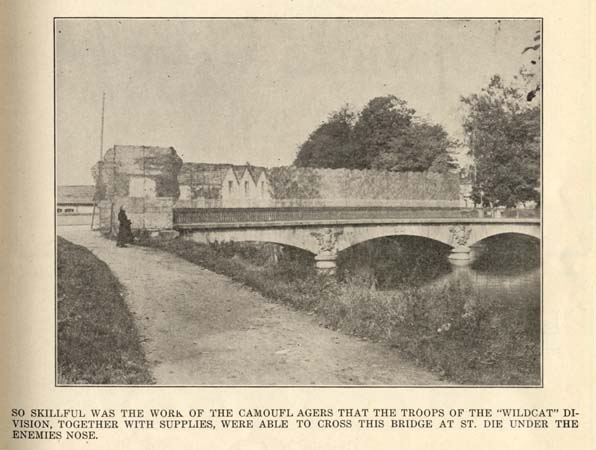
SO SKILLFUL WAS THE WORK OF THE CAMOUFL AGERS THAT THE TROOPS OF THE "WILDCAT" DIVISION, TOGETHER WITH SUPPLIES, WERE ABLE TO CROSS THIS BRIDGE AT ST. DIE UNDER THE ENEMIES NOSE.

Compliments of
C. A. DILLON R. W. WYNNE G. L. DILLON
Members of Southern Supply and Machinery Dealers
Association
EVERYTHING FOR THE MILL
GENERAL REPAIRING IN OUR MODERN SHOP
DILLON SUPPLY COMPANY
Mill Supplies
RUBBER BELTING, PACKING & HOSE, RUBBER
ROOFING
Long Distance Phones 753 & 752 RALEIGH, N. C.
Compliments of
RALEIGH ELECTRIC SERVICE
COMPANY
Delco-Light Products
WAKE, JOHNSTON AND WILSON COUNTIES
Office and Display Room: 110 West Martin Street
Raleigh, N. C.
Page 26

Compliments of
J. WHITE WARE
Gastonia, N. C.
E. T. JAMES COMPANY
Gastoina, N. C.
Distributor for Lalley Light, for Power and Lighting
Purposes
DEALER IN AUTOMOBILE ACCESSORIES
Chalmers Cars, Vim and Indiana Trucks
Page 27

[Illustration]

Compliments of
O. L. HOPKINS, Inc.
122 Lafayette St.
Ladies Ready-to-Wear
Raleigh, N. C.
Established 1836
H. J. Brown Company
Fabius P. Brown, Prop. Funeral Directors and Embalmers
RALEIGH, N. C.
Page 28

J. C. RANKIN, Pres. & Supt. P. P. MURPHY, Vice-Pres. S. M. ROBINSON, Secy. & Treas.
Peerless Manufacturing Co.
Cotton Yarns, Skeins, Cones and Tubes LOWELL, NORTH CAROLINA
JNO. C. RANKIN, Pres. & Supt. C. M. ROBINSON, Vice Pres.
S. M. ROBINSON, Secy. & Treas.
Lowell Cotton Mills
MANUFACTURERS OF
Cotton Yarns, Skeins, Warps, Cones and Tubes (40s, 60s and 70s) LOWELL NORTH CAROLINA
Page 29

GROCERIES
Feeds and Fertilizers
Our Volume Of Business Enables Us To Quote You
AT ROCK BOTTOM PRICES
COTTON AND NAVAL STORES
HANDLED ON REASONABLE COMMISSION AND
PROMPT RETURNS ASSURED
J. W. BROOKS
South Water St. Wilmington, N. C.
LONG DISTANCE PHONE 137 OFFICE, COR. WATER & DOCK STS.
G. HERBERT SMITH, President W. L. GRIFFITH, Secy. & Treasurer
M. J. CORBETT, Vice-President
CAPE FEAR PACKING COMPANY
DIRECTORS
G. HERBERT SMITH, M. J. CORBETT, W. L. GRIFFITH,
A. M. CHINNIS, HUGH MACRAE
Manufacturers of
Old North State Brands
SMOKED MEATS--SAUSAGE--LARD
Wilmington North Carolina
Page 30

Compliments of
The Commercial National Bank
High Point, N. C.
Statement of Condition at Close of Business November 17, 1919
| RESOURCES | LIABILITIES | ||
| Loans and Investments | $2,714,554.92 | Capital Stock | $ 150,000.00 |
| Overdrafts | 1,822.10 | Surplus and Profits | 205,977.07 |
| U. S. Bonds, Liberty Loan Bonds, Victory Notes, Certificates of Indebtedness and War Savings Stamps | 760,760.35 | Rserved for taxes, accrued interest and unearned interest | 16,403.08 |
| Circulation | 150,000.00 | ||
| Bond Account | 239,000.00 | ||
| N. C. 4 per cent Bonds | 210,000.00 | Due Federal Reserve Bank for Liberty Bonds and Certificates of indebtedness | 541,000.00 |
| Guilford County Bonds | 57,000.00 | ||
| Stock in Federal Reserve Bank | 9,000.00 | ||
| Furniture and Fixtures | 11,065.98 | Notes secured by Liberty Bonds and Victory Bonds re-discounted with Federal Reserve Bank | 95,700.00 |
| Customers' Liability Account Acceptances | 49,000.00 | ||
| Cash in vaults and due from banks | 1,212,382.41 | Liability Account Acceptances | 49,000.00 |
| Deposits | 3,578,505.61 | ||
| Total | $5,025,585.76 | Total | $5,025,585.76 |
WILL INCREASE CAPITAL TO $500,000, AND SURPLUS TO $500,000, MAKING
A MILLION DOLLAR BANK ON JAN. 1, 1920
Page 31
History of The 81st Division
A deathless record of gallantry and high spirit, for all America to cherish, was made on battle fields of France by the Eighty-First Division, United States National Army.
This division, known popularly as the "Wildcat" Division, was organized at Camp Jackson, near Columbia, S. C., August 29, 1917, and made up of drafted men. Major-General French was assigned to command, but because of his illness Brigadier-General Barth was its head until Major-General Charles J. Bailey was placed in charge, to remain throughout the division's career.
ost of the officers were from Alabama, North and South Carolina, receiving their training at the first officers' training school at Fort Oglethorpe. There were, however, men from other sections in the officers' personnel. Likewise the men in the ranks were largely from Alabama, North and South carolina, with a substantial sprinkling of men from other sections.
The morale and esprit de corps of the division was unusual from the start. Through the heavy routine of preparation, there were few delinquencies. In the spring of 1918 thedivision was transferred to Camp Sevier, having its ranks filled by men from Alabama, Florida, New York and a few from Chicago.
In July, 1918, the division went to Camp Upton to make ready for the great voyage. Part of the men sailed from Philadelphia, part from New York, both sections going to Southampton, England, and later to La Havre, going thence to the training area near Tennere, France.
II.
The first taste of actual war experiences the division gained was here. The matter of billeting the men was a knotty problem, necessitating the use of numerous cow barns and like structures. However, if retrospective comment of the men counts for anything, which it does, these "Yanks" took to the situation like ducks to water, after the first few grimaces, and made the best of the worst, thereby helping to earn the reputation the American soldiers got overseas of being equal to any occasion.
After something less than a month spent in more intensive training and other activities at Tonnere, the division started on its way to the front in the Vosges mountains sector, in the vicinity of St. Die. Later it moved from the St. Die sector to the Rambersville trea, where it remained from October 20 to October 31, awaiting transportation. During this period daily training was kept rigidly up.
Orders having come, the division was entrained during the days of October 31 and November 1 and 2 at Charmes, Thaon, Chatel, andR ambersvillers and started on the way to the Meuse sector, detraining at Sorcy, Le Rouville, Sampigny, and Bannoncourt. From tor.
these points it was marched into the Sommedieue sec-
In the Sommedieue sector the Eighty-first relieved the Thirty-fifth division, taking over the line from Besonvaux to Fresnes, which extended over a length of about 24 kilometers. It was necessary here to place all four infantry regiments in line, with two battalions of each occupying the center of resistance and one being held in reserve. The 60th field artillery brigade of the Thirty-fifth division remained in the sector and came under the command of the Eighty-first division. The division post command moved to Dieue on November 2, and on Sommedieue on the seventh, the command of the sector passing to Major-General Bailey on that date, the relief having been completed on the night of November 6.
The division was here greatly handicapped by not having full transport equipment, and movements were made with the greatest difficulties. Only fifteen percent of the authorized motor equipment and forty percent of the authorized animal equipment was in the possession of the division. This condition continued to exist up until the cessation of hostilities, and was greatly to be deplored as it worked an increased

B. C. Royal, Pres. & Genl. Mgr. J. M. S. Salsbury, Sec. & Treas.
Compliments of
IDEAL TABLE COMPANY
High Point, N. C.
MANUFACTURERS OF
Dining Room Suites, Library and Extension Tables
Page 32

A. E. TATE, Prest. & Treas. D. R. PARKER, Vice Prest. J. H. DOBBS, Secy.
Compliments of
TATE FURNITURE COMPANY
MANUFACTURERS OF
Chamber Sets, Dressers, Bedsteads, Chiffoniers,
KITCHEN SAFES, TABLES, METAL BEDS
and Springs
HIGH POINT, NORTH CAROLINA
H. C. KEARNS, JR., Pres't. B. C. VITT, Vice Pres't. P. M. DILLON, Sec. & Treas.
Compliments of
Dillon-Kearns Underwear Company
INCORPORATED
MANUFACTURERS OF
NAINSOOK UNDERWEAR
HIGH POINT, NORTH CAROLINA
Page 33
hardship on both officers and men and hindered badly the movements of the division.
On November 7 the division passed from the 17th French corps,w ith which it had been operating, to the 2nd colonial corps, French.
III.
It was here that the already hardened and well-trained troops received their first real baptism of fire. Warning had been given to the Thirty-fifth division of a possible impending offensive. In view of this, plans were drawn up in this division and issued on November 88, and all troops going into the sector were cautioned to patrol carefully and vigorously, and to obtain all possible information as to the enemy's movements and operations. In addition to this an intelligence memorandum giving all pertinent data available was published and distributed.
Two conditions at the time of the advance were very favorable to the enemy and consequently made the advance of the troops of the Eighty-first very difficult. One of these was the condition of the territory where the engagement occurred. The land was low and marshy, and had been flooded in places, making the going of the troops extremely hard. During the period of the four years preceding this the enemy had constructed elaborated defensive work here. Concrete machine gun and trench mortar emplacements

NORTH CAROLINA MEN VERY EFFECTIVELY OPERATING A LARGE GUN AGAINST FRITZ. THE SCENE WAS TAKEN DURING BATTLE NEAR THE CLOSE OF THE WAR, WHEN THE ENEMY BEGAN TO RUN.

ENGINEERS OF THE 306th, 81st, CONSTRUCTING AVIATION HANGARS NEAR NEUF CHATEAU.

Compliments of
Kearns Furniture Company
High Point, N. C.
Page 34

With Compliments to the Boys of
30th, 31st, 81st, 42nd and 82nd
Cutting Mills High Point, N. C., West End, N. C.
Panel Mills, High Point, N. C., Thomasville, N. C.
General Offices High Point, N. C.
THE CONSOLIDATED VENEER & PANEL CO.
R. R. RAGAN, President
J. W. CLINARD, Vice-President
W. G. MUNYAN, Sec. & Treas.
Compliments of
F. M. PICKETT, Pres. & Treas.
W. P. PICKETT, 1st. Vice Pres.
J. W. HARRIS, 2nd Vice Pres.
R. H. WALKER, Secretary
PICKETT COTTON MILLS
Incorporated
Manufactures of
Pickett's Ideal Quality Print Cloths
DIRECTORS
W. P. Pickett, Jno. McSween, R. H. Walker, R. R. Ragan, F. M. Pickett
J. Elwood Cox, J. W. Harris, Walter P. Inman,
Dr. D. A. Stanton
FINANCE COMMITTEE
J. Elwood Cox, J. W. Harris, W. P. Pickett, R. R. Ragan, F. M. Pickett
High Point, N. C.
Page 35
dotted the landscape, and deep dugouts were everywhere. In addition to this it was impossible for the command of the Eighty-first to obtain sufficient artillery support to cover the advance properly. For some reason neither the necessary artillery itself not a sufficiently large supply of ammunition for it were obtainable. A rolling barrage was entirely out of the question, and all that could be done was to direct the 60th field artillery brigade, which was commanded by Birgadier General L. R. Berry, to cover the advance and to do everything possible to destroy the barbed wire entaglements of the enemy, while two battalions of 75's were prepared to advance behind the infantry waves.
Orders to begin the advance as early as possible after the break of day on the morning of November 9 were received from the second colonial corps on the day before, and everything was gotten in readiness to carry them out. Everywhere that the word had been whispered could be seen faces tense in determination, for it was to be the first time "over the top" for many a man. Though they had trained hard they had not yet been given the actual fire test, and doubtless many of them wondered how this mettle would prove, and there is still less doubt that there was a man among them all who was not still more eager to get at the Hun and prove what he inwardly felt was the quality of his own mettle. Though their blood may have been racing

GRAVES OF MEN OF THE EIGHTY
FIRST IN FRANCE.
AVIATION CAMP AT NEUF CHATEAU
SNOWED UNDER.
W. B. THOMAS, Pres. R. R. RAGAN, V. Pres.
FRED A. THOMAS, Secy. & Treas.
Compliments of
UNION FURNITURE COMPANY
Incorporated 1899
Manufacturers
HIGH POINT, - - - N. C.
Page 36

J. P. CROWDER M. J. CROWDER
Compliments of
HIGH POINT STEAM LAUNDRY
We Klean Klothes Klean
Office and Plant:
203 E. Washington St.
Dry Cleaning and Pressing
a Specialty
Phone 99
High Point, - - - N. C.
Compliments of
MARSH FURNITURE COMPANY
MANUFACTURERS
Celebrated "MARSH" Kitchen Cabinets
J. E. MARSH, JR., President J. A. MARSH, Vice-Pres.
J. E. MARSH, Sec. & Treas.
High Point, North Carolina, U. S. A.
Page 37
madly through their veins, no excitement was apparent among either officers or men. Every man went coolly about hisd uties with an air of eager, though grim, determination.
The liaison officer from the division on the Eilghty-first's left, the Tenth French colonial division, also reported with the plan of attack of that division, which included a passage of the lines of the Eighty-first'st hreele ft centers of resistence. This shortened the sector of attack about six kilometers, leaving a frontage of about 12 kilometers on which the attack would have to be made.
It was necessary to assemble brigade and separate organization commanders as the time was too short for the ordinary distribution of orders. The attack orders were issued as soon as possible after assembly of the officers. Plan of liaison had already been issued.
Little time could be given for reconnaisance and issuing of orders by subordinate units. There was barely time to move the attacking regiments into place before the zero hour.
The whole plan of action was based on the assumption that the enemy was withdrawing and would not greatly oppose the Eighty-first's advance. It was not the case in this particular sector, however, as patrols had found the enemy's defensive system manned in the usual manner.

IT WAS INSIDE OF THE REMAINS OF THIS BUILDING THAT THE TROOPS OF THE EIGHTY-FIRST GOT THEIR WATER SUPPLY WHILE IN ACTION AROUND CHATILLON.

AVIATION CAMP NEAR NEUF CHATEAU.

Compliments of
NATIONAL MACHINE & ELECTRIC CO.
All Kinds of Machine and Electric Repairing
of Highest Quality
GREY IRON AND BRASS CASTING
OXY-ACETYLENE WELDING
High Point, - - - - - N. C.
Page 38

Compliments of
SHIPMAN ORGAN COMPANY
Manufacturers of
High Grade Organs
OFFICERS
E. A. SNOW, Pres't. W. G. SHIPMAN, Sec., Treas. and Gen. Mgr.
High Point, N. C.
Compliments of
HIGH POINT HOSIERY MILLS
Incorporated
ESTABLISHED 1904.
Hosiery and Hosiery Yarns
High Point, N. C.
Compliments of
PIEDMONT MILLS COMPANY
ESTABLISHED 1909.
Hosiery Manufacturers
High Point, - - N. C.
Page 39
To avoid moving through heavy timber, the advance had to be in two eschelons, one on each side of the Bois De Manheulles. One brigade was assigned to each. A battalion of 75's and two companies of engineers were attached to each brigade.
The artillery opened fire at 7:30 o'clock on the morning of November 9, and the advance began on time, the troops in the northern part of the sector moving into reserve behind the left attack as their lines were passed by the Tenth colonial division.
The division post command moved at 8:15 o'clock on the morning of the 9th to Bierupt, where it was more centrally located with respect to the troops. It remained there through the action, General Bailey and staff officers making several trips to the lines.
A detailed account of the movements follows:
At the beginning of the operations, the disposition of the units of the Eighty-first were as follows:
321st infantry was in divisional reserve in the woods west of Chatillon.
Two battalions of the 322nd infantry were in line, each with two companies as support; and one battalion in reserve in the Verdun-Etain road sector to Ronvaux, inclusive.
The 323rd infantry was in defile at the western edge of Haudiamont, as divisional reserve.
Two battalions of the 324th infantry were in line, and one battalion in reserve in the Bonzee at Ronvaux

IN THE VICINITY OF VERDUN
TRENCH SCENE, SHOWING HOW
THE TERRIFIC FIRE STRIPPED
TREES IN NO MAN'S LAND

EIGHTY-FIRST DIVISION ENGINEERS
BUILDING AVIATION
HANGARS AT NEUF CHATEAU

COL. WESCOTT ROBERSON, President CHARLES L. AMOS, Vice-Pres.
R. T. AMOS, Secretary and Treasurer
AMOS HOSIERY MILLS COMPANY
Manufacturers
High Point, - - - N. C.
Page 40

Compliments of
S. H. TOMLINSON, General Manager
S. F. TOMLINSON, President C. F. TOMLINSON, Sec. & Treas.
TOMLINSON CHAIR MANUFACTURING
COMPANY
Manufacturers of
Chairs and Furniture
SPECIALTY: COMPLETE DINING SUITS
HIGH POINT, - - - - N. C.
Compliments of
THE CLIMAX UPHOLSTERING
CO.
Incorporated
MANUFACTURERS OF
Upholstered Furniture
High Point, - - - N. C.
Compliments of
T. A. KEARNS, Pres't. R. R. RAGAN, Vice Pres't.
G. H. KEARNS, Sec. & Treas.
CROWN HOSIERY MILLS
MANUFACTURERS OF
HOSIERY
High Point, - - - - N. C.
Page 41
sector.
The 316th machine gun battalion was in divisional reserve in the vicinity of Haudimont.
The 317th machine gun battalion had one company with the 322nd infantry, and three companies in brigade reserve near Chatillon.
Two companies of the 318th machine gun battalion were with the 324th infantry and one company with the 323rd infantry, one in brigade reserve.
The disposition of the 60th field artillery brigade was behind sector of attack.
The attack started at 8 o'clock on the morning of November 9, after artillery preparations of a half-hour. Artillery and heavy machine gun fire was encountered by all units, almost immediately on starting the advance. At 10::30 o'clock a line 600 meters west of Moranville had been reached by the 322nd infantry where heavy machine gun fire made further advance impossible. At 12:30 noon, Noire-Baies was taken and Claires-Chenes cleared of a machine by the first battalion of the 324th infantry.
At 1:25 p. m. developments were started against Ville en Woevre, but continuation of the advance was rendered impossible on account of the Thirty-third division on the right failing to advance; the flank was thus left exposed to heavy fire. The first battalion was forced to withdraw, where it remained in readiness until 1:25 o'clock the following morning. The reserve battalion was moved against the line of trenches running north from which machine gun fire fas coming. By verbal orders of the regimental commander the first and third battalions were withdrawn at 4 o'clock on the morning of the 10th to the lin in prolongation of the Fresnes-Manheulles road. At 4 o'clock in the afternoon of the 9th, the line running northwest from Chateau D'Aulnois had been reached by the second battalion of the 324th infantry. At 4:30 o'clock heavy machine gun fire forced the withdrawal of this battalion to the ridge 700 yards northeast of and parallel with the Fresnes-Manheulles road. Moranville was taken by the 322nd infantry at 5:15 o'clock on the afternoon of the 9th after American artillery fire had silenced most of the machine guns located in the town.
Being exposed to heavy fire in this position at 4 o'clock on the morning of the 10th, the second battalion of the 324th Infantry retired to form a continuation of the line of the first and third battalions on its left. At 6:30 o'clock the 322nd infantry resumed its advance on Grimaucourt. This town was entered at 9 o'clock in spite of stubborn resistance from the enemy machine guns. Company C, of the 322nd infantry, reached the vicinity of Abaucourt at 11 o'clock and was soon followed by B and D companies of the same regiment, which went into the line beside it. At 1 o'clock that afternoon Grimaucourt was passed and an advance started against the enemy's main line of resistance, 1,500 meters east of that town. On account of intense artillery fire on Grimaucourt the second battalion of the 322nd infantry retired at 4 o'clock to the old German trenches, just west of the town.
At 8:30 o'clock on the night of the 10th, the relief of the 322nd infantry units by the 321st infantry was completed, except that B, C and D companies of the 322nd, on the extreme left, remained in position. The second battalion of the 321st was held in reserve at Chatillon. At 9 o'clock the second battalion of the 324th infantry was relieved by the first battalion of the 323rd infantry. The third battalion of the 324th had moved back to the vicinity of the post command at Bordeaux.
The movements of the units of the division on the morning of fateful November 11 from 6 o'clock to 11 o'clock, wher fighting ceased, follow:
At 6 o'clock, after preparation of one hour by the artillery, the attack, mentioned above, was resumed by the 321st infantry with three battalions in line, the second battalion having been moved up to Moranville. At 7:30 o'clock Grimaucourt was passed by the third battalion of the 321st infantry. Bois-de-Petite Cognon was reached by the first battalion of the 321st at 8:30 o'clock; heavy machine gun fire was met at that point. At 9 o'clock the first battalion of the 324th was relieved by the second battalion of the 323rd infantry, the third battalion of the 323rd being held in reserve.
At 10:30 o'clock after heavy shelling with high exvplosive, gas, shrapnel and continuous machine gun fire, which resulted in heavy casualties, the advance was resumed by the 323rd infantry. At 11 o'clock after artillery fire on Grande and Petite Cognon, the

Compliments of
FERD. ECKER
IMPORTER AND MANUFACTURER OF
FRENCH PLATE MIRRORS
HIGH POINT, - - - - N. C.
Page 42

Compliments of
WRENN-COLUMBIA FURNITURE CO.
MANUFACTURERS OF
FURNITURE
J. T. and T. F. WRENN, Proprietors
High Point, - - - N. C.
Compliments of
J. A. LINDSAY
Manufacturer of
PARLOR SUIT FRAMES
High Point, N. C.
Compliments of
W. W. SMITH, Pres. H. A. MILLS, Vice-Pres.
W. L. SMITH, Sec'y & Treas.
HIGH POINT MACHINE
WORKS, Inc.
Machinists, Founders and Engineers
NEW AND SECOND HAND MACHINERY,
ENGINES AND SUPPLIES
GENERAL REPAIR WORK, MILL SUPPLIES
TEXTILE CASTINGS A SPECIALTY
Milwaukee Drill Press, Union Lathe, Watson Motor
HIGH POINT, N. C.
Page 43
first battalion of the 321st infantry was able to march through the gap between the woods, and reach the main defenses of Hautecourt. The second battalion had advance between the first and third battalions.
During the afternoon of the 9th it was seen that the advance could not be pushed further without additional troops and the reserve regiments were put at the disposition of the brigade commanders and the divisional machine gun battalion placed in the real of the gap between the two brigades. Two companies of the 306th ammunition train (armed as infantry) were also ordered up on the 10th to assist the engineers with the left column. One company of engineers had been withdrawn from the reserve and sent to the corps and the last reserve company of engineers was sent to assist in the road work.
Orders were issued that evening to continue the advance next day. The Thirty-third division, of the Second army, on the right of the Eighty-first, had not received orders to advance. It had, however, sent stron patrols to its front.
These were driven back by heavy enemy fire, finally uncovering the right flank of the Eighty-first and making it necessary to bend back the line to the Manheulles-Fresnes road, where liaison with the Thirty-third division was maintained. There was evidently some misunderstanding about the advance of the Thirty-third division as the liaison officer sent from that division to the Eighty-first stated that that advance was ordered.
Colonel C. D. Roberts, chief of staff of the Eighty-first, telephoned the First army regarding the matter and was informed the division was to advance. He also, at 11 o'clock telephoned to the chief of staff, Thirty-third, and told him of the Eighty-first's advance east of Haudimont. As it had been proven impossible for the Eighty-first's right to advance without the movement of the Thirty-thrid division, orders were given in the evening to the commanding general of the 162nd brigade not to advance his right until the Thirty-third moved.
November 10 was largely employed in relieveing the fighting line regiments, supplying food and ammunition and preparing for a further advance next day. The enemy's artillery was very active and every attempto to patrol to the front was met by machine gun and artillery fire, causing severe losses.
The enemy's aviators were very active throughout November 9 and 10, directing his artillery fire, and their machine guns were used with telling effect upon the forces of the division. An enemy airplane was hit by rifle fire from the "Wildacts" and fell within the French lines near Verdun. Although repeated requests were made for aircraft support for the Eighty-first, it was impossible to obtain such until late in the afternoon of the 10th, the second day of the battle, when several airplanes appeared on the scene.
The next day, November 11, was the day on which an armistice was declared, and up until eleven o'clock, the hour at which it had been ordered that hostilities cease, a heavy fog prevented the aviators from operating to any appreciable advantage.
IV.
It was decided, after a consultation with the brigade commanders on the evening of November 10, to strike hard on the left, and, in accordanve with this plan, the 324th infantry, minus one battalion, was held in divisional reserve, while the 316th machine gun battalion was placed at the disposition of the left column. This column was ordered to advance to the attack to the south of Hautecourt, while the right was given instructions to attack Ville-en-Woevre. However, this column was ordered not to begin the advance until it hadreceived assurance that the Thirty-third division was advancing.
An officer of the artillery assistence, which was much needed, was made by a staff officer of the 151st artillery brigade, which was under the command of Brigadier General R. P. Davis, which resulted in plans for counter battery fire and preparations for artillery support being made.
With a preparatory artillery fire, which was reported as being very effective, the attack was launched at 6 o'clock on the morning of the eleventh. A dense fog enveloped everything and greatly retarded movements, but it also undoubtedly served to prevent heavier losses than were actually sustained. In spite of the difficulties presented by the weather, and the natural and artificial obstacles which hindered the advancing columns greatly the troops pushed ahead

Compliments of
COMMONWEALTH HOSIERY MILLS
Incorporated
Seamless Hosiery
High Point, North Carolina
Page 44

Compliments of High Point Buggy Company
to
THE HOME COMER
Welcome back to the good old farm. Get the prancing filly a new "High Point" buggy and a nice set of harness and go take your girl for a spin down the wooded road.
Oh boy, "When you ride, ride right"!
Compliments of
MYRTLE DESK COMPANY
Manufacturers of
OFFICE DESKS
High Point, - - N. C.
Page 45
steadily at many points, and the advancing was kept up to eleven o'clock in the morning, when firing was stopped, orders having been received at 7:40 that morning fro mthe second corps headquarters to cease firing at that time. Upon the receipt of these orders, warning instructions were sent to each organization. These instructions were later confirmed by orders stating that hostilities would stop at eleven o'clock on all fronts.
No instructions had been issued for a let up in the advance until the appointed hour; consequently, the attack was pushed determinedly until that time, with the result that the progress of the advancing columns was good. This was especially true of the left. When th elast shot was fired at the stroke of eleven the 321st infantry was in the last line of the enemy's entaglements and had already captured and made prisoners of a few of the opposing forces.
The advance up until the time of the cessation of hostilities had reached a depth of from two to five and a half kilometers, and five of the enemy's officers together with eighty-nine of his men had been taken. Two of the officers and nine of the men were turned over to the 10th French colonial corps.
The total losses of the Eighty-first division during the three days of fighting on this front in killed, wounded and missing, were 1,023. Of these 11 officers and 158 men were killed; 31 officers and 746 men were wounded, while one officer and 76 men were reported as missing. The losses of each organization were as follows:
321st infantry: Killed, 3 officers and 45 men; wounded, 5 officers and 175 men; missing, 3 men.
322nd infantry: Killed, 5 officers and 52 men; wounded, 8 officers and 209 men; missing, 10 men.
317th machine gun battalion: Killed, 2 men; wounded, 1 officer and 17 men.
323rd infantry: Killed, 16 men; wounded, 5 officers and 114 men; missing, 4 men.
324th infantry: Killed, 2 officers and 34 men; wounded, 5 officers and 145 men; missing, 18 men.
318th machine gun battalion: Killed, 3 men; wounded, 2 officers and 14 men; missing, 1 officer and 37 men.
306th engineers: Killed, 2 men; wounded, 2 officers and 37 men; missing, 4 men.
316th machine gun battalion: Killed, 1 officer and 2 men; wounded, 2 officers and 24 men; missing, 3 men.
306th ammunition train: Wounded, 3 men.
306the field signal battalion: Killed, 1 man; wounded, 7 men.
6th field artillery brigade: 1 officer and 1 man wounded.
V.
Immediately after ceasing fire, the enemy troops showed a disposition to fraternize, but this was not permitted. A few prisoners, taken by the 321st infantry just after 11 o'clock were released.
The work of the supply and sanitary trains were satisfactory, and ammunition and rations were provided in ample quantities and a large surplus was placed in the forward dumps before the movement was terminated.
During the entire operation, the enemy units engaged were the fifth guard division and the third Bavarian infantry division, and also a part of the Thirteenth Landstrum division. Three units seemed to have excellent morale and discipline up to the last.
Artillery support: The sixth field artillery brigade, commanded by Brig. Gen. R. L. Berry, furnished as efficient support as possible under the circumstances. The two battalions used with the infantry brigades were efficiently used. The enemy's artillery constantly outranged that of the American division's supporting guns and countery-battery work therefore was not very effective, and there was an entire lack of airplane observation on the Americans' side until late in the day of November 10, while the enemy's air service was very active and efficient. On November 9, when the clouds were low, the enemy planes dropped down through the clouds close to the lines of the Eighty-first division, using their guns with the result that a number of Americans were killed or wounded. They also directed a very accurate fire on the Americans. The appearance of more allied planes next day served to improve the morale of the Americans. Repeated requests were heard for more airplanes and artillery assistance, and the French artillery authorities

You Will Remember the Quality Long After the Price Is Forgotten
Compliments of
THE HAYWORTH ROLL & PANEL CO.
J. P. HAYWORTH, Secretary and Treasurer
We Make A Specialty of Rolls and
Built-Up Tops
HIGH POINT, - - - - - - N. C.
Page 46

Compliments of
J. ELWOOD COX MANUFACTURING CO.
Established 1868
MANUFACTURERS OF
HARDWOOD, DIMENSION STOCK
DOGWOOD, PERSIMMON, HICKORY
J. ELWOOD COX, Pres't. JOS. D. COX, Sec'y. & Treas.
Cable Address "ELWOOD"--A. B. C. Code, Fifth Edition
High Point, N. C.
BUYERS OF DOGWOOD, PERSIMMON AND HICKORY LOGS
Compliments of
GLOBE PARLOR FURNITURE CO.
Manufacturers of
UPHOLSTERED FURNITURE
High Point, N. C.
Page 47
showed a disposition to refuse even the necessary amstrong points of Abaucourt, Moranville, Crimaucourt munition for the sixtieth brigade and the sector artillery. The American losses were declared mostly due to artillery fire to which the Americans' support could not make effective reply.
The attack of this position was evidently decided upon by higher authority under the assumption that the enemy was retreating, but this proved not to be true. However, good progress was made and the hostilities was the last line of enemy wire of the Gerand Blanzee were taken and the line at the end of man main line, which would have been penetrated in a short time.
It was the first severe engagement of this division and the small losses that were suffered from enemy machine gun fire showed the excellent progress that had been made in training. The division was fortunate in having two able brigade commanders, Brig. Gen. G. W. McIver, 161st brigade and Brig. Gen. Monroe McFarland, 162nd brigade, and four excellent infantry regimental commanders. Colonels L. T. Richardson, 322nr infantry; T. A. Pearce, 323rd infantry; G. W. Moses, 324the infantry, and Frank Halstead, 321st infantry.
The infantry regiments went into action with about 3,000 men each and the 306th engineers with about 1,550 men. The machine gun battalions, 306th field signal battalion, sanitary train and ammunition train were almost at full strength.
While the operations of November 9, 10, 11, were not extensive, as compared to those of previous fighting in the Argonne and to the north, it is believed they demonstrated to no small extent the soldierly qualities of officers and men, and that both training and discipline were a credit to the division in this, its only fighting in the line of the advancing First army. The troops were continually subjected to intense artillery fire, to which no response could be made, yet the troops kept their organization and morale and suffered a minimum of losses.
The retirement of the troops of the 324th infantry on the night of November 9 was due to the lack of support from the Second army and was made with skill, and the men, although exposed to heavy artillerly moved as their officers reported, as though at an ordinary drill.
During the attack, it was a notable fact that serious gassing was exceptional, and that few were reported missing, showing that there was almost no stragglers.
ost of the reported missing were killed and the fatalities were almost 200, including those who died from wounds of whom there were many. Out of the approximately 18,000 present, one in 18 was acsualty, and of the 1,023 casualties, some 200 were fatalities, or one death in each five casualties.
During this operation, the troops were directed with skill and good judgment and the officers and men maintained the high standard expected of American troops.
VI.
Soon after the declaration of an armistice at the enemy's request, the "Wildcats" were ordered to Chatillon-sur-Seine and began immediately to prepare for the long hike. Weary and footsore from one of the hardest of its marches the division arrived here during the second and third of December and was billited, with heaquarters at ussey-sur-Seine.
In spite of the rain and snow which fell almost every day from the time of the division's arrival here until the first of May, regular drill and instructon were resumed and kept rigidly up until the first of April, when these exercises were cut in half in order that the remaining half day might be devoted to athletics. The order which brought this about met with the instant approval of almost (everyone, for the officers were weary and eager to return home, and the time dragged slowly. This, coupled with the natural love of the American soldier, resulted in a great deal of interest being manifested in outdoor games, particularly baseball, and helped to make the time pass more pleasantly for officers and men until sailing orders came.
On the sixth of May orders transferring the division from the 8th army corps to the S. O. S. were issued and on the twelfth the first train of troops left for Le Mans. Again the division was split, part of it going to St. Nazaire, while the other went to Brest, from which ports it sailed for the United States in the

Compliments of
THOMASVILLE CHAIR COMPANY
1850 Quality
Box Seat Diners Chairs and Rockers
Manufacturers
Thomasville, - N. C.
Page 48

Compliments of
E. A. SNOW, Prest. J. E. KIRKMAN, Vice-Prest.
S. L. DAVIS, Secy., Treas. & Mgr.
SOUTHERN CHAIR CO.
Manufacturers
HIGH POINT, - - N.C.
FRANK WINESKIE,
Compliments of
SOUTHERN MIRROR COMPANY
MANUFACTURERS AND JOBBERS
MIRRORS
FACTORIES--HIGH POINT, N. C., WINSTON-SALEM, N. C.
Polished Plate Glass, Window Glass, Prism Glass, Auto Windshields, Metal
Store Fronts, Art Glass.
HIGH POINT, N. C.
Page 49
early part of June, 1919. The majority of the division was debarked at Newport News, Va., and Charleston, S. C., and from these ports officers and men were sent to various camps to be finally discharged from military service.

THE POST COMMAND OF A MACHINE GUN BATTALION OF
THE 81st DURING THE OPERATIONS AT
CHATILLON-SUR-SEINE

American and Enemy Dead in France

Aviation Camp at Neuf Chateau Snowed Under

Compliments of
STANDARD CHAIR COMPANY
CHAS. F. LAMBETH, President JAS. E. LAMBETH, V. President
FRANK S. LAMBETH, Sec'y. & Treas.
Wholesale Manufacturers
Thomasville, N. C.
Page 50

Compliments of
ROWE PARLOR FURNITURE COMPANY
Incorporated
MANUFACTURERS OF
Select Parlor Furniture
High Point, - - - N. C.
Compliments of
RANKIN COFFIN & CASKET CO.
W. P. PICKETT, President J. A. GRAY, Vice President
A. M. RANKIN, Secy. & Treas.
Manufacturers of
Coffins and Caskets
DEALERS IN UNDERTAKERS' SUPPLIES
High Point, - - - N. C.
Page 51

Compliments of
HILL VENEER CO.
Manufacturers of Veneers
High Point, N. C.
Compliments of
GIANT FURNITURE COMPANY
J. E. KIRKMAN, President & Treas. J. H. SHAW, Sec'y. & Manager
Manufacturers of
SUITS, ODD DRESSERS AND CHIFFONIERS
High Point, N. C.
Page 52

Compliments of
UNION BROKERAGE COMPANY
(Twelve Factories)
QUICK DISTRIBUTORS OF
Everything in Furniture
High Point, - - - - N. C.
Compliments of
FRED N. TATE, Prest., Treas. & Gen. Mgr. A. J. HAGOOD, Vice-Prest.
A. L. SMITH, Secretary
THE CONTINENTAL FURNITURE CO.
MANUFACTURERS OF
Fine Furniture
Long Distance Bell Telephone
High Point, N. C., U. S. A.
Page 53

"Lest We Forget--"
VICKS VAPORUB
Your Bodyguard Against All
Cold Troubles
THE VICK CHEMICAL CO.
Greensboro, N. C.
We are proud of the record made by our Boys, and
we are glad to have you back home with us.
FOSTER and CAVENESS
JNO. R. FORTER S. A. CAVENESS
R. L. CAVENESS
Wholesale
Fruits and Produce
Groceries
BANANAS, APPLES, ORANGES, LEMONS,
CABBAGE, POTATOES, ONIONS PEAS, BEANS
Local and Long Distance Phones 751 and 752
GREENSBORO, - - - N. C.
Compliments of
GUILFORD MOTOR CAR
COMPANY
Incorporated
R. M. Clapp, Pres. J. Ivan Clendenin, Sec. & Treas.
DISTRIBUTORS OF
The FRANKLIN Car
REO Passenger Cars and Trucks
Telephone 166
114-118 South Davie Street
GREENSBORO, - - N. C.
Page 54

MAJOR GENERAL EBEN D. SWIFT LEADING OFFICERS OF THE 82ND ON A PRACTICE MARCH.

Compliments of
LAMBETH FURNITURE COMPANY
Manufacturers of
KITCHEN FURNITURE, WARDROBES AND CHIFFOROBES
Thomasville, N. C.
Page 55
History of The 82nd Division
The birthday of the Eighty-second Division is the 25th of August. On that day in the year 1917 a new city on the outskirts of Atlanta was opened to the men who were to control its destinies and the destinies of its inhabitants for the next eight months. The city was called Camp Gordon and its officials were the officers ordered there to organize the Eighty-second Division out of civilian material from all four points of the compass.
The camp was located some fifteen miles out Peachtree road on the national highway between Atlanta and New York City. It had been built in record time by government engineers and contractors who for the past three months had been transforming the naked Georgia hills into red clay streets and blocks and blocks of raw pine barracks that rose, as if by magic, at the rate almost of one building a day.
Here, while the chorus of hammer and saw was still sounding through the hot summer sunshine, came the advance guard of men who were to help create for Uncle Sam an army with which to fight the war into which he had entered for no other purpose than to save the world from tyranny.
The first-comers were officers of the regular army. Major-General Eben Swift was the new commander of the division and Col. Preston Brown was his chief of staff.
Of the majors and higher officers one-third were officers of the regular army. With only a few exceptions, the remaining officers were southerners, the pick of Dixie's young manhood. Hailing in the main from Alabama, Georgia and Florida, they had volunteered at the first crack of war for the initial training camp at Fort McPherson, and there, for the past three months they had done "squads right" and "squads left" until they shouted commands in their sleep, hiked until their feet were masses of blazing blisters, studied themselves blind, taken their fun where they found it and, at last, won their reward in the shape of new serge uniforms, leather puttees, garrison caps and shining new insignia of which those who wore gold leaves were no more proud than those who wore a single silver bar.
It was in full regalia that they turned out at Camp Gordon following their brief leave after graduating to answer to the announcement that the division commander would review the new officers. But some hours later the white collars were sadly wilted and the new uniforms were decidedly sweaty, for instead of reviewing them, the division commander hiked them twelve miles over the red old hills of Georgia to the tune of "The Long Boy." The war had begun, and from that time on it never stopped.
The first recruits to report at Camp Gordon were select men from Alabama, Georgia and Tennessee, along with a small training cadre of non-commissioned officers from the Sixth and Seventeenth regiments of infantry at Fort Oglethorpe. Thus it seemed for a time that the Eighty-second Division, officered in the main by southern men and with its ranks filled with other southerners, was to be more representative of Dixie than any division in the country.
And then came the great change, the change that made the Eighty-second not representative of Dixie, but representative of the nation, one might almost say, representative of the world. For in the new organization that came to pass were men of all creeds and colors, of all nationalities and faiths, drawn from the nooks and corners of the country to be painted by the same brush of khaki that turned them out one finished product--the All-American Division.
Only six weeks of training had been completed when the order was received transferring the entire enlisted personnel of the camp, with the exception of the training cadre of 783 men, to southern National Guard outfits and the Eighty-first Division.
In February and March, 1917, the Eighty-second Division was inspected at Camp Gordon by the war department. The report on the division was so favorable that overseas orders were issued. It was the second national army division to leave the United States and the seventh in order of all divisions crossing.
The departure of the division began early in April. To the general public all was as before, for no waving banners or cheering crowds sped the regiments on their way. There were strict orders against imparting information to anyone of the movements in progress, but

This Page Donated by
W. L. CAMMON
Concord, N. C.
Page 56

Compliments of
DENNY ROLL & PANEL CO.
J. C. HILL, President G. W. DENNY, Sec'y & Treas.
MANUFACTURERS OF
BUILT UP STOCK
FINE-TABLE TOPS SPECIALTY
High Point, - - - - - N. C.
KERR BLEACHING & FINISHING WORKS
Established 1890 CONCORD, N. C.
Located in the South contiguous to the Cotton Mills. Equipped with the best machinery for doing first-class work. Finishers of Garbadines, Pajama Checks, Muslins, Towels, Crashes, Seamed Sheets, Pillow Cases, Necktie Flannels, and various kinds of Napped and Bleached Goods.
MYRICK & RICE, Agents, 320 Broadway, New York
Page 57
if here and there were farewells too tense to tell of, no one was censured.
Divisional headquarters sailed from New York on April 25, 1917, and the last infantry and machine gun battalions of the unit had followed by May 3. The artillery did not said at the same time as the rest of the division. The One Hundred and Fifty-seventh brigade began to move from Camp Gordon on May 7th, and completed the movement on May 11th. The advance school detachment went to Camp Merritt, the remainder to Camp Mills, but the entire brigade moved out of New York harbor in intervals from May 19th to May 21st.
The main part of the division crossed the Atlantic in convoys of ten vessels that followed each other at intervals down the North River, past the Statue of Liberty and out past Sandy Hook into the open sea. It was not a cheerful voyage, for while some of the battalions were quartered on giant liners, such as the Leviathon and the Mauretania, others were crowded into the smoky, dirty holes of Oriental ships that had been hastily pressed into service. The Allies were calling for men and comfort must be sacrificed to get them on the western front, where the Germans even then were launching their great spring drive.
It was a tremendous relief to everybody when ten swift destroyers appeared one day and the word spread that the convoy was within three hundred miles of the Irish coast. The various units of the division landed at Liverpool during the ten days from May 7th to May 17th. From there the battalions were sent to various English "rest camps"--the quotes are meant to express doubt regarding the adjective--before proceeding to Southampton to embark for Havre.
Not all of the regiments proceeded directly to Southampton, however. To one outfit, the Three Hundred and Twenty-fifth Infantry, was given the proud honor of being the first American troops to parade through the streets of London since the United States entered the war. It was to be a demonstration of England's appreciation in welcoming the United States as her ally, and surely no man who took part in it will ever forget it.
The Eighty-second Division came first to France by way of Southampton, England, crossing the rough-and-tumble channel in the small, swift steamers that roared along through the waves and the darkness as though they were shot from a cannon.
All of the troops made the crossing at night. They landed at Havre during the second week of May, when the weather was still cold and rainy and this country of France appeared anything but attractive to the lads from overseas who had come so far to fight for it. The British met them at Havre and with the British the division was trained for battle for the next month.
Then they entrained in the box-cars labeled "40 hommes-8 chevaux" for the British training area near Eu, with division headquarters at Escarbotin. The troops began training about May 16th with the Sixty-sixth British Division, of which Major-General Bethil was the commander. A strenuous course was laid down. It included the training of the infantry with Lewis automatic rifles and the machine gun battalions with Vickers guns, schools for officers and non-coms, the British system of bayonet fighting, and practice hikes to towns around the area on which the new equipment was thoroughly tested out.
Some members of the division got closer to the real fighting than air raids. In June officers and non-coms from the various commands were sent up to the British front line trenches near Albert and Amiens to see how the game was played. They went by way of Abbeville to the British Third Army headquarters, thence to division headquarters, thence to brigade headquarters and finally into the front lines under actual fire of the German guns.
It was on one of these trips that the division suffered its first casualty, when a gallant Georgian, beloved of his regiment and beloved of his fellow-officers, was killed in action. On June 9, 1918, Capt. Jewett Williams, commander of B Company, Three Hundred and Twenty-sixth Infantry, was out on patrol in No Man's Land, mending wires, when the Germans opened fire on the detachment with machine gun bullets. He was instantly killed, and his body, brought in by his companions, lies today in the little cemetery at Abbeville, France, where it was buried with full military honors.
The division had been inspected May 26th by Field Marshal Sir Douglas Haig, and on May 30th it was inspected again, this time by the commanding general of the American Expeditionary Forces himself, General

MEMBER BUILDERS EXCHANGE OF NORTH CAROLINA
MEMBER ASSOCIATION GOVERNMENT CONTRACTORS
THE McCLAMROCH CO.
Marble, Tile, Terrazza, Mosaics and
Composition Floors
J. R. McCLAMROCH
Manager
GREENSBORO, - - - - N. C.
Page 58

Compliments of
PROXIMITY MANUFACTURING COMPANY
Proximity Cotton Mills--White Oak Cotton Mills
Proximity Print Works
Greensboro, N. C.
Compliments of
THE MELTON-RHODES CO., Inc.
MANUFACTURERS OF
Filing Cabinets and Sectional
Bookcases
EXECUTIVE OFFICES AND FACTORIES
GREENSBORO, - - - N. C.
Compliments of
SOUTHERN TRUCK AND CAR
CORPORATION
GREENSBORO, N. C.
Manufacturers of
Automobiles and Motor Trucks
We extend to you the courtesy of paying us a visit at our new home opposite the Fair Grounds, on the High Point road.
Page 59
John J. Pershing. It was on his trip of inspection that General Pershing let fall a hint to the officers of the Eighty-second regarding the vital issue then being discussed by the allied high command; namely, whether or not the Americans should be brigaded with the French and British or be permitted to paddle their own canoe. History has told since then how General Pershing held out for the American canoe, and it was this determination of his form and American army that the officers of the Eighty-second learned on this occasion.
Therefore, it did not come as such a great surprise after all when, on June 16th, tentative orders which would have sent regiments of the division into action with the British were cancelled and the entire division was ordered to entrain for Toul. The Enfield rifles were returned and the infantry was armed with United States guns, and the word was passed that the Eighty-second was to become a part of the first All-American Army.
On June 16th the movement of the division toward the front line trenches began. It lasted for two days. Traveling in box-cars, the men were routed to their new locations by way of Paris, but all they saw of the city was the Eiffel tower spinning up in the misty distance. No Paris for them at that time!
After journeying tediously for several days, the division finally detrained and, one by one, the units began to settle down in the American "old home sector" northwest of Toul. Thus it has been dubbed by reason of the fact that so many American troops obtained their baptism of fire in this "quiet sector," but for the boys of the All-American there was nothing home-like about it. It was their initial entry as a division; not only that, it was the first time a national army division had entered the front lines as a fighting unit, and the men and officers alike were on their mettle.
The historic date when the relief of the Twenty-sixth Division by the Eighty-second began was the night of June 25th. The sector taken over was known as the Lagney sector, Woevre front. The Eighty-second held the left flank of the Thirty-second French Army Corps, Eighth French Army, with the French artillery taking over the artillery positions of the Twenty-sixth Division in place of the Eighty-second's artillery brigade, which was then in training at La Courtine.
A march up long and muddy hills brought the various units to billets shortly in the rear of the front lines. Here they trained for a week on the target range of the French with the new French Chauchat rifles which were issued to them. In the meantime officers of the various regiments reconnoitered the front line positions which were to be taken over, finding just where they were to locate their own troops and getting at the same time all the information the French could furnish them regarding the enemy positions and No Man's Land. Positions of all machine guns, together with all maps and orders of the sector, were carefully studied. Then under cover of darkness, column after column moved quietly into the lines, some of them into the first trenches, others into support positions in the rear. They found their dugouts, put out their sentries and, when day broke on the morning of June 26th, they looked out across No Man's Land--a desert of ruined trenches and rusty wire, a few scattered, crumbling houses that used to be a town, and, almost a mile away, a fringe of timber which they knew sheltered the Boche.
The Eighty-second Division occupied the Lagney sector near Toul for exactly two weeks, from June 26th to August 10th.
Today any member of the division which later went through the Argonne and the Meuse battles would describe those two weeks at Toul as distinctly a "good war," but it was not so to them then. The tingle of holding the front lines was in the blood of every man, and the most casual bombing raid of the enemy left an indelible impression.
As a matter of fact, the Eighty-second's first experience of trench warfare--the old trench warfare of four years past where for weeks the combat troops occupied opposite trenches and patrols through No Man's Land and sniping from parapet to parapet made life a deadly grind--was to be its last. When next it entered the lines at St. Mihiel, until the last unit of the division was withdrawn after those twenty-five decimating days in the Argonne, it was open warfare all the way, warfare which, at its worst, was more terrible than the trenches at any time.
At any rate, before the division left the Larceny sector it had made things much livelier for the Boche

Compliments of
GEO. C. BROWN & CO.
Red Cedar Lumber and Logs
Page 60
Compliments of
REVOLUTION COTTON MILLS
Manufacturers of
COTTON FLANNELS
Greensboro, - - - N. C.
Compliments of
J. L. GRIFFIN
Electrical Contractor and Emergency
Electrician
A COMPLETE LINE OF ELECTRICAL SUPPLIES
Office 209 South Elm Street Phone 203
Greensboro, N. C.
Compliments of
JEFFERSON STANDARD LIFE
INSURANCE COMPANY
Greensboro, North Carolina
Page 61
than when it entered. At the first the men were intensely nervous. Peering over the top of the trench in the dead of night, the ghostly darkness of No Man's Land seemed alive with a thousand shadows which might be spectres and might not be. And it was this nervousness which resulted in the death of one of the two officers killed during those two weeks. First Lieutenant Winston P. Anderson, of Birmingham, Three Hundred and Twenty-fifth Infantry, was shot by one of his own men on the night of July 3d while he was making a relief of companies. He was mistaken in the darkness for one of the enemy. Regimental services were held on July 4th and he was buried a short distance back of the lines.
The division celebrated the Fourth of July by keeping vigil throughout the day and night in the lines. Some of the battalions which were in reserve managed to hold real celebrations, and in this they were assisted by the French, who took this opportunity to show their appreciation of America's part in the war.
During its stay in the Lagney sector, the men of the All-American Division built an entirely new system of defensive trenches, including concrete pill-boxes, camouflage, roads and trench wiring, work in which the Three Hundred and Seventh Engineers, under command of Colonel J. L. Schley, of Savannah, Ga., had no small share. The division in reality was expecting a heavy attack from the Boche and though it never came they were ready for it.
As the time of the division's occupation drew toward its close, activity increased on both sides. Several times raiding parties had pentrated deep into the enemy lines, and on August 6th Companies K and M, of the Three hundred and Twenty-sixth Infantry, led by Major Homer Watkins, of Atlanta, staged a raid of unusual proportions. The object of the raid was to get information identifying the German unit opposing the Eighty-second. For days the men picked for the raid were trained by the French on dummy works in the rear in exact replica of the trenches they were to attack. Then, with their advance covered by a barrage from the artillery, the two companies crawled out of the trenches, walked, ran and crawled over No Man's Land and entered the German lines, killing as they went. For six hundred meters they penetrated enemy territory, blasting the Boche out of his dugouts with hand grenades, bayonetting him as he tried to resist and returning at last with their mission fulfilled and a toll of one entire platoon of Germans killed and wounded, three machine guns captured, besides numerous rifles and other equipment that completely identified the unit.
Only one American had been killed in the raid and four wounded, but as the raiding party stumbled back into its own lines, the German artillery opened a vengeful fire. Two bays filled with men in one of the trenches were each hit by a shell, and seventeen men were killed outright and fifteen wounded. The troops participating in the raid were cited for their gallantry in a division order published August 8th.
Casualties increased before the division was relieved, for the artillery on both sides began to engage in thunderous duel, and the Boche aviators, most daring and reckless of any of his fighters, flew over the American lines, attacking observation balloons, engaging the Yank pursuit planes with fighting machines, dropping his eggs on posts of command and occasionally coming low enough to sweep the trenches with a hail of machine gun bullets. One German "ace" shot down two of the American observation balloons in quick succession, so that the observators were forced to take to their parachutes.
The total casualties of the Eighty-second during its occupation of the Lagney sector were as follows: Killed, two officers and sixty enlisted men; severely wounded, six officers and ninety-three enlisted men; slightly wounded, thirteen officers and one hundred and fifty-nine enlisted men; wounded, degree undetermined, five officers and one hundred and twenty-seven enlisted men; missing or captured, one enlisted man; died of wounds, sixteen enlisted men; total casualties, twenty-six officers and four hundred and fifty-six enlisted men.
During the month of Auvgust and the early part of September, 1918--the time that elapsed between the Eighty-second Division's withdrawal from the Lagney sector and the beginning of the St. Mihiel drive--the division enjoyed a period of comparative quiet, although for part of the time it was in the front lines and suffered no small number of casualties.
Its relief by the Eighty-ninth Division in the Toul sector was completed on August 10th, and the division moved by hiking and by box-cars to an area west of

Compliments of
POOLE & BLUE, Inc.
Funeral Directors
Greensboro, North Carolina
Page 62

Annual Capacity 2700 Car Loads VIEW OF OUR THREE PLANTS
POMONA TERRA-COTTA CO., POMONA, N. C.
Manufacturers of Sewer Pipe, Hollow Tile and other Clay Products
Compliments of
COBLE & STARR MOTOR
COMPANY
AUTOMOBILES, GARAGE AND ACCESSORIES
533 South Elm Street
Auburn and Dort Cars
International Trucks
Greensboro, N. C.
Compliments of
DICK'S LAUNDRY COMPANY
High-Class Launderers
111 WEST MARKET STREET
GREENSBORO, N. C.
Page 63
Toul, with headquarters at Blenod-les-Toul. On August 10th orders were received assigning the division to the American Third Army Corps, which was then at grips with the Boche in the Marne salient. But for some reason or other the orders were revoked within twenty-four hours and the division thus missed the Marne battles.
Instead the division was assigned to the Fourth American Army Corps for administration and to the Eighth French Army Corps for tactical control, and plunged into a course of training in the area where it was then billeted. The training period, while hard, was not without its compensations, for the boys were able to get hot baths for the first time in many weeks and to don fresh clothes.
Transferred August 20 to the control of the First Corps, which became part of the First American Army August 30, the division was ordered to relieve the Second division (American) in the Marbache sector, beginning August 15. The One Hundred and Twenty-fifth French division was on the right of the Eighty-second and the First American Division was on the left, although the latter was releived a week later by the Ninetieth American Division.
"War de luxe" is the way the Eighty-second speaks of its service in the Marbache sector. The sector lay astride the beautiful valley of the Moselle river, just bordering on the vineyards of Lorraine. Since the first year of the war it had been known as a "rest sector" for both the French and German troops. Here, it was said, the Germans brought their student officers from Metz to break them in on patrol work. As for the French, they were content to let well enough alone, for they intended some day to have the province of Lorraine returned to them intact and they were very much averse to starting anything that might lay waste its bounteous fields and make of its prosperous cities another Verdun.
But even here, where "war de luxe" was waged, came battle and death to the Eighty-second. The boche patrols had been quite bold at first, coming up to the edge of the wire-on the outskirts of the town at night, and pitching hand grenades out of the darkness into dugouts. And their boldness brought retaliation from the Americans. Counter raids were begun and before long the American patrols were often penetrating deep into the enemy lines.
In the Marbache sector the All-American Division was reunited as the same original division that left Camp Gordon four months ago, when it was reqoined by the One Hundred and Firty-seventh Field Artillery brigade, which had been absent from the division ever since the troops moved out of Camp Gordon the spring before.
The reduction of the Saint Mihiel salient by the Americans in the second week of September, 1918, is recognized as one of the great achievements of the war and was especially notable since it marked the first All-American blow against the boche.
In the victory the Eighty-second Division had a minor part to play, but it played that part to perfection, while its One Hundred and Sixty-fourth Infantry brigade, particularly one regiment, the Three Hundred and Twenty-eighth, was directly in the main drive.
For four years the Saint Mihiel salient had been a thorn in the Allies' side. Especially at this time, when it bulged out like a bag into the Allies' lines, it constituted a grave menace. The Yanks were given the job of obliterating it. How they did it history has told. In two days they swept formard through oll enemy defenses, captured their objectives, took 16,000 prisoners and 443 guns, freed scores of French villages from Hun rule and established a new line that directly threatened Metz. And the cost of it all was but 7,000 casualties, mostly light.
Mighty preparations were made for the drive. Divisions totalling 600,000 troops were moved forward at night, for the attack to be a complete surprise. Artillery stood hub to hub, ready to launch one of the most ferocious barrages the war produced. Aircraft, transport, tanks, ambulances, field hospitals, all the paraphernalia of war, were assembled at super strength on a line that extended about forty miles around the nose of the salient from Les Eparges to the Moselle River.
At the extreme right of the line, where the salient bent in toward Metz, was the First Army Corps, under command of Major-General Hunter Liggett, its right rest on Pont-a-Mousson. And here, as a part of the corps, was the Eighty-second Division. From the position

COMPLIMENTS OF
GLASCOCK STOVE AND MANUFACTURING
COMPANY
STOVE MANUFACTURERS
Cook and Heating Stoves, Hollow-Ware, Grates,
Andirons
Wood Sawings and Splitting Machinery, Factory,
Dry Kiln and Lumber Trucks
FOUNDERS AND MACHINISTS
GREENSBORO, N. C.
Compliments of
J. N. ALLEN & COMPANY
Brokers and Distributers
Office and Warehouse, 319 South Davie Street
Local and Long Distance Phone 324
GREENSBORO, - - - N. C.
Page 64

The 81st, 42nd, 30th and All Who
Wore the Khaki
All honor to the Boys, that went over the Sea's,
To unfurl old Glory to every breeze,
To take the front Ranks in the world's greatest Fight,
That all humanity might awake to see the light.
To those of our Heroe's who so gallantly laid down their life,
Fighting for the freedom of the world, in the Carnage and Strife,
Wrapped in old glory, yet living today, although asleep in the silent mounds,
They speak of heroism unequaled in all the world round.
Greensboro Hardware Company
221 So. Elm St.
Greensboro, N. C.
Compliments of
CHERO-COLA BOTTLING
COMPANY
Carbonated Beverages
Greensboro, - - N. C.
Wood Working
Machinery
For Plants of all Kinds
Newman Machinery Co.
Corner Jackson Street and Southern Railway
Greensboro, N. C.
Page 65
of the division, on the right flank of both the corps and the army, it will be seen that no attack was to be expected from it. Its instructions were to " extrt pressure and maintain contact with the enemy." In other words, granting that the St. Mihiel salient was an open door, th eEighty-second was to hold the hinges fast while other divisions pushed the door shut.
Therefore, when the American barrage began to shake the earth at 1 o'clock on the morning of September 12, and when, after four hours of merciless bombardment, the infantry jumped off at the zero hour, all four regiments in the division pushed to the front strong daylight patrols whose job it was to gain close contact with the enemy, to keep him busy, drive in his outposts and get information concerning the location of his supporting troops.
The patrols fulfilled their job to the limit, but the cost was not light. One patrol from the Three Hundred and Twenty-seventh Infantry had reached Bel Air Farm, when a strong counter attack was directed against them by the Germans. So powerful was the counter-stroke that the troops were forced to fall back against their own trenches. Here the heroism of First Lieutenant Robert M. Goodall, of Florida, was later rewarded with the Distinguished Service Cross.
Lieutenant Goodall was leading a platoon from Company D, of the Three Hundred and Twenty-first ____Machine Gun Battalion. As the boche appeared out of the fog and both his own command and the infantry seemed in danger of capture or annihilation from a flank attack. Lieutenant Goodall, armed only with his pistol, held them back and prevented them from enfilading down the trenches until the troops were withdrawn. Then, still firing, he helped a wounded soldier to safety and rejoining the machine guns on the Metz road, remained with two guns to hold the front line trench as the boche continued to advance. Man by man, his companions were shot down around him, but he still held on, until his guns were jammed, and then he fired up the last cartridge in his pistol before he, too, withdrew.
The good work which the Eighty-second Division did on the opening day of the St. Mihiel drive brought the following telegram from the commanding general of the First Army corps to the Division commander: "Please convey to the officers and men of your division my appreciation of the difficult part they had to perform in the highly successful operation of the First Corps today. This part they performed to my full satisfaction."
While the Eighty-second Division came out of the St. Mihiel drive with thinned ranks, it came out with honors as well.
A division citation was given Lieutenant-Colonel Emory J. Pike, divisional machine gun officer. Colonel Pike was directing the movements of the machine gunners at Vandiers and was also assisting the infantry in its advance, when he was struck by a piece of flying shell. He later died from his wounds.
Another noteworthy feature of the drive was the work of the artillery. It was at the St. Mihiel that the division brigade got its first chance to prove its mettle.
For two weeks following its operations in the Marbache sector and the St. Mihiel the Eighty-second Division had a comparatively quiet time. But it was only the calm before the storm, for the period was to come to a climax in the great smash through the forest of the Argonne in which the division suffered its greatest losses and won its most undying fame.
The division was relieved in the Marbache sector on September 20 and 21 by the Sixty-ninty division. Even its outfits which had not been participated in the main St. Mihiel drive had managed to stir things up considerably for the boche, but with the advent of the French, the "quiet sector" was allowed to resume its usual placid ways and both sides, it was said, settled down to their old occupation of "fishing on the banks of the Soille."
On September 24 the All-Americans began their movement toward the north and the Argonne. The orders were for the division to assemble in the vicinity of Clermont, west of Verdun. This they did. The horse transport and the artillery marched, but the rest of the division was transported in French trucks. One of the marvels of the war has been the way in which the French moved entire divisions, almost entire armies, in camions. One hundred and fifty trucks were alone and it must have taken between eight hundred required to move one regiment of the Eighty-second

WE APPRECIATE THE WORK OF OUR BOYS
AND WELCOME THEIR RETURN HOME
MIXER & COMPANY
Wholesale Lumber and Shingles
Home Office BUFFALO, N. Y.
Greensboro, N. C.
Compliments of
McClomock Supply Co
Greensboro, N. C.
Page 66

Compliments of
J. W. MURCHISON W. E. PERDEW J. R. MURCHISON
J. W. MURCHISON & COMPANY
Wholesale Hardware
2, 4, 6, 8 and 10 Chestnut Street 106 and 1030 Bell Telephone
Wilmington, - - - - N. C.
Compliments of
LIBERTY
ENGINEERING AND CONSTRUCTION COMPANY
Inc.
General Contractors
604 Murchison Bank Building
Wilmington, - - - - N. C.
Page 67
and a thousand to transport the entire division.
The trip was long and tedious, and the period of waiting that followed was no better, marked as it was by rain and cold and insufficient shelter and the suspense upon every man who knew that a great battle was impending. Arriving at its destination on September 25th and 26th, the division pitched shelter tents in the woods west of the Clermont-Bar-le-Duc road and the commander reported to the commanding general of the American First Army that his troops were ready as army reserve.
Then began the battle of the Argonne, which will go down in history as one of the bloodiest fought by American armies in any war and which, had it not been for the Eight-second Division, might never have been the momentous victory it was for the Yanks. This is not exaggeration. Without boasting, without claiming undue credit for the division, it is an authenic fact that it was its big flank push on October 7th, when the American drive had come to a standstill, that caved in the German lines and made it possible for the Yanks to sweep the enemy back to the banks of the Meuse. Incidentally, it was this attack which liberated the famous "lost battalion" of the Seventy-seventh division, the story of which has been told at least a dozen times in our leading magazines without any mention by name of the Eighty-second.
For these reasons and for the reason that for twenty-five days, the longest time, it is said, that any division has served in the front lines without even a few hours' rest, the Eighty-second fought through the Forest of the Argonne as it had never fought before. The division lost 8,500 men in killed, wounded, captured and missing. It suffered from bullets, it suffered from hunger, it suffered from cold, it suffered from shells and gast and machine guns and all the horrors the Hun could bring to bear. It was, for a fact, almost wiped out. Yet it captured in turn 845 prisoners, sixteen cannons, one hundred and twenty-one machine guns, many minnenwerfers and large quantities of stores. It cleared the Argonne of the boche that blocked its path, it slew them wholesale, it broke the famous Kriemhold-Stellung line and when it was finally relieved, it finished the war with enough glory to last all of its members to the ends of their days.
Early in October the Yankee divisions began to assemble for the starting of the steam-roller. On September 29th they cranked off. With the exception of one regiment, the Eighty-second was not called into action until the drive had been going on for a week. That regiment was the Three Hundred and Twenty-seventh Infantry. It has been temporarily made First Corps Reserve and on jump-off day it was ordered to report to the commanding general of the Twenty-eighth Division.
The regiment's function was to go forward and close the gap between two divisions that were driving forward, one on the right and one through the heart of the forest. The regiment bivouaced the night of September 29th in the woods three kilometers west of Varennes. Next day two battalions reinforced the Thirty-fifth division near Baulny and Charpontry.
They marched forward in broad daylight in direct range of the German guns. They were shelled heavily. Two officers were wounded and about two hundred men were killed and wounded. Despite the shells and despite shortage of rations, they took their positions and held it until they were withdrawn slightly next day to the position they occupied before west of Varennes. There they remained until October 7th, when the entire Eighty-second division, which had passed meanwhile to control of the First Army corps, entered the Argonne drive on October 7, 1918, not to leave it for twenty-five terrible days.
On October 6 the impetus gained at the outset by the Yankee divisions had spent itself in ten days of demoniac struggle through the fastnesses of the forest. The divisions that had entered the drive at the gateway had been almost cut to pieces, and the advance through the Argonne and up the valley of the Aire had come to a deadlock. The Huns had thrown into the conflict their utmost resources in men and guns, with disastrous results to American troops. The Thirty-fifth American division, after suffering greivous losses, had been relieved by the First division. These fresh troops, by a continuous plunge on the east of the forest, had bitten deep into the Hun lines and produced a salient east of the river running north to Flaville. Here, too, however, the advance had been definitely stopped, while the Twenty-eighth division

J. IRVING BEAR
FREDERICK D. BEAR
Compliments of
BEAR PRODUCE and MERCHANDISE COMPANY
WHOLESALE DEALERS IN
Fruits, Candies, Soda Fountain Supplies, Etc.
Corner Nutt and Grace Streets
Wilmington, - - - N. C.
Page 68

Compliments of
C. R. SUTTON R. M. MIDDLETON
C. R. SUTTON AUTO CO.
State Distributors of
211-213 BUCHANAN ST.
SERVICE AND PARTS A TRUCK FOR EVERY USE
Greensboro, N. C.
W. J. Westbrook Elevator Company
MANUFACTURERS OF
ELEVATORS
PASSENGER AND FREIGHT
HAND POWER, BELT POWER,
ELECTRIC, HYDRAULIC
GREENSBORO, N. C.
CONDENSED REPORT OF THE CONDITION OF
Greensboro National Bank
GREENSBORO, N. C.
| RESOURCES | |
| Loans and Discounts | $1,263,964.93 |
| Overdrafts | 2,553.99 |
| Stocks, Bonds and other securities | 339,773.29 |
| Banking House | 77,747.58 |
| Customers' Liability Account Acceptance | 25,000.00 |
| Interest Earned not collected | 2,836.65 |
| Cash and Due from Banks | 629,050.84 |
| $2,340,927.28 | |
| LIABILITIES | |
| Capital Stock | $ 100,000.00 |
| Surplus and Profits | 49,448.01 |
| Interest Collected and not Earned | 13,340.20 |
| Reserved for Interest Accrued | 2,380.90 |
| National Bank Notes Outstanding | 100,000.00 |
| Rediscounts | 28,231.97 |
| Acceptances executed | 25,000.00 |
| Deposits, Ind. and Banks | 2,022,526.20 |
| $2,340,927.28 |
We invite your careful consideration of the above statement. We pay four per cent interest in our savings department. Our banking rooms are new, convenient and equipped with a new burglar and fire-proof steel vault including safe deposit boxes renting at three, five and ten dollars annually. Also have installed the latest bookkeeping machines so that we can handle an expanding business rapidly and carefully. We solicit your business and are prepared to afford you every facility which your business and balance justify. Correspondence solicited.
"THE OLD RELIABLE"
Your Collection Business Will Receive Prompt and
Careful Handling
Page 69
west of the Aire and the Seventy-seventh division in the heart of the forest were enduring heavy casualties without any compensating gains in territory.
The American coupe, started so brilliantly, seemed at this critical point to be doomed to actual failure; it was openly feared that the Yanks, for once, had bitten off more than they could chew. And then the American high command determined to stake everything on one bold stroke.
Conceive, if you can, the appearance of the Argonne situation at this time. In default of a better simile, it might be likened to a gigantic paper bag. Holding the bag in your hand with the top wide open, imagine the German armies occupying it. On one side of the bag were the French, exerting pressure on the left in an effort to push in that side of the bag. At the bottom of the bag was the Seventy-seventh American division, trying to push it in from the bottom and thus flatten out the forest at one fell stroke. The right side of the bag was the salient created by the plunge of the First division, with the Twenty-eighth division holding the lines on that side of the bag near the bottom. But neither the French nor the Seventy-seventh nor the Twenty-eighth nor the First, having pushed that far, were able to push any farther.
The plan was for the Eighty-second Division to enter the salient on the right and to drive the Twenty-eighth and the First. While they were pushing in the top of the bag on that side, the French were to push from the other side and thus the bag would be squeezed together at the top, just as you would squeeze a paper bag together with your hand before blowing into it and bursting it on your knee. And exactly the same thing would happen to the Germans in the bag as happens to your breath, unless they got out first. And, above all, the bag would be bursted.
That was the plan and that was the Eighty-second's job. It was no ordinary task, for troops making such a flank attack would be exposed to counter attack and concentrated artillery and machine gun fire from the west and north; also, to some extent, from the south, should the division succeed in cutting off the enemy opposing the Seventy-seventh division at the bottom of the bag. The success of the stroke, however, should it be successful, outweighed all other considerations, since it would free the Argonne of the Hun and open the path for an American drive on Sedan that would prove his final undoing.
Let it be said here and now that the division fulfilled its mission to the last letter. That "Lost Battalion" of the Seventy-seventh, already referred to, was freed from Hun pressure and liberated, when the Eighty-second began to come in strong from the east and the Germans began to retreat. The complexion of the entire Argonne situation was changed, and instead of an American death-trap, it became the victory with consequences so far-reaching that what happened on November 11 can be attributed directly to what happened in the Argonne in October.
For a week preceding its entrance into the Argonne battle, the Eighty-second Division had been biouaced in the forest behind the American lines, knowing all the time that they were soon to be shot into the turmoil, holding themselves on the alert for the orders that might come at any minute.
The boys had heard the terrific crash of artillery on the morning of September 29th that heralded the Yankee push. They had been listening for days to the roar of the big guns. Bulletins had come in stating that the right of the drive was forging ahead, but that in the ctneral ring of the big show there was bloody work in the forest and the Americans were having all they could handle. The wounded began to dribble back along the roads; then came the German prisoners in long strings. At last the orders came.
On October 4th the division struck its tents and began moving toward the front, passing as it went the men of the Thirty-fifth division, which had been badly cut up and was being relieved. The next day evidences of the great struggle that had been going on greeted them on every side--trees hacked to pieces and broken to bits by the ferocious American barrage; German trenches smashed in and the barbed wire defenses twisted and torn aside; a deep ravine tunneled with dugouts and fitted up with furniture and baths where the German headquarters had so lately been. At the latter point the division bivouaced for the night.
On October 6 commanders of the several regiments were ordered forward to make reconnoisances of possible routes to be followed for the blow which the

Compliments of
CHAS. SYER & CO.
Wilmington, N. C.
Page 70

Compliments of
CITIZENS BANK OF WILMINGTON
J. HAUGHTON JAMES, Pres. T. E. SPRUNT, Vice-Pres.
H. W. WELLS, Cashier C. J. LcGRAND, Asst. Cashier
Wilmington, - - - - N. C.
Compliments of
CEMENT PRODUCTS COMPANY
Manufacturers of
"SANISEP"
PORTABLE SEWAG_ DISPOSAL SLST_MS
Wilmington, - - - - N. C.
Branch Office--39 Cortland, St. New York
Branch Office--Oliver Building. Pittsburgh, Pa.
Page 71
division was scheduled to strike on the flank of the boche. They went up in army cars over the roads shelled by the German artillery. They found the Germans strongly entrenched on two high hills across the river overlooking the little town of Chatel-Chehery, which was in their possession. Units of the First Division were facing them in shallow trenches. The point from which the division would have to fling its troops int othe fight offered no concealment for a jump-off, but there was no choice in the matter.
It was under every difficulty that could be imagined that the boys of the All-American outfit went over the top in the Argonne forest on the morning of October 7. The One Hundred and Sixty-fourth brigade, under General Lindsey, led the attack, with the One Hundred and Sixty-third brigade, under General Cronin in corps reserve.
Orders had been received by General Lindsey only the afternoon before for his troops to attack at daylight. The One Hundred and Fifty-seventh Field Artillery brigade, under General Rhodes, was ordered to get into position during the night and support the attack, assisted by several batteries of the First Division.
"Like soldiers on parade," some one has said of them, these boys, footsore, cold and tired from their night's march, swept out of the shelter of the woods on that gray October morning and down the long hill raked with red-hot fire. Many of them were going to their death, many of them to the torture of the damnen; yet they went with overcoats and blankets tossed aside, with set smiles on their faces under the tin hats, a glorious column of dull brown khaki that takes its place in American history side by side with the men who stormed Stony Point and those who charged San Juan Hill.
Nor was it a battle of minutes or a battle of hours, but a battle of days--days of desperate advance into the sheets of machine-gun bullets, days of bitter fighting in the streets of Chatel-Chehery; days of charging through wood and morass and wire, to bayonet the machine gunners at their posts; days of hunger and thirst and suffering from wounds and gas and the agony of seeing comrades shot down around them; days that tried men's souls and made the ability to "carry on" possible only because of the fever of combat that had entered the blood of their possible only because of the fever of combat that had entered the blood of their veins.

FORTIFICATIONS AROUND METZ

WELCOME TO "OUR BOYS"
THE PEOPLES SAVINGS BANK
Established 1900
H. C. McQUEEN, Chairman of the Board
F. W. DICK, President J. HOLMES DAVIS, Cashier
M. J. CORBETT, Vice President J. H. GERDES, Asst. Cashier
Capital $65,000.00 Surplus $150,000.00
Wilmington, North Carolina
Page 72

Compliments of
RUCKER & COMPANY
Cotton Merchants
MEMBERS NEW YORK COTTON EXCHANGE
NEW ORLEANS COTTON EXCHANGE
Cable Address--"RUCKCO"
GREENSBORO, N. C.
Compliments of
ROBERSON, STRADER & CO.
VIRGIL O. ROBERSON ZEBULON V. STRADER
MANUFACTURERS
Lumber and N. C. Pine Box Shooks
Owners and Operators of
BELEWS CREEK MILLS, FLOUR, MEAL
AND FEED
Bellews Creek, N. C.
Greensboro, - - N. C.
This space is Complimentary to the Boys Who Went
Over There
EL-REES-SO 8c-2 for 15c
JOHN T. REES 10c and 2 for 25c
EL-REES-SO CIGAR CO.
339 So. Elm St.
Greensboro, N. C.
Page 73

COL. RICHARD WETHERILL AND OFFICERS
OF THE 328TH INFANTRY

WITH THE 326TH.

THE RUINS OF THE TOWN OF RONVAUZ, NEAR VERDUN
THE "WILDCATS" WERE IN THE LINE HERE
FROM NOVEMBER 7, 1918, UNTIL THE— — —
SIGNING OF THE ARMISTICE

Compliments of
EINSTEIN BROS.
IMPORTERS and JOBBERS
Dry Goods and Notions
SOLE OWNERS "EBROS SHIRTS" and "NEVER RIP" OVERALLS
New York Office--98 Franklin St.
Wilmington, - - - - N. C.
218-220-222-224 N. Front St.
Page 74

A. B. LAMBERT, President
A. R. LEWIS, Sec. and Treas.
COOK-LEWIS FOUNDRY CO.
Incorporated
FOUNDERS
IRON, BRASS, BRONZE AND ALUMINUM
CASTINGS
Office and Works--Fulton Street and Southern
Railway
Greensboro, N. C.
We Reserve the Right to Correct Stenographic Errors in Quotations or any other important matter. All promises are contingent upon strikes, accidents, and other delays beyond our control. Prices subject to change without notice.
"YOUR SATISFACTION IS OUR PLEASURE"
WYSONG & MILES COMPANY
Improved and Patented
Wood Working Machinery
OUR SPECIALTIES:
Belt Sanders, Chair Post Mortisers, Automatic Dovetailers,
Square Chisel Mortisers, Belt Drawer
Fitting Machines, Chair Back and
Seat Mortisers
Kept in Stock:
Bank Saws, Circular Saws, Planer Knives, Molding
Knives, Pulleys, Shafting Hangers, Belting, Etc.
Greensboro, - - N. C.
Compliments of
T. & H. MOTOR CO.
Hudson, Essex and Velie Pleasure
Cars--Diamond T and Vim Trucks
111 South Davie Street
Greensboro, N. C.
Compliments of
B. B. TATUM
Transfer and Livery Stables
Moving Vans, Trucks and City
Drays
AUTOMOBILES AND HORSE-DRAWN VEHICLES
FOR ALL OCCASIONS
GREENSBORO, - - North Carolina
Page 75

Compliments of
JOHN F. McNAIR H. LACY HUNT P. PEARSALL
McNAIR and PEARSALL
Wholesale Grocers
Wilmington, - - - - N. C.
Compliments of
FRED L. PEARSALL, Vice President HORACE PEARSALL, Secretary
PEARSALL & COMPANY
HIGH GRADE FERTILIZERS--HAY AND GRAIN
Wilmington, - - - - N. C.
Page 76

Compliments of
S. P. McNAIR C. O. McNAIR A. B. McNAIR
S. P. McNAIR & CO.
SUCCESSORS TO S. P. McNAIR
WHOLESALE GROCERS
MOLASSES, RICE, COFFEE, CIGARS
North Water Street
Wilmington, - - - - N. C.
Compliments of
THE MURCHISON NATIONAL BANK
Wilmington, N. C.
Page 77

Compliments of
H. L. VOLLERS
WHOLESALE GROCER
Cigars, Tobacco
Wilmington, - - - - N. C.
Compliments of
C. C. BROWN T. E. BROWN J. S. BROWN
WILMINGTON BROKERAGE CO.
MERCHANDISE BROKERS and MANUFACTURERS AGENTS
Wilmington, - - - - N. C.
Page 78

Compliments of
THE R. W. WALKER LUMBER CO.
MANUFACTURERS AND DEALERS
HARDWOODS
BAND MILLS AT SALISBURY, N. C.
Salisbury, N. C.
We appreciate the work of our boys overseas, and
welcome you home and invite you to call on us.
NUSSMAN BRICK & LUMBER
CO.
Incorporated
W. E. McWHIRTER I. A. NUSSMAN
Brick Manufacturers and Dealers In
Lumber, Doors, Blinds and
General Mill Work
Salisbury, N. C.
Compliments of
J. P. TAYLOR COMPANY, Inc.
(VIRGINIA) LEAF TOBACCO
Goldsboro, - - - - N. C.
Page 79
W. C. BOREN, President J. W. LANDRETH, Vice President
H. E. CARTLAND, Sec'y. & Treas.
ARCTIC ICE CREAM COMPANY
Manufacturers and Wholesalers
"THE SMILE FOLLOWS THE SPOON"
DIRECTORS:
W. C. BOREN, J. W. LANDRETH, H. E. CARTLAND, J. P. SWANSON,
J. ELWOOD COX, CLAUDE KISER, C. W. GOLD,
A. M. RANKIN, J. F. RISON
Daily Capacity--Ice 200 Tons, Ice Cream, 3000 Gallons
GREENSBORO, WINSTON-SALEM, HIGH POINT, SALSBURY
Compliments of
THOS. S. EWERS
Greensboro, N. C.
Office Banner Building
Division Manager
WEYMAN-BRUTON COMPANY
1107 Broadway New York
MANUFACTURERS OF
Bruton, Rooster, and Red Flag Snuff
NASHVILLE, TENN.
Copenhagen Snuff
CHICAGO, ILL.
and
Real Grasely Plug Tobacco
DANVILLE, VA.
AMERICAN EXCHANGE
NATIONAL BANK
Capital $400,000.00
R. G. Vaughn, Pres. J. W. Scott, Vice-Pres.
F. C. Boyles, Cashier F. H. Nicholson, Asst. Cashier
Greensboro, N. C.
You saved for Nations Victory, keep it for your
financial independence.
4 PER CENT INTEREST PAID ON
SAVINGS DEPOSITS
Page 80

C. W. JOHNSTON, Pres. F. J. HAYWOOD, Treas.
CHAS. B. WAGONER, V. Pres. WM. G. BROADFOOT, Sec.
Norcott Mills Company
MANUFACTURERS OF
Double Carded Knitting Yarns
Concord, - - - - - N. C.
C. W. JOHNSTON, President F. J. HAYWOOD, Sec. & Treas.
Brown Manufacturing Co.
Manufacturers of
COTTON GOODS
Concord, - - - - - N. C.
Page 81
History of the Rainbow Division
On August 14, 1917, it was made known in America that a division of American troops was to be formed from the National Guard organizations in 26 states. Organization was to be rapidly made in order that the division might go overseas immediately.
This was the beginning of the Rainbow division. The 26 states called on included some from practically every section of the United States. National Guard soldiers being so-called "home soldiers," naturally every little town was represented in the various state organizations. So the important news that the Rainbow division was to be formed created quite a flurry among sisters, sweethearts and homefolks.
Mobilization at Camp Mills on Long Island, New York, took place rapidly and by September 13, 27,000 men stood there ready and waiting for orders to sail to the land where they made for themselves a name for bravery that will always live. Assembling these men and clothing and equipping them had taken a little less than a month. However, much hard work was gone through by the pick of the National Guard units of the country in the few days before they left. It was early in the war and Uncle Sam did not as yet have his transporting system perfected.
The morning of October 18 found the division gone, the men beginning to move at 2 a. m. At 6 o'clock the whole convoy of ships that took them to France was anchored down the Hudson. The ships were the Covington, the President Lincoln, President Grant, Tenadores, Pastores and Mallory.
The President Grant disappeared when the convoy was about three days out. Rumor spread that she had been torpedoed, but it was soon learned she had gone back on account of engine trouble. On this ship was a whole infantry regiment. Through careful work of our navy, which has never failed, the division was seen safely across the big pond with but few mishaps and no loss of life from submarines.
It was late on October 31 that the Rainbow Division began entering the port of St. Navzaire. The first impression of France was unfavorable. There was much rain and mud was ankle deep. Extortionate prices were charged at stores and cafes. Also about this time news came of the Russian collapse and Italian reverses. With America so far away, it seemed the war would last for years.
II.
The training schedule began in earnest. It was the result of the experience of the Allies, brought up to the minute. Officers and specialists in one branch or another of the new warfare attended schools, and the daily drill under the eyes of Franch and American instructors included artillery, machine guns, rifles, pistols, trench mortars and 37-milimeter gun target practice; bayonet and gas drill, digging trenches, building shelters and wire entanglements, roads and bridges; the art and science of liaison; maneuvers and terrain problems, disciplinary drill of many sorts, grenade throwing and marches.
At Vaucouleurs the One Hundred and Sixty-fifth Infantry--the old Sixty-ninth New York--and some smaller elements of the division which had not been in the first convoy joined the division.
The men who had had to turn back on the President Grant caught up about December 12 in what was known as the La Fucha area, adjoining the Vaucouleurs area. They had come by way of Liverpool and rest; had seen how strictly the British were regulating food supplies and had beenu proariously welcomed in England.
The day before Christmas the division received orders to leave for the Rolampont area. So Christmas Day was spent in preparation for a hike that no man in it will ever forget on account of hardships brought on mainly because of lack of supplies. The American supply system was not then what it became in the summer of 1918. It was just before New Year's day, 1918, when they reached the Rolampont area. There the Rainbow division settled down to have its equipment completed, get the finishing touches to its training, and await orders to go into the trenches.
General Mann was succeeded here as division commander

EDUARD AHRENS ADOLPH G. AHRENS
Compliments of
AHRENS BROTHERS
Wholesale Druggists
LONG DISTANCE CONNECTIONS
Wilmington, - - - - - - - N. C.
Page 82

Compliments of
HARTSELL MILLS COMPANY
COLONIAL DAMASK
Hartsell Yarns
Concord, - - - - - N. C.
Compliments of
HOME SAVINGS BANK
DJ. W. YATES, President. JOS. W. LITTLE, Vice-President
DJ. F. ROACHE, Cashier. ROBERT STRANGE, Asst. Cashier.
CAPITAL $50,000.00
Wilmington, - - N. C.
Compliments of
THE PINE LUMBER CO.
FREEMAN HAWK, President W. F. ABERLY, Sec. and Treas.
Manufacturers, Wholesalers and Retailers of
LUMBER, LATH AND SHINGLES,
KILN DRIED NORTH CAROLINA PINE LUMBER.
New Bern, - - - - - - - N. C.
Page 83
by Major Gen. Charles T. Menchel. As the division thawed out and got clothes and shoes and fighting equipment, its confidence grew. The future was shaping up now, growing plainer; there was fighting ahead, that was certain, but they wanted to fight.
Then, on February 15, 1918, came the orders to go to the front. The preliminaries were over. For the Rainbow Division the war was about to begin. On February 16 the division entrained and rolled northward, toward the Luneville sector in Lorraine. From that direction came the smell of battle.
III.
It was just after the middle of February that the Rainbow Division finished detraining within marching distance of the trenches in the Luneville sector--about ten miles back.
A "quiet sector" is the way the War Department had referred to Luneville. Actually there had been no fighting here since 1914. It seems mainly on account of the beauty of the country there was a sort of tacit agreement between the French and Germans to spare the villages. Neither side used gas and very seldom was a shot fired in the day time.
But with the Yanks of the Forty-second opposite them--a new, eager foe confident of its untried strength, the Germans might have known that their order of battle was to undergo a great change.
The Germans knew now that new American troops were just across the way. They didn't have to depend upon instinct to prove it. They could see the men and the uniforms, just as our men could see the Germans, so close together were the trenches in some places. It was enough.
At 4 o'clock on the morning of March 5 the Boche came over, and the men of the Rainbow division had their first battle.
For several minutes the German batteries poured a rain of shells on every trench and every known position from which the Americans might fire back. They counter-batteried the artillery; their 77s cut the protecting barbed-wire to pieces.
They dropped a barrage behind the trenches to cut off both retreat and reinforcements. It was naturally supposed that all the green Americans who did not die of fright would be either killed by the fire or captured by the picked German raiders who now came across behind the barrage about 100 strong, with ready bayonets.
The American were green--they were not veterans and they didn't act like veterans. They were horribly scared, too. But they were also at that moment the most alert and desperate bunch of young Iowans in the world.
The spot toward which the raid was directed was a little group of ruined brick buildings just north of Badonvillers, known as Le Chamois Ferme. The One Hundred and Sixty-eighth Infantry was holding it. It was right at the junction of two valleys, an ideal place to sneak upon, but a death trap is properly defended.
What it took to defend it properly the Iowans were all broken out with. Within one minute after the first alarm they opened up down the valley with their rifles, the Marylanders cut loose with trench mortars, and the Georgians turned on the machine guns.
It was their first chance to fire and they were as vivacious about it as a debutante at a coming-out ball. The field artillery, French and American, joined in. Dumbfounded and maddened at the resistance, the Germans tried to rush the trenches, but they got not even to the first line. Dawn, breaking slowly through the mist and smoke, showed three bodies in field-gray hanging grotesquely over the torn wire.
One officer and 18 men of the Rainbow Division were killed in this, the first battle, and 22 were wounded. But it was a victory; the rain had been repulsed. No Man's Land was strewn with German dead.
The splendid success in their first engagement caused the division's spirit to take a great leap and it also reassured the French. As a result of the first brush several Croix de Guerres were awarded.
In the days that followed the Americans launched several raids and light attacks for themselves always with a certain amount of success and encouragement.
IV.
The Forty-second came out of the Luneville sector on March 20 and while preparing to march to Rolampont for a "rest," it got orders to stop.
The great German offensive of March 21 had begun. The Rainbow Division turned around, marched back to the front and from that time its history is almost the same as the history of the war.
When the Rainbow Division took over Baccarat

Compliments of
JOE SCHAD
General Contractor and Builder
Wilmington, - - - - N. C.
Page 84

Compliments of
WORTH OVERLAND COMPANY
A. M. WORTH, President C. C. BELLAMY, Secretary
Automobiles
OVERLAND COMMERCE TRUCKS WILLYS KNIGHT
PHONE 2163 8-10 DOCK ST.
Wilmington, - - - - N. C.
Compliments of
WOOLVIN-ANDREWS CO.
Incorporated
Funeral Directors and Embalmers
WILMINGTON, NORTH CAROLINA
STONE TOWING LINE
R. R. STONE
Lighterage and Towing
4 TUGS and 20 BARGES
Day Phone 594 Night Phone 1342-J
Wilmington, N. C.
Page 85
sector it had the honor of being the first to occupy a divisional sector all its own, under its own commander. All through April the sector was quiet except for raids by both sides. The enemy was concentrating its main effort further to the north. However, day after day, the Americans managed to make a very noisy sector out of a "quiet" one. It was simply the American way.
The Germans retaliated with deluges of gas. On the night of May 26-27 they launched a projectile attack on the village Negre, northeast of Bandonviller.
Seven hundred big gas shells of large calibre descended all at once and without warning upon the Rainbow Division along a front of about 400 meters. It caught the Iowa Infantry by surprise and the high concentration of deadly gas killed and disabled 251 officers and men. Simultaneously, the Boches laid down an artillery barrage and attempted to raid the trenches, but were repulsed.
Two nights later they tried the same thing, but this time the Rainbow Division was ready. It had improed its gas discipline and its losses were only 53 officers and men.
By June 21 the Rainbow Division was out of the trenches. It had been holding the Baccarat sector three full months. This record for continuous duty was neither broken or approached by any other American division throughout the war. Still the division was not to rest even now. It was moved to another part of the front.
Marshal Foch, learning of the Germans' planned attack against Chalons, availed himself of General Pershing's offer and looked about for one high-spirited and hard-fighting American division. So it was the Rainbow Division, a five-months-old American war-baby, was a unit, the only American unit, in Gouraud's plan of defense.
It was a novel defensive plan. It was the greatest and most successful of plans for the defense of an old-time trench system; for as this proved to be the last of the great trench battles of the war, so also was it the fiercest and most decisive.
The most threatening advance on Paris had been stopped earlier in the summer, but that Allied success had not broken the German power of large-scale offensives.
Gouraud had abandoned his first-line system and turned it into a mass of death traps. No soldiers were there except the handful of French men in sacrifice companies, prepared to face certain deaths for the sake of keeping the Germans fooled into believing that the signal flares and rockets they sent up by night and their own visible movements by day meant that the first line was full of troops.
Armed with machine guns, they were to await there, first in deep dugouts while the bombardment went on, then in the midst of labyrinths of wire so thick that they could not get out and no one else could get in, and they were to delay the German advance and separate the German infantry from the German barrage, until overwhelmed by sheer force of numbers.
At sunset the evening before the attack they were pitching horseshoes inside their barbed-wire backyards.
So all the German bombardment on the first lines by trench artillery and minenwerfer would be time, labor and ammunition wasted.
For its first real infantry defense, Gouraud had moved his troops back to the intermediate line, about three miles from the German positions. On the extreme left, just south of Auberive-sur-Suippes were the Third and Second Battalions of the One Hundred and Sixty-fifth Infantry, all New Yorkers, and the Third Battalion, One Hundred and Sixty-sixth, from Ohio, and on the extreme right, northeast of Souain, were Alabamians of the Second Battalion, One Hundred and Sixty-seventh Infantry, and Iowans of the Second Battalion, One Hundred and Sixty-eighth Infantry. Between the Alabamians and the New Yorkers ran the ancient Roman road to Chalons-sur-Marne. They were the guardians of the pass.
In the second line, from left to right, five miles from the German positions, were the One Hundred and Seventeenth Engineers from California and South Carolina, ready to fight as infantry; First Battalion, One Hundred and Sixty-fifth Infantry; First and Second Battalions, One Hundred and Sixty-sixth Infantry; First and Third Battalions, One Hundred and Sixty-seventh Infantry, and First and Third Battalions, One Hundred and Sixty-eighth Infantry. Mingled with them were French soldiers of the One Hundred and Seventieth Division on the left and the Thirteenth Division on the right. The Rainbow Division had been

Compliments of
THE F. E. HASHAGEN CO.
Distributing agents for
"TIDAL WAVE" and "WHITE ROSE" FLOUR
Wilmington, - - - - N. C.
Page 86

Compliments of
Harvey W. Hoyer
Contractor and Builder
Rooms 415-416
Murchison National Bank Building
Wilmington, N. C.
Compliments of
Hanover Iron Works
Horace T. King, Proprietor
Sheet Metal and Roofing Contractors
111 North Water Street
WILMINGTON, N. C.
Page 87
brigaded with two French infantry divisions.
The farthest advanced American unit in the battle system was the One Hundred and Seventeenth Trench Mortar Battery, from Maryland. It was out beyond the intermediate line on the right, charged with the duty of delaying the German advance with showers of bombs.
General Gouraud began his barrage at 11 o'clock, Until November 1, during the Argonne-Meuse offensive that chorus of guns held the Allied record for volume of sound and devastating effect.
It was timed to coincide with the probable massing of the German armies for the attack, or at least with the manning of the German artillery for the preliminary bombardment.
It paled the clear light of the moon; where the guns were the horizon was red as sunset with their muzzle flashes; over the German lines and rear areas the sky flamed with shell explosions.
The Rainbow men, with nothing in their war experience except the desultory cannonading of the Baccarat sector came out of dugouts and elephant-backs to watch the spectacle. When they shouted to one another "great sight, ain't it!" they had to shout through cupped hands directly in a comrade's ear.
They stood there feeling a little sorry for the enemy who had to endure such punishment; but exultant to think in what a terrible mess his plans for the night's work must be--artillery smashed before it could get under way, storm troops demoralized, ammunition dumps going up. And while they thought these things the world went suddenly mad beneath their feet and hideous death ran rampant over every foot of ground.
VI.
Like a monster blanket the German barrage fell on a 42-mile Allied front on the night of July 14. It seemed that every gun the Germans had began firing at once. A dive into the nearest hole was the only thing to do for the Americans who were watching the effects of their own barrage.
The Hun bombardment was terrific. Only the first German offensive on the Somme in 1918 rivaled that barrage; the attack on Verdun in 1916, compared to it, was mere harrassing. The firing continued until 4 o'clock and then lessened in violence while the German infantry, six divisions in all, began its attack. They were the pick of German troops.
Finding the front line deserted, mines and gas clouds in the place of men, the Boche were surprised; more so when the French sacrifice companies came out of their holes and turned loose machine guns on them. In the face of artillery fire that tore huge holes in their advancing ranks and in the path of direct hits from Allied high explosive shells, the Germans kept on to the Allies' first real line of defense.
In that part of the line held by Alabama troops some of the fiercest fighting of the war took place. When the Americans opened fire all the Germans that could dropped in communicating trenches and continued sneaking forward under cover. From that time on no American in that part of the fight remembers very clearly what happened, except in his own particular patch of ground. Then and there the battle of the Champagne became a rough-and-tumble fight with bare knives--man against man, with blades, fists, teeth and rifle butts. The Germans were stopped here.
However, the fate of the right of the line seemed to hang in balance. German tanks had been able to advance here and the Allied artillery was not having the same deadly affect as in the center and on the left. So when the peril of the right wing seemed very real, the Alabamians showed great courage by the first counter-attack of the battle against the picked and proud Prussian troops. They advanced by plattoons, the first plattoon never returned, but the Alabamians were successful.
The armies were still fighting when the sun arose. The first shock of the last German offensive had fallen on men who would not yield an inch. Throughout the entire fight the left of the line held by New York and Ohio troops, held its own. The French more than held the center and aided in a counter-attack on the right.
Throughout the day of July 16, the enemy tried to break through by means of ruses and tricks, but had little success. On the night of the 16th they gave up hope and the hand-to-hand fighting ceased. The Allies had won the decisive battle of the war. The Hun became spiteful and ragged in defeat, he shelled the rear areas as far back as Chalons and sprinkled the earth with bombs from the sky. An American hospital, ammunition, supplies and everything within range was

W. L. PARSLEY, President. R. A. PARSLEY, Sec. and Treas.
Compliments of
HILTON LUMBER COMPANY
Manufacturers of _ _
ROUGH AND DRESSED NORTH CAROLINA PINE
Wilmington, - - - - N. C.
Page 88

Alexander Sprunt and Son
INCORPORATED
COTTON
Established 1866
Wilmington, - - - - N. C.
| James Sprunt, Chairman | ||
| W. H. Sprunt, President | Walter P. Sprunt, Vice-Press. | W. J. Bergen, Asst. Sec. |
| J. L. Sprunt, Vice-President | D. H. Lippitt, Treasurer | Alex Sprunt, Asst. Sec. |
| NEW YORK | CHARLOTTE, N C. | HAVRE, FRANCE |
| HOUSTON, TEXAS | SAVANNAH, GEORGIA | ROTTERDAM, HOLLAND |
Employes of Alexander Sprunt & Son Inc., who served in the war.
| J. Laurence Sprunt | William Louis Fisher | Royce S. McClelland |
| Alexander Sprunt | Lawrence S. Everett | Ernest R. Burriss |
| J. Dalziel Sprunt | Walter Kenneth Gaylor | Elmo Padgett |
| Douglas H. Sprunt | Joseph S. LeMoyne | John C. Carter |
| Thomas Sparrow Payne | David H. Holmes | Newton Fisher |
Men from Wilmington North Carolina who never came back:
| Arthur Blenthenthal | Thomas B. Carroll | Manning Hall |
| H. Tate Moore | Theodore S. Sidbury | Frank Lenox Williams |
| James Craig Loder | Warren Gregory Davis | Lewis P. Vann |
| Erastus J. Nelsom | Douglas W. Pate | Harry E. Orrell |
| David Worth Loring | Joseph L. Holland | Vaughn E. Smith |
| Loren Fennie Mason | Cordon Othneal Perry | Thomas F. Bagley, Jr. |
| John Victor Grainger, Jr. | Archie H. Melton | Harry F. Shaw |
| Arthur Hewlett | JoJseph H. Loughlin | Thomas J. Bullock, colored |
| Edward Peden, Colored | Harry Porter | Walter S. Brock |
| George Summerlin | William M. Turner | Colin Mackpeace McRae |
| Edward James Fox | Arthur Beach | Bennie F. King |
| James Glass |
The Wilmington Savings and Trust Company
110 Princess Street
Organized March 1, 1888
| Capital paid in | $ 25,000.00 |
| Capital earned | 75,000.00 |
| Present capital | $ 100,000.00 |
| Earned SURPLUS | 400,000.00 |
| Resources | 4,500,000.00 |
| C. E. Taylor | President |
| H. Walters | Vice President |
| J. W. Norwood | Vice President |
| W. Hull Moore | Cashier |
| J. G. Thornton | Assistant Cashier |
| C. S. Grainger, Jr. | Teller |
| Henry Walters | J. V. Grainger | J. W. Norwood |
| J. D. Bellamy, Jr. | H. L. Vollers | D. O'Connor |
| Donald MacRae | D. H. Penton | R. H. Northrop |
| J. L. Williams | H. C. Bear | N. B. Rankin |
| W. V. Hardin | Lyman Delano | C. E. Taylor |
4 Per Cent Interest, Compounded Quarterly, Paid on Deposits
Page 89
shelled with great damage. Roads were obliterated. But the line had held. The bodies of Americans in the Rainbow Division had barred the road to Chalons.
The Rainbow Division was relieved by Moroccan troops on July 18. General Gouraud told the officers and men that the division had put a new spirit in France. After this date the tide of war turned.
On the morning of the 29th the entire Rainbow Division made a general attack, not only upon Sergy and Muercy Farm, but upon the plateau between. It was not a rush this time; it was a painfully slow crawl.
German machine guns blazed from fields of tall, yellow wheat on top of the plateau. From the tall grass a brown streak would suddenly shoot ahead for a yard or two and disappear from view while the German guns blazed at it.
A moment of quiet, then off to the left another brown streak and a burst of bullets from the wheat. Then in the center another, then another to the right, until a half dozen men were headed toward that single German machine gun, advancing in quick dives, now left, now right, now center; and whenever a man dived a volley of rifles from his comrades answered the sputter of the machine gun.
And soon--though it might be a half hour or an hour, and though a sheaf of bullets might have caught one of those brown streaks in midair so that it never dived again--a little ring of men in alive drab would be around that machine gun nest and "a kill" would be on.
One by one the German machine gun nests grew silent. As the day waned the clatter of them, like the clatter of riveting hammers, came from farther and farther to the north.
The Iowans took Sergy. They got some machine guns in a near crest of Hill 220, from which they could fire into the German nests in the Arbre les Jomblets and the Bois de Planchette.
Here on Hill 220, Sergt. B. W. Hamilton, of M Company, One Hundred and Sixty-eighth Infantry, wounded while out ahead of his own line, was attacked by 10 Prussian Guardsmen. He shot five and the rest ran away.
German gunners were being chained to their guns; it was becoming necessary. And since men at bay will always fight for their lives, the fights around the machine gun nests in the Battle of the Ourcq were nearly always fights to the death.
The Rainbow Division took few prisoners in that battle; its record of prisoners captured throughout the war fell short of the records of one or two other divisions; it usually fought to kill. That was the cruelty of which the Germans spoke.
With this advance of the Rainbow Division through the first of the Ourcq's great defenses the German high command too, because alarmed for the dignity of its retirement from the Chateau Thierry salient. It began putting in reserves.
Opposite the Rainbow Division there was now, from left to right, the Tenth Landwehr Division, the Sixth Bavarian Reserves, the Fourth Prussian Guard and the Two Hundred and First Division. Nowhere else along the whole fighting front were German troops massed so densely as opposite the Rainbow Division, the Twenty-eighth and the Third American Divisions at this stage of the Ourcq battle.
By 8 o'clock on the night of July 30, Colonel Fairchild, the Rainbow Division surgeon, had reported the losses in wounded alone as 3,276 men from the beginning of the fighting at La Croix Rouge Ferme.
Of the killed no record could be kept at that time, the brave men who had died were out there in the waving wheat fields, and the bodies of some of them had floated down the Ourcq.
But neither losses nor German reinforcements could stop the Rainbow Division, now that it had started. The Foret de Nesles lay before it, full of German defenses, and from the woods on Hill 220 machine guns still raked the positions of the One Hundred and Sixty-eighth.
The Rainbow's fighting methods grew more and more successful. The division outgamed and outfought the best soldiers in the German army, which at this time was in full retreat from the Ourcq. The pursuit started the next morning. The Forty-second advanced through the Forest de Nesles nearly five kilometers beyond the point from which it started. The Germans in their hurry to get away blew up great ammunition dumps, but the Rainbow came so closely upon their heels that they deserted nearly 30,000 shells which the division captured intact.
A line running between Mont St. Martin and Chery

WITH FULL APPRECIATION OF THE GREAT
SERVICE RENDERED
PACKARD DODGE BROTHERS
BUICK
W. D. MacMILLAN, JR.
108-110-112 North Second Street
Wilmington, - - - - N. C.
Page 90

J. F. SLATER
Compliments of
BROADDUS & IVES LUMBER CO.
Manufacturers of
NORTH CAROLINA PINE
Band Sawn, Kiln Dried Rough and Dressed
MIXED CAR SHIPMENTS OUR SPECIALTY
New Bern, N. C.
Compliments of
E. K. BISHOP, President J. S. CLAYPOOLE, Sec'y & Treas.
E. K. BISHOP & CO.
Incorporated 1914
Wholesale Grocers
New Bern, N. C.
Special Prices in Car Lots
Salt a Specialty
Storage Warehouses For
Cotton and Fertilizers
Page 91
Chartreuve was the limit of the Rainbow's advance; between the first-named point and La Croix Rouge Ferme the distance was 17 kilometers--the longest advance by any division attacking between Soissons and Rheims.
There a relief of the Rainbow by the Fourth Division, which had been progressing during the pursuit, was completed, but the artillery stayed in position for several days assisting the Fourth to maintain a footing beyond the Vesle River.
The weather was hot, and the country full of American--and thousands of dead horses. The men were dirty; baths were next to impossible. But instead of being withdrawn from the salient, which seemed on the verge of becoming a pest hole, the Rainbow Division infantry was held in reserve for nearly a week. Sickness broke out.
VIII.
At St. Mihiel the Rainbow Division played a most important part, covering itself with glory, collectively and individually, that will always be praised in American history and spoken of in many generations to follow. After the famous battle had subsided into a mere mopping-up process, there seemed nothing else to be done there, but the Rainbow had a way of keeping its hand in.
Wherefore, before it left the St. Mihiel salient it gave the Huns one last swat. It was only a raid, but a raid that left 50 Germans dead on the field and 25 prisoners, to say nothing of the information gained. The division's next move was toward the Argonne-Meuse front to take part in the last great drive of the war.
The great Argonne drive was the last participated in by the Rainbow Division. It was the end of their brilliant record of months of hard fighting. The division had to finish its fighting with as stiff a battle as any that preceded, but it had learned much in these previous battles and it took but two days to smash the Boche and send him reeling back towards his own Hunland.
Then began a race of the various American units for Sedan, a race that ended in a draw, and after that came the order "On to Germany."
IX.
For with the fighting all done and the armistice in effect, the Rainbow Division was assigned to the Army of Occupation. Immense preparations were made for the hike to the Rhine, the men dressing up and stripping other divisions of equipment to replace its own battle-torn things. The first stop was at Montmedy, where the division "butted into" a reception given by the town to President and Mme. Poincare.
Belgium was too dazed by the suddenness of peace to do more than stare at the American column when it entered Belgian town on its march to the Rhine. However, they soon realized what the entry of the Rainbow Division meant--a real rainbow of hope it was to them--and they brought out their rarest old wines, which had been buried for four years, to feast their liberators.
Germany beaten, and with her armies back inside her own border, made quite a different sort of person of the German in the first days after the armistice. As the Americans marched into Hunland the populace there cringed and tried to conciliate the occupying forces. The Yanks, however, had orders not to fraternize, and they didn't accept when it meant food after a long day's march.
The most interesting part of the Rainbow's history as far as the surviving heroes and their loved ones were concerned, was the division's return home. They were welcomed in America with demonstrations and receptions that few fighting bodies have ever enjoyed in the history of the world.

Compliments of
E. A. METTS. President D. D. BARBER, Vice-Pres. & Gen, Mgr.
D. M. CARROLL, Secretary & Treasurer
THE WORTH CO.
Established 1853
WHOLESALE GROCERS
Wilmington, - - - - N. C.
Page 92

Compliments of
C. L. IVES, Prest. & Mgr. D. C. McCOTTER, Vice-Pres.
G. ALLEN IVES, Treas.
W. K. STYRON, Secretary
New Bern Cotton Oil and Fertilizer
Mills
MANUFACTURERS
Cotton Seed Products
And
High Grade Fertilizers
FACTORY & MILL, RIVERSIDE, NEUSE RIVER
New Bern, - - - - - - N. C.
Compliments of
Ivy Damask Mill, Inc.
R. LEE MAHALEY, Pres. LONNIE A. MAHALEY, Treas.
Fine Table Damask
SALISBURY, N. C.
Page 93
History of The 31st Division
As a unit the Thirty-first Division never obtained any of the glory on the battlefields of France that many other divisions did. But it was not the fault of the same, many men of the division were in as much fighting and demonstrated just as much true heroism during the great war as did any of the soldiers who were strictlyl identified with their respective divisions.
It so happened that Thirty-first men were right in the thickest fighting while attached to other units. Their praises have been sung long an loud; hundreds were cited for bravery; while many were recipients of scores of medals.
The Thirty-first was named the Dixie Division because it was organized at Camp Wheeler, Macon, Georgia, soon after declaration of war by the United States, and was composed of strictly southern men throughout practically the whole of its existence.
After the Rainbow, 42nd Division, was formed by taking National Guard units from 26 different states, the remainder of the National Guard men in the states of Georgia, Florida and Alabama formed the nucleus around which was built the Thirty-first Division.
They were stationed at Camp Wheeler, the tented city, wheere they were soon joined by recruits from Camps Pike and Gordon, who filled the ranks and caused Wheeler to develop into one of the largest camps in the country. Many recruits were sent from Birmingham and other parts of Alabama to Camp Pike and Alabama men were among those who were sent from Pike to Wheeler where they were in training many months before finally entraining. Alabama, Florida and Georgia troops were sent also to Camp Gordon and other camps only to be transferred later to Camp Wheeler.
Macon afforded an ideal location for a camp. This city's and other Georgia hospitality afforded the Dixie boys pleasure and recreation that shortened the long days of hard training and preparation. Indeed, it has been said, were it not for the splendid treatment afforded, the men at Wheeler would have finally lost much of their interdest in life, so long were they at this camp and so monotonous grew the inten-
But as for goin to France the division's men for a trenches in France to "life-time stay in camp," as long time encountered the same sort of luck as did sive drill and instructions. Practically every man wanted to move. They preferred the front line many expressed it.
scores of other patriotic Americans who were kept away by fate from the big doings on the other side of the pond. It came to a point when everybody at Wheeler was saying, "Join the Navy and see the world--join the army and see Camp Wheeler."
On top of displeasure at remaining in camp so long an epidemic of pneumonia hit Wheeler and caused even more downcast spirits. For a time large numbers daily succumbed to (the dreadful disease, while the hospitals were overcrowded with patients who were fighting for life. Great alarm was felt in all Dixie homes for the loved ones who were stationed there. Pneumonia's death toll grew to such an extent that the entire country became disturbed and prayed that the medical men, fighting the suckness night and day, would be able to stop at once the awful loss of life. This, they finally succeeded in doing only after many hardships. The Spanish influenza also hit Wheeler hard, but when this disease was at its heigfiht a large portion of the Thirty-first had gone.
Toward the last of summer of 1918, Illinois and Michigan troops were sent to Wheeler to fill gaps left by a large number of casuals who had gone overseas. With the coming of these northern yanks, the Thirty-first Division could no longer be classed a strictly Dixie outfit.
On October 27, 1918, most of the Thirty-first Division was on its way to France. About this date the entire division set sail from Hoboken, following the casuals and others who had gone over during the summer. Thirteen days was about the average time it took the ships to carry them over. Very little trouble

Compliments of
M. W. Divine & Company
PAINTS
Wilmington, - - - - N. C.
23 Market St.
Sash, Doors, Blinds,
Plate & Window Glass,
Roofing & Sheathing Paper,
Builders' Hardware
Ready Mixed Paints,
White Lead, Linseed Oil,
Varnishes, Enamels, Brushes,
Lubricating Oils.
Page 94

Compliments of
J. G. BALL CO.
Wholeslae Groceries
133 and 135 South Wilmington Street
Raleigh, N. C.
Sell to Merchants Only.
COMPLIMENTS OF
THE RALEIGH FURNITURE CO.
T. E. GREEN, President
Dealers in Fine Furniture and
House Furnishing Goods
119-121 East Hargett Street
Raleigh, N. C.
COMPLIMENTS OF
JAMES E. THIEM
Successor to
THE OFFICE STATIONERY COMPANY
Everything for the Office
JOBBER AND RETAILER
Loose Leaf Devices, Filing Cabinets, Desks,
Chairs, Blank Books
Sporting Goods, Books, Games, Stationery,
Kodaks
RALEIGH, - - - - N. C.
Page 95
was encountered with submarines because by now the underseas craft had been practically defeated.
Nearly all the Americans in France were being used to push the Germans when the Thirty-first set sail. The Huns had begun to run but there was a hurry-up call from the Allies for more reserves to inflict on the enemy some final crushing blows.
But shortly after the division reached Brest the armistice was signed, meaning no fighting for the division while intact. The Thirty-first Division was split up and assigned to various units throughout France.
Some of Dixie's men came back to America within a month, others came back in the months to follow, while the summer of 1919 found some of them still in France.
Among the officers in command of the Thirty-first at different times were Generals French, Hayden and Lyons. The latter was in charge of the division as it went to France.

Compliments of
ROBERT R. BELLAMY
Wholesale Druggist and Manufacturing Chemist
Wilmington, - - - - N. C.
Compliments of
HORTON MOTOR COMPANY
JAS. T. HORTON, Proprietor
PARTS AND ACCESSORIES
117-119 E. Morgan St. Phone 1575
Hudson and Essex Cars
BRUNSWICK TIRES AND TUBES
Raleigh, N. C.
Compliments of
ROSE GROCERY COMPANY
Groceries, Feeds, Produce
Durham, North Carolina
WHOLESALE ONLY
C. C. THOMAS MARSHALL B. WYATT
Page 96

Farms and Suburban Property Sub-divided, developed
and Sold at Auction
DANIEL ALLEN W. G. ALLEN FRANK ALLEN
ALLEN BROTHERS
Real Estate
8 WEST MARTIN STREET
RALEIGH, N. C.
B. R. JOLLY, Pres. J. S. WYNNE, Vice-Pres.
F. M. JOLLY, Treas R. W. WYNNE, Sec.
THE JOLLY & WYNNE JEWELRY
COMPANY
Jewelers & Optometrists
128 Fayetteville St.
Raleigh, N. C.
COMPLIMENTS OF
H. MAHLER'S SONS
Jewelers
ESTABLISHER 1858
RALEIGH, N. C.
Page 97

CAROLINA POWER & LIGHT COMPANY
YADKIN RIVER POWER COMPANY
OPERATE A HYDRO-ELECTRIC POWER TRANSMISSION SYSTEM
IN THE EAST-CENTRAL PORTION OF NORTH CAROLINA
SUPPLYING
ELECTRIC LIGHT POWER AND HEAT
Also
GAS AND STREET RAILWAY
Always At Your Service
THOMAS H. BRIGGS & SONS
Dealers In
Hardware, Builders' Supplies, Stoves
and Ranges
The Big Hardware Men
Raleigh, N. C.
Style Headquarters Where Society
Brand Clothes Are Sold
"The Vogue"
Shop for Men MANHATTAN SHIRTS ALWAYS SOMETHING IN HABERDASHERY AND HATS "Vogue Suits Me" RALEIGH, - - - - N. C.
Compliments of
ALDERMAN & COMPANY
Wholesale Confectioners
307 S. Wilmington Street
RALEIGH, N. C.
Compliments of
KAPLAN BROS. CO.
Raleigh, N. C.
Page 98

Compliments of
THOMAS & HOWARD COMPANY
Wholesale Grocers
Durham, N. C.
DURHAM, N. C., GREENSBORO, N. C., COLUMBIA, S. C.
GREENVILLE, S. C., SPARTANBURG, S. C., CHARLOTTE, N. C.
Compliments of
AUSTIN-HEATON COMPANY
BRANDS
OCCO-NEE-CHEE
SELF-RISING-FLOUR
PEERLESS SUPERLATIVE
PATENT FLOUR
J. S. CARR, JR.
Chair. Board of Directors
W. M. SPEED
President & Treasurer
C. H. WILLIAMS
Asst. Cashier
M. A. BRIGGS
Secretary Durham, N. C.
Compliments of
MERCHANT'S BANK
Durham, N. C.
Compliments of
Fidelity Bank
Durham, North Carolina
Page 99

We heartily appreciate the work of our boys overseas and welcome your return.
T. B. Jenkins Tobacco Company
INCORPORATED
LEAF TOBACCO DEALERS
Goldsboro, N. C.
Compliments of
Empire Manufacturing Co.
Three Ply Gum Panels and Packing Cases
Pine Lumber and Truck Packages
Goldsboro, N. C.
Page 100

Compliments of
F. B. SHORT M. E. ROBINSON
BUILDERS SUPPLY COMPANY
WHOLESALE AND RETAIL DEALERS IN
Lumber, Sash, Doors, Columns, Laths, Shingles,
Roofing, Paints, Lime, Cement, Etc.
GOLDSBORO, - - - - - - N. C.
Compliments of
J. L. BORDEN, President M. L. LEE, Sec'y & Treas.
Utility Manufacturing Company, Inc.
MANUFACTURERS OF
Three Ply Veneer Packing Cases and Panels,
Strongest, Lighest and Most Economical
Package Made.
Goldsboro, - - - - - N. C.
Page 101

We Carry
The largest stock of Farm Machinery and Supplies
in the Carolinas
Stalk Cutters
| Planet Jr. Cultivators | Tractors |
| Plows | Gasoline Engines |
| Nails | Kerosene Engines |
| Wire Fencing | Churns |
| Roofing | Castings |
| Disc Harrows | Spike Harrows |
| Farm Wagons | Fruit Jars |
| Mowers | Threshers |
| Cotton Gins | Reapers |
| A full line of repairs carried in our warehouses. |
JOB P. WYATT & SONS CO.,
"The Leading Seed House of the Carolinas"
RALEIGH, N. C.
WHOLESALE RETAIL
Send for our large illustrated 1920 Catalogue of Farm,
Machinery and Field, Garden and Flower Seeds.
Compliments of
HOWARD WHITE
LUMBER
Daily Capacity 250,000 Feet
Offices 701-702-703-705
COMMERCIAL NATIONAL BANK BUILDING
Raleigh, N. C.
MILLS TIRE CO.
W. Hartwick Mills
Distributor for Firestone Tires, Tubes, Truck
Tires, Vulcanizing
Goodyear, Hood, Diamond, United
States, Firestone
Raleigh, N. C.
FIRESTONE TRUCK TIRES APPLIED
Page 102

H. I. WOODHOUSE, Pres't. C. W. SWINK, Cashier
J. W. CANNON, Vice Pres't. W. G. CASWELL, Asst. Cashier
Compliments of
CABARRUS SAVINGS BANK
Capital $100,000.00 Surplus $100,000.00
CONCORD, N. C.
W. R. MURRAY COMPANY
Dealers In
ARTISTIC AND HIGH-GRADE
Pianos, Player-Pianos, Organs and
Edison Diamond Disc Phonographs
Established 1887--Incorporated 1904
Office and Warerooms--122 E. Main Street
DURHAM, N. C.
S. D. ARROWOOD, President
A. H. HOOVER, Sec. & Treas.
Compliments of
HOOVER HOSIERY COMPANY
MANUFACTURERS OF
Silk and Mercerized Hosiery
CONCORD, NORTH CAROLINA
Compliments of
Gastonia Cotton Manufacturing Co.
Gastonia, North Carolina
Yarns and Scrims.
SNOWFLAKE LAUNDRY
W. M. Morris, Proprietor
GASTONIA,
First Class Work
NORTH CAROLINA
Prompt Delivery
Phone 13
Page 103

Compliments of
J. L. BORDEN, President GEO. B. BYNUM, Sec. and Treas.
Goldsboro Furniture Manufacturing
Company
PERIOD BED ROOM SUITES
Goldsboro, - - - N. C.
Compliments of
JOE ROSENTHAL LESLIE WEIL LIONEL WEIL
H. WEIL & BROS.
Established 1865
Goldsboro, - - - N. C.
Page 104
Compliments of
VENABLE TOBACCO CO., Inc.
Leaf Tobacco Brokers
4th District
Storage Capacity 10,000 HHDS.
Durham, N. C., U. S. A.
Compliments of
SNIDER-FLETCHER COMPANY
Diamonds, Watches
and Jewelry
DURHAM, - - - - N. C.
Compliments of
O. C. Upchurch R. C. Upchurch L. M. Massey
O. C. UPCHURCH & CO.
Dealers In
HEAVY AND FANCY GROCERIES
105 Parrish Street Phone 136
Durham, N. C.
Statement of the Condition of
HOME SAVINGS BANK
DURHAM, N. C.
November 17, 1919
| RESOURCES | |
| Loans and Investments | $ 997,024.36 |
| Furniture and Fixtures | 1,499.90 |
| Cash in Vault and in Banks | 156,190.36 |
| Total | $1,154,714.62 |
| LIABILITIES | |
| Capital Stock | $ 50,000.00 |
| Surplus and Profits | 53,064.10 |
| DEPOSITS | 1,051,650.52 |
| Total | $1,154,714.62 |
We welcome small and large accounts and pay 4 per cent interest.
Geo. W. Watts, Pres. T. B. Peirce, Cashier
Compliments of
W. T. MINOR, Gen. Mgr.
E. F. SHARPE, Parts Dept.
FIRE PROOF
GRAND-CENTRAL GARAGE
Operated by DURHAM BUGGY CO.
State Agents For
Winton and Mitchell Sixes
CAPACITY 300 CARS--PHONE 1500
DEPARTMENTS:--Battery Department, Repair Department, Vulcanizing Department, Repainting Department, Trimming Department, Accessory Department, Machine Shop.
Durham, N. C.
Page 105

W. DUKE SONS & CO. BRANCH
Liggett & Myers Tobacco Company
Durham, N. C.
With best wishes always to Our Boys from
LIGGETT & MYERS TOBACCO COMPANY
Compliments of
Durham Hosiery
Mills
Durham, N. C.
New York Office
88 Leonard St.
Chicago Office
Continental & Commercial
Bank Building
208 S. LaSalle Street
San Francisco Office
619 Hobart Building
582 Market Street
J. S. CARR, JR., President
A. M. CARR, 1st Vice-Pres.
A. H. CARR, 2nd Vice-Pres.
C. M. CARR, Treasurer
W. F. CARR,
Secretary and Asst. Treas.
DURHAM HOSIERY MILLS
No. 1 Durham, N. C.
DURHAM HOSIERY MILLS
No. 2 Durham, N. C.
DURHAM HOSIERY MILLS
No. 3 High Point, N. C.
DURHAM HOSIERY MILLS
No. 4 Carrboro, N. C.
Shipping Point Chapel Hill,
N. C.
DURHAM HOSIERY MILLS
No. 5 Goldsboro, N. C.
DURHAM HOSIERY MILLS
No. 6 Durham, N. C.
DURHAM HOSIERY MILLS
No. 7 Carrboro, N. C.
Shipping Point Chapel Hill,
N. C.
DURHAM HOSIERY MILLS
No. 8 Mebane, N. C.
DURHAM HOSIERY MILLS
No. 9 Finishing Mill
Durham, N. C.
Compliments of
PUBLIC HARDWARE COMPANY
Phone 185 107 and 109 Parrish St.
Durham, N. C.
Compliments of
SHEPHERD FURNITURE CO.
Music Department
Corner Corcoran and Parrish Sts.
Durham, N. C.
Page 106
W. W. STORM, President E. Z. KING, Sec. and Treas.
C. C. WILSON, Superintendent
ESTABLISHED 1859
WILMINGTON IRON WORKS
Incorporated
HERRING BONE GRATE BARS
ENGINEERS, FOUNDERS, MACHINISTS, BOILERMAKERS
AND BLACKSMITHS
ELECTRIC AND ACETYLENE WELDING AND CUTTING
RAILROAD AND WHARF FACILITIES
OFFICE AND WORKS FOOT OF ORANGE STREET
Builders of Special Machinery
Plans and Estimates Furnished on Request
Manufacturers Agents
Dealers In Industrial and Marine Engineering Specialties
and General Mill Supplies
Mill, Marine and Locomotive Repairs a Specialty
WILMINGTON, NORTH CAROLINA
UNITED STATES FOOD ADMINISTRATION LICENSE NO. G-06226
Compliments of
HALL & PEARSALL, Incorporated
Wholesale Grocers
Office and Shipping Depot
Between A. C. L. & S. A. L R R Depots 713-719 Nutt Street
Wilmington, - - - - N. C.
Page 107

TOWN WHERE THE EIGHTY-FIRST DIVISION
WAS IN ACTION

GRAVES OF HEROES OF THE EIGHTY-FIRST AT
MORANVILLE, FRANCS

B. H. Parker & Company
Cotton Brokers
Staples a Specialty Bell Phone 51
Codes 1878-1881
Gastonia, North Carolina
J. B. ATKINSON
Wholesale Lumbe and Boxes
GASTONIA, N. C.

Compliments of
THE LANCE PACKING CO.
Charlotte, N. C.
Compliments of
J. L. Birton
Wilmington, N. C.
Page 108

Compliments of
THOMAS F. WOOD
Incorporated
Ship Chandlers and Provisioners
NOS. 1-3-5 PRINCESS AND 102 NORTH WATER STREET
PHONES:--Shipping Dept. 474--Office 475
Wilmington, - - - - N. C.
Compliments of
THE CORBETT COMPANY
Commission Merchants & Manufacturers Agents
Meat, Lard, Flour, Sugar, Grain and Mixed Feed
NUTT AND BRUNSWICK STS.
Wilmington, - - - - N. C.
Page 109

Compliments
O. MARKS & SON
WHOLESALE SHOES
Manufacturers Agents
New Bern, - - - - N. C.
Compliments of
NEW BERN COCA-COLA BOTTLING WORKS, Inc.
BOTTLERS Coca-Cola UNDER AN
Exclusive License from the Coca-Cola Company, of Atlanta, Georgia.
Also Bottlers of High Class Sodas, Ginger Ale, Etc.
BELL 'PHONE 28 C. A. SEIFERT, Manager
New Bern, N. C.
Page 110

Compliments of
THE PEOPLES BANK
MEMBER OF THE FEDERAL RESERVE SYSTEM
WILLIAM DUNN, Chairman of the Board; T. A. UZZELL, President;
C. D. BRADHAM, Vice-Pres.; E. C. REA, Cashier;
W. C. CHADWICK, Asst. Cashier.
New Bern, _ - - - - _ N. C.
W. A. McIntosh, Pres. Harry Murray, V.-Pres.
C. D. Cherry, Sec. & Treas.
Compliments of
McINTOSH GROCERY CO.
(Incorporated)
Wholesale Grocers
15 MIDDLE ST. NEW BERN, N. C.
Compliments of
FOWLER AUTOMOBILE CO.
Distributors of
DODGE, BUICK, CHALMERS, MAXWELL,
CADDILAC AND NASH AUTOMOBILES New Bern, N. C.
Page 111

Compliments of
THE FIRST NATIONAL BANK
Capital $250,000 Surplus $250,000
Gastonia, N. C.
WM. B. ANDERSON, President J. W. TIMBERLAKE, Vice-President
WALTER E. DANIELS, Sec. & Treas.
GASTONIA & SUBURBAN GAS CO.
E. C. POWELL, Manager
Gastonia, - - - N. C.
Not Poison Gas, but Gas for cooking,
Heating, Lighting
G. & S. G. CO.
Page 112

J. K. DIXON, Pres. & Treas.
L. L. JENKINS, Vice-Pres.
A. M. DIXON, Asst. Treas. & Supt.
E. N. PEGRAM, Secretary.
Compliments of
TRENTON COTTON MILLS
Manufacturers of
Fine Combed Yarns
36's, 40's, 50's AND 60's
ONE, TWO AND THREE PLY--WARPS,
SKEINS, TUBES AND CONES
GASTONIA, N. C.
Compliments of
SPENCER-ATKINS BOOK CO,
"GASTONIA'S QUALITY BOOK SHOP"
J. White Ware, Pres. Geo. B. Mason, V-Pres.
A. M. Spencer, Sec. & Treas.
Gastonia, N. C.
A. M. SMYRE, President FRED L. SMYRE, Vice-President
C. M. BOYD, Sec. & Treas.
Compliments of
GASTONIA HARDWARE COMPANY
General Hardware and Mill Supplies
PAINTS, OILS, VARNISHES, BICYCLES, AND BICYCLE AND
AUTO ACCESSORIES
210-212 West Main Avenue
Gastonia, - - - - - - - N. C.
Page 113
That Great Mother, The American Red Cross

[That Great Mother, The American Red Cross]
There is no need to remind you who have been in France of what the Greatest Mother in the World did for you there. You know how she went into danger and hardships with you, how she comforted, fed and warmed you, how she kept you in touch with your family at home and how she helped that family over many a weary bit of road while you were away.
Now that you have come home, the Greatest Mother is not making an end of her services to you. If you go into camp, you will find the Red Cross there before you, ready to perform those thousand and one little acts of friendship that make you feel that someone is really interested in you; if you have been wounded and must spend some time in a hospital, the Red Cross will supplement the care the Government will give you. It will give you wholesome recreation that is the best aid to the skill of the surgeon; it will give you intesesting occupation for your hands or your mind to help the long days pass more quickly; it will help you fit yourself to return to civilian life and take up a new occupation; it will give you advice or material aid or the solutin to your particular problem of life. There is no line drawn beyond which the Red Cross can not or will not go; the scope of its service to you is limited only by your need.
When you return to your home, the Red Cross will still not forget you. The Home Service Section that was friend and adviser to your family during the dark days of your absence is ready to perform the same service for you. It adjusted your allotment and allowance difficulties while you were in France; it will give you information now as to the provisions the Government has made for you and help in securing your $60.00 bonus; it will make your re-establishment in civil life as easy as is possible under the individual circumstances, and, if your term of service has left you physically weakened, it will see that you have the proper care. It will be your lawyer, your doctor, your nurse, if necessary, even your banker, and it will do all this because it is your friend.
Then, when the Red Cross has done its utmost for you, when it has discharged its debt of love and gratitude of of the American people to the American soldier, it wants yur help in doing for the world what only the organized love and kindness of the world can do. Article twenty-five of the revised covenant of the League of Nations reads as follows: "The members of the League agree to encourage and promote the establishment and co-operation of duly authorized voluntary National Red Cross organizations, having as purposes the improvement of health, the prevention of disease and the mitigation of suffering throughout the world." The American Red Cross expects to play a large part in the program now being mapped out, the purpose of which is to carry health, happiness and higher ideals of living and of citizenship into the farthest corners of the earth and to make each one of us his neighbor's keeper. And to do this the Red Cross wants the good will and help of every American soldier. If what the Red Cross has been able to do for you has been of value, help the Red Cross to do the same service to suffering humanity wherever it may be.
Page 114

D. B. COLTRANE, President
Concord, N. C.
G. O. LIPE, Superintendent
C. J. DEAL, Sec. and Treas
Linn Mills Company
Manufacturers of
Cotton Yarns
WEAVING YARNS IN PLIES
Cones, Tubes, Warps
8's to 14's
HOSIERY AND UNDERWEAR
Yarns
Extra Carded 30's
LANDIS, NORTH CAROLINA
C. J. DEAL, President G. O. LIPE, Superintendent
L. A. CORRIHER, Sec. and Treas.
Corriher Mills Company
Manufacturers of
High Grade Yarns
FOR HOSIERY AND UNDERWEAR
26's AND 28's
LANDIS, __ NORTH CAROLINA
Page 115

North Carolina's Biggest and Best
Department Store--
S. COPLON & SONS
NEW BERN, N. C.
We employ more people than any one Store in the State
Return to Menu Page for "Lest We Forget." The Record of North Carolina's Own
Return to North Carolinians and the Great War Home Page
Return to The North Carolina Experience Home Page
Return to Documenting the American South Home Page